Who’s Afraid of an Alternative for Germany?
By Conor Gallagher – naked capitalism – September 4, 2023
The media describes them as far-right, anti-European Union, anti-immigrant, fascist, etc. But what exactly are the positions of the Alternative for Germany (AfD) party? Why is it steadily gaining in public opinion polls, and why is the German establishment so afraid of them?
Various AfD party members have made comments in recent years that, depending on your point of view, are offensive or were blown out of proportion by the media. I’m not going to review all those here but instead wanted to look at what policies are contained in the AfD platform. The party’s “Manifesto for Germany” is a 93-page document that covers just about everything, but I want to focus here on areas that the media most frequently focus on – immigration, the EU, and nationalism, as well as the set of positions that I would argue is the real reason for hyperventilating over AfD’s rise: foreign policy.
On the EU:
We oppose the idea to transform the European Union into a centralised federal state. We are in favour of returning the European Union to an economic union based on shared interests, and consisting of sovereign, but loosely connected nation states.…
We believe in a sovereign Germany, which guarantees the freedom and security of its citizens, promotes economic welfare, and contributes to a peaceful and prosperous Europe.
Should we not succeed with our ideas of a fundamental reform within the present framework of the European Union, we shall seek Germany‘s exit, or a democratic disso- lution of the EU, followed by the founding of a new Euro- pean economic union.…
European politics are characterised by a creeping loss of democracy. The EU has become an undemocratic entity, whose policies are determined by bureaucrats who have no democratic accountability.
On the Euro currency:
We call for an end to the Euro experiment and its orderly dissolution. Should the German Federal Parliament not agree to this demand, Germany’s continued membership of the single currency area should be put to a popular vote. …
The Euro actually jeopardises the peaceful co-existence of those European nations who are forced into sharing a common destiny by the Eurocracy. The introduction of this currency has led to resentment and confrontation amongst countries in Europe. Countries incurring economic difficulties within the single currency area are forced to restore their competitiveness by such measures as internal devaluation and associated budgetary constraints (austerity policies), rather than exploiting the tool of currency adjustments. Tensions amongst European nation states can inherently be ascribed to the Euro.
AfD doesn’t just oppose the Euro for altruistic reasons. The party also objects to any form of financial equalization between the richer and poorer euro countries and claims Germany shoulders an unfair burden in propping up the weaker members of the eurozone.
The political programme provides very little on labor policy, but AfD does want to provide financial incentives for Germans to reproduce. Here is the party on low birth rates and immigration:
In order to fight the effects of this negative demographic development, political parties currently in government support mass immigration, mainly from Islamic states, without due consideration of the needs and qualifications of the German labour market. During the past few years it has become evident that Muslim immigrants to Germany,in particular, only attain below-average levels of education, training and employment. As the birth rate is more than 1.8 children amongst immigrants, which is much higher than that of Germans, it will hasten the ethnic-cultural changes in society.
The attempt to counteract these developments by increasing the rate of immigration will inevitably lead to the estab lishment of more parallel communities, particularly inlarge cities, where integration with the native population is already a problem. The spread of conflict-laden and multiple minority communities erodes social solidarity, mutual trust, and public safety, which all are elements of a stable commu- nity. The average level of education will continue to drop.
Greater political support for parental work, as well as education and family policies which are focused on the needs of families and young couples wanting to start a family, will once again lead to birth rates at a self-sustaining rate in the medium to long-term. We regard the closing of the gap between the actual number of children being born, and the desire of 90% of young Germans to have children, as a central element of our political platform.
The document goes on for many pages about protecting the nation’s culture and how Islam is not a good fit for Germany. What exactly is that culture?
The AfD is committed to German as the predominant culture. This culture is derived from three sources: firstly, the religious traditions of Christianity; secondly, the scientific and humanistic heritage, whose ancient roots were renewed during the period of Renaissance and the Age of Enlightenment; and thirdly, Roman law, upon which our constitutional state is founded.
Islam does not belong to Germany. Its expansion and the ever-increasing number of Muslims in the country are viewed by the AfD as a danger to our state, our society, and our values. An Islam which neither respects nor refrains from being in conflict with our legal system, or that even lays claim to power as the only true religion, is incompatible with our legal system and our culture. Many Muslims live as law-abiding and well-integrated citizens amongst us, and are accepted and valued members of our society. However, the AfD demands that an end is put to the formation and increased segregation by parallel Islamic societies relying on courts with shari’a laws.
Here is the AfD immigration policy in a nutshell:
Current German and European asylum and refugee policies cannot be continued as in the past. The ill-fitting term “refugee” used for all the people who enter Germany irregularly with the aim to stay here forever, is characteristic of this misguided policy. It is necessary to make a distinction between political refugees and people fleeing from war on the one hand, and irregular migrants on the other. It is the AfD’s view that true refugees should be granted shelter as long as there is war in the countries of origin. Irregular migrants, who are not persecuted, have no right to claim protection, contrary to refugees. Once the reasons for fleeing, such as an end to wars, or political and religious persecution, no longer applies, shall residence permits of refugees be terminated. These refugees need to leave Germany. Germany and its EU partner countries should provide incentives for those who have to leave. It is in the interest of domestic and foreign peace if refugees return to their home countries and contribute to the political, economic and social reconstruction of these countries.
We advocate moderate legal immigration based on qualitative criteria where there is irrefutable demand, which can neither be satisfied from domestic resources, nor by EU immigration. The interests of Germany as a social, economic and cultural nation are paramount.
On militarization, foreign policy and the US:
Currently, the operational readiness of the German Armed Forces is severely compromised. Due to poor political decisions and mismanagement, our armed forces have been severely neglected for over three decades. The operational readiness has to be fully restored so that the armed forces will be able to perform all their responsibilities. This is an essential prerequisite for the acceptance of Germany as an equal partner by NATO, the EU and the international community.
Membership of NATO corresponds to Germany‘s interests with regard to foreign and security policy, as long as NATO’s role remains that of a defensive alliance. The AfD believes that predictability in meeting commitments towards NATO allies is an important goal of German foreign and security policy, so that Germany can develop more political weight to shape policies, and gain influence. We advocate that any engagement of NATO must be aligned to German interests, and has to correspond to a clearly defined strategy.
Wherever German Armed Forces, as part of NATO operations, are involved beyond the borders of its Alliance partners’ territory, shall, in principle, only be carried out under a UN mandate, and only if German security interests are taken into account.
On Germany’s occupation by allied troops (i.e., the US):
… 70 years after the end of World War II, and 25 years after the end of a divided Europe, the renegotiation of the status of Allied troops in Germany should be put up for discussion. The status of Allied troops needs to be adapted to Germany’s regained sovereignty. The AfD is committed to the withdrawal of all Allied troops stationed on German soil, and in particular of their nuclear weapons.
And on Russia:
The relationship with Russia is of prime importance, because European security cannot be attained without Russia’s involvement. Therefore, we strive for a peaceful solution of conflicts in Europe, whilst respecting the interests of all parties.
Why Is AfD Surging in Popularity?
AfD is a relatively new party – it was founded in 2013. It first began to gain a foothold among disenchanted voters in East Germany during the refugee crisis in 2017, but with the onset of the war in Ukraine and the energy crisis in Germany, their support has been growing and spreading. What originally made AfD so attractive in East Germany?
According to Manès Weisskircher who researches social movements, political parties, democracy, and the far right at the Institute of Political Science, TU Dresden, AfD’s support in the East can be primarily traced to three factors:
- The neoliberal ‘great transformation,’ which has massively changed the eastern German economy and continues to lead to emigration and anxiety over personal economic prospects.
- An ongoing sense of marginalization among East Germans who feel they have never been fully integrated since reunification and resent liberal immigration policies in this context.
- Deep dissatisfaction with the functioning of the political system and doubt in political participation.
Recent polling contains interesting findings with regards to the AfD. It shows that 44 percent of Germans supporting the party do not have far-right views, but they are more concerned with inflation (90 percent) and immigration (87 percent) than the general public (78 and 56 percent, respectively). A whopping 78 percent of those who said they would vote for AfD said they would do so to show they were unhappy with current policies.
The rise of the AfD is rooted in the crisis of German neoliberalism, and the current war in Ukraine that accompanies it. The idea that the West would cause Russia to collapse, divide it into pieces and plunder its natural resources has spectacularly backfired.
The German economy is instead the one in a freefall. In response, Berlin continues to liberalize immigration laws to attract more foreigners with the hope it will help the economy – this despite the fact that half of German citizens would like the country to take in fewer refugees than it currently does.
A record high of 71 percent of the German public are not satisfied with the work of the federal government, according to a recent Deutschlandtrend survey. The current government is unresponsive to the concerns of working class voters. Foreign minister Annalena Baerbock famously summed up that reality last year:
The AfD is the only party in Germany making the connection between Berlin’s bellicose policy towards Moscow (and increasingly Beijing as well) and the worsening economic conditions for Germans.
The Greens, rather than examine their own failings, are blaming voters for not fully understanding their policies. They’ve launched a “charm” offensive to better explain their wisdom while simultaneously escalating their charges against the AfD. Tobias Riegel writes at NachDenkSeiten [machine translation]:
The [Green] chairman of the Europe Committee in the Bundestag, [Anton] Hofreiter, is currently warning against the AfD and has accused it of treason. He also did not rule out a ban on the party, as reported by the media . Two sentences by Hofreiter are particularly striking. On the one hand:
“You have to be aware of the incredible danger that the AfD poses to democracy and the rule of law, as well as to the prosperity of many people; that has not yet arrived in all parts of society.”
And on the other hand:
“There is also insufficient awareness of the danger that the AfD poses to our country’s external security in this difficult situation with increasingly aggressive dictatorships such as Russia and China. The AfD is predominantly a group of traitors who act not in the interests of our country but in the interests of opposing powers.”
If you swap “AfD” for “Greens” and if you swap “Russia” for “USA”, you could almost think Hofreiter is talking about himself and his leading party friends in these quotes.
Meanwhile, the country’s Left Party, which is considered a direct descendant of the Socialist Unity Party that ruled East Germany until reunification, has completely collapsed after abandoning nearly all of its platform in an attempt to appear “ready to govern.” Much like the bourgeoisie Greens, the Left increasingly stands for neoliberal, pro-war and anti-Russia policies. Former Left voters have increasingly switched to the AfD in response.
As long as the AfD is the only party in Germany willing to connect the dots between US control over German foreign policy and the increasing toll that is taking on the citizens’ standard of living, it will likely continue to attract voters.
Why Is There Such an Outcry Over AfD?
For years now, the German establishment has been throwing the kitchen sink at the AfD. There are of course allegations of Russia connections. They hate the disabled. They are extremist and must be monitored. A former AfD representative was also allegedly part of a coup plan involving 25 geriatrics that were inspired by QAnon and were somehow going to take over the government. Stories on the coup plot almost always focus on the AfD link and warnings that they are getting “more extreme.”
Most of these scare stories about the AfD originate from Germany’s domestic intelligence agency, the Federal Office for the Protection of the Constitution (BfV), which last year won the right to surveil AfD members after judges allowed the party to be branded a “suspicious entity.”
German authorities are now able to monitor and intercept mail correspondence, phone calls and online conversations. It can also limit members’ ability to get employment in the public sector and make it more difficult to obtain licenses for weapons.
(In the past, the BfV investigated members of the Left Party suspecting them of intending to replace the existing economic, political and social order with a socialist or communist system.)
Much of this seems ripped straight out of the US playbook for dealing with Trump and unruly voters in general: ignore the voters, blame the voters, and then release spooks.
The media hysteria over the AfD is reminiscent over the constant ringing of alarm bells over the election of the Italian Prime Minister and her Brothers of Italy party last year. Fascism was on the march, they declared. Well, Meloni has turned out to be a pretty run-of-the-mill corporate stooge who toes the line on the EU and NATO. Even her anti-immigrant rhetoric gave way to ensuring the arrival of a certain number in order to maintain the supply of cheap labor for Italian businesses. And the freak out over Meloni died down as soon as she proved her devotion to the EU and NATO.
Let’s not pretend that any of the concern over the AfD is due to its proposed policies regarding German culture and immigrants. It is because the party is advocating for positions that are a direct threat to Brussels and Washington. If it went forward with efforts to get Germany off the euro or boot US troops out of the country, it would collapse the whole EU-NATO system.
Despite the media and intelligence agency pressure, the AfD only seems emboldened. Beyond the party platform, AfD members have since gone further in their criticisms of the US.
Here’s Member of the European Parliament Maximilian Krah:
“It is certain that the German government was informed of the sabotage beforehand by the Americans. This is the only explanation for Scholz’s awkward silence. With the addition of a woke and irresponsible warmonger like [Foreign Minister Annalena] Baerbock, who declares that Germany is at war with Russia, nothing surprises me.
The problem is that this is tearing the German economy to pieces and significantly impoverishes Germany. Moreover, the billions spent by Germany on this gas project, which ensured us cheap energy, are lost, but the coalition which governs Germany does not care. Officially, Scholz knows nothing. Apparently, we live in a democracy.”
The AfD is also increasingly critical of Berlin’s stance towards China, which it believes is being driven by US interests and Germany’s detriment. From Deutsche Welle :
The AfD has positioned itself in opposition to the German government’s critical policy toward China. Berlin’s China Strategy, published in mid-July, for example, was denounced by Bystron, the AfD’s foreign policy spokesperson, as the “attempt to implement green-woke ideology and US geopolitical interests under the guise of a strategy for German foreign policy.”
The description of China in the strategy as a rival — as well as a partner and competitor — was for Bystron “the consequence of the US’ confrontational course toward China. This confrontation and division are not in the interests of Germany as an export nation,” he said.
For political scientist Wolfgang Schroeder from the University of Kassel, the AfD’s foreign policy positions demonstrate an attempt to set itself apart from the other German political parties. Geopolitically, said Schroeder, the AfD sees the traditional Western ties with the United States, which it regards as hegemonic, as having past their use-by date.
“The AfD considers Washington to be more part of the problem than part of the solution to the challenges facing Germany,” he told DW. “That’s because the AfD considers the US an imperial actor whose vested interests cannot be reconciled with those of Germany.”
The AfD is essentially calling for a return to the Angela Merkel foreign policy based on Wandel durch Handel (“transformation through trade”). It relied on cheap Russian gas imports and exports to its largest trading partner, China.
There is now a central disconnect to Germany’s foreign policy and domestic policy. As Berlin follows the wishes of the US, lives for the citizens of Germany will continue to worsen. How can Germany reconcile this?
German Chacellor Olaf Scholz’s Zeitenwende was essentially a promise to the US that Germany will from now on take up its sword in defense of US hegemony and morally superior purposes (such as Baerbock’s feminist foreign policy that aligns neatly with Washington’s enemy list) against Russia, China, Iran, and whoever else threatens the “rules-based order.”
The AfD, whether you agree or disagree with its other positions, is for now the sole German party standing against such an arrangement.
The German state’s harassment of the Left Party appears to have worked in getting it to abandon its previously “radical” goals of empowering workers, dissolving NATO and getting US troops out of Germany. We’ll have to wait and see what path the AfD takes.
Western leaders are all fighting for their survival in power
Where does this lead? To war!
By Gilbert Doctorow | September 1, 2023
I follow the Evening with Vladimir Solovyov shows as a professional duty, not for fun. The host is very often boorish and the panelists are variable in quality, with too many duds among them. However, every several days I am pleasantly surprised by the analytical talents of one or another panelist who gives us a fresh and often persuasive understanding of the drivers of global events.
One such case was last night when a panelist from MGIMO, the higher educational institution that has educated Russia’s diplomatic corps for decades, gave us his take on the danger of a new world war, meaning a nuclear holocaust, that we presently face. It is all because the political leaders in the United States and in Europe enjoy very low domestic ratings, face elections in the coming year or so and are desperate to hold onto power. For some losing power can mean being sent before courts for various crimes they have committed in office. War is the solution they seize upon in the hope of diverting attention from their personal failings and economic woes, as well as to clamp down on free expression of opposition to the powers that be.
So it is for Joe Biden. Tucker Carlson and Donald Trump have said as much in public over the past several days. But it is just as true of the European presidents and prime ministers. They are all buffeted by economic head winds, by rampant inflation, deindustrialization and falling living standards that they unleashed with their ill-considered imposition of sanctions on Russia. They all are highly unpopular. We know, for example, that German Chancellor Scholz is now among the least regarded politicians in his country. Macron is now rivaling former president Hollande, who came in at single digit numbers in polls before he abandoned his hopes of reelection. And what is the result? Scholz has become a war hawk and repeatedly has agreed to supply ever more deadly materiel to Kiev. Macron has come out as a hawk not only on Ukraine but now is a caricature colonialist on the question of participating in military operations against Niger to reinstall the French-backed comprador government.
Over in Poland, where an election is looming, the government of Prime Minister Mateusz Morawiecki is fighting for its life against a resurgent Civic Platform party. It has put in place a law aimed at sidelining the former prime minister and CP leader Donald Tusk over charges that he was soft on the Russians. Losing power might result in the chairman of the Law and Justice party, Jaroslaw Kaczynski being sent to trial, as is now demanded by Lech Walesa. The result? Poland has been building up its military forces on the border with Belarus and is preparing the public for an imminent outbreak of war.
And then there is the most recent example supporting the given line of analysis: what is going on in Estonia. Let us recall that in the past week there has been a political storm in Estonia when it became known that the husband of the viciously anti-Russian prime minister, Kaja Kallas, has been making millions of euros of profit from his logistics business assisting an Estonian company that has production in Russia. When confronted with this outrageous violation of the cut-off of relations with Russia that she has demanded of her fellow citizens since the war in Ukraine began, Kallas just shrugged it off as something she knew nothing about. However, we note that the drone attack that destroyed Russian military aircraft at the Pskov airport in Russia’s northwest region a day ago is said to have been launched from Estonian territory.
So far, Moscow has not reacted to what could and should be a casus belli with a NATO Member State. But how much longer will Putin show forbearance?
These are very dangerous times and the weakness of Western leadership points to more, not less war.
©Gilbert Doctorow, 2023
Sanctions against Russia turning Germany into ‘kamikaze’ – MP
RT | September 2, 2023
Western sanctions have failed to destabilize Russia and are now backfiring on the countries that imposed them, including Germany, Sevim Dagdelen, a German MP from the Left Party (Die Linke) wrote in an op-ed for the Berliner Zeitung published on Friday.
According to the lawmaker, Russia’s economy has successfully weathered the restrictions and is steadily adjusting to the new economic realities.
“In order to ruin Russia, it was hoped that the punitive measures that violate international law will have a long-lasting effect. But the reality is different. Even the Russian auto industry is recovering. Chinese companies are stepping in for the German manufacturers who leave Russia,” Dagdelen wrote.
“Contrary to what was hoped, Russia has not been ruined. The consequences of the sanctions are evident, but on our side. While Germany’s economy collapsed by 0.3% in the last quarter and stagnation is also threatening the Eurozone, Russia is now forecast to grow by 2.5% this year. As is often the case, a merciless idealism characteristic of the German ruling party obscures the view of reality.”
According to the lawmaker, the sanctions are strengthening Russia while the German government “is ruining domestic economy with open eyes.”
“The federal government acts here like a kamikaze pilot, replacing politics with dubious morality and is happy about a friendly nod from Washington,” she stated, noting that double-digit inflation in Germany is the product of sanctions, as well as the “ever increasing military support for Ukraine.” Dagdelen also noted that the sanctions war has prompted the largest redistribution of capital in the country, with large corporations boosting profits while ordinary German consumers suffer from a drop in real wages and a cost-of-living crisis.
The lawmaker criticized the government that “wants nothing to do with diplomacy” and urged Berlin to distance itself from Washington and NATO. She suggested closer ties with BRICS, a G7 rival economic bloc of countries that includes Russia and that will represent nearly 40% of global GDP after it officially admits new members at the beginning of next year. According to Dagdelen, Germany should “react accordingly to the new multipolarity.”
“Germany and Europe need a sovereign foreign policy that is no longer subordinate to the US and NATO. Supporting the BRICS peace initiative would be a first step towards freeing ourselves from the socially and politically fatal paternalism of the US. It would represent a step towards democratic sovereignty. No war is our war, not even this one.”
EU Budget Battle Shows Euroscepticism and Ukraine Fatigue Rising
By Ekaterina Blinova – Sputnik – 29.08.2023
Divisions are brewing among EU member states as the bloc’s leadership seeks a total of €86 billion ($93.2 billion) in additional funding, including financial support for Ukraine and salary increases for EU bureaucrats.
Brussels’ request for additional funding to fill the gaps of the EU budget and provide assistance to Ukraine has sowed discord among EU leaders who are seeing their domestic budgets dwindling and skepticism over the Kiev regime’s ability to win, according to the Western mainstream press.
EU member states have called for reductions and a longer approval timetable, while Ukraine’s botched counteroffensive makes war skeptics in both the Old Continent and the US even more doubtful about additional military support.
The EU’s €86 billion package consists of €66 billion ($71.6 billion) for the union’s budget and €20 billion ($21.6 billion) in military assistance for Kiev (stretched over four years). The package also contains €17 billion in grants for Kiev, while around €19 billion are meant to cover interest costs on joint EU borrowing; about €2 billion have been requested for the EU administration’s salary increases; €15 billion would be spent on issues related to rising migration and funding for external countries; and €10 billion would cover the EU’s other endeavors.
Per Germany and the Netherlands, it’s a tricky time for Brussels to increase its internal spending when its member states are tightening their belts due to rising interest rates, economic slowdown and still swirling inflation.
“Essentially, what is happening is that the EU is asking for a top-up from member states for its own increased expenses, including increasing its own officials’ salaries, as part of a total long-term budget plan that also includes aid to Ukraine,” Dr. Roslyn Fuller, director of the non-profit think tank Solonian Democracy Institute and the author of the book “Beasts and Gods: How Democracy Changed Its Meaning and Lost Its Purpose,” told Sputnik.
“While the increase to salaries ‘only’ accounts for €2 billion [$2.2 billion] of this package (compared to a reported €19 billion to cover higher interest on loans), there is definitely a perception of European ‘fat cat’ officials in society at large, so increasing their salaries, while many others have seen their purchasing power drop dramatically due to inflation, will certainly not be popular, and this has become a bit of a sticking point.”
The Eurozone has yet to overcome inflation hurdles, with some nations, like Italy, suffering from the European Central Bank’s (ECB) aggressive rate hikes or facing nothing short of deindustrialization, like Germany, over the EU’s energy embargo slapped on Russia in the aftermath of the latter’s special military operation in Ukraine.
“Although Germany is the major economic hub of the EU, and has been particularly hard-hit by energy shortages, it is also a major weapons manufacturer, and thus spending on military aid is not bad news for the German economy. If you look at a company like Rheinmetall AG, for example, its stocks haven’t been higher in the last quarter century than they have been since 2022,” said Fuller.
While Rheinmetall AG apparently feels good, many other German companies are suffering from energy uncertainty. Some big German enterprises, including BASF and Lanxess, closed facilities and relocated their businesses, opening the door to deindustrialization.
As per the International Monetary Fund (IMF), Germany is the only G7 economy which is projected to contract in 2023. What’s more, the nation has already slid into a technical recession and is lagging behind its Western rivals in terms of economic growth. Thus, unsurprisingly, Berlin has no appetite at replenishing the EU coffers at the expense of its dwindling national wealth.
Hence, Berlin’s opposition to Brussels’ latest hefty package.
Meanwhile, inflation in the Eurozone dropped to 5.3% in July, down from 5.5% in the previous month, but is still higher than the European Central Bank’s 2% threshold.
“Although any conflict is obviously a drain on resources, we have so far experienced a much softer economic downturn than anyone was expecting in early 2022. This is likely because Western states were flooded with money and had ultra-low interest rates during the early part of the pandemic. Savings rates were also very high during the pandemic. This created a huge financial cushion that allowed people to absorb the increased costs of energy and inflation far better than was expected,” Fuller remarked.
Still, even though the relatively warm winter of the 2022/2023 helped Europe to weather its own energy sanctions on Russia, it’s unclear what the future has in store for the Old continent during the 2023/2024 winter season.
Tom Luongo, a geopolitical and financial analyst, suggested in his July interview with Sputnik that Europe’s financial cushion could collapse very quickly. According to him, an impending crisis may soon flood “the Potemkin villages” of the EU economy.
Per Luongo, there’s a greater chance that the next global recession, if it does take place, would emanate from Europe due to a commodity wave, prompting a new wave of inflation, and the banking collapse. The first harbinger of the impending trouble was Switzerland’s Credit Suisse bank collapse in March 2023.
While the future of the European economic bloc is still murky, one thing is clear: the EU is not expecting the Kiev regime’s victory any time soon and needs to prolong its agony as long as possible.
“Since the EU is locking in funding for four years, they clearly aren’t planning on victory any time soon, and people eventually grow weary with protracted wars,” Fuller stressed.
German regional leader calls for repair of Nord Stream
RT | August 28, 2023
The leader of the German state of Saxony has argued that the Nord Stream 1 natural gas pipeline linking to Russia, which was ruptured in an underwater explosion last September, should be repaired. Minister-President Michael Kretschmer warned that unless action is taken soon, sea water will damage the conduit beyond repair.
In an interview with Germany’s WirtschaftsWoche magazine published on Monday, Kretschmer said: “It is important because this infrastructure can secure our energy supply in five or ten years.”
He insisted that it is the “most normal [thing] in the world that the pipeline is repaired, that is, the water is removed and it is sealed and thereby secured for starters.”
The Saxony leader stressed that no one knows what the situation will look like in a decade from now, and that “keeping as many options open for yourself as possible would be a sign of a smart politician.”
Back in June, Economy Minister Robert Habeck warned that Germany may have to scale back or even shut down some of its industrial capacity, should deliveries of Russian natural gas through Ukraine stop next year. He said authorities in Berlin should not disregard the economic risks from energy shortages.
Doubts remain as to whether Ukraine and Russia will renew a contract for gas transit to Europe, set to expire at the end of 2024, as the conflict continues.
Habeck explained that while Germany has mostly weaned itself off Russian energy, other EU member states, such as Austria, Slovakia, Italy, and Hungary are still very much dependent on Russian gas. Should supplies from Russia be discontinued, Berlin will be obliged to come to their rescue under the EU’s gas-sharing rules, creating problems for industrial consumers at home, the minister noted at the time.
The Nord Stream 1 gas pipeline and one leg of Nord Stream 2 were destroyed in a series of near-simultaneous blasts off the Danish island of Bornholm in the Baltic Sea in late September last year. In February this year, veteran US journalist Seymour Hersh claimed that the US was behind the sabotage.
Reports in the German media over the summer have suggested that authorities in Berlin suspect the possible involvement of the Ukrainian secret service in the pipelines’ destruction.
The Establishment Wants to Ban Germany’s Second Largest Party – for the Sake of Democracy
Free West Media | August 27, 2023
The rising popularity of AfD has raised strong concerns within the establishment. Despite lies and demonization in the media and isolation from the overall political establishment, the party continues to grow. Certain representatives of the party are accused of becoming increasingly “extreme,” and in an unusual move, the influential weekly newspaper Der Spiegel demanded that AfD be “banned.”
In mid-June, Alternative for Germany (AfD) surpassed the Social Democratic Party (SPD) to become Germany’s second-largest party in terms of public opinion. By August, they had garnered a substantial 21 percent of voter support, three percentage points ahead of the SPD and five percentage points behind the Christian Democratic Union (CDU). Some individual opinion polls even showed AfD with as much as 23 percent support.
The growing public support for AfD, which has already been the dominant party in the eastern parts of the country for a while, but is now also growing in the western regions, has shaken the establishment. Both the coalition government composed of the SPD, the Free Democratic Party, and the Greens, as well as the Christian Democratic opposition outside the government, have continued to argue that the so-called “firewall” against AfD must be maintained: absolutely no cooperation of any kind whatsoever.
Recently, CDU’s chairman Friedrich Merz found himself in hot water after stating that practical cooperation on municipal matters was unavoidable and even required by law. After facing internal criticism, he had to backtrack and confirm that he naturally did not advocate cooperation at the “legislative” levels, meaning in state parliaments or the Bundestag.
AfD’s female spokesperson, Alice Weidel, stated during the AfD conference in Magdeburg that it’s hypocritical to speak in favor of democracy while isolating a party with significant popular support from influence.
“The firewall must be torn down. We are the largest in eastern Germany, and what we are witnessing now is just the beginning. No one will surpass us as the strongest force. The firewall is antidemocratic; millions of voters are excluded from influence. We speak with all parties; it’s our duty to the voters; otherwise, we’ll have excessive political polarization. We need to create a bulwark against the Green party, which advocates for banning us.”
The established parties have also invoked constitutional protection several times. In some federal states, AfD has been placed under “observation” for “suspected anti-constitutional efforts.” The focus has primarily been on ethnonationalist statements from certain representatives, where it’s considered unconstitutional to talk about “true Germans” in an ethnic sense as opposed to “Germans” who are immigrants and citizens.
AfD has taken “legal counteractions” by appealing such decisions, which have been successful in several cases. In one federal state, the term “extremism” was withdrawn by Federal Office for the Protection of the Constitution after a decision by an administrative court.
Not surprisingly, the Federal Office for the Protection of the Constitution faced significant criticism during AfD’s party conference at the end of July. The Office has “delegitimized itself,” among other things, according to statements made.
In an unusually bold move, the magazine Der Spiegel entered the debate on August 11 with an editorial titled “Ban Enemies of the Constitution!” Der Spiegel has a globalist profile and is the largest political weekly magazine in Europe. They argue that AfD has “become increasingly radicalized. It’s time to defend democracy with sharper weapons.”
SPD party leader Olaf Scholz has also expressed that a ban should be considered if it can be proven that AfD can be categorized as a “right-wing extremist group” by constitutional protection.
Many have reacted to the fact that the political establishment and its mainstream media believe that the best way to defend democracy is to undermine it.
Is Germany once again the “sick man of Europe”?
By Uriel Araujo | August 25, 2023
In 1999, the Economist described Germany as “the sick man of Europe” – in the following years, however, Germany’s economy prospered as an exporting powerhouse. In the 2010s, after the so-called Jobwunder (employment miracle), Germans went on pretty much unhindered by the global financial crisis of 2007-2009. At the time, there was a boom in emerging markets and manufactured goods were in high demand in China. The German economy grew by 24% in that period – in comparison, the figures for France and Great Britain were 18 and 22% respectively.
According to the Economist, German economic and political models were largely perceived as solid and stable, in contrast with so-called “populism of the Trump-Brexit” persuasion. Today, however, the Economist suggests Germany might once again be “the sick man of Europe”, as the country has experienced its third quarter of contraction and may turn out to be the only big economy to shrink in 2023. Alternative für Deutschland (AfD), often described as a far-right or populist party, is on the rise, and the nation’s economic model is increasingly seen as unable to deliver growth. The IMF forecasts that it will be the only G7 economy to contract in 2023, while the purchasing-managers’ manufacturing index is now at its lowest since the beginning of the pandemics in 2020. Gas prices today are about twice as high as they were before Covid. How has all of this come about?
For one thing, the US-led political West efforts towards “decoupling” or, if you will, “de-risking” ties with Beijing are hurting Berlin in some sensitive areas and this is one of the things which have been driving Germany’s recent interest in “strategic autonomy”. The American subsidy war against Europe does not help much at all.
Interest rates, which have risen a lot in Europe since the pandemic, certainly play a role: they hurt German business investment and the construction sector. The rising interest rates were a response to inflation and the latter, of course, has a lot to do with the ongoing Russian-Ukrainian conflict, as has the rise in energy prices. Then there is Nord Stream – or rather its current absence.
German authorities investigating the September 26 attack on Nord Stream pipelines stated, last month, “traces of subsea explosives were found” in a yacht hired by a Ukrainian-owned company. The Washington Post reported in June that US President Joe Biden “knew of the Ukrainian plan to attack Nord Stream” three months before the pipeline explosion. Western media, for a while, had been keen on pointing fingers at Russia – which of course makes close to zero sense: the destruction of Nord Stream pipelines has indeed made it quite impossible for German and other European states to reverse sanctions and reopen the pipeline – plus it ensures most Russian energy exports to the European continent transit Ukraine, as Emma Ashford, a senior fellow with the Reimagining U.S. Grand Strategy program at the Stimson Center, writes in her Foreign Policy piece.
Ashford reminds that, while unpopular in part of Eastern Europe, due to disputes between Moscow and the energy transit states, “the original Nord Stream project was backed not only by Germany, but also by the Netherlands and the United Kingdom.” Its first pipeline was completed in 2011 “with only minimal controversy” (in Europe). After 2014, things changed, and the American war on Nord Stream ensued. Her closing thoughts, in the aforementioned piece, are the following: “the destruction of Nord Stream once again places Ukraine and other Eastern European states in a position of greater leverage on the energy question. Destroying Nord Stream is an understandable enough choice from the point of view of a country engaged in a desperate war for survival. But it may prompt Ukraine’s partners to reassess just how closely their interests actually align with Kyiv.”
Far from being merely “conspiracy theory” speculations, the issue of who blew up Nord Stream is increasingly a pressing issue. It is not just of interest to prosecutors and police authorities or the tabloids: it rather has deep geopolitical and geoeconomic implications. It has everything to do with European sovereignty, for instance (or the lack of it). Back in October 2021, Europe was already haunted by the specter of a major energy crisis, with a 600% rise in gas prices. Now, Europe could face a mass recession worse than 2008. As I wrote in December 2021, all of that affected European and British industry production and societies as a whole. The end of Nord Stream is a game-changer, and, as I wrote a number of times, the European energy crisis in fact serves American interests quite well.
In Germany, the most vocal players calling for an investigation into the pipeline’s sabotage are AfD lawmakers, and this being so, it is no wonder that the populist camp is growing, while this kind of discussion remains largely marginalized within the so-called mainstream political sphere.
Germany might, once again, be seen as the “sick man of Europe”. The sickness, however, is not just German; it is European. And its roots are deep and they pertain to Europe’s great paradox of being dependent on Washington for security while relying on nearby Russia for energy – the latter, by the way, makes total sense, geopolitically and economically, as Nord Stream 2 itself could provide Europe with energy security and lower costs and avoided the energy crisis which now haunts the continent.
For a while, much has been talked about German economic woes (and British ones as well, for that matter). These conversations however cannot fail to take into account the issue of the energy crisis and the issue of de-industrialization in post-Nord Stream Europe. The problem is that such topics are just too unpleasant and the European political establishment does not seem to be ready for this conversation yet.
German Judge Gets Probation Sentence For Allowing Kids to go Maskless
After his house was raided in 2021
NAKED EMPEROR | AUGUST 23, 2023
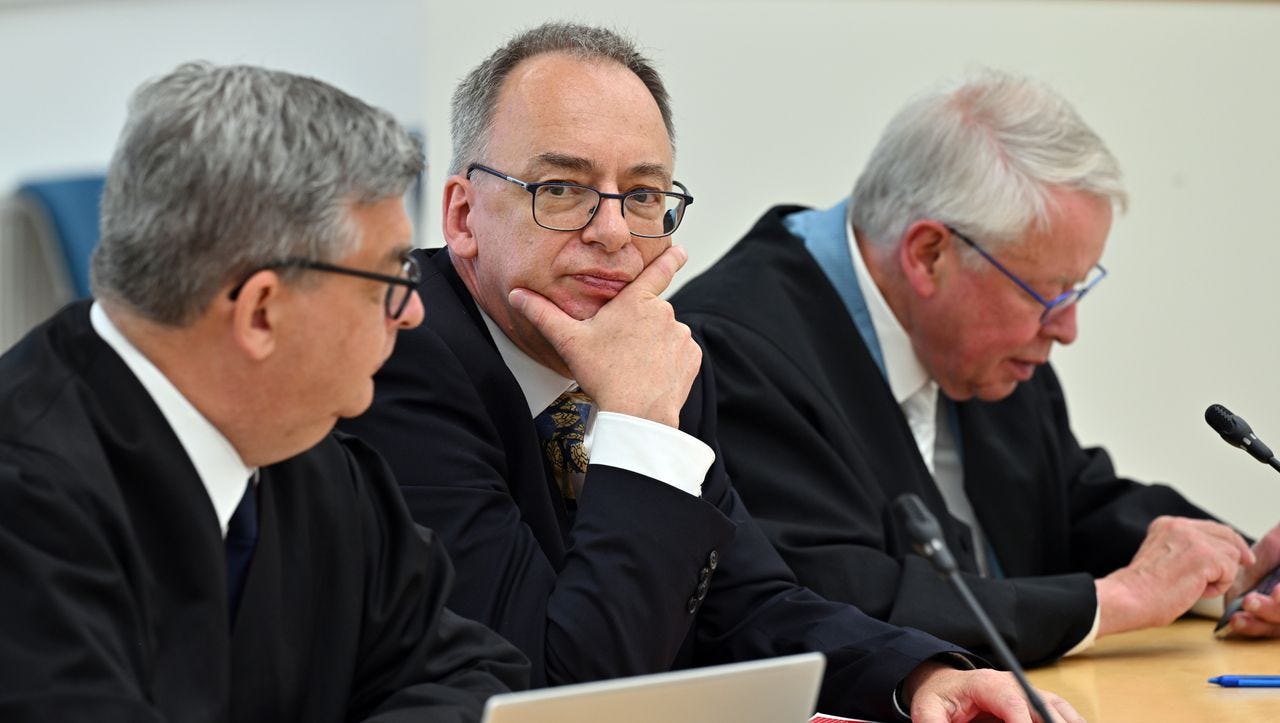
Christiaan Dettmar, a family judge from the Weimar District Court in Germany recently faced the Erfurt Regional Court for his stance against the unnecessary imposition of mask mandates on children. In April 2021, going against the grain, he ruled that children at two Weimar schools should not be burdened with wearing Covid masks in class, defying the restrictive guidelines set by the Thuringian Ministry of Education.
However, in a move reflective of the bureaucratic stranglehold on such decisions, higher courts dismissed his ruling, claiming it unauthorised. The Thuringian Higher Regional Court stated that the family judge did not possess the jurisdiction on this matter, a viewpoint also echoed by the Federal Court of Justice. They insisted that only administrative courts should handle state orders regarding corona protection measures.
At the time (in April 2021), Dettmar had his office, private residence and car searched after he ruled that children should not be wearing masks. He also had his phone confiscated after his decision which embarrassed the government.
His decision to end mask mandates was made after hearing evidence from Professor Kappstein on the lack of benefit of wearing masks and observing distance rules for the children and third parties. Kappstein said that after evaluating all the international data on the subject of masks, the effectiveness of masks for healthy people in public is not supported by scientific evidence.
Dettmar concluded that not only are masks useless but they are also dangerous.
The compulsion imposed on school children to wear masks and to keep their distance from each other and from third persons harms the children physically, psychologically, educationally and in their psychosocial development, without being counterbalanced by more than at best marginal benefit to the children themselves or to third persons. Schools do not play a significant role in the “pandemic”.
The PCR tests and rapid tests used are in principle not suitable on their own to detect an “infection” with the SARS-CoV-2 virus. This is already clear from the Robert Koch Institute’s own calculations, as explained in the expert reports. According to RKI calculations, as expert Prof. Dr. Kuhbandner explains, the probability of actually being infected when receiving a positive result in mass testing with rapid tests, regardless of symptoms, is only two per cent at an incidence of 50 (test specificity 80%, test sensitivity 98%). This would mean that for every two true-positive rapid test results, there would be 98 false-positive rapid test results, all of which would then have to be retested with a PCR test.
A (regular) compulsion to mass-test asymptomatic people, i.e. healthy people, for which there is no medical indication, cannot be imposed because it is disproportionate to the effect that can be achieved. At the same time, the regular compulsion to take the test puts the children under psychological pressure, because in this way their ability to attend school is constantly put to the test.
In the recent trial against Judge Dettmar, although the prosecution demanded a hefty three-year prison term, the defence, representing the concerns and wishes of countless parents and citizens, argued for acquittal. The presiding judge at the Erfurt Regional Court noted that the Weimar judge’s decision emanated from his personal views.
After originally being sentenced to two years in prison, the court has now suspended the sentence on probation.
However, it is still possible that Dettmar may lose his office and pension as a result of the conviction.
Throughout the proceedings, the courtroom was electric with tension and support. Spectators broke into spontaneous applause in favour of Dettmar. This would have continued except the judge threatened to throw them out. The prosecution’s attempt to paint the judge’s intentions as malicious was met with scepticism. They claimed that he intentionally set up a child protection procedure against the mask mandate, misrepresenting it as a statement against government measures. Their evidence, mainly based on emails and chat messages, was tenuous at best.
The defence, however, passionately highlighted the judge’s genuine concern for the well-being of children. They asserted that the case was merely an attempt to suppress and penalise differing opinions in a society where free thought should be celebrated.
Reiterating his unwavering stand, Dettmar confirmed he would make the same decision again. The subsequent lifting of school mask mandates by German states in April 2022 only reinforces the argument that such restrictions should never have been in force in the first place.
German Courts Are Going FULL Dystopia
OffGuardian | August 23, 2023
It’s been an astonishing couple of days for German judges. Well, “astonishing” if you’ve been living in a cave for the last four years.
Many of you likely already know that satirist and playwright (and frequent OffG contributor) CJ Hopkins is being prosecuted in Germany for “disseminating propaganda, the contents of which are intended to further the aims of a former National Socialist organization,”
All because the cover of his book has a swastika on it.
Needless to say, the charges are absurd. Insultingly so. You can read CJ’s first-hand account of this nonsense here and here.
Anyone who isn’t a) stupid or b) delusional can plainly see these charges have nothing to do with a stock-image swastika, and everything to do with the content of the book. In short, they are politically motivated charges brought against an author for criticizing the state. The very essence of dystopian tyranny.
… and yesterday he was convicted.
He now faces 60 days in prison or a 3600 Euro fine.
That’s case one, and as we say one you are likely familiar with if you’re regular readers.
Something you probably haven’t heard is that, just this morning, a different German court sentenced a former judge to two years in prison.
His crime? Ruling that mask mandates in schools were not constitutional.
The case dates back to April 8th 2021, when Weimar District Family Court judge Christiaan Dettmar ruled that two schools in the district a) could not enforce mask mandates, b) must continue in-person classes and c) could not force pupils to test for “Covid”.
From Human Rights Blog :
The court case was a child protection case under to § 1666 paragraph 1 and 4 of the German Civil Code (BGB), which a mother had initiated for her two sons, aged 14 and 8 respectively, at the local Family Court. She had argued that her children were being physically, psychologically and pedagogically damaged without any benefit for the children or third parties. At the same time, she claimed this constituted a violation of a range of rights of the children and their parents under the law, the German constitution (Grundgesetz or Basic Law) and international conventions.
After listening to testimony from expert witnesses, the judge ruled in favour of the mother, writing in his verdict:
These are the risks [to mask mandates]. The children are not only endangered in their mental, physical and psychological well-being by the obligation to wear face masks during school hours and to keep their distance from each other and from other persons, but they are also already being harmed. At the same time, this violates numerous rights of the children and their parents under the law, the constitution and international conventions.
Two weeks after handing down this ruling, his home and office were raided by the police and his mobile phone was seized.
And now, two years later, he was found guilty of “judicial misconduct” and initially given two years in prison (the court has since suspended the sentence). “Judicial Misconduct”, for simply disagreeing with the government.
Free speech is the first and most vital liberty, without it no one is truly free. An independent judiciary is a must to preserve any kind of justice, judges who simply nod along with government edicts are the building blocks of authoritarian states.
The voice of the people and the power of the courts – ideally – work together to hold the government to account.
And yet, whether in the judiciary or the arts, the German legal system is now a machine for criminalizing and punishing dissent of any kind.
… I’d make a comparison to another German government that used to function in a similar way, but I really can’t afford a 4000 euro fine.
German general admits heavy personnel losses of Ukrainian army
By Ahmed Adel | August 21, 2023
The Armed Forces of Ukraine have lost many commanders, said German Army Lieutenant General Andreas Marlow to Reuters agency. This suggests that Germany’s training of Ukrainian troops makes no difference on the battlefield as these newly trained recruits do not reinforce an experienced leadership. This comes as the popularity of the German government collapses amid a growing economic crisis.
“The training of sergeants and officers is what moves the Ukrainians most because the professional soldiers have been fighting this war for one and a half years now, and many have died or been wounded – so they need a fresh supply of military leaders,” said Marlow to journalists.
The press meeting was held at the Klietz training camp in Germany, where foreign instructors trained the Ukrainian military. The site is used to train Ukrainian service members to operate German Leopard 1 and Leopard 2 tanks, as well as IRIS-T air defence systems. However, as has already been proven, these short training missions make no difference to Ukraine’s war effort as the undertrained soldiers are only fed to the Russian meatgrinder.
Marlow’s revelation that most of Ukraine’s professional soldiers are either exhausted, wounded or dead comes as Gunnar Beck, a member of the Alternative for Germany (AfD) party in the European Parliament, blasted his country’s policy on Ukraine.
Olaf Scholz’s government members, including Finance Minister Christian Lindner, recently expressed support for sending long-range Taurus KEPD 350 cruise missiles to Ukraine. The German finance minister said a decision would be made “faster, in a shorter timeframe” than in the past. Berlin is pushing ahead with this despite most Germans opposing the step.
A new poll revealed that while 36% favour supplying new military aid, 52% are against it. Support fell to just 21% among residents of eastern Germany.
According to Russian sources, Germany has sent more than 260 Leopard 1 and Leopard 2 tanks, including from its arsenals and other European NATO allies, as well as Gepard self-propelled anti-aircraft guns, MARS rocket artillery systems, Panzerhaubitze 2000 self-propelled howitzers, Marder infantry combat, Bergepanzer armoured recovery vehicles, Panzerfaust rocket-propelled grenades, and many other weapons, support equipment, ammunition, and supplies. These weapons are worth about €7.5 billion, all handed to Ukraine over the past year and a half, the second-highest amount after the US.
Although the US and other NATO countries promised that the weapons would not be used against Russian territory, the Ukrainian military used supplied military equipment, including artillery, missiles, and drones, to attack Russian cities and towns. Germans who do not want to be embroiled in the war are especially afraid that Ukraine will use the Taurus cruise missile, a €950,000 481kg warhead with an operational range of over 500km, against Russia. Ordinary Germans fear what a Russian response could be.
Berlin would obviously want to prevent Ukraine from using the missiles against Russian territory, but this is wishful thinking. In practice, Germany cannot do anything to prevent Ukraine from using the missiles, which is why the move is so unpopular.
Recently, support for the right-wing AfD, which has been the most critical of Berlin’s anti-Russia policies, has increased, with recent polls indicating the party would get up to 21% of the vote if elections were held today, the same level as Scholz’s Social Democrats. Despite relentless anti-Russian propaganda in the German media, many Germans have lost faith in the Scholz coalition, mainly due to the declining economic situation spurred on by anti-Russia sanctions.
According to the new Insa survey for Bild, 64% of those surveyed found that a change of government would be better for Germany. The survey found that just as many respondents (64%) are dissatisfied with the work of the current federal cabinet. Only 27% are satisfied. There are even more dissatisfied and less satisfied when it comes to Scholz. 70% are dissatisfied with his work, and only 22% are satisfied.
The German economy for two quarters in a row declined, a “technical recession,” as described by economists. Germany’s GDP stagnated at the previous quarter’s level in the last recent quarter, and there is evidently a decline. The IMF predicted in its July estimates that most of the world’s major economies will see growth, except for Germany, which is expected to contract by 0.3% this year. In fact, the financial institution forecasted Germany to do worse than in the last report from April 2023.
Germany is no longer the European economic powerhouse it once was, primarily due to self-sabotaging anti-Russia sanctions, making the country import energy at an inflated price and cut off from Russian markets and businesses. More disturbing is that Germany insists on maintaining the sanctions and continues to train mostly ordinary Ukrainian men knowing they cannot overturn Russian forces.
Ahmed Adel is a Cairo-based geopolitics and political economy researcher.
Eris vaccine marketing hits Germany, complete with panic about a nonexistent August “Covid wave”
eugyppius: a plague chronicle | August 20, 2023
We will not be free of the virus until we are free of the vaccinators.
The leftist taz newspaper on 17 August: New German Wave: The new Covid variant Eris has arrived in Germany. Concerns about a new wave are growing – but the country is not well prepared.
The pandemic is over, but the virus is still dangerous: Reports of the new variant EG.5.1. seem to confirm this analysis. EG.5.1. (Eris) has been considered a “variant of interest” since 9 August. According to the WHO, the phenotype does not differ fundamentally from other Omicron lineages and does not require special public health measures …
With the announced end of the pandemic, virtually all mandated protective measures have been lifted in Germany. The most important instrument in the fight against Covid-19 is thus the immunisation of the population through infection or vaccination.
Das Erste, state media, on 19 August: Covid Variant “Eris”: How Dangerous is the New Mutation EG.5?
The World Health Organisation WHO has upgraded the new Covid mutationEG.5. This variant, called “Eris,” now belongs to the “variants of interest.” …
As WHO Covid expert Maria Van Kerkhove explained in Geneva on Wednesday, more severe outcomes have not been observed with Eris, but vaccination confers less protection than with other virus variants. …
Even though the new variant is unlikely to cause severe disease, the [German vaccine regulatory authority] STIKO still recommends getting vaccinated – above all to avoid possible long-term consequences of SARS-CoV-2 infection and to protect employees in medical and nursing care.
n-tv, a subsidiary broadcaster of RTL, on 18 August: The Number of Coivd-19-Cases Continues to Rise.
The pharmaceutical company Moderna has announced that its updated Covid vaccine according to an initial study is effective against the Eris sub-variant. The company now expects to launch the new vaccine in time for the autumn vaccination season. Approval from vaccine regulators however is still pending.
Moderna, like vaccine manufacturers Novavax and Pfizer, has developed versions of its vaccines with Biontech SE that target Eris subvariants. Shortly before, the pharmaceutical company Pfizer had reported that its revised vaccine had been effective against Eris in a study with mice. …
Most recently, it was suspected that the cinema hype surrounding the feel-good film “Barbie” and the gloomy biopic “Oppenheimer” may have caused many infections. At the same time, the Robert Koch Institute (RKI) recorded an increase in the number of reported Covid infections. Experts, however, see no reason for concern so far.
Frankfurter Rundschau, a regional Frankfurt paper, on 17 August: Covid comeback with “Eris”: First experts demand return to masking.
Is Covid on the attack again? There are indications that the virus is once on the rise once more. …
British doctors are already calling for a return to masking. [Relentless virus charlatan and deranged hypermasker] Trisha Greenhalgh suggests that, “in view of the spread of new variants,” masking in high-risk situations should be considered.
The [virus surveillance] of the Federal Ministry of Health shows that the numbers are also on the rise in Germany. … “Eris” is already responsible for every fourth corona infection, according to new figures from the RKI. “The number of Covid-19 cases reported to the RKI .. seems to be related to the increasing circulation of this ‘variant of interest’,” the Robert Koch Institute says.
The increase in the case numbers – at least in Great Britain – coincides with the opening of the blockbusters “Barbie” and “Oppenheimer” in British cinemas, which has given rise to talk of the “Barbenheimer” phenomenon. It is well known that larger crowds in enclosed indoor spaces are associated with an increased risk of corona infection. So is it time for a mask renaissance?
In the USA, more and more voices calling for one. [Relentless virus pest] Eric Feigl-Ding … used the hashtag #MaskUp on Twitter to call once again for protecting oneself from Covid infections with masks. Health Minister Karl Lauterbach shared the post, warning that the latest Covid data from New York is “worrying.” …
“There is still a risk that a more dangerous variant will emerge, which could lead to a sudden increase in cases and deaths,” emphasises WHO Director-General Tedros Adhanom Ghebreyesus. Not only adapted vaccines that take the new variants into account, but also wearing a mask would then help to protect oneself and others, Frankfurt virologist Martin Stürmer told Spiegel.
tagesschau, state media, on 17 August: Covid Case Numbers are Rising Again.
The number of laboratory-confirmed Corona cases in Germany is rising again – but at a relatively low level. This development has been ongoing for around a month, reports the Influenza Working Group at the Robert Koch Institute (RKI) … According to the report, about 2,400 confirmed cases of Covid-19 were reported nationwide last week. This is more than double the number reported in the week ending 9 July, when there were about 1,000. …
According to the RKI report, the activity of acute respiratory diseases in general in the population was “at a low summer level.” … “Anyone with symptoms of an acute respiratory infection should stay at home for three to five days and until the symptoms have clearly improved,” advises the RKI. …
Despite all of this obnoxious verbiage, absolutely nothing of virological note is happening in Germany. Official Covid testing has been all but abolished here, forcing our journaloids to unearth statistics from RKI influenza surveillance – something they refused to do during the pandemic itself, because the flu people routinely posted data that undermined their panic narrative. Here, I’ve circled in red the scary rise in infections from the latest RKI report that we’re meant to be worried about:
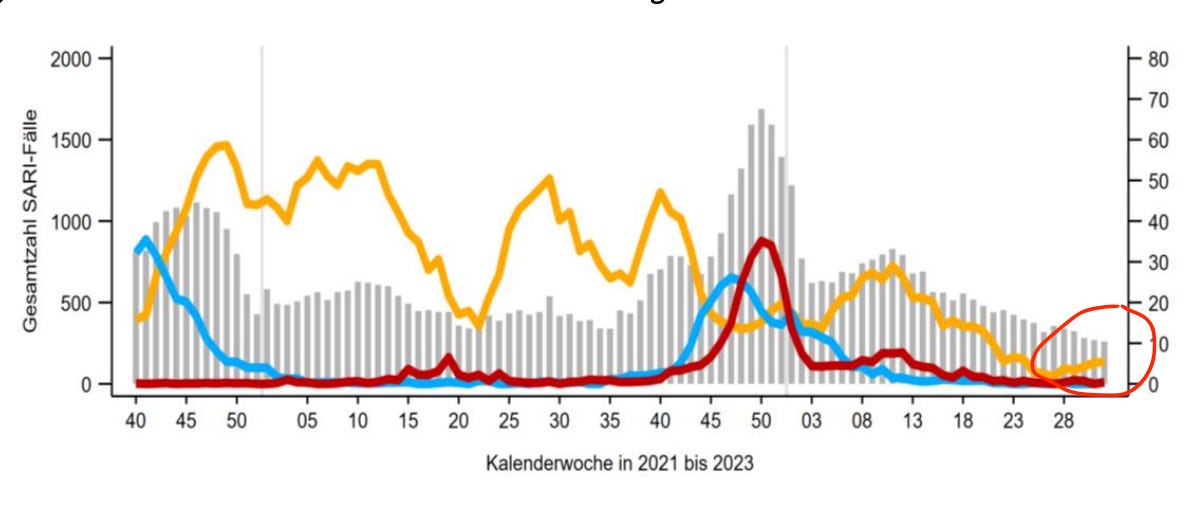
This microscopic uptick is dwarfed by the February/March wave that peaked between weeks 8 and 13. Our media luminaries took next to no notice of this frightening late-winter surge, and as I type this, Covid diagnoses have not even re-achieved their June levels. The difference between the state of things now and the state of things in February is not the unremarkable Eris variant. XBB was also debuting across Europe early this year, driving the post-February case peak, and nobody cared. The only thing that is different now, is the proximity of the autumnal vaccination liturgy and the prospect of new, updated vaccines from Pfizer/BioNTech, Moderna and Novavax. That is why we are hearing about variants and masks and Long Covid all over again. It is also why many of these articles contain buried within them somewhere the advice to line up for the shiny new anti-Covid juice this Fall. This whole thing is, very plainly, a psy-op, if a very low-effort one.
There are several patterns in the German reporting that are worth noting. First of all, the latest hysteria was unleashed on 17 August, prompted by a report on Eris from the German news agency Deutsche Presse-Agentur. Particularly in the realm of routine reporting, the news agencies are a powerful coordinating force, and their influence here means that the full media panic machine is not engaged. We’re looking instead at pieces thrown together by low-level staff desperate to fill column inches. Second, all the German stories are firmly downstream from Anglophone sources, going so far as to recycle from British tabloids the improbable theory of a “Barbenheimer” wave (it is painful even to type this stupid word). Third, at least German health authorities – Karl Lauterbach excepted – resolutely refuse to provide virus doom quotes. Thus the Frankfurter Rundschau had to appropriate the tweets of Anglosphere mask hysterics like Greenhalgh and Feigl-Ding to make Eris sound scary.
I know there are rumours that American authorities are planning to bring back mask mandates and other restrictions in the coming months, and I’ll be honest: We should be so lucky. If the pandemicists try to kick up another round of non-pharmaceutical interventions this fall, they’ll be flirting with self destruction. There are important prerequisites for virus panic: You need a plausibly novel pathogen, the risk of which can be exaggerated. You need a prevailing sense of stability, with nothing else much going on, because the public health interventions themselves have to seem new. Risk, excitement and the prospect of a break from routine are important enticements. That’s all gone now. Covid is not a new scary virus anymore; nearly everyone has had personal experience with it. Solid majorities everywhere have learned to hate lockdowns, despise masking and avoid the mRNA vaccines. The pandemicists need a plausibly new virus to reopen the circus, and they need a lot of people to forget about what a misery the last pandemic response was. They’ll have another chance in ten or fifteen years, I’d guess. Then, it’ll be time to worry.
German Long-Range Taurus Missiles Won’t Be Wunderwaffe Ukraine Is Looking For
By Ilya Tsukanov – Sputnik – 19.08.2023
Berlin has joined Washington in climbing up the escalation ladder in the proxy war against Russia in Ukraine, sending more military aid to Kiev than any other country besides the US. Germany has also borne the brunt of the West’s economic war against Moscow, with its economy sinking into a recession and facing the threat of deindustrialization.
A majority of Germans are opposed to sending Taurus KEPD 350 air-launched long-range cruise missiles to Ukraine, with a fresh poll finding while 36 percent are in favor of their delivery, 52 percent are opposed, with support falling to just 21 percent among residents of eastern Germany.
Despite opposition, German Finance Minister Christian Lindner and other members of Chancellor Olaf Scholz’s government have expressed support for delivering the missiles this week, with Lindner saying a decision on the matter would be reached “faster and at shorter notice” than in the past.
German media first reported on talks to send Taurus missiles to Kiev last week, saying the chancellor’s office was hoping to make changes to the missiles’ programming to prevent Ukraine from using them to attempt strikes deep into Russian territory.
Previous assurances in this vein by the US and other NATO powers have turned out to be empty promises, with Ukraine’s military eagerly using its Western-provided military hardware including artillery, missiles and drones to strike Russia, and to indiscriminately fire on cities and settlements in the Donbass.
“As in the past, we will always check every single decision very carefully,” Scholz told reporters last week when asked about the Taurus missiles’ delivery.
These “very careful” checks have already seen Germany send some €7.5 billion ($8.15 billion) in weapons to Ukraine over the past year-and-a-half, the second-largest amount only behind the United States. Berlin has already approved sending over 260 Leopard 1 and Leopard 2 tanks, including from its own armories and those of other European NATO allies, plus Gepard self-propelled anti-aircraft guns, MARS rocket artillery systems, Panzerhaubitze 2000 self-propelled howitzers, Marder infantry fighting vehicles, Bergepanzer armored recovery vehicles, Panzerfaust RPGs and billions more in other weapons, support equipment, ammunition and supplies.
What distinguishes the Taurus cruise missile is its range and firepower. The €950,000-a-piece bunker buster munition has a 481 kg warhead, and an operational range of over 500 km, making it a standoff weapon which, in the wrong hands, could turn into a tool for terror bombings.
No Wonder Weapon
“The long-range Taurus cruise missiles are an advanced high-precision unmanned weapon system, but they are not a wonder weapon,” AfD European Parliament MEP Gunnar Beck told Sputnik.
“They will add to Ukraine’s military capability, but not decisively,” the lawmaker, who serves as vice president of the European Parliament’s Identity and Democracy fraction, said.
Instead, “the delivery of these missiles is significant in that it marks a further escalation of the conflict, leading perhaps to the delivery of other weapons with greater and more decisive offensive capability. That, to me, is the danger here,” Beck stressed.
The lawmaker noted that the danger of Ukraine using Taurus missiles against Russian territory is “the main point of controversy,” with government assurances that this won’t take place of little comfort to ordinary Germans.
“The German government says it would like to prevent Ukraine from using the missiles against Russian territory. However, this is just fanciful talk. In practice, Germany cannot do anything to prevent Ukraine from using the missiles as they like,” Beck said.
“Most Germans do not wish to be drawn into a major international conflict with Russia,” the AfD lawmaker emphasized. “This is particularly true of East Germans who still appreciate that without Russian blessing reunification could not have been achieved 33 years ago.” Most Germans “simply do not believe that Russia and President Putin are a real threat to Germany today. That is my own personal view too. Ordinary Germans have less to fear of Russia today than it has from the EU, their own government and any of the major political parties within Germany itself.”
Amid the Ukrainian crisis and economic downturn, Beck’s party has seen a major surge in support, with recent polling indicating it would win up to 18 percent of the vote if elections were held today – on par with Chancellor Scholz’ Social Democrats. The growing prominence of the upstart opposition party and its social conservative, Eurosceptic brand of populism has led to debate inside the German political establishment on whether it should be banned as an “extremist” organization.
Beck emphasized that notwithstanding the “relentless” “anti-Russian propaganda” in German media, many Germans, especially in the east of the country, “have lost faith” in Scholz’s coalition, and “cannot remember when their government last did something for them.” Instead, half of Germans “now regard their political elite as just the executor of the aims and objectives of large multinationals and foreign powers – very well-paid executors at that,” the lawmaker summed up.
Germans Don’t Want Nuclear War With Russia
Dan Kovalik, a US-based human rights and labor rights lawyer and peace activist, echoed Beck’s sentiments on the implications and dangers of the Taurus missiles’ potential delivery to Kiev.
“I think Russia is about to destroy the Ukrainian military and probably the Ukrainian state as it exists, and that’s just a fact. I don’t think the missiles will change that. Of course, what they could do is allow Ukraine to fire more into Russian territory in a more destructive way than they are now with drones, which of course presents a great danger of escalating this conflict into a major world war, possibly even into a nuclear conflict. That’s why I think the German people are against this,” Kovalik stressed.
“Of course, Germany and Russia have been through two world wars against each other, and I don’t think either wants to repeat that,” the observer added.
Featured Video

Macgregor: We Haven’t Seen the Worst of the Iran War Yet
or go to
Aletho News Archives – Video-Images
From the Archives
15 Saudi ‘hijackers’ were CIA agents working for US: Scholar
Press TV – April 13, 2016
Fifteen of the 9/11 “hijackers” from Saudi Arabia were CIA agents working for the United States government, which was seeking to destroy the Middle East for Israel and to double the American military budget, says Dr. Kevin Barrett, an American academic who has been studying the events of 9/11 since late 2003…. continue
Blog Roll
 Aletho News
- Breast Cancer: Before You Consent
- Iran’s Plan to Shut Down AI in the Persian Gulf
- Israel seeks ‘compensation’ from Washington over Saudi F-35 sale
- Saudi crown prince seeks dialogue with Ansarullah after Yemeni blows: Report
- Damascus rejects Saudi request for Syrian fighters to counter Yemen: Report
- South Korea says will not send troops to join terrorist US war on Iran
- Russia Just Struck the Eyes of NATO’s War Machine in Ukraine
- Russia summons UK charge d’affaires over Kiev drone support
- NATO member warns bloc seeking pretext for war with Russia
- Macgregor: We Haven’t Seen the Worst of the Iran War Yet
- If Americans Knew
- Debunking The Claim That Macklemore Has A “History Of Antisemitism”
- CPJ demands release of arrested Palestinian-US journalist near Bethlehem
- Robert Kraft: The Billionaire Friend of Netanyahu Pulling The Strings Behind the Macklemore/Ed Sheeran Blow Up
- Columbia Administered Fund Gives Big Money to Pro-Israel Groups
- Deportation Case of Palestinian Activist Salah Sarsour Tests First Amendment
- ‘We Will Not Forget’: Palestinians Mark 44 Years since Sabra and Shatila
- Why do we let Zionists decide what we can and can’t say?
- US welcomes Israeli, Iranian delegations to UN, but not Palestinians – Daily Update
- Biden’s Genocide Accomplices Targeted by New Accountability Campaign
- AIPAC’s Network Has Already Spent $67.2 Million to Shape the Midterm Elections
- No Tricks Zone
- New Study: ‘Global Drought Shows No Detectable Recent Acceleration Under Climate Warming’
- Economic Masterminds: German Socialists Suggest Taxing Productivity Gains Stemming From Using AI
- The South China Sea Has Not Been Cooperating With The Climate Change Narrative
- Energy Crisis: Germany Enters Heating Season With Historically Low Gas Reserve Fill Levels
- New Study: The Antarctic Ice Sheet Gained Mass From 2020-2024 Due To Staggering Snow And Ice Accumulation
- Study: Ocean Heating Rates From Thousands Of Years Ago ‘Dwarf’ Modern Ocean Heating Rates
- Climate Extremists Target, Attack Large-Scale Power Grid Infrastructure In Germany!
- New Study: Antarctic Ice Melt Has Contributed Less Than 1 Centimeter To Sea Level Rise In The Last 30 Years
- Fear Of Debate: Alarmist German Climate Scientist Calls On Mainstream Media To Discredit Skeptic Voices
- End-Of-August Arctic Sea Ice Extent Hasn’t Fallen In 20 Years, Official Data Show!
 Aletho News