NATO adopts new anti-Russia defense plan
RT | July 13, 2023
NATO passed a new defense plan at the Vilnius summit on Tuesday. The whopping 4,400-page document details the defense of critical locations in case of “an emergency” and lists a potential attack by Russia as one of the biggest threats, according to German media. The bloc’s secretary general, Jens Stoltenberg has welcomed what he called “the most comprehensive defense plans since the end of the Cold War.”
The document addresses two “main threats – Russia and terrorism,” and accuses the former of being “the greatest and most immediate threat to the security of allies and to peace and stability in the Euro-Atlantic region,” according to Germany’s Bild tabloid.
German Chancellor Olaf Scholz also called on his country and the other NATO members to “arm ourselves against a threat to our territory,” Bild added. The new plan also lists the military capabilities the bloc’s members must demonstrate, including new member Finland and applicant, Sweden.
The document reportedly claims a “violent” and “revisionist” Russia could potentially attack NATO territory. “We recognized that we could indeed be faced with an Article 5 situation again, in which part of NATO territory is under direct attack,” a military bloc official told German news agency, dpa.
To counter the supposed ‘Russian threat,’ the bloc plans to massively increase its Response Force (NRF) from the current 40,000 troops to over 300,000, comprising land, sea and air units, as well as rapidly deployed Special Forces.
The bloc also plans to significantly increase weapons production and stockpiling. The new strategy includes a “new Defense Production Action Plan to accelerate joint procurement, boost production capacity, and enhance Allies’ interoperability,” the NATO statement said.
According to Bild, the bloc would seek to build up armored “heavy forces,” and deploy more long-range artillery systems and missiles, as well as air defense systems.
NATO also plans to enhance what it calls ‘deterrence measures’ by sending additional forces to the Baltics and Eastern Europe. Battlegroups comprising 1,000 soldiers are to support the national armies of the Baltic States and Poland, Bild reported, citing the document.
The UK will be responsible for Estonia, Canada for Latvia, Germany for Lithuania, and the US for Poland, the German media outlet said. Berlin also plans to station a brigade of 4,000 soldiers in Lithuania, according to the German media.
Germany is also reportedly expected to serve as the NATO logistics hub in case of a major conflict. The bloc is also considering establishing a second Land Command, in addition to the existing station in Türkiye’s Izmir. Wiesbaden in Germany is being considered as a potential location since it already hosts a large US base, Bild reported.
Russia repeatedly stated that it considers NATO’s buildup on its borders as well as the bloc’s expansion to the east a threat to its national security. It also named preventing Ukraine from joining the bloc among the main reasons for launching its military operation in the neighboring country in February 2022.
Germany creates equity in Western Ukraine
BY M. K. BHADRAKUMAR | INDIAN PUNCHLINE | JULY 13, 2023
The hypothesis that the Anglo-Saxon axis is pivotal to the proxy war in Ukraine against Russia is only partly true. Germany is actually Ukraine’s second largest arms supplier, after the United States. Chancellor Olaf Scholz pledged a new arms package worth 700 million euros, including additional tanks, munitions and Patriot air defence systems at the NATO summit in Vilnius, putting Berlin, as he said, at the very forefront of military support for Ukraine.
German Defence Minister Boris Pistorius stressed, “By doing this, we’re making a significant contribution to strengthening Ukraine’s staying power.” However, the pantomime playing out may have multiple motives.
Fundamentally, Germany’s motivation is traceable to the crushing defeat by the Red Army and has little to do with Ukraine as such. The Ukraine crisis has provided the context for accelerating Germany’s militarisation. Meanwhile, revanchist feelings are rearing their head and there is a “bipartisan consensus” between Germany’s leading centrist parties — CDU, SPD and Green Party — in this regard.
In an interview in the weekend, the CDU’s leading foreign and defence expert Roderich Kiesewetter (an ex-colonel who headed the Association of Reservists of the Bundeswehr from 2011 to 2016) suggested that if conditions warrant in the Ukraine situation, NATO should consider to “cut off Kaliningrad from Russian supply lines. We see how Putin reacts when he is under pressure.” Berlin is still smarting under the surrender of the ancient Prussian city of Königsberg in April 1945.
Stalin ordered 1.5 million Soviet troops supported by several thousand tanks and aircraft to attack the crack Nazi Panzer divisions deeply entrenched in Königsberg. The capture of the heavily fortified stronghold of Königsberg by the Soviet army was celebrated in Moscow with an artillery salvo by 324 cannons firing 24 shells each.
Evidently, Kiesewetter’s remarks show that nothing is forgotten or forgiven in Berlin even after 8 decades. Thus, Germany is the Biden Administration’s closest ally in the war against Russia. The German government has stated its understanding for the Biden administration’s controversial decision to supply Ukraine with cluster ammunition. The government spokesman commented in Berlin, “We are certain that our US friends did not make their decision lightly, to deliver this sort of munition.”
President Frank-Walter Steinmeier remarked, “In the current situation, one should not obstruct the USA.” Indeed, the top CDU figure Kiesewetter suggested in an interview with the Green Party-affiliated daily taz that not only should Ukraine be given “guarantees, and if necessary, even provided with nuclear assistance, as an intermediary step to NATO membership.”
Coinciding with the NATO summit in Vilnius (July 11-12), Rheinmetal, the great 135-year old German arms manufacturing company, has disclosed that it is opening an armoured vehicle plant in western Ukraine at an undisclosed location in the next twelve weeks. To begin with, German Fuchs armoured personnel carriers will be built and repaired while there are plans afoot to manufacture ammunition and possibly even air defence systems and tanks.
Rheinmetall’s CEO told CNN on Monday that like other Ukrainian arms factories, the new plant could be protected from Russian air attack. Germany has more than doubled the 2022 allocation of €2 billion for upgrading Ukraine’s armed forces. It now touches around €5.4 billion with further plans to increase to €10.5 billion.
Now, is this all about Russia? Germany cannot be unaware that Ukraine has simply no hope on earth to defeat Russia militarily. Germany is playing the long game. It is creating equity in western Ukraine where it is not Russia but Poland that is its contender. Ever since the Tsarist army advanced into Galicia in 1914, Russia has had a difficult history with Ukrainian nationalists. If the current war in Ukraine spreads to western Ukraine, that cannot be Russia’s choice but out of some necessity forced upon it.
The Soviet victory in Ukraine in October 1944, the Red Army’s occupation of eastern Europe, and Allied diplomacy resulted in a redrawing of Poland’s western frontiers with Germany and Ukraine’s with Poland. Simply put, with compensation of German territories in the west, Poland agreed to the cession of Volhynia and Galicia in western Ukraine; a mutual population exchange created for the first time in centuries a clear ethnic, as well as political, Polish-Ukrainian border.
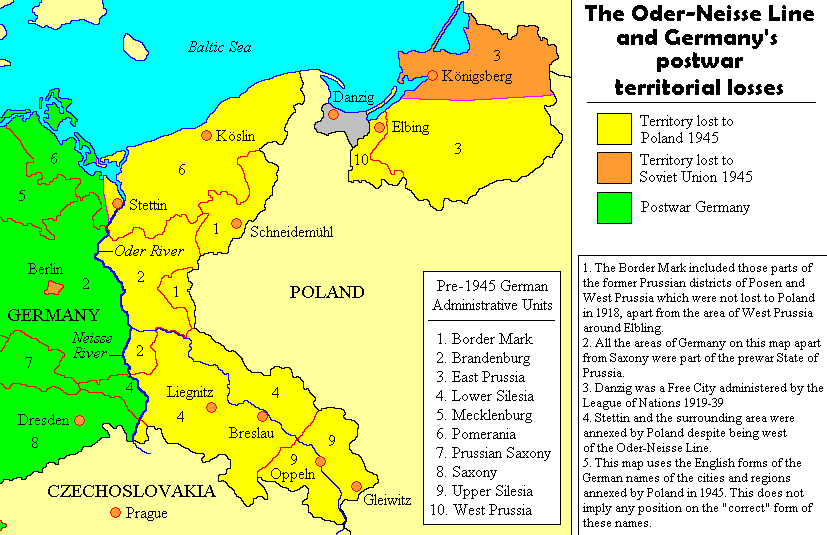
It is entirely conceivable that the ongoing Ukraine war will radically change the territorial boundaries of Ukraine in the east and south. Possibly, it can re-open the post-WW II settlement with regard to western Ukraine as well. Russia has repeatedly warned that Poland aims to reverse the cession of Volhynia and Galicia in western Ukraine. Such a turn of events will most certainly bring to the fore the issue of the German territories that are part of Poland today.
Perhaps, it was in anticipation of turbulence ahead that last October, eight months after the Russian intervention began in in February, Warsaw demanded WWII reparations from Berlin — an issue which Germany says was settled in 1990 — to the tune of €1.3 trillion.
Under the Potsdam Conference (1945), the “former eastern territories of Germany” comprising nearly one quarter (23.8 percent) of the Weimar Republic with the majority ceded to Poland. The remainder, consisting of northern East Prussia including the German city of Königsberg (renamed Kaliningrad), was allocated to the Soviet Union.
Make no mistake about the importance of the Eastern border for German culture and politics. Indeed, there is always something volatile about a “handicapped” Great Power when a whole new intensity appears in political, economic and historical circumstances, which prompts those in power to turn ideas into reality, and revanchist and imperialistic discourses that were quietly but steadily streaming below the surface of the carefully considered diplomatic efforts begin to probe pan-nationalist expansion.
In retrospect, Germany’s — in particular, then foreign minister and current president Steinmeier’s — diabolical role to align Germany with the neo-Nazi elements during the regime change in Kiev in 2014 and the subsequent German perfidy in the implementation of the Minsk Agreement (“Steinmeier formula”), as admitted recently in February by former Chancellor Angela Merkel should not be forgotten.
Suffice to say, even as Russia is winning the Ukraine war, the concern of the German foreign policy makers once again faces the need to redefine what was German. Thus, the war in Ukraine is only the means to an end. Recent reports suggest that Berlin may be moving, finally, toward meeting Ukraine’s pending demand for Taurus cruise missiles with a range exceeding 500 kms and unique “multi-effect war head” that can be a game changer in the combat dynamics on the battlefield and create the prerequisites for victory.
Equally, German soldiers already comprise about half of the NATO battlegroup already present in Lithuania. Defense Minister Boris Pistorius said two weeks ago while on a visit to Vilnius that Germany is preparing the infrastructure to permanently base 4,000 soldiers (“a robust brigade”) to Lithuania so as to have the capability to maintain military flexibility at the Eastern flank. The decision has support from both Germany’s governing coalition and its main opposition.
The CDU foreign policy expert and member of the Bundestag, Kiesewetter called the idea of establishing a German base in the Baltics a “decision of reason and reliability.” Indeed, there have been past attempts, historically speaking, to create German rule in the Baltics based on revisionist claims towards the new states of Estonia, Latvia and Lithuania where German colonists had settled as far back as in the 12th and 13th centuries.
German Parliament Approves Purchase of 60 Chinook Helicopters From US’ Boeing
Sputnik – 05.07.2023
BERLIN – The defense committee of the German parliament approved the purchase of 60 CH-47F Chinook heavy military transport helicopters from US company Boeing, a German daily reported on Wednesday.
The purchase is estimated at 7.2 billion euros ($7.8 billion) and adapting infrastructure for helicopter operation is expected to require about 750 million euros on top of that.
The first helicopters will reportedly be delivered in 2027.
In January, media reported, citing a document obtained, that the price of helicopters will almost double from 6 billion to 12 billion euros as some components have not even been designed yet and become more expensive due to inflation.
‘Responsibility for Israel’s right to exist’ pillar of Germany’s national security strategy

(Photo Credit: Getty Images)
The Cradle | July 3, 2023
On 14 June, Germany announced its first National Security Strategy since the end of World War II under the slogan “To promote world peace in a united Europe.”
While the strategy takes aim at several “integrated security” elements, from military and “terrorist” threats to those posed by climate change, healthcare, and “the decline of democracy,” the document also stresses that a central security pillar for Berlin is to “take on responsibility for Israel’s right to exist.”
“We will continue to bear responsibility for Israel’s right to exist … The responsibility for Israel’s right to exist remains a permanent commitment for us,” the executive summary reads.
While Germany’s position is not new, it confirms what many have seen as certain through the years. Former German chancellor Angela Merkel has repeatedly emphasized that Germany’s support for Israel’s “right to exist” is a national interest and “must never be questioned.”
During the visit of former Israeli Prime Minister Yair Lapid to Germany, Chancellor Olaf Scholz stressed that Germany “will always stand by Israel and that Germany and Israel. They are the closest allies, strategic partners, and friends.”
Berlin also remains one of the most important trading partners for Tel Aviv, as the volume of trade exchange between the two reached $5.2 billion in 2020. Both nations also partner in several defense projects.
Following the start of the war in Ukraine, Scholz described it as a “turning point” and stressed, “Germany must stand on the right side of history.” However, since making these statements, Berlin has only redoubled its reliance on US diktats, even after the Nord Stream 2 pipeline bombing cut the EU nation off from vital natural gas supplies.
In an article published by Foreign Affairs, Scholz stressed that today’s priority is “the defense of the rules-based world order,” that is, the defense of US hegemony over the world order, including Israeli supremacy in West Asia.
In this regard, Berlin’s National Security Strategy takes aim at Iran by accusing the Persian nation of “violating the human rights of its own citizens,” “pursuing its nuclear ambitions,” and even of “blocking efforts” to revive the 2015 Iran nuclear deal that was blown up by the US in 2018.
The document also takes aim at Russia, calling it “the most significant threat to peace and security in the Euro-Atlantic area” while calling China “a partner, competitor and systemic rival.”
Moreover, the document highlights that Germany “owes its security, as well as peace at the heart of Europe, to the United States of America.”
It also reaffirms Germany’s commitment to NATO, saying Berlin will increase its military spending to 2 percent of its GDP.
Another security issue for Berlin is the delivery of oil and gas from West Asia and spreading “democracy and protecting human rights” via government-funded NGOs.
German government to begin systematic surveillance of RSV
… so that public health authorities can identify “outbreaks” and “implement measures to … prevent spread”
eugyppius: a plague chronicle | July 1, 2023
The Scholz government plans to direct German public health authorities to begin systematic monitoring of RSV, the respiratory syncytial virus, which can cause serious symptoms in young children but is little more than a cold for healthy adults:
The respiratory syncytial virus (RSV) will very soon be made subject to mandatory reporting requirements. Doctors and laboratories will have to report infected patients by name to health authorities …
Up to now, there has been no obligation to report RSV in Germany, with the exception of the federal state of Saxony …
The stated reason is that RSV has caused a high rate of illness in children the past two seasons and placed a serious burden on paediatric clinics nationwide. The RSV outbreak in autumn 2022 has made it clear that an improvement in data collection is needed for early detection and avoiding an overload of the health system.
The planned reporting requirements will not only improve the collection of epidemiological data, but also enable public health authorities “to carry out targeted early investigations and implement on-site measures to limit an outbreak and prevent further spread.” …
My emphasis.
[The] coalition governments believes that several RSV vaccines will be approved in Germany in the foreseeable future. The additional data gleaned from reporting requirements would assist in the evaluation of vaccines and the design of vaccination strategies.
Let us get this straight: The virus pests imposed harmful and destructive hygiene measures on the greater part of the developed world for years, which failed to do anything much about SARS-2, but apparently limited exposure to many common viruses like RSV. After population immunity to these old endemic viruses had substantially waned due to these wrongheaded policies, we reopened, leaving these heretofore mostly harmless pathogens to tear through the respiratory tracts of young children with new fury. The virus pests, having failed in the most spectacular way possible, now hope to turn the minor disaster they caused into an occasion for future restrictions and impositions in daily life.
Note also the insidious role of the vaccinators. As soon is there is a jab for any virus, the pressure to begin counting that virus begins, thereby making a problem where nobody ever noticed one before. It’s thinly veiled marketing for the vaccine producers, undertaken by the health authorities at public expense.
Palestinian journalist wins wrongful termination appeal against DW
The Cradle | June 29, 2023
Palestinian-Jordanian journalist Farah Maraqa on 28 June announced winning an appeal filed by Germany’s Deutsche Welle (DW) media network over her unlawful dismissal for alleged “antisemitism.”
The decision comes nine months after the German judiciary ruled that her dismissal by state-owned broadcaster DW on charges of anti-Semitism was “legally unjustified,” which the German broadcaster appealed.
“It is a relief that the judge ruled in Farah’s favor and held Deutsche Welle accountable for this illegal dismissal,” Giovanni Fassina, director of the European Legal Support Center (ELSC), which advocates for the legal rights of Palestinians in Europe, said at the time.
In February 2022, DW fired Maraqa alongside five other Arab journalists – all Palestinian or Lebanese – accusing them of “antisemitism” in social media posts and articles they had written for outside publications.
The charges were based on the International Holocaust Remembrance Alliance’s (IHRA) controversial extended definition of antisemitism, which includes criticism of Israel’s military occupation of Palestinian land and the system of apartheid imposed on Palestinians.
The definition, which Germany adopted, has been criticized as a means of silencing pro-Palestinian support and dissent against Israeli policies.
In May 2021, DW reportedly sent an internal two-page memo to employees banning them from using terminology such as “colonialism” and “apartheid” when describing Israel.
Over the past few years, western outlets have come under fire for firing or suspending Arab journalists over alleged “antisemitism.”
In March, France24 suspended four journalists from their Arabic branch at the behest of the pro-Israel media monitoring organization, Committee for Accuracy in Middle East Reporting and Analysis (CAMERA).
Last October, the New York Times (NYT) fired Palestinian photojournalist Hosam Salam over social media posts supporting Palestinian resistance factions.
The freelance journalist was dismissed after the Israeli lobby organization Honest Reporting alerted the NYT of his posts.
Social media giants like WhatsApp, Facebook, and TikTok have also been accused of silencing or “purging” Palestinian journalists in Gaza and the occupied West Bank who report on Israeli war crimes.
Furthermore, Google employees accused the tech giant of censuring them for protesting against a controversial $1.2 billion contract signed with Israel to provide the country with advanced artificial intelligence (AI), which many fear will worsen human rights abuses in Palestine.
EU delivers ‘neither peace nor prosperity’ – Hungarian PM
RT | June 29, 2023
The Hungarian government has blasted the EU, declaring that in its current state it brings “neither peace nor prosperity” to member states. Prime Minister Viktor Orban, who was attending a summit of bloc leaders in Brussels, offered a similar assessment of the bloc.
Orban’s position was relayed via his government’s official Facebook account on Tuesday, the first day of the high-profile two-day gathering in Brussels. The statement apparently came from an interview that the Hungarian leader had given to the German media earlier in the week.
Asked by the German tabloid Bild whether he could explain the rising popularity of Alternative for Germany (AfD), a right-wing political party, the prime minister cited disillusionment with the EU as a possible cause.
“The European Union was created for two reasons. The first is peace – and now there is war. The second is prosperity – the economy is in an increasingly worrying state, it is difficult to maintain competition and it is increasingly difficult to ensure prosperity for people,” Orban argued.
“That is why I see the so-called protest parties gaining strength everywhere in Europe. I’m not talking about Germany alone, I’m talking about Europe in general,” he added.
Hungary stands out among EU members for having consistently criticized the West’s approach to the Ukraine conflict. Arming and training Kiev’s troops and punishing Russia with economic sanctions have not brought a truce any closer and have caused serious damage to the bloc itself, according to Budapest.
Ukraine is one of the top items on the agenda of the EU summit. The bloc’s leaders are expected to offer some form of security guarantees to Kiev and provide assurances of continued military assistance.
Orban told Bild that Ukraine has no chance to win against Russia regardless of the amount of Western money that is poured in, because eventually Kiev will run out of manpower.
15 Signs That You Might Be In An Abusive Relationship…
… With Your Government
The Naked Emperor | June 28, 2023
The Workplace Mental Health Institute delivers mental health training and consultancy to medium and large-sized organizations across the world. On their website they have various resources that you can download and put in your office, to help boost productivity, by addressing mental health issues.
One of their infographic downloads provides 15 signs that your might be in an abusive relationship. You may be in an abusive relationship if they [your partner]:
- Stop you seeing friends and family;
- Won’t let you go out without permission;
- Tell you what to wear;
- Monitor your phone or emails;
- Control the finances, or won’t let you work;
- Control what you read, watch and say;
- Monitor everything you do;
- Punish you for breaking the rules, but the rules keep changing!
- Tell you it is for your own good, and that they know better;
- Don’t allow you to question it;
- Tell you you’re crazy and no one agrees with you;
- Call you names or shame you for being stupid or selfish;
- Gaslight you, challenge your memory of events, make you doubt yourself;
- Dismiss your opinions;
- Play the victim. If things go wrong, it’s all your fault.
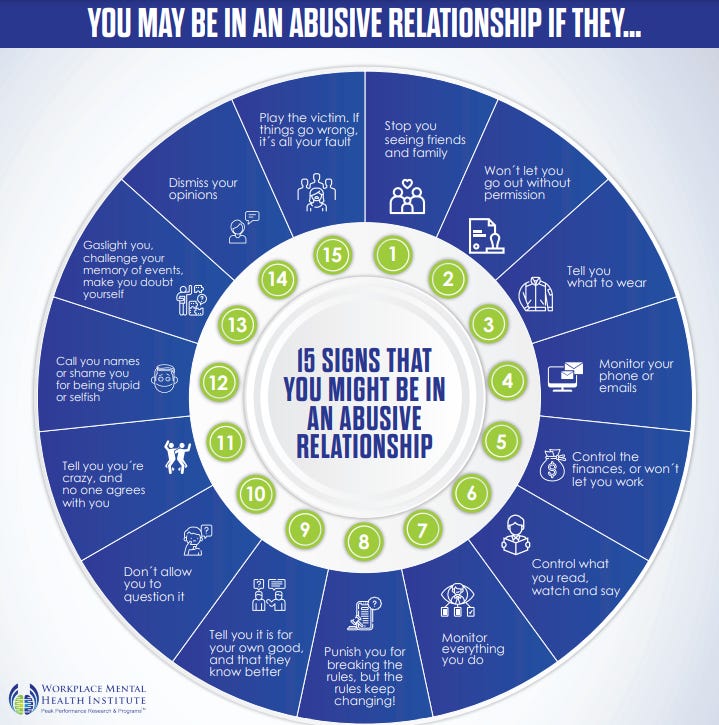
Now go back through that list and see which ones your government has subjected you to over the past three years. For most western countries it is every single one.
Your government has been mentally abusing you for years, in an almost identical fashion as an abusive partner would.
FDA responds to negative efficacy of variant boosters with another variant booster
By Daniel Horowitz – conservative review – June 21, 2023
The human experimentation of Operation Warp Speed was not an anomaly; it is the new normal, and the FDA is just getting started. The agency is now allowing the COVID vaccine manufacturers to change the formulation of their shots to continue to chase variants, themselves created by antigenic drift of the shots. And they continue to do so based on nothing more than measuring antibody titer levels. No human clinical trials necessary! Except, studies now show, and reality confirms, the more they chase variants, the more they create negative efficacy against the existing variant, thereby engendering a “need” for another formulation.
What was the response of the FDA to the increasing news of cataclysmic injuries and negative efficacy of the COVID shots for variants that are no longer dangerous? Last Thursday, the FDA’s VRBPAC unanimously approved a fall booster, advising Pfizer, Moderna, and Novavax to update their formulations for the so-called XBB.1.5 Omicron variant. So, officials pre-emptively approved a shot that doesn’t exist based on antibody level testing without human trials – all for a variant that not only is not dangerous but will actually be extinct by the time this poison reaches the market, just as they did with the bivalent formulation for the BA.4 and BA.4 variants.
To this day, the bivalent shot is the only one available, and according to the CDC, that variant doesn’t even exist! It is true that very few people are dumb enough to get this shot, but what they are trying to do is create an endemic schedule of COVID shots to time perfectly with the flu shots in the fall. They have already groomed people over the generation to “get their flu shot” every fall. So now the pharmacies will be waiting with the COVID needle to complete their seasonal updates.
So, what happens when you keep tricking the body to respond to a virus for strains that no longer exist? As the FDA approved these shots, the agency already had the peer-reviewed Cleveland Clinic study showing negative efficacy of the original COVID shots. Just days before this meeting, the Cleveland Clinic came out with a preprint showing negative efficacy for the bivalent booster shots too.
The study contrasted 11,990 employees of this venerable institution who chose to be “up to date” with the bivalent boosters compared to 36,344 employees who were “not up to date” and tracked their outcomes. It turns out that after about three and a half months, you were about 25% more likely to get COVID after having gotten the boosters as compared to the control group.
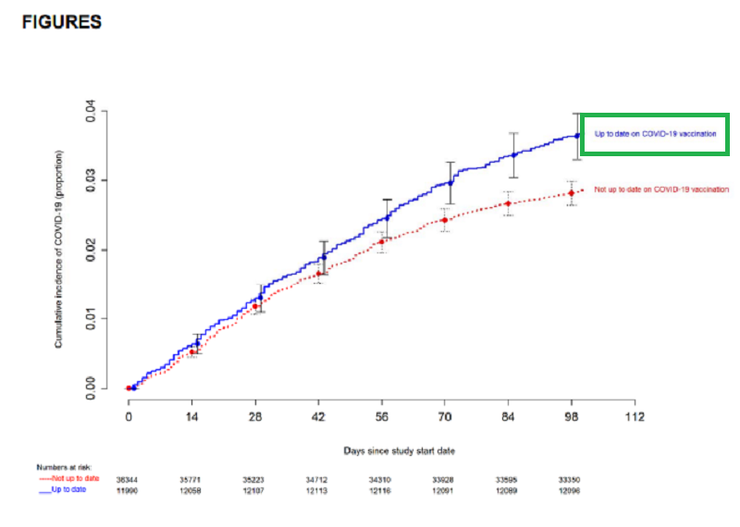
After adjusting for confounding factors between the groups, the study authors actually found a 33% rate of negative efficacy!
“This study’s findings question the wisdom of promoting the idea that every person needs to be ‘up-to-date’ on COVID-19 vaccination, as currently defined, at this time,” conclude the Cleveland Clinic researchers. They also observe, “It should be pointed out that there is not a single study that has shown that the COVID-19 bivalent vaccine protects against severe disease or death caused by the XBB lineages of the Omicron variant.”
The push for boosters comes at a time when more evidence proves a strong correlation between excess deaths and the vaccine take-up. A letter published in a peer-reviewed journal of Medicine and Clinical Science shows that Japan and Germany, two highly vaccinated countries, experienced sharp excess deaths coinciding with the vaccine take-up. They found very little excess death during the pandemic months before the vaccine was rolled out.
“It should be investigated to what extent the about 5%-10% highly significantly increased mortalities in Germany and Japan in 2021 and 2022 might be due to the pandemic countermeasures, including the vaccinations with their possibly underestimated immediate or protracted side effects,” concluded the researchers from Japan and Germany.
“From this point of view, it seems possible that a high vaccination rate has contributed to an increased all-cause mortality in some countries.”
The twisted irony is that, according to the CDC’s variant tracker, XBB.1.5 has gone from 80% of cases to less than 40% of cases in just a few months. It will clearly be obsolete by the fall. None of this was discussed at the FDA hearing. Of course, nothing about Pfizer’s own document showing five million cumulative reports of adverse events affecting every organ system was ever discussed. Hence, we have record injuries, negative efficacy, long-term immune imprinting causing the body to constantly respond inappropriately to wrong strains of the virus – all for a virus that is no longer deadly and for a population that has already gotten the virus!
That’s not just a lousy cost-benefit analysis; that is premeditated murder against the American people. What is the GOP plan to stop this? Or do Republicans even care? How can they continue to fund more COVID shots in the HHS appropriations bill, much less the broader FDA/CDC scheme to create new dangerous shots at warp speed?
Just how callously does the FDA regard human life? After its own VAERS system exploded with every adverse event imaginable, an outcome we now know officials anticipated, to this day they have not followed up on those safety signals. For example, according to the Informed Consent Action Network, the Standard Operating Procedures and Policies document for the FDA’s Vaccine Safety Team requires that its staff members identify VAERS adverse event reports that “need a rapid response and complex coordination,” after which they are supposed to “immediately” inform certain FDA management, who then alert other sub-agencies. Did that occur?
Well, more than a year after the ICAN’s record request, the agency responded, “A search of our records did not locate any documents responsive to your request.”
Where is the action from the House GOP? Why are they still only investigating the shutdown of schools in the past, but not the ongoing, premediated unleashing of deadly products on the American people?
The Administrative Man
On the view of humanity adopted by the state and its agents

eugyppius: a plague chronicle | June 23, 2023
There is a pattern, a recurring blindness, in the approach of the administrative state to everyday human life.
Let’s consider a few examples of recent political idiocy and the common thread that unites them:
1. The Scholz government hopes to convince more Germans to opt for public transit by tinkering with fares and introducing a universal 49-Euro ticket. The offering, which collapses regional ticket schemes into one simple, relatively cheap monthly subscription, is now more than 50 days old, and preliminary data show it’s changed hardly anybody’s habits. The vast majority of the 11 million subscriptions sold so far have gone to longstanding public transit users; less than a tenth have been purchased by new customers. Surveys show that interest is concentrated in the urban centres, while rural populations have no use for the ticket because everybody drives cars there. Calls for improving transit offerings in the countryside are half-hearted and bizarre; the whole concept of public transit requires dense, concentrated populations.
2. For some years now, the German state has deployed extravagant subsidies to convince consumers to buy electric vehicles. While adoption has been substantial, the dream of 15 million EVs by 2030 remains very far off. Subsidies aren’t enough to counterbalance the substantial cost of the batteries, leaving conventional automobiles with an enormous competitive advantage at the cheaper end. Also too, it seems that the core market for EVs – relatively well-off Germans who take mostly short trips and primarily charge their vehicles at home – will soon be saturated. For those who have longer commutes or must frequently travel long distances, the limited range and insufficient charging network are disqualifying.
3. I’ve already written about proposed government legislation to compel all Germans to transition to heat pumps beginning in 2024. Massive controversy compelled substantial changes in the law, which has been blunted in many respects, but remains worrying. Because not everybody lives in buildings that are suitable for heat pumps, the law in its original form would’ve required massive renovations across broad sectors of the housing market, effectively wiping out billions of Euros in personal wealth. If enacted in its original form, it might well have rendered many prewar buildings basically uninhabitable.
4. Bizarre proposals to mitigate the dangers of warm summer weather, accompanied by strange state media hysteria about recent warm summer temperatures, are similarly oblivious. The proposals are based on French plans, which foresee imposing bans on school trips and large gatherings in the event of extended heat waves. While rules like these have the potential to destroy ordinary summer activities for millions of people, they won’t save any lives. Summer mortality spikes are confined almost entirely to the old and the sick, not schoolchildren or sports fans.
5. Lockdowns and mass vaccination also belong in this list. These policies arose from the myopia of public health mandarins, who regarded everyone in their jurisdiction as equally likely to spread SARS-2, equally likely to die from it and equally able to endure months of rolling house arrests and an indefinite marathon of mRNA injections. They were wrong in every respect: The virus was only ever dangerous to a very small segment of the population, there was never any purpose in vaccinating the millions of people who had recovered from SARS-2 infection, and even according to officially accepted, heavily massaged statistics, the vaccines have no measurable upside for any healthy person under 50.
Underlying these policy initiatives and many others is a highly abstract bureaucratic conception of the individual, what I’ll call the Administrative Man. This is how state bureaucrats everywhere approach their subject populations, and it is an unavoidable artefact of routine bureaucratic processes like regulation and taxation. In this conception, everybody is more or less the same, subject to nudging via the same incentives, requiring the same protections from the same risks, and likely to benefit from the same one-size-fits-all solutions. The highly differentiated lives that people actually lead – their vast differences in personal circumstances, wealth, individual preferences, religious beliefs and political opinions – are at best ignored, at worst considered a massive inconvenience. There is an unstated, unconsciously harboured bureaucratic vision of a country made up entirely of Administrative Men as the ideal receptacles of bureaucratic solutions, which are of course always correct, except when the people fail them.
The image of the Administrative Man, while heavily abstracted, is not without some intriguing specific characteristics. These will vary from country to country, but we can derive some of the features of the German Administrative Man from our five examples. He appears to live in cities or at least in towns, not in the countryside. He’s certainly an apartment dweller, and he’s more likely than not to rent. He’s actually somewhat well-off, but not wealthy; he’s older and probably not in the best of health. He leads a fairly withdrawn, local life, with limited interest in public events. All in all, it seems fair to call him a composite figure, combining features of the civil servants most responsible for this vision and of the aging voters who support the major political parties.
Our states are some of the most powerful and overextended in history; no system has been so well positioned to impose its vision of politics and culture on its subjects ever before. A few weeks ago, I wrote about the political mechanics of the rainbow revolution, but the all-consuming interesting of Western politicians in ethnic and sexual diversity surely admits of other interpretations as well. You could say that there is an eagerness to confine human variation to those areas of least concern to the institutional apparatus, and thus to “celebrate,” or actively promote, all those diversities which are of least consequence to the administrative ideal. Modern states actually want highly uniform, undifferentiated populations, and they hope to confine personal expression to sexual, ethnic and consumerist spheres. The Administrative Man may be straight or gay, he may be from any continent; these details hardly matter for the regulators.
The Administrative Man is not real, and no amount of bureaucratic intervention can ever bring him into being. What’s more, the state itself seems only intermittently conscious of and profoundly uninterested in the distance between its abstract administrative model of humanity and the reality of human variation. Ours aren’t the hard authoritarian regimes of the Warsaw Pact countries, which sought to beat their subjects into a uniform mass via economic deprivation and overt repression. They’re rather soft authoritarian systems, which operate via sophisticated messaging campaigns and realigning incentives – approaches which are always limited from the beginning by the deep inaccuracies of the administrative vision.
Polish-German dispute on the rise
By Uriel Araujo | June 23, 2023
German-Polish relations have been in a crisis, and the climate just keeps getting uglier, as exemplified by recent developments. For instance, Alice Weidel, spokesperson for Alternative for Germany (AfD), Germany’s third-strongest political force today, called in a tweet the area of former East Germany a “Central Germany” – thus implying that territories which today belong to Poland are German lands. This has sparked outrage: Poland’s former PM Beata Szydło, in response, said the AfD could in the future power over all of Germany, thus creating a “dangerous scenario for Europe”, because, she claims, it is a party “whose leaders openly negate the existing borders.” She added that German Chancellor Olaf Scholz has recently demanded the abolition of the right of veto within the EU and asked: “Should Europe go in this direction? Towards a German-dominated federation?” This provocation from a German political figure takes place in the context of a rising Polish campaign against Berlin.
Meanwhile, two families of Polish WWII victims are suing German companies Bayer and Henschel for €4.3 million over the persecution of Polish businessmen during the Nazi occupation of Poland. Brzozowska-Pasieka, head of the War Compensation Foundation (Fundacja Odszkodowań Wojennych), the Polish organization which represents the claimants, claims that these lawsuits are groundbreaking because they have been filed against private companies instead of the German state. Further claims on behalf of other families are being prepared. Commenting on the lawsuits, deputy culture minister Jarisław Sellin, lent his support, saying that “German companies which used forced laborers and actually participated in crimes during World War Two were never legally held accountable for what they did.”
Considering that Polish officials back these initiatives, one must see them as also part of a larger trend and context. Last month I wrote on the legal campaign Warsaw has been launching against Berlin for wartime reparations. It is accompanied by harsh anti-German rhetoric, which often describes Germany’s prominent role within the European Union as a “Fourth Reich”.
Polish discourse on the issue is not without its dose of hypocrisy: while criticizing Ukraine for celebrating genocidal Nazis, as recently as 2019, with Polish President Andrzej Duda’s support, Warsaw opened ceremonies honoring the Holy Cross Mountains Brigade of the National Armed Forces – an underground force which, in the end of Second World War, collaborated with the Nazis in their anti-Soviet struggle. This was denounced by Poland’s chief rabbi as “dangerous revisionism”. Moreover, Warsaw so far has refused to publish state archives which would expose the degree of Polish collaboration with the Nazi persecution of Jews. It is no wonder the German ambassador to Poland, Thomas Bagger, warned the country not to “open Pandora’s box”.
Behind the weaponization of WWII resentments lie also geopolitical goals. As I wrote in September 2022, Washington has apparently been promoting Warsaw’s ambitions regarding regional hegemony as mainly a means to counter Berlin, Poland in turn also benefits from this situation. For a while, Warsaw has, for example, been urging Washington to support the Three Seas Initiative (3SI) as a Western “counterweight” to Chinese investments in “critical infrastructure” – as Polish Foreign Minister Zbigniew Rau and his Romanian counterpart, Bogdan Aurescu, both wrote in a June 2021 piece published in Francis Fukuyama’s “American Purpose”.
Already in 2020, during the “Defender Europe 2020” military exercises, it had become clear that Poland aspired to become the main stronghold of American military presence in Eastern Europe – and the current conflict in Ukraine, since February 2022, has opened a window of opportunity in that regard.
By doing so, Poland aspires to establish itself as a new EU geopolitical center, while challenging Germany’s leading role in the continent. From a German perspective, this is ironic in itself, considering the fact that Berlin’s contribution to the EU budget has been the highest of any other member state, and therefore one could argue that the more recent EU member states such as Poland itself have been able to implement sustainable development policies largely thanks to Berlin’s disproportionate financial injections into the European budget. Therefore, according to this reasoning, Warsaw basically strives to get the maximum financial and economic benefits from its EU membership, at the expense of its “allies”, Germany especially.
For decades, Poland has arguably been on the path of refusing to contribute with the building of an intra-European system of relations. Warsaw pursues exclusively its own interests and shows no interest in building pan-European cooperation within a framework of mutual respect. Germany and France today are potentially forces for strategy autonomy in the European bloc (at least up to a certain point); Poland, on the other hand, is perhaps the main promoter of European “alignmentism”.
Warsaw, for instance, actively opposed the (now gone) Russian-German gas pipeline Nord Stream 2. The pipeline’s still unexplained explosion, denounced by journalist Seymour Hersh as an act of sabotage carried out by Washinton, remains an open wound in Germany – and a German investigation into allegations that Poland could have been used as a hub for the sabotage only make German-Polish tensions even worse. The Polish National Prosecutor’s Office said in a statement that such suspicions are “not supported by the evidence.”
In any case, Polish-German and intra-Europeans tensions in all likelihood will keep building up, because the Polish government weaponizes anti-German feelings, as it also does with Russophobia, in its rewriting of history. These tensions mirror a short-circuit in the European narratives as well as the continent’s own ideological and geopolitical contradictions.
Poland denies US media claims about Nord Stream
RT | June 22, 2023
A Wall Street Journal (WSJ) report on Poland’s alleged role in the Nord Stream gas pipelines blasts last September is “completely untrue,” the Polish National Prosecutor’s Office said in a statement to the country’s daily Rzeczpospolita on Thursday.
Citing German investigators, the US media outlet claimed in early June that the EU nation supposedly served as an operational base for the suspects that might be behind the Russian natural gas pipeline sabotage. A Polish source familiar with the investigation told the paper that Berlin allegedly knew very little about some of the suspects and might be following the wrong track entirely.
Warsaw has launched its own probe into last September’s incident, alongside Germany, Denmark, and Sweden, the prosecutor’s office told the Polish outlet. The data gathered by Polish officials contradicts the claims made by the WSJ, it added.
“The statement that ‘Poland was a logistics hub for the operation of blowing up Nord Stream’ is completely untrue and is not supported by the evidence of the investigation,” the prosecutor’s office said.
The WSJ reported that a yacht called the ‘Andromeda’ – which was chartered by a Ukrainian-owned, Warsaw-based travel agency and moored at a Polish port – had been sailing around each of the locations where the explosions later occurred.
The Polish prosecutor’s office said there was “no direct evidence” of the yacht’s or its crew’s involvement in the blasts. ‘Andromeda’ arrived in Poland from a small German port called Wiek with six people on board. It moored in one of the Polish ports for 12 hours before leaving the nation’s territorial waters, according to the prosecutors.
“The findings of the investigation show that, during the stay of the yacht in a Polish port, no items were loaded onboard, and the crew of the yacht was inspected by the Polish Border Guard,” the prosecutor’s office said. The vessel’s crew had Bulgarian passports, which appeared authentic, according to the officials. None of the crew members were banned from entering the Schengen area either, they added.
“There is no evidence that would indicate the participation of Polish citizens in blowing up the Nord Stream pipeline,” the prosecutor’s office concluded.
A source familiar with the Polish probe also told Rzeczpospolita that German investigators had contacted Polish officials in mid-May and requested information under the European Investigation Order. The Germans asked many questions about ‘Andromeda’ and its crew, including “many trivial facts,” the source said, adding that they apparently had no knowledge of them. Berlin was also not willing to share its own findings on the issue, the source added.
Rzeczpospolita’s source also questioned the yacht’s role in the sabotage operation by claiming that it could not be used to transport enough explosives to relevant locations and deliver them to the undersea pipelines. No equipment that could facilitate that was found onboard, they added.
Rzeczpospolita also reported that Polish officials had not ruled out the possibility that the yacht might have been used as a distraction from the very onset and its purpose was to put the entire investigation on the wrong track.
Featured Video

Macgregor: We Haven’t Seen the Worst of the Iran War Yet
or go to
Aletho News Archives – Video-Images
From the Archives
15 Saudi ‘hijackers’ were CIA agents working for US: Scholar
Press TV – April 13, 2016
Fifteen of the 9/11 “hijackers” from Saudi Arabia were CIA agents working for the United States government, which was seeking to destroy the Middle East for Israel and to double the American military budget, says Dr. Kevin Barrett, an American academic who has been studying the events of 9/11 since late 2003…. continue
Blog Roll
 Aletho News
- Breast Cancer: Before You Consent
- Iran’s Plan to Shut Down AI in the Persian Gulf
- Israel seeks ‘compensation’ from Washington over Saudi F-35 sale
- Saudi crown prince seeks dialogue with Ansarullah after Yemeni blows: Report
- Damascus rejects Saudi request for Syrian fighters to counter Yemen: Report
- South Korea says will not send troops to join terrorist US war on Iran
- Russia Just Struck the Eyes of NATO’s War Machine in Ukraine
- Russia summons UK charge d’affaires over Kiev drone support
- NATO member warns bloc seeking pretext for war with Russia
- Macgregor: We Haven’t Seen the Worst of the Iran War Yet
- If Americans Knew
- Debunking The Claim That Macklemore Has A “History Of Antisemitism”
- CPJ demands release of arrested Palestinian-US journalist near Bethlehem
- Robert Kraft: The Billionaire Friend of Netanyahu Pulling The Strings Behind the Macklemore/Ed Sheeran Blow Up
- Columbia Administered Fund Gives Big Money to Pro-Israel Groups
- Deportation Case of Palestinian Activist Salah Sarsour Tests First Amendment
- ‘We Will Not Forget’: Palestinians Mark 44 Years since Sabra and Shatila
- Why do we let Zionists decide what we can and can’t say?
- US welcomes Israeli, Iranian delegations to UN, but not Palestinians – Daily Update
- Biden’s Genocide Accomplices Targeted by New Accountability Campaign
- AIPAC’s Network Has Already Spent $67.2 Million to Shape the Midterm Elections
- No Tricks Zone
- New Study: ‘Global Drought Shows No Detectable Recent Acceleration Under Climate Warming’
- Economic Masterminds: German Socialists Suggest Taxing Productivity Gains Stemming From Using AI
- The South China Sea Has Not Been Cooperating With The Climate Change Narrative
- Energy Crisis: Germany Enters Heating Season With Historically Low Gas Reserve Fill Levels
- New Study: The Antarctic Ice Sheet Gained Mass From 2020-2024 Due To Staggering Snow And Ice Accumulation
- Study: Ocean Heating Rates From Thousands Of Years Ago ‘Dwarf’ Modern Ocean Heating Rates
- Climate Extremists Target, Attack Large-Scale Power Grid Infrastructure In Germany!
- New Study: Antarctic Ice Melt Has Contributed Less Than 1 Centimeter To Sea Level Rise In The Last 30 Years
- Fear Of Debate: Alarmist German Climate Scientist Calls On Mainstream Media To Discredit Skeptic Voices
- End-Of-August Arctic Sea Ice Extent Hasn’t Fallen In 20 Years, Official Data Show!
 Aletho News