Clinton calls for sanctions on Tehran over test-firing missiles

Press TV – March 9, 2016
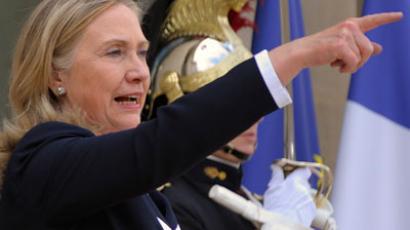
US Democratic presidential front runner Hillary Clinton has called for sanctions against Iran over the country’s test-firing of ballistic missiles.
“Iran should face sanctions for these activities and the international community must demonstrate that Iran’s threats toward Israel will not be tolerated,” claimed the former first lady, who is running for the 2016 presidential election, in a statement on Wednesday.
Her remarks run contrary to the Obama administration’s statement that the move is “not a violation of the Iran deal.”
Earlier in the day, Iran’s Islamic Revolution Guards Corps (IRGC) successfully test-fired two ballistic missiles in line with the country’s defense doctrine.
The missiles were fired from East Alborz heights in northern Iran and could hit targets 1,400 kilometers away in Makran Coasts southeast of the country.
Last month, Iranian Foreign Minister Mohammad Javad Zarif said the Islamic Republic would continue to develop its missile program and that Tehran would need “no permission” to enhance the country’s defense capabilities.
US State Department Spokesman John Kirby has expressed concerns over the move but made it clear that it does not violate the Joint Comprehensive Plan of Action (JCPOA) singed between Tehran and the world powers last year.
“We’re not going to turn a blind eye to this… I’m just trying to get to a technical point here, which is that it’s not a violation of the Iran deal itself,” Kirby said earlier.
In recent years, Iran has made great achievements in its defense sector and manufactured different types of military equipment.
Iran has repeatedly assured other countries that its military might poses no threat to other states, insisting that its defense doctrine is entirely based on deterrence.
In her new statement, Clinton repeated her pro-Israeli rhetoric, calling Iran a “threat.”
“As President, I will continue to stand with Israel against such threats,” she said, adding she was “deeply concerned.”
She stated that it was possible to “address Iran’s destabilizing activities across the region, while vigorously enforcing the nuclear deal.”
The former secretary of state had heartily supported President Barack Obama for his efforts in reaching a deal with Tehran, which she had described as “the path of diplomacy.”
According to Barry Grossman, an international lawyer based in Indonesia, voting for Hillary means voting for “the Israeli hard right and the US war machine.”
“By making prior unqualified commitments on US policy in return for large sums of money and media support, Hillary Clinton is now incapable of honoring the oath of office which any president must take before stepping into the oval office,” he said in an interview with Press TV in July 2015.
See also:
Israeli supporters financing Clinton’s campaign: James Petras
The Honduras Killing Field

Slain Honduran environmental activist Berta Caceres
By Dennis J Bernstein | Consortium News | March 8, 2016
An apparent resurgence of death-squad violence in Honduras, including the March 3 murder of prominent Honduran indigenous rights activist Berta Cáceres, is a harsh reminder of Secretary of State Hillary Clinton’s role in defending a 2009 coup that ousted leftist President Manuel Zelaya and cleared the way for the restoration of right-wing rule in the impoverished Central American nation.
Caceres, the recent winner of the prestigious Goldman Environmental Prize, was murdered in her hometown of La Esperenza, Intibucá, in the highlands near the Salvadoran border. Her good friend and close associate, Gustavo Castro, was shot twice but survived the assassination and is now being held against his will by the Honduran Government.
Castro held Cáceres in his arms as she lay dying and played dead to avoid his own execution. He has since been forcibly stopped from leaving Honduras.
The Honduran Government has characterized the killing of Cáceres as a common burglary gone bad, but her friends and close associates reject the government claims as preposterous and part of an emerging cover-up.
In a statement, COPINH, the indigenous rights group that Cáceres was closely associated with, characterized her close-range murder as an assassination. In a press release the day after the murder, the group talked about the multiple death threats that Caceres faced prior to her slaying.
“In the last few weeks, violence and repression towards Berta, COPINH, and the communities they support, had escalated,” COPINH stated. “In Rio Blanco on February 20th, Berta, COPINH, and the community of Rio Blanco faced threats and repression as they carried out a peaceful action to protect the River Gualcarque against the construction of a hydroelectric dam by the internationally-financed Honduran company DESA.
“As a result of COPINH’s work supporting the Rio Blanco struggle, … Berta had received countless threats against her life and was granted precautionary measures by the Inter-American Commission for Human Rights. On February 25th, another Lenca community supported by COPINH in Guise, Intibuca was violently evicted and destroyed.”
Cáceres received the Goldman Environmental Prize after she led a high-profile, peaceful campaign to stop one of the world’s largest dam builders from pursuing the Agua Zarca Dam, which would have effectively cut off the ethnic Lenca people from water, food and medicine. When Caceres won the Goldman Prize last year, she accepted in the name of “the martyrs who gave their lives in the struggle to defend our natural resources.”
Friends, co-workers, intellectuals and activists are outraged by the killing and many track this and many other murders of activists in Honduras back to the tenure of Hillary Clinton as Secretary of State. They say Clinton’s lead role in supporting the 2009 oligarch-backed coup that drove the elected progressive President Zelaya from power. Zelaya’s ouster opened the door to a restoration of right-wing rule and out-of-control “free trade.” Honduras soon became the murder capital of the world.
When the Honduran military removed Zelaya from power, the international community – including the United Nations, the Organization of American States and the European Union – condemned the coup and sought Zelaya’s restoration. But Secretary of State Clinton allied herself with right-wing Republicans in Congress who justified Zelaya’s removal because of his cordial relations with Venezuela’s leftist President Hugo Chavez.
In her memoir, Hard Choices, Clinton took credit for preventing Zelaya from returning to Honduras, as if it were a major victory for democracy instead the beginning of a new era of death-squad violence and repression in Honduras.
“We strategized on a plan to restore order in Honduras,” Clinton wrote, “and ensure that free and fair elections could be held quickly and legitimately, which would render the question of Zelaya moot.” In other words, rather than support the right of the elected president to serve out his term, Clinton allowed his illegal ouster to lead to an interim right-wing regime followed by elections that the Honduran oligarchs could again dominate.
Since then, the violence in Honduras has spiraled out of control driving tens of thousands of desperate Hondurans, including unaccompanied children, to flee north to the United States where Clinton later supported their prompt deportation back to Honduras.
On Tuesday, I spoke with Beverly Bell from Other Worlds who worked closely with Berta Cáceres and Gustavo Castro. She was deeply concerned about the safety of Castro and other close associates of Cáceres. She described the situation as follows:
“One person saw the assassination, Gustavo Castro Soto, coordinator of Otros Mundos Chiapas / Friends of the Earth Mexico. A Mexican, Gustavo had come to Berta’s town of La Esperanza to provide her with peace accompaniment, and spent the night at her house on her last night of life. Gustavo himself was shot twice and survived by feigning death. Berta died in his arms.
“Gustavo was immediately detained in inhumane conditions by the Honduran government for several days for ‘questioning’. He was then released and accompanied by the Mexican ambassador and consul to the airport in Tegucigalpa. He was just about to go through customs when Honduran authorities tried to forcibly grab him. The Mexican government successfully intervened, and put Gustavo into protective custody in the Mexican Embassy.”
But according to Bell, the matter didn’t end there: “The Honduran government issued a warning that Gustavo may not leave the country. In a gross violation of international sovereignty, the Honduran government has reclaimed Gustavo from the Embassy, taking him back to the town of La Esperanza for questioning.”
In a March 6 note to close friends, Gustavo Castro wrote, “The death squads know that they did not kill me, and I am certain that they want to accomplish their task.” Shortly after the murder of Berta Cáceres, I interviewed her close friends Beverly Bell, Adrienne Pine and Andres Conteris.
The interviews follow in two parts below, first the interview with Beverly Bell and Adrienne Pine, an associate professor at American University and a Fulbright Scholar who has been doing research in Honduras for nearly two decades. She is the author of Working Hard, Drinking Hard: On Violence and Survival in Honduras.
The second interview is with Conteris, a producer with Democracy Now! Spanish language programming, who lived for years in Honduras and was there throughout the military coup in 2009. He worked as a human rights advocate in Honduras from 1994 to 1999 and is a co-producer of “Hidden in Plain Sight,” a documentary film about U.S. policy in Latin America and the School of the Americas.
DB: Beverly let me start with you. … There was more than one person shot, correct, Beverly Bell?
BB: There were actually three people shot … in addition to Berta, who was shot fatally. Her brother was also shot and a third person, who will be familiar with many of your listeners, and that is Gustavo Castro, who is the coordinator of the social and economic justice group, Otros Mundus, “other worlds” in Spanish, in Chiapas, who has also worked very closely with Berta for years. He spent the night in Berta’s house, as part of a peacekeeping team, which Berta had had for many years now, off and on, because her life has always been so at risk.
And he was shot in the ear, he is okay from that, but the concern that you mention is Gustavo went down this morning to give his testimony to the local court, and he is a very inconvenient witness to them. … So there is an international alert out right now to guarantee Gustavo Castro free passage back to Mexico, together with his wife.
DB: Now, that’s a double-edged sword, because if they hold him, he’s in danger, his life is in danger. And if they release him, his life is in danger. His life is in danger as being a witness to the murder, right?
BB: That’s absolutely correct. In Honduras, pretty much anybody’s life is in danger for anything that relates to peace, to justice, to indigenous rights, to participatory democracy, and notably to opposing the role of the U.S. We are working with peace accompaniment teams right now to try and guarantee Gustavo’s safe passage to Mexico, if the government doesn’t let him go. …
DB: We know that the United States government, Hillary Clinton played a key role in overthrowing the duly elected president, leading us down this path of regular mass murder of human rights activists, and anybody who resists sort of free trade government so what can we say? Has the U.S. expressed its deep concern about the killing?
BB: Yes, cynically and sickly, the U.S. came out … lamenting the murder of Berta Cáceres. And yet, we know that the U.S. has funded to the tune, well this year alone of more than $5,500,000 in military training and education. We know that many of the people who have threatened Berta’s life over the years have been trained at the School of the Americas.
We know that the U.S. government has stood fiercely by the horrible succession of right-wing governments that followed the overthrow of the democratically elected government of Zelaya. And as you mentioned, Hillary Clinton was deeply involved in that. In fact, she even bragged about it in her recent book.
DB: I know, that is shocking that she is proud, this self-declared human rights activist and sophisticated diplomat was proud to brag in her book that she played the key role in keeping Zelaya from going back and assuming his legitimately won presidency. So this is your, as we have called her before, the deposer in chief. And, on that note, let’s bring into the conversation anthropologist Adrienne Pine, who has spent many years, written extensively about Honduras. Adrienne I know that you’re at an airport now, but let me get your initial response to what happened here.
AP: Well, with Bertita, it’s hard to talk about her in the past tense. She’s one of the most amazing activists and advocates I’ve ever met. And also, one of the most compassionate, wonderful people. The fact that they would kill her really sends a message. I mean this is an intentional message that all Hondurans, I think, would understand as such that nobody is safe. Berta, has a sort of, what those of us in the international solidarity community had considered…she had just some sort of protection because she was so well known, because she had won the Goldman prize.
And, of course, we have learned since the coup, the U.S. supported military coup, and I think Beverly laid that out very well, we’ve learned that the international protective measures actually don’t count for much, in Honduras. But this is really ramping up of the criminalization of activism that has occurred since the U.S.-supported military coup in 2009, and it really speaks to the incredible impunity that reigns right now in what is in fact a military dictatorship, a U.S.-supported military dictatorship. That, I think you’re right, it would not have been possible without the direct intervention of Hillary Clinton, as Secretary of State.
Berta Cáceres blood is on Hillary Clinton’s hands.
DB: And, of course, Donald Trump could not have been more violently right-wing when it comes to what happened in Honduras. He could have never out-done her. Because she was more sophisticated, and understood better how to solidify the right-wing, representing corporate America, and make sure that things continued ever since the Monroe Doctrine. Let me come back to you, if I could, I’m getting a little bit angry, Beverly Bell. Let me ask you to talk a little bit about Berta. How you met her, when’s the last time you spoke with her?
BB: I spoke with her, I guess, a couple of months ago, and it was the same content as so many of our conversations have been over the last 15 years, or so, that we’ve worked with each other, which was yet another threat. And how we were going to get protection for her, from what was a long, long, long journey of hideous oppression. She has been terrorized, she just a week or two ago, she and a whole team of people who were at the site of a river which the Honduran government and a multi-national corporation had been trying to dam, but which had been blocked by the organization that she headed, the Council of Popular and Indigenous Organizations of Honduras or COPINH.
A bunch of them were put into a truck and taken away. And it was certainly shaky hours there for a while until they emerged free. So just to answer your question, I have worked with Berta, very, very closely for about 15 years. I’m sitting right now in a house in Albuquerque where she used to live with me. We have fought together, like so many others, against the World Bank, against the U.S. government, against so-called free trade accords, against Inter-American Development Bank, against the Honduran government, against the Honduran oligarchy.
Basically Berta has stood for pretty much anything that any of your listeners would believe is right. She has been at the forefront for decades of the movement for indigenous rights, for indigenous sovereignty, for the environmental protection of land and rivers, for women’s rights, for LGBQ rights in a country that has grossly persecuted and assassinated LGBQ activists. She is, as Adrienne said, just the most extraordinary person, certainly one of the most that I have ever known and it is impossible to speak of her in the past tense.
And, in fact, I have refused to because Berta’s spirit has impacted so many people around the world. If you could be in my in-box today and see the countries from which condolences and denunciations have come, it’s amazing who she has touched, and that spirit will live on in the fight of all of us, for justice, for indigenous rights, for a world that is not tyrannized by the U.S. government, by trans-national capital, and by the elites of various countries.
DB: I’m sure, Beverly Bell, her spirit will be on the tongues and in the hearts of many women as they celebrate, if you will, International Women’s Day. … I’m sure she had some plans for that. It’s an amazing assassination. It’s troubling. Adrienne Pine, when is the last time you saw Berta? What did she mean to you?
AP: It’s so hard for me to accept. I think, like Beverly said she was somebody who I stood with side by side on more times than I could count … protesting the U.S. military base. We’ve been tear gassed together. And she’s helped me through a number of very dangerous situations. It’s hard. It’s hard to lose somebody who was not just such an amazing leader, but also such a good friend, and not just to me but to so many people.
Bertita lives on, with all of us. And I think the most important thing right now if you look at the social network…Beverly is right. My in-box is exploding with condolences, as well. And if you look at the social networks right now, Honduras is ready to rise up, at the murder of somebody who was so dear, so beloved by so many people. And I think one of the things that’s special about Berta which Beverly also mentioned is that she has a much longer trajectory than many of the activists, in Honduras. I mean, she has been on it for many decades fighting the forces that only recently following the coup the massive number of Hondurans came out to join her to fight the forces of corporatization, destruction of indigenous land, the violence of the patriarchy as Beverly mentioned. I mean she has been right all along.
And people in Honduras are furious. There are lots of different protests around the country that have been organized. There’s a protest in Washington, D.C. tomorrow, at the State Department, that’s been organized. And I think it’s going to be pretty big. She’s just moved people around the world, so deeply. And I think if Honduras is giving a signal that nobody is safe in Honduras then around the world we need give a signal that this regime cannot stand, any longer. And the U.S. has to stop supporting it.
DB: And, Adrienne, say a little bit more about the way in which she resisted. … I mean, it’s important for people to understand that in the face of so many threats…the idea that she won the Goldman Environmental prize here, given out here with huge fanfare in San Francisco. I mean, it really is clearly a message to everybody on the ground. But say a little bit more about what she meant to the people on the ground, how she worked with people. What were some of the actions that she helped to organize? You mentioned some protests and demonstrations, but is there one issue? This was about this dam. I guess resisting this dam was huge in Honduras. It means a lot to the corporate 1%, and a lot to the people who were resisting it.
AP: Well, absolutely. I mean the Aqua Zarca Dam, that Berta and her organization, COPINH. managed to successfully stop was an incredible victory for the Lenca people, and for the people of Honduras against the corporatization that is part and parcel of the U.S.-supported military coup of 2009, which was fundamentally a neo-liberal coup, and which vastly increased vulnerability of the already most marginalized groups, that Berta herself was part of, the indigenous groups of Honduras.
And so as somebody who had been organizing to resist this kind of government and corporate intrusion on sovereign indigenous lands and waters for decades, Berta was a natural leader. After the coup, when those forces became even stronger, against the participatory democracy, in Honduras, and Berta really stood alone in that. She was a woman leader among mostly male leaders.
And you’ve got a social movement that has traditionally been male led and there were a whole lot of feminists during the resistance movement that stood up against that. But Berta was just amazing. She held her own in very male-dominated forum, and it was through her inclusive insistence on fighting the patriarchy alongside the fight against the predatory violence of capitalism and neo-liberal capitalism, and U.S. militarism.
I mean, she tied it altogether in a way that very few Honduran leaders have managed to do. And yet she was uniquely not about her ego. I mean, she was somebody who gave so much to so many people. And I think that’s why in the protests people weren’t afraid to go up to her. She would … it’s hard to put into words. I mean I’m devastated by this loss and I’m not the primary mourner. I think there are thousands of people today who are devastated just as much as I am.
DB: And back to you Bev Bell. So maybe describe a little bit from your perspective what this loss looks like.
BB: As Adrienne said it’s huge. There are two indigenous movements in Honduras, and both of them have really been about the construction of indigenous identity. Which is to say that both the Garifuna people, that is the afro-indigenous people who reside on the Atlantic coast, and the Lenca people of which Berta was one, had had their indigenous identity stamped out. And Berta, and remarkably another woman, Miriam Miranda, who has also been terrorized and persecuted, who was head of the Garifuna indigenous movement had been able to shape together, with so many other people whom they pulled into participatory leadership, as Adrienne said.
They really were not about the sort of top down leaders that we see, well certainly in the U.S. government, but also in so many social movements, and in the NGO context in the U.S. They really were about empowering everybody, and led with humility. It’s huge. There is not anyone else in COPINH who is anywhere close to the capacity or the stature of Berta.
Most campesinos indigenous peoples are denied the right to education. They’re denied a lot of things that would allow them to also become leaders. That Berta who grew up in a very, very humble home, was able to become a leader was remarkable and really was due to her mother who was a fierce fighter. She was the mayor of the town, and the governor of the state, in a time when women were neither of those things.
And Berta grew up, for example, listening to underground radio from Cuba and Nicaragua that they had listened to, secretly, during the revolutions there. She was very engaged in the revolution in El Salvador. She has just had an incredible history that is really unparalleled. So the loss is huge. It’s irreparable, and as we said it’s not just a loss for Honduras, but for social movements everywhere, because Berta was all over.
I mean, she just met with the Pope in Italy, a couple of weeks ago. She was a leader in global social movements, not just Honduran ones, and not just indigenous ones. However, it is important to say and I know that Berta would say this: That the social movements in Honduras are strong. She loved to say that Honduras is known for two things. First, for having been the military base for the U.S.-backed Contra, and secondly for Hurricane Mitch. But in fact Honduras holds another fact which is that it is home to an extraordinary movement of feminists, of environmentalists, of unionists, of many sorts of people. And they are much stronger because of the life of Berta Cáceres. And that is not hyperbole. She single-handedly helped shape the strength of that social movement. But they will live on, and they are a part of the legacy of Berta Cáceres.
DB: Well, I know Adrienne it’s not going to be the last word on this subject. But, for the moment, what do you think you’re going to be doing in the context of fighting this fight, and standing with your friend and friends, where you’ve worked so long…how you’ve worked so long within Honduras. I swear there’s a traffic jam between my heart and my mind here, but final words, from you for now.
AP: You know I think we need to stand by the people of Honduras, who have been given a clear message that their lives are at risk, if they stand up for their own rights. And in part, a big part of what that means is standing up for democracy here in the United States. And if we had had a democratic system, and if we had been able to decide for ourselves as a people if we wanted to allow that coup to stand, I don’t think that would have happened.
And instead Hillary Clinton who is now running for president, is…and she proudly made sure that that coup would stand. I think we need to fight here at home for democracy, just as strongly as it is fought in Honduras, and in solidarity with people around the world. I mean, this is a call to action. We have to honor Berta’s life, by continuing to fight, and fighting even stronger. …
DB: It’s a tragedy that is has to be in this context and I hope we can continue this dialogue about these important issues and I’m sure there are going to be many people on the ground who are going to need these microphones, who are going to need the support of all of us, to resists this policy that was really instituted by Hillary Clinton, as Secretary of State.
ANDRES THOMAS CONTERIS
DB: We are now joined by Andres Conteris who is the founder of Democracy Now en Espanol, and who was in Honduras during the 2009 coup, all through the coup. We spoke to him many times, several times from the palace as the coup was in progress. …
AC: It’s a very difficult day because of the news that we’re talking about, and the horrible assassination of dear Bertita.
DB: Tell us a little bit about your time with her, your impression of what her work was like, what she was like?
AC: Well, I’m very glad to follow both Beverly and Adrienne, who have spoken very eloquently about Berta’s life. I go back a little bit further because I lived in Honduras from 1994 to 1999. And when I met Berta was in May of 1997. I can recall it very clearly. And it has to do very much with the context of what just happened today, in Honduras.
At that time there was a horrible assassination of an indigenous leader, in Honduras. He was part of the nation of the Chorti, the Mayan Chorti people. It’s 1 of 8 different indigenous communities in the nation, in Honduras. … His name was Candido Amador. He was assassinated in May of 1997 and what Berta, and her partner, Salvador, at the time, and other indigenous leaders did is, they gathered all indigenous nations in Honduras at that time, and they organized the most amazing pilgrimage to the capital.
And, Dennis, it was so awesome to be there at the time, and to see the stalwart nature in which these people were willing to risk everything, and leave their communities, and not even know how they would get back home. And go and camp in front of the presidential palace. It was incredible. And that is the context in which I met Berta. And she was such a leader of her people. And the entire indigenous peoples that gathered together, and collaborated with one another very closely to resist this kind of repression, that slaughtered Candido Amador at that time.
And what happened, Dennis, was truly amazing. The President, because he was going to go to receive this human rights prize had to do everything to get rid of them. And he ordered a military eviction, a forced, militarized, brutal repression against the indigenous who were camped out in front of his presidential palace. But they refused to leave the capital. And they only moved 2 miles away, and then just continued to camp out there.
And that put him, the president, in a dilemma whereby he was then forced to negotiate. And this is where Berta’s skills just really came forward. She was part of a negotiation of an accord that the president signed. And representatives from each of the indigenous nations also signed it. And what they did is they put together what they called a commission of guarantees or a guarantors commission, which was an signed by international leaders and human rights leaders in order to guarantee the compliance of this accord.
I was invited by Berta and Salvador to be part of that guarantors commission. And as part of it, then, in the following months one of the clear memories that I have is that the government, of course, was not living up to the agreements that it had promised for education, for electrification, for health. And most of all, for land for the indigenous people. And they were not living up to these accords. And so I was part of non-violent training of the indigenous who were rising up. And they engaged in occupations of embassies, like the Costa Rican embassy for one. And they also did a blockade of the tourist attraction that is most popular in Honduras which are the Mayan ruins.
And I spent the night with the Chorti people and with Berta Cáceres, in front of those ruins, blocking them so that tourists could not go, so the government would be forced to negotiate in a much more honest way, with the indigenous. And that is how I knew Berta, living her life in her country. She was always there accompanying her people. She would make sure that everyone had enough to eat and she would not tend to herself until she knew …
Well what Berta would do is just make sure that the people were really as cared for as much as possible. And this she showed in so many clear ways. But one thing that needs to be said is that she was not only a leader of her people, a leader in the environmental movement, a strong model for women, a strong model for indigenous leaders, but she was an amazing mother herself. She’s a mother of four children, and one of whom I was just with last week. It’s her oldest, her name is Olivia.
And I was there in the town La Esperanza where Berta was assassinated. And Olivia is turning out to be the spitting image of her mother, in so many ways. She’s 26 years old. She’s the age now when I met Berta in 1997. And Olivia is now basically becoming one of the women leaders, one of the indigenous leaders that is leading her people. And it’s just incredible and impressive to see that.
I remember joking with Olivia just last week about her mother, Berta, being concerned for her during the coup, because she was at the university protesting the violent military coup. And, Berta, of course, was concerned, as a mother for her daughter. And her daughter said “Hey, you lived out in El Salvador, for instance, the revolution. Give me a chance to live out my revolution during my age.”
So, of course, Berta wanted to do that but she also is a mother and she’s got two children who are studying medicine in Buenos Aires. Another, a daughter, who is in Mexico City, studying. And then her oldest daughter, Olivia, is there in La Esperanza working with indigenous people and organizing them.
DB: A huge, huge loss, that the family is probably devastated. We know that people are rising up right now in Honduras and the loss to the community is hard to evaluate.
AC: It’s really unspeakable. I’ve not been able to talk to Mama Berta, who is Berta’s mother, who I saw last week. Mama Berta, as Beverly shared was the Mayor of La Esperanza, the Governor of the Department…but also Mama Berta is this incredible midwife. She helped to give birth to probably over 1,000 people over the decades. And she is an incredible woman herself. And I cannot imagine how devastated she is right now, with this incredibly horrible, horrible news. …
One other thing before I go, and it’s important to point out that there’s a petition going around on social media to sign to make sure that the U.S. Congress guarantees an international investigation into this brutal murder and also, Senator [Patrick] Leahy has already signed a statement with regard to this assassination. You know, Berta was in Washington, D.C. and met with over 30 members of Congress, many of whom she met personally including Senator Boxer.
So Berta’s name is familiar in Washington. And so this should be a very important event that causes change in U.S. policy towards Honduras, which I’m so glad both Adrienne and Bev mentioned the complicity of Hillary Clinton in the coup in Honduras. And not pressuring, at all, this horrible regime of Juan Orlando Hernandez, who is very, very complicit in the horrible human rights violations against LGBT, against women, against journalists, and against Indigenous and against others in the country.
It’s been documented that Honduras is near the murder capital of the world, outside of hot wars going on. And it’s very much related to the militarized situation that this man, Juan Orlando Hernandez, who came to power in an illegitimate way. Hillary Clinton did not denounce that, she did not denounce the coup strong enough.
DB: Did not denounce? … She made sure that the coup was sustained and it is really troubling Andreas, on the one hand her work as deposer in chief sent people running out of the country, and turned it into the murder capital. …
Dennis J Bernstein is a host of Flashpoints on the Pacifica radio network and the author of Special Ed: Voices from a Hidden Classroom. You can access the audio archives at www.flashpoints.net.
What is really at stake in the oddest American election season of a lifetime
By John Chuckman | Aletho News | March 8, 2016
I keep reading stuff in British papers about what America’s Left must do in an election where Donald Trump “has thrown caution to the wind.” Each time I read anything along that line, invariably, I ask myself, “What Left are they talking about?” As perhaps few in Europe understand, there is no Left in the United States.
Bernie Sanders comes closest to being Left, but he is not only from one of the very smallest states in the Union, it is a state known for its liberal bent, something which exists in very few corners of that huge “pounding fist” of a country.
It would be refreshing if Sanders could win, but he cannot. The odds are completely stacked against him. I believe the unexpected force of his campaign, this man whose name was widely unknown west of New England in a campaign against someone whose name and face are, by contrast, as well known as Hershey bars, is a quiet wave of public recognition of just how repulsive a person Hillary Clinton is. It seems a miracle that he has run so well against her, sometimes beating or virtually tying her.
But remember, this is America we’re talking about, a plutocratic imperial power, not a democracy, and one engaged in vast military and secret state security operations. There is simply no room for a self-declared “democratic socialist.” America has no truck with socialists, even rather nice and soft ones.
Money counts hugely in politics, as it does in every nook and cranny of American life. An accurate motto for America might well be, “If it can’t be bought, it ain’t worth having.” Hillary is exceptionally well connected with, and financed by, the people who really count in shaping American government. Short of a tidal wave of support, any primary lead by Sanders would be stripped of delegates or would be defeated by “super-delegates” at the convention by party insiders.
As for Hillary being elected, nothing in my view could be a greater disaster. She has a murderous record, and I doubt she has told the truth twice in her entire life.
There is simply no question about her tendency to brutal violence. She pushed husband Bill on the needless war in Serbia. She advocated inside the administration for what became the Waco horror. She voted for the illegal invasion of Iraq. She ran at least part of what went on in Libya, a black operation to gather weapons and men to send to Turkey for terrorizing Syria. And we have her brutal idea of humor, complete with sneering laughter, about Gadhafi, a man who on the whole did a decent job of governing in a difficult part of the world: “We came, we saw, he died.” She supports Israel’s worst bloody excesses with a smile and regularly takes money from some of the people who work strenuously to keep them going.
Trump carries a great deal of heavy baggage, and has said many things with which I totally disagree, but he does not have Hillary’s record of death and destruction on a grand scale. He may often be quite unpleasant, but Hillary is almost certainly a psychopath whose narcissistic personality feels driven and entitled to be President so she can continue toying with human beings. I reject 90% of what Trump says, but I reject just about 100% of what Hillary has actually done.
There is one area, and a very important one, where possibly Trump can do something good for the world, and that is foreign affairs. Some of his views there are sound, sounder by far than Hillary’s. His views on matters like Syria and Russia are entirely rational and not weighed down by America’s malicious policies of the last quarter century, policies which Hillary not only supports but helped to establish and execute.
A vote for Hillary is a vote for more American bullying and terror in the world, and that is not in the least an exaggeration. Terror is the right word for what America has done in the Middle East: it has crashed and raged through the region, leaving it in blazes. Hillary has served as a “willing executioner” in that hellish effort.
If you look at the groups and individuals who are key Hillary supporters, it is a pretty grim picture. It includes many corrupt and brutal foreign governments such as Saudi Arabia, Qatar, Bahrain, and Israel, and a vast collection of gigantic international corporate special interests, even financial terrorists like the firm of Goldman Sachs who played a key role in the collapse of 2008 and who have never really been called to account for bringing so many to ruin. There is not a glimmer of genuine liberalism or democratic ideals in the people paying and easing her way, although she likes to put on her best clownishly little-girl face and claim how interested she is in the welfare of ordinary Americans at campaign stops.
If we could only gain some sense and rationality in America’s foreign affairs, it would be a genuine advance for the entire world. Almost certainly you have to pay a price for doing that in a place like the United States. Nothing comes free in a throbbing plutocratic power. That price may be living with Trump’s many unpleasant aspects.
The neocons especially see that possibility in Trump, which is why they hate him beyond telling. Already many have said really ugly things in public. And, remarkably, the word “assassination” keeps popping up in those circles. That fact alone should tell us how destructive the impact of the neocons has been upon America’s own society.
It would have been unthinkable fifty years ago for prominent Americans to talk or joke of assassinating a political candidate. That is how low American society has sunk during its long march with neocons, bombing, invading, promoting terrorism through proxies, and assassinating in the Middle East and in places like Ukraine – virtually all of which derives from the special influence of the neocons.
The political poverty of America was embarrassingly displayed in the original field of Republican candidates which resembled nothing so much as Madame Tussaud’s Chamber of Horrors. Fortunately, most of them are gone. As for Ted Cruz, the neocons’ possible “go to” man for stopping Trump, he is, just for a start, a right-wing religious wacko. There is a video of him on-line sitting at breakfast holding hands with his perfect little suburban family praying over the Sugar Pops. Staff working for Cruz include neo-con and CIA-types, and his wife is associated with Goldman Sachs. He is intellectually gifted, but many of his old associates in government say he is an extremely unpleasant man with which to work, extremely arrogant, and one not to be trusted, being given to treacherous turns. His former roommate at Princeton tells of getting e-mails from other students asking why he didn’t suffocate Cruz with a pillow while he had the chance. At least one person has commented on his resemblance to a serial killer. It would be a pretty desperate move by Republicans to try stopping Trump by loading Cruz, a man they simply don’t like, with money and influence. And I tend to feel the effort would fail in any event.
You get nothing free in a big, ugly place like America, so if you would like to see some end to a quarter century of brutal wars and the savage practices which have taken root under Bush/Clinton/Obama, perhaps you need to take a chance.
As few non-Americans realize, in domestic affairs the American President’s office is a rather weak one. It was designed to be that way. We have seen the frustration of Obama trying increasingly to govern by executive order, a pernicious practice not much different than imperial fiats, but even with that practice he has made little headway in this rigidly structured society. And no one, certainly no genuine liberal, ever can, without fundamental changes we have no reason to expect any time soon. America in its governance much resembles a giant wearing a huge, thick suit of concrete.
It is only in the area of military and foreign affairs that the American President has some real power, and that is an area which needs serious change. It won’t happen under bloodthirsty Hillary, loyal servant to neocon interests.
As far as ugly stuff like great walls or drastic changes to migration, Trump could do nothing without both houses of Congress, so they are proposals unlikely to become realities. Even on such domestic subjects, however, we do hear echoes of the neocon influence. After all, Israel has built many walls and builds more now, all on other people’s land and all of which prevent normal life for millions of others. It couldn’t be more unfair and anti-democratic, but the same people viciously attacking Trump for his proposals are the last ones to say a word about Israel’s actual practices. So those most violently attacking Trump cannot claim concerns for human decency or human rights motivate them, although they very much pretend to do so rather than being open about their real motives. Calling Trump a fascist over mere rhetoric and proposals is pretty ridiculous when we see Israel’s actual practices left unquestioned by crowds of prominent people.
Trump Bashing Reaches Epic Proportions
By Stephen Lendman | March 4, 2016
Ideologically he’s over-the-top like all other duopoly power presidential aspirants, supporting the same dirty business as usual agenda.
His unorthodox campaigning against the grain sounding anti-establishment put him at odds with Republican power brokers.
They’re committed to anyone but him – with, as expected, echo chamber scoundrel media backing. Bashing him virtually drowns out other news.
A separate article discussed Republican desperation in hauling out failed presidential aspirant Mitt Romney, a vulture capital predator profiting from asset-stripping companies and mass-firings to cut costs.
The March 4 Washington Post edition published an astonishing nine anti-Trump opinion pieces in one issue, plus other reports with a distinct anti-Trump flavor.
New York Times editors bash him relentlessly, while shamelessly supporting war goddess Hillary Clinton, their latest broadside citing an open letter from 95 so-called Republican national security experts, declaring “united… opposition to a Donald Trump presidency,” followed by a volley of pejoratives.
Claiming Trump’s agenda makes America less safe ignores endless post-9/11 US wars of aggression, raging in multiple theaters, Obama more belligerent than Bush, Hillary Clinton to continue his ruthlessness on steroids if elected president.
Times op-ed columnist Charles Blow blasted Trump with a volley of pejoratives, most applicable to the array of despicable aspirants, calling him “nativist, sexist… fascist,” demagogic, “oddly entertaining, vacuous… vain, disarming and terrifyingly dangerous.”
Wall Street Journal contributor, former Louisiana governor Bobby Jindal was over-the-top claiming Obama created Trump, his support stemming from “deficiencies of the incumbent.”
The political silly season usually runs from early summer to the beginning of autumn in election years – characterized by demagogic and hyperbolic posturing.
It’s been raging now since Trump declared his candidacy for president in mid-June last year – with comments like America “has become a dumping ground for everybody’s problems.”
“(W)e have no protection and we have no competence. We don’t know what’s happening. (I)t’s got to stop, and it’s got to stop fast.”
Things have been downhill since then. Expect ferocious Trump bashing to continue, bipartisan campaigning and media coverage ignoring vital issues.
What matters most to Americans goes unaddressed. No matter who succeeds Obama next January, monied interests exclusively will continue being served at the expense of popular ones.
The state of America is deplorable, a nation unfit to live in except for its privileged few.
Stephen Lendman lives in Chicago. He can be reached at lendmanstephen@sbcglobal.net.
His new book as editor and contributor is titled “Flashpoint in Ukraine: US Drive for Hegemony Risks WW III.”
Clinton Politics Made Simple
By Craig Murray | March 2, 2016
Oxfam recently published that 62 people own as much as half the population of the entire world. The entire pitch of the Clinton campaign is that this is absolutely fine, provided half of them are black and the appropriate proportions from ethnic minorities.
Identity politics have become well and truly established as the antidote to demands for social progress and for an end to the massive growth in wealth inequality. This is essentially an American development, although the idea that the purpose of feminism is for Emma Watson to get $12 million a film has caught on with at least some British people, and is the whole basis of the political stance of the modern all-American Guardian.
Hillary summed up the psychological trick of the faux egalitarianism in a simple sentence:
“If we broke up the big banks tomorrow … will that end racism? Will that end sexism? Will that end discrimination against the LGBT community?”
It is brilliant rhetoric, a masterpiece of sophistry. Of course breaking up the banks will not directly end these other evils. But neither would ending those things end the appalling level of wealth inequality. It comes directly back to my opening question of whether multi-billionaires are OK as long as they are appropriately representative of black, female and LGBT.
The truth of the matter is that almost everybody who campaigns against wealth inequality is also strongly against racial, gender, religious and sexual inequality. But many of those who focus on identity politics not only have no concern for general equality, but are primarily concerned with the ability of themselves and those like them to propel themselves into the ranks of the elite.
Hillary Goes to War
By Diana Johnstone | CounterPunch | February 26, 2016
When voters elected Bill Clinton president of the United States in 1992, they were also electing his wife. Bill announced the fact himself, but after the failure of her health reform plan, Hillary’s only political success was her excellent performance in the role of a faithful wife who “stands by her man”. Her brave defense of her frivolous husband was widely appreciated, but as a qualification for the highest office in the land, it seems a bit skimpy. Having played a part in wars in the former Yugoslavia might seem more presidential.
During the 2008 Democratic Party primaries, Hillary evoked the foreign policy experience she had gained as First Lady by repeatedly regaling audiences with an exciting account of her trip to the Bosnian city of Tuzla in 1996:
“I certainly do remember that trip to Bosnia,” she told audiences. “There was a saying around the White House that if a place was too small, too poor, or too dangerous, the president couldn’t go, so send the First Lady. I remember landing under sniper fire. There was supposed to be some kind of a greeting ceremony at the airport, but instead we just ran with our heads down to get into the vehicles to get to our base.”
As word got around of what she was telling audiences, Hillary’s story was rapidly denied by numerous eyewitnesses to the event, as well as by television footage showing Ms. Clinton arriving in Tuzla with her daughter Chelsea and being greeted by little children offering flowers.
Cornered by the Philadelphia Daily News editorial board during an interview in late March, 2008, Hillary Clinton was forced to acknowledge that there were no snipers, but eased her way out:
“I think that, a minor blip, you know, if I said something that, you know, I say a lot of things – millions of words a day – so if I misspoke it was just a misstatement.”
She never had to dodge sniper fire, but she does know how to dodge embarrassing questions. The fact that she utters “millions of words per day” is supposed to give her a generous quota of possible “misstatements”, or to put it more simply, lies.
The claim to have run from snipers was historically absurd and morally pretentious, in addition to being blatantly false. Four months before her visit, the hostilities in Bosnia had been decisively brought to a halt by the Dayton peace accords, signed on November 21, 1995. She could not fail to know that. Indeed, far from being sent to a place that was “too dangerous” for the
 President, the visit by the First Lady and her daughter was intended precisely to emphasize that the White House had not lost interest in Bosnia even though peace had been restored. Hillary’s spokesman Howard Wolfson had also added to the “misstatements” by claiming that she was “on the front lines” of “a potential combat zone”. Aside from the fact that there could be no “front lines” or “combat zone” when the war was over, Tuzla had never been either one. Tuzla was a largely Muslim- inhabited industrial center which had been selected as a U.S. military base, probably in part because it was a particularly safe environment.
Lying about Bosnia was nothing unusual, but this was a particularly silly, self-aggrandizing lie. Hillary evidently assumed that a brush with gunfire would be considered by the masses as adding to her qualifications to become Commander in Chief. It also showed a persistent tendency to view conflicts as occasions to display personal toughness, instead of as challenges calling for intelligent understanding of political complexities. Hillary’s claim to have braved sniper fire is not so far removed from Sarah Palin’s claim to understand Russia because she could see it from Alaska.
Hillary’s recorded statements concerning the former Yugoslavia revealed the same tendency to play to the galleries in matters of foreign policy that would mark her subsequent term as Secretary of State.
The Holocaust Pretext
In her star-struck biography of the First Lady, Hillary’s Choice, Gail Sheehy reported Hillary’s plea in favor of bombing Yugoslavia in 1999 as a major point in her favor. According to Sheehy’s book, Hillary convinced her reluctant husband to unleash the 78-day NATO bombing campaign against the Serbs with the argument that: “You can’t let this ethnic cleansing go on at the end of the century that has seen the Holocaust.”
This line is theatrical and totally irrelevant to the conflict in the Balkans. As a matter of fact, there was no “ethnic cleansing” going on in Kosovo at that time. It was the NATO bombing that soon led people to flee in all directions – a reaction that NATO leaders interpreted as the very “ethnic cleansing” they claimed to prevent by bombing. But Hillary’s remark illustrates the fact that Yugoslavia marks the start of using reference to the Holocaust as the most emotionally-potent argument in favor of war.
It was not always so. At the end of World War II, both the long- suffering survivors and those who discovered the horrors of the Nazi concentration camps wanted only to draw the conclusion that this was yet another powerful reason never again to go to war. But as time passed, by the strange chemistry of the Zeitgeist, the memory of the Holocaust has now become the strongest rhetorical argument for war. It is a sort of imaginary revisionism of past history that gets in the way of facing the present. Hillary’s sentence is a way of saying, “I would have said no to Hitler at Munich”, or “I would have bombed Auschwitz”. The history of World War II, and even world history itself, has been totally overshadowed in recent decades by the tragedy of the Holocaust to such an extent that even Western heads of State may find themselves acting out the dramas of the past instead of facing the realities of the present. The conflict in Kosovo was so obscure, so unfamiliar to Americans and so distorted by deception and self-deception , that the easiest way to think of it was by analogy with a conflict everyone knew about, or thought they knew about. The moral reward seemed immense, especially in consideration of the low cost, since it entailed bombing a country with inadequate air defenses, with no great risk to our side.
It is worth noting that Hillary urged Bill to bomb the Serbs via telephone, while she was in North Africa, touring Egypt, Tunisia and Morocco. Her guide on that trip was her new assistant, Huma Abedin, the young daughter of Muslim scholars and her trusted expert on the Muslim world. Many secular Arab nationalists in North Africa sympathized with the Serbs, due to past good relations with Yugoslavia during the days of the Non-Aligned Movement. However, Hillary had become an apprentice in learning to appreciate the fundamentalist Muslim outlook, and the Muslims of Bosnia and Kosovo enjoyed widespread, even fanatical support, in the Islamic world at this point. Did Huma assure Hillary that Muslims everywhere would applaud the Clinton administration for bombing Serbs?
Nevertheless, there are strong reasons to doubt that Hillary’s moralistic urging was the sole cause of the NATO bombing of what remained of the former Yugoslavia in 1999. Strategists were concerned with less sentimental geopolitical reasons, briefly alluded to above. But there is much less reason to doubt that Hillary did indeed urge Bill to bomb. And there is no reason at all to doubt that she boasted of this to her awed biographer, as a way of proving her “resolve” to use U.S. military power on a “humanitarian” mission. It fits her chosen image as “tough and caring”.
This article is excerpted from Diana Johnstone’s Queen of Chaos: the Misadventures of Hillary Clinton (CounterPunch Books).
Sanders and Trump Are Too Establishment on Syria
By Sheldon Richman | Free Association | February 23, 2016
Marco Rubio and Hillary Clinton both want the U.S. government to set up a “safe zone” in Syria to care for refugees from the raging civil war. You may assess their judgment by noting that Secretary of State Clinton and Sen. Rubio also pushed for bombing and regime change in Libya, which was crucial in spreading bin Ladenite mayhem far and wide. And Rubio thinks knocking out the Sunni Islamic State would hurt Shi’ite Iran.
Ted Cruz does not call for a safe zone; he merely wants to bomb the Islamic State back to the stone age while arming the Kurds, whom the leadership of NATO member Turkey wants to destroy and the Sunni Arabs distrust. Cruz says the Kurds would be “our ground troops,” yet he does not rule out American troops as a last resort.
Where do the reputed anti-establishment candidates stand on the safe zone? Alas, Donald Trump favors it, and Bernie Sanders is ambiguous.
If this is disestablishmentarianism American-style, we are in bad shape.
“What I like is build a safe zone in Syria,” he said. “Build a big, beautiful safe zone, and you have whatever it is so people can live, and they’ll be happier. You keep ’em in Syria. You build a tremendous safe zone. It’ll cost you tremendously much less, much less, and they’ll be there and the weather’s the same.”
Like Cruz, Trump says he’d send U.S. ground forces “if need be,” but he also promises to “take the oil.” How would he do that without an extended stay for grounds troops.
What about Sanders? He is reported as opposing Clinton’s call for a safe zone, or a no-fly zone, but look at his precise wording from October: “I oppose, at this point, a unilateral American no-fly zone in Syria which could get us more deeply involved in that horrible civil war and lead to a never-ending U.S. entanglement in that region” (emphasis added).
I realize that candidates don’t like to close doors because reopening them later can look awkward. Still, that makes me nervous.
Sanders approves of President Obama’s bombing of the Islamic State in Syria and Iraq, and favors “supporting those in Syria trying to overthrow the brutal dictatorship of Bashar Assad” — which in reality means supporting bin Ladenites or worse. He has also said the Saudi regime should be pressured to fight the Islamic State: “This war is a battle for the soul of Islam and it’s going to have to be the Muslim countries who are stepping up. These are billionaire families all over that region. They’ve got to get their hands dirty. They’ve got to get their troops on the ground. They’ve got to win that war with our support.”
A Saudi-led effort, however, would be awkward, considering that the Saudis and their Gulf state partners enabled the rise of radical jihadism as part of an effort to make trouble for Iran and its ally Assad, their Shi’ite rivals. And let’s not forget that for a year the Saudis have practically been committing genocide, with Obama’s help, in Yemen. What’s with Sanders anyway?
“Why,” asks blogger Sam Husseini, “should a U.S. progressive be calling for more intervention by the Saudi monarchy? Really, we want Saudi troops in Syria and Iraq and Libya and who knows where else? You’d think that perhaps someone like Sanders would say that we have to break our decades-long backing of the corrupt Saudi regime — but no, he wants to dramatically accelerate it…. If the position of the most prominent ‘progressive’ on the national stage is for more Saudi intervention, what does that do to public understanding of the Mideast and dialogue between people in the U.S. and in Muslim countries?”
At least Sanders and Trump understand that George W. Bush’s Iraq war gave birth to the Islamic State, just as U.S. bombing and regime change in Libya and Obama and Clinton’s declaration of open season on Assad led to its expansion. What Sanders and Trump do not understand is that even the relatively limited involvement they favor would have a dynamic that could well lead a U.S. president to deploy ground troops to the quagmire both men say they want to avoid.
Hillary Clinton, The Council on Foreign Relations and The Establishment
By Matt Peppe | Just the Facts | February 22, 2016
When asked by Wolf Blitzer in January if she was “the establishment,” Hillary Clinton replied: “I just don’t understand what that means. He’s been in Congress, he’s been elected to office a lot longer than I have.” Several weeks later, her Democratic primary opponent Sen. Bernie Sanders made the case in a debate that the issue was who had the support of more powerful elected officials, arguing that Clinton has the support of “more governors, mayors, members of the House.”
Clinton framed the notion of “the establishment” as consisting solely of political bodies of elected officials. Sanders simply argued that a better indicator of the establishment is one’s power and influence within political circles.
As part of the “two for the price of one” that Bill Clinton promised during his rise to the Presidency, Hillary is forced to hide from her role in the creation of the neoliberal New Democrats, the dominant faction of the party. During their joint reign in the White House, the Clintons steered the party far to the right with their draconian criminal justice measures, assault on welfare, liberalization of trade, and deregulation of banking. Their cronies continue to staff the highest ranks of the party and the Obama administration.
Clinton, in a desperate piece of deflection, resorted to playing the gender card: “Senator Sanders is the only person who I think would characterize me, a woman running to be the first woman president, as exemplifying the establishment.” This fatuous identity politics is meant to distract from her decades-long tenure at the top of the political system and collusion with those who exercise control over it. Of course, as Bernie points out, Hillary most represents and enjoys the support of the Democratic faction of the political establishment.
But framing the issue as simply a matter of party politics and the electoral system misses the point. Elected officials are merely the public face of the establishment. The broader establishment is the elite class that determines economic policy.
There is no building that says “Establishment” on the door, but there is a century-old institution made up of wealthy and influential representatives of business, Wall Street, corporate law, academia and government. It is a creation of the elite ruling class to ensure their control over shaping policy for their own benefit. Their decisions result in funneling money – and, hence, power – into the hands of a small percentage of capitalists who exercise control over the political process in a positive feedback loop.
In their book Imperial Brain Trust, Laurence Shoup and William Minter write that: “The Council on Foreign Relations is a key part of a network of people and institutions usually referred to by friendly observers as ‘the establishment.’ ” [1]
The Council was founded after World War I in response to growing domestic social tensions and labor unrest. Socialism was gaining in popularity among the American public in an economic environment marred by exploitative working conditions and skyrocketing inequality.
The Council’s mission was to carry out long-term planning for a national agenda. The agenda was meant to undermine a domestic-oriented program that would involve collective decision making to achieve self-sufficiency, and thereby reduce the country’s dependence on foreign resources, trade, and other governments.
Some of the many multinationals that subscribed to the CFR’s Corporation Service included General Motors, Exxon, Ford, Mobil, United States Steel, Texaco, First National City Bank and IBM. [2]
“The Council, dominated by corporate leaders, saw expansion of American trade, investment, and population as the solution to domestic problems. It thought in terms of preservation of the status quo at home, and this involved overseas expansion,” Shoup and Minter write. [3]
This imperialist agenda was achieved through manufacturing the consent of the masses (what they called “public enlightenment”), as well as developing foreign policies and ensuring government officials supported and executed these policies.
The Council has been remarkably successful in its mission. It has achieved a monopoly over foreign policy planning, and become thoroughly integrated with the government that carries out policy prescriptions. Entire administrations have drawn their foreign policy officials from the ranks of the Council. There is a steady two-way flow of personnel between the Council and government.
Both Bill and Chelsea are current members of the CFR. While Hillary herself is not a member, she is no doubt influenced by her immediate family’s ties to the Council. Additionally, her role as Secretary of State involved close collaboration with the Council, as she made clear in a 2009 speech at the Council’s office in Washington:
“I am delighted to be here in these new headquarters. I have been often to – I guess – the mothership in New York City. But it’s good to have an outpost of the Council right here down the street from the State Department. We get a lot of advice from the Council, so this will mean I won’t have as hard a go to be told what we should be doing, and how we should think about the future.” One of many people whose career was launched by his association with the Council was Henry Kissinger. In the late 1950s, he was appointed the director of a study group on nuclear weapons, in collaboration with several of the Council’s directors. The result was a book authored by Kissinger, Nuclear Weapons and Foreign Policy.
Kissinger went on to serve as possibly the most influential foreign policy official in history under Richard Nixon (and later Gerald Ford), as both Secretary of State and National Security Adviser. He helped carry out war crimes when he transmitted President Nixon’s order “anything that flies on anything that moves” to General Alexander Haig, directing a massive, secret bombing campaign of Cambodia hidden from Congress and the American public.
Kissinger’s tenure also saw him intimately involved with the military coup led by General Pinochet to overthrow and kill democratically-elected President Salvador Allende in Chile in 1973; the invasion by Indonesia of East Timor in 1975 and the subsequent genocide against the native East Timorese; the South African invasion of Angola in 1975 and attempted installation of a puppet ruler amenable to the apartheid regime; and the Dirty War in Argentina in which leftist opposition members were killed an disappeared.
Rather than being subjected to prosecution, or even suffering a loss of prestige, Kissinger has seen his reputation rise in the decades following his genocidal actions, whose strategy was in line with the designs peddled by the Council.
Clinton wrote that “Kissinger is a friend, and I relied on his counsel when I served as secretary of state.” She noted that they share “a belief in the indispensability of continued American leadership in service of a just and liberal order.”
Clinton’s abstract and idealistic rhetoric exemplifies the bipartisan, imperialist agenda formulated and propagated by the Council on Foreign Relations. The humanitarianism is a guise for the pursuit of United States political and economic hegemony across the world. The people who belong to this elite club have internalized the imperialist worldview that the U.S. is an “indispensable nation” that upholds “a just and liberal” world order, and use this belief to rationalize their Machiavellian exertions of power abroad.
The establishment is not made up of any one party, gender, or government organization. It is made up of people who are involved, directly or peripherally, in formulating and carrying out the plans of a tiny elite class – plans that ignore the 99 percent of the Americans in whose names they act, and the billions of people whose lives their decisions impact. There is no one whose social relationships and professional career typifies this more than Hillary Rodham Clinton.
References
[1] Shoup, Laurence H. and William Minter. Imperial Brain Trust: The Council on Foreign Relations & United States Foreign Policy. Lincoln, NE: Authors Choice Press, 1977/2004. (pg. 9)
[2] Ibid. (pg. 50)
[3] Ibid. (pg. 23)
Hillary Clinton And Israel – Hillary’s Bob And Weave Can’t Hide Her Support For The Settler State

By Brandon Turbeville | February 18, 2016
While those on the Republican side of the aisle are able to parade their support for the brutal, racist, and horrific Zionist settler state of Israel as a positive aspect of their campaigns, Democrats generally need to be a little more couched in terms of their position on Israel. This is not because the Democratic Party is any less dedicated to the facilitation of the Israeli campaign of extermination of the Palestinians, promotion of Israeli aggression in the Middle East, or any less beholden to AIPAC or the Israel lobby than the Republican Party. It is merely because a sizeable portion of the base of the Democratic party are either legitimately anti-war, opposed to genocide, or simply consumed with the desire to take up human rights causes (real or imagined).
Hillary Clinton, however, has been open in her unwavering support for the Zionist settler state on numerous occasions.
For instance, in 2000, when Clinton was running for New York Senate, she became embroiled in a Senate debate that essentially turned into a contest of who could placate and pledge allegiance to Israel the most. Clinton seems to have won that debate.[1] Consider the brief exchange:
Q: In recent weeks, scores of people have been killed in the Middle East. In view of what’s happened, do you think there should be a Palestinian state now?
CLINTON: Only as part of a comprehensive peace agreement. That’s always been my position, that [it should] guarantee Israel’s safety and security and the parties should agree at the negotiating table. A unilateral declaration is absolutely unacceptable and it would mean the end of any US aid.
LAZIO: That’s a change of heart for Mrs. Clinton, because back in 1998 you called for a Palestinian state. You undercut the Israeli negotiating position. The people of New York want to have somebody who has a consistent record. For eight years I have been consistent and strong in my support for the security of the state of Israel. Without equivocation. Without a question mark next to my name.
CLINTON: There is no question mark next to me. There’s an exclamation point. I am an emphatic, unwavering supporter of Israel’s safety and security. [2]
Clinton has also supported the “West Bank Barrier,” a construction that is not so much a border fence as it is a Ghetto divider. “This is not against the Palestinian people. This is against the terrorists. The Palestinian people have to help to prevent terrorism. They have to change the attitudes about terrorism,” she stated.[3]
In 2006, Clinton attended a pro-Israel rally being held outside the United Nations headquarters in New York where she expressed support for Israel in the 2006 Lebanese-Israeli conflict. Clinton lumped Hamas and Hezbollah into the same category, condemning both, and expressing her undying love for the Israelis. “We are here to show solidarity and support for Israel. We will stand with Israel, because Israel is standing for American values as well as Israeli ones,” she said.[4]
Clinton has long opposed steps by the Palestinian Authority to attempt to declare its own state and receive recognition of Palestinian statehood. While the standard American line on the conflict is that a two-state solution is the only solution, Clinton has consistently opposed Palestinian efforts to seek full membership with the UN. Instead, Clinton suggested that the Palestinians should negotiate one-on-one with the Israelis, a method of negotiation that has brought the Palestinians nothing over the last 80 years. Obviously, Clinton’s line is one that would have the Palestinians weighed down in attempt to reason with the unreasonable until the Israeli war of attrition and genocide is completed. Eventually, when there are no Palestinians left, there will be no more Palestinian conflict. The logic is there but the morals are not.[5]
Clinton has also stated her support for “A strong Israeli military,” saying that it “is always essential, but no defense is perfect. And over the long run, nothing would do more to secure Israel’s future as a Jewish, democratic state than a comprehensive peace.” In addition to supporting a strong Israeli military – courtesy of the American taxpayer – it is worthy of note that Clinton would likely find it difficult to recognize another country as a “Muslim” or “Christian” state.
In 2012, Clinton invoked the personal. She stated “protecting Israel’s future is not simply a matter of policy for me, it’s personal. I know with all my heart how important it is that our relation goes from strength to strength. I am looking forward to returning to Israel as a private citizen on a commercial plane.”
In 2014, Hillary offered strong support for the Israeli government, the state of Israel, and Benjamin Netanyahu when she stated in an interview with the Atlantic that “I think Israel did what it had to do to respond to Hamas rockets. Israel has a right to defend itself. The steps Hamas has taken to embed rockets and command and control facilities and tunnel entrances in civilian areas, this makes a response by Israel difficult.” Clinton was referring to the Israeli bombing of Gaza which resulted in large numbers of dead civilians and the destruction of civilian infrastructure, all of which Clinton simply chalked up to the “mistakes” of war.
As Shadi Ashtari of the Huffington Post wrote regarding Clinton’s defense of Israel’s war operation,
The fog of war may be more of a Rorschach test, it turns out.
Here’s Hillary Clinton, on the downing of a Malaysia Airlines plane in Ukraine: “I think if there were any doubt it should be gone by now, that Vladimir Putin, certainly indirectly … bears responsibility for what happened.”
And here’s Clinton, on the bombing of a United Nations facility in Gaza: “I’m not sure it’s possible to parcel out blame because it’s impossible to know what happens in the fog of war.”
The two remarks were made less than three weeks apart, and offer a window into how one’s view of how the world should be, can color how it’s seen — or at least how it’s relayed to the public.
In her July interview with CNN’s Fareed Zakaria, Clinton forcefully implicated the Russian leader in a strike that claimed the lives of 298 passengers after overwhelming evidence indicated that Russian-supplied rebels shot down passenger liner MH17.
A few weeks later, on July 30, five Israeli shells rained down on a U.N. school at the Jabalia refugee camp, killing more than 15 people, mostly women and children. The attack, which also wounded more than 100 civilians, marked the second time in a week that a U.N. school housing hundreds of homeless Palestinians had been targeted.[6]
Indeed, Clinton has been vocal enough in support of Israel and its brutal treatment of Palestinians that Peter Beinart, an academic who regularly comments on the Israeli-Palestinian issue, once labeled her as “the Israeli government’s best spokesperson.”[7]
Gary Luepp of Counterpunch describes Hillary’s position on Israel as by writing that,
She has been an unremitting supporter of Israeli aggression, whenever it occurs. The Israeli newspaper Haaretz described her last year as “Israel’s new lawyer” given her sympathetic view of Binyamin Netanyahu’s 2014 bombardment of Gaza and even his desire to maintain “security” throughout the occupied West Bank. She postured as an opponent of Israel’s unrelenting, illegal settlements of Palestinian territory in 2009, but backed down when Netanyahu simply refused to heed U.S. calls for a freeze. In her memoir she notes “our early, hard line on settlements didn’t work”—as though she’s apologizing for it.
In 1999 as First Lady, Hillary Clinton hugged and kissed Yassir Arafat’s wife Suha during a trip to the West Bank. She advocated the establishment of a Palestinian state. She changed her tune when she ran for the New York Senate seat. When it comes to the Middle East, she is a total, unprincipled opportunist.[8]
It is this “opportunism” that Hillary is putting to good use when attempting to suck up money from wealthy Jewish donors. As Kenneth P. Vogel and Tarini Parti write for Politico in their article “Hillary Clinton Signals To Jewish Donors: I’ll Be Better For Israel,”
Hillary Clinton is privately signaling to wealthy Jewish donors that — no matter the result of the Iranian nuclear negotiations — she will be a better friend to Israel than President Barack Obama.[9]
But, even as donors increasingly push Clinton on the subject in private, they have emerged with sometimes widely varying interpretations about whether she would support a prospective deal, according to interviews with more than 10 influential donors and fundraising operatives.
. . . . .
Publicly, she’s expressed support for the negotiating process, which she secretly initiated during her time as secretary of state, but has also said “no deal is better than a bad deal.”[10] [11] [12]
. . . . .
At a fundraiser last month at the Long Island home of Democratic donor Jay Jacobs, Clinton was asked by an Orthodox rabbi about threats to Israel’s security. “She did stress in no uncertain terms her full and fervent support of the state of Israel and the defense of the state of Israel,” recalled Jacobs. “And the people in the audience who heard it seemed to be comfortable with her answer.”
. . . . . .
Clinton’s allies are carefully monitoring the sensitivities of a handful of hawkish Democratic mega-donors for signs that the Iran talks may be influencing their willingness to write million-dollar super PAC checks. Chief among that group is billionaire Hollywood entrepreneur Haim Saban, who sources say has spoken multiple times with Clinton and her top aides about the deal.
In April, he strongly suggested that Clinton opposed the deal. “I know where she stands, but I can’t talk about it,” Saban told an Israeli television news channel, adding under questioning, “She has an opinion, a very well-defined opinion. And in any case, everything that she thinks and everything she has done and will do will always be for the good of Israel. We don’t need to worry about this.”[13]
He soon backtracked, saying “I have no idea what Hillary thinks about the Iran deal.”[14] [15]
If one simply goes by Clinton’s campaign rhetoric and public speeches, then it is entirely justified to be unaware of Clinton’s position on the Iran deal, the State of Israel, or a possible plan for peace. If one follows the money and observes her past history, however, Hillary’s position on Israel is abundantly clear.
[1] “Hillary Clinton On War And Peace.” On The Issues. http://www.ontheissues.org/Celeb/Hillary_Clinton_War_+_Peace.htm Accessed on September 8, 2015.
[2] “New York Senatorial Campaign Debate.” September 13, 2000. C-SPAN. http://www.c-span.org/video/?159214-1/new-york-senatorial-campaign-debate Accessed on September 8, 2015.
[3] Benhorin, Yitzhak. “Settlements, Iran, and Hamas: Hillary Clinton’s Israel Policy.” YNet News. April 12, 2015. http://www.ynetnews.com/articles/0,7340,L-4646394,00.html Accessed on September 8, 2015.
[4] Benhorin, Yitzhak. “Settlements, Iran, and Hamas: Hillary Clinton’s Israel Policy.” YNet News. April 12, 2015. http://www.ynetnews.com/articles/0,7340,L-4646394,00.html Accessed on September 8, 2015.
[5] Benhorin, Yitzhak. “Settlements, Iran, and Hamas: Hillary Clinton’s Israel Policy.” YNet News. April 12, 2015. http://www.ynetnews.com/articles/0,7340,L-4646394,00.html Accessed on September 8, 2015.
[6] Ashtari, Shadi. “Hillary Clinton Twists Herself In Knots To Avoid Blaming Israel For UN Bombing.” Huffington Post. August 13, 2014. http://www.huffingtonpost.com/2014/08/13/hillary-clinton-israel-gaza-school-bombing_n_5672881.html Accessed on September 8, 2015.
[7] Merica, Dan. “With Vocal Support Of Israel, Clinton Rankles Pro-Palestinian Americans.” CNN. August 11, 2014. http://politicalticker.blogs.cnn.com/2014/08/11/with-vocal-support-of-israel-clinton-rankles-pro-palestinian-americans/ Accessed on September 8, 2015.
[8] Luepp, Gary. “The Warmongering Record Of Hillary Clinton.” Counterpunch. February 11, 2015. http://www.counterpunch.org/2015/02/11/the-warmongering-record-of-hillary-clinton/ Accessed on September 8, 2015.
[9] Crowley, Michael. “Iran Talks: 5 Key Things To Watch.” Politico. June 27, 2015. http://www.politico.com/story/2015/06/iran-nuclear-talks-geneva-john-kerry-5-things-to-watch-119482 Accessed on September 8, 2015.
[10] Karni, Annie. “Clinton On Iran: ‘Diplomacy Deserves A Chance To Succeed.’” Politico. April 2, 2015. http://www.politico.com/story/2015/04/clinton-on-iran-deal-diplomacy-deserves-a-chance-to-succeed-116646 Accessed on September 8, 2015.
[11] Crowley, Michael. “Hillary Clinton’s Secret Iran Man.” Politico. April 3, 2015. http://www.politico.com/story/2015/04/hillary-clintons-secret-iran-man-116647 Accessed on September 8, 2015.
[12] “Hillary Clinton: No Deal Better Than ‘Bad Deal’ With Iran.” Associated Press. May 14, 2014. http://www.huffingtonpost.com/2014/05/14/hillary-clinton-iran_n_5323991.html Accessed on September 8, 2015.
[13] Friedman, Naomi. “Saban Hints: Clinton Opposes Iran Deal.” The Hill. April 17, 2015. http://thehill.com/blogs/congress-blog/foreign-policy/239091-saban-hints-clinton-opposes-the-iran-deal Accessed on September 8, 2015.
[14] Goodman, Alana. “Top Pro-Israel Donor Unsure Of Clinton’s Position On Iran Deal.” April 21, 2015. http://freebeacon.com/politics/top-pro-israel-donor-unsure-of-clintons-position-on-iran-deal/ Accessed on September 8, 2015.
[15] Vogel, Kenneth P.; Parti, Tarini. “Hillary Clinton Signals To Jewish Donors: I’ll Be Better For Israel.” Politico. July 3, 2015. http://www.politico.com/story/2015/07/hillary-clinton-jewish-donors-israel-119705 Accessed on September 8, 2015.
Brandon Turbeville – article archive here – is the author of seven books, Codex Alimentarius — The End of Health Freedom, 7 Real Conspiracies, Five Sense Solutions and Dispatches From a Dissident, volume 1 andvolume 2, The Road to Damascus: The Anglo-American Assault on Syria, and The Difference it Makes: 36 Reasons Why Hillary Clinton Should Never Be President.
Brandon Turbeville’s new book, The Difference It Makes: 36 Reasons Hillary Clinton Should Never Be President is available in three different formats: Hardcopy (available here), Amazon Kindle for only .99 (available here), and a Free PDF Format (accessible free from his website, BrandonTurbeville.com).
Featured Video
Macgregor: We Haven’t Seen the Worst of the Iran War Yet
or go to
Aletho News Archives – Video-Images
From the Archives
15 Saudi ‘hijackers’ were CIA agents working for US: Scholar
Press TV – April 13, 2016
Fifteen of the 9/11 “hijackers” from Saudi Arabia were CIA agents working for the United States government, which was seeking to destroy the Middle East for Israel and to double the American military budget, says Dr. Kevin Barrett, an American academic who has been studying the events of 9/11 since late 2003…. continue
Blog Roll
 Aletho News
- Iran’s Plan to Shut Down AI in the Persian Gulf
- Israel seeks ‘compensation’ from Washington over Saudi F-35 sale
- Saudi crown prince seeks dialogue with Ansarullah after Yemeni blows: Report
- Damascus rejects Saudi request for Syrian fighters to counter Yemen: Report
- South Korea says will not send troops to join terrorist US war on Iran
- Russia Just Struck the Eyes of NATO’s War Machine in Ukraine
- Russia summons UK charge d’affaires over Kiev drone support
- NATO member warns bloc seeking pretext for war with Russia
- Macgregor: We Haven’t Seen the Worst of the Iran War Yet
- ‘We are not like everyone else’ laws that bind other nations do not apply to Israel, says Likud lawmaker
- If Americans Knew
- Debunking The Claim That Macklemore Has A “History Of Antisemitism”
- CPJ demands release of arrested Palestinian-US journalist near Bethlehem
- Robert Kraft: The Billionaire Friend of Netanyahu Pulling The Strings Behind the Macklemore/Ed Sheeran Blow Up
- Columbia Administered Fund Gives Big Money to Pro-Israel Groups
- Deportation Case of Palestinian Activist Salah Sarsour Tests First Amendment
- ‘We Will Not Forget’: Palestinians Mark 44 Years since Sabra and Shatila
- Why do we let Zionists decide what we can and can’t say?
- US welcomes Israeli, Iranian delegations to UN, but not Palestinians – Daily Update
- Biden’s Genocide Accomplices Targeted by New Accountability Campaign
- AIPAC’s Network Has Already Spent $67.2 Million to Shape the Midterm Elections
- No Tricks Zone
- New Study: ‘Global Drought Shows No Detectable Recent Acceleration Under Climate Warming’
- Economic Masterminds: German Socialists Suggest Taxing Productivity Gains Stemming From Using AI
- The South China Sea Has Not Been Cooperating With The Climate Change Narrative
- Energy Crisis: Germany Enters Heating Season With Historically Low Gas Reserve Fill Levels
- New Study: The Antarctic Ice Sheet Gained Mass From 2020-2024 Due To Staggering Snow And Ice Accumulation
- Study: Ocean Heating Rates From Thousands Of Years Ago ‘Dwarf’ Modern Ocean Heating Rates
- Climate Extremists Target, Attack Large-Scale Power Grid Infrastructure In Germany!
- New Study: Antarctic Ice Melt Has Contributed Less Than 1 Centimeter To Sea Level Rise In The Last 30 Years
- Fear Of Debate: Alarmist German Climate Scientist Calls On Mainstream Media To Discredit Skeptic Voices
- End-Of-August Arctic Sea Ice Extent Hasn’t Fallen In 20 Years, Official Data Show!
 Aletho News