NYT Touts Honduras as Ad for ‘American Power’–Leaving Out Support for Murderous Coup Regime
By Jim Naureckas | FAIR | August 17, 2016
“How the Most Dangerous Place on Earth Got Safer” was the headline over the lead article in the New York Times‘ “Week in Review” (8/11/16), with the teaser reading, “Programs funded by the United States are helping transform Honduras. Who says American power is dead?”

The New York Times‘ “faith in American power.”
The piece never really got around to explaining, though, how Honduras became the most dangerous place on Earth. That’s American power, too.
Reporter Sonia Nazario returned to Honduras after a three-year absence to find
a remarkable reduction in violence, much of it thanks to programs funded by the United States that have helped community leaders tackle crime…. The United States has not only helped to make these places safer, but has also reduced the strain on our own country.
Nazario described US-funded anti-violence programs in a high-crime neighborhood in the Honduran city San Pedro Sula:
The United States has provided local leaders with audio speakers for events, tools to clear 10 abandoned soccer fields that had become dumping grounds for bodies, notebooks and school uniforms, and funding to install streetlights and trash cans.
She offered the results of this and similar programs as evidence that “smart investments in Honduras are succeeding” and “a striking rebuke to the rising isolationists in American politics,” who “seem to have lost their faith in American power.”
But Nazario failed to explain how American power paved the way for the shocking rise in violence in Honduras. In the early 2000s, the murder rate in Honduras fluctuated between 44.3 and 61.4 per 100,000—very high by global standards, but similar to rates in neighboring El Salvador and Guatemala. (It’s not coincidental that all three countries were dominated by violent, US-backed right-wing governments in the 1980s—historical context that the op-ed entirely omitted.) Then, in June 2009, Honduras’ left-leaning President Manuel Zelaya was overthrown in a military coup, kidnapped and flown out of the country via the joint US/Honduran military base at Palmerola.
The US is supposed to cut off aid to a country that has a military coup—and “there is no doubt” that Zelaya’s ouster “constituted an illegal and unconstitutional coup,” according to a secret report sent by the US ambassador to Honduras on July 24, 2009, and later exposed by WikiLeaks. But the US continued most aid to Honduras, carefully avoiding the magic words “military coup” that would have necessitated withdrawing support from the coup regime.
Internal emails reveal that the State Department pressured the OAS not to support the country’s constitutional government. In her memoir Hard Choices, Hillary Clinton recalled how as secretary of State she worked behind the scenes to legitimate the new regime:
In the subsequent days [following the coup] I spoke with my counterparts around the hemisphere, including Secretary Espinosa in Mexico. We strategized on a plan to restore order in Honduras, and ensure that free and fair elections could be held quickly and legitimately, which would render the question of Zelaya moot.
With a corrupt, drug-linked regime in place, thanks in large part to US intervention, murder in Honduras soared, rising to 70.7 per 100,000 in 2009, 81.8 in 2010 and 91.4 in 2011—fully 50 percent above the pre-coup level. While many of the murders involved criminal gangs, much of the post-coup violence was political, with resuscitated death squads targeting journalists, opposition figures, labor activists and environmentalists—of whom indigenous leader Berta Cáceres was only the most famous.
At one point, it seemed like Nazario was going to acknowledge the US role in creating the problems she gives “American power” credit for ameliorating. “We are also repairing harms the United States inflicted,” she wrote—but the explanation she gives for that was strangely circumscribed:
first by deporting tens of thousands of gangsters to Honduras over the past two decades, a decision that fueled much of the recent mayhem, and second by our continuing demand for drugs, which are shipped from Colombia and Venezuela through Honduras.
No mention of the US supporting Honduras’ coup, or the political murders of the US-backed regime.
At one point, three-quarters of the way through the lengthy piece, Nazario did acknowledge in passing the sinister role the US plays in Latin America:
It will take much more than this project to change the reputation of the United States in this part of the world, where we are famous for exploiting workers and resources and helping to keep despots in power.
Surely it’s relevant that some of the despots the US helped keep in power were in the country she’s reporting from, and that this led directly to the problem she’s writing about? But she dropped the idea there, moving on immediately to talk about the US’s interest in reducing the flow of child refugees.
The most troubling part of the op-ed is that it didn’t feel the need to acknowledge or even dispute the relationship between US support for the coup and Honduras’ shocking murder rate. The New York Times covered much of this ground, after all, in an op-ed by Dana Frank four years ago (1/26/12). Now, however, that information is down the memory hole—leaving the Times free to tout donations of trashcans and school uniforms as an advertisement for American power.
Washington’s ‘New Managers’ in Latin America: Oligarchs, Bankers and Swindlers
By James Petras :: 07.07.2016
Amid raging corruption, social pathologies and outright political thuggery, a new gang of vassal regimes has taken-over Latin America. The new rulers are strictly recruited as the protégé’s of US financial and banking institutions. Hence the financial press refers to them as the “new managers” – of Wall Street.
The US financial media has once again provided a political cover for the vilest crimes committed by the ‘new managers’ as they launch their offensive against labor and in favor of the foreign and domestic financiers.
To understand the dynamics of the empire’s new vassal managers we will proceed by identifying (1) the illicit power grab (2) the neo-liberal policies they have pursued (3) the impact of their program on the class structure (4) their economic performance and future socio-political perspectives.
Vassals as Managers of Empire
Latin America’s current vassalage elite is of longer and shorter duration.
The regimes of longer duration with a historical legacy of submission, corruption and criminality include Mexico and Colombia where oligarchs, government officials and death squads cohabit in close association with the US military, business and banking elites.
Over the past decades 100,000 citizens were murdered in Mexico and over 4 million peasants were dispossessed in Colombia. In both regimes over ten million acres of farmland and mining terrain were transferred to US and EU multinationals.
Hundreds of billions of illicit narco earnings were laundered by the Colombian and Mexican oligarchy to their US accounts via private banks.
The current political managers, Peña in Mexico and Santos in Colombia are rapidly de-nationalizing strategic oil and energy sectors, while savaging dynamic social movements – hundreds of students and teachers in Mexico and thousands of peasants and human rights activists in Colombia have been murdered.
The new wave of imperial vassals has seized power throughout most of Latin America with the direct and indirect intervention of the US. In 2009, Honduras President Manuel Zelaya was ousted by a military coup backed by Secretary of State Hillary Clinton. Zelaya’s program of agrarian reform, regional integration (with Venezuela) and constitutional elections was abolished. Zelaya was replaced by a US vassal, Roberto Micheletti who proceeded to murder several hundred landless rural workers and indigenous activists.
Washington moved to organize a constitutional cover by promoting a highly malleable landowner, Porfirio Lobo Sosa to the presidency.
The State Department next ousted Paraguyan President Francisco Lugo who governed between 2008-2012. Lugo promoted a moderate agrarian reform and a centrist regional integration agenda.
With the backing of Secretary of State Clinton, the Paraguayan oligarchy in Congress seized power , fabricated an impeachment decree and ousted President Lugo. He was briefly replaced by Vice President Federico Franco (2012-2013).
In 2013, Washington backed , the capital, Asuncion’s, notorious crime boss for President, one Horacio Castes – convicted for currency fraud in 1989, drug running in 1990, and most recently (2010) money laundering.
The Honduras and Paraguayan coups established (in miniature) the precedent for a new wave of ‘big country’ political vassals. The State Department moved toward the acceleration of banking takeovers in Brazil, Argentina and Peru.
In rapid succession, between December 2015 and April 2016 vassal managers seized power in Argentina and Brazil. In Argentina millionaire Mauricio Macri ruled by decree, bypassing constitutional legality. Macri fired scores of thousands of public service workers, closed social agencies and appointed judges and prosecutors without Congressional vote. He arbitrarily arrested social movement leaders – violating democratic procedures.
Macri’s Economic and Finance Ministers gained millions of dollars by ‘buying into’ multinational oil companies just prior to handing over private options on public enterprises.
The all-encompassing swindles and fraud carried out by the ‘new managers’ were covered up by the US media, who praised Macri’s professional team.
Moreover, Macri’s economic performance was a disaster. Exorbitant user fees on utilities and transport for consumers and business enterprises, increased three to ten-fold, forcing bankruptcy rates to soar and households to suffer light and gas closures.
Wall Street vulture funds received a seven billion dollar payment from Macri’s managers, for defaulted loans purchased for pennies over a dollar, twenty-fold greater then the original lenders.
Data based on standard economic indicators highlights the worst economic performance in a decade and a half.
Price inflation exceeds 40%; public debt increased by twenty percent in six months. Living standards and employment sharply declined. Growth and investment data was negative. Mismanagement, official corruption and arbitrary governance, did not induce confidence among local small and medium size businesses.
The respectable media, led by the New York Times, the Financial Times, the Wall Street Journal and the Washington Post falsified every aspect of Macri’s regime. Failed economic policies implemented by bankers turned cabinet ministers were dubbed long-term successes; crude ideologically driven policies promoting foreign investor profiteering were re-invented as business incentives.
Political thugs dismantled and replaced civil service agencies were labelled ‘a new management team’ by the vulgar propaganda scribes of the financial press.
In Brazil, a phony political power grab by Congressional opportunists ousted elected President Dilma Rousseff. She was replaced by a Washington approved serial swindler and notorious bribe taker, Michel Temer.
The new economic managers were predictably controlled by Wall Street, World Bank and IMF bankers. They rushed measures to slash wages, pensions and other social expenditures, to lower business taxes and privatize the most lucrative public enterprises in transport, infrastructure, landholdings, oil and scores of other activities.
Even as the prostitute press lauded Brazil’s new managers’, prosecutors and judges arrested three newly appointed cabinet ministers for fraud and money laundering. ‘President’ Temer is next in line for prosecution for his role in the mega Petrobras oil contracts scandal for bribes and payola.
The economic agenda by the new managers are not designed to attract new productive investments. Most inflows are short-term speculative ventures. Markets, especially, in commodities, show no upward growth, much to the chagrin of the free market technocrats. Industry and commerce are depressed as a result of the decline in consumer credit, employment and public spending induced by ‘the managers’ austerity policies.
Even as the US and Europe embrace free market austerity, it evokes a continent wide revolt. Nevertheless Latin America’s wave of vassal regimes, remain deeply embedded in decimating the welfare state and pillaging public treasuries led by a narrow elite of bankers and serial swindlers.
Conclusion
As Washington and the prostitute press hail their ‘new managers’ in Latin America, the celebration is abruptly giving way to mass rage over corruption and demands for a shift to the political left.
In Brazil, “President” Temer rushes to implement big business measures, as his time in office is limited to weeks not months. His time out of jail is nearing a deadline. His cabinet of ‘technocrats’ prepare their luggage to follow.
Maurico Macri may survive a wave of strikes and protests and finish the year in office. But the plunging economy and pillage of the treasury is leading business to bankruptcy, the middle class to empty bank accounts and the dispossessed to spontaneous mass upheavals.
Washington’s new managers in Latin America cannot cope with an unruly citizenry and a failing free market economy.
Coups have been tried and work for grabbing power but do not establish effective rulership. Political shifts to the right are gyrating out of Washington’s orbit and find no new counter-balance in the break-up of the European Union.
Vassal capitalist takeovers in Latin America generated publicist anesthesia and Wall Street euphoria; only to be rudely shocked to reality by economic pathologies.
Washington and Wall Street and their Latin America managers sought a false reality of unrestrained profits and pillaged wealth. The reality principle now forces them to recognize that their failures are inducing rage today and uprisings tomorrow.
Hillary Clinton’s Memoir Deletions, in Detail
By Ming Chun Tang | The Americas Blog | May 26, 2016
As was reported following the assassination of prominent Honduran environmental activist Berta Cáceres in March, former Secretary of State Hillary Clinton erased all references to the 2009 coup in Honduras in the paperback edition of her memoirs, “Hard Choices.” Her three-page account of the coup in the original hardcover edition, where she admitted to having sanctioned it, was one of several lengthy sections cut from the paperback, published in April 2015 shortly after she had launched her presidential campaign.
A short, inconspicuous statement on the copyright page is the only indication that “a limited number of sections” — amounting to roughly 96 pages — had been cut “to accommodate a shorter length for this edition.” Many of the abridgements consist of narrative and description and are largely trivial, but there are a number of sections that were deleted from the original that also deserve attention.
Colombia
Clinton’s take on Plan Colombia, a U.S. program furnishing (predominantly military) aid to Colombia to combat both the FARC and ELN rebels as well as drug cartels, and introduced under her husband’s administration in 2000, adopts a much more favorable tone in the paperback compared to the original. She begins both versions by praising the initiative as a model for Mexico — a highly controversial claim given the sharp rise in extrajudicial killings and the proliferation of paramilitary death squads in Colombia since the program was launched.
The two versions then diverge considerably. In the original, she explains that the program was expanded by Colombian President Álvaro Uribe “with strong support from the Bush Administration” and acknowledges that “new concerns began to arise about human rights abuses, violence against labor organizers, targeted assassinations, and the atrocities of right-wing paramilitary groups.” Seeming to place the blame for these atrocities on the Uribe and Bush governments, she then claims to have “made the choice to continue America’s bipartisan support for Plan Colombia” regardless during her tenure as secretary of state, albeit with an increased emphasis on “governance, education and development.”
By contrast, the paperback makes no acknowledgment of these abuses or even of the fact that the program was widely expanded in the 2000s. Instead, it simply makes the case that the Obama administration decided to build on President Clinton’s efforts to help Colombia overcome its drug-related violence and the FARC insurgency — apparently leading to “an unprecedented measure of security and prosperity” by the time of her visit to Bogotá in 2010.
The Trans-Pacific Partnership
Also found in the original is a paragraph where Clinton discusses her efforts to encourage other countries in the Americas to join negotiations for the Trans-Pacific Partnership (TPP) trade agreement during a regional conference in El Salvador in June 2009:
So we worked hard to improve and ratify trade agreements with Colombia and Panama and encouraged Canada and the group of countries that became known as the Pacific Alliance — Mexico, Colombia, Peru, and Chile — all open-market democracies driving toward a more prosperous future to join negotiations with Asian nations on TPP, the trans-Pacific trade agreement.
Clinton praises Latin America for its high rate of economic growth, which she revealingly claims has produced “more than 50 million new middle-class consumers eager to buy U.S. goods and services.” She also admits that the region’s inequality is “still among the worst in the world” with much of its population “locked in persistent poverty” — even while the TPP that she has advocated strongly for threatens to exacerbate the region’s underdevelopment, just as NAFTA caused the Mexican economy to stagnate.
Last October, however, she publicly reversed her stance on the TPP under pressure from fellow Democratic presidential candidates Bernie Sanders and Martin O’Malley. Likewise, the entire two-page section on the conference in El Salvador where she expresses her support for the TPP is missing from the paperback.
Brazil
In her original account of her efforts to prevent Cuba from being admitted to the Organization of American States (OAS) in June 2009, Clinton singles out Brazilian President Luiz Inácio Lula da Silva as a potential mediator who could help “broker a compromise” between the U.S. and the left-leaning governments of Venezuela, Ecuador, Bolivia and Nicaragua. Her assessment of Lula, removed from the paperback, is mixed:
As Brazil’s economy grew, so did Lula’s assertiveness in foreign policy. He envisioned Brazil becoming a major world power, and his actions led to both constructive cooperation and some frustrations. For example, in 2004 Lula sent troops to lead the UN peacekeeping mission in Haiti, where they did an excellent job of providing order and security under difficult conditions. On the other hand, he insisted on working with Turkey to cut a side deal with Iran on its nuclear program that did not meet the international community’s requirements.
It is notable that the “difficult conditions” in Haiti that Clinton refers to was a period of perhaps the worst human rights crisis in the hemisphere at the time, following the U.S.-backed coup d’etat against democratically elected president Jean-Bertrand Aristide in 2004. Researchers estimate that some 4,000 people were killed for political reasons, and some 35,000 women and girls sexually assaulted. As various human rights investigators, journalists and other eyewitnesses noted at the time, some of the most heinous of these atrocities were carried out by Haiti’s National Police, with U.N. troops often providing support — when they were not engaging in them directly. WikiLeaked State Department cables, however, reveal that the State Department saw the U.N. mission as strategically important, in part because it helped to isolate Venezuela from other countries in the region, and because it allowed the U.S. to “manage” Haiti on the cheap.
In contrast to Lula, Clinton heaps praise on Lula’s successor, Dilma Rousseff, who was recently suspended from office pending impeachment proceedings:
Later I would enjoy working with Dilma Rousseff, Lula’s protégée, Chief of Staff, and eventual successor as President. On January 1, 2011, I attended her inauguration on a rainy but festive day in Brasilia. Tens of thousands of people lined the streets as the country’s first woman President drove by in a 1952 Rolls-Royce. She took the oath of office and accepted the traditional green and gold Presidential sash from her mentor, Lula, pledging to continue his work on eradicating poverty and inequality. She also acknowledged the history she was making. “Today, all Brazilian women should feel proud and happy.” Dilma is a formidable leader whom I admire and like.
The paperback version deletes almost all references to Rousseff, mentioning her only once as an alleged target of NSA spying according to Edward Snowden.
The Arab Spring
By far the lengthiest deletion in Clinton’s memoirs consists of a ten-page section discussing the Arab Spring in Jordan, Libya and the Persian Gulf region — amounting to almost half of the chapter. Having detailed her administration’s response to the mass demonstrations that had started in Tunisia before spreading to Egypt, then Jordan, then Bahrain and Libya, Clinton openly recognizes the profound contradictions at the heart of the U.S.’ relationship with its Gulf allies:
The United States had developed deep economic and strategic ties to these wealthy, conservative monarchies, even as we made no secret of our concerns about human rights abuses, especially the treatment of women and minorities, and the export of extremist ideology. Every U.S. administration wrestled with the contradictions of our policy towards the Gulf.
And it was appalling that money from the Gulf continued funding extremist madrassas and propaganda all over the world. At the same time, these governments shared many of our top security concerns.
Thanks to these shared “security concerns,” particularly those surrounding al-Qaeda and Iran, her administration strengthened diplomatic ties and sold vast amounts of military equipment to these countries:
The United States sold large amounts of military equipment to the Gulf states, and stationed the U.S. Navy’s 5th Fleet in Bahrain, the Combined Air and Space Operations Center in Qatar, and maintained troops in Kuwait, Saudi Arabia, and the UAE, as well as key bases in other countries. When I became Secretary I developed personal relationships with Gulf leaders both individually and as a group through the Gulf Cooperation Council.
Clinton continues to reveal that the U.S.’ common interests with its Gulf allies extended well beyond mere security issues and in fact included the objective of regime change in Libya — which led the Obama administration into a self-inflicted dilemma as it weighed the ramifications of condemning the violent repression of protests in Bahrain with the need to build an international coalition, involving a number of Gulf states, to help remove Libyan leader Muammar Gaddhafi from power:
Our values and conscience demanded that the United States condemn the violence against civilians we were seeing in Bahrain, full stop. After all, that was the very principle at play in Libya. But if we persisted, the carefully constructed international coalition to stop Qaddafi could collapse at the eleventh hour, and we might fail to prevent a much larger abuse — a full-fledged massacre.
Instead of delving into the complexities of the U.S.’ alliances in the Middle East, the entire discussion is simply deleted, replaced by a pensive reflection on prospects for democracy in Egypt, making no reference to the Gulf region at all. Having been uncharacteristically candid in assessing the U.S.’ response to the Arab Spring, Clinton chose to ignore these obvious inconsistencies — electing instead to proclaim the Obama administration as a champion of democracy and human rights across the Arab world.
Caceres’ Relatives: No Confidence in Official Investigation
teleSUR | May 3, 2016
Relatives of Berta Caceres, Indigenous and environmental leader murdered in Honduras March 3, reaffirmed their distrust of the public prosecutor after having been excluded from the investigation, regarding the arrest of four suspects Monday.
“They excluded us from the investigation process from the beginning, we have no way of knowing whether the arrests are the result of exhaustive proceedings, nor do we know whether these include the masterminds at all levels,” they said in a statement.
They also stated that the alleged involvement of active and retired military linked to the company DESA demonstrates the involvement of state agents in the murder of Caceres.
Children and other relatives of Berta Caceres learned of the arrests through the media “and not through the channels they are entitled to by law,” the statement said.
The Honduran Office of the Public Prosecutor reported that 10 coordinated raids were carried out Monday in connection with Caceres’ homicide in the capital Tegucigalpa, as well as in La Ceiba, and Trujillo.
The four suspects are scheduled to appear in court in the following days, the OPP added.
Caceres’ death prompted massive international condemnation and led to huge protests in Honduras, a country that currently has the one of highest murder rates in the world.
Honduran Journalist Survives 2 Murder Attempts in One Day

Honduran radio journalist Felix Molina | Photo: Facebook / Felix Molina
teleSUR | May 3, 2016
Prominent Honduran radio journalist and critic of the country’s 2009 military coup Felix Molina has been wounded after suffering an assassination attempt on the eve of World Press Freedom Day and the two-month anniversary of the murder of another renowned Honduran figure, Indigenous leader Berta Caceres.
“I declare myself a survivor of the insecurity that the majority of the country faces,” Molina said in a statement released by the local human rights organization Cofadeh on Tuesday from the University School Hospital in Tegucigalpa where he is being treated for injuries from the attack.
Molina was the victim of a double attempt on his life on Monday. In the second attack, he suffered four bullet wounds, two in each leg, while taking a taxi in the capital city.

Photo: Facebook / Cofadeh
Hours earlier, he had reported on his Facebook account that two youth had pulled a gun on him while he rode in a taxi, asking him to hand over his phone. One of the attackers shouting at the other to shoot, but the driver sped away before the trigger was pulled.
Medical professionals reported that after receiving treatment, Molina’s life was not in danger due to the non-fatal location of the gunshot wounds.
“It is not my intention to speculate on this act, but with the repeat of the attack on the same day I think this was not a simple telephone theft but rather a direct attack against me,” Molina continued in his statement to rights defenders from the hospital, adding that he awaited a thorough and fair investigation. “If it is that, I am the most interested to know because I want to continue practicing journalism without fear, and continue living without fear.”
Human rights defenders were quick to point out that the attempt on Molina’s life was not an isolated event but part of the systematic repression and intimidation against activists and journalists that has sharply increased since the U.S.-backed military coup that hurled the country into crisis.
The human rights defense network of the western Honduran department of Lempira released a statement through Cofadeh holding the Honduran government responsible for the attack on Molina.
Human rights defender and prominent resistance activist Gilberto Rios wrote on social media that it is urgent to spread the news of the attack nationally and internationally.
“It is important that the world knows that is happening in Honduras everyday,” Rios wrote. “Freedom of expression is a precious right and there are not many journalists that identify with popular causes. No more assassinations of journalists!”
In the immediate aftermath of the 2009 U.S.-backed coup in Honduras, Molina was a pivotal source of information amid a media blackout around the coup and repression against massive protests taking over the streets. Through his radio program Resistencias, aired on Honduras’ Radio Globo, and other alternative media, he has reported on pro-democracy and resistance movements from the front lines of struggle, despite receiving death threats.
The human rights situation in Honduras has drastically deteriorated since the 2009 coup, and the country has become one of the most dangerous countries in the region for media workers, second only to Mexico.
Since the 2009 coup that ousted President Manuel Zelaya, 59 journalists have been assassinated in Honduras. Four have been murdered since the beginning of 2016.
RELATED:
‘They Want to Silence Us:’ Honduran Journalist Handed 10 Years
59 Journalists Murdered in Honduras Since Clinton-Backed Coup
Hillary Clinton Justifies her Support for 2009 Coup in Honduras
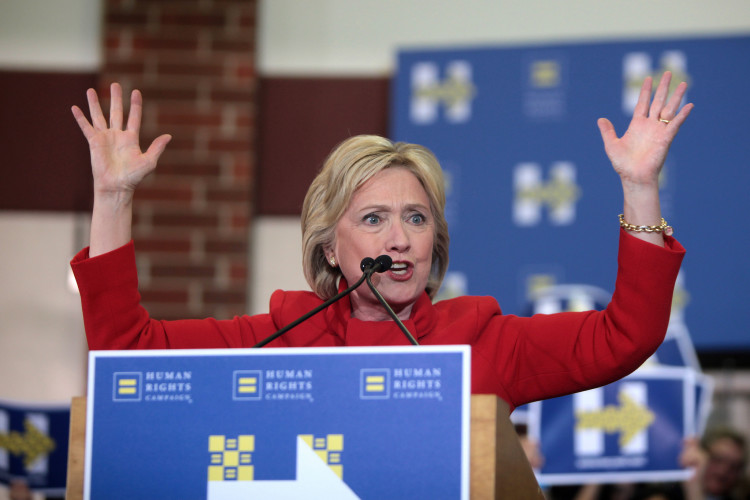 (Photo – Gage Skidmore on Flickr)
teleSUR – April 11, 2016
Democratic presidential frontrunner Hillary Clinton did not express any regret Monday about her support for the 2009 coup in Honduras, despite the deteriorating human rights situation, recently highlighted with the murder of prominent Indigenous activist Berta Caceres.
In fact, in an interview with the New York Daily News, in her opinion, the U.S. aid to military and police forces in Central America will eventually pay off just like Plan Colombia.
Plan Colombia was established under the administration of Bill Clinton in 1999 under the guise of fighting the war on drugs. The U.S. aid package, totalling almost US$2 billion, gave 78 percent of the funds to the Colombian military and police for counternarcotics and military operations against the rebel forces.
Despite a long list of studies and evidence that shows that Plan Colombia contributed to human rights abuses by security forces and the rise of paramilitary forces, Clinton took most of the credit for the current peace talks between the government and the FARC rebels, suggesting Plan Colombia brought peace to Colombia.
“I didn’t like the way it looked or the way they did it but (the coup leaders) had a very strong argument that they had followed the constitution and the legal precedence,” she said in an interview with the New York Daily News.
Democratically-elected president Manuel Zelaya was forcibly put on a plane and sent out of the country by the Honduran military in June 2009.
Clinton justified the move despite opposing advice from her top aides, who urged her to declare it a military coup, and to cut off U.S. aid, as some emails leaked in July revealed.
She admitted that the coup leaders “really undercut their argument by spiriting (Zelaya) out of the country in his pajamas, where they sent the military to take him out of his bed and get him out of the country.”
Nevertheless she strongly rejected the idea of cutting U.S. aid for Honduras, claiming this would have harmed the Honduran people, although it is mainly directed to the country’s security forces. It is used to keep the drug war within Honduran borders – as well as to keep Central American migrants running away from drug violence from reaching the United States.
59 Journalists Murdered in Honduras Since Clinton-Backed Coup
teleSUR – April 11, 2016
Since the 2009 U.S.-backed coup that removed President Manuel Zelaya, 59 journalists have been assassinated in Honduras, with four of them being murdered just in 2016 alone.
The most violent year until now has been 2015, with 218 alerts registered and 12 journalists assassinated.
In April 2015, the Honduras National Congress approved the Journalist Protection Law, which included measures like providing police protection when a journalist receives a threat. The law also planned the creation of a center monitoring threat follow-ups, although the government has not yet approved the budget.
In four years of former President Profirio Lobo’s government, 30 journalists were murdered, while in the current government headed by President Juan Orlando Hernandez, 22 journalists have been assassinated in the two years and three months since he took office. These two post-coup presidencies have been accused of systematic human rights abuses and corruption.
The Attorney General’s office has only processed six cases, while only four people have been prosecuted and sent to jail. There has not been any investigation into who ordered these crimes and the motivations behind each one.
A ‘Silent Coup’ for Brazil?
By Ted Snider | Consortium News | March 30, 2016
Brazil keeps its coups quiet (or at least quieter than many other Latin American countries). During the Cold War, there was much more attention to overt military regime changes often backed by the CIA, such as the overthrow of Guatemala’s Jacobo Arbenz in 1954, the ouster of Chile’s Salvador Allende in 1973 and even Argentina’s “dirty war” coup in 1976, than to Brazil’s 1964 coup that removed President João Goulart from power.
Noam Chomsky has called Goulart’s government “mildly social democratic.” Its replacement was a brutal military dictatorship.
In more modern times, Latin American coups have shed their image of overt military takeovers or covert CIA actions. Rather than tanks in the streets and grim-looking generals rounding up political opponents – today’s coups are more like the “color revolutions” used in Eastern Europe and the Mideast in which leftist, socialist or perceived anti-American governments were targeted with “soft power” tactics, such as economic dislocation, sophisticated propaganda, and political disorder often financed by “pro-democracy” non-governmental organizations (or NGOs).
This strategy began to take shape in the latter days of the Cold War as the CIA program of arming Nicaraguan Contra rebels gave way to a U.S. economic strategy of driving Sandinista-led Nicaragua into abject poverty, combined with a political strategy of spending on election-related NGOs by the U.S.-funded National Endowment for Democracy, setting the stage for the Sandinistas’ political defeat in 1990.
During the Obama administration, this strategy of non-violent “regime change” in Latin America has gained increasing favor, as with Secretary of State Hillary Clinton’s decisive support for the 2009 ouster of Honduran President Manuel Zelaya who had pursued a moderately progressive domestic policy that threatened the interests of the Central American nation’s traditional oligarchy and foreign investors.
Unlike the earlier military-style coups, the “silent coups” never take off their masks and reveal themselves as coups. They are coups disguised as domestic popular uprisings which are blamed on the misrule of the targeted government. Indeed, the U.S. mainstream media will go to great lengths to deny that these coups are even coups.
The new coups are cloaked in one of two disguises. In the first, a rightist minority that lost at the polls will allege “fraud” and move its message to the streets as an expression of “democracy”; in the second type, the minority cloaks its power grab behind the legal or constitutional workings of the legislature or the courts, such as was the case in ousting President Zelaya in Honduras in 2009.
Both strategies usually deploy accusations of corruption or dictatorial intent against the sitting government, charges that are trumpeted by rightist-owned news outlets and U.S.-funded NGOs that portray themselves as “promoting democracy,” seeking “good government” or defending “human rights.” Brazil today is showing signs of both strategies.
Brazil’s Boom
First, some background: In 2002, the Workers’ Party’s (PT) Luiz Inacio Lula da Silva came to power with 61.3 percent of the vote. Four years later, he was returned to power with a still overwhelming 60.83 percent. Lula da Silva’s presidency was marked by extraordinary growth in Brazil’s economy and by landmark social reforms and domestic infrastructure investments.
In 2010, at the end of Lula da Silva’s presidency, the BBC provided a typical account of his successes: “Number-crunchers say rising incomes have catapulted more than 29 million Brazilians into the middle class during the eight-year presidency of Luiz Inacio Lula da Silva, a former trade unionist elected in 2002. Some of these people are beneficiaries of government handouts and others of a steadily improving education system. Brazilians are staying in school longer, which secures them higher wages, which drives consumption, which in turn fuels a booming domestic economy.”
However, in Brazil, a two-term president must sit out a full term before running again. So, in 2010, Dilma Rousseff ran as Lula da Silva’s chosen successor. She won a majority 56.05 percent of the vote. When, in 2014, Rousseff won re-election with 52 percent of the vote, the right-wing opposition Brazilian Social Democratic Party (PSDB) went into a panic.
This panic was not just because democracy was failing as a method for advancing right-wing goals, nor was the panic just over the fourth consecutive victory by the more left-wing PT. The panic became desperation when it became clear that, after the PT had succeeded in holding onto power while Lula da Silva was constitutionally sidelined, he was likely returning as the PT’s presidential candidate in 2018.
After all, Lula da Silva left office with an 80 percent approval rating. Democracy, it seemed, might never work for the PSDB. So, the “silent coup” playbook was opened. As the prescribed first play, the opposition refused to accept the 2014 electoral results despite never proffering a credible complaint. The second move was taking to the streets.
A well-organized and well-funded minority whose numbers were too small to prevail at the polls can still create lots of noise and disruption in the streets, manufacturing the appearance of a powerful democratic movement. Plus, these protests received sympathetic coverage from the corporate media of both Brazil and the United States.
The next step was to cite corruption and begin the process for a constitutional coup in the form of impeachment proceedings against President Rousseff. Corruption, of course, is a reliable weapon in this arsenal because there is always some corruption in government which can be exaggerated or ignored as political interests dictate.
Allegations of corruption also can be useful in dirtying up popular politicians by making them appear to be only interested in lining their pockets, a particularly effective line of attack against leaders who appear to be working to benefit the people. Meanwhile, the corruption of U.S.-favored politicians who are lining their own pockets much more egregiously is often ignored by the same media and NGOs.
Removing Leaders
In recent years, this type of “constitutional” coup was used in Honduras to get rid of democratically elected President Zelaya. He was whisked out of Honduras through a kidnapping at gunpoint that was dressed up as a constitutional obligation mandated by a court after Zelaya announced a plebiscite to determine whether Hondurans wanted to draft a new constitution.
The hostile political establishment in Honduras falsely translated his announcement into an unconstitutional intention to seek reelection, i.e., the abuse-of-power ruse. The ability to stand for a second term would be considered in the constitutional discussions, but was never announced as an intention by Zelaya.
Nevertheless, the Supreme Court declared the President’s plebiscite unconstitutional and the military kidnapped Zelaya. The Supreme Court charged Zelaya with treason and declared a new president: a coup in constitutional disguise, one that was condemned by many Latin American nations but was embraced by then-Secretary of State Hillary Clinton.
This coup pattern reoccurred in Paraguay when right-wing Frederico Franco took the presidency from democratically elected, left-leaning Fernando Lugo in what has been called a parliamentary coup. As in Honduras, the coup was made to look like a constitutional transition. In the Paraguay case, the right-wing opposition opportunistically capitalized on a skirmish over disputed land that left at least 11 people dead to unfairly blame the deaths on President Lugo. It then impeached him after giving him only 24 hours to prepare his defense and only two hours to deliver it.
Brazil is manifesting what could be the third example of this sort of coup in Latin America during the Obama administration.
Operation Lava Jato began in Brazil in March of 2014 as a judicial and police investigation into government corruption. Lava Jato is usually translated as “Car Wash” but, apparently, is better captured as “speed laundering” with the connotation of corruption and money laundering.
Operation Lava Jato began as the uncovering of political bribery and misuse of money, revolving around Brazil’s massive oil company Petrobras. The dirt – or political influence-buying – that needed washing stuck to all major political parties in a corrupt system, according to Alfredo Saad Filho, Professor of Political Economy at the SAOS University of London.
But Brazil’s political Right hijacked the investigation and turned a legitimate judicial investigation into a political coup attempt.
According to Boaventura de Sousa Santos, Professor of Sociology at the University of Coimbra in Portugal and Distinguished Legal Scholar at the University of Wisconsin-Madison, although Operation Lava Jato “involves the leaders of various parties, the fact is that Operation Lava Jato – and its media accomplices – have shown to be majorly inclined towards implicating the leaders of PT (the Workers’ Party), with the by now unmistakable purpose of bringing about the political assassination of President Dilma Rousseff and former President Lula da Silva.”
De Sousa Santos called the political repurposing of the judicial investigation “glaringly” and “crassly selective,” and he indicts the entire operation in its refitted form as “blatantly illegal and unconstitutional.” Alfredo Saad Filho said the goal is to “inflict maximum damage” on the PT “while shielding other parties.”
Neutralizing Lula
The ultimate goal of the coup in democratic disguise is to neutralize Lula da Silva. Criminal charges — which Filho describes as “stretched” — have been brought against Lula da Silva. On March 4, he was detained for questioning. President Rousseff then appointed Lula da Silva as her Chief of Staff, a move which the opposition represented as an attempt to use ministerial status to protect him from prosecution by any body other than the Supreme Court.
But Filho says this representation is based on an illegally recorded and illegally released conversation between Rousseff and Lula da Silva. The conversation, Filho says, was then “misinterpreted” to allow it to be “presented as ‘proof’ of a conspiracy to protect Lula.” De Sousa Santos added that “President Dilma Rousseff’s cabinet has decided to include Lula da Silva among its ministers. It is its right to do so and no institution, least of all the judiciary, has the power to prevent it.”
No “presidential crime warranting an impeachment has emerged,” according to Filho.
As in Honduras and Paraguay, an opposition that despairs of its ability to remove the elected government through democratic instruments has turned to undemocratic means that it hopes to disguise as judicial and constitutional. In the case of Brazil, Professor de Sousa Santos calls this coup in democratic disguise a “political-judicial coup.”
In both Honduras and Paraguay, the U.S. government, though publicly insisting that it wasn’t involved, privately knew the machinations were coups. Less than a month after the Honduran coup, the White House, State Department and many others were in receipt of a frank cable from the U.S. embassy in Honduras calling the coup a coup.
Entitled “Open and Shut: the Case of the Honduran Coup,” the embassy said, “There is no doubt that the military, Supreme Court and National Congress conspired on June 28 in what constituted an illegal and unconstitutional coup.” The cable added, “none of the . . . arguments [of the coup defenders] has any substantive validity under the Honduran constitution.”
As for Paraguay, U.S. embassy cables said Lugo’s political opposition had as its goal to “Capitalize on any Lugo missteps” and “impeach Lugo and assure their own political supremacy.” The cable noted that to achieve their goal, they are willing to “legally” impeach Lugo “even if on spurious grounds.”
Professor de Sousa Santos said U.S. imperialism has returned to its Latin American “backyard” in the form of NGO development projects, “organizations whose gestures in defense of democracy are just a front for covert, aggressive attacks and provocations directed at progressive governments.”
He said the U.S. goal is “replacing progressive governments with conservative governments while maintaining the democratic façade.” He claimed that Brazil is awash in financing from American sources, including “CIA-related organizations.” (The National Endowment for Democracy was created in 1983, in part to do somewhat openly what the CIA had previously done covertly, i.e., finance political movements that bent to Washington’s will.)
History will tell whether Brazil’s silent coup will succeed. History may also reveal what the U.S. government’s knowledge and involvement may be.
Hillary is a Neocon
She has the record and the vision
Hillary is a Neocon – 03/15/2016
 “For this former Republican, and perhaps for others, the only choice will be to vote for Hillary Clinton. The party cannot be saved, but the country still can be.” —Robert Kagan
 “I have a sense that she’s one of the more competent members of the current administration and it would be interesting to speculate about how she might perform were she to be president.” —Dick Cheney
 “I’ve known her for many years now, and I respect her intellect. And she ran the State Department in the most effective way that I’ve ever seen.” —Henry Kissinger
Nobody Beats This Record
- She says President Obama was wrong not to launch missile strikes on Syria in 2013.
- She pushed hard for the overthrow of Qadaffi in 2011.
- She supported the coup government in Honduras in 2009.
- She has backed escalation and prolongation of war in Afghanistan.
- She voted for the 2003 invasion of Iraq.
- She skillfully promoted the White House justification for the war on Iraq.
- She does not hesitate to back the use of drones for targeted killing.
- She has consistently backed the military initiatives of Israel.
- She was not ashamed to laugh at the killing of Qadaffi.
- She has not hesitated to warn that she could obliterate Iran.
- She is not afraid to antagonize Russia.
- She helped facilitate a military coup in Ukraine.
- She has the financial support of the arms makers and many of their foreign customers.
- She waived restrictions at the State Department on selling weapons to Saudi Arabia, Algeria, Kuwait, United Arab Emirates, Oman, and Qatar, all states wise enough to donate to the Clinton Foundation.
- She supported President Bill Clinton’s wars and the power of the president to make war without Congress.
- She has advocated for arming fighters in Syria.
- She supported a surge in Iraq even before President Bush did.

Colombia, Honduras Are Most Unequal Countries in Latin America
teleSUR – March 10, 2016
Latin America has five of the world’s most unequal countries, with Honduras and Colombia being the region’s top two, according to statistics released by the World Bank Wednesday.
Using data from December, the World Bank calculated that Latin America is not the poorest region in the world, but is home to some of the world’s most unequal countries.
Among them are Honduras (6), Colombia (7), Brazil (8), Guatemala (9) and Panama (10), which all rank within the world’s top 10 most unequal countries.
The results were found by calculating each country’s Gini coefficient, what measures the income distribution in each nation, whereby nations approaching 0 have total equality and those approaching 100 have total inequality.
Colombia’s Gini coefficient ranked at 53.5, the same as 2012, while Honduras’ was 53.7 and plummeting dramatically, according to news reports.
In the current situation, the top 10 percent of Colombia’s richest people earn four times more than the bottom 40 percent of the population. Additionally, 77.6 percent of land in the country is owned by only 13.7 percent of the country’s inhabitants.
In Honduras, 64.5 percent of the population is living in poverty while 42.6 percent live in extreme poverty (less than US$2.5 a day), according to World Bank statistics.
Featured Video
10K More U.S. Troops Deploy as Trump Weighs New Iran Strikes
or go to
Aletho News Archives – Video-Images
From the Archives
Genetic baloney in thick slices
MAYBE COULD BE INC.
By Jon Rappoport | No More Fake News | July 8, 2021
Gene research companies tend to come and go. They start out banging and popping like fireworks in the sky, and then they fade out—selling themselves to larger outfits who’ve hired better liars…
Once upon a time, it sounded easy. Start with a disease, find the gene responsible for the disease, and correct the problem.
Then, researchers wondered, was disease the result of one gene or a group of genes acting together?
Either way, the proof would be in devising cures for diseases using gene therapy. “Not yet, but soon…”
And regardless, the major need was: money. Lots and lots of money.
This need required good PR people. “We have to pump up the idea that we’re on the edge of tremendous breakthroughs. We’re always on that edge…”
This hype also needed to obscure the fact that there wasn’t (and isn’t) ANY gene cure for ANY disease. … continue
Blog Roll
 Aletho News
- UK Government Body Kept Files on People Criticizing Prevent Program
- US military withdrawal from Iraq and the collapse of US-Israeli hegemonic project in West Asia
- What does Europe want – a war with Russia?
- She Followed the Actual Data on COVID Vaccines and Masks — Her Career Took a Huge Hit
- Florida AG Sues Pfizer, Bourla Over Deceptive Marketing of COVID Vaccines
- Von der Leyen gifts her spin doctor a job for life
- 10K More U.S. Troops Deploy as Trump Weighs New Iran Strikes /Suliaman Ahmed
- Iranian crew declared Dena training vessel ‘unarmed’ to US warship before deadly torpedo strike: Report
- Iran’s NPT debate moves beyond parliament
- Houthis condemn Saudi claims of attack on Medina
- If Americans Knew
- Israel is squeezing the life out of Palestinians – Daily Update
- The Israeli Right Portrays Islam as Murderous. It Serves a Political Purpose
- Jordan Has Had Enough: King Abdullah’s Scathing Warning to Israel
- Israeli Colonizers (i.e. Settlers) Kill Palestinian Man Near Salfit
- New Google Maps images reveal massive scale of devastation in Gaza
- Jewish supremacy, anti-Palestinian bigotry on display in Israel – Daily Update
- Israeli Soldiers Abduct At Least 22 Across Occupied West Bank
- Eight Palestinians Killed in Israeli Attacks on Gaza
- Israeli former leaders and security chiefs threaten legal action over ‘Jewish terrorism’
- Israel map in LA Times ad includes all land from the river to the sea
- No Tricks Zone
- Green Energy Debacle: German Expert Professor Fritz Vahrenholt Warns Of Severe Economic And Social Consequences
- Two More Paleo Reconstructions Affirm Meters-Higher Sea Levels Across Ireland, Brazil 7000-6000 Years Ago
- New Study: Earth And Venus Surface Warmth Largely Explained By Convection And Lapse Rate, Not CO2 Or Radiation
- 2025 Nature Paper Claiming Worsening Global Drought Gets RETRACTED …Heavily Flawed
- New Study: ‘Global Drought Shows No Detectable Recent Acceleration Under Climate Warming’
- Economic Masterminds: German Socialists Suggest Taxing Productivity Gains Stemming From Using AI
- The South China Sea Has Not Been Cooperating With The Climate Change Narrative
- Energy Crisis: Germany Enters Heating Season With Historically Low Gas Reserve Fill Levels
- New Study: The Antarctic Ice Sheet Gained Mass From 2020-2024 Due To Staggering Snow And Ice Accumulation
- Study: Ocean Heating Rates From Thousands Of Years Ago ‘Dwarf’ Modern Ocean Heating Rates

