Hernandez declared winner of Honduras presidential race, opposition calls for rallies
Press TV – December 18, 2017
In Honduras, incumbent Juan Orlando Hernandez has been declared the winner of last month’s disputed presidential election after a partial recount, with the opposition candidate rejecting the results and calling for fresh protests.
The Supreme Electoral Tribunal said Sunday after the official recount that Hernandez has won with 42.95 percent to 41.42 for challenger Salvador Nasralla.
“We have fulfilled our obligation (and) we wish for there to be peace in our country,” the tribunal’s president David Matamoros said.
Matamoros said the tribunal had resolved all the disputed issues, and that votes were recounted at select polling stations.
The count has, however, been questioned by the two main opposition parties and monitors with the Organization of American States (OAS).
As he left for the United States, Nasralla rejected Hernandez’s re-election as illegitimate and called for more protest rallies on Monday.
“The declaration by the court is a mockery because it tramples the will of the people,” Nasralla said. He added that he was “very optimistic” because “the people do not endorse fraud.”
He also said he would urge the OAS in Washington to invoke its democratic charter against Honduras.
The former Honduran president, Manuel Zelaya, who backed Nasralla, tweeted Hernandez “is not our president,” urging people to take to the streets in protest.
Meanwhile, the OAS secretary general, Luis Almagro, said “serious questions” surrounded the election results, urging Honduran officials to avoid making “irresponsible announcements.”
He also called for a fresh presidential election to guarantee peace in the country, which has been the scene of angry protests and clashes since the November 26 presidential election.
However, European Union election observers said the vote recount showed no irregularities.
The initial results had shown Nasralla with a significant lead over Hernandez with nearly 60 percent of the vote counted.
The electoral tribunal then went mysteriously silent, giving no further public updates for about 36 hours, and when they resumed, Nasralla’s lead steadily eroded and ultimately reversed in favor of Hernandez.
The protests and violence, which broke out over the manner of announcing the results, has killed at least 22 people.
Honduran Opposition Seeks Annulment of Election Results
teleSUR | December 2017
The main opposition parties in Honduras independently submitted requests to annul the results of the Nov. 26 presidential election, which they consider fraudulent and skewed in favor of President Juan Orlando Hernández.
Salvador Nasralla, the leader of the Alliance of Opposition Against the Dictatorship, called on the Supreme Electoral Tribunal (TSE) to initiate a total recount of all votes and documents.
Before Nasralla presented his official challenge before the TSE, he warned that 200,000 extra votes had already been counted.
“Honduras has become a global joke,” he told reporters.
The candidate stressed his optimism, claiming that justice will prevail in the end.
“I know the people will defend the result (of the recount),” said Nasralla, who indicated that once the legal bodies perform their duties after the formal challenge, he plans to travel abroad to denounce the “fraud we have found.”
Meanwhile, the Liberal Party secretary, Octavio Pineda, also delivered a formal request to the TSE to annul the results. “Principles have been violated since the current president was allowed to participate in the electoral process when the Constitution forbids it,” he said.
The TSE has up to 10 days to respond to requests for annulment.
The election, which occurred two weeks ago, has left Hondurans unsure of who will be their next president for the next four years. This uncertainty has triggered protests in the Central American country that has left at least 11 dead and 15 wounded.
OAS Finally Hints at ‘Irregularities’ in Honduran Elections Days After Vote
teleSUR | December 7, 2107
After almost two weeks since Honduran elections, the Organization of American States said it may urge for a new presidential vote if “irregularities” continue to undermine the credibility of the Nov. 26 results, which have not been officially announced.
OAS Secretary General Luis Almagro said in a written statement the regional group would prefer to audit the existing ballots, rather than initiate a new vote, adding that Honduran citizen confidence in its electoral system cannot be restored “without an exhaustive and meticulous process of verification that determines the existence or not of an electoral fraud.”
The Opposition Alliance’s Salvador Nasralla and many national and international organizations have called the vote count fraudulent, as a wide lead was erased to right-wing incumbent President Juan Orlando Hernandez of the National Party.
With the electoral process in its second week Nasralla and his team began calling for a run off election if a full ballot recount under international scrutiny couldn’t be completed.
The Opposition Alliance first demanded an internationally audited recount of the ballots from over 1,000 polling stations. This was carried out. They later demanded that the Supreme Electoral Tribunal recount the disputed ballots from over 5,000 polling stations. TSE officials and Hernandez agreed to the ballots in questions late last night after regional pressure.
Alliance evidence of electoral irregularities on the part of the TSE and its Director David Matamoros has incited profound distrust of the TSE from the opposition camp, creating a virtual stalemate in the process. Nasralla said late last night, “you can’t present your demands to a tribunal that isn’t neutral.”
He said he no longer recognizes the TSE and demands that an international mediator oversees any recount. “If we hadn’t had international participation, we would truly be in the law of the jungle,” Nasralla commented.
Nasralla and his team had earlier sent the TSE its 11 demands for electoral transparency, which included the revision of ballot boxes they say arrived at TSE offices “opened” exposing “sensitive information,” but they haven’t been completed.
Luis Zelaya, of the Liberal Party and third runner-up in the elections, has thrown his support to Nasralla and agreed that a full recount under OAS and European Union observation should take place.
Meanwhile, Matamoros was vague Wednesday night as to whether a full recount or a new election will take place.
According to current TSE figures, Hernandez is ahead with 42.98 percent while Nasralla has 41.38 percent of votes. The TSE has counted, at least once, nearly 100 percent of all ballots. By law, the TSE has until Dec. 26 to declare a winner.
Other OAS requests were that the Honduran government restore all constitutional rights to citizens and lift the nighttime national curfew, both of which were put in place Dec. 1. After the statement was released the administration lifted the curfew in nearly half of the country’s departments, but it’s still in effect in most of the nation until Dec. 11.
The curfew was put in place to limit Opposition Alliance supporters from protesting what they say was a stolen election. Despite the curfew, however, thousands of opposition supporters continue to rally day and night on the streets and highways of Honduras.
The Honduran Committee for Families of the Detained and Disappeared said that 14 people have been killed, 51 injured and 844 detained so far during the post-election protests.
Hernandez supporters are reportedly marching today in Tegucigalpa to support their candidate.
The U.S. State Department released a statement yesterday advising U.S. citizens to delay or cancel travel to Honduras “due to ongoing political protests and the potential for violence.”
Honduran opposition urges total vote recount or run-off
Press TV – December 6, 2017
Honduras’ opposition presidential candidate has demanded either an entire vote recount or a run-off poll following a controversial vote-counting process that resulted in favor of incumbent President Juan Orlando Hernandez by a low margin but no declared winner.
Salvador Nasralla, who had earlier demanded a recount of at least one-third of the votes, said in a Twitter post on Tuesday that the electoral tribunal now had to review all the voting cards.
“If you don’t agree with that, let’s go to a run-off between (Hernandez) and Salvador Nasralla,” he added.
It took Honduran authorities more than a week to count the votes from the November 26 presidential election in the country of only nine million people.
Early on Monday, electoral authorities said Hernandez had won 42.98 percent of the votes, compared with Nasralla’s 41.39 percent. But the authorities stopped short of declaring a winner.
As the results began to trickle in last week, Nasralla was in the lead with a significant margin before a 24-hour hiatus in the official vote count reversed that trend. The opposition candidate soon alleged fraud and called on his supporters to take to the streets. Tens of thousands took to the streets on Sunday in a show of support for Nasralla, a former TV star.
Former Honduran president Manuel Zelaya, who was toppled in a US-backed coup in 2009 and now supports Nasralla, also declared through a Twitter message that the opposition was seeking a total recount of the vote, or legislation to allow for a run-off.
Meanwhile, police forces rebelled against the Hernandez administration on Monday, refusing to take part in a crackdown on protesters and calling on the government to address the political stalemate.
A top official at the Honduran electoral tribunal, David Matamoros, invited the opposition to compare their copies of voter tally sheets with the official body’s versions. He also said the tribunal would extend a deadline for legal challenges from Wednesday to Friday.
Meanwhile, protest rallies in favor of Nasralla that started last week continued on Tuesday afternoon as scores of people, including police officers, converged at the Tegucigalpa headquarters of Honduras’ elite police force yelling “Out, JOH,” using President Hernandez’s initials.
Hernandez, who has been commended by the US for his crackdown on violent street gangs, has also claimed victory a number of times since the election but avoided making the claim in remarks broadcast on Monday and Tuesday.
Honduran police refuse to obey government orders to curb protest
Press TV – December 5, 2017
Officers of the Honduras National Police have refused to enforce a curfew after days of deadly violence triggered by allegations of electoral fraud.
Honduran police announced on Monday night that they will refuse to obey orders from the government of the incumbent president, Juan Orlando Hernandez, and will remain in their barracks until a political crisis triggered by last Sunday’s contested presidential election has been resolved.
According to reports, all national police as well as hundreds of members of riot police force known as Cobras were refusing to obey the government’s orders during the protests in the capital, Tegucigalpa and instead are striking.
“We want peace, and we will not follow government orders – we’re tired of this,” said a spokesman outside the national police headquarters in Tegucigalpa.
“We aren’t with a political ideology. We can’t keep confronting people, and we don’t want to repress and violate the rights of the Honduran people.”
Crowds of anti-government protesters greeted the announcement with cheers.
The small Central American nation of 10 million, which suffers from chronic violence and prolific gang activity, held the presidential vote last Sunday.
Rival candidate Salvador Nasralla has cried foul and his supporters have been on the streets protesting.
Tensions have been high since shortly afterwards. Nasralla was in the lead with a significant margin before a 24-hour hiatus in the official vote count reversed that trend last week. The opposition candidate soon alleged fraud and called on his supporters to take to the streets.
In recent days, Tens of thousands took to the streets in a show of support for Nasralla, a former TV star.
Authorities then restricted the freedom of movement in the country in an attempt to control widening unrest.
The Inter-American Commission on Human Rights on Monday reported that they have received preliminary information on the deaths of 11 Hondurans during the protests.
Meanwhile, the electoral tribunal in Honduras has finished counting votes in the country’s contentious presidential election after more than a week, with incumbent President Juan Orlando Hernandez having received more votes in the official tally.
Early on Monday, electoral authorities said Hernandez had won 42.98 percent of the votes, compared with opposition candidate Salvador Nasralla’s 41.39 percent, based on 99.96 percent of the votes counted.
But the authorities stopped short of declaring a winner.
Honduras: Teenage Girl Killed as Army Enforces Curfew
teleSUR | December 2, 2017
Three people – including a teenaged girl – have so far been killed in violent clashes following the disputed Honduran elections, as the armed forces opened fire on unarmed opposition supporters while enforcing a 10-day curfew imposed by the government late Friday.
One man was killed in the port city of La Ceiba on Friday and 19-year-old Kimberly Dayana Fonseca was shot in the head early Saturday in Tegucigalpa as soldiers busted up protesters’ blockades, a spokesman for the national police said, bringing the total death toll to three.
In a brief statement to the press, the head of the Supreme Electoral Tribunal (TSE) David Matamoros announced late Saturday that the scrutiny of more than 1,000 disputed ballots would resume Sunday 9:30am local time.
He also noted that screening more than 5,000 ballots, as requested by the Opposition Alliance, would have taken 12 to 15 days. “We appreciate your presence, but there will be nothing else here today, I reiterate that we will call for tomorrow at 09h30 local time,” the magistrate said.
In response, Opposition Alliance leader Salvador Nasralla accused the TSE of deliberately excluding the towns of Lempira, La Paz and Intebuca after he requested they be reviewed when the turnout was abnormally high (75 percent) compared with the rest of the country (50 percent).
Nasralla insisted it was mathematically impossible that Hernandez could win the election with 30 percent of the votes still uncounted before the electronic system collapsed.
“We want what the Honduran people want,” he told teleSUR in a televised interview. “If the people want, we will run for another election. If they want, I won’t participate if Juan Orlando Hernandez doesn’t either.
“If (electoral authorities) refuse to recount, let’s hold the elections again, but with an international tribunal: that’s our position,” he concluded, describing the situation as “a coup d’etat.”
He also said the leadership of the armed forces had “sold themselves” in shirking their constitutional duties “against a tyrant who forcefully wants to stay in power,” and accused the government of infiltrating opposition protests in order to loot local stores and discredit the movement.
Human rights organizations have denounced the curfew, blaming “excessive force” by state troops. The U.S.-based Action Network has sent an open letter to the U.S: Congress and State Department, expressing “deep concern about reports of fraud and state violence” and calling for the immediate suspension of all U.S. police and military aid to Honduras.
The Venezuelan government firmly condemned on Saturday the “latest attempted blow against democracy from sectors of the Honduran oligarchy. The people’s will and human rights of the people of Honduras must be respected,” said Jorge Arreaza on Twitter.
In a communique, Venezuela’s Foreign Ministry also slammed the “repression and the excessive use of force by State security forces,” accusing “the same actors” responsible for the 2009 coup against the constitutional President Manuel Zelaya.
The Honduran Ministry of Justice ordered the suspension of citizens’ constitutional rights shortly before 11pm Friday. On Saturday, the Committee of the Relatives of the Disappeared in Honduras (Dodafeh) confirmed 11 people have been injured in Tegucigalpa since late Saturday and 41 arrested, six of whom are minors.
The government, controlled by current president and electoral candidate Juan Orlando Hernandez, claims the move is to counter what they call “violent protests” by supporters of presidential candidate and Opposition Alliance leader Nasralla.
The Honduran Roundtable for Human Rights (HRHR) said “excessive force” is being used by Honduran military and state security forces. Nasralla said the suspension of constitutional guarantees is part of a Supreme Electoral Tribunal (TSE) plan to “steal” his “victory,” claiming the electrobal body has committed electoral fraud since polls closed Sunday night.
The HRHR, in a formal statement, said the Armed Forces are creating a “terrorist state” against peaceful protesters, killing at least two people with rubber bullets and injuring dozens. National police forces have “arbitrarily arrested” citizens, intimidated media and thrown tear gas at marchers.
Bolivian President Evo Morales reprimanded the United States and Organization of the American States (OAS) for their alleged complicity: “Nearly a week since the Honduran elections. Why are the U.S. and OAS silently complicit regarding the elections and death of citizens in Honduras? Democracy is in danger in a neighboring country?”
Official election results on the TSE website have remained unchanged since Friday morning, with Hernandez leading by less than one percentage point over Nasralla. Over 94 percent of ballots are counted.
The decree now in effect until Dec. 11 says that people can move about freely only from 6am until 6pm. Outside of that time, they are not allowed to be on highways or in any public space, otherwise they are “putting their lives in danger.” The decree gives the military the right to patrol the streets and detain anyone “violating” the curfew.
Honduras in limbo as election results suddenly shift
Press TV – November 29, 2017
Honduras was in a state of limbo on Tuesday as presidential election results began to trickle in after a 24-hour delay, with a TV host’s surprise lead suddenly starting to plunge, prompting him to claim that electoral fraud was taking place.
President Juan Orlando Hernandez, who won US praise for helping tackle the flow of migrants and deporting drug cartel leaders, was favored to win before the Sunday vote in the poor Central American nation with one of the world’s highest murder rates.
But a delayed, partial count on Monday morning pointed toward an unexpected victory for TV entertainer Salvador Nasralla, 64. Inexplicably, election authorities then stopped giving results for more than 24 hours.
When, under mounting criticism from international election monitors over a lack of transparency, the electoral tribunal began updating its website again, the tendency rapidly began to change.
In a television interview on Tuesday evening, an angry Nasralla said the election was being stolen from him and asked his supporters to flock to the capital, Tegucigalpa, to protest.
“We’ve already won the election,” he said. “I’m not going to tolerate this, and as there are no reliable institutions in Honduras to defend us, tomorrow the Honduran people need to defend the vote on the streets.”
Nasralla accused the conservative president of plotting to rig the vote, saying his “survival instinct” was hijacking democracy.
He also said Hernandez was colluding with the army and the electoral authorities to forge new result sheets and give himself the edge in the Sunday presidential election.
“He controls the media. He’s going to have the result sheets he wants validated and change the will of the people.”
“He’s trying to sow chaos so he can declare a state of emergency and take control with the help of his people and the army.”
The Electoral Observation Mission of the Organization of American States (EOM/OAS) in Honduras urged people to remain calm and wait for official results, which it said should be delivered as quickly and transparently as possible.
“The credibility of the electoral authorities and the legitimacy of the future president depend on this,” it said in a statement.
On Tuesday evening, Nasralla’s original five-point lead had thinned to under 2 percentage points, with nearly 71 percent of ballots counted, according to the election tribunal.
Nasralla said in a later television interview that the election tribunal was only counting ballots from regions where Hernandez had won, skewing the results and giving the false sense that the president was heading for victory. He asked the tribunal to include ballots from regions where he was stronger.
The election in this poor, gang-plagued country has turned into a drawn-out showdown between Nasralla, 64, and Hernandez, 49, who is going for four more years in office despite a constitutional limit of just one term.
Both candidates have declared victory, but the results are far from clear.
Hernandez’s conservative National Party — which controls the executive, legislative and judicial branches of government — contends that a 2015 Supreme Court ruling allows his re-election.
Nasralla and his coalition, the Opposition Alliance Against the Dictatorship, have denounced the incumbent’s bid, saying the court does not have the power to overrule the 1982 constitution.
Difficult negotiations
On Tuesday, Hernandez reiterated that he had won, and refused to concede, telling supporters they should wait for final results.
“The result is more than clear,” he said at the presidential residence. “It is important for everyone to be patient, for everyone to be considerate with Honduras.”
After Hernandez spoke, thousands of his blue-clad supporters gathered outside the presidential residence to celebrate his supposed victory.
“We won the election with Juan Orlando Hernandez, and we won’t let them remove him from power,” said 35-year-old housewife Maria Aguirre, who hailed from a rough neighborhood on the outskirts of Tegucigalpa.
Meanwhile, two European diplomats who spoke on condition of anonymity said the election tribunal’s delay was due to difficult negotiations between Hernandez’s National Party and Nasralla’s alliance. Behind closed doors, the parties were discussing immunity from prosecution for current officials and how to carve up positions in government, the diplomats said.
But in an interview on Tuesday, Nasralla denied he was in talks with the National Party.
He vowed to review whether to keep US troops stationed at a base in the country if he wins the election but also promised to deepen security cooperation with the US.
Hernandez’s National Party appears set to retain control of Congress in the election, giving it the second-most important perch in the country.
The European Union’s chief observer for the election, Marisa Matias, urged election officials to maintain an open channel of communication as they finalized the results.
The electoral body had been so certain Hernandez would win that it showed unprecedented transparency during the contest, one of the diplomats said. That left the body with little room to maneuver when Nasralla came from nowhere to take a strong lead.
Nasralla is backed by former president Manuel Zelaya, who was ousted in 2009 after he proposed a referendum on his re-election. The possible return to a position of influence for one-time leftist Zelaya risks fueling concern in Washington.
Situated in the heart of Central America’s “Northern Triangle,” where gangs and poverty are rife, Honduras has one of the highest murder rates in the world Hernandez was credited with lowering the murder rate and boosting the economy, but he was also hurt by accusations of ties to illicit, drug-related financing that he denies.
European ‘Left’ Caves in to Censorship and Media Lies
By Tortilla Con Sal | teleSUR | May 31, 2017
In 2011, the former European colonial powers, backed by the United States, with the complicity of the United Nations, worked with minority opposition forces to overthrow legitimate governments in Libya, Syria and the Ivory Coast. They trashed the very international law and basic human rights they cynically proclaimed to defend. In 1961, the Belgian and U.S. governments colluded directly in the murder of Patrice Lumumba, the Democratic Republic of the Congo’s elected Prime Minister.
No one should be surprised at how easily the majority of progressive opinion in the West is intimidated by bullying from the mainstream. The overwhelming majority of progressive Western media outlets and intellectuals either accepted or openly supported Western aggression and intervention in 2011, as if they had learned nothing in the 50 years following the martyrdom of Patrice Lumumba. The 2011 events faithfully re-enacted the catastrophe of the Congo 50 years earlier.
Subsequently, that country has suffered over five million deaths from civil war and foreign intervention, a holocaust shamefully ignored internationally. Similarly, the destruction of Libya and Syria have provoked catastrophic human suffering with millions displaced and hundreds of thousands killed. Now, the U.S. elites and their allies are applying the age old formula of 1961 and 2011 to Venezuela. What still passes for the Western Left should be ferociously defending Venezuela’s right to self-determination.
Instead, less blatantly than in 2011, majority progressive opinion has crumbled and folded against the same old imperialist psychological warfare offensive used against every imperialist target since the end of WWII. Most progressive comments on Venezuela implicitly validate corporate media spin that, as in Syria, Venezuela’s opposition can be neatly segmented into moderates and extremists when in fact the main opposition leaders refuse dialogue.
With great restraint, President Nicolas Maduro has banned the use of lethal force and persisted in efforts at negotiation. Extensive Western media coverage falsely promotes an image of government repression in Venezuela in sharp contrast to their failure in 2009 to cover murderous government repression in Honduras of massive peaceful protests against the country’s coup regime. Those protests lasted over four months, much longer than the Venezuelan opposition’s latest prolonged coup attempt. But events in Honduras received nothing like the coverage of the current crisis in Venezuela. Western media soft-pedalled events in Honduras because the U.S. authorities supported the coup, one they hope to see repeated in Venezuela.
Despite that self-evident fact, Western progressive opinion has effectively caved in to the false mainstream corporate media narrative that the Venezuelan opposition offensive is a legitimate one against a dictatorial government. That moral and political collapse makes itself evident in many ways.
The latest example in Europe is the illegal summary dismissal by a leading Swedish progressive media outlet of its most experienced journalist writing on Latin America, Dick Emanuelsson. Dick has covered Latin American news for over 35 years for the Flamman weekly. Based for many years in Bogota before moving to Tegucigalpa in 2006 where he works with his partner Mirian, Dick’s reports cover all of Latin America and the Caribbean.
Very clearly, Flamman’s decision is blatantly political and should certainly be seen in the context of the Swedish authorities’ support for U.S. attempts to censor Wikileaks in the case of Julian Assange. In Emanuelsson’s case, the decision will surprise no one with any experience with the phony progressive non-governmental and media sector in Western Europe and North America.
Just as Western governments trample human rights while claiming to defend them, so Western non-governmental sector managers abuse basic rights when it suits them. Obviously, Flamman’s editors can no longer accommodate Emanuelsson’s uncompromising support for radical political and social movements in Latin America because it conflicts with received wisdom in Sweden.
Emanuelsson is among the very few European reporters with a lifetime’s experience of reporting on Latin America and one of only a handful writing as revolutionaries. Over the years, his work on Colombia relentlessly exposed the paramilitary and narcotics links of Colombia’s ruling elite. He was practically the only European reporter writing first hand about the FARC-EP’s guerrilla struggle against successive corrupt genocidal Colombian governments and the persistent efforts of the Colombian guerrilla to work for peace.
Similarly, following the 2009 coup in Honduras, Dick and Mirian fearlessly reported the events of the coup itself, the murderous repression of the peaceful protest movement and the return of ousted President Manuel Zelaya. Subsequently, along with a few North American activists, they have worked in constant solidarity with Honduran activists and reporters documenting the corrupt regimes of Porfirio Lobo and Juan Orlando Hernandez.
But now, the supposedly progressive editors of one of Sweden’s leading labor media outlets ignominiously dismissed Emanuelsson two years before retirement, despite his unique record of commitment and achievement.
In order to fire Emanuelsson, Flamman’s editor blew out of proportion minor errors made in relation to a task that only takes up about 10 percent of his overall agreed workload, totally disregarding the Swedish Law of Employment’s Protection – an odd thing to do for a media outlet that regards itself as a defender of worker’s rights. No criticisms about his regular feature reports on Latin America nor about his overall coverage were issued. In fact, no such criticisms against his work have ever been made in almost 35 years!
The paper’s readership has always regarded Emanuelsson’s work as exemplary reporting unavailable elsewhere. On the basis of their flimsy pretext and ignoring his impressive track record, Flamman tried to dismiss him with no compensation. The flagrant illegality of the dismissal notice under Swedish labor law is beyond dispute. When his union intervened, Flamman upped their offer to a measly four month’s salary, a recompense adding insult to the injury of chronic insecurity.
Flamman is an ostensibly left-wing weekly associated with the former VPK Left Communist political party which years ago aligned with acceptable pro-imperialist opinion in Sweden. That realignment is part of the general drift to the right in Europe which has seen the neo-fascist Sverigedemokraterna party become the second most popular in the country. Rather than fight that drift, many former communists and other progressives in Sweden have accommodated to it. That reality is clear from the support of most progressive opinion in Sweden for NATO’s role in the destruction of Libya and Syria and the decline in solidarity with Cuba.
Domestically, Flamman’s treatment of Emanuelsson reflects the accommodation of Swedish former communists with the neoliberal agenda of Sweden’s business sector. Like so many phony progressives across Western Europe, Flamman’s editors talk excitedly about Podemos in Spain, Jeremy Corbyn’s Labor Party in the U.K. or even Syriza in Greece.
But their real commitments reveal themselves in the practice they apply to cases like that of Emanuelsson. People may or may not agree with the politics of his reporting any more than they have to agree with the politics of Julian Assange, but basic justice demands we should defend their fundamental human rights.
1 Year After Berta Caceres’ Murder, Activists Demand US Stop Funding Abusive Honduran State Forces
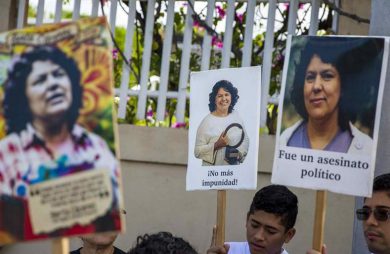
Photo: EFE
teleSUR | March 2, 2017
One year after the assassination of Honduran Indigenous leader Berta Caceres, human rights organizations and Indigenous communities continue to demand justice in the case, while the international branch of the struggle pressures to an end of U.S. funding for police and military forces accused of human rights abuses in the Central American country.
Caceres’ family sent a letter Thursday to U.S. Representative Norma Torres to ask for her support for the Berta Caceres Human Rights in Honduras Act, which was reintroduced the same day to the House of Representatives after stalling without adequate support since last year. The bill seeks the suspension of Washington’s security aid to Honduras until the country fulfills more rigorous human rights conditions — including an end to abuses by the police and military and justice in cases like Berta Caceres’ murder.
“It is increasingly clear that the government of Juan Orlando Hernandez is unwilling to act decisively to stop the killings of social activists in Honduras and to conduct honest and thorough investigations of killings and attacks,” Caceres’ family members state in the letter to Torres, urging her to “stand with” them and with Honduras. “In addition, the government has consistently failed to respect basic indigenous land rights, as it is required to do under its international treaty obligations.”
The original U.S. bill inspired by Caceres’ murder paints a grim picture of Honduras’ grave human rights situation, including the lack of justice in cases like Caceres’ murder. “Impunity remains a serious problem, with prosecution in cases of military and police officials charged with human rights violations moving too slowly or remaining inconclusive,” it states, adding that the U.S. State Department itself reported in 2015 problems of “corruption, intimidation, and institutional weakness of the justice system” in Honduras.
Caceres’ family addressed the letter to Torres to ramp up individual pressure for support of the bill. Torres, the first and only Central American in Congress and the founder of the bipartisan Central American Caucus, has faced criticism for aligning herself with the Honduran government, backing Washington’s controversial Alliance for Prosperity security aid package for Central America’s Northern Triangle and for refusing to support the Berta Caceres bill.
“We believe that your support for the Berta Caceres Human Rights Act will further strengthen your standing as an advocate for Central Americans and human rights, both in the U.S. and Honduras,” the family wrote in its letter to Torres, imploring her endorsement of the bill.
Caceres’ family also highlighted in the letter the involvement of active and former members of the military — including suspects trained at the infamous U.S. School of the Americas — in her murder, underlining the urgent need for more rigorous conditions on security aid to Honduran state forces. A former member of the military police in Honduras revealed to the Guardian that her name had been at the top of a “hit list” that a U.S.-trained unit received.
“A government that fails to protect its citizens and whose security forces are implicated in attacks and killings of activists should not be receiving security funding and training from the U.S. government,” the letter stressed, adding that Caceres’ murder is only one example among scores of assassinations, attacks and other forms of intimidation targeting activists in the country.
According to a recent report by the international rights organization Global Witness, 120 land and environmental defenders have been killed in Honduras since 2010 after an increase in state-sanctioned abuses in the wake of the 2009 U.S.-backed military coup.
Meanwhile, in Honduras, members of the organization that Caceres founded — the Civic Council of Popular and Indigenous Organizations of Honduras or COPINH — held a march Wednesday in the capital city Tegucigalpa demanding justice one year after her death.
They blasted Honduran authorities over the fact that, to this day, the motive for her assassination has not been identified and perpetrators in the killing not brought to justice. Demonstrators with banners shouted slogans demanding that authorities arrest the masterminds behind Caceres’ murder.
Caceres rose to international prominence for leading the Indigenous Lenca people in a struggle against a controversial hydroelectric dam project in the community of Rio Blanco that was put in motion without consent from local communities. She was also a key leader in the post-coup resistance movement that demanded a constituent assembly to rewrite the Honduran Constitution.
For her environmental and land defense work, she was awarded the prestigious 2015 Goldman Environmental Prize, while at the same time suffering dozens of death threats and other forms of harassment. Berta Caceres was shot dead just before midnight March 2, 2016, when gunmen stormed her house and attacked her.
Caceres’ family claim that the Honduran company behind the hydroelectric project she fought against, Desarrollos Energeticos or DESA, and the Honduran government hired contract killers to murder her and other activists.
Her family and fellow activists insists that her legacy will continue to inspire a movement for rights and justice.
In a statement ahead of the anniversary of her murder, Caceres’ COPINH reiterated calls for justice and an end to unwanted corporate projects on Indigenous land and vowed to forge on in the struggle that Caceres championed in the name of a “just society where life is respected.”
“One year after Berta’s murder, she continues teaching us that ideas cannot be killed and the processes of the people cannot be stopped,” the organization said. “May she continue to be present and our task continue with her legacy of resistance and struggle against injustice.”
RELATED:
Honduras Is the Deadliest Country for Environmental Activists
Son of Honduran Human Rights and Resistance Activist Murdered

teleSUR | November 2, 2016
In post-coup Honduras, a coup which Democratic presidential candidate Hillary Clinton supported, the corpses continue to pile up.
Human rights organizations are raising alarm after yet another assassination in Honduras, this time of the son of a prominent resistance activist, human rights defender, and aspiring progressive candidate for local political office with the left-wing Libre party.
Fernando Aleman Banegas was shot dead in the early hours of Monday morning when we was getting into his car after leaving a club in the northern port city of La Ceiba, according to local reports. The gunmen reportedly fled the scene on a motorcycle.
Aleman will be buried in the nearby city of Tocoa, which borders the Aguan Valley agricultural region, home to a brutally repressive land conflict between campesino communities and large private landowners.
Aleman’s mother, Elsy Banegas, has accompanied the campesinos struggle for years as the President of the Coordinator of Popular Organizations of the Aguan, known as COPA, a human rights group focused on labor and campesino issues in the region. Banegas is also an aspiring mayoral candidate for Tocoa with the Libre party, founded as an offshoot of the popular resistance movement in the wake of the 2009 U.S.-backed coup, in order push for a constituent assembly to rewrite the Honduran constitution at the ballot box, to complement their street resistance.
According to the Honduran human rights organization COFADEH, Banegas’ candidacy “threatens the interests of transnational mining companies and large landowners in the region.” The prominent activist has long been a vocal critic of systematic grave human rights abuses, impunity and the consequences of militarization in the region, particularly since the coup.
Banegas’ organization COPA reported after the murder that the social leader has “on many occasions received death threats for acting against mining companies, privatization and against the violation of human rights.”
Aleman’s assassination came hours before Libre kicked off its internal elections process to select the party’s new leadership leading up to the 2017 general election. Despite the shadow of violence, participation in the process surpassed the party’s own goals, according to Libre leader and ousted President Manuel Zelaya, with at least 239,000 people casting votes when estimates expected participation of 150,000 in the country of about 8 million.
Human rights organizations have called for a thorough and impartial investigation into Aleman’s murder.
The killing comes just two weeks after two Aguan campesino activists were murdered. Jose Angel Flores, president of the Unified Campesino Movement of the Aguan, one of the most prominent land rights organizations on the forefront of the Honduran resistance movement, and his fellow activists Silmer Dionisio George were both gunned down on Oct. 17. Since 2010, the bloody land conflict in the Aguan has claimed the lives of nearly 150 campesinos, according to human rights groups.
The wave of assassinations also comes months after the high-profile killing of internationally-renowned Indigenous activist Berta Caceres in March. Caceres’ case has come to epitomize the grave human rights situation in Honduras and systemic impunity enjoyed by perpetrators of political violence.
Human rights organizations have stressed that the United States — which under the leadership of former Secretary of State Hillary Clinton helped secure the 2009 coup — is complicit in the ongoing crisis in Honduras and must cut all aid funding to the Honduran government and military.
Featured Video
10K More U.S. Troops Deploy as Trump Weighs New Iran Strikes
or go to
Aletho News Archives – Video-Images
From the Archives
Genetic baloney in thick slices
MAYBE COULD BE INC.
By Jon Rappoport | No More Fake News | July 8, 2021
Gene research companies tend to come and go. They start out banging and popping like fireworks in the sky, and then they fade out—selling themselves to larger outfits who’ve hired better liars…
Once upon a time, it sounded easy. Start with a disease, find the gene responsible for the disease, and correct the problem.
Then, researchers wondered, was disease the result of one gene or a group of genes acting together?
Either way, the proof would be in devising cures for diseases using gene therapy. “Not yet, but soon…”
And regardless, the major need was: money. Lots and lots of money.
This need required good PR people. “We have to pump up the idea that we’re on the edge of tremendous breakthroughs. We’re always on that edge…”
This hype also needed to obscure the fact that there wasn’t (and isn’t) ANY gene cure for ANY disease. … continue
Blog Roll
 Aletho News
- UK Government Body Kept Files on People Criticizing Prevent Program
- US military withdrawal from Iraq and the collapse of US-Israeli hegemonic project in West Asia
- What does Europe want – a war with Russia?
- She Followed the Actual Data on COVID Vaccines and Masks — Her Career Took a Huge Hit
- Florida AG Sues Pfizer, Bourla Over Deceptive Marketing of COVID Vaccines
- Von der Leyen gifts her spin doctor a job for life
- 10K More U.S. Troops Deploy as Trump Weighs New Iran Strikes /Suliaman Ahmed
- Iranian crew declared Dena training vessel ‘unarmed’ to US warship before deadly torpedo strike: Report
- Iran’s NPT debate moves beyond parliament
- Houthis condemn Saudi claims of attack on Medina
- If Americans Knew
- Israel is squeezing the life out of Palestinians – Daily Update
- The Israeli Right Portrays Islam as Murderous. It Serves a Political Purpose
- Jordan Has Had Enough: King Abdullah’s Scathing Warning to Israel
- Israeli Colonizers (i.e. Settlers) Kill Palestinian Man Near Salfit
- New Google Maps images reveal massive scale of devastation in Gaza
- Jewish supremacy, anti-Palestinian bigotry on display in Israel – Daily Update
- Israeli Soldiers Abduct At Least 22 Across Occupied West Bank
- Eight Palestinians Killed in Israeli Attacks on Gaza
- Israeli former leaders and security chiefs threaten legal action over ‘Jewish terrorism’
- Israel map in LA Times ad includes all land from the river to the sea
- No Tricks Zone
- Green Energy Debacle: German Expert Professor Fritz Vahrenholt Warns Of Severe Economic And Social Consequences
- Two More Paleo Reconstructions Affirm Meters-Higher Sea Levels Across Ireland, Brazil 7000-6000 Years Ago
- New Study: Earth And Venus Surface Warmth Largely Explained By Convection And Lapse Rate, Not CO2 Or Radiation
- 2025 Nature Paper Claiming Worsening Global Drought Gets RETRACTED …Heavily Flawed
- New Study: ‘Global Drought Shows No Detectable Recent Acceleration Under Climate Warming’
- Economic Masterminds: German Socialists Suggest Taxing Productivity Gains Stemming From Using AI
- The South China Sea Has Not Been Cooperating With The Climate Change Narrative
- Energy Crisis: Germany Enters Heating Season With Historically Low Gas Reserve Fill Levels
- New Study: The Antarctic Ice Sheet Gained Mass From 2020-2024 Due To Staggering Snow And Ice Accumulation
- Study: Ocean Heating Rates From Thousands Of Years Ago ‘Dwarf’ Modern Ocean Heating Rates

