Israeli forces stop UN convoy, detain and strip-search paramedics
Press TV – February 27, 2024
Israeli regime forces in the Gaza Strip have stopped a UN ambulance convoy that was evacuating critically-ill patients from a hospital in the southern city of Khan Younes before detaining and strip-searching the paramedics in the convoy.
In a statement on Tuesday, the United Nations Office for the Coordination of Humanitarian Affairs (OCHA) said that Israeli regime forces had stalled the UN convoy on Sunday detaining a paramedic and forcing others to remove their clothes.
The incident occurred during the evacuation of 24 critical patients from the city’s al-Amal Hospital, which has been under the continuous siege of Israeli regime forces, it said, adding that one pregnant woman and one mother and a newborn were among the patients.
“Despite prior coordination for all staff members and vehicles with the Israeli side, the Israeli forces blocked the WHO-led [World Health Organization] convoy for many hours the moment it left the hospital,” Jens Laerke, spokesperson for OCHA, told reporters in Geneva.
“The Israeli military forced patients and staff out of ambulances and stripped all paramedics of their clothes,” Laerke added.
He added that Israeli forces had subsequently detained three Palestine Red Crescent Society (PRCS) paramedics, “although their personal details had been shared with the Israeli forces in advance,” while the rest of the convoy stayed in place for “over seven hours.”
One paramedic was released, said the OCHA spokesman as he appealed for the immediate release of the other two, and all other detained health workers in Gaza.
OCHA’s statement said that the UN relief agencies operating in war-torn Gaza face “unacceptable security conditions” for humanitarian aid delivery.
“This is not an isolated incident. Aid convoys have come under fire and are systematically denied access to people in need,” it said.
“Humanitarian workers have been harassed, intimidated or detained by Israeli forces, and humanitarian infrastructure has been hit.”
That comes as the US-Israeli genocidal war against the defenseless Palestinians in Gaza continues unabated.
Nearly 30,000 people, including 14,000 children, have been killed in Gaza since Israel launched its aggression on Gaza in early October.
Netanyahu’s last battle promises no victory, just slaughter in Rafah
By Ramzy Baroud | MEMO | February 26, 2024
The Palestinian city of Rafah is not only older than Israel, it is also as old as civilisation itself. Rafah has existed for thousands of years. The Canaanites referred to it as Rafia, and Rafia has been almost always there, guarding the southern frontiers of Palestine, ancient and modern.
As the gateway between two continents and two worlds, Rafah has been at the forefront of many wars and foreign invasions, from ancient Egyptians to the Romans, to Napoleon and his eventually vanquished army. Now, it is Benjamin Netanyahu’s turn.
The Israeli prime minister has made Rafah the jewel in his crown of shame, the battle that will determine the fate of his genocidal war in Gaza; in fact, the very future of his country. “Those who want to prevent us from operating in Rafah are essentially telling us: ‘Lose the war’,” he said at a press conference on 17 February.
There are now anywhere between 1.3 to 1.5 million Palestinians in Rafah, an area that had a population of 200,000 people before the war started. Even then, it was considered to be crowded. We can only imagine what the situation is right now, with hundreds of thousands of people scattered in muddy refugee camps, subsisting in makeshift tents that are unable to withstand the elements of a harsh winter. The Mayor of Rafah says that only 10 per cent of the needed food and water is reaching the people in the camps, where they suffer from extreme hunger, if not outright starvation.
They have lost loved ones and homes, and have no access to any medical care. They are trapped between high walls, the sea and a murderous army.
An Israeli invasion of Rafah will not alter the battlefield in favour of the occupation army, but it will be horrific for the displaced Palestinians. The slaughter will go beyond anything and everything we have seen so far anywhere in Gaza.
Where will up to 1.5 million people go when Israel’s tanks arrive? The closest so-called safe area is Al-Mawasi, which is already overcrowded. The displaced refugees there are also starving due to Israel’s blocking of aid and constant bombing of humanitarian convoys.
Then there is northern Gaza, which is mostly in ruins. It has no food to the extent that, in some areas, even animal feed, which is now being consumed by human beings, is no longer accessible.
If the international community does not finally develop the will to stop Israel, this horrific crime will prove to be worse by far than all the crimes that have already been committed by the occupation forces. It is expected that more than 100,000 Palestinians will be killed or wounded in Rafah alone.
However, an invasion of Rafah promises neither military nor strategic victory for Israel, just slaughter. Netanyahu simply wants to satisfy the bloodlust across the occupation state. Even though their armed forces have killed 30,000 Palestinians so far, and wounded 70,000, Israelis still want more revenge. “I am personally proud of the ruins of Gaza,” said Israel’s Minister of Social Equality May Golan during a Knesset session on 21 February.
At the start of the war, Israel claimed that Hamas was concentrated mostly in the north of Gaza. The north was duly destroyed, but the Resistance carried on unabated. Then Israel claimed that the Resistance headquarters was under Shifa Hospital, which was bombed, raided and destroyed. Then it claimed that Bureij, Maghazi and central Gaza were the main prizes of the war. Then, Khan Younis was declared the “capital of Hamas”. And so it has gone on and on…
The Resistance has not been defeated, and the alleged “Hamas capital” has shifted conveniently from one city to another, even from one neighbourhood to another.
Now, the same ridiculous claims and unsubstantiated allegations are being made about Rafah, where most of Gaza’s population was ordered to go by Israel, in total despair, if they wanted to survive the onslaught.
Israel had hoped that the Palestinians would rush to leave Gaza in their hundreds of thousands and go to the Sinai Desert. They didn’t. Then Israeli leaders, like far-right Finance Minister Bezalel Smotrich, spoke of “voluntary migration” as the “right humanitarian solution”. Still, the Palestinians stayed put. Now, the Israelis have agreed on the invasion of Rafah; it’s just a matter of time, in a last-ditch effort to orchestrate another Palestinian Nakba.
But another Nakba will not happen. Palestinians will not allow it to happen.
Ultimately, Netanyahu’s and Israel’s political madness must come to an end. Moreover, the world cannot persist in its cowardly inaction. The lives of millions of Palestinians are dependent on our collective push to stop this genocide immediately.
FRENCH BILL SEEKS TO CRIMINALIZE MEDICAL “MISINFORMATION”
The Highwire with Del Bigtree | February 22, 2024
Press and medical journalists appear to be the target of a new bill proposed in France that may seek to criminalize criticism of therapeutic and prophylactic remedies that have been deemed safe by the medical community.
UK Government Minister Shuns Concerns About “Anti-Disinformation Unit”
By Didi Rankovic | Reclaim The Net | February 25, 2024
Critics of the contentious, and some would say at times unlawful, work of UK’s Counter Disinformation Unit (CDU) are expectedly unimpressed by it getting a “rebrand” – that is, a new name.
It remains to be seen if the National Security Online Information Team (NSOIT – née CDU), will continue with activities of the kind that highly likely got the image of the CDU so tarnished that it needed a “rebrand.”
But government officials continue at the same time to deny there was any wrongdoing on the part of CDU to begin with – or that there will be any done by NSOIT.
The controversy over CDU goes back to the “heyday” of the pandemic and censorship of Covid-related content. The accusation – that continues to be rejected by the government – is that individuals, including senior figures from across the UK’s political spectrum, were targeted.
And, their online activity was first surveilled by CDU, which would then flag some posts for removal merely for criticizing the government, rather than “spreading disinformation.”
But, responding to questions about all this in the British Parliament’s House of Lords earlier in the week, an official from the Department for Science, Innovation and Technology – NSOIT’s parent agency, said there was no merit to such claims, or fears, going forward.
“I can confirm not only that it is not the role of NSOIT or the CDU to go after any individuals, regardless of their political belief, but that it never has been,” junior minister Jonathan Berry told the lords, adding that the unit supposedly only looks for “threats from foreign states” – while the form of domestic political persecution it was accused of is something that is “categorically false.”
However, Liberal Democrat Paul Strasburger continues to press the matter, specifically seeking answers as to how NSOIT will be controlled in the future, particularly given what he says was CDU’s “worrying overreach.”
And – why the government “refuses to allow the Intelligence and Security Committee” to do that oversight.
Berry’s response essentially amounted to revealing that NSOIT will – oversee itself.
“As part of the civil service, NSOIT would have robust internal measures to verify and check its own work, and indeed it reports regularly across government and to ministers,” the junior minister is quoted as stating.
Other than that, Berry could offer “reassurances” to the House of Lords regarding the unit’s role, and he at the same time would not speak about either how NSOIT is staffed, nor how many people it employs, referring to it as “a national security institution.”
Four Norwegian universities cut ties with Israeli institutions over Gaza genocide
Press TV – February 24, 2024
Four Norwegian universities have decided to suspend ties with Israeli universities they deem complicit in the occupying regime’s genocidal war in Gaza.
The Palestinian Campaign for the Academic & Cultural Boycott of Israel (PACBI) welcomed the decisions, hailing them as a crucial step in supporting the Palestinian struggle.
The move aligns with the campaign’s call for international academic and cultural institutions to sever ties with Israeli counterparts involved in Israel’s genocide in Gaza.
Among the universities taking action, OsloMet has announced the termination of its ties with Haifa University and vowed not to engage in any new agreements with Israeli universities complicit in the war.
Additionally, OsloMet has committed to discontinuing procurement contracts with suppliers linked to the Israeli military or illegal settlements.
The University of South Eastern Norway has followed suit, cutting off relations with Haifa University and Hadassah Academic College.
Similarly, the University of Bergen has severed cooperation agreements with Bezalel Academy of Arts and Design, citing the academy’s involvement in providing uniforms and gear for the Israeli military.
The Bergen School of Architecture has also joined in this action, ending its collaboration with Bezalel Academy over its ties with the Israeli military.
This move echoes the sentiments expressed by 15 Palestinian universities, which have called for Israeli universities to face international isolation for their complicity in Israel’s crimes against Palestinians.
Meanwhile, Norway’s pension fund, with some US$95 billion worth of assets, announced that it was divesting from their entire Israel Bond holdings over their links with the Israeli settlements in the occupied West Bank.
US, UK sacrifice international security for Israel’s interests: Tehran
Press TV – February 25, 2024
Iran’s foreign ministry spokesman has strongly condemned fresh “arbitrary” airstrikes by the United States and Britain on Yemen, saying the raids proved once again that the pair sacrifice international security for Israel’s interests.
Nasser Kan’ani made the remarks on Sunday after American and UK forces carried out a series of aerial assaults against positions across Yemen, including the capital Sana’a.
“Such arbitrary and adventurous attacks contravene the internationally recognized rules and principles and violate Yemen’s sovereignty and territorial integrity,” he said.
“The US and the UK once again proved that they fully support the Zionist regime’s war crimes and genocide in the Gaza Strip and the West Bank, and that they put the illegitimate security and interests of the occupying regime ahead of international peace and security.”
In a statement, the US Central Command (CENTCOM) said that the strikes were conducted with the support of Australia, Bahrain, Canada, Denmark, the Netherlands, and New Zealand in a bid to “degrade” Yemen’s capabilities to conduct naval pro-Palestine operations.
Kan’ani said that the US and Britain showed that they breach all moral and humanitarian principles, as well as international law and the UN Charter.
He added that the two countries are seeking to escalate tensions in the region, expand the scope of the Gaza war and divert public opinion from Israel’s war crimes, and buy an opportunity for the continuation of the ongoing genocide against Palestinians.
“Instead of taking effective and immediate action to eliminate the main cause of insecurity and instability, which is the Zionist regime’s warmongering and its daily killing of hundreds of Palestinians…, the US and the UK are waging military attacks on a country that is trying to somehow put pressure on this killer regime and stop its killing machine,” the top diplomat said.
In recent months, the US and its allies have launched illegal attacks on Yemen amid their frustration in the face of an anti-Israel maritime campaign by the Yemeni armed forces.
Israel waged a US-backed genocidal war on the besieged Gaza Strip on October 7 following a historic operation by the Palestinian Hamas resistance group against the occupying regime.
In support of Gaza, Yemeni armed forces have targeted ships going to and from ports in the occupied territories, or whose owners are linked to Israel, in the southern Red Sea, the Bab el-Mandeb Strait, the Gulf of Aden, and even in the Arabian Sea.
The US-led attacks on Yemen prompted the country’s military to declare American and British vessels to be legitimate targets.
Schools in German capital ordered to distribute leaflets describing 1948 Nakba Day as ‘myth’

Palestinians flee the village of Qumiya during the Nakba in 1948
Press TV – February 24, 2024
Schools in the German capital Berlin have been ordered to distribute leaflets describing the Nakba Day as a “myth”, 76 years after Zionist paramilitaries forcibly removed two-thirds of the Palestinian population from their ancestral homes.
Germany’s leading Social Democratic Party (SPD) – German Chancellor Olaf Scholz’s party – and the opposition Christian Democratic Party (CDU) have asked high schools in Berlin’s borough of Neukolln to distribute brochures titled “The Myth of Israel #1948”, the London-based Middle East Eye website said in a report on Friday.
The report cited a motion that was passed during a public meeting of the borough’s council on Wednesday stating that “the district office is asked to advocate the use of the brochure ‘Myths#Israel1948’ in Neukolln’s secondary schools to confront existing anti-Semitic narratives within the educational framework of the school.”
“The expanded definition of anti-Semitism of the IHRA (International Holocaust Remembrance Alliance) and the German government should also be communicated,” the motion further read.
More than 750,000 Palestinians were forcibly removed from their ancestral homes in Palestine and 500 villages and towns were destroyed by Zionist militias before the Israeli regime declared its illegal establishment. Palestinians are still enduring the repercussions of this catastrophe to this day. The systematic ethnic cleansing occurred between 1947 and 1949.
The incident is known among Palestinians as the Day of Nakba, or the Day of Catastrophe, and it is commemorated every year on May 15.
The leaflet distributed among high school students in Berlin’s Neukolln borough flatly rejected, among others, this catastrophe as a “myth” despite the fact that ample credible evidence in favor of the occurrence of the incident are impossible to ignore.
Based on such overwhelming evidence, the United Nations, for the first time in its history, commemorated the 75th anniversary of Nakba Day back on May 15 last year.
The UN Committee on the Exercise of the Inalienable Rights of the Palestinian People (CEIRPP), at the time, organized a high-level special meeting.
It was presided over by the chairman of the committee, Ambassador Cheikh Niang of Senegal, and included a keynote address by Palestinian President Mahmoud Abbas. Senior UN officials and representatives of regional groups and civil societies also made statements to commemorate Nakba.
The leaflet stresses that criticism of illegal Israeli settlements is anti-Semitic.
According to the report, while Germany stands out with its unwavering political and military support for Israel, the German left is split over its stance on Palestine.
UNRWA: ‘Over 400 Palestinians killed seeking refuge in our Gaza facilities’
MEMO | February 24, 2024
Occupation army has killed 3,847 Palestinians since ICJ ruling
MEMO | February 24, 2024
The Euro-Med Human Rights Monitor, an independent organisation based in Geneva, confirmed on Friday that it had observed six main indicators that Israel is continuing the crime of genocide in the Gaza Strip within four weeks of the ruling issued by the International Court of Justice (ICJ), which required it to take measures to prevent this.
The organisation added in a press statement that these indicators include the continuation of mass killings of civilians in the Gaza Strip, intentionally inflicting severe physical and psychological harm on the residents of the Strip and deliberately subjecting residents to miserable living conditions with the aim of actual destruction, including the destruction of homes, facilities and infrastructure.
It added that the indicators also include starvation, blocking the entry of humanitarian aid, imposing measures aimed at preventing childbirth within Palestinian families and official and public incitement by Israeli officials to escalate its genocide.
The organisation announced that it documented: “The killing of more than 3,847 Palestinians by the Israeli army, including 1,306 children and 807 women, in addition to the injury of about 5,119 since the ICJ issued its ruling.”
It noted: “The toll of Palestinian victims since 7 October rose to 38,067, including 14,350 children and 8,620 women. This also includes more than 8,000 martyrs under the rubble and in the streets who medical teams were unable to recover, hundreds of which were killed after the ICJ ruling.”
The Euro-Med Human Rights Monitor stated: “Israel continues to violate international law with its authoritative rules by committing the crime of genocide as part of it committing grave violations, war crimes, and crimes against humanity, which exist as independent crimes in their own right, against the Palestinians across the Gaza Strip.”
The EU Is Hotel California
An Unelected Body Of Ruling Class Elites, Indistinguishable From Feudal Leaders Of Europe’s Bloodstained Past
By Manorborn | The Truth Barrier | February 20, 2024
Two weeks ago, leaks emerged in The Financial Times revealing how the EU is setting out to destroy Hungary economically for its refusal to fund the war against Russia.
The irony is stunning. Viktor Orban, the president of Hungary, who was once arrested in his youth for protesting the brutality of the USSR toward his little nation, is now objecting to the EU’s strongarmed sabotage of the sovereignty of member states like his and by the EU’s unjustified, unreasonable treatment of the Russian Federation as an enemy instead of a beneficial economic partner.
Orban was forced to back down a few days later. But by backing down, he weakened Hungary vis a vis Ursula van der Leyen and her minions. Orban should have presented the EU’s unacceptable, coercive plan of economic warfare against the Hungarian people and their livelihoods before the UN.
Hungary has many allies around the world – it’s time to go to them for support now that he’s discovered what Greece discovered a decade or so ago – that the EU is Hotel California.
It was that “lovely face” of Western Europe that drew the love starved Easterners once free from the Soviets. Nimium non crede lepidi faciei. (Trust not too much to an enchanting face). – Virgil
Before the inception of the EU, Europe was a region of free, sovereign, more or less democratic nation-states with bright economic futures. After federalization under the EU and concurrent with the neocon capture of the US government, EU member states absent Germany, France, Italy and the Twisted Sisters of Benelux gradually found themselves inured in a 21st Century version of the Warsaw Pact with a grim future of belt tightening, war and downward mobility.
Now we are witnessing just how individual European nations are no longer free in all instances to make decisions that best serve their distinctive populations. Instead they’re tightly bound to EU governance – a commissariat administered by an unelected body of ruling class elites who’re indistinguishable in character and ambitions from the feudal leaders of Europe’s bloodstained past.
But whereas the Warsaw Pact was formed to protect the interests of the USSR, the EU exists to serve the interests of the US hegemon and the competing globalist vision of the WEF who groom and vet future EU leaders.
Fortunately, Orban, along with Fico in Slovakia, Vučić in Serbia and Matteo Salvini in Italy is one of the few European leaders who is not afraid to call out the authoritarian nature and mounting abuses of the EU. Surely he’s noted the EU’s subservience to US plans for escalating wars to target Iran and eventually directly target Russia for its refusal to lie down and allow the West to select its leaders and open up its resources to the kind of pillaging by the West that transpired under Boris Yeltsin.
Orban knows that what the EU is doing to Russia, it could and would do to Hungary. EU membership will not shield it. Western NGOs have been working round the clock to create regime change in Slovakia, Serbia and Hungary. In 2020 the EU ruled that national laws like the law in Hungary requiring NGOs to register as foreign agents are unlawful. That can only signify one thing: Room keys will always be held by the front desk at Hotel California.
Biden Admin Wants To Spend Around $1 Million on University “Disinformation” Monitoring Program
Despite legal scrutiny, the Biden administration continues its interest in speech monitoring.
By Didi Rankovic | Reclaim The Net | February 23, 2024
The White House’s latest initiative to carry out its brand of combating misinformation, disinformation, and malinformation (which is now referred to by the handy “MDM” initial) continues to co-opt the education sector.
The Department of Justice agency the National Institute for Justice (NIJ) is behind the funding effort that is said to be designed to study and research “effective technologies and tools for identification, moderation, and/or removal of extremist content.”
A grant worth $1 million will be spent to come up with a dashboard featuring an MDM tracker, which is supposed to surveil the internet for both speech, and narratives, and do so in real time. The project’s official name is, “Networks and Pathways of Violent Extremism: Effectiveness of Mis/Disinformation Campaigns.”
And reports say that the targeted speech coincides with “contentious political events.” Critics say that the taxpayer dollars here are in reality going towards suppression of conservative and religious groups, rather than as declared, violent extremists.
The recipient of the grant is South Carolina-based Clemson University. Researchers there are expected to come up with computer models that will keep an eye on accounts singled out as MDM peddlers and identify people associated with allegedly spreading MDM.
Eventually, the effort should produce the real-time tracking dashboard.
Regular citizens may not benefit from this project – considering the “fluid” nature of the very definitions of misinformation and its companions (some reports mention the initial, and subsequent treatment of the Covid origin and Hunter Biden laptop stories as examples of this.)
But the grant does specify who will benefit: law enforcement and policymakers.
This is by no means the only initiative of the kind coming from the Biden administration – since the current US president came to power, $39 million went to “MDM research” from the National Science Foundation (NSF) alone, also in some cases involving prominent educational institutions, such as the Massachusetts Institute of Technology (MIT).
And while Clemson researchers are reassuring that their efforts are not politically or ideologically biased, the Internet Accountability Project and the Foundation for Freedom Online are voicing their fears that the end result will be yet another tool facilitating censorship, specifically by suppressing conservative voices.
Featured Video
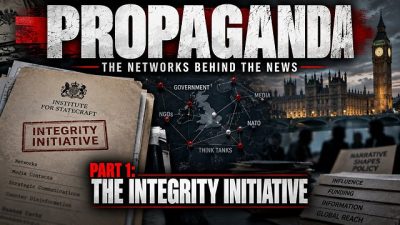
Integrity Initiative: UK-funded network framed dissent as Russian disinformation for years
or go to
Aletho News Archives – Video-Images
From the Archives
Why Saudi Ties to 9/11 Mean U.S. Ties to 9/11
By Kevin Ryan | Dig Within | September 27, 2015
Media interest in Saudi Arabian connections to the crimes of 9/11 has centered on calls for the release of the 28 missing pages from the Joint Congressional Inquiry’s report. However, those calls focus on the question of hijacker financing and omit the most interesting links between the 9/11 attacks and Saudi Arabia—links that implicate powerful people in the United States. Here are twenty examples. … continue
Blog Roll
 Aletho News
- EUROPE FEARS RUSSIA’S NEXT MOVE / Ian Proud
- Big tech hands in its DSA censorship reports to the EU
- ‘A Big Victory’ – Palestine Chronicle Wins Two-Year Legal Battle
- IAEA inspectors cannot return to Iran amid US threats: Russia
- Senate Rejects Iran War Powers Resolution Passed By House
- ‘We did not attack Pakistan with drones’: Afghan sources
- Iraqi Resistance faction links arms to sovereignty, questions US exit
- Cannon fodder no more… South Korea rejects Trump’s pressure to join his criminal war on Iran
- Neria Leiter Was A Legitimate Military Target
- Integrity Initiative: UK-funded network framed dissent as Russian disinformation for years
- If Americans Knew
- ‘This is where I live now, the back of a truck’: a day in the life of a grandmother in Gaza
- In UN Speech, Iran’s President Displays Pictures of Children Killed by US, Brings Attention to Israel’s Nuclear Arsenal
- Israel displaces hundreds of Palestinians amid wave of demolitions in West Bank
- Aid, reconstruction, and Israel’s history of obstruction in Gaza
- Trump administration digs an ever-deeper hole of complicity in genocide – Daily Update
- US-Israel $2.8 Billion Arms Deal, 40,000-Bomb Supply Faces New Gaza Complicity Accusations
- Caught on Tape: AIPAC CEO Boasted of Controlling Trump’s National Security Officials
- Why Hamas Attacked Israel in October 2023 – Israeli professor Ilan Pappé
- They see them, then kill them: Israeli quadcopters track, deliberately target civilians in Gaza
- Winter could turn Gaza’s treacherous, war-damaged buildings into deathtraps
- No Tricks Zone
- New Study: Earth And Venus Surface Warmth Largely Explained By Convection And Lapse Rate, Not CO2 Or Radiation
- 2025 Nature Paper Claiming Worsening Global Drought Gets RETRACTED …Heavily Flawed
- New Study: ‘Global Drought Shows No Detectable Recent Acceleration Under Climate Warming’
- Economic Masterminds: German Socialists Suggest Taxing Productivity Gains Stemming From Using AI
- The South China Sea Has Not Been Cooperating With The Climate Change Narrative
- Energy Crisis: Germany Enters Heating Season With Historically Low Gas Reserve Fill Levels
- New Study: The Antarctic Ice Sheet Gained Mass From 2020-2024 Due To Staggering Snow And Ice Accumulation
- Study: Ocean Heating Rates From Thousands Of Years Ago ‘Dwarf’ Modern Ocean Heating Rates
- Climate Extremists Target, Attack Large-Scale Power Grid Infrastructure In Germany!
- New Study: Antarctic Ice Melt Has Contributed Less Than 1 Centimeter To Sea Level Rise In The Last 30 Years

