The WHO Changes Guidelines to Favor Lockdowns
BY WILL JONES | BROWNSTONE INSTITUTE | MAY 18, 2022
The World Health Organisation intends to make lockdowns and other non-pharmaceutical interventions intended to curb viral spread part of official pandemic guidance.
The revelation comes in a report scheduled to go to the WHO’s World Health Assembly later this month. This is not part of new pandemic treaty and does not require the endorsement of member states. The report says the implementation is already underway.
Many have raised the alarm about a new WHO pandemic treaty. However, as I’ve noted previously (and as Michael Senger notes here), there isn’t a new pandemic treaty on the table. Rather, there are amendments to the existing treaty, the International Health Regulations 2005, plus other recommendations (131 in all) put forward in a report from the Working Group on Strengthening WHO Preparedness and Response to Health Emergencies.
Most of these amendments and recommendations relate to information and resource sharing and preparation for future pandemics; none of them directly interferes with state sovereignty in the sense of allowing the WHO to impose or lift measures. However, that doesn’t mean they’re not dangerous, as they endorse and codify the awful errors of the last two years, beginning with China’s Hubei lockdown on January 23rd 2020.
The recommendations in the report originate from WHO review panels and committees and were sent out in a survey in December 2021 to member states and stakeholders to seek their views.
Non-pharmaceutical interventions appear three times in the recommendations, once under “equity” and once under “finance,” where states are urged to ensure “adequate investment in” and “rapid development, early availability, effective and equitable access to novel vaccines, therapeutics, diagnostics and non-pharmaceutical interventions for health emergencies, including capacity for testing, scaled manufacturing and distribution”.
While rapid development and early availability of non-pharmaceutical interventions sounds worrying in itself, it could be interpreted in a number of ways by states.
Where it really gets alarming, however, is in the “leadership and governance” section. LPPPR 29 states (emphasis added):
Apply non-pharmaceutical public health measures systematically and rigorously in every country at the scale the epidemiological situation requires. All countries to have an explicit evidence-based strategy agreed at the highest level of government to curb COVID-19 transmission.
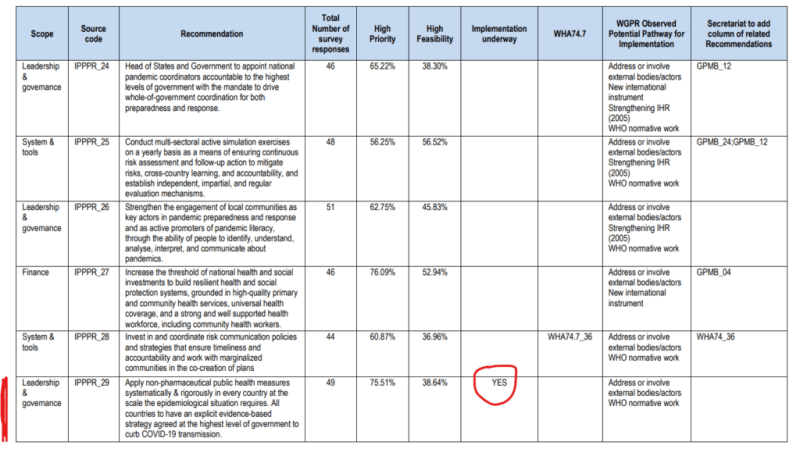
The requirement that a country’s pandemic strategy must aim to curb viral transmission is a major change from the current guidance. The U.K.’s existing pandemic preparedness strategy, prepared in line with previous WHO recommendations, is completely clear that no attempt should be made to stop viral transmission as it will not be possible and will waste valuable resources:
It will not be possible to halt the spread of a new pandemic influenza virus, and it would be a waste of public health resources and capacity to attempt to do so.
It almost certainly will not be possible to contain or eradicate a new virus in its country of origin or on arrival in the U.K. The expectation must be that the virus will inevitably spread and that any local measures taken to disrupt or reduce the spread are likely to have very limited or partial success at a national level and cannot be relied on as a way to ‘buy time’.
It will not be possible to stop the spread of, or to eradicate, the pandemic influenza virus, either in the country of origin or in the U.K., as it will spread too rapidly and too widely.
But now the WHO says that curbing viral transmission is to be the aim of pandemic response. This is a disaster.
Worse, the report says this recommendation will be incorporated into the WHO’s “normative work,” meaning it will be part of official WHO guidance to states in responding to a pandemic. Worse still, it says it’s already being implemented – it doesn’t need a treaty or the agreement of member states to do this, it’s already happening.
Expect to see new guidance appearing at the international and national levels over the coming months and years which incorporate this presumption that restrictions should be imposed to curb viral spread. This is despite the last two years only confirming the wisdom of the WHO’s previous guidance that this is not possible and not worth the attempt.
This matter must be raised at the highest levels so that lockdowns and other non-pharmaceutical interventions are kept out of all pandemic planning.
Sign the parliamentary petition against the latest moves by the WHO here – now at over 121,000 signatures.
South Australia introduces prospect of jail time for breaking strict Covid restrictions
By Dan Frieth | Reclaim The Net | May 20, 2022
The state government of South Australia is about to introduce the harshest penalties in the nation, and some of the most severe in the world, for those breaking Covid restrictions.
The regulations, which are coded in the Public Health Act, mandate that citizens that break isolation rules or fail to abide by vaccine passport and mask mandates are subject to a fine of $20,000 or two years in prison.
Businesses that are in noncompliance with the law face an even bigger fine of $75,000. The law is expected to pass Parliament this week and applies to those who break Covid regulations in high-risk settings. Upon passage, regulations codified in the Public Health Act would take effect on June 30.
The tough regulations have drawn sharp criticism from some members of South Australia’s Parliament and civil liberties groups. Despite this disapproval, Premier Peter Malinauskas, a Labour Party member, says that the new law is necessary to protect the state’s most vulnerable residents. Continuing, Malinauskas adds that Australia is in a stage of the pandemic where governments need to once again conduct basic services in a normal manner, thus necessitating the codification of Covid laws.
Those who oppose the new law not only criticize its tough penalties but how it was passed by Parliament.
Referring to the law as a “backroom deal,” Adelaide Advertiser of the Liberal Party condemned it as a way for Malinauskas to quickly incarcerate rule breakers. The Law Society of South Australia also criticizes the law as being overly vague.
The group’s head, Justin Stewart-Rattray, says that the act fails to provide an adequate definition of what constitutes a close contact. Examining Australian regulations since the start of the pandemic, Stewart-Rattray points out that the definition of close contact has changed several times throughout the crisis.
Given how unclear the law is, Stewart-Rattray says that enforcement could be too wide, leading to rampant abuse of power and loss of rights for accused citizens.
Why the World should be very concerned about New Zealand under the Jacinda government
By Guy Hatchard | Waikanae Watch | May 19, 2022
The New Zealand government relies upon a science body known as Te Punaha Matatini (Centre for Science in Society) whose work is funded directly by the office of the Prime Minister and cabinet.
Yesterday, Te Punaha Matatini published a 21-page document entitled “The Murmuration of Information Disorders” (see attached release from the Science Media Centre) designating those opposed to the government’s pandemic policies as violent right wing insurrectionists planning the weaponised storming of parliament and the execution of public servants, academics, journalists, politicians, and healthcare workers.
This is an utterly false characterisation worthy of the worst excesses of historical propaganda.
This 21-page document, represented to the public as a scientific paper, contains not a single discussion of the scientific concerns being raised in opposition to government pandemic policy.
It omits for example analyses of the government’s own official figures which show that the vaccinated are more vulnerable to infection, hospitalisation, and death than the unvaccinated, a fact that has been deliberately hidden from the public.
Prime Minister Jacinda Ardern introduced yesterday’s Te Punaha Matatini report with the words:
“One day it will be our job to try and understand how a group of people could succumb to such wild and dangerous mis- and disinformation. And while many of us have seen that disinformation and dismissed it as conspiracy theory, a small portion of our society have not only believed it, they have acted upon it in an extreme and violent way that cannot stand. We have a difficult journey in front of us to address the underlying cause.”
Since when do reasonable scientifically-based questions asked of the government in good faith constitute violent insurrection?
I am tempted to think that Ardern could just as well be talking about her own government. The Prime Minister and the social scientists(?) working at Te Punaha Matatini might do well to read the New York Times, (although they probably don’t do so because the official policy of the New Zealand government is to discourage any information that is not sanctioned and edited by themselves).
A NYT article on 10 May 2022 entitled “Emergent Hid Evidence of Covid Vaccine Problems at Plant” reports that
“Emergent BioSolutions, a longtime government contractor hired to produce hundreds of millions of coronavirus vaccine doses, hid evidence of quality control problems from Food and Drug Administration inspectors in February 2021 — six weeks before it alerted federal officials that 15 million doses had been contaminated.”
A reasonable observer might conclude that early (and later) concerns being voiced about vaccine safety were justified, but the New Zealand government is far from reasonable.
A succession of scientific papers published in reputable journals during recent weeks (which we and many others have reported extensively and communicated directly to the government) have in fact fully justified concerns about safety and efficacy, but unbelievably our government is in denial and still moving ahead with propaganda advertising of their mRNA vaccination agenda for all ages and, as today’s Te Punaha Matatini report shows, labelling any opposition as a conspiracy with violent aims.
How Did the Transformation of the NZ Government Come About?
New Zealand has a small population of 5 million, but it has been used to trial new products in order to gauge what the public reaction and acceptance might be in bigger markets overseas. Never more so than during the pandemic. Take up of the Pfizer mRNA Covid vaccination has reached up to 95% of the eligible population.
This has been achieved through a transformation in the style of government, media control, science funding, intellectual standards, and international relations unprecedented in the western world, along with the coercion of draconian employment mandates and the pursuit of dissenters through compliant courts.
This has been engineered under the leadership of a person with a bachelor’s degree in communication who grew up in a strict rural Mormon household and cut her political teeth under the Blair administration in London. In keeping with her upbringing and education, Ardern is a leader who is sure she is right and is prepared to enforce her orthodoxy against all opposition and reason.
Her international perspective is one of unquestioning acceptance of the authority and right to rule of global institutions. Her top confidant and mentor Helen Clark, former NZ Labour Prime Minister, is closely associated with this outlook. Ardern recounts that she begins her day with a discussion with Clark over breakfast.
Like Ardern, Clark is renowned for her iron fist management style. She ruffled feathers at the United Nations Development Programme, which she led from 2009 to 2017, reportedly undermining human rights and supporting China’s Belt and Road initiative.
On 9 July 2020 the World Health Organization (WHO) appointed Clark as co-chair of a panel reviewing the WHO’s handling of the COVID-19 pandemic and the response of governments to the outbreak. The Independent Panel for Pandemic Preparedness and Response (IPPR) examined how the outbreak occurred and how future pandemics can be prevented.
Nothing says more about the overt global agenda of Ardern and Clark than this 11 May 2022 statement of the New Zealand government:
“The establishment of a pandemic treaty/instrument was a key recommendation of the Independent Panel for Pandemic Preparedness and Response and is one of New Zealand’s foremost global health priorities”
Like China, New Zealand’s fading international reputation for successful management of the pandemic was actually built on a single policy—control the borders, restrict entry, and impose lengthy quarantine.
The Current Situation in New Zealand is Deeply Concerning
Ardern controls the media and the science dialogue through a mixture of government funding and exclusion of dissent. The government has spent big on saturation advertising advising complete safety and efficacy of the Pfizer vaccine, and continues to do so.
It has instituted funding of cultural groups, GPs, and commercial organisations who promote vaccination. The level of funding is so generous that it has distorted prior long standing economic and political relationships.
So far the government has spent on the order of $100 billion on the pandemic in addition to normal expenditure. To put this in stark perspective, that is equal to the total annual government budget prior to the pandemic—more than $20,000 for every man, woman, and child. This is borrowed money which will have to be repaid through increased taxation of an already struggling population.
We Have No Constitution in New Zealand, the Power of the Government Is Absolute.
The control that Ardern’s government exercises over the courts, government agencies, parliament, media, independent regulators, and over the vast majority of the population is staggering and rigidly enforced. Dissenting medical professionals are excluded from practicing and in some cases prosecuted also. They are also mercilessly hounded and vilified by bought mainstream media.
In an atmosphere of strict government control, more worrying aspects of information control have emerged. In some cases noted by my scientific colleagues, policy and pronouncements that they have demonstrated are in conflict with published research have disappeared from the public record.
Even rare court rulings in favour of caution have been rapidly bypassed by simply passing new laws without debate. Court rulings about mandates have also been openly flouted, as happened when the military vaccine mandate was ruled illegal. With the support of the government, the military said the courts had no jurisdiction over its operation and went ahead anyway.
Ardern has introduced her policies in such a dedicated, persuasive, secretive, and complete way that almost the whole population of New Zealand has complied. They have accepted limitations on medical choice, judicial protections, human rights, press freedom, freedom of information, privacy, employment conditions and opportunities, standard of living, and social interaction.
Ardern’s successful efforts to persuade the population that government should be your only source of truth, have all but negated any of the longstanding mechanisms of government accountability. A majority of the population have all but concurred with Ardern that the unvaccinated may be safely blamed for every government failing and omission; and for all Covid case loads, hospitalisations, and deaths contrary to all evidence.
The opposition parties have apparently accepted that they will in future go about their business using the same Ardern doctrines and techniques. Accordingly they have failed to sound the alarm, investigate Covid science publishing deeply, or oppose draconian legislation. They have joined Ardern in labelling peaceful protest as unacceptable and illegal.
Ardern on the Global Stage
Ardern is about to deploy her international political capital to promote the globalisation of her policies and outlook. Her public persona can be deceptively mesmerising. You should be worried.
The world’s economy also has no constitution. So far Ardern appears to be happy to allow it to be controlled by global economic predators. Pfizer has been uncritically promoted by her, and the notion of WHO control over New Zealand’s sovereign rights is being welcomed with open arms. It fits with her strict hierarchical perspective.
Ardern may be viewed by naive foreign governments as a pandemic success story unfairly criticised in her own country. Stop for a moment and consider that she is about to lend her support to the promotion of a new world order on the global stage using her trademark persuasive techniques of propaganda, coercion, and control of information.
Ukraine eyes law to deprive people of citizenship
Samizdat | May 20, 2022
Ukrainian lawmakers have introduced a bill that seeks to deprive conscripts of citizenship if they left the country during martial law.
In a bill registered in the Verkhovna Rada – Ukraine’s parliament – on Tuesday, lawmakers proposed several amendments to legislation defining the legal regime under martial law intended to “strengthen the economy and defensive capabilities of the country.”
One of the proposals suggests that anyone liable for military service may be deprived of Ukrainian citizenship if they left the country and failed to return within 30 days.
The measure would apply to those who left and did not return without a valid reason, such as a ban on leaving the host country, natural disasters, accidents, business trips, official work abroad, hospitalization or other circumstances preventing the individual from returning back home.
The bill also states that the measures would extend to individuals who have left for the Russian Federation amid the ongoing military conflict between Moscow and Kiev and those who have submitted a written refusal to mobilize.
On Wednesday, Ukrainian President Volodymyr Zelensky signed a decree on the extension of martial law and the terms of general mobilization in the country by 90 days, which is now awaiting approval by the Supreme Council of Ukraine.
Under Ukraine’s martial law, men between the ages of 18 and 60 are prohibited from leaving the country and all citizens liable for military service are required to participate in the general mobilization of all reserve forces.
Ukraine imposed martial law on February 24, after Russia attacked the neighboring state following Kiev’s failure to implement the terms of the Minsk agreements, first signed in 2014, and Moscow’s eventual recognition of the Donbass republics of Donetsk and Lugansk. The German- and French-brokered Minsk Protocol was designed to give the breakaway regions special status within the Ukrainian state.
The Kremlin has since demanded that Ukraine officially declare itself a neutral country that will never join the US-led NATO military bloc. Kiev insists the Russian offensive was completely unprovoked and has denied claims it was planning to retake the two republics by force.
WHO pandemic treaty: A fresh push for vaccine passports, global surveillance, and more
By Tom Parker | Reclaim The Net | May 20, 2022
Members of the World Health Organization (WHO) are days away from voting on an international pandemic treaty and amendments to the International Health Regulations (2005) which would give the unelected WHO greater control of national emergency healthcare decisions and new powers to push vaccine passports, global surveillance, and “global coordinated actions” that address “misinformation” whenever it declares a “health emergency.”
From May 22 to May 28, representatives of the WHO’s 194 member states (which represent 98% of all the countries in the world) will attend a World Health Assembly meeting in Geneva and vote on this treaty and the proposed amendments to the International Health Regulations (IHR). If passed, both the treaty and amendments to the IHR will be legally binding under international law.
The international pandemic treaty
The World Health Assembly (WHA), the decision-making body of the WHO, established an intergovernmental negotiating body (INB) to draft and negotiate a “global accord on pandemic prevention, preparedness and response” in December 2021. The WHA aims to have this treaty adopted under Article 19 of the WHO Constitution which gives the WHA the power to impose legally binding conventions or agreements on WHO member states if two-thirds of the WHA vote in favor of them.
While the WHO framed this as an international pandemic treaty, the latest draft of the treaty has since evolved to cover all “health emergencies.” Unlike the term “pandemic,” which is limited in scope and refers to the worldwide spread of infectious disease, the WHO’s definition of a “public health emergency of international concern” (PHEIC) is much broader and applies to all types of disease, regardless of whether they’re infectious:
“A PHEIC is defined in the IHR (2005) as, ‘an extraordinary event which is determined to constitute a public health risk to other States through the international spread of disease and to potentially require a coordinated international response.’”
The draft treaty places the “WHO at the centre” and solidifies the WHO as “the directing and coordinating authority on international health” and gives it sweeping, legally binding powers to force member states to adopt many of the censorship and surveillance tools that were imposed during the COVID-19 pandemic.
Some of the key areas of the draft treaty include:
International vaccine passports and contact tracing: Member states will be required to “support the development of standards for producing a digital version of the International Certificate of Vaccination and Prophylaxis” (the WHO’s official vaccine passport). The WHO will also “develop norms and standards” for “digital technology applications relevant to international travel” such as contact tracing apps and digital health forms.
Global surveillance: The WHO will conduct “coordinated global surveillance of public health threats” and member states will be required to build out their surveillance systems and work with “the WHO’s global systems for surveillance.” Non-state actors (which could include Big Tech companies) will also be required to work with governments, the WHO, and other international partners to leverage their “considerable data” to “create the strongest possible early warning and response systems.”
Addressing “misinformation,” “disinformation,” and “too much information:” The draft treaty pushes “national and global coordinated actions to address the misinformation, disinformation, and stigmatization, that undermine public health.” Member states will also be required to strengthen their approaches to “infodemic management” (a term coined by the WHO that refers to “too much information including false or misleading information in digital and physical environments during a disease outbreak.”) Additionally, non-state actors will be required to actors to work with governments to fight disinformation.
Funding: WHO members are set to collectively pay the WHO over $950 million in dues for 2022-2023 and already paid over $270 million in voluntary contributions for 2020-2021. And this draft treaty proposes that G7 countries (Canada, France, Germany, Italy, Japan, the UK, and the US) also pay $11 billion for the “Access to COVID-19 Tools Accelerator (ACT-A).” Additionally, it intends to create an”International Pandemic Financing Facility” that will extract long-term (10-15 year) contributions of $5-10 billion per year.
We obtained a copy of the draft treaty for you here.
If this draft treaty is approved at the May 22 to May 28 WHA meeting, the INB will hold a second meeting on August 1 to discuss progress on the draft. A progress report will then be delivered at the 76th WHA meeting in May 2023. The final treaty will then be presented for adoption at the 77th WHA meeting in May 2024.
Proposed amendments to the International Health Regulations (2005)
On January 18, the Biden administration quietly sent the WHO its extensive proposed amendments to the IHR. The details of these proposed amendments were only made public on April 12, almost three months after they were sent.
Under the current IHR, 196 countries are legally required under international law to build the capability to detect and report potential public health emergencies worldwide and respond promptly to a public health emergency of international concern (PHEIC) whenever it’s declared by the WHO.
These proposed amendments from the Biden administration give the WHO and its Director-General, Dr. Tedros Adhanom Ghebreyesus, sweeping new powers to declare public health emergencies, even over the objection of member states, and implement global surveillance measures that require the mass collection of genetic sequence data.
Some of the key amendments that are being pushed by the Biden administration include:
Increased WHO powers to declare “potential” emergencies: Currently, the WHO can only declare a PHEIC when there’s an actual “public health risk to other States through the international spread of disease.” These proposed amendments allow it to declare a PHEIC when there’s a “potential or actual” PHEIC. This means there doesn’t have to be evidence of the international spread of disease, just the potential for it.
Increased WHO powers to declare health emergencies: Currently, the WHO has to follow the PHEIC criteria when declaring a public health emergency and health emergencies can only be declared by the Director-General. But under these proposed amendments, the WHO Director-General can issue an “intermediate public health alert” to any country in response to events that don’t meet the criteria of a PHEIC and a WHO “regional director” can declare a “public health emergency of regional concern” (PHERC).
Global surveillance and data sharing: The Biden administration’s proposed amendments empower the WHO to develop new “early warning criteria” for monitoring “national, regional, or global risk posed by an event of unknown causes or sources.” Additionally, these proposed amendments expand the scope of data sharing under the IHR and require members to hand over genetic sequence data to the WHO whenever they have an event that “may constitute a public health emergency of international concern.”
We obtained a copy of the proposed amendments to the IHR for you here.
If these amendments are approved at the May 22 to May 28 WHA meeting, nations have six months to reject them. After six months, they’ll enter into force and any rejection or reservation “shall have no effect.”
The WHO’s history of supporting surveillance and acting as an arbiter of truth
Not only could this treaty and the proposed amendments to the IHR empower the unelected WHO to push surveillance, vaccine passports, and global programs that target what it deems to be misinformation but this international health agency already gave the world a taste of how it exercises these powers during the COVID-19 pandemic. As COVID-19 spread, the WHO rigorously supported surveillance tech and was increasingly used as an arbiter of truth on Big Tech platforms, even though it got many things wrong.
YouTube, Facebook, Wikipedia, and others have partnered with the WHO to tackle misinformation or display labels with information from the WHO. YouTube even goes as far as removing videos that go against the WHO and has censored over 800,000 videos under this policy.
Despite having significant influence over how these platforms determine which posts to brand as misinformation, the WHO has got many things about COVID wrong and amplified misleading statements. For example, in an infamous January 14, 2020 tweet, the WHO stated that “preliminary investigations conducted by the Chinese authorities have found no clear evidence of human-to-human transmission” of the coronavirus.
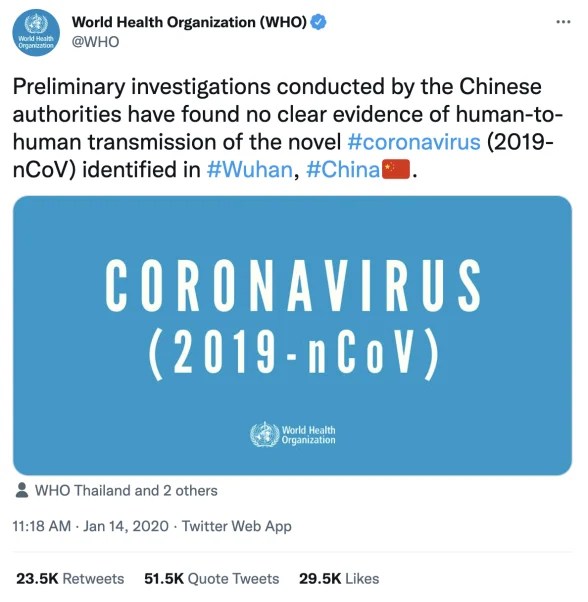
The WHO has also praised China’s response to COVID which relies heavily on digital censorship and surveillance. Only recently did the WHO break this trend and criticize China’s zero-COVID policy. And when it did, these digital censorship systems were unsurprisingly used to censor the WHO’s statements on Chinese social platforms.
Another thing that the WHO heavily supported throughout the COVID-19 pandemic was vaccine passports. It pushed for them in December 2020 and it’s still pushing for the adoption of global vaccine passports this year.
The WHO’s undemocratic global governance system
The way the WHO gains its powers gives citizens almost no recourse. Instead of the response to national emergencies in democratic nations being the sole purview of elected officials who can vote on proposed measures that apply to their citizens and be held accountable at the ballot box by those citizens, WHO members vote on legally binding international treaties and agreements on their behalf via the WHA. If two-thirds of the WHA vote to adopt a treaty or agreement, it becomes legally binding under international law.
This global governance system has the support of both parties in most democratic countries. For example, during the 2022 Australian federal election campaign, both of the leading candidates expressed full support for the WHO’s expanded powers.
And the WHO Director-General has used the COVID-19 pandemic to push countries to further embrace the WHO’s global governance system by blasting countries that made their own decisions and claiming that their “‘me-first’ approaches… stymie the global solidarity needed to deal with a global threat.”
Countries that support the WHO’s expanded powers
Many countries have expressed support for the international pandemic treaty or the proposed amendments to the IHR.
The US supports both its proposed IHR amendments and the international pandemic treaty.
The treaty also has the support of the UK, Canada, Australia, New Zealand, and the European Council (EC) (which represents 27 European Union (EU) member states). According to the EC, 110 countries supported the decision to launch negotiations on the treaty. If these 110 countries vote in favor of the treaty, it would give the WHA close to the two-thirds of the majority it needs to pass the treaty.
Opposition to the WHO’s expanded powers
While there’s significant member state support for these expanded WHO powers, local politicians, citizens, and rights groups are opposing this power grab.
In the US, Congresswoman Mary Miller (R-IL), Congressman Byron Donalds (R-FL), and Congressman Chris Smith (R-NJ), have opposed the Biden administration’s proposed amendments to the IHR.
Senator Rick Scott (R-Fla.), and Senator Tom Cotton (R-Ark.) have also opposed the Biden administration’s support of the international pandemic treaty.
In Australia, Senator Malcolm Roberts (One Nation), Senator Alex Antic (Liberal Party), and Senator Gerard Rennick have opposed the international pandemic treaty.
Several UK Members of Parliament (MPs), including the Conservative MPs Craig Mackinlay and Steve Baker, have also called for the government to provide clarity on the treaty.
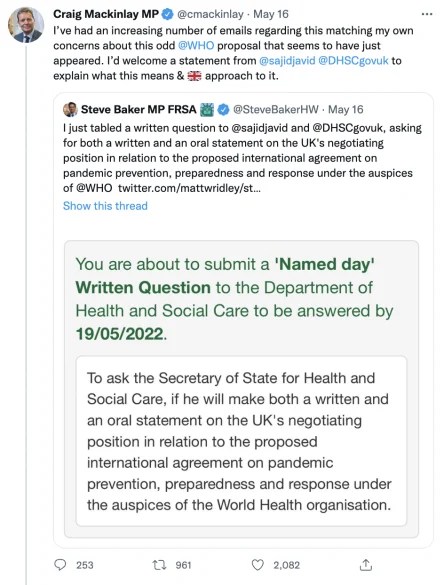
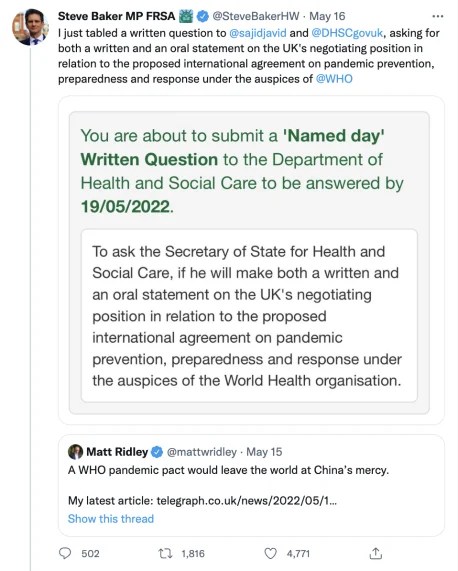
UK Health Secretary Sajid Javid responded to Baker’s calls by stating that the UK government supports the treaty but “would not sign up to any instrument that compromises the UK’s sovereignty,” including “any instrument which compromises the UK’s ability to take domestic decisions on national restrictions or other measures.”
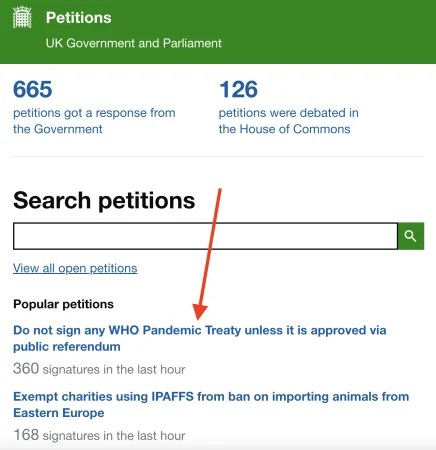
A UK Government and Parliament petition urging the government to not sign any WHO pandemic treaty unless it’s approved via public referendum has received over 130,000 signatures which means Parliament will now consider it for a debate. The petition has also trended on the homepage of the UK Government and Parliament petition’s website.
Member of the European Parliament (MEP) Christine Anderson has opposed the treaty, branding it an “abolition of democracy by the global elites.”
Conservative Party of Canada (CPC) MP Leslyn Lewis has also pushed back against the treaty and launched a “Stop The Treaty” petition which calls for Canada to decline the treaty.
And rights group World Council for Health has launched a #StopTheWho Campaign which opposes both the treaty and proposed IHR amendments.
But for now, the fate of this WHO power grab rests on the outcome of the May 22 to May 28 WHA meeting.
House passes antisemitism resolution calling for surveillance and censorship of online content
By Christina Maas | Reclaim The Net | May 20, 2022
The House of Representatives has voted to pass a resolution that calls for increased surveillance and censorship of online speech, to help reduce antisemitism.
The resolution goes beyond condemning antisemitism; it goes into the realm of calling on social media platforms to do more to stop it.
We obtained a copy of the resolution for you here.
The resolution calls on social media platforms to “institute stronger and more significant efforts to measure and address online antisemitism” and, like most resolutions of this kind, pays lip-service to the idea of “protecting free speech concerns,” without providing details on how this is possible.
The resolution also calls for the house to work “in tandem with the cross-party Inter-parliamentary Task Force to Combat Online Anti-semitism to help craft thoughtful global initiatives designed to address online antisemitism.”
The resolution names platforms specifically, saying there has been an uptick in “antisemitic language, conspiracy theories, and hatred has increased on multiple social media platforms—from Facebook and Instagram to Twitter and TikTok.”
Rep. Thomas Massie, a Republican, was the only member of the House that recognized the implications of government once again trying to insert themselves into moderation on online platforms and voted against the bill on free speech grounds.
Massie made clear that his vote against the bill was not due to hating anyone “based on his or her ethnicity or religion” but on First Amendment grounds, that is designed to prevent the government from regulating speech. While the resolution is not a law that would force this speech regulation on platforms, the sentiment of the government pressure on platforms is evident.
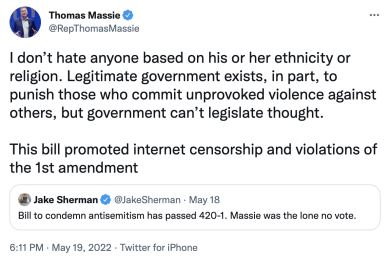
“I don’t hate anyone based on his or her ethnicity or religion. Legitimate government exists, in part, to punish those who commit unprovoked violence against others, but government can’t legislate thought,” Massie wrote on Twitter.
“This bill promoted internet censorship and violations of the 1st amendment.”
The author of the resolution, Democrat Rep. Debbie Wasserman Schultz, blamed the racially-motivated shooting in Buffalo, New York, on social media for amplifying “radicalizing content and conspiracy theories.” She argued that Section 230, which protects platforms from liability from content posted by users, should be removed.
“It’s past time to pass sane gun safety laws, but we also need to revisit Section 230 to remove social media company immunity if they amplify radicalizing content and conspiracy theories that promote violence like we saw in Buffalo,” she wrote on Twitter.
Israeli forces use Palestinian girl as a human shield in Jenin

Defense for Children International Palestine | May 19, 2022
Ramallah — Israeli soldiers used a 16-year-old Palestinian girl as a human shield in front of an Israeli military vehicle while deployed in the northern occupied West Bank city of Jenin last week.
Israeli soldiers forced Ahed Mohammad Rida Mereb, 16, to stand in front of an Israeli military vehicle on May 13 around 8 a.m. in the Al Hadaf neighborhood of Jenin as Palestinian gunmen shot heavily toward the Israeli forces’ position, according to information collected by Defense for Children International – Palestine. Israeli forces ordered Ahed to stand outside the military vehicle for around two hours while they sat inside.
“International law is explicit and absolutely prohibits the use of children as human shields by armed forces or armed groups,” said Ayed Abu Eqtaish, Accountability Program director at Defense for Children International – Palestine. “Israeli forces intentionally putting a child in grave danger in order to shield themselves constitutes a war crime.”
Israeli forces besieged Ahed’s home around 6 a.m. on May 13 in order to arrest her 20-year-old brother, according to documentation collected by DCIP. Israeli forces ordered Ahed, her parents, and her two younger brothers out of the house and to move to a yard across the street. Israeli forces exchanged fire with Ahed’s older brother, who remained in the house. Around 8 a.m., Palestinian gunmen shot heavily toward an Israeli military vehicle, which is when Israeli forces ordered Ahed to stand outside the military vehicle.
“Bullets were being fired at the military vehicle from all directions,” Ahed told DCIP. “I was trembling and crying and shouting to the soldiers to remove me because the bullets were passing over my head, but one of them ordered me in Arabic through a small window in the military vehicle, ‘Stay where you are and don’t move. You’re a terrorist. Stand in your place until you say goodbye to your brother.’”
Ahed tried to tilt her head to the side to dodge the bullets, but one of the Israeli soldiers ordered her to stand up straight, according to information collected by DCIP. Ahed stood in front of the Israeli military vehicle for about two hours before running to a nearby tree and collapsing on the ground, according to documentation collected by DCIP.
Around two hours later, Israeli forces evacuated Ahed’s two-story house, where she lived with her parents, three brothers, grandparents, two uncles and their wives, and their eight children ranging in age from one to 11 years old, according to information collected by DCIP. After the family evacuated, Israeli forces bombed the house with rocket-propelled grenades, which caused the house to catch on fire. Israeli forces also shot live ammunition at the house, according to documentation collected by DCIP.
Israeli forces withdrew from Ahed’s neighborhood around 11 a.m. She learned that Israeli forces arrested her older brother and that neighborhood residents posted on social media that she was being used as a human shield by Israeli forces, which led the Palestinian gunmen to stop shooting at the Israeli military vehicle.
Ahed was transferred by private vehicle to Jenin Hospital and was treated for intense mental stress and a severe lack of oxygen, according to documentation collected by DCIP.
The use of civilians as human shields, wherein civilians are forced to directly assist military operations or used to shield armed forces or armed groups or objects from attack, is prohibited under international law. The practice is also prohibited under Israeli law based on a 2005 ruling by the Israeli High Court of Justice.
Since 2000, DCIP has documented at least 26 cases involving Palestinian children being used as human shields by the Israeli army. All except one case have occurred after the Israeli High Court of Justice ruling. Only one of those cases led to the conviction of two soldiers for “inappropriate behavior” and “overstepping authority.” Both were demoted in rank and given three-month suspended sentences.
German Supreme Court rules mandatory vaccination is constitutionally justified
The Naked Emperor’s Newsletter | May 19, 2022
Judges in Germany’s top court clearly haven’t looked at the data produced in multiple countries, showing the vaccinated being more likely to catch coronavirus.
In a press release today, the court announced that a case, challenging the obligation to provide evidence of vaccination, had been unsuccessful. The complainants said that the mandates violated their fundamental rights.
Whilst the initial vaccine mandate for all adults was rejected earlier in the year, it was still implemented for healthcare workers in March. This meant that all healthcare workers had to provide proof of full vaccination, recovery from COVID-19 or a small number of medical exemptions. If employees did not provide proof, the health department was to be notified immediately and the individual banned from entering the workplace.
One of the reasons for the case being unsuccessful, given in the judgment, was that interference with the right to physical integrity is constitutionally justified. Basically, the protection of vulnerable people is more important than an individual’s fundamental right.
The judgement admits that COVID-19 is mild for most people but can be fatal for the elderly and vulnerable who also don’t respond well to vaccination. They say that at the time the law was passed, a clear scientific majority assumed that vaccinated and recovered people were less likely to become infected and therefore transmit the virus. It was also assumed that vaccinated people were less infectious and for a shorter amount of time. According to the judgement, expert third parties largely agree that vaccine effectiveness will continue to exist, albeit at a reduced level.
Comically, the judgement states that there is no justification for compulsory vaccination enforced by the state but instead the decision should be down to the individual – they can choose to either give up their previous job or consent to the impairment of their physical integrity. Why thank you, Master, for providing me with two terrible choices. But, every cloud and all that, I suppose it is better than being pinned down and vaccinated. Well, until you can’t pay your rent or buy food for your children and have to steal a cardboard box to sleep on in the street.
Fortunately, the judges concluded that it is ok to breach an individual’s fundamental rights because serious side effects or serious consequences induced by the administration of the vaccine are very rare. And, in any case, they are continuously monitoring and evaluating them. They say that the very low probability of serious consequences of vaccination contrasts with the significantly higher probability of damage to vulnerable people.
They conclude, that the further development of the pandemic, after the law was passed, has not changed anything. Nor have any new developments or better insights.
So there you have it. An individual’s rights can be overhauled if a majority of experts conclude you are a danger to a small group of people. Whilst I can understand and appreciate the need to protect the elderly and vulnerable, this shouldn’t be used as a pretext to remove people’s basic rights.
The majority of health care workers want to protect the elderly and vulnerable, that’s why they do the jobs they do. If they are ill or test positive, they aren’t going to deliberately go and infect someone who is likely to die from Covid – they aren’t pyschos (unlike some of the individual’s making these laws).
Furthermore, the science clearly doesn’t back up what they are saying. You are more likely to catch Covid if you are vaccinated and your viral load is similar, if not the same. There may be evidence showing that you are not as infectious for as long but there also may be evidence showing you can have Covid but aren’t testing positive.
Health Minister Karl Lauterbach welcomed the ruling saying that “the state is obliged to protect vulnerable groups”. He is now off for a meeting with other G7 ministers, despite being in contact with the US health secretary, a day before testing positive for Covid. Rules for thee, not for me.
Clearly, the battle to retain one’s basic rights is still not over in many parts of the world. And if it isn’t completely squashed now, you can be sure it will return everywhere with a vengeance, come the winter.
A Primer on the WHO, the Treaty, and its Plans for Pandemic Preparedness
By David Bell | Brownstone Institute | May 19, 2022
The World Health Organization (WHO), whose constitution defines health as ‘a state of physical, mental and social well-being, not merely the absence of disease or infirmity,’ has recently orchestrated remarkable reversals in human rights, poverty reduction, education, and physical, mental and social health indices in the name of responding to the Covid-19 pandemic.
WHO proposes to expand the mechanisms that enabled this response, diverting unprecedented resources to addressing what in terms of history and disease are rare and relatively low-impact events. This will greatly benefit those who also did well from the Covid-19 outbreak, but has different implications for the rest of us. To address it calmly and rationally, we need to understand it.
Building a new pandemic industry
The World Health Organization (WHO) and its Member States, in concert with other international institutions, is proposing, and currently negotiating, two instruments to address pandemics and widely manage aspects of global public health. Both will significantly expand the international bureaucracy that has grown over the past decade to prepare for, or respond to, pandemics, with particular emphasis on development and use of vaccines.
This bureaucracy would be answerable to the WHO, an organization that in turn is increasingly answerable, through funding and political influence, from private individuals, corporations and the large authoritarian States.
These proposed rules and structures, if adopted, would fundamentally change international public health, moving the center of gravity from common endemic diseases to relatively rare outbreaks of new pathogens, and building an industry around it that will potentially be self-perpetuating.
In the process, it will increase external involvement in areas of decision-making that in most constitutional democracies are the purview of elected governments answerable to their population.
WHO does not clearly define the terms ‘pandemic’ and ‘public health emergency’ that these new agreements, intended to have power under international law, seek to address. Implementation will depend on the opinion of individuals – the Director General (DG) of the WHO, Regional Directors and an advisory committee that they can choose to follow or ignore.
As a ‘pandemic’ in WHO parlance does not include a requirement of severity but simply broad spread – a property common to respiratory viruses – this leaves a lot of room for the DG to proclaim emergencies and set the wheels in motion to repeat the sort of pandemic responses we have seen trialed in the past 2 years.
Responses that have been unprecedented in their removal of basic peace-time human rights, and that the WHO, Unicef and other United Nations (UN) agencies have acknowledged to cause widespread harm.
This has potential to be a boon for Big Pharma and their investors who have done so well out of the last two years, concentrating private wealth whilst increasing national indebtedness and reversing prior progress on poverty reduction.
However, it is not something that has just appeared, and is not going to make us slaves before the month is out. If we are to address this issue and restore societal sanity and balance in public health, we need to understand what we are dealing with.
Proposed International Health Regulations (IHR) amendments
The IHR amendments, proposed by the United States, build on the existing IHR that were introduced in 2005 and are binding under international law. While many are unaware of their existence, the IHR already enables the WHO DG to declare public health emergencies of international concern, and thereby recommend measures to isolate countries and restrict movement of people. The draft amendments include proposals to:
- Establish an ‘emergency committee’ to assess health threats and outbreaks and recommend responses.
- Establish a ‘Country review mechanism’ to assess compliance of countries with various recommendations / requirements of WHO regarding pandemic preparedness, including surveillance and reporting measures. This appears to be modeled on the UN’s human rights country review mechanism. Countries would then be issued with requirements to be addressed to bring them into compliance where their internal programs are considered inadequate, on the request of another State party (country).
- Expand the power of the WHO DG to declare pandemics and health emergencies, and therefore recommend border closures, interruption and removal of rights to travel and potentially internal ‘lockdown’ requirements and send teams of WHO personnel to countries to investigate outbreaks, irrespective of the findings of the emergency committee and without consent of the country where the instance is recorded.
- Reduce the usual review period for countries to internally discuss and opt out of such mechanisms to just 6 months (rather than 18 months for the original IHR), and then implement them after a 6-month notice period.
- Empower Regional Directors, of which there are 6, to declare regional ‘public health emergencies,’ irrespective of a decision by the DG.
These amendments will be discussed and voted on at the World Health Assembly on May 22-28, 2022. They only require a simple majority of countries present to come into law, consistent with Article 60 of the WHO constitution. For clarity, this means countries such as Niue, with 1,300 people, have an equal weight on the voting floor as India, with 1.3 billion people. Countries must then signal intent to opt out of the new amendments within 6 months.
Once approved by the WHA, these measures will become legally binding. There will be heavy pressure applied to governments to comply with the dictates of the WHO DG and the unelected bureaucrats that comprise the organization, and thereby also the external actors who are influential in WHO decision-making processes.
Proposed WHO pandemic ‘treaty’
The WHO proposes a new ‘instrument’ to allow it to manage pandemics, with force of a convention under international law. This has been formally discussed within WHO since early 2021, and a special session of the WHA in November 2021 recommended it go to a review process, with a draft to be presented to the World Health Assembly meeting in Q2 2023.
This proposed treaty would give WHO powers to:
- Investigate epidemics within countries,
- Recommend or even require border closures,
- Potentially recommend travel restrictions on individuals,
- Impose measures recommended by the WHO which, based on Covid-19 experience, may include ‘lockdowns,’ prevention of employment, disruption of family life and internal travel, and mandated masks and vaccination,
- Involve non-state actors (e.g., private corporations) in data gathering and predictive modeling to influence and guide pandemic responses; and in implementing, including providing commodities for, the response;
- Impose censorship through control of, or restrictions on, information the WHO considers to be ‘mis-information’ or ‘dis-information’, which may include criticism of the measures WHO imposes.
Notably, it envisions the setting up of a large entity within WHO to support permanent staff whose purpose is to undertake and enforce the above measures. This sounds very similar to the ‘GERM’ entity proposed recently by Mr Bill Gates, a wealthy US software developer with major pharmaceutical investments, who is the second largest funder of the WHO and one of a number of ‘billionaires’ who have greatly increased personal wealth during the Covid-19 response.
The proposed treaty would prioritize vertical structures and pharmaceutical approaches to pandemics, reflecting approaches by Gavi and CEPI, two organizations set up in the past decade in parallel to the WHO. It would create another bureaucratic structure on pandemics, not answerable directly to any taxpayer base, but imposing further support, reporting and compliance requirements.
Process, acceptance and implementation
These two mechanisms for increasing direct WHO control of pandemics have strong backing from private sector funders of the WHO, and from many national governments, starting with Western governments who adopted Covid draconian measures. To come into practice they must be adopted by the WHA and then be agreed, or ratified, by national governments.
The proposed IHR amendments modify an existing mechanism. A simple majority of States present at the WHA voting against them at the May 2022 meeting would also reject them, but this appears unlikely. To prevent their application, sufficient individual countries will need to signal non-acceptance or reservations after the coming WHA and WHO DG’s notice of adoption, so probably before the end of November 2022.
With regard to the proposed treaty, a two-thirds majority at the 2023 WHA will be required for its adoption, after which it will be subject to national ratification by processes which vary according to national norms and constitutions.
Funding for the large increase in bureaucracy proposed to support both mechanisms will be necessary – this may be partially diverted from other disease areas but will almost certainly require new, regular funding. Other mechanisms in parallel are already being discussed, with the World Bank also proposed as the home for a similar bureaucracy to manage pandemic preparedness, and the G20 mulling their own mechanism.
It is unclear whether these would be tied into the WHO’s proposed treaty and IHR mechanisms or be presented as a ‘rival’ approach. The G20 task force of the WB and WHO suggest a $10.5 billion additional annual budget for pandemic preparedness is required. With such potential financing on offer, and the promise of building powerful institutions around this pandemic preparedness agenda, there is going to be much enthusiasm and momentum, not least from institutional staff and the global health community in general, who will sense lucrative employment and grant opportunities.
While all this depends on money being available, a refusal of countries to fund may not be sufficient to prevent it, as there is considerable private and corporate interest in the treaty and related proposals. The same entities that benefited heavily financially from the Covid-19 response will also stand to benefit from an increased frequency of similar responses.
Whilst pandemics are historically rare, the existence of a large bureaucracy dependent on their declaration and response, coupled with the clear gains to be made by influential funders of the WHO, raise a strong risk that the bar to declaring emergencies, and imposing human rights restrictions on States, will be far lower than before.
Independent States are not however directly subject to the WHO, and adopting these amendments and treaties will not automatically allow the WHO to send teams across borders. Treaties must be ratified according to national processes and constitutions. If accepted by the WHA, it will however be difficult for individual States to avoid compliance unless they are particularly influential on the WHO itself.
International financial agencies, such as the IMF and World Bank, can also exert considerable pressure on non-complying States, potentially tying loans to implementation and commodity purchase as the World Bank has done for the COVID-19 response.
The IHR amendments also allow measures to be taken such as interrupting international travel that can be economically very harmful to small States, irrespective of the State providing permission. Powerful States that are highly influential on the DG election may also in practice be subject to different levels of implementation than smaller ones.
There seem to be at least two feasible scenarios for preventing the adoption of the two new mechanisms.
Firstly, the populations in democratic donor States, who have most to lose in terms of autonomy, sovereignty and human rights and whose taxes will predominantly fund these institutions, can stimulate open debate leading to decisions of national governments to reject the treaty at the WHA, and/or otherwise refuse to ratify.
Secondly, large blocs of countries could refuse to ratify or subsequently comply, making the treaty and IHR amendments unworkable. The latter is conceivable if, for instance, African nations perceive all this as a form of neo-colonialism that needs to be fought in the name of independence.
Some background on pandemic risk, and the WHO.
What is the risk of pandemics?
WHO records 5 pandemics in the past 120 years:
- The Spanish Flu (1918-19), killed 20-509 million people. Most died due to secondary bacterial infection, as this was before availability of any modern antibiotics.
- The 1957-58 influenza outbreaks that killed about 1.1 million people each
- The 1968-69 influenza outbreak that also killed about 1.1 million
- Swine Flu in 2009-10 killed about 120,000 to 230,000.
- Lastly, COVID-19 (2020-22) is recorded by WHO as contributing to the death of several million, but most in old age with other severe comorbidities, so actual figures are difficult to assess. As this indicates.
Pandemics have therefore been rare – once per generation. For context, cancer kills many more people each year in Western countries than Covid-19 at its height, tuberculosis kills 1.6 million people every year (much younger than Covid-19) and malaria kills over half a million children annually (barely affected by COVID-19).
However, as pandemics are very loosely defined by WHO, it Is not unreasonable to assume that a large bureaucracy dependent on pandemics to justify its own existence, and heavily invested in surveillance for new strains of virus, will find reason to declare far more pandemics in the future.
Pandemic response
COVID-19 is the first pandemic in which mass lockdowns, including border closures, workplace closures and prolonged school closures, have been used on a large scale. It is worth remembering that 1969 is remembered for the Woodstock music festival more than the ‘Hong Kong flu,’ a pandemic that targeted young people more than Covid-19. Human rights and economic health did not suffer such declines in any of these prior events.
These new approaches used in the Covid-19 response have resulted in wide disruption of supply lines and healthcare access, increases in early marriage / enslavement of women, mass loss of education of children, and increases in current financial inequality and educational (so future) inequality. Many low-income countries have increased debt and undergone recession, which will reduce future life expectancy, while child deaths have increased, including from former priority diseases such as malaria.
What is WHO, and who owns or runs it?
The WHO (the World Health Organization) was set up in the late 1940s, to coordinate health standards and data sharing internationally, including support for the response to pandemics. It is the main health agency of the United Nations Organization (UN). It provides some support for low-income country health systems where local technical expertise is lacking.
It has country offices in most countries, 6 regional offices, and a global office in Geneva. It is a hierarchical organization, with the Director General (DG) at its head. It has a few thousand staff (depending on definition) and a budget of roughly $3.5 billion a year.
The WHO is controlled in theory by the member nations (most UN members, and a couple of others), on a one country-one vote basis through the World Health Assembly, that usually meets annually. As example, India, with 1.3 billion people, has the same power on the voting floor as Nuie, with 1,300 people. The WHA elects the DG through a 4-yearly vote that is often heavily accompanied by lobbying by major countries.
WHO funding was originally nearly all derived from member countries, who contributed to the ‘core’ budget. WHO would then decide on priorities for expenditure, guided by the WHA. In the past 2 decades, there has been a significant change in funding:
- A rapid increase in private funding, from individuals and corporations. Some is direct, some indirect through parallel international health organizations (Gavi, Cepi) that are heavily privately funded. The second largest contributor to the WHO budget is now a private couple in the United States heavily invested in the international pharmaceutical sector and in software / digitization services.
- The budget has moved from mainly core funding, to mainly ‘directed’ funding, in which the funder specifies the area in which the funding can be used, and sometimes the actual activities to be undertaken. The WHO therefore becomes a conduit for their funds to undertake their intended activities. Both country private funders heavily use this directed approach.
The WHO therefore retains under overall control of an assembly of countries, but day-to-day priorities are increasingly directed by single countries and private interests. Former strong rules on conflict of interest regarding private sector involvement are less externally obvious now, with WHO working more closely with private and corporate sector entities.
Reference documents:
- WHO constitution: https://apps.who.int/gb/bd/PDF/bd47/EN/constitution-en.pdf?ua=1
- IHR 2005: https://www.who.int/publications/i/item/9789241580410
- WHO IHR proposed amendments: https://apps.who.int/gb/ebwha/pdf_files/WHA75/A75_18-en.pdf
- EU and proposed WHO treaty: https://www.consilium.europa.eu/en/policies/coronavirus/pandemic-treaty/
- WHO WHA Nov 21 Special Session draft report: https://apps.who.int/gb/wgpr/pdf_files/wgpr5/A_WGPR5_2-en.pdf
- WHO (EURO) influenza pandemic definition: https://www.euro.who.int/en/health-topics/communicable-diseases/influenza/pandemic-influenza
- WHO ‘zero draft’ of proposed pandemic treaty: https://apps.who.int/gb/wgpr/pdf_files/wgpr9/A_WGPR9_3-en.pdf
- Review of WHO pandemic definitions: https://www.ncbi.nlm.nih.gov/pmc/articles/PMC3127275/
- Unicef on harms from public health response:
- https://data.unicef.org/covid-19-and-children/
- IFF harms from public health response: https://www.globalfinancingfacility.org/emerging-data-estimates-each-covid-19-death-more-two-women-and-children-have-lost-their-lives-result
- BIS on health impact of economic harms https://www.bis.org/publ/work910.htm
- On G20 and World Bank mechanisms: https://g20.org/wp-content/uploads/2022/02/G20-FHTF-Financing-Gaps-for-PPR-WHOWB-Feb-10_Final.pdf
- WHO pandemic guidelines (includes previous pandemic list): https://apps.who.int/iris/bitstream/handle/10665/329438/9789241516839-eng.pdf
- Background on evolution of the WHO: https://www.pandata.org/who-and-covid-19-re-establishing-colonialism-in-public-health/
David Bell is a public health physician based in the United States. After working in internal medicine and public health in Australia and the UK, he worked in the World Health Organization (WHO), as Programme Head for malaria and febrile diseases at the Foundation for Innovative New Diagnostics (FIND) in Geneva, and as Director of Global Health Technologies at Intellectual Ventures Global Good Fund in Bellevue, USA. He consults in biotech and global health. MBBS, MTH, PhD, FAFPHM, FRCP
WHO Stealth Coup to Dictate Global Health Agenda of Gates, Big Pharma
By F. William Engdahl – New Eastern Outlook – 18.05.2022
Acting on an initiative from the Biden Administration, by November 2022, conveniently at the onset of the next flu season in the northern hemisphere, the World Health Organization, barring a miracle, will impose an unprecedented top-down control over the national health regulations and measures of the entire planet. In what amounts to a stealth coup d’etat, WHO will get draconian new powers to override national sovereignty in 194 UN member countries, and to dictate their health measures with force of international law. It is sometimes referred to as the WHO Pandemic Treaty but it is far more. Worse, most of the WHO budget comes from private vaccine-tied foundations like the Gates Foundation or from Big Pharma, a massive conflict of interest.
Draconian New WHO Powers
Doing something with stealth means doing it in a secretive or concealed manner, to prevent it being widely known and possibly opposed. This applies to the proposal given by the Biden Administration to the Geneva WHO in January 18, 2022 according to official WHO documents. The WHO hid the details of the US “amendments” for almost three months, until 12 April, just a month before the relevant body of the WHO meets to approve the radical measures. Moreover, rather than the previous 18 month waiting time to become treaty in international law, only 6 months are used this time. This is a bum’s rush. The US proposal is backed by every EU country and in total 47 countries ensuring almost certain passage.
The proposals, officially titled, “Strengthening WHO preparedness for and response to health emergencies: Proposal for amendments to the International Health Regulations,” were submitted by Assistant Secretary for Global Affairs (OGA) in the US Department of Health and Human Services, Loyce Pace, as “amendments” to a previously ratified 2005 WHO International Health Regulations treaty. The WHO defines that 2005 treaty thus: “the International Health Regulations (2005) (IHR) provide an overarching legal framework that defines countries’ rights and obligations in handling public health events and emergenciesthat have the potential to cross borders. The IHR are an instrument of international law that is legally-binding on 196 countries, including the 194 WHO Member States.” (emphasis added).
Ms Pace came to the Biden Administration from heading the Global Health Council, whose members include the most corrupt names in Big Pharma including Pfizer, Lilly, Merck, J&J, Abbott, Bill Gates-funded AVAC, to name a few. Her proposals for the radical transformation of WHO “pandemic” and epidemic powers, could easily have been written by Gates and Big Pharma.
Before we look at what the Loyce Pace “amendments” will do to empower the transformation of WHO into a global health dictatorship with unprecedented powers to overrule judgments of any national governments, one stealthy legal issue must be noted. By disguising a complete change in the 2005 WHO treaty powers as mere “amendments” to a ratified treaty, WHO claims, along with the Biden Administration, that the approval of the amendments requires no new ratification debate by member governments. This is stealth. With no national debate by elected representatives, the unelected WHO will become a global superpower over life and death in the future. Washington and WHO have deliberately restricted the process of public participation to ram this through.
A De Facto New Law
As required, the WHO finally published the US “amendments.” It shows the deletions and as well the new additions. What the Biden Administration changes do is to transform a previously advisory role for the WHO to national governments on not only pandemic responses but also everything tied to national “health,” with an entirely new power to override national health agencies if the WHO Director General, now Tedros Adhanom, determines. The US Biden Administration and WHO have colluded to create an entirely new treaty which will shift all health decisions from a national or local level to Geneva, Switzerland and WHO.
Typical of the Washington amendments to the existing WHO Treaty is Article 9. The US change is to insert WHO “shall” and delete “may”: “If the State Party does not accept the offer of collaboration within 48 hours, WHO shall may…,. In the same article now deleted is “offer of collaboration by WHO, taking into account the views of the State Party concerned…” The views or judgment of say, Germany or India, or USA health authorities become irrelevant. WHO will be able to override national experts and dictate as international law its mandates for any and all future pandemics as well as even epidemics or even local health issues.
Moreover in the new proposed Article 12 on “Determination of a public health emergency of international concern, public health emergency of regional concern, or intermediate health alert,” WHO head–now Tedros in his new 5-year term–alone can decide to declare an emergency, even without agreement of the member state. The WHO head will then consult his relevant WHO “Emergency Committee” on Polio, Ebola, Bird Flu, COVID or whatever they declare to be a problem. In short this is a global dictatorship over citizen health by one of the most corrupt health bodies in the world. The members of a given WHO Emergency Committee are chosen under opaque procedures and typically, as in the current one on polio, many members are tied to the various Gates Foundation fronts like GAVI or CEPI. Yet the selection process is entirely opaque and internal to WHO.
Among other powers the new Pandemic Treaty will give Tedros and WHO the power to mandate vaccine passports and COVID jabs worldwide. They are working on the creation of a global vaccine passport/digital identity program. Under the new “Pandemic Treaty”, when people are harmed by the WHO’s health policies, there’s no accountability. The WHO has diplomatic immunity.
Former WHO senior employee and whistleblower, Astrid Stuckelberger, now a scientist at the Institute of Global Health of the Faculty of Medicine of the University of Geneva, noted, “if the new Pandemic Treaty is adopted by member states, “this means that the WHO’s Constitution (as per Article 9) will take precedence over each country’s constitution during natural disasters or pandemics. In other words, the WHO will be dictating to other countries, no longer making recommendations.”
Who is WHO?
The Director General of WHO would have the ultimate power under the new rules, to determine for example if say, Brazil or Germany or USA must impose a Shanghai-style pandemic lockdown or any other measures it decides. This is not good. Especially when the head of WHO, Tedros, from the Tigray region of Ethiopia, is a former member of the Politburo of the designated terrorist (then by Washington) Marxist organization, the Tigray People’s Liberation Front. He holds no medical degree, the first in WHO director-general history without such. He has a PhD in Community Health, definitely a vague field, hardly medical qualification for a global health czar. Among his published scientific papers are titles such as “The effects of dams on malaria transmission in Tigray Region.” He reportedly got his WHO job in 2017 via backing from Bill Gates, the largest private donor to WHO.
As Ethiopia Minister of Health in the Tigray-led dictatorship, Tedros was involved in a scandalous coverup of three major cholera outbreaks in the country in 2006, 2009 and 2011. An investigative report published by the Society for Disaster Medicine and Public Health found that during one major cholera outbreak, “Despite laboratory identification of V cholerae as the cause of the acute watery diarrhea (AWD), the Government of Ethiopia (Tedros) decided not to declare a “cholera outbreak” for fear of economic repercussions resulting from trade embargos and decreased tourism. Further, the government, in disregard of International Health Regulations (WHO), continually refused to declare a cholera epidemic and largely declined international assistance.”
As Ethiopian Health and later Foreign Minister Tedros was accused of systematic ethnic cleansing against rival tribes in the country, especially Amharas, denying opposition supporters World Bank and other food aid, as well as nepotism, diversion of international funds for hospital construction into political support for his minority party. Ironically this is the opposite of the new WHO law Tedros backs today. On 22 September 2021 Merkel’s Germany proposed Tedros for a further term without opposition.
WHO, Gates, GERM
A hint of what’s in store under the new rules was given by WHO’s largest donor (including his GAVI), the self-appointed “Globalist Everything Czar”, Bill Gates. On his April 22 blog entry, Gates proposes something amusingly with the acronym GERM — Global Epidemic Response and Mobilization—team. It would have a “permanent organization of experts who are fully paid and prepared to mount a coordinated response to a dangerous outbreak at any time.” He says his model is the Hollywood movie, Outbreak. “The team’s disease monitoring experts would look for potential outbreaks. Once it spots one, GERM should have the ability to declare an outbreak…” It would be coordinated by, of course, Tedros’ WHO: “The work would be coordinated by the WHO, the only group that can give it global credibility.”
A dystopian notion of what could take place is the ongoing fake “Avian Flu” epidemic, H5N1, that is causing tens of millions of chickens to be terminated worldwide if even one chick tests positive for the disease. The test is the same fraudulent PCR test used to detect COVID-19. Recently, Dr Robert Redfield, Trump’s head of CDC, gave an interview where he “predicted” that Bird Flu will jump to humans and be highly fatal in the coming “Great Pandemic,” for which COVID-19 was a mere warm-up. Redfield declared in a March 2022 interview, “I think we have to recognize – I’ve always said that I think the COVID pandemic was a wakeup call. I don’t believe it’s the great pandemic. I believe the great pandemic is still in the future, and that’s going to be a bird flu pandemic for man. It’s gonna have significant mortality in the 10-50% range. It’s gonna be trouble.” Under the new WHO dictatorial powers, WHO could declare a health emergency on such a fraud regardless of contrary evidence.
Featured Video

The American Retreat from Vietnam
or go to
Aletho News Archives – Video-Images
From the Archives
Secret document reveals plans for civil war in Lebanon, Israeli false flags, and invasion
By Randi Nord | Geopolitics Alert | April 5, 2019
Beirut – During his visit with US Secretary of State, Mike Pompeo, Lebanese President Michael Aoun reportedly received a US-Israeli document detailing plans for creating a civil war in Lebanon with covert false flag operations and possible Israeli invasion.
Although the source of the document is Israeli and created in partnership with Washington, no one knows who presented it to Aoun. The Lebanese TV station, Al-Jadeed, initially reported the document on Lebanese TV and a video on its website. Geopolitics Alert translated the report for this article. … continue
Blog Roll
 Aletho News
- There’s a drought in academia: A drought in honest research on the subject of drought and other weather extremes
- Department of War Awards $20.7 Billion Contract to Raytheon for Air-to-Air Missiles
- ‘Distance yourselves from Israel’: IRGC urges US population to question govt policies
- America’s Greenland deal has a radioactive backstory
- The RAF Fairford ‘terror plot’: Unpacking escalation in the UK echo-chamber
- EU Council Advances Chat Control 2.0 Scanning Proposal
- Ex-Greek MEP files complaint against Israeli spyware firm over alleged Pegasus surveillance
- Troubling ideas throughout the Torah, Talmud, Mishneh Torah and Tanya
- ‘Grave, alarming’: Iran mission on Trump’s UNGA ‘annihilation’ threats
- Najaf airport to reopen to Iranian flights within 24 hours: Ambassador
- If Americans Knew
- New Report: “Scholasticide and Genocide in Gaza: Assessment, Testimonies and Legal Analysis”
- Ex-Biden officials are desperate for a Gaza scapegoat
- Israeli “settlers” Invade Al-Aqsa; Pour Boiling Water on 75-Year-Old
- Israel Has Kidnapped Another American Teenager
- US arms sales to Israel worth $21.6 billion in 20 months
- Three Palestinians Killed in Israeli Attacks on Gaza
- Revealed: German “Anti-Semitism Expert” Driving Crackdown on Palestine Solidarity is Former Israeli Spy
- Egypt’s Warning to Israel Before Oct 7
- Israel’s siege signals another cruel winter for 1.8 million Gazans – Daily Update
- Netanyahu Asked UAE Leader to Deny Report on Oct. 7 Warning in Secret Visit, Sources Say
- No Tricks Zone
- New Study: Earth And Venus Surface Warmth Largely Explained By Convection And Lapse Rate, Not CO2 Or Radiation
- 2025 Nature Paper Claiming Worsening Global Drought Gets RETRACTED …Heavily Flawed
- New Study: ‘Global Drought Shows No Detectable Recent Acceleration Under Climate Warming’
- Economic Masterminds: German Socialists Suggest Taxing Productivity Gains Stemming From Using AI
- The South China Sea Has Not Been Cooperating With The Climate Change Narrative
- Energy Crisis: Germany Enters Heating Season With Historically Low Gas Reserve Fill Levels
- New Study: The Antarctic Ice Sheet Gained Mass From 2020-2024 Due To Staggering Snow And Ice Accumulation
- Study: Ocean Heating Rates From Thousands Of Years Ago ‘Dwarf’ Modern Ocean Heating Rates
- Climate Extremists Target, Attack Large-Scale Power Grid Infrastructure In Germany!
- New Study: Antarctic Ice Melt Has Contributed Less Than 1 Centimeter To Sea Level Rise In The Last 30 Years

