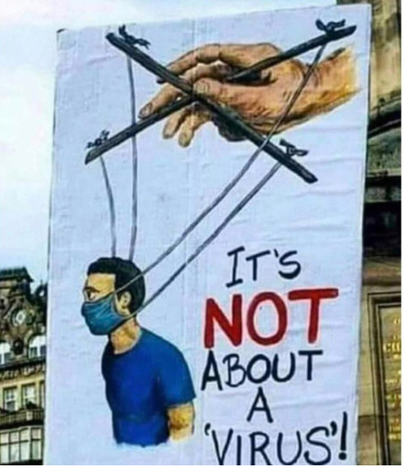
Following the Science is Impossible and Stupid
Institutional science follows politics; it will always endorse central regime policies

eugyppius | April 30, 2022
During the pandemic, Germany closed schools on a wider scale and for a longer duration than most other places in the civilised world. I was recently reminded of how our government came to embrace these extreme policies. The story is very revealing:
It began with the strange decision of state media to elevate Christian Drosten at Berlin Charité to national prominence, by granting him the Coronavirus Update podcast on 26 February 2020. The WHO had just endorsed lockdowns two days before, and various countries were acquiring new Corona tsars – random virus wizards who would become the face of containment policy to panicking domestic audiences. Every day, Drosten’s banal podcast interviews were reported breathlessly across the German media, as if they meant anything.
It’s important to remember that Drosten is a virologist. He’s not a statistician, and for what it’s worth, he’s not a public health expert either. He studies how very small proteins work and how they interact with human cells. Nevertheless, Drosten had (or claimed to have) a wide range of opinions on matters outside of his field, including the question of whether closing schools would slow down SARS-2.
At first, Drosten said that he didn’t think this would accomplish very much. Like everyone else of his ilk, he had an early history of saying basically correct and sensible things before he went crazy. On 11 March 2020, he went home and read this paper on Nonpharmaceutical Interventions Implemented by US Cities During the 1918–1919 Influenza Pandemic. It wasn’t his field; his assessment of its analysis is worth no more than mine or yours. But after reading it, he decided that actually closing schools would be a great idea, especially when used in combination with other interventions, such as banning mass gatherings. This was wind in the sails of hystericists like Markus Söder, minister president of Bavaria. And so we closed our schools, and our kids endured months of social isolation and mental anguish, because Drosten read a thing and had a brilliant idea.
But, that’s only the official story. It may be vastly worse than that. I really doubt, for example, that Drosten’s ridiculous podcast was a spontaneous programming idea by Norddeutscher Rundfunk. I suspect, instead, that there’s a reason lockdowns and Corona tsars went together in those early days. Primary was the political or bureaucratic decision to do all this crazy stuff, in the absence of any evidence aside from some dodgy numbers out of Wuhan. Thus the genius smart guys who run our institutions had to find celebrity virus astrologers, who could become the public face of novel policies and provide a simulacrum of science for the politicians to pretend they were following. It’s even odds, whether Drosten really did change his mind because of a paper he read one night; or whether it was rather the political or bureaucratic faction behind Drosten that changed their minds and gave him a paper or two to read.
Science isn’t some objective reasonable force outside of politics. Scientists spend most of their careers chasing government grant funding, and fighting for appointments and promotions in government-funded university systems. Science follows politics, and nobody knows this as much as the disingenuous politicians who claim that their policies are subordinate to scientific findings.
D.C. Schools Can’t Vaccinate Kids 11 and Up Without Parents’ Consent Until Lawsuits Settled
The Defender | April 28, 2022
A preliminary injunction prohibiting the mayor of the District of Columbia, the D.C. Department of Health and D.C. public schools from enforcing the D.C. Minor Consent for Vaccination Amendment Act of 2020 (D.C. Minor Consent Act) will remain in place after the defendants declined to file an appeal within the required 30-day period.
The preliminary injunction reverts D.C. to the standard age of consent of 18, at least until the conclusion of the case.
The injunction stemmed from two lawsuits filed against the D.C. Minor Consent Act, which allows children 11 and older to consent to vaccinations without their parents’ knowledge or consent.
The law, passed on Dec. 17, 2020, specifically targets children whose parents filed religious exemptions for their children.
“This is a significant legal victory,” said Rolf Hazlehurst, senior staff attorney for Children’s Health Defense (CHD). “But the legal battle is by no means over.”
D.C. is the legal testing ground for mandatory vaccinations, according to Hazlehurst, which makes this a “high-stakes” battle.
“The defendants and other states are twisting and distorting the ‘mature minor’ doctrine to push the limits of government overreach at the expense of parental rights,” Hazlehurst said. “They will not abandon this tactic or their assault upon our children or parental rights.”
The two lawsuits challenging the D.C. Minor Consent Act include one filed by CHD and the Parental Rights Foundation and a second brought by Informed Consent Action Network.
Both lawsuits sought a preliminary injunction to immediately prohibit D.C. schools and public health officials from enforcing the law until the lawsuits are concluded.
During oral arguments on March 3, Hazlehurst argued the D.C. Minor Consent Act violates the Supremacy Clause of the U.S. Constitution because it contains multiple provisions that strip away the meager protections guaranteed to parents under the National Childhood Vaccine Injury Act of 1986.
Hazlehurst also argued the law violates the right to freedom of religion guaranteed by the First Amendment to the U.S. Constitution.
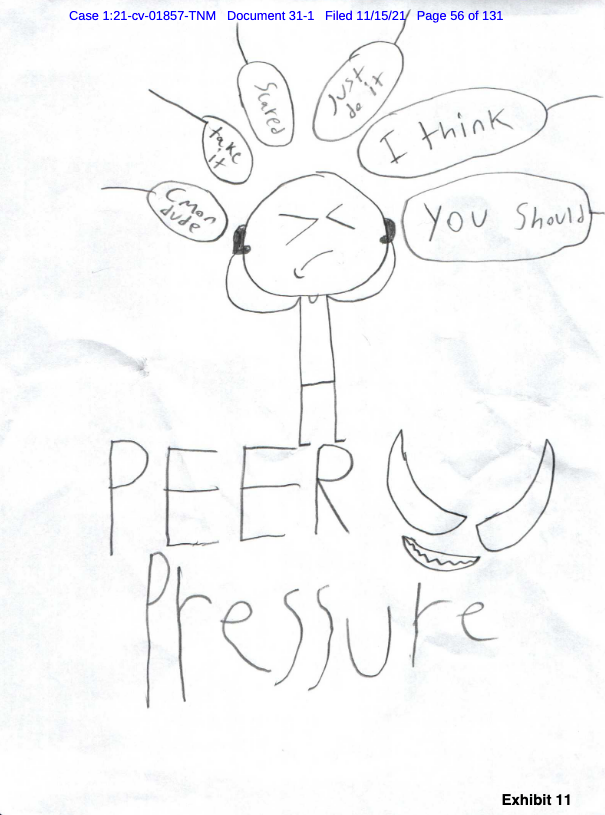
Hazlehurst told the court the mayor of D.C. created a “pressure-cooker environment,” enticing and psychologically manipulating minor children to defy their parents and take vaccinations against their parents’ will.
To make his point, Hazlehurst relied on a drawing, “Peer Pressure,” by a child of one of the plaintiffs. The drawing depicts the dilemma children face at school when they don’t want to get the COVID-19 vaccine.
On March 18, the U.S. District Court for the District of Columbia ordered the preliminary injunction.
In obtaining the preliminary injunction, the plaintiffs overcame a high legal hurdle that the “threatened injury must be certainly impending” as established by the U.S. Supreme Court precedent Clapper v. Amnesty Int’l, Hazlehurst said.
The court also ruled the plaintiffs in both lawsuits have legal standing based on preemption because the D.C. Minor Consent Act conflicts with the National Childhood Vaccine Injury Act.
In CHD’s case, U.S. District Judge Trevor N. McFadden made the additional finding that the plaintiffs have standing based upon the fact that they are likely to succeed on the merits that the law violates the free exercise of religion clause in the First Amendment.
“This preliminary injunction is part of ongoing litigation in an extremely important national precedent-setting case,” said Hazlehurst. “The rights of parents to decide what is best for their children’s health is at stake. Government can’t be allowed to make such decisions for minor children.”
The D.C. Minor Consent Act contains several provisions designed to deceive parents by hiding the fact that their children have been vaccinated against their parental judgment, authority or religious convictions.
The law requires healthcare providers to falsify records by leaving the child’s school vaccination records blank.
It also allows doctors to bill parents’ insurance companies for vaccines administered to children against their parents’ written directive. However, insurance companies may not send parents of those children an explanation of benefits.
60 countries sign declaration that commits to bolstering “resilience to disinformation and misinformation”
By Tom Parker | Reclaim The Net | April 29, 2022
The United States (US) and 60 partner countries, including the United Kingdom (UK), Canada, Australia, and members of the European Union (EU), have signed a sweeping “Declaration for the Future of the Internet” which commits to bolstering “resilience to disinformation and misinformation” and somehow upholding free speech rights while also censoring “harmful” content.
The White House framed the declaration as something that supports freedom and privacy by focusing on its commitments to protect human rights, the free flow of information, and privacy. The EU put out similar talking points and claimed that those who signed the declaration support a future internet that’s open, free, global, interoperable, reliable, and secure.
However, the commitments in the declaration are vague and often conflicting. For example, the declaration makes multiple commitments to upholding freedom of expression yet also commits to bolstering “resilience to disinformation and misinformation.” It also contains the seemingly contradictory commitment of ensuring “the right to freedom of expression” is protected when governments and platforms censor content that they deem to be harmful.
Furthermore, many of the governments that signed this declaration are currently pushing sweeping online censorship laws or openly supporting online censorship.
For example, just a few days ago, the Biden administration called for private companies to censor online “misinformation” – the latest of many similar calls. The EU also recently passed its Digital Services Act (DSA) which contains requirements to censor “hate speech” and “misinformation.”
Some government officials, including Canadian Minister of Innovation, Science, and Industry François-Philippe Champagne and UK Digital, Culture, Media, and Sport (DCMS) Secretary of State Nadine Dorries, even mentioned their country’s online censorship laws during the live launch of this Declaration for the Future of the Internet.
“The vision outlined in this declaration aligns very well with the many initiatives we are working on here in Canada, including our Digital Charter,” Champagne said.
Canada’s Digital Charter was launched in 2019 and threatens platforms with “meaningful financial consequences” if they fail to fight online “hate” and “disinformation.”
“I am enormously encouraged to see online safety is a key principle of that declaration,” Dorries said. “As the UK’s Digital Secretary, doing more to protect people online is one of my main priorities – and last month, I was proud to introduce a groundbreaking Online Safety Bill to the UK Parliament that will make the internet safer for everyone.”
The UK’s Online Safety Bill will give the government sweeping censorship powers, censor some “legal but harmful” content, and criminalize “harmful” and “false” communications.
Like the commitments to freedom of expression, the declaration’s commitments to privacy are also being made by governments that engage in or allow mass surveillance.
For example, the EU is allowing the linking of face recognition databases to create a mega surveillance system. The Federal Bureau of Investigation (FBI) recently boosted its social media surveillance technology. And the outgoing London Metropolitan police commissioner recently congratulated herself on extending the surveillance state.
While the current signatories of this declaration are governments, the White House plans to work with “the private sector, international organizations, the technical community, academia and civil society, and other relevant stakeholders worldwide to promote, foster, and achieve” the “shared vision” of this Declaration for the Future of the Internet.
Big Tech companies such as Facebook and Google have already welcomed this declaration.
“It’s great to see countries coming together today to launch the Declaration for the Future of the Internet (DFI),” Google’s Vice President, Government Affairs & Public Policy, Karan Bhatia, wrote in a blog post. “We are committed to partnering with governments and civil society through the Declaration to disrupt disinformation campaigns and foreign malign activity, while ensuring people around the world are able to access trustworthy information.”
Google and its video-sharing platform YouTube have used the term misinformation to justify the mass censorship of content. Additionally, Bhatia’s commitment to ensuring access to “trustworthy information” echoes YouTube’s commitment to boosting “authoritative sources” – a practice that creates a huge disparity between mainstream media outlets and independent creators and results in mainstream media outlets being artificially boosted by as much as 20x.
“This Declaration is an important signal from some of the world’s leading democracies,” Nick Clegg, the President of Global Affairs at Facebook’s parent company Meta, tweeted. “The only way to preserve and enhance the best of the open internet, prevent it from fragmenting further and protect human rights in the digital space is by working together.”
While Clegg’s statement focuses on the open internet and protecting human rights, Meta also mass censors content on its platforms and plans to continue this censorship in its metaverse.
And despite the declaration’s commitment to privacy, both Google and Meta’s businesses rely heavily on surveilling users to serve targeted ads.
The current list of countries that have endorsed this Declaration for the Future of the Internet includes Albania, Andorra, Argentina, Australia, Austria, Belgium, Bulgaria, Cabo Verde, Canada, Colombia, Costa Rica, Croatia, Cyprus, Czech Republic, Denmark, Dominican Republic, Estonia, the European Commission, Finland, France, Georgia, Germany, Greece, Hungary, Iceland, Ireland, Israel, Italy, Jamaica, Japan, Kenya, Kosovo, Latvia, Lithuania, Luxembourg, Maldives, Malta, Marshall Islands, Micronesia, Moldova, Montenegro, Netherlands, New Zealand, Niger, North Macedonia, Palau, Peru, Poland, Portugal, Romania, Senegal, Serbia, Slovakia, Slovenia, Spain, Sweden, Taiwan, Trinidad and Tobago, the United Kingdom, the United States, Ukraine, and Uruguay.
The declaration isn’t legally binding but is intended to be used as a “reference for public policy makers, as well as citizens, businesses, and civil society organizations.” The signatories also intend to translate its principles into “concrete policies and actions; and, work together to promote this vision globally.”
We obtained a copy of the Declaration for the Future of the Internet for you here.
The EU’s Digital Services Act is the next big threat to free speech

By Didi Rankovic | Reclaim The Net | April 29, 2022
Authorities across the world continue to use the Ukrainian crisis as the backdrop against which to pass, in some cases unprecedented in the way they restrict or censor free speech, legislation regulating the digital industry.
These trends are nothing new, but the current massive global crisis presents an excellent excuse to introduce draconian measures with little or no scrutiny or opposition. And so, in the EU, the Digital Services Act just got “enriched” by a new law that will allow the bloc to declare a state of emergency – on the internet.
The law, referred to as a “crisis mechanism” is a part of the Act and got ushered into existence last Saturday.
A state of emergency normally gives governments extraordinary powers and suspends normal laws and regulation in order to preserve lives and property – something that has thus far been used in case of war or natural disaster, i.e., those events affecting a country’s physical security, economy, etc.
But now the 27 EU countries will be able to do the same in imposing extraordinary control on all key, public-facing elements of the web: social platforms, search engines, and e-commerce sites.
A good chunk of these three categories means this is not about the usual emergency measures in a time of crisis – they also concern freedom of speech, which is where things get very complicated. What critical voices who manage to find their way into corporate media seem to be admitting is legislation like this can bring harmful outcomes, but they’re also trying to normalize it.
Daphne Keller of Stanford’s Cyber Policy Center has been quoted as telling Wired, “It looks like the war in Ukraine created a political opportunity for advocates of tighter restrictions to push their agenda. That’s pretty normal politics, if bad law.”
But many others, whose voices cannot these days be heard in the mainstream, will argue that this is also an example of “bad politics”: in Europe, that part of the world that has given birth to democracy and always strives, though does not always succeed, at implementing its tenets, sneakily passing extreme regulation almost literally “under cover of the night” (reports say that the vote on the new EU law took place “in the early hours of Saturday”) could highly likely backfire, down the road.
For the moment, the EU seems happy to explain its latest attempt at dipping its toe in the authoritarianism pond by saying that forcing tech companies to silence or completely censor information should be considered as not controversial, if a crisis is taking place, whether that concerns public security or – a health threat. Yes, the Covid panic, and its possible future (re)apparitions in European societies and economies, has also been factored in, when deciding to draft and then approve the new law.
With issues sensitive as this, every word counts – but the definition of what constitutes a “threat” big enough to invoke these massive new powers is predictably murky and bureaucratic.
Members of a European Parliament (EP) grouping called the European People’s Party (EPP), said only that when the EU Commission decides, “very large” platforms will have to “limit any urgent threat on their platforms.”
There’s more. “All measures under the crisis mechanism will be limited in time and accompanied by safeguards for fundamental rights,” European Commission spokesperson Johannes Bahrke promised.
These statements mean everything and nothing, and that’s exactly what they’re designed to do.
There’s other news revealing a bid to centralize power in the EU, now a very diffuse, and at times confused organization. Thus European Commission head Ursula von der Leyen will be given the power to enforce the new rules, bypassing a previous system where countries like Ireland, that have the most to lose if Big Tech is pushed out of Europe, had a voice.
It’s of interest to note that Big Tech has been playing along pretty well so far, making this latest legislative push somewhat unclear. Both during the Covid and Ukraine war events, these large corporations have been heeding political messages and catering to political needs, basically to a fault.
Reports suggest that now, the bureaucrats in Brussels may just want to make their jobs simpler. Instead of having to go to the sanctions regime and relying on Big Tech to obey – like they did when they blocked Russian media outlets like RT and Sputnik – they will now have a whole new law that enforces all this in one fell swoop.
This is happening as Big Tech – both the from the West, like Google, Facebook, and Amazon, and from the East, like TikTok, are yet to make any comment.
And now it’s up to EU member countries to approve the law and allow the “crisis mechanism” to kick into gear.
IRGC chief: Resistance sole way to liberation of Palestine
Press TV – April 28, 2022
Chief Commander of Iran’s Islamic Revolution Guards Corps (IRGC) Major General Hossein Salami says negotiations and accords brokered by the United States only aim to buy time for Israel, and weaken the Palestinian resistance front.
The senior commander made the remarks in a televised address to a ceremony in Gaza City on Thursday, on the eve of International Quds Day.
“The so-called peace treaties like the Camp David Accords, the Oslo Accords, the Sharm El Sheikh Memorandum etc have never been and will never be able to result in the liberation of Palestine.
“All such accords, which former US presidents, [former Israeli prime ministers Ehud] Olmert, [Benjamin] Netanyahu, Yitzhak Shamir and Yitzhak Rabin tried to seal, as well as the deal of century are nothing but deception and a conspiracy to marginalize jihad, weaken the resistance front, buy time and obliterate the awareness of the nations,” he stated.
He underscored that Palestinian people have come to realize that they will not achieve their goals except through resistance and struggle in the path of God (jihad).
Salami described the recent developments in the occupied Palestinian territories as a sign of the Israeli regime’s brutality and the strength of resistance groups, stressing that Palestinian resistance fighters have reinforced the Muslim Ummah and changed the balance of power in the region.
The IRGC chief hailed International Quds Day as a gift from Imam Khomeini, the late founder of the Islamic Republic in Iran, stating that the designation of the last Friday of the holy month of Ramadan for the event made Palestine a top priority for the entire Muslim world.
“Palestinian people are close to victory as the Zionist enemy is growing weaker. Weakness inside the Zionist entity is evident in its politics, economy and security apparatus, he said.
“All Muslims around the world are united with Palestinians in the struggle against the Israeli regime. Al-Quds and al-Aqsa Mosque are symbols of unity among Muslims in support of Palestinians,” Salami pointed out.
IRGC: Events herald Israel’s imminent end
Earlier, the IRGC said current developments in the occupied Palestinian territories show that the demise of Israel is imminent and the regime is doomed to end very soon.
“Recent developments, particularly the fact that the flames of Intifada (uprising) have passed through the inner walls of the regime, suggest that the Tel Aviv regime’s days are numbered and occupiers of holy al-Quds are quickly nearing their end,” the force said in a statement released on the eve of International Quds Day.
It lauded the decision by Imam Khomeini to designate the last Friday of the holy month of Ramadan as International Quds Day, describing the prudent initiative and historic move as a novel phenomenon and a source of pride for the Iranian nation to play an effective role in supporting the oppressed Palestinian nation.
The IRGC underlined that free and justice-seeking nations have joined forces more than ever to support the oppressed Palestinians, the Palestinian cause and the liberation of al-Quds.
“Zionists thought they could consign the Palestinian issue and the cause of al-Quds to oblivion by following satanic schemes such as the so-called ‘Deal of the Century’ and normalization of ties with some Arab countries. They were, however, wrong and their dream of sustainable and permanent security has now been broken,” the statement read.
The statement further stressed that the discourse of resistance and support for Palestine states that an end to the Israeli occupation, expulsion of occupiers, return of Palestinian refugees and free elections are the only solution to the Palestinian issue.
The IRGC went on to term any concession, including normalization of ties with the child-killing regime of Israel as an act of treason, emphasizing such bids are doomed to failure.
Hamas official: Normalization with Israel a crime
Meanwhile, a high-ranking official from the Palestinian Hamas resistance movement said the Arab states that have normalized diplomatic ties with the Israeli regime have not only committed a grave crime against Palestinians but also their own peoples.
Khalil al-Hayya, a member of the Hamas political bureau and the deputy chief in the Gaza Strip, made the remarks in an exclusive interview with Iran’s English-language Press TV television news network on Thursday ahead of International Quds Day.
Hayya slammed normalization with Israel as the regime kills Palestinian civilians, including women and children, in cold blood.
He stressed that establishment of relations with Israel only serves the best interests of the United States and the Tel Aviv regime.
The senior Hamas official said Palestinians are a nation under occupation and reserve the right to defend themselves against Israeli occupiers.
Hayya also condemned Israeli forces’ attacks against Palestinian worshippers at the al-Aqsa Mosque compound in the occupied Old City of al-Quds.
He said Palestinians are always ready to defend the holy place, warning that Israeli officials are seeking to alter its true image by preventing Palestinians from entering the site.
Study: Lockdowns Drove 60,000 Children in UK to Clinical Depression
By Paul Joseph Watson | Summit News | April 28, 2022
A new study published in the Royal Society Open Science journal found that lockdowns in the UK caused around 60,000 children to suffer clinical depression.
Researchers detected a 27.1 per cent prevalence of depression amongst their sample, a number significantly higher than would have occurred without lockdowns.
According to a report by the Telegraph, the percentage equates to about 60,000 extra kids who suffered clinical depression thanks to COVID-19 restrictions.
“After controlling for baseline scores and several school and pupil-level characteristics, depressive symptoms were higher in the COVID-19 group,” the study found.
“These findings demonstrate that the COVID-19 pandemic increased adolescent depressive symptoms beyond what would have likely occurred under non-pandemic circumstances.”
Figures show that 400,000 British children were referred to mental health specialists last year for things like eating disorders and self-harm.
Once again, the study underscores how those who vehemently promoted lockdowns, while demanding voices of dissent be silenced, were on the wrong side of history.
As we previously highlighted, a shocking outbreak of hepatitis cases in children was likely caused by lockdowns and social distancing, which served to weaken immune systems, according to health experts.
Many infants are also suffering from cognitive developmental and speech disorders due to adults wearing face coverings during the pandemic.
According to speech therapists, mask wearing has caused a 364% increase in patient referrals of babies and toddlers.
A major study by Johns Hopkins University concluded that global lockdowns have had a much more detrimental impact on society than they have produced any benefit, with researchers urging that they “are ill-founded and should be rejected as a pandemic policy instrument.”
Doctors Could Be Struck Off For Questioning Government Line on Lockdowns and Vaccines Under New Guidance
By Will Jones | The Daily Sceptic | April 27, 2022
Doctors who criticise vaccines or lockdown policies on social media could face being struck off if regulators rule they are guilty of spreading ‘fake news’, according to new guidance from the GMC. The Telegraph has the story.
The core guidance for medics has been updated for the first time in almost a decade to cover media such as Twitter, Facebook and Instagram. The rules on use of social media include a duty to be “honest” and “not to mislead”, as well as to avoid abuse or bullying.
The draft regulations from the General Medical Council (GMC) – which the watchdog describes as a 21st-century version of the Hippocratic Oath – also say doctors must speak out if they encounter “toxic” workplace cultures that threaten patient safety. And they say medics must take action if they encounter workplace bullying, harassment or discrimination.
The watchdog regulates doctors, who can face a range of sanctions – including being struck off the medical register – if they are found to have failed in their duties.
Charlie Massey, the Chief Executive of the GMC, said… the fundamental principles of the guidance remained the same, but had been updated to reflect the modern world.
“We’ve had feedback that doctors want more clarity on using social media. We are already clear that doctors must be honest and trustworthy in their communications, and are now emphasising that this applies to all forms of communication. The principles remain the same whether the communication is written, spoken or via social media,” he said.
The use of social media by medics has become an increasingly vexed issue during the pandemic, the report adds.
In December a judge ruled that the GMC’s interim orders tribunal had made an “error of law” when it ordered a GP accused of spreading misinformation to stop discussing Covid on social media.
Dr. Samuel White, who was a partner at a practice in Hampshire, raised concerns about vaccines and claimed “masks do nothing” in a video posted last June.
The GMC’s Interim Orders Tribunal imposed restrictions on Dr. White’s registration as a result. But the High Court said this decision was “wrong” under human rights law.
He had claimed “lies” around the NHS and Government approach to the pandemic were “so vast” that he could no longer “stomach or tolerate” them.
In August, the tribunal concluded Dr. White’s way of sharing his views “may have a real impact on patient safety”. It found Dr. White allegedly shared information to a “wide and possibly uninformed audience” and did not give an opportunity for “a holistic consideration of COVID-19, its implications and possible treatments”.
But the GP’s barrister, Francis Hoar, argued the restrictions imposed on his client’s registration were a “severe imposition” on his freedom of expression.
The draft guidance says doctors can be held accountable for promoting misleading information or stepping outside areas of their expertise. They are told to “be honest and trustworthy … make clear the limits of your knowledge… [and to] make reasonable checks to make sure any information you give is not misleading.
“This applies to all forms of written, spoken and digital communication,” the draft guidance states. And doctors are warned that online rows and trolling could jeopardise their professional futures.
It is of course outrageous that medics should be at risk of losing their career for questioning on Twitter the Government line on its draconian public health interventions. If there’s one thing we were lacking during the pandemic it was not an excess of conformity amongst doctors. The right of medics to ‘informed dissent’ should be strengthened, as per the High Court ruling in favour of Dr. White, not weakened.
On the other hand, there are plenty of Government advisers I can think of who could do with being penalised for “stepping outside areas of their expertise”. Somehow I doubt anything similar will ever be applied to them, however.
Worth reading in full.
Stop Press: The GMC guidance is still the subject of a public consultation – and anyone can contribute. Click here to begin the process.
The Illusion of Freedom: We’re Only as Free as the Government Allows

By John W. Whitehead & Nisha Whitehead | The Rutherford Institute | April 26, 2022
“Rights aren’t rights if someone can take them away.”— George Carlin
We’re in a national state of denial.
For years now, the government has been playing a cat-and-mouse game with the American people, letting us enjoy just enough freedom to think we are free but not enough to actually allow us to live as a free people.
Case in point: on the same day that the U.S. Supreme Court appeared inclined to favor a high school football coach’s right to pray on the field after a game, the high court let stand a lower court ruling that allows police to warrantlessly track people’s location and movements through their personal cell phones, sweeping Americans up into a massive digital data dragnet that does not distinguish between those who are innocent of wrongdoing, suspects, or criminals.
Likewise, although the Supreme Court gave the go-ahead for a death row inmate to have his pastor audibly pray and lay hands on him in the execution chamber, it refused to stop police from using hidden cameras to secretly and warrantlessly record and monitor a person’s activities outside their home over an extended period of time.
For those who have been paying attention, there’s a curious pattern emerging: the government appears reasonably tolerant of those who want to exercise their First Amendment rights in a manner that doesn’t challenge the police state’s hold on power, for example, by praying on a football field or in an execution chamber.
On the other hand, dare to disagree with the government about its war crimes, COVID-19, election outcomes or police brutality, and you’ll find yourself silenced, cited, shut down and/or branded an extremist.
The U.S. government is particularly intolerant of speech that reveals the government’s corruption, exposes the government’s lies, and encourages the citizenry to push back against the government’s many injustices. For instance, Wikileaks founder Julian Assange, the latest victim of the government’s war on dissidents and whistleblowers, is in the process of being extradited to the U.S. to be tried under the Espionage Act for daring to access and disclose military documents that portray the U.S. government and its endless wars abroad as reckless, irresponsible, immoral and responsible for thousands of civilian deaths.
Even political protests are fair game for prosecution. In Florida, two protesters are being fined $3000 for political signs proclaiming stating “F—k Biden,” “F—k Trump,” and “F—k Policing 4 Profit” that violate a city ban on “indecent” speech on signs, clothing and other graphic displays.
The trade-off is clear: pray all you want, but don’t mess with the U.S. government.
In this way, the government, having appointed itself a Supreme and Sovereign Ruler, allows us to bask in the illusion of religious freedom while stripping us of every other freedom afforded by the Constitution.
We’re in trouble, folks.
Freedom no longer means what it once did.
This holds true whether you’re talking about the right to criticize the government in word or deed, the right to be free from government surveillance, the right to not have your person or your property subjected to warrantless searches by government agents, the right to due process, the right to be safe from militarized police invading your home, the right to be innocent until proven guilty and every other right that once reinforced the founders’ belief that this would be “a government of the people, by the people and for the people.”
Not only do we no longer have dominion over our bodies, our families, our property and our lives, but the government continues to chip away at what few rights we still have to speak freely and think for ourselves.
On paper, we may be technically free.
In reality, however, we are only as free as a government official may allow.
We only think we live in a constitutional republic, governed by just laws created for our benefit.
Truth be told, we live in a dictatorship disguised as a democracy where all that we own, all that we earn, all that we say and do—our very lives—depends on the benevolence of government agents and corporate shareholders for whom profit and power will always trump principle. And now the government is litigating and legislating its way into a new framework where the dictates of petty bureaucrats carry greater weight than the inalienable rights of the citizenry.
With every court ruling that allows the government to operate above the rule of law, every piece of legislation that limits our freedoms, and every act of government wrongdoing that goes unpunished, we’re slowly being conditioned to a society in which we have little real control over our lives.
In our quest for less personal responsibility, a greater sense of security, and no burdensome obligations to each other or to future generations, we have created a society in which we have no true freedom.
Government surveillance, police abuse, SWAT team raids, economic instability, asset forfeiture schemes, pork barrel legislation, militarized police, drones, endless wars, private prisons, involuntary detentions, biometrics databases, free speech zones, etc.: these are mile markers on the road to a fascist state where citizens are treated like cattle, to be branded and eventually led to the slaughterhouse.
We are overdue for a systemic check on the government’s overreaches and power grabs.
Where we find ourselves now is in the unenviable position of needing to rein in all three branches of government—the Executive, the Judicial, and the Legislative—that have exceeded their authority and grown drunk on power.
The American kleptocracy (a government ruled by thieves) has sucked the American people down a rabbit hole into a parallel universe in which the Constitution is meaningless, the government is all-powerful, and the citizenry is powerless to defend itself against government agents who steal, spy, lie, plunder, kill, abuse and generally inflict mayhem and sow madness on everyone and everything in their sphere.
Unfortunately, there is no magic spell to transport us back to a place and time where “we the people” weren’t merely fodder for a corporate gristmill, operated by government hired hands, whose priorities are money and power.
As I make clear in my book Battlefield America: The War on the American People and in its fictional counterpart The Erik Blair Diaries, our freedoms have become casualties in an all-out war on the American people.
If we continue down this road, there can be no surprise about what awaits us at the end.
Constitutional attorney and author John W. Whitehead is founder and president The Rutherford Institute. His books Battlefield America: The War on the American People and A Government of Wolves: The Emerging American Police State are available at www.amazon.com. He can be contacted at johnw@rutherford.org. Nisha Whitehead is the Executive Director of The Rutherford Institute. Information about The Rutherford Institute is available at www.rutherford.org.
Corruption of Language, Corruption of Thought
With a brief discourse on totalitarian regimes and conspiracy theories
By Aaron Kheriaty, MD | April 27, 2022
In his classic dystopian novel 1984, George Orwell famously wrote, “If you want a picture of the future, imagine a boot stamping on a human face—for ever.” This striking image served as a potent symbol for totalitarianism in the 20th Century. But as Caylan Ford recently observed, with the advent of digital health passports in the emerging biomedical security state, the new symbol of totalitarian repression is “not a boot, but an algorithm in the cloud: emotionless, impervious to appeal, silently shaping the biomass.” The new forms of repression will be no less real for being virtual rather than physical.
These new digital surveillance and control mechanisms will be no less oppressive for being virtual rather than physical. Contact tracing apps, for example, have proliferated with at least 120 different apps in used in 71 different states, and 60 other digital contact-tracing measures have been used across 38 countries. There is currently no evidence that contact tracing apps or other methods of digital surveillance have helped to slow the spread of covid; but as with so many of our pandemic policies, this does not seem to have deterred their use.
Other advanced technologies were deployed in what one writer has called, with a nod to Orwell, “the stomp reflex,” to describe governments’ propensity to abuse emergency powers. Twenty-two countries used surveillance drones to monitor their populations for covid rule-breakers, others deployed facial recognition technologies, twenty-eight countries used internet censorship and thirteen countries resorted to internet shutdowns to manage populations during covid. A total of thirty-two countries have used militaries or military ordnances to enforce rules, which has included casualties. In Angola, for example, police shot and killed several citizens while imposing a lockdown.
New Zealand Used Selective Science and Force to Drive High Vaccination Rates
By J.R. Bruning | Brownstone Institute | April 26, 2022
We expect that knowledge produced and applied in a health emergency will produce information that is protective of health. But it is increasingly apparent that over the last two years New Zealand’s Ardern government has designed policy, regulation, and information to coercively steward citizens to accept a drug under provisional consent.
Strict lockdowns were promised to end when 90% of the population was vaccinated. This was unprecedented: policy endpoints required population-level uptake of novel technology, no matter whether the individual was at risk or not.
In addition, data production was contracted by the department intent on a 90% vaccination rate. For decades governments have promoted ‘evidence-based science’ as the gold standard for public reasoning and risk deliberation. What we saw was internally produced and contracted science that focused on case rates, while (inconvenient) information in the published scientific literature on vaccine risk, waning and breakthrough was ignored.
This produced a tightly controlled scope of knowledge production that then failed to adhere to long-established democratic and public health principles. Responsible risk governance requires that governments must be responsive to data that indicates a technology is not as effective or is possibly more harmful than estimated, – for a democratic government’s primary role is the protection and safety of all citizens. Technology must not be valorized, and uncertainty set aside, in order to achieve policy ends.
Universal Vaccination Assumed from April 2021
New Zealand’s Unite Against Covid-19 ‘elimination’ strategy was confirmed in the first quarter of 2020. Policy, propaganda and legislation predominantly centred around the case, or infection rate, rather than the fatality rate as the measure of risk.
Even though the clinical trials did not demonstrate that the vaccine prevented transmission and infection, the Government promoted ‘the jab’ as a way to protect families in the Unite Against Covid-19 campaign. Persistent reporting of case rates fostered a perpetual state of fear and uncertainty among the population, who perceived infection from the SARS-CoV-2 virus to be something more like Ebola.
The Ardern government’s intention for the entire population to get the mRNA vaccine was declared through the signing of a supply agreement. This intention was then embedded in policy and regulation via the Traffic Light system, designed to nudge the population over 12 into compliance.
It was known by July 2021 that the vaccine waned and was leaky. Breakthrough infections were relatively common and for many. The clinical trials remain incomplete, lacking long-term safety data. The trials did not demonstrate that the vaccine prevented hospitalization and death.
However, in April 2022 in New Zealand, mandatory vaccinations remain compulsory for border workers, and workers in health and disability; corrections; defence; Fire and Emergency New Zealand (FENZ) and Police. These professions must be vaccinated and have received a booster vaccination against COVID-19.
At ‘Traffic Light Orange’ Kiwis ‘must wear a face mask’ in retail businesses, on shared and public transport, in government facilities and when visiting a healthcare service. This is despite the fact that Omicron ripped through New Zealand in February.
In the first week back at school and university after the summer holidays –the obedient mask-wearing young friends of my kids, including my son, from Otago and Canterbury down on the South Island up to the capital Wellington and Auckland – were locked down with Omicron in their first weeks back at university. No evaluation of Omicron and mask efficacy has been provided by the state.
The Risk Modellers
Government policy processes have persistently excluded uncomfortable knowledge that suggested uncertainty or risk. First, the policy accompanying and justifying Covid-19 legislation and Orders, and modelling by the contracted institution Te Pūnaha Matatini (TPM) contained narrow reasoning central to the state’s claims, locking in the narrative that infection was the predicator of risk, modelling wave after wave of infection.
Second, policy supporting the legislation excluded consideration of age-stratified risk and failed to address common principles of infectious disease management embedded in the New Zealand Health Act. Third, reviews of the scientific literature that could publicly identify and communicate risk relating to vaccine-related harm and issues relating to efficacy simply never occurred.
The gaps are considerable. The Government’s Covid-19 Unite campaign failed to communicate age-stratified risk of hospitalization and death as the pandemic evolved. New evidence on infection fatality rates were not reported to the public. In modelling papers, TPM used old infection fatality rate statistics that overestimated death rates.
The potential for the vaccine to wane or for breakthrough infection to occur was ignored in a major policy paper focussed on elimination and by the modellers at TPM. The role of natural infection in producing a broader, and protective structural response, assisting populations to shift to herd immunity status was downplayed. While herd immunity was recognized, testing and data modelling was undertaken to identify naturally derived herd immunity in the population. Later modelling exclusively associated herd immunity with vaccination.
Perhaps the problems addressed here are not surprising, when most modelling was undertaken outside of New Zealand’s public health institutions. Instead, number-crunching was carried out by data analysts, mathematicians affiliated with TPM, with scarce few infectious disease epidemiologists trained in public health ethics participating. And of course, the science and data modelling were directly funded by the government departments and Ministries dedicated to over 90% vaccine compliance.
Global vaccination policies ignored the fact that infection-related risk always centered on the aged and infirm and those with complex multimorbid conditions. Disconcertingly, the clinical trial data had conceded that vaccine efficacy remained uncertain for the most at-risk of harm from Covid-19 – the immunocompromised, autoimmune and people who were frail, and those with inflammatory conditions (see p.115). In addition, as coronaviruses readily mutate, it was highly probable the vaccine would have a short shelf life.
Early Treatments Sidelined
Governments are entrusted with an overarching obligation to protect health – this includes putting populations directly at risk through bad policy. There was always a role for safe, established drugs with a long history of safe use that had undergone complete testing before launching onto the market.
Early treatments could have been integrated as a major tool to prevent hospitalisation and death. Early treatments avoid the dilemma of mutating variants while acting to protect at-risk groups whose immune systems might not be as responsive to a vaccine.
Conventionally doctors are at liberty to repurpose drugs for their patients, such as antivirals with a long history of safe use. However, in July 2021, the government locked in approved drugs for treatment.
From at least October, New Zealand doctors were instructed to ‘not use any other antiviral outside of a clinical trial’ while Medsafe warned against use of the safe antiviral Ivermectin for a respiratory virus. Yet the clinical guidelines were intended as last resort medicine for the hospitalized, rather than designed as protective nor preventative at home therapies.
These directives have fractured the practice of informed consent, which forms the basis of trust in the doctor-patient relationships. Even the New Zealand Medical Council, the organisation that grants licences to practice medicine, declared that there was ‘no place for anti-vaccination messages in professional practice.’ These actions may unwittingly undermine trust in vaccines and the doctor-patient relationship for years to come.
The implications of silencing doctors, some who have had their medical licenses suspended, when observed alongside the above-mentioned data gaps, are extraordinary.
Ethical questions continue to be sidelined. The principle of proportionality, embedded in the 1956 Health Act, has been effectively dropped. Proportionality, which allows for individual risk, is a core consideration in public health. Medicine is a technology, and the space where biology meets technology – including medicine – is never constant, and requires value-based judgement. Risk management of a medical intervention for a pregnant woman, young person or child requires significantly different deliberation to a 75-year-old.
Democratically Unaccountable Legislation
Since January 2020, a tsunami of rights-limiting has been rolled out purposefully and consistently. There was scant citizen consultation with public input limited to a few short days in most cases. The unprecedented barrage of rules and orders released by the Ardern government entrenched requirements for almost everybody to get the mRNA vaccine.
By mid-2021 – before most mandates – the scientific literature was revealing that the vaccine waned; that breakthrough infection occurred and that there was extensive evidence that it produced a wide range of side effects, and even death. This knowledge should have invalidated any workforce vaccine mandate, but instead by October, the state doubled down and locked in mandates and regulations that would legally and socially coerce most of the population over 12 into accepting the shot.
It’s probable that the mountain of legislation produced over the last two years never fulfilled democratic norms of accountability and transparency. For science in a pandemic to be harnessed to serve the public interest, the institutions that set those terms of reference must be guided by principles that protect health.
The failure of government agencies to draw on peer-reviewed scientific literature while prioritizing internal modelling is clear from tracking the literature stored online with the relevant agencies. Most compellingly, it is documented in the policy supplied in support of the unprecedented quantity of law-making.
It appears that from late 2019, institutional interests anticipated that there would be hesitancy around vaccine safety. Yet there was no public forum. Instead, groups who sought to question the safety of the novel mRNA vaccine remained outside ‘accredited’ media, possibly due to the chilling effect of unprecedented Covid-19 funding and advertising boosts which effectively captured mainstream media.
That the New Zealand state mandated not-at-risk people accept a novel technology, creating rules (as nudge policies) that limited economic and social life for the non-vaccinated when there was early evidence the vaccine was leaky and potentially harmful, will take years to unpick. As mandates continue, injured groups continue to face barriers to justice following vaccine injury and death.
Ultimately, practices such as this raise nagging doubts concerning the state’s capacity to honor broader obligations to protect health and the public interest in future emergency situations. New Zealand’s response to the Covid-19 pandemic serves as a case study – a precedent, for future health emergencies.
A deeper dive on this discussion can be found in the paper, Covid-19 Emergency Powers and on Rumble. The paper is offered to assist academic and legal experts, citizens and communities to consider use of policy and science by the Ardern Government from 2020-2022. I question the potential for the New Zealand state to navigate future pandemics, and future techno-controversies, in the public interest.
J.R. Bruning is a consultant sociologist (B.Bus.Agribusiness; MA Sociology) based in New Zealand. Her work explores governance cultures, policy and the production of scientific and technical knowledge. Her Master’s thesis explored the ways science policy creates barriers to funding, stymying scientists’ efforts to explore upstream drivers of harm. Bruning is a trustee of Physicians & Scientists for Global Responsibility (PSGR.org.nz). Papers and writing can be found at TalkingRisk.NZ and at JRBruning.Substack.com and at Talking Risk on Rumble.
5 signs they are CREATING a food crisis
By Kit Knightly | OffGuardian | April 25, 2022
It’s no secret that, according to politicians and the corporate press, “food shortages” and a “food supply crises” have been on the way for a while now. They have been regularly predicted for several years.
What’s really strange is that despite its near-constant incipience, the food shortage never seems to actually arrive and is always blamed on something new.
As long ago as 2012, “scientists” were predicting that climate change and a lack of clean water would create “food shortages” that would “turn the world vegetarian by 2050”.
In 2019, UN “experts” warned that “climate change was threatening the world’s food supply”.
Later the same year, the UK was warned that they could expect a food shortage as a result of “post-Brexit chaos”.
By early March 2020 supermarkets were already “warning” that the government had been too slow to act on the coronavirus outbreak, and they might run out of food. (They never actually did).
A month later, in April 2020 when the “pandemic” was less than three months old, “officials” warned Covid was going to create a global food crisis. Three months later it had ballooned into “the worst food crisis for 50 years”.
In the Summer of 2021 the British press was predicting the “worst food shortages since world war 2” and “rolling power cuts”, allegedly due to a lack of truck drivers blamed equally on Covid and Brexit (neither the shortages nor power cuts ever really materialised).
By September 2021, the UK was told the gas price spike would create a shortage of frozen food, and just a month later, that we may have to ration meat ahead of Christmas, due to the gas crisis. (There never was any rationing)
In January 2022, Australia saw “empty supermarket shelves” blamed on the Omicron variant crippling the supply chain, while the US had the same empty shelves blamed on bad winter weather.
Moving into the spring of 2022, the food crisis is still on its way…only now it’s because of the war in Ukraine, or China’s “Zero Covid” policies, or the bird flu outbreak.
You’d be forgiven for thinking that – since the food crisis is always expected but never arrives, and is always blamed on the current thing – that it doesn’t really exist. That it’s nothing but a psy-op designed to spread panic and give suppliers an excuse to jack up their prices in response to fake “scarcity” created by the press.
However, there are indications that this may be about to change.
In a Brussels press conference on March 25th of this year, Joe Biden said…
Regarding food shortages – yes, we did talk about shortages, and they’re going to be real.”
… which is a decidedly odd thing to say.
Most of the time the only reason to strongly affirm something is “going to be real” from now on, is that up to that point it was not.
Indeed, there are a few signs that the food supply is about to genuinely come under attack.
1. UKRAINE WAR & WESTERN SANCTIONS
It’s well documented that Russia’s “special operation” in Ukraine has driven up the prices of oil, gas and wheat. Partly due to disruption on the ground, but mostly due to Western sanctions.
Russia is the largest exporter of wheat and other grains in the world, and these products are used not just for making food for humans, but also as animal feed. Western nations boycotting Russian wheat will therefore potentially drive up the price of a huge variety of foodstuffs.
We have already seen rationing of sunflower oil (a major Ukrainian export), with reports that this could extend to all kinds of other products including sausages, chicken, pasta and beer.
This war did not need to happen, it could have been prevented (and could still be stopped) by a simple agreement on Ukrainian neutrality. Combine that with the sweeping nature of the anti-Russian sanctions – unmatched in recent history – and you can reason that the chaos on the ground and concomitant increase in food prices is part of a deliberate policy serving the Great Reset agenda.
2. INCREASING THE PRICE OF OIL
The increased price of oil has natural and obvious knock-on effects for every industrial sector – most especially transport, logistics and agriculture. Despite fears of a cost of living crisis, warnings of food shortages and Russia’s status as the largest exporter of oil and gas in the world, Western nations and their allies have made virtually zero effort to lower the cost of oil.
The high oil price has already seen the Russian ruble bounce back to pre-war strength, and yet Saudi Arabia has been increasing their prices, not flooding the market to tank the price as they did in 2014/15.
Keeping the cost of petroleum high is a deliberate policy decision, and one that shows the cost of living crisis – and any resultant food shortages – are being engineered on purpose.
3. BIRD FLU
The press is claiming there is a major bird flu outbreak going on. As we published last week, the dynamics of “bird flu” seem to be identical to Covid. Birds are tested for the virus using PCR tests, culled if they are “positive”, and these culls are then labelled “bird flu deaths”.
This process has already seen at least 27 million poultry birds destroyed in the US alone, the world’s largest exporter of both chicken and eggs. France, Canada and the UK have also culled millions of birds.
Bird flu has already (allegedly) caused the price of chicken and eggs to skyrocket.
(As a potentially important aside, a new report has also warned that pigs can pass “superbugs” to humans, so pigs may be for the chop sometime soon, too)
4. UK & US PAYING FARMERS TO STOP FARMING
Going back to last May, the Biden administration began pushing farmers to add agricultural land to the “conservation reserve program”, a federally funded program allegedly aimed at preserving the environment. The program is essentially paying farmers not to farm. A very odd policy decision, given the widely predicted food shortages.
A state-level plan in California is going to pay farmers to grow less, this time in the name of saving water.
Interestingly, the UK has a similar program going on for (again, allegedly) totally different reasons. Starting this past February, the British government is paying lump sums of up £100,000 to any farmers who want to retire from farming. Again, a strange policy during a period of geopolitical unrest impacting the food supply.
5. MANUFACTURED FERTILISER SHORTAGES
Russia and Belarus are two of the biggest exporters of fertiliser and fertiliser-related products in the world, accounting for around 10 billion dollars worth of trade manually. So, the war in Ukraine (and the sanctions) are already hitting the fertiliser market hard, with prices hitting new all-time highs in March.
China, the third biggest exporter of fertiliser in the world, has had a self-imposed export ban on the product since last summer, allegedly in an effort to keep domestic food prices low.
Given that, it is very strange that America’s Union Pacific Railway has suddenly placed a limit on the number of fertiliser deliveries it will make, informing fertiliser giant CF Industries they will need to cut their train car use by as much as 20%.
In their public response, CF Industries stated:
The timing of this action by Union Pacific could not come at a worse time for farmers…Not only will fertilizer be delayed by these shipping restrictions, but additional fertilizer needed to complete spring applications may be unable to reach farmers at all. By placing this arbitrary restriction on just a handful of shippers, Union Pacific is jeopardizing farmers’ harvests and increasing the cost of food for consumers.”
BONUS: FIRES AT FOOD PROCESSING PLANTS
This get’s a bonus slot, not an official spot, because of the multiple unknowns in this case.
In the strangest and most ephemeral story on the list, it seems there has been a rash of fires at food processing plants all over the United States in the last six months. Since August 2021 at least 16 major fires have broken out at food processing plants all across the country.
In September last year a meat processor in Nebraska burned down, impacting 5% of the country’s beef supply. In March of this year fire shut down a Nestle frozen food plant in Arkansas and a major potato processing site in Belfast, Maine was almost levelled by a huge fire.
The examples just keep on coming.
In just the last week two different single-engine planes have crashed into two different food plants, causing major fires. One at a potato processing plant in Idaho, another at a General Mills plant in Georgia.
Right now we can’t prove this is a deliberate campaign, or even statistically unusual, but it certainly warrants some further investigation.
There’s a good write-up on this story on Tim Pool’s website, and an in-depth twitter thread covering all the recent events from Dr Ben Braddock here.
*
In summary …
- A war which did not need to happen is driving up food and oil prices.
- Sanctions which did not need to be put in place are also driving up food and oil prices.
- Western allies are intentionally raising their oil prices.
- Despite warning of a food crisis, US and UK are paying farmers not to farm.
- A “bird flu epidemic” very much like the fake Covid “pandemic” is driving up the price of poultry and eggs.
- Western companies are actively making the fertiliser shortages worse.
- Bizarre fires are crippling large sections of the US food industry.
Taken individually maybe these points could all be seen as mistakes or coincidences, but when you put them all together it’s not hard to spot the pattern. The press may claim we are “sleepwalking” into a food crisis, but it looks more like they’re running head-first into it.
After years of saying there’s a food shortage on the way, it looks like they might be about to finally actually create one.
Featured Video
Dan Dicks with James Corbett on Solutions Watch
or go to
Aletho News Archives – Video-Images
From the Archives
Secret document reveals plans for civil war in Lebanon, Israeli false flags, and invasion
By Randi Nord | Geopolitics Alert | April 5, 2019
Beirut – During his visit with US Secretary of State, Mike Pompeo, Lebanese President Michael Aoun reportedly received a US-Israeli document detailing plans for creating a civil war in Lebanon with covert false flag operations and possible Israeli invasion.
Although the source of the document is Israeli and created in partnership with Washington, no one knows who presented it to Aoun. The Lebanese TV station, Al-Jadeed, initially reported the document on Lebanese TV and a video on its website. Geopolitics Alert translated the report for this article. … continue
Blog Roll
 Aletho News
- How to MAKE THE CONSPIRATORS PAY for their crimes! Dan Dicks with James Corbett on Solutions Watch
- There’s a drought in academia: A drought in honest research on the subject of drought and other weather extremes
- Department of War Awards $20.7 Billion Contract to Raytheon for Air-to-Air Missiles
- ‘Distance yourselves from Israel’: IRGC urges US population to question govt policies
- America’s Greenland deal has a radioactive backstory
- The RAF Fairford ‘terror plot’: Unpacking escalation in the UK echo-chamber
- EU Council Advances Chat Control 2.0 Scanning Proposal
- Ex-Greek MEP files complaint against Israeli spyware firm over alleged Pegasus surveillance
- Troubling ideas throughout the Torah, Talmud, Mishneh Torah and Tanya
- ‘Grave, alarming’: Iran mission on Trump’s UNGA ‘annihilation’ threats
- If Americans Knew
- New Report: “Scholasticide and Genocide in Gaza: Assessment, Testimonies and Legal Analysis”
- Ex-Biden officials are desperate for a Gaza scapegoat
- Israeli “settlers” Invade Al-Aqsa; Pour Boiling Water on 75-Year-Old
- Israel Has Kidnapped Another American Teenager
- US arms sales to Israel worth $21.6 billion in 20 months
- Three Palestinians Killed in Israeli Attacks on Gaza
- Revealed: German “Anti-Semitism Expert” Driving Crackdown on Palestine Solidarity is Former Israeli Spy
- Egypt’s Warning to Israel Before Oct 7
- Israel’s siege signals another cruel winter for 1.8 million Gazans – Daily Update
- Netanyahu Asked UAE Leader to Deny Report on Oct. 7 Warning in Secret Visit, Sources Say
- No Tricks Zone
- New Study: Earth And Venus Surface Warmth Largely Explained By Convection And Lapse Rate, Not CO2 Or Radiation
- 2025 Nature Paper Claiming Worsening Global Drought Gets RETRACTED …Heavily Flawed
- New Study: ‘Global Drought Shows No Detectable Recent Acceleration Under Climate Warming’
- Economic Masterminds: German Socialists Suggest Taxing Productivity Gains Stemming From Using AI
- The South China Sea Has Not Been Cooperating With The Climate Change Narrative
- Energy Crisis: Germany Enters Heating Season With Historically Low Gas Reserve Fill Levels
- New Study: The Antarctic Ice Sheet Gained Mass From 2020-2024 Due To Staggering Snow And Ice Accumulation
- Study: Ocean Heating Rates From Thousands Of Years Ago ‘Dwarf’ Modern Ocean Heating Rates
- Climate Extremists Target, Attack Large-Scale Power Grid Infrastructure In Germany!
- New Study: Antarctic Ice Melt Has Contributed Less Than 1 Centimeter To Sea Level Rise In The Last 30 Years