How Billions in COVID Stimulus Funds Led to Dangerous, Tyrannical Policies in U.S. Schools
The Defender | January 20, 2022
In a January interview on Del Bigtree’s “The Highwire” —“COVID-19: Following the Money” — policy analyst A.J. DePriest, a member of the grassroots Tennessee Liberty Network, shared the group’s jaw-dropping findings about the undue influence of federal relief monies on school and hospital policies.
In this article, The Defender covers how federal money affected schools. We will cover the impact of federal money on hospitals in a separate article to follow.
In 2020 and 2021, Congress passed trillions in COVID-related stimulus through the Coronavirus Aid, Relief and Economic Security (CARES) Act, the Coronavirus Response and Relief Supplemental Appropriations (CRRSA) Act and the American Rescue Plan (ARP) Act.
Sizeable portions of those funds went to schools.
Digging into the education allotment, the Tennessee network discovered public, charter and nonprofit private schools in the U.S. received nearly $190.5 billion during three rounds of Elementary and Secondary School Emergency Relief (ESSER) funding (called ESSER I, II and III).
One of DePriest’s disquieting take-home messages is that this education lucre came with major strings attached — federal strings that are persuading ignominious school board members to adopt policies unfavorable and even dangerous to student health and well-being.
While DePriest characterized the stimulus bonanza as a “BIG carrot” for cash-strapped schools, that assessment may be too generous. If one examines the disturbing conditions attached to the U.S. Department of Education’s (DOE’s) dazzling largesse, the government billions seem closer to a godfather-like “offer they can’t refuse.”
The $190 billion ‘carrot’
The size of the federal “carrot” increased with each ESSER iteration. The $1.9 trillion ARP package alone assigned state educational agencies and school districts a whopping $122 billion (ESSER III).
On Jan. 18, the U.S. Department of Education (DOE) crowed about its disbursement of the final chunk of ESSER III monies, claiming the funds were “critical” for addressing “recent challenges” such as the putative and much-ballyhooed Omicron variant.
In Tennessee, the state’s initial take from ESSER I was nearly $260 million, but ESSER II quadrupled that amount to over $1.1 billion. By ESSER III, Tennessee’s educational haul had reached almost $2.5 billion.
The school district encompassing Memphis received roughly three-quarters of a billion dollars, DePriest noted, while Nashville schools pocketed a cool half a billion.
Schools and COVID vaccines
In DePriest’s view, there’s a catch that explains why school boards in every state have been so coldly unresponsive to parental pleas to unmask their children and abandon other COVID restrictions.
The catch is that federal generosity for state educational agencies is contingent on states proving to DOE (in reports submitted twice a year through fall 2023) they are meeting requirements synced with the Centers for Disease Control and Prevention’s (CDC’s) “safety recommendations.”
The CDC’s aggressive “recommendations” include:
- Enforcing “universal and correct wearing of masks”
- Physically modifying schools to facilitate “distancing”
- Ensuring “respiratory etiquette” and handwashing (likely with carcinogenic sanitizers)
- Implementing strenuous cleaning protocols to maintain “healthy facilities”
- Facilitating contact tracing, “in combination with isolation and quarantine”
- Conducting testing (both screening and diagnosis), helped along by additional resources from a federal-CDC-Rockefeller Foundation partnership to “ensure that all schools can access and set up screening testing programs as quickly as possible”
- Coordinating with state and local health officials
- Engaging in “efforts to provide vaccinations to school communities”
In its Jan. 18 press release, DOE took pains to emphasize that expanding access to vaccinations is “critical” for “safely reopening schools and sustaining safe operations.” And it furnished two ominous illustrations of how its stimulus monies are supporting vaccination efforts on the ground.
First, DOE noted, the Vermont Agency of Education is partnering with other statewide agencies “to vaccinate all Vermonters, including eligible students.” DOE approvingly stated that three-fourths of 12- to 17-year-olds in Vermont already received at least one dose.
DOE also considered the Hawaii Department of Education’s hosting of dozens of vaccination clinics for students, staff and “school communities” to be exemplary.
Further evidence of the feds’ hold over schools comes from the fact that some school districts have already taken steps to mandate COVID shots for some or all K-12 students, even in advance of formal U.S. Food and Drug Administration (FDA) approval.
Weaponizing HVAC systems?
More than 40% of school districts plan to spend some of their ESSER funds on “improvements” to heating, ventilation and air conditioning (HVAC) systems.
This raises a potential red flag in light of the Environmental Protection Agency’s (EPA) authorization in February 2021 — through a slippery “Public Health Emergency Exemption” — of a potentially hazardous, nanoparticle-based “air treatment” called Grignard Pure.
Dispersal of the chemical, authorized for indoor use in public spaces, occurs primarily “in-duct” via HVAC systems.
EPA’s authorization allows for Grignard Pure’s use in indoor spaces “when adherence to current public health guidelines … is impractical or difficult to maintain.”
As examples of spaces where the chemical’s use is permitted, the agency lists government facilities, healthcare facilities, food processing facilities and public transit.
EPA’s definition of “government facilities” does not appear to include schools, but the agency does admit to studying use of “air treatment technologies” on school buses.
A senior EPA scientist conceded last August, “how safe [the technologies] are, particularly for sensitive populations such as children, is not fully understood.” Given the experimental use of “air treatments” on school buses, it would behoove parents to query schools’ motives for upgrading their HVAC systems.
Moreover, though EPA initially green-lighted Grignard Pure in just two states (Georgia and Tennessee), it added four more states — Maryland, Nevada, Pennsylvania and Texas — last July.
The manufacturer’s website indicates that applications for Public Health Emergency Exemption are pending in another 15 states.
Nor does EPA’s vaguely worded list of indoor spaces seem to preclude use of the chemical in facilities not on that list. For example, Grignard Pure’s CEO is openly publicizing his product’s use in religious spaces, and a member of the company’s engineering steering committee elatedly stated last year, “There’s no limit to where we can use it!”
St. Simons Presbyterian Church in Georgia paved the way for church use, with the facility’s HVAC vents, which “run the length of both sides of the sanctuary’s ceiling,” apparently having been deemed ideal for spritzing congregants during services. This generates “a light haze [that] comes from the air vents and settles over the sanctuary.”
According to news accounts, the Georgia church’s pastor views Grignard Pure as “an added layer of safety,” a fact that the church emphasizes in its weekly bulletins. The pastor also is considering using the chemical-dispensing system during flu season.
Health risks associated with triethylene glycol
As The Defender previously reported, Grignard Pure’s supposedly virus-killing active ingredient is triethylene glycol (TEG), a chemical whose prior claim to fame was its use in theatrical fog machines.
Shortly before EPA reached its upbeat decision to approve TEG, the UK’s Scientific Advisory Group for Emergencies (SAGE) recommended against TEG’s use as a virucide due to its limited effectiveness and “potential health effects for those exposed over a long period of time.”
After WWII and in the early 1950s, there was an attempt to deploy TEG for “air disinfection” purposes in school settings. However, “wartime and post-war authors would not have had access to much of the toxicological and health data now available for this chemical,” said the UK SAGE group.
These data show “a number of potential acute health effects,” including respiratory tract irritation in case of inhalation.
A Berkeley, California lab — the Indoor Air Quality Scientific Findings Resource Bank — recently expressed multiple concerns about TEG in relation to air disinfection.
The indoor air quality experts cautioned, “careful attention should be given to dosage of triethylene glycol in indoor settings in order to minimize potential health effects caused by chemical exposure,” particularly in light of evidence of health effects with repeated exposure.
The Berkeley group also warned “TEG could react with other indoor chemicals” — including common disinfectants — “leading to additional and perhaps unexpected adverse health effects,” including toxic effects on human airway epithelial cells.
In light of these “uncertainties about TEG dosing, chemical mixtures, and health risks,” they suggested TEG should be viewed as a “lower priority” option.
In similar comments about the use of TEG “or other similar chemicals” for air disinfection (p. 23), SAGE wrote in November 2020:
“There is currently no strong evidence that using a continuous spray chemical in the air will be an effective control against SARS-CoV-2 transmission. … [T]here is no precedent for such an approach to be used as a continuous spray in an occupied space for infection control. Cleaning the air by spraying it with a chemical is a misnomer – it is simply swapping one contaminant for another.”
TEG’s cousin polyethylene glycol (PEG)
As The Defender reported a year ago, TEG is a chemical cousin to and sometime-component of polyethylene glycol (PEG), a synthetic, nondegradable polymer of questionable biocompatibility.
PEG is known to be associated with adverse immune responses, including anaphylaxis.
Both the Pfizer and Moderna COVID jabs use PEG to make their mRNA “carrier systems” work, and the compound is also present in numerous other drugs and consumer products.
Up to 72% of the U.S. population may have anti-PEG antibodies — including an estimated 8% with highly elevated levels — that could lead to life-threatening anaphylactic reactions. Research is needed to assess potential TEG-PEG cross-reactivity.
Children’s Health Defense (CHD) in August 2020 first sounded the alarm about the risks of PEG in COVID shots, pointing out that well before COVID, PEG had already been flagged, including by Moderna itself, for its potential to trigger immediate hypersensitivity reactions.
CHD was so concerned about the potential for anaphylaxis that it followed up with a letter to the FDA on Sept. 25, 2020, outlining the need for critical safeguards for Moderna clinical trial participants.
Those concerns have since been borne out by repeated reports of PEG-linked anaphylaxis that began surfacing concurrent with the two mRNA vaccines’ rollout.
Resistance is NOT futile
In mid-August, Tennessee’s governor issued an executive order giving parents ultimate decision-making authority over their children’s masking behavior at school.
U.S. Secretary of Education Miguel Cardona evinced no compunction about immediately chastising the governor and his education commissioner for taking matters into their own hands.
In a letter dated two days later, Cardona wrote that the Tennessee governor’s action was “at odds with the school district planning process embodied in the U.S. Department of Education’s. . . interim final requirements,” pointedly adding that CDC safety recommendations include “universal and correct wearing of masks.”
Meanwhile, Treasury Secretary Janet Yellen warned Arizona Gov. Doug Ducey on Jan. 14 that the Biden administration is prepared to take back Arizona’s relief funds — and also withhold future federal aid — due to the state’s active discouragement of school mask mandates.
Yellen offered no explanation as to why the Treasury Department, rather than DOE, was issuing the warning.
In response, Ducey emphasized Arizona’s focus on “things that matter” — math, not masks. Attorney General Mark Brnovich urged Yellen to rescind the threat, arguing that Treasury is “trying to overstep its constitutional bounds” by dictating how the state should run and fund its schools.
These types of intimidation tactics are also evident at the school-district level, prompting parents’ growing frustration.
Rather than continue to beg for mask lenience, DePriest reminds parents they have every right to confront school board members about the feds’ cash-in-exchange-for-obedience arrangements.
“They’re getting the money to mask your kids. It has nothing to do with health and safety,” DePriest said.
As evidenced by the quadrupling of homeschooling since the beginning of COVID, many families have simply had it. However, for parents for whom homeschooling is not an option, there is every reason to push local school boards to address their student-unfriendly behavior more transparently.
Here are a handful of possible questions and actions:
- Borrowing DePriest’s no-nonsense wording, a first step is to ask, “How much money are you taking from the federal government to commit this egregious, tyrannical behavior on our kids?” If school board members profess not to know, prepared citizens can easily present them with the financial information listed here.
- As one state describes it, “The governance of local school boards by democratically-elected individuals remains at the heart of two vital United States structures: the public education system and democracy itself.” Remind school board members that when they put politics and financial arm-twisting ahead of their relationship with the public and the students they are supposed to serve, they are engaging in a fundamental betrayal of trust and ethics.
- Emphasize to school board members that the damage caused by COVID restrictions has far outweighed any threat from the illness, turning schools into “a physically, spiritually, and emotionally unsafe place” for children. Moreover, none of the restrictions are genuinely evidence-based.
- Continue to present school board members with evidence about the experimental COVID injections’ dangers (see sample talking points here).
- Ask schools whether they are planning for or engaging in HVAC “improvements.” If yes, ask them to describe the purpose of the “improvements” and whether schools intend to use HVAC systems to disseminate unsafe chemicals. Tell them EPA is doing research on “air treatments” in school buses, and let them know about the risks — both known and hypothesized — of chemicals like TEG.
- Finally, for officials who claim that their hands are tied, A.J. DePriest has a ready solution: Tell them to “give the money back”!
© 2022 Children’s Health Defense, Inc. This work is reproduced and distributed with the permission of Children’s Health Defense, Inc. Want to learn more from Children’s Health Defense? Sign up for free news and updates from Robert F. Kennedy, Jr. and the Children’s Health Defense. Your donation will help to support us in our efforts.
SCOTUS failed to debate the key Constitutional issues raised by the OSHA and CMS cases
Decided on narrow technical grounds to appease certain powerful institutions
By Toby Rogers | January 18, 2022
I am grateful to the U.S. Supreme Court for granting a stay that blocks enforcement of the OSHA vaccine mandate and disappointed that they split the baby in half by allowing the vaccine mandate to continue for healthcare workers in facilities that receive funding from the Centers for Medicare and Medicaid Services (CMS). As the Babylon Bee noted, now “healthcare workers are the only people who can’t make decisions about their own health.”
What initially seemed like a heavyweight boxing match between two radically different worldviews was decided on narrow technical grounds and the larger Constitutional issues were mostly avoided.
I understand why the Supreme Court wanted to make the narrowest possible ruling — they do not want to be seen as making law and they do not want to get too far out front on any issue lest they risk the credibility of the court. The problem with this approach is that if we are not going to debate the big issues at the Supreme Court, then where exactly are these debates going to take place? They are not happening in the media (completely captured), nor Congress (completely captured), nor within medical societies (completely captured). So how, as a society, are we supposed to come to clarity about a new and novel virus and how best to respond to it if we are never allowed to have a robust public debate about it in any venue?
In this article I want to try to walk through some of the big issues left unaddressed by the Supreme Court’s narrow rulings in these cases.
No findings of fact and no Jacobson
Jeff Childers at Covid & Coffee wrote the best initial take on the U.S. Supreme Court’s decisions in the OSHA and CMS mandate cases.
Childers notes that there were no real findings of fact — the three Democratic appointees gestured toward the claims submitted by OSHA and HHS and left it at that and the six Republican appointees did not make any attempt at determining the facts at all. This is very strange. Findings of fact are a standard part of any trial. And here we have a new, novel, and likely man-made virus; several vaccines that have never worked in humans before; and unprecedented vaccine failure and yet neither side wanted to discuss the facts!? In the highest court in the country? Even though one cannot make rational decisions about these matters in the absence of facts? We’ll return to this issue below.
Childers also points out that there is no mention of Jacobson v. Massachusetts in either decision. Jacobson is the 1905 case regarding a state vaccine mandate that has been used incorrectly ever since to justify all sorts of heinous state actions including forced sterilization of poor women. See analysis from former NYU law professor and current President of Children’s Health Defense Mary Holland, Esq. (here) and (here) for further explanations of why Jacobson was wrongly decided and how it has been misinterpreted.
Childers seems to suggest that the Democratic appointees did not want to cite Jacobson because that would acknowledge that this power rests with the states (not the federal government). Republican appointees may not have wanted to mention Jacobson because, well it’s not quite clear. Perhaps they think it was wrongly decided and want to overturn it but the court is hesitant to overturn precedent too often lest they be seen as activist and illegitimate — and they are likely to overturn precedent in the pending abortion decisions (Texas and Mississippi) so perhaps they are saving their powder for that battle.
I want to add three important issues to the conversation:
A product under Emergency Use Authorization cannot be mandated
In the U.S., the FDA has granted Emergency Use Authorization for three coronavirus vaccines.
21 U.S. Code § 360bbb–3 clearly states that medical products under Emergency Use Authorization cannot be mandated and a federal district court has confirmed this.
The FDA has only given so-called “full approval” to Pfizer’s Comirnaty coronavirus vaccine which is used in Europe and is not available in the U.S.
Pfizer claims that the European and U.S. formulations of their coronavirus vaccines can be used interchangeably but the courts have rejected this assertion.
If the Supreme Court wanted to rule on narrow technical grounds, it should have rejected the mandates because they clearly violate the rules in connection with Emergency Use Authorization of medical products.
However, as I explain below, all vaccine mandates are unconstitutional, regardless of their FDA status.
The Constitutional rights of the individual
Across two majority opinions, one concurring opinion, and three dissents (44 pages in all) there is no mention of the Constitutional rights of individuals. This is very strange. The question at hand was whether the federal government, acting through unelected bureaucratic agencies can force 84 million private sector workers and 10 million healthcare workers to have a sharp metal object plunged into their body that will inject a genetically modified substance that hijacks the RNA inside individual cells for an uncertain period of time with unknown short- and long-term health impacts. And not a single member of the Supreme Court had anything to say about the Constitutional rights of individuals? In a country built on the notion of individual freedoms? Really? What’s going on!?
It appears that the Democratic appointees to the court (Kagan, Sotomayor, and Breyer) did not want to acknowledge a constitutional right to privacy and bodily sovereignty because then they would have had to reject both mandates. As Naomi Wolf points out a Constitutional right to privacy and bodily autonomy has been the bedrock principle of liberal jurisprudence for the last 50 years and so it is more than a little odd that the three liberal justices suddenly pretended that they had never heard of this idea. But worshipping the golden calf of vaccines has become the only issue in the Democratic imagination and so apparently all other principles be damned. When it comes to injecting toxic substances into the peasants, Democrats want the federal government to be all-powerful, never mind what they said before about “My body, my choice.”
Republican appointees to the court (Roberts, Alito, Thomas, Gorsuch, Kavanaugh, and Barrett) however do not want to acknowledge a Constitutional right to bodily sovereignty or privacy because they are likely to curtail such rights in their upcoming decisions in the two abortion cases (regarding Texas Senate Bill 8 and the Mississippi law that blocks abortions after 15 weeks of pregnancy). Said differently, regardless of how they might feel about individual rights in this case, when it comes to abortion, Republicans want the state to have the power to make these decisions rather than individuals.
It is not my intention here to weigh in on the abortion debate but rather to point out that no one on the court is looking out for our rights as individuals. I suppose one could argue that Thomas, Alito, and Gorsuch are at least aware of the fact that vaccines involve some risks and that individuals have rights — but their reasoning was indirect and between the lines (writing that one could not remove a vaccine at the end of the workday or that vaccination could not be undone rather than saying that individuals have sovereignty over their own bodies). In these rulings none of the nine justices are being consistent in their judicial philosophy.
This glaring omission of any discussion of individual liberties is apparent in the concurring opinion from Justice Gorsuch in the OSHA case (that was joined by Justices Thomas and Alito). He writes:
The central question we face today is: Who decides?… The only question is whether an administrative agency in Washington, one charged with overseeing workplace safety, may mandate the vaccination or regular testing of 84 million people. Or whether, as 27 states before us submit, that work belongs to state and local governments across the country and the people’s elected representatives in Congress.
Given this menu of options, I’m glad that Gorsuch (and 5 other justices) came down on the side of the states and Congress. But this is the wrong menu. Neither an administrative agency in Washington nor state and local governments and Congress should decide this matter. Vaccination is a matter that can only be decided by individuals weighing their potential individual risks and benefits. Mandatory one-size-fits-all medicine is, by definition, tyranny and savage barbarism because every individual body is unique. And no level of government has the right to trespass my body. This is not complicated and it is strange that no one on the court stood up for these fundamental individual rights.
Arguments from authority and so-called experts are a logical fallacy. SCOTUS wants to sidestep this thorny problem but they should not
This is a return to the issue mentioned above about the absence of any real findings of fact in this case. It is very important and I have not heard others comments on it thus far. My argument has two steps to it:
1. The problem of deferring to institutions. It appears that the Supreme Court decided this case based on the institutions involved, not the Constitutional principles. In the OSHA case the majority noted that 27 states and a majority of the U.S. Senate were on record as opposing this workplace mandate. And in the CMS case, the majority (Roberts and Kavanaugh were in the majority on both cases) noted that the American Medical Association and the American Public Health Association were on record as supporting the mandate for healthcare workers and the plaintiffs were not a well-recognized institutional body. So it seems that they just weighed up the power of the various institutions in each case and gave the victory to the more powerful institutions. That is politics — not justice — and it is the wrong way to decide the case.
2. The problem of deferring to experts. In their dissent in the OSHA case, Justices Breyer, Sotomayor, and Kagan speak to the question of “Who decides?” Writing about the Supreme Court they argue:
Its Members are elected by, and accountable to, no one. And we “lack[] the background, competence, and expertise to assess” workplace health and safety issues. South Bay United Pentecostal Church, 590 U. S., at ___ (opinion of ROBERTS, C. J.) (slip op., at 2). When we are wise, we know enough to defer on matters like this one. When we are wise, we know not to displace the judgments of experts, acting within the sphere Congress marked out and under Presidential control, to deal with emergency conditions.
It is preposterous to claim that anyone at OSHA or CMS are “experts” on these matters because this is a new and novel virus (so it is unclear who has the correct answers at this point) and these agencies, like all bureaucracies in D.C., are captured by industry.
But I want to make a larger point. It is not just Democrats who do this. Oh heavens me, I could not possibly decide such weighty scientific matters, let’s leave it to the experts is a standard flex by politicians of both political parties and judges across the country — and it is entirely wrong.
Nothing in the Constitution supports this approach. The Seventh Amendment to the Constitution articulates the right to trial by jury. The founders of this country wanted legal matters decided by everyday citizens — as a check against corruption. The Constitution did not envision a society of technocrats making decisions on behalf of society. The founders were well aware of the fact that power corrupts everyone and so they returned decision-making on matters of fact to ordinary citizens. In a democracy, no one can side-step their individual responsibility to evaluate the evidence for themselves. If the matter is over the heads of U.S. Supreme Court Justices then it must be left to individuals to decide — rather than giving totalitarian powers to bureaucrats.
But it’s more than that. From a scientific and medical perspective, institutions and “experts” tell you nothing about the data. It’s the wrong epistemology. Institutions and “experts” tell you about the politics surrounding the data, they do not necessarily tell you if the data is more likely to be correct than not.
Respondents should have to make their case publicly in ways that everyone can understand and they should have to present their data for the entire society to comb through if they wish. The notion that we are going to contract out the findings of fact to unelected bureaucrats who are almost always captured by the pharmaceutical industry is an affront to democracy and entirely unscientific. It would be extremely beneficial for society for us to have these scientific debates out in the open — in the courtroom, in the digital public square, and in our living rooms — so that as a society we can grow, learn, and sort out fact from fiction. The idea of leaving these matters to captured technocrats has been catastrophic for public health and it must stop.
Furthermore, it’s not like these justices even believe this flex themselves. The so-called Special Masters on the vaccine court include a former tax specialist, a military judge, and a sex crimes prosecutor — these people are not scientific experts — and yet they decide thousands of vaccine injury cases involving intricate matters of science and medicine. So on the one hand, the Supreme Court (and lots of elected officials) claim that they could not possibly decide weighty scientific matters and then they punt to people who know even less than them (corrupt bureaucrats or Special Masters) — entirely bypassing the system set up by our founders — ordinary citizens, on juries, using common sense and reason.
It is time for the U.S. to return to the founding principles of individual liberty and trust in the common sense and reason of individual citizens. If you don’t believe in that then you don’t believe in democracy.
Conclusion
The OSHA case now returns to the U.S. Court of Appeals for the Sixth Circuit. Some legal analysts think OSHA may withdraw the rule rather than continue with a case that it is expected to lose.
The CMS case returns to the Fifth and Eighth Circuit courts where legal analysts believe that the challenges to the CMS mandate will be dismissed.
But the enormous Constitutional issues remain. I think there is ample opportunity for the Fifth and/or Eighth Circuit courts to re-examine the government’s shoddy reasoning in the CMS case. I also think citizens should come together to fund new litigation to defend the Constitutional right to bodily autonomy for all Americans, including the healthcare workers who are under assault by the CMS rule right now.
Both the OSHA and the CMS mandates are clearly unconstitutional. The First (freedom of speech), Fourth (freedom to be secure in my person…), Seventh (right to trial by jury), and Fourteenth (equal protection under the law) Amendments to the Constitution can all be used to strike down this totalitarian government overreach. Any honest examination of the scientific evidence will reveal that coronavirus shots do not work as claimed and the risks outweigh the benefits. If the courts are wise, they will leave these decisions up to individuals acting within their conscience as sovereign citizens.
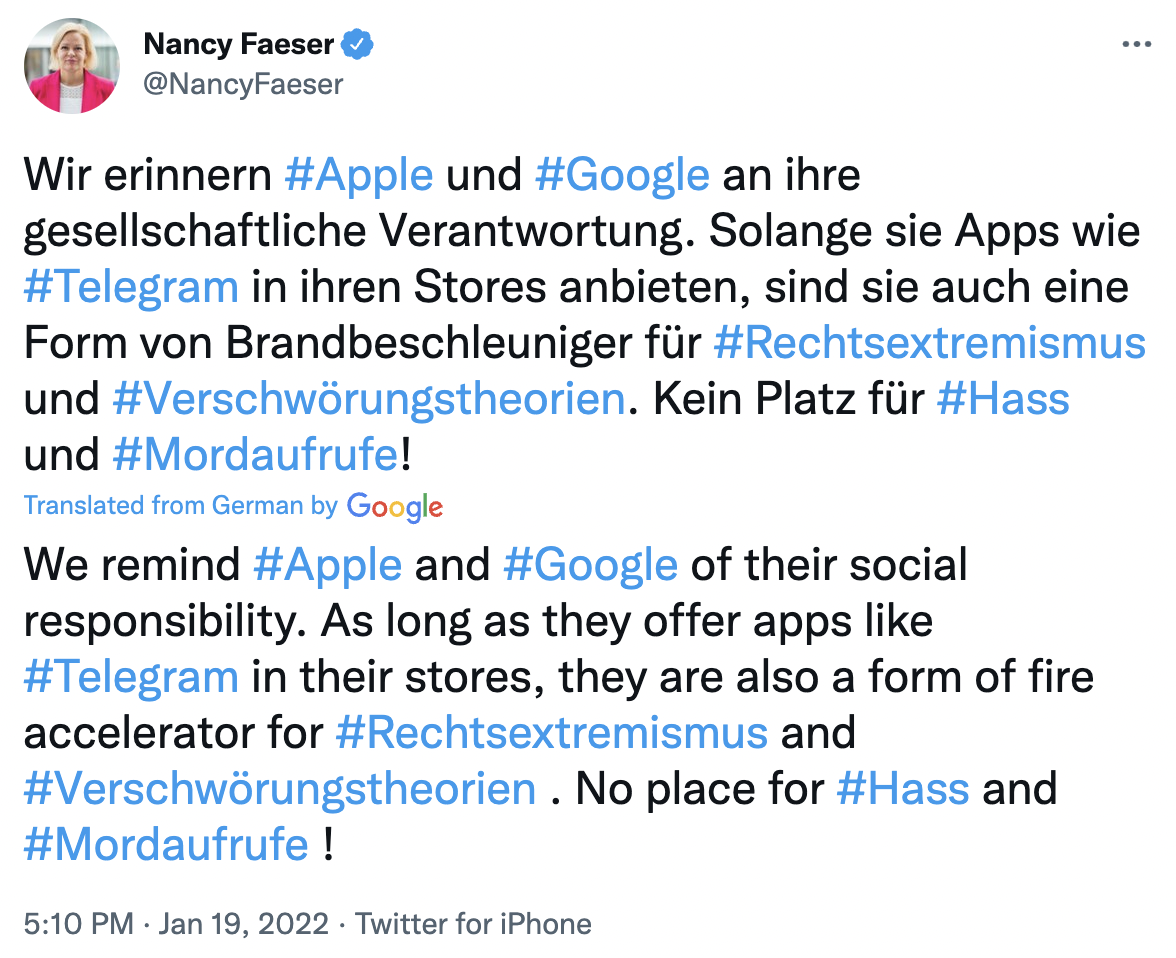
Germany’s Interior Ministry accuses Google and Apple of inciting “conspiracy theories” for allowing Telegram
By Didi Rankovic | Reclaim The Net | January 21, 2022
Germany seems determined to try to undermine Telegram under the fairly absurd pretext that among its hundreds of millions of users are also some “extremists” (same logic applies to the whole of the internet – so will Berlin try to heavily regulate *that* as well?)
And the definition of “extremist” and “radical,” as mentioned in reports about the latest push to get Telegram to cooperate – or else – also includes people who have been unhappy with extreme and radical Covid restrictions.
But given the apparent financial independence of the company that develops the messaging app, the suppression bid doesn’t seem like it will be a straight-forward task.
Judging by the news coming out of Germany now, the route the Interior Ministry would prefer to take is roundabout – to possibly get an uncooperative Telegram banned on the two biggest app stores, those operated by Google and Apple, and thus severely limit its exposure to users.
However, this doesn’t make sense either – because a dedicated “dangerous right-wing extremist” or “conspiracy theorist” would surely find out how to sideload Telegram, and march on.
But by removing the app from the most widely used official app stores, it is those hundreds of millions of everyday users in search of secure and private ways to communicate, without any malicious actors – be they governments or hackers – interfering, who would suffer the most.
For that reason, when Germany’s Interior Minister Christian Pegel recently spoke about the need to get Telegram “cooperating” with law enforcement in order to suppress extremism and threats of violence – or Berlin will pressure Google and Apple – what it really comes down to is trying to put another brick in the ongoing “war on encryption” wall.
Among the members of the security/encryption purist community, Telegram is not even regarded as the best solution – but the benefits provided by this messaging app overall as a secure and privacy-friendly alternative to mainstream competitors still far outweigh any of its flaws. As a result Telegram has seen a strong uptake in recent years.
In Germany, Facebook’s WhatsApp and Messenger are both shedding users, Signal is holding steady – but behind Telegram, that has been growing.
Join the global rally for freedom
By Kathy Gyngell | TCW Defending Freedom | January 20, 2022
THIS Saturday, January 22, will see another worldwide freedom rally. It starts at 1pm in London and other UK cities as well as globally.
To find the details of where, please join the Together Declaration’s Telegram Channel for updates. The Together organisers will be in London and will have placards available on the day. You can find the details on Twitter @togetherdec and on Instagram: @togetherdeclaration […]
Please continue to share Together links to drive their message home. They are doing a vital campaigning and lobbying job. It’s essential that we all keep pushing to end all restrictions on January 26 and to insist on the revocation of an end to all vaccine mandates and coercion.
Together ask us to use the following hashtags in our Twitter communications:
#WorldWideDemo
#StandTogether
and to follow their news and share it on the following platforms:
Twitter: @togetherdec
Instagram: @togetherdeclaration
The Last Days of the Covidian Cult
By CJ Hopkins | Consent Factory | January 18, 2022
This isn’t going to be pretty, folks. The downfall of a death cult rarely is. There is going to be wailing and gnashing of teeth, incoherent fanatical jabbering, mass deleting of embarrassing tweets. There’s going to be a veritable tsunami of desperate rationalizing, strenuous denying, shameless blame-shifting, and other forms of ass-covering, as suddenly former Covidian Cult members make a last-minute break for the jungle before the fully-vaxxed-and-boosted “Safe and Effective Kool-Aid” servers get to them.
Yes, that’s right, as I’m sure you’ve noticed, the official Covid narrative is finally falling apart, or is being hastily disassembled, or historically revised, right before our eyes. The “experts” and “authorities” are finally acknowledging that the “Covid deaths” and “hospitalization” statistics are artificially inflated and totally unreliable (which they have been from the very beginning), and they are admitting that their miracle “vaccines” don’t work (unless you change the definition of the word “vaccine”), and that they have killed a few people, or maybe more than a few people, and that lockdowns were probably “a serious mistake.”
I am not going to bother with further citations. You can surf the Internet as well as I can. The point is, the “Apocalyptic Pandemic” PSYOP has reached its expiration date. After almost two years of mass hysteria over a virus that causes mild-to-moderate common-cold or flu-like symptoms (or absolutely no symptoms whatsoever) in about 95% of the infected and the overall infection fatality rate of which is approximately 0.1% to 0.5%, people’s nerves are shot. We are all exhausted. Even the Covidian cultists are exhausted. And they are starting to abandon the cult en masse.
It was always mostly just a matter of time. As Klaus Schwab said, “the pandemic represent[ed] a rare but narrow window of opportunity to reflect, reimagine, and reset our world.”

It isn’t over, but that window is closing, and our world has not been “reimagined” and “reset,” not irrevocably, not just yet. Clearly, GloboCap underestimated the potential resistance to the Great Reset, and the time it would take to crush that resistance. And now the clock is running down, and the resistance isn’t crushed … on the contrary, it is growing. And there is nothing GloboCap can do to stop it, other than go openly totalitarian, which it can’t, as that would be suicidal. As I noted in a recent column:
“New Normal totalitarianism — and any global-capitalist form of totalitarianism — cannot display itself as totalitarianism, or even authoritarianism. It cannot acknowledge its political nature. In order to exist, it must not exist. Above all, it must erase its violence (the violence that all politics ultimately comes down to) and appear to us as an essentially beneficent response to a legitimate ‘global health crisis’ …”
The simulated “global health crisis” is, for all intents and purposes, over. Which means that GloboCap has screwed the pooch. The thing is, if you intend to keep the masses whipped up into a mindless frenzy of anus-puckering paranoia over an “apocalyptic global pandemic,” at some point, you have to produce an actual apocalyptic global pandemic. Faked statistics and propaganda will carry you for a while, but eventually people are going to need to experience something at least resembling an actual devastating worldwide plague, in reality, not just on their phones and TVs.
Also, GloboCap seriously overplayed their hand with the miracle “vaccines.” Covidian cultists really believed that the “vaccines” would protect them from infection. Epidemiology experts like Rachel Maddow assured them that they would:
“Now we know that the vaccines work well enough that the virus stops with every vaccinated person,” Maddow said on her show the evening of March 29, 2021. “A vaccinated person gets exposed to the virus, the virus does not infect them, the virus cannot then use that person to go anywhere else,” she added with a shrug. “It cannot use a vaccinated person as a host to go get more people.”
And now they are all sick with … well, a cold, basically, or are “asymptomatically infected,” or whatever. And they are looking at a future in which they will have to submit to “vaccinations” and “boosters” every three or four months to keep their “compliance certificates” current, in order to be allowed to hold a job, attend a school, or eat at a restaurant, which, OK, hardcore cultists are fine with, but there are millions of people who have been complying, not because they are delusional fanatics who would wrap their children’s heads in cellophane if Anthony Fauci ordered them to, but purely out of “solidarity,” or convenience, or herd instinct, or … you know, cowardice.
Many of these people (i.e., the non-fanatics) are starting to suspect that maybe what we “tin-foil-hat-wearing, Covid-denying, anti-vax, conspiracy-theorist extremists” have been telling them for the past 22 months might not be as crazy as they originally thought. They are back-pedaling, rationalizing, revising history, and just making up all kinds of self-serving bullshit, like how we are now in “a post-vaccine world,” or how “the Science has changed,” or how “Omicron is different,” in order to avoid being forced to admit that they’re the victims of a GloboCap PSYOP and the worldwide mass hysteria it has generated.
Which … fine, let them tell themselves whatever they need to for the sake of their vanity, or their reputations as investigative journalists, celebrity leftists, or Twitter revolutionaries. If you think these “recovering” Covidian Cult members are ever going to publicly acknowledge all the damage they have done to society, and to people and their families, since March 2020, much less apologize for all the abuse they heaped onto those of us who have been reporting the facts … well, they’re not. They are going to spin, equivocate, rationalize, and lie through their teeth, whatever it takes to convince themselves and their audience that, when the shit hit the fan, they didn’t click heels and go full “Good German.”
Give these people hell if you need to. I feel just as angry and betrayed as you do. But let’s not lose sight of the ultimate stakes here. Yes, the official narrative is finally crumbling, and the Covidian Cult is starting to implode, but that does not mean that this fight is over. GloboCap and their puppets in government are not going to cancel the whole “New Normal” program, pretend the last two years never happened, and gracefully retreat to their lavish bunkers in New Zealand and their mega-yachts.
Totalitarian movements and death cults do not typically go down gracefully. They usually go down in a gratuitous orgy of wanton, nihilistic violence as the cult or movement desperately attempts to maintain its hold over its wavering members and defend itself from encroaching reality. And that is where we are at the moment … or where we are going to be very shortly.
Cities, states, and countries around the world are pushing ahead with implementing the New Normal biosecurity society, despite the fact that there is no longer any plausible justification for it. Austria is going ahead with forced “vaccination.” Germany is preparing to do the same. France is rolling out a national segregation system to punish “the Unvaccinated.” Greece is fining “unvaccinated” pensioners. Australia is operating “quarantine camps.” Scotland. Italy. Spain. The Netherlands. New York City. San Francisco. Toronto. The list goes on, and on, and on.
I don’t know what is going to happen. I’m not an oracle. I’m just a satirist. But we are getting dangerously close to the point where GloboCap will need to go full-blown fascist if they want to finish what they started. If that happens, things are going to get very ugly. I know, things are already ugly, but I’m talking a whole different kind of ugly. Think Jonestown, or Hitler’s final days in the bunker, or the last few months of the Manson Family.
That is what happens to totalitarian movements and death cults once the spell is broken and their official narratives fall apart. When they go down, they try to take the whole world with them. I don’t know about you, but I’m hoping we can avoid that. From what I have heard and read, it isn’t much fun.
#
Fauci reports back to Davos that the US has a Covid “disinformation” problem

By Didi Rankovic | Reclaim The Net | January 18, 2022
The annual “globalization ball” in Davos is upon us once again and this year the virtual event has brought together figures such as Chinese President Xi Jinping and Dr. Anthony Fauci, the White House chief medical adviser, among others.
Xi opened the World Economic Forum (WEF) gathering with his address, while Fauci spoke later to focus on what he sees as “entirely destructive” Covid misinformation raging in the US.
A comprehensive public health endeavor is made impossible by this kind of misinformation, Fauci said. He should feel right at home at the Davos summit given his previous remarks about the need for radical changes in rebuilding the infrastructure of human existence – something reports see as close to the thinking of WEF’s own Klaus Schwab and his controversial musings found in the “Great Reset” initiative presented last year.
Fauci made those comments in 2020, in a paper he co-authored, titled, “Emerging Pandemic Diseases: How We Got to COVID-19,” calling for changes in human behavior and “other radical changes” in order to live “in greater harmony with nature,” which he appears to believe would stand in the way of future pandemics such as the never-ending one we are experiencing now.
He at the time proposed focusing on “a transformation” that will change human behavior by reducing crowding at home, work, and in public places, among other things.
But just as Fauci now once again insists that a dangerous online misinformation campaign is hampering efforts to combat the pandemic, more and more scientists and health officials are reversing course on policies, like lockdowns, vaccination, masking, and coronavirus origin. Until recently, skepticism of those would have been immediately branded as misinformation or worse still, a conspiracy theory.
Opposing Booster Shot Mandates and the Rest of the Coronavirus Crackdown at Universities
By Adam Dick | Ron Paul Institute | January 18, 2022
Across America in 2020, draconian restrictions were imposed in the name of countering coronavirus at just about every university, even though most college students, being relatively young and healthy, have been at very little risk of serious sickness or death from coronavirus.
Some people said “no thanks” to paying universities to harass and demean them with such restrictions, choosing, instead, to withdraw from or not enter college. Indeed, college enrollment in America is down over six percent — a loss of nearly a million students — since the Fall of 2019 semester that preceded the coronavirus scare. Other people grudgingly put up with the situation and tried to take advantage of opportunities they could find to experience some of the freedom universities were working hard to deny.
In the spring of 2021, many universities began announcing their plans to mandate students take experimental coronavirus “vaccine” shots. Some people hoped that the shots mandates would come with the permanent lifting of restrictions. But, at many universities it turned out to be just another requirement added on the pile.
Those shots mandates implemented by the fall of 2021 semester have been followed up at some of these universities with new mandates that the students take booster shots as well — booster shots that even European Union regulators and the World Health Organization are now advising against. The initial shots have proven ineffective and dangerous contrary to the insistence of politicians, big money media, and college administrators. The case for boosters of more of the same has become ludicrous.
Even if the shots were the miracle drug that was promised, in a free society the choice to take or not take this or other medical treatments would be left to individuals, not mandated. Over the last nearly two years of coronavirus crackdown, however, America has transitioned substantially farther from that free society ideal. Fortunately, some state and local governments have resisted this movement, and others that went along with it early on have reversed course, at least in part. This has led to the lifting of many restrictions, and the blocking of others including shots mandates, at some government-controlled universities. But, for many college students the coronavirus crackdown remains intense and threatens to grow with the addition of new mandates such as the mandate to take booster shots of the experimental coronavirus vaccines.
Students, as well as professors and other employees, at universities across America who want to challenge one of the latest additions to the coronavirus crackdown in higher education would do well to consider the strong arguments presented in a January 11 editorial by the editorial board of Chicago Thinker. The editorial presents a case against the University of Chicago’s recently announced mandate that students and employees, already required to have taken the initial coronavirus shots, take booster shots as well. The editorial board, comprised of University of Chicago students, presents in the editorial many well-reasoned arguments against the new mandate.
The editorial begins with the following statement before proceeding into detailed argument against the new mandate:
Per the University of Chicago’s newly announced booster mandate, all students and employees must obtain a booster shot by January 24. Those who do not comply will be barred from campus and restricted from attending in-person classes, among other activities.
This booster mandate is demonstrably unsafe, ineffective, unnecessary, inconsistent, and unethical. We’ve struggled beneath UChicago’s draconian COVID decrees for years, but the university’s booster mandate reaches a new height of absurdity.
UChicago Demands We Submit to Experimental Shots
UChicago claims to rely upon “expert” opinion in structuring its COVID regime. Yet, even advisory committees at the FDA and CDC initially declined to recommend the COVID booster for those under the age of 65.
The FDA’s Vaccines and Related Biological Products Advisory Committee made an official recommendation to approve Pfizer’s application for boosters only for those 65 and older and certain high-risk populations after rejecting, in a 16-2 vote, Pfizer’s application for broader approval for the general population. The committee cited a lack of data on potential adverse effects, particularly the risks of developing myocarditis and pericarditis.
However, the FDA chose to cast aside this concern and granted “approval” anyways. But even this “approval” is itself questionable. The FDA only granted approval to Comirnaty, a legally distinct version of the Pfizer-BioNtech vaccine that isn’t actually available in the United States. The version of the vaccine currently available in the US remains under Emergency Use Authorization, not formal approval.
Similarly, the CDC’s initial recommendation that Americans under the age of 65 receive boosters was made against the counsel of its own Advisory Committee on Immunization Practices, which voted to recommend boosters only for those over the age of 65 or who have underlying conditions. Director Rochelle Walensky overruled this vote in an unusual departure from agency protocol. The committee later reversed course, recommending a booster for 12-17 year olds. But the calculus behind its sudden 180-degree turn remains unclear, given that the initial concerns regarding myocarditis and pericarditis remain unresolved.
You can continue reading the Chicago Thinker editorial here.
UK government hires ad agency to convince the public they don’t need privacy
By Didi Rankovic | Reclaim The Net | January 17, 2022
The UK is stepping up its “war on encryption,” reports are saying, and like in any good old war, propaganda comes first to “prepare the ground.” And a new campaign is expected to launch as early as this month.
In this case, they call it publicity, with the Home Office being behind the effort whose goal is to sway public opinion in favor of undermining the privacy of the very members of that public – using their own money from public funds, to the tune of over half a million pounds.
Meanwhile the “hired gun” is ad agency M&C Saatchi. The Rolling Stone said it had a chance to review documents thanks to a Freedom of Information request, and that what it discovered were “some shockingly manipulative tactics.”
The main target seems to be Facebook’s Messenger app, specifically, the giant company’s move to better encrypt communications of its users. The government’s narrative is old – “think of the children” – the way many politicians try to push through policies of deeper and broader restrictions that eventually end up hurting everybody.
But the UK government appears to want to wrap that “classic” message in some new advertising glitz – as it launches what the Rolling Stone calls “a publicity blitz” to undermine privacy of people’s chats.
“We have engaged M&C Saatchi to bring together the many organizations who share our concerns about the impact end-to-end encryption would have on our ability to keep children safe,” said a statement from the Home Office.
The advertising agency has reportedly gone with visualizing end-to-end encryption – which safeguards people’s security and privacy online and keeps bad actors out – as something sinister and dark. The report says that this is done by putting two actors, an adult and a child, both appearing to be on their phones, in a glass box installed in a public space, which gradually becomes black.
The idea here is that allowing law enforcement near unfettered access to people’s communications would represent the clear glass, while encryption dims it until the goings on inside the box become invisible.
The documents, a presentation to get non-profits on side, also contains a slide saying that since “most of the public” is ignorant about end-to-end encryption they can be easily swayed, while the recommendation is not to allow the campaign to turn into “a privacy vs safety debate.”
But that’s exactly what it is, advocates suggest.
“The Home Office’s scaremongering campaign is as disingenuous as it is dangerous. Without strong encryption, children are more vulnerable online than ever. Encryption protects personal safety and national security… what the government is proposing puts everyone at risk,” said Robin Wilton, a director with the Internet Society.
Featured Video

Nima R. Alkhorshid: US military bombs multiple targets on Iran’s Qeshm Island
or go to
Aletho News Archives – Video-Images
From the Archives
British Intel Tried to Make N Irish Gang ‘Shoot Up’ School, Documentary Claims
Sputnik – 23.02.2019
A new documentary, based on an interview with a self-confessed member of the Glennane Gang, gives some insights into allegations that British military intelligence was behind a shocking murder plot to cause the situation in Northern Ireland to “spiral out of control”.
In a documentary, Unquiet Graves: The Story of the Glennane Gang, John Weir, a former officer from the Royal Ulster Constabulary (RUC), alleges that British intelligence tried to persuade paramilitary group Ulster Volunteer Force (UVF) to attack a Catholic primary school at Belleeks in County Armagh.
Weir claimed that the UVF was urged to kill children and teachers in retaliation for the 1976 Kingsmill massacre, in which gunmen stopped a minibus carrying twelve workmen and shot them; only one person survived despite having been shot 18 times.
“The plan that was decided on was to shoot up a school in Belleeks”, he said, adding that the British intelligence plot was to make the situation in Northern Ireland “spiral out of control”. … continue
Blog Roll
 Aletho News
- Rhode Island Staffer Could Be Reinstated After Firing Over Ceasefire Post
- Will Republicans Learn Their Lesson from the ‘Disastrous’ Midterms?
- Wrong, Newswise, Irresponsible Climate Messaging, Not Climate Change Itself, Is Fueling Student Anxiety
- Zelensky’s Critics Vanish Into Ukrainian Secret Prisons – Source
- Nima R. Alkhorshid: U.S. Military Bombs Multiple Targets on Iran’s Qeshm Island
- Iran-Linked Ships Spotted Hovering over Subsea Cables: Report
- New attack on Iran could devastate ‘Israel’, IOF general warns
- Nuclear deterrence: The US-Israeli military aggression against Iran made the unthinkable legitimate
- U.S. Midterms – a Referendum on Israel and Zionist Power
- Twice as many Canadian Jews serve in Israeli military as Canada’s armed forces: Report
- If Americans Knew
- An error has occurred; the feed is probably down. Try again later.
- No Tricks Zone
- Zonal Asymmetry of Temperature Change in the Antarctic Circumpolar Current
- New Study: The Net Fossil Fuel Contribution To Rising Atmospheric CO2 Has Been Zero For 500 Years
- Germany’s Green Energy Transition Becoming Increasingly Expensive…Another 6 Trillion Euros!
- Sudden Stratospheric Warming, Powerful El Niño Combination May Lead To Extreme Europe Cold, Energy Crisis!
- Two New Studies Find Thwaites Glacier Melt Cannot Be Driven By Human Activity Or A Warming Ocean
- E-Cars Reduce CO2 Emissions By Only 41% Compared To Internal Combustion Engine Vehicles
- Predictions Made By Renowned Climate Professor Over Past Decades Have Been Proven To Be Poor
- New Study Suggests Large Regions Of The Pacific Ocean Have Been Cooling For The Last 80 Years
- Germany’s Green Energy Debacle: High Energy Costs Force Kahla Porzellan to Close After 182 Years!
- New Study: 50 Years Of The Most Aggressive ‘Net Zero’ Policies Can Only Affect The Global Climate By 0.03°C

