Living Under the French Hate Speech Laws
By Lawrence G. Proulx • Unz Review • October 4, 2017
The term “hate speech” is employed more and more these days, and Internet companies and government agencies are being urged to suppress it. So it might be worthwhile to consider how countries without a First Amendment treat the types of speech that are likely to fall within the ever-expanding definition of the term.
I can report on one such country, France, which may be representative of European countries generally. I worked there as an (English-language) newspaper copyeditor from 1999 to 2016. While I am not competent to describe precisely how its complex legal system works, I believe I can offer an informative overview. To do this well, many thousands of words are necessary, but I have divided them into sections and invite you to jump ahead to the next whenever you might feel bogged down.
The United States is often described as a litigious society, even as the litigious society. This view has been shared by the French at least since the publication of “Democracy in America,” in 1835, in which Alexis de Tocqueville wrote that “there is hardly a political question in the United States which does not sooner or later turn into a judicial one.”
Today, however, an American observing French public life is likely to be surprised by the frequency with which the courts are asked to punish people for things written or said. A legal tradition different from our own, to which have been added a number of specific criminal laws, has produced a regulatory system in which fines, damage payments and prison sentences (almost always suspended) are imposed for violations.
In the United States, punishment for saying or writing things that others find objectionable is sometimes imposed by private entities, such as employers, and in the past few decades many businesses, institutions and organizations have established restrictions on expression. But the means of engaging the judiciary in this enterprise are severely limited. In this the United States differs not only from France but also from many other European countries as well as the developing legal structure of the European Union.
The First Amendment to the U.S. Constitution states that “Congress shall make no law … abridging the freedom of speech, or of the press.” The Declaration of the Rights of Man and the Citizen, adopted during the French Revolution and confirmed explicitly in 1958 in the preamble to the constitution of the Fifth Republic, states: “The free communication of ideas and opinions is one of the most precious of the rights of man. Every citizen may, accordingly, speak, write, and print with freedom, but shall be responsible for such abuses of this freedom as shall be defined by law.”
It would be simplistic to say that the difference between the two systems lies primarily in the “but” clause of the latter. But even if the American amendment has inevitably been moderated by court decisions through the years, it does make every abridgment fight for its life, as it were, whereas the French formulation takes the inevitability of exceptions as a matter of course.
What infractions must a speaker or writer or editor or publisher avoid in order to stay within the law in France? Here are the basics, as discussed in the manual “Droits des journalistes et liberté d’expression” by Bernard Dapogny and Marion Dapogny:
- False news, “made in bad faith, that disturbs the public order or is capable of disturbing it.”
- Use of a false document in reporting.
- Attempt to harm the discipline or morale of the armed forces or to hinder a war effort.
- Defamation.
- Insult. [The distinction between this and the preceding is that defamation must assert something specific, whereas insult can be merely an offensive word.]
- Attempt to harm a person’s honor or reputation.
- Defamation of or insult to the judiciary, the military services, various other public bodies including “junior high schools, high schools, universities, the Legion of Honor” as well as “local administrations, the police, hospitals, penitentiaries.”
- Defamation of or insult to persons acting in a position of public authority, including “representatives and senators, ministers and Secretaries of State” as well as “police personnel, magistrates, teachers.”
- Defamation or insult based on race, religion or belonging to an ethnic group or a nation.
- Defamation or insult based on sex, sexual orientation or handicap.
- Defamation of or insult to deceased persons, where the offense touches on the honor of the heirs or close survivors.
- Provocation to the commission of a crime which leads to the crime.
- Provocation to the commission of a crime which doesn’t lead to the crime.
- Indirect provocation (apology), that is, stating that certain crimes were justified, including “war crimes, crimes against humanity or crimes in collaboration with the enemy.”
- Provocation to hate, violence or discrimination, which could be based on a person’s “origin, sex, family situation, state of pregnancy, physical appearance, family name, state of health, handicap, genetic characteristics, morals, sexual orientation, age, opinions, politics, labor union activity, belonging or not belonging, real or supposed to a particular ethnic group, nation, race or religion.”
- Provocation to or apology for terrorism.
- Contesting “the existence of one or several crimes against humanity as defined by Article 6 of the charter of the International Military Tribunal [the Nuremberg Tribunal] annexed to the London Agreement of August 6, 1945, and which were committed by the members of an organization declared criminal in application of Article 9 of the said charter, by a person recognized as guilty of such crimes by a French jurisdiction or by an international one.” Enacted in July 1990 and called the Gayssot Law.
- Offending the president of the Republic. [This law was repealed in 2013.]
Many of these laws are seldom invoked; others are used frequently. To put flesh on the matter, I offer you a list of cases from 2013 that I put together in 2014 for an article that never found a publisher. (Sorry, but the work of assembling it was too tedious for me to undertake it again, and I think the general impression given by more recent cases would not be different.) Although details of the offensive language are frequently omitted in the news reports from which this list is compiled, a quick look will give a sense of how routine the cases are.
One thing should be mentioned first. An anti-racism law passed in July 1972, commonly called the Pleven Law, strengthened the restrictions on speech and granted to private associations dedicated to fighting racism the right to participate in the prosecution of criminal cases and to claim damages as well. Amendments to the law empowered additional categories of associations, for example, associations working “to defend the moral interests and the honor of veterans and victims of war and of those who died for France” or “to defend the memory of slaves and the honor of their descendants.” Such associations are frequently the first to blow the whistle on remarks they consider violative, and because they have the standing to file complaints even when no particular person is targeted by the contested remarks, their legal recognition is an important factor in the number of cases brought before the courts today.
January
Marie-Josée Roig, the mayor of Avignon, files a complaint for public insults contained in a book purporting to be fiction (“Le Monarque, son fils, son fief”) by Marie-Célie Guillaume in which a character who resembles Nicolas Sarkozy, the former president, demands a quick sexual “present” from a woman who resembles Roig.
Daniel Boyer, the mayor of Châteaubernard, files a complaint for public insults after a wave of graffiti attacking him and various acts of vandalism.
Frédéric Haziza, a Jewish journalist, files a complaint for public insult and public insult committed against a person because of his religion, after being attacked on the website of Alain Soral, a self-described anti-Zionist activist. Haziza had refused to invite Soral onto his show to discuss Soral’s book “Comprendre l’empire” because of Soral’s “clearly antisemitic” views.
March
A judge, Jean-Michel Gentil, files a complaint for contempt and insult against Henri Guaino, a deputy in Parliament, for having said that the judge “dishonored the [state] institutions and justice” after Sarkozy was interrogated on suspicion of abusing the weakness of a rich aged widow.
Bloc Identitaire, a nationalist group, announces its intention to file a complaint for public insult against Yann Galut, a deputy from the Cher department, for having called the members of the bloc “casseurs” (protesters who destroy property) in a Twitter message.
April
Rama Yade, a former secretary of state for human rights and for sports, is found guilty of defamation and insult for eight of twenty-eight contested statements posted on her blog about a political opponent, Manuel Aeschlimann, after she was challenged over her domicile status in the Hauts-de-Seine department.
May
Yvan Benedetti and Alexandre Gabriac, right-wing activists, file a complaint against Jean-François Carenco, the prefect of Lyon, and Albert Doutre, director of public security, for “hateful” public insults (such as “imbecilities” and “thugs”) made during the containment of a nationalist youth protest in front of the Socialist Party local headquarters.
June
The city of Angers files suit against a shopkeeper for public insult in the form of signs he put up to protest a proposed tax on businesses that serve clients on the sidewalk, which followed among other things a police check of whether he was serving alcohol without the proper license.
Pierre Dubois, the mayor of Roubaix, and the Human Rights League file a complaint against an unnamed man who, during the course of a heated discussion at a public meeting, suggested that the Roma (Gypsies) be sent to Auschwitz.
July
Sylvie Goy-Chavent, a senator of the Ain department who prepared a report on the security of meat production in France, files a complaint against a website, Internet JSSNews.com, which describes itself as a webzine of Israeli opinion, for calling her such things as “bitch” and “little shit” and writing, among other things, “Goy, she wears her name well.”
September
The Union of Jewish Students of France says it will file a complaint against the weekly magazine Valeurs Actuelles for provocation of racial or religious discrimination, hatred or violence. The group describes the cover of the magazine’s Sept. 26 issue, which shows a white bust of a woman representing France wearing a black Islamic veil and bearing the title “Naturalized: The Invasion They’re Hiding,” as “racist” and “hateful.” The magazine says in return that it will file a complaint against the group for calumnious denunciation, defamation and attack on freedom of expression.
The Foundation for the Memorial of the Black Slave Trade, along with the Federation of African Associations, the National Union of Overseas France, and other organizations and individual citizens file a complaint against Jean-Sebastien Vialatte, a deputy in Parliament, for public insult, defamation and incitement of racial hatred and racial discrimination, for his remarks after vandalism occurred during a celebration of the Paris Saint-Germain soccer team. He had sent a Twitter message in which he said sardonically that “the people who vandalize are surely descendants of slaves, they have excuses[.] #Taubira [the justice minister] will give them some compensation!”
October
The League for the Judicial Defense of Muslims files a complaint against the weekly newspaper Charlie Hebdo for its July 10 cover which had a cartoon captioned in large letters with “The Koran, it’s shit; it doesn’t stop bullets”; against the magazine Valeurs Actuelles for its Sept. 26 cover; against the website Riposte Laïque for various articles; and against Manuel Valls, the secretary of the interior, for provocation of discrimination and hate, for saying, “Within ten years we will show, we are in the process of showing, there is a will, that Islam is compatible [sic] with the Republic.”
Bruno Gilles, a senator in the Union for a Popular Movement, files a complaint against a socialist, Patrick Mennucci, for “defamation and public insults.” “He called me a racist and xenophobe,” the senator said.
France-El Djazaïr, a Franco-Algerian friendship association, announces that it will file a complaint against a police officer in the city of Alès for “insults and incitement to xenophobic and Islamophobic hatred”; the officer had put on his Facebook profile page a photo-montage representing the Algerian flag over which was written “I hate Algeria,” attached to an image of a man wiping his bottom with the flag.
Bachir Bouhmadou, adjunct general secretary of Citizen Resistance, and Ali Saab, president of the Association of Muslims of the Territory of Belfort, file a complaint against Christine Tasin, a militant with the group Republican Resistance, for videotaped comments opposing ritual Islamic butchery and criticizing Islam.
Abdellah Zekri, the president of the National Observatory Against Islamophobia, says he will file a complaint after his house was defaced with swastikas and graffiti saying “Islam Out” and “Heit [sic] Hitler.”
The National Front says it will file a complaint against Christiane Taubira, the justice minister, for public insult for having described the party’s way of thinking as “deadly and murderous” and summarizing it thus: “It’s the blacks in the branches of the trees, the Arabs in the sea, the homosexuals in the Seine, the Jews in the oven and so forth.”
November
A 65-year-old man is found guilty of insulting Claudine Ledoux, the mayor of Charleville-Mézières, on his website, l’Union-l’Ardennais, in a manner described by a regional newspaper as “menacing, racist and sexist,” in relation to her being made a knight in the Legion of Honor; he is ordered to pay a fine of one thousand euros and damages for mental distress of the same amount to Ledoux.
The association SOS Racisme says it will file a complaint for incitation to racial hatred against Minute, a 16-page rightist weekly, for its cover with a photo of Justice Minister Christiane Taubira, who is a native of French Guiana, and for the title “Clever Like a Monkey, Taubira Finds the Banana Again,” which combines two common French expressions; to have the banana (or the peach) means to be full of energy.
A player files a complaint for racial insult after a rough soccer game (three red cards) between the second-stringers of the Sablé and Lude clubs. A player explained: “This attacker called me a dirty white. I called him a dirty black.”
The Movement Against Racism and for the Amity of Peoples files a complaint for provocation of racial hatred against Manuel Valls, minister of the interior, for comments about the Gypsies including, “The Gypsies should stay in Romania or return there.” The case will be dismissed in December 2013.
Bob Dylan is put under formal investigation for insult and provocation of racial hatred after the Representative Council of the Croatian Community and Institutions of France files a complaint against both him and the magazine Rolling Stone, the French version of which republished an interview in which he said, “If you’ve got a slave master or the Klan in your blood, blacks can sense that. … Just like Jews can sense Nazi blood and the Serbs can sense Croatian blood.” The case will be dismissed in April 2014.
December
The comedian Nicolas Bedos testifies after being accused of complicity in making a public racial insult in an article in the magazine Marianne as well as on its website; among the phrases he used were “Negro bugger,” “island indolence” and “lazy natives.”
Gérard Huet, the mayor of Loudéac, is sued by the Human Rights League for comments about Gypsies he made at a meeting to discuss expenditures to renovate the area where the Gypsies were living. “They’ve stolen all our plumbing,” he says, and he later objects to the comment of another member of the city council with, “You’re defending thieves?” He sues the league in return for harassment.
The comedian Dieudonné files a defamation complaint after Alain Jakubowicz, the president of the International League Against Racism and Antisemitism, describes the “quenelle,” a gesture used by the comedian and his fans, as “corresponding to an inverted Nazi salute signifying the sodomizing of the victims of the Holocaust.” Dieudonné also says he will sue Le Monde, Le Figaro, BFMTV, France 2 and Manuel Valls, the interior minister.
The imam Hicham El Barkani files a complaint for insult after a protest described as islamophobic against the opening of a mosque in Papeete.
Historians on Trial
Some cases have greater import than those listed above, as when historians are attacked for their work.
The Columbia University historian Bernard Lewis gave an interview to Le Monde on November 16, 1993, in which he discussed the killings of Armenians by Turks during the First World War. In the course of it he said, “If one speaks of genocide, that implies that there was a deliberate policy, a decision, to systematically annihilate the Armenian nation. That is quite doubtful. Turkish documents prove a will of deportation, not of extermination.” On January 1, 1994, in response to strong objections to his remarks, he published a further explanation of his position, again in Le Monde, ending with a repetition of his main point, that “no serious proof exists of a decision and a plan by the Ottoman government aiming at exterminating the Armenian nation.” He was sued by the Forum of Armenian Associations of France and the International League Against Racism and Antisemitism on the claim that he had “gravely hurt the memory and respect of the survivors and of their families.” The civil court of Paris ruled that Lewis had “failed to meet his duty of objectivity and prudence in expressing himself without nuance on so sensitive a subject” and ordered him to pay a franc each to the two associations as well as the cost of publishing the decision. Lewis was also the defendant in other civil cases and one criminal one on the same subject, all of which were dismissed.
In 2001, the French Parliament “publicly recognized the Armenian genocide of 1915,” and in 2012 the Parliament passed a law instituting a punishment of imprisonment for one year and a fine of 45,000 euros of anyone who “contests or minimizes in an outrageous fashion” genocides recognized as such by French law, but the Constitutional Council ruled the latter law unconstitutional a month later. Both of the main candidates for president that year, Nicolas Sarkozy and François Hollande, soon announced that they would seek a new law to criminalize denial of the Armenian genocide, and in January 2017 a law took effect providing for a year of prison and a fine of 45,000 euros for those who denied, belittled or “banalized in an outrageous way” recognized genocides, crimes against humanity, and enslavement or exploitation of an enslaved person.
In 2001 Parliament also passed a law recognizing “that the trans-Atlantic trade in Negroes as well as the trade in the Indian Ocean on the one hand, and, on the other hand, the slavery perpetrated starting in the 15th Century, in the Americas and the Caribbean, in the Indian Ocean and in Europe against the Africans, Amerindians, Madagascans and Indians constitute a crime against humanity.” Four years later this law was invoked against Olivier Pétré-Grenouilleau, a professor at the University of Southern Brittany. In the course of an interview given on June 12, 2005, in relation to his book “Les traites négrières” (The Negro Slave Trades), which had won many awards including the Senate History Book Prize, Pétré-Grenouilleau rejected a comparison of the slave trades to the Jewish Holocaust: “The slave trades are not genocides. The slave trade didn’t have the goal of exterminating a people. The slave was a good that had a market value that one wanted to make work as much as possible.” An association representing people of the Caribbean, French Guiana and Réunion filed a complaint against him for denying a crime against humanity and demanded that he be “suspended from his university functions for revisionism.” In the vehement debate that ensued, Pétré-Grenouilleau was strongly supported by many prominent historians, and in February 2006, acknowledging this opposition, the association withdrew its complaint.
Shortly before the Pétré-Grenouilleau affair erupted, another “memorial” law had been passed, in January 2005, aimed generally at recognizing the suffering of those French citizens who had been repatriated from North Africa at the end of the Algerian War. This law had itself evoked controversy, by requiring that “school programs recognize in particular the positive role of the French presence overseas, notably in North Africa.” A year later the law was emended and the “positive role” removed.
Real Prison Sentences
I know of only three writers who have recently been given sentences that were “fermes,” as the French say, that is, that were not suspended as soon as pronounced. Vincent Reynouard is a Frenchman born in 1969 and trained as a chemical engineer who has argued that the Nazis had no plan to exterminate the Jews and that gas chambers were not used to kill people. Among the many videos he has placed on the Internet, there is one in which he expresses his admiration for Hitler; he says, “I think that Hitler was a man too good for the 20th Century, too honest, too straightforward.” A month after being arrested in Belgium, Reynouard was extradited to France in August 2010 and served seven and a half months in prison for contesting a crime against humanity. He has continued to produce writings and Internet videos, and in February 2015 he was convicted of contestation of crimes against humanity and sentenced to two years in prison. In November 2016 he was given a five-months sentence for publishing two videos in which he stated that he would offer 5,000 euros to “anyone who can show me, in free, candid and courteous debate, that the homicidal Hitlerian gas chambers are not a myth of history.” To avoid a return to prison, he is said to be living in England.
Hervé Ryssen, according to Wikipedia, has been sentenced several times for his writings about Jews on counts, among others, of racial insult, racial defamation, defamation against a group of persons because of their belonging to a certain race, and incitation to racial hatred; and Boris Le Lay, who is living in Japan, has been sentenced in absentia many times, most recently in July this year to serve 32 months in prison and to pay 31,500 euros to the groups representing the supposed victims, for his writings judged to constitute incitement to discrimination and to racial hatred and violence, and to contain public racial insults. Among the recent charges against Le Lay was one of making death threats against activists of the Human Rights League; I have not been able to determine if he was convicted of this; if he was, he appears in that instance to be an exception to the other cases discussed in this article, which involve no violence or threat thereof.
Politicians on Trial
Although many speech cases involve politicians, two in particular deserve mention because they arguably played a role in the presidential election of 2007.
The first round of the previous election, in 2002, had stunned the country as Jean-Marie Le Pen, the leader of the National Front, edged out Lionel Jospin, the Socialist candidate, for a place in the second round. Le Pen’s share of the first-round vote was only 16.9 percent, but Jospin was handicapped by an abundance of rivals on the left who split the vote. Before the second round, a broad denunciatory publicity campaign to block Le Pen took place, and his opponent, Jacques Chirac, the incumbent, refused to debate him. Chirac was re-elected with 82 percent of the vote.
Before the next election, in 2007, both Le Pen and the party’s second-ranking member, Bruno Gollnisch, would be defendants in high-profile cases over things they said.
On January 7, 2005, the rightist weekly Rivarol published an interview in which Le Pen said: “In France, at least, the German occupation wasn’t particularly inhumane, even if there were slip-ups, inevitable in a country of 550,000 square kilometers.” He also related a story about a German lieutenant, “crazy with pain” after an attack on a train in which many young soldiers died, who he said would have shot up a village had the Gestapo not intervened. Various groups filed complaints, and in March an investigation was formally opened. In February 2008 he was found guilty of complicity in the contestation of crimes against humanity and complicity in apology for war crimes. In January 2009 the appeals court in Paris confirmed the verdict on the first count but threw out the war-crimes verdict. In April 2011 the Court of Cassation overturned the crimes-against-humanity verdict, and remanded the matter to the appeals court, which again found him guilty in February 2012, a judgment confirmed by the Court of Cassation in June 2013. Le Pen was sentenced to three months in prison (suspended) and assessed a fine of 10,000 euros, and the editor of Rivarol and the interviewer were fined 5,000 euros and 2,000 euros respectively. Three of the complainant groups were awarded damages of 5,000 euros each, and Rivarol was ordered to pay for the publication of the decision in Le Figaro.
In the other case, Gollnisch, a professor of Japanese language and culture at the University of Lyon who at the time was director general of the National Front (before the ascension of Marine Le Pen), was charged with contestation of crimes against humanity for responses to a journalist’s questions at a press conference in October 2004. No electronic recording was made, but he was quoted as saying: “There is no serious historian who accepts completely the conclusions of the Nuremberg Tribunal; I think that the discussion should remain free concerning the drama of the concentration camps. The number of deaths, the manner in which the people died —historians have the right to discuss. … I don’t deny that there were homicidal gas chambers, but the discussion should remain free.” In 2006, before the verdict was rendered, he was suspended from his university post for five years.
During the trial Gollnisch was questioned intensively for hours one day in November 2006 over his true beliefs on the matter, and the attorney examining him, Alain Jakubowicz, representing the International League Against Racism and Antisemitism, said he would withdraw from the case if Gollnisch would only admit “that the organized extermination of the Jews of Europe by the Nazi regime during the Second World War constitute an incontestable crime against humanity perpetrated notably by the use of gas chambers.” According to Le Monde, Gollnisch appeared surprised and hesitated before giving an answer that might alienate the “hard fringe of his movement.” Gollnisch replied, “Completely.” Asked to repeat his answer, he said: “My answer is affirmative.” He was convicted in January 2007, three months before the first round of the presidential election, and sentenced to serve three months in prison (suspended) and pay a fine of 5,000 euros. An appeals court in February 2008 confirmed the conviction and added fines totaling 39,000 euros to be paid to nine associations devoted to fighting racism or representing people deported from France during World War Two. But in June 2009 the Court of Cassation, judging that his contradictory remarks as presented to the court did not constitute contestation, overturned the verdict without possibility of retrial.
However these cases might be viewed in relation to freedom of speech, they also merit attention from a purely political point of view. In the 2002 election, Jean-Marie Le Pen scored an upset in the first round; in 2007, Nicolas Sarkozy won the presidency by, in the view of many commentators, “borrowing the discourse” and luring the voters of Le Pen’s party. In between, both Le Pen and his righthand man were put on trial, to the accompaniment of much public commentary, on charges that suggested their approbation of Nazi atrocities. Under such circumstances, borrowing and luring may be much easier than would otherwise be the case.
Censored Books
In September 2013 the International League Against Racism and Antisemitism sought an injunction from a court in Bobigny to order the excision of passages from five books republished by Kontre Kulture, a publishing enterprise whose publication director is Alain Soral. David-Olivier Kaminski, an attorney for the league, described Soral as someone known as a “vector of hate” and characterized the re-editions as a “provocation, with the purpose of arousing tensions.” The league also asked for 20,000 euros in damages for each of the five books.
In November the court ordered the withdrawal from sale of one of the books, “L’Anthologie des propos contre les juifs, le judaïsme et le sionisme” by Paul-Eric Blanrue, which had originally been published by another publisher in 2007, and the removal of certain passages from the four others, all of which were reprints of books published long ago: “La France juive” by Edouard Drumont, “Le salut par les juifs” by Léon Bloy, “Le juif international” by Henry Ford, et “La controverse de Sion” by Douglas Reed. The court judged that the works constituted “insult toward a group of persons because of their belonging to a specific religion,” “negation of crimes against humanity,” and “provocation of racial hatred.” Kontre Kulture and Soral were also ordered to pay 8,000 euros each to the league as well as a part of its legal expenses. In December 2014 a court overturned the previous ruling on the “Anthologie” and it was again allowed to be sold.
The media reaction focused principally on the book by Léon Bloy. Bloy’s great-grandchild, Alexis Galpérine, reminded readers in Le Figaro that Bloy was a “philosemite” and that “Le salut par les juifs” had been recommended as a “book against antisemitism” by Franz Kafka. Pierre Glaudes, a professor at the Sorbonne, wrote in the weekly magazine Le Nouvel Observateur : “This decision of justice arouses astonishment and disquiet by attacking a literary work that is 122 years old and has been republished several times without having attracted lightning strikes by justice. … This condemnation sets a dangerous precedent. Why not censor ‘The Merchant of Venice’ by Shakespeare, ‘Gobseck’ by Balzac or ‘Money’ by Zola for their antisemitic statements?”
Stage Show Blocked
The case of the comedian Dieudonné M’bala M’bala merits notice particularly for the legal manner in which the performance of his show “The Wall” in Nantes was forbidden in January 2014.
Dieudonné, the son of a Cameroonian man and a French woman, performed for several years early in his career with a Jewish partner, and their sketches often made fun of racism. Eventually he came to hold Jews responsible in large part for the slave trade, he expressed resentment at the attention given to the Holocaust in comparison with that given to the slavery, and he came to regard Jews not as fellow victims of prejudice but instead as important members of a power structure in which people of the Third World and of Third World origin are kept down. His new acts were sharply criticized, and he responded with provocations such as including Robert Faurisson, notorious as a denier of the Holocaust and gas chambers, in his acts. Dieudonné was found guilty of racial insult or defamation on numerous occasions, for example, for saying that a television host financed the Israeli Army, “which doesn’t hesitate to kill Palestinian children”; for characterizing Holocaust remembrance as “memorial pornography”; for stating that the directors of a pro-Israeli website were trying to paint him as an antisemite and “son of Hitler”; for describing the International League Against Racism and Antisemitism as one of the “mafia-like associations that organize censorship, … that deny all concepts of racism except that concerning the Jews. In fact, they are nothing but Israeli agents.”
Largely excluded from television and other standard venues, he has nonetheless maintained an enthusiastic and politically and racially mixed following through his stage shows and videos. In January 2014 his stage show “The Wall” was challenged by the government as a threat to public order and to the dignity of the human person. Its performance in Nantes was banned by the prefecture of the Loire-Atlantic region, which judged that it contained antisemitic remarks that would incite racial hatred and constitute an apology for discriminations, persecutions and exterminations perpetrated in the course of the Second World War. The ban was lifted on the day of the show by the region’s administrative tribunal, which held that the show “could not be regarded as having as its essential purpose an affront at human dignity,” but the tribunal’s ruling was overturned and the ban reinstated later the same day by a judge of the Council of State, the highest court in the administrative-law system, after an urgent request by Interior Minister Manuel Valls.
Conclusion
French people in general seem content with the way free speech questions are handled. If in private they will occasionally murmur that “one can’t say anything anymore,” in public there is very little disagreement over the necessity of punishing infractions involving remarks characterized as racist or antisemitic or “negationist.” Prominent cases, such as the many brought against Jean-Marie Le Pen, are approved, explicitly or implicitly, by the vast majority of commentators in the press and on the radio and television. Even publications that push the limits of public tolerance in other ways — for example, with crude or even violently obscene and sacrilegious writings and cartoons — do not defend the targets of anti-racism or anti-contestation laws on general free-speech grounds; quite the contrary.
There is no high-profile organization or figure that publicly espouses the famous words that Voltaire apparently never really said, “I disapprove of what you say, but I will defend to the death your right to say it.” Over all the attitude is closer to that attributed to the revolutionary Saint-Just, “No liberty for the enemies of liberty.” The slogan of the International League Against Racism and Antisemitism, one of the organizations most active in denouncing speech offenders, is “Racism is not an opinion but a criminal offense.” Even a group such as Reporters Without Borders, which works to further the freedom of the press throughout the world, generally makes no objection to the laws discussed above, although it did oppose the one criminalizing the denial of legally recognized genocides. In an interview, Antoine Héry, in charge of the group’s activities in the European Union and the Balkans, explained to me: “I think that the problem in France is that there really are racist statements — many. … This climate exists; it isn’t a phantasm. There is, from this point of view, a necessity to regulate a little the domain of speech, because there are abuses. I don’t think that in the United States one finds this sort of mass behavior — because it is massive, it isn’t just one guy in his corner doing his thing.”
There have been dissident voices on the subject of the criminalization of so-called negationism and other “memorial laws.” One of the most prominent is a group called Liberté pour l’Histoire, which was formed in 2005 in response to what seemed about to become a wave of such laws. In a public appeal signed by nineteen historians in December of that year and later by hundreds more, it stated that “in a free state, it is not the business of the parliament nor of the judicial authority to define historical truth” and called for “the abrogation of these legislative measures unworthy of a democratic regime.” But even this unambiguous stand is not so solid as it might appear. In 2010, at the International Congress of Historical Sciences in Amsterdam, the group’s president, Pierre Nora, spoke of the Gayssot Law and stated: “It is now twenty years since the law was voted, and even if we continue to regret it intellectually speaking, the association Liberté pour l’Histoire does not campaign for its suppression and does not wish to challenge it for the simple reason that this legal and official challenge would only be seen in the public eye as authorizing and even encouraging the denial of the Jewish genocide.” There could hardly be a better illustration of the French ambivalence on the matter than this.
This ambivalence derives from an evident fact: the characteristics of the system that make it vicious from a free-speech perspective — the vagueness and elasticity of the definitions of the crimes, the politically selective application of the laws, the tendency of the trials to become examinations of the defendants’ thoughts and beliefs rather than merely of their public statements — are virtues for a system of political repression, and in France there is a general consensus that the “extreme right” needs to be kept down and that expressions of “racism” and “antisemitism” deserve to be squelched. While there are pockets of dissidence — such as the websites Polémia and Boulevard Voltaire, the independent rightist station Radio Courtoisie and the Internet television channel TV Libertés — the assumption remains widespread that anyone arguing that freedom should extend to such speech must have evil motives.
The legal procedures through which speech is restricted do sometimes come under criticism. For instance, the ban on Dieudonné’s show “The Wall” was widely criticized because it imposed a prior restraint, seen as equivalent to censorship in a way that punishing the performer afterward would not be. Jack Lang, who was minister of culture in the Mitterrand administration, said that the Council of State had opened a Pandora’s box of potential abuses; he objected as well to basing the decision on a vague principle of “human dignity” and pointed out that the risk to public order was not credible. Michel Tubiana, a former president of the Human Rights League, which also objected to the ban, told me in an interview that Dieudonné should have been allowed to do his show and then he could have been prosecuted in the normal way. On the league’s website, one reads: “Clearly it is necessary to let nothing pass, to systematically bring prosecutions against the delinquent, to denounce systematically his crimes.”
For the future, there is pressure to increase the surveillance, particularly of the Internet. At its annual dinners, which are grand affairs similar to those of the American Israel Public Affairs Committee in the United States, the Representative Council of Jewish Institutions of France presses the attending government officials hard for ever more stringent restrictions, especially on Internet communications. In March 2016, for example, its president, Roger Cukierman, urged that the state of emergency “should also apply to the Internet,” and this year its new president, Francis Kalifat, called for “zero tolerance” for bloggers “of hateful content.”
In the meantime, France, like the other countries of the European Union, is a party to the Council Framework Decision “on combating certain forms and expressions of racism and xenophobia by means of criminal law,” adopted unanimously by the ministers in the Council of the European Union in November 2008. In a report in January 2014 on the implementation of this decision, the European Commission stated: “Member States must ensure that the following intentional conduct is punishable when directed against a group of persons or a member of such a group defined by reference to race, colour, religion, descent or national or ethnic origin:
- publicly inciting to violence or hatred, including by public dissemination or distribution of tracts, pictures or other material;
- publicly condoning, denying or grossly trivialising
- crimes of genocide, crimes against humanity and war crimes as defined in Articles 6, 7 and 8 of the Statute of the International Criminal Court; or
- the crimes defined in Article 6 of the Charter of the International Military Tribunal appended to the London Agreement of 8 August 1945, when the conduct is carried out in a manner likely to incite violence or hatred against such a group or one or more of its members.”
And France does its part, by continuing to reinforce its laws. On August 5 of this year it made illegal any “nonpublic” insult or defamation (as, for example, made during a meeting in a company’s offices) “made toward a person or group of persons because of their origin or belonging or not belonging, real or supposed, to an ethnic group, a nation, a putative race or a particular religion; … [or] because of their sex, their sexual orientation or gender identity, or their handicap.”
The law provides for fines of 1,500 euros initially and 3,000 euros for recidivists. It also gives a judge the option of augmenting the punishment with a compulsory course in citizenship.
Lawrence G. Proulx is a retired copy editor who worked for more than 30 years at the Washington Times, Washington Post, International Herald Tribune and International New York Times.
Catalonia: Rajoy Moves Towards Extreme Measures
By Craig Murray | October 4, 2017
Things have taken a much more sinister turn in Catalonia, without sufficient notice being paid internationally. The leader of the Catalan regional police force has been formally arraigned for sedition by the Spanish attorney general, for refusal to comply enthusiastically with the beating up of old women. That carries a minimum jail sentence of four years. It is the first step towards major imprisonment of Catalan leaders. It is also extremely significant that this first step is aimed at decapitating the only disciplined and armed force under some measure of Catalan government control. What does that tell you about Rajoy’s next move?
This extreme action against Major Trapero is precisely in line with last night’s ultra hardline address by a man with the comic opera name of Felipe Juan Pablo Alfonso de Todos los Santos de Borbón y Grecia. It is hard to take seriously anyone named after a whiskey, but we live in such a strange world that this unelected, far right and immensely corrupt, inbred buffoon could spout about democracy and accuse anyone who did not bow the knee to him of disloyalty and sedition. That precisely prefigures the legal action taken against Major Trapero. It can only be a precursor to a Spanish attempt to impose physical control on Catalonia and imprison its leaders. Having rejected both dialogue and mediation, I see no other direction Rajoy will take.
The Catalan government has said it will declare Independence within days. I am not, and have never been, a pacifist. A vital duty of any state is the defence of its citizens. Once Catalonia declares Independence it will be in a different position as a state than as a movement for Independence within Spain. The highly impressive and disciplined non-violence of the Independence movement will no longer be appropriate. But physically, I am not aware of any capacity to defend itself against the Spanish forces which there is every sign Rajoy will unleash immediately after any Declaration of Independence. Catalonia will also need to move instantly to dismantle any parts of the state fabric, and particularly the judiciary and prosecutorial service, which may remain loyal to Madrid,
The EU failed to draw a line in the sand when Rajoy’s Francoist paramilitary thugs beat up old ladies, en masse, before the eyes of the whole world. Rajoy will be certain to calculate that if he now invokes article 155, seizes Catalonia by force, and imprisons all the Catalan leadership for 30 years for rebellion, that the EU will continue to back him. Following the “royal” address yesterday and the extreme charges against Major Trapero today, the Francoist solution seems to me to be where we are heading, with nobody in any position of authority in Europe making the slightest effort to stop it.
Catalan Independence Vote Risks Creating ‘Domino Effect’ in France
Sputnik – 04.10.2017
While Paris has taken a dim view of the Catalan independence referendum, members of French autonomist group Breizh Europa praised the vote as an example of the people’s right for self-determination.
Even as French President Emmanuel Macron voiced his support of Spain’s constitutional unity in the wake of the October 1 Catalan independence referendum, the proponents of Brittany’s autonomy welcomed Catalonia’s choice and even sent their representatives to act as observers during the vote.
Caroline Ollivro, president of the autonomist Breton movement Breizh Europa that promotes the concept of an “autonomous Brittany within the federated Europe,” told Sputnik France that her group regards the Catalan referendum as a glimmer of hope.
“Our unitary Jacobin state is unable to organize referendums even though all the mechanisms are detailed in the constitution. A French president would never organize such vote because he’s too afraid of the outcome. A referendum on the simple autonomy of a French region, let alone independence, is simply not possible,” Ollivro said.
She pointed out that Breizh Europa has been asking for a referendum on the reunification of historical Brittany (the Loire-Atlantique department and the city of Nantes which used to be part of the historical Brittany currently belong to another administrative unit of France, the Pays de la Loire region). However, the French government continues to ignore these requests despite the fact that “each year opinion polls show that 60-65 percent of respondents support the reunification,” apparently due to concerns that the referendum could be followed by calls for greater autonomy of the region.
Ollivro also added that even if Madrid “currently opposes the events in Catalonia, one day the law would have to be changed” in accordance with the people’s right for self-determination.
“France does not have the kind of cultural and historical unity that is being presented by Paris or the textbooks. The unity of the French nation is determined by the so-called ‘republican unity pact’ which was not brought forth via a referendum. The centralized France is a centuries-old tradition that is being actively supported by a press which strives to diminish the scale of autonomist movements,” she explained.
Meanwhile, historian and Catalan affairs expert Garcia Dorel-Ferre told Sputnik that the issue of separatism is a concern for the region as a whole, and lamented that no one in Europe appears willing to deal with this problem.
“Minority issues are not limited to Lombardy, Catalonia and Corsica; the scope of this problem is much greater. There are many countries in Europe that have minorities… with which these countries have to come to accord and to respect their peculiarities. This is a real problem for Europe, and one day this matter needs to be taken seriously,” Dorel-Ferre warned.
On Sunday, October 1, Spain’s northwestern autonomous region of Catalonia held an independence referendum despite the fact that the vote had been previously outlawed by Madrid, with over 90 percent of more than 2.26 million Catalans who took part in the referendum voting ‘Yes’.
Following the vote, Catalonia’s President Carles Puigdemont announced that the region will declare independence in a matter of days.
The Skewed Depiction of Colonialism in “Victoria and Abdul”

By Kate Harveston | American Herald Tribune | October 3, 2017
Some will tell you that we should no longer be obligated to bear the sins of our nation’s past, playing the masochistic martyr and ignoring any spatiotemporal context. However, what they don’t understand is that it’s less about bearing responsibility for something in the past and more about being balanced when portraying it and bringing it back to life. The real issue comes into play when a past contentious issue is exploited and monetized with bias. Colonialism in today’s supposedly civilized society is a caricature of inequality and what progressive culture is against.
The movie Victoria and Abdul was recently released. In it, Stephen Frears tells the story of Queen Victoria, who is played by Dame Judi Dench, and her unlikely friendship with Abdul, who is played by Ali Fazal. What follows is an intentionally romanticized version of an otherwise unsettling story within tragic circumstances.
The Matter of the Movie
Queen Victoria is introduced to Abdul, an Indian servant who is shipped from India without any choice, to gift the queen with a coin. The queen is characterized as an exceptionally enlightened monarch and, ironically, almost as an egalitarian. In one scene, she accuses her court of being racialists, therefore doubtlessly endearing the character to a 21st-century audience.
Abdul, on the other hand, has barely any character at all. He’s objectified as a mere prop to only reflect the wonder of the queen and the glory of the Empress of India. Treated as some sort of bright and sparkly new toy or exotic pet, Abdul is portrayed as eternally grateful for having been brought to England for the great privilege of being part of this glorious people.
What is even more peculiar is that Frears’ Abdul seems to absolve any wrongdoing by the Queen — even when his fellow Indian servant dies as an ill-treated slave to the British. This all culminates in the final shot which epitomizes everything absolutely ill-considered and just frankly wrong about the film. It shows Abdul, having returned to India, kissing the feet of Queen Victoria’s statue in front of the Taj Mahal.
The overriding issue with period dramas such as Victoria and Abdul is that they romanticize colonialism and sell it to the masses as light entertainment. This is a direct insult against the historic abuse and injustices that colonized countries faced at the hands of the ruling empire of the time. Unfortunately, it’s not only the media. Even the royals, to this day, should be more cautious of how they represent their past link with India.
The Darker Reality
The reality was that the Victorian era was accountable for horrific atrocities in India, both on a humanitarian and an economic level. Shashi Tharoor has been particularly vocal about how Britain furthered its own industrial revolution by decimating India’s accrued share of the world economy. The nature of this profiteering had appalling and disastrous consequences.
Through Britain’s exploitation of India’s agricultural products like grain, the Indian people found themselves in unimaginable poverty — an epidemic of poverty in which 20 million people are thought to have died. The Great Famine and the Indian Famine, however, are rarely talked about.
Furthermore, the evils that India suffered under the British Raj were not only confined to tragedies that resulted from consequences of otherwise economically motivated actions, but also through direct aggression and violence driven by racism. The Amritsar massacre in 1919 saw a major murder spree of peaceful, nonviolent protestors. Over 1,000 Indians perished by gunfire at the hands of the British army.
How, then, can the film and television world and British media in general so easily gloss over such unimaginable injustices with nostalgia, romanticism and even comedy? Well, the problem goes slightly deeper than just monetization. Even though Frears knew what he was doing and will doubtless enjoy a profit from appealing to the audience via this whitewashed and jewel-encrusted version of colonialism, far too few people will even identify a problem with it. This is due to Britain’s own brand of causal propaganda.
British history — where Britain institutionalized pain and suffering of seemingly lesser peoples — has barely been featured in the country’s history books. It wasn’t only injustices in India that have been ignored in both media as well as education. Britain invented the world’s first concentration camps in South Africa, where Boer settlers were incarcerated, raped and worked to death. When referring to the deaths of over 25,000 Boer women and children, Lloyd George, future Prime Minister of Great Britain, said, “We are simply ranging the deepest passions of the human heart against British rule in Africa.” However, today’s generation only hears of how Britain stood against the Afrikaners during Apartheid.
Given that it’s now 2017, and that Britain is one of the forerunners in the international fight against illiberal governing, surely admitting your own nation’s past and bearing your mistakes by way of example is the more inclusive route to encouraging true democracies. In that way, producers, writers and directors of British film and television have a real responsibility here, and need to examine the racist injustices Britain has built itself upon. The victims of the past, current and future would be less offended, and healing and peace processes could begin to be brokered.
How I Got Fired
Exposing Jewish power in America has real consequences

By Philip Giraldi • Unz Review • October 3, 2017
Two weeks ago, I wrote for Unz.com an article entitled “America’s Jews Are Driving America’s Wars.” It sought to make several points concerning the consequences of Jewish political power vis-à-vis some aspects of U.S. foreign policy. It noted that some individual American Jews and organizations with close ties to Israel, whom I named and identified, are greatly disproportionately represented in the government, media, foundations, think tanks and lobbying that is part and parcel of the deliberations that lead to formulation of U.S. foreign policy in the Middle East. Inevitably, those policies are skewed to represent Israeli interests and do serious damage to genuine American equities in the region. This tilt should not necessarily surprise anyone who has been paying attention and was noted by Nathan Glazer, among others, as long ago as 1976.
The end result of Israel centric policymaking in Washington is to produce negotiators like Dennis Ross, who consistently supported Israeli positions in peace talks, so much so that he was referred to as “Israel’s lawyer.” It also can result in wars, which is of particular concern given the current level of hostility being generated by these same individuals and organizations relating to Iran. This group of Israel advocates is as responsible as any other body in the United States for the deaths of thousands of Americans and literally millions of mostly Muslim foreigners in unnecessary wars in Afghanistan, Iraq, Libya and Syria. It has also turned the U.S. into an active accomplice in the brutal suppression of the Palestinians. That they have never expressed any remorse or regret and the fact that the deaths and suffering don’t seem to matter to them are clear indictments of the sheer inhumanity of the positions they embrace.
The claims that America’s Middle Eastern wars have been fought for Israel are not an anti-Semitic delusion. Some observers, including former high government official Philip Zelikow, believe that Iraq was attacked by the U.S. in 2003 to protect Israel. On April 3rd, just as the war was starting, the Israeli newspaper Haaretz headlined “The war in Iraq was conceived by 25 neoconservative intellectuals, most of them Jewish, who are pushing President Bush to change the course of history.” It then went on to describe how “In the course of the past year, a new belief has emerged in [Washington]: the belief in war against Iraq. That ardent faith was disseminated by a small group of 25 or 30 neoconservatives, almost all of them Jewish, almost all of them intellectuals (a partial list: Richard Perle, Paul Wolfowitz, Douglas Feith, William Kristol, Eliot Abrams, Charles Krauthammer), people who are mutual friends and cultivate one another.”
And the deference to a Jewish proprietary interest in Middle Eastern policy produces U.S. Ambassadors to Israel who are more comfortable explaining Israeli positions than in supporting American interests. David Friedman, the current Ambassador, spoke last week defending illegal Israeli settlements, which are contrary to official U.S. policy, arguing that they represented only 2% of the West Bank. He did not mention that the land controlled by Israel, to include a security zone, actually represents 60% of the total area.
My suggestion for countering the over-representation of a special interest in policy formulation was to avoid putting Jewish government officials in that position by, insofar as possible, not giving them assignments relating to policy in the Middle East. As I noted in my article, that was, in fact, the norm regarding Ambassadors and senior foreign service assignments to Israel prior to 1995, when Bill Clinton broke precedent by appointing Australian citizen Martin Indyk to the position. I think, on balance, it is eminently sensible to avoid putting people in jobs where they will likely have conflicts of interest.
Another solution that I suggested for American Jews who are strongly attached to Israel and find themselves in a position that considers policy for that country and its neighbors would be to recuse themselves from the deliberations, just as a judge who finds himself personally involved in a judicial proceeding might withdraw. It would seem to me that, depending on the official’s actual relationship with Israel, it would be a clear conflict of interest to do otherwise.
The argument that such an individual could protect American interests while also having a high level of concern for a foreign nation with contrary interests is at best questionable. As George Washington observed in his farewell address,
“… a passionate attachment of one nation for another produces a variety of evils. Sympathy for the favorite nation, facilitating the illusion of an imaginary common interest in cases where no real common interest exists, and infusing into one the enmities of the other, betrays the former into a participation in the quarrels and wars of the latter without adequate inducement or justification…”
My article proved to be quite popular, particularly after former CIA officer Valerie Plame tweeted her approval of it and was viciously and repeatedly attacked, resulting in a string of abject apologies on her part. As a reasonably well-known public figure, Plame attracted a torrent of negative press, in which I, as the author of the piece being tweeted, was also identified and excoriated. In every corner of the mainstream media I was called “a well-known anti-Semite,” “a long time anti-Israel fanatic,” and, ironically, “a somewhat obscure character.”
The widespread criticism actually proved to be excellent in terms of generating real interest in my article. Many people apparently wanted to read it even though some of the attacks against me and Plame deliberately did not provide a link to it to discourage such activity. As of this writing, it has been opened and viewed 130,000 times and commented on 1,250 times. Most of the comments were favorable. Some of my older pieces, including The Dancing Israelis and Why I Still Dislike Israel have also found a new and significant readership as a result of the furor.
One of the implications of my original article was that Jewish advocacy groups in the United States are disproportionately powerful, capable of using easy access to the media and to compliant politicians to shape policies that are driven by tribal considerations and not necessarily by the interests of most of the American people. Professors John Mearsheimer of the University of Chicago and Stephen Walt of Harvard, in their groundbreaking book “The Israel Lobby”, observed how the billions of dollars given to Israel annually “cannot be fully explained on either strategic or moral grounds… [and] is due largely to the activities of the Israel lobby—a loose coalition of individuals and organizations who openly work to push U.S. foreign policy in a pro-Israel direction.”
Those same powerful interests are systematically protected from criticism or reprisal by constantly renewed claims of historic and seemingly perpetual victimhood. But within the Jewish community and media, that same Jewish power is frequently exalted. It manifests itself in boasting about the many Jews who have obtained high office or who have achieved notoriety in the professions and in business. In a recent speech, Harvard Law School Professor Alan Dershowitz put it this way, “People say Jews are too powerful, too strong, too rich, we control the media, we’ve too much this, too much that and we often apologetically deny our strength and our power. Don’t do that! We have earned the right to influence public debate, we have earned the right to be heard, we have contributed disproportionately to success of this country.” He has also discussed punishing critics of Israel, “Anyone that does [that] has to be treated with economic consequences. We have to hit them in the pocketbook. Don’t ever, ever be embarrassed about using Jewish power. Jewish power, whether it be intellectual, academic, economic, political– in the interest of justice is the right thing to do.”
My article, in fact, began with an explanation of that one aspect of Jewish power, its ability to promote Israeli interests freely and even openly while simultaneously silencing critics. I described how any individual or “any organization that aspires to be heard on foreign policy knows that to touch the live wire of Israel and American Jews guarantees a quick trip to obscurity. Jewish groups and deep pocket individual donors not only control the politicians, they own and run the media and entertainment industries, meaning that no one will hear about or from the offending party ever again.”
With that in mind, I should have expected that there would be a move made to “silence” me. It came three days after my article appeared. The Editor of The American Conservative (TAC) magazine and website, where I have been a regular and highly rated contributor for nearly 15 years, called me and abruptly announced that even though my article had appeared on another site, it had been deemed unacceptable and TAC would have to sever its relationship with me. I called him a coward and he replied that he was not.
I do not know exactly who on the TAC board decided to go after me. Several board members who are good friends apparently were not even informed about what was going on when firing me was under consideration. I do not know whether someone coming from outside the board applied pressure in any way, but there is certainly a long history of friends of Israel being able to remove individuals who have offended against the established narrative, recently exemplified by the hounding of now-ex-Secretary of Defense Chuck Hagel who had the temerity to state that “the Jewish lobby intimidates lots of people” in Washington. As Gilad Atzmon has observed one of the most notable features of Jewish power is the ability to stifle any discussion of Jewish power by gentiles.
But the defenestration by TAC, which I will survive, also contains a certain irony. The magazine was co-founded in 2002 by Pat Buchanan and the article by him that effectively launched the publication in the following year was something called “Whose War?” Buchanan’s initial paragraphs tell the tale:
“The War Party may have gotten its war. But it has also gotten something it did not bargain for. Its membership lists and associations have been exposed and its motives challenged. In a rare moment in U.S. journalism, Tim Russert put this question directly to Richard Perle: ‘Can you assure American viewers … that we’re in this situation against Saddam Hussein and his removal for American security interests? And what would be the link in terms of Israel?’ Suddenly, the Israeli connection is on the table, and the War Party is not amused. Finding themselves in an unanticipated firefight, our neoconservative friends are doing what comes naturally, seeking student deferments from political combat by claiming the status of a persecuted minority group. People who claim to be writing the foreign policy of the world superpower, one would think, would be a little more manly in the schoolyard of politics. Not so. Former Wall Street Journal editor Max Boot kicked off the campaign. When these ‘Buchananites toss around neoconservative—and cite names like Wolfowitz and Cohen—it sometimes sounds as if what they really mean is ‘Jewish conservative.’ Yet Boot readily concedes that a passionate attachment to Israel is a ‘key tenet of neoconservatism.’ He also claims that the National Security Strategy of President Bush ‘sounds as if it could have come straight out from the pages of Commentary magazine, the neocon bible.’ (For the uninitiated, Commentary, the bible in which Boot seeks divine guidance, is the monthly of the American Jewish Committee.)”
Pat is right on the money. He was pretty much describing the same group that I have written about and raising the same concern, i.e. that the process had led to an unnecessary war and will lead to more unless it is stopped by exposing and marginalizing those behind it. Pat was, like me, called an anti-Semite and even worse for his candor. And guess what? The group that started the war that has since been deemed the greatest foreign policy disaster in American history is still around and they are singing the same old song.
And TAC has not always been so sensitive to certain apparently unacceptable viewpoints, even in my case. I write frequently about Israel because I believe it and its supporters to be a malign influence on the United States and a threat to national security. In June 2008, I wrote a piece called “The Spy Who Loves Us” about Israeli espionage against the U.S. It was featured on the cover of the magazine and it included a comment about the tribal instincts of some American Jews: “In 1996, ten years after the agreement that concluded the [Jonathan] Pollard [Israeli spying] affair, the Pentagon’s Defense Investigative Service warned defense contractors that Israel had ‘espionage intentions and capabilities’ here and was aggressively trying to steal military and intelligence secrets. It also cited a security threat posed by individuals who have ‘strong ethnic ties’ to Israel, stating that ‘Placing Israeli nationals in key industries is a technique utilized with great success.’”
Three days later, another shoe dropped. I was supposed to speak at a panel discussion critical of Saudi Arabia on October 2nd. The organizer, the Frontiers of Freedom foundation, emailed me to say my services would no longer be required because “the conference will not be a success if we get sidetracked into debating, discussing, or defending the substance of your writings on Israel.”
Last Saturday morning, Facebook blocked access to my article for a time because it “contained a banned word.” I can safely assume that such blockages will continue and that invitations to speak at anti-war or foreign policy events will be in short supply from now on as fearful organizers avoid any possible confrontation with Israel’s many friends.
Would I do something different if I were to write my article again today? Yes. I would have made clearer that I was not writing about all or most American Jews, many of whom are active in the peace movement and, like my good friend Jeff Blankfort and Glenn Greenwald, even figure among the leading critics of Israel. My target was the individuals and Jewish “establishment” groups I specifically named, that I consider to be the activists for war. And I refer to them as “Jews” rather than neoconservatives or Zionists as some of them don’t identify by those political labels while to blame developments on Zios or neocons is a bit of an evasion in any event. Writing “neoconservatives” suggests some kind of fringe or marginal group, but we are actually talking about nearly all major Jewish organizations and many community leaders.
Many, possibly even most, Jewish organizations in the United States openly state that they represent the interests of the state of Israel. The crowd stoking fear of Iran is largely Jewish and is, without exception, responsive to the frequently expressed desires of the self-defined Jewish state to have the United States initiate hostilities. This often means supporting the false claim that Tehran poses a serious threat against the U.S. as a pretext for armed conflict. Shouldn’t that “Jewish” reality be on the table for consideration when one is discussing the issue of war versus peace in America?
When all is said and done the punishment that has been meted out to me and Valerie Plame proves my point. The friends of Israel rule by coercion, intimidation and through fear. If we suffer through a catastrophic war with Iran fought to placate Benjamin Netanyahu many people might begin to ask “Why?” But identifying the real cause would involve criticism of what some American Jews have been doing, which is not only fraught with consequences, but is something that also will possibly become illegal thanks to Congressional attempts to criminalize such activity. We Americans will stand by mutely as we begin to wonder what has happened to our country. And some who are more perceptive will even begin to ask why a tiny client state has been allowed to manipulate and bring ruin on the world’s only super power. Unfortunately, at that point, it will be too late to do anything about it.
Trampling Core American Values US Cracks Down on RT
By Andrei AKULOV | Strategic Culture Foundation | 02.10.2017
RT America, the American arm of the state-owned Russia Today, has been notified by the Department of Justice (DOJ) that it must register as a foreign agent that is disseminating propaganda in the United States under the Foreign Agents Registration Act (FARA). Otherwise, it might face restrictions that would make it unable to continue work in the country. Passed in 1938, FARA requires those who represent the interest of foreign powers to disclose their relationship along with information about related activities and finances. The DOJ is also investigating Sputnik, another Kremlin-controlled media organization, which could also be compelled to register under FARA.
The law normally applies to political consultants and those working in lobbying or public relations. The enforcement of FARA has been weak historically. There are 401 entities in the active FARA register that include tourist boards and lobbyists. Normally, media organizations have been exempted from the law. After all, RT and Sputnik are legitimate news outlets no different than the BBC or Germany’s Deutsche Welle, neither of which is subject to FARA. The legal pressure upon them has grave implications for freedom of speech.
RT America can continue to operate in the United States but it will have to regularly submit the information about its sources of foreign government-tied revenue and the contacts it made the US. Any news product must be labeled as being influenced or financed by the Russian government. The broadcaster might be asked to provide the list of all the employees, their salaries, home addresses and telephones.
Earlier this year, a Democratic senator and two congressmen from both parties introduced a bill called the Agents Registration Modernization and Enforcement Act, which would broaden the scope of FARA. They specifically named RT as a target of the legislation.
RT and Sputnik were identified in a US intelligence report in January as being arms of Russia’s “state-run propaganda machine” that served as a “platform for Kremlin messaging to Russian and international audiences.” The report states that the outlets played a role in Russia’s “influence campaign” to back Donald Trump and attack Hillary Clinton during the 2016 presidential campaign. According to it, RT “actively collaborated with WikiLeaks” during the presidential election. The paper asserts that Sputnik and RT “consistently cast President-elect Trump as the target of unfair coverage from traditional US media outlets that they claimed were subservient to a corrupt political establishment.”
According to RT editor- in-chief Margarita Simonyan, the registration “may entail restrictions that will simply not allow us to work in” the United States. She pointed out that a campaign to “ruin the reputation” of RT was followed by “people being put under critical pressure so that they won’t appear on air and stopped giving us interviews.” On September 29, Russian President Vladimir Putin told a Security Council meeting that Russian media outlets abroad were facing increasing and “unacceptable” pressure. That statement followed an accusation the previous day by the Russian Foreign Ministry that the United States was placing “unwarranted pressure” on Russia’s RT television network by compelling it to register as a foreign agent. The Ministry said that every move in relation to a Russian media will have a relevant response.
The recent attack against RT and Sputnik is part of a broader picture. The US countermeasures aren’t limited to those stemming from Mueller’s probe. The Department of Homeland Security has said all government agencies must stop using Kaspersky Lab products within 90 days, fearing that the Moscow-based cybersecurity company might be susceptible to Kremlin influence.
It makes spring to mind the hysteria over the activities of former Russian ambassador to the United States Sergey Kislyak, who was accused of attempts to influence the presidential election and other wrongdoings just because he met some people, which is part of his job. The NATO-linked Atlantic Council went as far as Poland to include RT into the list of targets for cyberattacks!
35 Russian diplomats were expelled from the US in late 2016. In early September, three Russian diplomatic outposts – the consulate in San Francisco and trade offices in Washington and New York – were seized after it was confirmed that the Russian staff had complied with the administration’s order to get out within two days. It was done in open violation of the Vienna Convention on Consular Relations, Article 17 of which states that «the receiving State shall, even in case of armed conflict, respect and protect the consular premises, together with the property of the consular post and the consular archives». The same way the attacks against the media outlets violate the universally accepted norms of freedom of speech.
Actually, the US itself is involved in activities it tries to put the blame on Russia for. The government spends budget money on involvement in other states internal affairs and propaganda efforts. In 2008, the State Department created the Digital Outreach Team to engage on Internet sites, including on blogs, news sites and discussion forums. Formally, its mission is to “explain US foreign policy and to counter misinformation”.
It was the British Guardian, not a Russian newspaper, that published the story about the Pentagon’s Operation Earnest Voice (OEV) program. The aim of the initiative is to develop software that would allow to secretly manipulate social media sites by using fake online personas to influence internet conversations and spread pro-American propaganda. The publication said the US military was developing false online personalities – known to users of social media as “sock puppets”. Each fake online persona must have a convincing background, history and supporting details able to operate false identities from their workstations “without fear of being discovered by sophisticated adversaries”.
The Russian Aggression Prevention Act of 2014 envisaged providing funds “to strengthen democratic institutions and political and civil society organizations in the Russian Federation.” As part of anti-Russian sanctions, the US State Department allocated $60 million to ‘Russian democratic and civil organizations for the support of media and free internet in Russia’ from 2016 to 2018. The State Department is to allocate $20 million annually for these purposes, acting both directly and via Soros’s National Endowment for Democracy.
The list can go on. The hunchback does not see his own hump. Looks like the US administration under pressure from Congress is doing its best to thwart any attempts to ease the tensions between the two countries. It does not hesitate to use any methods to achieve the goal, including trampling on the core America value such as freedom of speech.
Erasing academic freedom in America by Congressional legislation
By William Cook | MEMO | October 1, 2017
Senator Chuck Schumer’s plaintive lament before the US Senate decrying the supposedly despicable practice of criticising Israel under the guise of anti-Zionism moves inexorably closer to fulfilment. The Anti-Semitism Awareness Act has passed through the Senate unanimously. Shumer’s presentation of his case is classic Hasbara; propaganda disguised as empathy. His emotional appeal casts the Jews as victims of anti-Semitism even when critics of Israel target Zionism and not Jews per se. “Anti-Semitism… has been used throughout history when Jewish people are judged and measured by one standard and the rest by another,” he explains.
As an example of historic anti-Semitism, Schumer claims that Jews could not farm “when everyone else was allowed to.” When, though, were the Jews not allowed to farm? According to Steven Landsburg, “… for well over a millennium … Jews had not been farmers – not in Palestine, not in the Muslim empire, not in Western Europe, not in Eastern Europe, not anywhere in the world.” Indeed, the economist pointed out in a 2003 article (“Why Jews don’t farm”) that you have to go back almost 2,000 years to find a time when Jews, like virtually every other identifiable group, were primarily an agricultural people. “Around AD 200, Jews began to quit the land. By the seventh century, Jews had left their farms in large numbers to become craftsmen, artisans, merchants and moneylenders—the only group to have given up on agriculture. Jewish participation in farming fell to about 10 per cent through most of the world; even in Palestine it was only about 25 per cent. Everyone else stayed on the farms.”
That Jews don’t farm has nothing to do with anti-Semitism yet it becomes an emotionally charged condemnation of those who criticise the state of Israel by citing the truth about its founding ideology, Zionism. From its founding in the late 1800s to the present day, political Zionism has been an ideology determined to bring into existence a nation state for the Jewish people. Prior to World War One, the Zionists argued their right to a homeland, but until the opportunity arose to edge their way into an agreement with a failing Britain for fiscal support through the Balfour Declaration, the possibility of creating that state in Palestine did not exist. (See The Balfour Declaration 1917—2017: 100 years of Deceit, Devastation and Genocide, AHT, 30 March 2017, William A. Cook)
Ralph Schoenman provides a detailed analysis of Zionism in his classic work The Four Myths. Chapter 2 outlines the Zionist Objectives. Nothing so epitomises the reality of Zionism as Vladimir Jabotinsky’s writings on what it asserts and how it must achieve its goals. “We cannot give any compensation for Palestine, neither to the Palestinians nor to other Arabs,” insisted the revisionist Zionist leader. “Therefore, a voluntary agreement is inconceivable. All colonisation, even the most restricted, must continue in defiance of the will of the native population. Therefore it can continue and develop only under the shield of force which comprises an Iron Wall through which the local population can never break through. This is our Arab policy. To formulate it any other way would be hypocrisy… To the hackneyed reproach that this point of view is unethical, I answer, absolutely untrue. This is our ethic. There is no other ethic.”
This is Zionism, raw and vicious. Today, Zionism is still racist, militaristic and unethical. It is inherently anti-democratic yet proclaims to be democratic; it proclaims victimhood yet it is merciless in its occupation and oppression of the Palestinians; and it proclaims friendship with the people of the United States yet continues to take billions of dollars from its ally caring nothing for the people of America who must shoulder $20 trillion of debt, even though Israel is one of the wealthiest nations in the world.
How can the US Congress justify protecting Israel and Zionism by erasing the first amendment to the Constitution regarding freedom of speech, with the “Anti-Semitism Awareness Act”? How can Senators justify silencing critics of this racist, Zionist state when it is clear to the people of the world at large that its ideology openly defies international law, damns as irrelevant the Universal Declaration of Human Rights, and claims an ethical code that supersedes the law? That is what Senators are about to do by “criminalising critics of Israel”. (see “Congress Considers Sweeping Bills to Fine and Jail Backers of BDS”. Democracy Now!, July 17, 2017).
Since the US Congress and Israel have been unable to find a solution, it seems logical to look elsewhere. Consider this fifteen-month collaborative study from South Africa which set out to examine legally the following question: Do Israel’s practices in occupied Palestinian territory, namely the West Bank, East Jerusalem and Gaza, amount to the crimes of colonialism and apartheid under international law?
Apartheid is defined as an institutionalised form of racism in which states enact laws which function as the apparatus to commit inhuman acts for the purpose of establishing and maintaining domination by one racial group of persons over any other racial group of persons and systematically oppressing them. Apartheid regimes rely on three “Pillars of Apartheid” to maintain their domination:
- The state codifies into law a preferred identity: (See full report for evidence)
- The state segregates the population into geographic areas based on their identity.
- The state establishes security laws and policies designed to suppress any opposition to the regime.
Using these criteria, the May 2009 South African study found that, “Israel, since 1967, is the belligerent Occupying Power in occupied Palestinian territory, and that its occupation of these territories has become a colonial enterprise which implements a system of apartheid.”
Despite claims to being a democracy, in practice, Israel’s preferred identity is Jewish, and its separate system gives Jews privileges over non-Jewish citizens. Israel’s domestic law establishes that collective rights extend to Jews only. All other people lack the right to a national life anywhere in Israel proper or in occupied Palestinian territory.
For example, Israel’s state resources, including land in occupied Palestinian territory which Israel has declared “state land”, are specified as being for the exclusive benefit of Jews, administered under the World Zionist Organisation, Jewish Agency and Jewish National Fund. Since 1967, when Israel completed its occupation of historical Palestine, it supplanted existing laws governing Palestinian territory with two separate sets of law: Israeli domestic law applies to Jewish settlers and Israeli military law applies to Palestinians.
Israel denies Palestinians the right to an education through indirect measures such as creating obstacles to movement so Palestinian students cannot get to their schools and universities; repeated closure of Palestinian schools; military attacks on schools and students; destroying educational infrastructure; and denying Palestinian students exit permits preventing them from studying abroad.
What Israel does to the Palestinians in the occupied and besieged Gaza Strip is cruel and inhumane. From 2000 to 2004, Israel demolished over 2,500 homes in the Gaza Strip leaving 16,000 Palestinians homeless. According to the Israeli Committee against House Demolitions (ICAHD), an estimated 24,813 “Palestinian structures” have been demolished in the occupied territories since 1967. This excludes the destruction caused by Israel’s frequent military offensives.
Under international law, the State of Israel has the duty to:
- Cease its unlawful activity.
- Dismantle the structures of colonialism and apartheid.
- Promote full rights and expression of the Palestinian people.
- Pay reparations and damages to the Palestinians people.
Furthermore, third party states are obligated to:
- Not recognise the illegal situation as lawful.
- Not render aid or assistance in maintaining the situation.
- Cooperate to bring the illegal situation to an end.
- Not become complicit in the crimes by failing to fulfil the first three obligations.
As a next step the report recommends that states take action to meet their legal obligations under international law and urgently request the International Court of Justice to issue an advisory opinion on the question of Israel’s practices in occupied Palestinian territory.
I am a Professor Emeritus at an American university; a scholar and researcher; a mentor of a Fulbright Scholar from Morocco; a professional academic administrator at four institutions in four different states, public and private; and a full-time tenured professor at a private university for the past 14 years. I also have an aggregate of 52 years of experience from Instructor to Vice President for Academic Affairs. I believe, therefore, that I can speak with some authority relative to academic freedom, tenure, ethics and values appropriate to this profession.
The action threatened by Representatives Peter Roskam and Dan Lipinski through their HR 4009 proposal seeks to curtail not only freedom of expression voiced against a political entity, the state of Israel, for perceived crimes against humanity in its destructive actions against Palestinian educational institutions and their students, but also presents the American people, most particularly the faculty and administrators at American institutions, with obligations to support a state that has been found guilty of apartheid actions that require international legal action. This could, at some time in the future, result in a finding that convicts this nation and its people themselves of crimes against humanity. The evidence presented in truncated form in this article damns the state of Israel for crimes that are intolerable by any intellectual measure, crimes that cannot be supported by those committed to justice, human dignity and respect for the rights inherent in all humans under the UN’s Universal Declaration of Human Rights and the Geneva Accords, most especially the definition of genocide as expressed in the UN charter.
![Israeli forces brutally arresting a Palestinian youth [File photo]](https://i1.wp.com/www.middleeastmonitor.com/wp-content/uploads/images/article_images/middle-east/Palestinian-youth-arrested-by-Israeli-soldiers.jpg?resize=933.5%2C622&quality=75&strip=all&ssl=1)
Israeli forces brutally arresting a Palestinian youth [File photo]
It would be better for these two Congressmen and their peers to offer the American people a gift of peace. They could begin with the withholding of the $8 million per day provided to Israel so that it can maintain the horrendous conditions it imposes on those living under its military occupation. They could also suggest that Israel’s institutions of higher learning demand of their government a commitment to open the gates of the walled-in State of Israel to all people of goodwill, beginning with an interscholastic dialogue on equity for all – the citizens of Israel as well as the citizens entrusted to their care under international law as occupiers – that all may share the gifts of thoughtful interchange as citizens of the world.
After all, the purpose of higher education is to enhance the intellect and promote the expansion of its capabilities; to recognise that all things, both living and non-living, infuse the possibilities of life by providing richness in artistic expression; to nurture compassion in the understanding of differences and creativity in technical advancement for the benefit of all; to seek, in the realm of the unknown, what enriches us and lifts us beyond our limited selves, because we see the joy of fulfilment in the multitude of faces among whom we live, play, work and pray. The great wonder of higher education is in its freedom of thought and expression; its openness to ideas and explorations of the mind; its quest to know, to seek answers, to thrive on speculation, to entertain paradoxes, mystery, fantasy and intuition, and yet know that all accept that journey of the mind and do so without threat to another, without fear of another, without anxiety or anger or hate.
There is no place in that purpose to criticise with vitriol; to lash out at perceived ignorance; to mock others; to devise weapons of destruction whether of the military kind or mental; or to hate and create “exceptionalism” which blossoms against and excludes others to enhance a few. All of these are anathema to learning. We must all learn from this exercise that the criminals in the US Congress should not be the ones responsible for dictating how academia responds to its purpose.
Read also: Opposing Zionism is not racism
‘Collective punishment’ enacted on West Bank Palestinians for 6th day running

Ma’an – October 1, 2017
RAMALLAH – Israeli forces imposed a general closure on a cluster of villages in the central occupied West Bank northwest of Jerusalem for the sixth consecutive day on Sunday, in what Israeli human rights group B’Tselem denounced as an act of “collective punishment” on tens of thousands of innocent Palestinians.
Locals have been largely trapped inside the villages as a result of military roadblocks and strict security checks, since Sept. 26, when 37-year-old Nimr Jamal from Beit Surik carried out a shooting attack outside of the adjacent illegal Har Adar settlement, leaving an Israeli border police officer and two Israeli security guards killed.
The Israeli army said only “humanitarian cases” would be allowed passage in and out of Beit Surik, Biddu, and up to nine other neighboring localities.
On Sunday, locals told Ma’an that the area had been turned into an “open-air prison,” and “threatened to trigger a humanitarian catastrophe” as the entry of food supplies to these villages has been impeded.
B’Tselem emphasized that the Israeli military sealed off all entries and exits in Beit Surik itself, where soldiers have also taken over seven rooftops, kicking residents out. In Biddu, Israeli forces took over eight rooftops having turned out the residents. Several other homes have been raided and in some cases property has been destroyed.
Raids in Beit Surik and Bidda have sparked clashes, with Israeli forces violently suppressing protesters with live bullets, rubber-coated steel bullets, and tear gas, forcing schools in both villages to shut down, according to B’Tselem.
The siege has also caused severe gridlock in the area, as long lines of cars pile up behind checkpoints and crowd through detour routes.
At at least one roadblock near Biddu and another at the entrance to Beit Anan, Israeli soldiers started denying passage to anyone under 40 years old, and anyone who is not a resident.
Israeli forces have taken measurements of Jamal’s family’s house in preparation to punitively demolish it, interrogated and detained several members of his family including two of his brothers, and revoked revoked all of his family members’ permits to enter Israel for work.
According to B’Tselem, five demolition orders and 15 stop-work orders have also been issued in Beit Surik, all under the pretext of “illegal construction,” and where some 30 cars have also been confiscated. In Biddu, 25 cars have been confiscated.
B’Tselem estimated that some 40,000 Palestinians were being collectively punished as a result of the ongoing security measures.
“Disrupting the lives of tens of thousands of people, who have done nothing wrong and are not suspected of any wronging in such a severe manner is completely unjustifiable. This violence against the population is an exploitation of the military’s power and authority in aid of wanton abuse of civilians without any accountability,” “B’Tselem said.
British Labour is also a victim of the Zionist lobby
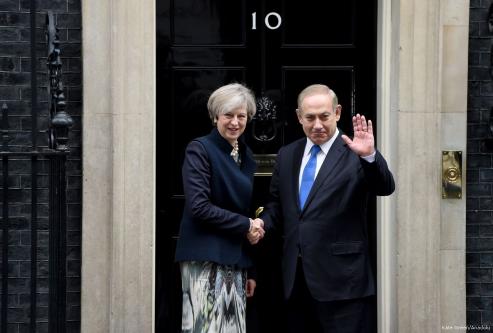
British Prime minister Theresa May (L) and Israeli Prime Minister Benjamin Netanyahu (R) on the steps of No.10 Downing street, London, UK on Feb. 6, 2017. ( Kate Green – Anadolu )
By Hanin Zoabi | Arab48 | September 29, 2017
It seems that the international meetings I am participating in for the 30th time and the ninth series of lectures in Britain specifically are taking up the lion’s share of my visits. This is due to the fact that solidarity campaigns with the Palestinian people in Britain are considered to be the strongest and most active in the world. Time after time, we try to expand the discourse related to solidarity with the Palestinians in order for it to go beyond confronting the occupation and blockade, i.e. “bad Israel” and to including the concept of “good Israel” that Israel is trying to convince the world exists. Does “good Israel” really exist? Could the “Zionist dream” with its ideal conditions and without being subject to resistance from the victim or any international opposition, constitute a normal human life?
The answer to this question is not derived from the reality of the conflict, but the reality of the state, i.e. the routine practices of the Zionist project, not only from its bloody crimes. The basic routine produced by this project is the Jewish State itself, as well as its institutions, its legal system, and the values it produces and raises its generations with on a daily basis. This is the routine that embodies the “Zionist dream”, and this routine is what produces one violation after another and one crime after another.
This is the main claim we can present to the international solidarity movements, and by doing so we can confirm that the problem is with the dream (the Jewish state) and that the crimes committed by this state are the same tools it uses to define itself as a Jewish state. This also confirms that the state cannot exist, even within its basic daily routine, without committing ethnic cleansing, uprooting and the physical and symbolic liquidation of the Palestinian presence, i.e. the crimes are not outside of the Israeli routine, but rather are what form the routing within the system itself. It translates the plans for uprooting, liquidation and ethnic cleansing into legal tools and local administration systems.
We cannot continue to talk about a solution that is merely a “Palestinian state alongside the State of Israel”, a motto even some of our own central political forces still promote. Those who want to combat Israel’s crimes cannot be satisfied with removing Israel from the West Bank and Gaza Strip alone. They must remove Zionism from the legal and political system of the state, because the plans for uprooting, displacement and liquidation are plans that govern Israel’s relationship with the Palestinian presence in all its forms. Citizenship was never protection for the Palestinians from Zionism and its plans, but it has always been a tool of control and a means to implement its plans against us.
As for the “diplomatic” significance of this claim, along with its political significance, it refutes Israel’s defence discourse to the Europeans, which is based on Israel’s spilt personality. There is good/real Israel, which, if left alone by the world, would prove its moral superiority, and there is Israel that is dragged into war, which if forced, possibly, may commit some unintentional or forced violations but only in self-defence.
The importance of stating that liquidations, displacement and cleansing are crimes established in Israel’s routine and are at the core of the Zionist project, is that it refutes Israel’s claims of moral superiority and legitimacy which it is trying to rely on.
If Israel can silence the world with claims of “Islamic terrorism” in Gaza or “defence of its democracy” in the West Bank, then what will its answer be if asked about the reason for prohibiting Arabs from living in over 500 towns, the law of Jewish neighbourhoods receiving larger budgets, the Prawer Plan, the citizenship law, the law to withdraw parliamentary representation, the law prohibiting the commemoration of the Nakba, the law to reduce the sound of the call to prayer, or the law restricting participation in political parties? What will Israel say about physical, political and symbolic liquidation laws? Especially since its typical answer of “self-defence” won’t hold up here. What will it say if the claims of “some violations it was forced to commit” in the West Bank and Gaza Strip were legitimate in order to protect Israel, the democratic state that promotes the West’s democratic values are not accepted?
What would happen if we reveal that the “good” that Israel willingly chooses is no less evil than the evil that it is forced to commit in the West Bank and Gaza?
Such exposure is exactly what Israel fears. It is afraid that the world will discover that the “perfect” Jewish state has committed crimes that are no less of a crime than the war crimes it “forcibly” committed because people have not yet understood the pureness and morality of what Israel wants. They fear that the world will realise the problem isn’t only the brutal crimes but also lies in the daily routine. They are afraid the world will realise that the main problem is not in the missiles and siege that will end if the Palestinians surrender, nor is it in the confiscation of the land, which will stop if the Palestinians voluntarily surrender their land, but the problem is what Israel wants, even if we do not resist. The problem is the laws, culture and intellect that considers your existence terrorism.
Perhaps it is because of Israel’s fear of this that the Zionist lobby is forced to tighten its control in order keep up with the growing solidarity with the Palestinians that not only stems from the ugliness of Israel’s crimes but from a deeper understanding of the concept of the Jewish state itself.
Confronting the nature of the Jewish state requires the Europeans to first liberate themselves from the continuous oppression and extortion that they are constantly subjected to, that undeniably succeeds in controlling the political scene they are living in. It isn’t only the Palestinians who have lost control of their reality, but the Brits as well, or more accurately, those who want to express their views on the Palestinian cause freely. Although they are in remission, their inability to express their opinions freely enough regarding the Palestinian cause indicates their sense of losing control or helplessness. If an embassy and lobby are controlling the freedom of thousands in a certain country, it is not a typical scene and cause for surprise, followed by resentment and anger.
Perhaps the anger felt by dozens of these activists at the fact that a foreign lobby is controlling them is greater than the anger provoked by the violation of Palestinians’ freedom and dignity by the Zionist project, not because the latter’s suffering is less, as the suffering of Palestinians is too deep to compare, but because of Zionism’s success in oppressing British citizens. This gives it more confidence and reassurance in oppressing the Palestinians; is it possible for Israel to succeed in Britain but fail with the Palestinians?
The answer is yes, it is possible for Israel to succeed in suppressing the freedom of expression of activists in solidarity with Palestine who are from strong and sovereign nations and fail with the victim. This is because it has already taken over all means of its victims’ material and symbolic life, leaving them with very little to lose. Sometimes, strength is one’s weakness, while confinement within narrow limits means you will only lose narrowness.
In the past two years, the British have voiced their resentment, their fear of the Zionist lobby and, most importantly, its success in silencing them more than ever. The Zionist lobby has intensified its campaigns, relations and means of pressure, this time in coordination with the Israeli Foreign Ministry and the Israeli ambassador in London. Everyone will attest to his unprecedented means of intimidation, which no other ambassador has ever used. This is despite the fact that the British, and other countries’ laws do not permit local lobbies to receive guidance, instructions or funding from any foreign embassy in the country in which it operates, as this constitutes an interference in the internal affairs of the state, which is prohibited by the norms and rules of international diplomacy.
Al Jazeera’s investigation revealed how the Zionist lobby infiltrated and penetrated not only the corridors of British politics, but also the corridors of the personal life of British officials. They even went as far as trying fabricate a scandal for one of the conservative ministers as punishment for his rejection of settlements. Despite the discovery of such actions and plots, no punishment or measure have been taken in accordance with the diplomatic standards.
The peak Zionist lobby’s success is embodied by the British government’s adoption of the new definition of anti-Semitism, which considers any unconventional criticism against Israel anti-Semitic. This new change must not be underestimated. This change occurred in late 2016 when British Prime Minister Theresa May promised to issue a government resolution to adopt a definition recently formulated by the International Holocaust Remembrance Alliance, known as the IHRA, which stated that “anti-Semitism could include criticism of Israel as a Jewish state”. This means anyone who dares to criticise Israel will “put themselves at risk” of being labelled as anti-Semitic.
Not only did the Zionist lobby succeed in making Theresa May adopt this definition, but the harshest blow came in the form of Labour party leader Jeremy Corbyn, known for his unprecedented support in the British political arena for the legitimate rights of the Palestinians and his full awareness of the essence of the Zionist project, agreeing to adopt this new definition of anti-Semitism.
Hence, it seems that the Zionist lobby in Britain pre-empted the “benefits” the Palestinians would gain from electing their “friend” Corbyn as head of the Labour party by adding new restrictions to the British political scene. They have made the Zionist definition of anti-Semitism most in control of the limits of what is permissible and prohibited in terms of supporting Palestinians and opposing colonialism, settlement, apartheid and Israeli oppression in the British political scene.
This may suggest that supporting Zionism is a condition for the freedom of expression in Britain (similar procedures and laws were approved recently in other European countries including France and Spain), in a clear example of McCarthyism that puts anyone who criticises Israel on a blacklist.
Dozens of members of the Labour party have revealed their membership has been frozen for months after the Zionist lobby filed complaints against them, accusing them of anti-Semitism. They all noted that the number of those who believe they were punished for this accusation by freezing their membership reached thousands, while others said the number is tens of thousands of people. In some cases, people’s memberships were frozen without their knowledge, and without any formal procedure or without allowing them to air their side of the story.
Some of us overlook the fact that the efforts to eliminate thousands of Labour party activists is not only a personal attack on these individuals, but also reflect attempts by the Zionist lobby to manipulate the internal influence of the Labour party, known for its member’s support for Corbyn’s left-wing pro-Palestinian positions, but not known to support the official bodies in the party and the senior officials who are known for their hostility toward Corbyn and their relentless fight against his influence. This indicates some mechanisms of the Zionist lobby in combatting Corbyn and influencing the internal elections of the British parties.
These new developments are what allow us to confirm that there are motives for the Brits’ solidarity with the Palestinian that go beyond their support for their just cause. They are also standing in solidarity against the Zionist lobby’s attempts at political intimidation and with their right to think, express and speak freely in their country. The Zionist lobby’s success in oppressing the freedom of expression of other nations would be the greatest indicator of the credibility of the Palestinians’ claims, not to mention the fact that the Zionist lobby is forced to exaggerate its means of pressure and repression in an attempt to keep up with the increased solidarity with the Palestinians.
In the past two years, Britain has been criticising the Zionist lobby, not in defence of the Palestinians’ rights but in defence of the British people’s rights. Petitions signed by 200 lawyers and academics confirmed that the restrictions imposed by British policy against the international boycott of Israel, in addition to the government’s adoption of the Zionist definition of anti-Semitism are a violation of human rights in Britain.
The suppression against British citizens by foreign parties in their own country does not stop at the suppression of freedom of expression. Just as the Palestinians experience this, the Zionist lobby in all European countries threaten those who rent out their halls for conferences and forums organised by solidarity campaigns. The surrender of many is not because they are afraid of punishment, but most of the time it is to reduce harassment and headache they are subjected to. Other fears faced by the British people causing them to surrender to the pressure of the lobby are related to their fear of losing sources of funding or defamation in the media and social networking sites under the control and influence of the Zionist lobby.
Despite all this, I must note that although the Palestinian cause has lost some of its international political presence due to the Arab revolutions and their consequences, as well as the fact that the cause has been liquidated as a liberation cause and is being dealt with as a diplomatic issue by the PA, it has not lost its moral presence globally, and is still a symbol of justice and the fight against domination.
The Palestinians still do not require much effort to convince any European of the justice of their cause, and the Zionist lobby is still forced to redouble its efforts, funds and intimidation to keep pace with the popular support given instinctively to the Palestinians without much effort. However, this requires us to focus our efforts and to emphasise that the definition, principles and laws of the Jewish state itself eliminate any possibility of the existence of an “innocent Israel” and that Israel’s daily practices represented by its legal, political and educational system should be subject to international scrutiny and accountability, and not only its crimes in the West Bank and Gaza. The former carries as much crime as the latter. The second thing we must emphasise is the extent to which Zionism has become an international movement against freedom in the world.
Translation by MEMO
Featured Video
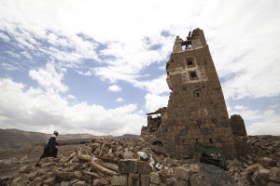
Saudi Led Destruction of Yemen’s heritage
or go to
Aletho News Archives – Video-Images
From the Archives
Israel: Strategic Ally or Liability?
By Stephen Sniegoski | My Catbird Seat | June 12, 2010
The claim that Israel serves as a valuable ally for the United States is made by both pro-Zionists and much of the anti-war and anti-Zionist Left that is influenced by Noam Chomsky. As a result of the Gaza flotilla massacre, which has caused a world-wide uproar against Israel, the value of Israel to the United States is being publicly questioned in more mainstream foreign policy forums. … continue
Blog Roll
 Aletho News
- Declassified UK exposes British man who fought for ‘Israel’ in Gaza
- West’s death cult in a theater near you
- How the Yandex ‘Russian bots’ lie fell apart
- Burnham’s ‘Russia did Brexit’ ruse crumbles
- Estonia making movies and games to encourage war against Russia
- Four in five new UK jobs taken by foreigners – report
- Here’s what Trump’s latest U-turn really means for Russia and Ukraine
- The Houthis Are Not an Iranian Proxy
- Europe’s Energy Hypocrisy, Russian LNG Profits and US Dependence
- ICC ignored ‘very well-documented’ NATO crimes – ex-Libyan minister
- If Americans Knew
- An error has occurred; the feed is probably down. Try again later.
- No Tricks Zone
- New Study Suggests Large Regions Of The Pacific Ocean Have Been Cooling For The Last 80 Years
- Germany’s Green Energy Debacle: High Energy Costs Force Kahla Porzellan to Close After 182 Years!
- New Study: 50 Years Of The Most Aggressive ‘Net Zero’ Policies Can Only Affect The Global Climate By 0.03°C
- US September “Heat” Was No Record…Many Records Set Decades Ago
- Latest European Green Energy Debacle; Portugal’s Largest Flagship Solar Park Insolvent!
- Green Energy Debacle: German Expert Professor Fritz Vahrenholt Warns Of Severe Economic And Social Consequences
- Two More Paleo Reconstructions Affirm Meters-Higher Sea Levels Across Ireland, Brazil 7000-6000 Years Ago
- New Study: Earth And Venus Surface Warmth Largely Explained By Convection And Lapse Rate, Not CO2 Or Radiation
- 2025 Nature Paper Claiming Worsening Global Drought Gets RETRACTED …Heavily Flawed
- New Study: ‘Global Drought Shows No Detectable Recent Acceleration Under Climate Warming’

