Misplacing priorities and freedom of expression
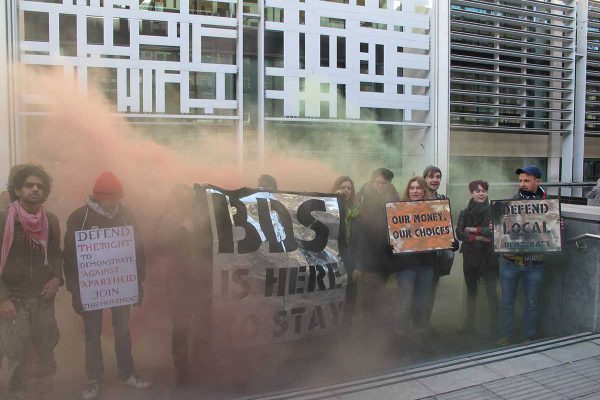
BDS supporters protest anti BDS activities in London
By Ramona Wadi | MEMO | November 3, 2016
It would be slightly premature to consider the statement by the EU Representative for Foreign Affairs and Security Policy, Federica Mogherini, regarding the right of EU citizens to boycott Israel as some sort of victory. At first glance, it might look as if activism has overcome a significant hurdle, given the Israeli government’s obsession with suffocating the Boycott, Divestment and Sanctions movement (BDS). A study of the brief statement actually suggests otherwise, and all in the name of freedom of expression.
Mogherini asserted that the EU “stands firm in protecting freedom of expression and freedom of association in line with the Charter of Fundamental Rights of the European Union”, even when such information or ideas “offend, shock or disturb the State or any sector of the population.” You just knew that there was a “but” coming: she made it equally clear that “the EU rejects the BDS campaign’s attempts to isolate Israel and is opposed to any boycott of Israel.” The EU official missed the point, of course; Israel isolates itself by its contempt for international laws and conventions, along with its brutal military occupation and colonisation of Palestine.
Commenting on Mogherini’s statement, BDS Europe Campaigns Officer Riya Hassan voiced the expectation that the EU should respect “its obligations under international law and its own principles and laws by, at the very least, imposing a military embargo upon Israel,” as well as a suspension of the EU-Israel Agreement signed in 1995. The latter stipulates regulations regarding political dialogue, economic cooperation, security and cooperation on social matters, based upon the premise in Article 2 of the agreement that all provisions “shall be based on respect for human rights and democratic principles.” Israel has no such respect; it is a colonial entity and the EU functions as a protector of colonialism. The entire agreement should thus be declared null and void, or amended according to each entity’s characteristics, without the need to drag pretentious terms such as democracy into the equation.
Through Mogherini’s recent statement we have a clear example of how the EU actually demeans human rights and freedom of expression by utilising the discourse meant to uphold them. The entire essence of the EU’s true intentions lies in its opposition to BDS. Hence, any concession given by the EU should not be misconstrued as support, or upholding the right to freedom of expression. It is merely a recurring political ploy that ridicules the very essence of freedom. At the same time, it is through these clauses that BDS has managed to retain ground. Notwithstanding the genuine efforts of the masses which have embarked upon collective and individual efforts to boycott Israel, the fragile compromise upon which the global boycott outlook rests may well become tarnished if it continues to laud statements blatantly supportive of Israel while grudgingly allowing dissent as proof of freedom of expression.
Hence, Mogherini’s statement is not welcome. It is a calculated contribution to the debate that places Israel’s interests above the legitimate demands and legal rights of the Palestinians. BDS should distance itself from the litany of symbolic gestures that have taken precedence over genuine, active support for the anti-colonial struggle unless, that is, the movement seeks to become just another actor that thrives upon Palestinian demands as the means for the entity’s survival. If the movement’s chartered course is in the slightest way intertwined with that of the EU, however insignificant it may seem on the surface, Palestine may well be destined to accumulate festering wounds; the objective — which is already compromised due to the two-state subjugation rhetoric — will in the meantime become ever more distant from the land and the indigenous people.
Son of Honduran Human Rights and Resistance Activist Murdered

teleSUR | November 2, 2016
In post-coup Honduras, a coup which Democratic presidential candidate Hillary Clinton supported, the corpses continue to pile up.
Human rights organizations are raising alarm after yet another assassination in Honduras, this time of the son of a prominent resistance activist, human rights defender, and aspiring progressive candidate for local political office with the left-wing Libre party.
Fernando Aleman Banegas was shot dead in the early hours of Monday morning when we was getting into his car after leaving a club in the northern port city of La Ceiba, according to local reports. The gunmen reportedly fled the scene on a motorcycle.
Aleman will be buried in the nearby city of Tocoa, which borders the Aguan Valley agricultural region, home to a brutally repressive land conflict between campesino communities and large private landowners.
Aleman’s mother, Elsy Banegas, has accompanied the campesinos struggle for years as the President of the Coordinator of Popular Organizations of the Aguan, known as COPA, a human rights group focused on labor and campesino issues in the region. Banegas is also an aspiring mayoral candidate for Tocoa with the Libre party, founded as an offshoot of the popular resistance movement in the wake of the 2009 U.S.-backed coup, in order push for a constituent assembly to rewrite the Honduran constitution at the ballot box, to complement their street resistance.
According to the Honduran human rights organization COFADEH, Banegas’ candidacy “threatens the interests of transnational mining companies and large landowners in the region.” The prominent activist has long been a vocal critic of systematic grave human rights abuses, impunity and the consequences of militarization in the region, particularly since the coup.
Banegas’ organization COPA reported after the murder that the social leader has “on many occasions received death threats for acting against mining companies, privatization and against the violation of human rights.”
Aleman’s assassination came hours before Libre kicked off its internal elections process to select the party’s new leadership leading up to the 2017 general election. Despite the shadow of violence, participation in the process surpassed the party’s own goals, according to Libre leader and ousted President Manuel Zelaya, with at least 239,000 people casting votes when estimates expected participation of 150,000 in the country of about 8 million.
Human rights organizations have called for a thorough and impartial investigation into Aleman’s murder.
The killing comes just two weeks after two Aguan campesino activists were murdered. Jose Angel Flores, president of the Unified Campesino Movement of the Aguan, one of the most prominent land rights organizations on the forefront of the Honduran resistance movement, and his fellow activists Silmer Dionisio George were both gunned down on Oct. 17. Since 2010, the bloody land conflict in the Aguan has claimed the lives of nearly 150 campesinos, according to human rights groups.
The wave of assassinations also comes months after the high-profile killing of internationally-renowned Indigenous activist Berta Caceres in March. Caceres’ case has come to epitomize the grave human rights situation in Honduras and systemic impunity enjoyed by perpetrators of political violence.
Human rights organizations have stressed that the United States — which under the leadership of former Secretary of State Hillary Clinton helped secure the 2009 coup — is complicit in the ongoing crisis in Honduras and must cut all aid funding to the Honduran government and military.
Israel acts to blunt criticism of the occupation as its grip tightens
By Jonathan Cook | Dissident Voice | November 1, 2016
Israel has just emerged from its three-week high holidays, a period that in recent years has been marked by extremist religious Jews making provocative visits to Al Aqsa mosque compound in occupied East Jerusalem.
Many go to pray, in violation of Israel’s international obligations. Most of them belong to groups that seek to replace the mosque with a Jewish temple. They now enjoy increasing parliamentary support, some of it from within prime minister Benjamin Netanyahu’s party.
A rash of such visits last autumn outraged Palestinians and triggered a wave of so-called lone-wolf attacks on Israelis. The attacks have recently abated.
Taking advantage of the renewed quiet, Israel allowed a record number of ultra-nationalists to visit the mosque, figures released last week showed. Parties of Israeli soldiers are also entering the site.
The police, whose recently appointed commander is himself from the extremist settler community, have recommended that restrictions be ended on visits by Jewish legislators who demand Israel’s sovereignty over the mosque.
For Palestinians, Israel’s treatment of this supremely important Islamic holy site symbolises their powerlessness, oppression and routine humiliation. Conversely, a sense of impunity has left Israel greedy for even more control over the Palestinians.
The gaping power imbalance was movingly detailed last month at a special hearing of the UN security council. Hagai El-Ad, head of B’tselem, which monitors the occupation, termed Israel’s abuses as “invisible, bureaucratic, daily violence” against Palestinians exercised from “cradle to grave”.
He appealed to the international community to end its five decades of inaction. “We need your help. … The occupation must end. The UN Security Council must act. And the time is now,” he said.
Israeli politicians were incensed. Mr El-Ad had broken one of Israel’s cardinal rules: you do not wash the country’s dirty linen abroad. Most Israelis consider the occupation and Palestinian suffering as an internal matter, to be decided by them alone.
Mr Netanyahu accused B’tselem’s director of conspiring with outsiders to subject Israel to “international coercion”.
With the US limply defending Mr El-Ad’s freedom of speech, Mr Netanyahu found a proxy to relaunch the attack. David Bitan, chair of his party, demanded that Mr El-Ad be stripped of his citizenship and proposed legislation to ban calls in global forums for sanctions against Israel. Unsurprisingly, Mr El-Ad has faced a flood of death threats.
Meanwhile, another UN forum has been considering Israel’s occupation. Its educational, scientific and cultural body, Unesco, passed a resolution last month condemning Israel’s systematic violations of Palestinian holy sites, especially Al Aqsa.
Again, Israelis were enraged at this brief disturbance of their well-oiled machinery of oppression. The abuses documented by Unesco were overshadowed by Israeli protests that its own narrative was not the focus.
While Israel exercises ever more physical power over Palestinians, its moral credit is running out with foreign audiences, who have come to understand that the occupation is neither benign nor temporary. The rise of social media has accelerated that awakening, which in turn has bolstered grassroots reactions such as the boycott (BDS) movement.
Aware of the dangers, Israel has been aggressively targeting all forms of popular activism. Facebook and YouTube are under relentless pressure to censor sites critical of Israel.
Western governments – which joined the chorus of “Je suis Charlie” after ISIL’s lethal attack on the Paris office of Charlie Hebdo magazine last year – have cracked down on the boycott movement. Paradoxically, France has led the way by banning such activism, echoing Israeli claims that it constitutes “incitement”.
And left-wing social movements emerging in Europe face loud accusations that any criticism of Israel is tantamount to an attack on all Jews. Notably, a British parliamentary committee last month characterised as anti-semitic parts of the opposition Labour party under its new leader, Jeremy Corbyn, a champion of Palestinian rights.
In these ways, European governments have been trying to hold in check popular anger at a belligerent and unrepentant Israel.
Illustrating that caution, Uneso was forced last week to vote a second time on its resolution, this time removing the word “occupation” and, against normal practice, giving equal status to the occupier’s names for the sites under threat from its occupation.
Even with the resolution neutered, Unesco’s usual consensus could not be reached. The resolution passed by a wafer-thin majority, with European and other governments abstaining.
Israel and its enablers have successfully engineered a hollowing out of official discourse about Israel to blunt even the mildest criticism. Gradually, western powers are adopting Mr Netanyahu’s doubly illogical premises: that criticising the occupation is anti-Israel, and criticising Israel is anti-semitic.
Incrementally, western leaders are conceding that any criticism of Mr Netanyahu’s policies – even as he tries to ensure that the occupation becomes permanent – is off-limits. Mr El-Ad called for courage from the western powers that dominate the security council. But the signs are his words have fallen on deaf ears.
NYPD to Innocent Business Owners: Give Up Your Rights or Get Shut Down
Institute For Justice | October 12, 2016
When undercover NYPD officers offered to sell stolen electronics to customers at Sung Cho’s laundromat, near the northern tip of Manhattan, Sung never imagined the sting operation could be used as a pretext to shut down his business. But that’s exactly what happened. Attorneys for the city threatened Sung with eviction merely because a “stolen property” offense had happened at his business.
The city presented Sung with a choice: See his business shut down or sign an agreement giving up constitutional rights—including his Fourth Amendment right to be free from warrantless searches of his business. Faced with the imminent closure of his laundromat, Sung had no real choice but to sign.
In New York City today, this experience is all too common. Under New York City’s so-called nuisance eviction ordinance—more appropriately termed a “no-fault” eviction ordinance—residents and business owners can be evicted simply because their home or business was the site of a criminal offense. Under the ordinance, the identity of the criminal offender is irrelevant. You can be evicted because a total stranger (or a friend or family member) decided your home or business was a good place to commit a crime.
City attorneys churn out no-fault eviction filings by the hundreds, relying on form templates and little more than NYPD officers’ say-so that the targeted home or business was the site of a crime. In many cases, the “proof” of the alleged criminal offense is an affidavit from an NYPD officer relaying vague allegations from unnamed confidential informants.
Moreover, under the ordinance, occupants of the home or business can be evicted without any notice. After being summarily evicted, occupants have just days to put together a case to persuade a judge to undo the eviction order.
City attorneys routinely offer to drop these no-fault eviction proceedings if occupants agree to waive their constitutional rights. Some, like Sung, are forced to sign agreements waiving their Fourth Amendment rights. Others are forced to sign agreements barring family members from the home—including family members who have not been accused of any crime.
Now, Sung is joining with other victims of the city’s conduct to bring a federal class action lawsuit challenging the city’s no-fault eviction ordinance. If the lawsuit is successful, past waivers of constitutional rights will be declared unenforceable and, going forward, this practice will be put to an end once and for all.
Show a Film, End Up on a Watch List
By Ted Steinberg | CounterPunch | October 31, 2016
In a speech before the American Israel Public Affairs Committee earlier this year, Hillary Clinton, who vehemently opposes the Boycott, Divestment and Sanctions movement warned against anyone who tries to “to shut down debate, especially in places of learning like colleges and universities.” Her concern, of course, was with reassuring pro-Israel students that she stood behind them as they battled efforts to criticize Israel from the left.
It is certainly sportsman-like of Clinton to be open to debate, but the reality is that the free exchange of ideas on campus is currently under assault, not from the left but from the right. Consider the following incident from here in Ohio.
On September 21, the Case Western Reserve University Radical Student Union showed a documentary titled “The Occupation of the American Mind: Israel’s Public Relations War in the United States,” which is available to all members of the university community through the Kanopy streaming service. Today, the RSU stands accused by the AMCHA Initiative, a nonprofit pro-Israel group, of engaging in an “antisemitic expression” that “condoned terrorism,” simply for showing the film in public. One radical student critical of Israel’s policies likened the climate of fear on the CWRU campus with respect to this issue as akin to being “stalked.”
The RSU decided to host the film to raise awareness and in the words of its president, Gabriel Murcia, to give “voice to people who don’t have a voice.” Although some 100 people attended the screening, the RSU decided at the last minute not to have a formal discussion after the film when an email raising the specter of antisemitism emerged from the president of a pro-Israel student group.
I have watched this film at least four times now. There is absolutely not one shred of evidence of antisemitism in it if by that word we mean hatred or discrimination against the Jewish people. The film does, however, take Israel to task for engaging in a dishonest campaign of public diplomacy. These efforts have tended to cast the problem in Israel/Palestine in terms of terror instead of territory, and have made it seem as if Palestinians are on the whole just prone to violence instead of people with legitimate grievances about displacement and dispossession of land.
After the movie, a student fellow of the Committee for Accuracy in Middle East Reporting in America (CAMERA), a group formed after the Israeli invasion of Lebanon in 1982, noted that though “every student on this campus is entitled to express their opinion” the film was biased and “unacceptable to be presented by a student organization at our university.” The student then expressed her opposition to the BDS movement and argued that the president of CWRU had made opposition to academic boycotts the institution’s official stance.
The student’s reference is to a 2013 statement in which the president and provost, like many university administrations across the country, communicated their personal opposition to the academic boycott of Israel following the American Studies Association’s endorsement of it. They argued that the boycott compromised academic freedom. Never mind that the academic boycott was set up to help Palestinian scholars achieve academic freedom while under the Israeli occupation. The AMCHA Initiative liked their statement so much that it still links to it on its website. The statement was not, however, the official position of CWRU, simply the personal opinions of its two highest administrators.
The statement by the CWRU administration and the letter from the CAMERA fellow recall, as I pointed out in a letter to the student paper, Edward Said’s comment, nearly 40 years ago, that politically speaking, the Palestinian in the United States “does not exist.”
I thought the matter was at an end, but to my surprise the Cleveland Jewish News ran a story about the movie screening. A university administrator who directs a continuing education center dedicated to “the heritage of Jewish learning” condemned the film and the RSU, as if a radical Jewish tradition did not exist. He also implied that faculty drove the group’s agenda, implying that the students were not bright enough to think for themselves. The chairman of the board of trustees of the Jewish Federation of Cleveland, Gary Gross, meanwhile, called the film a bunch of “lies and distortions” without providing any evidence in support of the assertion. In fact, the film is about a policy of using lies and distortions to advance the interests of a foreign government. Gross added that he supports free speech, but then ominously intoned, “We will follow what’s happening on [the CWRU] campus through our partner agency, Cleveland Hillel.”
The reference to Hillel was not an idle one. Cleveland Hillel just partnered with CWRU on the creation of the new Albert & Norma Geller Hillel Student Center which includes within it classrooms available for undergraduate courses. Some students on the left are dismayed that they are forced to take classes in a building run by a group that offers “Israel advocacy training.”
This incident is part of nationwide trend. Universities all over the country are under surveillance, most famously at the University of California, Berkeley, where a student-led course titled Palestine: A Settler-Colonial Analysis was canceled after AMCHA coordinated with other groups, including CAMERA, to pressure administrators. The course was later reinstated, but the intimidation continues online. An anonymous website called the Canary Mission, established in 2015, targets those on campus critical of the Israeli occupation. The site’s main goal is to harass student activists and attempt to block their admission into graduate school.
If Hillary Clinton really does care about academic freedom, she should step up and publicly condemn the blacklisting of students and faculty concerned about Palestinian human rights. And so should the university presidents who invoked academic freedom as the rationale for their opposition to the ASA’s endorsement of the boycott of Israeli academic institutions. These leaders should also learn something from the experience on the Berkeley campus and stop caving in to people who have trouble tolerating a perspective that challenges them to think.
When I informed Mr. Murcia about his group’s inclusion on the AMCHA website he was saddened. As he put it, “All we did was show a movie.”
Ted Steinberg teaches history and law at Case Western Reserve University. He is the faculty advisor to the Radical Student Union and the author, most recently, of Gotham Unbound: The Ecological History of Greater New York.
The U.S. National Bird Is Now a Drone
By David Swanson | Let’s Try Democracy | October 27, 2016
Officially, of course, the national bird of the United States is that half-a-peace-sign that Philadelphia sports fans like to hold up at opposing teams. But unofficially, the film National Bird has it right: the national bird is a killer drone.
Finally, finally, finally, somebody allowed me to see this movie. And finally somebody made this movie. There have been several drone movies worth seeing, most of them fictional drama, and one very much worth avoiding (Eye in the Sky ). But National Bird is raw truth, not entirely unlike what you might fantasize media news reports would be in a magical world in which media outlets gave a damn about human life.
The first half of National Bird is the stories of three participants in the U.S. military’s drone murder program, as told by them. And then, just as you’re starting to think you’ll have to write that old familiar review that praises how well the stories of the victims among the aggressors were told but asks in exasperation whether any of the victims of the actual missiles have any stories, National Bird expands to include just what is so often missing, and even to combine the two narratives in a powerful way.
Heather Linebaugh wanted to protect people, benefit the world, travel, see the world, and use super cool technology. Apparently our society did not explain to her in time what it means to join the military. Now she suffers guilt, anxiety, moral injury, PTSD, sleep disorder, despair, and a sense of responsibility to speak out on behalf of friends, other veterans, who have killed themselves or become too alcoholic to speak for themselves. Linebaugh helped murder people with missiles from drones, and watched them die, and identified body parts or watched loved ones gather up body parts.
Even while still in the Air Force, Linebaugh was on a suicide watch list and had a psychologist recommend moving her to a different sort of job, but the Air Force refused. She has episodes. She sees things. She hears things. But she’s forbidden to discuss her work with friends or even with a therapist who doesn’t have the proper “security clearance.”
We let Daniel down even more than Heather. He says he actually opposed militarism but was homeless and desperate, so he joined the military. We could have given him a house for much less than we paid him to help murder people at Fort Meade.
Lisa Ling worked on a database filled by drone surveillance that compiled information on 121,000 “targets” in two years. Multiply that by a dozen years. With 90% of victims not among the targets, add up how many people would die in the targeting of the whole list. That’d be over 7 million. But it’s not numbers that have poisoned the souls of these three veterans; it’s children and mothers and brothers and uncles lying in pieces on the ground.
Ling travels to Afghanistan to see the place at ground level and to meet with drone victims. She meets a little boy who lost his leg and his 4-year-old brother and his sister and his father. On February 2, 2010, drone “pilots” at Creech Air Base murdered 23 innocent members of one family.
The filmmakers have voices read the written transcript of what the drone operators said to each other before, during, and after sending in the missiles that did the damage. This is worse than Collateral Murder. The people whose job it is to identify children and others who should not be murdered have identified children among the group of people being targeted. The “pilots” at Creech are eager to reject this information and to get on to killing as many people as they can. Their lust for blood drives the decision process. Only after they’ve killed 23 people do they recognize children among the survivors, and the lack of guns.
We see the bodies brought home to bury. Those injured describe their suffering, physical as well as mental. We see people being fitted with artificial legs. We hear Afghans describe their perception of drones. They imagine, just as many Americans may imagine, and just as viewers of Eye in the Sky would imagine, that drone operators have a clear, high resolution view of everything. In fact, they have a view of fuzzy little blobs on a computer screen that looks like it was created in the 1980s.
Linebaugh says there is no way to distinguish the little “civilian” blobs from little “militant” blobs. When Daniel hears President Obama claim that there is always near certainty that no civilians will be killed, Daniel explains that such knowledge is simply not possible. Linebaugh says she was often on the side of the conversation telling the “pilots” at Creech not to murder innocents, but that they always pushed for permission to kill.
Jesselyn Radack, attorney for whistleblowers, says in the film that the FBI told two whistleblowers that a terrorist group had put them on a kill list. She said that the FBI has also contacted Linebaugh’s family and warned her that “terrorists” have been searching for her name online, suggesting that she fix this problem by shutting up. (She had written an op-ed in the Guardian).
The FBI also raids Daniel’s house, arriving with 30 to 50 agents, badges, guns, cameras, and search warrants. They take away his papers, electronics, and phone. They tell him he is under investigation for a possible indictment under the Espionage Act. This is the World War I-era law for targeting foreign enemies that President Obama has made a routine of using to target domestic whistleblowers. While Obama has prosecuted more people under this law than did all previous presidents combined, we probably have no way of knowing how many people have been explicitly threatened with the possibility.
While we should be apologizing to, comforting, and aiding these young people rather than denying them the right to speak to anybody and threatening them with decades in prison, Lisa Ling did manage to find some kindness. Victims of drone strikes in Afghanistan told her that they forgave her. As the film ends, she’s planning another trip to Afghanistan.
Palestinian Man Seriously Injured By Israeli Army In Ramallah
IMEMC | October 29, 2016
 Israeli soldiers shot and seriously wounded a young Palestinian man, near Ein Yabroud town, east of the central West Bank city of Ramallah on Saturday at dawn after he reportedly attempted to “ram Israeli soldiers with his car, then tried to stab them.”
The Israeli army claims that the soldiers shot and injured the young man, identified as Ahmad Ayman Hamed, 21, after he “tried to run over them” near a military base, close to the illegal Ofra colony.
It added that the soldiers fired at the Ahmad’s vehicle, forcing him to stop, and that he allegedly stepped out of his car and “tried to stab a soldier, before he was shot and injured.”
An Israeli ambulance was called to the scene and moved Ahmad to a hospital for treatment.
Palestinian eyewitnesses said while the young man was driving his car, he was surprised to see a group of soldiers in his way on the main road, before the army opened fire and seriously wounded him.
They added that the wounded young man was shot with three live round in his abdomen, and was left bleeding, without any first aid, until the Israeli ambulance arrived and took him away.
Following the shooting, the soldiers invaded Ahmad’s home, and interrogated his family while searching their property.
Many Palestinians have been shot dead by the soldiers since last year under similar allegations of attempting to ram soldiers with their car.
In September, the soldiers shot and killed a young Palestinian man, identified as Mustafa Nimir, 25, after alleging he attempted to ram them with his car, but later admitted that the man was not even the driver of the vehicle, to blame his brother-in-law for “driving erratically”
Mustafa Nimir, 25, was returning home along with his brother-in-law Ali after the two had gone shopping and purchased clothes for Ali’s six-year-old daughter, and baked goods for the family.
Imprisoned lives: closed military zone in occupied al-Khalil (Hebron)

Photo credit – CPT.net
International Solidarity Movement | October 30, 2016
Hebron, Occupied Palestine – It’s like living in a prison. That’s how residents describe what Israeli forces are doing to their lives in the Tel Rumeida neighborhood and Shuhada Street in occupied al-Khalil (Hebron). The area was first declared a ‘closed military zone’ on 30th October 2015 – solely and deliberately affecting the Palestinian residents. One year of collective punishment, open discrimination, racism, apartheid policies and rampant attempts at ethnic cleansing in this area, commonplace tactics of an illegal occupying force in an obvious attempt to rid the area of any Palestinian presence and instead, create a continous ‘sterile’ strip of illegal settlements.
The ‘closed military zone’ has several times been extended within this year of collective punishment of the Palestinian population, adding even more areas and ‘re-inforcing’ and creating more checkpoints, exclusively for the Palestinian civilian population. Only the Palestinian civilian residents, who must register to pass through a checkpoint to gain access to their family home, have been degraded to a mere number on a list by the Israeli forces. Only ‘registered’ residents are allowed to reach their homes. The lists of Palestinian residents have been changed repeatedly lately, arbitrarily dropping various names from the list. Apparently registering with the occupying force as a resident in one’s own home just once often isn’t sufficient. This dehumanization of the Palestinian civilians who at the checkpoint are reduced to a number, is a deliberate tactic to create a forcible environment directly furthering ethnic cleansing. For some time Palestinian residents were assigned numbers that were marked on their IDs, completely ridding these civilians of their human aspect, instead making them a mere number on a list. Now, with those numbers temporarily not in use, Palestinians are reffered to by their ID-number. The Palestinian civilian trying to live in their own home is just that for the Israeli forces, a number, void of any humanity.
During the Jewish holiday of Sukkot, Israeli forces basically declared a curfew on the whole area, closing Shuhada checkpoint, denying Palestinians passage while allowing exclusive access tor settlers at the same time. The prison this area is becoming for the Palestinian civilian population is further exacerbated by the fact that, if there’s a large number of Israeli forces or settlers from the nearby illegal settlements on the street, leaving the house is not an option. One year of collective punishment – a sad anniversary that proves that the Israeli state does not need to fear an outcry by the international community when implementing their racist, apartheid measures, ethnically cleansing an entire neighborhood. During a year in which the residents have not been allowed to receive visitors like family or friends, workers of any sort have been denied entry and even medical personnel will be turned away at the checkpoint.
Israel: 1984 Everlasting
By Stanley L. Cohen | CounterPunch | October 28, 2016
Empty Declarations of Democracy… Vacant Boasts of humanity
For decades, Israel has held itself out as being the lone “democracy” in the Middle East; a state where the rights of individuals could not and would not be held hostage to the autocratic whims of royalty, but rather a full partner to a free and robust electoral process that guarantees not just meaningful input from the governed but the ability to challenge state policies as the winds of change blow from “the river to the sea.”
Once again, recent events have proven this to be just so much a perverse myth… empty rhetoric… second only to the brazen unfounded Israeli boast of having the “most humane army in the world,” even as the body count of Palestinian children grows in cemeteries and prisons that have become very much its own unique brand of 21st century youth hostel.
Recently, Hagai El-Ad, an Israeli and Jew, who serves as executive director of B’Tselem (The Israel Information Center for Human Rights in the Occupied Territories), spoke before the UN Security Council urging it to take immediate action against Israel’s illegal settlements.
Demagoguery and Inhumanity Exposed
Not quite 1400 words in its entirety, one paragraph in particular of El-Ad’s testimony sums up life for millions of those captured by a democracy that sees day as night… pain as pleasure. Crushing, despite its brevity, the power and pain of these words could easily be part of an opening statement by a war crimes prosecutor at a tribunal called to hold Israel accountable for crimes unseen since the Nuremburg tribunals some 70 years ago.
“What does it mean, in practical terms, to spend 49 years, a lifetime, under military rule? When violence breaks out, or when particular incidents attract global attention, you get a glimpse into certain aspects of life under occupation. But what about the rest of the time? What about the many “ordinary” days of a 17,898-day-long occupation, which is still going strong? Living under military rule mostly means invisible, bureaucratic, daily, violence. It means living under an endless permit regime, which controls Palestinian life from cradle to grave: Israel controls the population registry; Israel controls work permits; Israel controls who can travel abroad – and who cannot; Israel controls who can visit from abroad – and who cannot; in some villages, Israel maintains lists of who can visit the village, or who is allowed to farm which fields. Permits can sometimes be denied; permits must always be renewed. Thus with every breath they take, Palestinians breathe in occupation. Make a wrong move, and you can lose your freedom of movement, your livelihood, or even the opportunity to marry and build a family with your beloved.”
In a free democratic society these comments, while perhaps controversial, would certainly not constitute sedition. In an open, healthy State these words would surely give reason to pause and reflect… but never serve as a rational trip-wire to strip their speaker of his birthright as an unbound citizen empowered to support his government for policies he finds just but condemn it for those that bear the star of tyranny. It is a distinction that Israel has failed to adopt or learn over the course of its 50 year subjugation of millions whose only crime is to be born Palestinian in occupied land with sign-posts everywhere that simply say “ Jews only.”
Beating of Chests
Not long after El-Ad’s powerful speech before a world body entrusted with securing fundamental rights and liberty for all of its citizenry, the hue and cry could be heard among Israeli political elite to silence such subversive talk. Thus, Coalition Chairman MK David Bitan of the Likud Party undertook the first steps of reprisal by announcing he was considering submitting a bill to the Knesset that could remove the citizenship of Israelis who act against their country in international organizations. According to Bitan, “El-Ad’s actions at the Security Council are a blatant violation of the trust citizens must have for their country, so he should go find another country where he could be a citizen.”
Alarming, one might ask; no, not at all… merely another in an endless daily stream of steps by a government second to none when it comes to autocratic, indeed dictatorial, control of every fiber of its citizen’s freedoms, particularly their ability to access and exchange information without fear of retribution.
Much is known and largely ignored about the thousands of Palestinian civilians that have been targeted and slaughtered by the Israeli military machine in occupied Palestine, whether in Gaza or the West Bank. Indeed, the killing fields of Gaza or execution alleys of back street Jerusalem no longer acquire more than a passing fancy or footnote in the evening news spread across a world now busy with outrages of more recent vintage. After 70 years of slaughter, it’s just so much business as usual.
So, too, we have seemingly become numbed to the reality that thousands of Palestinian political prisoners languish in isolation, many sitting year after year, some for decades, in administrative detention cells of political prisons… uncharged, undefended and untried, tortured in ways that leave the spirits of those still roaming the now empty cellblocks of South Africa’s notorious Robben Island relieved their misery was ended quickly through state sanctioned executions by “suicide.”
The Mighty Censor’s Sword
Closures of Palestinian news rooms and television stations are commonplace… yet no more remarkable than assaults by Israel upon Palestinian journalists that long ago moved into triple digits and show no sign of abating. The Palestinian Centre for Development and Media Freedoms (MADA) has documented a pattern of such attacks by Israel running, for some time now, at almost 400 per year. Although the exact number of Palestinian journalists killed or injured by Israel over just the last decade may never be known, it has been documented that seventeen lost their lives in Gaza, alone, during the months of bombings which it endured in 2014.
Dozens of Palestinian journalists and private bloggers have been arrested by Israel and held for violating vague administrative codes that typically come down to the application of entirely undefined prohibitions such as “incitement.” Dareen Tatour, a 35-year-old poet and Arab-Palestinian citizen of Israel, was arrested and placed under administrative detention on charges of inciting violence via her poetry which she posted on Facebook and which merely praises those who fight against Israeli domination. Also arrested and charged with criminal incitement was 19-year-old Anas Khateeb, on the basis of her Facebook posts which included such alarming statements as “Jerusalem is Arab,” and “Long live the Intifada.”
Recently, Palestinian journalist, Samah Dweik, was released from prison having served almost six months for an alleged incitement charge which resulted from comments about the occupation she posted on her private Facebook account. For most of her sentence, her family was banned from visiting or having any contact with her. She was but one of over 20 Palestinian journalists recently imprisoned by Israel for allegations of incitement, along with hundreds of other Palestinian activists or bloggers who have been targeted for arrest and prosecution for nothing more than postings of political opinions about the Israeli occupation and Palestinian resistance on social media. Dweik’s release came not long after Israel and Facebook entered into an agreement to “work together” to monitor Palestinian posts.
The Sword Cuts Deeper
Increasingly, Palestinians are not the sole victims of an Israeli policy to silence “dissent” or to dramatically curb the nature and extent of information made available to its citizens… Jews and Arabs alike. For example, not long ago, Israeli Defense Minister Avigdor Lieberman confronted the military station director after Army Radio broadcast a documentary on the life of the leading Palestinian national poet, Mahmoud Darwish, saying that material like Darwish’s shouldn’t darken Israeli airwaves.
In what can only be described as a systematic effort to control both journalists and citizens in their ability to read and write, to access and exchange information, and to reach informed opinions essential to a public and democratic dialogue about current and future Israeli policies, its machinery of censorship has become the linchpin of the State’s view of what is appropriate knowledge and speech and what is not.
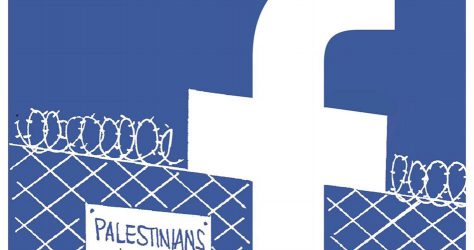
Thus, of late, Israel has begun to demand of social media giants such as Facebook and Twitter that they have input, if not control, over what posts ultimately find their way into the stream of ideas and debate within the Israeli public at large. According to Quds Press, Facebook and Twitter recently deleted thousands of posts, pages and accounts as a result of demands made by the Israeli Ministry of Justice based upon little more than amorphous claims that the information posed a threat to the safety of Israel.
On an even more ominous note, the Knesset has begun to formulate legislation that would require foreign entities to actively monitor social media sites for information deemed to be offensive to Israel. Under the legislation, content based liability could be found for material published by foreign nationals, addressed to foreign nationals and posted on foreign websites thereby reducing the concept of free speech in Israel to one that is cast by the prevailing political winds of the day and little else.
Recently the chief Israeli censor notified dozens of Israeli bloggers and social media activists that any material they might wish to publish in their personal blogs or social media accounts, when dealing with a wide range of what was described as “security” related subject matters, must be vetted. Although provided a generic and ambiguous catalog of those areas to be submitted for clearance, the targets, themselves, were not permitted to disclose the makeup of the list under penalty of law. If history can be counted upon to be the guidepost of what subject matters must be prescreened before publication, in the past the list has included such security “sensitive” subject matters as:
+ Cooperation agreements with foreign militaries;
+ Letters to the editor on military or security matters;
+ Contacts with foreign countries;
+ Anything connected to the nuclear industry;
+ Information about official delegations abroad;
+ Any material which constitutes a “danger” to people’s lives;
+ Immigration policies from “endangered” nations;
+ Use of foreign sources or material that touch upon any of these areas;
+ Detention of those suspected of security offenses;
+ Any information about military industries;
+ Appointments, resignations, firings, rumors about IDF activities or commanders
Finally, in a readily transparent effort to maintain a democratic illusion of a free and uncensored flow of information in the market place of ideas, pursuant to the censorship regulations there are complete prohibitions against leaving any blank spaces or other potential indicators in one’s writing or posts that might suggest or lead one to conclude that material has been deleted.
For those disturbed over this censorship procedure, it must be remembered that we are, after all, talking about a state that recently placed 101st out of 179 countries in the press Freedom index worldwide. Indeed, this appalling placement for the Middle East’s sole democracy is significantly better than Israel has scored in the Freedom index for quite a number of years.
For those wondering just how widespread, indeed systemic, Israel’s censorship procedures are, it is a country with a military censor procedure that has banned, outright, publication of, soon to be, some 2,000 articles and redacted various information from 15,000 others in recent history. That is thousands of articles professional journalists and editors decided were of public interest but which never saw the light of day. Imagine how many more events of public interest went uninvestigated, or articles which were not written, issues debated, or challenges brought to bear for the Israeli body politic to consider because of self-censorship by journalists or editors too tired or principled to seek pre–approval of their body of work by government censors. Stories simply swallowed up and disappeared by an industry of censorship.
Human Rights… Israel Wrongs
Although not yet law, in what can only be described as an all-out onslaught against core democratic rights and values, over the last several days consideration of a bill has begun in the Knesset that would empower the Defense Minister to detain a citizen without trial; to deny one the right to pursue or obtain employment in a field of interest; to limit access to various public places; and “to impose any other order or restriction necessitated by considerations of national security or public safety”.
Earlier in January 2011, the Knesset endorsed a right-wing proposal to investigate some of Israel’s best-known human rights organizations for “delegitimizing” its military. Among others was B’Tselem. The proposed investigations would entail inquiries into the funding of several human rights groups that have a history of criticizing Israeli policies. At the time, the Association for Civil Rights in Israel described the proposal as a “severe blow” to Israeli democracy and critics labeled the policy as “McCarthyist“.
Recently a variation on that bill became law in Israel compelling non-governmental organizations (NGOs) that receive more than half of their funding from foreign state entities to declare so publicly. Ultimately, the legislative criteria were tailored specifically to silence criticism of government policies by some 27 NGO’s… 25 of which, including B’Tselem, are considered to be left-wing… while the other two are non-affiliated. As intended, the bill will have absolutely no impact upon right-wing and pro-settlement NGOs which are funded almost entirely by private donations from powerful Zionists and Zionist entities from outside of Israel.
One can only imagine that upon returning home to the firestorm awaiting him, following his speech before the UN, Hagai El-Ad surely felt what it must have been like to be an activist leftist Jew in the United States during the dark days of McCarthy.
On the other hand, perhaps El-Ad should consider himself very fortunate indeed. On his twitter account, Arab-Palestinian MK Ahmad Tibi mocked MK David Bitan’s call for El-Ad’s de-citizenship saying: “Why stop at removing citizenship? Why not destroy the home of the B’Tselem director-general? Why not bar his entire family from entering the country, remove his land, submit them to administrative detention, and put checkpoints and closures in his neighborhood?”
UN Expert to Investigate Israel’s War on Human Rights Defenders
teleSUR | October 29, 2016
A United Nations expert said on Friday that Israel is attacking human rights organizations and trying to delegitimize their work and that he will launch an investigation into the problem.
Michael Lynk, the United Nations Special Rapporteur on the situation of human rights in the Palestinian territories occupied since 1967, presented his first report to the UN General Assembly calling Israel to end the nearly 50 years of occupation, which he said “is entrenched, is dripping in human rights violations.”
“The fact that the Israeli government threatened to revoke the citizenship of the executive director of B’Tselem is a particularly worrying path for Israel to wind up taking,” Lynk said, referring to the rights groups’ appearance before the Security Council earlier this month.
He praised the recent intervention at the Security Council by the Israeli human rights organization B’Tselem, which urged the UN to end the Israeli occupation in Israel and said he was especially troubled by the Israeli government’s reaction.
In a statement, Israel’s U.N. Ambassador Danny Danon called Lynk’s comments offensive and said it “shows the immense damage done by Israeli organizations that defame us in front of the international community.”
Most of the international community has labeled the Israeli occupation as illegal because the territories in which half a million Israelis live in over 230 settlements, were captured by Israel in a war in 1967 and are hence subject to the Geneva Conventions, which forbid construction on occupied lands.
Featured Video

Piers Corbyn on religion of climate change
or go to
Aletho News Archives – Video-Images
Book Review
How the U.S. Navy Sold the Vietnam War
By Gareth Porter | TruthDig | March 27, 2019
Dr. Tom Dooley, whose best-selling book “Deliver Us From Evil” helped create a favorable climate of opinion for U.S. intervention in South Vietnam, has long been linked to legendary CIA officer Edward G. Lansdale and his black operations in Vietnam between 1954 and 1955. But the real story about Dooley’s influential book, which has finally emerged from more recent scholarly research, is that it was engineered by an official of the U.S. Navy’s Pacific Command, Capt. William Lederer.
Lederer is best known as the co-author, with Eugene Burdick, of the 1958 novel “The Ugly American,” which was turned into a 1963 movie starring Marlon Brando. Far more important, however, is the fact that from 1951 through 1957 Capt. Lederer was on the staff of the commander in chief of the U.S. Pacific Fleet (CINCPAC), Adm. Felix Stump. … continue
Blog Roll
 Aletho News
- The Nasser Hospital attack and Israel’s relentless lies
- Could it be satan? No, Huckabee, just the Americans you work for
- AIPAC and more: Network of pro-Israel influence in US Congress
- Putin aide reveals Moscow’s stance on Europe at peace talks
- Imran Khan warns Pakistani judges he may die in prison
- IOF used Amazon facial recognition to track millions of Palestinians
- More EU Citizens Face Sanctions For Criticizing The Ukraine Proxy War
- In Mexico, the CIA Is Playing a Dangerous Game
- Spain’s Left Protested the Crisis It Legitimized: the General Strike as election stunt
- The power of inflicting oblivion
- If Americans Knew
- An error has occurred; the feed is probably down. Try again later.
- No Tricks Zone
- New Study: Barents Sea Temperatures Were Warmer And Sea Ice Less Extensive In The 1700s Than Today
- German Authorities Start Initiative To Evaluate Public Register For Climate “Disinformation” Spreaders!
- Zonal Asymmetry of Temperature Change in the Antarctic Circumpolar Current
- New Study: The Net Fossil Fuel Contribution To Rising Atmospheric CO2 Has Been Zero For 500 Years
- Germany’s Green Energy Transition Becoming Increasingly Expensive…Another 6 Trillion Euros!
- Sudden Stratospheric Warming, Powerful El Niño Combination May Lead To Extreme Europe Cold, Energy Crisis!
- Two New Studies Find Thwaites Glacier Melt Cannot Be Driven By Human Activity Or A Warming Ocean
- E-Cars Reduce CO2 Emissions By Only 41% Compared To Internal Combustion Engine Vehicles
- Predictions Made By Renowned Climate Professor Over Past Decades Have Been Proven To Be Poor
- New Study Suggests Large Regions Of The Pacific Ocean Have Been Cooling For The Last 80 Years

