Slovenia bans import, export, transit of Israeli arms over war on Gaza
Al Mayadeen | July 31, 2025
Slovenia announced its decision on Thursday to prohibit all weapons trade with “Israel” due to its ongoing war in Gaza, marking what the country described as the first such move by an EU nation.
In a statement, the Slovenian government said it adopted a decision banning the export and transit of military weapons and equipment from or through the Republic of Slovenia to “Israel”, as well as imports from “Israel” into the Republic of Slovenia.
It added that “Slovenia is the first European country” to make such a decision of full ban, noting that it was taking this step unilaterally since the EU had been “unable to adopt concrete measures” as Slovenia had previously urged.
Slovenia previously warned that it would take independent action, in coordination with like-minded countries, should the European Union fail to implement substantial measures within two weeks to tackle the escalating humanitarian catastrophe in the Gaza Strip.
‘They are dying beneath the rubble’
It blamed the countries’ inaction for the “shameful result” as “people in Gaza are dying because humanitarian aid is being systematically obstructed.”
The Central European country described the unfolding dire situation in Gaza, stating, “They are dying beneath the rubble, without access to drinking water, food, or basic medical care. This is a complete denial of humanitarian access and a deliberate prevention of the basic conditions necessary for survival.”
“In such circumstances, it is the duty of every responsible state to act—even if it means taking a step ahead of others,” it asserted.
During his address at the June 28 EU summit in Brussels, Slovenian Prime Minister Robert Golob expressed increasing dissatisfaction with what he characterized as a disjointed European approach, while alleging that some member states were prioritizing their internal political considerations over the protection of Palestinian rights.
On June 6, 2024, the majority of the Slovenian Parliament voted to recognize the state of Palestine as an independent, sovereign state, a move mirroring actions taken by Spain, Ireland, and Norway at the time.
Irish High Court Rejects X’s Challenge to Online Censorship Law
By Cindy Harper | Reclaim The Net | July 31, 2025
The Irish High Court has thrown out a legal challenge by X, dealing a blow to the company’s pushback against Ireland’s new censorship rules for online video-sharing services.
X had taken aim at Coimisiún na Meán, the country’s media watchdog, accusing it of stepping beyond legal limits with its Online Safety Code.
The rules demand that platforms hosting user-generated videos take active steps to shield users from “harmful” material. The company had described the regulator’s actions as “regulatory overreach.”
Mr Justice Conleth Bradley, delivering judgment on Wednesday, found no merit in X’s application for judicial review. The court concluded that the regulator’s code was lawful and that its provisions fell within the scope of both the EU’s Audiovisual Media Services Directive (AVMSD) and Ireland’s 2009 Broadcasting Act.
According to the ruling, the code does not clash with the Digital Services Act and can function in tandem with EU law.
Responding to the outcome, Coimisiún na Meán said it welcomed the decision and intended to examine the ruling closely before offering more detailed comment.
The case comes as X begins rolling out new age verification systems to meet obligations under the Irish code, alongside compliance efforts aimed at satisfying UK and wider EU digital censorship regulations.
The ruling marks a significant moment in the ongoing struggle over who decides the boundaries of online speech and content moderation.
While the court’s backing of the state regulator reinforces governments’ ability to impose strict platform controls, it raises deeper concerns about the growing normalization of surveillance-based compliance measures and centralized authority over digital expression.
In protest over Gaza, Brazil withdraws from International Holocaust Remembrance Alliance
By Eman Abusidu | MEMO | July 30, 2025
The government of President Luiz Inácio Lula da Silva has formally withdrawn Brazil from the International Holocaust Remembrance Alliance (IHRA), intensifying diplomatic tensions with Israel and reigniting global debate over the boundaries between antisemitism and criticism of Israeli policies. The decision, made on 18 July but only confirmed publicly on 24 July by the Israeli Ministry of Foreign Affairs, has drawn both praise and criticism at home and abroad, particularly in the context of Brazil’s recent support for genocide accusations against Israel at the International Court of Justice (ICJ).
Brazil had joined the IHRA in 2021 during the presidency of Jair Bolsonaro, holding observer status within the organisation. According to sources within Brazil’s Ministry of Foreign Affairs (Itamaraty), the accession was “hasty” and lacked sufficient public or institutional debate. These officials cited unmet obligations, such as financial contributions and participation in plenary sessions, as contributing factors in the decision to leave.
Brazil’s withdrawal from the IHRA comes on the heels of its decision to join South Africa in accusing Israel of genocide at the ICJ. Despite the timing, Brazilian officials insist the move is not directly linked to its formal entry into the ICJ lawsuit filed by South Africa against Israel on 23 July. However, the diplomatic and symbolic overlap is hard to ignore.
In its official statement, the Brazilian government condemned Israel’s conduct, citing a lack of accountability and accusing it of violating international norms.
“There is no longer room for moral ambiguity or political omission,” the Itamaraty statement read. “Impunity undermines international legality and compromises the credibility of the multilateral system.”
The government emphasised that its participation in international alliances must reflect Brazil’s constitutional values, particularly the defence of human rights and the self-determination of peoples.
Israel swiftly condemned Brazil’s withdrawal from the IHRA. The Israeli Ministry of Foreign Affairs labeled the move a “profound moral failure” and accused Brazil of abandoning the global consensus on fighting antisemitism. Fernando Lottenberg, the Commissioner for Monitoring and Combating Anti-Semitism at the Organization of American States (OAS), also criticised the decision, calling it a “mistake.”
Domestically, the reaction was polarised. Senator Sergio Moro (União Brasil–PR) described the move as “yet another international embarrassment” by the Lula administration, accusing it of adopting a hostile stance toward the Jewish community.
The Palestinian Arab Federation of Brazil (Fepal) celebrated Brazil’s withdrawal from the IHRA. In a public statement released on July 25, Fepal described the move as a “necessary break” from what it characterised as the misuse of historical memory to justify “crimes against the Palestinian people.”
Fepal further urged the Brazilian government to take what it called a “final civilizing step”: the complete severance of diplomatic relations with Israel. According to the federation, Brazil’s IHRA membership served to “legitimise colonial, racist, and apartheid policies.” Its exit, they argue, symbolises a rejection of efforts to “criminalise anti-Zionism and silence reports of the genocide in Gaza.”
The organisation also criticized Bill 472/2025, authored by Representative Eduardo Pazuello (PL-RJ), which proposes adopting the IHRA’s definition of antisemitism. Fepal called it the “Zionist gag bill” and cited a legal opinion from the National Human Rights Council deeming the bill unconstitutional and a threat to free expression. According to Fepal, the IHRA definition conflates criticism of Israel with hate speech and has been weaponised internationally to suppress students, activists, intellectuals, and even dissenting Jewish voices.
“Rejecting this definition is protecting democracy and political freedom,” the federation wrote.
Brazil’s withdrawal sends a strong signal that historical memory and contemporary international policy are now more intertwined—and more contested—than ever.
That signal became even clearer on Monday (28 July), when the Brazilian government announced a series of retaliatory diplomatic, commercial, and military measures against Israel in response to what it described as “genocide” in Gaza. The announcement came from Foreign Minister Mauro Vieira during a speech at the United Nations headquarters in New York.
Among the steps, Brazil will ban the export of defence equipment to Israel and launch investigations into imports from illegal Israeli settlements in the occupied West Bank. The government framed these actions as part of its commitment to upholding international law and rejecting impunity.
“These are the legal measures that countries can take now,” Vieira said at the conference. “The credibility of the international system depends on this non-selective enforcement. What we need now is political will and effective action to monitor this conference.”
These developments occur against the backdrop of worsening diplomatic tensions between Brazil and Israel, which have been escalating since February 2024, when President Luiz Inácio Lula da Silva compared Israel’s military actions in Gaza to the Holocaust. The controversial remark prompted Israel to declare Lula persona non grata. In May, Brazil recalled its ambassador from Tel Aviv, and the position has remained vacant since. Furthermore, the Brazilian government has refused to approve the appointment of Israel’s proposed ambassador to Brasília, deepening the diplomatic standoff.
REVEALED: Ofcom Pressured Rumble and Reddit to Enforce UK Censorship Laws Beyond Borders
By Rick Findlay | Reclaim The Net | July 29, 2025
Internal communications now made public by the US House Judiciary Committee shed light on a pattern of escalating pressure by the UK’s “communications regulator,” Ofcom, aimed at pushing US-based tech platforms like Rumble and Reddit into adopting strict speech standards, even in apparent disregard for national boundaries and free speech protections.
The emails expose how Ofcom has been leaning on Rumble to align itself with the UK’s Online Safety Act, a censorship law that vastly expands the state’s oversight of online content under the guise of child protection and harm prevention.
Rumble, which has consistently maintained that it is not within the scope of the legislation, told the regulator that the UK is not a “target market” and that the platform does not have a substantial user base in Britain.
Despite this, Ofcom responded with veiled warnings. In one exchange, the agency stated that it would be “monitoring Rumble’s position carefully” and that it may follow up if Rumble’s stance is contradicted by future activity or incidents involving UK users. The implication was clear: remaining outside the regulatory net may not be tolerated for long.
Ofcom also stated it would “strongly encourage Rumble to take the steps required by the Act to protect UK users of internet services from content that is illegal in the UK or potentially harmful to UK children.”
Yet Rumble operates from within the United States, where citizens actually have free speech rights under the First Amendment, raising serious concerns about the extraterritorial application of UK law to platforms governed by different legal frameworks.
Further emails show that Ofcom believes “a supervisory relationship” between the agency and online services is “the most effective way to review and assess compliance,” again suggesting that companies should voluntarily submit to oversight, or risk the alternative: legal coercion. “We retain the right to legally request information,” the regulator warned.
Reddit also appears to be in the crosshairs. In a separate line of correspondence, Ofcom indicated that it expects a “supervision plan” to be in place for the platform, with particular emphasis on how Reddit handles so-called “hate” content, a term that remains dangerously elastic and open to political manipulation.
This shows how regulators are leveraging ambiguous language and compliance pressure to steer speech policies on platforms that are not even based in the UK.
Ofcom’s behavior shows a bureaucratic intent to expand its influence far beyond Britain’s borders, effectively demanding that foreign platforms enforce UK legal standards on content that may not be illegal elsewhere.
Reform UK Vows to Repeal New Online Censorship Law
By Cindy Harper | Reclaim The Net | July 29, 2025
The political party Reform UK has declared its intent to repeal the Online Safety Act, warning that the law grants excessive powers to regulators and poses a serious threat to free speech.
The party claims the legislation, which recently came into force, is presented as a safety measure but in reality undermines civil liberties.
Although the event was announced as a discussion on crime, Reform leader Nigel Farage and his adviser Zia Yusuf devoted most of their Westminster press conference to attacking the legislation.
Their concerns centered on the way the act targets social media platforms and expands the role of the media regulator, Ofcom.
Yusuf, a former party chair who now leads Reform’s efforts on local council reform, said the law was a vast overreach. He warned that it hands regulators the power to pressure platforms into silencing views that challenge the government. According to Yusuf, even companies known for tolerating broad speech would be forced to restrict political discourse.
“So much of the act is massive overreach and plunges this country into a borderline dystopian state,” Yusuf said.
He argued that the legislation uses safety as a cover to expand state control. “Any student of history will know that the way countries slip into this sort of authoritarian regime is through legislation that cloaks tyranny inside the warm fuzz of safety and security and hopes nobody reads the small print.”
Reform UK promised to eliminate the act entirely if it came to power.
Yusuf dismissed tools like age verification as ineffective, claiming children could simply use VPNs to bypass restrictions.
Farage also admitted the party doesn’t have all the answers yet, but insisted they are working with leading technology experts. “Can I stand here and say that we have a perfect answer for you right now? No,” he said. “Can I say that as a party, we have more access to some of the best tech brains, not just in the country, but in the world? That I can say to you.”
Labour leader Keir Starmer responded to questions about the act while in Scotland ahead of a meeting with President Donald Trump, and flat out lied in his denial that the government was censoring people.
TikTok hires ex-Israeli military associate to censor anti-Zionist content
Press TV – July 29, 2025
TikTok has appointed a new “hate speech” manager with long-standing ties to the Israeli regime amid mounting pressure to curb anti-Israel content on the social media platform.
Erica Mindel, who previously served as an instructor in Israel’s military, has been tasked with shaping TikTok’s stance on what the company refers to as “anti-Semitism,” according to TikTok officials.
Mindel will “develop and drive the company’s positions on hate speech,” seek to “influence legislative and regulatory frameworks,” and “analyze hate speech trends,” with a particular focus on “antisemitic content,” according to an official job description shared by TikTok.
Her appointment to the post comes as the platform faces growing scrutiny over a surge in posts critical of the Israeli regime, particularly since its genocidal war on the Gaza Strip. This has sparked renewed concerns over the censorship of pro-Palestinian content on TikTok.
According to a 2023 survey cited by the Jewish Federations of North America, users who spend more than 30 minutes a day on TikTok are 17 percent more likely to hold critical views of Israel.
That gap reportedly widened after Israel launched its devastating war on the Gaza Strip on October 7, 2023, prompting calls for a national ban over content that according to US lawmakers fuels “hatred” against the Zionist regime.
American Academy of Pediatrics Goes To War Against Religious Exemptions, Parental Rights
By Jefferey Jaxen | July 29, 2025
The ability to practice ones sincere religious beliefs is woven into the very fabric of America and its founding ethos yet the American Academy of Pediatrics (AAP), a membership organization focusing on pediatricians, just declared war on this bedrock right.
Besides being morally objectionable, the concept is just plain unpopular in modern America. By 2023 only six U.S. states officially denied parents religious exemptions to vaccination for their children via laws that were enacted in the face of massive opposition from the public.
Since then, two of the states (Mississippi and West Virginia) have seen their religious denial laws overturned by court wins from the Informed Consent Action Network’s legal team in which judges deemed such laws to violate the First Amendment.
Meanwhile, public pushback saw Hawaii as the latest state to defeat a bill that would have removed its religious exemption option.
AAP’s new policy paper has stepped in with an attempt to stop the momentum of religious freedom in the medical and public health spaces – an idea whose time has come.
“The AAP recommends that all states, territories, and the District of Columbia eliminate all nonmedical exemptions from immunizations as a condition of school attendance.
With a flowery mission to ‘attain optimal physical, mental, and social health and well-being for all infants, children, adolescents and young adults,’ AAP fashions itself more as a continuous pipeline for industry products through overreaching, anti-science edicts.
The AAP recently floated a lawsuit against HHS Secretary Kennedy for his recommendation to remove pregnant women and healthy children from the Covid vaccine schedule.
Lets take a look at some of AAP’s greatest hits over the last 5 years.
In 2019, Washington D.C.’s B23-0171 (later named D.C. Law 23-193) sought to add a new section into the existing regulations that would allow a minor child to consent to receive a vaccine. The bill, and its hearing, signaled a new high-water mark towards the removal of parents from some of their children’s most important medical decisions – and AAP was there.
During the public hearing before it was signed into law, pediatrician Dr. Helene Felman, representing Washington D.C.’s chapter of the American Academy of Pediatrics (AAP), stated:
“As a pediatrician, I like the legislation as it stands because it offers the opportunity to capture those young adults who can make informed decisions at technically any age.”
Any age…
An ICAN legal victory halting D.C.’s overreach saw a D.C. district judge issue a preliminary injunction against the act in favor of parents who brought suit. The parents filed complaints and were able to demonstrate that the act likely violates federal law.
Next up AAP was on the wrong side of the push, against clear scientific evidence, to medically transition children. As Norway, Sweden, Denmark, U.K. and other countries officially backed off the practice. A 2025 review by HHS of the evidence and best practices found significant risks associated with gender dysphoria treatments.
One of the authors of the paper stated simply:
“… No reliable research indicates that these treatments are beneficial to minors’ mental health.”
In 2023, AAP reaffirmed its stance in a policy paper arguing for youth to have open access to gender-affirming health care fully funded by health insurance.
And finally, the AAP worked to influence public policy by advocating for new injectable weight loss drugs for children.
“Children struggling with obesity should be evaluated and treated early and aggressively, including with medications for kids as young as 12 and surgery for those as young as 13, according to new guidelines released Monday.”
The newly discovered harms of such drugs are unfolding on a weekly basis but that didn’t seem to matter to the AAP.
As an industry mouthpiece who see children as a profit margin and pipeline demographic for drugs and shots, AAP is unmatched in its corporate ‘advocacy.’
The organization appears to have chosen another losing battle siding against religious freedom in the United States of America and with it a further loss of relevancy for the organization.
Settlers kill Palestinian in Masafer Yatta
International Solidarity Movement – Palestine | July 28, 2025
 Israeli settlers murdered activist and dear friend Awda Hathaleen and critically injured Ahmad Hathaleen today during a settler invasion on the village of Umm al-Khair. Another member of the community, Ibrahim Al-Faqir also died as a result of a severe stroke during the attack.
The deadly attack took place after illegal Israeli settlers, including internationally sanctioned settler Yinon Levi, invaded the Bedouin village, located in the Masafer Yatta region. They were using an excavator in an attempt to destroy Palestinian infrastructure, including the communities’ water pipes. When residents gathered to stop the demolition, the excavator intentionally hit Ahmad in the head, causing serious injury and loss of consciousness.
Eyewitnesses said Levi then shot Awda in the chest causing critical injuries. He was evacuated to the Soroka Medical Center, where he was pronounce dead on arrival. A relative of Awda confirmed his death to the International Solidarity Movement.
Israeli forces later arrived at the scene, arresting 7 Palestinians and 2 internationals at the request of Levi.
Levi is under international sactions for crimes against Palestinian communities. In January of this year, Donald Trump reversed US sanctions on Levi and other settlers. Israel has never brought criminal proceedings against him despite years of violence and terrorizing Palesitian communties.
Awda, 31 years old, was a teaching staff member at al-Saray’a Secondary School in the Bedouin desert of Masafer Yatta. He was a father of three children, the eldest of whom is 6 years old.
On behalf of his community, Awda was relentless in his pursuit to tell the world of Israel’s campaign of ethnic cleansing and violence against the people of Umm al-Khair, including the confiscation of land, choking of water supplies and poisoning of trees and livestock.
For many years the ISM has stood in solidarity with the Bedouin community in Masafer Yatta, who live under constant threat of ethnic cleansing. Umm al-Khair is one of the many villages in Area C under total Israeli control, meaning almost every structure has a demolition order. Meanwhile Israel provides the neighbouring illegal settlement of Carmel with running water from pipes built over Umm al-Khair land. An ISM spokesperson said: “Awda was an incredibly kind friend and couragous member of his community. He was forced to live his short life under the constant threat of violence and displacement, yet he never gave up hope for justice and a free Palestine.”
In the hours before he was killed, Awda sent an urgent call to action, “If they cut the pipe the community here will literally be without a drop of water”. The international community must now take up Awda’s call to take action to protect the village of Umm al-Khair and the residents of the wider Masafer Yatta region against Israel’s escalating campaign of ethnic cleansing. Settlers generally walk free, and continue to harass Palestinian communities. Sanctions against individual violent settlers are not enough. The international community must demand accountability.
UK Introduces Online Speech Monitoring Police

By Cam Wakefield | Reclaim The Net | July 28, 2025
If you’re in the UK and you’ve ever dared to type a mildly spicy opinion about immigration into the vast and idiotic circus that is social media, you might now be under surveillance by a shiny new government outfit with a name so Orwellian it sounds like it was cooked up during a slow afternoon in North Korea’s Ministry of Truth.
The UK has officially launched a National Internet Intelligence Investigations team, a title that manages to be both comically vague and terrifyingly specific.
This is the stuff that authors of dystopian novels have been warning people about for decades.
The Frankenstein of a task force, stitched together from officers across the country and headquartered in Westminster’s National Police Coordination Centre, has been given the noble mission of snooping through your posts, likes, and digital mutterings for any whiff of “anti-migrant sentiment.”
The government has decided that free thought is a public safety risk.
Gone are the days when bobbies on the beat focussed on burglaries, stabbings, or the occasional drunken scuffle. Now, they’ve been upgraded, or rather, downloaded, into an era where your keyboard is the weapon and your opinion the crime.
The Home Office insists this is all very necessary. According to a leaked letter, the Telegraph obtained, from Dame Diana Johnson, Policing Minister and part-time press-release poet, the squad will focus on “exploiting internet intelligence” to help local police forces anticipate unrest.
“Exploit.” Not “monitor,” not “observe,” but exploit.
It’s all part of a grand, techno-utopian fantasy where public order is maintained not by policing actual crimes, but by interpreting emojis and out-of-context Facebook posts.
Supporters of this initiative are quick to remind us that tensions are rising over immigration. Protests have flared up from Norwich to Bournemouth, with citizens wondering why their local hotels now resemble temporary refugee camps paid for with their tax funds.
Many Brits are asking uncomfortable questions, questions that the current government would apparently prefer whispered, if not deleted altogether.
Which brings us neatly to the absurd theatre of this whole operation: the idea that public discontent can be managed not by addressing policy failures, but by stalking Instagram stories and dispatching undercover agents to Nextdoor forums.
Essex Police actually sent officers to the home of journalist Allison Pearson over something she posted online. Meanwhile, a mother named Lucy Connolly received a prison sentence longer than some violent offenders after sharing a message deemed offensive following the Southport attacks.
Naturally, the political opposition is smelling blood. Shadow Home Secretary Chris Philp has weighed in.
“Two-tier Keir can’t police the streets,” he fumed, “so he’s trying to police opinions instead.”
He’s not wrong. This isn’t law enforcement; it’s law enforcement theatre, a stage production in which your tweets are the script and the cops are the critics.
Nigel Farage, Reform Party leader, ever the populist thundercloud, put it in even starker terms: “This is the beginning of the state controlling free speech. It is sinister, dangerous, and must be fought.”
Let’s rewind for a moment. During the pandemic, the government rolled out “disinformation teams” that quietly monitored online content and flagged anything that strayed too far from the Approved Messaging Bible. They assured people it was for their safety. They always do.
Now, in what appears to be the spiritual sequel to that damp squib of a policy, we’re being served a reheated version, garnished with civil unrest panic and a dash of woke paranoia. And it arrives just as the Online Safety Act lumbers into force, a lumbering beast of a bill that seems hellbent on turning the UK into a digital kindergarten, where only soft voices and pre-approved opinions are allowed.
The Free Speech Union has already sounded the alarm after users discovered protest videos involving asylum hotels were mysteriously unavailable in the UK. Not removed by the platform. Not censored by other users. Just: poof, gone, as if reality itself had been deemed problematic.
Where does this all end? Are we one government memo away from officers arresting people for sarcastic memes? Will sarcasm itself soon be listed as a hate crime?
Here’s the uncomfortable truth: a state that polices speech will eventually police thought. And a government that fears its people’s opinions is a government that knows it has failed them.
Yemeni army announces ‘new phase’ of attacks on Israel-linked ships
Press TV – July 27, 2025
The Yemeni Armed Forces have announced plans to escalate military operations against Israel in response to the ongoing humanitarian crisis in Gaza.
In a statement issued on Sunday evening, the Yemeni Armed Forces called on nations around the world to exert pressure on the Israeli regime to cease its aggression and lift the blockade on Gaza to prevent further escalation.
They emphasized that their decision to intensify attacks on Israel stems from their moral and humanitarian obligation to address the suffering of the Palestinian people.
The Yemeni Armed Forces highlighted the rapid developments in occupied Palestine, particularly in the Gaza Strip, where the ongoing conflict has resulted in the deaths of thousands of Palestinians amid a prolonged siege and military assault.
They said that in light of the continued, horrific massacres occurring in our contemporary history, Yemen finds itself facing a profound religious, moral, and humanitarian responsibility toward the oppressed people who are subjected daily to relentless killing and destruction by air, land, and sea bombardments.
The severe blockade has led to starvation and thirst in steadfast and proud Gaza, which is unacceptable to any human being, especially Arabs and Muslims, the statement read.
Consequently, the Yemeni Armed Forces said they have decided to escalate military support operations and implement a fourth phase of a naval blockade against Israel. This phase includes targeting all ships belonging to any company that engages with Israeli ports, regardless of the company’s nationality, in locations accessible to the Yemeni armed forces.
The Yemeni Armed Forces have issued a warning to all companies to cease dealings with Israeli ports immediately upon the announcement of this statement. Failure to comply will result in their vessels being targeted anywhere within reach of Yemeni missiles and drones.
The Armed Forces reiterated their call for countries to intervene to prevent this escalation, urging them to pressure Israel to halt its aggression and lift the blockade on the Gaza Strip. “There is no free person on this earth who can accept what is happening,” they stated.
The actions of the Yemeni Armed Forces reflect a moral and humanitarian commitment to stand against the injustice faced by the Palestinian people. They declared that all military operations would cease immediately upon the cessation of aggression against Gaza and the lifting of the blockade, the statement said.
The Yemeni army condemned the persistent aggression against Gaza, attributing it to what they described as the shameful silence of the Arab, Islamic, and international communities.
Since the onset of the conflict in Gaza, the Yemeni Armed Forces have launched numerous attacks on vessels bound for Israel and have targeted locations deep within the occupied Palestinian territories using missiles and drones.
Zionist spies innovate AI sexual blackmail tech

By Kit Klarenberg | Al Mayadeen | July 27, 2025
On July 19th, Ynet announced Israeli artificial intelligence startup Decart “has unveiled a groundbreaking real-time video transformation technology, setting a new benchmark in the fast-evolving field of generative media”, following “months of anticipation and extensive fundraising”. Dubbed Mirage, it “allows continuous transformation of live or pre-recorded video content without interruption, maintaining high quality and impressive stability throughout”. The obvious suspicion arises that the tech’s true purpose is to concoct convincing, fabricated kompromat on targets, with no risk of Zionist intelligence being publicly exposed.
Such an interpretation isn’t immediately obvious from the description of Mirage offered by Ynet. The outlet states the tech “transforms the very definition of video – from a static, pre-recorded format to a living, flexible, and interactive medium”. This reportedly opens up “new business models for content creators, brands, and platforms”. For example, “broadcasters and advertisers” could “generate multiple versions of a single piece of content during a live transmission…[tailoring] content in real-time to different audience segments.”
Yet, buried in the Ynet report is reference to how Decart was forged in 2023 by Dean Leitersdorf and Moshe Shalev, while they were serving in the Zionist Occupation Forces’ fearsome Unit 8200. The shadowy spying cell conducts clandestine operations, signals intelligence collection, code decryption, counterintelligence, cyberwarfare, and surveillance. Many of its veterans have established major tech companies, frequently operating in Silicon Valley. Decart generated enormous early interest among investors, raising $53 million just two months after official launch, and securing a $500 million valuation.
Among those investors is Zeev Ventures, founded by Israeli-American Oren Zeev. Its other investments include Israeli firm Riverside, an audio and video recording service. Its staff is riddled with ZOF veterans. Moreover, Decart has thoroughly impressed Technion – the Israel Institute of Technology. The pair have announced a joint AI research center, “to strengthen academic research, knowledge development, and technological innovation”. Under its auspices, the Institute’s elite honours program will be renamed the “Technion-Decart Honors Program”.
Technion has an extensive and deplorable history of direct complicity in the Zionist entity’s erasure of the Palestinian people. The Institute maintains formal partnerships with multiple Israeli weapons manufacturers and security and intelligence firms, including infamous Elbit Systems. Its assorted faculties have helped innovate numerous monstrous resources, such as remote control capabilities for the Caterpillar D9 armored bulldozer, used by Tel Aviv to demolish Palestinian homes. Benefits such as academic credits and scholarships are specifically awarded to Institute students based on their ZOF service.
Markedly, numerous Technion alumni – among them individuals who previously served in Unit 8200 – have gone on to work for Toka, which has patented technology capable of locating security cameras and webcams, hacking into them, then altering their live feeds without trace. Toka was founded by former Israeli premier Ehud Barak – a close associate of Jeffrey Epstein. Given ample indications Epstein was collating sexual blackmail material on powerful figures for intelligence agencies, comments made by Mirage cofounder Dean Leitersdorf to Ynet take on a chilling character:
“Mirage marks the dawn of a new era in video. Content is no longer fixed or closed – it’s alive, adaptive and created in real time in collaboration with the user. Anyone can become a creator and give visual form to their imagination. This opens up endless possibilities for creation, communication and a new relationship between people and technology.”
‘Video Platforms’
A January Ynet report sheds considerable further light on the significance of Unit 8200 to Decart’s founding, and its chiefs’ intelligence backgrounds. Leitersdorf, described as the company’s “central figure” who “grew up immersed in the world of high-tech and business”, hails from “Israel’s old-money aristocracy”. His close relatives are all major players in the entity’s finance and ‘defence’ sectors. Moreover, Leitersdorf completed his bachelor’s, master’s, and doctoral degrees at Technion, in just five-and-a-half years, all while serving in the ZOF. He explained:
“I’d work from 9 am to 7 pm in Unit 8200, and then squeeze in a few hours of studying before bed.”
Moshe Shalev, a 14-year Unit 8200 veteran, told Ynet that towards the end of his ZOF service he “wanted to explore the world of research”, and crossed paths with Leitersdorf. When they started chatting, Shalev realised he’d “found someone who could tell me what was possible and what wasn’t”, and “knew all the technologies of 8200”. He described the experience as “mind-blowing”, and they began meeting regularly, discussing how to apply their experiences of working in the Unit to the commercial sphere.
So it was in late 2024, Decart released a “cute demo” dubbed Oasis, demonstrating the company’s AI capabilities. The app lets users explore an ever-changing virtual environment, which is influenced in real-time based on their keystrokes and mouse movement, purely via artificial intelligence. Leitersdorf claims, “we thought a few people might play with it… [but] we were stunned by how fast it blew up”. Oasis went viral across multiple platforms, exceeding one million users in just three days.
While Mirage was unmentioned in the January Ynet report, Leitersdorf talked a big game of Decart’s ambitions to create a suite of products that would attract up to a billion users, which “doesn’t solve a single problem but solves thousands of problems”. Still, “the ability to turn imagination into video” loomed large in the company’s stated vision, and “to that end”, the firm is “establishing one of the most advanced AI labs in the world, recruiting the best minds Israeli tech has to offer”:
“Decart has a bold and ambitious goal: to reinvent AI from the ground up and become the technological backbone for anyone in the world who wishes to use it.”
In July, Ynet suggested Decart’s real-time video editing software would be of enormous utility on “social platforms”, allowing users to use Mirage “to change their appearance in real time, create clips or livestream with custom visual effects – all without relying on professional editing tools”. The technology was said to support image generation “at 20 frames per second with live-broadcast-quality resolution”, and “future updates are expected to support Full HD and even 4K, the standard for most video platforms and televisions.”
The obvious interest of such tech to intelligence agencies was unmentioned. This was despite Mirage evidently being spawned directly from the founders’ experience toiling in Unit 8200. The enormous mainstream hype elicited by the tool, launched by hitherto unknown figures, and vast sums of money pumped into the fledgling company instantly upon its emergence, may also be illuminating. For every dollar invested in a startup by the CIA’s little-known venture capital wing In-Q-Tel, the private sector injects $18.
‘Sex Trafficking’
Intelligence services the world over are notorious for using sexual blackmail to force targets into doing their bidding. Moreover, agencies, including the CIA have extensive histories of forging sex tapes and compromising photos of “enemy” leaders to discredit them. Witnesses and victims alike have claimed Jeffrey Epstein’s numerous lavish residences – purchased with uncertain wealth – were equipped with hidden cameras and microphones, used to record sexual assaults and rapes by countless politicians and high-profile figures he counted as close friends.
Following Epstein’s arrest in July 2019 for sex trafficking of minors, veteran reporter on intelligence affairs Eric Margolis came forward to recount his attendance at a grand lunch convened in the shadowy financier’s New York mansion during the late 1990s, at which all attendees “sang the praises of Israel”. Immediately upon arrival, a butler invited him to enjoy “an intimate massage” courtesy of a “pretty young girl”. The offer “seemed so out of place and weird to me that I swiftly declined”, Margolis reported:
“More important than indelicacy, as an old observer of intelligence affairs, to me this offer reeked of ye old honey trap, a tactic to ensnare and blackmail people… A discreet room with massage table, lubricants and, no doubt, cameras stood ready off the main lobby.”
Margolis subsequently told mainstream media outlets he didn’t “believe for a moment” Epstein committed suicide, and it was “more likely he was killed”, as “he was a man who knew too much” – “the old pirate line of ‘dead men tell no tales’ certainly applied to Epstein”. Today, controversy around Epstein’s death endures. Polls indicate just 16% of US citizens believe he took his own life in prison, with almost 90% supporting disclosure of all information related to Epstein’s prosecution.
Donald Trump’s reneging on his promises to unseal classified documents related to Epstein’s crimes has prompted mass public backlash, even among the President’s most fervent supporters. Meanwhile, US lawmakers are engaged in a bipartisan push to compel Washington to release all federally-gathered evidence identifying those “involved in the sex trafficking that Epstein led.” Despite operating with impunity for decades, and being protected from legal repercussions as he “belonged to intelligence”, Epstein was eventually caught, raising the risk of his targets and paymasters being publicly exposed.
The real-time, AI-powered video creation and editing technology honed by Toka and Decart removes the troublesome human elements inherent in old-fashioned intelligence agency “honey traps”. We are thus left to ponder whether these firms are being enthusiastically promoted because they “solve the problem” of sexual blackmail requiring real-life individuals to oversee such operations, and targets to take the bait. The “possibilities” of such technologies to transform users’ “imagination” into realistic video content are, after all, avowedly “endless”.
France’s recognition of Palestine risks helping Israel — Indonesia should rethink its applause
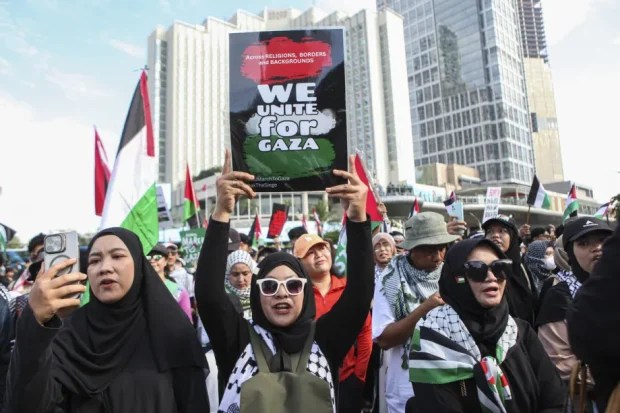
Activists at a solidarity march for the Palestinians in Jakarta, Indonesia, on June 15, 2025. [Agoes Rudianto – Anadolu Agency]
By Dr. Muhammad Zulfikar Rakhmat | MEMO | July 27, 2025
This week, Indonesia welcomed France’s decision to recognise the State of Palestine as a “positive step” toward peace. On its surface, this diplomatic endorsement may appear aligned with Indonesia’s long-standing support for Palestinian self-determination. But behind France’s gesture lies a deeper, more dangerous calculus—one that does not just ignore the reality on the ground, but actively entrenches it.
What France proposes is not justice. It is not freedom. It is an updated version of the same illusion that has kept Palestinians caged and dispossessed for decades: the so-called two-state solution.
In Jakarta’s official statement, the French move was praised for supporting a “sovereign and independent” Palestinian state based on 1967 borders, with East Jerusalem as its capital. But President Emmanuel Macron made clear what kind of state he envisions: a demilitarized Palestine that fully recognizes Israel. No mention of dismantling settlements, no restitution for occupied land, no accountability for war crimes in Gaza. Only submission, in return for a diplomatic label.
This is not a step toward peace—it’s a framework for permanent subjugation.
France’s position not only lacks balance, it weaponizes it. Macron calls for the “demilitarization of Hamas,” the rebuilding of Gaza, and regional stability—but with no demands for Israeli disarmament, no consequences for its mass killing of civilians, no guarantees of actual sovereignty for Palestinians. Instead, Palestinians are asked to disavow resistance, while the occupying power faces no requirement to end its occupation.
Indonesia, by praising this deal without reservation, is endorsing a framework that surrenders Palestinian rights under the language of diplomacy. In doing so, it becomes complicit in a process that allows Israel to continue its long project of expansion and erasure.
Because that is exactly what we are witnessing: not just war, but erasure.
Israel’s leaders have shed any pretense of restraint. Finance Minister Bezalel Smotrich has declared that Gaza should be “completely flattened.” Members of the Knesset and senior military figures have called to “wipe out” the territory. Starvation, siege, and bombing are not incidental—they are deliberate. The goal is not merely to punish, but to depopulate.
And this genocidal ambition is not new. It is part of a larger ideological blueprint long championed by elements of Israel’s far-right: the “Greater Israel” project. This vision seeks to claim not just the full expanse of historic Palestine—from the Jordan River to the Mediterranean Sea—but in some renditions, territory beyond it. It is a dream of exclusive ethnic control over a vast swath of the region. Palestinians, in this model, are not citizens or neighbors—they are obstacles to be removed.
This is the context in which France’s recognition must be understood: not as a bold shift in policy, but as a stabilizing gesture for an apartheid regime facing global criticism. And by embracing it, Indonesia—whether intentionally or not—is lending moral cover to that regime.
It is tempting, in the face of so much suffering, to welcome any sign of progress. But symbolic recognition without structural change only reinforces the status quo. A demilitarized Palestine, hemmed in by Israeli checkpoints, with no right of return and no means of defense, is not a state—it’s an open-air prison with a flag.
What is needed now is not more applause for diplomatic theater, but a refusal to accept false solutions. The two-state framework, as currently constructed, is not a path to justice. It is a political tool that enables colonization while pretending to end it.
Indonesia has long stood as a voice for the oppressed. It must not dilute that legacy by celebrating a plan that leaves Palestinians with a flag and no freedom. Instead of encouraging other nations to follow France’s lead, Indonesia should be demanding accountability: for the destruction of Gaza, for the daily violence in the West Bank, and for the decades of displacement.
This is not a time for symbolic victories. It is a time for moral clarity.
France’s vision, and Indonesia’s uncritical support of it, may win applause in diplomatic circles. But on the ground, in Gaza and the West Bank, it enables a project whose end goal is not peace, but erasure. If Indonesia truly believes in justice for Palestine, it must reject this illusion—and instead, insist on the one thing Palestinians have never been offered: freedom on their own terms.
Featured Video

Death Spikes & Rising Cancer In Our Youth Explained
or go to
Aletho News Archives – Video-Images
From the Archives
Politicians lie
By Mazin Qumsiyeh | Popular Resistance | August 18, 2013
There is no way to say this truth nicely: Politicians lie. That includes Japanese, American, Egyptian, Israeli, and Palestinian politicians! Is there something more common sense than that? Yet, so many citizens around the world believe their own politicians or wistfully acknowledge lies but think it is part of the job needed to run things. They believe even when politicians contradict themselves blatantly. This phenomenon is rather remarkable. It is a dissonance and disconnect from reality that many seem oblivious to. It is very dangerous because it can lead to accepting rationales for going to war. These can be deadly wars that lead to millions of lives lost as happened in what was called World War 1 and WW2. Even when incredible and declassified evidence abound, politicians continue to lie and old mythologies refuse to die. Here are just a few of the countless lies told to us over the past few decades… continue
Blog Roll
 Aletho News
- China pushes back against US on Cuba, Iran
- Ukrainian Soldiers, Potential Mercenaries: Have Gun, Will Travel!
- Burnham’s UN debut… A masterclass in British disinformation
- Iran flights continue despite US aviation sanctions
- Global Tipping Points Lead the World Into a State of Entropy
- The day-after at the White House: USA and Xi Jinping
- The Geopolitical Balance in the Red Sea: The UAE Being Displaced by New Players
- Iraqi resistance group vows to stage airport sit-ins over Iran aerial blockade
- Turkish parliament to review Saudi-Pakistan defense pact next month
- DEATH SPIKES & RISING CANCER IN OUR YOUTH EXPLAINED
- If Americans Knew
- Deconstructing Netanyahu’s pants-on-fire UN rant – Daily Update
- Trump betrayed voters with his campaign lies and prioritized a foreign country once he took office
- Netanyahu calls Israel’s war in Gaza ‘opposite of genocide’ in UN speech to near-empty hall
- Settler Kidnappings: Torture, Sexual Abuse and Terrorisation of Palestinian Abductees as Israel Deepens Annexation of West Bank
- Gaza winter nears as 162,000 tents become unusable, raising fears of humanitarian crisis
- Netanyahu says, “It’s the opposite of genocide”; UN says Gaza economy is world’s ‘most severe crisis on record’ – Daily Update
- Israel’s US-Backed Assault on Gaza Has Created the ‘World’s Most Severe Economic Crisis on Record’: UN
- ‘Protecting U.S. Citizens’… From Israel
- ‘This is where I live now, the back of a truck’: a day in the life of a grandmother in Gaza
- In UN Speech, Iran’s President Displays Pictures of Children Killed by US, Brings Attention to Israel’s Nuclear Arsenal
- No Tricks Zone
- New Study: Earth And Venus Surface Warmth Largely Explained By Convection And Lapse Rate, Not CO2 Or Radiation
- 2025 Nature Paper Claiming Worsening Global Drought Gets RETRACTED …Heavily Flawed
- New Study: ‘Global Drought Shows No Detectable Recent Acceleration Under Climate Warming’
- Economic Masterminds: German Socialists Suggest Taxing Productivity Gains Stemming From Using AI
- The South China Sea Has Not Been Cooperating With The Climate Change Narrative
- Energy Crisis: Germany Enters Heating Season With Historically Low Gas Reserve Fill Levels
- New Study: The Antarctic Ice Sheet Gained Mass From 2020-2024 Due To Staggering Snow And Ice Accumulation
- Study: Ocean Heating Rates From Thousands Of Years Ago ‘Dwarf’ Modern Ocean Heating Rates
- Climate Extremists Target, Attack Large-Scale Power Grid Infrastructure In Germany!
- New Study: Antarctic Ice Melt Has Contributed Less Than 1 Centimeter To Sea Level Rise In The Last 30 Years

