Historic: Peru Jails 10 Military Men for Brutal State Massacre

Claudia Pomacongo holds a card detailing the case of her husband, who was murdered in the Accomarca massacre. | Photo: AFP
teleSUR – September 1, 2016
Among the military officials sentenced for the 1985 rape massacre of civilians was the Peruvian general nicknamed the “Butcher of the Andes.”
A Peruvian court Thursday sentenced 10 former military officials and soldiers to between 10 and 25 years in prison for the 1985 massacre of 69 civilians, mostly women and children, in the town of Accomarca, in one of the most iconic cases from the South American country’s so-called “war on terror.”
Three high-ranking military men, then-Lieutenants Telmo Hurtado and Juan Rivera Rondon and then-general Wilfredo Mori, were sentenced to 23, 24, and 25 years in jail as the masterminds behind the massacre. Judges singled out Hurtado — infamously known as the “Butcher of the Andes” — and Rivera Rondon as those principally responsible for carrying out the violence as the leaders of the patrols, while Mori was held responsible by giving the orders as the highest in the chain of the command.
Two other accused received 25 years in jail each, and another five were sentenced to 10 years each, all for carrying out the violent tragedy. Six were acquitted, including then-general Jose Williams Zapata. Sentences were not handed down for 11 others accused in the case, because one died before the trial was completed and 10 others are fugitives.
People gathered outside the National Criminal Court in Lima to await the results of the sentencing trial, which was delayed more than eight hours. Families of the victims and other Accomarca community members prepared food to share with those waiting to hear the announcement outside the court.
The outcome of the six-year-old case establishes a precedent for prosecuting similar crimes against humanity at the hands of the state in the guise of cracking down on left-wing insurgency in the 1980s and 1990s.
The Accomarca massacre trial is also groundbreaking because it is the only such case in Peru—aside from prosecutions of members of the military death squad known as Grupo Colina—that brings charges against the military’s entire chain of high command, according to local media.
On Aug. 14, 1985, at the height of the government’s conflict with the notorious Shining Path rebel army, the Peruvian military massacred at least 69 unarmed victims—30 children, 27 women, and 12 men—in Accomarca, located in Peru’s southern department of Ayacucho. Troops raped the women, then herded all the men, women, and children into houses before launching hand grenades at them. They finally burned the houses to kill every last victim.
The National Human Rights Coordinator and the Washington Office on Latin American had stressed in a joint statement leading up the the hearing the importance of the trial and the “need for a sentence that imparts real justice for one of the most heinous crimes and reminders of the internal armed conflict” in Peru from 1980 to 2000.
“Peruvian justice has an enormous debt with the victims in the Accomarca case,” said Jorge Bracamonte, executive secretary of Peru’s National Human Rights Coordinator, in a statement, stressing that the massacre has gone unpunished for too long. “We not only hope for an exemplary sentence, but we also hope that the court will order the collective return of the bodies of the Accomarca victims so that the families can bury their dead and close their grief.”
Human rights organizations have called for comprehensive reparations for victims as part of the process of seeking justice for acts of state terror.
“Justice not only seeks the punishment of those responsible, it also seeks to dignify the victims who, for so many years, have been sidelined and forgotten,” said WOLA’s Jo-Marie Burt in a statement.
In the sentencing hearing, judges also ordered reparations of US$44,000 be paid to the family of each of the victims of Accomarca.
The massacre took place under the state guise of Peru’s counterinsurgency strategy aimed at wiping out left-wing armed groups that challenged the state. But the Peruvian army killed scores of unarmed rural civilians accused of collaborating with guerrilla groups as part of the bloody conflict that claimed a total of 70,000 lives from 1980 to 2000.
Human rights groups have pointed to the Accomarca case as representative of the reign of state terror inflicted on poor and Indigenous communities.
“It has been shown that the Accomarca massacre was not an excess of the counterinsurgency fight nor an overreaction of soldiers overwhelmed by war,” said Burt, “but the result of a state policy of combating subversion using indiscriminate violence against the civilian population.”
Coca-Cola Accused of Funding Colombian Death Squad
teleSUR – September 1, 2016
U.S.-based Coca-Cola company along with more than 50 other companies were accused by Colombian courts of financing terrorism for their ties to the now-disbanded paramilitary organization, United Self-Defense Forces of Colombia, a fact trade union leaders have been denouncing for decades.
The cases against the companies will be heard in a transitional justice tribunal after the peace deal with the Revolutionary Armed Forces of Colombia and the government is signed.
Coca-Cola was accused of hiring hitmen from the AUC between 1990 and 2002 to kill at least 10 labor union leaders who were trying to organize Coca-Cola’s plants. U.K. oil company BP has also be taken to court for its funding of AUC, along with kidnapping and human rights abuses.
Other companies suspected of financing terrorism, commonly referred to as the “para-economy,” include Colombia’s largest beverage company Postobon, cement company Cementos Argos, state oil company Ecopetrol and banana distributor Chiquita Brands International.
In June, families of victims killed by paramilitary groups opened a federal lawsuit against Chiquita in the U.S. for supporting the AUC. The company was estimated to have made at least 100 payments to the group worth US$1.7 million between 1997 and 2004.
The right-wing AUC coalition, deemed a terrorist organization by the Colombian government, disbanded in 2006. The paramilitary group was responsible for a number of massacres, human rights abuses, kidnappings and extortions that resulted in the displacement of thousands of Colombians.
Some politicians and authorities have been sentenced in relation to links with the AUC, the majority of businesses involved have not been punished for their illegal financial activities.
Investigations and punishment of businesses involved with paramilitary groups have commonly stuttered over whether payments were voluntary or not and if companies received any benefits in return.
RELATED:
Brazilian Coca-Cola Manufacturer Accused of Slave Labor
Israel shuts down Palestinian radio station amid escalation in press violations
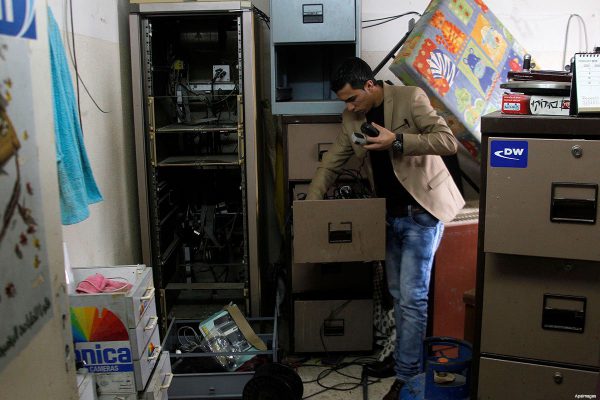
A Palestinian journalist checks damages after Israeli forces raided offices of local Palestinian Al-Khalil radio overnight in Hebron on November 21, 2015
Ma’an – August 31, 2016
HEBRON – Israeli forces raided and ransacked a Palestinian radio station early Wednesday morning in Dura City in the southern occupied West Bank district of Hebron, detained five of the station’s employees, and ordered it closed for three months, amid a documented escalation of violations against media freedoms by Israeli forces in the occupied Palestinian territory.
Locals told Ma’an that Israeli forces raided al-Sanabel radio station, destroyed its contents, and confiscated transmission and broadcast equipment.
Israeli forces left a closure order on the door of the radio station.
Locals added that Israeli forces detained head of the radio station Ahmad al-Darawish, as well as radio employees Muhammad al-Sus, Nidal Amro, Muntaser Nassar, and Hamed al-Nammura after raiding their homes.
Spokesperson for the Israeli army Avichay Adraee said in a statement in Arabic that Israeli forces, police, and civil administration authorities closed al-Sanabel upon a military order that claimed that the radio station broadcast programs inciting against Israel.
Adraee added that the five detainees were transferred for interrogation.
News of the closure came after Palestinian press freedoms watchdog MADA released a report on Saturday saying Israeli violations against media freedoms in the occupied Palestinian territory increased by 17 percent during the first half of 2016.
MADA General Director Moussa Rimawi said in the semi-annual report that while the total number of violations by both Israeli and Palestinian authorities declined from 224 cases in the first half of 2015 to 198 in the first half of this year — a rate of 12 percent — Israeli violations continued to climb, as Palestinian authorities committed 41 percent less violations during the same period.
A total of 133 violations committed by Israel were recorded during the period.
The most common types of violations committed by Israel were physical attacks, arrests, confiscation of equipment, prevention of coverage, and detentions.
The report highlighted that Israeli authorities in March closed two media institutions — Falastin al-Yawm and TransMedia Production Company — after ransacking and confiscated equipment from their offices.
Meanwhile, some 23 journalists and media workers were detained between January and June of 2016.
The report also noted an escalation of the Israeli practice of detaining Palestinians for social media activity, with Israeli authorities alleging that a wave of unrest that swept the occupied Palestinian territory last October was encouraged largely by “incitement.”
Palestinians have instead pointed chiefly to the frustration and despair brought on by Israel’s nearly 50-year military occupation of the Palestinian territory and the absence of a political horizon.
MADA said in the report that they were “gravely concerned regarding all systematic attacks and violence against journalists and media workers by the Israeli occupation, and urges state members to do their utmost to prevent violence against journalists, to ensure accountability, and bring to justice perpetrators of crimes against media freedoms.”
Israeli army continue to flout regulations on child detainees
MEMO | August 29, 2016
Following numerous complaints and legal action concerning pain and injury caused by the use of single plastic hand ties by the Israeli military on detainees, including children, the office of the Military Advocate General announced the introduction of new procedures for the use of restraints in 2010. The nature of the complaints prior to the introduction of the new procedures relating to the use of plastic ties included swelling, ties cutting into wrists and severe pain.
Under the new procedures introduced in 2010, hands should be tied from the front, unless security considerations require tying from behind. Three plastic ties should be used; one around each wrist and one connecting the two; there should be the space of a finger between the ties and the wrist; and the restraints should avoid causing suffering as much as possible. The officer in charge is responsible for ensuring compliance.
According to international juvenile justice standards restraints should only be used if the child poses an imminent threat to him or herself, or to others and all other means have been exhausted. Restraints may be used as a precaution against escape during transfer but only for as long as is strictly necessary and must not cause unnecessary pain or suffering. According to UNICEF and a UK report, single plastic hand ties should be prohibited in all circumstances, as should blindfolds.
Approximately three years after the introduction of the new procedures, UNICEF reported that “the ill-treatment of children who come in contact with the military detention system appears to be widespread, systematic and institutionalized throughout the process”. In reaching this conclusion UNICEF found that children continued to be painfully hand tied and blindfolded on a routine basis contrary to international standards and Israeli military regulations.
In May 2013, the military authorities responded to UNICEF’s findings by issuing a letter to the heads of all Brigades, Divisions, Police and Military Police operating in the West Bank reminding all units of existing standard operating procedures and policies in relation to the arrest of minors. Existing standard operating procedures stipulate that: hand-tying should be done at the discretion of the head of forces and always with three plastic ties in accordance with the 2010 regulations.
According to evidence collected by Military Court watch (MCW) in 2016, 90 percent of children continue to be restrained upon arrest, generally with plastic hand ties, and 85 percent report being blindfolded. In situations where plastic hand ties are used, many children continue to report experiencing pain. In 67 percent of cases where restraints are used, the military regulations for their use continue to be disregarded.
Although UNICEF and the UK reports also recommended that children should never be restrained while attending court except in extreme and unusual circumstances, children continue to be shackled by the ankles during their appearances in the military courts. … Full article
If Israel wants to be treated like a normal state, it should act like one

By Professor Kamel Hawwash | MEMO | August 29, 2016
Israel is not a normal state, but has craved to be treated as such ever since its creation in historic Palestine, against the will of the indigenous Palestinian people, in 1948. It sometimes claims its legitimacy from the UN partition plan, the terms of which bear no resemblance to the area currently controlled by the state; at other times Israelis refer to Biblical connections, which they claim to extend over the whole of Palestine. Exceptionally, proponents of Israel claim that only the followers of Judaism and no other faith are entitled to a state or homeland in the land of their choosing, regardless of who inhabited that land when they claimed it.
To this day, Israel remains a state without declared borders; it is the illegal occupier of another people’s land, whose rights under occupation it has flouted for the past 49 years. Israel claims to be a Western-style “democratic” state but only certain inhabitants of the land it has controlled since 1967 – basically all of historic Palestine – have a right to vote in its elections. It claims to want peace based on a two-state solution but has been implementing policies to ensure that there will only ever be one state, Israel, the borders of which are those of historic Palestine, and where people are defined by a sophisticated system of identity cards, driving cars with differently coloured number plates. It operates different laws for different people; civil law for Israelis but military law for Palestinians in the occupied territories. The law applied to Israeli citizens discriminates between Jews and non-Jews. This discrimination extends to land purchase, which gives Jews rights over non-Jews.
So Israel is clearly not a normal state, because a normal state does not build homes and towns for one ethnic group, to the exclusion of others. Israel does this by building illegally Jewish-only settlements on occupied Palestinian land. Further, in some towns within its nominal border, it allows “admissions committees” to decide whether residents will allow other citizens to live there; it is usually Jewish citizens who make these decisions and non-Jewish citizens who are excluded.
A normal state does not regularly demolish the homes of the people it occupies, or evict their occupants so that it can move its ethnically-chosen citizens into them. Israel does this.
A normal state does not besiege an occupied area for over ten years. Israel has done this with Gaza, the most densely populated place on earth. It controls the entry and exit of goods and people.
A normal state does not then attack the people living under siege repeatedly with the most destructive weapons on earth, short of nuclear warheads. Israel does.
A normal state does not repeatedly attack neighbouring states with impunity. Israel has done this to Iraq, Syria and Lebanon.
A normal state does not exist in one continent but play its sport in another. Israel does; it is in Asia but plays football in Europe.
A normal state does not violate agreements it signs, as Israel has done with the Oslo agreement and repeated ceasefire agreements with the Palestinians in Gaza.
A normal state does not carry out extrajudicial killings against the people living under its military occupation. Again, Israel does this with impunity.
A normal state does not treat children in the territory it occupies with the cruelty that Israel displays; it abducts children in the night and takes them before military courts in shackles.
The list of abnormal acts that Israel carries out is endless and developing on an almost daily basis. It is therefore hypocritical of it and its leaders to claim that it should be treated as a normal state.
This expectation was tested recently in incidents at the Rio Olympic Games involving the Lebanese team and an Egyptian judo player. The games had not even started when what turned out to be a misguided decision by the organisers became a major incident as teams were making their way to the Maracanã Stadium for the opening ceremony. In this now well-documented incident the Lebanese team refused to share a bus with their Israeli counterparts. Israel saw this as discrimination. “How could they let something like this happen on the eve of the Olympic opening ceremony?” complained one Israeli official. “Isn’t this contrary to what the Olympics stand for? … I’m in shock from the incident.” Those not familiar with the Arab-Israeli conflict would see no problem in any two teams from either end of the globe, let alone neighbours, sharing a bus.
However, this almost paled into insignificance compared to the now famous shunning by Egyptian Judoka Islam El-Shehabi of the extended hand of his Israeli opponent Or Sasson, after his defeat in the qualifying rounds of the 100 kg competition. El-Shehabi himself, who had come under pressure at home not to compete, said: “I have no problem with Jewish people or any other religions or different beliefs but for personal reasons you can’t ask me to shake the hand of anyone from this state, especially in front of the world.” Although the Egyptian’s appearance for the bout was seen as progress by many, this was not the official line. The International Olympic Committee (IOC) said El-Shehabi’s action was “contrary to the rules of fair play” and against the spirit of friendship exemplified by the games. He was reprimanded by the IOC and sent home by his team.
However, a normal state would not withhold the Olympic kit of the representatives of the people it occupies and ban their officials from travel, as Israel did. Furthermore, it would not restrict the movement of its sporting teams both within the occupied territories and to the outside world. Israel does this all the time. Its soldiers recently fired tear gas into a stadium where a Palestinian football match was taking place.
Away from the sporting arena, Israel claims that it faces discrimination in many ways, particularly from UN bodies. It insists that the UN Human Rights Council singles it out for special and disproportionate treatment. However, which other state violates so many aspects of international law and international humanitarian law, and has done so since its creation? The answer is simple: not one.
Israel is currently facing a campaign by the Boycott, Divestment and Sanctions (BDS) movement, which was called for by Palestinian civil society to place pressure on the state to behave in a “normal” way by adhering to international law. The BDS campaign was launched because of the failure of the international community to pressure Israel to conform to “normal” behaviour. Its call for an end to the occupation, equal rights for all citizens and the right of return for Palestinian refugees is peaceful, legal and highly moral. However, Israel has once again cried wolf and claims that BDS is not only discriminatory but also “anti-Semitic” because it targets “the only Jewish state” in the world. The fact is that there would be no need for a BDS movement if Israel behaved like a “normal” state.
Hence, if Israel really does want to be treated like a normal state it must first behave like one. It is currently so far away from such a designation that it merits being seen as the pariah, the rogue state that it is. Its leaders choose this status by their decisions to act in the ways that it does, not its critics. Israel should begin the process of change or risk further isolation and condemnation as even its most loyal allies begin to see what an embarrassment it is to them.
US Okay With Surgical Strikes on Yemen Hospitals
By William Boardman | Reader Supported News | August 24, 2016
Nuremberg: “a war of aggression … is the supreme international crime”
Waging genocidal war on a defenseless country was never so baldly and honestly put on any agenda for talks among US secretary of state John Kerry, representatives of Saudi Arabia’s dictatorship, and their mutual allies, even though they are all engaged in an endless genocidal war on Yemen. This war is a war of aggression, started by Saudi Arabia in March 2015, with crucial US blessing, participation, personnel, and ordnance. The US has been a willing, guilty partner and enabler in 18 months of military atrocities in a one-sided war that everyone involved knew – or should have known – was a pure war crime based on a paranoid delusion.
American participation in this war of aggression was a war declared by press release from the National Security Council on March 25, 2015, another example of the imperial presidency’s ability to act by fiat without fear of serious objection from the public, the media, or even Congress:
President Obama has authorized the provision of logistical and intelligence support to GCC [Gulf Cooperation Council]-led military operations. [emphasis added]
The fundamental crime in Yemen is waging a war of aggression, which encompasses all the subsequent war crimes including bombing civilians, using cluster bombs, bombing hospitals, bombing food supplies, and trying to starve a population to submission or death. Yemen, with a population of 26 million people, was the poorest country in the region even before it was attacked. What the US supports and sanctions against Yemen makes any US complaint about Russian actions in Crimea sound like howling hypocrisy.
For all that the Saudis frame their war on Yemen as a defense against a threat from Iran, there has never been any credible evidence of any credible threat to Saudi Arabia from any element of the miniscule Iranian presence in Yemen. Yemen is fighting a civil war, a new version of the same old civil war Yemenis have been fighting for decades, both before and after Yemen was two separate countries. The Iran “threat” is the paranoid delusion supposedly justifying a merciless war on a civil population already beset by a four-sided civil war. There is no way that those who decided to wage this war of aggression could not have known the reality in Yemen if they had wanted to know it. Presumably they knew it all full well and chose a war of aggression anyway, recklessly, perhaps even thoughtlessly, but criminally all the same.
The Saudi goal was always to get rid of a longstanding threat on its southwestern border, where the tribal land of the Houthis lay both in Yemen and Saudi Arabia. When the long-oppressed Houthis, a Shia minority in a Sunni world, drove out the Sunni government of Yemen in 2015, the Saudis, without saying in so many words, decided on a course of action that could lead to a final solution. And everyone knew, at the time, and no one objected, according to this account by the highly reliable Andrew Cockburn on Democracy NOW! (whose piece in Harper’s Magazine for September 2016, ironically titled “Acceptable Losses,” provides an excellent exegesis of the war on Yemen, but with a more elegiac tone):
I was told, very early on in the war, Deputy Secretary of State Tony Blinken went to Riyadh to ask the—this is two weeks—yeah, it was two weeks into the war [mid-April 2015], when they had already been bombing away, using the U.S. bombs, U.S.-supplied bombs, using U.S. weapons, killing already dozens, if not certainly, you know, hundreds of civilians, destroying factories. And finally, Blinken turns up in Riyadh and asks, “By the way, what are you trying to accomplish here?” And the Saudis effectively said, or at least the Americans understood them to say, “Well, we basically want to wipe out the Houthis.” Well, they termed it as “end all Iranian influence in Yemen.” So, the Americans—Blinken was a bit shocked by that, so I’m told, and said, “Well, you know, that’s going a bit far. But it’s—you should certainly stop the Houthis taking over the country.” And that, effectively, gave the Saudis carte blanche to continue this kind of mindless carpet bombing….
By 2015, American hands were already bloody with the US drone assassination program that had killed not only innocent civilians, but American citizens, without a trace of due process of law. In effect, already enmeshed in its own nexus of war crimes in Yemen, the US green-lighted the Saudi-led war of aggression that would make American crimes pale by comparison. As American policy over the years would have it, American weapons have been dispersed all over Yemen since 2006.
Kerry to consult on terrorism, but not US or Saudi terrorism
Terror bombing, an example of which is Saudi pilots flying American planes dropping American bombs on defenseless Yemeni civilian targets, is probably not the terrorism Secretary Kerry wants to discuss – ever – with the Saudis and their allies, never mind other weapons suppliers like France and the United Kingdom. As the official State Department notice put it in deadly opaque prose:
Secretary Kerry will travel to Jeddah, Saudi Arabia, for a series of meetings with senior Saudi leaders, his counterparts from the Gulf Cooperation Council, the United Kingdom, and the United Nations Special Envoy for Yemen. His discussion will focus on the ongoing conflict in Yemen and efforts to restore peace and stability….
Those “efforts to restore peace and stability” notably include the destruction of two schools, another hospital, and a potato chip factory, along with the associated men, women, and children, especially at the schools. Perhaps the latest great military “victory” achieved by the war criminals known as the Saudi-led coalition is to drive the world’s leading medical crisis-zone organization out of Yemen by targeting its hospitals over and over and over and over since March 2015. Of course, America the Exceptional does not stand for this betrayal of human decency, and our presidential candidates of all parties have railed ceaselessly against this indiscriminate murder of patients, their families, their doctors and other medical personnel, forcing the White House to take action to bring to an end 17 months of aggressive war and other war crimes and crimes against humanity – no, wait, that’s not happening, is it?
Actually, if any presidential candidate of any political party has expressed the slightest objection to the Saudi-coalition’s genocidal war on Yemen, such evidence is so hard to come by that it may as well not exist. (In August 2015, Jill Stein of the Green Party mentioned in passing that the Saudis “are committing war crimes right now in Yemen,” and more recently she called for an end to US funding for Saudi Arabia and Israel because of their violations of human rights laws. She does not tend to make a point of the US support for a war of aggression in Yemen, but she’s better than any other candidate on Yemen.) At this point, a year and a half into our shared war of aggression, every candidate is complicit in this horrendous, unjustified war promoted and pursued with smug disdain for anything like peace by our peace prize winning President Obama. The blood drips from all their hands, their feet, their tongues and eyelashes, but most of all from every pore of our Nobel Laureate in the White House. (As the book Double Down reported in 2012: “Turns out I’m really good at killing people,” Obama said quietly, “Didn’t know that was gonna be a strong suit of mine.”)
With the US at war, Congress has nothing to say about any of it
The US is at war with Yemen, in support of the Saudi-led coalition that launched its undeclared war of aggression on March 26, 2015. US war-making includes, but is not limited to: US intelligence services providing intelligence to the aggressor nations; US military personnel participating in daily target planning and attack assessment; US tanker aircraft re-fueling aggressor nation aircraft bombing Yemen (46,500 acknowledged sorties in the first 11 months of war); US drones targeting and attacking under US control; US military contractors servicing the Saudi F-15s that bomb Yemen; US personnel training Saudi military; US military personnel operating in Yemen; and the US Navy reinforcing the Saudi blockade intent on starving Yemen into submission.
The US Congress has never debated, never authorized US participation in a war of aggression against Yemen. The US president has never asked Congress for such authorization of a war of aggression against Yemen. Neither house of Congress has acted on any bill that directly addresses the war of aggression against Yemen. More than a year after the war started, two Democratic members of Congress (joined by two Republicans) introduced identical bills intended to respond to the war. California congressman Ted Lieu (joined by Florida congressman Ted Yoho) and Connecticut senator Christopher Murphy (joined by Kentucky senator Rand Paul) asked their colleagues to address the horrors of the war (briefly enumerated in the bill), not by ending the war, but only by temporarily limiting US arms sales to Saudi Arabia. That’s it. They did not mention US participation in the war. Both their bills were referred to committee. At the time there was a spotty ceasefire in Yemen while peace talks proceeded in Kuwait (the talks were suspended in early August, leading to the Saudi escalation currently killing more civilians).
Incredibly, this non-response response to war crimes in Yemen has gotten Rep. Lieu some recent positive press coverage, in The Intercept of August 22 and elsewhere, even though his bill is designed to have no immediate impact on the carnage. Rep. Lieu is a colonel in the US Air Force Reserve. When he was on active duty he taught the law of war to other Air Force officers. His interview rhetoric, like most of his public action, is soft-edged even though he knows perfectly well his country is committing war crimes. He almost said as much in an August 15 statement objecting to the Saudi attack on a school in Haydan, Yemen, that killed 10 children:
The indiscriminate civilian killings by Saudi Arabia look like war crimes to me. In this case, children as young as 8 were killed by Saudi Arabian air strikes. By assisting Saudi Arabia, the United States is aiding and abetting what appears to be war crimes in Yemen. The Administration must stop enabling this madness now. [emphasis in original]
Rep. Lieu and others have also objected to the State Department’s certification of another arms sale to Saudi Arabia: this one is $1.15 billion for 153 tanks, hundreds of machine guns, and other war materiel. This is in addition to the record $100 billion in arms sales to the Saudis already made by the Obama administration. The latest arms deal suggested to Rep. Lieu “that the administration is, at best, callously indifferent to the mass amount of civilians dying as a result of the Saudi-led coalition’s bombing.” He did not openly consider whether 153 Abrams Main Battle Tanks and other weaponry might open the way for the air war of aggression to be matched by an escalation of the ground war of aggression as well. Twenty of those new US tanks are specifically designated as replacements for tanks lost in combat, some of them in Yemen. On the other hand, the official State Department notice of the Abrams Tank sale assures Congress: “The proposed sale of this equipment and support will not alter the basic military balance in the region.” That’s hardly reassuring in a region where wars of attrition and military quagmires are killing not only thousands of Yemenis, but Palestinians, Israelis, Lebanese, Syrians, Saudis, Turks, Kurds, Iraqis, Afghans, and god knows who else, more often than not with Made-in-USA weapons and munitions.
The proposed US tank sale has drawn the attention of several NGOs (non-governmental organizations) looking to wash American hands of the war on Yemen by blocking the sale, or at least having a debate about it in Congress. Human Rights Watch (HRW) wrote a letter to Secretary Kerry August 19, with temperate language of concern about several countries, including Yemen. HRW asked Secretary Kerry “to emphasize the potential consequences if Saudi Arabia fails to improve its conduct.” But it did not suggest what those consequences might be in light of the reality that the US has coordinated and condones all Saudi conduct to date. CODEPINK is supporting a petition to support the Congressional letter that urges President Obama to postpone the US tank sale to the Saudis.
Even The New York Times is expressing something shy of anguish over “American complicity” and “carnage” and targets that are not “legitimate” under international law as it supports efforts to block the tank sale in Congress. The Times doesn’t mention that this is the same Congress that in June – supporting a White House request – refused to block the sale of cluster bombs to Saudi Arabia for fear of “stigmatizing” cluster bombs. That’s a reflection of the American version of reality, since cluster bombs are already stigmatized by most countries of the world and using them on civilians, as US-Saudi forces do in Yemen, is widely understood to be a war crime. The solution, according to the Times :
Congress should put the arms sales on hold and President Obama should quietly inform Riyadh that the United States will withdraw crucial assistance if the Saudis do not stop targeting civilians and agree to negotiate peace.
That can’t happen in the real world, where the president and the Saudis all know they are war criminals and are, like Macbeth, so steeped in blood “that should I wade no more,/Returning were as tedious as go o’er.”
There is no reason to expect any good to come to Yemen until a whole lot more Americans face the reality of their country’s support for a genocidal war of aggression. When enough Americans recognize that, then they will have to do a lot more about it than stop selling tanks to the aggressors. Until then the US-sponsored atrocity of ethnic cleansing in a poverty-stricken country that threatens no one will continue unabated.
Israeli commander threatens to ‘disable all youth in the camp’ as 2 Palestinians shot in Duheisha
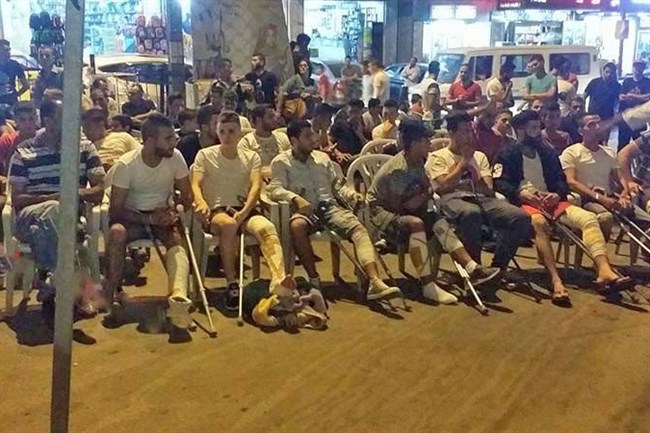
A file photo of a group of Palestinian youth after being treated for gunshot injuries by Israeli forces (Photo: BADIL)
Ma’an – August 26, 2016
BETHLEHEM – Two Palestinian youths were injured with live fire during clashes with Israeli soldiers in al-Duheisha refugee camp in southern Bethlehem early Friday morning, as reports emerged of an Israeli army commander making repeated threats in recent weeks to make “all youth in the camp disabled.”
Local sources said that two youths were shot and injured in the legs during clashes that erupted after Israeli forces raided the camp in Friday’s predawn hours.
Sources added that Israeli soldiers raided and searched the house of the incarcerated Palestinian Muhammad al-Seifi, detaining his mother and sister by locking them inside their home to pressure Muhammad’s younger brother Naba to turn himself into Israeli authorities.
Israeli forces also blew off the door of the Ibdaa Cultural Center near the entrance to the camp and occupied the rooftop of the building, from where Israeli snipers fired live ammunition and tear-gas canisters at local youth.
Violent clashes in al-Duheisha are common and break out nearly every time Israeli army forces enter the camp, which is located in Area A and should be under full Palestinian Authority control according to the Oslo agreements.
In a response to a request for comment, an Israeli army spokesperson told Ma’an that the Israeli army was not involved, and claimed Israeli border police were behind it, despite the area being located outside of police jurisdiction in Area A of the occupied West Bank.
When contacted by Ma’an, Israeli police spokesperson Micky Rosenfeld said he was not aware of the raid, saying it “made no sense” that police would be involved, and confirmed that al-Duheisha fell under the Israeli army’s jurisdiction in terms of raids. When contacted a second time, an Israeli army spokesperson insisted again that the army was not behind the raid and could not say who had been.
‘I will make all the youth of the camp disabled’
The clashes come in the wake of reports documented by BADIL, the Resource Center for Palestinian Residency and Refugee Rights, of an Israeli army commander making repeated threats during and after raids, and during interrogations, to disable all Palestinian youth in al-Duheisha.
The commander is reportedly responsible for the al-Duheisha area, and known to locals as “Captain Nidal.”
Local youth in al-Duheisha told BADIL that Captain Nidal has made statements such as: “I will make all the youth of the camp disabled,” “I will have all of you walking with crutches and in wheelchairs,” “I will make half of you disabled, and let the other half push the wheelchairs,” and “I will make all of you stand in line at the ATM waiting for your disability subsidies and assistance.”
One of the injured youth told BADIL that Captain Nidal told him to tell his friends that “Nidal will make all of you disabled.”
According to BADIL, which is based in Bethlehem, 30 Palestinians have been shot with live ammunition in the camp since the beginning of the year, the majority in their legs and knees.
They added that al-Duheisha had been raided at least three times by Israeli forces between the end of July and mid-August, during which time 18 Palestinian youth between 14 and 27 years old were shot in their legs — eight of which shot directly in the knee and several more in both legs — causing both permanent and temporary disabilities.
An Israeli army spokesperson could not immediately be reached for comment on the reports of the threats made by the commander.
“These threats indicate that these actions are not accidental or isolated incidents, but rather result from a systematic Israeli military policy aimed at suppressing resistance, terrorizing Palestinian youth, and permanently injuring them and/or causing significant damage to their physical and mental well-being,” BADIL said in their statement.
The reported threats come amid what BADIL called an intensification of the “systematic targeting” of Palestinian youth in the occupied Palestinian territory — particularly in refugee camps — since the beginning of 2016.
“This targeting has taken the form of injuries and arbitrary killings by the use of live ammunition by the Israeli army in the context of arrest campaigns, military raids, and random wide searches which usually trigger clashes,” the statement said.
BADIL’s statement also highlight a recent Israeli military incursion in the Hebron-area refugee camp al-Fawwar that lasted some 20-hours, during which an unarmed Palestinian teen was shot dead and dozens others were hospitalized.
“These cases of intentional wounding, when added to the comparable actions happening in refugee camps such as Aida, al-Arroub, Qalandia, Amari, and the West Bank at large, prove that these incidents amount to a systematic policy and an implementation of Captain Nidal’s threats.”
“These willful and grave breaches of international law trigger the obligations of third party states and other mandated agencies to put an end to this climate of impunity under which Israeli forces and its officials operate.”
BADIL’s collection of testimonies came as the latest report amid years of well documented cases of abuse and mistreatment of Palestinian children by Israeli forces in the occupied territory, including in East Jerusalem, which is under Israeli police jurisdiction.
On ceasefire anniversary, UN agencies urge end to Gaza’s ‘de-development spiral’
MEMO | August 26, 2016
UN agencies have urged an end to what they describe as the Gaza Strip’s “de-development spiral”, in a report marking the two-year anniversary of the ceasefire that ended ‘Operation Protective Edge’.
In a statement released Friday, 16 heads of United Nations agencies in Palestine call for the “uninterrupted and predictable flow of material and increased funding to address humanitarian needs and boost economic prospects for Gaza’s 1.9 million residents.”
In the report, UN agencies “document collective progress made in the last two years, as well as some of the remaining challenges in the recovery and reconstruction effort.” To date, “half of the homes which suffered partial damages and a third of destroyed homes have been rebuilt.”
Robert Piper, the UN Coordinator for Humanitarian Aid and Development Activities, warned that “repairing the damages from the 51-day hostilities cannot be our only measure of success, given that humanitarian and socio-economic indicators were already so dire before 2014.”
Piper added: “We must reverse Gaza’s de-development trajectory and address the needs of a population that has gone through three rounds of conflict, nine years of an Israeli blockade and the consequences of the Palestinian internal divide.”
The senior UN official emphasised that “addressing economic recovery requires much greater financial investments and serious policy changes, including a lifting of [Israeli-imposed] restrictions on both imports and exports.”
On October 2014, donors pledged US$ 3.5 billion to support Gaza. According to the World Bank, only an estimated 40 percent had been disbursed by April this year.
Bilal Kayed’s strike ends with agreement for his freedom; continued mobilization critical for fellow prisoners

Samidoun Palestinian Prisoner Solidarity Network – August 26, 2016
In a press conference held on Thursday morning, 25 August, Sahar Francis, the executive director of Addameer, confirmed that Bilal Kayed had ended his hunger strike after 71 days following the conclusion of an agreement with Israeli occupation prison administration that he will be released in December 2016, with no renewal of administrative detention.
In the press conference, joined by Kayed’s brother Mahmoud Kayed, as well as Prisoners’ Affairs Committee chair Issa Qaraqe and Osama al-Saadi of the Joint List, Francis noted that occupation security officials had earlier stated that they demanded Kayed be deported to Jordan for four years and noted their intention of keeping him in administrative detention for years. Kayed is held in the intensive care unit at Barzilai hospital and was moved there on 19 August as he refused to consume sugar or vitamin B1. He suffers from blurred vision, difficulty breathing and severe pain throughout his body. He will receive treatment until his condition improves considerably and he is returned to health.
Samidoun Palestinian Prisoner Solidarity Network salutes Bilal Kayed for his victory and achievement in the defense of Palestinian rights from the constant attempts of the Israeli occupation to expand, enlarge and intensify the scope of the imprisonment of Palestinian leaders and struggles. We extend our warmest congratulations to Bilal, his struggling family who were at the forefront of his support campaign, his lawyers and advocates with Addameer Prisoner Support and Human Rights Association and his fellow Palestinian prisoners who engaged in a series of collective hunger strikes within Israeli prisons. Kayed’s fellow prisoners of the Popular Front for the Liberation of Palestine were subject to isolation, the targeting of leaders Ahmad Sa’adat, Ahed Abu Ghoulmeh, Wael Jaghoub and Kamil Abu Hanish among others, excessive daily fines, harassment and assaults, and denial of family and legal visits. We salute the Palestinian people throughout occupied Palestine and in exile, including in the refugee camps of Lebanon, who repeatedly took the streets and mobilized in support of Kayed’s battle for freedom, directly confronting the occupation as well as the international institutions and states that refused to stand for justice for Palestinian prisoners.
Furthermore, Samidoun salutes all of the international activists, organizations and movements that came together to stand beside Bilal Kayed and beside the Palestinian people in this battle of freedom. From the outstanding efforts of the Irish movement for freedom for Bilal Kayed, to the ongoing and constant actions in New York City and Berlin, to the honorary citizenship granted to Bilal in Naples, to the organizers of the Black liberation movement who expressed their solidarity, to the organizers in the United States, Canada, Mexico, Venezuela, Brazil, Ecuador, Turkey, the UK, Ireland, Scotland, France, Belgium, the Netherlands, Germany, Switzerland, Italy, Spain, Greece, Portugal, Iceland, the Czech Republic, Finland, Austria, Norway, Sweden, Denmark, South Africa, Jordan, Lebanon, Tunisia, Algeria, Morocco, Bahrain and elsewhere who have mobilized in support of Bilal Kayed, international mobilization has escalated to new heights in support of the Palestinian prisoners in this struggle.
We urge the importance of continued mobilization and action in support of Palestinian prisoners, particularly the current hunger strikers, Mahmoud al-Balboul, on strike since 1 July; Mohammed al-Balboul, his brother, on strike since 4 July; and Ayed al-Herama and Malik al-Qadi, on strike since 14 July, all protesting administrative detention without charge or trial – and for continued mobilization in support of the action of all of the Palestinian prisoners, struggling for freedom from Israeli imprisonment, and for freedom and liberation for the Palestinian people throughout Palestine.
Argentine General and 28 Others Sentenced to Life for Crimes Against Humanity
teleSUR | August 25, 2016
An Argentine court sentenced former General Luciano Benjamin Menendez to life in prison Thursday for crimes against humanity committed at secret Dirty War-era detention centers in the late 1970s, making a landmark step in the struggle for justice for human rights abuses during one of the darkest chapters in the South American country’s history.
Menendez stood trial with 42 other defendants who will also be sentenced today after a nearly four year so-called “mega-trial” involving events related to over 700 victims.
The general was in charge of two clandestine jails, known as La Perla and La Ribera, in the province of Cordoba where torture, assassinations, and other human rights abuses were carried out during the 1976-1983 military dictatorship. He was charged with over 600 cases of torture, over 300 murders and forced disappearances, unlawful detentions, and other crimes against humanity committed at the two detention centers between 1976 and 1978.
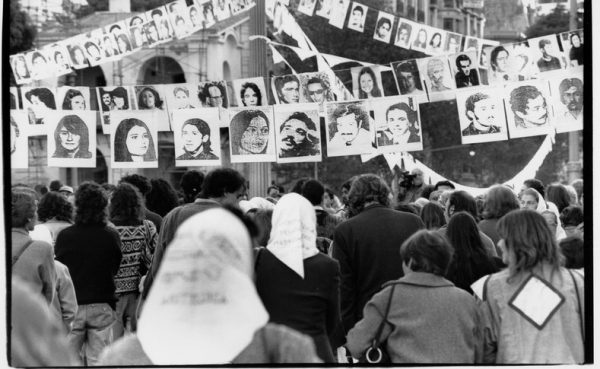
Thousands of people, including the families of victims and social movements such as the iconic Mothers and Grandmothers of the Plaza de Mayo, filled the streets outside of the federal court in the province of Cordoba to await the announcement under the banner of remembering the 30,000 disappeared during the dictatorship.
Former military intelligence agent Arnoldo Jose Lopez, former military man Ernesto Guillermo Barreiro, and former military captain Hector Pedro Vergez were also found to be among the principle masterminds responsible for the abuses and sentenced to life in jail for charges of hundreds of aggravated homicides, among other crimes.
Ricardo Alberto Lardone and Oreste Valentin Padovan, both considered among the special command at La Perla responsible for carrying out torture and kidnappings, were also sentenced to life in jail.
A total of 28 of the 43 accused were handed life sentences, nine were sentenced to up to 21 years, and six were acquitted.
The case was also historic for marking the first time a court in Cordoba tried charges of illegal apprension of babies during the dictatorship, a military practice of stealing babies from political dissidents, detainees, and victims of forced disappearance and handing them over the families linked to the military regime. The Grandmothers of the Plaza de Mayo has struggled for nearly 40 years to identify their missing grandchildren and reunite them with their families.
The La Perla case dealt with forced disappearance of Silvina Monica Parodi de Orozco, who was over six months pregnant when she and her husband Daniel Francisco Orozco were kidnapped. Silvina’s mother Sonia Torres is still searching for her missing grandchild, whose whereabouts has never been known.
The landmark trial brought together 21 separate cases of crimes against humanity at the hands of the Argentine military, police, and paramilitary forces immediately leading up to and in the years after the 1976 military coup against left-wing President Isabel Peron. The case heard some 600 witnesses provide testimony over the course of 350 hearings related to the 716 victims. Less than half, 340, of the victims survived. Most of the others, 311, were disappeared with no documentation of what happened to them, and the rest were killed.
La Perla was the second most important detention center in the country in the early years of the military dictatorship. Between 2,500 and 3,000 victims of state terrorism were detained at the secret military prison between 1976 and 1977, and it is though to have stopped operating by 1978, according to local media.
A 1979 U.S. Department of State memo included in a batch of over 1,000 pages of recently-declassifed documents related to Argentina’s Dirty War reveals that the U.S. Embassy was aware that “physical torture” was practiced at La Perla in 1976 and 1977. A 1978 State Department recommendation memo to then-President Jimmy Carter characterized General Menendez as as a “hardline general,” and another document indicated that Menendez was pushing for “continued strong efforts to battle ‘ideological subversion.'”
Argentina’s U.S.-backed Dirty War disappeared an estimated 30,000 victims in its brutal state terrorism campaign against suspected political dissidents, which involved systematic forced disappearances, torture, rape, and assassinations. Argentine human rights groups have dubbed the bloody era a “genocide” against political dissidents.
Featured Video

Matt Bracken: US Plans Massive MOAB Strike on Iran?
or go to
Aletho News Archives – Video-Images
From the Archives
Confronting the Threat of Ethnic Bioweapons
By Tony Cartalucci – New Eastern Outlook – 29.11.2017
The United States Air Force’s 59th Medical Wing’s molecular biology branch recently was revealed to have been collecting specifically Russian RNA and synovial (connective) tissue samples, prompting fears in Russia of a possible US directed ethnic-specific bioweapons program. … continue
Blog Roll
 Aletho News
- Matt Bracken: US Plans Massive MOAB Strike on Iran?
- Russia accuses France of ‘piracy’ over tanker seizure
- Why Yemen Is Bombing Saudi Arabia’s Airports: The War Behind the Headlines
- Sally Rooney’s books pulled from UK over support for Palestine Action
- Bombs for Tel Aviv, Promises for Riyadh
- Israeli ad agency conducted vast global espionage campaign using online ads: Report
- Oct. 7 Forever Marks The Big Reveal: ‘We See You, Israel, We Revile You, We Reject You!’
- Meet the US generals and admirals advancing Israeli policy
- Israel’s Straw Widow Protocol: The Kill Zones Where Civilians Were Labelled ‘Terrorists’
- Leading Israeli Think Tank Publishes Psychotic Israeli ‘National Security’ Doctrine
- If Americans Knew
- Israeli firm used online ads to run vast spy operation, researchers say
- No, the world zionist movement is not an antisemitic conspiracy theory
- Hundreds of IDF investigations into killings still have no public outcome, BBC Verify finds
- After Ashley Moody Epstein Probe, Donors Linked to Him Poured Money Into her Senate Campaign
- Worried about Russian meddling in UK politics? Wait till you see what Israel is up to
- Israeli settlers attack West Bank center for disabled children, church leader calls for int’l action
- Pulling Out Teeth Just to Live: How Israel Has Devastated Dental Care in Gaza
- Gaza’s “ceasefire” death toll passes 1,500 – Daily Update
- Activists Abused By Israel Return to New Freedom Flotilla Mission
- 60 Minutes won’t tell the full truth about Israeli settler violence
- No Tricks Zone
- New Study Suggests Large Regions Of The Pacific Ocean Have Been Cooling For The Last 80 Years
- Germany’s Green Energy Debacle: High Energy Costs Force Kahla Porzellan to Close After 182 Years!
- New Study: 50 Years Of The Most Aggressive ‘Net Zero’ Policies Can Only Affect The Global Climate By 0.03°C
- US September “Heat” Was No Record…Many Records Set Decades Ago
- Latest European Green Energy Debacle; Portugal’s Largest Flagship Solar Park Insolvent!
- Green Energy Debacle: German Expert Professor Fritz Vahrenholt Warns Of Severe Economic And Social Consequences
- Two More Paleo Reconstructions Affirm Meters-Higher Sea Levels Across Ireland, Brazil 7000-6000 Years Ago
- New Study: Earth And Venus Surface Warmth Largely Explained By Convection And Lapse Rate, Not CO2 Or Radiation
- 2025 Nature Paper Claiming Worsening Global Drought Gets RETRACTED …Heavily Flawed
- New Study: ‘Global Drought Shows No Detectable Recent Acceleration Under Climate Warming’

