Homeland Security detains US journalist returning from Beirut, tries to confiscate phones
RT | July 22, 2016
A Wall Street Journal reporter returning from Beirut was taken into holding, grilled and asked to hand over her phones by the Department of Homeland Security at Los Angeles International Airport.
When the journalist, Maria Abi-Habib, returned from Beirut, it was another ordinary work trip. But after touching down at LAX in Los Angeles, she was treated as a dangerous suspect by the service, which now enjoys broad authority at airports.
She outlined the ordeal in a Facebook post, largely focusing on the dangers of the loss of privacy and the risk to journalistic work emerging out of the DHS practice.
As soon as she joined the line for immigration, a friendly officer walked up, giddily saying “Oh, there you are. I was trying to recognize you from your picture. I’m here to help you get through the line.” The friendly greeting by the female agent was only offset by the fact of how much she already knew. As Abi-Habib explains:
“The DHS agent went on to say she was there to help me navigate immigration because I am a journalist with The Wall Street Journal and have travelled to many dangerous places that are on the US’ radar for terrorism. She independently knew who I worked for and my Twitter account, countries I’d reported from (like Iraq) and even recent articles I’d written — I told her nothing about myself.”
But to a journalist already on the US Immigration list, this was unsurprising. Abi-Habib was put on the list precisely because of her line of work, and it had previously served to help her navigate customs more quickly.
But this time was different. After being escorted to baggage claim, she was led into a closed-off section of LAX into a room, where another DHS agent was already waiting.
“They grilled me for an hour – asking me about the years I lived in the US, when I moved to Beirut and why, who lives at my in-laws’ house in LA and numbers for the groom and bride whose wedding I was attending.”
Although she took this all in high spirits – given her previous work experience with security checks – Abi-Habib’s story quickly took a darker turn when the DHS officers asked her for her two mobile phones, saying they needed to “collect information,” though didn’t say about what.
Abi-Habib tried to explain that this not only violated her First Amendment rights, but exposed the professional sources she was protecting as a journalist. Although the words are nothing out of the ordinary for the profession, the DHS officer questioning her shot back: “Did you just admit you collect information for foreign governments?”
Shocked, Abi-Habib replied: “No, that’s exactly not what I just said,” as she proceeded to protest the confiscation of the phones.
That is when the real shock came. Abi-Habib was promptly handed a DHS document, which outlined that the service could deprive her of her rights as a US citizen at any border, and that the authority extended up to 100 miles (160km) from the border inside the actual country.
“So, all of NY city for instance,” she writes. “If they forgot to ask you at JFK airport for your phones, but you’re having a drink in Manhattan the next day, you technically fall under this authority. And because they are acting under the pretence to protect the US from terrorism, you have to give it up.”
Abi-Habib tried a different tactic – revealing that the phones were the property of the Wall Street Journal, and that the service would need to contact the paper’s attorneys to obtain permission. At that point things became potentially even more dangerous. The DHS now accused her of impeding the investigation.
That is “a dangerous accusation,” she wrote, “as at that point, they can use force.”
“She said she had to speak to her supervisor about my lack of cooperation and would return,” she wrote, as another officer remained.
The female officer returned 30 minutes later and said Abi-Habib was free to go.
“I have no idea why they wanted my phones – it could have been a way for them to download my contacts. Or maybe they expect [sic] me of terrorism or sympathizing with terrorists – although my profile wouldn’t fit, considering I am named Maria Teresa, and for a variety of other reasons including my small child.”
The DHS’ expanded powers are coming under increasing scrutiny in an age when all of one’s most private information is carried in their back pocket – not to mention sensitive work-related information. But as Abi-Habib later found out, the DHS was indeed perfectly within its right to deprive a citizen of their rights for up to 100 miles within US borders – a law that was “quietly passed” in 2013.
“This legislation also circumvents the Fourth Amendment that protects Americans’ privacy and prevents searches and seizures without a proper warrant,” she explains, adding that using encryption is now practically a must – although even then is not a guarantee, seeing as some apps will reveal the identity of the recipient, if not the chat history.
“Never download anything or even open a link from a friend or source that looks suspicious. This may be malware, meaning that they have downloaded software on your phone that will be able to circumvent the powers of encryption,” Abi-Habib warns after speaking to an encryption expert.
She also advises to “travel naked” – an expression which a tech-savvy acquaintance used. That means not taking a sensitive phone with you – only the SIM card – and using it in a ‘clean’ phone. All sensitive numbers should also be written on paper.
Abi-Habib’s story follows a wave of controversy over special powers now afforded to US agencies at the border. A new proposal to ask visitors for their “social media identifier” could help border agents search your background without having to go to the National Security Agency (NSA), it turned out late June.
Customs and Border Protection (CBP), which is part of the DHS, believes having this “identifier” could help it find “possible nefarious activity and connections.”
The public consultation process for that proposal will expire August 22. If successful, the social media information would be gathered in addition to the numerous database checks, fingerprinting, and face-to-interviews that already take place. How it would be processed is not revealed in the proposal and providing the information would be voluntary.
Read more:
Social profiling: US border agents want to know what you’re saying on Facebook & Twitter
Palestinian student Donya Musleh sentenced to 10 months in Israeli prison for posting on Facebook

Samidoun Palestinian Prisoner Solidarity Network – July 21, 2016
Palestinian student activist Donya Musleh was sentenced to 10 months in Israeli prison and a fine of NIS 2,000 (approximately $500) on charges of “incitement” for posting on Facebook about the Israeli occupation and Palestinian resistance.
Musleh, 19, a Palestinian refugee from Dheisheh camp near Bethlehem, is a student at Palestine National University and an activist with the leftist student organization, the Progressive Student Labor Front. She was arrested in a raid on her home in the camp on 16 November 2015.
Musleh is one of hundreds of Palestinians arrested, charged, or ordered to administrative detention for posting their political opinions and views about their occupied homeland on social media. Just days ago, journalist Samah Dweik was sentenced to six months and one day in prison for posting on Facebook. Astrophysicist Imad Barghouthi is currently being charged with Facebook “incitement,” after winning an end to his administrative detention with the support of hundreds of international scientists. Poet Dareen Tatour is held in house arrest after three months in prison, for posting her poetry on Youtube.
The PSLF is currently calling for a World Student Day of Solidarity with Bilal Kayed and Palestinian Prisoners on 25 July. Bilal Kayed, 35, is on hunger strike for the 37th day in protest of his administrative detention without charge or trial, imposed upon him after 14.5 years of Israeli imprisonment.
The detention of two more Palestinian women, Banan Mahmoud Mafarjah, 21, a medical student at Al-Quds University in Abu Dis, arrested at an Israeli occupation “flying checkpoint” west of Ramallah on 16 July; and Samaher Abdul Qader Musalma, of Beit Awwa near al-Khalil, arrested on 18 July while visiting her husband Nabil in the Negev desert prison; were extended until Sunday, 24 July. There are approximately 61 Palestinian women currently held in Israeli jails.
EU eyes Israeli technology for surveillance: Official
Press TV – July 20, 2016
A senior European Union security official says the body is looking into Israeli technology for online surveillance in Europe.
EU Counter-Terrorism Coordinator Gilles de Kerchove said Tuesday that the bloc was turning to Israeli methods after internet companies proved reluctant to monitor individuals.
The official cited a series of deadly attacks across Europe which had prompted officials to think of using Israeli technologies.
Once focused on “meta data” or information regarding individuals’ communications patterns, Israeli spy agencies now have refocused on social media as a complementary means of snooping on Palestinians.
An Israeli military official who administers these methods said human intervention is required to set parameters such as age, religiosity, socio-economic background for the population being monitored.
Traditionally a source of funds for the Israeli military to maintain its “edge” in the Middle East, the US and Europeans have recently turned to a major customer of Israeli weapons.
Last month, the US military said it had tested an Israeli short-range missile for possible use in its European network of missile systems to deter Russia.
Major General Glenn Bramhall of the US Army’s Air and Missile Defense Command said a variant of the Israeli “Tamir” rocket which is incorporated to Tel Aviv’s so-called Iron Dome missile system had been tested.
Last month, a report said European countries were increasingly purchasing weapons from Israeli arms manufacturers, promoting their products on the grounds that they have been “field-tested” against Palestinians.
The report came as 29 Israeli arms makers displayed their military technologies earlier this week at the Eurosatory conference in Paris, one of the world’s largest land defense exhibitions.
French purchases of weaponry from Israeli firms more than doubled in 2015 compared to a year earlier, amounting to $355 million.
In 2016, Israel is projected to overtake Italy as the world’s seventh-largest weapons exporter, the report said, citing IHS Jane’s.
Many of the Israeli arms technologies being sold to Europe are used in the repression of Palestinians, including in the destructive 2014 war on the besieged and densely-populated Gaza Strip.
The war left over 2,200 dead — mostly civilians — while injuring thousands more and displacing nearly 500,000 people, according to UN figures.
Human Rights Watch has criticized the purchase of field-tested Israeli weapons, saying the group has documented “violations of the rules of war that appear to rise to the level of war crimes in Gaza using some of these weapons.”
Deir Qaddis resists ongoing theft of village land
International Solidarity Movement | July 21, 2016
Deir Qaddis, Occupied Palestine – On the morning of July 14th, Israeli excavators arrived on Majid Mahmoud’s farmland in Deir Qaddis to begin work on an illegal expansion of a wastewater facility for the nearby illegal settlement of Nili.
Construction vehicles and Occupation forces were met by about fifty Palestinians from Deir Qaddis and nearby Nil’in in protest of the theft and destruction of village land, who refused to leave until the construction was halted. Through nonviolent means the villagers managed to temporarily prevent the destruction of their grazing lands, though excavation and land clearing did resume in the days afterwards. Illegal settlements around Deir Qaddis have been expanding for decades, swallowing up thousands of dunams and dispossessing farmers and agricultural workers in the area.
Majid’s land, now on the other side of a settler road, has been rendered mostly inaccessible by both the expansion of illegal settlements and the threat of violence from Israeli forces and private settlement security.
“We have no rights under this Occupation. I cannot ask the soldiers why they are on my land. It is as if I am being beaten, but cannot question it or raise my hands to stop it,” Majid said. “We have all the papers to prove ownership, but it does not matter.”
Majid and members of the local council are planning to bring the case to court and have all the documentation necessary to do so. They are not optimistic, however, about their chances.
Though the people of Deir Qaddis did succeed in halting the illegal construction on Thursday, it has since resumed. Fares Naser, mayor of the village, has little confidence that the settlement expansion and illegal construction will ever end. “It will not stop,” said Fares, “and the next generation will wonder why it is this way.”
Deir Qaddis is surrounded on three sides by the Apartheid Wall and the illegal Israeli settlements of Nili, Modi’in Illit, and Na’aleh, cutting it off from much of the West Bank. According to Fares, only 4,000 of the village’s original 10,000 dunams have not yet been seized by Israeli forces and settlers. Over ninety percent of the Deir Qaddis is classified as “Area C,” territory in which Israel maintains full military and civil control.
In 1999, Israeli authorities assured the people of Deir Qaddis that all land lying west of the town would remain untouched. Israel has since broken that promise, with both state confiscation and private theft of valuable farmland within Deir Qaddis. According to international law, all Israeli settlements are illegal, as is nearly every piece of the Israeli colonial apparatus. Israel will continue to build, and the people of Deir Qaddis will continue to resist the ongoing theft of their land and livelihoods.
Israel bans travel of noted Jerusalemite figure abroad & to West Bank
Palestinian Information Center – July 21, 2016
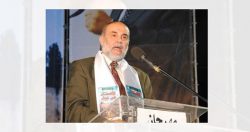 OCCUPIED JERUSALEM – The Israeli occupation police have handed professor Jamil Hamami, secretary-general of the higher Islamic commission in Occupied Jerusalem, a written order banning his travel abroad and to the West Bank.
According to this police order, Hamami will be prohibited from entering the West Bank for four months and the previous ban on his travel abroad will be extended for six months.
The police justified the measure against Hamami by saying that he is involved in banned activities and his departure for other countries will constitute a security threat to Israel.
For his part, Hamami, who works as a lecturer at al-Quds University, condemned Israel’s decision against him as “unjust and a violation of the Palestinians’ right to travel and movement”. He considered this Israeli step as “part of the Israeli campaign that targets the Palestinian dignitaries in Jerusalem.”
Amnesty No More
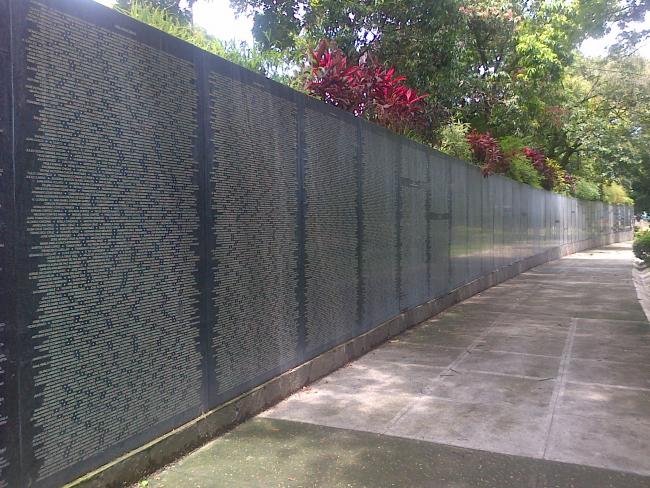
The Memory and Truth Monument commemorating the victims of El Salvador’s violence civil war (Wikimedia Commons)
By Robin Maria DeLugan | NACLA | July 20, 2016
The Salvadoran Supreme Court’s recent decision to overturn the country’s controversial Amnesty Law opens the door to unravel impunity for war crimes during El Salvador’s violent civil war.
On July 11, 2016, in a historic decision, El Salvador’s highest court abolished the amnesty law that has been in effect since 1993. The controversial law was put in place immediately following the signing of the peace accords that ended El Salvador’s brutal 12-year civil war (1980-1992), thus sheltering from prosecution the perpetrators of grave human rights violations committed during the conflict in El Salvador. In a much-anticipated decision, the Constitutional Supreme Court declared that amnesty law unconstitutional because it impeded the state’s obligation to investigate crimes against humanity.
An estimated 75,000 civilians lost their lives during El Salvador’s civil war. Some 8,000 were forcibly disappeared, while tens of thousands more were internally displaced or obligated to flee protracted violence. News of brutal atrocities spread across the world. From the high-profile assassination of Archbishop Monseñor Oscar Arnulfo Romero to the merciless slaughter of the entire village of El Mozote, more than 22,000 acts of violence by armed actors of the civil war were recorded by the United Nations Commission on the Truth for El Salvador.
While the state and the oppositional forces of the Farabundo Marti Liberación Nacional (FMLN) both committed abuses during the conflict, the UN-backed Truth Commission attributed 80% of human rights violations to the government of El Salvador. The Truth Commission, while helpful towards recouping the memories of the brutal acts of the war, had no power to enforce, especially against the amnesty law that followed. The amnesty law prevented prosecution and supported continued impunity thus thwarting national efforts for justice and reconciliation.
Over the past 20 years of post-civil war nation-building, government representations of national culture, history, and identity have maintained silence about the atrocities of the civil war. Some officials argued that to do otherwise would threaten the nation’s fragile peace. Others argued that the nation needed to look forward to the future, rather than dwell on the violence of the past. Such arguments justified the amnesty law. Challenging the government’s muteness and combatting public forgetting, civil society actors created two new museums and one major monument in the nation’s capital of San Salvador. Such commemorative sites have played a pivotal role as memory keepers while also helping to sustain the calls for unfulfilled justice.
In the late 1990’s the Museum of the Word and the Image (Museo de la Palabra y el Imagen, MUPI) was established “against forgetting” (contra la desmemoria) with exhibitions and educational activities dedicated to “weaving memory” (tejiendo la memoria). The museum collects and exhibits photographs, manuscripts, audio recordings, and films. Among the collections in the museum archives are photographs of the El Mozote massacre, posters demonstrating the international solidarity for the people of El Salvador and their revolutionary struggle; propaganda used by the Salvadoran government’s armed forces to reduce popular support of the guerrillas; photos about women combatants and the popular schools that were activated in the conflict zones during the war; and information about refugees and their return at to the country after the Civil War. The museum houses the most comprehensive existing archive of materials on the Salvadoran Civil War, maintaining documentation and memory of wartime abuses that the amnesty law sought to shield.
Carlos Henriquez Consalvi, MUPI’s co-founder and director, participated in the civil society collective that erected the Monument to Memory and Truth (Monumento a la Memoria y la Verdad) in San Salvador’s central Parque Cuzcatlán in December 2003. The commemoration site consists of an 85-meter black granite wall etched with the names of more than 24,000 civilian victims. Another portion of the monument contains colorful stucco reliefs, depicting symbols of past social struggles and violence, such as the assassination of Archbishop Romero. Since its construction, the monument has been recognized as a space for hope—and a place for continuing to envision and a more just, humane, and equitable society. In the absence of state recognition of past atrocities, civil society has had to rely on its own resources to recapture the memories and to publicly recognize the war’s many civilian victims.
Meanwhile, the Museum of Art (Museo del Arte, MARTE), which opened in 2003, has relied on private funding to promote and support contemporary art in El Salvador with an expansive collection that showcases the nation’s history. Its permanent exhibition, “Pieces of Identity,” (“Trozos de la Identidad”) includes paintings that represent the history of social movements in the country, as well as the violence associated with the civil war. Among them is “El Sumpul” (1984) by Carlos Cañas. The painting refers to a 1980 military operation in which at least 300 civilians, including many women and children, were assassinated in the River Sumpul in the department of Chalatenango. By displaying “El Sumpul,” MARTE does more than display the historical and contemporary artistic talent of El Salvador; it also tells the history of the nation’s darkest hours and serves as an important guardian of memory.
The abolition of the amnesty law is an important step in the government’s slow process of addressing an important chapter in the nation’s difficult recent past. In 2010, President Mauricio Funes, the first FMLN candidate to achieve the presidency, gained international attention when he issued a state apology for the assassination of Monseñor Romero, as well as an apology for historical and ongoing violence against indigenous populations in the country. In 2012, at an event marking the 20th anniversary of the El Salvador’s 1992 peace accords, Funes also apologized for the atrocities committed at El Mozote. Later that year the Inter-American Court of Human Rights issued a judgment condemning the Amnesty Law for impeding the government of El Salvador’s responsibility to investigate various cases of human rights violations including the case of El Mozote.
In 2013, an international forum at the Universidad de El Salvador’s entitled “Memories of the War: Changes and Continuities in Local Societies at the beginning of the 21st Century” continued the process of recuperating the history and memory of the Salvadoran conflict. In addition to highlighting the growing body of international scholarship on the civil war, the forum announced the creation of the Unit for Investigations about the Salvadoran Civil War within the national university and the decision to dedicate new resources to research about the conflict. These actions of official apology, international involvement, and state-sponsored academic programming made important steps to breaking long-standing official silence and together with other other civil society initiatives, like museums and monuments, promoted new knowledge about the causes and consequences of the civil war.
One of these consequences, of course, is that the civil war brutality has been replaced with other kinds of violence. As has been widely publicized, El Salvador replaced Honduras as the most violence peacetime country in the world in 2015, with homicide rates nearing one homicide per minute in January 2016. Many, including Benjamín Cuéllar, the ex-director of the Instituto de Derechos Humanos de la Universidad Centroamericana, (Institute for Human Rights at the Central American University, IDHUCA,) see a connection between ignoring prosecution of the human rights abuses of the civil war and high levels of postwar violence. As he noted in a recent article in El Diario de Hoy, the impunity that resulted from the amnesty laws has permitted other wars, namely “the war between gangs, the government’s war against gangs, and the war of gangs against the Salvadoran population.” There is hope that addressing past human rights violations will play a role in creating a more just and peaceful society.
The revocation of the amnesty law now makes it possible to pursue justice for civil war wrongs including criminalizing those responsible for the human rights abuses caused by death squads, paramilitary, and security forces. The 73-page court decision lists 32 crimes that occurred between 1989 and1992 that can now be investigated. The list includes the names of members of the military or of the FMLN indicated as having responsibility. In terms of next steps, Romeo Benjamín Barahona Meléndez, ex-Attorney General under former President Mauricio Funes, explained that victims can now formally denounce these past crimes, and the Attorney General’s office will begin investigating the cases.
The court decision, while heralded by many, is causing a commotion within the leadership of the FMLN, the political party that holds executive power in the government. Structurally, whereas the military actors on the list are no longer in the government, investigations could instead lead to trials that involve FMLN leaders, for example the President of the Republic, Vice President, Ministers and Deputies. Some elected officials and government functionaries are openly critical about what will happen next, stating they fear “witch hunts” and the reopening of old wounds. Despite reservations from some in government, the Attorney General’s office appears to have the will to undertake investigations. However, the government lacks resources for the processes, including funds to support the indemnization of the victims who are determined to have suffered “moral damage” (daño moral).
However, should leaders or government actors ignore the ruling, there will undoubtedly be international criticism and a demand for accountability. Sites and practices of public memory in El Salvador have maintained the nation’s focus on civil war human rights abuses and the need for justice for decades. National and international attention created through these efforts contributed to the historic decision to finally revoke El Salvador’s Amnesty Law. These audiences will be carefully monitoring the fresh developments to follow. It is difficult to predict the outcomes of this important court decision. What happens next in El Salvador will be a chapter in an important historical process of nation-building, memory and justice that will provide lessons for other societies pursuing similar struggles against state violence, forgetting and impunity.
Robin Maria DeLugan is Associate Professor of Anthropology at the University of California, Merced. She is the author of Reimagining National Belonging: Post-Civil War El Salvador in a Global Context (University of Arizona Press, 2012).
Legal centre slams Israeli parliament’s new Expulsion Law
MEMO |July 20, 2016
Adalah – The Legal Center for Arab Minority Rights in Israel has slammed a newly-passed Israeli law designed to facilitate the expulsion of publicly-elected Palestinian parliamentarians in the Knesset.
The law, approved overnight by a vote of 62 to 45, is described by Adalah as posing a “grave danger to basic democratic rights”, and intended to expel those Arab Knesset members “who ‘dare’ to stray beyond boundaries dictated to them by Israeli Jewish majority.”
As Adalah explains, under the new law, “a majority of 90 Knesset members may oust a serving Knesset member on two grounds, as enumerated in Section 7A of the Basic Law: The Knesset: 1) incitement to racism; and 2) support for armed struggle against Israel.”
In addition, “the law stipulates that when the Knesset decides on an expulsion, the statements of the ‘suspect’ Knesset member will also be examined and not only their aims or actions.”
The law also provides that: 1) a member’s expulsion lasts for the full period of the Knesset’s remaining term; 2) the commencement of expulsion proceedings requires the support of 70 Knesset members, including a minimum of 10 opposition members; and 3) suspension proceedings may not commence during an election campaign.
Described as “the latest attempt by the government to trample on the political rights of Palestinian citizens of Israel”, according to Adalah, “there are no existing laws in western democratic states comparable to Israel’s new Expulsion Law.”
The Expulsion Law is the latest expression in a disturbing national tendency over the past several years – including many attempts to disqualify Arab Members of Knesset and Arab party lists from participating in the elections, the government’s decision to outlaw the Islamic Movement in 2015, and the Knesset’s approval of a series of laws such as the ‘Electoral Threshold Law’, the ‘Nakba Law’, and the ‘Boycott Law’ – all intended, via varying means, to silence the Arab public.
Ukrainian Regime Turns Into ‘Mass Grave’ for Journalists – Moscow

Journalist Pavel Sheremet © Sputnik/Ramil Sitdikov
Sputnik — 20.07.2016
MOSCOW — Ukrainian political system is turning into “mass grave” for journalists and journalism in general, Russian Foreign Ministry spokeswoman Maria Zakharova said Wednesday, commenting on the killing of journalist Pavel Sheremet in a car bomb attack in Kiev.
Earlier in the day, a car bomb claimed Sheremet’s life in the Ukrainian capital of Kiev. The Ukrainian general prosecutor confirmed Sheremet’s death, classifying it as murder.
“A vehicle with Pavel Sheremet was blown up in Kiev. [He was] a professional journalist, who was not afraid of telling the authorities what he thinks about them — to different authorities and at different periods of time. And he was respected for this. Ukraine (not the country, but the system) is turning into mass grave for journalists and journalism,” Zakharova wrote on her Facebook page.
President Petro Poroshenko ordered investigators to ensure the perpetrators of the attack are brought to justice.
Sheremet is a well-known journalist who worked in Russia, Belarus and Ukraine. He had worked in Kiev for the last five years for the Ukrayinska Pravda news portal and Radio Vesti broadcaster.
In April 2015, Ukrainian opposition journalist Oles Buzina was shot dead in Kiev by two masked gunmen near his home. The incident occurred less than a day after former lawmaker and government critic Oleh Kalashnikov was murdered at his residence in the Ukrainian capital. Another Ukrainian journalist, Donetsk-born Serhiy Sukhobok, was also killed the same month near his house in Kiev.
Reporters Without Borders has repeatedly urged the Ukrainian authorities to investigate the killing of journalists.
Former hunger striker, brother of slain activist, among 18 Palestinians arrested by occupation forces

Samidoun Palestinian Prisoner Solidarity Network – July 19, 2016
In a series of late-night and pre-dawn raids, Israeli occupation forces seized at least 18 Palestinians between 18 and 19 July. They include Ghassan Zawahreh, former prisoner, hunger striker against administrative detention, and the brother of Moataz Zawahreh, shot dead by occupation forces as he participated in a protest in Dheisheh refugee camp on 15 October 2015.
In an invasion of Dheisheh camp by occupation forces, Zawahreh was seized in a pre-dawn raid with a massive military presence. Zawahreh has spent nearly ten years in Israeli prisons over various arrests, including many under administrative detention without charge or trial. He has permanent injuries to his right hand and left leg due to beatings by Israeli occupation forces during earlier arrests, including his first arrest in 2002; he was denied treatment for his knee injury for three years. Zawahreh was released on 30 November 2015, after being held in administrative detention since 4 August 2014. He was one of the initiators of the “Battle of Breaking the Chains,” the 40-day hunger strike by five Palestinians imprisoned without charge or trial under administrative detention.
Moataz, his brother, returned from a study program in France in order to support Ghassan’s strike; he was shot dead by Israeli forces during a demonstration in the refugee camp. When Ghassan was released, he immediately headed directly to his brother’s gravesite to pay his respects and two days later, spoke at a memorial for his brother, video here:
The invasion of Dheisheh camp followed a large protest action in the camp in support of hunger-striking prisoner Bilal Kayed, hospitalized after 35 days of hunger strike for freedom from administrative detention, imprisonment without charge or trial.
Four former prisoners – all students at An-Najah University in Nablus – were detained by occupation forces: Mahmoud Asida, Malek Bilal Shtayyeh, Mumin Munir Sabah, and Karam Kheir Bani Fadel.
Five Palestinians in Qalandia refugee camp north of Jerusalem were arrested: Muath Alayan, Mohammed Samih Muteir, Mahmoud Samih Muteir, Haitham Udwan, and Muhannad Kanaan. In the town of Taqua, east of Bethlehem, two Palestinians were seized by occupation forces, Mohammed Salim Abu Mafarah and Musa Mohammed Amour. Hussein Issa, of al-Khader village west of Bethlehem, was also arrested by occupation forces.
Also yesterday, Israeli occupation forces arrested two more An-Najah university students yesterday, Mohammed Shehadeh at Huwwara checkpoint south of Nablus, and Said al-Tawil in Far’ata village. Samaher Abdul Qader Musalma, of Beit Awwa near al-Khalil, was arrested while visiting her husband in the Negev desert prison, and her husband, Nabil Musalma, was transferred to an unknown prison.
Featured Video

Matt Bracken: US Plans Massive MOAB Strike on Iran?
or go to
Aletho News Archives – Video-Images
From the Archives
Confronting the Threat of Ethnic Bioweapons
By Tony Cartalucci – New Eastern Outlook – 29.11.2017
The United States Air Force’s 59th Medical Wing’s molecular biology branch recently was revealed to have been collecting specifically Russian RNA and synovial (connective) tissue samples, prompting fears in Russia of a possible US directed ethnic-specific bioweapons program. … continue
Blog Roll
 Aletho News
- Matt Bracken: US Plans Massive MOAB Strike on Iran?
- Russia accuses France of ‘piracy’ over tanker seizure
- Why Yemen Is Bombing Saudi Arabia’s Airports: The War Behind the Headlines
- Sally Rooney’s books pulled from UK over support for Palestine Action
- Bombs for Tel Aviv, Promises for Riyadh
- Israeli ad agency conducted vast global espionage campaign using online ads: Report
- Oct. 7 Forever Marks The Big Reveal: ‘We See You, Israel, We Revile You, We Reject You!’
- Meet the US generals and admirals advancing Israeli policy
- Israel’s Straw Widow Protocol: The Kill Zones Where Civilians Were Labelled ‘Terrorists’
- Leading Israeli Think Tank Publishes Psychotic Israeli ‘National Security’ Doctrine
- If Americans Knew
- Israeli firm used online ads to run vast spy operation, researchers say
- No, the world zionist movement is not an antisemitic conspiracy theory
- Hundreds of IDF investigations into killings still have no public outcome, BBC Verify finds
- After Ashley Moody Epstein Probe, Donors Linked to Him Poured Money Into her Senate Campaign
- Worried about Russian meddling in UK politics? Wait till you see what Israel is up to
- Israeli settlers attack West Bank center for disabled children, church leader calls for int’l action
- Pulling Out Teeth Just to Live: How Israel Has Devastated Dental Care in Gaza
- Gaza’s “ceasefire” death toll passes 1,500 – Daily Update
- Activists Abused By Israel Return to New Freedom Flotilla Mission
- 60 Minutes won’t tell the full truth about Israeli settler violence
- No Tricks Zone
- New Study Suggests Large Regions Of The Pacific Ocean Have Been Cooling For The Last 80 Years
- Germany’s Green Energy Debacle: High Energy Costs Force Kahla Porzellan to Close After 182 Years!
- New Study: 50 Years Of The Most Aggressive ‘Net Zero’ Policies Can Only Affect The Global Climate By 0.03°C
- US September “Heat” Was No Record…Many Records Set Decades Ago
- Latest European Green Energy Debacle; Portugal’s Largest Flagship Solar Park Insolvent!
- Green Energy Debacle: German Expert Professor Fritz Vahrenholt Warns Of Severe Economic And Social Consequences
- Two More Paleo Reconstructions Affirm Meters-Higher Sea Levels Across Ireland, Brazil 7000-6000 Years Ago
- New Study: Earth And Venus Surface Warmth Largely Explained By Convection And Lapse Rate, Not CO2 Or Radiation
- 2025 Nature Paper Claiming Worsening Global Drought Gets RETRACTED …Heavily Flawed
- New Study: ‘Global Drought Shows No Detectable Recent Acceleration Under Climate Warming’

