Palestinian Fishers Under Attack – End the Siege on Gaza

Samidoun Palestinian Prisoner Solidarity Network | May 31, 2016
Palestinian Fishers Under Attack
Five Palestinian fishers in Gaza – Rajab Abu Riyala, Khaled Abu Riyala, Hassan Miqdad, Mahmoud Miqdad, and Bashar Abu Riyala – were arrested this morning, 31 May, by Israeli occupation forces and two fishing boats confiscated by the Israeli navy. According to the Union of Agricultural Work Committees, these arrests bring the number of Palestinian fishers in Gaza arrested by Israeli occupation forces in 2016 to 70, including eight children, and the number of boats confiscated to 20. In 2015, 71 fishermen were detained and 22 boats confiscated throughout the year.
Zakaria Baker of the UAWC, which organizes fishers and farmers for land defense and mutual support and solidarity, said that these violations against fishers in Gaza have only increased since the proclaimed decision of the Israeli occupation to “extend” the fishing area to 9 nautical miles – a decision retracted on Monday – saying that fishers could not make use of this distance because they were prevented by force of arms. The fishers were attacked this morning 5 nautical miles out to sea, Baker said. Further, Israeli occupation forces fired on fishing boats northwest of Gaza city, damaging a fishing boat and forcing the fishermen to flee for safety, and in the sea off Deir al-Balah, firing live bullets pushing the fishers back to the beach.
On Monday, Israeli occupation naval forces said that the extended fishing zone had been “temporary,” for the fishing season, and that the fishing zone was again six nautical miles. The limit has frequently been used as a means of pressure and of maintaining the naval siege on Gaza; while the Oslo Accords set Gaza fishers’ zone as 20 nautical miles, the Israeli occupation has unilaterally lowered it to an area as small as three nautical miles, extended to six in 2014.
The fishing economy in Gaza – which supports 70,000 Palestinians – has been nearly destroyed by the naval siege on Gaza and the attacks on Palestinian boats, causing expensive boat damage to small fishing families who cannot afford repairs and preventing Palestinian fishers from entering deep waters where mature fish are available. Fishers in Gaza have lost 85% of their income since 2006 and the tightening of the siege.
On 30 May – 4 June 2016, activists are engaged in campaigns against the siege on Gaza – the denial of reconstruction, the smothering of the Palestinian economy, the closing of the crossings and denial of freedom of movement, the prevention of trade, the aerial attacks on Gaza, the firing on Palestinian farmers and destruction of Palestinian agriculture in the “no-go zone” near the border, and the strangling of the Palestinian fishery of Gaza – demanding an end to 10 years of Israeli siege with international support and complicity, and the involvement of the Egyptian state.
The actions mark ten years of siege and six years since Israel naval commandos attacked the international Freedom Flotilla to Gaza, killing ten Turkish activists seeking to break the naval siege. The occupation’s draconian restrictions on the movement of people and goods, along with its repeated military onslaughts and their destruction of Palestinian industry, resources, infrastructure, and life, have pushed the local unemployemt rate to 41.2%, the highest in the world. 75,000 remain displaced following Israel’s destruction of their homes, which have yet to be rebuilt, during its 2014 bombardment. Family members, patients, students, and workers are trapped, with over 25,000 having applied for rare permits to leave through the one crossing with Egypt.
UAWC video on Palestinian fishers in Gaza:
End the Siege on Gaza
Samidoun Palestinian Prisoner Solidarity Network urges protests and actions to support the besieged fishers in Gaza, and raising the voice of Palestinian fishers to end the attacks and break the siege on Gaza. Samidoun in New York City will rally on Friday, 3 June at 4:00 pm outside the offices of G4S at 19 W. 44th Street in New York City. G4S, the world’s largest security company and second-biggest private employer, equips Israeli prisons and detention centers where Palestinian prisoners, including many fishermen detained off the coast of Gaza, are held and tortured, as well as the occupation forces and infrastructure – like checkpoints surrounding the Gaza Strip – routinely used to massacre Palestinians while holding millions under military rule.
Take Action!
1. Organize or join a protest against the attacks and arrests of Palestinian fishers and the siege on Gaza, outside your national government buildings, local Israeli embassy, G4S office, or corporation involved in the occupation. If you are in New York, join Samidoun’s protest – elsewhere, send us your local protests against the attacks on Palestinian fishers in Gaza. Email us at samidoun@samidoun.net.
2. Contact political officials in your country – members of Parliament or Congress, or the Ministry/Department of Foreign Affairs or State – and demand that they cut aid and relations with Israel on the basis of its apartheid practices, its practice of colonialism, and its numerous violations of Palestinian rights including the siege on Gaza and the attacks on fishers. Demand they pressure Israel to stop attacking Palestinian fishers and strangling Palestinians in Gaza. In the United States, call the Israel/Palestine Bureau at the State Department at 202-647-3930 and the White House – 202-456-1111. Demand action on Barghouthi’s case and an end to aid to Israel. In the UK, call UK Foreign and Commonwealth Office, Philip Hammond, MP, +44 20 7008 1500. In Canada, call Foreign Minister Stephane Dion: 613-996-5789.
3. Boycott, Divest and Sanction. Hold Israel accountable for its violations of international law. Don’t buy Israeli goods, and campaign to end investments in corporations that profit from the occupation. G4S, a global security corporation, is heavily involved in providing services to Israeli prisons that jail Palestinian political prisoners – there is a global call to boycott it. Palestinian political prisoners have issued a specific call urging action on G4S. Learn more about BDS at bdsmovement.net.
Fake “Humanitarians” and Fake “Leftists” taking Canada down the wrong path

Special Envoy of the UNHCR addresses the Security Council meeting on the continuing conflict in Syria. Credit: UN Photo/ Mark Garten/ flickr
By Mark Taliano | American Herald Tribune | May 30, 2016
There’s really no excuse for supporting the NATO/terror position. We’ve seen the destruction of Iraq, Libya, Ukraine, now Syria, all built on lies, all beneath the guise of “humanitarian interventions”. Since people with any sense of historical memory can not legitimately plead ignorance, supporters of the terrorist invasion of Syria fall into the category of “fake humanitarians”. They aren’t “progressive” or “left” when they support the criminal violation of Syria’s sovereignty and territorial integrity.
Canadian peace activist Ken Stone, recently returned from Syria, expresses similar sentiments in his newly released book, Defiant Syria|dispatches from the Second Tour of Peace to Syria. He explains,
“The point for me is to ask why otherwise intelligent people can fall for such shit (referring to a 2015 New Internationalist magazine article: “The forgotten revolution of Syria”), and not once but repeatedly. It’s not as if Syria is the very first government targeted for regime change by the USA. It’s not that people are unaware of the fact that the first casualty of war is the truth … there is never a shortage of “leftists” in the West who can be either bought or convinced through incredible naivété, warped political outlook, or Eurocentric arrogance, that the motives of Empire are good.”
People such as Ken, who have visited Syria and have seen with their own eyes the devastation wrought by Western-supported terrorists against civilization, have less tolerance for the lies, the propaganda and the “fake humanitarians” who enable it all.
Stone doesn’t mince words when he describes some of his on-the-ground observations of Homs, Syria; observations fortified by his historical memory of NATO’s imperial destruction elsewhere:
To their detriment, the fake “humanitarians” and pseudo “leftists” are shielded from such on-the-ground realities.
In a later chapter, “Palmyra: Bride Of The Desert”, Stone also bemoans the self-proclaimed “leftists” who cast the Russians as “imperialists” and as guilty as the West in the war against Syria – conveniently forgetting that Russia is legally in Syria, while NATO is not:
“It’s true,” he writes, “that Russia is unfortunately no longer a socialist country. However, it doesn’t act like an imperialist country either. Mr. Putin consistently respects the sovereignty of other countries, such as Syria, and speaks up at the United Nations for the observance of international law, which the USA, priding itself as “the exceptional country” and the “sole indispensable country”, tramples on almost every day.”
This resonates with the author’s earlier piece, “Western Hegemony vs Russian Sanity”, and the “Saker’s” observations of the differences between the “Anglo-Zionist Unipolar Imperial Model” and the “Russian Multi-polar Model”.
Sustainable evidence demonstrates, for example, that the current Russian multi-polar model respects the rule of international law, ideological and cultural pluralism, and the use of military force as a last resort.
The illegal Western war of aggression against Syria, on the other hand, is consistent with the “Anglo-Zionist Unipolar Imperial Model” which defies the rule of international law, negates ideological and cultural pluralism, and uses military violence as a first resort.
The West’s invasion contradicts the rule of international law: Russia is in Syria legally, whereas the West is not; it negates Syria’s ideological and cultural pluralism and seeks to replace it with a Wahhabist stooge government or an assortment of stooge governments in balkanized states; and it demonstrates the West’s propensity to use military violence as a first resort – the invasion, after all, was planned well in advance.
Given the fact of the West’s criminality, consistent with the “Anglo-Zionist Unipolar Imperialist Model”, and the concurrent failures of the “fake humanitarians” and the fake “left” to reconcile themselves to evidence-based findings and historical memory, Stone reiterates some concrete steps that should be taken by those of us who support foreign policy trajectories consistent with peace and the rule of international law, rather than the current reality of war and barbarism.
Important steps would include normalizing diplomatic relations with Syria, ending illegal sanctions, withdrawing from all criminal military interventions against Syria, and withdrawing from NATO.
Canada needs to assert an independent foreign policy, and it needs to reject the current barbarity implicit in its status as a vassal appendage of the Anglo-Zionist Unipolar Imperial Model. This is what Real Change would look like.
Mark is a retired high school teacher.
The US and the EU Support a Savage Dictator
By Brian CLOUGHLEY | Strategic Culture Foundation | 31.05.2016
On May 6 a court in Istanbul, acting on the orders of Turkey’s President Recep Erdogan, sentenced the editor of the Cumhuriyet newspaper to five years and ten months in prison for publishing a report about illegal provision of weapons to Islamist terrorists in Syria by Turkey’s secret service. His bureau chief got five years.
Two weeks later Istanbul was host to the World Humanitarian Summit, which was held «to stand up for our common humanity and take action to prevent and reduce human suffering». Attendance included 65 heads of state. It was the usual total waste of time (Oxfam called it «an expensive talking shop» and those who refused to be there included President Putin and the global medical charity Médecins Sans Frontières), but the point is that a humanitarian conference should never have been held in Turkey, which is being transformed into a dictatorship by a president who is well-described by Professor Alan Sked of the London School of Economics as «a volatile, unstable, highly authoritarian personality».
The professor went on to observe that Erdogan «has pursued a civil war in his own country and has clamped down on the opposition and social media at will. Thousands have been imprisoned for merely criticising him. He has ordered the shooting down of a Russian warplane, and his country has been accused by Russia of trafficking secretly in oil with Isis. He cannot be trusted…»
Erdogan is a bigoted thug, yet the international community rushed to his country to hold a humanitarian conference and foreign heads of state flock to press his hand in friendship. He is treated with deference around the world and there can be no public criticism of him in the many countries that have laws prohibiting disparagement of heads of state and holding defamation and insult of their leaders to be a criminal offence punishable by imprisonment.
In January over 1,100 Turkish academics signed a letter asking Erdogan to cease his merciless blitz on Kurdish centres in the south east of the country. Thousands of Kurds had been (and continue to be) killed and crippled by ground and air assaults of merciless savagery. Erdogan’s response to the petition was to declare that these compassionate scholars «spit out hatred of our nation’s values and history on every occasion. The petition has made this clearer… In a state of law like Turkey, so-called academics who target the unity of our nation have no right to commit crimes. They don’t have immunity for this».
Some thirty of the humanitarian signatories were arrested and fifteen were dismissed from their university posts. They live under constant threat, as do all who attempt to disagree with the imperial president.
Yet Erdogan’s Turkey is strongly supported by the United States and by the European Union, albeit for very different reasons.
The US backs him because he supports Washington’s efforts to destroy President Assad of Syria and is a strident and aggressive opponent of Russia, while the EU is behind him because if he chose he could control the influx of Syrian refugees to Europe. So Erdogan can persecute and jail as many journalists and academics as he likes, while continuing to slaughter Kurds in Turkey, Syria and Iraq, and although there may be a few murmurs of disapproval in Brussels and Washington there will be no action whatever taken by either the US or the EU to stop the President of Turkey wielding absolute power over his people.
In March, while Erdogan was attending the 2016 Nuclear Security Summit in Washington (yet another total waste of time and money, except for the travel industry) he met separately with the US president and vice-president, neither of whom had the moral courage to take him to task for his blatant oppression of those of his citizens who dare to have ideas and opinions contrary to his own.
As the Voice of America reported on March 31, «President Barack Obama assured his Turkish counterpart of American commitment to the security of Turkey, a critical ally in the fight against the Islamic State group», while the White House “readout” of the Erdogan-Biden meeting recorded that «the Vice President reiterated the United States’ unwavering commitment to Turkey’s national security as a NATO Ally». They discussed «ways to further deepen our military cooperation» which was no doubt heartening to a bellicose thug whose aim is to persecute and preferably kill Kurds wherever they may be.
In spite of all the evidence, the United States refuses to acknowledge that Erdogan’s Turkey has sent massive quantities of weaponry to Islamic terrorist groups who are prepared to kill Kurds. It does not appear to matter to Washington that «Not only has Erdoğan done almost everything he can to cripple the forces actually fighting ISIS; there is considerable evidence that his government has been at least tacitly aiding ISIS itself».
The countries of the European Union, in similar blinkered mode, ignore Erdogan’s transformation of Turkey from democracy to dictatorship because they are prepared to make almost any sacrifice to reduce the flood of refugees now threatening their countries. Their leaders are terrified that behaving in a humanitarian manner will damage their domestic electoral chances and have set up an extraordinary deal with Erdogan who has agreed to «do more to prevent refugees from traveling to Europe via its territory and take back all migrants and refugees who manage to cross into Europe from Turkey … In return, the European Union has doubled the financial aid it promised Turkey from 3 billion to 6 billion euros, has agreed to take in more Syrian refugees from Turkey, and will move to provide visa-free travel to Turks and reopen EU accession talks».
Little wonder that Erdogan is on the crest of a wave and can persecute dissenters and slaughter Kurds with hardly a word of international criticism. In March, when he took over Turkey’s largest newspaper, the independent Zaman, and replaced the entire staff with his supporters, US State Department spokesman John Kirby called the seizure «troubling». And it was reported on 25 May that, «the EU wants Ankara to narrow its definition of terror to stop prosecuting academics and journalists for publishing ‘terror propaganda’, but Turkey has refused to do so».
Unless the US and the EU bring pressure to bear on Erdogan to restore democracy in his country, he will continue to suppress and persecute his critics and continue his killing spree. But he is too valuable to them for that to happen. All they will do is hold more humanitarian conferences.
The NY Times Plays the Israeli Army’s Game: Hyping Threats, Shielding Criminals
By Barbara Erickson | TimesWarp | May 30, 2016
The New York Times reports today that Israel faces “monumental security challenges” and is now caught in a debate over just how tough the military should be with those who threaten to harm its soldiers and civilians.
The story, by Isabel Kershner, is framed around “months of Palestinian attacks” that have left some 30 Israelis dead. She makes no mention anywhere of the more than 200 Palestinians killed by security forces over the same time period, nor does she say anything about the brutal conditions of the occupation that provide the impetus for Palestinian assaults.
Kershner briefly notes that Palestinian and human rights groups have accused the Israeli military of “excessive force,” but she fails to say that the charges go beyond this vague reference: In fact, numerous groups have accused Israel of carrying out “street executions” of Palestinians who posed no real threat to soldiers or civilians.
The mostly youthful Palestinian attackers over the past eight months have been armed with nothing more than knives, vehicles and even scissors, but they have carried out their assaults (some alleged, some substantiated) against an army equipped with submachine guns, drones, tanks, surveillance equipment, nuclear warheads, fighter jets, attack helicopters and naval gunboats.
In spite of this immense disparity, Kershner is able to claim that Israel faces “monumental” security challenges. It never seems to occur to her that Palestinians face immense security concerns of their own.
Moreover, she presents the Israeli Defense Force as an army operating under humane policies, which are now under attack by politicians and a vocal segment of the public. “The military chiefs have urged restraint and a strict adherence to open-fire regulations, saying a soldier should shoot to neutralize a threat, but not beyond that,” she writes.
When army officials have promoted these guidelines, she says, they have been “attacked by rightist politicians who advocate a policy based on the Talmudic lesson ‘Whoever comes to slay you, slay him first.’”
Kershner thus gives voice to army leaders who have criticized the trigger-happy responses of security forces, but she fails to quote from those human rights groups who have frequently raised the alarm over the killings of Palestinians who posed no real threat.
Readers are left with the impression that the army has been operating with restraint, following a set of humane policies, but is now being challenged by rightists who urge even tougher measures against would be attackers.
Missing from her story is the fact that army and police have operated with impunity over many years, even when cases of abuse and criminal behavior are well documented. Two recent statements by Israeli rights groups, Yesh Din and B’Tselem, bear this out.
Yesh Din, which works for structural changes in the occupied territories, reported last month that 5,500 Palestinians have been killed by Israeli forces over the past 15 years, yet not one Israeli soldier has been charged for murdering a Palestinian.
Just last week the monitoring group B’Tselem announced that after more than 25 years of cooperating with the military, sharing information on cases that merited action, it has now suspended all of these efforts because of this record of impunity.
When Israel claims to investigate charges against the military, B’Tselem said, “not only does the state manage to uphold the perception of a decent, moral law enforcement system, but also maintains the military’s image as an ethical military that takes action against [ostensibly prohibited] acts.” In fact, the organization stated, the system is nothing more than “an outward pretense,” and an effort to whitewash criminal activity.
The rights group concluded that it would “no longer play a part in the pretense posed by the military law enforcement system and will no longer refer complaints to it.” After 25 years of consistent effort, the group concluded that “there is no longer any point in pursuing justice and defending human rights by working with a system whose real function is measured by its ability to continue to successfully cover up unlawful acts and protect perpetrators.”
This is far from the impression we get from Kershner’s story. She quotes military officials who insist on the moral standards of the Israeli army without a hint of irony or any effort to challenge their claims.
The Times is a willing partner in the whitewash of Israel’s military. Its editors accepted Kershner’s characterization of the army without asking for any follow up. They were aware of the B’Tselem announcement, however, running two wire service accounts of the move online but failing to assign any reporter to the story. The newspaper made no mention of the Yesh Din findings.
Kershner’s story plays perfectly into the scenario described by B’Tselem. It provides the impression of a functioning military justice system, an army run on moral principles but under attack by “terrorists”. It is all part of the narrative of Israeli victimhood, even though its chief threat comes from teenagers armed with kitchen knives.
Follow @TimesWarp on Twitter.
New Survey: Over Two-Thirds of California Voters Oppose Asset Forfeiture
By TJ Martinell | The Tenth Amendment Center | May 27, 2016
One thing Californians agree on is their opposition to laws that allow law enforcement to seize and keep people’s cash and property merely for being suspects of a crime, also known as asset forfeiture (learn more here).
That’s according to a two new surveys by the Public Policy Polling. The surveys found “overwhelming statewide and local opposition” to asset forfeiture laws. Over two-thirds of voters surveyed (82 percent) opposed these laws compared to 14 percent in favor of them.
Opposition to asset forfeiture also transcended party lines. Rough the same amount of Democrats, Republicans and independents expressed aversion to the idea that our property rights don’t apply when someone is suspected of crime – even if they’re never convicted.
Their support is not due to voter ignorance, as PPP also found that “opposition to civil asset forfeiture laws strengthens as voters learn more about them” and very few changed their minds after hearing law enforcement arguments justifying these laws. Maybe that’s because 17 percent of those surveyed knew someone who had lost property to police without a conviction.
Although California has asset forfeiture restrictions a loophole allows local police to pass off cases to the federal government, while still getting up to 80 percent of the proceeds obtained through civil forfeiture.
A bill introduced last year in the California state Senate would rein in these practices by law enforcement agencies. After passing the Senate by a wide margin, SB 443 was hit by massive opposition and delays in the Assembly. It was pulled from the “inactive file” this week and a final Assembly vote is expected in coming days.
California residents should contact their Assemblymember and insist the loophole be closed once and for all.
There’s also a Facebook group to support SB443 – HERE.
Nobel Laureate: “Plan Condor Should Never Have Happened”
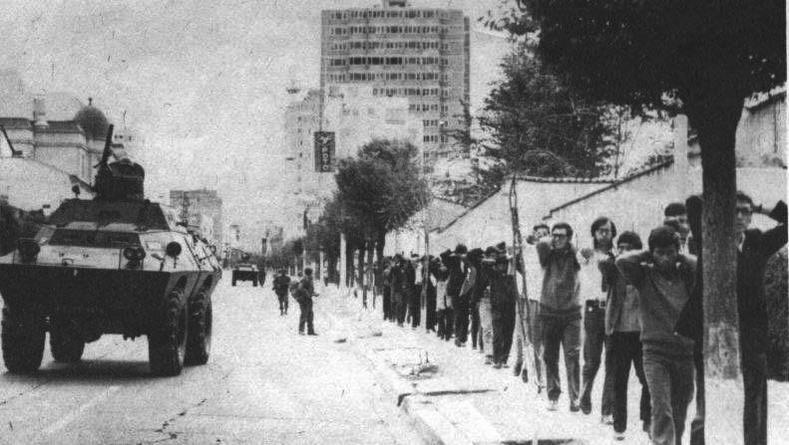
In Bolivia, a CIA-backed military coup led to the overthrow of leftist President Juan Torres. Following the coup, dictator Hugo Banzer had over 2,000 political opponents arrested without trial, tortured, raped and executed.
teleSUR | May 28, 2016
Adolfo Perez Esquivel voiced his opposition to celebrations over the conviction of 15 military officials in Argentina. In his view, there is nothing to celebrate.
Perez Esquivel, recipient of the 1980 Nobel Peace Prize, said Friday that Plan Condor was a conspiracy to kill leftist movements in Latin America and the Caribbean.
In his view, there is no reason to celebrate the conviction of those who participated in Plan Condor in Argentina. An Argentine court found 15 military officials guilty Friday.
“Plan Condor should never have happened,” the Argentine Nobel laureate and human rights defender wrote on the social network Twitter.
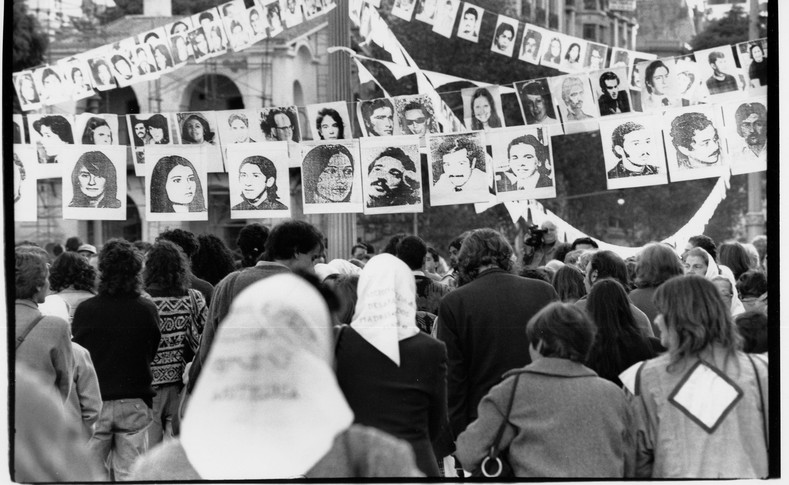
Photographs of the disappeared in Argentina. Photo:Colección AGRA, Archivo Memoria Activa
After the sentencing of several of the military officials, Chilean journalist and diplomat Odette Magnet said “justice was achieved, but we need the truth,” referring to her sister Maria Cecilia Magnet who was disappeared during the dictatorship in the country.
The journalist explained that for 40 years she has played an active role in seeking the truth about repression during the military dictatorships in Latin America.
“I want to know where they are, where (the death squads) threw them, where all the victims of this macabre plan are,” Magnet said. Officials from the dictatorships across Latin America would often throw victims out of helicopters and airplanes into the ocean.
“Nobody knows what really happened to our people, we have no information because the murderers do not speak, they will not talk and that is very frustrating because we have the facts,” Magnet concluded.
RELATED:
UN Body on Prevention of Torture Suspends Visit to Ukraine
Sputnik – 25.05.2016
The UN Subcommittee on Prevention of Torture (SPT) decided to halt its visit to Ukraine as it did not get access to some sites where it suspected infringements of human rights were taking place, the Office of the United Nations High Commissioner for Refugees (UNHCR) said Wednesday.
“The delegation concluded that the integrity of the visit, which began on 19 May and was due to end on 26 May, had been compromised to such an extent that it had to be suspended as the SPT mandate could not be fully carried out,” the UNHCR statement said.
Malcolm Evans, head of the delegation, told the UNHCR that the delegation was denied access to the sites where tortures and ill-treatment allegedly was taking place.
The UNHCR said it is only the second time it was forced to suspend its mission under the Optional Protocol to the Convention against Torture (OPCAT), according to which the SPT has a right to visit all sites of detention without preliminary notification.
Evans called on Ukraine to fulfill its duties under the OPCAT that will enable the SPT to resume its mission.
“The SPT expects Ukraine to abide by its international obligations under the Optional Protocol, which it ratified in 2006. We also hope that the Government of Ukraine will enter into a constructive dialogue with us to enable the SPT to resume its visit in the near future and so work together to establish effective safeguards against the risk of torture and ill-treatment in places where people are deprived of their liberty,” he said.
The Optional Protocol to the Convention against Torture entered into force in 2006 and is ratified by 81 countries including Ukraine.
Europe Revolts Against Russian Sanctions
By Finian CUNNINGHAM | Strategic Culture Foundation | 26.05.2016
From ministerial offices to barricades on the streets, Europe is in open revolt against anti-Russian sanctions which have cost workers and businesses millions of jobs and earnings. Granted, the contentious issues are wider than anti-Russian sanctions. However, the latter are entwined with growing popular discontent across the EU.
Germany’s vice chancellor Sigmar Gabriel is among the latest high-profile politicians to have come out against the sanctions stand-off between the European Union and Russia.
At stake is not just a crisis in the economy, of which the anti-Russian sanctions are symptomatic. It is further manifesting in a political crisis that is challenging the very legitimacy of EU governments and the bloc’s institutional existence. The issue is not so much about merely trying to normalize EU-Russian relations. But rather more about preserving the EU from an existential public backlash against anti-democratic and discredited authorities.
Gabriel, who also serves as Germany’s economy minister, said that relations between the EU and Moscow must be quickly normalized. And he called for the lifting of sanctions that have been imposed since early 2014 as a result of the dubious Ukraine conflict. The EU followed Washington’s policy of slapping sanctions on Russia after accusing Moscow of «annexing» Crimea and interfering in Ukraine’s internal affairs. The charges against Russia are tenuous at best and are far removed from the mundane pressing concerns of ordinary EU citizens, who are being made to bear a heavy economic price for a stand-off that seems unduly politicized, if not wholly unwarranted.
Russia responded to the sweeping sanctions by implementing counter-measures banning exports from the EU and the US. The stand-off has hit the European economies hardest, with the Austrian Institute of Economic Research estimating that the trade war will cost the EU over €100 billion in business and up to 2.5 million in jobs. By contrast, the US has scarcely felt a pinch from the trade impasse.
Germany, Europe’s biggest economy with the largest trade links to Russia, has suffered most from the sanctions rift. Up to 30,000 German businesses are invested in Russia, amounting to as many as half a million jobs in danger and €30 billion in lost revenues, according to the Austrian Institute of Economic Research.
In one German state alone, Saxony-Anhalt, the local economy minister Jorg Felgner says that exports to Russia have been slashed by 40 per cent, with the loss of €200 million to his state. Felgner is among the growing chorus of EU voices who are calling for the anti-Russian sanctions to be lifted when the EU convenes in July to decide on whether to extend its embargo or not.
The EU has been reviewing its sanctions policy on Russia every six months since 2014. To extend the measures, a unanimous decision is required among all 28 member states. It looks increasingly unlikely that the EU will maintain its hitherto unanimity. It can be safely assumed that if Brussels were to end the sanctions, then Moscow will respond in kind to promptly resume normal trade with the bloc.
In addition to the country’s vice chancellor, Germany’s foreign minister Frank-Walter Steinmeier has also expressed disquiet with the ongoing EU-Russian tensions stemming from the sanctions. Steinmeier noted that «resistance to anti-Russian sanctions is growing across the EU».
He also reiterated dismay over a fundamental contradiction in EU policy objectives. «How can we expect Russia’s help in solving the Syrian crisis while at the same time imposing economic sanctions on Russia?» asked Steinmeier.
It’s not just Germany that is growing leery with the deterioration in relations with Russia. Hungary and Italy, which have also strong historic trade ties with Russia, are increasingly opposed to the EU’s policy towards Moscow, according to a recent Newsweek report.
Added to the maligned mix is Greece. The country’s six-year economic crisis has been greatly exacerbated by the loss of a once-bustling agricultural export business to Russia. The country’s finance minister Dimitrios Mardas attributed major losses specifically to the anti-Russian sanctions, which have piled on fiscal deficits to the teetering Greek economy. Greece is no isolated problem. It threatens to undermine the whole EU from its chronic bankruptcy.
In France, the National Assembly’s Lower House voted last week by 55 to 44 votes to end the EU sanctions on Russia. The vote is non-binding on the government of President Francois Hollande. Nevertheless, it demonstrates the growing popular opposition to what is widely seen as a self-defeating policy of trade antagonism with Russia.
The cancellation last year by the Hollande government of the Mistral dual helicopter-ship contract with Moscow epitomizes the self-inflicted pain on French workers. The cancellation – cajoled by Washington – cost the French government revenues of over €1.5 billion and has put thousands of shipyard jobs at risk. Paris claims to have since directed the ships’ order to Egypt, but that remains doubtful.
The economic losses from anti-Russian sanctions have rebounded severely on French farmers too. Dairy, meat, vegetable and fruit exports to the once lucrative Russian market have been pummeled. Hollande recently vowed to release €500 million in state aid to placate angry farmers. The absurdity is not lost on the French agricultural sector that such state handouts would not be necessary if the Hollande government hadn’t sabotaged Russian markets in the first place by following US hostility towards Moscow, as in the case of the Mistral fiasco.
France’s economic problems, as with the rest of Europe, are not entirely related to the downturn in relations with Russia. But there seems little doubt that the issues intersect and are compounded. And the public knows that.
Hollande – the most unpopular French president since the Second World War – is ramming through draconian labor reforms. The president and his truculent prime minister Manuel Valls claim that the retrenchment of workers’ rights will boost the economy and reduce France’s soaring unemployment rate of 10 per cent nationally and 25 per among French youth.
In opposition to the French government’s deeply unpopular assault on workers’ rights, the country is to observe nationwide strikes this week. The protests have been going on now for several months and seem set to escalate, as Hollande’s administration digs its heels in and refuses to relent.
Among students and farmers joining France’s nationwide strike are workers in the transport sectors of road haulage, rail, shipping and airports. With exports to Russia slashed due to the French government-backing of EU sanctions, the transport sectors are among the hardest hit. The Hollande government’s attempt to force through labor cuts, purportedly to reinvigorate the economy, is seen as it trying to offload responsibility for economic woes on to workers and businesses. If Hollande did not pick a fight with Russia – at Washington’s goading – then the country’s economy wouldn’t be under such duress.
Across Europe, the popular revolt against economic austerity is bound up with the EU’s self-defeating sanctions on Russia. And it is leading to a crisis of authority among EU governments who are held with increasing disdain by their citizens. More enlightened political leaders like Germany’s vice chancellor Sigmar Gabriel and foreign minister Frank-Walter Steinmeier are obviously aware of the geopolitical connection that citizens are making.
As Europe’s economic crisis deepens, the policy of anti-Russian sanctions is tantamount to the EU cutting off its nose to spite its face. The growing public disaffection is also fueling the electoral rise of anti-EU political parties in Germany, France, Britain, Netherlands, Hungary, Poland, Slovakia and other member states.
Mainstream EU parties like the ruling coalition government in Berlin realize that the EU’s trade war with Russia is simply becoming untenable. It is an ideologically driven and dubious antagonism that the EU can ill-afford. That policy speaks to EU citizens of a political leadership that is losing legitimacy from its fundamentally wrongheaded and anti-democratic governance. As well as from slavish pandering to American hegemonic ambitions.
Brussels, in following Washington’s hostility to Moscow, is inflicting further economic pain on the bloc’s 500 million citizens. Something has to give way if Europe is not to implode, or explode, from popular fury. Normalizing relations with Russia is not the whole solution to Europe’s economic and political crises. But such a move would certainly alleviate. And is long overdue.
EU governments are thus facing a stark choice. Are they to continue on the path of destruction at Washington’s reckless behest, or can they find an independent policy of pursuing mutual relations with Russia? Undoing the crass anti-Russian sanctions is taking on an urgency – before such a policy leads to the undoing of the EU itself.
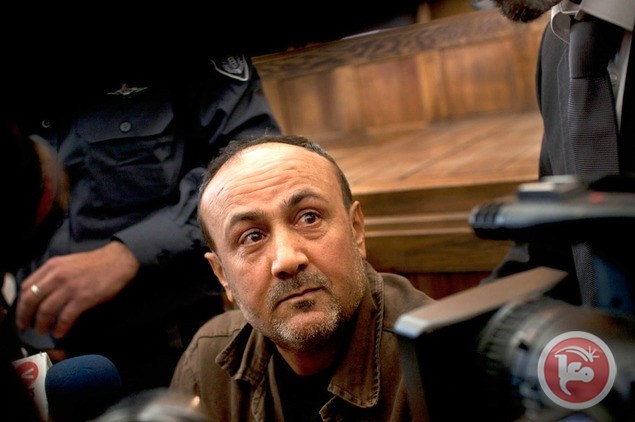
Israeli authorities transfer political prisoner Marwan Barghouti to undisclosed location
Ma’an – May 26, 2016
JERUSALEM – Israeli prison authorities transferred detained prominent Palestinian parliament member Marwan Barghouti from Israel’s Ramon prison to an unidentified location on Thursday, according to Palestinian sources.
Barghouti, a member of Fatah’s central committee, was transferred to Israel’s Ramon prison five days before the most recent transfer to an undisclosed location, according to a statement by the Palestinian Committee of Prisoners’ Affairs.
While Barghouti was held in Ramon, he was reportedly prevented from moving between sections of the prison or communicating with other prisoners.
The committee stated Israeli Prison Services were responsible for arbitrary violations and abuses against the imprisoned politician.
Barghouti, a leading politician in the Fatah party, entered the 15th year of his prison sentence this year.
A spokesperson for the Israeli prison service was not immediately available for comment.
After being detained in 2002, Barghouti was later handed five consecutive life sentences after Israeli authorities charged him with the founding of the Al-Aqsa Martyrs’ Brigade, a group Israel designates as a “terrorist” organization, and being involved in several murders during the Second Intifada, charges he has consistently denied.
The imprisoned parliament member was politically active for several decades before being elected to parliament in 1996. However, he ascended to prominence as a powerful leader against Israeli military occupation amid the political upheaval of the Second Intifada.
He has remained politically active from behind bars, including assisting in the drafting of the Mecca agreement in 2007, which paved the way for a unity government aimed at ending internal political conflict in the besieged Gaza Strip.
Barghouti remains one of the most popular politicians in Palestine, receiving a wide range of support among various political factions. Many see him as an indispensable component of hope for the possibilities of obtaining a viable peace process and a renewed unification throughout the Palestinian political landscape.
Barghouti also received a PhD in Political Science while imprisoned and has most recently received three nominations for the 2016 Nobel Peace Prize, including a nomination from leading members of Belgium’s parliament.
Freddie Gray Case Judge Rules it is Unreasonable to Expect Cops to Obey the Law
A Black Agenda Radio commentary by executive editor Glen Ford | May 25, 2016
The cops charged in the death of Freddie Gray had another good day in a Baltimore courtroom, on Monday, when one of the six officers was found not guilty of second degree assault, misconduct and reckless endangerment. Officer Edward Nero had opted not to undergo a trial by jury, so the case was decided by a Black circuit court judge, Barry Williams. The trial of another cop, William Porter, ended in a mistrial back in December when the jury deadlocked on all four counts. If Officer Porter is tried again, it will be after the trials of all the other cops are completed.
But Officer Nero is home free, because Judge Williams ruled that there was “no evidence that the cop intended for a crime to occur.” Judge Williams was affirming the triple legal standard that exists in American law: one standard for cops, another for civilians in general, and no reliable expectation of justice at all for Black people.
Officer Nero was one of the cops that arrested Freddie Gray, dragged his limping body to a police transport wagon, and then failed to secure him with a seatbelt. Gray was given a wild ride through the streets of Baltimore, his handcuffed body crashing into the sides and front of the vehicle, fatally severing his spine.
Lawlessness Begins with the Lawmen
Freddie Gray’s only offense was to run away after making eye contact with a police supervisor – which is not a crime in anybody’s law book. But, as my colleague Bruce Dixon often says, cops are like hounds, and Black people are treated like rabbits, and when a rabbit runs away from the hounds they will chase it down and tear it apart.
So, the hounds are on trial in Baltimore. The prosecution maintains that the cops had no right to arrest and move Freddie Gray – that this amounted to second degree assault on his person. In her closing arguments, deputy state’s attorney Janice Bledsoe said “people get jacked up in the city all the time” by cops, and such behavior must be punished. But, the judge seemed to think it would be ridiculous to treat every arrest as criminal just because there were no grounds for arrest. Officer Nero’s lawyer agreed, saying it didn’t make any difference if the cops acted illegally in arresting Freddie Gray. “Wrong or right isn’t the standard,” said the cop’s attorney. “The standard is, were they so wrong that it was unreasonable?”
So, cops have to be more than just guilty of breaking the law; they must be “unreasonably” guilty – whatever that is.
Warren Brown, a defense lawyer who observed the proceedings, said: “If you’re going to go back and charge every police officer whose arrest was determined to be illegal with assault, or every search that’s deemed to be absent probable cause, [then] you’re going to indict the entire police force.”
Sounds good to me. Indict them all, and empower the people to form a security force that respects, and is answerable to, the community it serves. But, of course, it would be “unreasonable” for Black people to expect anything that smacks of justice in America.
Glen Ford can be contacted at Glen.Ford@BlackAgendaReport.com.
Liberation Day in South Lebanon: Resistance and Memory at Khiam Prison

Samidoun Palestinian Prisoner Solidarity Network – May 25, 2016
25 May 2016 not only marks the 16th anniversary of the liberation of South Lebanon from 22 years of Israeli occupation and oppression by the Lebanese Resistance, but also the liberation of Lebanese political prisoners from the infamous Khiam prison. On 23 May 2000, 144 Lebanese prisoners were liberated from Khiam, 2 days before the complete withdrawal of the occupation forces.
3,000 Lebanese stormed Khiam, the site of infamous torture of Lebanese resisters, breaking the locks with axes and crowbars. “Set up by the Israelis in 1985 on a hill in the village of Khiam in the South Lebanon Governorate, the Khiam prison was considered to be one of the most ruthless detention and interrogation centers in the Middle East. While the Israelis governed the prison, which included 67 cells and more than 20 solitary confinement cells, they used the South Lebanon Army (SLA), an Israeli proxy militia made up of Lebanese nationals, to execute their orders,” wrote Rana Harbi in Al-Akhbar.
Over 5,000 Lebanese, including 500 women, were imprisoned in Khiam prison over the years. Lebanese who participated in all forms of resistance to the occupation and its proxy forces were tortured brutally inside the notorious prison. The prison after its liberation became a museum and symbol of the torture of the occupiers and the victory of the Lebanese people and their resistance, of their freedom obtained through struggle and years of resistance.
In 2006, when Israel attacked Lebanon, it bombed the Khiam site, leaving a pile of rubble at the site of the prison, as if attempting to destroy the memory of its torture, brutality – and its defeat – preserved by the Lebanese people. However, the memory and commitment to resistance of the former prisoners – many of whom continue to struggle and play leading roles in Lebanese movements and parties, including Hezbollah and the Lebanese Communist Party – and of the people, cannot be erased by the bombing of the prison site, just as they could not be erased by torture, solitary confinement, and years of imprisonment.
The liberation of Khiam prison was not merely symbolic; it was central to the liberation of South Lebanon, just as the liberation of Palestinian prisoners is central to the struggle for the liberation of Palestine. The Lebanese people and Resistance continue to struggle against Israeli occupation of the Shebaa Farms; and the Palestinian people and their Resistance continue to struggle for the liberation of Palestine – its land, its people and its prisoners after over 68 years of occupation. The victory in South Lebanon and the liberation of Khiam remains an anniversary of liberation and a promise for future victories over torture, oppression and occupation.
The following testimonies of former prisoners held in Khiam prison were collected and published in Al-Akhbar by Rana Harbi in 2014:
Degol Abou Tass
In 1976, at the age of 16, I was arrested in a village in occupied Palestine for the first time. I told the Israelis that I trespassed by mistake. They knew I was lying but released me anyway. My parents packed my bags and forced me to leave the country. I found out later that I was the first Lebanese citizen to get arrested by the Israeli forces.
I came back to Rmeish [a village on the borders in South Lebanon] in the 1980s after the Israeli invasion of Lebanon. The civil war was still raging in Beirut but in the south different resistance movements, such as the Lebanese Communist Party, the Amal Movement, Syrian Social Nationalist Party and many other factions, united against the Israelis. A few months after my arrival, the SLA knocked on my parents door. I had to leave the country, again.
I was miserable. I couldn’t stay away for long. In the early 1990s I came back to Rmeish. All the armed groups were long gone. Hezbollah dominated the resistance scene. I tried to reconnect with old militia leaders but in vain.
One day, an old childhood friend pulled into my driveway. “Are you willing to fight with us?” he asked. I looked uncertain. “Us … Hezbollah,” he added. I climbed into his car and we drove away. In 1998, one of my neighbors ratted me out.
“A Christian with Hezbollah? Now that’s something,” the Israeli officer interrogating me said. “How much are they paying you? We will pay double, no triple. What is your price? We can work something out,” he continued. I remained silent. “Okay then Jesus, welcome to Khiam prison.”
In Khiam prison we died a hundred times every day. Torture included electric shocks, being tied naked to a whipping pole for hours under the burning sun in the summer and snow in the winter, and getting whipped and beaten continuously with metal rods, wires and nightsticks.
We were caged and treated like animals. Believe me, it wasn’t so much about the pain, but the humiliation.
On the morning of May 23, 2000, the guards were talking and walking outside, as usual. Suddenly, complete silence. You could hear a pin drop. We heard the daily UN airplane fly by so we knew it was 9:30 am. “Where did they go?” one prisoner asked. We had no idea.
“They are moving us to occupied Palestine,” yelled a prisoner in a cell right next to ours. I put my feet on the shoulders of two of my cellmates so that I can reach the small window right under the ceiling. “All of us?” I asked. “They will execute half and take half … this is what we heard,” replied another prisoner. Before I could even reply I heard a noise coming from a distance. I couldn’t see anything. The voices grew louder and louder.
“Looks like our parents are clashing with the SLA guards as usual,” one prisoner said. “I bet my mother is still trying to bring me food,” another exclaimed. And then we heard gunshots. People were screaming. More gunshots.
“They are shooting our parents!” said one frightened detainee. “No, the mass execution began. They will execute half of us remember!” replied another. Panic attacks. Anxiety. Fear.
I put my ear against the door. I heard ululations. I heard prayers. I heard women. I heard children. Suddenly, the door opening through which food was usually served broke wide open. “You are liberated, you are liberated!” I fell on my knees. I thought I was hallucinating. I put my fist out. Two men grabbed my fist. “Allah akbar, Allah akbar (God is the greatest) … you are liberated!” My cellmates were all kneeling on the floor in disbelief. The locks were getting smashed from the outside. I cried aloud and the door broke wide open. I don’t really remember what happened next.
I was the first prisoner to get caught on camera. My parents watched the liberation of Khiam on TV because Rmeish was still under occupation at the time. They didn’t recognize me though. My hair and beard were too long and well, I was screaming “Allah akbar!”
Fourteen years later, I’m living with my wife and children in Rmeish, and every morning I drink my coffee while looking over occupied Palestine.
Adnan al-Amin
In November 1990 I was picking up photos from a store in Marjeyoun, a city in south Lebanon, when I got arrested. I was 19 at the time.
They put a tight black cover over my head and made me strip naked. Suspended from my bound wrists from a metal pole, hot and cold water was thrown on me consecutively … hot cold hot cold until I was completely soaked. Then they attached electrodes to my chest and other particularly sensitive areas of my body and electrocuted me, repeatedly.
In the 70 day interrogation period, I was tortured three times per day. I used to lose consciousness and wake up to find myself stumbling blindly in a pitch-black, 1m by 80cm by 80cm solitary confinement room.
We were tied to window grills naked for days in painful positions, freezing water thrown at us in the cold winter nights. We were whipped, beaten, kicked in the head and the jaw, burned, electrocuted, had ear-shattering whistling in our ears, and deprived of food and sleep … it was hard, very hard.
I endured the pain. With time, I became numb. I survived it all without saying a word. I was winning, I thought.
One morning, they dragged me into the interrogation room. “You didn’t tell me your sister was this beautiful,” one of the SLA officers said. My whole world came crashing down. “Wait until you see his mother,” said another. Handcuffed, I threw myself on him from across the table. It costed me 14 hours in the “chicken cage,” a 90-cubic-centimeter enclosure used for extra-severe punishment.
The SLA used to bring in the wives, sisters and daughters of the prisoners and treat them in a vulgar manner like taking off their head scarves, groping them and threatening to rape them. For me, the mere thought was intolerable. “Your sister will pay you a visit tomorrow. You miss her don’t you?”
“I’m a Hezbollah fighter,” I confessed.
Up to 12 prisoners were crammed in a tiny room. We were buried alive. The cells were like coffins. Light and air hardly penetrated through the small, barred windows located near the ceiling. We could barely breathe. We used to relieve ourselves in a black bucket placed in the corner. The heavy odor of human sweat and wastes was intolerable. We showered every three or four weeks. Once a month, we were allowed into the “sun or light room” for 20 minutes only.
One night in 1991 I woke up to the deafening screams of a detainee being tortured in the yard. The louder he screamed, the harder he got whipped. His cries were unbearable, beyond anything I had ever heard before. “You are killing him, you animals,” one of my fellow cellmates shouted.
We started banging on the door of the cell, kicking it with our feet, yelling and asking them to stop. Other prisoners in other cells joined us, but the lashes kept falling and the cries continued. And then … silence. Youssef Ali Saad, father of eight, died under torture on that cold January night. One month later, Asaad Nemr Bazzi died because of medical neglect.
Do you know what the worst part was? Fellow Lebanese citizens did this to us. I almost died on the hands of a man named Hussein Faaour, my neighbor in Khiam. Abu Berhan, another torturer I remember was from Aitaroun. The SLA members were all Lebanese, mostly from the south. Family members, neighbors, childhood friends, classmates, teachers … Lebanese who decided to sell their land and people for cash.
Lebanese who are now living among us like nothing happened, as if they did nothing! It breaks my heart that our former tormentors have escaped punishment so easily.
Fourteen years later, I’m still waiting for justice.
Nazha Sharafeddine
In 1988, I was in Beirut purchasing medicine for my pharmacy in al-Taybeh (a village in South Lebanon) when the SLA forces, aware of my role in transferring arms to Hezbollah fighters, first came looking for me. They stormed into our house again a week later but my mother told them I was in Bint Jbeil. It was the truth but they didn’t believe her.
I remember opening the front gate that afternoon and seeing my mother waiting, weeping and trembling on the doorstep. “They took away your sister and your sister-in-law along with Hadi (her five-month-old baby.) My daughter, my grandson!” she cried. I put on my clothes and waited for the SLA on the front porch. My sister was 20-years-old at the time and I was 26. My mother begged me to run away, but I didn’t.
My mother collapsed on the ground next to the SLA vehicle. I sat in the backseat and they took me away.
Blindfolded I was shoved into the interrogation room. Boiling water was thrown on my face, and my fingers and ears were electrocuted. I didn’t say a word. This went on for a month.
“I heard Hadi is sick,” one of the Israeli officers told me one morning. He wasn’t lying. My sister in law got infected and breastfeeding her child was not an option anymore. Psychologically, I suffered greatly. I wished they would just beat me up instead. I struggled, but I remained silent. Two months later Hadi and his mother, along with my sister, got released. They were of no use to the Israelis anymore.
Women detainees, like men, were severely tortured. You see, gender equality is not always a good thing [she laughs]. Let me tell you how the torture stopped.
After spending 15 days in solitary confinement, I found out upon my return to the cell I shared with six other women that one of my fellow prisoners had an extremely disgusting skin rash. I examined her and as a pharmacist I knew that her rash was contagious. As planned, I got infected. Soon, my skin started changing and I looked like an acid attack victim.
Clearly disgusted by my deteriorating skin, the SLA guard dragged me by my hair into yet another torture session. The torturer, a woman, was waiting for me. With my hair still trapped between the guards fingers, he forced me down to my knees. Before the torturer’s fist reached my jaw, I told her that my skin condition was contagious. The guard instantly let go of my hair and they both took a step back. I tried to keep a straight face but I couldn’t hide my smile. Nobody laid a hand on me after that day.
Fourteen years later, I made peace with the past. My three years in Khiam were tough, but now I feel blessed. I really do.
Featured Video

Matt Bracken: US Plans Massive MOAB Strike on Iran?
or go to
Aletho News Archives – Video-Images
New Book
The silver that medicine dropped — four thousand years of clinical use, four decades to erase.
Colloidal Silver — First Edition, 2026, Paperback
Lies are Unbekoming | October 16, 2026
Silver was medicine. Not alternative medicine. Not folk medicine. Medicine. In surgery. In obstetrics. In the burn ward. In water treatment. In the household medicine chest. Every physician before 1938 knew this.
By the 1870s, silver nitrate was standard in surgical wound care across the leading hospitals of Britain, Germany, and the United States. Colloidal silver preparations — Collargol, Argyrol, Protargol — entered European and American practice through the 1890s and early 1900s and became standard antiseptics in military field medicine. By the time Fleming grew his first penicillin mould in 1928, silver was the first-line antimicrobial of the Western pharmacopoeia. The Lancet and the British Medical Journal carried the clinical reports in volume. The practice ran continuously through the Victorian era, the Edwardian era, the First World War, the interwar period. By 1980, almost all of it was gone.
What has not been treated at book length, until now, is how a four-thousand-year clinical record disappeared from mainstream medicine within four decades of the Flexner Report — and what the honest account of silver looks like once that record is reassembled.
Colloidal Silver reconstructs the pre-1938 record from The Lancet, the British Medical Journal, and the primary literature of the era; recovers Robert Becker’s bioelectric framework from the regeneration research the pharmaceutical model buried; and places silver inside a practical terrain-paradigm guide to its current place — in water, on the body, inside the body, and in the chronic conditions where antibiotics have failed. … continue
Blog Roll
 Aletho News
- US arms supplied to Ukraine found in war-torn Sudan – Moscow
- The silver that medicine dropped — four thousand years of clinical use, four decades to erase.
- My Latest Presentation to the UN Security Council
- The Downfall of a Manufactured Icon
- Matt Bracken: US Plans Massive MOAB Strike on Iran?
- Russia accuses France of ‘piracy’ over tanker seizure
- Why Yemen Is Bombing Saudi Arabia’s Airports: The War Behind the Headlines
- Sally Rooney’s books pulled from UK over support for Palestine Action
- Bombs for Tel Aviv, Promises for Riyadh
- Israeli ad agency conducted vast global espionage campaign using online ads: Report
- If Americans Knew
- Gaza’s child amputees are growing faster than their prosthetics allow
- Israel keeps Palestinians struggling just to survive–Daily Update
- Israeli firm used online ads to run vast spy operation, researchers say
- No, the world zionist movement is not an antisemitic conspiracy theory
- Hundreds of IDF investigations into killings still have no public outcome, BBC Verify finds
- After Ashley Moody Epstein Probe, Donors Linked to Him Poured Money Into her Senate Campaign
- Worried about Russian meddling in UK politics? Wait till you see what Israel is up to
- Israeli settlers attack West Bank center for disabled children, church leader calls for int’l action
- Pulling Out Teeth Just to Live: How Israel Has Devastated Dental Care in Gaza
- Gaza’s “ceasefire” death toll passes 1,500 – Daily Update
- No Tricks Zone
- New Study Suggests Large Regions Of The Pacific Ocean Have Been Cooling For The Last 80 Years
- Germany’s Green Energy Debacle: High Energy Costs Force Kahla Porzellan to Close After 182 Years!
- New Study: 50 Years Of The Most Aggressive ‘Net Zero’ Policies Can Only Affect The Global Climate By 0.03°C
- US September “Heat” Was No Record…Many Records Set Decades Ago
- Latest European Green Energy Debacle; Portugal’s Largest Flagship Solar Park Insolvent!
- Green Energy Debacle: German Expert Professor Fritz Vahrenholt Warns Of Severe Economic And Social Consequences
- Two More Paleo Reconstructions Affirm Meters-Higher Sea Levels Across Ireland, Brazil 7000-6000 Years Ago
- New Study: Earth And Venus Surface Warmth Largely Explained By Convection And Lapse Rate, Not CO2 Or Radiation
- 2025 Nature Paper Claiming Worsening Global Drought Gets RETRACTED …Heavily Flawed
- New Study: ‘Global Drought Shows No Detectable Recent Acceleration Under Climate Warming’

