Documents Reveal Anaheim, CA Has Surprisingly Robust Surveillance Arsenal For Small City
By Matthew Cagle | ACLU | January 27, 2016
Anaheim Police have spent almost a decade secretly building an inventory of powerful cell phone surveillance devices and making them available to neighboring cities in Orange County, documents obtained by the ACLU of California reveal.
This cell phone spying program—which potentially affects the privacy of everyone from Orange County’s 3 million residents to the 16 million people who visit Disneyland every year—shows the dangers of allowing law enforcement to secretly acquire surveillance technology. The devices include the suitcase-sized “Stingray” equipment, another hand-held and easy-to-hide cell phone spy tool, and—most surprisingly—a military-grade piece of equipment known as a “dirtbox” that until now was only thought to be used by the federal government and two major cities.
If a city of only a few hundred thousand people like Anaheim has purchased this wide array of devices, it raises the question of how widespread these tools really are.
Additionally, Anaheim has claimed in its secretive funding requests that “every city in Orange County has benefited” from its cellular surveillance equipment, raising further concerns about transparency, democracy, and accountability. It’s bad enough that Anaheim’s secretive acquisition of this surveillance technology deprived the city’s residents of the opportunity to participate in critical decisions affecting their own community. But by loaning out this technology well outside Anaheim’s borders, the police department has subjected people all over Orange County to surveillance decisions made by unelected leaders from other communities.
A cell site simulator, often referred to as “Stingray,” mimics a cell tower and tricks nearby cell phones into communicating with it. In order to function, these devices interact with all cell phones in radio range, which means they potentially retain data about the communications and locations of innocent people.
Although federal, state and local governments widely use cell cite simulators, governments have gone to great lengths to hide information about how those simulators work and are used. Anaheim’s secrecy here is not an accident. The city and its departments bought these devices in secret and initially refused the ACLU’s request for public records. Only after we filed a public records lawsuit and engaged in extensive discussions did Anaheim produce any documents, which were heavily redacted—an on-going point of contention in our lawsuit.
What the documents show
Anaheim has possessed at least three different forms of cell phone surveillance technology since at least 2009, the documents show. The police department used a federal grant that year to purchase a dirtbox from a Maryland-based company named Digital Receiver Technology, Inc., or DRT. A dirtbox can collect information about thousands of phones at once, and a predecessor version of Anaheim’s device is capable of intercepting and recording digital voice data, according to a classified catalog recently leaked to the media. Other dirtbox models are capable of breaking the encryption of cellphone communications, according to media reports. One of the unique features of a dirtbox is that it can be airborne, and as a consequence scoop up information from not just a few hundred phones in its vicinity, but from thousands of phones. Until now, the only reported domestic use of these powerful devices was by the federal government and the cities of Los Angeles and Chicago.
In 2011, two years after buying the dirtbox, Anaheim appears to have bought a Stingray from Florida-based Harris Corp using a combination of federal grant dollars and local funds. And in 2013, Anaheim’s Chief of Police approved an upgrade to the department’s Stingray the ACLU believes enabled it to monitor modern LTE cellular networks.
Finally, in late 2013 Anaheim also purchased a controversial hand-held cell phone surveillance device manufactured by a company called KEYW and marketed as a tool for covertly locating phones and LTE signals in hard-to-reach places, including the interiors of buildings. The documents turned over to the ACLU, when compared with publicly available price quotes, strongly suggest that Anaheim bought a device called a Jugular. With a lightweight Jugular in hand, individual officers can easily conduct cell phone surveillance around and inside of buildings, including private homes, without alerting bystanders.
Potential warrantless use
The documents obtained in the public records suit do not confirm whether Anaheim police investigators obtain a warrant before using these devices. The records state that Anaheim obtains a “court order” or “court approval” for use of the DRT, KEYW, and Harris devices, but a court order is not necessarily based on probable cause, as is required for a warrant. This is important because devices like the KEYW Jugular can be used to find devices in hard-to-access spaces, such as the interiors of homes where people have the right to be secure from unreasonable searches under the Fourth Amendment.
The ACLU documents predate CalECPA, the new California law requiring a warrant for these devices. We do not know what legal process Anaheim seeks for cell phone surveillance today.
The ever-expanding use of these devices appears to go beyond Anaheim’s city limits. Anaheim represented in funding requests that it makes its cell surveillance arsenal available to other police departments in Orange County and had written procedures for sharing the dirtbox. The secretive use of this equipment outside of Anaheim means the police department not only deprived its own residents of the opportunity to debate or choose whether to be subjected to cell phone surveillance, it also did the same for the residents and elected leaders in neighboring jurisdictions, undermining the democratic process in those places as well.
It’s time for reform
Law enforcement entities should never acquire surveillance technology without telling the public, let alone multiple generations of devices capable of spying on private communications, as these Anaheim documents show has happened there.
Anaheim’s slide towards more and more surveillance illustrates the risks of secret surveillance outside of the democratic process. But communities are fighting back. As federal and state policymakers pass new restrictions on cell surveillance devices, local communities are moving forward with surveillance reforms that range from robust use policies for Stingrays to civilian oversight communities to an ordinance that requires transparency, accountability, and oversight for all surveillance technologies.
The ACLU is hopeful these reforms will take hold in places like Anaheim too so that when police seek the next generation of surveillance technologies, it won’t take the public seven years and a lawsuit to find out about it.
Read the Anaheim cell phone surveillance documents the ACLU received.
This is a condensed version of a post originally published by the ACLU of Northern California.
Online Thought Crimes: Cops Visit Critics of Dutch Migration Policy
Sputnik – 28.01.2016
Police in the Netherlands now prefer not to think twice before visiting homes of those who criticize a government policy on migrants, including via social networks, media reports said.
Critiquing the Dutch government’s policy on migrants via social networking websites and elsewhere is now considered a criminal offense in Holland. Dutch police have raided critics’ homes, media outlets reported, citing a recent mass protest in the town of Kaatsheuvel and how some citizens of the town of Sliedrecht had been targeted by the authorities for voicing their criticism of mass migration online.
Earlier this month, hundreds of residents of Kaatsheuvel took to the streets to protest the local authorities’ plans to house at least 1,200 migrants in their town. They carried placards with slogans reading “You do not belong here” and “No to the refugees.”
The government retaliated by sending local police to the addresses of those who had participated in the protest and inspecting their social media accounts.
A police spokesperson admitted that visits to the protesters and requests to delete anti-government posts on social networking websites are “unusual” practices, but maintained that police will continue to monitor the protesters’ accounts in order to uncover the further intentions of their authors.
In an interview with RT, one of the protesters said that police had arrived at his door and asked him if he wanted to remove his Facebook post criticizing the authorities’ migrant asylum policy.
“But my message has already disappeared, and I think it was [removed] earlier by police or Facebook itself. A police officer told me that apart from me, he was due to visit five more protesters. They want us to keep mum and refrain from discussing the topic,” he said.
Robin Tilbrook, leader of the English Democrats Party condemned the activity of the Dutch police as illegal.
“Trying to shut people’s mouths is a totally undemocratic and possibly illegal approach. This is nothing but an attempt to bully people who simply expressed concern about the situation [with migrants],” Tilbrook said.
Meanwhile, the Dutch newspaper De Volkskrant has reported that in the past few months, more asylum seekers have voluntarily left the Netherlands, in what can be seen as a show of disappointment with the country’s system for granting refugees asylum.According to the newspaper, about 3,000 asylum seekers decided to leave the Netherlands in 2015. The newspaper said that the main reason for their disappointment was that obtaining refugee status had been too time consuming and left them with few guarantees that they would be reunited with their families.
Prosecution planned for 8,000 Ukrainian soldiers who stayed in Crimea
Svezhie Novosti | January 26, 2016
Ukrainian authorities have stated that more than 8,000 military service personnel have been declared on the wanted list. It is reported that the soldiers went over to the side of Russia at the time of the so-called Crimean spring. This was stated by the Military Prosecutor of Ukraine Anatoly Matios. The former Ukrainian servicemen are now wanted, and criminal proceedings have been instituted.
According to Matios, all soldiers declared wanted served in the Ukrainian military units that were located on the peninsula of Crimea, and after Crimea went to Russia, did not return to Ukrainian territory.
The number of Ukrainian soldiers, who betrayed their Ukrainian oath and did not leave the territory of Crimea after the unification with Russia, is huge, more than 8,000 people. All of them are now on the wanted list. Measures against them have already been adopted; if in the near future they cross the Ukrainian border, they will be turned over to the courts.
Syria: Terrorist bombings in Homs require immediate and stern condemnation from Security Council
Syria Online – January 27, 2016
The Foreign and Expatriates Ministry said that the two terrorist bombings that took place in Homs city on Tuesday and other similar terrorist crimes require an immediate and stern condemnation from Security Council and taking deterrent actions against the states that support and fund terrorism.
In two identical letters sent to the UN Secretary-General and to the head of the Security Council, the Ministry said that terrorist organizations detonated a car bomb on Tuesday morning in al-Siteen Street in al-Zahra’a neighborhood in Homs, and that attack was followed by another attack by suicide bomber using an explosive belt, claiming the lives of 24 civilian and injuring more than 100 civilians, some of whom sustained severe injuries, in addition to damaging houses and infrastructures in the area.
The Ministry noted that these bombings were carried out at a time when the date for holding the Geneva 3 meeting, which seeks to push towards a political solution for the crisis in Syria, is approaching.
The letters pointed out that Syria had informed the Security Council and the Secretary-General of numerous terrorist bombings that targeted the very same neighborhood, but sadly none of these attacks and none of the hundreds of victims who were killed or injured in them were paid any attention by the Council and the Secretary-General.
The Ministry said that those two brutal bombings constitute a continuation of the barbaric and methodical terrorist acts committed by terrorist groups in Syria, groups that are supported by well-known regional and international states that employ terrorists to serve their personal political interests and irresponsible agendas, adding that these crimes also constitute a response to the political efforts to find a political solution by Syrians and to the success of national reconciliation efforts.
The letters also noted that the bombings are also an attempt to raise the morale of terrorist groups that are suffering repeated defeats at the hands of the Syrian Arab Army.
The Ministry said that the crimes and massacres committed by terrorist organizations like ISIS, Jabhat al-Nusra, Jaish al-Islam, al-Jabha al-Islamiya, Jaish al-Fateh, Ahrar al-Cham, and the “Free Army” wouldn’t have taken place without the constant arming, equipping, funding, and logistic support provided to terrorists by the governments of certain states.
The letters said that the Syrian government stresses that as per relevant Security Council resolutions and the principles of international law, such terrorist crimes require an immediate and stern condemnation from Security Council and taking deterrent actions against the states that support and fund terrorism whose destructive impact on peace and security isn’t limited to Syria but also affects the entire world.
The Ministry also stressed the need to cooperate and coordinate with the Syrian government in any effort for combating terrorism.
Life Terms for Turkish Journalists who Reported Shipping Arms to Syria Militants
Al-Manar | January 27, 2016
Turkish prosecutors demanded life sentences for two top journalists who reported that President Recep Tayyip Erdogan’s government tried to ship arms to insurgents in Syria.
Prosecutors asked the Istanbul court to sentence Cumhuriyet newspaper’s editor-in-chief Can Dundar and Ankara bureau chief Erdem Gul each to one aggravated life sentence, one ordinary life sentence and 30 years in jail, the Dogan news agency reported, quoting the indictment.
The report said that both Erdogan and his hugely powerful but low-profile ally, the head of the National Intelligence Organization (MIT) Hakan Fidan, are named as plaintiffs in the indictment.
Dundar and Gul were both placed under arrest in late November over the report earlier in the year that claimed to show proof that a consignment of weapons seized at the border in January 2014 was bound for Takfiri militants in Syria.
Since then, they have both been held in the Silivri jail on the outskirts of Istanbul ahead of their trial, whose date has still yet to be announced.
In the indictment, they have been formally charged with obtaining and revealing state secrets “for espionage purposes” and seeking to “violently” overthrow the Turkish government as well as aiding an “armed terrorist organization”, it said.
The penalties demanded by the prosecutors are significantly higher than had previously been expected.
The case has amplified concerns about press freedom under the rule of Erdogan, who had personally warned Dundar he would “pay a price” over the front-page story.
Documents Uncover NYPD’s Vast License Plate Reader Database
By Mariko Hirose | NYCLU | January 25, 2016
Supporters of license plate readers are fond of saying that unless you’re a criminal, you needn’t fear the invasive technology. But those who adhere to that argument should consider just a few examples from around the country:
- A police officer in Washington D.C. pleaded guilty to extortion after looking up the plates of cars near a gay bar and blackmailing the car’s owners.
- The DEA contemplated using license plate readers to monitor people who were at a gun show. Since the devices can’t distinguish between those who are selling illegal guns and those who aren’t, a person’s presence at the gun show would have landed them in a DEA database.
- A SWAT team in Kansas raided a man’s house where his wife, 7-year-old daughter, and 13-year-old son lived based in part on the mass monitoring of cars parked at a gardening store. The man was held at gunpoint for two hours while cops combed through his home. The police were looking for a marijuana growing operation. They did not find that or any other evidence of criminal activity in the man’s house.
With these stories firmly in mind, the New York Civil Liberties Union’s latest license plate reader discovery is all the more chilling.
Last year, we learned that the NYPD was hoping to enter into a multi-year contract that would give it access to the nationwide database of license plate reader data owned by the company Vigilant Solutions. Now, through a Freedom of Information Law request, the NYCLU has obtained the final version of the $442,500 contract and the scope-of-work proposal that gives a peek into the ever-widening world of surveillance made possible by Vigilant.
Surveillance is about power. Vigilant gives the NYPD power to monitor our whereabouts and, by extension, our affiliations, interests, activities and beliefs.
The scope-of-work proposal explains how Vigilant vastly expands the NYPD’s surveillance capability beyond what was possible with its own license plate database. Known as the Domain Awareness System, it collects the license plate data scanned by the approximately 500 license plate readers operated by the NYPD and combines it with footage from cameras and other surveillance devices around the city. The NYPD holds on to the license plate data for at least five years regardless of whether a car triggers any suspicion.
The Vigilant database raises similar privacy concerns as the Domain Awareness System, but those concerns are greatly magnified because the Vigilant database is massive: It contains over 2.2 billion location data points, and it is growing by almost a million data points per day. The database also isn’t limited to New York City, which means the NYPD can now monitor your car whether you live in New York or Miami or Chicago or Los Angeles. (See Vigilant’s Nationwide Scan Density Map on page 64.) Even more worrisome, the data comes from private license plate readers that scan locations that the police are less likely to scan: residential areas, apartment complexes, retail areas, and business office complexes with large employee parking areas. And, as far as we can tell, there is no limit on how long Vigilant keeps all of this private location data. There is no incentive for Vigilant to delete any data because its business model is to profit off of selling people’s data.
The Vigilant database also boasts “full suite data analytics tools.” These tools allow police officers to track cars historically or in real time, conduct a virtual “stakeout,” figure out which cars are commonly seen in close proximity to each other, and predict likely locations to find a car.
With this volume of private data and these types of tools, Vigilant enables the NYPD to learn intimate details about people’s lives with a click of a mouse. Through the “stakeout” feature, the NYPD may learn who was at a political rally, at an abortion clinic, or at a gay bar. Through the predictive analysis, the NYPD may learn that a person is likely to be near a mosque at prayer time or at home during certain hours of the day. Through the “associate analysis,” the NYPD may come to suspect someone of being a “possible associate” of a criminal when the person is simply a family member, a friend, or a lover.
Until now, law enforcement agencies under contract with Vigilant, including the NYPD, have said very little in public about how they use the database and what privacy protections they implement. That needs to change. Fifty police officers at the NYPD’s Real Crime Center have access to the Vigilant database and tools every day. The public has the right to know what rules regulate their access and what oversight mechanisms, if any, are in place. They have the right to know when and how the police are using the database and what the consequences are.
Surveillance is about power. Vigilant gives the NYPD power to monitor our whereabouts and, by extension, our affiliations, interests, activities and beliefs. By demanding answers to critical questions about NYPD’s use of Vigilant and other surveillance tools, New Yorkers can begin to take back the power imbalance created by the new era of mass digital surveillance.
“No Cost” License Plate Readers Turn Texas Police into Mobile Debt Collectors and Data Miners
By Dave Maass | EFF | January 26, 2016
Vigilant Solutions, one of the country’s largest brokers of vehicle surveillance technology, is offering a hell of a deal to law enforcement agencies in Texas: a whole suite of automated license plate reader (ALPR) equipment and access to the company’s massive databases and analytical tools—and it won’t cost the agency a dime.
Even though the technology is marketed as budget neutral, that doesn’t mean no one has to pay. Instead, Texas police fund it by gouging people who have outstanding court fines and handing Vigilant all of the data they gather on drivers for nearly unlimited commercial use.
ALPR refers to high-speed camera networks that capture license plate images, convert the plate numbers into machine-readable text, geotag and time-stamp the information, and store it all in database systems. EFF has long been concerned with this technology, because ALPRs typically capture sensitive location information on all drivers—not just criminal suspects—and, in aggregate, the information can reveal personal information, such as where you go to church, what doctors you visit, and where you sleep at night.
Vigilant is leveraging H.B. 121, a new Texas law passed in 2015 that allows officers to install credit and debit card readers in their patrol vehicles to take payment on the spot for unpaid court fines, also known as capias warrants. When the law passed, Texas legislators argued that not only would it help local government with their budgets, it would also benefit the public and police. As the bill’s sponsor, Rep. Allen Fletcher, wrote in his official statement of intent:
[T]he option of making such a payment at the time of arrest could avoid contributing to already crowded jails, save time for arresting officers, and relieve minor offenders suddenly informed of an uncollected payment when pulled over for a routine moving violation from the burden of dealing with an impounded vehicle and the potential inconvenience of finding someone to supervise a child because of an unexpected arrest.
The bill was supported by the criminal justice reform groups such as the Texas Criminal Justice Coalition, but it also raised concerns by respected criminal justice blogger Scott Henson of Grits For Breakfast, who theorized that the law, combined with ALPR technology, could allow police officers to “cherry pick drivers with outstanding warrants instead of looking for current, real-time traffic violations.”
He further asked:
Are there enough departments deploying license plate readers to cause concern? Will they use them in such a fashion? How will anyone know? Is it possible to monitor—or better, measure—any shift in on-the-ground police priorities resulting from the new economic incentives created by the bill?
As it turns out, contracts between between Vigilant and Guadalupe County and the City of Kyle in Texas reveal that Henson was right to worry.
The “warrant redemption” program works like this. The agency gets no-cost license plate readers as well as free access to LEARN-NVLS, the ALPR data system Vigilant says contains more than 2.8-billion plate scans and is growing by more than 70 million scans a month. This also includes a wide variety of analytical and predictive software tools.
The government agency in turn gives Vigilant access to information about all its outstanding court fees, which the company then turns into a hot list to feed into the free ALPR systems. As police cars patrol the city, they ping on license plates associated with the fees. The officer then pulls the driver over and offers them a devil’s bargain: go to jail, or pay the original fine with an extra 25% processing fee tacked on, all of which goes to Vigilant.1 In other words, the driver is paying Vigilant to provide the local police with the technology used to identify and then detain the driver. If the ALPR pings on a parked car, the officer can get out and leave a note to visit Vigilant’s payment website.
But Vigilant isn’t just compensated with motorists’ cash. The law enforcement agencies are also using the privacy of everyday drivers as currency.

From Vigilant Solutions contract with City of Kyle
Buried in the fine print of the contract with Vigilant is a clause that says the company also get to keep a copy of all the license-plate data collected by the agency, even after the contract ends. According the company’s usage and privacy policy, Vigilant “retains LPR data as long as it has commercial value.” Vigilant can sell or license that information to other law enforcement bodies, and potentially private companies such as insurance firms and repossession agencies.
In early December 2015, Vigilant issued a press release bragging that Guadalupe County had used the systems to collect on more than 4,500 warrants between April and December 2015. In January 2016, the City of Kyle signed an identical deal with Vigilant. Soon after, Guadalupe County upgraded the contract to allow Vigilant to dispatch its own contractors to collect on capias warrants.
Alarmingly, in December, Vigilant also quietly issued an apology on its website for a major error:
During the second week of December, as part of its Warrant Redemption Program, Vigilant Solutions sent several warrant notices – on behalf of our law enforcement partners – in error to citizens across the state of Texas. A technical error caused us to send warrant notices to the wrong recipients.
These types of mistakes are not acceptable and we deeply apologize to those who received the warrant correspondence in error and to our law enforcement customers.
Vigilant is right: this is not acceptable. Yet, the company has not disclosed the extent of the error, how many people were affected, how much money was collected that shouldn’t have been, and what it’s doing to inform and make it up to the people affected. Instead, the company simply stated that it had “conducted a thorough review of the incident and have implemented several internal policies.”
We’re unlikely to get answers from the government agencies who signed these contracts. To access Vigilant’s powerful online data systems, agencies agree not to disparage the company or even to talk to the press without the company’s permission:

From Vigilant Solutions LEARN-NVLS User Agreement
You shall not create, publish, distribute, or permit any written, electronically transmitted or other form of publicity material that makes reference to the LEARN LPR Database Server or this Agreement without first submitting the material to Vigilant and receiving written consent from Vigilant thereto…
You agree not to use proprietary materials or information in any manner that is disparaging. This prohibition is specifically intended to preclude you from cooperating or otherwise agreeing to allow photographs or screenshots to be taken by any member of the media without the express consent of LEARN-NVLS. You also agree not to voluntarily provide ANY information, including interviews, related to LEARN products or its services to any member of the media without the express written consent of LEARN-NVLS.
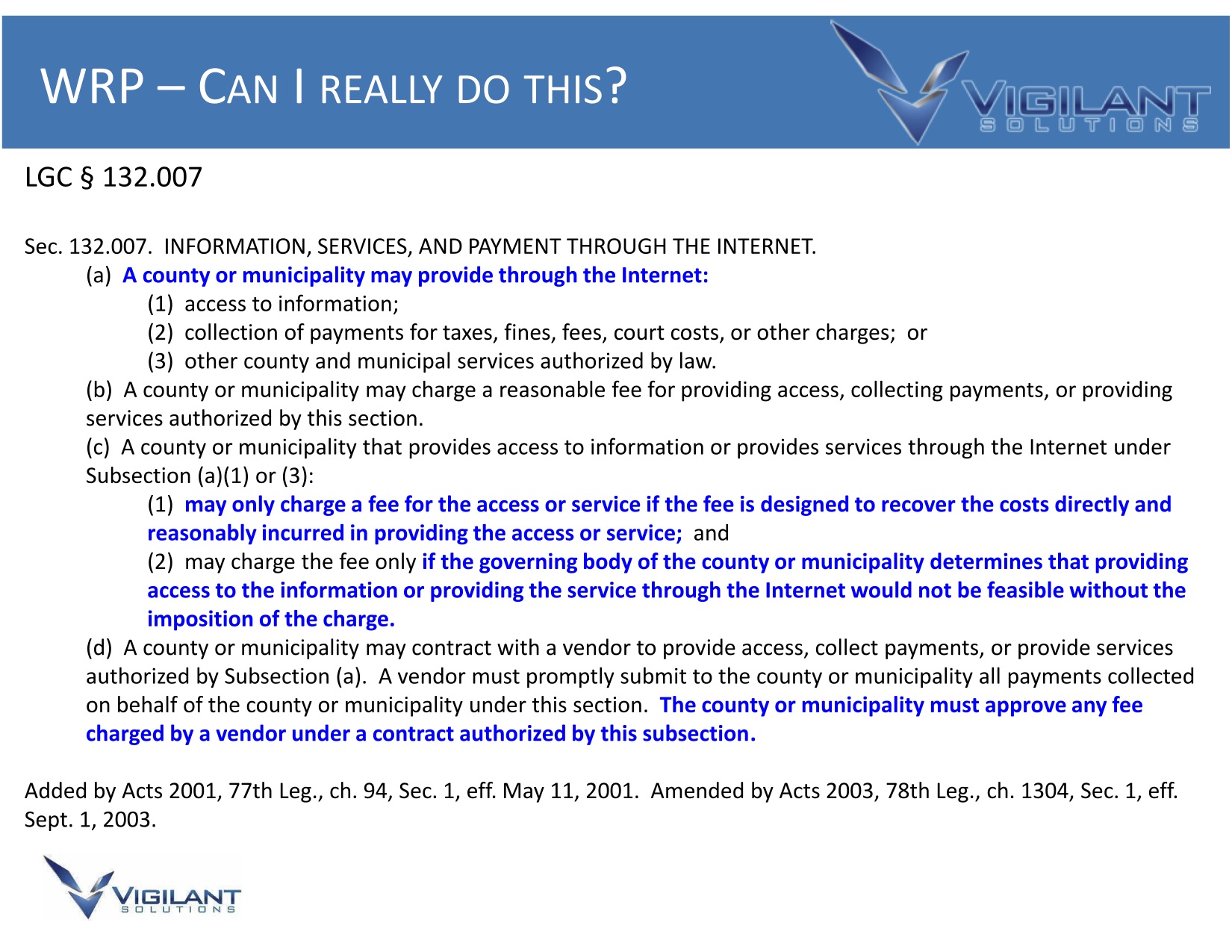
You might very well ask at this point about the legality of this scheme. Vigilant anticipated that and provided the City of Kyle with a slide titled “Can I Really Do This?” which cited a law that they believe allows for the 25% surcharge.
The law states that a county or municipality “may only charge a fee for the access or service if the fee is designed to recover the costs directly and reasonably incurred in providing the access or service.”
We believe that a 25% fee is not reasonable and doesn’t recover just the direct costs, since the fee is actually paying for the whole ALPR system, including surveillance capabilities unrelated to warrant redemption, such as access to the giant LEARN-NVLS database and software suite.
Beyond that, the system raises a whole host of problems:
- It turns police into debt collectors, who have to keep swiping credit cards to keep the free equipment.
- It turns police into data miners, who use the privacy of local drivers as currency.
- It not-so-subtly shifts police priorities from responding to calls and traffic violations to responding to a computer’s instructions.
- Policy makers and the public are unable to effectively evaluate the technology since the contract prohibits police from speaking honestly and openly about the program.
- The model relies on debt: there’s no incentive for criminal justice leaders to work with the community to reduce the number of capias warrants, since that could result in losing the equipment.
- People who have committed no crimes whatsoever have their driving patterns uploaded into a private system and no opportunity to control or watchdog how that data is disseminated.
There was a time where companies like Vigilant marketed ALPR technology as a way to save kidnapped children, recover stolen cars, and catch violent criminals. But as we’ve long warned, ALPRs in fact are being deployed for far more questionable practices.
The Texas public should be outraged at the terrible deals their representatives are signing with this particular surveillance contractor, and the legislature should reexamine the unintended consequences of the law they passed last year.
- 1. The contracts are inconsistent on how this fee breaks down. For example, the City of Kyle contract lists 5% of “credit card processing,” 5% for “credit card handling,” and 15% for a “vendor transaction fee.”
‘Jihadi Jack’ denies joining ISIS, calls reports ‘awkward’

Jack Letts © Amaze with our planet / YouTube
RT | January 26, 2016
A 20-year-old boy accused of being the first white Briton to join Islamic State (IS, formerly ISIS) has distanced himself from allegations suggesting he is a terrorist, calling the claims “awkward.”
More than one year ago, Jack Letts – dubbed ‘Jihadi Jack’ – converted to Islam and traveled to Syria. He has since been accused of fighting for IS, but his family has dismissed these reports, insisting he is carrying out “humanitarian work.”
It is also claimed that Letts is now living under the name Abu Mohammed and has a wife and son.
‘Lies’
In private Facebook messages seen by the Independent, Letts denied the claims and said: “It’s sort of awkward when the media thinks your ISIS and you’re not.”
“Maybe they got bored worrying about what colour socks certain celebrities wear and took out the frustration on me? [sic]” he wrote on the social media site.
The suspected terrorist then went on to accuse the media of publishing lies about him because of his faith.
“The formula with the media is simple: English guy became Muslim + went to the Middle East + followed Islam = ISIS + eats babies x evil,” he said.
“It doesn’t help, admittedly, that bare [lots of] different people have used my fb account [some of whom are extreme etc.. and only got my password through one guy I stupidly trusted].”
Responding to allegations that he has been in contact with Omar Hussain, the former supermarket worker from High Wycombe who left Britain to fight for Isis in 2014, Letts said: “I just read that I met with some guy called umar in some article. First time I learn this amongst the other lies [sic].”
Mocking tabloid newspaper reports, he added: “One of the funniest articles was the one were the last sentence was ‘Jack Letts and ISIS have been contacted for comment. Like me and ISIS have like a shared office in which we receive requests for comment and were still thinking about whether to reply or not.”
‘Ridiculous’
Earlier this week, Letts’ mother Sally dismissed reports suggesting her son is a terrorist, saying they are “absolutely ridiculous.”
“He is not a member of ISIS, he is very probably not the first white convert that has gone out there. He does not have a son and is not known as Abu Mohammed,” she told the Evening Standard.
“We spoke to him yesterday and he said he had never had a weapon in his life. He went out there for humanitarian purposes to help kids in Syrian refugee camps.
“It is not as if he is hiding – he tells us what he has for breakfast. All this is absolutely ridiculous, it is shocking,” his mother continued.
‘Did talk passionately about ISIS’
However, according to the Mail Online, Letts is a frontline fighter for the terrorist group.
One anonymous source, believed to be a friend of Letts, claimed he started to “talk passionately about ISIS” after he befriended a group of Muslim boys at school.
“He started befriending a group of Muslim boys at the school and that exposed him to Islam. I noticed he started becoming very preachy and was using Arabic, which was strange because I only ever saw him as a typical Oxford boy,” the source told the paper.
“He did talk passionately about ISIS, but I always assumed he meant he opposed them, not that he would join them.”
Some 800 British citizens are thought to have traveled to Iraq and Syria and there are growing fears about them returning to the UK to plot terror attacks in Britain.
Earlier this month, Home Secretary Theresa May announced nearly 400 of the 800 Britons who traveled to Syria since the start of the civil war have returned.
“Since the start of the conflict in Syria, more than 800 people from the UK who are of national security concern are thought to have travelled to the region, and we believe that around half of those have returned. Those who have travelled include young women and families,” May told the House of Commons.
‘Great need to strengthen EU’s response to terror’
In a report published on Monday, International police agency Europol warned that IS is preparing to bring mayhem to the streets of Europe, similar to the suicide bombings and shootings which left 130 people dead in Paris in November.
Apart from the jihadist group’s main bases in Syria, it has “smaller-scale training camps in the EU and Balkan [region],” Europol found.
The report says there is “every reason” to expect another IS-led terror attack in the coming months, as the group has a new “combat style capability.”
“There is every reason to expect that IS, IS-inspired terrorists or another religiously inspired terrorist group will undertake a terrorist attack somewhere in Europe again, intended to cause mass casualties amongst the civilian population,” Europol said in the report.
In a statement, Europol stressed that the threat of further terror attacks in Europe remains high, but added that there is a “great need” within the EU to “strengthen our response to terror.”
The publication of Europol’s report comes after the release of IS’ new propaganda video, showing the alleged Paris attackers participating in murders in a desert.
Featured Video

John Mearsheimer Talking Iran with Iran
or go to
Aletho News Archives – Video-Images
New Book
The silver that medicine dropped — four thousand years of clinical use, four decades to erase.
Colloidal Silver — First Edition, 2026, Paperback
Lies are Unbekoming | October 16, 2026
Silver was medicine. Not alternative medicine. Not folk medicine. Medicine. In surgery. In obstetrics. In the burn ward. In water treatment. In the household medicine chest. Every physician before 1938 knew this.
By the 1870s, silver nitrate was standard in surgical wound care across the leading hospitals of Britain, Germany, and the United States. Colloidal silver preparations — Collargol, Argyrol, Protargol — entered European and American practice through the 1890s and early 1900s and became standard antiseptics in military field medicine. By the time Fleming grew his first penicillin mould in 1928, silver was the first-line antimicrobial of the Western pharmacopoeia. The Lancet and the British Medical Journal carried the clinical reports in volume. The practice ran continuously through the Victorian era, the Edwardian era, the First World War, the interwar period. By 1980, almost all of it was gone.
What has not been treated at book length, until now, is how a four-thousand-year clinical record disappeared from mainstream medicine within four decades of the Flexner Report — and what the honest account of silver looks like once that record is reassembled.
Colloidal Silver reconstructs the pre-1938 record from The Lancet, the British Medical Journal, and the primary literature of the era; recovers Robert Becker’s bioelectric framework from the regeneration research the pharmaceutical model buried; and places silver inside a practical terrain-paradigm guide to its current place — in water, on the body, inside the body, and in the chronic conditions where antibiotics have failed. … continue
Blog Roll
 Aletho News
- Pharma- and Gates-Funded GAVI Seeks to Assure Parents
- John Mearsheimer Talking Iran with Iran
- Inside Bill C-22, Canada’s Patriot Act.
- China’s FM: Palestinian cause is ‘greatest injustice of the century’
- US sympathy for Palestinians surpasses support for Israelis
- Israeli rabbi permits occupiers to steal Palestinian olive harvest in West Bank
- Spanish firm sells Latvia vehicles equipped with Israeli tech despite arms embargo
- Saudi Arabia under fire… Yemen is burning down the House of Saud
- Israeli Spy Pollard stole the files, today’s it’s delivered through official channels
- Why Iran Didn’t Walk Away
- If Americans Knew
- NPR investigation finds evidence of widespread fraud at mall kiosks tied to Israeli skincare brand
- Tucker Carlson exposes Israeli Lies about the Oct 7th attack, Charlie Kirk, and the U.S.
- Israel has detained thousands of Palestinian children since Oct 7th – over half spent time in solitary, many uncharged
- Israeli Analysis: Is Netanyahu Planning an ‘October Surprise’ Attack Before Israel’s Election?
- Israeli settlers brutally attack Palestinians and Washington Post female photographer, 65
- Words Have Changed, Occupation Continues: The Reality of the Gaza Ceasefire
- Gaza’s child amputees are growing faster than their prosthetics allow
- Israel keeps Palestinians struggling just to survive–Daily Update
- Israeli firm used online ads to run vast spy operation, researchers say
- No, the world zionist movement is not an antisemitic conspiracy theory
- No Tricks Zone
- New Study Suggests Large Regions Of The Pacific Ocean Have Been Cooling For The Last 80 Years
- Germany’s Green Energy Debacle: High Energy Costs Force Kahla Porzellan to Close After 182 Years!
- New Study: 50 Years Of The Most Aggressive ‘Net Zero’ Policies Can Only Affect The Global Climate By 0.03°C
- US September “Heat” Was No Record…Many Records Set Decades Ago
- Latest European Green Energy Debacle; Portugal’s Largest Flagship Solar Park Insolvent!
- Green Energy Debacle: German Expert Professor Fritz Vahrenholt Warns Of Severe Economic And Social Consequences
- Two More Paleo Reconstructions Affirm Meters-Higher Sea Levels Across Ireland, Brazil 7000-6000 Years Ago
- New Study: Earth And Venus Surface Warmth Largely Explained By Convection And Lapse Rate, Not CO2 Or Radiation
- 2025 Nature Paper Claiming Worsening Global Drought Gets RETRACTED …Heavily Flawed
- New Study: ‘Global Drought Shows No Detectable Recent Acceleration Under Climate Warming’

