California Cops Shoot Two Innocent Black Men, Then Accuse Them of Murder
Sputnik – 10.12.2015
Two innocent black men who were shot by Los Angeles area cops have been falsely accused of murder even though the victim was actually struck and killed by a police vehicle.
Robert Pickett, 35, and Darryl Lewis, 39, testified in federal court that they were simply going about their business in May 2011, when Officer Mike Bollinger of the Inglewood Police Department approached them with his gun drawn.
Pickett claims that Bolliger “parked his car at the corner, got out armed with his shotgun cocked, loaded and ready to fire” and shot at the two men.
“No questions asked, no weapons seen, no words offered or exchanged,” Pickett wrote in a federal complaint. “Defendant Bollinger blasted three shotgun rounds at the hapless and unarmed plaintiffs, striking them and wounding them as they sought to take cover from assault, leaving them in critical condition, bleeding face-down on the ground.”
The two men were outside the apartment complex where Lewis lived as the officer arrived alone to respond to a call of a home invasion involving two black men armed with handguns. No other information was provided about the alleged robbers.
“Without warning, without investigation, without knowledge of who was in the area, of who the suspects were or what they looked like, and in violation of all training and standard police protocol, [Bollinger] approached the apartment gate and immediately shot Mr. Lewis and Mr. Pickett,” the complaint alleges.
Pickett, who has a young son, was shot seven times, including in his head.
Lewis, a father of four, was shot in the back and three times in his legs.
As more officers arrived on the scene, the two men say it had become apparent to the police that they had the wrong guys, and that the officers set to covering it up.
An officer also struck and killed a pedestrian while rushing to the scene.
Mysteriously, stolen items from the robbery that had initially prompted the police response appeared at the scene, as well as two weapons.
“The problem for defendant Bollinger and the rest of defendant police officers was that neither plaintiff was armed; neither possessed a weapon of any kind. Likewise, neither plaintiff was in possession of any of the stolen items supposedly taken by the suspect in the robbery,” the complaint states. The robbery victims also did not name Pickett and Lewis as the people who had entered their home.
The complaint also states that the first photos from the scene “do not show any weapon nor any of the stolen items. Some of the responding officers to the scene failed to see any weapons purportedly belonging to either plaintiff. Somehow, however, two handguns appeared and stolen items appeared as well. It was determined by subsequent forensic analysis before plaintiffs’ criminal trial, that neither plaintiff was in any way connected physically with the weapons or the items.”
The men reportedly did not receive medical treatment for an hour, and the officer allegedly told them that he “he did not give a f*** that he had shot him in the head.”
Pickett and Lewis were charged with murder of the pedestrian killed by the police car, attempted murder of Bollinger, and carrying loaded firearms.
The innocent men then spent a year in jail awaiting their trial, which eventually exonerated them.
They now seek punitive damages for civil rights violations, unreasonable and excessive force, false arrest, malicious prosecution, and failure to intervene, train, supervise and discipline, Courthouse News reported.
‘Sick of being targeted’: French authorities conducting warrantless raids on Muslims
RT | December 9, 2015
Emergency legislation enacted after last month’s Paris attacks has led to a fierce crackdown on France’s Islamic population. Warrantless searches and raids have become commonplace, a move which many say violates the civil liberties of Muslims.
Speaking to RT’s Daniel Bushell, the manager of the Pepper Grill restaurant on the outskirts of Paris recalled a police raid at his restaurant on Saturday night.
“They blocked the roads with trucks, and up to 40 armed men stormed our restaurant… Saturday night’s the busiest time. Children were eating. The cops had shotguns, black masks, and shields, making the women tremble with fear. Several officers rushed downstairs, then suddenly… they began breaking the doors with battering rams. The door wasn’t even locked,” the restaurant manager said.
After police failed to find any weapons during the search, they raided so-called “undeclared prayer rooms” above the restaurant. However, legal experts told RT that it is unlikely that such rooms are illegal, even under the country’s new emergency legislation.
The emergency laws, implemented after last month’s terror attacks which killed 130 people and left 352 others injured, have led to thousands of warrantless searches and raids.
But it’s not just private property that is being targeted – Muslims are also being singled out on the street.
“Police tried to pull the hood off the head of an Arab friend eating with my little brother. Then they detained him, saying it’s a state of emergency so they have the right,” a local told RT on condition of anonymity, fearing police reprisals. He added that the community is “sick of being targeted.”
Such targeting is reportedly worse for young people, many of whom said they pull hoods over their faces as soon as they see a police car, so officers can’t see the color of their skin.
That fear is a direct result of the war being waged against the Muslim community, according to Yasser Louati of the Collective Against Islamophobia in France. He recalled a situation where a mother was “touched in her private parts by police,” and another mother who “lost her baby after a raid.”
However, one French mayor is not backing down, believing that extra security is necessary because France is “living amid an Islamic threat.”
“I’ve already doubled the number of city policemen, but I went even further. I asked all the former policemen, firefighters and servicemen to come and help to protect our citizens. If my initiative goes against the law, we should change the law. We are living amid an Islamic threat and we should be aware of the consequences. Our country, as well as other European countries, is at war – both outside our borders, in Syria for instance, and inside our borders, because our enemies live in our own country,” Robert Menard, mayor of the French town of Beziers, told RT.
In addition to warrantless searches and raids, France’s state of emergency laws allow the government to put people under house arrest, seal the country’s borders and ban demonstrations. The laws were created during the Algerian war in 1955.
France is currently aiming to change its constitution to allow a state of emergency to last for six months, according to government sources. The proposal, which has been slammed by many who say the government is abusing its powers, will be put to ministers on December 23, according to AFP.
Turkey detains & deports Russian journalists investigating ISIS oil trade reports
RT | December 9, 2015
Russian journalists preparing an investigative report into Ankara’s alleged involvement in the oil trade with ISIS have been detained and deported from Turkey. Moscow strongly condemned the treatment of the Rossiya 1 TV crew, demanding explanations.
“We strongly condemn the illegal actions of the Turkish authorities,” the Russian Foreign Ministry said. “Such an attitude towards the media is absolutely unacceptable.”
On Monday, the press crew of the TV program ‘Special Correspondent’, headed by Alexander Buzaladze, were detained in southeastern Turkey by authorities in civilian clothes. The journalists were preparing an investigative report into the alleged smuggling of Islamic State (IS, formerly ISIS/ISIL) oil into Turkey.
The trouble for the Rossiya 1 TV crew started only once they arrived at the border, Buzaladze said after the deportation. He told Russian state-owned channel Vesti that while the crew worked in Istanbul and Ankara they had faced no opposition from the authorities.
But as soon as they tried to film close to the Turkish-Syrian border the crew was “blocked [by] the Turkish security forces” leaving them no time to even “get the camera out.”
The Russian crew was arrested in Hatay province bordering Syria as they were on their way to the neighboring province of Gaziantep. According to Buzaladze, there the journalists wanted to film “the border itself, military hardware, people that work at the border, and the border crossing.”
Turkish authorities were first of all concerned “whether we had a camera,” Buzaladze says.
“The first thing they wanted to know [was] if we had a camera. The camera was left in the luggage compartment, locked in a case. Despite this, they took our documents, we were taken to the police station, later we were photographed, fingerprinted, brought to the doctor for a medical examination to confirm that we are in a sane state, and that we are alive and well,” the journalist said.
The crew was later informed by the Turkish side that they were being deported. At the same time, authorities failed to explain the reason behind their move, Buzaladedze notes. The Russian journalists were escorted by police to the airport and put on a plane back to Russia.
Throughout the entire incident the Turkish authorities refused to cooperate with Russian diplomats on the ground. The Russian Foreign Ministry wants to know the real reasons behind the detention of the Rossiya 1 crew, and remains curious as to what “rules” were violated by the Russian journalists.
“The Turkish authorities refused to give explanations to representatives of the Russian Embassy in Turkey who got in touch with the crew shortly after its detention,” the Russian Foreign Ministry said. The group was deported apparently under the pretext of its members having violated laws for foreign journalists working in Turkey.
The lack of a clear explanation forces the Ministry to speculate that the journalistic investigation might have uncovered something which Turkey would rather not share with the world in light of Turkish-Russian tensions following the shooting down of the Russian Su-24 bomber last month.
“One gets the impression that Ankara is scared that correspondents of the Rossiya 1 TV channel may throw a spotlight on facts about the illegal activities carried out in the Turkish-Syrian border area [that] the Turkish government would prefer to keep in the shadow[s],” the Russian Foreign Ministry said.
According to Rossiya 1 TV channel, the journalists arrived in Turkey on an assignment “to make a package on what is actually happening on the border between Turkey and Syria, and to clarify the situation with the traffic across the border of militants and illegal oil tank trucks.”
The scandal over alleged oil profiteering on the part of Turkey follows the downing of the Russian Su-24 bomber by Turkey in Syrian airspace amid the ongoing campaign against ISIS oil infrastructure on the Syria-Turkey border. Russian President Vladimir Putin described the act as “a stab in the back” by terrorist supporters and accused Turkey of involvement in the illegal oil deals with IS.
Meanwhile, the Russian Foreign Ministry commissioner for human rights, Konstantin Dolgov, said via Twitter that the latest incident shows that the Turkish authorities are ignoring international obligations with respect to the protection of journalists. Dolgov also called for international condemnation of the incident, including by the OSCE.
Overall, the latest incident, according to the ministry, is just part of the ongoing trend by the Turkish authorities to crack down on freedom of speech in the country.
“The international organizations, including the OSCE, have repeatedly drawn [the] attention of the world public to this. In this regard, the detention of the editor-in-chief of the Turkish daily newspaper Cumhuriyet Can Dundar and the newspaper’s Ankara bureau chief Erdem Gul in late November over a report about the involvement of the Turkish intelligence agencies in the supplies of weapons to militants in Syria is indicative in this respect,” the Russian Foreign Ministry said. “The journalists were charged with ‘espionage, disclosure of state secrets and terrorism.’ They are facing life in prison.”
Medics: Bethlehem youth shot dead with illegal ammunition
Ma’an – December 8, 2015
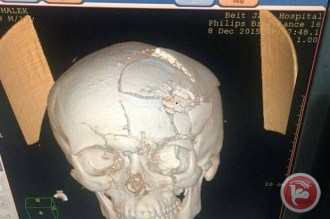 BETHLEHEM – Malik Akram Shahin, 19, who was shot dead by Israeli forces in Bethlehem overnight Monday, was killed by an explosive bullet fired at his head, medical sources at the Beit Jala Governmental Hospital told Ma’an.
Medics said the explosive bullet smashed Shahin’s skull, and exploded inside his head, with the bullet and skull fragments shattering into “hundreds of pieces.”
The sources said the positioning of the shot, as well as the type of bullet used, clearly indicates that Israeli forces shot at Shahin with every intention to kill.
The use of explosive bullets, also called expanding bullets or “dum dum” bullets, is illegal under international law, and considered a crime of war under the 1899 Hague Declaration and the International Criminal Court’s Rome Statute, among others.
The bullets are banned due to the brutal damage inflicted on the victim, as the bullets are made to splinter apart and become lodged, instead of making a clean exit through the body.
Israel has repeatedly denied claims that its forces use such bullets, though Palestinian medical examiners have on occasion documented their use.
Locals told Ma’an that after Shahin was shot, he was “left bleeding for a long time before he was evacuated to the public hospital in Beit Jala, where medics pronounced him dead.”
An Israeli army spokesperson had no information of his death, but said that Israeli soldiers had opened fire after Palestinians threw “pipe bombs and Molotov cocktails” at them.
The left-wing Popular Front for the Liberation of Palestine later said that Shahin had been one of its supporters. The group said in a statement that he fell “during fierce clashes with Israeli troops who raided the camp to detain young men affiliated to the PFLP.”
Following his death, a Bethlehem committee announced a halt to all business across the district and stores and government institutions were closed.
At least 114 Palestinians have now been killed in just over two months of unrest across the occupied Palestinian territory.
Everyday humiliation of Israeli military occupation
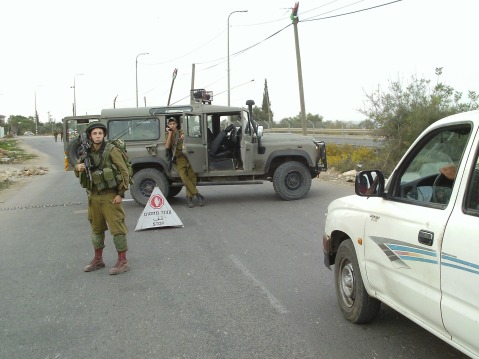
Israeli soldiers and the flying checkpoint outside the village
International Solidarity Movement | December 7, 2015
Hebron, occupied Palestine – Palestinians living in the Israeli militarily occupied West Bank face discrimination, racism and humiliation at the hands of Israeli forces on an everyday basis. Humiliation is entrenched in every aspect of daily life under the Israeli occupation. The message is clear: as a Palestinian you are always perceived as a threat, a possible terrorist or a menace – but never as a human being.
As a Palestinian citizen of the West Bank, freedom of movement is severely restricted and rather resembles trying to navigate a maze of road-blocks, permanent checkpoints and temporary ‘flying checkpoints’ that can suddenly pop up anywhere. All of these restrictions share one commonality: they are clearly intended to target only Palestinians – while Israeli settlers from the illegal settlements in the occupied West Bank are using roads that might not even be allowed for Palestinians to drive on.
In occupied al-Khalil (Hebron), the Israeli bus collecting passengers from the illegal settlements is not allowed for Palestinians to ride on, and thus passes Bethlehem checkpoint on the way to Jerusalem without even stopping – all the passengers are Israeli settlers anyways. On the Palestinian bus going through the same checkpoint, everyone, with the exception of tourists and elderly, are forced to get off the bus and wait for their IDs to be checked outside in any weather, and often their bags inspected by heavily-armed soldiers.
Right during rush hour on Thursday afternoon, Israeli forces set up checkpoints at all the entrances of occupied al-Khalil, resulting in endless queues of cars, on their way to visit family over the weekend on Friday and Saturday. As two soldiers thoroughly checked every passenger’s ID and car going in both directions, the queues grew longer and even ambulances with emergencies were denied passage and held up for at least ten minutes while being checked – ten minutes that hopefully weren’t critical for the emergency the ambulance was attempting to quickly get to. As Israeli forces strategically blocked every possible way to leave or enter al-Khalil either by permanent road-blocks completely blocking any sort of traffic except pedestrians or temporary checkpoints; there was no possible alternative than to either turn around and stay inside the city or to endure at least two hours of waiting to eventually be allowed to pass this checkpoint.
Finally passing one checkpoint successfully, though, in militarily occupied Palestine basically doesn’t mean anything: just a few hundred meters down the street might be another checkpoint. Palestinians try to avoid Gush Etzion junction on the way to Bethlehem, as settlers often attack Palestinians cars there, and soldiers stop and search cars with Palestinian license plates only; they take a detour through Palestinian villages. But in order to make the near-lockdown of al-Khalil ‘perfect’, Israeli forces set up checkpoints at entrances and exits of Sa’ir village. Thus, after an hour-long wait to leave al-Khalil city itself, Palestinian cars were stuck in yet another checkpoint just a twenty minutes drive away.
Waiting in the dark for seemingly endless hours to move ahead just one or two more meters in the line as a car was allowed to pass – or turned around, giving up the hope of ever crossing that night at all; Israeli settler cars speed past on a nearby road without any hurdles or hassles, just ‘normaly’ driving down a road at night. When finally slowly approaching the make-shift checkpoint with traffic spikes on the street, cars have to switch off their lights, so people next in line will only hazily see what’s going on. Once it’s their turn, everyone inside the car has to get out and stand a few meters away from the soldiers, while they inspect the IDs and cars. Depending on the soldiers mood, some people, mainly young adult males, will have to lift up their shirts and trouser-legs; while others will have to answer questions about their destinations and the reason of travels, and even about their families and private life. The only thing that is for sure is that you can never tell what will happen. The power dynamics is clear, the heavily armed soldiers have the ‘authority’ to decide over everything, the Palestinian passengers will have to obey whatever is asked of them. That none of this has to do with ‘security’ but everything with control and humiliation is obvious. This is the face of just a tiny little aspect of the everyday humiliation defining this military occupation.
Humiliation doesn’t even stop with death – the Israeli forces are still withholding the bodies of Palestinians they claim attacked Israeli soldiers – refusing an appropriate funeral and mourning for their families, relatives and friends. Denying even a last peaceful rest and a person’s family to mourn the death of a loved one is the last possible way to humiliate. Not even in death, does the humiliation stop or are Palestinians treated like human beings.
Israeli court sentences Palestinian MP Jarrar to 15 months in jail

Palestine Information Center – December 7, 2015
RAMALLAH – An Israeli military court on Sunday evening sentenced member of the Palestinian Legislative Council (PLC) Khalida Jarrar to 15 months in prison.
Ofer military court gave Palestinian lawmaker Khalida Jarrar a 15-month prison sentence for purely political reasons, according to her husband, Ghassan Jarrar.
Jarrar was arrested by the Israeli occupation forces from her home in the West Bank town of al-Bireh, on 2 April 2015.
The Israeli government charged her on 12 accounts, and after 25 court hearings, the prosecution and the court settled on three main charges: Providing assistance to the Popular Front for the Liberation of Palestine (PFLP), incitement against Israel, and membership in the PFLP.
Jarrar is a prominent and inspirational leader in Palestinian society. In addition to being a lawmaker, she is a women’s rights activist and a member of the board of directors for the Addameer Prisoner Support and Human Rights Association.
Addameer reported in November that the Israeli military prosecution relied on alleged secret material to maintain leverage during the trial proceedings in Jarrar’s case.
Jarrar was placed under administrative detention based on “secret material” from the day she was arrested.
Addameer also said that Israel used “fabricated charges” against Jarrar obtained through “deceptive and flawed interrogation techniques” that were used to force confessions from Palestinian detainees.
The witnesses later denied the confessions, which they said were given under duress.
Jarrar’s husband told al-Araby website that the Israeli police had been exhausting his wife by transporting her from prison to court nearly 25 times in the past few months.
“It takes 22 hours to transfer her each time. She is usually prevented from using the toilet for nearly 8 hours and remains in cuffs all the time.”
Jarrar is detained in Hasharon prison where Palestinian women are mainly held. Her husband is not allowed to visit her on “security” grounds.
Jarrar had also been targeted by forced displacement to Jericho from Ramallah by an occupation military order, which she succeeded in defeating after a month-long sit-in at the PLC office and an international support campaign.
“The conviction of Khalida Jarrar comes as no surprise; Israeli military courts serve no function except as an instrument of repression and suppression directed against Palestinians. Khalida Jarrar is a Palestinian political leader and an internationally-renowned struggler for justice. She has dedicated her life to working for freedom for her people and her land, and especially for the freedom of Palestinian political prisoners,” said Charlotte Kates, coordinator of Samidoun Palestinian Prisoner Solidarity Network.
“It is urgent that we build the movement internationally to demand freedom for Jarrar and for her nearly 7,000 sisters and brothers held as Palestinian political prisoners inside Israeli jails,” Charlotte Kates added.
Nisreen Azzeh continues to struggle after the death of her husband, Hashem Azzeh
International Solidarity Movement | December 6, 2015
Al-Khalil, Occupied Palestine – The 22nd of November, one month after the passing away of Palestinian activist and dear friend of the ISM, Hashem Azzeh, the team of al-Khalil (Hebron) visited his widow, Nisreen.
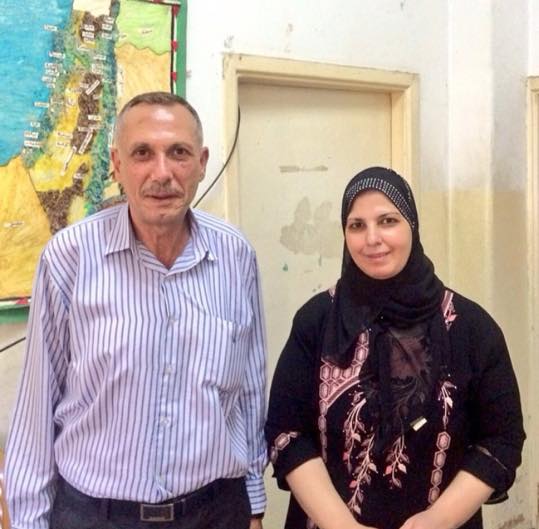
Nisreen with her late husband, Hashem Azzeh. Photo credit: Global Research
While sitting in her living room, Nisreen explained how, after her husband’s death, everyday life for her and her family has only gotten worse.
The Israeli army does not allow any visitors into the house. She also says that the army refers to them not by their actual names, but with numbers.
4 days before this conversation took place, Nisreen was coming back home to find the main access to the house closed. The Israeli soldiers had declared it a military closed zone. They asked her, “Why are you so nervous?” To which she replied, “Because the way is closed.”
The soldiers mockingly answered, “Call Mahmoud Abbas and tell him to stop the Intifada.” But Nisreen answered back to this cruel sarcasm, saying that this is H2 area, “which is ruled by Netanyahu.”
Since the main access to her home is now blocked, she is forced to use an alternative entrance where she must climb some very difficult rocks. Nisreen suffers from knee problems, and she can foresee that when the winter and the snow comes, this passageway will be very slippery, putting her in danger of falling.
Both Nisreen and her brother in law are afraid of their children going out alone on the street. They are especially afraid for Raghad, Nisreen’s oldest daughter who is 17, and her cousin, who is 19 years old. Because of their age, both of their parents are scared that the illegal Israeli settlers and Israeli army will shoot and kill them and place a knife next to their bodies, since this is what they have been doing, targeting youth of similar age, almost on a daily basis from the beginning of October. Read more about this here and here.
Therefore, Raghad is not going out of the house alone, and she had to stop walking her youngest sister to school. Now her mother has taken on that task.
Fear of settler violence is part of every day life for the inhabitants of Al-Khalil (Hebron). Nisreen will never forget how she suffered two miscarriages due to settlers’ attacks. During the first miscarriage, she was three months pregnant; the second time, she was four months pregnant.
After one of these miscarriages, which happened in 2003, she had decided to file a complaint to the Israeli Police. After waiting for 8 years, the case was finally brought to court in 2011. The settlers counted with three lawyers, whereas for her it was very hard to pay for all the necessary expenses.
She recalls how, during the first court hearing, the settlers did not show up saying they were sick. During the second court hearing, when the settlers came with three layers, she had presented a video showing how they had attacked her together with her son Younes, who was three years old at the time. The court even requested her to draw a map of the location where this took place. She did so, but the final decision of the court was that she was lying and she lost the case.
In the meantime, Nisreen continues her struggle to provide a life as normal as possible for her children.
For a deeper understanding of Al-Khalil’s daily life struggle, read an interview ISM made to late Hashem Azzeh in 2013 here.
Anti-Assimilation group protests Christmas tree event in Jerusalem
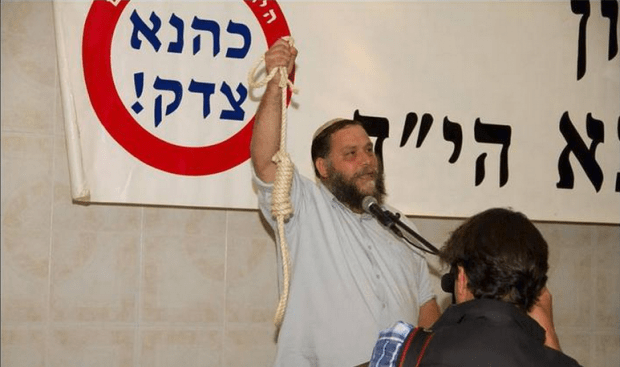
Benzi Gopstein holds a noose at a Lehava meeting shared on social media (Twitter/@ronnie_barkan)
IMEMC News | December 6, 2015
The right-wing Jewish group ‘Lehava’ held a protest outside of the YMCA in Jerusalem, shouting at Palestinian Christian children and families as they were entering and leaving the annual Christmas-tree decoration party.
Lehava is a group that calls for the expulsion of the indigenous Palestinian population from their homes in what is now Israel, in Jerusalem and in the West Bank. At a protest last year outside of a business that had some Palestinian employees, the group chanted “Stop hiring Arabs,” “stop dating our women” and “employing Arabs equals Assimilation.”
The group, whose name in Hebrew stands for the “Organization for the Prevention of Assimilation in the Holy Land”, has also disrupted weddings between Palestinians and Israeli Jews, and handed out fliers saying they are trying to “save the daughters of Israel” by preventing them from dating or marrying Arab men.
A 2011 investigation by the Israeli newspaper Ha’aretz found that around half of the annual budget of the controversial Lehava organization was funded directly by the Israeli government.
The leader of the group, Benzi Gopstein, was reportedly present at the YMCA protest on Friday. Gopstein is on the record voicing support for Pinhas Aburamed, an Israeli man who murdered a Palestinian who he thought was trying to flirt with a Jewish girl. Gopstein said that Aburamed is a hero and should receive a medal.
The event that the right-wing Jewish Lehava group chose to protest was a family event described on the YMCA’s website as “A festive evening in the YMCA lobby decorating the Christmas tree, singing carols and enjoying holiday treats.”
The protesters shouted anti-Palestinian and anti-Christian slogans at the children who came to decorate the Christmas tree, including, “The Arabs won’t defeat us with knifes, and the Christians won’t buy us with presents,” and “Jews want a hanukkiah [menorah], not a fir tree”, according to Israel National News.
Around 1% of the population of Israel, the West Bank and Gaza is Christian. The percentage had been higher before the Israeli military occupation and theft of Palestinian land began. The emigration of Palestinian Christians to other countries increased significantly after the Oslo Accords were signed in 1993 and Israeli settlement expansion increased exponentially.
Many Palestinian Christians in Bethlehem, Jerusalem and Nazareth can trace their ancestry back to early Christians who have remained continuously on the land where Christians believe that Jesus was born, died and resurrected.
Why ‘Active Investigations’ Don’t Justify Keeping Police Video Secret
By Jay Stanley | ACLU | December 4, 2015
The Chicago police last week released video of 17-year-old Laquan McDonald being shot to death by a police officer. Release of the video showing the 16-shot barrage came only after a judge order its release, and after more than a year during which the police had refused to make it public. In Minneapolis, protesters have been clashing with police as the police similarly refuse to release video in the recent shooting death of another young Black man, 24-year-old Jamar Clark. In both cases the police have cited the need to keep video under wraps because there is an “ongoing investigation.”
The question of what police body camera video gets released to the public, and when, is an important one, and has become one of the central areas of dispute surrounding the technology. At issue are two sometimes conflicting values: privacy, and government transparency. Our position (as outlined in our body camera white paper and model policy) is that while most video footage should be kept private—held for a short period in case a complaint is filed, not analyzed or used for any other purpose, and then deleted within six months—some video footage is important for the public to see. We call for video of incidents to be releasable under state open records laws where there has been a use of force, a felony arrest, or a complaint against a police officer. Certainly in the case of a police shooting or other use of deadly force, the public’s interest in understanding how and why an officer took such an extreme measure is overwhelming.
Police departments, however, regularly refuse to release video citing their need not to release details of ongoing criminal investigations. Aside from the question of whether police should have exclusive control over videos in the first place, the question needs to be asked: does this general exception to public transparency make sense in the case of body camera or other video footage of police uses of force?
There are a limited and narrow range of purposes for which exemptions should legitimately be granted. Those purposes include:
- Protecting personal privacy
- Protecting confidential sources
- Not interfering with the investigation
- Protecting the right to a fair trial
Many state laws have active-investigation exceptions to their open-records laws, and these laws vary but generally include the above factors, as does the federal FOIA law (Exemption 7). The federal law also includes a broad catch-all exemption for circumstances where disclosure could “reasonably be expected to interfere with enforcement proceedings,” as well as an exemption for when it could “reasonably be expected to endanger the life or physical safety of any individual.” And, it contains an exemption for law enforcement guidelines, techniques, and procedures where “such disclosure could reasonably be expected to risk circumvention of the law.”
But none of these exemptions justify the withholding of video footage of a shooting or other use of force by a police officer. Exemptions to open-records laws for “ongoing investigations” were simply not created with police video of police shootings in mind, and do not make sense applied to such recordings. Yet police departments around the country are using these rules to block or delay release of video not because it would harm investigations, but because it makes them look bad. This is not how things are supposed to work in a democracy.
Let’s look at each justification for “active investigation” exemptions and how they apply—or not—to body camera footage.
Privacy: One purpose of these exemptions is to protect people from the stigma of being under investigation before the police have even finished assessing whether there is evidence of their involvement in a crime. A police officer who has used deadly force against a citizen has typically already been identified, and has no right to privacy in such circumstances as they are an employee of the public whose actions, ostensibly to protect the interests of that public, merit the highest levels of community scrutiny.
A concrete example of this was given to me recently by Laura Schauer Ives, a civil rights attorney in New Mexico (and former legal director for the ACLU there) who litigates on police use-of-force issues, including the infamous James Boyd shooting. As she pointed out,
The public needs to know if there are problematic officers. That’s why in Albuquerque, we know which officers have shot people three, four times. We have officers who have repeatedly used excessive force against citizens, and that’s the only way to know it, by knowing their names. And that is their job. You’re a police officer doing your public job.
In Chicago, where police and city officials fought to keep civilian complaints secret, the resulting lack of sunshine has allowed problematic officers to stay on the job unpunished (as we now know only because of a decade-long legal battle to bring that information to light).
When it comes to the privacy interests of the subject or victim of a use of force (or his or her survivors), typically they do not object to release of the video on privacy grounds; in the vast majority of cases under contention they are the ones clamoring for release. I recently wrote about an exception, where a shooting victim’s family sought to block release—but even there the public’s interest in monitoring the police force overcomes the privacy rights of the subject of police use of force. Should a video show bystanders with a legitimate privacy interest, their identity can be obscured through redaction of the video.
Protecting confidential sources: If an officer shown in the video is an undercover officer, his or her identity can ordinarily be obscured through redaction. While a case involving an undercover officer is theoretically possible, I have not heard of one. Redaction should also be sufficient should bystanders or others in a video happen to be informants. (And of course unredacted bystander video posted online can render any of these protections moot.) But this exemption to transparency has been abused: Ives told me that in New Mexico “we see the Albuquerque Police Department making the argument that officers who are not undercover, are undercover. If you’re out in public in a police vest that says APD, sorry but you’re not undercover.”
Interfering with the investigation: Another purpose of secrecy can be to avoid alerting suspects that they are under investigation (potentially spurring them to destroy evidence) or revealing what the authorities know about them and their possible crimes. But if there has been a police shooting, then the situation is different from those in which the above concerns apply. In a shooting, or if there has been a complaint, the involved officers know full well that they will be the subject of an investigation. (It is important to temporarily withhold the video from viewing by those under investigation—witnesses, arrestees, and the involved officers—until after they have given initial statements on the incident, as we have explained, but that does not justify any significant delay in release of the video to the public.)
Furthermore, the reason that police don’t want to release the details of an investigation to the public is that they don’t want one member of the public in particular—the perpetrator—to see that evidence. But in a police shooting, once the involved officer has seen that video, withholding it from the public no longer serves the purpose of keeping it from the person under investigation—now it serves only to prevent the public from seeing it. That’s not a legitimate goal on its own.
The right to a fair trial: It is important insofar as possible to protect defendants in criminal trials—whether they are arrestees or police officers—against pre-judgment by the community. Exposure to video evidence can harm not just the defense, but also the prosecution; one former Justice Department official whose job had included prosecuting police officers made the point to me that letting potential jurors in the community view a video before trial will shape and prejudice their impressions of what took place.
This is a legitimate concern, but generally does not hold up against the public’s critical need to engage in oversight of how its police are using force. There are also several factors that diminish the force of this consideration. Bystander video has so far been much more common in police shootings than bodycam video, and nothing can stop bystanders from exercising their First Amendment right to post their videos of an incident for the whole community to see. The courts have dealt with public bystander videos and they can deal with public bodycam videos—through the jury selection process for example, or change-of-venue motions that can be filed if the concern is particularly significant. In addition, it’s not clear how differently a video will prejudice a juror who views it on YouTube before joining a jury, compared to how they’ll interpret it when viewed at trial. It is far more important to get untainted initial testimony from witnesses and participants in a use of force case, than shielding the community at large.
The right to a day in court: There’s another reason it’s not okay to delay release of video until investigations and other legal processes around an incident have run their course: it prevents individuals from seeking justice for police wrongdoing in court. “It’s actually imperative that these things be public because of federal pleading requirements,” Laura Ives told me, explaining:
It used to be when you go to federal court with a claim of abuse, you just needed to make enough of a claim to get past a motion to dismiss. Now the federal standard under a case called Iqbal is that your claim needs to be “plausible.” To demonstrate that, you have to have enough information—you have to have evidence, you have to have a fairly strong claim going into the litigation, and even then you’re going to go up and back within a circuit on the qualified immunity issue before you ever get discovery, before you ever get to see a video or get a deposition. So getting video as a public record, seeing what happened in a shooting for example, is very, very important if you don’t want your lawsuit dismissed before you ever get to see discovery.
Overall, in some circumstances there can be sufficient reason to delay the release of certain evidentiary materials due to an active investigation, but when it comes to police body camera videos, the public’s interest in immediate oversight of how police officers use force is overwhelming, and it is hard to imagine circumstances in which the reasons for withholding such videos are not inapplicable or fatally weak—and even in the scenarios I can come up with, redaction would be sufficient.
Indeed last week’s release of the Laquan McDonald video followed a ruling by a judge who found that the Chicago police had failed to prove that releasing the video would hurt any ongoing investigation. But where existing state open records laws and jurisprudence do not clearly provide for the immediate release of police body camera video, state legislatures should take action to make clear that ongoing-investigations exceptions to open records laws do not apply to police body camera footage. If unusual situations should arise that we have not unanticipated, in which the harms such laws are intended to prevent would be brought about with sufficient severity to overcome the compelling public interest in disclosure, then withholding should be allowed if the police can establish the likelihood of those harms to a judge under a very high standard—and establish that redaction cannot solve the problem. And the videos should be released at the earliest possible moment that those extraordinary conditions no longer apply.
Finally, it’s important to note the significant harm that withholding video of police shootings does to trust and confidence in police and their relations with the community. Such withholding increases the sense of disrespect, and often appears to communities to be another example of police abusing their authority—not without reason, as our analysis here suggests. Police having exclusive control over, and then refusing to release, video of killings, which are disproportionately of Black men, frays even further any semblance of dignity and trust, and brings into sharp relief the use of authority to attempt to avoid accountability.
CNN Goes on Defensive After Calling Man Killed by Police the ‘Son of an Illiterate Heroin Addict’
By John Vibes | The Free Thought Project | December 3, 2015
Baltimore, MD – When reporting on the case of police brutality victim Freddie Gray, the man that was killed by police in Baltimore earlier this year, a CNN writer described Gray as “the son of an illiterate heroin addict.” The article quickly drew backlash and CNN attempted to edit the article, but it was too late, screenshots of the article had already gone viral.
CNN president Jeff Zucker later said that it was simply a mistake and insisted that there was no intent to slander the dead victim Freddie Gray.
“This was a mistake, the digital team removed it last night and inserted an editor’s note to be completely transparent. The editorial intent as the digital team has laid it out to me was to make clear he had a difficult upbringing. But clearly it did not come across that way when it was written and published. We recognize that. It did not work and we removed it. And were transparent about that. That was a mistake,” Zucker said.
 Zucker said that the comments were taken “out of context,” however, the context was clear, they were attempting to assassinate the character of a dead man with accusations that were not even relevant to the case. This type of smear campaign is typical for victims of police violence, which is one big part of the reason why people in America are so confused about the police. When the victim is demonized, it allows the police to maintain the moral high ground and it absolves them of their crimes in the eyes of the public.
According to police, Gray was first stopped and arrested by officers at 8:39 am on April 12, and was thrown in the back of a police van 15 minutes later. An entire hour later an ambulance was called to give him medical care, but he sadly fell into a coma died soon after. He suffered broken vertebra and an injured voice box, which required emergency spinal surgery that he never recovered from.
Many suspect that Gray was the victim of a “Nickel Ride”, a horrific police torture tactic where a suspect is handcuffed and placed in the back of a police van without restraints, and driven recklessly around town by police officers. This practice has also been called a “Rough Ride” or a “Cowboy Ride.”
Grays death resulted in the protests and riots that took place in Baltimore earlier this year. The police officers involved in his death are now standing trial for their crimes.
Featured Video

Why the U.S. Should Pull Back From the First Island Chain
or go to
Aletho News Archives – Video-Images
Book Review
‘Why Fauci Must Rot in Prison’: A Tale of Two Diaries
By Jill Erzen | The Defender | October 13, 2026
Dr. Anthony Fauci’s private diary reveals a “mind-numbing” contradiction between what the former top U.S. infectious disease official knew about COVID-19 and what he told the public, senior White House adviser Peter Navarro, Ph.D., said last week on “American Thought Leaders.”
In his new book, “Why Fauci Must Rot in Prison,” due out Oct. 20, Navarro compares Fauci’s private entries to his own pandemic-era diary, and uses what he calls “a tale of two diaries” to argue that Fauci should face criminal prosecution.
“I show, actually, how a prosecution can and should happen … at the state level, most likely,” Navarro said. “He should wind up in prison, and we’ve got the receipts in this book to put him there.”
Navarro said Fauci repeatedly acknowledged important facts in private, then publicly pursued policies that contradicted those facts — with devastating consequences.
“What he says many times privately in his diary is so at odds with both his public behavior and public statements that it’s mind-numbing,” Navarro said.
Navarro examines the lasting damage caused by lockdowns and other pandemic policies, and the ongoing toll of long COVID.
His book also addresses questions about vaccine safety, including why healthy young people faced COVID-19 vaccination mandates despite concerns about myocarditis, and why women were not warned about miscarriage risks linked to the shots. … continue
Blog Roll
 Aletho News
- Jennifer Kavanagh: Why the U.S. Should Pull Back From the First Island Chain
- Yemen denounces international community’s silence on Saudi aggression, siege
- UAE and Saudi Arabia move toward renewed coordination against Sanaa
- How Iran’s two-week retaliatory strikes exposed cracks in US military architecture in Persian Gulf
- The mother of all propaganda: Why the hype over US MOAB strike against Iran is nothing but theater
- Iran says it possesses technology behind US 14-ton GBU bunker-buster
- Trump asks Iran not to retaliate after he strikes Pickaxe Mountain – w/ Prof. Marandi
- Vice President J.D. Vance’s Deceptive ‘Antiwar’ Campaign Speech
- Iran: Palestinians’ rights must not be compromised in Gaza’s future; US, Israel to blame for Hormuz situation
- Ongoing tales of Syrian chemical weapons
- If Americans Knew
- Israeli rabbi permits occupiers to steal Palestinian olive harvest in West Bank
- Netanyahu’s spin on latest settler attack is laughable – Daily Update
- Israeli soldiers debunk Israel’s talking points
- In West Bank, Israeli settlers are totally out of control – Daily Update
- NPR investigation finds evidence of widespread fraud at mall kiosks tied to Israeli skincare brand
- Tucker Carlson exposes Israeli Lies about the Oct 7th attack, Charlie Kirk, and the U.S.
- Israel has detained thousands of Palestinian children since Oct 7th – over half spent time in solitary, many uncharged
- Israeli Analysis: Is Netanyahu Planning an ‘October Surprise’ Attack Before Israel’s Election?
- Israeli settlers brutally attack Palestinians and Washington Post female photographer, 65
- Words Have Changed, Occupation Continues: The Reality of the Gaza Ceasefire
- No Tricks Zone
- Predictions Made By Renowned Climate Proifessor Over Past Decades Have Been Proven To Be Poor
- New Study Suggests Large Regions Of The Pacific Ocean Have Been Cooling For The Last 80 Years
- Germany’s Green Energy Debacle: High Energy Costs Force Kahla Porzellan to Close After 182 Years!
- New Study: 50 Years Of The Most Aggressive ‘Net Zero’ Policies Can Only Affect The Global Climate By 0.03°C
- US September “Heat” Was No Record…Many Records Set Decades Ago
- Latest European Green Energy Debacle; Portugal’s Largest Flagship Solar Park Insolvent!
- Green Energy Debacle: German Expert Professor Fritz Vahrenholt Warns Of Severe Economic And Social Consequences
- Two More Paleo Reconstructions Affirm Meters-Higher Sea Levels Across Ireland, Brazil 7000-6000 Years Ago
- New Study: Earth And Venus Surface Warmth Largely Explained By Convection And Lapse Rate, Not CO2 Or Radiation
- 2025 Nature Paper Claiming Worsening Global Drought Gets RETRACTED …Heavily Flawed

