Baby amongst children removed over Islamist radicalization fears
RT | October 9, 2015
More than 20 children including one baby have been taken into care over fears they could be subject to extremist views and radical Islam at home.
Children from at least 11 families have been subjected to court orders, which remove children into state care.
The youngest child is a one-year-old from Rochdale whose family were caught attempting to flee to Syria via Turkey earlier in the year.
The figures come after one of the most senior judges in the UK released new guidelines on the increasing number of extremist cases which are taken to family courts.
In many cases judges use court orders to protect children who are considered vulnerable to extremist behavior. The orders can include making the children wards of court, place them in foster care or prevent them leaving the UK.
President of the Family Division of the High Court Sir James Munby said on Thursday that the number of cases involving children had risen since the beginning of the year.
“Recent months have seen increasing numbers of children cases coming before … the family court,” he said.
“There are allegations that children, with their parents or on their own, are planning or being groomed to travel to parts of Syria controlled by the so-called Islamic State; that children are at risk of being radicalized; or that children are at risk of being involved in terrorist activities either in this country or abroad.”
Munby said police should be proactive in seeking court orders, and not rely on local councils. He added that the safety of vulnerable children was “paramount.”
His announcement came days after Prime Minister David Cameron highlighted the “danger” Islamic extremism poses in the UK, saying the “passive tolerance” of radical ideas was allowing the spread of dangerous rhetoric.
Hannah Stuart, counter-radicalization expert at the Henry Jackson Society, said terror groups are continuing to target young people.
“Both among those who support people joining the conflict in Syria or who want to see terror acts committed here, we see a recurring obsession with the radicalization of children.
“We are seeing a generation who are getting older and having children, and those children are growing up in an environment where there is a risk of them being taken to Syria – or being told that it is right to hate non-Muslims and desire martyrdom.”
Casualty Count: 794 Palestinians, 7 Israelis—NY Times Obsesses on Israeli Victims
By Barbara Erickson | TimesWarp | October 8, 2015
Isabel Kershner in The New York Times tells us that Palestinians are running amok, lashing out at Israelis not only in the West Bank but now in Israel as well. Prime Minister Netanyahu has vowed to quell this “wave of terrorism,” she reports, and Israelis are “unnerved” by the spread of incidents.
Kershner describes three alleged stabbing attempts, dwelling at length on one of them; recaps an earlier incident that left two Israelis dead; and in the final paragraphs of her story informs us that “at least two” Palestinians were killed, one of them a 13-year-old boy “described as a bystander.”
Nowhere do we learn that the major victims of violence in this turbulent conflict are Palestinians, not Israelis, as revealed in a recent United Nations report: In one week, ending Oct. 5, Israeli security forces injured 794 Palestinians, while Palestinians injured a total of seven Israelis. (As of Oct. 5, 30 Palestinians had been killed in 2015 compared with eight Israelis.)
This is an injury ratio of more than 100 to one, a shocking disparity, but the Times story shows concern only for Israeli injuries and fears. We find no accounts there of what the Palestinian victims experienced as they faced the aggression of heavily armed security forces.
Readers and viewers elsewhere, however, got a firsthand view of Israeli violence yesterday as videos emerged that revealed undercover agents inciting stone throwers in the West Bank. The agents, wearing keffiyehs and bearing a Hamas flag, urge bystanders to join them, then draw their weapons and assault Palestinian youths.
The videos, by several agencies, including Reuters and Agence France-Presse, went viral, appearing on French, British, Israeli and American media outlets. The Times, however, has so far failed to link to the videos, which show a soldier shooting a captive Palestinian in the leg at point blank range.
The newspaper also avoids any commentary that would shed a clear light on the nature of the conflict even as Israeli columnists have recently provided eloquent testimony of the despair behind Palestinian attacks.
Gideon Levy, writing in the Middle East Eye, notes that when Palestinians remain quiet, they reap nothing but “an intensification of the occupation.” He lists the constant attacks and humiliations they endure and asks, “Are Palestinians to assent to all this in silence?”
Levy notes that after a Palestinian family was burnt alive, Israeli officials admitted that they knew who was responsible but refused to make any arrests. “What people could maintain restraint in the face of such a sequence of events,” he writes, “with the entire might of the occupation in the background, without hope, without prospects, with no end in sight?”
Amira Hass writes in a similar vein, and the headlines on her Haaretz article express it well: “Palestinians Are Fighting for Their Lives; Israel Is Fighting for the Occupation—That we notice there’s a war on only when Jews are murdered does not cancel out the fact that Palestinians are being killed all the time.”
Both these Israelis speak with an honesty that rarely, if ever, appears in the Times. Readers of the newspaper of record instead face a determined effort to protect Israel’s reputation, to preserve the narrative of Israeli victimhood even in the face of the evidence.
As Palestinians fall to Israeli violence at the rate of 100 a day, the Times obsesses on Israeli Jewish victims. It ignores the numbers that reveal an enormous toll of Palestinian suffering and it excludes the news and the voices of conscience that could help readers gain a truer perspective in this conflict.
Cell Phone Video Clears Canadian Man of Assault Charges Despite Phone Going Missing in Police Custody
By Alexandra J. Gratereaux | PINAC | October 8, 2015
These days, a simple cell phone can make the difference between a conviction and an acquittal.
At least it did for Abdi Sheik-Qasim, who was cleared of assault charges thanks to a video he recorded of the interaction he had last year with two Toronto-based cops.
The best part?
Despite the phone going missing while in police custody, it instantly uploaded a duplicate copy of the 10-second video clip directly to Sheik-Qasim’s email, giving him the proof necessary to clear his name.
“It saved my life, or at least a lot of headaches,” Sheik-Qasim told The Toronto Star, who broke the news last week. “I would have probably been in jail right now.”
The incident took place on Jan. 4, 2014 with officers Piara Dhaliwal and Akin Gul.
Sheik-Qasim, 32, was staying over his uncle’s house in Ontario when law enforcement officials arrived after a noise complaint had been placed by neighbors. According to The Star, Sheik-Qasim quickly turned down the music’s volume without hesitation and gave the cops his identification.
But when the two police officers insisted on entering his home without a warrant, Sheik-Qasim whipped out his cellphone and began recording the incident, only to have the phone slapped from his hands.
He was then arrested for allegedly assaulting a police officer as well as refusal to comply with a court order.
Both officers testified that Sheik-Qasim was the one who initiated the brawl, alleging he reached for Gul’s utility belt, leaving Dhaliwal no choice but to arrest him.
Nevertheless, Ontario Court Justice Edward Kelly disagreed.
But only after he viewed the video.
Kelly cleared Sheik-Qasim of the bogus charges after viewing the clip and stating he found it “extremely troubling” the cellphone went missing while in police custody.
“The absence of the phone is extremely troubling when considered in light of the testimony of the officers, which I regard to be deliberately misleading,” Kelly said, adding that it must have been nearly impossible for Sheik-Qasim to have reached the utility belt as fast and as aggressively as the cops claim.
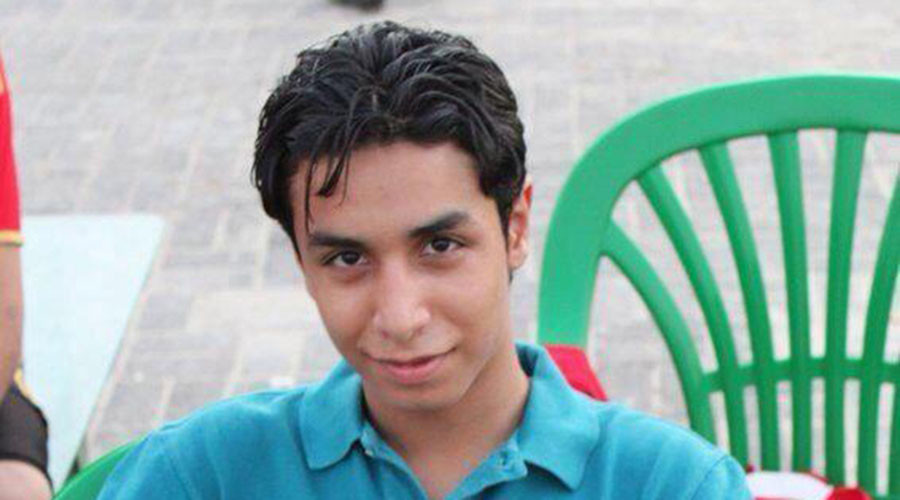
Saudi juveniles now in ‘solitary confinement’ far from families, says father
Reprieve | October 9, 2015
The father of Ali al-Nimr, a Saudi juvenile facing execution for his role in protests, has spoken of his uncertainty and concern about the fate of his son, as it emerged Ali and a second juvenile are now being held in solitary confinement in a prison in Riyadh.
Speaking last night, Mohammed al-Nimr said that the family hadn’t seen their son since 15th September, saying: “I’m very worried now, because they’ve moved my son to a prison in Riyadh, and he’s in solitary confinement – I fear he could be executed at any moment.” He added that Ali was among several other young men sentenced to death in the wake of protests, including Dawoud al-Marhoon, whose sentence of beheading was upheld last week.
Both Ali and Dawoud were 17 when they were arrested in the wake of protests in Saudi Arabia’s Eastern Province. Both received death sentences after being tortured into ‘confessions’ used to convict them in the country’s secretive Specialized Criminal Court. Executions are shrouded in secrecy in Saudi Arabia, and it is possible that both juveniles could now be executed at any time, without prior notification to their families. However, speaking to Al Jazeera this week, Abdallah al-Mouallimi, the Saudi permanent representative to the UN, suggested that Ali’s case was still “being reviewed in legal circles”, ahead of his execution receiving the “personal approval of the King”.
Speaking to Channel 4 last night, Ali’s father Mohammed al-Nimr said that as the UK and Saudi Arabia had a “warm relationship”, he hoped that interventions by the British government would save his son. Prime Minister David Cameron has said the government has raised Ali’s case with the Saudi authorities; however, the Ministry of Justice has faced criticism over its ongoing bid to provide services to the Saudi prison system, which would be responsible for carrying out Ali and Dawoud’s executions.
Concerns over the UK’s position come amid growing calls for firmer interventions from close allies of Saudi Arabia, such as the UK and the US. Yesterday, the European Parliament passed a resolution that called on member states – including the UK – to “deploy all their diplomatic tools and make every effort to immediately stop the execution” of Ali and others arrested at protests.
Commenting, Kate Higham, caseworker at human rights organization Reprieve, said: “Saudi Arabia’s plans to kill Ali and Dawoud are appalling, and have rightly caused an international outcry. Now these two juveniles – who have been through a shocking ordeal of torture and unfair trials – have been disappeared to solitary confinement, far from their families, who have no idea what the next few days could bring. We can only imagine how terrified they must be. Countries like the UK and the US, who count the Saudis among their closest allies, must listen to Ali’s father and urge a halt to these executions. Britain’s Ministry of Justice must also urgently call off its bid to provide services to the Saudi prison service that will carry out these executions.”
Neither Served, Nor Protected
By Holly Dickson | ACLU | October 7, 2015
 When 16-year-old Matthew Robinson and his mother, Eva, took their dog out for a walk one September evening four years ago, they never once thought they’d end up in a federal courtroom. Yet that’s where they have been as their terrifying case against two police officers was put in the hands of a jury this week in Little Rock, Arkansas.
Tased, beaten, and terrorized — the Robinsons were not suspected of any crime when they were stopped by police beside their home in Dover, Arkansas. The catalyst for the stop was innocent: Matthew looked and waved at Dover Deputy Marshall Steven Payton as he drove by. Payton admitted this behavior is perfectly legal, yet said he found it suspicious. That led to Matthew being beaten, tased multiple times, kicked, searched, and arrested while his mother was also beaten, handcuffed, choked, and arrested. Her glasses were broken as her face was repeatedly slammed into the hood of a patrol car.
Dover Deputy Marshall Steven Payton testified that he detained the Robinsons and their dog in the back of his patrol car, with the intent to take them to jail solely to identify them. When co-defendant Pope County Sheriff’s Department Sergeant Kristopher Stevens arrived on the scene, he ordered Matthew to get out of the car. When Matthew was not able to get out quickly enough, the Pope County sergeant tased him twice inside the car.
Counsel for the officers claim that the incident would have been avoided if Matthew had said who he was or if he had gotten out of the patrol car when they said, maintaining that officers had “no choice” to use the taser.
We disagree. De-escalation is always an option.
The case has been rife with missing evidence that police had a duty to preserve. Data from the taser, which would have shown the number and duration of taser deployments on Matthew, was destroyed even after a request was made for a copy of the data. Sergeant Stevens admitted at trial he was untruthful when he told Mr. Robinson there was no data on the taser. Though three police cars were audio and video capable, and should have been in use, police produced only one grainy video of part of the stop.
Photographs show 22 separate taser marks on Matthew’s torso, sides, shoulder, stomach, and lower back. Police admitted at trial to tasing Matthew at least six times, though Sergeant Stevens’ written report from the incident reflected only three tasings and Deputy Payton’s report showed only one. Sergeant Stevens admitted that his testimony in the juvenile case against Matthew, where he denied tasing the teenager while he was on the ground being cuffed, was untrue and that he had in fact tased the minor while he was on the ground. He also admitted that each of the six tasings were in violation of the department’s policy, as was the failure to properly record the incident.
To boot, each officer testified that the other was in charge of the scene. Neither Matthew nor his mother were ever read their rights or told that they were being arrested or why. This is in direct violation of the Robinson’s rights and the polar opposite of good policing.
While the officers continued to deny any wrongdoing, they have admitted to previously testifying falsely, false reports, missing evidence, and multiple violations of policy and training standards. We brought out the missing evidence and inconsistent testimonies in the Robinsons’ case. Missing evidence and police misconduct, after all, are often reasons that the criminal justice system fails us.
With the officers and departments disclaiming any and all responsibility, the Robinsons had nowhere else to turn but to court. They’ve had to fight for four years to ask a jury to serve as the first line of accountability.
In the end, Sergeant Stevens and Pope County settled with the Robinsons just before the verdict for $225,000. No action has been taken by the departments or the officers to prevent such a thing from happening again. Officers have not been disciplined or retrained, and no policies have been revised or implemented. In fact, both officers testified that they would do things exactly the same again.
Success in civil rights cases is against the odds, especially in a case involving police. Tremendous time, money, resources, and energy must be invested just to fight for a chance to obtain some bit of relief or accountability. And then, judges and juries are not empowered to truly bring about better, safer policing.
Unchecked violations of the duty to serve and protect threaten police credibility and safety as well as public safety. We entrust our police officers with great power — to detain, arrest, and use deadly force if necessary — and we provide them special status in return. For all our sakes, they should honor that status by serving and protecting, not terrorizing and tasing.
Mexican Marines Place Community Under Siege, Disappear Two People
teleSUR | October 8, 2015
Mexican marines raided a small community in the northern state of Durango and opened fired on homes with no known reason, while two young males were forcibly disappeared, neighbors told Sinaloan newspaper RioDoce.
“The troops of the Ministry of the Navy arrived in the community of El Verano and began firing at houses,” the witness said, according to RioDoce.
The newspaper said the El Verano inhabitant told them that about 15 families live in the community, still “besieged” by the marines.
The unidentified person that spoke with RioDoce said they were unaware if there were any victims, but said they saw a funeral home hearse driving through the small community.
Those forcibly disappeared were identified as Jesus Felix and his cousin Octavio Almodovar.
RioDoce said there were unconfirmed reports that a naval helicopter had been gunned down near El Verano.
A witness, identified as Lorena Silvas, said, “There are many complaints by people of other small communities near the municipality of Tamazula near El Verano, and they say there too many abuses being committed by the marines.”
Silvas said there are reports of marines carrying out raids on homes without search warrants, where they “take with them everything they find.”
The U.N.’s high commissioner for human rights, Zeid Ra’ad Al-Hussein, called on the Mexican government Wednesday to remove all military forces from public safety operations.
Al-Hussein said that impunity in Mexico is extremely commonplace, with 98 percent of reported crimes never resolved and in most cases not even investigated. He also said that 151,233 people have been murdered in Mexico from December 2006 to August 2015, while over 27,000 remain disappeared.
In June, various news outlets reported that marines had fired on civilians — including minors — in Tamazula.
Cadena Cinco reported that marines attacked a family traveling in a vehicle during which at least two people died, according to local officials. The president of the Commission for the Defense of Human Rights of Sinaloa, Leonel Aguirre, explained then that marines planted guns on various young males to justify the attack and deaths.
Video: Israel lures protesters into trap
By Jonathon Cook | The Blog From Nazareth | October 8, 2015
This two-minute video, taken on October 7 in the West Bank near Ramallah, is worth studying carefully to understand how Israel has become so adept at managing the Palestinian population under occupation and at foiling their efforts at resistance.
We can see about 20 men, faces concealed, who look like they are Palestinian protesters throwing stones at the army. In fact, they are what are called “mistaravim”: Israeli security forces in disguise as Palestinian youths.
According to those who witnessed this incident (see update below), the mistaravim began throwing stones at the army in a piece of theatre to lure other Palestinians to the protest.
Then, as we can see in the video, when a few Palestinian protesters separate themselves from the main body of the crowd they are picked off by the mistaravim, like lions going after a gazelle.
Notice, once they have grabbed the main Palestinian in this video, they shoot him in the knee and take turns kicking him.
We can’t see what happens next, but the routine is well known.
He will be taken off to a Shin Bet interrogation (torture) cell, where he will be made to give up the names of anyone he can think off who was there (and very possibly those who weren’t).
Then the Israeli army will make night raids to grab those who were named, or arrest them when they try to cross one of the many checkpoints and roadblocks Israel operates in the occupied territories.
At some point later he will be released. The Shin Bet will use his “confession” as blackmail to get him to serve as an informer.
This has been going on for nearly five decades in the occupied territories. It has created an awful lot of Palestinians trapped in a vicious cycle of collaboration, and a very effective system of control for Israel.
Sam Bahour makes the point that the drama playing out here illustrates the way young Palestinians are being drawn not into an organised intifada but into futile bursts of anger against Israel.
He says it more eloquently than I can:

UPDATE:
Here is another video of the same incident, showing what happens earlier when the mistaravim are throwing stones and then switch sides.
Jordan: Human Rights Activist Sentenced to 10 Years in Prison After Unfair Trial Before State Security Court
Alkarama | October 5, 2015
 On 29 July 2015, human rights activist Amer Jubran was sentenced to 10 years in prison by the State Security Court following an unfair trial during which confessions extracted under torture were admitted as evidence. In view of this decision, Amer appealed to the Cassation Court, which has not considered his case yet. Following this, Amer’s friends and family sent a communication to the United Nations Working Group on Arbitrary Detention (WGAD) in September calling upon the Jordanian authorities to release him immediately, as well as launched a campaign on his behalf.
Amer is a long-time activist for the Palestinian cause and an anti-war advocate who frequently expresses his political opinion on social media. After publishing articles criticising Israel’s policies against Palestine, on 5 May 2014 Amer was arrested by members of the General Intelligence Directorate of Jordan, an intelligence agency notoriously known for its sweeping powers to monitor public life in Jordan and its frequent use of torture and ill-treatment. He was kept in secret detention for almost two months, during which he was subjected to numerous acts of torture in order to obtain confessions, which would later be used as evidence during his trial. The acts of torture inflicted on Amer include 72-hour long interrogations, sleep deprivation, threatening his family, and severe beatings all over his body.
It is only two months after his arrest, on 27 June 2014 that his family was allowed to visit him for the first time for 10 minutes. In August 2014, Amer was charged with a series of terrorism-related offences, which included conducting “acts that threaten to harm relations with a foreign government.” On 29 July 2015, Amer was sentenced to 10 years in prison with hard labour, following an unfair trial before the State Security Court, a military court known for its lack of independence, as it is directly linked to the executive branch and its members are appointed by the Prime Minister. In prison, Amer currently fears that the Jordanian authorities will take retaliatory measures against him for speaking out about his case.
In view of these facts, Alkarama will raise Amer’s case before the UN Committee against Torture (CAT) in view of Jordan’s third review during the Committee’s 56th session, which will take place from 9 November to 9 December 2015. “Although Jordan is a party to the Convention against Torture (UNCAT) and has taken some encouraging legislative measures to put an end to torture – such as removing the term ‘illegal torture’ in Article 208 of the Criminal Code in January 2014 – violations of the right to physical integrity persist,” says Inès Osman, Legal Officer for the Mashreq at Alkarama. “The Jordanian special courts continue to rely heavily on confessions extracted under torture, which, added to their lack of independence, often leads to the arbitrary sentencing of people like Amer,” she continues.
Concerned over the systematic crackdown on dissent under the pretext of the fight against terrorism in Jordan, Alkarama calls upon the Jordanian authorities to:
- Adjust the legal framework, including by amending the Antiterrorism Law to create an environment where the freedoms of expression, association and assembly are respected;
- Abolish the State Security Court; and
- Implement the obligations arising from the Convention against Torture (UNCAT).
Belgian police clash with anti-austerity protesters
Press TV | October 7, 2015
Police in Belgium have clashed with protesters in the capital, Brussels, where thousands of people took to the streets to demonstrate against government austerity measures.
On Wednesday, police used tear gas and water cannons to break up crowds of protesters in the city.
Belgium’s three main unions said about 100,000 people gathered in the capital. The demonstration in the capital was part of a nationwide strike against budget cuts, tax policy changes, and a rise in the retirement age.
The Christian union, ACV, the socialist union, ABVV, and the liberal union, ACLVB, say the administration of Prime Minister Charlies Michel is promoting policies which unfairly benefit employers at the expense of workforce. They say the austerity measures are targeting the poor and leaving the rich unaffected.
Workers will have to work until the age of 67, as part of a pension reform package agreed on by the one-year-old government. Reforms also include more control over those who qualify for unemployment benefits, as well as a deal on the indexation of incomes.
The unions are calling on the government to implement alternative policies.
A national rail strike has been also planned for October 9.
Last year, 120,000 people protested against the government’s free-market reforms and austerity measures in Brussels.
Guantánamo reinstates genital searching policy to prevent lawyer-client meetings
Reprieve | October 7, 2015
This week, two clients of international human rights NGO Reprieve chose not to meet their attorneys at Guantánamo due to reinstated genital searches, raising fears that the searches are being used in a deliberate attempt to stop detainees from meeting with their lawyers.
Staff at Guantánamo told Reprieve attorney Cori Crider during her visit this week, that cleared detainee Samir Moqbel refused their meeting because he didn’t want to submit to the genital search.
Guantánamo staff explained in prior filings that the search involved invasive searches of the prisoner’s groin “by placing the guard’s hand as a wedge between the [detainee’s] scrotum and thigh . . . and using [a] flat hand to press against the groin to detect anything foreign attached to the body,” after which a guard “uses a flat hand to frisk the detainee’s buttocks to ensure no contraband is hidden there.”
In 2013, during the height of a mass hunger strike at Guantánamo, the genital searches were the subject of litigation in US federal court, and were eventually discontinued by camp authorities. A judge who ordered the searches should be stopped wrote: “the choice between submitting to a search procedure that is religiously and culturally abhorrent or forgoing counsel effectively presents no choice for devout Muslims like petitioners.”
Both Samir Moqbel and Pakistani Ahmed Rabbani have refused their planned meetings with Reprieve attorneys visiting Guantanamo this week. Both are previous hunger-strikers. Mr Rabbani is currently thought to weigh less than 100 pounds and in recent letters has described his mental and physical deterioration. Because of the searches he is now unlikely to see an attorney. Reprieve lawyers have requested a meeting with the camp Commander to discuss the practice but have so far received no response.
Cori Crider, Reprieve director and counsel to a number of Guantánamo prisoners, said: “After fourteen years of indignity, it’s no surprise that many of my clients aren’t willing to put themselves through the further humiliation of being pointlessly groped by guard staff. This whole policy is plainly an effort to stop Gitmo prisoners meeting their lawyers. For months these men were searched normally and brought to sit with counsel without incident. Yet for no discernible reason the authorities have changed protocol and resumed grabbing my clients’ genitals – it’s degrading, it’s needless, and it unlawfully interferes with these people’s right to consult an attorney.”
Featured Video

Why the U.S. Should Pull Back From the First Island Chain
or go to
Aletho News Archives – Video-Images
From the Archives
Only 19.7% of Americans agree with US State Dept on Israeli settlements
… Most American adults of voting age don’t appear willing to reject the applicability of international law to Israel’s ongoing colonization of occupied territories in East Jerusalem, the West Bank and Golan Heights. … Full article
Blog Roll
 Aletho News
- Tokyo protests demand Takaichi’s resignation over support for ‘Israel’
- Jennifer Kavanagh: Why the U.S. Should Pull Back From the First Island Chain
- Yemen denounces international community’s silence on Saudi aggression, siege
- UAE and Saudi Arabia move toward renewed coordination against Sanaa
- How Iran’s two-week retaliatory strikes exposed cracks in US military architecture in Persian Gulf
- The mother of all propaganda: Why the hype over US MOAB strike against Iran is nothing but theater
- Iran says it possesses technology behind US 14-ton GBU bunker-buster
- Trump asks Iran not to retaliate after he strikes Pickaxe Mountain – w/ Prof. Marandi
- Vice President J.D. Vance’s Deceptive ‘Antiwar’ Campaign Speech
- Iran: Palestinians’ rights must not be compromised in Gaza’s future; US, Israel to blame for Hormuz situation
- If Americans Knew
- Israeli rabbi permits occupiers to steal Palestinian olive harvest in West Bank
- Netanyahu’s spin on latest settler attack is laughable – Daily Update
- Israeli soldiers debunk Israel’s talking points
- In West Bank, Israeli settlers are totally out of control – Daily Update
- NPR investigation finds evidence of widespread fraud at mall kiosks tied to Israeli skincare brand
- Tucker Carlson exposes Israeli Lies about the Oct 7th attack, Charlie Kirk, and the U.S.
- Israel has detained thousands of Palestinian children since Oct 7th – over half spent time in solitary, many uncharged
- Israeli Analysis: Is Netanyahu Planning an ‘October Surprise’ Attack Before Israel’s Election?
- Israeli settlers brutally attack Palestinians and Washington Post female photographer, 65
- Words Have Changed, Occupation Continues: The Reality of the Gaza Ceasefire
- No Tricks Zone
- Predictions Made By Renowned Climate Proifessor Over Past Decades Have Been Proven To Be Poor
- New Study Suggests Large Regions Of The Pacific Ocean Have Been Cooling For The Last 80 Years
- Germany’s Green Energy Debacle: High Energy Costs Force Kahla Porzellan to Close After 182 Years!
- New Study: 50 Years Of The Most Aggressive ‘Net Zero’ Policies Can Only Affect The Global Climate By 0.03°C
- US September “Heat” Was No Record…Many Records Set Decades Ago
- Latest European Green Energy Debacle; Portugal’s Largest Flagship Solar Park Insolvent!
- Green Energy Debacle: German Expert Professor Fritz Vahrenholt Warns Of Severe Economic And Social Consequences
- Two More Paleo Reconstructions Affirm Meters-Higher Sea Levels Across Ireland, Brazil 7000-6000 Years Ago
- New Study: Earth And Venus Surface Warmth Largely Explained By Convection And Lapse Rate, Not CO2 Or Radiation
- 2025 Nature Paper Claiming Worsening Global Drought Gets RETRACTED …Heavily Flawed

