Leaked: NSA’s Talking Points Defending NSA Surveillance
By Mike Masnick | techdirt | June 14, 2013
The government has been passing around some “talking points” to politicians and the press trying to spin the NSA surveillance story. We’ve got the talking points about scooping up business records (i.e., all data on all phone calls) and on the internet program known as PRISM. Both are embedded below. Let’s dig in on a few of the points, starting with the business records/FISA issue:
The news articles have been discussing what purports to be a classified, lawfully-authorized order that the Foreign Intelligence Surveillance Court (FISA Court) issued under an Act of Congress – the Foreign Intelligence Surveillance Act (FISA). Under this Act, the FISA Court authorized a collection of business records. There is no secret program involved here – it is strictly authorized by a U.S. statute.
“There is no secret program here”? Bullshit. Why, then, have so many people, both in the Congress and the public been shocked at the extent to which the NSA is snarfing up data? This is a secret program, enabled by a secret interpretation of the FISA Amendments Act, by the FISA Court, which the DOJ and the NSA insist the public is not allowed to know. Yes, it’s a secret program. Saying otherwise is simply lying.
It authorizes only metadata collection, which includes barebones records – such as a telephone number or the length of a call.
“Barebones records” and “metadata” are terms being used to play down the extent of the collection of info, but it ignores multiple reports that note the amount of data actually collected — including phone numbers, call times, call location, among other things — is more than enough to identify who someone is and a variety of important characteristics about that person.
This legal tool, as enacted by Congress, has been critical in protecting America. It has been essential in thwarting at least one major terrorist attack to our country in the past few years.
“At least one” is a lot less than the “dozens” NSA boss Keith Alexander recently stated. But, so far the only “one” identified, involving an attempted NYC Subway bombing was shown not to have needed this data collection program to uncover and stop. So, nope.
Despite what appears to be a broad scope in the FISA Court’s order, the Intelligence Community uses only a small fraction of a percent of the business records collected to pursue terrorism subjects.
This is meaningless. That’s like saying, even though we search everyone’s house illegally, we only actually arrest a small number of people. No one would allow such house searches under the 4th Amendment, so why is it okay with phone records?
All three branches – Congress, the Courts, and the Executive Branch – review and sign off on FISA collection authorities. Congress passed FISA, and the Intelligence Committees are regularly and fully briefed on how it is used.
Except many in Congress have made it clear they did not review this kind of program, or were led to believe that the NSA did not collect this kind of information. And those who are being briefed now say the program goes way beyond what they were told. And, those who did know about it beforehand, tried to dig deeper into the program, but were blocked. As for “the Courts” reviewing it, we’re talking about the FISA Court which is a rubberstamp in black robes, having approved every single request of it for the past three years. It last rejected a request back in 2009, and that was only one out of 1320. In its entire history, since 1979, the court has rejected a grand total of 11 applications. 11. Out of 33,939 applications. That’s 0.03%. Not 3%. 0.03% with not a single rejection in over three years. That’s not careful review. That’s a rubber stamp. As for the executive branch signing off on it, what do you expect? They’re going to hold back their own ability to spy on people?
The FISA Court authorizes intelligence collection only after the Intelligence Community has proven its case, based on underlying facts and investigations.
Well, we already covered the rubber stamp issue above, but Section 215 of the Patriot Act requires that the government present a case that the data it is seeking “must be relevant to an authorized preliminary or full investigation to obtain foreign intelligence information not concerning a U.S. person or to protect against international terrorism or clandestine intelligence activities.” I’d love to see the argument that all data is somehow relevant to the investigation. Of course, I can’t see it, because it’s secret.
This legal tool has been reauthorized only after ongoing 90-day renewal periods. That means that every 90 days, the Department of Justice and the FBI must prove to the Foreign Intelligence Surveillance Court that they have the facts and legal basis to renew this legal authority. It is not a rubber stamp.
Ha ha ha. So, we violate your privacy without any opposing view — but we do it every 90 days for seven straight years.
FISA-authorized collections are subject to strict controls and procedures under oversight of the Department of Justice, the Office of the Director of National Intelligence and the FISA Court, to ensure that they comply with the Constitution and laws of the United States and appropriately protect privacy and civil liberties.
What kind of “strict controls and procedures” allow for the collection of every single record of every single phone call, and then also make it accessible to the 29-year-old IT guy in Hawaii? Just wondering…
Moving on to the “NSA internet talking points.”
Section 702 is a vital legal tool that Congress reauthorized in December 2012, as part of the FISA Amendments Act Reauthorization Act, after extensive hearings and debate. Under Section 702, the Foreign Intelligence Surveillance Court (FISA Court) certifies foreign intelligence collection. There is no secret program involved – it is strictly authorized by a U.S. statute.
Again, “no secret program,” merely a secret interpretation of the law, in a secret ruling by a secret court. What’s everyone complaining about?
Section 702 cannot be used to target any U.S. person. Section 702 also cannot be used to target any person located in the United States, whether that person is an American or a foreigner.
Note the careful choice of words: it cannot be used to target a person in the US. It can, however, be used to collect info on a person in the US if they’re not “the target” of the investigation. Fun with words!
The unauthorized disclosure of information about this critical legal tool puts our national security in grave danger, puts Americans at risk of terrorist and cyber attacks, and puts our military intelligence resources in danger of being revealed to our adversaries.
Right. So this is not a new program, it’s no surprise, people shouldn’t be concerned… and now that you know about it we’re all going to die!
How does anyone take these jokers seriously?
NGOs find loopholes in Foreign Agents’ Law, officials urge corrections
RT | June 13, 2013
Russian NGOs that receive funding from abroad have developed several methods that allow them to bypass the obligatory registration as ‘foreign agents’.
Currently the law obliges all NGOs engaged in political activities and receiving funding from abroad to register as “foreign agents”under threat of fines.
One possible option is to register an ordinary commercial company that would receive funds from abroad and employ NGO staff as workers to pay their salaries, Kommersant daily wrote quoting the head of a Russian NGO who spoke on the condition of total anonymity.
The source noted that about 15 Russian groups had already switched to this method.
Another possible loophole, suggested by the daily itself, is to set up an endowment that would properly register as a foreign agent and receive foreign funding which would then be transferred to one or several Russian groups, allowing them to skip the registration as they are formally sponsored by a Russian company.
The third way has been outlined in a recent report by the Civil Initiatives Committee, an influential expert group chaired by former finance minister Aleksey Kudrin, which said that under growing pressure Russian NGOs could re-register in neighboring states.
Some Russian officials already called for changes in the recently approved law, saying that the flaws of the original bill are being exposed as it is applied. Mikhail Fedotov, chairman of the Presidential Council on Human Rights, said that the practice was only showing one thing – that the law had been poorly written and that it was in need of corrections.
Fedotov added that the council had already prepared several suggestions on corrections, but he did not go into detail.
Deputy Prime Minister Arkady Dvorkovich has said that the law needs changes and called for activists to draft their amendments. But Dvorkovich added that the law is in force and must be observed by all members of the community until it is altered in the desired way.
Russia introduced the so-called Foreign Agents Law in November last year.
Prosecutors and the Justice Ministry launched a major nationwide program in March this year in order to check how the fresh law is being applied. The inspections caused protests from NGOs, rights activists and the international community, which claimed they were a form of government pressure on independent critics.
Russian officials, including the president, have repeatedly stated that the law is not banning any NGOs and simply requires disclosure of the sources of their income. Such transparency would give Russian citizens and voters some clues about possible motives of the groups’ political actions, the officials added.
Currently no organization is registered as a foreign agent in Russia.
Settlers from Bracha attack and harass farmer on his land
International Solidarity Movement | June 13, 2013
Al Rujeib, Occupied Palestine – On Friday 7th June five settlers from the illegal settlement of Bracha attacked a farmer on his land, using sling shots to throw stones at him near Huwwara checkpoint. The same settlers continued to harass the farmer in the following days as he tried to graze his sheep and gather his crops, unprotected by the Israeli authorities.
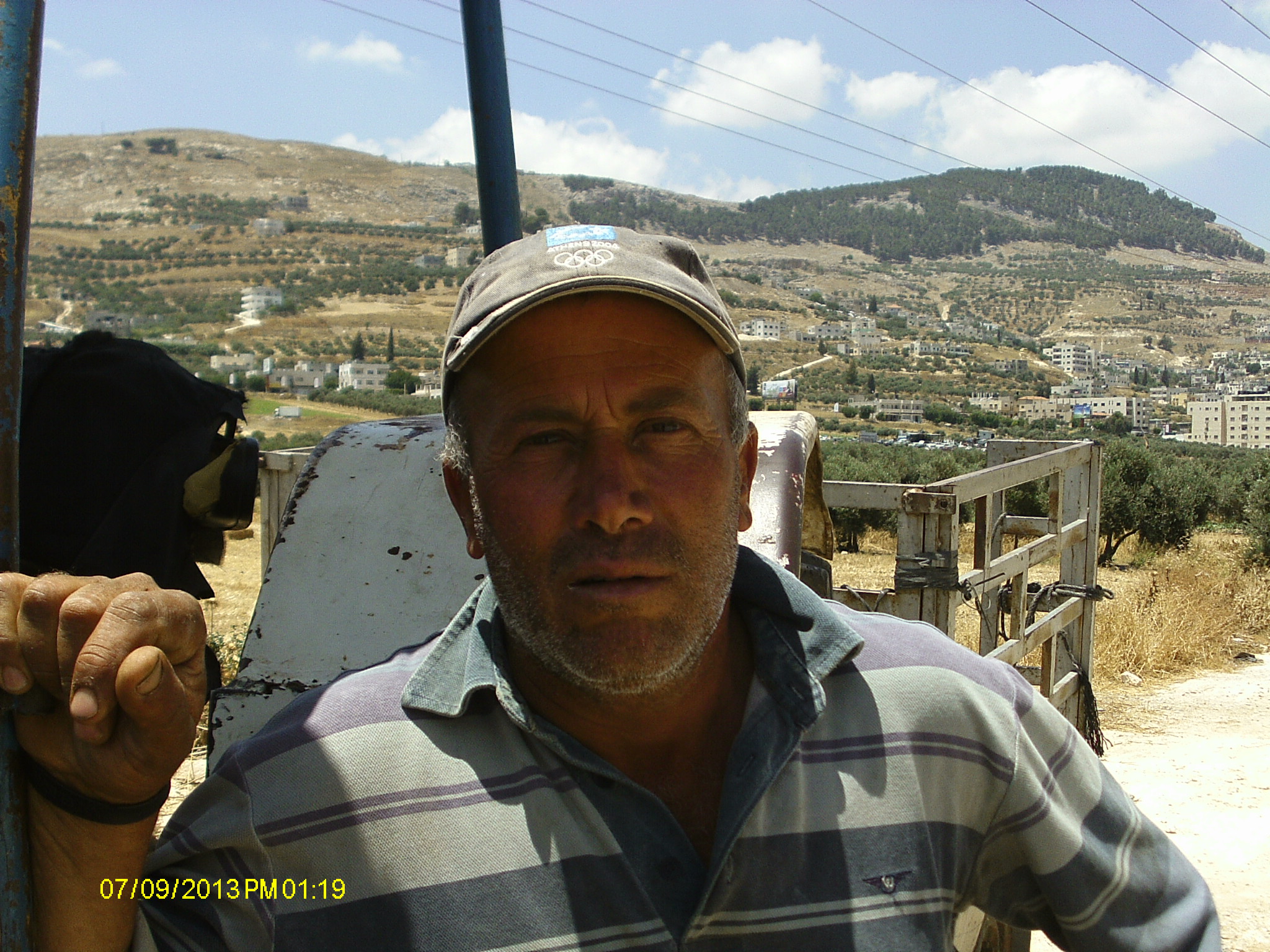
Salah Sukamel Deweket (Photo by ISM)
Salah Sukamel Deweket rents 70 dunums of land between his home in Al Rujeib and the occupation forces’ checkpoint at Huwwara. The land is mainly used to plant crops for his sheep to graze upon.
On Friday 7th June Salah was working hard to enable his sheep to feed when he was surprised by five settlers, thought to be an old man and his four sons who brought their own sheep to eat Salah’s wheat. The settlers threw rocks using slingshots at Salah and his flock. Salah had no one who could help him as he had no number for the District Coordination Office (DCO) – the Palestinian liasion with Israeli authorities or other organisations. Unable to get the number, he returned to his land to find that the settlers had ripped apart his bales of wheat.
The settlers resumed throwing stones at him in full view of soldiers stationed at the Israeli occupation forces checkpoint at Huwwara. The soldiers did nothing but watch as the Palestinian farmer was attacked. As an occupying power the Israeli military are meant to protect all citizens in the territory.
Salah asked the older settler why he had destroyed his wheat. “People who stay in Israeli land have to be good Israeli people”, the settler replied. “If this is Israeli land, where’s Palestinian land?” Salah asked. “There is no Palestinian land” the settler shouted back. The settlers continued to graze their sheep on Salah’s land and then encouraged their sheep to eat the olive trees of another Palestinian farmer who came to protect his land. It was only then that army jeeps came to intervene – asking why the Palestinian farmers were there. Salah tried to explain the problem with the settlers to the army, who told him to take photos and go to DCO. Salah then asked the soldiers if they were going to arrest the settlers, to which they said, ” we don’t know, it’s up to the judge.” When the soldiers were asked why they did not come earlier, they replied that it wasn’t their problem. The next day Salah tried to fix his wheat bales but the settlers kept coming and causing problems. Soldiers eventually came and told both Salah and the settlers to leave but said that the Palestinians must leave first.
Palestinians face many attacks by settlers of varying severity. Religious extremists living in illegal settlements attack Palestinian people, lands and crops. Palestinians have almost no means of legal recourse or protection from settler attacks but are routinely targeted by the army in mass arrests in the alleged defence of the Israeli occupation and settlements. Even when Palestinians can contact the DCO, the coordination office can often not solve issues with settlers who generally are treated with impunity under Israeli law. Settlements are illegal under international law under the fourth Geneva convention.

Salah Sukamel Deweket’s wheat fields (Photo by ISM)
Related articles
- Jewish settlers setting up tent and planning road on Palestinian owned land in Al Khalil (alethonews.wordpress.com)
- After the flames, only determination remains in Burin and Madama (alethonews.wordpress.com)
- VIDEO | 82-year-old Hebron woman Umm Salah challenges Israeli settlers, troops. Alone. (occupiedpalestine.wordpress.com)
- Jewish settler fires at Palestinian workers wounding one of them (occupiedpalestine.wordpress.com)
Hospital Drugs Patients & Dumps Them Onto Buses, Suit Claims
By MEGAN GALLEGOS | Courthouse News | June 13, 2013
LAS VEGAS – Calling it “Greyhound therapy,” a Las Vegas psychiatric hospital drugs patients and sends them on buses out of state to cities where they know no one, without medical instructions or anyone to care for them, one such patient claims in a federal class action.
Lead plaintiff James Flavy Coy Brown claims the hospital’s illegal policies are “sometimes referred to as ‘Greyhound therapy.'”
He sued Rawson-Neal Psychiatric Hospital, Southern Nevada Adult Mental Health Services, the Nevada Bureau of Health Care and Quality and Compliance, Dr. Anurag Gupta, his psychiatrist at Rawson-Neal, and others.
The complaint states: “Plaintiffs are former psychiatric patients at defendant Rawson-Neal Psychiatric Hospital (hereinafter ‘Rawson-Neal’) who, while still in need of psychiatric care, were involuntarily discharged from the facility by defendants and their agents and employees, and sent to out-of-state destinations where defendants knew said patients would be unable to obtain proper treatment, care and housing. Plaintiffs were medicated before their discharge and required to leave the facility under the influence of powerful anti-psychotic/tranquilizing medication. While plaintiffs were in a drugged state, and incompetent to give informed consent, the standard procedure was for institution staff to physically escort plaintiffs from the facility and place them in taxis bound for the Greyhound Bus Station in Las Vegas, Nevada. They were directed and required to travel on pre-paid tickets which had been previously ordered and paid for by Defendants Southern Nevada Adult Mental Health Services (hereinafter ‘SNAMHS’) and Rawson-Neal.”
Brown, 48, says he was admitted to Rawson-Neal on Feb. 9. The hospital is run by Southern Nevada Adult Mental Health Services. He was given “a diagnosis of psychosis, hearing voices, and thinking of suicide,” he says in the complaint.
He was discharged on Feb. 11.
“Defendants knew he was penniless and homeless and defendant Rawson-Neal knew or acted in reckless disregard of the fact that he would be unable to care for himself during the journey or upon his arrival,” the complaint states. “Before he was discharged, he was started on Thorazine, Cymbalta and Klonopin, all psychotropic medications which affect thinking and judgment. While Defendant Rawson-Neal had developed a written treatment plan which included assisting him to locate a group home placement and locating a case worker for him, this treatment plan was intentionally disregarded and violated by his involuntary discharge contrary to the plan.
“On February 13, defendant psychiatrist Dr. Anurag Gupta (hereinafter ‘Gupta’) ordered Brown discharged, physically escorted from the facility, and placed in a taxi which had been ordered by the defendants. Plaintiff Brown was then transported to the Greyhound Bus Station, where a pre-paid ticket had been purchased by the defendants to take Brown to Sacramento, California, a city which he had no prior contact, and where he knew no one. There was no follow-up plan and no prior contact had been made with any institutions in Sacramento from which Brown could obtain medical and psychiatric care. He was given three days of powerful anti-psychotic medications and bottle of Ensure for the 15 hour bus ride.
“Plaintiff Brown arrived in Sacramento, homeless, confused and anxious. He was taken by police to a local homeless service center, Loaves and Fishes, which could provide no housing, medical care or transportation. After his arrival at that location, he was directed to the U.C. Davis Medical Center’s emergency department which, after three days, arranged for Brown to be treated by Heritage Oaks psychiatric facility. From there he was discharged to a group home in Sacramento.”
Brown claims he’s one of more than 1,500 patients the defendants have treated this way, sent dazed and confused to nearly every state in the union.
“After learning of the ‘dumping’ of Brown in Sacramento by defendants, the Sacramento Bee newspaper began to investigate the circumstances which led to Brown’s arrival in Sacramento and discovered that since the year 2008 approximately 1,500 patients of the Rawson-Neal Psychiatric Hospital in Las Vegas, Nevada, have been transported by Greyhound Bus to almost every state in the country, all with minimum provisions to sustain them during protracted bus rides.
“A random survey by Nevada’s Bureau of Health Care Quality and Compliance of 30 discharges of psychiatric patients from Rawson-Neal revealed discharges in violation of policy and procedures of the Centers for Medicare and Medicaid and the facility’s own policies occur frequently. Patients, such as Brown, were involuntarily placed on Greyhound buses and sent out of state without prior arrangements having been made for follow-up care. These patients were not informed where they should go to receive continuing care upon arrival at their destinations. Discharge orders did not specify the amount of nutritional supplements to be provided to the patients for their extended bus trips; and appropriate and necessary prescription medications were not provided. Furthermore, necessary information was not provided on discharge documentation.”
Brown seeks punitive damages for civil rights violations, constitutional violations including cruel and unusual punishment, medical malpractice, negligence, gross negligence and breach of fiduciary duties.
He is represented by Allen Lichtenstein with the ACLU of Nevada.
Land Grabs, the Latest Form of Genocide in Guatemala

By Leonor Hurtado – Americas Program – 12/06/2013
In a historic decision this May, Guatemala’s Supreme Court of Justice sentenced former dictator General Ríos Montt to 80 years in prison for the genocidal massacres of indigenous people in the 1980s. Many Guatemalans hoped that the judicial process against the top criminals of the country’s “dirty war” would finally bring justice—but ten days after the decision, the Constitutional Court reversed the judgment.
While the Guatemalan people protest this violation of the rule of law, the processes of genocide initiated 30 years ago by Ríos Montt’s massacres continue today by other means.
In the last decade, the expansion of oil palm plantations and sugarcane production for ethanol in northern Guatemala has displaced hundreds of Maya-Q´eqchi´ peasant families, increasing poverty, hunger, unemployment and landlessness in the region, according to a new Food First report by Alberto Alfonso-Fradejas, “Sons and Daughters of the Earth: Indigenous Communities and Land Grabs in Guatemala.”
There is a major contradiction here: at the same time that the former General Ríos Montt is convicted for genocide, the Guatemalan government allows the oligarchy, allied with extractive industries, to displace entire populations without concern for the human cost. In many cases, these land grabs result in the murder and imprisonment of rural people who resist the assault.
Genocide against the indigenous peasant population in Guatemala no longer has the face of a military dictatorship supported by the United States. Now it is the corporations, the oligarchy and the World Bank who push peasants off their lands.
In today’s Guatemala, land and resource control is increasingly in the hands of a small oligarchy of powerful families allied with agri-food companies. At the center of this power are fourteen families who control the country’s sugarcane-producing companies (AZAZGUA); five companies controlling the national production of ethanol; eight families that control the production of palm oil (GREPALMA); and members of the Coordinating Committee of Agricultural, Commercial, Industrial, and Financial Associations (CACIF).
Together these powerbrokers are accumulating land and wealth with the support of investment from international institutions such as the World Bank, the Inter-American Development Bank (IDB) and the Central American Bank for Economic Integration (BCIE). The convergence of multiple global crises—finance, energy, food and environment—has directed corporate investment into land-based resources such as agrofuels, minerals, pasture and food. The situation in Guatemala is extremely violent, part of a global trend where agrarian, financial and industrial interests are grabbing control of peasant lands and resources.
Can land grabs be considered genocide? In many ways, land grabbing is a new form of genocide. Ricardo Falla’s study “What Do You Mean There Was No Genocide?” analyzes the definition of genocide and its characteristics. According to Falla, of the five acts that define genocide, two were most prominent in Guatemala: “the massacre of the members of a group,” and “the intentional subjection of a group to living conditions which will lead to their total or partial physical destruction.”
The first genocide was against the Ixil peoples during the reign of Ríos Montt. The second genocide is enacted today through the privation of the Q´eqchi´ peoples’ means of survival through land grabs. Hundreds of families have been displaced. They do not have land on which to produce food or live, and they are denied their cultural and community identity. These conditions undermine their ability to survive, and lead to their displacement, and in many cases death.
The historic genocide trial this May came about through the peoples’ long struggle to defend their rights. The Ríos Montt conviction is a condemnation of impunity. The oligarchy did everything possible to impede the trial while continuing to displace the indigenous peasant population with the support of international investment and a legal system that favors land grabbing to the detriment of the people.
On May 20, the Constitutional Court overturned the conviction, with two of the five judges opposing the decision. Pablo de Greiff, UN Special Rapporteur for the Promotion of Truth, Justice, Reparation and Guarantees of Non-Recurrence stated, “No legal decision is inconsequential, even if it is revoked.” The Inter-American Court of Justice issued a statement criticizing the verdict for violating international obligations assumed by the state and preventing the people from seeking justice. Multiple organizations and authorities have spoken out against the court’s decision, arguing that it overstepped its bounds, violated legal provisions, and endorsed the corrupt mechanisms upon which impunity is built in Guatemala. The decision bolsters evidence that Guatemala’s top court lacks political independence and is tied to the country’s economic and ruling elite.
On May 24, thousands of people demonstrated and delivered a letter with more than a thousand signatures to the Court demanding that the decision be reversed. In Argentina, Chile, Honduras, Mexico, Nicaragua and Peru, thousands more marched in solidarity to the Guatemala embassy demanding justice.
If we fail to judge and condemn the massacres committed thirty years ago, what hope is there for the Mayan Q’eqchi’, Xinka, Mam, Kaqchikel and other indigenous peoples currently being displaced and massacred by extractive corporations with the support of the state and international institutions? The people continue to courageously resist and defend their lives, lands and identities. How shall we express our solidarity?
Leonor Hurtado is a fellow at Food First/Institute for Food and Development Policy. A native of Guatemala, she has spent decades defending human rights and indigenous rights, and supporting indigenous resistance to the expansion of extractive industries.
Photo: Caracol Producciones
Related articles
- Survivors Reluctant to Testify in New Genocide Trial (ipsnews.net)
- Guatemalans protest annulment of dictator’s genocide conviction (workers.org)
- Israel’s Hand in Guatemala’s Genocide (phantomreport.com)
State propaganda on NPR’s “Morning Edition”
By Justin Doolittle | Crimethink | June 12, 2013
On Wednesday’s episode of “Morning Edition” on NPR, a segment was devoted to exploring the extreme violence that has engulfed Honduras in recent years. Indeed, if measured by per capita murder rate, Honduras is now the most dangerous in the country in the world. There are many reasons why Honduran civil society has broken down like this, but let’s suspend that discussion for the moment in order to focus on one particular aspect of this story on NPR that was quite revealing.
At one point in the segment, Carrie Kahn, the NPR correspondent reporting from Honduras, said the following:
Last year, the U.S. Congress held up funding to Honduras over concerns of alleged human rights abuses and corruption, particularly in the Honduran police force. Part of the funds are still on hold.
This is an astonishing statement for someone who purports to be a journalist. Unless Ms. Kahn has psychic powers, she cannot know why the U.S. Congress held up funding to Honduras. She can only know why Congress said it was holding up funding to Honduras. There is often a profound difference between why politicians say they are implementing policy X and why they are actually doing it. As you might have heard, politicians are occasionally dishonest and insincere, and their decisions are informed by a number of factors that have nothing to do with their personal beliefs. For a journalist, someone who is supposed to adversarially cover politicians and express skepticism at everything they say, this kind of blind faith is inexcusable.
The problem, though, is that Ms. Kahn’s statement is actually quite a bit worse than that. Even if she had said, “the U.S. Congress held up funding to Honduras over what it claimed were concerns of alleged human rights abuses and corruption,” instead of just mindlessly repeating what the government claimed, that would still be wildly insufficient for any journalist who takes her profession even the slightest bit seriously. Why? Because the United States government provably does not base its decisions on allocating foreign aid on “concerns about human rights and corruption.” For decades, the U.S. has provided aid to some of the most repressive and corrupt governments on Earth. Going down the list would be trivial, but, for the sake of comparison, let’s stay relatively close by and just look at Colombia. The U.S. government ships hundreds of millions of dollars to the Colombian government every year; in FY 2012, $443 million was provided, making Colombia the leading recipient of U.S. aid in the hemisphere.
In a strange twist, though, Colombia is also widely considered to be the most repressive violator of human rights in the hemisphere, and corruption there is rampant. This is quite a conundrum. Ms. Kahn tells us that the U.S. withheld aid from Honduras “over concerns of alleged human rights abuses and corruption.” But the U.S. evidently has no such “concerns” in Colombia and continues to send hundreds of millions of dollars in annual aid. One is almost tempted to conclude that the U.S. government makes these decisions based not on noble and selfless “concerns” about human rights and corruption, but, rather, on what it perceives to be U.S. interests.
Ms. Kahn must know that the government claim she dutifully parroted is transparently fraudulent and, in fact, downright comical. She cannot be a working journalist and not know this. Presumably, she follows the news, she is knowledgeable regarding basic facts about U.S. aid, and she knows that the U.S. has always cheerfully sent aid to brutal regimes around the world. She’s not a wide-eyed poly-sci 101 student who is shocked to find out that U.S. government decisions are not invariably and solely based on considerations of Good and Evil. Ms. Kahn is a highly educated reporter, and she obviously does know these things, but the culture of obedience and submissiveness in American journalism is so profound that she probably doesn’t even consciously realize that she’s serving state power instead of doing journalism. The U.S. government told her that aid is being withheld to Honduras because of concerns about human rights and corruption, therefore aid is being withheld to Honduras because of concerns about human rights and corruption. That’s that. Then she goes on NPR, unquestioningly repeats government claims, and she’s done her job. We would call this “propaganda” if it happened in the Soviet Union, but it’s called “journalism” when it happens here.
Obama Speaks with Forked Tongue on Surveillance
By Sheldon Richman | FFF | June 11, 2013
It’s bad enough the federal government spies on us. Must it insult our intelligence too?
The government’s response to Edward Snowden’s leaks about the National Security Agency’s secret monitoring of the Internet and collection of our telephone logs is a mass of contradictions. Officials have said the disclosures are (1) old news, (2) grossly inaccurate, and (3) a blow to national security. It’s hard to see how any two of these can be true, much less all three.
Can’t they at least get their story straight? If they can’t do better than that, why should we have confidence in anything else that they do?
Snowden exposed the government’s indiscriminate snooping because, among other things, it violates the Fourth Amendment protection against unreasonable searches and he had no other recourse.
Director of National Intelligence James Clapper says Snowden should have used established channels to raise his concerns, but there are no effective channels. Members of the congressional intelligence committees are prohibited from telling the public what they learn from their briefings. Two members of the Senate committee, Ron Wyden and Mark Udall, for years have warned — without disclosing secrets — that the Obama administration is interpreting the Patriot Act and related laws far more broadly than was ever intended by those who voted for those pieces of legislation. Their warnings have made no difference.
A court challenge wasn’t open to Snowden either. Glenn Greenwald, who published Snowden’s leaks in the Guardian, notes that for years the ACLU has tried to challenge the surveillance programs in court on Fourth Amendment grounds, but the Obama administration has blocked the effort by arguing that the ACLU has no standing to bring the suit. It’s a classic Catch-22. Since the surveillance is secret, no one can know if he has been spied on. But if no one knows, no one can go into court claiming to be a victim, and the government will argue that therefore the plaintiff has no standing to challenge the surveillance. Well played, Obama administration.
The administration should not be allowed to get away with the specious claim that telling its secrets to a few privileged members of Congress is equivalent to informing the people. It is not. It’s merely one branch of government telling some people in another branch. Calling those politicians “our representatives” is highly misleading. In what sense do they actually represent us?
Equally specious is the assertion that the NSA can’t monitor particular people without court authorization. The secret FISA court is a rubber stamp.
When Obama ran for president in 2008, he said Americans shouldn’t have to choose between privacy and security. Now he says that “one of the things that we’re going to have to discuss and debate is how are we striking this balance between the need to keep the American people safe and our concerns about privacy? Because there are some tradeoffs involved.”
What do you take us for, Mr. President? Do you say whatever serves your momentary interest?
It’s outrageous for Obama to say he welcomes this debate — when his regime is plotting to capture and prosecute the heroic whistleblower who made it possible.
The debate would be bogus anyway. No one has a right to make a security/privacy tradeoff for you. Our rights should not be subject to vote, particularly when a ruling elite ultimately will make the decision — out of public view!
Americans have learned nothing from the last 40 years if they have not learned that the executive branch — regardless of party — will interpret any power as broadly as it wishes. Congressional oversight is worse than useless; it’s a myth, especially when one chamber is controlled by the president’s party and the other chamber’s majority embraces big government as long as it carries a “national security” label.
Obama says, “If people can’t trust not only the executive branch but also don’t trust Congress and don’t trust federal judges to make sure that we’re abiding by the Constitution, due process and rule of law, then we’re going to have some problems here.”
That’s wrong. If the politicians’ only response to revelations that they’re violating our privacy is to ask for trust, then we already have problems.
Related articles
- US lawmakers call for review of Patriot Act after NSA surveillance revelations (guardian.co.uk)
- Information chiefs worldwide sound alarm… (guardian.co.uk)
Germany slams US for ‘Stasi methods’ ahead of Obama visit
RT | June 12, 2013
Germans are expressing outrage as details of a US internet spy program – revealed by a former CIA employee-turned-whistleblower – are prompting comparisons with that of former communist East Germany’s Ministry for State Security.
Unfortunately for Obama’s upcoming trip to Berlin, it was revealed that Germany ranks as the most-spied-on EU country by the US, a map of secret surveillance activities by the National Security Agency (NSA) shows.
German ministers are expressing their outrage over America’s sweeping intelligence-gathering leviathan, with one parliamentarian comparing US spying methods to that of the communist East Germany’s much-dreaded Ministry for State Security (Stasi).
Washington is using “American-style Stasi methods,” said Markus Ferber, a member of Chancellor Angela Merkel’s Bavarian sister party and member of the European Parliament.
“I thought this era had ended when the DDR fell,” he said, using the German acronym for the disposed German Democratic Republic.
Clearly, enthusiasm for the American leader’s upcoming visit will be much more tempered than it was in 2008 when 200,000 people packed around the Victory Column in central Berlin to hear Obama speak of a world that would be dramatically different from that of his hawkish Republican predecessor, George W. Bush.
Merkel will question Obama about the NSA program when he visits in Berlin on June 18, government spokesman Steffen Seibert told reporters on Monday. Some political analysts fear the issue will dampen a visit that was intended to commemorate US-German relations on the 50th anniversary of John F. Kennedy’s famous “Ich bin ein Berliner” speech.
Bush excesses, Obama digresses
One year into his second term, Barack Obama seems powerless to roll back the military and security apparatus bolted down by the Bush administration in the ‘War on Terror.’
One consequence of this failure of the Obama administration to reign in Bush-era excesses emerged last week when former National Security Agency employee Edward Snowden, 29, blew the whistle on a top-secret intelligence system named Prism, which collects data on individuals directly from the servers of the largest US telecommunications companies.
According to documents leaked to the Washington Post and Guardian newspapers, PRISM gave US intelligence agencies access to emails, internet chats and photographs from companies like Google, Facebook, Twitter, Verizon and Skype.
Justice Minister Sabine Leutheusser-Schnarrenberger said leaked reports that US intelligence services are able to track virtually all forms of Internet communication demanded an explanation.
“The more a society monitors, controls and observes its citizens, the less free it is,” she wrote in a guest editorial for Spiegel Online on Tuesday. “The suspicion of excessive surveillance of communication is so alarming that it cannot be ignored. For that reason, openness and clarification by the US administration itself is paramount at this point.”
All of the facts must be put on the table, the minister added.
Obama has defended the intelligence-gathering system as a “modest encroachment” that Americans should be willing to accept on behalf of security.
“You can’t have 100 per cent security and also then have 100 per cent privacy and zero inconvenience,” he said. “We’re going to have to make some choices as a society. There are trade-offs involved.”
The United States, however, is not legally restricted from eavesdropping on the communications of foreigners, meaning in theory that Washington could be listening to and collecting the private communications of individuals anywhere in the world.
Peter Schaar, Germany’s federal data protection commissioner, said the leaked intelligence was grounds for “massive concern” in Europe.
“The problem is that we Europeans are not protected from what appears to be a very comprehensive surveillance program,” he told the Handelsblatt newspaper. “Neither European nor German rules apply here, and American laws only protect Americans.”
Meanwhile, German opposition parties hope to gain from the scandal, especially with parliamentary elections approaching in September, and Merkel looking to win a third term.
“This looks to me like it could become one of the biggest data privacy scandals ever,” Greens leader Renate Kuenast told Reuters.
Obama is scheduled to hold talks and a news conference with Merkel on Wednesday followed by a speech in front of the Brandenburg Gate, the 18th triumphal arch that is one of Germany’s most recognizable landmarks.
Related articles
- Why Did Edward Snowden Go to Hong Kong?
- The NSA Black Hole: 5 Basic Things We Still Don’t Know About the Agency’s Snooping
- NSA Document Leak Proves Conspiracy To Create Big Brother Style World Control System
- DOJ launches criminal probe of NSA leaker
- US security officials said NSA leaker, journalist should be ‘disappeared’ – report
- Government Spying: Should We Be Shocked?
- Boundless Informant: NSA’s complex tool for classifying global intelligence
- The NSA’s Favorite Weasel Word To Pretend It’s Claiming It Doesn’t Spy On Americans
- The “Congress knew” defense
- NSA memo pushed to ‘rethink’ 4th Amendment
Featured Video

John Mearsheimer: Why Russia Gains By Hitting Ukraine Harder
or go to
Aletho News Archives – Video-Images
From the Archives
A Climate Scientist Who Engages Skeptics
By Judith Curry | November 27, 2009
An open letter to graduate students and young scientists in fields related to climate research:
Based upon feedback that I’ve received from graduate students at Georgia Tech, I suspect that you are confused, troubled, or worried by what you have been reading about ClimateGate After spending considerable time reading the hacked emails and other posts in the blogosphere, I wrote an essay that calls for greater transparency in climate data and other methods used in climate research. The essay is posted over at climateaudit.org.
What has been noticeably absent so far in the ClimateGate discussion is a public reaffirmation by climate researchers of our basic research values: the rigors of the scientific method (including reproducibility), research integrity and ethics, open minds, and critical thinking. Under no circumstances should we ever sacrifice any of these values; the CRU emails, however, appear to violate them. … continue
Blog Roll
 Aletho News
- USAID Files: The Trusted Flaggers Nobody Can Audit
- How Western media weaponizes unverified claims to justify military aggression
- Content control: USAID docs expose Biden admin’s grip on Ukraine coverage
- Ukraine destroying itself: every attack on the Crimean Bridge will come at a price
- NATO capital under protest siege, so NATO escalates war
- A Climate Scientist Who Engages Skeptics
- John Mearsheimer: Why Russia Gains By Hitting Ukraine Harder
- Argentina’s Perito Moreno Glacier Joins Antarctica and Arctic In Defying Doomsday Melt Claims
- ‘Chinagate’ Is Here
- Iran, four other countries condemn US plans to deploy weapons in outer space
- If Americans Knew
- An error has occurred; the feed is probably down. Try again later.
- No Tricks Zone
- Alarmist Climatologists In Shock! 2026 Atlantic Hurricane Season Sees Lowest Count In 101 Years
- New Study: Modern Temps Are Among The Coldest Of The Last 10,000 Years In East Central Europe
- Germany’s Renewable Energies Lead to 1.4 Billion Euro Electric Power Trade Deficit
- Argentina’s Perito Moreno Glacier Joins Antarctica and Arctic In Defying Doomsday Melt Claims
- New Study: Barents Sea Temperatures Were Warmer And Sea Ice Less Extensive In The 1700s Than Today
- German Authorities Start Initiative To Evaluate Public Register For Climate “Disinformation” Spreaders!
- Zonal Asymmetry of Temperature Change in the Antarctic Circumpolar Current
- New Study: The Net Fossil Fuel Contribution To Rising Atmospheric CO2 Has Been Zero For 500 Years
- Germany’s Green Energy Transition Becoming Increasingly Expensive…Another 6 Trillion Euros!
- Sudden Stratospheric Warming, Powerful El Niño Combination May Lead To Extreme Europe Cold, Energy Crisis!

