US leaves trail of bitterness in Syria
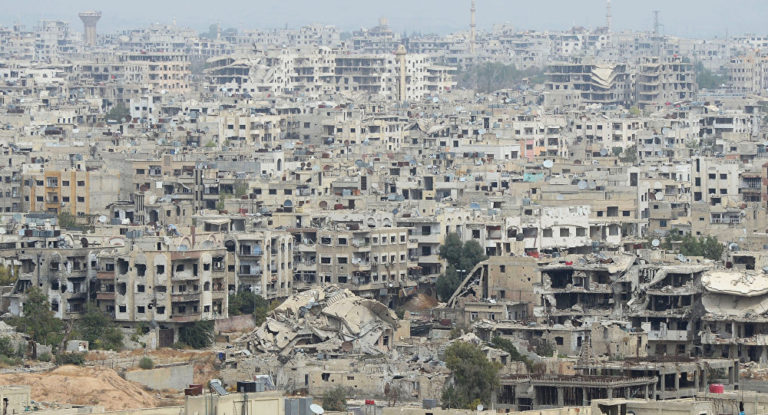
Stalingrad of Syrian war: ancient Syrian city of Raqqa after US bombing
By M. K. BHADRAKUMAR | Indian Punchline | December 21, 2018
On December 17, Ankara was notified of President Trump’s decision on troop withdrawal from Syria. During an earlier phone conversation between him and President Recep Erdogan on Dec 14, Trump had pointedly asked and elicited a positive response from the Turkish leader as to whether Turkey would have the capability to eliminate the remnants of the ISIS in the Syrian tract east of the Euphrates in the event of a US withdrawal from Syria. Erdogan reportedly “reaffirmed” Turkey’s commitment to fight the ISIS.
Ankara likely shared this information with Moscow and Tehran. The three foreign ministers met in Geneva on Dec 19 for a trilateral meeting as guarantors of the Astana format on Syria. The joint statement issued after the meeting, therefore, can be seen as indicative of Turkey’s resolve to give primacy to the trilateral format with Russia and Iran on issues concerning Syria.
To be sure, Turkey will have issues to take up with the Trump administration in the coming days and weeks. As one commentator put it, “For example, will the U.S. collect the weapons provided to the YPG? What measures will the U.S. take for preventing a chaos in the region after the withdrawal? All these require more military and political talks between Turkey and the U.S. Turkey will continue to cautiously follow the situation in Syria.”
However, senior Turkish officials have made it clear that the planned military operations against Syrian Kurds will continue to unfold. Defence Minister Hulusi Akar has been quoted by the state news agency Anadolu as saying, “Now we have Manbij and the east of the Euphrates in front of us. We are working intensively on this subject. Right now it is being said that some ditches, tunnels were dug in Manbij and to the east of the Euphrates. They (Kurds) can dig tunnels or ditches if they want, they can go underground if they want, when the time and place comes they will buried in the ditches they dug. No one should doubt this.”
Yesterday, Erdogan told the visiting Iranian president Hassan Rouhani that Ankara hopes to work closer with Tehran to end the fighting in Syria. Erdogan said at a joint press conference with Rouhani, “There are many steps that Turkey and Iran can take together to stop the fighting in the region and to establish peace. Syria’s territorial integrity must be respected by all sides. Both countries are of the same opinion regarding this.” Significantly, Erdogan also voiced Turkey’s support for Iran (“brotherly nation”) against the US sanctions.
However, Ankara is yet to make an official statement regarding Trump’s Syrian pullout plan. All three countries – Turkey, Russia and Iran – seem skeptical about Trump’s clout to enforce his decision overcoming resistance from the Pentagon. From such a perspective, the resignation of Defence Secretary James Mattis on December 20 will come as confirmation that Trump is indeed forcing his political will, exercising his presidential prerogative to take foreign policy decisions as well as insisting on his supreme authority as commander-in-chief to decide on issues of war involving the US armed forces.
Unlike Turkey and Iran, Russia has voiced opinions on Trump’s withdrawal plans. President Vladimir Putin stated at a press conference in Moscow on Dec 20:
“As concerns the defeat of ISIS, overall I agree with the President of the United States. I already said that we achieved significant progress in the fight against terrorism… There is a risk of these and similar groups migrating to neighbouring regions… We know that, we understand the risk fully. Donald is right about that, and I agree with him.”
“As concerns the withdrawal of American troops, I do not know what that is. The United States have been present in, say, Afghanistan, for how long? Seventeen years, and every year they talk about withdrawing the troops. But they are still there. This is my second point.”
“Third… The current issue on the agenda is building a constitutional committee… We submitted the list to the UN… Maybe not by the end of this year but in the beginning of the next the list will be agreed and this will open the next stage of the settlement, which will be political settlement.”
“Is the presence of American troops required there? I do not think it is. However, let us not forget that their presence… is illegitimate… The military contingent can only be there under a resolution of the UN Security Council or at the invitation of the legitimate Syrian Government…. So, if they decide to withdraw their troops, it is the right decision.”
Overall, Putin commended Trump’s decision, while keeping fingers crossed that as the focus is shifting to the political process will gain traction. Putin didn’t mince words in calling the US intervention in Syria as a violation of international law and UN Charter. The Kremlin spokesman Dmitry Peskov who spoke later in a TV interview was also quite upfront: “The American presence on the Syrian soil is not conductive to attaining the goals of a political and diplomatic solution.” (TASS )
Neither Russia nor Turkey and Iran would expect a cooperative attitude from the American side in a near term over Syria. The US has a stony heart when it comes to Syria’s reconstruction – although it caused immense destruction in that country during its occupation. The US military will be leaving behind a trail of bitterness in Syria. The three other protagonists understood perfectly well that Pentagon commanders were fighting a secretive geopolitical war against each of them. “Good riddance” – that must be the refrain in Ankara, Moscow and Tehran.
The gulf within GCC is only widening
By M. K. BHADRAKUMAR | Indian Punchline | December 10, 2018
The annual summit meeting of the Gulf Cooperation Council (GCC) in Riyadh on Sunday was particularly important for Saudi Arabia as a display of its regional leadership. But the short meeting of the GCC leaders behind closed doors, lasting for less than an hour, ended highlighting the huge erosion of Saudi prestige lately.
The litmus test was the participation by Qatari Emir Sheikh Tamim bin Hamad al-Thani. King Salman’s letter of invitation to the emir was perceived as some sort of an olive branch for reconciliation. But Qatar’s Minister of State for Foreign Affairs Sultan bin Saad Al Muraikhi represented the country at the summit.
The calculation by the hot headed crown princes of Saudi Arabia and the UAE that Qatar would pack up is turning out to be a historic blunder. Qatar had some trying times but it has successfully weathered the harsh embargo by Saudi Arabia and the UAE, and the boycott is now hurting its enforcers. Qatar “celebrated” the anniversary of the boycott in June by banning the import of goods from the UAE, Saudi Arabia, Bahrain and Egypt (which had cut diplomatic and transport ties on June 5, 2017.) Ironically, Iran has been a beneficiary as Qatar established diplomatic relations with Tehran and began importing Iranian products.
Qatar also strengthened its alliance with Turkey, which stepped in as provider of security for Doha. And Turkey checkmated any plans that Saudis and Emiratis might have had to use force to bring the Qatari emir down on his knees.
The emir’s absence from the summit in Riyadh yesterday underscores that he is not in a mood to forget and forgive. Equally, Kuwait and Oman also have issues to settle with Saudi Arabia and the UAE. There is tension between Kuwait and Saudi Arabia over two oil fields – Khafji and Wafra – that are jointly owned by the two states, which have a capacity to produce more than half a million barrels per day, but have been closed since 2014 and 2015, respectively. The dispute is over the sovereignty over the so-called Neutral Zone on their border, which has been undefined for almost a century.
The Saudis are not relenting. “We’re trying to convince the Kuwaitis to talk about the sovereignty issues, while continuing to produce until we solve that issue,” Saudi Crown Prince Mohammed bin Salman told Bloomberg in an interview in October. Similarly, Saudis and Emiratis have stationed troops in Yemen’s southern province of al-Mahra that borders Oman although the region has no presence of Houthi rebels. Oman considers the move an infringement on its national security. Interestingly, instead of the Sultan of Oman, Deputy Prime Minister for the Council of Ministers Sayyid Fahd bin Mahmood Al Said represented the country at the GCC summit.
To be sure, like Banquo’s ghost at Macbeth’s banquet in Shakespeare’s play, the killing of Jamal Khashoggi provided the backdrop to the GCC summit. The GCC states (including Qatar) have not criticized the Saudi Crown Prince Mohammed bin Salman (MBS) but they would know this is a developing story and it has dented Saudi prestige irreparably, especially with the US Senate is at loggerheads with the Trump administration. The big question for the Gulf region would be as to where Saudi Arabia is heading. (See the blog by Thomas Lippman What Now For U.S. Policy And The Crown Prince?)
Of course, if the GCC disintegrates due to these contradictions, Saudi Arabia will be the big loser, because it will be a reflection on its regional leadership. But do the Saudis understand it? The remarks by the Saudi Foreign Minister Adel Al-Jubeir at the end of the GCC summit showed no sign of remorse.
He said, “The members of the Gulf Cooperation Council are keen that the crisis with Qatar will have no impact on the Council (GCC). But this does not mean relinquishing the conditions imposed on Qatar.” Doha should stop supporting terrorism and extremism and avoid interfering in other countries’ affairs and needed to fulfill the Arab countries’ conditions to open the way for its return to the full-fledged work in the GCC. “The stance towards Qatar came to push it to change its policies,” he added.
The leading Saudi establishment writer Abdulrehman al-Rashed fired away at Qatar on the day of the GCC summit. In a column entitled Is it Time to end the GCC? in the Saudi daily Asharq Al-Awsat (owned by royal family members) he wrote:
“Qatar… has been putting obstacles in the GCC path and it has succeeded where Saddam and Iran have failed: It managed to destroy and rip it [GCC] apart… It organized an internal and external opposition against the United Arab Emirates. It is now the primary financier of the greatest attack against Saudi Arabia and it stands behind the politicization of Khashoggi’s murder… Today’s [GCC] summit could not conceal the dark political cloud hanging over its head. It also strongly poses a question over the future of the GCC as doubts rise over the value of this union… A wedge has been driven in the GCC.”
The disarray within the GCC undoubtedly calls attention to the decline of US influence in the Middle East region. At the end of the day, the Gulf states have not paid heed to repeated US entreaties for GCC unity. Ideally, GCC should have provided today for the US strategy a strong platform for launching the regime change project against Iran. On the contrary, GCC is split down the middle, with Qatar, Oman and Kuwait getting along just fine with Tehran. While addressing the summit in Riyadh on Sunday, the Emir of Kuwait, Sheikh Sabah Al Ahmad hit the nail on the head when he said, “The most dangerous obstacle we face is the struggle within the GCC.”
US Deploys Carrier Strike Group to Middle East Amid Iran, Syria Tensions
Sputnik – December 8, 2018
A carrier strike group led by the Nimitz-class supercarrier USS John C. Stennis has arrived in the Middle East, ending an eight month period during which a US carrier wasn’t based in the region, the US Navy has reported.
Earlier, the Pentagon announced that the US and its allies in eastern Syria would train an additional 35,000 to 40,000 local militia to “provide stability” in the region following the defeat of Daesh (ISIS) terrorists.
The carrier group will be based with the 5th Fleet, which is responsible for US naval activity in the Arabian Sea and the Persian Gulf, and will be stationed in the region for at least two months.
According to the US government-funded news service Voice of America, the carrier strike group is being deployed to “help in the fight against the Islamic State terror group in Iraq and Syria and the war in Afghanistan.”
Furthermore, a US Defense Department official confirmed earlier reports that the US was beefing up its presence in the region as a “message” to Tehran, telling VOA that “just being there is a show of force to Iran.”
The carrier group’s presence is expected to have a similar effect to the US base in at-Tanf, southern Syria, the official added.
The US established an illegal garrison at at-Tanf in 2016, justifying the deployment as part of its war against Daesh. Damascus and its allies have repeatedly accused the US of using the base to retrain and reequip former Islamist militia to continue the war against the Syrian government. On Thursday, Chairman of the Joint Chiefs of Staff General Joseph Dunford said that the US would have to train 35,000 to 40,000 more “local forces” to “provide stability” in eastern Syria, where US-backed Syrian Kurdish forces took control following Daesh’s expulsion from the region.
Washington, which originally justified its presence in Syria by citing the war against terrorism, has altered its reasoning for remaining in the country following Daesh’s decline. In September, Trump national security adviser John Bolton said that the US military would stay in Syria until alleged Iranian-backed militias had also left the country.
Tensions between Washington and Tehran escalated in May, after the US unilaterally withdrew from the Joint Comprehensive Plan of Action nuclear deal and slapped Iran with a series of strict sanctions.
Iran opposes US-drafted resolution against Palestinian resistance Hamas: FM
Press TV – December 3, 2018
Iran has voiced its objection to a US-drafted resolution condemning the Palestinian resistance movement Hamas, saying the Islamic Republic would do its utmost to prevent its ratification at the United Nations General Assembly.
In a telephone conversation with Head of Hamas Political Bureau Ismail Haniyeh on Monday, Iranian Foreign Minister Mohammad Javad Zarif reaffirmed the Islamic Republic’s full support for the Palestinian people’s rights.
The UN General Assembly plans to vote on Tuesday on the motion that would reportedly condemn the resistance movement “for repeatedly firing rockets into Israel and for inciting violence.”
“Iran will make its utmost efforts at the General Assembly in coordination with other Muslim and progressive countries to prevent the ratification of the resolution [which is] a violation of the United Nations Charter and runs counter to the Palestinian people’s resistance,” the top Iranian diplomat said.
He added that the policies of certain regional countries have emboldened the administration of US President Donald Trump not only to relocate its embassy in Israel from Tel Aviv to Jerusalem al-Quds in violation of the international law, but also to propose a resolution against the Palestinian people’s resistance at the General Assembly.
Earlier on Monday, Palestinian Authority President Mahmoud Abbas’s Fatah party vowed to support its rival Hamas at the General Assembly against the US-drafted resolution.
“We will stand against all hostile efforts to condemn Hamas at the United Nations,” Fatah spokesman Osama Qawassmeh said.
In a letter addressed to UN General Assembly President Maria Fernanda Espinosa late last month, the Hamas political bureau chief condemned “aggressive” attempts by the US to pass the resolution against the resistance movement, urging the world body to end Tel Aviv’s “abhorrent” occupation of the Palestinian territories.
Haniyeh highlighted the importance of international work to thwart Washington’s efforts meant to delegitimize the Palestinian resistance.
The letter came days after Israel’s UN Ambassador Danny Danon said that US diplomats had been in talks with their EU counterparts to win their backing for a draft resolution against Hamas.
The Palestinian leadership has been divided between Fatah and Hamas since 2006, when the latter scored a landslide victory in parliamentary elections in the Gaza Strip.
Ever since, Hamas has been running the coastal enclave, while Fatah has been based in the autonomous parts of the Israeli-occupied West Bank.
US Destabilizes Iraq for Decades, US House of Representatives Has New Plan for Stabilization
By Adam Dick – Ron Paul Institute – November 28, 2018
The United States attacked Iraq in the Gulf War in 1990, followed by years of US bombing of Iraq. Then, in 2003, the US invaded and conquered Iraq in the Iraq War. Since then, many US troops have been stationed in Iraq, along with a huge contingent of US government employees and contractors from a variety of agencies, seeking to mold the country to US wishes. Still, 28 years since all this began (and longer since the previous US assistance for the Iraq government it later overthrew), the US House of Representatives approved on Tuesday a bill titled the Preventing Destabilization of Iraq Act (HR 4591).
The only way this bill title would make sense given the long history of massive US intervention failing to improve the situation in Iraq is if the bill required the end of US intervention. Instead, the bill seeks more intervention.
In particular, the Preventing Destabilization of Iraq Act calls on the US president to impose sanctions on any foreign people he determines knowingly commit “a significant act of violence that has the direct purpose or effect of — (1) threatening the peace or stability of Iraq or the Government of Iraq; (2) undermining the democratic process in Iraq; or (3) undermining significantly efforts to promote economic reconstruction and political reform in Iraq or to provide humanitarian assistance to the Iraqi people.” Further, the bill charges the US Secretary of State to determine if listed individuals should be sanctioned and if people connected to certain organizations should be considered terrorists or sanctioned. In other words, the bill calls for ramping up proven destructive policies for reshaping Iraq.
Also included in the bill is a call for action that would help push for escalating the US government’s destabilization project in Iran. The bill says the Secretary of State “shall annually establish, maintain, and publish a list of armed groups, militias, or proxy forces in Iraq receiving logistical, military, or financial assistance from Iran’s Revolutionary Guard Corps or over which Iran’s Revolutionary Guard Corps exerts any form of control or influence.” Thus, claims of Iran’s intervention in its neighboring country can be used to build the case for massive intervention in Iran, up to invasion and conquest of Iran, by a nation thousands of miles away. Not to worry, 28 years from now, the US Congress can approve a Preventing Destabilization of Iran Act.
Iran rejects ‘ridiculous’ US claims against its missile program
Press TV – December 2, 2018
Iran has rejected US Secretary of State Mike Pompeo’s claims against its missile capabilities, saying the program is defensive and does not violate the international agreement on Tehran’s nuclear program.
“Iran’s missile program has a defensive nature and is designed according to the needs of the country,” Foreign Ministry spokesman Bahram Qassemi said Sunday, responding to Pompeo’s claim that Tehran had tested a medium-range ballistic missile.
Pompeo claimed in a statement released on Twitter Saturday that Iran was increasing its “testing and proliferation” of missiles and called on the Islamic Republic to “cease these activities.”
The test, he said, “violates UNSCR 2231,” citing the United Nations Security Council’s endorsement of the international nuclear agreement which the United States abandoned in May.
“No resolution at the Security Council has banned Iran’s missile program or missile tests,” Qassemi said as he roasted Washington over its decision to pull out of the Joint Comprehensive Plan of Action (JCPOA).
“What is interesting and, of course, ridiculous is that you are citing a resolution which you have not only violated with your unilateral and illegal withdrawal from the JCPOA, but also are encouraging others to violate it or even threaten to punish and sanction those who implement it,” he added.
UN Security Council Resolution 2231 “calls on” Iran “not to undertake any activity related to ballistic missiles designed to be capable of delivering nuclear weapons, including launches using such ballistic missile technology.”
Tehran has always emphasized that it has no nuclear warheads and that none of its missiles have been designed to carry nuclear weapons.
The International Atomic Energy Agency (IAEA) has repeatedly confirmed Iran’s compliance with the accord.
Back in May, US President Donald Trump pulled his country out of the JCPOA despite objections from the other signatories to the nuclear deal.
Since then, Washington has imposed “toughest ever” sanctions against Iran. It has also warned of severe penalties for the companies that evade the bans and engage in business with Iran.
However, the European parties to the JCPOA have vowed all-out efforts to save the agreement and protect their firms in the face of American bans.
They are now working to set up the so-called Special Purpose Vehicle (SPV) in a bid to circumvent the US sanctions against Iran and facilitate non-dollar trade with Tehran.
What you won’t hear from US govt: Iran is open to working with Saudi Arabia
By Darius Shahtahmasebi | RT | November 22, 2018
Washington’s rhetoric regarding Iran paints the picture of an evil nation hellbent on destroying the world. In reality, it appears that Tehran would prefer dialogue with its rivals, which is unacceptable to the US.
Tuesday’s White House Statement from President Trump on “Standing with Saudi Arabia” was an outright condemnation of Iran and a total free pass for Saudi Arabia.
Iran is to blame for almost every issue in the Middle East, including the war in Yemen, according to the statement. The US-made and supplied bombs raining down on Yemeni school buses, with some 85,000 children dying in the process, is simply because of Iran. Not only is Iran responsible for the bloodshed in Yemen, Tehran has further helped “dictator Bashar Assad” in Syria kill “millions of his own citizens.” The official death toll of the Syrian war is under one million, and certainly the various jihadist groups, including Islamic State (IS), share responsibility for that figure.
“The Iranians” have also killed many Americans and other innocent people throughout the Middle East. Iran not only shouts “Death to America” and “Death to Israel” but it is also considered “the world’s leading sponsor of terror.”
It is curious enough that firstly, in a statement about Saudi Arabia, the term “world’s leading sponsor of terror” is not gifted to the prime sponsors of Al-Qaeda and IS. Secondly, the fact that Trump himself put that term in inverted commas seems to suggest that even he doesn’t quite believe that one to be true.
Remember, Saudi Arabia is the country that Trump, before becoming president, once accused of masterminding the 9/11 attacks. I wasn’t aware of this until reading the statement, but according to the White House, Saudi Arabia would gladly withdraw from Yemen if the Iranians would agree to leave. That’s right, Iran’s non-presence in Yemen must be removed in order for Saudi Arabia to cease blowing up children, hospitals, factories, food trucks, schools, agricultural land, strategic ports, and relinquish its complete stranglehold over the country.
If you were naive enough to take the White House statement at face value, you would surely think that Iran has much to answer for. Iran is, after all, public enemy number one and has been for some time. Conversely, Saudi Arabia has been a longstanding ally of the United States, a faithfully serving client state, and it should be protected at all costs especially if there is to be any hope at pushing back against Iran as it yells “Death to America” and “Death to Israel.”
But what if Iran was, despite all of its flaws, not interested in fighting a war with Saudi Arabia? What if we dug a little bit deeper and asked ourselves: is there another way of dealing with the “threat” that Iran poses?
In January this year, Iran’s Foreign Minister Mohammad Javad Zarif wrote an article that was published in the Financial Times which laid out the country’s proposed framework for bringing stability to the Middle East. The article was widely ignored by the rest of the world, even though its implications were potentially life-saving.
“The objective of a strong region — as opposed to a quest for hegemony and the exclusion of other actors — is rooted in recognising the need to respect the interest of all stakeholders,” Zarif wrote. “Any domineering effort by one country is not only inappropriate but essentially impossible: those who insist on following that path create instability. The arms race in our region is an instance of this kind of destructive rivalry: siphoning vital resources into the coffers of arms manufacturers has contributed nothing to achieving peace and security. Militarism has only served to fuel disastrous adventurism.”
Zarif states that the usual modes of forming alliances have become “obsolete” and suggests that security networking to address issues is a much better practice. He proposes that instead of ignoring conflicts of interests, the countries in the region should accept their differences.
“The rules of this new order are straightforward: common standards, most significantly the purposes and principles of the UN Charter, such as sovereign equality of states; refraining from the threat or use of force; peaceful resolution of conflicts; respect for the territorial integrity of states; non-intervention in the domestic affairs of states; and respect for self-determination within states,” Zarif adds.
Zarif recommends opening up dialogue and blames a “dialogue deficit” for instability throughout the region. Such a dialogue, he argues, could help other nations understand that all parties have “similar concerns, fears, aspirations and hopes.” His eventual vision is that these countries will eventually adopt a “non-aggression pact.”
Now, Zarif did not explicitly state who he was talking about in this proposed path to peace and stability. But what if his intention was to work with Saudi Arabia, is this not something that should be talked about, particularly by the US commander-in-chief when releasing statements stoking the fire of an already volatile region while pitting two major regional players against each other?
In October last year, Zarif was quoted as saying that Tehran is willing and ready for rapprochement with the Kingdom of Saudi Arabia, adding that he does not believe the two countries should have the type of relationship they have right now.
In December last year, Iran’s president Hassan Rouhani further intimated that Tehran is willing to resume ties with Saudi Arabia if it halted its military campaign in Yemen and severed its ties with Israel.
“We don’t have any problem with the country that is our neighbor and unfortunately speaks a lot and speaks irrationally. Saudi Arabia, as our neighbor, should stop bombing Yemen from tomorrow, stop bowing to Israel, stand straight and rely on its nation,” Rouhani said.
In March this year, Zarif then took his ambiguous article one step further and openly said that Iran is willing to resolve its differences with Saudi Arabia’s as part of Tehran’s desire for stability in the region. As Zarif notes, this is not the first time Iran has reached out to the kingdom, yet the Saudis continue to reject Iran’s proposed dialogue.
In August of this year, Zarif further stated that Iran wants to restore relations with Saudi Arabia as well as the United Arab Emirates (UAE) and Bahrain. Surprisingly, Saudi Arabia had just allowed the entry of an Iranian diplomat to head Iran’s interests in the Kingdom, a rare move since diplomatic ties had been cut almost two years prior.
Just last month, Zarif again called for Saudi Arabia’s cooperation to push back against the “repeated insults” made by the US president at the time.
“This is the reward of the illusion that security could be achieved through external support,” Zarif said. “We extend our hands to our neighbours, saying: let’s build a strong region to stop this arrogant pride.”
I could be wrong, but in its totality, it does appear that Iran is proposing a framework where Middle Eastern countries settle their disputes between themselves without outside interference, whereby the US would be left out completely. Such a suggestion is in itself a form of hubris so unacceptable to Washington that the proposal itself makes the country ripe for a targeted regime change operation. Despite this, Iran has been quite open about its blueprint for a new outlook to the Middle East.
“We don’t need foreigners to guarantee the security of our region,” Iran’s president said earlier this year.
“When it comes to regional security arrangements, we are ready to talk to our neighbours and friends, without the presence of foreigners,” he added. “We are, have been and always will be good neighbours.” Yes – even Saudi Arabia.
In August, UN experts went even further and said that Iran might be willing to play a “constructive role” in ending the war in Yemen, something Iran has said it has been wanting to do for years by working with Saudi Arabia.
Conversely, the Saudis and their US counterparts are not so willing to take the Iranians up on their offer.The Saudis always want to “fight the Iranians to the last American,” according to former Secretary of Defence Robert Gates. The Saudis have even openly abandoned the Palestinian cause in an attempt to cosy up to Israel and create a US-backed alliance that can confront Iran in the region. The Saudi Crown Prince also compared Iran’s supreme leader to Adolf Hitler, a brazen statement for a man who executes journalists and unarmed children with complete impunity. The kingdom continues to openly work with Al-Qaeda linked groups to prolong the fighting in Yemen, all because its anti-Iran hysteria cannot falter from its position.
A détente between Riyadh and Tehran appears to be a far cry away from happening any time soon, but we cannot continue to pretend we haven’t noticed the opportunity that continues to present itself, particularly from the Iranian side. Whether an Iran-Saudi relationship is a positive step or a disastrous one is an important question to ask; but we should at least consider it as an option if it can avoid a potential and unnecessary war between two regional powers, as well as its potential to diffuse an already devastating war which continues to kill thousands of people completely needlessly.
Iran, Iraq Can Ramp up Trade to $20bn: Rouhani
Al-Manar | November 17, 2018
Iranian President Rouhani said Saturday that the current economic transactions between Iran and Iraq stands at about $12 billion, which can be boosted to $20 billion with further cooperation.
President Rouhani made the remarks in a press conference with his Iraqi counterpart Barham Salih on Saturday in Tehran, which was held after their bilateral meeting earlier that day.
The Iranian president maintained that the two sides held talks on electricity and gas swap, as well as cooperation on petroleum products and oilfield exploration and extraction.
The Shalamcheh-Basra railway is ready to come on stream, and the Iranian side is ready to carry out its side of the project together with the help of measures taken by Iraq’s Ministry of Finance, said Rouhani, adding that the 35km-railway will facilitate transport for the people of both countries.
Rouhani said the two sides also talked about environmental issues, noting the dust storms in western and eastern borders that need joint cooperation to be resolved. He added that Iraqi President Barham Salih has vowed to follow up on those environmental issues.
We reached an agreement to establish a free trade zone between the two countries, Rouhani added.
He further maintained that the two sides conferred on regional issues, saying the two believed that stability and security in the region will benefit all people, and there is no need for foreign interference in regional affairs.
The Iraqi president, for his part, highlighted that Iraq would never forget Iran’s support in defeating terrorism in the country.
After the military defeat of ISIL, Iraq has ahead of itself the two important objectives of ‘reconstruction’ and ‘strengthening of political stability’, he added.
President Salih maintained that the realization of these two goals requires political and economic measures and reforms, as well as stable conditions in the region.
It is time for the formation of a new regional order which can be in the interest of all regional states, President Salih stressed, adding that Iraq attaches high significance to Iran’s role and place in this new regional order.
He further voiced hope that the implementation of joint projects such as railway connections between Iran and Iraq could provide the necessary condition for Iraq to play a more active role in the region, and allow other countries in the region to form relations based on mutual interests.
Featured Video

EUROPE FEARS RUSSIA’S NEXT MOVE / Ian Proud
or go to
Aletho News Archives – Video-Images
New Book
New Book: No Autoimmunity The Body Doesn’t Attack Itself
Lies are Unbekoming | September 24, 2026
 The label for Humira, once the best-selling drug in the world, lists its risks in plain print. One of them, in the label’s own words, is new “autoimmune” disease.
A drug prescribed for a condition labelled autoimmune carries a warning that it can cause a condition labelled autoimmune. That contradiction sits in every box, on a folded paper almost nobody reads.
My new book starts there.
No Autoimmunity: The Body Doesn’t Attack Itself
For seventy years, “your body is attacking itself, and we don’t know why” has ended the conversation for people diagnosed with multiple sclerosis, lupus, rheumatoid arthritis, Hashimoto’s, Type 1 diabetes, Crohn’s and psoriasis. More than eighty conditions now carry the autoimmune label. The diagnosis comes with a prescription for life. It almost never comes with a question about cause.
This book asks the question and answers it from the framework’s own records: its drug labels, its journals, its regulatory filings, and its own experiments. … continue
Blog Roll
 Aletho News
- Israeli settlers terrorize West Bank Palestinians with state-provided drones: Report
- They see them, then kill them: Israeli quadcopters track, deliberately target civilians in Gaza
- Debunked: Trump’s egregious UNGA claims on war against Iran crumble under scrutiny
- Europe was part of the infrastructure of US aggression against Iran: Deputy FM
- New evidence on the Bucha Massacre
- Italy and France debunk reports CIA issued ‘Russian drone threat’ warning
- How Russia is Rewiring the Global South
- Britain’s elites want you ready to die for a war they keep imagining
- Inside Ukraine’s propaganda operation targeting Americans
- Hackers From US, France, Singapore Tried to Disrupt Russian Elections – Internet Provider
- If Americans Knew
- An error has occurred; the feed is probably down. Try again later.
- No Tricks Zone
- New Study: Earth And Venus Surface Warmth Largely Explained By Convection And Lapse Rate, Not CO2 Or Radiation
- 2025 Nature Paper Claiming Worsening Global Drought Gets RETRACTED …Heavily Flawed
- New Study: ‘Global Drought Shows No Detectable Recent Acceleration Under Climate Warming’
- Economic Masterminds: German Socialists Suggest Taxing Productivity Gains Stemming From Using AI
- The South China Sea Has Not Been Cooperating With The Climate Change Narrative
- Energy Crisis: Germany Enters Heating Season With Historically Low Gas Reserve Fill Levels
- New Study: The Antarctic Ice Sheet Gained Mass From 2020-2024 Due To Staggering Snow And Ice Accumulation
- Study: Ocean Heating Rates From Thousands Of Years Ago ‘Dwarf’ Modern Ocean Heating Rates
- Climate Extremists Target, Attack Large-Scale Power Grid Infrastructure In Germany!
- New Study: Antarctic Ice Melt Has Contributed Less Than 1 Centimeter To Sea Level Rise In The Last 30 Years

