Iran’s ‘Nuclear Weapons Program,’ Again
By Peter Hart | FAIR | January 31, 2013

On Monday’s edition of the NewsHour (1/28/13), host Gwen Ifill referred to concerns about the “threat posed by Iran’s nuclear program,” and told viewers at the end of a Margaret Warner report that “Margaret’s next story looks at the debate in Israel over how to deal with the threat of a nuclear-armed Iran.”
And on last night’s broadcast (1/30/13), Warner explained that countries like the U.S., Israel and Turkey “are concerned about Iran’s nuclear weapons program.”
To reiterate an obvious point: There is no proof of an Iranian nuclear weapons program. There are allegations that Iranian’s enrichment of uranium for its nuclear power program is hiding a military component, but weapons inspectors have not uncovered any such diversion.
The NewsHour has made this mistake before, as FAIR noted in a recent action alert:
In an October 22 discussion of the foreign policy presidential debate, the PBS NewsHour‘s Jeffrey Brown stated that “Iran’s nuclear weapons program has been a particular flash point.”
A few weeks earlier (10/5/12) on the NewsHour, Ray Suarez said that Venezuelan president Hugo Chávez had
continued to thwart American efforts on a range of international issues, such as Washington’s attempt to convince Iran’s President Mahmoud Ahmadinejad to halt his country’s pursuit of nuclear weapons.
How hard is it for NewsHour to understand that allegations are not facts? Write to them at onlineda2@newshour.org
Toothless sanctions? Iranian oil trade booming, China top buyer
RT | January 31, 2013
Iran has quickly found ways to circumvent the EU sanctions imposed on its oil trade in July. After dipping sharply in summer of 2012, Iranian crude oil exports rose again by the end of the year.
So far, Iran’s December crude oil sales were the highest recorded since the sanctions were first imposed. Iran exported 1.4 million barrels per day (bpd) in December, compared to less than 900,000 bpd in September. Pre-sanctions oil exports stood at 2.2 million bpd in late 2011.
EU sanctions, introduced in January 2012 and put into effect in July, aimed to curb Iran’s ambitious nuclear program, which Tehran has insisted is only for peaceful purposes. The Iranian economy is heavily dependent on oil sales – the cuts in production lead to billions of dollars in lost revenue and a plunge in the value of the national currency.
Analysts believe that sales to Asia and the expansion of Iran’s tanker fleet helped the Islamic Republic circumvent the sanctions. In countries like China, India and Japan, Iranian oil constitutes more than 10 percent of the total crude supply – and demand from Asia is only growing.
“China is saying let’s up the numbers because no-one is doing anything about it and it looks like Obama has made a political decision not to go to war with Iran,” a senior source at a large independent trading house told Reuters.
Iran is also improving its delivery channels, despite the numerous bans and restrictions imposed by the international community.
“Iran bought a number of tankers from China and can now do more deliveries. It’s taken some pressure off Iran and facilitated tanker traffic and we are seeing higher exports to China,” analyst Salar Moradi at oil and gas consulting firm FGE told Reuters.
Meanwhile, a fresh round of US sanctions looms for Iran. Starting on February 6, US law will prevent the Islamic republic from repatriating earnings from its oil export trade. The ban is in addition to the already-existing restrictions, including the country’s removal from the SWIFT global financial service and an indefinite international asset freeze.
The new sanctions are expected to reduce export volumes to around 1 million barrels per day, the International Energy Agency predicted. However, analysts believe that further sanctions will not stop Iran from selling oil or pursuing its nuclear goals.
“What we have seen is that when Iran is pushed to a do or die situation, they have looked for creative solutions to get around sanctions,” oil and gas analyst Elena McGovern of Business Monitor International told Reuters. “The system will always find a way to cope.”
The international community has been failing to engage in constructive dialogue with Iran on its nuclear program. The so-called ‘sixtet’ of ‘5+1’ states – Britain, China, France, Russia, the US and Germany – met three times last year with little to no results. The next round of talks has been stalled until a venue for the meeting is agreed upon.
“Some of our partners in the six powers and the Iranian side cannot come to an agreement about where to meet, behaving like little children,” Russian Foreign Minister Sergey Lavrov said. He stressed that Russian mediators “are willing to meet at any location.”
While the West has demanded that Iran abandon its nuclear aspirations, Iran refuses to back down: Tehran has seized every opportunity to advance its nuclear capabilities. On Thursday, Iranian officials informed the UN nuclear agency of its plan to use more modern centrifuges at the Natanz uranium enrichment plant.
Related articles
- China defying sanctions imposed on Iran (alethonews.wordpress.com)
- US probes Swiss medicine giant for trade with Iran (alethonews.wordpress.com)
IAEA Dismisses Reports of Explosion at Iran’s Fordo
Al-Manar | January 30, 2013
The International Atomic Energy Agency has dismissed Israeli and Western media reports claiming there had been an explosion at the Fordo uranium enrichment facility and stated that it had seen no sign of such an event at the Iranian nuclear site.
On Tuesday, IAEA spokeswoman Gill Tudor told The Associated Press that Iran’s denial of “an incident” at the Fordo plant is “consistent with our observations.”
On Monday, Iran categorically rejected the reports about an explosion at the Fordow nuclear facility.
MP Alaeddin Boroujerdi, who is the chairman of the Majlis (parliament) National Security and Foreign Policy Committee, described the news stories as Western propaganda designed to influence the upcoming round of talks between Iran and the P5+1 group (Britain, China, France, Russia, the United States, and Germany).
Iran engineers capable of building refineries abroad
Press TV – January 27, 2013
A senior Iranian oil industry official says Iranian engineers are capable of building refineries in other countries.
Managing Director of National Iranian Oil Engineering and Construction Company (NIOEC) Farhad Ahmadi said after building the Shazand Oil Refinery near the central city of Arak, Iran has gained necessary experience to build refineries abroad.
He added that NIOEC has been flooded with demands from refining companies in neighboring countries.
“With the implementation of this giant refining project [in Arak], we have acquired the know-how to construct a fully Iranian refinery, and also achieved the capability to export technical and engineering services related to refining projects.”
Shazand’s Imam Khomeini Refinery, due to be inaugurated in the coming days, is to enhance the country’s premium gasoline production by eight million liters per day (lpd).
The treatment facility produces gasoline, liquefied gas, propylene, kerosene, gasoil as well as fuel oil and tar.
The refinery has undergone development with an investment of USD3.3 billion by NIOEC.
Iran plans to inaugurate three mega-projects at Shazand, Lavan and Abadan refineries by the end of the current Persian calendar year (ending March 20, 2013) to enhance production of the country’s premium gasoline from 12 million lpd to 25 million lpd.
The projects will increase Iran’s total gasoline output to 70 million lpd, enabling the country to become a long-term exporter of gasoline.
Iran attained self-sufficiency in fuel production after its international suppliers stopped selling gasoline to Tehran under US pressure.
Related articles
- China defying sanctions imposed on Iran (alethonews.wordpress.com)
- Iran self-sufficient in building gas turbo-compressors: Official (alethonews.wordpress.com)
China defying sanctions imposed on Iran
By Shabbir Kazmi | January 26, 2013
The recently released data shows Iran’s crude oil exports to China soared to the second highest level in December 2012, despite US-led sanctions against the Islamic Republic’s energy sector.
According to a Reuters report China imported nearly 593,390 barrels per day (bpd) of crude from Iran in December last year, up 3.6 per cent from the preceding year and up 39 per cent from November. For the full year 2012, the highest level of China’s crude imports from Iran stood at 633,000 bpd.
Industry officials in China attributed the enhancement in Iran’s crude oil exports to improvement in shipment. The problems that used to cause delays have been overcome recently. The period of delay has become shorter and overall, less frequent.
Iran is currently China’s third largest supplier of crude, providing Beijing with roughly 12 percent of its total annual oil consumption.
At the beginning of 2012, the United States and the European Union had imposed new sanctions on Iran’s oil and financial sectors with the goal of preventing other countries from purchasing Iranian oil and conducting transactions with the Central Bank of Iran.
On October 15, 2012, the EU foreign ministers reached an agreement on another round of sanctions against Iran.
Iran terms these impositions illegal and insists that US-engineered sanctions were imposed based on the unfounded accusation that Iran is pursuing non-civilian objectives in its nuclear energy program.
According to another news report China will soon start importing polyethylene made in Iran, which became possible after the Islamic Republic partially lifted a ban on the export of petrochemicals late last year.
Lately, China-based market sources said that an estimated 100,000-150,000 metric tons of high density polyethylene (HDPE) and low density polyethylene (LDPE) from Iran is expected to arrive in China within a month aboard five vessels. The sources added that the Iranian tanker Touska will shortly discharge HDPE and LDPE at Shanghai port.
On November 6, 2012, Iranian Deputy Oil Minister Abdolhossein Bayat announced that the Oil Ministry had lifted the ban on the export of seven petrochemicals; benzene, styrene monomer, caustic soda, linear alkyl benzene (LAB), melamine crystal, premature ventricular contraction (PVC), and polyethylene.
Related articles
- US probes Swiss medicine giant for trade with Iran (alethonews.wordpress.com)
- Israel may rely on US ‘scalpels’ to contain Iran – defense minister (alethonews.wordpress.com)
- US exempts 9 countries from sanctions on Iranian oil industry (alethonews.wordpress.com)
Pretty in Pink: The Parchin Preoccupation Paradox
By Professor Yousaf Butt | Arms Control Law | January 22, 2013
The Stockholm International Peace Research Institute (SIPRI) has just released an important new expert report on Iran’s nuclear program, specifically on the Parchin site of much recent interest to the IAEA. The report is a must-read for a number of reasons, not the least of which is the expertise of the author, Robert Kelley. Kelley is a nuclear engineer and a veteran of over 35 years in the US Department of Energy’s nuclear weapons complex, most recently at Los Alamos. He managed the centrifuge and plutonium metallurgy programs at Lawrence Livermore National Laboratory, and was seconded by the US DOE to the IAEA where he served twice as Director of the nuclear inspections in Iraq, in 1992 and 2001.
Rarely, if ever, has such a technically qualified person spoken publicly on this important topic.
The SIPRI report dramatically revises the standard narrative in the mainstream western press about what is known about the Parchin site, and what – if anything — needs to be done about it. It also perfectly contextualizes the relative (un)importance of the IAEA gaining access to the site, and what the IAEA — and P5+1 countries — stands to gain or lose in the process of making a mountain out of a molehill on this issue. As Kelley states, “a careful review of the evidence available to date suggests that less has been going on at the site of interest than meets the eye.”
The dispute centers on “the IAEA’s request to visit a large military production complex located at Parchin, near Tehran. The request is part of the agency’s efforts to resolve questions about whether alleged Iranian nuclear activities have what IAEA Director General Yukiya Amano has called ‘possible military dimensions’.” Note the “possible” there. Specifically, the IAEA says it has secret information (which it will not share, even with Iran) from a member state’s intelligence agency indicating that Iran may have constructed a large steel chamber in one of the buildings for conducting conventional high explosives experiments—some of which may have involved natural (not enriched) uranium—which could be associated with a secret program to do research on nuclear bombs. As Kelley explains in the SIPRI report the whole scenario is a bit of a stretch from a technical standpoint.
“A chamber such as the one claimed to be in the building is neither necessary nor particularly useful for developing a first-generation nuclear weapon. Such development tests have normally been done outdoors for decades.”
And:
“There are a range of experiments involving explosives and uranium that a country presumably would conduct as part of a nuclear weapon development programme. Most of these are better done in the open or in a tunnel. They include basic research on neutron initiators using very small amounts of explosive and grams of uranium and on the very precise timing of a neutron initiator using a full-scale conventional explosion system and many kilograms of uranium. The alleged chamber at Parchin is too large for the initiator tests and too small for a full-scale explosion. If it exists at all, it is a white elephant.”
And if someone is going to build a chamber like the one alleged in the secret evidence passed to the IAEA, they will want to do experiments and make measurements. They will want to measure things with, for example:
· very high speed optical cameras
· flash X-ray systems (like an X-ray strobe light which gives you one x-ray of implosion in a very short time)
· neutron detectors
· Various electric timing and pressure detectors.
The collar that is shown in the alleged graphic of the chamber gets in the way of the optical, X-ray and neutron measurements. So it would be better not to have it there at all. The collar of the alleged chamber also means that when the chamber is used up to its design capacity it could well fail on the ends, the entrance door or the windows and cable ports for the measurements.
But before highlighting more of the take-aways from the SIPRI report, let me first briefly mention what other former senior IAEA officials have said about how the IAEA is handling the Parchin issue more broadly.
Firstly, let’s recall that the IAEA has already visited Parchin twice in 2005 and found nothing – although they did not go to the specific area they are now interested in. However, the IAEA could have gone to that area even in 2005 – they simply chose to go to other sites on the military base. As the IAEA report at the time summarized:
“The Agency was given free access to those buildings and their surroundings and was allowed to take environmental samples, the results of which did not indicate the presence of nuclear material, nor did the Agency see any relevant dual use equipment or materials in the locations visited.”
When the IAEA last went to Parchin, Olli Heinonen was head of IAEA safeguards and led the inspections – the methodology for choosing which buildings to inspect is described in an excellent Christian Science Monitor article which is worth reading in its entirety, but I quote the relevant bits:
“At the time, it[Parchin] was divided into four geographical sectors by the Iranians. Using satellite and other data, inspectors were allowed by the Iranians to choose any sector, and then to visit any building inside that sector. Those 2005 inspections included more than five buildings each, and soil and environmental sampling. They yielded nothing suspicious, but did not include the building now of interest to the IAEA.
“The selection [of target buildings] did not take place in advance, it took place just when we arrived, so all of Parchin was available,” recalls Heinonen, who led those past inspections. “When we drove there and arrived, we told them which building.”
Would the Iranians really have risked exposing some nefarious nuclear weapons-related work at Parchin by making all of Parchin available to the IAEA in 2005?
In the same article Heinonen also explains why the current IAEA approach is deeply, logically flawed:
“Also unusual is how open and specific the IAEA has been about what exactly it wants to see, which could yield doubts about the credibility of any eventual inspection.
“I’m puzzled that the IAEA wants to in this case specify the building in advance, because you end up with this awkward situation,” says Olli Heinonen, the IAEA’s head of safeguards until mid-2010.
“First of all, if it gets delayed it can be sanitized. And it’s not very good for Iran. Let’s assume [inspectors] finally get there and they find nothing. People will say, ‘Oh, it’s because Iran has sanitized it,’” says Mr. Heinonen, who is now at Harvard University in Cambridge, Mass. “But in reality it may have not been sanitized. Iran is also a loser in that case. I don’t know why [the IAEA] approach it this way, which was not a standard practice…”
As for the typically tendentious reporting on this topic, which almost always casts Iran in a negative light, the words of Hans Blix, former head of the IAEA, bear repeating:
“Hans Blix, former chief of the IAEA and later of UN weapons inspectors in Iraq, has also expressed surprise at the focus on Parchin, as a military base that inspectors had been to before.
“Any country, I think, would be rather reluctant to let international inspectors to go anywhere in a military site,” Mr. Blix told Al Jazeera English… “In a way, the Iranians have been more open than most other countries would be.”
One of the reasons that Mr. Blix says that is because normally the IAEA does not have the legal authority to inspect undeclared non-nuclear-materials related facilities, in a nation – like Iran — that has not ratified the Additional Protocol. The IAEA can call for “special inspections” but they have not done so. They can also choose arbitration, as specified in the Comprehensive Safeguards Agreement, but again they have not done that.
In fact, the Comprehensive Safeguards Agreement between Iran and the IAEA states quite clearly that its “exclusive purpose” is to verify that nuclear material “is not diverted to nuclear weapons or other nuclear explosive devices.” Nothing else – that is it exclusive purpose. It does not cover conventional explosives testing, as suspected at Parchin (according to secret information given by a third-part intelligence agency). The IAEA itself has admitted that “absent some nexus to nuclear material the Agency’s legal authority to pursue the verification of possible nuclear weapons related activity is limited.”
Regarding the secret information from an unidentified intelligence agency, it is useful to keep in mind that in the past, forgeries have been passed along to the IAEA. (And, if recent leaks that the IAEA is using mathematically flawed graphs in its case against Iran are to be believed, the IAEA’s case is further weakened.)
So as Hans Blix stated, Iran has been more cooperative than other countries would be in the same situation, and indeed more cooperative than it legally needs to be. It has shown great goodwill by allowing the IAEA a visit to Parchin in 2005. And let’s not forget that in 2004, Brazilian authorities refused to give IAEA inspectors full access to the Resende uranium enrichment facility with nary a peep out of the “world community”.
But coming back to the SIPRI report, a couple more of the highlights:
“The IAEA says that Iran did very complex experiments involving explosives and many fibre-optic detectors and possibly uranium. However, the IAEA says these experiments were not done at Parchin but rather 500 km away at Marivan. In any case, the experiments at Marivan described in great detail by the IAEA would not use uranium.”
And has Iran demolished the building at Parchin that the IAEA wants to visit as some “experts” have claimed?
“No. Some reports implied that Iran had destroyed the building, but this is incorrect. The IAEA claims that five buildings on this site have been demolished but this cannot be seen in satellite imagery. Iran did demolish a small outbuilding on the same site that appears to have been a garage. It was probably demolished to make way for a new road that is being built at the Parchin complex. Another small structure, probably a garage or material store was reported destroyed but is still in place in the latest satellite imagery…The building of interest for the IAEA remains standing.”
Regarding reports (e.g. from the ISIS group ) that Iran may be sanitizing the site, perhaps to prevent the IAEA from detecting uranium contamination, Kelley states:
“Iran has engaged in large-scale bulldozing operations on about 25 hectares near the Parchin building. This includes the bulldozing of old dirt piles to level a field 500 metres north of the building of interest. However, there has been no such activity in the area west of the building, except for removing some parking pads within about 10 m of it. The fact that the building’s immediate vicinity has been largely untouched on the west side strongly suggests that the purpose of the earth-moving operations was for construction and renovation work and not for ‘sanitizing’ the site by covering up contamination.”
What about the pink tarps mentioned by ISIS, supposedly to prevent satellites from viewing the inside of the buildings ?
“In the summer of 2012 Iran began major renovations at the site. Workers decreased perimeter security by tearing down fences, demolished one outbuilding and began renovation of two buildings. They covered both buildings with pink styrofoam insulation…One building is completely covered with insulation and the other is about 60 per cent covered. Raw materials can be seen on the ground nearby. The buildings were then reroofed and are at different stages of renovation even today.”
A picture of the pink insulation is shown in the report.
Kelley concludes, “The impasse over the Parchin visit has taken on a symbolic importance that is distracting attention from the IAEA’s efforts to address a range of questions about the scope and nature of Iran’s nuclear programme… The IAEA is stretching its mandate to the limit in asking for access to a military site based on tenuous evidence.”
And, of course, let’s keep in mind that these allegations, suspicions and “concerns” (as opposed to actual legal issues) that the IAEA has about Parchin date from about a decade or more ago – if they are true at all. And that they relate to conventional explosives testing.
As for any current worries about nuclear weapons work in Iran, James Clapper, the director of national intelligence, has confirmed that he has “a high level of confidence” that no such work is going on now. Defense Secretary Leon Panetta has also weighed in: “Are they [Iranians] trying to develop a nuclear weapon? No.” And Mohamed ElBaradei, the Nobel Peace Prize laureate who spent more than a decade as the director of the IAEA, said that he had not “seen a shred of evidence” that Iran was pursuing the bomb. Adding, “I don’t believe Iran is a clear and present danger. All I see is the hype about the threat posed by Iran.”
There are a number of other problems in the IAEA reports on Iran: For example, the agency keeps saying in its reports that it cannot “provide credible assurance about the absence of undeclared nuclear material and activities in Iran” nor that “all nuclear material in Iran is in peaceful activities.” But the agency cannot be expected to do this – that is not its job. Pierre Goldschmidt, the former deputy director of Safeguards at the IAEA summed it up well: “The Department of Safeguards doesn’t have the legal authority it needs to fulfill its mandate and to provide the assurances the international community is expecting.”
In fact, not only is it legally problematic to fulfill such a verification, it is a logical impossibility: The agency cannot prove the absence of something. There can always be somewhere in Iran where the IAEA has not looked. In fact, no one can reasonably task the IAEA to prove a negative in any country, whether it be in Brazil, Argentina, or the 49 other nations for which it is still evaluating the absence of undeclared nuclear activity.
The only real concern with Iran at the moment is that it is stockpiling 20% enriched uranium and that it could — if it decided to weaponize in the future — further enrich it to weapons grade. This is a worry about a future potential, not something that is happening now. Brazil and Argentina could do similar things. Japan could leave the NPT and breakout also. This breakout potential is a well known and inherent flaw (or a “feature”, depending on one’s perspective) of the NPT. If the P5+1 countries (all nuclear-armed, aside from Germany) would like to close this loophole, they should consider a bold new “NPT 2.0” Treaty, such as the one I outlined in an article for Foreign Policy.
Despite the generally alarmist reporting on Iran, it is not at all an eminent threat. For 30 years it has been claimed that Iran is just about to weaponize, when in fact none of those claims have ever panned out. For example, in 1984, Jane’s Defence Weekly quoted West German intelligence sources as saying that Iran’s bomb production “is entering its final stages”. In 1992, Bibi Netanyahu said Iran is 3-5 years from a bomb. He is just as wrong now, as he was then.
What about the claims that Iran’s allegedly covert enrichment plant at Fordow indicates a sinister weaponization intent? Not necessarily — Iran’s perspective on its national security environment is likely different than the view in Washington or Jerusalem. The Iranians may see this location as a defensive measure to protect its legitimate nuclear program. They have surely heeded the lesson from Israel’s bombing of Iraq’s civilian Osirak reactor in 1981: There is no guarantee of safety when it comes to nuclear facilities in the Middle East, not even civilian ones. It’s a rough neighborhood. What is viewed with suspicion in the West may simply be seen as a defensive no-brainer in Tehran.
And, of course, Iran’s nuclear enrichment program was not covert by initial design. Iran’s nuclear program was kicked off in the 1950s with the full encouragement and support of the United States, under the auspices of president Dwight D. Eisenhower’s Atoms for Peace program. In 1983, after the Islamic revolution, Iran went – in an overt way – to the IAEA to get help in setting up a pilot uranium enrichment facility. And the IAEA was then very receptive to the idea. According to an authoritative Nuclear Fuel article by the renowned Mark Hibbs, “IAEA officials were keen to assist Iran in reactivating a research program to learn how to process U3O8 into UO2 pellets and then set up a pilot plant to produce UF6, according to IAEA documents obtained by Nuclear Fuel.” But, according to Hibbs, “when in 1983 the recommendations of an IAEA mission to Iran were passed on to the IAEA’s technical cooperation program, the U.S. government then ‘directly intervened’ to discourage the IAEA from assisting Iran in production of UO2 and UF6. ‘We stopped that in its tracks,’ said a former U.S. official.”
So, yes, when Iran’s overt attempt was stymied politically, they obtained more covert means to set-up their enrichment facility. Enrichment facilities by their nature can be dual-use, of course, but they are certainly not disallowed under the NPT. And Iran’s allegedly “covert” or “sneaky” behavior may be largely a response to past politicization at the IAEA, and a lesson-learned from Israel’s bombing of Iraq’s civilian nuclear facility at Osirak in 1981. Unfortunately, the politicization has evidently only gotten worse since the 1980s. As representatives of the Non-Aligned Movement (NAM) at an IAEA board of governors meeting in 2010 already noted: “NAM notes with concern, the possible implications of the continued departure from standard verification language in the summary of the report of the director general [Yukio Amano].” (NAM represents over 100 nations, a clear majority of the world community).
Regarding how intrusive IAEA inspectors are supposed to be, the model safeguards agreement (INFCIRC-153), is quite clear:
“The Agency shall require only the minimum amount of information and data consistent with carrying out its responsibilities under the Agreement. Information pertaining to facilities shall be the minimum necessary for safeguarding nuclear material subject to safeguards under the Agreement.”
This completely validates Mr. Hans Blix statement that Iran has already exceeded the typical level of cooperation required of it by letting the IAEA visit Parchin twice: “Any country, I think, would be rather reluctant to let international inspectors to go anywhere in a military site…in a way, the Iranians have been more open than most other countries would be.”
So, back to current events: Iran is known to be converting part of its 20% enriched UF6 gas to metallic form making a “breakout” that much harder. And Tehran has signaled that it is willing to suspend 20% uranium enrichment if some sanctions are removed: so if the P5+1 countries are serious about their concern about a — completely legal — possible future potential Iranian breakout capability using its 20% enriched uranium stockpile, and they would like Iran to foreclose that option then they should take Iran up on its offer to suspend 20% enrichment by lifting some sanctions. What is definitely not constructive is making a mountain out of the Parchin molehill – a molehill that the IAEA has visited twice before and found exactly nothing at.
~
Professor Yousaf Butt is a nuclear physicist, and is currently professor and scientist-in-residence at the James Martin Center for Nonproliferation Studies at the Monterey Institute of International Studies. The views expressed here are his own, and do not reflect institutional views of CNS or MIIS.Yousaf has a piece just out in Foreign Policy today on how the Parchin obsession may be obstructing progress on the larger Iran issue.
Related article
- When Fact Becomes Opinion: Half-Truths, Non-Truths & the Phony Objectivity of the Associated Press (alethonews.wordpress.com)
Iran self-sufficient in building gas turbo-compressors: Official
Press TV – January 24, 2013
An Iranian energy official says the Islamic Republic has become self-sufficient in building gas turbo-compressors and is now among six countries which manufacture the equipment.
Director for Research and Technology at the National Iranian Gas Company (NIGC) Saeed Pakseresht said gas turbo-compressors are high-tech equipment whose design and manufacture technology is monopolized by a handful of European and American companies.
He added that domestic manufacturers can now design and manufacture indigenous turbo-compressors for gas projects across Iran.
Prior to such achievement, Pakseresht pointed out, Iranian companies made certain parts of gas turbines by transferring technology from foreign companies, but they are currently capable of both designing and building the whole assembly in the country.
The NIGC official noted that the Iranian Oil Ministry signed an agreement with a domestic research center in March 2012, commissioning the center to indigenize and develop the technology necessary for design and manufacture of gas turbines with capacities ranging from 25 to 30 megawatts.
Related article
- Iran: We are self-sufficient in nanotechnology (nanowerk.com)
Featured Video
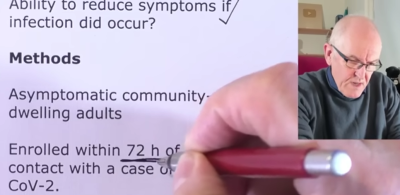
New positive ivermectin evidence
or go to
Aletho News Archives – Video-Images
From the Archives
Fanatical Followers of the Covid Regime: A Jim Jones-Style Cult?
By Professor Roger Watson and Dr. Niall McCrae | The Daily Sceptic | November 15, 2021
As scholars at leading British universities over recent decades, we witnessed the replacement of critical thinking and debate by narrative: facts are discrimination and scientific method is imperialism; truth, instead, is derived from ‘progressive’ values. This educational trend may be a major contributory factor to the ease in which society has been inculcated to the Covid ‘new normal’ of masking, testing, and repeated doses of vaccines for a disease of similar risk to severe influenza.
One doesn’t need much critical reasoning to observe the flawed logic of some vaccination enthusiasts, such as people who respond to experiencing any side effects, however debilitating, by saying “at least I know it’s working”, or, after contracting the disease despite their promised inoculation (over 90% effective, according to initial drug company claims), “I’d have been worse off without the jab.” … continue
Blog Roll
 Aletho News
- The Coming GOP Bloodbath?
- Arctic Scare Stories Melt Away
- Wrong, Euronews: Climate Change Has Not Created a Food, Energy, and Economic “Meta-Crisis”
- New positive ivermectin evidence
- Met Office Caught Fabricating Daily Temperature Record Claims
- Merck Virologists Admitted to Falsely Certifying Vaccine Efficacy
- Mandatory Folic Acid for every man, woman & child
- Pro-Palestine protesters arrested outside UK’s ruling Labour Conference in Liverpool
- Mauritius denies landing permit to flight from Israel, forcing cancellation: Tour operator
- Israeli finance minister calls for genocidal war on West Bank, annexation of south Lebanon
- If Americans Knew
- Israel kills more Palestinians, amid push to resettle Gaza – Daily Update
- Israel forces Gazans to live in constant peril – Daily Update
- Deconstructing Netanyahu’s pants-on-fire UN rant – Daily Update
- Trump betrayed voters with his campaign lies and prioritized a foreign country once he took office
- Netanyahu calls Israel’s war in Gaza ‘opposite of genocide’ in UN speech to near-empty hall
- Settler Kidnappings: Torture, Sexual Abuse and Terrorisation of Palestinian Abductees as Israel Deepens Annexation of West Bank
- Gaza winter nears as 162,000 tents become unusable, raising fears of humanitarian crisis
- Netanyahu says, “It’s the opposite of genocide”; UN says Gaza economy is world’s ‘most severe crisis on record’ – Daily Update
- Israel’s US-Backed Assault on Gaza Has Created the ‘World’s Most Severe Economic Crisis on Record’: UN
- ‘Protecting U.S. Citizens’… From Israel
- No Tricks Zone
- New Study: Earth And Venus Surface Warmth Largely Explained By Convection And Lapse Rate, Not CO2 Or Radiation
- 2025 Nature Paper Claiming Worsening Global Drought Gets RETRACTED …Heavily Flawed
- New Study: ‘Global Drought Shows No Detectable Recent Acceleration Under Climate Warming’
- Economic Masterminds: German Socialists Suggest Taxing Productivity Gains Stemming From Using AI
- The South China Sea Has Not Been Cooperating With The Climate Change Narrative
- Energy Crisis: Germany Enters Heating Season With Historically Low Gas Reserve Fill Levels
- New Study: The Antarctic Ice Sheet Gained Mass From 2020-2024 Due To Staggering Snow And Ice Accumulation
- Study: Ocean Heating Rates From Thousands Of Years Ago ‘Dwarf’ Modern Ocean Heating Rates
- Climate Extremists Target, Attack Large-Scale Power Grid Infrastructure In Germany!
- New Study: Antarctic Ice Melt Has Contributed Less Than 1 Centimeter To Sea Level Rise In The Last 30 Years

