Iran discovers 14 billion barrels of crude oil reserves
Press TV – January 21, 2013
Iran has discovered 14 billion barrels of crude oil reserves during the first three quarters of the current Persian calendar year (started March 20, 2012), an Iranian deputy oil minister says.
In a Monday interview, Mohsen Khojasteh-Mehr noted that during the previous Iranian year (ended March 19, 2012), the country discovered 20 billion barrels of crude oil.
“A total of 14 billion barrels of crude oil reserves has been also discovered in the first nine months of the current year,” he added.
The official pointed to Iran’s 300-percent progress in discovery of oil and natural gas resources and noted that the oil ministry is currently ahead of its discovery plans.
“Even in the absence of new discoveries, Iran will be capable of producing oil for the next 140 years,” Khojasteh-Mehr pointed out.
Iran holds the world’s third-largest proven oil reserves and the second-largest natural gas reserves.
The country’s total in-place oil reserves have been estimated at more than 560 billion barrels, with about 140 billion barrels of recoverable oil. Moreover, heavy and extra-heavy varieties of crude oil account for roughly 70-100 billion barrels of the total reserves.
Related articles
- Iran discovers new natural gas reserves (en.trend.az)
- Iran begins oil production from a joint field with Iraq (alethonews.wordpress.com)
- Iraq Discovered Another Billion Barrels Of Oil It Had No Idea Existed (businessinsider.com)
- China Imports of Iranian Crude Rebound to Highest in Six Months – Bloomberg (bloomberg.com)
Jordan Paust’s Bad Law: UH Law Professor Tries & Fails to Legalize an Israeli Attack on Iran
By Nima Shirazi | Wide Asleep in America | January 16, 2013
On January 15, 2013, University of Houston Law Center professor Jordan Paust penned an article entitled “Iran’s Nuclear Weapons Program and Lawful Israeli Self-Defense,” which was published on Jurist, a website of analysis and opinion pieces written by law professors, lawyers, and legal scholars. It is clear throughout Paust’s piece that his arguments are neither sound nor based in fact, and unfortunately rely entirely on false premises and long debunked propaganda. Paust himself is a contributing editor to Jurist.
To begin with, the title of Paust’s analysis itself betrays both its agenda and its absurdity, considering Iran doesn’t have a nuclear weapons program according to all Western and Israeli intelligence agencies and unprovoked, “preventative,” “anticipatory” or “preemptive” military assaults are not only totally illegal but also can not possibly be justified as “self-defense.”
And that’s just the beginning; the falsehoods continue to stack up. In fact, Paust reveals his utter ignorance from the get-go, writing – in his very first sentence, no less – that the Iranian leadership “continues to proclaim its desire to wipe Israel off the map” – something even Israel’s own Deputy Prime Minister Dan Meridor admits it has never done. His understanding of Article 51 of the United Nations Charter (which affirms the right to retaliatory self-defense if attacked first) is bizarrely lacking, especially considering he’s a law professor. He joins the shameful company of Alan Dershowitz in this regard.
Paust goes on to (1) accuse of Hezbollah and Hamas of terrorism and serving as Iranian proxies, without ever mentioning Israel’s decades of international law violations and continuing war crimes and occupation or the fact that they are autonomous organizations that don’t take direction from Iran; (2) ignore all facts pertaining to the illegality of initiating of a “war of aggression” (the “supreme international crime,” according to the Nuremberg Tribunal); and (3) claim that Iran is violating UNSC resolutions regarding the cessation of uranium enrichment, a demand many have long acknowledged is ultra vires, itself abrogates the NPT and the resolutions are themselves illegal.
Apparently, though, these facts aren’t important to Professor Paust.
Furthermore, among the “facts” that Paust marshals to advance his argument that Israel could legally launch a preemptive attack on Iran is the contention that “Iran is publicly ‘gunning’ for Israel.” Yes, he wrote that. And he still has a law degree. And is presumably literate.
From there, Paust launches into a bizarre and wholly inapplicable “Wild West Showdown” analogy in which the (Israeli) “good guy” is justified in “shoot[ing] first” since he knows the (Iranian) “bad guy” is out to get him. It is “not necessary that the bad guy shoot first,” Paust writes, elaborating (for some inexplicable reason) that “the good guy could have drawn first once it was known that the bad guy was gunning for him and they were staring each other down in the street.” By way of trying to make this dumbfounding, Manichean analogy make sense, he explains, “Someone was about to draw first and, in context, the process of attack had begun and a right of self-defense had been triggered even though it was possible that the bad guy might back down and make this clearly known before the good guy fired.”
If this passes for astute legal analysis these days, it’s no wonder the United States has little to no respect for basic tenets of international law.
The analysis is so strained, based entirely on presumptions and assumptions with no basis in fact (only in Netanyahu-approved talking points), that Paust discredits himself by writing in the first place.
In the end, Paust pines for a peaceful way out. His solution? That Iranian leaders “shift their attention to peace,…comply with the Treaty on the Non-Proliferation of Nuclear Weapons” and not build a bomb. As countless IAEA reports have demonstrated, Iran’s nuclear program remains peaceful and no nuclear material has ever been diverted to a military program. Iran has also never been found to have violated its obligations to the NPT. Its leaders, for decades now, have repeated denounced nuclear weapons as, not only amoral and religiously sinful, but also strategically useless and politically irrelevant.
But you wouldn’t know that from reading Jurist.
Related articles
- Ask The Leveretts Anything: Are Israeli Fears Of A Nuclear Iran Overblown? (andrewsullivan.thedailybeast.com)
Ahmadinjejad calls for structural change in economy to neutralize sanctions
Press TV – January 16, 2013
Iran’s President Mahmoud Ahmadinejad has underlined the need to make structural modifications to the country’s economy as a means to overcome the sanctions imposed against the Islamic Republic.
“Employing national capacities, overcoming sanctions and disappointing the enemy are possible through structural modifications,” Ahmadinejad said in a Majlis open session on Wednesday.
The Iranian president attended the Majlis session to provide the Iranian lawmakers with the latest information about the country’s economy.
Ahmadinejad proposed four major ways to solve the country’s economic problems, namely the decentralization of the country’s wealth and assets, engaging the people in economic activities, making the utmost use of domestic resources and cutting the budget’s dependence on oil revenues.
He noted that the sanctions have been imposed on Iran to impede the country’s progress and development.
The United States, Israel and some of their allies have falsely accused Iran of pursuing non-civilian objectives in its nuclear energy program. The US and certain other countries have imposed sanctions against the Islamic Republic over the unfounded allegation.
Iran has vehemently rejected the allegations against its nuclear energy program, arguing that as a committed signatory to the nuclear Non-Proliferation Treaty (NPT) and a member of the International Atomic Energy Agency (IAEA).
Billion-dollar US nuclear sub comes off worst in Strait of Hormuz collision with ‘fishing boat’
RT | January 11, 2013
The USS Jacksonville, a large nuclear submarine, has broken its periscope after colliding with a vessel which escaped unscathed. This is the latest collision to involve a US vessel in the busy and tense oil choke point of the Strait of Hormuz.
The American sub was performing a routine pre-dawn patrol when seamen heard a “thump”, according to a Navy source who spoke to several news agencies. The crew tried to ascertain the damage by looking into its periscope, only to realize it was no longer working. The other periscope on the submarine revealed that the first one had been “sheared off”.
It appears the ‘fishing trawler’ that collided with the 7,000-tonne submarine was not only undamaged, but barely noticed the accident.
“The vessel continued on a consistent course and speed, offering no indication of distress or acknowledgement of a collision,” says an official statement published on the US Navy website.
Authorities insist that USS Jacksonville is in no immediate danger.
“The reactor remains in a safe condition, there was no damage to the propulsion plant systems and there is no concern regarding watertight integrity,” they said.
The cost of repairing the damaged periscope are as yet unclear, but the discontinued Los Angeles-class submarines, to which USS Jacksonville belongs, would cost over $1 billion to build in today’s money (the sub was launched in 1978).
USS Jacksonville has now returned to Bahrain, where its damage will be assessed.
The Strait of Hormuz, by far the world’s busiest oil choke point and less than 40km across at its narrowest, has been a scene of several collisions since tension has risen between Iran and the US over the past two years.
The latest spiral of tension in the waterway, which is controlled by Iran on the north side, and US allies Oman and the United Arab Emirates on south, started with the gradual imposition of sanctions on the export of Iranian oil to most Western countries over the last two years.
In response, Iran has repeatedly threatened to close the strait, which transits a third of the world’s sea-borne oil, through ‘asymmetrical’ measures such as laying extensive minefields.
To counter the threat, the US and its allies have deployed what UK media has reported is the biggest concentrated naval force since World War II.
In the crowded passageway, with distrustful captains from dozens of nations operating at cross-purposes, collisions are inevitable.
Most notably, in August last year a Japanese oil tanker left a 3-meter-wide hole in the side of Navy destroyer USS Porter.
Logical Fallacies: The Financial Times on Syria and Uranium Stockpiles
News Unspun | January 10, 2013
On 8 January the Financial Times published an article by James Blitz, entitled ‘Fears raised over Syria uranium stockpile’, premised primarily on the ‘fears’ and otherwise subjective ruminations of unnamed ‘official’ and ‘expert’ sources, one the two named sources being former weapons inspector David Albright (discussed further below).
The claims of Blitz’s sources rest on the argument that, because we lack proof that something is false, it must be true (an ad ignorantiam argument). For example, Blitz states that, ‘Three satellite pictures of the Marj al-Sultan site taken in October, November and December of 2012 and shown to the FT […] appear to show the gradual clearance of a large orchard there, for no apparent reason’. And so, the clearance has triggered fears that (a) the site is ‘a secret uranium conversion facility’, and (b) that tonnes of uranium have been transferred to the site. Because we do not have proof that the orchard has not been cleared for the transfer of uranium, this is cause for concern that this may be the case, according to the article.
Blitz’s sources claim that they have legitimate concerns about a uranium stockpile in Syria, enough uranium they say ‘to provide weapons-grade fuel for five atomic devices’, which could then be transferred ‘from Syria to Iran by air’.
The overarching concern of the article is that Iran would be provided with ‘a “vital resource” [which could] possibly be used to build a bomb’. This depends on a series of speculative claims made by Blitz’s sources turning out to be simultaneously true, with the addition of Iran ‘attempt[ing] to build another secret uranium plant’ (Blitz doesn’t expand on the meaning of ‘another’). To reach this conclusion, the following must all occur:
1. Syria must be in possession of 50 tonnes of unenriched uranium. (Blitz plainly states, in the opening paragraph, that cause for concern lies with ‘up to 50 tonnes of unenriched uranium’ – the implication being that such a thing actually exists – before later backtracking to suggest uncertainty with the inclusion of the clause ‘if it exists’ in reference to the uranium.)
2. The Marj al-Sultan site must actually be a uranium conversion facility. (The report notes that such claims are alleged: ‘what [the experts] allege is a secret uranium conversion facility that the Syrian regime built at the town of Marj al-Sultan near Damascus’.)
3. The uranium must be at the site. (‘Whether the uranium is at the site is unclear, the officials conceded’.)
4. Iran must be trying to ‘seize’ the uranium. (‘Iran, which is closely allied to the Syrian regime and urgently needs uranium for its nuclear programme, might be trying to seize such a stockpile’.)
Given that the above scenarios are at best uncertain and at worst hypothetical, the credibility given to the argument that this might result in Iran ‘building the bomb’ is questionable.
One of Blitz’s two named sources is David Albright, former weapons inspector and head of the Institute for Science and International Security (ISIS). Put forward as a ‘leading expert’ on the Iranian nuclear programme, he is quoted as having concerns about the ‘whereabouts of this uranium’, which Blitz concedes may or may not exist. Albright’s past speculations on states he supposed had been hiding nuclear weapons is worth considering. In August 2002, eight months before the US-led invasion of Iraq, he was interviewed by The Guardian in an article entitled ‘Does Iraq have a nuclear weapon?’ Below are three quotes from the article, which highlight to some degree the lack of substance to his arguments:
‘People have argued that you could find nuclear facilities quickly as they are big, but Iraq knows how to make them small…The clock is ticking’.
‘You would think that if Iraq had a nuclear weapon, it would have done something to show it. But then you can’t be certain’.
‘Once it gets the gas-centrifuge programme, you have to assume that it could make [a bomb] in half a year’.
More recently, Albright has been the co-author of a report from ISIS entitled ‘New Satellite Image Shows Activity at Parchin Site in Iran’. The introduction to the report discusses a satellite image which ‘shows what appears to be a stream of water that emanates from or near the building’ that ‘raises concerns that Iran may have been washing inside the building, or perhaps washing the items outside the building’. This and other activities at the Parchin site that have been seen in the last year on satellite images, such as the movement of lorries, and the demolishing of a building, provide the sole basis for Albright’s argument that there has been a nuclear cover-up. In the Financial Times article, Blitz’s reference to ‘the gradual clearance of a large orchard’ is in a similar vein to the speculations that ISIS have made in the past about Iran.
As Albright’s targets are generally the official ‘enemies’ of the west, he receives respectful attention from the UK media, despite an absence of any factual substance to his work.
The ‘concerns’ Blitz reports on belong to his sources, so it is their judgement, and not just his, which is premised on fallacy. Blitz, however, has based his entire argument, without criticism, on the opinions of these officials, and has further developed them into a foretelling narrative, one which doesn’t stand up to even the slightest scrutiny.
Why Latin America Will Not Bow to US Pressure over Iran
By Yusuf Fernandez | Al-Manar | January 11, 2013
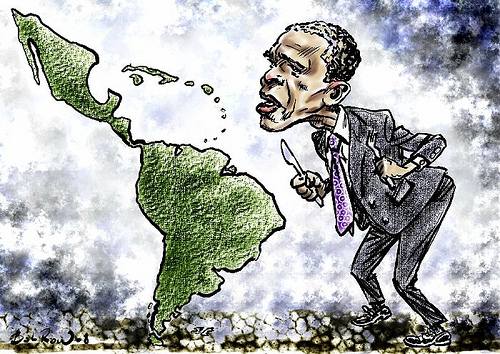
On December 28, US President Barack Obama enacted the so-called “Countering Iran in Western Hemisphere Act” which seeks to undermine Iran´s growing relations with Latin America, a region that has traditionally seen by the United States as its backyard and sphere of influence.
The Act, passed by congressmen earlier this year, requires the US Department of State to develop a strategy within 180 days to “address Iran´s growing hostile presence and activity” in Latin America. The Act points out that “Iran´s business and diplomatic ties are a threat to US national security”. It is seen, however, as another anti-Iranian move fabricated by the Zionist lobby in the US.
Shortly before, in July 2011, Robert F. Noriega – former Assistant Secretary of State for Western Hemisphere affairs, former US ambassador to the Organization of American States (OAS) and current Visiting Fellow at the American Enterprise Institute, one of the main neoconservatives -controlled entities in the US – said in a hearing before the House Subcommittee on Counterterrorism and Intelligence that Iran was carrying out “an offensive strategy” in Latin America.
The Iranian presence in the Latin America has also been harshly attacked by the pro-Israeli hawk Ileana Ros-Lehtinen, Foreign Affairs Committee Chairman and self-appointed bulwark against the alleged “Islamo-Boliviarian threat” to US security. She was co-star of a so-called “documentary” entitled “La amenaza iraní” (The Iranian Threat), in which she said, without blushing, that the US should attack Iran in order to “avert bomb explosions in various Latin American capitals”. The film was aired by Univision, a US broadcast network, which is owned by someone who has hosted galas in honour of the occupying Israeli army.
In 2009, another ridiculous “documentary” released by Univision involved the Venezuelan consul in Miami, Livia Acosta, in an absurd cyber-plot against the US allegedly promoted by “Iranian diplomats and Mexican computer hackers”. This was the pretext used for expelling her from the United States in a move that was widely seen as an American political revenge for Venezuela´s independent foreign policy.
Actually, the US Act rudely violates Latin American countries´ sovereignty and contains some stupid claims such as that the opening of Iranian embassies or cultural centers is to “spread terrorism”. Former Defense Secretary Leon Panetta also echoed those views by claiming, in a recent visit to Colombia, that Iranian attempts to expand its influence in South America amounted to expanding terrorism. Of course, no real evidence has ever been shown to support that laughable allegation.
“The paranoid nature of these estimations, and the scant evidence presented for them, are eerily reminiscent of the kind of broad-strokes, hawkish fear-mongering on display in the lead up to the war in Iraq. The testimony comes from a group bent on hyping security threats and, as Noriega admitted in the testimony, is not even in agreement with the State Department or intelligence agencies”, wrote John Glaser in a recent report.
The US accusations against Iran are also a way of targeting and casting suspicion on Latin American Muslims. In the Act, Washington speaks of “isolating Iran and its allies” and US officials accuse Iran or other pro-Iranian forces of “establishing mosques or Islamic centers throughout the region” in order to advance violent jihad “on our doorstep”.
US declining influence in Latin America
However, Latin American people know well that for over a hundred years it was the United States, and not another country, which wrought terror, war, poverty and repression throughout Latin America in the form of CIA-orchestrated military coups and support of paramilitary crimes, terrorism and dictatorial regimes. Military personnel found guilty of the worst violations of human rights in Latin American countries were trained in the notoriously famous School of Americans by US officers.
Actually, the Act is more evidence that US influence in Latin America is rapidly waning. Latin American countries have developed their own policies and set up independent blocks -ALBA, UNASUR and CELAC- while the Organization of American States, which includes the US and Canada, has been declining due to its submission to US policies on issues such as Cuba´s participation in its summits.
Iran has been seeking to increase its relations with Latin America in a bilateral way and in the framework of the Non-Aligned Movement and other international organizations. This has irritated Washington, which still seems to consider Latin American countries as vassals not having the right to pursue an independent foreign policy or seek its own friends and partners. Any agreement between Latin American states and Iran –or Russia and China- always arouses suspicion in the US.
Several Latin American countries have enhanced their diplomatic and trade ties with Iran in recent years, while their relations with the US have been downgraded amid popular demands for an end to dependence on Washington. Although the United States is still the largest economic partner of many Latin American countries, its economic and financial crisis has adversely affected them. This has led some nations, such as Mexico, to announce their intention to diversify their commercial partners in the next years.
As an international partner, the Islamic Republic is one of the best positioned to help Latin American countries develop their economies and their scientific and technological skills in many fields. The Iranian industry is highly developed. It has remarkable expertise in oil and gas exploitation and other sectors including health, defence, agriculture and space technology.
Iran has helped Venezuela build unmanned drone aircraft as part of their military cooperation. Referring to a Spanish media report that US prosecutors were investigating drone production in Venezuela, President Hugo Chavez said: “Of course we are doing it, and we have the right to. We are a free and independent country.”
In a televised speech to military officers at Venezuela´s Defense Ministry, Chavez said the aircraft only had a camera and was exclusively for defensive purposes. He said that Venezuela planned to soon begin exporting the unmanned drone. Moreover, Iran and Venezuela have mutual investments of about $ 5 billion in factories to make cement, satellites and tractors and the Iranians have helped the Latin American country build 14,000 houses.
Tehran has forged significant economic and political relations with the government of Evo Morales in Bolivia and with that of Rafael Correa in Ecuador. Iran´s links with Argentina, where Zionist circles have unsuccessfully tried to blame Iran for the AMIA attack in 1994, are also rapidly improving, as the government of President Cristina Fernandez is promoting a more conciliatory line towards Tehran.
Latin American countries, especially those that follow an independent foreign policy, trust Iran because they know that the Iranians cannot be pressured into betraying an agreement that disturbs the US or its allies. This is a main reason of Iran´s rising popularity in Latin America despite the propaganda of Zionist-owned media outlets and the US political and diplomatic actions.
HispanTV, the Spanish-language channel similar to the English-language Press TV channel, is also feared by the US establishment and Zionist circles because it is giving Latin American audiences accurate information about the Middle East and international developments that exposes the lies of Zionist-controlled agencies and media. The recent expulsion of Hispan TV from the Spanish-owned Hispasat channel is, in this sense, a desperate attempt to prevent the channel from reaching mass audiences. However, this move, as other similar ones in the past, is doomed to failure.
Therefore, Latin American nations won´t allow the US to dictate their foreign policy on the issue of their relations with Iran or any other country. In fact, Washington has already had a sign of this when it tried to pressure these countries to vote against Palestine’s bid to gain the status of a non-member state at the United Nations. Only one country, Panama, whose government has strong links with the Zionist entity and the local Zionist lobby voted against it.
Related articles
- US, Israel instill fears over Iran’s growing influence in Latin America (alethonews.wordpress.com)
- Ecuador to maintain foreign policy, ties with Iran: FM (alethonews.wordpress.com)
Ecuador to maintain foreign policy, ties with Iran: FM
Press TV – January 11, 2013
Ecuador’s Foreign Minister Ricardo Patino has reaffirmed his country’s determination to maintain its foreign policy and continue bilateral ties with Iran and other friendly countries despite disagreements by the US.
Recent US legislation aimed at countering the Iran-Latin America ties will not affect Ecuador’s relationship with Iran, Prensa Latina news agency quoted Patino as saying in an interview on Thursday.
On December 28, 2012, US President Barack Obama enacted the law to counter Iran’s growing relations with Latin American countries. The Countering Iran in Western Hemisphere Act requires the US Department of State to develop a strategy within 180 days to “address Iran’s growing hostile presence and activity” in Latin America.
The Ecuadorian minister decried the US legislation and said Washington believes that when it breaks off relations with a country, the rest must also follow suit.
He emphasized that Quito would proceed with its relations with Iran, China, Russia, Middle East, Africa and all the countries with which it has traditionally maintained ties.
He expressed hope that the Community of Latin American and Caribbean States (CELAC) would support Ecuador’s stance during their next meeting.
Patino added that the new US law seeks to affect countries in Latin America that have good relations with Iran as in the case of Ecuador.
This law refers only to the US interests and not the global peace, he said, emphasizing that we should not maintain the interests of the power elites.
Major Latin American nations have enhanced their diplomatic and trade ties with Iran in recent years. The promotion of all-out cooperation with Latin American countries has been among the top priorities of the Islamic Republic’s foreign policy over the past few years.
Washington considers Latin America as its strategic backyard, a term used to refer to the USA’s traditional areas of dominance.
Related articles
- US, Israel instill fears over Iran’s growing influence in Latin America (alethonews.wordpress.com)
‘Iran not involved in cyber strikes like US’
Press TV – January 10, 2013
Iran’s mission to the United Nations has dismissed allegations of the Iranian government being behind cyber attacks on the US banking system.
The mission said in a statement on Thursday that the Islamic Republic condemns any use of malware that target important service-providing institutes by violating the national sovereignty of states.
“Unlike the United States, which has, per reports in the media, given itself the license to engage in illegal cyber-warfare against Iran, Iran respects the international law and refrains from targeting other nations’ economic or financial institutions,” the statement said.
The US Center for Strategic and International Studies (CSIS) has claimed that Iran has orchestrated cyber attacks on US financial institutions.
“We believe that raising such groundless accusations are aimed at sullying Iran’s image and fabricating pretexts to push ahead with and step up illegal actions against the Iranian nation and government,” the Iranian mission’s statement noted.
Related articles
- Iran is guilty because… we say so (alethonews.wordpress.com)
Iran is guilty because… we say so
left i on the news | January 09, 2013
The U.S. is ramping up pressure on the American public to accept an attack on Iran, with not one but two stories in today’s news. It wasn’t enough to accuse Iran of producing nuclear weapons based on no evidence, now we’re throwing into the mix accusations of cyberattacks and hostage taking as well.In perhaps the more serious charge, an AP story accuses Iran of holding retired FBI agent Robert Levinson, who disappeared in 2007 on an Iranian island. Iran has repeatedly denied holding Levinson, which would seem reasonable on two counts — one, they never denied holding the three American hikers, nor journalist Roxanna Saberi; why would they deny holding Levinson? And two, considering they have made no demands for a “spy swap” or anything of the sort, to what end would they be holding him?
Logic, of course, doesn’t deter the U.S. authorities who planted this story. And what exactly is their “evidence”? “The tradecraft used to send those items [videos and pictures of the hostage] was too good, indicating professional spies were behind them.” An example of that “professional tradecraft”? They used a cybercafe to send the video and never used that email address again! Oh, the amazing professionalism! The wondrous “tradecraft” of anyone who could pull off such a daring feat! Yes, you read right, this is the evidence on which “the U.S. government’s best intelligence analysis” says that Iran is holding Levinson.
The second story comes with an equal lack of significant evidence. The U.S. government (through the accommodating auspices of the New York Times) is accusing Iran of being behind recent DDoS attacks on American online banking sites. And here comes the “evidence”:
American officials have not offered any technical evidence to back up their claims, but computer security experts say the recent attacks showed a level of sophistication far beyond that of amateur hackers. Also, the hackers chose to pursue disruption, not money: another earmark of state-sponsored attacks, the experts said.
Again, two things. One, amateur hackers are pretty much capable of doing anything these days. And two, many amateur hacking attacks, probably most of them, are done for the purpose of disruption, not money.The most interesting aspect of this story is actually this admission:
American intelligence officials…claim Iran is waging the attacks in retaliation for Western economic sanctions and for a series of cyberattacks on its own systems.
Needless to say, Iran would be perfectly justified in doing so, given that the U.S. is waging an all-out non-military war against Iran. It’s no accident that sanctions are referred to as “tightening the noose.” U.S. “officials” even admit that the sanctions are “designed to…threaten the country with economic collapse.” This is war, and Iran would be perfectly justified in retaliating by a lot more serious means than these cyberattacks. That said, it must be noted again that the “evidence” that Iran is behind these attacks borders on the laughable.But the U.S. government is not laughing. It is deadly serious in its intent to bring down the Iranian government, and remove from the world one more pole of independence from imperialism.
Featured Video

New positive ivermectin evidence
or go to
Aletho News Archives – Video-Images
From the Archives
Fanatical Followers of the Covid Regime: A Jim Jones-Style Cult?
By Professor Roger Watson and Dr. Niall McCrae | The Daily Sceptic | November 15, 2021
As scholars at leading British universities over recent decades, we witnessed the replacement of critical thinking and debate by narrative: facts are discrimination and scientific method is imperialism; truth, instead, is derived from ‘progressive’ values. This educational trend may be a major contributory factor to the ease in which society has been inculcated to the Covid ‘new normal’ of masking, testing, and repeated doses of vaccines for a disease of similar risk to severe influenza.
One doesn’t need much critical reasoning to observe the flawed logic of some vaccination enthusiasts, such as people who respond to experiencing any side effects, however debilitating, by saying “at least I know it’s working”, or, after contracting the disease despite their promised inoculation (over 90% effective, according to initial drug company claims), “I’d have been worse off without the jab.” … continue
Blog Roll
 Aletho News
- The Coming GOP Bloodbath?
- Arctic Scare Stories Melt Away
- Wrong, Euronews: Climate Change Has Not Created a Food, Energy, and Economic “Meta-Crisis”
- New positive ivermectin evidence
- Met Office Caught Fabricating Daily Temperature Record Claims
- Merck Virologists Admitted to Falsely Certifying Vaccine Efficacy
- Mandatory Folic Acid for every man, woman & child
- Pro-Palestine protesters arrested outside UK’s ruling Labour Conference in Liverpool
- Mauritius denies landing permit to flight from Israel, forcing cancellation: Tour operator
- Israeli finance minister calls for genocidal war on West Bank, annexation of south Lebanon
- If Americans Knew
- In Gaza, ‘Whoever Survives the Bombing Won’t Survive the Rubble’
- Israel kills more Palestinians, amid push to resettle Gaza – Daily Update
- Israel forces Gazans to live in constant peril – Daily Update
- Deconstructing Netanyahu’s pants-on-fire UN rant – Daily Update
- Trump betrayed voters with his campaign lies and prioritized a foreign country once he took office
- Netanyahu calls Israel’s war in Gaza ‘opposite of genocide’ in UN speech to near-empty hall
- Settler Kidnappings: Torture, Sexual Abuse and Terrorisation of Palestinian Abductees as Israel Deepens Annexation of West Bank
- Gaza winter nears as 162,000 tents become unusable, raising fears of humanitarian crisis
- Netanyahu says, “It’s the opposite of genocide”; UN says Gaza economy is world’s ‘most severe crisis on record’ – Daily Update
- Israel’s US-Backed Assault on Gaza Has Created the ‘World’s Most Severe Economic Crisis on Record’: UN
- No Tricks Zone
- New Study: Earth And Venus Surface Warmth Largely Explained By Convection And Lapse Rate, Not CO2 Or Radiation
- 2025 Nature Paper Claiming Worsening Global Drought Gets RETRACTED …Heavily Flawed
- New Study: ‘Global Drought Shows No Detectable Recent Acceleration Under Climate Warming’
- Economic Masterminds: German Socialists Suggest Taxing Productivity Gains Stemming From Using AI
- The South China Sea Has Not Been Cooperating With The Climate Change Narrative
- Energy Crisis: Germany Enters Heating Season With Historically Low Gas Reserve Fill Levels
- New Study: The Antarctic Ice Sheet Gained Mass From 2020-2024 Due To Staggering Snow And Ice Accumulation
- Study: Ocean Heating Rates From Thousands Of Years Ago ‘Dwarf’ Modern Ocean Heating Rates
- Climate Extremists Target, Attack Large-Scale Power Grid Infrastructure In Germany!
- New Study: Antarctic Ice Melt Has Contributed Less Than 1 Centimeter To Sea Level Rise In The Last 30 Years

