Iran embassy censures awarding Nobel Peace Prize to Venezuelan opposition leader
Press TV – October 11, 2025
Iran’s embassy in Caracas has blasted the Nobel Committee for awarding this year’s Nobel Peace Prize to someone who advocates for military aggression against Venezuela in yet another sign of the West’s “divisive and interventionist” mentality.
In a post on its X account on Saturday, the embassy said the decision to award the Nobel Peace Prize to Venezuelan opposition leader María Corina Machado is “nothing less than a mockery of the true meaning of ‘peace’”
“Awarding the Nobel Peace Prize to someone who justifies the genocide in Gaza and advocates for military aggression against Venezuela is yet another example of the West’s divisive and interventionist mentality in the developing world,” it emphasized.
The Nobel committee on Friday awarded the 58-year-old Machado, a Venezuelan politician notorious for advocating American and Israeli military intervention in her country, the 2025 Nobel Peace Prize for her “tireless work promoting democratic rights”.
The country’s Supreme Court upheld a 15-year ban against her, citing her direct support for US sanctions, involvement in large-scale corruption, and responsibility for massive financial losses suffered by Venezuela’s foreign assets — including the US-based oil refiner CITGO and the Colombia-based chemicals firm Monómeros.
This comes as the US military escalated its operations against Venezuela in August, involving three destroyers, anti-submarine aircraft, battleships, nuclear submarines, and F-35 squadrons.
Since then, US forces have attacked several vessels, killing dozens of Venezuelan nationals while claiming they were drug traffickers transporting narcotics to the United States.
In response, the Venezuelan government has declared a national emergency, reinforced its armed forces, and mobilized its national militia to counter any potential military aggression from Washington.
Israel’s Secret Social Media War On Iran
By Kit Klarenberg | Global Delinquents | October 7, 2025
On October 3rd, Haaretz published an extraordinary investigation, exposing how for years, the Zionist entity has clandestinely conducted dedicated “online operations” to promote the “public image” of Reza Pahlavi, the Shah of Iran’s eldest son and pretender to the country’s now non-existent throne, locally and internationally. The efforts were highly sophisticated and wide-ranging, harnessing artificial intelligence, social media manipulation of every sort, and other online warfare techniques intended to convince audiences Pahlavi was Tehran’s exiled rightful ruler-in-waiting.
Hundreds of bogus online personae, with AI-created profile photos and fraudulent biographies, calling for the restoration of the Islamic Republic’s monarchy and sharing photos and videos of Pahlavi, are run by a shadow battalion of Persian-speakers specifically recruited by Israeli intelligence for the project. Bot and troll networks amplify their output, with campaign messaging constantly updated based on audience analysis.
Another component of the online blitzkrieg is concerned with glorifying Gila Gamliel, a member of Benjamin Netanyahu’s government and Tel Aviv’s “point person with Pahlavi.”
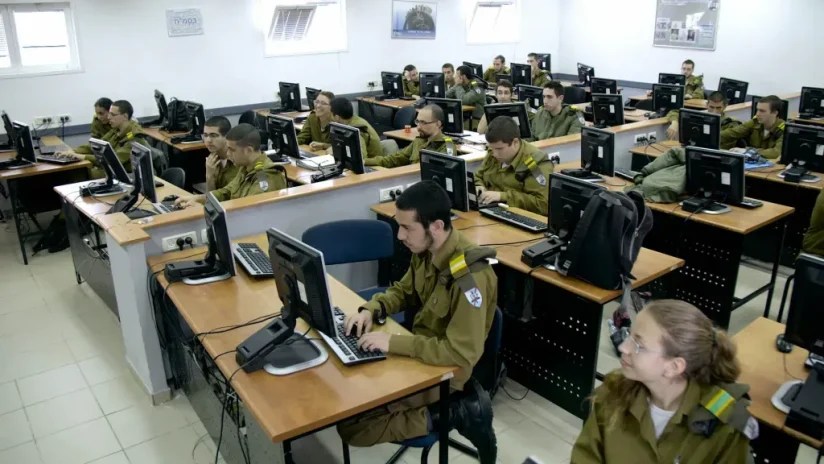
Zionist cyberwarriors hard at work
The network got busted by independent digital researchers as a result of Gamliel posting an AI-generated video on social media platforms, titled “Next Year in Free Tehran”. The fictional clip, published June 15th – three days into the Zionist entity’s botched 12 Day War, and coincidentally the same day Netanyahu forecast imminent regime change in Iran – “had massive exposure, most of which was likely inorganic.” It depicted Netanyahu, his wife, Gamliel, her partner, Pahlavi and his wife walking through Tehran’s streets.
“The video received many more views than most of the minister’s X posts, and these and other attempts to amplify it” helped researchers “locate” a network of bots and fake users artificially boosting Gamliel’s “frequent” calls for regime change in Iran and her ties to Pahlavi. “Many of these accounts were opened in 2022, at the height of the so-called hijab protests in Iran,” Haaretz records. Over 100 further “allied accounts” were launched during the 12 Day War to further boost the malignant network’s output.
Haaretz cryptically reveals, “this doesn’t appear to be the only campaign operating on this issue from Israel.” Still, the outlet’s bombshell disclosures confirm the Zionist entity – if not other hostile foreign powers, including the US – was covertly engaged in expansive psychological warfare initiatives to manufacture consent for Pahlavi’s installation as Iran’s ruler at two critical junctures in recent history, when regime change in Tehran was being openly promoted by Israeli officials, Western governments, and the mainstream media.
Those attempts floundered. While Pahlavi occasionally receives positive coverage by Western news outlets, he enjoys no support among Iran’s population at home, and even many diaspora detractors reject any suggestion of him taking power in the country. In fact, the would-be monarch’s reputation is so poisonous, his endorsement is a decisive kiss of death for any challenge to Tehran’s government. That vast resources were – and seemingly remain – invested by the Zionist entity in such a futile endeavour ranks as an embarrassing failure of epic proportions.
‘Monarchist Accounts’
Further detail on Israeli online dark arts pushing Pahlavi is provided by a July 2023 report from data analytics firm Social Forensics, on “state-sponsored platform manipulation” during the 2022 protests in Iran. The investigation concluded Tehran was the victim of wide-ranging cyberwarfare operations throughout this period. This included “disinformation, smears, and threats” emanating from a vast nexus of bots and trolls on Twitter. While the report did not make a definitive attribution for this malign activity, its findings point unambiguously in Tel Aviv’s direction.
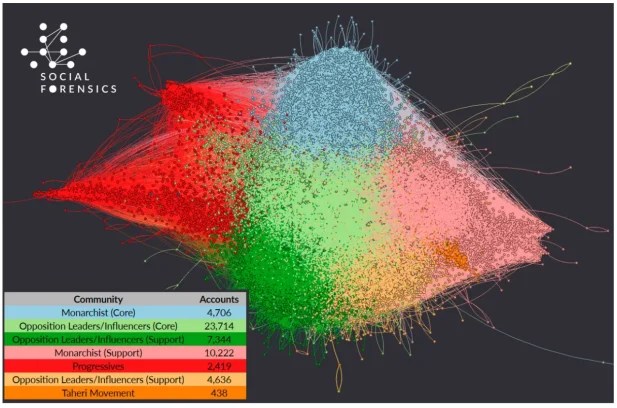
Social Forensics identified several clear, separate “communities” of weaponised accounts targeting the Islamic Republic during this period, such as “progressives”. However, the most influential community were “monarchists”. All accounts in this category had significant followings, and their output generated sizeable engagement, both inauthentic and organic. Thousands of supposed users boasted crown emojis in their display names, denoting their monarchist allegiance. In all, over 95% of these accounts were found to be automated “sockpuppets” by Social Forensics:
“Most… are inauthentic and function to flood Twitter with monarchist, pro-Pahlavi imagery and content to make it seem like there is a larger base of monarchist supporters on Twitter than reality reflects.”
In March 2023, hundreds of pro-Pahlavi bots were suspended for violating Twitter/X rules, after engaging in platform manipulation. Despite many quickly resurfacing with almost identical usernames and continuing their wrecking activities, several prominent anti-Tehran figures condemned the mass ban of automated agitators. Among them was Alireza Nader, formerly a senior apparatchik at notorious, pro-Pahlavi Zionist lobby group the Foundation for Defense of Democracies, and opaquely-funded exile organisation National Union for Democracy in Iran. Social Forensics found he followed and amplified several inauthentic monarchist accounts.
The analytics firm also discovered numerous official Israeli government accounts on the platform likewise followed the most influential pro-Pahlavi sockpuppets. Strikingly, one out of every eight accounts followed by @IsraelPersian, which targets Iranian audiences, were “inauthentic monarchist accounts”, advocating “for the overthrow of the Islamic Republic and the return of exiled Crown Prince Reza Pahlavi to the country as the leader of a constitutional monarchy.” But irresistible indications of Tel Aviv’s management of this belligerent bot network don’t end there.
An authentic user followed by @IsraelPersia, among other official Zionist entity accounts, is Emily Schrader, CEO of digital marketing agency Social Lite Creative. At the time of Social Forensics’ investigation, her company’s website openly boasted of working with “high level government organizations and NGOs in Israel, including the IDF.” The analytics firm’s probe concluded Schrader’s follower count “is inflated and her tweets are artificially amplified by the same inauthentic accounts” calling for insurrection in Iran, including monarchist bots.
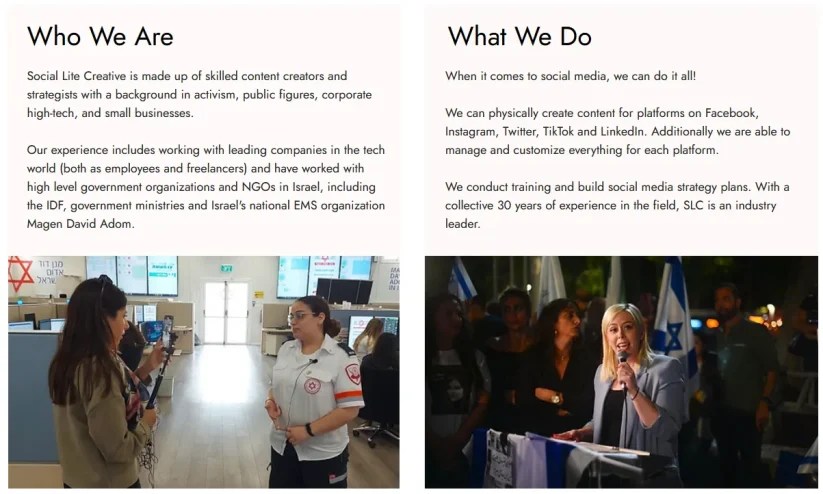
Since amended entries on Social Lite Creative’s website
‘Peddling Distrust’
Schrader avowedly counting multiple Israeli state entities, including its genocidal military, as clients is sufficient grounds to postulate Tel Aviv was ultimately responsible for the pro-monarchist “platform manipulation” campaign. Just as suspiciously, the protests they accompanied were launched following the Pentagon waging a clandestine online war against Iran for years prior. These efforts were exposed by digital researchers after Twitter and Meta banned a vast network of US military-run accounts, which “used deceptive tactics to promote pro-Western narratives” in Central and West Asia.
Iran was a preponderant target, with Pentagon psyops specialists managing multiple anti-government media outlets publishing content in Farsi with accompanying social media channels, and a panoply of bot and troll accounts. These personae frequently posted non-political content, including Iranian poetry and photos of Persian food, in order to enhance their authenticity. They also engaged with real Iranians on Twitter, often joking about mundane topics such as internet memes. The sockpuppets spanned a wide ideological gamut, employing differing narrative techniques for varying audiences.
For example, some ‘Iranian’ Pentagon bots and trolls promoted “hardliner” views, criticising the Islamic Republic for being too liberal domestically, and inadequately aggressive in asserting its interests regionally. Others posed as left-wingers, secularists and other opposition elements. It was a full-spectrum digital assault from every angle. Eerily, many of these accounts promoted women’s rights, and protests against hijab-wearing. One Pentagon-circulated meme compared the treatment of women abroad with Iran, by contrasting photos of Western female astronauts and an alleged local victim of violent domestic abuse.
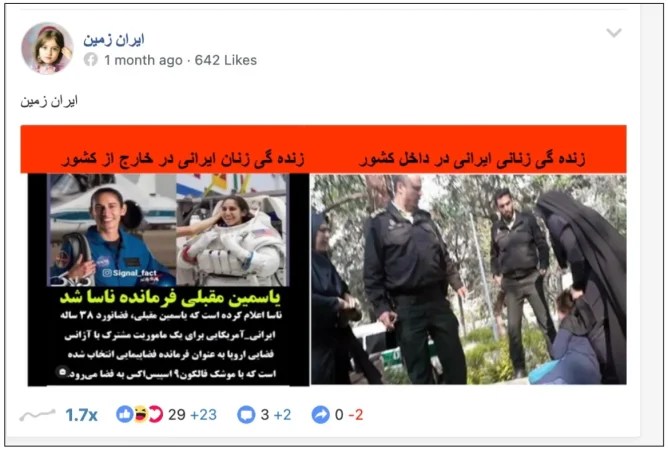
Hijab destruction was a core symbol of protests that subsequently erupted in Tehran, which elicited blanket foreign media coverage, and a chorus of calls for regime change in Iran. Quickly, Pahlavi and close allies such as Masih Alinejad, a veteran of US-funded propaganda efforts targeting the Islamic Republic, who has called for Zionist entity attacks on the country and assassination of its leaders, proclaimed themselves to be leading the demonstrators. However, their attempt to commandeer the protests resulted in the unrest’s instant termination locally.
A withering post-mortem of “why Iran’s ‘woman, life, freedom’ revolution failed” authored by Zionist lobby-connected Mariam Memarsadeghi, who similarly promotes regime change in Tehran, pinned the blame squarely on Pahlavi’s attempt to associate himself so intimately with the protests. She noted the fake king’s close associates push extreme “Iranian nationalism”, calling for “retributive violence [and] summary executions” of enemies, while “peddling distrust and attacking other opposition leaders on social media.” These activities gravely alienate Iranians within and without the country, leaving Pahlavi irreparably tarnished.
In April 2023, Pahlavi made a surprise appearance in Tel Aviv. Despite eliciting zero Western media interest, Israeli news outlets eagerly promoted his appearance as of earth-shattering significance. The Times Of Israel claimed the “historic” visit was a “healing process for many Iranian Jews,” leaving them with a “unique sense of joy, optimism, and a feeling of healing.” At a press conference, Pahlavi was asked about the response his trip there was receiving from average Iranians. He declared their vehement support was provably clear:
“Don’t take my word for it, search on social media… on Twitter, Instagram, any platform. If you do the research yourself, you don’t need to ask me the question. The answer is right before your eyes.”
Of course, that “answer” was provided by people who don’t exist, courtesy of “online operations” conducted by Israel, and likely other states seeking regime change in Iran. Evidently undeterred by the 2022 campaign’s faltering, Pahlavi was again fraudulently promoted by a Zionist-orchestrated social media effort during the 12 Day War, wholly counterproductively. A July report from Tel Aviv’s Institute for National Security Studies concluded monarchist backing for insurrection during that conflict only strengthened local support for the government, “rallying the public around the flag”:
“It is therefore advisable to avoid ties, when possible, with Iranian opposition groups (including some monarchist circles in the diaspora) who are perceived by large segments of the Iranian public as tainted and having betrayed Iran in its time of need. Although aligning with pro-Western and pro-Israel diaspora groups that push for revolutionary change may seem natural, such associations may, in fact, undermine the credibility of internal opposition and ultimately obstruct the desired outcome.”
Iran to respond as US moves to target commercial shipping: Source
Al Mayadeen | October 7, 2025
Indicators point to escalating tensions between the United States and Iran, sources told Al Mayadeen, as Washington reportedly prepares to obstruct Iranian commercial shipping under the pretext of renewed sanctions on Iran.
According to the sources, any such move by the US would provoke a swift and decisive response from Tehran, citing the Islamic Revolution Guard Corps Navy and the Iranian Army’s possession of capabilities that can neutralize any threat posed to Gulf maritime security and the Sea of Oman.
They emphasized that Iran’s naval fleet and missile bases, deployed along the country’s southern coastline, are ready to respond immediately to any hostile action targeting its commercial or civilian vessels.
The sources added that any attempt to target Iranian ships would trigger a direct response, underscoring Iran’s readiness to defend its maritime interests, further confirming that regional countries have been explicitly warned: any cooperation with the US in actions that obstruct Iranian commercial shipping will not go unanswered by Tehran.
In event of mishap, Navy to respond with all might: IRGC chief
On October 5, IRGC Commander Major General Mohammad Pakpour inspected naval units situated at Gulf bases, assessing their combat preparedness as high during his visit to the operational units stationed on the islands.
Addressing the naval units, the IRGC commander stated, “Just as the armed forces brought the Zionist regime and the United States to their knees in the 12-day imposed war, if any movement is made by the enemies in the sea and islands, the IRGC Navy will respond with all might.”
He also credited the forces’ high morale and profound faith as a key strength that intimidates “Israel” and the US. General Pakpour additionally oversaw the sailing of a United States ship in the Gulf during his tour.
This comes amid rising tensions in the region, as the United States ups its military build-up in countries neighboring Iran.
US sent $21.7 billion to Israel to back Gaza genocide: Study
Press TV – October 7, 2025
An academic study has revealed that the United States has funneled $21.7 billion in financial and military assistance to Israel since the onset of the Gaza genocide on October 7, 2023.
The report released on Tuesday by the Costs of War Project at Brown University’s Watson Institute for International and Public Affairs details how the US State Department and the newly renamed Department of War, under both Joe Biden and Donald Trump administrations, have collectively transferred at least $21.7 billion to support Israel’s genocide in Gaza.
According to the study, the United States supplied $17.9 billion to Israel in the first year of the genocide, during former US president Joe Biden’s tenure, and $3.8 billion in the second year.
A large portion of the assistance has already been delivered, while the remainder will be distributed in the coming years, the report added.
The study notes that Washington is expected to allocate tens of billions of dollars in future funding to Israel through various bilateral deals.
Another analysis, also published by the Costs of War Project, states that the United States has spent approximately $9.65 – $12.07 billion on military operations in West Asia over the past two years.
US spending in the region, such as strikes on Yemen in March and May 2025 and attacks on Iranian nuclear sites on June 22, estimates total costs between $9.65 billion and $12 billion since October 7, 2023, including $2 billion to $2.25 billion for operations against Iran.
Although both reports rely on open-source data, they present detailed assessments of US military support for Israel and estimates of the cost of direct American involvement in the region.
Meanwhile, the State Department has not commented on the amount of military assistance given to Israel since October 2023. The White House referred inquiries to the Pentagon, which oversees only a part of the aid that is given to the Zionist entity.
The studies argue that without US backing, the regime would have been unable to maintain its genocidal campaign in Gaza for two years.
The principal study was produced in collaboration with the Washington-based Quincy Institute for Responsible Statecraft.
Pro-Israel groups have accused the institute of isolationism and anti-Israel bias, allegations the organization firmly denies.
Meanwhile, Israel’s war machine continues its campaign of destruction, claiming countless civilian lives across Gaza and the wider region.
Since October 7, 2023, when Israel launched its genocidal war on the besieged Gaza Strip, more than 76,000 Palestinians, including over 20,000 children and 12,500 women, have been killed or gone missing, while in its 12-day war with Iran last June, the regime killed at least 1,604 people.
Iran discovers large natural gas reserve near Persian Gulf
Press TV – October 6, 2025
Iran has discovered a large gas reserve in its southern province of Fars near the Persian Gulf as the country moves ahead with plans to expand its massive petroleum sector despite foreign sanctions.
Iran’s Oil Minister Mohsen Paknejad said on Monday that the Pazan gas reserve holds an estimated 10 trillion cubic feet, or more than 280 billion cubic meters (bcm), of natural gas.
Paknejad said the large gas field also covers areas in the neighboring province of Bushehr, which is the hub of Iran’s gas processing industry.
He said Iran had awarded a contract to develop the field, adding that production could start within the next 40 months.
The minister said exploration activities in Pazan had also led to the discovery of a reserve with at least 200 million barrels of crude oil, adding that the figure could increase as a result of ongoing operations in the field.
His comments came in a report by the Iranian Oil Ministry’s news service Shana, which indicated that the discovery of the Pazan gas field had taken place after drilling a second well in the field in recent years.
It said production from the field will boost Iran’s capacity to respond to an increasing demand for energy in the country in the coming years.
Iran is the second-largest holder of natural gas resources in the world. It is also the third-largest producer of natural gas after the United States and Russia, and the fourth-largest consumer after the US, Russia, and China.
Facing an increasing demand for natural gas in power plants and industries, the country has successfully increased its production in recent years by relying on domestic companies that have replaced foreign contractors wary of US sanctions.
The South Pars gas field, located on the maritime border between Iran and Qatar in the Persian Gulf, is responsible for more than 70% of Iran’s natural gas production of nearly 1 bcm per day.
Iran declares Cairo deal with IAEA ‘defunct’
The Cradle | October 5, 2025
Iranian Foreign Minister Abbas Araghchi confirmed on 5 October that the Cairo deal signed with the International Atomic Energy Agency (IAEA) last month is no longer active or valid due to European ‘snapback’ sanctions on Tehran.
“Experience has shown that there is no solution to Iran’s nuclear issue other than a diplomatic and negotiated one,” Araghchi said.
“The three European countries thought they could achieve results through the snapback mechanism, but that tool was ineffective and only made diplomacy more complicated. Diplomacy will always continue, but the form and the parties involved in negotiations have now changed. Undoubtedly, the role of the European countries in the upcoming talks has diminished, and their diplomatic justification for participating has weakened,” he added.
“In recent months, our discussions have been focused solely on the nuclear issue, conducted either directly or indirectly with the American side. In these exchanges, our proposals were completely transparent. Had they been taken seriously … reaching a negotiated and diplomatic solution would not have been out of reach. Even now, if the [opposing] parties act in good faith and consider mutual interests, the continuation of negotiations is possible.”
“Nevertheless, the situation following the military attack and the activation of the snapback mechanism has changed, and the upcoming negotiations will certainly be different from before,” he went on to say, adding that both the US-Israeli attacks on Iran in June and the activation of the ‘snapback’ mechanism have complicated matters.
“After several rounds of talks, this agreement was reached in Cairo. However, the Cairo Agreement no longer suffices under the new circumstances, including the activation of the snapback mechanism, and new decisions will be made.”
“To prove the peaceful nature of its nuclear program and its goodwill, the Islamic Republic of Iran has exhausted all diplomatic avenues, pursued consultations and cooperation, and presented constructive and balanced proposals. There is now no excuse left for Western countries to prevent Iran from cooperation or dialogue. Iran’s positions are fully legitimate and reasonable, and it is ready to pursue any solution that leads to confidence-building.”
The snapback sanctions took effect on 28 September. Washington welcomed the European decision.
Iran had previously warned that activating the sanctions would jeopardize the Cairo deal, reached on 9 September after Tehran resumed cooperation with the IAEA following a brief suspension as a result of the war.
Negotiations to prevent the return of the sanctions failed after the UN Security Council (UNSC) rejected a draft resolution to permanently lift sanctions against Iran. Russia, China, Pakistan, and Algeria voted to prevent the reintroduction of sanctions, while nine Security Council members voted against sanctions relief. Two countries abstained.
Tehran has recalled its envoys from Germany, France, and Italy.
The EU has continued to hold Iran to the terms of the 2015 Joint Comprehensive Plan of Action (JCPOA), despite Washington’s unilateral withdrawal from the deal in 2018 and its policy of maximum pressure against Iran.
Tehran is insisting on its right to maintain peaceful uranium enrichment.
Nuclear talks between Tehran and Washington have been halted since the US-backed Israeli war against Iran started on 13 June.
The US was aware that Israel was set to attack while continuing to pretend it was negotiating with Iran. In late June, Washington joined the war with a bunker-buster attack on Iranian nuclear sites.
Israel has publicly threatened to restart the war against Iran. Tehran has vowed to respond more harshly to any new attack.
Seyed M. Marandi: Peace Deal & Another War Against Iran
Glenn Diesen | October 5, 2025
I spoke with Seyed Mohammad Marandi in Sochi about the peace deal being imposed on Gaza, and the US/Israeli preparations for another war with Iran. Marandi is a professor at Tehran University and a former advisor to Iran’s Nuclear Negotiation Team.
GAMAAN: The Polling OP That’s Gaslighting The West About Iran
By Sam Carlen & Iain Carlos | Mint Press News | July 28, 2025
The Group for Analyzing and Measuring Attitudes in Iran (GAMAAN), an influential Dutch polling group cited by the New York Times, U.S. State Department, and U.K. government, claims to capture the true views of everyday Iranians through unconventional online surveys.
GAMAAN calls itself an “independent” research foundation, a label echoed by news outlets and think tanks covering the group’s headline-grabbing findings, which portray the Iranian public as far more secular and anti-government than data from organizations such as Gallup and Pew Research suggest. But GAMAAN’s extensive links to U.S.-funded organizations, many of which advocate for regime change in Iran, and its flawed methodology, have raised serious questions about its credibility and impact on Western understanding of Iran.
“[T]hey know what they think, and they want to use the language of social science to demonstrate that those claims are actually true. And of course, that’s a problem,” said Daniel Tavana, an assistant professor of political science at Penn State who was a principal investigator for Princeton’s Iran Social Survey.
“[T]hey’re just ideological,” Tavana said.
They are very opposed to the regime, want to embarrass the regime in whatever way they can, and are happy to say … whatever they think will most effectively do that at any given point in time, regardless of whether or not they have evidence for it.”
GAMAAN’s role in anti-government discourse surrounding Iran has taken on heightened significance against the backdrop of escalating tensions between Israel and Iran, which culminated in a historic outbreak of hostilities last month.
Ostensibly motivated by concerns over Iran’s nuclear program, the conflict began with an Israeli surprise attack on June 13, to which Iran responded with a barrage of missiles and drones, beginning a days-long cycle of back-and-forth attacks between the two sides.
The U.S. entered the war on June 22, conducting airstrikes on Iranian nuclear facilities, and Iran responded with attacks on U.S. military bases in Qatar. On June 24, a shaky U.S.-brokered ceasefire took hold, and despite initial violations by both Israel and Iran, active hostilities gradually came to a halt.
GAMAAN’s poll results, which portray the Iranian citizenry as far more hostile to their government than other surveys, are often cited by advocates for regime change. The question of Iranians’ support (or lack thereof) for the Islamic Republic was particularly relevant during the hostilities, when doubts arose about the government’s survival, and the prospect of installing the Shah’s son was granted legitimacy by some media outlets.
While Iranian state-owned media have discussed some of GAMAAN’s ties to Western-funded organizations and regime change proponents, as well as the limitations of its survey methods, Noir News is the first to report the full scope of GAMAAN’s numerous connections with U.S. government-funded regime change operatives and the severity of its methodological issues.
Given GAMAAN’s rapid rise to prominence, with its findings often cited by Western governments and prestigious news outlets, the group’s numerous ties to U.S. government-funded supporters of regime change in Iran, and the organization’s dubious survey methods, warrant scrutiny, especially given the anti-Islamic Republic trend of its survey results (with one survey finding 81% of respondents opposed the Islamic Republic), which are used by critics as a cudgel against Iran’s government.
GAMAAN founders Pooyan Tamimi Arab, an assistant professor of religious studies at Utrecht University, and Ammar Maleki, an assistant professor of comparative politics at Tilburg University, are themselves outspoken critics of the Iranian government. Maleki refers to himself as a “pro-democracy activist” and is a vociferous critic of the Islamic Republic and proponent of regime change. Neither responded to requests for comment.
Indeed, GAMAAN has relied on U.S. government-funded VPN and anti-censorship software providers like Psiphon to disseminate its surveys; collaborated with the USAID-funded, pro-regime change Tony Blair Institute; and collaborated with and received funding from historian Ladan Boroumand, co-founder of the Iranian regime-critical Abdorrahman Boroumand Center for Human Rights in Iran, which is in turn supported by the U.S. government-funded National Endowment for Democracy (NED).
Likewise, for a February 2023 report on Iranians’ attitudes toward the anti-government protests, GAMAAN enlisted the help of U.S. government-linked Iran International and U.S. government-funded Voice of America Persian in circulating survey questions.
Founded in 2019, the logic behind GAMAAN’s founding was that, in the context of state repression, traditional survey approaches based on random sampling and in-person or telephone interviews fail to capture the population’s true beliefs regarding sensitive religious and political topics, because “individuals often censor their true views or even actively alter them to avoid scrutiny by authorities,” according to GAMAAN.
Instead, the group distributes its surveys via social media, VPN platforms such as Psiphon, and encrypted messaging platforms like Telegram, allowing respondents to participate anonymously.
Unlike traditional polling based on probability sampling—random selection of respondents and persistent follow-up to minimize non-responsiveness—GAMAAN uses a voluntary, opt-in model. Respondents are not randomly selected from the broader target population of literate Iranians over the age of 19.
Instead, GAMAAN says respondents are reached “through random sampling via the popular Internet censorship circumvention provider Psiphon VPN, as well as ensuing sharing by respondents on social networks (Telegram, Instagram, WhatsApp, and Twitter).”
Prior to its use of VPN platforms like Psiphon for sampling, GAMAAN had exclusively relied on surveys being shared on social media, a method also referred to as “multiple chain-referral sampling,” also known as “snowball sampling.”
To account for methodological issues with non-random sampling inherent to opt-in surveys, GAMAAN tries to circulate its polls across a range of channels “representing radically diverse social layers of society and political perspectives,” and adjusts response data using statistical methods meant to render the final polling data more representative of the target population (literate Iranians 19 years and older with internet access).
At times, the circulation of GAMAAN’s surveys has been aided by social media virality.
Using this unorthodox methodology, GAMAAN’s survey results have often surprised observers and contradicted the findings of long-established pollsters, such as Pew Research and Gallup, which employ conventional face-to-face and telephone polling methods. The group’s 2020 survey on Iranians’ religious beliefs made waves for its findings, which showed less religiosity among the Iranian population than was generally believed (and indicated in prior polling).
Among other surprising results, GAMAAN’s survey found 22% of respondents did not belong to any religion, 9% identified as atheist, and 47% reported “having transitioned from being religious to non-religious.” In contrast, Pew Research reported in 2009 that 99.4% of Iranians are Muslim.
But according to polling experts, GAMAAN’s findings cannot be generalized to the broader Iranian public due to significant bias in who its surveys reach. GAMAAN relies chiefly on the Psiphon VPN platform to circulate its survey questionnaires, with about 66% of respondents in its latest poll participating through the platform, and the remainder reached through Telegram (13.1%), Instagram (8.5%), WhatsApp (4.6%), X (1.5%), and the remaining 6.7% through other undisclosed channels.
According to polling experts, these methods suffer from “coverage bias” in that they fail to reach large segments of the Iranian population, including Iranians who do not use the internet or do not use VPNs or encrypted messaging.
Nor do GAMAAN’s methods account for the fact that Iranians who use Psiphon or come across its surveys through social media are different in important ways from the Iranian population as a whole, to which GAMAAN claims its findings can be generalized.
Indeed, GAMAAN’s survey links are frequently shared by vocal critics of the Iranian government, and demographic data reported by GAMAAN shows respondents are disproportionately urban (93.6% of respondents in its latest survey, vs. about 80% of the total Iranian population), college-educated (70.9% of respondents, compared to 27.7% of literate Iranians 19 years and older, per labor force statistics cited by GAMAAN); and high-income (54% of respondents had a “household monthly income above 13 million Rials,” compared to 40% among the target population, per GAMAAN’s methodology section).
“[F]or that inference that GAMAAN is making to be true, that this sample represents the Iranian population, the adult age population, we would have to assume or believe that Psiphon users are reflective of the Iranian population as a whole, which … just could not possibly be true,” Tavana said.
GAMAAN’s surveys have a high rate of repeat participation (i.e., a large share of respondents to a given survey participated in previous GAMAAN polling), with 26% of respondents in its most recent poll having participated in previous GAMAAN surveys, which GAMAAN interpreted as “indicating that the random sampling method was effective in distributing the questionnaire among a wide range of demographic groups, reaching far beyond networks familiar with GAMAAN.”
“The authors’ claim that this number provides evidence that their methods reach a random sample is a vast misinterpretation,” according to Kevan Harris, an associate professor of sociology at UCLA who was a principal investigator for the Iran Social Survey along with Tavana. “Indeed, it is the opposite. This number, if true, is evidence of how this organization’s methods are reaching a relatively small, interconnected group of people who are predisposed to take their surveys.”
Harris highlighted that, per GAMAAN’s own methodology section in its most recent survey report, 5-11 million Iranians use Psiphon daily (the main source of survey participants), meaning the “refined sample” of 77,216 (which excludes “random or bot-entered responses,” per GAMAAN) constitutes approximately 0.7-1.5% of daily Psiphon users in Iran, yet GAMAAN reported that “26% of respondents had previously participated in GAMAAN’s surveys.”
“When you have a 26% repeat rate from what’s already less than 2% of your potential sample pool of Psiphon users (and less than 0.2% of all adult VPN users), that’s a major red flag about how representative your sample really is,” Harris wrote in an email to Noir.
[I]t shows they’re not really getting a random sample of all Iranians, just likely a small, enthusiastic subset who regularly take their surveys. Indeed, the 26% number, given this relatively large sample size, is telling.”
Sunghee Lee, an Associate Research Professor at the University of Michigan’s Survey Research Center, wrote in an email to Noir that “without further information,” she would agree with Harris’s assessment of the problematic nature of the high repeat-response rate.
“Based on my quick search, the adult population of Iran appears to be around 70 million. The sample of 77K from the June 2024 report accounts for 0.1% of the adult population. This means that, if a true probability sample is used for 77K, you are likely to be sampled 1 out of 1000 studies. The fact that 26% of the sample is a repeat group suggests that the sample is likely to represent a group much narrower in scope than the adult population.”
While GAMAAN purports to use “various balancing methods such as weighting and the sample matching method” to derive a representative sample from its raw survey data, survey experts interviewed by Noir said these methods can’t compensate for the unrepresentative nature of GAMAAN’s underlying data.
“[W]e use weights when we don’t know what the probability is that any given person will enter into a sample, and so we weight certain respondents in our sample more or less if we think that they were more or less likely to be chosen to be on our sample, we don’t have any way to assess that,” Tavana said.
“So what they call weights is actually just refining the sample so that on key demographics, the sample looks more like the Iranian [population]. But it’s not a probability sample to begin with.”
Stanford University social psychologist and survey methodologist Jon Krosnick concurred, writing in an email to Noir : “[T]he phrase ‘matching and weighting’ without disclosing the details also sounds like a snake oil salesman. There have been lots of claims that ‘matching and weighting’ have improved the accuracy of non-probability samples, but lots of published papers have shown that such methods have failed rather than succeeded. I don’t know of a single one showing improvement in accuracy.”
Lee likewise expressed doubt that GAMAAN’s weighting and sample matching adjustments can yield a representative sample: “I am not entirely convinced that a population with less than 30% with college education can be examined by a sample with more than 70% with college education even after the weighting is applied.”
Lee also noted that the Pew Research study GAMAAN links to in its June 2024 survey report when discussing the “raking” weighting method for adjusting online opt-in samples, which used over 30,000 online opt-in survey responses to evaluate weighting procedures and their ability to reduce bias, concluded that “[e]ven the most effective adjustment procedures were unable to remove most of the bias.”
Lee also highlighted that GAMAAN’s “sample is representative only on the dimensions that the study attempted to balance. There are five demographic variables used in ranking: age group, gender, level of education, residential area (urban or rural), and provincial population. Therefore, whether results on the study outcome variables (e.g., expected election turnout) are representative is debatable.”
“The bottom line for me is that abandoning random sampling in Iran or the U.S. leaves a researcher with no basis for generalizing the results of a survey to any population,” Krosnick wrote. “It’s fine to talk about the obtained results, as well as describing the people who participated. But not to generalize.”
According to the survey experts interviewed by Noir, a chief issue with GAMAAN’s approach is the inappropriate generalization of its survey results to the entire Iranian adult population, rather than the (likely meaningfully different) participants in its surveys.
“This doesn’t mean [GAMAAN’s] surveys are useless, but their results should be presented much more cautiously, with clear acknowledgment that they represent opinions of a specific, self-selected subset of internet-using, politically engaged people – not the general population,” Harris wrote in an email to Noir. “This is especially crucial when the surveys cover sensitive political topics that might influence US/European policy or public opinion.”
“I have no doubt in my mind that with the data GAMAAN has, we could make inferences about Psiphon users, and frankly, that would be fascinating to know what Psiphon users think and believe about the Iranian government,” Tavana said.
It’s an incredibly important constituency we could generalize their findings to, and make inferences about, the activist population, maybe even the online population, right? That would be fine, but to say that it’s representative of the whole country … we would have to believe [all] of these things that we know are false. We would have to believe that Psiphon users in particular, but also Twitter and Telegram users, are reflective of their population, and we already have substantial verified information that they are not.”
“GAMAAN tells us to believe that their findings are generalizable to the entire adult population, right? This is invalid,” Tavana said. “That conclusion does not follow from, even if we had their data, even if we knew what procedures they were following, how they were recruiting subjects, and so on, that scientifically does not logically follow from what they are doing.”
Even the central premise of GAMAAN’s approach—that citizens of a country with a repressive, authoritarian state will not give honest answers to questions pertaining to sensitive political or cultural issues when an interviewer is present—is dubious, Krosnick wrote.
“[M]any studies have surprisingly shown that removing interviewers rarely causes responses to change much,” Krosnick wrote. “In general, if a person is going to participate in answering questions, why bother if the person is going to lie – it’s obviously easier just to decline to participate at all from the start or to break off mid-interview.”
GAMAAN has also drawn criticism for a lack of transparency in its methods and, with one exception, a failure to subject its work to the rigor and scrutiny of publishing in peer-reviewed academic journals.
“Because they don’t document carefully enough for scientific standards what they do, none of what they produce is replicable,” Tavana said. “This is compounded by the fact that their data is not publicly available. I cannot go and download their data and analyze it for myself, right?”
The only article based on GAMAAN’s survey work that has been published in a peer-reviewed academic journal to date, “Survey Zoroastrians: Online Religious Identification in the Islamic Republic of Iran,” primarily focuses on a single finding from GAMAAN’s 2020 survey on Iranians’ religious beliefs (which was “financially supported by and carried out in cooperation with Dr. Ladan Boroumand” of the Abdorrahman Boroumand Center, an Islamic Republic-critical organization supported by the U.S. government-funded National Endowment for Democracy) – that 8% of respondents identified as Zoroastrian (a far higher share than reported in previous research).
The paper does not use GAMAAN’s more controversial findings (such as those concerning Iranians’ political beliefs). Moreover, a note appended to the journal article states “[t]he raw data used for this research can be shared with researchers under a confidentiality and collaborative agreement with GAMAAN,” which Tavana characterized as “unusual.”
“Typically, we do not require these kinds of agreements for access to this type of data,” Tavana wrote in an email to Noir. “I have seen it before when the data is proprietary or owned by a private company. But not data that an academic has collected on their own. This means that no one – not the reviewers, the editorial staff, or anyone else – has verified the claims made in the article.”
“[B]ecause we cannot replicate what they do, because their data are not available, we don’t know whether the inferences they are making on that data are valid, and so we have to take them at their word, and there are many reasons why we probably should not take them at their word,” Tavana said.
GAMAAN’s methodological shortcomings may account for substantial differences seen between its findings and those of long-established pollsters using traditional probability sampling.
For instance, in a 2022 survey on Iranians’ political beliefs, GAMAAN reported far lower approval ratings for then-president Ebrahim Raisi compared to those reported by Gallup in a 2021 survey. GAMAAN itself highlighted this divergence (illustrated in the graphic below), but wrote that “both surveys are substantially similar … if Gallup’s results are compared with only the Principlists and Reformists in GAMAAN’s sample” (meaning, responses from more conservative and incrementalist participants in GAMAAN’s survey align with Gallup’s findings across its entire sample).
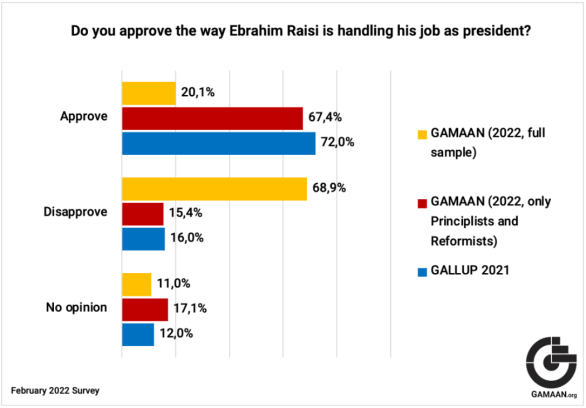
Figure 13-1 — Maleki, Ammar. 2022. Iranians’ Attitudes Toward Political Systems: A 2022 Survey Report. Published online, gamaan.org: GAMAAN.
GAMAAN’s Ties To US-Funded Regime-Change Orgs
Chief among GAMAAN’s ties to U.S. government-funded groups is the organization’s recent “partnership” with the Tony Blair Institute. GAMAAN “exclusively provided” the U.K. nonprofit with detailed survey data gathered in June 2020 (regarding Iranians’ religious beliefs), and February & December 2022 (regarding political systems and the Mahsa Amini street protests, respectively).
The Tony Blair Institute used GAMAAN’s survey data for a series of articles depicting the Iranian populace as eager for regime change, with one article titled “The People of Iran Are Shouting for Regime Change – But Is the West Listening?”.
Founded by former U.K. Prime Minister Tony Blair, the Institute has received millions in grants from the U.S. Agency for International Development (USAID), at least some of which were Cooperative Agreement grants “characterized by extended involvement between recipient and agency.”
The Tony Blair Institute is also funded by the U.K.’s Foreign, Commonwealth, and Development Office (akin to the U.S. State Department), as well as private entities such as the French consulting firm Altai Consulting. Altai boasts the European Commission, USAID, and the French Development Agency as clients.
GAMAAN’s widely-discussed 2020 survey of Iranians’ religious beliefs was “financially supported by and carried out in cooperation with” Dr. Ladan Boroumand, co-founder and research director of the Abdorrahman Boroumand Center, a nonprofit focused on Iranian human rights abuses and critical of Iran’s Islamist government.
Named after her father Abdorrahman Boroumand, an Iranian lawyer and pro-democracy activist who was allegedly assassinated by Islamic Republic agents in 1991, the Center’s ‘Omid’ project documents cases of executions and assassinations in Iran in a searchable electronic database. The organization isn’t shy about supporting regime change, stating that its “goal is to prepare for a peaceful and democratic transition in Iran and build a more just future.”
The Boroumand Center has received substantial funding from the U.S. government-financed National Endowment for Democracy (NED), of which the Boroumand Center is a “partner.”
Ladan Boroumand has held multiple positions at the NED, including serving as a former Reagan-Fascell Democracy Fellow, researching “secularization in Iran,” a current member of the editorial board for the NED’s Journal of Democracy, as well as a current Research Council Member at the NED’s International Forum for Democratic Studies. She has also served on the Steering Committee of the World Movement for Democracy, of which the NED serves as the “secretariat.”
Ladan Boroumand is also on the advisory committee for the Atlantic Council’s Iran Strategy Project, which convened various experts and former officials “to develop a holistic US policy toward the Islamic Republic of Iran for the next four years.”
The Atlantic Council is an influential international relations think tank with extensive ties to U.S. lawmakers that receives large sums from the U.S. government (with FY 2023 grant obligations totaling over $6 million). The group’s October 2024 Iran Strategy Project report recommends a policy of continued pressure against the Islamic Republic, including through “enhanced support to the Iranian people” with the “long-term goal of supporting the Iranian people’s ability to change their system of government if they so desire.”
Ladan Boroumand was invited, along with her sister Roya Boroumand, to a July 2018 speech by former Secretary of State Mike Pompeo at the Reagan Library, amid the Trump administration’s pivot to a hardline posture towards the Islamic Republic. The two sisters likewise joined 12 other Iranian diaspora women in signing an August 2019 open letter calling for a “transition from the Islamic Republic.”
GAMAAN has also consulted with Dr. Shirin Ebadi, an Iranian lawyer and Nobel Peace Prize recipient, who has long worked with the U.S. government and the NED-funded Tavaana, a project of the E-Collaborative for Civic Education (ECCE), founded by staunch opponents of the Islamic Republic, Mariam Memarsadeghi and Akbar Atri.
Tavaana, which describes itself as “Iran’s premier civic education and civil society capacity building initiative,” aimed at ushering in democratic governance. It creates and disseminates anti-government media and information on anti-censorship tools, and has an extensive social media following. Memarsadeghi was also a signatory to the August 2019 open letter calling for a “transition from the Islamic Republic.”
Memarsadeghi is also the founder and director of the Cyrus Forum, an organization that supports ousting the Islamic Republic and works to “reverse engineer an Iranian government that upholds security, the rule of law, and individual liberty.” Ladan Boroumand is one of only two advisors to the Cyrus Forum and was previously listed on Tavaana’s website as a teacher.
Ebadi also appears to have been invited to the U.S. State Department’s 2017 Middle East Partnership Initiative (MEPI) Implementers’ Conference, organized by the Department’s Bureau of Near Eastern Affairs, Office of Assistance Coordination (NEA/AC).
Ebadi’s name and role as president of the Centre for Supporters of Human Rights—a U.K. NGO focused on human rights issues in Iran that Ebadi founded—appear on a guest list circulated by the State Department in September 2017.
GAMAAN has also relied on U.S. government-funded virtual private network (VPN) providers Psiphon and Lantern for assistance in disseminating their surveys and bypassing Iranian government internet censorship.
Since at least 2021, GAMAAN has collaborated with Psiphon, an open-source tool for circumventing internet censorship (using VPN and other technologies) that was developed at the University of Toronto and publicly released in 2006. Psiphon has received millions in funding from the Open Technology Fund, which “receives the majority of its funding from the U.S. government via the U.S. Agency for Global Media (USAGM).”
Psiphon, the Tony Blair Institute, the Abdorrahman Boroumand Center, and Shirin Ebadi did not respond to requests for comment.
The Context
GAMAAN co-founder Ammar Maleki’s ire against the Islamic Republic is more than ideological; it’s personal. His father, Mohammad Maleki, who served as the first president of the University of Tehran, was a well-known critic of the country’s human rights abuses and use of the death penalty.
In 2019, the elder Maleki joined 13 other Iranian activists in signing a pair of open letters calling for Iran’s Supreme Leader to step down and a “complete and peaceful transition” away from the Islamic Republic. Ammar Maleki told Univers, the student newspaper of his employer, Tilburg University, “My father was imprisoned regularly until old age. Almost all the milestones in my life he missed.”
He makes his views on the Islamic Republic clear on X: “To understand/analyze the #Islamic_Republic of Iran, 3 golden rules should be kept in mind: 1- I.R. [Islamic Republic] cannot be reformed by dialogue but will surrender to pressure 2- I.R. officials lie unless proven otherwise 3- when I.R. officials/supporters say #Iran, they mean the I.R. only!”
Hardline politics are not unusual among academics. More unusual and concerning is Maleki’s willingness to accuse those who call into question GAMAAN’s findings and methodology of carrying water for the Islamic Republic. Daniel Tavana experienced this firsthand when he criticized GAMAAN’s methodology online.
“I understand that you have a hard time these days selling your data by the IRGC-initiated IranPoll, so you attack GAMAAN to get attention. I cannot waste my time answering nonsense on GAMAAN’s method for an apologist! Our results were corroborated by external checks & field evidence,” Maleki wrote, referring to Tavana and the Iran Social Survey’s use of IranPoll to conduct surveys within Iran.
Noir couldn’t find evidence of IranPoll having ties to the Islamic Republic, and Maleki did not respond when we asked him to elaborate on the allegation. Tavana likewise stated, “IranPoll has no connection to the government [of Iran].”
Nonetheless, Maleki seems to allege that IranPoll’s work is evidence that Western universities “are under the control of the regime’s thugs,” as he wrote on X.
If mainstream media citations of GAMAAN’s findings are any indication, Maleki’s tenacity seems to be paying off.
Whether you’ve seen it in reports published by the State Department, the American Foreign Policy Council, the government of the United Kingdom, The New York Times, The Wall Street Journal, FiveThirtyEight, The Guardian, The Economist, CBC, Al-Monitor, The Jerusalem Post, Voice of America, the Wilson Center, DW News, Tablet Magazine, The Hill, The Washington Times, or Christianity Today, there’s a good chance that if you live in the West, GAMAAN has helped shape what you think is happening in Iran.
GAMAAN’s rise shows no signs of slowing: the organization announced in January that Maleki had been “selected as the country representative for Iran (2025-2026) in the prestigious World Association for Public Opinion Research (WAPOR).” The Washington Post described WAPOR as “the leading professional association of pollsters working outside the United States.”
For Tavana, GAMAAN isn’t merely worsening academic and mainstream conversation around Iran—it’s potentially providing justification for the kind of military confrontation that actually materialized last month.
“It wasn’t a very long time ago where, you know, the U.S. invaded another country, largely on the assumption that people who lived in that country wanted the invasion and [welcomed] their liberation … And so I think that, like, trafficking in these half-baked ideas is actually quite dangerous, and it’s going [to], if unchecked, get a lot of people killed,” Tavana said.
Sam Carlen is an investigative journalist writing for Noir News, an independent newsletter covering foreign policy and U.S. soft power projection, policing and surveillance, and other topics.
Iain Carlos is an investigative journalist and the founder of Noir News, a newsletter covering foreign policy, policing, surveillance, and other topics.
Max Blumenthal: Charlie Kirk BOMBSHELL Revelation | Middle East Faces Total COLLAPSE
Dialogue Works | October 1, 2025
Leaked Israeli Transcripts Reveal Trump Lied About Attack on Iran
Mainstream media won’t cover this story
By Kevin Barrett | American Free Press | September 30, 2025
Israel’s June 13 attack on Iran, which the US joined on June 22, was framed as a desperate attempt to pre-empt an imminent Iranian nuclear threat. On June 21, Donald Trump insisted that his Director of National Intelligence, Tulsi Gabbard, was mistaken when she testified, in March, that Iran was not building a nuclear weapon.
According to CBS News, a reporter asked Trump: “What intelligence do you have that Iran is building a nuclear weapon? Your intelligence community had said they have no evidence that they are at this point.” Trump responded: “Well then, my intelligence community is wrong. Who in the intelligence community said that?” The reporter answered: “Your director of national intelligence, Tulsi Gabbard.” “She’s wrong,” Trump insisted. Later he told reporters aboard Air Force One: “I don’t care what she said, I think they were very close to having one.”
It was all a big lie. Trump was getting his so-called intelligence from Israel, which was reeling from a wave of Iranian counter-strikes and desperately needed the US to join the war. Shockingly, we now know that Israel never really believed that Iran was building a nuclear bomb.
Recently-leaked Israeli documents show that Israel’s real motives for attacking Iran, and drawing the US into its war, were very different from the “immanent nuclear threat” claim. On September 14, Israeli Channel 13 published leaked transcripts of Netanyahu’s security cabinet meetings just before and during the June war. According to Netanyahu’s own words, and those of his advisors, the real aim of the war was not to pre-empt an imminent Iranian bomb—they knew there was no such threat—but rather to kill Iran’s Supreme Leader and as many other leaders as possible, slaughter top Iranian scientists, inflict maximum damage on Iran’s ballistic missile sites, terrorize the Iranian people, cause a mass exodus from Tehran, and thereby, hopefully, instigate a regime change. The nuclear threat, Netanyahu admitted, was “within a few years,” not days, weeks, or months.
Even Netanyahu’s claim that Iran would build nuclear weapons “within a few years” may have been grossly exaggerated. The leaked transcripts show a senior military figure explaining that the real military rationale for bombing Iran—aside from the attempt to instigate regime change—was “to improve Israel’s strategic balance” and “preventing Tehran from going nuclear in the long term.”
Let that sink in. Israel was trying to stop Iran from getting nuclear weapons “in the long term.” What does that mean, in years? I knew the approximate answer, but asked ChatGPT anyway: “When military strategists talk about ‘the long term’ what is the time frame, in years, they’re referring to?”
ChatGPT replied:
“Short term: Months to 1–2 years (immediate operations, contingencies, current deployments).
Medium term: About 3–7 years (building readiness, procurement cycles, training new units, near-future conflicts).
Long term: Typically 10–30 years…”
So to the extent that there was any real prospect of Iran building nuclear weapons, it was in the time frame of ten to thirty years. Yet Netanyahu and Trump risked World War III by massively bombing Iran on a blatantly false pretext—a pretext that makes George W. Bush’s lies about Iraqi weapons of mass destruction seem tame by comparison.
Ironically, the failed Israeli-American attack on Iran may create the very scenario it ostensibly sought to avoid. Iran’s aging Supreme Leader has repeatedly re-issued a religious edict banning nuclear weapons and other WMD. He insists that such weapons are sinful. That’s why strategists have long known—as Tulsi Gabbard said, and a top military advisor to Netanyahu confirmed—that it is highly unlikely that Iran will build a nuke in the foreseeable future…at least it was unlikely, until Netanyahu and Trump kicked the hornet’s nest with their June attack. That attack caused the Iranian people to rise up in fury behind a new generation of hardline leaders, far more militant than the current Supreme Leader, who are open to the argument, now supported by the majority of the Iranian people, that Iran must scrap its prohibition on WMD and build or buy nuclear bombs to deter future attacks.
According to a leading expert, Theodore Postol of MIT, Iran may have already built nuclear weapons in response to the June attack. In an interview with Glenn Diesen headlined “Iran Is Now an Undeclared Nuclear State,” Postol explained that the Israeli-US attack didn’t harm Iran’s now-hidden stockpile of 60% enriched uranium, which can be quickly, easily, and secretly made into bombs.
So the real reason Iran wasn’t building nukes was that it didn’t want them. But now, thanks to Netanyahu and Trump, it probably does.
The June attack wasn’t just a big lie, and a crime. It was a mistake—a blunder of epic proportions.
Kabul hails regional powers’ rejection of foreign military bases in Afghanistan
MEMO | September 28, 2025
Afghanistan on Saturday welcomed a joint stance by China, Russia, Iran and Pakistan opposing any reestablishment of foreign military bases in the country, the Taliban administration said, Anadolu reports.
Hamdullah Fitrat, deputy spokesman of the interim government, issued the statement after foreign ministers of the four nations met on the sidelines of the 80th UN General Assembly in New York.
The four countries form a quadrilateral consultation mechanism created in 2017 to promote regional stability and coordinate efforts to counter terrorism, narcotics and extremism emanating from Afghan territory.
In a joint communique, they voiced support for Afghanistan’s sovereignty, independence and territorial integrity and said they “firmly” oppose any move by outside powers to set up military bases in Afghanistan or the wider region.
Fitrat said that Afghanistan’s territory would not be allowed to be used against any country and that no armed groups are permitted to operate inside the country.
“Afghanistan is taking serious steps against corruption, drugs and all kinds of undesirable issues and considers this process its responsibility,” he said, adding that Kabul seeks positive relations with all countries based on “mutual respect.”
It comes days after US President Donald Trump warned “bad things” would happen if the interim Taliban administration did not cede control of Bagram Air Base to the Pentagon.
The Taliban returned to power in August 2021 after the withdrawal of US-led forces ended a two-decade war.
Kabul has said it would not negotiate its territorial integrity and urged Trump to honor the 2020 Doha agreement.
Iran security chief backs Saudi-Hezbollah rapprochement from Beirut
The Cradle | September 27, 2025
Secretary of Iran’s Supreme National Security Council, Ali Larijani, stated on 27 September that Hezbollah is a “bulwark” against Israeli aggression, rapprochement with Saudi Arabia is to be welcomed, and that the Lebanese people do not need the US as a “guardian.”
Larijani made the statements after arriving in the Lebanese capital on Saturday to attend the anniversary ceremony of the assassination of Hezbollah leader Hassan Nasrallah.
During a press conference following his meeting with Parliament Speaker Nabih Berri in Ain al-Tineh, Larijani said Hezbollah “represents a solid barrier against the Israeli entity,” one year after Israel’s devastating war that killed 4,047 Lebanese, including fighters and civilians.
Despite Israel’s air superiority, Hezbollah fighters were able to prevent the invading Israeli forces from moving deep into Lebanese territory.
However, Israeli troops managed to occupy five points on Lebanese territory near the border that they continue to hold.
Since the end of the war, Israel has carried out thousands of airstrikes, including a drone strike on a family traveling by car as they reached their home in Tyre in southern Lebanon earlier this week.
The strike killed Shadi Charara, a car dealer, and three of his daughters. His wife and one of his daughters survived the strike. A man riding a motorcycle nearby was also killed.
“The resistance represents a significant asset for the Islamic nation,” Larijani stated, while praising Nasrallah for recognizing the danger posed by Israel decades ago and developing plans to confront it.
Larijani pointed out that Iran wants countries in the region to cooperate with each other in the face of the Israeli threat, despite previous disagreements. “They must put these aside and make cooperation the basis of their relations.”
As a result, he praised Hezbollah Secretary-General Sheikh Naim Qassem’s efforts to improve relations with Saudi Arabia.
“Saudi Arabia is a sister country to us, and there are ongoing consultations between us. Today is a day of cooperation in confronting a single enemy,” Larijani stressed.
Regarding the deep US influence in the country, Larijani stated that, “The Lebanese people are rational and do not need a guardian, nor do they need the Americans to appoint themselves as their guardians.”
He also addressed US Special Envoy Tom Barrack’s assertion that the US is arming the Lebanese army not to fight against Israel, but to fight Hezbollah.
Larijani said that Barrack is “stirring up discord, sowing division, and causing problems within the country and among its citizens, while the approach adopted by Iran is based on Lebanese officials addressing their internal issues through consensus.”
Regarding Israeli threats, he stressed that Iran is prepared for another war with Israel, but warned that it would be “stupidity” for Israel to launch such a war and that Iran’s response would be severe.
In June, Israel launched an unprovoked war against Iran, killing at least 935 people and targeting the Islamic Republic’s air defense and nuclear sites. Iran responded by hitting Israel with barrages of ballistic missiles and drone strikes.
After meeting with Speaker Berri, Larijani then headed to the Government Palace, where he met with Prime Minister Nawaf Salam.
The two reviewed the latest developments in the region and bilateral relations between the two countries.
Salam emphasized that Lebanese-Iranian relations “must be based on mutual respect for each party’s sovereignty and non-interference in internal affairs.”
Featured Video

Macgregor: We Haven’t Seen the Worst of the Iran War Yet
or go to
Aletho News Archives – Video-Images
From the Archives
15 Saudi ‘hijackers’ were CIA agents working for US: Scholar
Press TV – April 13, 2016
Fifteen of the 9/11 “hijackers” from Saudi Arabia were CIA agents working for the United States government, which was seeking to destroy the Middle East for Israel and to double the American military budget, says Dr. Kevin Barrett, an American academic who has been studying the events of 9/11 since late 2003…. continue
Blog Roll
 Aletho News
- Iran’s Plan to Shut Down AI in the Persian Gulf
- Israel seeks ‘compensation’ from Washington over Saudi F-35 sale
- Saudi crown prince seeks dialogue with Ansarullah after Yemeni blows: Report
- Damascus rejects Saudi request for Syrian fighters to counter Yemen: Report
- South Korea says will not send troops to join terrorist US war on Iran
- Russia Just Struck the Eyes of NATO’s War Machine in Ukraine
- Russia summons UK charge d’affaires over Kiev drone support
- NATO member warns bloc seeking pretext for war with Russia
- Macgregor: We Haven’t Seen the Worst of the Iran War Yet
- ‘We are not like everyone else’ laws that bind other nations do not apply to Israel, says Likud lawmaker
- If Americans Knew
- Debunking The Claim That Macklemore Has A “History Of Antisemitism”
- CPJ demands release of arrested Palestinian-US journalist near Bethlehem
- Robert Kraft: The Billionaire Friend of Netanyahu Pulling The Strings Behind the Macklemore/Ed Sheeran Blow Up
- Columbia Administered Fund Gives Big Money to Pro-Israel Groups
- Deportation Case of Palestinian Activist Salah Sarsour Tests First Amendment
- ‘We Will Not Forget’: Palestinians Mark 44 Years since Sabra and Shatila
- Why do we let Zionists decide what we can and can’t say?
- US welcomes Israeli, Iranian delegations to UN, but not Palestinians – Daily Update
- Biden’s Genocide Accomplices Targeted by New Accountability Campaign
- AIPAC’s Network Has Already Spent $67.2 Million to Shape the Midterm Elections
- No Tricks Zone
- New Study: ‘Global Drought Shows No Detectable Recent Acceleration Under Climate Warming’
- Economic Masterminds: German Socialists Suggest Taxing Productivity Gains Stemming From Using AI
- The South China Sea Has Not Been Cooperating With The Climate Change Narrative
- Energy Crisis: Germany Enters Heating Season With Historically Low Gas Reserve Fill Levels
- New Study: The Antarctic Ice Sheet Gained Mass From 2020-2024 Due To Staggering Snow And Ice Accumulation
- Study: Ocean Heating Rates From Thousands Of Years Ago ‘Dwarf’ Modern Ocean Heating Rates
- Climate Extremists Target, Attack Large-Scale Power Grid Infrastructure In Germany!
- New Study: Antarctic Ice Melt Has Contributed Less Than 1 Centimeter To Sea Level Rise In The Last 30 Years
- Fear Of Debate: Alarmist German Climate Scientist Calls On Mainstream Media To Discredit Skeptic Voices
- End-Of-August Arctic Sea Ice Extent Hasn’t Fallen In 20 Years, Official Data Show!
 Aletho News