Iran and the International Atomic Energy Agency (IAEA) officially agreed to resume cooperation on 9 September, following a suspension over Israel’s US-backed war against the country and its strikes on Iranian nuclear facilities.
The meeting between IAEA chief Rafael Grossi and Iran’s Foreign Minister Abbas Araghchi was hosted by Egypt.
“In Cairo today, I agreed with Iran’s Foreign Minister on practical modalities to resume inspection activities in Iran. This is an important step in the right direction,” Grossi said on X.
During a press conference between Grossi, Araghchi, and his Egyptian counterpart, the Iranian foreign minister said, “the development marks an important step in demonstrating the Islamic Republic’s goodwill and its commitment to resolving all issues related to its peaceful nuclear program through diplomacy and dialogue.”
“Iran has remained steadfast in defending its inalienable rights under the Nuclear Non-Proliferation Treaty (NPT) to peaceful nuclear energy, even while facing illegal and criminal attacks by the Israeli regime and the US, and has shown readiness to engage in meaningful dialogue for the implementation of its obligations,” he added.
US and Israeli strikes on the Islamic Republic have “fundamentally altered the conditions under which Iran had cooperated with the IAEA.”
As a result, a “new mechanism” has been reached after intensive talks between Iran and the IAEA recently, Araghchi said.
Unnamed diplomats cited byReuters said “the devil was in the details, and neither Grossi nor Araghchi provided any.”
In early July, Tehran formally suspended cooperation with the IAEA. Talks between the two sides resumed the following month.
Iran stressed that it could not “completely end” its cooperation with the agency, but said “new conditions” would need to be reached.
The Iranian government had previously accused the agency of passing along sensitive information obtained from inspections over to Israel. It also said the agency paved the way for Israel’s war with its anti-Iran report in May and its resolution accusing Tehran of not fulfilling nuclear obligations, which was passed just one day before Tel Aviv attacked.
It also accused it of failing to properly condemn the attack on nuclear sites.
Officials even signaled potential legal action against Grossi himself, who was barred from entering the country in late June.
Iran has not yet given permission to IAEA inspectors to visit its nuclear facilities, despite an agreement to resume cooperation, Iranian Foreign Minister Abbas Araghchi said on Wednesday.
“I should note that under this agreement, we are currently not giving access to IAEA inspectors,” Araghchi said on Telelgram.
The Shanghai Cooperation Organization’s (SCO) summit in Beijing, marked by both symbolism and substance, underscored the slow erosion of Western financial dominance. While mainstream coverage focused on China’s military parade, the real significance lies in the economic agenda advanced by SCO members. Discussions of a potential SCO Development Bank, expanded use of local currencies, and closer coordination with BRICS initiatives point to a growing determination across Eurasia and the Global South to challenge the monopoly long exercised by the United States and its allies through the IMF, the World Bank, and the dollar system.
For decades, these Western-controlled institutions have functioned as instruments of geopolitical leverage. Structural adjustment programs dismantled social protections, imposed privatization, and locked countries into cycles of debt dependency.
The dollar, presented as a neutral global currency, has been repeatedly weaponized through sanctions, financial exclusion, and manipulation of international payment systems. In this context, the SCO’s economic discussions must be seen for what they are: not technical proposals, but acts of resistance. By seeking alternatives to dollar-based finance and conditional lending, SCO members are asserting that the age of Western financial coercion is no longer uncontested.
China and Russia, the central actors in this process, have both experienced the coercive use of Western financial power.
Sanctions on Russia and tariffs on China have reinforced the urgency of building parallel institutions. For smaller states, particularly in the Global South, the stakes are even higher. Access to credit that is not tied to Washington’s geopolitical priorities could mean the difference between austerity and investment, between dependency and sovereignty. The SCO’s proposals are embryonic, but they point toward a broader trend: the emergence of multipolar finance as a shield against unilateral domination.
Critics in the West have rushed to dismiss these efforts, portraying them as impractical or politically motivated. But such dismissals miss the point. The very fact that alternatives are being openly discussed and partially implemented signals the weakening of Western monopoly. The creation of the BRICS New Development Bank, the use of local currencies in trade between Russia, China, and India, and now the SCO’s initiatives all mark a shift from rhetoric to practice. Each new mechanism reduces the ability of the United States to dictate terms unilaterally.
This does not mean China or Russia will replace Washington as the new hegemons. Rather, it means that unipolarity is ending. The world is moving toward a multipolar order in which no single state can control the flows of finance, trade, and development. For Global South nations, this creates both opportunities and risks. It offers the possibility of diversifying partnerships and rejecting conditionality, but it also requires vigilance to avoid reproducing dependency under new patrons. Multipolarity is not a guarantee of justice, but it is a necessary precondition for breaking the cycle of Western domination.
The SCO summit should therefore be understood as part of a larger civilizational struggle over the architecture of world order. Western hegemony has rested not only on military alliances and cultural influence, but on financial coercion. By weaponizing the dollar, Washington has sought to enforce compliance far beyond its borders. The SCO’s economic agenda represents an attempt to reclaim sovereignty in the face of this coercion, to create breathing space for states that refuse to align with U.S. geopolitical priorities.
What emerges from Beijing is not a fully formed alternative, but a direction of travel. Multipolar institutions are being built step by step, challenging the illusion that Western institutions are eternal or indispensable. For countries in Africa, Asia, and Latin America, this is a call to action. It is an invitation to participate in the shaping of a world where development is not dictated from Washington or Brussels, but negotiated among equals.
The mainstream media will continue to focus on parades and symbols, but the real revolution is occurring in the realm of finance. The SCO summit was a reminder that the West’s monopoly on money and credit is cracking, and that the future of global order will be defined not by a single hegemon but by the collective efforts of states refusing to submit. For those seeking peace, justice, and sovereignty, this is a development to be welcomed, nurtured, and defended.
Peiman Salehi is a Political Analyst & Writer from Tehran, Iran.
It is unlikely that the anticipated continuation of the war on Iran, spearheaded by the Israelis but led by the United States, will be confined to a simple tit-for-tat missile trade-off as we saw earlier this year. The reason for this is simple: too much is at stake if this front again flares up.
Since the US-brokered ceasefire between “Israel” and Iran went into effect on June 29, the United States and the Zionist regime have scrambled to move around military equipment, engage in mass surveillance flights over Lebanon and the Persian Gulf. More recently, the US began an early withdrawal of its forces from the Ain al-Assad base and other installations inside Iraq.
The first point of entry to understanding what is currently brewing across West Asia is understanding the mentality at play on both sides of the divide.
On one side, we have the Zionist regime and its Western allies, who are the aggressors and believe themselves to be fighting what Israeli Prime Minister Benjamin Netanyahu calls a “seven-front war”. Although the front in the Gaza Strip has pervaded public consciousness over the past 23 months, overshadowing the wars on Lebanon, seizure of territory in Syria, bombing of Yemen, and attack on Iran, it is very much part of this wider war.
From the Israeli-American perspective, their ongoing war carries the goal of eliminating what is known as the Axis of Resistance, the leader of which is the Islamic Republic of Iran. The thinking clearly is that this period in time has provided a unique opportunity to crush the regional resistance and with it, achieve regime change in Tehran.
In June, the Israelis clearly got ahead of themselves and believed that they could inflict a similar blow in Iran to the blow they inflicted on Lebanese Hezbollah back in September of 2024. In the first few hours of the Zionist Regime’s illegal attack on Iran, their media boasted of landing such a blow. However, to everyone’s surprise, within 15 hours, the Iranians were back on their feet and began firing bursts of ballistic missiles into central “Tel Aviv”.
Even the US strikes didn’t inflict any kind of kill blow that degraded Iran sufficiently, as it proved more than anything that their nuclear facilities could survive US strikes, even if they were badly damaged. The United States certainly poses a major threat to Iran, but the takeaway here is that the Zionist regime can’t take them on alone.
If there is another battle between Iran and the Israelis, the Zionist Entity is already low on interceptor missiles, and its arsenal would be severely drained within around a week or so. We also still do not know the extent of the damage inflicted by Iran’s ballistic missile strikes, due to Israeli military censorship. Simply put, they don’t even allow the public to know the true number of soldiers killed and wounded in Gaza, so forget the notion that they’d admit what Iran did to them.
Another major player here is Lebanese Hezbollah, which appears to be successfully rebuilding itself and is at an intelligence deficit compared to what they had built up over decades and utilized late last year. Yet, what the Israelis do understand is that in the event that a conflict with Iran arises where Hezbollah chooses to enter the fight on the ground, they may face an existential battle for their very survival.
If, and this evidently depends on varying factors, Hezbollah chooses to launch an all-out ground offensive as Iran fires ballistic missiles in bursts across occupied Palestine, it is plausible that the Lebanese party will inflict a total defeat on the Israeli ground forces and seize huge swaths of territory in the north of Palestine.
The Zionist regime is now claiming to be preparing for mission impossible in the Gaza Strip, amassing troops in order to try and occupy Gaza City, an operation that would take between two to five years to complete, according to Israeli military estimates. It would also be extremely costly for the Israeli ground forces and their military vehicles. If they do commit to this, it would leave them open on the northern front. There is, however, the possibility that this is all a bluff.
If the Israelis are bluffing, they could be preparing for an offensive against Lebanon instead. The thinking here would be to try and halt Hezbollah’s rebuilding process, setting it back even further, and could even involve a ground operation, likely using Syrian territory to invade the Bekaa Valley area.
Such a conflict would be existential for Hezbollah, especially as the US works with the Lebanese government to impose a seizure of its weapons. A repeat of what occurred a year ago would work only to advance the US-Israeli goal of seizing Hezbollah’s weapons, while a victory could at the very least liberate Lebanese territory and represent a massive blow to the disarmament agenda.
Therefore, if Iran is currently in the scope of the Zionists, it would make strategic sense for them to either attack Lebanon first or launch a major offensive at the same time it attacks Iran.
The US withdrawal of forces from Iraq is another major indicator of a regional escalation involving Iran, specifically because of the Popular Mobilization Units (PMU) and the potential they have to inflict enormous damage, given that they enter the fold of the war.
Iraq’s PMU is yet to be mobilized, and its role in the ongoing regional conflict has been minimal. The reason for this is that if some 230,000 men are mobilized, or even a portion of them, it is difficult to suddenly put a halt to their operations, and this will mean a dramatic regional escalation, the likes of which the United States will not be able to manage inside Iraq and will instead use their economic levers as a primary weapon of war.
Depending on how far such a conflict is going to go, there is even the possibility that it could go global. While there is currently no evidence to support this notion, there has been talk that the US naval deployment to the Caribbean, triggering a mass militia mobilization across Venezuela, could be connected. Additionally, China and Russia could use the opportunity of a major Iran-US war to carry out some of their long-desired goals, at a time when Washington has diverted its resources to West Asia.
There is again the possibility that another attack on Iran could look similar to what the world witnessed during what is dubbed the “12-day war”, yet the same stalemate outcome would only lead us back to square one again and beget yet another war. At some point, something will have to give.
The reason why the danger of an all-out regional conflagration appears high as of now is purely down to the Israeli-US refusal to end their genocide against Gaza, indicating that they seek total defeat of the Axis of Resistance and nothing less. Inevitably, one side must win and the other lose; there is currently no such thing as deterrence for either side, only who will triumph and carve out a new regional reality.
Seyed Mohammad Marandi is a professor at Tehran University and a former advisor to Iran’s Nuclear Negotiation Team. Prof. Marandi argues that another Israeli/US attack is likely coming, and Iran has prepared itself by developing new and more powerful missiles. Prof. Marandi also argues that the only influence the EU had over Iran was the threat of using the snap-back sanctions, and Iran will no longer listen to the EU, as the decision has been made to impose these sanctions.
A top Iranian official said a deal with the US is still possible, but Washington must drop its demands to limit Tehran’s missile program. Talks between the US and Iran broke off in June when Israel launched an unprovoked war against the Islamic Republic.
On Tuesday, Ali Larijani posted a statement from the Iranian Supreme National Security Council on X. “The path for negotiations with the US is not closed; yet these are the Americans who only pay lip service to talks and do not come to the table; and they wrongfully blame Iran for it,” he wrote. “WE INDEED PURSUE RATIONAL NEGOTIATIONS. By raising unrealizable issues such as missile restrictions, they set a path which negates any talks.”
Since Donald Trump returned to office, the US and Iran engaged in five rounds of negotiations aimed at establishing a new nuclear agreement and lifting sanctions. A sixth round of talks was scheduled, but Israel attacked Iran, halting the diplomatic process. Iranian officials said the talks were progressing towards a deal before the attack.
The US participated in the Israeli war on Iran. Tehran has demanded that Washington give assurances that the US and Israel will not resume strikes on Iran while the talks are ongoing. However, Trump has not responded to Tehran’s demand and has threatened to attack Iran if Tehran restarts its nuclear enrichment program.
Trump has pressed Iran to agree to a new nuclear agreement after he scrapped the Joint Comprehensive Plan of Action (JCPOA) during his first administration. The 2015 Iran Nuclear deal established a strict inspection regime and limitations on Tehran’s nuclear program.
After Trump broke the agreement and reimposed sanctions on Iran, Tehran exceeded the limits set in the nuclear deal. In response to a series of Israeli assassinations and sabotage attacks, Tehran enriched uranium to a higher level and established a stockpile of 60% enriched Uranium.
Tehran expelled international nuclear inspectors following Israel’s attack on Iran in June.
The SCO has condemned Israel and the US for their attack on Iran in June. In a joint statement, they said that such aggressive actions against civilian targets, including nuclear energy infrastructure, which resulted in civilian deaths, constitute a gross violation of the principles and norms of international law and infringe on Iran’s sovereignty.
The SCO’s condemnation of Israeli and US strikes on Iran marks a turning point, Seyed Mohammad Marandi, Tehran University professor and political analyst, told Sputnik. “This is what we should have seen from the United Nations. Instead, the SCO and BRICS are emerging as the real alternative.”
Key takeaways:
The West’s wars, sanctions, and support for apartheid regimes are pushing nations together and marginalizing the very institutions it built after WWII
Iran’s membership in the SCO shows its people are not isolated—they have the backing of countries representing the global majority
Asia’s rise is unstoppable: new trade corridors, Belt & Road, and collective security are shielding nations from Western disruption
SCO is shifting into a real force: security, economic integration, and independence from Western financial institutions
Marandi: “Thanks to the West’s own foolish behavior, the SCO is becoming a central pillar of peace, security, and prosperity across Asia—and beyond.”
The Australian Prime Minister and his government are resorting to increasingly laughable measures to deflect public anger at their continued support for “Israel”.
A day after “Israel” had committed yet another massacre against journalists in Gaza, luring them with a strike on a hospital before eliminating them in a “double-tap” maneuver, the Labor government of Australia announced a major imminent foreign policy measure.
For a brief, fleeting moment, it appeared as though Anthony Albanese had listened to the demands of hundreds of thousands of protesters marching almost constantly throughout the country and was going to impose sanctions on the Israeli entity or even expel its ambassador over the Gaza slaughter.
Instead, the PM and his foreign minister, Penny Wong, engaged in a kind of public humiliation ritual, in which they asserted that Iran had “attacked” Australia by sponsoring the firebombing of a Melbourne synagogue and a Jewish delicatessen in Sydney through a convoluted web of criminal intermediaries.
Based on this “intelligence” provided by the national spy agency ASIO, the PM then announced the expulsion of the Iranian ambassador and his staff and the proscription of the Islamic Revolution Guard Corps, an institutional part of Iran’s political system, as a “terrorist organization”.
When questioned live on national television on the specifics of what he was claiming, Albanese cut the figure of a lying schoolboy caught in the act, refusing to disclose any level of detail beyond the assertions themselves.
Scarcely a day has gone by, and already members of the Israeli government are crowing that they were involved in pushing Australia to take this action. Whether the Mossad was a source of the “intelligence” provided to the Australian Prime Minister is unclear, but to this and almost every other query for the specifics of the claims underpinning this major foreign policy shift, Albanese has steadfastly refused to comment.
The public reaction to the government’s assertions, at least online, has been less than charitable. Elementary questions of why, amid the full spectrum of military, economic, and political pressure on the country, Iran’s leaders would choose to pay local vandals in Australia to firebomb a Melbourne synagogue and a Sydney deli, are curiously uninteresting to much of the country’s media, which is all too willing to accept the government’s assertions at face value.
What benefit would Tehran possibly achieve by doing this, in Australia, of all places? The only other country possibly more removed from the Islamic Republic’s circle of concern, at least physically, might be New Zealand.
Of course, many will, and already have, concluded that this charade has less to do with any actual facts than it does the government’s ham-fisted attempts to deflect growing public outrage at its obstinate refusal to impose sanctions on “Israel” or even censure it for its genocidal behavior.
For nearly two years, since Oct. 7, 2023, the foreign minister, Penny Wong, has made it a near-daily ritual that each successive Israeli atrocity, rather than being condemned, is deemed merely a source of “concern” to the government.
Albanese himself, when the question of sanctions against “Israel” is raised, clearly seems to resent even having to address the issue, at one point rhetorically questioning what sanctions Australia should impose, seeming blissfully ignorant of his obligations under the Genocide Convention.
The government’s total disengagement stands in marked contrast to the Australian public, which has kept up one of the most consistent routines of public protest in support of Gaza, anywhere in the world. Just weeks ago, despite attempts to ban it, a protest spanning the Sydney Harbour Bridge drew global media attention. Just the following week, hundreds of thousands of demonstrators took to the streets around the country.
As of this week, tens of thousands of university students are voting in a nationwide referendum on whether to condemn the government for its inaction and to demand diplomatic expulsions and sanctions against Israel.
In May, the Australian Labor government was returned to power in a landslide election victory. The Liberal party, the official right-wing opposition, is widely considered unable to win back government even in the next election three years away, facing potentially as much as a decade in the wilderness.
Given its lack of any political rival, the government’s obstinate ignoring of public opposition to genocide hardly seems motivated by electoral calculations. In the face of an unstable Trump administration bringing the US alliance into question, it is more content to fall back on politicized narratives of “national security” written by the intelligence community rather than reacting dynamically to a changed world.
Whatever the real reasons for this government’s industrial-scale obfuscation, it speaks to a profound moral rot at the heart of its politics, rather than it needs to invent excuses to expel an ambassador, but cannot bring itself to expel that of an entity committing the defining slaughter of the century in real-time.
There is extremely alarming news about the situation around Iran. In consultations with the Trump administration — rather, in deference to the command from Washington — the E3 countries (Britain, France and Germany) who are the remaining western signatories of the 2015 Iran nuclear deal known as JCPOA, have initiated the process of triggering the so-called snapback mechanism with the aim to reimpose all UN sanctions against Iran on the plea that it has breached the terms of the ten-year old agreement.
A joint statement issued in the three European capitals on Thursday notified the UN Security Council that Tehran is “in significant non-performance of its commitments under the JCPOA” to give a 30-day notice “before the possible reestablishment of previously terminated United Nations Security Council resolutions.”
The E3 statement is patently an act of sophistry since it was the US which unilaterally abandoned the JCOPA in 2018 and the threeEuropean powers themselves have been remiss in ignoring their own commitments to lift the sanctions against Iran through the past 15-year period, which only had ultimately prompted Tehran to resume the uranium enrichment activity — although the Iranian side was ready to reinstate the JCOPA as recently as in December 2022.
A strange part of the E3 move is that they short-circuited the prescribed procedure in regard of the snapback mechanism with the intent to reduce the two other permanent member countries of the Security Council to be mere bystanders with no role whatsoever in the matter. Unsurprisingly, Russia and China have taken exception to this and in a lengthy statement on Friday, the Russian Foreign Ministry has demanded (with China’s backing) an extension of the time line by another six months by the Security Council as an interim measure so as to avoid a standoff with dangerous and tragic consequences.
Tehran has welcomed the Russia-China proposal as a “practical step.” Iran, of course, has explicitly warned that any such attempt by the E3 to reimpose the UN sanctions against it may compel it to reconsider its membership of the Nuclear Non-Proliferation Treaty.
It remains to be seen whether the E3 — or more precisely, the US-Israeli nexus which is the driving force behind the precipitate move— will be amenable to a compromise. All indications are that Israel with the full support of the Trump administration is spoiling for a fight with Iran and make a second attempt to force regime change in Tehran and the restoration of the erstwhile Pahlavi dynasty to replace the Islamic system that got established after the 1979 Islamic Revolution. Simply put, it is a make-or-break attempt by the US and Israel to bring about a geopolitical realignment in the West Asian region.
The US and Israel have drawn lessons out of the miserable failure of their first attempt in June to overthrow the Islamic system in Iran, and Israel suffered huge losses as Iran retaliated. This time around, the US and Israel seem to be preparing for a fight to the finish, although the outcome remains to be seen. Indeed, a protracted war may ensue. The US is rearming Israel with advanced weaponry. At some point, early enough in the war, a direct American intervention in some form can also be expected.
Unlike in June when the Trump administration in an elaborate ploy of deception lulled Tehran into a state of complacency when the Israeli attack began, this time around, Iran is on guard and has been strengthening its defenses. Make no mistake, Iran will fight back no matter what is takes. Iran is also getting help from Russia for beefing up its air defence system and there are reports that Russian advisors are helping Iran’s armed forces to augment their capability to resist the US-Israeli aggression.
Many western experts, including Alastair Crooke, have predicted that an Israeli attack on Iran can be expected sooner rather than later. The Israeli-American expectation could be that Russia’s military operations in Ukraine will have reached a climactic point by autumn which would almost certainly preclude any scope for Moscow to get involved in a West Asian conflict, and that, in turn, will give them a free hand to take the regime change agenda to its finish.
Besides, in a policy reversal, Iran has taken up the standing Russian offer to provide an integrated air defence system. Such a system will possibly be in position by the middle of next year or so and it is expected to be a force multiplier for Iran. Israel will most certainly try to attack Iran before the integrated system which is connected to Russian satellites becomes fully operational. It remains to be seen whether the Trump administration will be able to withstand Israeli pressure, given the Mossad’s alleged involvement in the Epstein scandal.
A West Asian war of titanic scale will be unprecedented. Apart from large scale loss of lives and destruction, the regional turmoil that ensues will also affect the surrounding regions — India in particular. The point is, an estimated 6 million Indians live in the Gulf region. Their safety and welfare will be in serious jeopardy if the Gulf states get sucked in to the war at some point.
The probability is high that Iran’s retaliation this time around may involve the blockade of the Strait of Hormuz through which tankers carry approximately 17 million barrels of oil each day, or 20 to 30 percent of the world’s total consumption. If that happens, oil price will sky rocket and India’s energy security, which is heavily dependent on oil imports, will be affected. India’s main sources of oil supplies are Russia (18-20%), Saudi Arabia (16-18%), UAE (8-10%) and the US (6-7%).
Clearly, if the oil supplies from the Gulf region get disrupted, India’s dependence on oil flows from Russia will only increase further. In fact, there will be a scramble for Russian oil and, paradoxically, Trump’s best-laid plans to hollow out “Putin’s war chest” will remain a pipe dream.
Significantly, according to Israel’s Kanal 13, Russia has evacuated its diplomatic personnel and their families in its embassy in Tel Aviv in anticipation of a “dramatic” change in the security situation and growing signs of an outbreak of hostilities between Israel and Iran.
Hossein-Ali Haji-Deligani, Deputy Chairman of the Article 90 Committee of Iran’s Parliament, confirmed that the bill will be uploaded to the parliamentary system on the following day and subsequently reviewed in an open session.
“As we had previously stated, these countries were already implementing the consequences of the snapback mechanism, including sanctions against us. There is nothing new in this.” Haji-Deligani told Iran’s Tasnim.
He further stated that the steps taken were “the most minimal response by Parliament to the recent action of the European countries, and further regret-inducing measures are also on the agenda.”
Deputy chairman calls for decisive action
The proposed legislation comes amid growing frustration in Tehran over the West’s repeated failure to honor agreements and ease pressure on Iran. Haji-Deligani noted that Iran’s Parliament is determined to pursue a firm and deterrent course of action.
According to the lawmaker, the activation of the snapback mechanism effectively reinstates previous sanctions but introduces no new developments. Nonetheless, he emphasized that Iran’s response would be strategic and assertive.
Criticizing continued dialogue with Western countries, Haji-Deligani asserted, “Given what these three countries have done, negotiations with them are now meaningless. Dialogue will only embolden them.”
“We witnessed that during negotiations with the arrogant US, a brutal war was launched against our country by Israel, and the US bombed our peaceful nuclear sites,” he added. “Our people clearly know that talks with these countries have brought nothing but more pressure. Therefore, all dialogue must be suspended until these countries abandon their double standards.”
The emergency bill signals a potential turning point in Iran-E3 talks and highlights a significant policy shift in Tehran’s approach to its nuclear file. The move could impact the broader framework governing the Iran nuclear program and regional diplomacy.
Iran vows response
Iran’s Foreign Ministry confirmed on Thursday that France, Britain, and Germany have formally notified Tehran of their decision to trigger the “snapback” mechanism to reimpose United Nations sanctions under the 2015 nuclear deal.
Foreign Minister Abbas Araghchi condemned the measure as “illegal and unjustified,” warning that Tehran would respond “appropriately to protect and guarantee its national rights and interests.”
In a phone call with his French, British, and German counterparts, Araghchi urged them to “appropriately correct this wrong decision in the coming days.” He stopped short of detailing possible retaliatory steps but hinted that the E3 risk being excluded from any future negotiations on Iran’s nuclear program.
The E3 action came just days after Iranian and European diplomats held a second round of talks in Geneva, billed as a last chance to salvage engagement before the October deadline for invoking the snapback clause.
The discussions collapsed without “tangible commitments,” according to European officials, who claim that Tehran’s ongoing breaches of enrichment limits left them with no choice but to act. It is noteworthy that the E3 had failed to uphold their commitments in accordance with the JCPOA after the US unilaterally left the agreement in 2018.
On July 29th, the Tel Aviv-based Institute for National Security Studies, a think tank that is enormously influential on Zionist entity ‘defence’ and security policy, published a document advocating for regime change in Iran, setting out potential methods by which Israel could achieve that malign end. In a bitter irony, much of the report’s contents not only attest to the implausibility of achieving such a goal, but lay bare how Benjamin Netanyahu’s calamitous ‘12 Day War’ has made this objective all the more unfeasible.
A flagrant deceit lies at the document’s core. Namely, “Israel did not set the overthrow of the regime in Iran as a goal in the war.” In reality, on June 15th Netanyahu menacingly declared the entity’s unprovoked attack on the Islamic Republic “could certainly” produce regime change. He claimed the government was “very weak”, and “80% of the people would throw these theological thugs out.” Such bold pronouncements were quickly silenced by an unprecedented and devastating missile barrage from Tehran, which Tel Aviv couldn’t repel.
Instead, INSS claims “some” military moves undertaken by the Zionist entity during the 12 Day War “were intended to undermine the foundations” of the Islamic Republic, and ignite mass public protests. However, the Institute admits “not only is there no evidence Israel’s actions advanced this goal, but at least some of them had the opposite effect.” The “clearest example” of this failure, per INSS, was Tel Aviv’s blitzkrieg of Evin prison on June 23rd – a “symbolic blow…intended to encourage public mobilization.”
As it was, scores of civilians, including prisoners and their family members, medical professionals, administrative staff, and lawyers were killed, which “aroused harsh criticism of Israel” even among “critics and opponents” of the Iranian government “inside and outside” the country, the Institute records. Western media and major rights groups condemned the action, with Amnesty International branding it a “serious violation of international humanitarian law” that “must be investigated as a war crime.”
Likewise, attacks on the headquarters of Iran’s internal security forces and IRGC branch Basij “had no noticeable effect and did not lead to eruption of public protests.” INSS suggests Israel’s reckless, indiscriminate targeting of civilian infrastructure during the conflict also neutralised any prospect of citizens taking to streets even if they were at all inclined to do so, due to concerns they may be caught in crossfire. Moreover, Tel Aviv’s belligerence elicited an intense “anti-Israel wave” among the public.
The Institute observes how Iranians “exhibited a notable degree” of “rallying around the flag” during the 12 Day War – “a willingness to defend their homeland at a critical moment against an external enemy.” IINS laments how any and all traces of public dissent in the Islamic Republic “have almost completely disappeared”, in the conflict’s wake. Today, there is no “organized, structured opposition” within or without the country capable of mobilising protesters, let alone displacing the Islamic Republic’s popular government.
Instead, Tel Aviv’s wanton bellicosity has only increased fears among Iranians that foreign powers are seeking to incite and exploit “anarchy and civil war…to impose an alternative political order” on Tehran. It also represented “the most traumatic event for the Iranian public” since the Iran-Iraq war during the 1980s. Millions of citizens, particularly younger generations external actors typically look to as regime change footsoldiers, “have now been exposed to the horrors” of “imposed” conflict – and are resultantly more united than ever against external threats.
‘Inadvertent Effects’
Meanwhile, the Islamic Republic demonstrated a “high level of internal cohesion”, and “ability to recover relatively quickly” from the Zionist entity’s initial onslaught. INSS bemoans how “there is no indication…of a significant and immediate threat to the stability” of Tehran. On top of the government enjoying “considerable support” among Iran’s “security and law enforcement apparatuses,” Mossad-controlled internal networks that initially wreaked havoc upon the 12 Day War’s eruption have been systematically hunted down, and liquidated. It will be difficult if not impossible to reconstruct them.
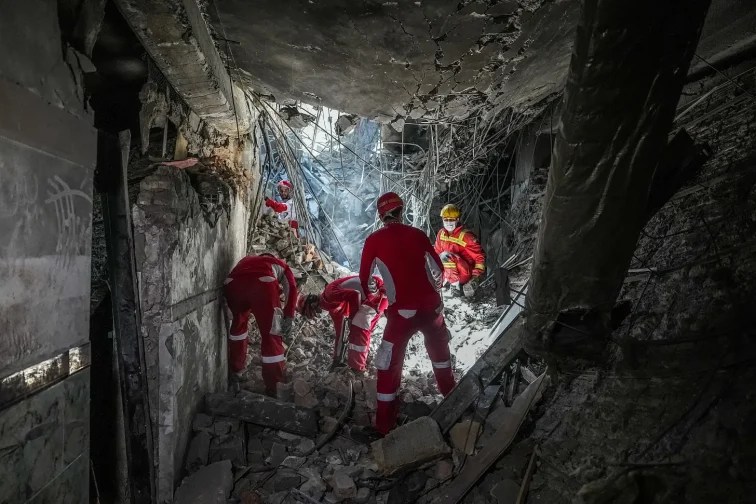
Iranian rescue workers sift through rubble inside Evin prison following Israel’s attack
Despite all this, the Institute inexplicably declares regime change in Tehran remains “a possible solution” and “worthy goal” – not just for the Zionist entity, but “the region, and the West.” The report sets out four “different strategies for overthrowing” Iran’s government, each more fantastical than the last. INSS advocates “beheading the ruling leadership” – assassinating “senior regime officials, including the Supreme Leader, his inner hive, and the heads of the political and military leadership,” arguing it might “create a reality that could develop into political change.”
The Institute alternatively suggests “a covert campaign to promote regime change, led by military, security, and political elements in Iran,” to foment a violent palace coup. Another option is “encouraging, organizing, and supporting opposition organizations in exile and training them for a quick return to Iran and taking over the centers of governmental power.” Finally, “providing aid and support to ethno-linguistic minorities while encouraging separatist tendencies and internal divisions within Iran” is mooted.
However, INSS contrarily concedes every proposed route “could lead to the opposite results of strengthening the government’s cohesion in Tehran and ‘rallying the public around the flag’,” and should thus be avoided. For example, the few Iranian diaspora who applauded the Zionist entity aggression’s against their home country, if not supported all-out insurrection in Tehran – most prominently monarchists – repulsed domestic audiences. “Large segments of the Iranian public” thus perceive them as “having betrayed Iran in its time of need”:
“Although aligning with pro-Western and pro-Israel diaspora groups that push for revolutionary change may seem natural, such associations may, in fact, undermine the credibility of internal opposition and ultimately obstruct the desired outcome.”
Similarly, the Institute warns assassinating Ali Khamenei – “raised as a possibility during the war” – “would not necessarily result in regime change,” and probably backfire spectacularly. The Islamic Republic “would likely have little difficulty selecting a successor, who could prove to be more extreme or more capable,” and the Supreme Leader’s murder “may also have inadvertent effects, such as elevating him into a martyr.” This would strengthen the government, solidify public opinion against Tel Aviv, and “complicate efforts to destabilize the regime through popular protest.”
Moreover, as a state that prides itself on religious and ethnic diversity and inclusion, “encouraging separatist tendencies” in Iran is likewise judged an ill-omened approach. INSS observes “heightened public sensitivity to any perceived foreign attempts to promote ethnic fragmentation” locally. Efforts to do so by Israel or its Anglo-American puppetmasters would inevitably “be viewed as trying to fracture the country” and rebound, “uniting large segments of the Iranian public against Israel.”
‘Capacity Problems’
No doubt disappointingly from Tel Aviv’s perspective, INSS concludes toppling the Islamic Republic “depends mainly on factors beyond Israel’s control, and on a catalyst whose prediction is elusive and may never materialize.” Despite purportedly “impressive operational successes” in the 12 Day War, the conflict amply demonstrated Zionist entity military action cannot “promote political change processes in Iran.” More generally, “historical experience shows regime change through foreign intervention brings highly questionable results at best” in West Asia:
“The US has failed to achieve the desired results in the vast majority of cases in which it has promoted moves for regime change, and Israel itself has problematic experience in intervening in another country for regime change – both in the First Lebanon War and in the considerable effort to topple Hamas in the Gaza Strip.”
Elsewhere, it’s suggested Iran “could be dragged into a strategic arms race with Israel, further depleting its already strained economic resources and deepening civilian suffering.” However, INSS acknowledges an almost inevitable upshot would be Tehran seeking nuclear weapons capability, given such an arsenal “would serve as an existential insurance policy.” In any event, “Israel, too, faces limits on its military and economic capabilities” – which is quite an understatement. Yet again though, the Institute ultimately endorses “Israel’s decision to actively act toward regime change in Tehran.”
Evidently, from the perspective of Tel Aviv and its Western sponsors, the regime change coast isn’t clear in Tehran. It is therefore imperative Iranian authorities and the public alike remain ever-vigilant of foreign-borne threats, seen and unseen. Yet, the INSS report abundantly underlines how in the 12 Day War’s wake, the Zionist entity has no good options left available, only scope for triggering far worse consequences for itself. And the Institute considerably downplays the extent to which the conflict was a counterproductive catastrophe for Israel.
It’s been reported senior entity officials had been preparing for June 13th since March, seeking to strike before Iran “rebuilt its air defenses by the latter half of the year.” The underlying plan to militarily cripple Tehran and trigger a popular revolution was in turn purportedly “carefully laid months and years in advance,” having been specifically wargamed in conjunction with the Biden administration. Israel gave Tehran its best shot, failed in its each and every objective, and was left battered.
Tel Aviv’s grand scheme to crush the Islamic Republic employed an extraordinary amount of finite munitions, at astronomical cost. A former financial adviser to the ZOF’s chief of staffhas estimated the abortive campaign’s first 48 hours alone cost $1.45 billion, with almost $1 billion spent on defensive measures alone. Government economists place the daily cost of military operations at $725 million. Haaretz calculates civilian and domesticfinancial damage could run to many billions. This, while the entity’s economy is already barely-functioning.
Furthermore, the entity was reportedly running hazardously low on missile interceptors within five days, despite the US being cognisant of “capacity problems” for months prior, and spending intervening months “augmenting Israel’s defenses with systems on the ground, at sea and in the air.” A July report from Zionist lobby group JINSA warned, “after burning through a large portion of their available interceptors,” Washington and Israel “both face an urgent need to replenish stockpiles and sharply increase production rates.”
Grave questions abound over the pair’s ability to do either. JINSA notes US THAAD interceptors provided 60% of the entity’s air defence, expending roughly 14% of Washington’s total THAAD stockpile in the process – which “at current production rates” will take three to eight years to replenish. Iran’s “large-scale missile campaign” moreover “revealed vulnerabilities in Israeli and US air defense systems, providing lessons that Iran or other US adversaries could exploit in the future.”
In sum, the Zionist entity is a beast encircled, reduced to lashing out through desperation, not strength. Its ability to flail against not merely Iran, but the wider Axis of Resistance, without further endangering its already precarious position is extremely limited, if not non-existent. Wholly dependent on foreign support at a time polls indicate it’s the most hated ‘country’ on Earth, Tel Aviv still presumes the capability to make the next move against its adversaries. INSS’ report strongly suggests this could be its very last.
Iran’s foreign minister has confirmed the arrival of inspectors from the International Atomic Energy Agency (IAEA) following a months-long hiatus.
Abbas Araghchi, however, said their presence does not mean the resumption of full cooperation with the UN nuclear watchdog.
Speaking to reporters in Tehran on Wednesday, the foreign minister said the entry was authorized by Iran’s Supreme National Security Council (SNSC) and limited to overseeing the fuel replacement process at the Bushehr Nuclear Power Plant.
He said under a recent parliamentary law, all cooperation with the IAEA must be approved by the SNSC.
“No text has yet received final approval,” he added, referring to ongoing discussions about a new cooperation modality following the acts of aggression by the Israeli regime and the United States in June.
Iran has barred any new inspections since the attacks, citing safety concerns at damaged nuclear sites and criticizing the IAEA’s failure to condemn the strikes.
Earlier, Behrouz Kamalvandi, spokesman for the Atomic Energy Organization of Iran (AEOI), said the inspectors’ presence was tied to routine operations at the Bushehr facility and the need to maintain electricity supply to the national grid.
On August 26, IAEA Director General Rafael Grossi announced that inspectors were “back in Iran.”
In an interview with Fox News, Grossi said, “When it comes to Iran, as you know, there are many facilities. Some were attacked, some were not.”
“So we are discussing what kind of … practical modalities can be implemented to facilitate the restart of our work there.”
The developments come amid renewed diplomatic tensions, as Iran held talks in Geneva with Britain, France, and Germany over their threat to trigger the so-called snapback mechanism, a provision of the 2015 nuclear deal that would restore UN sanctions lifted under the accord.
European signatories to the Joint Comprehensive Plan of Action (JCPOA) have said they will wait until August 31 to decide whether to activate the mechanism.
Iran has reduced its cooperation with the IAEA in recent years in response to the withdrawal of the United States from the 2015 nuclear deal and the failure of Europeans to make up for the withdrawal.
In June, US energy exports to China collapsed to zero in crude oil, coal, and liquefied natural gas. That followed a similar plunge in exports of liquefied petroleum gases and propane. Key BRICS members Russia and Iran have stepped in, and along with other Middle East trade partners easily supply China with energy previously sourced from US markets.
Fifteen of the 9/11 “hijackers” from Saudi Arabia were CIA agents working for the United States government, which was seeking to destroy the Middle East for Israel and to double the American military budget, says Dr. Kevin Barrett, an American academic who has been studying the events of 9/11 since late 2003…. continue
This site is provided as a research and reference tool. Although we make every reasonable effort to ensure that the information and data provided at this site are useful, accurate, and current, we cannot guarantee that the information and data provided here will be error-free. By using this site, you assume all responsibility for and risk arising from your use of and reliance upon the contents of this site.
This site and the information available through it do not, and are not intended to constitute legal advice. Should you require legal advice, you should consult your own attorney.
Nothing within this site or linked to by this site constitutes investment advice or medical advice.
Materials accessible from or added to this site by third parties, such as comments posted, are strictly the responsibility of the third party who added such materials or made them accessible and we neither endorse nor undertake to control, monitor, edit or assume responsibility for any such third-party material.
The posting of stories, commentaries, reports, documents and links (embedded or otherwise) on this site does not in any way, shape or form, implied or otherwise, necessarily express or suggest endorsement or support of any of such posted material or parts therein.
The word “alleged” is deemed to occur before the word “fraud.” Since the rule of law still applies. To peasants, at least.
Fair Use
This site contains copyrighted material the use of which has not always been specifically authorized by the copyright owner. We are making such material available in our efforts to advance understanding of environmental, political, human rights, economic, democracy, scientific, and social justice issues, etc. We believe this constitutes a ‘fair use’ of any such copyrighted material as provided for in section 107 of the US Copyright Law. In accordance with Title 17 U.S.C. Section 107, the material on this site is distributed without profit to those who have expressed a prior interest in receiving the included information for research and educational purposes. For more info go to: http://www.law.cornell.edu/uscode/17/107.shtml. If you wish to use copyrighted material from this site for purposes of your own that go beyond ‘fair use’, you must obtain permission from the copyright owner.
DMCA Contact
This is information for anyone that wishes to challenge our “fair use” of copyrighted material.
If you are a legal copyright holder or a designated agent for such and you believe that content residing on or accessible through our website infringes a copyright and falls outside the boundaries of “Fair Use”, please send a notice of infringement by contacting atheonews@gmail.com.
We will respond and take necessary action immediately.
If notice is given of an alleged copyright violation we will act expeditiously to remove or disable access to the material(s) in question.
All 3rd party material posted on this website is copyright the respective owners / authors. Aletho News makes no claim of copyright on such material.


 Aletho News