Iran FM says Australia’s envoy expulsion ‘appeasement’ of Israel
Press TV – August 26, 2025
Iran’s Foreign Minister has condemned Australia’s decision to expel Tehran’s ambassador over allegations of attacks on Jewish sites, describing it as an act of appeasement toward a “regime led by war criminals.”
In a post on X on Tuesday, Abbas Araghchi rejected Canberra’s allegation, citing Iran’s longstanding protection of its Jewish community.
“Iran is home to among the world’s oldest Jewish communities, including dozens of synagogues. Accusing Iran of attacking such sites in Australia while we do our utmost to protect them in our own country makes zero sense,” he said.
Araghchi said “Iran is paying the price for the Australian people’s support for Palestine”, referring to rising pro‑Palestine protests across Australia in the wake of the war in Gaza.
Earlier on Tuesday, Australian Prime Minister Anthony Albanese accused Iran of orchestrating two attacks on Jewish sites in October and December, allegations made without presenting evidence.
Media reports suggested the move could be aimed at countering Israeli criticism of Albanese’s government.
Tensions between Israel and Australia have already been running high after Canberra announced earlier this month it would join France and other nations in formalizing recognition of a Palestinian state at the UN General Assembly in September.
Israeli Prime Minister Benjamin Netanyahu reacted to that decision, accusing Albanese of “betraying Israel” and “abandoning Australia’s Jews” and labeling him a “weak politician.”
Araghchi said he was “not in the habit of joining causes with wanted War Criminals, but Netanyahu is right about one thing: Australia’s PM is indeed a ‘weak politician’.”
Issuing a warning to Australia, he added, “Canberra should know better than to attempt to appease a regime led by War Criminals. Doing so will only embolden Netanyahu and his ilk.”
Tehran has vowed reciprocal action in response to Australia’s move.
Europe lacks strategy to break snapback ‘deadlock’: Russia envoy
Press TV – August 23, 2025
A senior Russian diplomat says the European troika—Britain, France, and Germany—lack a clear strategy to break the “deadlock” they are poised to create if they follow through on their threat to invoke the “snapback” mechanism against Iran.
Russia’s permanent envoy to international organizations in Vienna, Mikhail Ulyanov, made the remarks in a post on his X account on Saturday.
He proposed to put aside legal and procedural issues which definitely do not give the E3 the right to trigger the snapback mechanism and to address the issue from a purely political viewpoint.
The Russian diplomat asked whether the trio has an exit strategy and a vision of how to find a way out of the deadlock they are going to create.
“The answers to these questions seem to be negative,” Ulyanov emphasized.
Snapback would bring into force six previous Iran-related Security Council resolutions adopted between 2006 and 2010. It would reinstate the expired UN arms embargo that barred countries from supplying, selling, or transferring most military equipment to Iran and prohibited Tehran from exporting any weapons.
It would also impose export controls, travel bans, asset freezes, and other restrictions on individuals, entities, and banks.
In a Friday phone conversation with the EU high representative for foreign and security policy and his British, French, and German counterparts, whose countries are the European signatories to the 2015 nuclear agreement, Iranian Foreign Minister Abbas Araghchi warned that triggering the snapback would have consequences.
The top Iranian negotiator once again emphasized that the European countries lack the legal and moral authority to resort to the mechanism.
China’s mission to the United Nations on Wednesday declared the country’s firm opposition to threats by European parties to the 2015 nuclear deal to activate the snapback mechanism within the framework of UN Security Council Resolution 2231.
The mission at the UN headquarters in New York distributed an explanatory note to the Security Council, stating that the difficult situation in implementing the JCPOA and Resolution 2231 is not the result of Iran’s actions but the disruption of the JCPOA’s implementation by the United States and the three European countries.
China and Russia’s backing plays a critical role in Iran’s diplomatic efforts to counter the snapback threat. Both countries are permanent members of the UN Security Council and have veto power over resolutions, including those related to Iran’s nuclear program.
Sabotage in the Skies: Was Pakistani General Zia-ul-Haq Murdered by Mossad?
The death of Pakistan’s military ruler remains one of the great unsolved puzzles of the 20th century
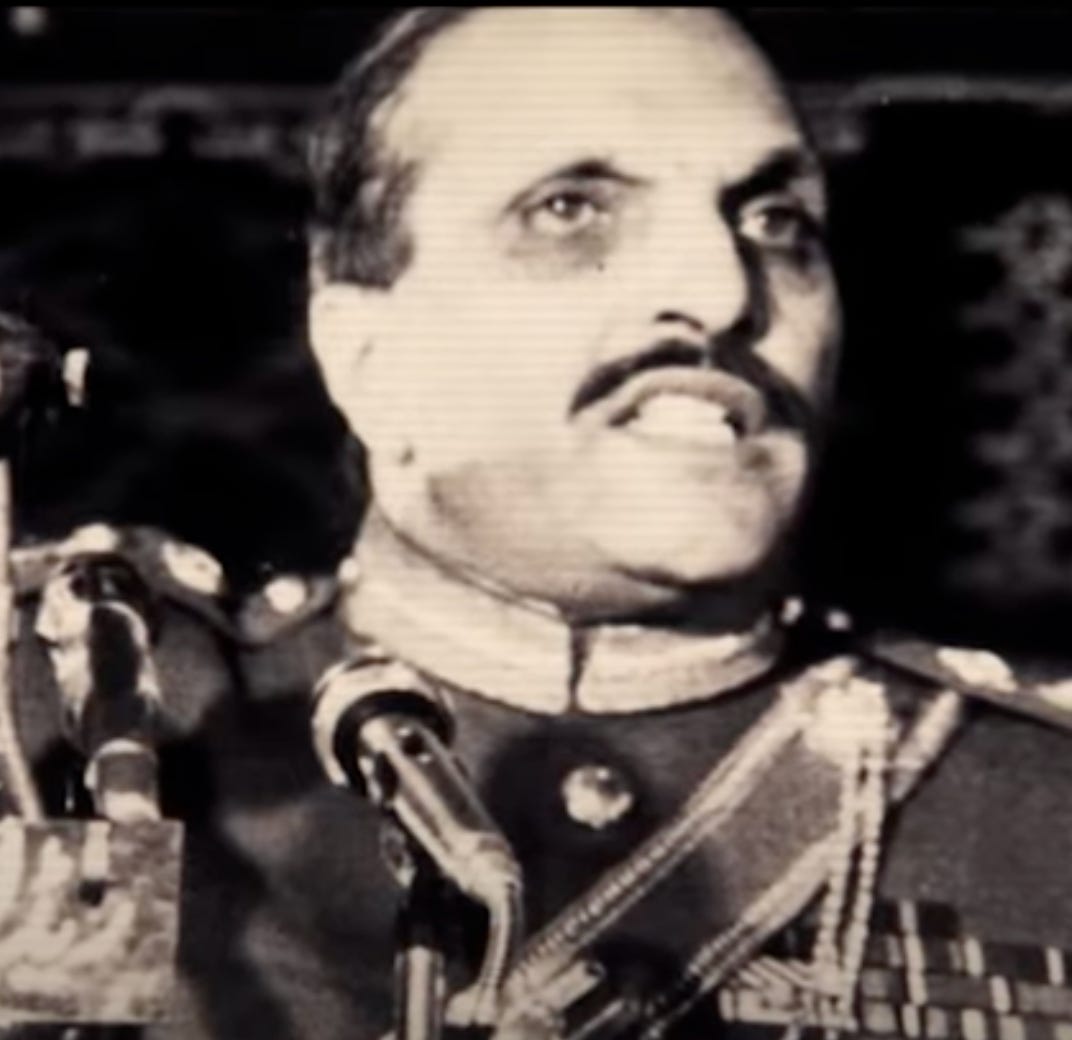
José Niño Unfiltered | August 17, 2025
37 years ago today, on August 17, 1988, General Muhammad Zia-ul-Haq died in a mysterious plane crash that eliminated nearly every member of Pakistan’s military high command in a single devastating blow. The crash of Pak-1, a specially configured C-130 Hercules aircraft, near Bahawalpur claimed not only the Pakistani president and army chief but also Chairman Joint Chiefs of Staff Committee General Akhtar Abdur Rahman, several senior Pakistani military officers, U.S. Ambassador Arnold Lewis Raphel, and Brigadier General Herbert M. Wassom, head of the U.S. military aid mission to Pakistan.
Zia’s Strategic Legacy: Architect of Pakistan’s Nuclear Ambitions
Before examining the mysterious circumstances of his death, Zia’s foreign policy accomplishments merit recognition. During his rule (1978—1988), Zia transformed Pakistan from a middling regional actor into a regional power with the ability to change the strategic landscape. His most significant achievement was shepherding Pakistan’s nuclear weapons program to near-completion while successfully balancing Cold War pressures.
After India conducted its first nuclear test—codenamed Smiling Buddha—on May 18, 1974, Pakistan moved swiftly toward its own weapons program. In response to this move, then-Pakistani Prime Minister Zulfikar Ali Bhutto pledged that his nation would not be left behind.
“We will eat grass or leaves, even go hungry, but we will get one of our own,” he declared. Pointing to the existing arsenals of other faith-based powers, he remarked: “There is a Christian bomb, a Jewish bomb and now a Hindu bomb. Why not an Islamic bomb?”
When Zia took power in 1978, he continued the Pakistani ruling class plan to turn the South Asian nation into a nuclear power. In 1987, Zia told the Carnegie Endowment that Pakistan sought sufficient nuclear capability “to create an impression of deterrence.” His bold proclamation that Pakistan was “a screwdriver’s turn away from the bomb” sent shockwaves across intelligence communities worldwide.
The nuclear program’s success vindicated Zia’s vision. Pakistan conducted its first successful nuclear tests on May 28, 1998, becoming the world’s seventh nuclear power.
Pakistan’s Unpredictable Foreign Policy Under Zia
Zia’s foreign policy demonstrated remarkable strategic acumen. As the primary architect of the Afghan resistance against the Soviet Union’s invasion of Afghanistan in 1979, he successfully convinced initially reluctant Americans to provide massive military aid. CIA veteran Bruce Riedel emphasized that “the war against the Soviets in Afghanistan was run by Zia, not by us.” Zia rejected President Carter’s initial $400 million aid offer as “peanuts” and ultimately secured $3.2 billion in military and economic aid from the Reagan administration.
Simultaneously, Zia pursued deeper ties with China and maintained complex relationships with Iran despite sectarian pressures. During the Iran-Iraq War, Pakistan officially maintained neutrality while covertly supporting Iran. Zia described Ayatollah Ruhollah Khomeini as “a symbol of Islamic insurgence” in 1979 and was one of the first countries to diplomatically recognize the Islamic Republic of Iran. Pakistan reportedly conducted clandestine arms deals that saw Chinese and U.S. weapons sent to Iran, including Silkworm and Stinger missiles originally intended for Afghan mujahideen, which played a decisive role for Iran in the “Tanker War” against Iraq.
The Fatal Flight: August 17, 1988
The events of that fateful day began routinely. Zia had traveled to Bahawalpur to witness a demonstration of the U.S. Army’s M1 Abrams tank at the Thamewali Test Range. After the successful demonstration, organized by Major-General Mahmud Ali Durrani, Zia and his delegation departed by army helicopter before transferring to the specially configured C-130 for the return flight to Islamabad.
At 3:40 PM Pakistan Time, Pak-1 took off from Bahawalpur Airport with thirty people aboard, including 17 passengers and 13 crew members. The aircraft had been equipped with an air-conditioned VIP capsule where Zia and his American guests were seated, walled off from both the flight crew and passenger sections. For two minutes and thirty seconds, the plane rose into clear skies. Takeoff was smooth and without problems.
At 3:51 PM, Bahawalpur control tower lost contact. Witnesses cited in Pakistan’s official investigation reported that the C-130 began pitching “in an up-and-down motion” while flying low before going into a “near-vertical dive” and exploding on impact. The plane crashed with such force that it was blown to pieces, with wreckage scattered over a wide area. All 30 people aboard died instantly.
Brigadier Naseem Khan, flying a French-made Puma helicopter in the vicinity, was among the first to arrive at the crash site. “I walked all around it,” he later recalled. “The plane had crashed at an almost perpendicular angle. I first spotted the cap worn by Gen Wassom, and then Gen Akhtar Rahman’s peaked cap. Then my eye fell upon a dismembered leg, wearing a black sock and black shoe. I suspected it belonged to Gen Zia.”
The Cover-Up Begins
Pakistan’s board of inquiry concluded that the most likely cause of the crash was a criminal act of sabotage within the aircraft. Investigators suggested that toxic gases rendered passengers and crew unconscious, preventing any distress call from being made. Curiously, despite prior C-130 models being fitted with flight recorders, none was found after the crash.
The American response proved equally suspicious. According to former New York Times South Asia Bureau Chief and Council on Foreign Relations member Barbara Crossette’s investigation, Ambassador Robert Oakley and General George B. Crist of CENTCOM rejected an attempt to have the FBI investigate a crash that killed the U.S. ambassador and an American general. Instead, they arranged for the Pentagon and State Department to hold an inter-departmental inquiry. Both officials later apologized to Congress for this decision.
Within two months of the crash, the American government was alone in promoting the theory that mechanical malfunction brought down the plane. On the other hand, most Pakistanis assumed assassination from the start.
Ambassador John Gunther Dean’s Shocking Revelations
The most explosive allegations about Zia’s death came from an unexpected source. John Gunther Dean, who in 1988 served as U.S. Ambassador to India, was a distinguished diplomat with four decades of service who had held more ambassadorships than most envoys. Dean was uniquely positioned to observe the aftermath of Zia’s death, and what he suspected would end his diplomatic career.
Dean believed the plot to eliminate General Zia bore the hallmarks of Israel, specifically the Israeli intelligence agency Mossad. His suspicions weren’t outlandish. Dean had personal experience with Israeli operations. Eight years earlier, while serving as Ambassador to Lebanon, Israelis had sought his support for their local projects, assuming that a fellow Jew would be willing to cooperate with them. When Dean rejected those overtures and declared his primary loyalty was to America, an attempt was made to assassinate him.
On August 28, 1980, Dean, his wife, daughter, and son-in-law narrowly escaped serious injury in a motorcade attack in suburban Beirut. The munitions were eventually traced back to Israel. Dean later discovered the Lebanese group claiming responsibility was an Israeli-created front organization used to carry out Mossad terrorist attacks.
Barbara Crossette’s Investigation
In 2005, after 17 years of silence, Dean finally revealed his suspicions to Barbara Crossette, in what would become a landmark investigation. Crossette’s 5,000-word article “Who Killed Zia?” appeared in the prestigious World Policy Journal, published by The New School in New York City under academic Stephen Schlesinger.
Dean’s theory centered on Israel’s alarm over Pakistan’s nuclear program. A few years before his death, Zia took bold steps to develop a nuclear weapons program. Although his primary motive was balancing India’s nuclear arsenal, Zia promised to share such weapons with other Muslim countries, including those in the Middle East. This possibility created major concerns in the Israeli national security community.
According to journalist Eric Margolis, Israel repeatedly tried to enlist India in launching a joint assault against Pakistan’s nuclear facilities. After careful consideration, India declined. This left Israel in a quandary. Zia was a proud military dictator with very close U.S. ties that strengthened his diplomatic leverage. Pakistan was 2,000 miles from Israel and possessed a strong military, making any long-distance bombing raid similar to the 1981 strike against Iraq’s Osirak reactor virtually impossible. That left assassination as the remaining option.
The Diplomatic Retaliation
Dean chose proper diplomatic channels rather than media disclosure. He immediately departed for Washington to share his views with State Department superiors and other top Administration officials. Upon reaching Washington, Dean was quickly declared mentally incompetent, prevented from returning to his India posting, and soon forced to resign. His four-decade career in government service came to a screeching halt.
Dean was sent to Switzerland to “rest” for six weeks before being allowed to return to New Delhi to pack his belongings and resign. He lost his medical clearance and security clearance because of his views about the crash. The accusation of “mental imbalance” effectively ended any investigation into his allegations.
One might expect such explosive charges from such a solid source would provoke considerable press attention, but the story was instead totally ignored and boycotted by the entire North American media. Stephen Schlesinger, who had spent a decade at the helm of World Policy Journal, saw his name vanish from the masthead shortly after publication, and his employment at The New School came to an end.
Ron Unz observed, with some shock, that the article is no longer available on the World Policy Journal website, though the text remains accessible via Archive.org. Even Dean’s detailed New York Times obituary portrayed his distinguished career in flattering terms while devoting not a single sentence to the bizarre circumstances under which it ended.
Zia’s Legacy Lives On
The patterns established during Zia’s era continue influencing Pakistan’s foreign policy today, often creating tension with traditional allies. Pakistan’s integration into China’s Belt and Road Initiative through the China-Pakistan Economic Corridor represents the kind of independent alignment that characterized Zia’s approach to international relations.
However, recent attacks on Chinese nationals working in Pakistan have troubling parallels to the covert plans to potentially target Pakistan’s nuclear program in the 1980s. What was envisioned as a secure trade and energy corridor linking Xinjiang to Gwadar has instead become a flashpoint for insurgency. Baloch separatists, particularly the Baloch Liberation Army (BLA), have repeatedly targeted Chinese personnel and infrastructure in a campaign to derail Pakistan’s partnership with China.
These efforts have ranged from the killing of nine Chinese engineers at the Dasu Hydropower Project in 2021, to Operation Dara-e-Bolan in January 2024, and the March 2025 hijacking of the Jaffar Express that left 59 dead. Each new CPEC agreement, including six signed in 2023, has provoked fresh waves of violence, underscoring the project’s vulnerability. Far from isolated incidents, this sustained series of attacks highlights how militant groups and their great power patrons see undermining CPEC as central to weakening the Chinese-Pakistani alliance.
Speculation about Western intelligence support for Balochi separatists has gained currency in recent years. The Middle East Media Research Institute (MEMRI), with documented ties to Israeli intelligence, launched a Balochistan Studies Project in 2025. This initiative highlighted Balochistan’s strategic importance for monitoring Iran’s and Pakistan’s nuclear program, suggesting Israel’s continued interest in leveraging regional ethnic tensions for broader geopolitical objectives.
The Imran Khan Parallel
The 2022 removal of Prime Minister Imran Khan bears striking similarities to the pressures Zia faced for maintaining independent foreign policy positions. Khan’s insistence on neutrality regarding the Russia-Ukraine conflict angered Washington, just as Zia’s support for Iran during the Iran-Iraq War created friction with Reagan administration officials.
The leaked diplomatic cable published by The Intercept revealed that U.S. State Department official Donald Lu explicitly linked Khan’s removal to his Russia policy. “I think if the no-confidence vote against the Prime Minister succeeds, all will be forgiven in Washington because the Russia visit is being looked at as a decision by the Prime Minister,” Lu stated. “Otherwise, I think it will be tough going ahead.”
Khan was removed through a no-confidence vote on April 10, 2022, exactly one month after the threatening meeting with U.S. officials. The parallel with Zia’s fate thirty-four years earlier is unmistakable: Pakistani leaders who pursue independent foreign policies will face tremendous pressure from Washington and could be unceremoniously removed from power.
Iran-Pakistan Relations: From Conflict to Cooperation
The January 2024 tit-for-tat missile exchanges between Iran and Pakistan initially appeared to represent a dangerous escalation. Iran struck Balochi separatist targets in Pakistani Balochistan on January 16, killing two children. Pakistan retaliated two days later, targeting Balochi militants in Iranian Sistan-Baluchestan province, killing nine people including four children.
However, the rapid diplomatic resolution echoed Zia’s approach to managing regional relationships. Within days, both countries agreed to de-escalate through diplomatic channels. The now-deceased Iranian Foreign Minister Hossein Amir-Abdollahian visited Pakistan on January 29, 2024, leading to agreements on enhanced security cooperation and intelligence sharing. This swift return to cooperation reflected the kind of pragmatic diplomacy Zia employed during the Iran-Iraq War.
This move also reflects the new challenge of challenging Judeo-American perfidy with respect to the activation of Balochi militants against the security interests of both Iran and Pakistan. Iran and Pakistan have been increasingly alarmed by the growing nexus between Baloch separatists and Israel, which both states see as a direct threat to their security. As Mansur Khan Mahsud of Pakistan’s FATA Research Centre told The Cradle, “During the recent 12-day standoff between Iran and Israel, Tehran noticed a tight-knit connection between Baloch separatists and Israel. Their sharing of intelligence with Tel Aviv led to significant human and infrastructure losses for Iran.”
Tehran has gone further with its accusations, directly implicating Tel Aviv and accusing Israel of recruiting and deploying mercenaries through the Balochistan Liberation United Front (BLUF). Abdullah Khan of the Pakistan Institute for Conflict and Security Studies warned: “Iran is enhancing its ties with Pakistan in the background of militants’ increased alignment with Israel. Their liaison with Tel Aviv would further crystallize when Iran shifts its policies and takes action against BLA and BLF sanctuaries within its territory. India has cultivated strong ties with both groups, enabling it to serve as a bridge to connect them with Israel.”
The Multipolar Reality
Today’s geopolitical environment increasingly resembles the complex balance Zia navigated during the 1980s. Pakistan’s alignment with China and Iran in various contexts, from CPEC to regional security cooperation against Israel’s Judeo-Accelerationist foreign policy, represents the kind of hedging strategy Zia pioneered.
The emergence of a multipolar world order, with China and Russia challenging American hegemony, provides Pakistan with alternatives to complete dependence on Washington. This mirrors the strategic space Zia created by balancing Cold War pressures while pursuing Pakistan’s independent interests.
The emergence of India as a strategic partner for both Israel and the United States creates new pressure points for Pakistan. This convergence of Israeli and American interests regarding Pakistan mirrors the strategic calculations that may have motivated action against Zia in 1988. Pakistan’s continued opposition to India, combined with its growing alignment with China and Iran, places it squarely in opposition to the emerging U.S.-India-Israel axis.
Just as Zia-ul-Haq’s demise brought one era to a close, the unresolved questions surrounding his death continue to haunt Pakistan’s foreign policy decision-making in a world where old alliances fade and new fault lines emerge.
Russia: European states ‘snapback’ activation push fundamentally illegal
Press TV – August 21, 2025
A senior Russian diplomat has roundly rejected the UK, France, and Germany’s push to invoke the so-called “snapback” mechanism inside the UN Security Council Resolution 2231 that has endorsed a 2015 nuclear deal between Iran and world countries, including the trio.
Mikhail Ulyanov, the Russian Federation’s permanent envoy to international organizations in Vienna, made the remarks in a post on X, former Twitter, on Wednesday.
He reminded that the countries, themselves, had been in clear violation of the resolution for long, and were, therefore, legally barred from activating the mechanism that returns the Security Council’s sanctions against the Islamic Republic.
“There is a serious obstacle on the way of implementing this threat,” he warned, while calling the European drive an effort at “blackmailing” the Islamic Republic.
The European states “are themselves in violation of Res.2231 and the JCPOA,” the official said.
He was referring to the nuclear agreement by the abbreviation of its official name, the Joint Comprehensive Plan of Action.
“The doctrine of good faith in international law precludes a party from claiming rights under an agreement while simultaneously failing to fulfill its own obligations thereunder,” he added.
“In other words, an attempt by E3 to trigger snapback, despite their own non-compliance would contradict the fundamental principles of international law.”
The countries have threatened to invoke the mechanism by the end of August in response to, what they have called, Iran’s contravention of the JCPOA.
Apart from Russia, China, another permanent Security Council member, has vociferously opposed the prospect.
Beijing has reminded that the European countries, themselves, were the parties that had initially started trying to throw the deal into trouble with their outright non-commitment to the accord.
The tripartite states returned their own economic sanctions against the Islamic Republic, accusing Tehran of trying to divert its peaceful nuclear energy program towards “military purposes.”
The International Atomic Energy Agency (IAEA) has, however, found no evidence that could verify the allegations, despite subjecting Iran to its most rigorous inspections in history.
Iranian officials and international observers have, meanwhile, repeatedly underscored the illegal nature of recourse to the “snapback.” They have also reminded the Islamic Republic’s resilience in the face of Western sanctions, noting that the country had already managed to successfully bypass Western sanctions of far more intensity than the ones that could be imposed following potential activation of the mechanism.
China says there’s no justification for JCPOA snapback activation
Press TV – August 20, 2025
China’s mission to the United Nations has declared the country’s firm opposition to threats by European parties to the 2015 nuclear deal to activate the “snapback” mechanism within the framework of UN Security Council Resolution 2231.
The mission at the UN headquarters in New York distributed an explanatory note to the Security Council, stating that the difficult situation in implementing the JCPOA and Resolution 2231 is not the result of Iran’s actions but the disruption of the JCPOA’s implementation by the United States and the three European countries.
The statement said this cannot be an excuse to restore the anti-Iran sanctions that had been lifted under the 2015 deal.
In the note, China warned that attempts to activate the snapback could have “unpredictable and catastrophic” consequences, destroying all the diplomatic achievements of recent years.
The document said any attempt by some countries to activate the “snapback” without following the legal process would be an abuse of the Security Council’s powers and duties and would be invalid.
The note underscored Iran’s right to peaceful use of nuclear energy as a member of the NPT, calling on all parties to adhere to dialogue, mutual respect, and finding solutions that address the legitimate concerns of the international community.
China concluded by stating that it will continue to play an active role in the negotiation process and called on the Security Council to, instead of creating obstacles, pave the way for a new and lasting agreement.
As the 2015 nuclear deal nears its official end, Iran is preparing for the removal of confidence-building curbs on its nuclear program.
However, the European signatories have threatened to invoke the “snapback” mechanism, which would restore all UN sanctions on Iran that were lifted under the deal.
Western media reports indicate that three European nations have agreed to activate the snapback by the end of August if a new nuclear deal is not reached.
This move would disrupt the successful conclusion of the current agreement.
The United States and Iran had been in talks to find a replacement for the 2015 deal, but these negotiations were halted following a surprise US-Israeli aggression against Iran.
In a show of support for Iran, Russia has also publicly opposed Europe’s activation of the snapback, distributing an explanatory note to declare its position.
Iraqi FM warns PMU, Lebanese Hezbollah cannot be disarmed by force
The Cradle | August 18, 2025
Iraqi Foreign Minister Fuad Hussein stated on 18 August that efforts to pass a new law in the parliament to regulate the status of the Popular Mobilization Units (PMU) are coming at the wrong time, while at the same time emphasizing the government’s inability to disarm the resistance factions comprising the PMU by force.
“The timing of introducing the Popular Mobilization Forces law was wrong, and I was the only minister who expressed this within the cabinet before the draft law was sent to parliament, especially in light of the tense regional and international situation and the Iranian–American conflict,” Hussein said in an interview on Iraqi TV.
The new law would update an existing law regulating the PMU, transforming it into a fully independent security institution directly under the prime minister and bypassing the Defense and Interior Ministries.
The PMU was created in 2014 to recruit volunteers to fight against ISIS, which had just taken over Mosul, Iraq’s second-largest city, with covert support from the US and Peshmerga forces loyal to Iraqi Kurdish leader Masoud Barzani.
The PMU, which was comprised of multiple Shia armed factions, was incorporated into Iraq’s security forces with the passage of the first PMU law in 2016. The group was later expanded to include other ethnic groups, including Sunnis, Yezidis, Shabaks, and Christians.
The Coordination Framework coalition, a Shia political bloc supported by Iran, is pushing for the Iraqi parliament to include a vote on the new PMU law in its upcoming sessions.
In contrast, Foreign Minister Hussein argued that the PMU should be disarmed, but through dialogue rather than force.
“We need a rational dialogue with the factions to disarm, and this cannot be done by force, as this could lead to internal strife. Before the national dialogue, we need an inter-Shia dialogue between the Shia parties and leaders, but unfortunately, so far, there has been no dialogue in this regard,” Hussein added.
The US has also reportedly pushed for the PMU to be disarmed.
Hussein, who also serves as deputy prime minister, compared the issue of the PMU in Iraq to that of Hezbollah in Lebanon. The US is also pressuring the Lebanese government to disarm Hezbollah, which defended the country from Israel’s invasion last year.
“Hezbollah’s weapons in Lebanon cannot be disarmed except through dialogue, and the Iraqis cannot disarm the Popular Mobilization Forces by force. Centralization of decision-making is the problem in Syria, and decentralization may be the solution.”
The minister accused Iran of interfering in Iraqi affairs by promoting the law. “Most neighboring countries interfere in political, security, and military affairs, including Iran, which has significant influence,” he stated.
Hussein’s statements come amid interference from Washington, which seeks to block the law’s passage.
The US has warned Iraq against passing the new law, arguing it would entrench Iranian influence and empower armed groups “undermining Iraq’s sovereignty.”
US Chargé d’Affaires Steven Fagin and US Secretary of State Marco Rubio both raised these concerns in meetings and calls with Iraqi officials, pressuring parliament to halt the vote despite the bill already completing its second reading in July.
Iraq’s parliament has since avoided including the law on its agenda, facing opposition from Sunni and Kurdish blocs, while pro-Iran factions continue to push for its passage.
Shafaq News wrote on Monday that according to Iraqi MP Thaer Mokheef, “the real obstacle lies in US opposition, warning that Washington seeks to block the legislation and may attempt to reassert influence in Iraq.”
Among the groups represented in the PMU are Kataib Hezbollah, Asaib Ahl al-Haq, and the Al-Nujaba Movement – Iran-linked resistance factions involved in the attacks on US bases in Iraq and Syria, which began after the start of the Gaza war and ended months later with the help of Iraqi government pressure.
Last year, the US launched heavy strikes on Kataib Hezbollah sites in Iraq in response to the killing of three soldiers in a drone strike on a US military base on the Syria–Jordan border.
Israeli daily reveals Mossad-MKO collaboration during aggression against Iran
Press TV – August 17, 2025
An Israeli newspaper has revealed collaboration between the Mossad spy agency and the Mujahedin Khalq Organization (MKO) terrorist cult during the recent illegal aggression against Iran.
In a blog in Times of Israel, US-based freelance journalist Julian Rennell said the Mossad-MKO collaboration, which dates back to at least 2002, reached “new levels of sophistication” over the course of the 12-day Israeli-US assault against Iran.
The MKO’s “operational elements” had established “team houses in Tehran, where they built launchers and handheld mortars” and conducted “propaganda and information-gathering activities” in support of Israeli objectives, he said.
The notorious terror group provided targeting data for high-value assassinations in Iran and “precise coordinates” of critical infrastructure during the June’s aggression.
Rennell also quoted US officials as saying that the MKO has been “financed, trained and armed by Israel’s secret service” to assassinate Iranian nuclear scientists.
He further cited Tehran’s Criminal Court as documenting how MKO operatives coordinated with Israeli intelligence by gathering data on traffic flow near Kermanshah’s Farabi Hospital and passing it to the Tel Aviv regime for a deadly strike.
Meanwhile, he referred to remarks by an Iranian judge, who confirmed “active cooperation” between MKO terrorists and Israeli operatives, particularly in identifying and targeting Iranian nuclear scientists.
Rennell urged Israel to “formalize” its relationship with the MKO and move beyond covert cooperation to strategic partnership regardless of significant backlash, both among Iranians and internationally.
The MKO – the most despised group among ordinary Iranians – has a dismal history of perpetrating heinous attacks against Iranian civilians and officials, killing around 12,000 people since the victory of Iran’s 1979 Islamic Revolution.
MKO members spent many years in Iraq, where they were hosted and armed by the former Iraqi dictator Saddam Hussein. They sided with Saddam during the 1980-88 imposed war against Iran.
MKO terrorists, who are now based in Albania, enjoy freedom of activity in the US and Europe.
A top Iranian criminal court has held 36 hearings on crimes of MKO members. It will hold more trial sessions for the case.
Iran blasts ICJ vice-president’s ‘blatant bias’ toward ‘Israel’
Al Mayadeen | August 16, 2025
Deputy Foreign Minister for Legal and International Affairs Kazem Gharibabadi has sharply condemned what he described as a “shocking breach of judicial ethics,” accusing International Court of Justice (ICJ) Vice-President Julia Sebutinde of openly siding with “Israel”, an entity currently facing multiple cases before the Court.
He warned that such “blatant bias” undermines the ICJ’s integrity and violates the core principle of judicial impartiality.
Gharibabadi’s comments follow Justice Julia Sebutinde’s controversial remarks defending her dissenting opinion in the ongoing Israeli genocide against Palestinians in Gaza.
Sebutinde, the only judge to oppose provisional measures against “Israel”, has now further stoked anger with a public speech that critics say confirms long-standing suspicions of personal bias and ideological alignment with Zionist narratives.
“There are now about 30 countries against Israel… the Lord is counting on me to stand on the side of Israel. The whole world was against Israel, including my country,” she declared on August 10 at Watoto Church in Uganda.
Speaking during the launch of the Golden Legacy ministry for members aged 55 and above, Sebutinde added, “I will never forget the day the judgment came out. Even though the government was against me, I remember one ambassador saying, ‘Ignore her because her ruling is not a representation of Uganda.’ The media ran this to fuel more anger and sentiment. Such sentiments can only come from the pit of hell.”
Her speech, laced with religious justification and inflammatory rhetoric, has intensified scrutiny over her role at the court, especially given the gravity of the charges brought against “Israel” by South Africa.
Controversial dissent at ICJ
Justice Sebutinde stood alone among the 17-judge panel at the ICJ, voting against emergency measures directing “Israel” to prevent and punish incitement to genocide in Gaza. Her lone dissent drew widespread condemnation and triggered accusations of both political and religious bias, particularly due to her openly expressed Zionist leanings.
Ugandan officials moved quickly to distance themselves from her stance. Uganda’s Permanent Representative to the UN, Adonia Ayebare, clarified in January: “Justice Sebutinde’s ruling at the ICJ does not represent the Government of Uganda’s position on the situation in Palestine. Uganda’s support for the plight of the Palestinian people has been expressed through our voting pattern at the United Nations.”
Public reaction in the region has been overwhelmingly critical. A Kenyan social media user wrote: “Judge Julia Sebutinde is such an embarrassment to her country and a disgrace to humanity. She didn’t just vote against South Africa’s petition; she voted against reason and morality, justice and freedom, love and compassion. She voted against the very soul of humanity.”
South Africa’s genocide case
On December 29, 2024, South Africa filed a case against “Israel” at the ICJ, accusing it of committing genocidal acts during its military campaign in Gaza. The case prompted global attention, with legal experts and rights advocates calling it a historic test of international law.
Uganda’s Permanent Secretary at the Ministry of Foreign Affairs, Vincent Bagiire Wasswa, reinforced the government’s position, saying, “She made an independent decision that was being misconstrued to be a decision of Uganda. The comments were to make clear that her decision was independent.”
Adding another layer of controversy, Sebutinde revealed that at the time of her dissent, she was also seeking election as ICJ vice-president. She claims she was hesitant to continue due to public backlash but said she was “compelled by God” to go through with it.
She added that a fellow judge later told her she had been elected because of her “character and independence.”
“So whatever the devil had planned for me, God turned it around. This happened a day after the verdict,” she added
Critics argue that such remarks, invoking divine guidance in judicial matters and portraying dissenters as influenced by “the devil”, raise serious questions about her suitability for one of the highest judicial offices in the world.
Lin: China opposes invocation of UN Security Council ‘snapback’ sanctions against Iran

Chinese Foreign Ministry Spokesperson Lin Jian
Press TV – August 15, 2025
China reaffirms its commitment to the peaceful resolution of Iran’s nuclear issue and opposes the invocation of the UN Security Council’s “snapback” mechanism.
Chinese Foreign Ministry spokesperson Lin issued the statement on Friday in response to the European troika’s warning to reimpose sanctions if a diplomatic solution is not achieved by the end of August.
“China stays committed to peacefully resolving the Iranian nuclear issue through political and diplomatic means, opposes invoking Security Council ‘snapback’ sanctions,” Lin said.
He argued that reimposing sanctions on Iran would not foster trust or bridge differences among parties and would hinder diplomatic efforts to resume talks promptly.
Lin emphasized that any actions taken by the Security Council should facilitate the achievement of new agreements rather than undermine the negotiation process.
The Chinese diplomat reiterated that China is committed to maintaining an objective and fair stance, continuing to promote conversations aimed at peace, and playing a constructive role in bringing the Iranian nuclear issue back to diplomatic negotiations at the earliest opportunity.
He also highlighted Beijing’s intention to safeguard the international nuclear non-proliferation regime and to promote peace and stability in the region.
Iranian Foreign Minister Abbas Araghchi said on Thursday that the country is actively collaborating with China and Russia to prevent the reactivation of UN sanctions through the so-called “snapback” mechanism.
“We are working with China and Russia to stop it. If this does not work and they apply it, we have tools to respond. We will discuss them in due course,” he added.
The snapback mechanism, embedded in the 2015 nuclear deal, known as the Joint Comprehensive Plan of Action (JCPOA), allows the automatic reinstatement of UN Security Council sanctions that had been lifted under the agreement. The deal terminates in October.
Iran, however, disputes the legitimacy of the European powers’ efforts to trigger the provision.
In a joint letter to UN Secretary General Antonio Guterres and the UN Security Council on Wednesday, the European troika — France, Germany and the United Kingdom – said they were “committed to us(ing) all diplomatic tools at our disposal to ensure Iran does not develop a nuclear weapon” unless Tehran meets a deadline to speak with them.
“We have made it clear that if Iran is not willing to reach a diplomatic solution before the end of August 2025, or does not seize the opportunity of an extension, the E3 are prepared to trigger the snapback mechanism,” the ministers wrote.
In a detailed letter to the UN Security Council last month, Iran laid out its position, asserting that Britain, France, and Germany are no longer legitimate JCPOA participants with the authority to reinstate sanctions through snapback. This position is supported by China and Russia, who share Tehran’s view on the matter.
China and Russia’s backing plays a critical role in Iran’s diplomatic efforts to counter the snapback threat. Both countries are permanent members of the UN Security Council and have veto power over resolutions, including those related to Iran’s nuclear program.
Iran overcomes heavy US sanctions and war with Israel, takes over key energy export markets
Inside China Business | August 12, 2025
China is a top buyer of Iranian crude, taking 90% of its crude exports. But Iran has recently passed Saudi Arabia, the UAE, and Qatar as the top producer and exporter of NG products, bringing in billions more. Ambitious expansions of their petrochemical industry are also ongoing. Iranians report little difficulty in business operations among different currencies, despite the US Treasury Department’s blacklisting of key energy suppliers, and firm control over the SWIFT systems.
Closing scene, Beihai, Guangxi
Resources and links: Iran Defies US Sanctions With Surging Exports of Liquefied Petroleum Gas https://www.bloomberg.com/news/articl…
Bloomberg, Iranian Oil Production Booms Amid the Bombs https://www.bloomberg.com/opinion/art…
S&P Global, Iran’s petrochemicals defy sanctions as exports, output on the rise https://www.spglobal.com/commodity-in…
Iran announces 15 petrochemical projects to expand domestic production to nearly 80 MMtpy https://www.hydrocarbonprocessing.com…
How real is the U.S. rhetoric of a ‘Unified Syria’?
By Erkin Oncan | Strategic Culture Foundation | August 7, 2025
The recent statements by the U.S. Special Envoy for Syria, Thomas Barrack, may at first glance appear to reflect diplomatic commitment, but developments on the ground and the U.S.’s covert alliances reveal that this rhetoric is largely a propaganda maneuver.
Speaking to the Associated Press, Barrack emphasized that the “deaths and massacres” on both sides of the conflict in southern Syria are unacceptable, stating: “I believe the current Syrian government, which is a new government with very few resources to address the emerging issues, is doing the best it can.”
However, if we are to speak of “territorial integrity” in the context of a new Syria, it is clear that the U.S.’s de facto policy in Syria actually serves to strengthen structures that weaken the country’s territorial unity. On the ground, the U.S. has established a fragile balance between Syria’s new government and the Syrian Democratic Forces (SDF). While this balance may give the appearance of localized stability in the short term, it carries the potential to pave the way for Syria’s long-term fragmentation. These entities are ideologically, ethnically, and politically at odds, with starkly conflicting expectations for a new Syria.
Red Lines in the Damascus—SDF Talks
The Damascus administration’s plans to integrate the SDF into the New Syrian Army, dismantle its autonomous structure, and transfer control of northeastern resources (oil, borders, educational institutions) to the Syrian state are clear.
The SDF, meanwhile, although it continues its contacts with the new Syrian administration, maintains a series of “red lines”: preserving autonomous administration, integrating its forces into the army independently of the central command, receiving a share of resources, and maintaining control over the borders.
In this scenario, the U.S. — a power that has provided extensive military and political support to both sides over time — appears to be attempting to “gloss over” this deeply uncertain process with diplomatic statements and messages of goodwill.
Israel’s Proxy Strategy
Israel, which has effectively “entered” the Syrian arena through the Suwayda clashes, likely sees the criticisms voiced by its greatest ally’s special envoy as a mere formality. Israel’s main strategy here is to sever southern Syria from Damascus and create new zones of control via proxy forces under the pretext of border security.
In other words, while there is rhetorical emphasis on a “Unified Syria,” what is being built on the ground is an increasingly entrenched multi-structure reality. A possible agreement between the SDF and HTS (Hay’at Tahrir al-Sham), for example, is not just about two armed groups sitting at the negotiating table; it encapsulates the conflicting interests of regional and global actors.
The negotiations between the SDF and HTS do not only involve these two actors; the balance includes the intervention of the U.S., Israel, and Turkey. Turkey, operating on the assumption that these negotiations will proceed parallel to the PKK’s disarmament process, seeks to secure its “share” in the governance of the new Syria.
The SDF, which received the most comprehensive support from the U.S. during the Trump era, is aware that such direct military and political backing may not continue under the Democrats. Furthermore, Washington’s regional priorities have shifted. Therefore, the SDF is striving to secure a balanced but strong position against HTS, with the primary goal of ensuring its continued existence. It is among the claims reported in Israeli and regional media that the group has engaged in a series of meetings not only with the U.S. but also with Israel.
Israel, for its part, is determined to exploit the “power vacuum” emerging in the new Syria to the fullest extent. What began under the guise of border security has now merged with Israel’s structural expansionist policy. Should Israel decide to “accelerate” its operations in Syria, it is well aware that Damascus may not be able to mount a serious resistance.
Is the Damascus Government Falling Short?
The new government led by Shara has so far failed to demonstrate the capacity to bear the role of “new leadership.” It faces a governance crisis, ethnic massacres that have sparked international condemnation, ongoing clashes with Israel, and severe economic issues.
Thus, the Damascus government finds itself compelled to “find middle ground” with the SDF, the U.S., and even Israel in order to secure its hold on power.
Within this equation, the perception of Iran as the “primary threat” on a regional level offers significant clues about the future of current power struggles.
The “Iran Threat” Will Determine the Balance
Despite suffering a severe blow with the fall of the Assad regime, Iran remains one of the strongest actors in the region. The SDF’s potential to serve as an “independent balancing force” against Iran perfectly aligns with the interests of the Tel Aviv—Washington axis. Therefore, in negotiations between the SDF and Damascus, the scenario in which the SDF’s demands gain weight and the central government’s power is curtailed is highly probable.
Despite the U.S.’s diplomatic calls for “unity,” the SDF’s de facto autonomy, its capacity to continue negotiations with Damascus thanks to current power balances, and the U.S.—Israel strategy of positioning against Iran all stand in the way of any real unification of Syria. Under current circumstances, it is nearly impossible for the new Syrian government under Shara to evolve into a stable and functioning structure. Ongoing military, political, and economic crises, coupled with the overarching “main threat is Iran” strategy, necessitate the continuation of the existing fragmented structure.
In conclusion, Washington’s rhetoric of a “Unified Syria” is largely propagandistic when viewed in light of the multilayered web of interests and covert alliances on the ground. With the U.S. and Israel seeking to expand the anti-Iran front, the scenario in which the SDF continues to play a strong role outside the framework of the central government remains the most likely outcome.
John Fetterman, a hawkish US senator who represents Americans but speaks for Israel

By Musa Iqbal | Press TV | August 7, 2025
It is no secret that the political apparatus of the United States is teeming with Zionists.
While some politicians are sleek in their support for the Zionist Occupation (with politically convenient cries for ‘civility’ in Palestine and the rest of the region), others are completely devoted to a maximalist Zionist agenda – advocating for Zionist expansion, aggression, and total servitude to Israeli interests – no matter their maximalist goals.
Among the latter is US Senator John Fetterman, a hawkish politician who once campaigned as a “progressive,” but has now turned into the Israeli occupation’s most darling Democratic cheerleader and an unofficial mouthpiece and apologist of the genocidal child-murdering regime.
Fetterman’s unwavering support for Israel, which comes with belligerent calls for war against Iran, betrays the very principles he once claimed to champion.
During the election cycle that put him into power, progressive groups had rallied around Fetterman as a “working man” that most Americans could relate to. They could not have been more wrong.
Fetterman, often skulking the halls of the US Capitol in a hoodie and gym shorts, has become the poster child for the US political establishment’s subservience to the Zionist project and its reckless drive toward regional hegemony in Western Asia.
Fetterman has shown total support with each new act of Zionist terror, something his constituents are increasingly condemning.
His rhetoric, particularly his enthusiastic endorsement of Israel’s military actions and his calls for US involvement in illegal and unprovoked strikes on Iran, is not only a betrayal of his constituents but a dangerous escalation that threatens to give more support to an increasingly belligerent Israeli occupation entity as it faces an existential crisis.
He has draped himself in the Israeli flag on several occasions—literally and figuratively—while dismissing calls for a ceasefire and championing Israel’s so-called “right to defend itself” against a besieged, starving population.
Perhaps as a hat-tip to his pro-Israeli donors, his office walls are covered with posters of Israeli captives held by the Palestinian resistance movement Hamas, further serving as a shrine to a one-sided narrative that erases the decades-long suffering of Palestinians under occupation.
To compare, there are tens of thousands of Palestinian hostages in Zionist prisons, a sizeable amount of them being Palestinian youth.
Speaking of donors, Fetterman has unapologetically collected hundreds of thousands of dollars from the Zionist lobby. Based on the data organized by Track AIPAC, Fetterman has received over $370,000 in donations from Israeli-associated PACs and donors, with one of his top donors being JStreetPAC, which donated $175k in 2024 alone.
Donations of this caliber suggest extreme levels of loyalty to furthering Israeli settler-colonial interests in the power corridors of Washington – from domestic policy fighting against Boycott Divestment Sanctions (BDS) efforts to foreign policy warmongering on behalf of the American-Israeli axis of evil.
It also aligns with Fetterman’s refusal to acknowledge the Palestinian death toll—over 150,000 by some estimates, including thousands of children—while fixating on Israeli victims reveals a moral bankruptcy that aligns him with the most hawkish elements of the US political spectrum.
Fetterman ghoulishly refuses to acknowledge the catastrophic loss of life, insisting that “now is not the time to talk about a ceasefire.”
Clearly, Fetterman’s loyalty to the Zionist cause goes as far as deliberate endorsement of collective punishment of innocent Palestinians, including children and women, a policy that violates international law.
Of course, being in line with the Zionist occupation’s expansionist interests, Fetterman’s zeal for Israel does not stop at Gaza. He has cheered on for US military aggression against Iran, celebrating the bombings against Iran’s peaceful nuclear program and threatening that Israel can continue to assassinate its nuclear scientists with his and other US politicians’ approval.
In his March 2025 visit to the occupied territories, Fetterman told journalists in Jerusalem al-Quds that he supports “partnering with Israel to bomb Iran’s nuclear facilities,” urging the US to “blow it up.”
His rhetoric continued to escalate, including in June 2025, when he called for Israel to assassinate the Leader of the Islamic Revolution, Ayatollah Seyyed Ali Khamenei. Such statements are not the musings of a principled senator but the ravings of a warmonger eager to appease the Zionist war machine and its patrons in Washington.
Fetterman’s rhetoric must be seen in the context of the broader US-Israel agenda to neutralize Iran as a regional power, especially as the latter secures critical economic alliances such as a place in BRICS and the SCO (Shanghai Cooperation Organization).
For decades, the US and its Zionist ally have sought to undermine Iran’s sovereignty, from crippling, high-pressure sanctions to covert sabotage operations and outright military threats.
Fetterman’s calls for illegal and unjustified strikes on Iran’s nuclear facilities, which Iran maintains are for peaceful energy purposes, echo the same discredited playbook used to justify the invasion of Iraq and Afghanistan, the bombing of Libya, the destruction of Yugoslavia, etc.
The threat of a nuclear bomb armed Iran is a propaganda campaign orchestrated by Washington and Tel Aviv to justify aggression while ignoring Israel’s undeclared nuclear arsenal, a violation of international norms, and a total means to destabilize the region.
The hypocrisy of Fetterman’s position declares the official US policy for the area: Israel’s nuclear capabilities are strategic and protect American interests, but Iran’s pursuit of energy independence is an intolerable existential threat.
Fetterman, in his blind allegiance to Israel, seems unperturbed by the realities of what the execution of this US-led policy would look like, choosing to ignore the total rupture of the region, plunging the US into a war it would not understand or be prepared for – Iran is not Iraq, Libya, or Afghanistan.
It is a regional power with a sophisticated military and an alliance with resistance groups that would be eager to defend their ally against American aggression.
By endorsing Israel’s strikes on Iran and advocating for US aggression, Fetterman is perpetuating a cycle of violence that benefits only the US ruling class and its Zionist beneficiaries.
The US has spent trillions on wars in the West Asia region, leaving behind shattered societies that will take decades to redevelop.
Fetterman’s call to “take out” Iran’s leadership and nuclear program is a recipe for more of the same- a reckless gamble with lives and resources that the US can ill afford, and would further plant the seeds of disdain for US policy both at home and abroad.
The American people, weary of endless wars and economic hardship, deserve a senator who prioritizes their interests over those of a foreign power tied to genocidal crimes and occupation.
Fetterman’s betrayal of his “progressive” voter base that elected him into power is not just a personal failing but a symptom of a deeper, more sinister alignment in US politics, where loyalty to Israel and the war machine comes before anything else, if anything else at all.
It is incumbent on the global community to reject the likes of Fetterman and their imperialist agendas, as there are war mongers like Fetterman, or worse, spread throughout different Western governments.
While they are considering replacements, they can also add someone who knows how to dress themselves as a requirement. Indeed, the bar has never been lower.
Featured Video

Macgregor: We Haven’t Seen the Worst of the Iran War Yet
or go to
Aletho News Archives – Video-Images
From the Archives
15 Saudi ‘hijackers’ were CIA agents working for US: Scholar
Press TV – April 13, 2016
Fifteen of the 9/11 “hijackers” from Saudi Arabia were CIA agents working for the United States government, which was seeking to destroy the Middle East for Israel and to double the American military budget, says Dr. Kevin Barrett, an American academic who has been studying the events of 9/11 since late 2003…. continue
Blog Roll
 Aletho News
- Iran’s Plan to Shut Down AI in the Persian Gulf
- Israel seeks ‘compensation’ from Washington over Saudi F-35 sale
- Saudi crown prince seeks dialogue with Ansarullah after Yemeni blows: Report
- Damascus rejects Saudi request for Syrian fighters to counter Yemen: Report
- South Korea says will not send troops to join terrorist US war on Iran
- Russia Just Struck the Eyes of NATO’s War Machine in Ukraine
- Russia summons UK charge d’affaires over Kiev drone support
- NATO member warns bloc seeking pretext for war with Russia
- Macgregor: We Haven’t Seen the Worst of the Iran War Yet
- ‘We are not like everyone else’ laws that bind other nations do not apply to Israel, says Likud lawmaker
- If Americans Knew
- Debunking The Claim That Macklemore Has A “History Of Antisemitism”
- CPJ demands release of arrested Palestinian-US journalist near Bethlehem
- Robert Kraft: The Billionaire Friend of Netanyahu Pulling The Strings Behind the Macklemore/Ed Sheeran Blow Up
- Columbia Administered Fund Gives Big Money to Pro-Israel Groups
- Deportation Case of Palestinian Activist Salah Sarsour Tests First Amendment
- ‘We Will Not Forget’: Palestinians Mark 44 Years since Sabra and Shatila
- Why do we let Zionists decide what we can and can’t say?
- US welcomes Israeli, Iranian delegations to UN, but not Palestinians – Daily Update
- Biden’s Genocide Accomplices Targeted by New Accountability Campaign
- AIPAC’s Network Has Already Spent $67.2 Million to Shape the Midterm Elections
- No Tricks Zone
- New Study: ‘Global Drought Shows No Detectable Recent Acceleration Under Climate Warming’
- Economic Masterminds: German Socialists Suggest Taxing Productivity Gains Stemming From Using AI
- The South China Sea Has Not Been Cooperating With The Climate Change Narrative
- Energy Crisis: Germany Enters Heating Season With Historically Low Gas Reserve Fill Levels
- New Study: The Antarctic Ice Sheet Gained Mass From 2020-2024 Due To Staggering Snow And Ice Accumulation
- Study: Ocean Heating Rates From Thousands Of Years Ago ‘Dwarf’ Modern Ocean Heating Rates
- Climate Extremists Target, Attack Large-Scale Power Grid Infrastructure In Germany!
- New Study: Antarctic Ice Melt Has Contributed Less Than 1 Centimeter To Sea Level Rise In The Last 30 Years
- Fear Of Debate: Alarmist German Climate Scientist Calls On Mainstream Media To Discredit Skeptic Voices
- End-Of-August Arctic Sea Ice Extent Hasn’t Fallen In 20 Years, Official Data Show!
 Aletho News