Spain’s acting Social Rights Minister suggested taking Israel to the International Criminal Court for “war crimes,” local media reported.
Ione Belarra shared a video accusing the European Union and the US of “being complicit in Israel’s war crimes,” the Spanish daily, El Mundo, said on Sunday.
She called on Spanish citizens to take to the streets to demand that Madrid distance itself from the US’s unwavering support for Israel and called on the Global South to find a solution.
“Today we want to raise our voice to denounce that the state of Israel is carrying out a planned genocide in the Gaza Strip, leaving hundreds of thousands without light, food and water and carrying out bombings on the civilian population that are collective punishment, seriously breach international law and may be considered war crimes” she said.
Ten days into Israel’s bombing of Gaza, over one million people – almost half the total population of Gaza – have been displaced.
October 16, 2023
Posted by aletho |
Ethnic Cleansing, Racism, Zionism, Timeless or most popular, War Crimes | European Union, Human rights, Israel, Palestine, Spain, United States, Zionism |
Leave a comment

Israel has killed at least 12 journalists since the start of their blitz in Gaza, in which warplanes have dropped thousands of bombs into the world’s largest open-air prison.
“As of 15 October, in the first nine days of fighting, at least 12 journalists were killed, two were missing, and eight injured,” said the Committee to Protect Journalists (CPJ). Attacking the press while reporting on conflicts is considered a war crime under Article 79 of Additional Protocol I in the Geneva Conventions.
“Journalists engaged in dangerous professional missions in areas of armed conflict shall be considered as civilians,” the CPJ report adds. “They shall be protected as such under the Conventions and this Protocol.”
Israel has never shied away from attacking journalists, and western news outlets constantly downplay these deadly attacks. This was the case with Reuters journalist Issam Abdallah, who the Israeli army killed on 13 October, but the UK news agency described his death as being caused by “missile fire from the direction of Israel.”
Killing individual journalists isn’t the only thing the Israeli army is guilty of. During the war on Gaza in 2021, the Israeli air force destroyed the Gaza Tower, a building that housed AP and Al Jazeera offices.
Last year, Al-Jazeera veteran journalist Shireen Abu Akleh was killed by an Israeli sniper in the occupied West Bank. No one has faced prosecution for her murder.
Israel has been responsible for the deaths of dozens of reporters, photojournalists, and freelance civilian journalists throughout the years.
The Israeli cabinet is in talks about banning Al-Jazeera, one of the few international news stations reporting from the ground of Gaza.
October 16, 2023
Posted by aletho |
Ethnic Cleansing, Racism, Zionism, Full Spectrum Dominance, Timeless or most popular, War Crimes | Human rights, Israel, Palestine |
Leave a comment
A survivor from the Palestinian resistance offensive on Israeli settlements on 7 October says the Israeli army is “undoubtedly” responsible for killing many of their civilians.
“They eliminated everyone, including the hostages, because there was very, very heavy crossfire,” 44-year-old mother of three Yasmin Porat told the Haboker Hazeh radio program on Israeli Kan radio last week.
When the interviewer asked if Israeli troops were responsible for civilian deaths, Porat said, “Undoubtedly.” Her interview has been scrubbed from the online version of Haboker Hazeh and the Kan website; however, Electronic Intifada procured a copy and translated it from Hebrew.
“There are five or six hostages lying on the ground outside. Just like sheep to the slaughter, between the shooting of our commandos and the terrorists,” Porat describes.
Porat says that, before the arrival of Israeli troops, she and other civilians had been held by the Palestinians “for several hours” and treated “humanely.”
“They did not abuse us. They treated us very humanely,” Porat said, adding, “They give us something to drink here and there. When they see we are nervous, they calm us down. It was very frightening, but no one treated us violently.”
She recalled one Palestinian fighter who spoke Hebrew saying: “Look at me well, were not going to kill you. We want to take you to Gaza. We are not going to kill you. So be calm, you’re not going to die.”
“I was calm because I knew nothing would happen to me,” she added.
Furthermore, during a lengthy interview on Israel’s Channel 12, Porat speaks of intense gunfire after Israeli forces arrived and elaborates that, although the resistance fighters were heavily armed, she never saw them shoot captives or threaten them with their guns.
She also highlights that the Israeli army announced their arrival at the settlement “with a hail of gunfire,” catching the resistance fighters and their captives by surprise.
Her account echoes that of another Israeli settler who spoke with Channel 12 last week about her experience as a prisoner of war (POW) of Hamas.
The accounts from survivors stand in stark contrast to the widespread claims found in western media outlets that say Hamas forces did everything from “beheading babies” to torturing and raping settlers.
Salah al-Aruri, Deputy Head of Hamas’ Political Bureau, last week addressed claims that resistance fighters were ordered to deliberately kill as many Israeli settlers as possible, telling Al Jazeera TV that fighters from the Qassam Brigades – the military wing of Hamas – were “under strict protocol to not harm civilians.”
He also said that after Israel’s Gaza division disintegrated in the face of the Gaza factions, others rushed the border, “causing chaos.” Furthermore, he notes that some of the deaths of Israeli settlers are a result of the so-called ‘Hannibal Directive,’ which is a protocol that allows Israeli soldiers to use overwhelming force to kill one of their own captured soldiers rather than allow them to be taken, prisoner.
“We are certain that young men [fighters] were bombed along with the prisoners who were with them,” Aruri said last week.
According to the Israeli army, at least 199 settlers were taken as POWs by the Palestinian resistance. The Israeli death toll from Operation Al-Aqsa Flood stands at over 1,300.
October 16, 2023
Posted by aletho |
Deception, Ethnic Cleansing, Racism, Zionism, Timeless or most popular, Video, War Crimes | Hamas, Israel, Palestine, Zionism |
Leave a comment

The missing context for what’s happening in Gaza is that Israel has been working night and day to ethnically cleanse the Palestinian people from their homeland since even before Israel become a state – when it was known as the Zionist movement.
Israel didn’t just cleanse Palestinians in 1948, when it was founded as a Western colonial project, and again under cover of a regional war in 1967. It also worked to ethnically cleanse Palestinians every day between those dates and afterwards. The aim was to move them off their historic lands, and either expel them beyond Israel’s new, expanded borders or concentrate them into small ghettoes inside those borders – as a holding measure until they could be expelled outside the borders.
The ‘settler’ project, as we call it, is a misnomer. It’s really Israel’s ethnic cleansing programme. Israel even has a special word for it in Hebrew: ‘Judaisation’, or making the land Jewish. It is official government policy.
Gaza was the largest of the Palestinian reservations created by Israel’s ethnic cleansing programme, and the most overcrowded. To stop the inhabitants spilling out, Israel built a fence-barrier in the early 1990s to pen them in. Then when policing became too hard from within the prison, Israel pulled back in 2005 to the outer perimeter barrier.
New technology allowed Israel to besiege Gaza remotely by land, sea and air in 2007, limiting the entry of food and vital items like medicine and cement for construction. Automated gun towers shot anyone who came near the fence. The navy patrolled the sea, stopping boats straying more than a kilometre or two off shore. And drones watched 24 hours a day from the sky.
The people of Gaza were sealed in and largely forgotten, except when they lobbed a few rockets over the fence – to international indignation. If they fired too many rockets, Israel bombed them mercilessly and occasionally launched a ground invasion. The rocket threat was increasingly neutralised by a rocket interception system, paid for by the US, called Iron Dome.
Palestinians tried to be more inventive in finding ways to break out of their prison. They built tunnels. But Israel found ways to identify those that ran close to the fence and destroyed them.
Palestinians tried to get attention by protesting en masse at the fence. Israeli snipers were ordered to shoot them in the legs, leading to thousands of amputees.
The ‘deterrence’ seemed to work. Israel could once again sit back and let the Palestinians rot in Gaza. ‘Quiet’ had been restored.
Until, that is, last weekend when Hamas broke out briefly and ran amok, killing civilians and soldiers alike.
So Israel now needs a new policy. It looks like the ethnic cleansing programme is being applied to Gaza anew. The half of the population in the enclave’s north is being herded south, where there are not the resources to cope with them. And even if there were, Israel has cut off food, water and power to everyone in Gaza.
The enclave is quickly becoming a pressure cooker. The pressure is meant to build on Egypt to allow the Palestinians entry into Sinai on ‘humanitarian’ grounds.
Whatever the media are telling you, the ‘conflict’ – that is, Israel’s ethnic cleansing programme – started long before Hamas appeared on the scene. In fact, Hamas emerged very late, as the predictable response to Israel’s violent colonisation project.
And no turning point was reached a week ago. This has all been playing out in slow motion for more than 100 years.
Ignore the fake news. Israel isn’t defending itself. It’s enforcing its right to continue ethnically cleansing Palestinians.
October 16, 2023
Posted by aletho |
Ethnic Cleansing, Racism, Zionism | Gaza, Israel, Palestine, Zionism |
Leave a comment
France’s broadcasting watchdog has ordered the satellite provider Eutelsat to pull the plug on the Palestinian Arabic-language Al-Aqsa television channel and take the station, which is affiliated with the Palestinian Hamas resistance movement, off the air over allegations that it violated rules on incitement.
Eutelsat, Europe’s leading satellite operator, said the Conseil supérieur de l’audiovisuel (CSA) had asked the firm to stop broadcasting al-Aqsa TV.
The Hamas-run channel denounced the French move on its Telegram channel on Saturday, stating that it had to stop broadcasting from Eutelsat 8 West B satellite due to French pressure.
“In light of the massacres being committed against our people in the Gaza Strip as they are unwearyingly and steadfastly fighting the Operation al-Aqsa Storm, and in line with continued targeting and killing of journalists in Gaza, the French company responsible for Eutelsat satellite made the decision to block the channel’s broadcast,” the television station wrote in its statement.
“The channel was taken off the air in response to pressure from the French government and submission to the occupying Zionist regime,” the statement added.
The channel also condemned its suspension as “a blatant and shocking violation of all standards of freedom,” stating that the move “contradicts the international laws that guarantee freedom of expression and the right to communicate the voice of oppressed people to the whole world.”
Hezbollah: Eutelsat complicit with Israeli enemy in brutal Gaza war
The Lebanese Hezbollah resistance movement censured the decision by satellite provider Eutelsat to take the Hamas-run al-Aqsa TV off the air, stating that the measure dealt a hard blow to Palestinian media.
“In the midst of a ruthless campaign by the Zionist enemy against Palestinian people, the European satellite operator, Eutelsat, opted to cease the broadcast of al-Aqsa television channel. The move was meant to prevent the world public opinion from observing the oppression that Palestinians are exposed to, and ultimately challenging the West’s so-called commitment to media neutrality and freedom of expression,” it said in a statement.
Hezbollah lambasted Eutelsat for “shamelessly collaborating with the Israeli enemy in its ongoing brutal onslaught against defenseless Palestinian civilians.”
The movement views this decision as a “deliberate attempt to conceal the atrocities of Zionist forces, which are increasingly coming to light on the global stage. They also draw a connection to the tragic killing of journalists in Gaza and Lebanon.”
Hezbollah underscored its “unwavering support for al-Aqsa TV as well as all independent media outlets dedicated to exposing the Israeli regime’s crimes and uncovering the truth behind them.”
October 16, 2023
Posted by aletho |
Civil Liberties, Ethnic Cleansing, Racism, Zionism, Full Spectrum Dominance | France, Israel, Palestine, Zionism |
Leave a comment
One hundred years after the Arab Revolt (1916-1918) against the ruling Ottoman Turks amidst the impending defeat of Germany and the Triple Alliance in World War I, another armed uprising by the Arabs has erupted — this time around, against Israeli occupation, in the backdrop of the looming defeat of the United States and NATO in the Ukraine War — presenting a thrilling spectacle of history repeating unabridged.
The Ottoman Empire disintegrated as a result of the Arab Revolt. Israel too will have to vacate its occupied territories and make space for a state of Palestine, which of course, will be a crushing defeat for the US and marks the end of its global dominance, reminiscent of the Battle of Cambrai in Northern France (1918) where Germans — surrounded, exhausted and with disintegrating morale amidst a deteriorating domestic situation — faced the certainty that the war had been lost, and surrendered.
The torrential flow of events through the past week is breathtaking, starting with a phone call made by Iran’s President Sayyid Ebrahim Raisi to the Saudi Crown Prince Mohammed bin Salman on Wednesday to discuss a common strategy toward the situation following the devastating attack by the Islamic Resistance Movement, Hamas, against Israel on October 7.
Earlier on Tuesday, in a powerful statement, Iran’s Supreme Leader Ayatollah Ali Khamenei had emphasised that “From the military and intelligence aspects, this defeat (by Hamas) is irreparable. It is a devastating earthquake. It is unlikely that the (Israeli) usurping regime will be able to use the help of the West to repair the deep impacts that this incident has left on its ruling structures.” (See my blog Iran warns Israel against its apocalyptic war.)
A senior Iranian official told Reuters that Raisi’s call to the Crown Prince aimed to “support Palestine and prevent the spread of war in the region. The call was good and promising.” Having forged a broad understanding with Saudi Arabia, Iran’s Foreign Minister Hossein Amir-Abdollahian held a discussion with his Emirati counterpart, Sheikh Abdullah bin Zayed, during which he called upon Islamic and Arab countries to extend their support to the Palestinian people, emphasising the urgency of the situation.
On Thursday, Amir-Abdollahian embarked on a regional tour to Iraq, Lebanon, Syria and Qatar through Saturday to coordinate with the various resistance groups. Notably, he met Hezbollah leader Hassan Nasrallah in Beirut and Hamas leader Ismail Haniyeh in Doha. Amir-Abdollahian told the media that unless Israel stopped its barbaric air strikes on Gaza, an escalation by the Resistance is inevitable and Israel could suffer a “huge earthquake,” as Hezbollah is in a state of readiness to intervene.
Axios reported on Saturday citing two diplomatic sources that Tehran has delivered a strong message to Tel Aviv via the UN that it will have to intervene if the Israeli aggression on Gaza persists. Simply put, Tehran will not be deterred by the deployment of 2 US aircraft carriers and several warships and fighter jets off the shores of Israel. On Sunday, White House National Security Advisor Jake Sullivan acknowledged that the US couldn’t rule out that Iran might intervene in the conflict.
In the meantime, while Iran was coordinating with the resistance groups on the military front, China and Saudi Arabia shifted gears on the diplomatic track. On Thursday, even as the US Secretary of State Antony Blinken was heading for Arab capitals after talks in Tel Aviv, seeking help to get the hostages released by Hamas, China’s Special Envoy on the Middle East Zhai Jun contacted the Deputy Minister for Political Affairs of the Saudi foreign ministry Arabia Saud M. Al-Sati on the Palestine-Israel situation with focus on the Palestine issue and the humanitarian crisis unfolding in Gaza, in particular. The contrast couldn’t be sharper.
On the same day, an extraordinary event took place in the Chinese foreign ministry when the Arab envoys in Beijing sought a group meeting with Special Envoy Zhai to underscore their collective stance that a “very severe” humanitarian crisis has emerged following Israel’s attack on Gaza and “the international community has the responsibility to take immediate actions to ease the tension, promote the resumption of talks for peace, and safeguard the Palestinian people’s lawful national rights.”
The Arab ambassadors thanked China “for upholding a just position on the Palestinian question … and expressed the hope that China will continue to play a positive and constructive role.” Zhai voiced full understanding that the “top priority is to keep calm and exercise restraint, protect civilians, and provide necessary conditions for relieving the humanitarian crisis.”
After this extraordinary meeting, the Chinese Foreign Ministry posted on its website at midnight a full-bodied statement by Member of the Political Bureau of the CPC Central Committee and Foreign Minister Wang Yi titled China Stands on the Side of Peace and Human Conscience on the Question of Palestine. This reportedly prompted a call by the Saudi Foreign Minister Prince Faisal bin Farhan to Wang Yi.
Interestingly, Blinken too called Wang Yi from Riyadh on October 14, where, according to the state department readout, he “reiterated U.S. support for Israel’s right to defend itself and called for an immediate cessation of Hamas’ attacks and the release of all hostages” and stressed the importance of “discouraging other parties (read Iran and Hezbollah) from entering the conflict.”
Succinctly put, in all these exchanges involving Saudi Arabia — especially, in Blinken’s meetings in Riyadh with Saudi FM and Crown Prince Mohammed bin Salman, while the US focused on the hostage issue, the Saudi side instead turned the attention to the humanitarian crisis in Gaza. The state department readouts (here and here) bring out the two sides’ divergent priorities.
Suffice to say, a coordinated Saudi-Iranian strategy backed by China is putting pressure on Israel to agree to a ceasefire and to de-escalate. The UN’s backing isolates Israel further.
Benjamin Netanyahu’s exit is to be expected but he won’t throw in the towel without a fight. US-Israel ties may come under strain. President Biden is caught in a bind, harking back to Jimmy Carter’s predicament over the Iran hostage crisis in 1980, which ended his bid for a second term as president. Biden is already backtracking.
Where do things go from here? Clearly, the longer the Israeli assault on Gaza continues, the international condemnation and demand to allow a humanitarian corridor will only intensify. Not only will countries like India which expressed “solidarity” with Israel lose face in the Global South, even Washington’s European allies will be hard-pressed. It remains to be seen whether an invasion of Gaza by Israel is anymore realistic at all.
Going forward, the Arab-Iran-China axis will raise the plight of Gaza in the UN Security Council unless Israel retracted. Russia has proposed a draft resolution and is insisting on a vote. If the US vetoes the resolution, the UN GA may step in to adopt it.
Meanwhile, the US project to resuscitate the Abraham Accords loses traction and the plot to undermine the China-brokered Saudi-Iranian rapprochement faces sudden death.
As regards the power dynamic in West Asia, these trends can only work to the advantage of Russia and China, especially if the BRICS were to take a lead role at some point to navigate a Middle East peace process that is no longer the monopoly of the US. This is payback time for Russia.
The era of petrodollar is ending — and along with that, the US’ global hegemony. The emergent trends, therefore, go a long way to strengthen multipolarity in the world order.
October 16, 2023
Posted by aletho |
Timeless or most popular | China, Israel, Middle East, Palestine, United States, Zionism |
Leave a comment

The martyr Qassim Hakam Qassim, 24, was one of the young people who answered the call to participate in a mass demonstration in solidarity with Gaza in the city of Tulkarm, in the West Bank.
The martyr Qassim, who grew up in the Tulkarm refugee camp and who has 6 siblings, did not neglect the blood of the martyrs who were killed for Palestine and came out to express solidarity with the people of Gaza, holding the flag of Palestine.
Since the beginning of the demonstration, which took place on Friday 13th of October 2023, Qassim tried to place the flag of Palestine close to the Sanaoz Israeli checkpoint, near the apartheid wall, to affirm the existence of the Palestinian people and their right to reclaim the lands occupied and controlled by the Israeli occupation.
Qassim did not survive the bullet of an Israeli sniper who was watching him from the very beginning. He was hit directly in the head area and died instantly.
An atmosphere of anger and sadness prevailed in the Tulkarm refugee camp, for the funeral of the body of the young man. His family and friends took one last look at him.
He was prayed for at the Al-Salam mosque in the camp, as Palestinians chanted angrily, condemning the continuing murders committed by the Israeli occupation forces in the West Bank and Gaza.
Qassim’s message is not gone: other young Palestinians will follow his path. The message and the voice of liberation do not die when the body dies.
October 15, 2023
Posted by aletho |
Ethnic Cleansing, Racism, Zionism, Solidarity and Activism, Subjugation - Torture | Human rights, Israel, Palestine, Zionism |
Leave a comment
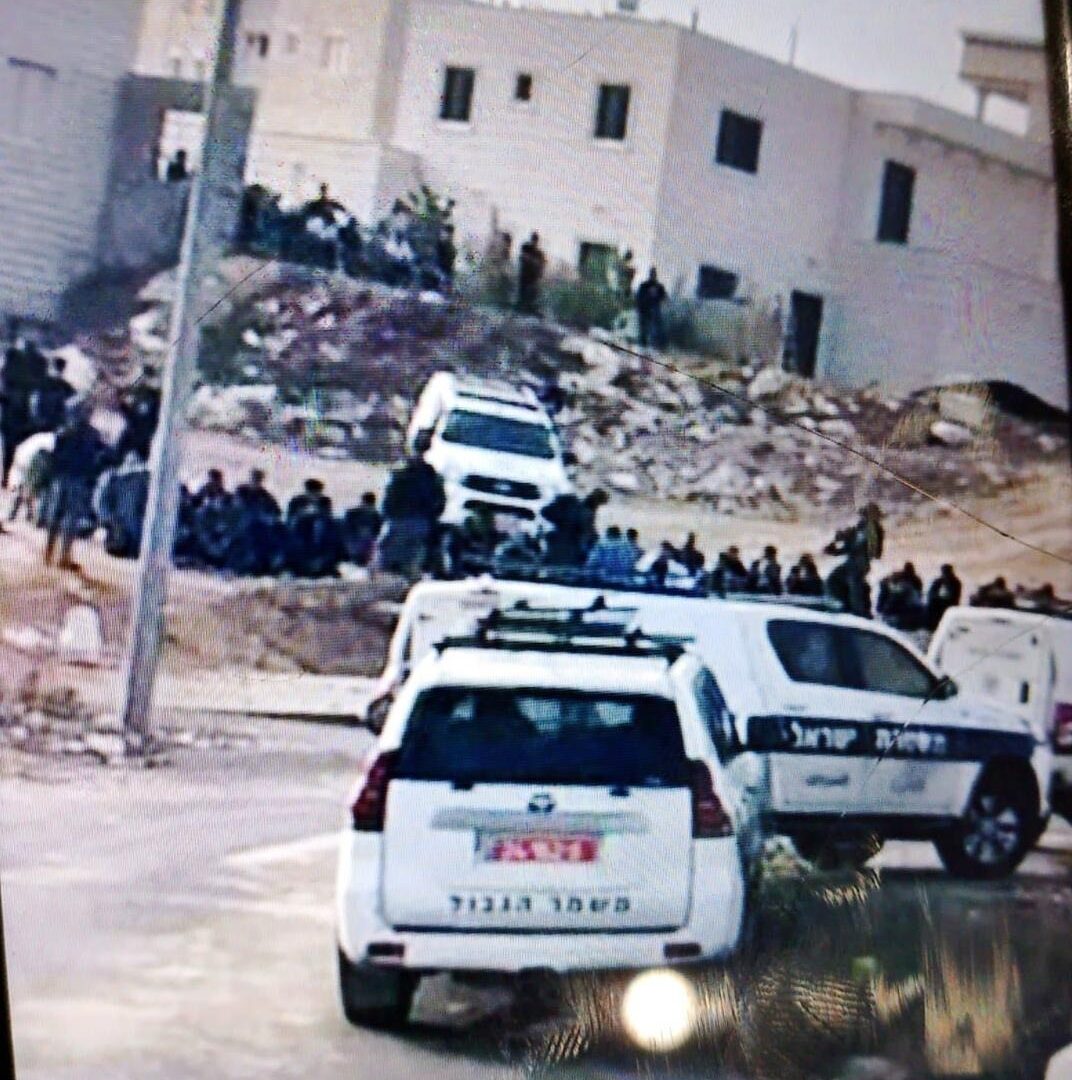
Gazans being held by Israeli police. Photo from one of the workers.
EXPLOITATION AND OCCUPATION
Hundreds of Gazan workers are being given refuge in Palestine, after having been dumped in the West Bank by Israel.
45 of them are in al-Khalil and the ISM spoke to many of them this evening.
These labourers were working in Israeli settlements. When Hamas broke out of Gaza they were rounded up, detained, and at least one of them was beaten and hospitalised. They spent four hours in prison, their phones confiscated and without contact with the outside world. One man says 6500NIS was stolen from him by the police.
Apartments have been provided by charitable individuals and groups are giving them food and bringing them brand-new clothing to replace the belongings they were not allowed to bring from Israel. No help comes from the P.A.
SO WHAT WERE THESE GUYS DOING IN ISRAEL?
After 16 years of blockade, Gaza’s economy has collapsed. Gazans buy Israeli work permits so as to get jobs as labourers in construction or hospitality. These permits, valid for one month, are purchased from specialised companies and cost 3,000 NIS. Gazan workers earn 6000 NIS monthly for 45 hour weeks. Israelis would be paid around 20,000 shekels for doing an equivalent job. These migrant workers have no health insurance or job security. They have to be married, too.
Women migrant workers find jobs in factories or in agriculture. Manual labour is the only option available to people from Gaza. One of the workers we spoke to has a degree in engineering, one qualified as a social worker and another was a teacher.
Visits to their wives and families are possible at weekends, and they try to return at least twice a month. Travel through the Eretz crossing involves a long wait of up to 12 hours, the crossing opens at 4am on a Sunday morning to let them through. Everything is checked, and they can’t take clothes through, so clothing has to be bought (at high expense) in Israel.
The guards at the border can deny entry at will to anyone, whether or not they have a permit. Israeli intelligence often interrogates and threatens the workers, hoping to add them to the network of informers in Gaza.
THE LUCKY ONES
We were told that around 1,500 migrant workers are still detained or missing in Israel. Their families in Gaza were asking for information about them.
We heard that, when Israel declared war, one of the employers of Gazan workers informed the police that the people working for him were terrorists. We saw a video of corpses after the police intervention. The people shot were colleagues of one of the men we spoke to. Here are their names:
Hashim Barawi (killed)
Suliman Al Atar (killed)
Hary Al Masry (location unknown)
Sahel AL Masry
Nabil Al Barrawi (injured)
Talal Warshasha (injured)
The workers intend to use every legal means possible to obtain justice.
NOT WAR BUT EXTERMINATION
The situation these men are in is difficult, but they are distraught about the situation in Gaza and worried about their families. “My son works with the emergency services, Israel bombed his ambulance, the driver was killed and my son is injured.” “My building was bombed, and my wife and kids are now living in a tent.” “I keep phoning my wife, but there is no answer.”
They denounce the lies and hypocrisy of the international community in its support for Israel. Western countries talk about law and democracy, but they respect neither. How can they support this massacre, this lack of humanity?
One of the men sums it up: This is not war, it is extermination.
Despite the atrocious, immoral position of the countries whose passports we hold, only one man didn’t greet us warmly. Hearing we were from European countries, he said he didn’t want to be in the same room as us.
I was totally sincere when I replied that I understood his feelings, that we are in Palestine because of our countries’ responsibility in the destruction of Palestine, because we don’t agree with Europe’s policies and that we would like to do what we can to tell people about what is happening here. If you’ve read this far, please help us in getting the word out and stopping this genocide.
October 15, 2023
Posted by aletho |
Ethnic Cleansing, Racism, Zionism, Subjugation - Torture, War Crimes | Gaza, Human rights, Israel, Palestine, West Bank, Zionism |
Leave a comment
American investigative journalist Seymour Hersh has revealed that the Israeli military plans to use a new version of Joint Direct Attack Munition (JDAM) bombs capable of killing all people within “one-half mile” from the dropping site during the ongoing aggression against the Palestinian people in the Gaza Strip.
According to Hersh, the attack is scheduled between Sunday and Monday.
“The current Israeli war planners are convinced, the insider told me, that the upgraded version of JDAMs with larger warheads would penetrate deep enough underground before detonating – thirty to fifty meters – with the blast and resulting sound wave ‘killing all within one-half mile’ … depending on the efficacy the forced expulsion of Gazi City and south proceeds, with a ground invasion to follow immediately,” Hersh said on his Substack column.
Earlier this week, Hersh warned in another report that an Israeli “national security veteran” said that the occupation is pondering whether to use a “Leningrad approach” to starve out “Hamas forces” in Gaza and avoid an invasion, something the source said may lead to the murder of nearly 100,000 civilians.
“The big debate today… is whether to starve Hamas out or kill as many as 100,000 people in Gaza,” adding that, “Hamas now only has a two or three-day supply of purified water and that, along with a lack of food … may be enough to flush all the Hamas [forces] out,” he said then citing the source.
The Israeli regime keeps pounding the densely-populated Gaza Strip relentlessly for the 9th day in a row, killing civilians and reducing buildings in the besieged Palestinian territory to rubble.
In one of the latest strikes, the regime killed 27 Palestinians in Jabaliya, north of the Gaza Strip.
Over 2,450 Palestinians have been killed and nearly 10,000 wounded. Over 700 children are among the dead.
At least 15 hospitals have been damaged by Israeli shelling and air raids.
The Palestinian resistance movement Hamas says at least 21 Israelis and foreigners held by the group were also killed in airstrikes.
The territory remains under Israel’s complete siege with no access to electricity, water, food, and medicines.
Raising the alarm on the Israeli atrocities, the Civil Defense spokesperson in Gaza has confirmed that 90% of the Israeli bombings targeted homes and residential buildings.
The United Nations recently stated that the ongoing aggression on the Strip had destroyed over 5,540 housing units and 3,750 were damaged and rendered uninhabitable.
The developments come as water and medical supplies are running out across Gaza, and the health sector is on the brink of collapse due to the blockade.
Palestine will not leave their land despite barbaric Israeli crimes: Hamas chief
Head of Hamas political Bureau, Ismail Haniyeh says Palestinian people will never leave their land despite the recent Israeli bloodshed in the besieged Gaza Strip.
Haniyeh said Palestinians have a country and their country is Palestine.
The Hamas official said the people of Palestine will not emigrate from their land despite the Israeli regime’s barbaric crimes to eliminate the roots of Palestinian people.
Haniyeh said the return of Palestinian people to their ancestral land is close given that the regime’s plan which is assisted by the US is doomed to fail.
The remarks come as the European Union, the United States and the United Kingdom have shown strong support for Israeli aggression.
Haniyeh has accused Israel of committing war crimes and preventing humanitarian aid from entering Gaza.
Elsewhere in his remarks, Haniyeh praised the military wing of Hamas, the al-Qassam Brigades for carrying out the operation against the Israeli regime.
Israel dropped equivalent to a quarter of a nuclear bomb
Meanwhile, the Euro-Med Monitor said the Tel Aviv regime’s aggression has included the dropping of more than 6,000 bombs on the densely populated area with over two million residents.
The Geneva-based organization stated that Israel’s relentless aerial and artillery attacks on the Gaza Strip had turned it into a hellhole where death and destruction prevail in extremely complex humanitarian conditions.
Basic services such as electricity, water, communications, and the internet are in short supply, posing unprecedented and serious threats to food security.
Civilian residents in Gaza find themselves with no shelter, fleeing from one form of death to another in an inhumane reality.
The Israeli army has executed thousands of airstrikes and artillery strikes around the clock, targeting residential neighborhoods and multi-story buildings housing the population in the Gaza Strip.
The Euro-Med Monitor emphasized that Israel continues to intensify its airstrikes and artillery attacks all over the Gaza Strip, including the complete destruction of residential neighborhoods, resulting in the annihilation of at least 82 families in horrific collective killings.
The international human rights monitor documented that Israel’s attacks have destroyed 2,650 residential buildings and severely damaged approximately 70,000 residential units. In addition, 65 government buildings were destroyed.
Israel’s attacks also caused destruction to at least 71 schools, the destruction of 145 industrial facilities, 61 media headquarters, the demolition of 18 mosques, and the damage to dozens of ancient churches and mosques.
The Gaza Strip was already experiencing a wide-scale displacement as a result of Israel’s attacks.
In the absence of a safe haven, tens of thousands of civilians sought refuge in hospitals to protect themselves from Israel’s attacks.
In addition to this, the Israeli army has been intimidating the residents of the Gaza and northern regions by warning them of collective evacuations from their residential areas.
The Euro-Med Monitor highlighted that the evacuation warnings for civilians in Gaza were made without any announcement of halting air raids and aerial attacks and without any safety or return guarantees, amounting to a war crime in the form of forced transfer.
In light of the current events, Euro-Med questioned the position of the The Hague-based International Criminal Court, which initiated in recent years an investigation into the occurrence of crimes in the occupied Palestinian territories without any tangible results so far.
October 15, 2023
Posted by aletho |
Timeless or most popular, War Crimes | Gaza, ICC, Israel, Palestine, Zionism |
Leave a comment
As Western politicians line up to cheer on Israel as it starves Gaza’s civilians and plunges them into darkness to soften them up before the coming Israeli ground invasion, it is important to understand how we reached this point – and what it portends for the future.
More than a decade ago, Israel started to understand that its occupation of Gaza through siege could be to its advantage. It began transforming the tiny coastal enclave from an albatross around its neck into a valuable portfolio in the trading game of international power politics.
The first benefit for Israel, and its Western allies, is more discussed than the second.
The tiny strip of land hugging the eastern Mediterranean coast was turned into a mix of testing ground and shop window.
Israel could use Gaza to develop all sorts of new technologies and strategies associated with the homeland security industries burgeoning across the West, as officials there grew increasingly worried about domestic unrest, sometimes referred to as populism.
The siege of Gaza’s 2.3 million Palestinians, imposed by Israel in 2007 following the election of Hamas to rule the enclave, allowed for all sorts of experiments.
How could the population best be contained? What restrictions could be placed on their diet and lifestyle? How were networks of informers and collaborators to be recruited from afar? What effect did the population’s entrapment and repeated bombardment have on social and political relations?
And ultimately how were Gaza’s inhabitants to be kept subjugated and an uprising prevented?
The answers to those questions were made available to Western allies through Israel’s shopping portal. Items available included interception rocket systems, electronic sensors, surveillance systems, drones, facial recognition, automated gun towers, and much more. All tested in real-life situations in Gaza.
Israel’s standing took a severe dent from the fact that Palestinians managed to bypass this infrastructure of confinement last weekend – at least for a few days – with a rusty bulldozer, some hang-gliders and a sense of nothing-to-lose.
Which is part of the reason why Israel now needs to go back into Gaza with ground troops to show it still has the means to keep the Palestinians crushed.
Collective punishment
Which brings us to the second purpose served by Gaza.
As Western states have grown increasingly unnerved by signs of popular unrest at home, they have started to think more carefully about how to sidestep the restrictions placed on them by international law.
The term refers to a body of laws that were formalised in the aftermath of the second world war, when both sides treated civilians on the other side of the battle lines as little more than pawns on a chessboard.
The aim of those drafting international law was to make it unconscionable for there to be a repeat of Nazi atrocities in Europe, as well as other crimes such as Britain’s fire bombing of German cities like Dresden or the United States’ dropping of atomic bombs on Hiroshima and Nagasaki.
One of the fundamentals of international law – at the heart of the Geneva Conventions – is a prohibition on collective punishment: that is, retaliating against the enemy’s civilian population, making them pay the price for the acts of their leaders and armies.
Very obviously, Gaza is about as flagrant a violation of this prohibition as can be found. Even in “quiet” times, its inhabitants – one million of them children – are denied the most basic freedoms, such as the right to movement; access to proper health care because medicines and equipment cannot be brought in; access to drinkable water; and the use of electricity for much of the day because Israel keeps bombing Gaza’s power station.
Israel has never made any bones of the fact that it is punishing the people of Gaza for being ruled by Hamas, which rejects Israel’s right to have dispossessed the Palestinians of their homeland in 1948 and imprisoned them in overcrowded ghettos like Gaza.
What Israel is doing to Gaza is the very definition of collective punishment. It is a war crime: 24 hours a day, 7 days a week, 52 weeks of every year, for 16 years.
And yet no one in the so-called international community seems to have noticed.
Rules of war rewritten
But the trickiest legal situation – for Israel and the West – is when Israel bombs Gaza, as it is doing now, or sends in soldiers, as it soon will do.
Israeli prime minister Benjamin Netanyahu highlighted the problem when he told the people of Gaza: “Leave now”. But, as he and Western leaders know, Gaza’s inhabitants have nowhere to go, nowhere to escape the bombs. So any Israeli attack is, by definition, on the civilian population too. It is the modern equivalent of the Dresden fire bombings.
Israel has been working on strategies to overcome this difficulty since its first major bombardment of Gaza in late 2008, after the siege was introduced.
A unit in its attorney general’s office was charged with finding ways to rewrite the rules of war in Israel’s favour.
At the time, the unit was concerned that Israel would be criticised for blowing up a police graduation ceremony in Gaza, killing many young cadets. Police are civilians in international law, not soldiers, and therefore not a legitimate target. Israeli lawyers were also worried that Israel had destroyed government offices, the infrastructure of Gaza’s civilian administration.
Israel’s concerns seem quaint now – a sign of how far it has already shifted the dial on international law. For some time, anyone connected with Hamas, however tangentially, is considered a legitimate target, not just by Israel but by every Western government.
Western officials have joined Israel in treating Hamas as simply a terrorist organisation, ignoring that it is also a government with people doing humdrum tasks like making sure bins are collected and schools kept open.
Or as Orna Ben-Naftali, a law faculty dean, told the Haaretz newspaper back in 2009: “A situation is created in which the majority of the adult men in Gaza and the majority of the buildings can be treated as legitimate targets. The law has actually been stood on its head.”
Back at that time, David Reisner, who had previously headed the unit, explained Israel’s philosophy to Haaretz: “What we are seeing now is a revision of international law. If you do something for long enough, the world will accept it.
“The whole of international law is now based on the notion that an act that is forbidden today becomes permissible if executed by enough countries.”
Israel’s meddling to change international law goes back many decades.
Referring to Israel’s attack on Iraq’s fledgling nuclear reactor in 1981, an act of war condemned by the UN Security Council, Reisner said: “The atmosphere was that Israel had committed a crime. Today everyone says it was preventive self-defence. International law progresses through violations.”
He added that his team had travelled to the US four times in 2001 to persuade US officials of Israel’s ever-more flexible interpretation of international law towards subjugating Palestinians.
“Had it not been for those four planes, I am not sure we would have been able to develop the thesis of the war against terrorism on the present scale,” he said.
Those redefinitions of the rules of war proved invaluable when the US chose to invade and occupy Afghanistan and Iraq.
‘Human animals’
In recent years, Israel has continued to “evolve” international law. It has introduced the concept of “prior warning” – sometimes giving a few minutes’ notice of a building or neighbourhood’s destruction. Vulnerable civilians still in the area, like the elderly, children and the disabled, are then recast as legitimate targets for failing to leave in time.
And it is using the current assault on Gaza to change the rules still further.
The 2009 Haaretz article includes references by law officials to Yoav Gallant, who was then the military commander in charge of Gaza. He was described as a “wild man”, a “cowboy” with no time for legal niceties.
Gallant is now defence minister and the man responsible for instituting this week a “complete siege” of Gaza: “No electricity, no food, no water, no fuel – everything is closed.” In language that blurred any distinction between Hamas and Gaza’s civilians, he described Palestinians as “human animals”.
That takes collective punishment into a whole different realm. In terms of international law, it skirts into the territory of genocide, both rhetorically and substantively.
But the dial has shifted so completely that even centrist Western politicians are cheering Israel on – often not even calling for “restraint” or “proportionality”, the weasel terms they usually use to obscure their support for law breaking.
Britain has been leading the way in helping Israel to rewrite the rulebook on international law.
Listen to Keir Starmer, the leader of the Labour opposition and the man almost certain to be Britain’s next prime minister. This week he supported the “complete siege” of Gaza, a crime against humanity, refashioning it as Israel’s “right to defend itself”.
Starmer has not failed to grasp the legal implications of Israel’s actions, even if he seems personally immune to the moral implications. He is trained as a human rights lawyer.
His approach even appears to be taking aback journalists not known for being sympathetic to the Palestinian case. When asked by Kay Burley of Sky News if he had any sympathy for the civilians in Gaza being treated like “human animals”, Starmer could not find a single thing to say in support.
Instead, he deflected to an outright deception: blaming Hamas for sabotaging a “peace process” that Israel both practically and declaratively buried years ago.
Confirming that the Labour party now condones war crimes by Israel, his shadow attorney general, Emily Thornberry, has been sticking to the same script. On BBC’s Newsnight, she evaded questions about whether cutting off power and supplies to Gaza is in line with international law.
It is no coincidence that Starmer’s position contrasts so dramatically with that of his predecessor, Jeremy Corbyn. The latter was driven out of office by a sustained campaign of antisemitism smears fomented by Israel’s most fervent supporters in the UK.
Starmer does not dare to be seen on the wrong side of this issue. And that is exactly the outcome Israeli officials wanted and expected.
Israeli flag on No 10
Starmer is, of course, far from alone. Grant Shapps, Britain’s defence secretary, has also expressed trenchant support for Israel’s policy of starving two million Palestinians in Gaza.
Rishi Sunak, the UK prime minister, has emblazoned the Israeli flag on the front of his official residence, 10 Downing Street, apparently unconcerned at how he is giving visual form to what would normally be considered an antisemitic trope: that Israel controls the UK’s foreign policy.
Starmer, not wishing to be outdone, has called for Wembley stadium’s arch to be adorned with the colours of the Israeli flag.
“The media is playing its part, dependably as ever“
However much this schoolboy cheerleading of Israel is sold as an act of solidarity following Hamas’ slaughter of Israeli civilians at the weekend, the subtext is unmistakeable: Britain has Israel’s back as it starts its retributive campaign of war crimes in Gaza.
That is also the purpose of home secretary Suella Braverman’s advice to the police to treat the waving of Palestinian flags and chants for Palestine’s liberation at protests in support of Gaza as criminal acts.
The media is playing its part, dependably as ever. A Channel 4 TV crew pursued Corbyn through London’s streets this week, demanding he “condemn” Hamas. They insinuated through the framing of those demands that anything less fulsome – such as Corbyn’s additional concerns for the welfare of Gaza’s civilians – was confirmation of the former Labour leader’s antisemitism.
The clear implication from politicians and the establishment media is that any support for Palestinian rights, any demurral from Israel’s “unquestionable right” to commit war crimes, equates to antisemitism.
Europe’s hypocrisy
This double approach, of cheering on genocidal Israeli policies towards Gaza while stifling any dissent, or characterising it as antisemitism, is not confined to the UK.
Across Europe, from the Brandenburg Gate in Berlin, to the Eiffel Tower in Paris and the Bulgarian parliament, official buildings have been lit up with the Israeli flag.
Europe’s top official, Ursula von der Leyen, president of the European Commission, celebrated the Israeli flag smothering the EU parliament this week.
She has repeatedly stated that “Europe stands with Israel”, even as Israeli war crimes start to mount.
The Israeli air force boasted on Thursday it had dropped some 6,000 bombs on Gaza. At the same time, human rights groups reported Israel was firing the incendiary chemical weapon white phosphorus into Gaza, a war crime when used in urban areas. And Defence for Children International noted that more than 500 Palestinian children had been killed so far by Israeli bombs.
It was left to Francesca Albanese, the UN’s special rapporteur on the occupied territories, to point out that Von Der Leyen was applying the principles of international law entirely inconsistently.
Almost exactly a year ago, the European Commission president denounced Russia’s strikes on civilian infrastructure in Ukraine as war crimes. “Cutting off men, women, children of water, electricity and heating with winter coming – these are acts of pure terror,” she wrote. “And we have to call it as such.”
Albanese noted Von der Leyen had said nothing equivalent about Israel’s even worse attacks on Palestinian infrastructure.
Sending in the heavies
Meanwhile, France has already started breaking up and banning demonstrations against the bombing of Gaza. Its justice minister has echoed Braverman in suggesting solidarity with Palestinians risks offending Jewish communities and should be treated as “hate speech”.
Naturally, Washington is unwavering in its support for whatever Israel decides to do to Gaza, as secretary of state Anthony Blinken made clear during his visit this week.
President Joe Biden has promised weapons and funding, and sent in the military equivalent of “the heavies” to make sure no one disturbs Israel as it carries out those war crimes. An aircraft carrier has been dispatched to the region to ensure quiet from Israel’s neighbours as the ground invasion is launched.
Even those officials whose chief role is to promote international law, such as Antonio Gutteres, secretary general of the UN, have started to move with the shifting ground.
Like most Western officials, he has emphasised Gaza’s “humanitarian needs” above the rules of war Israel is obliged to honour.
This is Israel’s success. The language of international law that should apply to Gaza – of rules and norms Israel must obey – has given way to, at best, the principles of humanitarianism: acts of international charity to patch up the suffering of those whose rights are being systematically trampled on, and those whose lives are being obliterated.
Western officials are more than happy with the direction of travel. Not just for Israel’s sake but for their own too. Because one day in the future, their own populations may be as much trouble to them as Palestinians in Gaza are to Israel right now.
Supporting Israel’s right to defend itself is their downpayment.
October 15, 2023
Posted by aletho |
Civil Liberties, Full Spectrum Dominance, Progressive Hypocrite, Subjugation - Torture, Timeless or most popular, War Crimes | European Union, France, Gaza, Hamas, Human rights, Israel, Keir Starmer, Palestine, UK, Zionism |
Leave a comment
At one time, the ‘Arab-Israeli Conflict’ was Arab and Israeli. Over the course of many years, however, it was rebranded. The media is now telling us it is a ‘Hamas-Israeli conflict’.
But what went wrong? Israel simply became too powerful.
The supposedly astounding Israeli victories over the years against Arab armies have emboldened Israel to the extent that it came to view itself, not as a regional superpower, but as a global power as well. Israel, per its own definition, became ‘invincible’.
Such terminology was not a mere scare tactic aimed at breaking the spirit of Palestinians and Arabs alike. Israel believed this.
The ‘Israeli miracle victory’ against Arab armies in 1967 was a watershed moment. Then, Israeli ambassador to the United Nations, Abba Eban, declared in a speech that “from the podium of the UN, I proclaimed the glorious triumph of the IDF and the redemption of Jerusalem.”
This, in his thinking, could only mean one thing: “Never before has Israel stood more honored and revered by the nations of the world.”
The sentiment in Eban’s words echoed throughout Israel. Even those who doubted their government’s ability to completely prevail over the Arabs, joined the chorus: Israel is unvanquishable.
Little rational discussion took place back then, about the actual reasons why Israel had won, and if that victory would have been possible without Washington’s complete backing and the West’s willingness to support Israel at any cost.
Israel was never a graceful winner. As the size of territories controlled by the triumphant little state increased by three-fold, Israel began entrenching its military occupation over whatever remained of historic Palestine. It even began building settlements in newly occupied Arab territories, in Sinai, the Golan Heights and all the rest.
Fifty years ago, in October 1973, Arab armies attempted to reverse Israel’s massive gains by launching a surprise attack. They initially succeeded, then failed when the US moved quickly to bolster Israeli defenses and intelligence.
It was not a complete victory for the Arabs, nor a total defeat for Israel. The latter was badly bruised, though. But Tel Aviv remained convinced that the fundamental relationship it had established with the Arabs in 1967 had not been altered.
And, with time, the ‘conflict’ became less Arab-Israeli and more Palestinian-Israeli. Other Arab countries, like Lebanon, paid a heavy price for the fragmentation of the Arab front.
This changing reality meant that Israel could invade South Lebanon in March 1978, and then sign the Camp David Peace Accords with Egypt, six months later.
While the Israeli occupation of Palestine grew more violent, with an insatiable appetite for more land, the west turned the Palestinian struggle for freedom into a ‘conflict’ to be managed by words, never by deeds.
Many Palestinian intellectuals make a point of arguing that “this is not a conflict”, that military occupation is not a political dispute, but governed by clearly defined international laws and boundaries. And that it must be resolved according to international justice.
That is yet to happen. Neither was justice delivered, nor an inch of Palestine was retrieved, despite the countless international conferences, resolutions, statements, investigations, recommendations, and special reports. Without real enforcement, international law is mere ink.
But did the Arab people abandon Palestine? The anger, the anguish, and the passionate chants by endless streams of people who took to the streets throughout the Middle East to protest the annihilation of Gaza by the Israeli army, did not seem to think that Palestine is alone – or, at least, should be left fighting on its own.
The isolation of Palestine from its regional context has proven disastrous.
When the ‘conflict’ is only with the Palestinians, then Israel determines the context and scope of the so-called conflict, what is allowed at the ‘negotiations table’, and what is to be excluded. This is how the Oslo Accords squandered Palestinian rights.
The more Israel succeeds in isolating Palestinians from their regional environs, the more it invests in their division.
It is even more dangerous when the conflict becomes between Hamas and Israel. The outcome is a whole different conversation that is superimposed on the truly urgent understanding of what is taking place in Gaza, in the whole of Palestine at the moment.
In Israel’s version of events, the war began on October 7, when Hamas fighters attacked Israeli military bases, settlements, and towns in the south of Israel.
No other date or event prior to the Hamas attack seems to matter to Israel, to the West and to corporate media covering the war with so much concern for the plight of Israelis, and complete disregard to the Gaza inferno.
No other context is allowed to spoil the perfect Israeli narrative of Daesh-like Palestinians disturbing the peace and tranquility of Israel and its people.
Palestinian voices that insist on discussing the Gaza war within proper historical contexts – the ethnic cleansing of Palestine in 1948, the occupation of Jerusalem, the West Bank and Gaza in 1967, the siege on Gaza in 2007, all the bloody wars before and after – are simply denied platforms.
The pro-Israel media simply does not want to listen. Even if Israel did not go as far as making unfounded claims about decapitated babies, the media would have remained committed to the Israeli narrative, anyway.
Yet, if Israel continues to define the narratives of war, historical contexts of ‘conflicts’, and the political discourses that shape the West’s view of Palestine and the Middle East, it will continue to obtain all the blank checks necessary to remain committed to its military occupation of Palestine.
In turn, this will fuel yet more conflicts, more wars and more deception regarding the roots of the violence.
For this vicious cycle to break, Palestine must, once more, become an issue that concerns all Arabs, the whole region. The Israeli narrative must be countered, western bias confronted, and a new, collective strategy formed.
In other words, Palestine cannot be left alone anymore.
October 15, 2023
Posted by aletho |
Ethnic Cleansing, Racism, Zionism, Illegal Occupation, Timeless or most popular | Human rights, Israel, Middle East, Palestine, Zionism |
Leave a comment
China’s top diplomat Wang Yi said Israel’s actions have gone beyond the scope of self-defense, expressing concerns about the escalating Israel-Palestine conflict as Israel ordered one million people from the northern part of Gaza to evacuate within 24 hours as it prepared for a ground assault.
In his phone call with Saudi Foreign Minister Prince Faisal bin Farhan Al Saud on Saturday, Chinese Foreign Minister Wang Yi said China opposes and condemns all acts that harm civilians, as they violate basic human conscience and the fundamental principles of international law.
Israel’s actions go beyond the scope of self-defense. It should heed the calls of the international community and the UN Secretary-General and avoid collective punishment of the people of Gaza, Wang said.
Israel was preparing on Saturday to launch a ground assault in the Hamas-controlled Gaza Strip, after telling Palestinians living in the densely populated territory to flee south toward a closed border with Egypt, Reuters reported.
Israeli national security adviser meanwhile warned Lebanese militant group Hezbollah not to start a war on a second front, threatening the “destruction of Lebanon” if it did, according to the media report.
UN Secretary-General Antonio Guterres warned on Friday that the relocation of Gaza residents from the north to the south “is extremely dangerous – and in some cases, simply not possible.”
The Chinese Foreign Minister said all parties should not take any actions that escalate the situation, and instead should return to the negotiation table as soon as possible. China is actively communicating with all parties to push for a ceasefire. The immediate priority is to ensure the safety of civilians, quickly open humanitarian rescue channels, and meet the basic needs of the people of Gaza, Wang said.
China’s special envoy on the Middle East Affairs Zhai Jun will visit relevant countries in the Middle East next week to further strengthen coordination with all parties, he was quoted as saying in media reports on Sunday.
The Israel-Palestine conflict continues to escalate. Armed conflicts have erupted at the Israel-Lebanon and Israel-Syria borders, and the spill-over effects on the regional and international community are spreading, Zhai noted. The international community must remain highly vigilant and collectively manage and control the situation to prevent it from spiraling out of control, he said.
China has always maintained that force is never the solution. Resorting to violence will only lead to a vicious cycle of retribution, creating further obstacles to a political resolution, Zhai noted. And it is imperative to cease fire and violence promptly, cool down the situation, and thus pave the way for a political solution.
Since the onset of this round of conflict, China has been actively communicating and coordinating with relevant parties. China’s special envoy recently had phone conversations with foreign ministers and officials from Palestine, Israel, Egypt, Saudi Arabia, the UAE, and others.
They all hope to end the hostilities, condemn acts that harm civilians, and avoid humanitarian disasters. They also hope to restore the Middle East peace process, Zhai revealed.
Currently, several Chinese citizens remain in the Gaza Strip, he said. In recent days, our overseas institutions have maintained close contact with them, providing safety guidance and support, assisting them in moving to the southern part of Gaza, and striving for their early evacuation to safe areas.
So far, four Chinese nationals have been killed, six are receiving treatment in local hospitals, and two are missing in the latest conflict.
October 15, 2023
Posted by aletho |
Militarism, War Crimes | China, Gaza, Human rights, Israel, Middle East, Palestine |
Leave a comment

 Aletho News
