Bombs Away or Walk Away in Iran /Lt Col Daniel Davis
Daniel Davis / Deep Dive – May 16, 2026
The Cradle | May 19, 2026
Italian authorities are holding three shipments suspected of carrying military-grade steel from India to Israel after activists from the Boycott, Divestment and Sanctions (BDS) movement and No Harbour for Genocide (NHB) exposed their contents, Middle East Eye (MEE) reported on 18 May.
According to the activists, the shipments amount to roughly 806 tonnes of military-grade steel and could be used to manufacture up to 17,458 artillery shells for the Israeli army.
They said the cargo originated from R L Steels & Energy Limited in Aurangabad and was destined for IMI Systems, now known as Elbit Systems Land, in Ramat Hasharon.
Three consignments transported by the Mediterranean Shipping Company (MSC) are being held in Gioia Tauro and Cagliari, while another three were reportedly rerouted toward Sri Lanka after activists began tracking the vessels.
“We are seeing now a flood of military supplies from India to Israel,” Ilham Yaseen, military embargo coordinator with BDS, told MEE.
She called for pressure “to stop these supplies from reaching Israel and to hold the far-right Indian government and any complicit Indian company accountable for their complicity in Israel’s atrocity crimes.”
A spokesperson for NHB said the steel was heading to “the Ramat Hasharon ammunition plant, which has no civilian output. It’s all military production. We know this 100 percent.”
Activists say the deliveries underline India’s growing role in supplying Israel during its wars in Gaza and Lebanon, particularly as demand for 155mm artillery shells has surged.
The activists also accused shipping firms of obscuring routes and destinations to avoid scrutiny, after Spain reportedly blocked one vessel from docking, Greek dockworkers refused to unload cargo, and Italian authorities later detained three shipments for possible inspection.
On 6 February, dockworkers from more than 20 ports across Italy, Greece, the Basque Country, Morocco, and Turkiye carried out coordinated action under the banner “Dockworkers Don’t Work for War,” aiming to disrupt arms shipments and oppose the use of civilian ports for war logistics.
Italy’s Unione Sindacale di Base said the action sought to “ensure that European and Mediterranean ports are places of peace, free from any involvement in war.”
Francesco Staccioli of USB warned, “If we don’t take this step, all our other demands will be crushed under war.”
Across Europe, since the genocide in Gaza was launched in October 2023, court rulings, national bans, dockworker actions, and rail blockades have worked to obstruct Israeli military shipments.
Despite this, many European states continue to facilitate arms transfers to Israel, with Germany approving $7.8 million in arms exports during the first weeks of the US-Israeli war on Iran, despite lawyers pursuing German officials for aiding Israel’s genocide in Gaza through weapons deliveries.
Most recently, Israeli media reported that dozens of cargo planes transported ammunition through US military bases in Germany, as Washington and Tel Aviv intensified preparations for possible renewed attacks on Iran.
Press TV – May 19, 2026
The Kata’ib Hezbollah resistance movement has warned the Amman government against ongoing reconnaissance missions launched by the United States and Israel from Jordanian soil against Iraqi resistance fighters, particularly the Popular Mobilization Units (PMU).
“In the wake of unfolding developments across the region and US-Israeli actions against Iraq’s security and stability, the enemies are aggressively seeking to escalate tensions against the (Iraqi) resistance front and the PMU,” Abu Mujahid al-Assaf, the security chief of the group, said in a statement on Monday evening.
He warned that the patience of heroic resistance fighters in the face of blatant Israeli violations of ceasefire agreements and recurrent acts of aggression against Iraq’s national sovereignty is about to run out.
Assaf noted that the bulk of US and Israeli surveillance missions are being launched from Jordan, warning that this serves as a prelude for attacks against Iraq.
The Jordanian government, therefore, is strongly advised to take lessons from missile and drone operations conducted in retaliation for the US-Israeli war of aggression against Iran, as “patience is starting to run out,” the senior Kata’ib Hezbollah official emphasized.
He further said that the US and Israel, based on received information, are preparing for a fresh round of strikes against commanders of Iraqi resistance groups and the PMU, commonly known by its Arabic name Hashd al-Sha’abi.
Assaf warned Washington and Tel Aviv against any strikes on Iraq, stressing that the response to such a folly would be comprehensive, and the United States would have to shoulder responsibility for all serious repercussions in such a case.
The remarks come as US military aircraft have been scrambling over the past few days to transfer personnel and munitions from one military installation to another across Iraq.
Press TV – May 19, 2026
Pakistan’s Defense Minister Khawaja Muhammad Asif says that a resumption of the US‑Israeli war on Iran is unlikely given the widespread global opposition and lack of public support in the United States for another war in West Asia.
In an interview with Geo News’ “Capital Talk” program on Monday, Asif said Israel strongly desires the war to restart and be fought by America on its side, but “my hunch says that this war will not happen again.”
“Wars are fought when the public stands behind them. When the public does not support them, wars are not fought,” he added.
The defense minister noted that even Iran’s neighbors across the Persian Gulf are not in favor of aggression against the Islamic Republic.
He highlighted Pakistan’s ancient linguistic and neighborly ties with Iran and expressed gratitude for Tehran’s trust in Islamabad’s mediation efforts.
Israel ‘left alone’ as world rejects war
Asif argued that Israel has been left alone in its push for a prolonged conflict.
“Israel or maybe two or three countries want the war to be prolonged and for America to fight on their behalf,” he said, stressing that the overwhelming international mood is against it.
He said the positions of China and Russia are very clear in that they, along with other nations, are not supporters of war against Iran.
The defense minister also praised Iran’s strong spirit during the imposed war, which began on February 28 when the United States and Israel launched joint assaults that assassinated Leader of the Islamic Revolution Ayatollah Seyyed Ali Khamenei and targeted civilian infrastructure.
Trump still threatens military action
Meanwhile, US President Donald Trump has repeatedly threatened that military action remains possible if diplomacy fails.
On Monday, Trump said he had paused plans for a major assault at the request of Persian Gulf Arab allies, but threatened to launch a “full, large‑scale assault” if no agreement is reached.
Despite the recurring threats, Iran has consistently rejected US proposals that undermine its sovereignty.
Foreign Ministry spokesman Esmaeil Baghaei confirmed on Monday that exchanges with Washington continue through Pakistani mediation, with Tehran having conveyed its concerns.
Palestinian Information Center – May 18, 2026
ROME – Italy witnessed a nationwide general strike on Monday, affecting transportation, education, and logistics sectors, following calls by labor unions protesting military rearmament programs, rejecting Israel’s ongoing genocide in Gaza, and expressing solidarity with the “Global Sumud Flotilla” attempting to break the blockade on the Gaza Strip.
The strike coincided with demonstrations in several Italian cities under the slogan “Stop Everything,” organized by labor unions and civil society groups to protest rising living costs, military policies, and increased spending on weapons at the expense of healthcare and education, while also demanding an end to what protesters described as the genocide against Palestinians and supporting the flotilla heading to Gaza.
In the capital, Rome, protesters gathered in one of the city’s main squares, carrying banners urging the Italian government not to continue what they called “complicity in crimes” alongside Israel.
Demonstrators also waved Palestinian flags and chanted slogans, including “Free Palestine,” expressing outrage over the Israeli attack on the Global Sumud Flotilla.
The strikes disrupted several metro lines, including Rome’s Line C and Naples’ Line 1, while some suburban train services in Milan were suspended. Port workers in the city of Livorno also staged similar protests.
Among the participants in Rome was Spanish-Palestinian activist Saif Abu Kishk, one of the activists detained by Israel during the April 29 attack on the flotilla in international waters near the island of Crete.
Speaking to Anadolu Agency, Abu Kishk said some of the boats had been seized during the latest attack, but participants remain determined to continue toward Gaza while solidarity movements for the flotilla continue across European cities.
He described the Israeli attack as another violation of international law and maritime law, saying it forms part of a broader pattern of ongoing abuses against Gaza.
Abu Kishk also argued that the continuation of such operations is tied to the complicity of Western governments, including the Italian government, which continues to allow arms trade through ports and airports. He called for sustained public pressure to end that complicity and stop the war on Gaza.
He added that participants were fully aware of the risks before setting sail but said morale remains high, noting that many people responded to the call to support Palestine through the flotilla.
Italian protester Andrea Ziccaro said he joined the strike to express support for the Global Sumud Flotilla and opposition to militarization policies.
He added that the latest Israeli attack on the flotilla represents a dangerous escalation, criticizing governments for prioritizing military spending over healthcare and education in what he described as a “war economy.”
Meanwhile, protester Natalia Mancini said the attack on the flotilla was “another humiliation,” arguing that repeated incidents of this kind expose contradictions within Western democratic discourse.
Earlier Monday, Israeli naval forces began seizing boats from the “Global Sumud Flotilla” in international waters in the Mediterranean Sea and detaining activists onboard.
With the participation of 54 boats, the flotilla had sailed Thursday from the Turkish city of Marmaris in a renewed attempt to break the Israeli blockade imposed on Gaza since 2007.
On April 29, Israeli forces attacked flotilla boats in international waters near Crete. The flotilla included 345 participants from 39 countries, including Turkish citizens.
Israeli authorities then seized 21 boats carrying around 175 activists, while the remaining boats continued toward Greek territorial waters.
blueapples on X | May 18, 2026
Ahead of a monumental primary on Tuesday, May 19th, which will determine whether or not the dying embers of America’s democratic process will be completely extinguished by the pro-Israel lobby, Kentucky representative Thomas Massie has introduced a bill into Congress that could deter future politicians actually willing to put America before Israel from suffering his same fate. On May 14th, Massie introduced the Americans Insist on Political Agent Clarity Act (”AIPAC Act”) in an effort to finally force the American Israel Public Affairs Committee (”AIPAC”) to register under the Foreign Agents Registration Act of 1938 (”FARA”). The proposed legislation is the apotheosis of a crusade fought by Massie that has opened the eyes of the American people to see how the pro-Israel lobby has taken control over the country’s electoral process. Yet, despite widespread public support to force AIPAC to register as a foreign agent under FARA, the pro-Israel lobby’s stranglehold over Congress stands as a seemingly insurmountable obstacle keeping Massie’s proposed legislation from turning that into a reality.
The express aim of the AIPAC Act is to “amend the Foreign Registration Act of 1938… to clarify the definition of ‘foreign principal’ and ensure transparency in lobbying on behalf of foreign interests.” Under FARA, a foreign principal is defined as:
(1) a government of a foreign country and a foreign political party;
(2) a person outside of the United States, unless it is established that such person is an individual and a citizen of and domiciled within the United States, or that such person is not an individual and is organized under or created by the laws of the United States or of any State or other place subject to the jurisdiction of the United States and has its principal place of business within the United States; and
(3) a partnership, association, corporation, organization, or other combination of persons organized under the laws of or having its principal place of business in a foreign country.
Since its inception in 1954, AIPAC has circumvented the registration requirements under FARA by virtue of being established as a domestic lobbying organization legally distinct from the parameters that the act uses to designate a foreign principal. AIPAC was created by Isaiah L. Kenen, a lobbyist for the Israeli government that previously served under the Israeli Ministry of Foreign Affairs, who worked as the information director of the American Zionist Council (”AZC”). After raising $65 million and $73 million in U.S. aid for Israel in 1951 and 1952, respectively, Kenen grew weary that he would be investigated by the U.S. State Department for not registering as a foreign agent under FARA. Kenen created the American Zionist Committee for Public Affairs (”AZCPA”) to navigate around the registration requirements under FARA in response to that concern. The AZPCA was renamed the American Israel Public Affairs Committee in 1959 and became the preeminent political vehicle for the pro-Israel lobby in the decades that followed its creation.
The AIPAC Act would amend FARA by adding a fourth paragraph that would additionally define a foreign principal as “any organization, association, corporation, or other entity….whose lobbying activities or stated mission is, either wholly or in part, to influence United States public policy or government action in furtherance of the political or economic interests of a foreign country or recognized state-affiliated political entity.” That language included in Massie’s proposed legislation would broaden the definition of a foreign principal to encompass domestic lobbying firms in the U.S. like AIPAC. The proposed legislation would also establish indicators for determining the foreign political alignment of lobbying firms and allow American citizens to file complaints with the U.S. Department of Justice to request investigations into potential FARA violations.
Massie explained the calculus behind the proposed legislation designed to require AIPAC to register as a foreign agent shortly after introducing it into Congress on May 14th in an interview with Redacted News. “For some reason, they’re immune right now, and I think not just the money that’s spent in politics but the lobbying that happens on Capitol Hill should be reported if it’s a foreign country. Whether it’s Great Britain, Australia, Turkey, Qatar, or Israel, it needs to be reported,” he stated, clarifying the amendment to FARA would apply to foreign principals lobbying on behalf of any nation.
Although the expanded definition of a foreign principal under FARA in the AIPAC Act would apply to lobbyists working on behalf of any nation, the material reality is that the legislation is designed to address the unrestrained power and influence of the pro-Israel lobby. In 2021, AIPAC changed its lobbying strategy by moving away from funding political candidates indirectly by working with unaffiliated political action committees (PACs) and instead created its own PAC to raise and contribute funds directly. In the 2024 election cycle alone, AIPAC backed candidates using its own PAC and super PAC, the United Democracy Project, in 389 congressional races through either official endorsements and/or campaign contributions. AIPAC-backed candidates won 318 of those 389 congressional races, expanding the roster of pro-Israel politicians in Congress even further. Presently, 80 members of Congress, or 15%, list AIPAC as their all-time top contributor.
Nowhere is the unyielding influence of the pro-Israel lobby on American elections more apparent than in Massie’s current bid for re-election to the U.S. House of Representatives. Massie, who has held the seat for the 4th Congressional District of Kentucky since first being elected to Congress in 2012, has seen the broader pro-Israel lobby spend tens of millions of dollars in an effort to depose him. Ed Gallrein, Massie’s opponent in the May 19th primary for the seat representing the 4th Congressional District of Kentucky, has received over $15.5 million in campaign contributions from pro-Israel PACs, including donations from the MAGA Kentucky PAC, created by Jewish billionaires Paul Singer, John Paulsen, and Donald Trump’s biggest political donor, casino magnate and fervent Zionist Miriam Adelson, expressly for the purpose of defeating Massie.
The race between Massie and Gallrein has eclipsed more than $30 million in spending, making it the most expensive congressional campaign in U.S. history. The majority of that spending has been made in an effort to unseat Massie, as the pro-Israel lobby’s expenditures against him have surpassed the $14.5 million dollars AIPAC spent to successfully replace former representative of New York’s 16th Congressional District, Democrat Jamaal Bowman, with pro-Israel candidate George Latimer in 2024. AIPAC also succeeded that year in unseating Democratic representative from Missouri’s 1st Congressional District, Cori Bush, with pro-Israel candidate Wesley Ball, thanks to $9 million of spending against her.
The defeats of Bowman and Bush were engineered by AIPAC to remove two of the most outspoken critics of Israel from Congress. However, neither Bowman nor Bush was as outspoken against the political malfeasance of the pro-Israel lobby as Massie has been. In recent years, Massie has shifted the Overton Window by exposing the inner machinations of the pro-Israel political machine toward a perspective that has accelerated the decline in public support for Israel from American citizens. In doing so, he has also amplified the efforts of AIPAC and the broader pro-Israel lobby inextricably tied to the Trump administration to replace him in Congress with a Zionist puppet, who has taken the form of Ed Gallrein.
While Massie had coasted to re-election in each of his previous campaigns, the spending against him by the pro-Israel lobby has created the realistic possibility that he could be ousted from Congress. If Massie fails at defeating Gallrein in the primary for his congressional seat, then it would render the AIPAC Act he has introduced to Congress as his last stand against a Zionist Occupied Government that has shown it will spend every resource at its disposal to subvert the American democratic process. That stranglehold that the pro-Israel lobby has over the American political system is clear as the AIPAC Act currently only has a 2% chance of being passed following its referral to the House Committee on the Judiciary. The dynamic cultivated by Massie that has led to the boundless spending against him by the pro-Israel lobby shows that even if he is defeated, then it may be little more than a Pyrrhic victory for AIPAC, as Massie’s demise would only prove how justified the crusade he fought against them was to begin with.
By Jack Hunter | The Libertarian Institute | May 18, 2026
When Donald Trump ran for president in 2024, he promised, among other things, no more U.S. regime change wars, no more of America sending its citizens’ dollars to fund foreign nations, and that he and Elon Musk would drastically cut federal departments and overall spending, finally taking a hatchet to the country’s mounting debt.
In other words, the opposite of the last Republican president, George W. Bush.
It is 2026, the United States is stuck in a seemingly endless regime change war in Iran, America continues to funnel money to nations around the world (particularly Ukraine and Israel), Musk is long gone and any promises of spending cuts through the Department of Government Efficiency (DOGE) are but a distant memory.
At this juncture, President Trump’s goal seems to be to become more George W. than George W.
Then there’s Thomas Massie, the libertarian-leaning Republican U.S. congressman from Kentucky’s 4th district, who was an avid supporter of Ron Paul’s presidential campaigns in 2008 and 2012.
Long before Trump officially entered the political fray, Massie supported Dr. Paul, in part, because he promised no more endless wars, an end to foreign aid, and because he was a serious fiscal conservative.
When Trump also promised these things, Massie lent his support at various intervals and gave his full endorsement in 2024. Massie also still votes according to these principles in Congress. If those votes run against any part of Trump’s agenda, and they have—part of Trump’s early ire against Massie was his opposition to the president’s big spending “Big Beautiful Bill” last year—Massie still votes against war and foreign aid and for fiscal responsibility.
Massie has refused to change throughout. This has made Trump and people who blindly support him mad.
President Trump and his allies apparently now expect Massie to support U.S. regime change wars, to support foreign aid, and to put up with financial recklessness from Republicans. They are so angry that he won’t go along with their complete betrayal of what Trump originally campaigned on that the president, leftwing Zionist billionaires and Israeli lobbying group AIPAC have poured a historic amount of money into Massie’s primary opponent ahead of tomorrow’s election.
Team Trump insists that Massie needs to betray his principles just like they have. They are absolutely outraged that he won’t do it.
If you think this sounds completely insane, you would be correct. Only someone with their head so far up Trump’s backend could not be able to see the complete lunacy of how Team Trump now views Massie and his primary race.
There’s a lot of those, unfortunately.
What is fortunate, however, is there are also powerful conservative voices who can still discern reality.
Tucker Carlson is chief among them. Before interviewing Massie on his popular podcast earlier this month, Carlson said in his opening monologue, “Thomas Massie is, in his district, and probably nationally, but certainly we know for a fact in his district, the most popular person.”
He continued:
“Thomas Massie has made good on the promises that Donald Trump made to the nation. Thomas Massie is a better standard bearer for Trumpism, for the ‘America First’ ideology that Donald Trump ran on three times, than Donald Trump is.”
Carlson went even further about Massie’s overall character. “He is, in short, the American they told us we should aspire to be. He is the man you want your son to be.”
That’s high praise.
Another Massie fan is Dr. Ron Paul, who was exiting Congress when the Kentucky Republican was elected in 2012. Paul has said of Massie:
“I met Thomas before he came to Congress and was sworn in before his class was actually sworn in. But I was leaving Congress a few weeks later. So we actually crossed paths so we could say we served in Congress together.”
Paul would add, “I knew he was very dedicated to the cause of liberty. I was anxious to help him. And I think he has proved his case for being a defender of liberty and the Constitution.”
The same Thomas Massie who supported Ron Paul’s presidential runs and who now votes according to those libertarian principles is the same in his beliefs now as he has been throughout his entire political journey. For a time, Trump claimed to believe in these things too, but now clearly doesn’t. As Carlson notes, in the three times he ran for president, Trump promised an “America First” agenda and now, today, prioritizes the state of Israel and other foreign interests over those of the country he was elected to lead.
Which indeed makes Massie “a better standard bearer for Trumpism,” or at least what Trump advertised himself as originally, than Trump himself.
This is barely even debatable. It is almost perfectly clear to anyone not completely blinded by mind-numbingly dumb partisanship.
Again, what Donald Trump and his supporters now truly need from Thomas Massie is for him to betray those principles too. To join them in putting America second or third or worse.
But he won’t. And thank God for that.
By Philip Giraldi • Unz Review • May 16, 2026
President Donald Trump is back from his business trip to China which had a lot of ambiguity over issues like Taiwan without having done either much discernible damage or benefit to American interests. The trip ended with the American participants dropping all the gifts that they had received from the Chinese into a large garbage bin on the tarmac before they boarded their plane. And while the president was gone Secretary of War Pete Hegseth to everyone’s surprised announced that he was canceling plans to deploy an additional 4,000 Texas-based US soldiers to Poland for a long-planned nine month rotation that includes training with NATO allies. The assignment was also originally intended to serve as a possible resource should the situation with Russia-Ukraine happen to spill over into adjacent NATO countries. The troops were already moving to establish themselves and their equipment in their new Polish bases when the surprise cancelation order was issued, possibly as a follow-up to Trump’s threats against NATO for failure to support the US war against Iran. As the situation in Eastern Europe stands, Russia has warned that an increasing level of NATO involvement in the conflict through its provision of weapons, intelligence and even some boots on the ground is already crossing several red lines which might quite plausibly be regarded as acts of war.
It might be possible to regard the decision not to add American soldiers to a region already awash with bellicosity as positive, but it could possibly be premature to regard it as so. The Trump Administration has been admittedly nearly always inclined to go for the most aggressive option whether it be in what adversaries regard as foreign policy “negotiations” or in terms of supporting even more violence prone allies like Israel. Indeed, two other foreign policy issues that are currently on the news front pages are renewed drives to send more soldiers to Greenland, presumably as another step forward to annexation, and the apparent desire to invade Cuba before too long and remove its Communist government.
Cuba is currently being blockaded by the US and has completely run out of fuel, leading to unrest which is being cynically exploited just as the White House manipulated the situation in Iran where riots among the public due to shortages were cited as sign that the government would easily fall. And the Trump administration is about to pull another rabbit out of its hat concerning Cuba, preparing to indict former Cuban President Raúl Castro on charges in connection with shooting down planes 30 years ago, a move similar to the indictment of now deposed Venezuelan leader Nicolás Maduro before his recent kidnapping by US Delta Force commandos.
Negotiations with Cuba were in fact launched after Trump suggested a “friendly takeover” of what he called a “failed nation,” while Secretary of State Marco Rubio, himself a Cuban refugee, said the country would need to change not just its economic policies but move away from the current regime, which he has called both “incompetent,” which admittedly sounds like the Trump Cabinet, as well as being Communist.
And as if that were not enough, there is even talk in Washington about making Venezuela the fifty-first state, though it should be observed that the Venezuelans, already on the receiving end of Yankee largesse when Maduro was kidnapped, have not been consulted on that possible development.
But the biggest issue confronting the returning Trump is what to do about the Iran War monster that has been confronting him since before he departed for Beijing, leading many observers to believe that he may have been looking for a way out of the situation with the help of China, which in the event only advised him to “end the war.” That the conflict was entered into by choice with considerable prodding and lying coming from his “best friends” the Israelis is, of course, the background to what developed. Trump returned to the confusion generated by negotiations that go nowhere wrapped around a ceasefire that is generally being regarded as only a pause in the action.
Trump may have gone to China with expectations that the Chinese government would suggest to him some face saving way to extricate the US from the Iran quagmire, but if that was so he was mistaken and China did not offer an acceptable off ramp for Trump to extricate himself. China, for its part, and like Russia, is undoubtedly delighted that the United States is finally knocked down from its pedestal as the world’s preeminent superpower. President Xi Jinping, to cite only one example of how China clearly regards itself as a major power equal to the US, made clear to Trump that Beijing will tolerate no US interference with Taiwan, which the Chinese consider an integral part of their country. Trump could not push back on that assertion.
There has been considerable news concerning Iran while Trump was gone, most notably in the United States due to the release of several articles in the mainstream media suggesting that the politically powerful neoconservatives, who normally delight both in global dominance by Washington as well as in any conflict directed against Israel’s enemies, are now calling the Iran war an unmitigated disaster, a “checkmate” by Iran and a “humiliation.” They are even arguing that there is no way to move forward with it. And there is more than that with the Saudi Arabians also chiming in on what a disaster the war has been to themselves and also to the other Gulf States. The Arabs now believe that the assumption that they were protected by a US security umbrella proved to be absolutely worthless. Beyond that, they also have observed that they were without any consultation dragged into an unnecessary and unwanted war against Iran by the US and Israel.
American neoconservatives have been a major force in support of US military dominance policies since the nineteen nineties, when they launched the international side of their movement with the A Clean Break: A New Strategy For Securing the Realm document in 1996, a policy statement that was prepared by a study group led by prominent Jewish neocon Richard Perle for then-as-now Israeli Prime Minister Benjamin Netanyahu. The report argued that Israeli security would be served best by regime change in surrounding countries brought about with the aid and assistance of the US. The “clean break” was a rejection of the Oslo Accords that actually sought to develop a modus vivendi between Israel and the Palestinians. This was followed by the Project For The New American Century (PNAC) in 1997, which had as its stated goal “to promote American global leadership.” The organization stated that “American leadership is good both for America and for the world” which it described as “a Reaganite policy of military strength and moral clarity. ” Both Clean Break and PNAC fit together nicely to promote a policy of political and military dominance for the United States. And, as most of the neocons were Jewish, one of the principal arguments made by them was that a confident and aggressive United States would be better able to support and protect Israel as it moved to establish dominance over the Middle East.
One of the founders of Neoconism (and of the PNAC) was Robert Kagan, who has now written a lengthy May 10th piece in the Atlantic Magazine entitled Checkmate in Iran: Washington can’t reverse or control the consequences for losing this war. He begins with: “It’s hard to think of a time when the United States suffered a total defeat in a conflict, a setback so decisive that the strategic loss could be neither repaired nor ignored. The calamitous losses suffered at Pearl Harbor, the Philippines, and throughout the Western Pacific in the first months of World War II were eventually reversed. The defeats in Vietnam and Afghanistan were costly but did not do lasting damage to America’s overall position in the world, because they were far from the main theaters of global competition. The initial failure in Iraq was mitigated by a shift in strategy that ultimately left Iraq relatively stable and unthreatening to its neighbors and kept the United States dominant in the region… Defeat in the present confrontation with Iran will be of an entirely different character. It can neither be repaired nor ignored. There will be no return to the status quo ante, no ultimate American triumph that will undo or overcome the harm done… Far from demonstrating American prowess, as supporters of the war have repeatedly claimed, the conflict has revealed an America that is unreliable and incapable of finishing what it started. That is going to set off a chain reaction around the world as friends and foes adjust to America’s failure.”
Another neocon godfather Max Boot set the stage by preceding Kagan in an April 8th Washington Post opinion piece entitled The Iran ceasefire was a TACO Tuesday, and thank goodness: Trump gets to act like his bloodcurdling threats worked, but he’s giving up far more than Tehran did. Both Kagan and Boot are well known and respected in the neocon movement. Kagan is the husband of the deplorable Victoria Nuland who, as a US Diplomat, did so much to create the political crisis in Eastern Europe that has led to the current conflict between Russia and Ukraine. Kagan and Boot are not particularly regarded as fans of Donald Trump, but they are reliable supporters of Israel and all its works, which should be considered when examining their writings and speeches on Iran, which they would be quite pleased to see destroyed.
The Kagans in particular are enamored of stirring up conflict when other options are available. Robert’s brother Frederick is a resident scholar at the neocon American Enterprise Institute. His wife Kimberly is founder and head of the aptly named Institute for the Study of War. And, to be sure, the Kagan hearts belong only to Israel…
One might reasonably consider what Kagan might be trying to accomplish by dissing Trump’s war. In my opinion he is of course deliberately depicting and over-emotionalizing the consequences of a “worst case” outcome to come into play if Trump panics and actually ignores Israel’s demands and decides to pull the plug on the war. By taking an adversarial position he is instead playing the Trump personality card by focusing on the president’s clear vulnerability when it comes to rationally considering policy options. In this case Kagan as well as Boot are seeking to humiliate Trump by emphasizing how the status quo is a disastrous defeat because the real objective is to take advantage of an insane T’s limited mental capability and non-existent moral code to shame him into changing the narrative on his personal failure by pursuing the “worst course” of action in the viewpoint of many observers, i.e. total war against Iran using all available weapons including nuclear to utterly destroy it!
Other neocons are also recognizing that the Iran war is going disastrously bad but are less ambivalent about the options they see, namely being openly and clearly focused on doubling down for victory. Danielle Pletka of the American Enterprise Institute sees success coming from a change in personnel in and around the White House coupled with a stiffening of Trump’s will to win. The-Iran focused neocon Foundation for the Defense of Democracies (FDD) also wants more war no matter what it takes to destroy the Persians.
Overall, I think that some neocons like Kagan and Boot are calling for not going back to a mismanaged and pointless war because they believe an embarrassed and ego driven Trump will seek to repair and reverse course on his damaged reputation and do precisely that. That is exactly what they want him to do! And bear in mind that Trump is being heavily pressured by the Israel Lobby and its billionaire donors like Miriam Adelson to continue war. And then there are the near daily phone calls from Prime Minister Benjamin Netanyahu, who has the same objective, i.e. to keep America in the fight to eliminate Iran. So one might assume that if indeed Trump would like to escape from the Iran quagmire there are a lot of reasons why he will not opt to do so. In fact, Trump has already declared that he does not care about the sinking US economy and upcoming midterm elections. He told reporters “I don’t think about Americans’ financial situation — I don’t think about anybody. I think about one thing: We cannot let Iran have a nuclear weapon.” And he has also declared that the “clock is ticking” and has vowed that there will be “nothing left of Iran if it does not come to terms.” Those threats, unfortunately, open the door to what comes next. Dare one mention that madmen like Trump and Netanyahu might well consider that if they can get away with an endless war that is damaging the whole world’s economy they can go one step further with their nukes to finish the job!
By Trita Parsi | May 17, 2026
The Middle East is once again teetering on the brink as Trump appears poised to reignite war with Iran. Press reports indicate he will convene military advisers on Tuesday, though my understanding is that both the meeting and the decision are likely to come sooner. Over the past several hours, Trump has flooded Truth Social with a barrage of incendiary threats. While some of this may be theatrical brinkmanship designed to force Tehran into submission, sources in the Iranian capital tell me they expect the United States to resume hostilities within the next 48 hours.
We should first recognize that restarting the war amounts to an admission that Trump’s previous escalatory gambit — the blockade of the blockade — has failed. That, in turn, was itself an admission that the war had failed. Which was an admission that the threats of war in January had failed. As I have argued before on my Substack, this relentless search for an escalatory silver bullet capable of bringing Iran to its knees is not unique to Trump; it has become a defining pathology of American Iran policy for decades.
Although negotiators have made meaningful progress on several fronts, talks have thus far failed to produce an agreement, largely because of irreconcilable differences over Tehran’s highly enriched uranium stockpile. And as Washington has come to realize that the blockade is backfiring, a new and dangerous dynamic has emerged: both sides now believe another round of fighting will strengthen their hand in the negotiations that follow.
As I argued in numerous interviews in January, Trump dramatically underestimated Iran’s strength, while hard-liners in Tehran believed war would strengthen Iran’s leverage by exposing the illusion of Iranian weakness. In their view, the outcome of the conflict vindicated that assessment, leaving them increasingly confident — even emboldened — about what a second round of war could yield. I am told the new Supreme Leader belongs to this camp.
Moreover, just as Tehran believes Trump intends to prosecute the next war with far greater ferocity, Iranian planners are preparing a far more expansive and punishing retaliatory campaign, complete with new strategic objectives and targets.
First, Iranian officials increasingly describe the next war as an opportunity to inflict maximum strategic damage on the United Arab Emirates, citing Abu Dhabi’s active role in the previous conflict, its deepening and increasingly overt partnership with Israel, and its role in urging Trump to resume hostilities.
Tehran is likely to target American data centers in the UAE, a move that serves multiple purposes. Iranian officials argue that these American technology firms have already become participants in the conflict through their support for the Pentagon. At the same time, Tehran sees an opportunity to cripple the UAE’s ambitions to become a global artificial intelligence hub — and, in doing so, potentially undermine Washington’s AI competition with China.
This points to a second defining feature of Iran’s strategy in a future war. Tehran believes Trump and his family hold financial stakes in many of these same technology ventures. Targeting Trump’s personal business interests is a lever Iran conspicuously avoided pulling during the first conflict but now appears increasingly willing to use. The logic is straightforward: Trump may tolerate damage to American strategic interests, but he is acutely sensitive to threats against his own financial empire. Raise the personal cost to Trump himself, the reasoning goes, and he may prove more willing to adopt a realistic negotiating position.
Third, Tehran is likely to show far less restraint if evidence emerges that other Gulf Cooperation Council states permit the United States or Israel to use their territory or airspace in a renewed conflict. The result would be broader and far more perilous horizontal escalation, with potentially catastrophic consequences for the global economy should critical energy infrastructure come under attack.
Fourth, the Red Sea is now in play. That would dramatically widen the geographic scope of the conflict while placing even greater upward pressure on already volatile oil prices.
Finally, Tehran is increasingly examining the possibility of severing the major submarine fiber-optic cable networks running beneath the Persian Gulf — arteries through which most GCC internet traffic flows, including billions of dollars in financial transactions. Iranian officials increasingly view this as a potential second Strait of Hormuz: a powerful new point of leverage capable of disrupting the global economy at enormous scale.
Renewed war is not inevitable. But when both sides convince themselves that another round of fighting will strengthen their negotiating position, the gravitational pull toward conflict becomes dangerously strong — however irrational the logic may ultimately be.
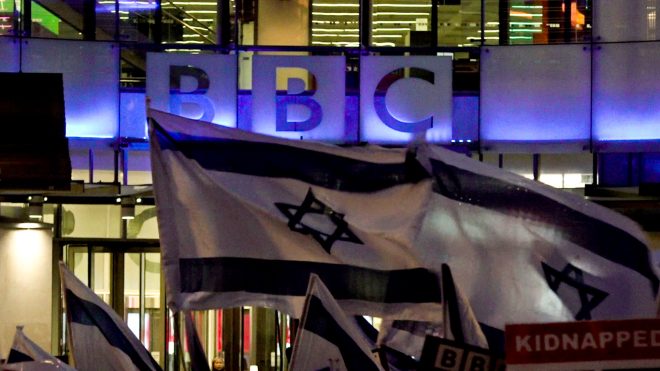
By Alan Macleod | MintPress News | January 3, 2025
A senior BBC editor at the center of an ongoing scandal into the network’s systematic pro-Israel bias is, in fact, a former member of a CIA propaganda outfit, MintPress News can reveal. Raffi Berg, an Englishman who heads the BBC’s Middle East desk, formerly worked for the U.S. State Department’s Foreign Broadcast Information Service, a unit that, by his own admission, was a CIA front group.
Berg is currently the subject of considerable scrutiny after thirteen BBC employees spoke out, claiming, among other things, that his “entire job is to water down everything that’s too critical of Israel” and that he holds “wild” amounts of power at the British state broadcaster, that there exists a culture of “extreme fear” at the BBC about publishing anything critical of Israel, and that Berg himself plays a key role in turning its coverage into “systematic Israeli propaganda.” The BBC has disputed these claims.
Our Man in London
Berg came to public attention in December after Drop Site News published an investigation based on interviews with 13 BBC staffers who present him as a domineering figure, systematically blocking coverage critical of Israel and manipulating stories to suit pro-Israel narratives.
The 9000-word report, written by popular journalist Owen Jones, is extensive and well-researched. However, one aspect of the story it almost completely avoids is Berg’s connections to the U.S. national security state, which MintPress News can now reveal.
According to his LinkedIn profile, Berg was an employee of the U.S. State Department’s Foreign Broadcast Information Service (FBIS) three years before joining the BBC. The FBIS is understood the world over to be a CIA front group known for gathering intelligence for the agency.
As the first two lines of its Wikipedia entry read:
The Foreign Broadcast Information Service (FBIS) was an open source intelligence component of the Central Intelligence Agency’s Directorate of Science and Technology. It monitored, translated, and disseminated within the U.S. government openly available news and information from media sources outside the United States.
In 2005, the FBIS was subsumed into the CIA’s new Open Source Enterprise.
Berg does not dispute that he was, in fact, a CIA man. In fact, according to a 2020 interview with The Jewish Telegraph, he was “absolutely thrilled” to be secretly working for the agency. Berg said, “One day, I was taken to one side and told, ‘you may or may not know that we are part of CIA, but don’t go telling people.’” He was unsurprised by this news, as the application process was extremely long and rigorous. “They went through my character and background with a fine tooth comb, asking if I had ever visited communist countries and, if I had, did I form any relationships while I was there,” he said.
Mossad Collaborator
The CIA, however, is not the only clandestine spy organization with which Berg has a long history of collaborating. He also has a rich professional relationship with Mossad, Israel’s premier intelligence agency.
In 2020, for instance, Berg published “Red Sea Spies: The True Story of Mossad’s Fake Diving Resort,” a book that tells the story of the Israeli operation to clandestinely smuggle Ethiopian Jews into Israel. That the 320-page account lionizes Israel and its spies is perhaps unsurprising, considering how much input Mossad had in its creation. Berg said that he wrote the book “in collaboration” with Mossad commander Dani Limor, whom he relied on extensively, as he, in his own words, knew “next to nothing” about the story and its background before writing it. Limor opened numerous doors and was able to secure “over 100 hours of interviews” with Israeli military and intelligence officials, including with the head of Mossad.
Limor and Berg became extremely close friends. In 2020, he posted a picture of himself with his arm around the ex-Mossad commander. The first page of “Red Sea Spies” is simply a glowing recommendation from Efraim Halevy, former director of Mossad, a group Berg describes as “the world’s greatest intelligence service.”
Berg has aggressively promoted his book and has, on multiple occasions, expressed his delight that Benjamin Netanyahu has shown interest in it. In August 2020, for example, he shared a picture of Netanyahu at his desk in front of a copy of his book. “First time I’ve been on a prime minister’s bookshelf” I know I’ve got one of Israel Prime Minister Netanyahu’s on mine – but wow!” he exclaimed, tagging Mossad, the Israeli Likud Party, and the Israeli Embassies in the United Kingdom and United States.
The following year, he messaged Netanyahu’s son, Yair, stating, “Your dad has my book, ‘Red Sea Spies: The True Story of the Mossad’s Fake Diving Resort,’ and sent me a lovely letter about it.” That letter can be seen on the wall of Berg’s office in his many public posts and videos, framed and placed beside pictures of him meeting a Mossad commander and meeting Mark Regev, the former spokesperson for the Israeli Prime Minister’s Office.
That a BBC Middle East editor would not only frame these images and documents and put them pride of place in his office but also choose to display them while talking publicly and in an official role is telling. The BBC sells itself as an impartial distributor of news on the Middle East and beyond. And yet, Berg, who, by most accounts, calls the shots when it comes to the network’s Israel-Palestine coverage, clearly believes that this is acceptable and unremarkable behavior.
If the opposite were true – that even a low-level BBC employee was openly sharing pictures of themselves embracing Hamas commander Yahya Sinwar or displaying a glowing letter from Iran’s Ayatollah Khamenei – it is clear that there would be serious repercussions. The BBC suspended six of its reporters for simply liking pro-Palestine tweets. And yet, in Berg’s case, his overt pro-Israel advocacy has been treated as entirely unproblematic.
Relentlessly Pro-Israel
Of course, it is entirely possible that a pro-Israel stance would help one climb the ladder at the BBC, an organization long known to display a strong bias in favor of the country and its interests.
Born and raised in England, Berg always took a keen interest in Israel, moving there to study Jewish and Israel Studies at the Hebrew University of Jerusalem. He worked at the FBIS between 1997 and 1998 and joined the BBC in 2001, starting as a world news writer and producer.
One of his first BBC articles profiled the Israeli military and its recruits, presenting the IDF as brave protectors of their homeland and as a “source of national pride” and framed women serving as a win for sexual equality.
In 2009, at the height of Operation Cast Lead – the Israeli attack on Gaza that killed more than 1,000 people – Berg attended a pro-Israel demonstration in central London. Moreover, he even chastised the Israeli newspaper, The Jerusalem Post, for noting that only 5,000 people showed up to the event. In Berg’s opinion, there were three times as many in attendance. The BBC would later change its guidelines to prevent its newsroom employees from attending controversial demonstrations.
During Operation Cast Lead, the Israeli military was found to have indiscriminately targeted and killed civilians, used Palestinians as human shields, and used banned chemical weapons, such as white phosphorous, on civilian areas.
Three years later, in November 2012, Israel launched Operation Pillar of Defense, a high-profile, bloody assault on Gaza that made worldwide headlines. As Israel bombarded the densely-populated civilian area, Berg went on his own internal offensive, telling his BBC colleagues to word their stories in a way that does not blame or “put undue emphasis” on Israel. Instead, leaked emails show, he encouraged journalists to present the attack as an operation “aimed at ending rocket fire from Gaza,” thereby framing Hamas as the aggressor.
Another Berg email instructed his coworkers to “Please remember, Israel doesn’t maintain a blockade around Gaza. Egypt controls the southern border” – a highly contestable opinion not shared by the United Nations, which declared that Israel was the occupying power besieging the strip.
Extraordinary Revelations
Shortly after Operation Pillar of Defense, Berg was promoted, becoming head of the BBC’s Middle East desk. This position gives him enormous influence in shaping the platform’s presentation of Israel’s current war on Gaza. In this role, he has helped turn the network into “systematic Israeli propaganda,” according to one journalist quoted by Jones in his Drop Site investigation. “This guy’s entire job is to water down everything that’s too critical of Israel,” said another.
The BBC staff Jones talked to painted a picture of a pro-Israel zealot systematically suppressing any content or information that would paint Tel Aviv in a negative light. A micromanager, numerous journalists reportedly attempted to notify management of their issues with Berg, but their complaints fell on deaf ears. “Almost every correspondent you know has an issue with him,” one staffer stated. “He has been named in multiple meetings, but [management] just ignore it.”
“How much power he has is wild,” another journalist told Jones, who explained that essentially every story or segment featuring Israel would have to be signed off by Berg first, even leaving other editors in “extreme fear” of commissioning anything without his approval.
Berg is alleged to have made extensive pre-publication edits to others’ stories, changing the framing of news events to shield Israel from blame. One example of this is the whitewashing of the Israeli attack on the funeral of Palestinian-American journalist Shireen Abu Akleh. In May 2022, Israeli snipers shot the Al Jazeera anchor in the head and proceeded to lie about their culpability. Israeli forces subsequently attacked the public funeral, beating mourners and firing tear gas. The BBC’s text, allegedly penned by Berg himself, read:
Violence broke out at the funeral in East Jerusalem of reporter Shireen Abu Aqla, killed during an Israeli military operation in the occupied West Bank.
Her coffin was jostled as Israeli police and Palestinians clashed as it left a hospital in East Jerusalem.
Thus, Abu Akleh’s murder by Israeli forces was downgraded to a mere death during an operation (with no perpetrator mentioned), while a police attack on a funeral procession was presented as a “clash” between rival factions, presumably of roughly equal responsibility.
A more recent example of this, Jones claims, comes from a July story about IDF soldiers setting an attack dog on Muhammed Bhar, a severely disabled Gazan man, and letting him bleed to death. Under Berg’s supervision, the original headline ran: “The Lonely Death of Gaza Man with Down’s Syndrome.” Only after a gigantic worldwide outcry did the BBC change its framing to note anything about how Bhar met his end. “There has to be a moral line drawn in the sand. And if this story isn’t it, then what?” one BBC journalist said, commenting on the affair.
Since the investigation was published, Berg has remained silent, although he has hired defamation lawyer Mark Lewis, the former director of U.K. Lawyers for Israel.
The BBC, meanwhile, has offered unequivocal support for him and his work, rejected any suggestion of a lenient stance towards Israel, and alleges that the Drop Site article “fundamentally misdescribe[s] Berg’s power, influence, and how the network works.
A Worldwide Network
Whatever the veracity of the Drop Site allegations, the undisputed fact that a former U.S. State Department and CIA operative is calling the shots at the BBC for its Middle East coverage is undoubtedly of public interest.
It also bears a striking resemblance to the accusations of journalist Tareq Haddad. In 2019, Haddad resigned in frustration from Newsweek, claiming that the outlet systematically stymied him from covering important Middle East news stories that did not align with Western objectives. Perhaps most strikingly, though, he claimed that Newsweek employed a senior editor whose only job was seemingly to vet and suppress “controversial” stories, in the same vein as Berg. This editor also had a similar background with state power. As Haddad concluded:
The U.S. government, in an ugly alliance with those the [sic] profit the most from war, has its tentacles in every part of the media — imposters, with ties to the U.S. State Department, sit in newsrooms all over the world. Editors, with no apparent connections to the member’s club, have done nothing to resist. Together, they filter out what can or cannot be reported. Inconvenient stories are completely blocked.”
When contacted by MintPress News for comment, Haddad said he found the BBC, State Department and CIA links to be “staggering,” adding:
When I resigned from Newsweek, I did so because all reporting on foreign affairs went through a particular editor, who, in my case, turned out to be connected to the European Council on Foreign Relations. That prevented me from writing truthfully when it came to a number of sensitive issues.”
CIA-Affiliated Media
The implications of former U.S. national security state operatives dictating global media output are profound. This is not least because the State Department and CIA are among the world’s most notoriously dishonest and perfidious institutions, regularly injecting lies and false information into public discourse to further Washington’s ambitions. As Mike Pompeo, former Director of the CIA and then-Secretary of State, said in 2019:
When I was a cadet, what’s the cadet motto at West Point? You will not lie, cheat, or steal or tolerate those who do. I was the CIA director. We lied, we cheated, we stole. We had entire training courses [on] it!”
Furthermore, both organizations have a long history of organizing invasions of and coups against foreign countries, drugs and weapons smuggling and operating a worldwide network of “black sites,” where thousands are tortured.
The CIA, in particular, has an extensive record of penetrating media outlets. As far back as the 1970s, the Church Committee unearthed the existence of Operation Mockingbird, a secret project to infiltrate newsrooms across America with secret agents masquerading as journalists. Investigative reporter Carl Bernstein’s work found that the agency had cultivated a network of over 400 individuals it considered assets, including the owner of The New York Times.
John Stockwell, former head of a CIA task force, explained on camera how his organization infiltrated media departments across the planet, establishing fake outlets and news agencies that worked to control global public opinion and spread false information demonizing Washington’s enemies. “I had propagandists all over the world,” he admitted, adding:
We pumped dozens of stories about Cuban atrocities, Cuban rapists [to the media]… We ran [faked] photographs that made almost every newspaper in the country… We didn’t know of one single atrocity committed by the Cubans. It was pure, raw, false propaganda to create an illusion of communists eating babies for breakfast.”
This process continues to this day, as the CIA continues to promote dubious stories about so-called “Havana Syndrome” and Russia putting bounties on American soldiers in Afghanistan.
Cable networks routinely employ a wide range of former State Department or CIA officials as personalities and trusted experts. Former CIA director John Brennan is employed by NBC News and MSNBC, while his predecessor, Michael Hayden, can be seen on CNN. Top anchors such as Anderson Cooper and Tucker Carlson have their own connections to the agency.
Meanwhile, in 2015, Dawn Scalici, a 33-year CIA veteran, left her job as national intelligence manager for the Western hemisphere at the Director of National Intelligence to become the global business director of the international news conglomerate Reuters. That this was a political hire was barely hidden; in Scalici’s official announcement, the company declared her primary responsibility would be “advancing Thomson Reuters’ ability to meet the disparate needs of the U.S. government.”
Social media, too, is full of former U.S. national security state agents. A previous MintPress News investigation uncovered a network of dozens of ex-CIA officials working at Google. Most of these individuals work in highly politically sensitive roles such as security and, trust and safety, effectively giving them control over the algorithms that decide what content gets seen and what is suppressed worldwide. Some were even directly recruited from the CIA, leaving the agency to join the Silicon Valley giant.
Competing with Google for the crown of employing most former CIA agents is Facebook. The company’s senior product policy manager for misinformation, Aaron Berman, the man most responsible for deciding what the world sees (and does not see) in its news feeds, was directly parachuted in from Langley, Virginia. Berman was one of the agency’s highest-ranking officers, writing the president’s daily brief for both Obama and Trump until July 2019, when he made the switch from big government to big tech.
And since it became a target of Washington’s ire, TikTok has been on a hiring spree, recruiting large numbers of U.S. State Department officials to run its internal affairs. The company’s head of data public policy for Europe, for example, is Jade Nester, who was previously the State Department’s director of internet public policy. These connections were explored in a MintPress investigation entitled, “TikTok: Chinese “Trojan Horse” Is Run by State Department Officials.”
Cheering on a Genocide
In recent years, Washington has shown considerable interest in influencing the British press. The National Endowment for Democracy—another unofficial branch of the CIA—has spent millions of dollars funding a wide range of media outlets in the U.K. The NED’s sister organization, USAID, is the third-largest funder of BBC Media Action, the company’s charitable arm, donating over $2 million annually.
The BBC itself has faced repeated accusations of pro-Israel bias, not only from the public but also internally. Their headquarters are a common start or end point for numerous pro-Palestine marches, including an upcoming national rally in London on January 18. In November, over 100 BBC staff signed an open letter to the corporation’s director-general, Tim Davie and Chief Executive Officer Deborah Turness. The letter admonishes the company for consistently providing “favorable coverage to Israel,” failing to uphold even “basic journalistic tenet[s]” when covering its war on Gaza, and aiding in “systematically dehumanizing Palestinians.”
Haddad agreed that much of the network’s coverage had been subpar, telling MintPress :
The BBC, of course, like many institutions, has fallen way short of their coverage in documenting what Israel has done in a densely populated strip of land we know as Gaza over the last 14 months and prior.”
Partially as a result, public confidence in the broadcaster has fallen to an all-time low. By July 2023, just 38% of Britons said they trusted the BBC to tell the truth – down from 81% 20 years previously. Since October 7, its biases have been put under even more scrutiny.
Israel’s actions, Haddad said, are “growing harder to ignore.” Officially, the death toll from the Israeli attack on Gaza stands at almost 50,000, although credible estimates put the likely figure at many times that. International organizations, such as the United Nations and Amnesty International, have described the onslaught as “genocidal.”
Israel could not sustain its attack without vital military, logistical, economic, and political support from Western powers. It is, therefore, vital for Washington, London and the E.U. that public opinion does not turn too far in favor of Palestine to the point where widespread public rebellion forces a change in policy. The BBC, with its deeply misleading and one-sided coverage of the events, therefore, plays an important role in the perpetuation of crimes against humanity. That this is being driven from the top down by overtly pro-Israel editors, including one with a history in both the State Department and CIA, is perhaps unsurprising but no less shocking, nonetheless.
To be clear, this article does not claim that Berg or anyone at the BBC is a plant. Nor is it accusing him of any specific wrongdoing beyond working at a distinctly biased network. What it is stating is that it is telling that the person in charge of its Middle East reporting has framed pictures and letters of Mossad commanders and high Israeli officials on the wall, as if they are rock stars and he is a teenage fan. That someone such as this rose the ranks is a clear indication of the kind of culture that exists at the BBC – one that has systematically demonized Palestinians and manufactured consent for genocide.
Glenn Diesen | May 16, 2026
Prof. Seyed Mohammad Marandi is a former advisor to Iran’s nuclear negotiation team. Prof. Marandi argues that the U.S. is preparing another attack on Iran after Trump’s failed meeting with Xi in Beijing. Iran has prepared an overwhelming retaliation.
Follow Prof. Glenn Diesen:
Support the research by Prof. Glenn Diesen:
Daniel Davis / Deep Dive – May 16, 2026
Press TV – May 16, 2026
Leaked documents have revealed the US tech firm Cisco Systems’ deep relationship with the Israeli regime in its continuous wars in West Asia, which the United States backs.
The papers leaked by Drop Site News on Friday reveal that Cisco has a deep illegal relationship with the Israeli regime and supported Tel Aviv forces in their atrocities against the people of Palestine, and beyond.
The Silicon Valley-based company, which produces hardware, software, telecommunications equipment, and other high-technology services used in networking, cybersecurity, and Artificial Intelligence (AI) systems, provided support and infrastructure to Israel in its genocidal war against Palestinians in the Gaza Strip, and also ran unlawful operations in illegal settlements in the occupied West Bank.
The leaked papers provided to Drop Site by whistleblowers show Cisco’s deep and growing collaboration with the Israeli military and intelligence communities for its genocide in Gaza and continued regional wars.
The San Jose-based networking giant, with a market capitalization in excess of $270 billion and annual revenue of $56.7 billion in 2025, manufactures the routers, switches, firewalls, and communications platforms that run the internet’s infrastructure, as well as many of its worldwide corporate, government, and military networks.
Cisco’s aggressive pursuit of contracts with the Israeli regime has led to the conclusion that the networking giant condones profiting from genocide.
Its collaborations with the Israeli regime have been documented in public news reports and new business announcements in the country. But the internal documents, including presentations, purchase and revenue records, and schedules, shed light on the rapidly expanding list of services that Cisco has been providing directly to the Israeli regime forces over the past several years, particularly since October 7, 2023, when Tel Aviv launched war on Gaza.
However, an update report by Cisco employees reveals that, as early as 2021, Israeli sources estimated that the US tech company was earning $40-50 million a year from computing contracts with the regime’s military forces.
The report highlights an agreement to provide a new list of itemized services to the Israeli forces, including enterprise and data center networking, cybersecurity, and classified network support.
On March 25, 2025, Cisco management instructed employees to focus on ways “to drive Cisco business, and one example specifically would be the ongoing conflict in [West Asia].” The executive added that, “We have made the decision that this topic cannot be discussed, cannot be debated in company or organization-wide meetings.”

or go to
Aletho News Archives – Video-Images
By Donald Neff | Washington Report On Middle East Affairs | January 1996
On January 4, 1948, Jewish terrorists drove a truck loaded with explosives into the center of the all Arab city of Jaffa and detonated it, killing 26 and wounding around 100 Palestinian men, women and children.[1] The attack was the work of the Irgun Zvai Leumi – the “National Military Organization,” also known by the Hebrew letters Etzel – the largest Jewish terrorist group in Palestine. The Irgun was headed by Revisionist Zionist Menachem Begin and had been killing and maiming Arabs, Britons and even Jews for the previous ten years in its efforts to establish a Jewish state.
This terror campaign meant that at the core of Revisionist Zionism there existed a philosophical embrace of violence. … continue
 Aletho News If Americans Knew No Tricks Zone
