Palestinian families forced to demolish homes for Israeli theme park
Al Mayadeen | May 16, 2026
Residents of the al-Bustan neighbourhood in Silwan, located in occupied al-Quds just below the walls of the Old City, are being forced to demolish their own homes to make way for “Israel’s” expansionist project in the area, The Guardian reports.
Palestinians have been forced to demolish their own homes for decades as a form of “collective punishment” in an effort for the Israeli entity to continue its settlement expansion.
The coercive mechanism that “Israel” is employing in Silwan is not only meant to dehumanise the families, but is laced with financial threats as well. The Guardian reports that residents are being told that if municipal workers demolish the homes, the cost would reach approximately 280,000 shekels.
One resident, Jalal al-Tawil, described to The Guardian the feeling of watching a hired tractor dismantle the home built by his father, which itself stood on the foundations of his grandparents’ house. “This is something really hard. This is something bitter,” he said, noting that it meant erasing multiple generations of family history in a single act.
He also left the remains of a 35-year-old grapevine until the end, recalling that it once produced fruit for the entire neighbourhood. The vine, like the house, was ultimately destroyed as part of the demolition.
The Guardian reports that residents described the situation as both physically destructive and psychologically draining, as entire family histories are reduced to rubble in front of them.
‘Kings Garden’ as tool of occupation
The demolitions are taking place in preparation for the planned “King’s Garden” project, a biblical-themed development intended to be built on cleared land in al-Bustan.
The project is promoted as a heritage and archaeological initiative, which Israelis claim links to the historical narrative of King Solomon. It is also presented as part of a wider archaeological-tourism network centered on the nearby “City of David” site.
However, the project is not merely cultural or recreational as the Israeli occupation claims, but forms part of a broader strategy of spatial reconfiguration in occupied al-Quds, where archaeological interpretation is used to reshape the urban landscape and occupy land inhabited by Palestinian families.
That said, the transformation of residential neighbourhoods into curated heritage zones is a mechanism for displacing existing communities while embedding a singular historical narrative over a multi-layered living city.
Systematic targeting of al-Bustan homes
More than 57 homes in al-Bustan have been demolished over the past two years, with at least eight additional structures designated for demolition in the coming weeks.
Municipal Israeli bodies allege that the homes were built without permits and that the area was never zoned for residential use. But residents rejected this false claim, arguing that many homes were built decades ago, including structures that predate the occupation of Palestine.
They also point to a broader pattern of unequal planning enforcement in occupied al-Quds, where Palestinian construction is frequently targeted while other forms of unauthorized building elsewhere by settlers in the city are treated differently.
Life under demolition orders and economic strain
The demolition campaign is also increasing severe financial pressure on residents.
Fakhri Abu Diab, the al-Bustan community leader, had his home demolished in 2024. He is still paying a municipal fine of approximately 43,000 shekels, which is being repaid in monthly instalments of around 4,000 shekels.
Abu Diab also reported being charged an additional 9,000 shekels for costs that are associated with police operations during the demolition process.
Following the destruction of his home, he and his wife now live in a portable cabin placed amid the rubble of the original structure. Only a portion of the former kitchen remains standing.
Contesting narrative of ‘public development’
Israeli authorities, in attempts to hide the brutality of their project, told the media that the “Kings Garden” project is intended to serve all city residents and address a shortage of public green space. However, the reality is that it serves as another expansionist project of the Israeli regime to push Palestinians out of their ancestral homes.
Residents and community representatives of Silwan dispute the claims made by the Israelis, stating that they themselves proposed a comprehensive master plan for the neighbourhood that included green space and regulated development, but that it was rejected at the political level.
They argue that enforcement is inconsistent, pointing to the expansion of unauthorised settlement structures in other parts of occupied al-Quds and the West Bank that do not face the same level of demolition enforcement.
Al-Qassam leader Ezzeddin al-Haddad martyred in Israeli attack on Gaza

Al Mayadeen | May 16, 2026
The al-Qassam Brigades, the military wing of Hamas, announced the martyrdom of its Chief of Staff, Ezzeddin al-Haddad “Abu Suhaib,” stating that he was killed alongside his wife, daughter, and several Palestinians in an Israeli assassination in central Gaza City.
In its statement, al-Qassam slammed the killing of its senior commander as a “cowardly assassination” carried out by the enemy in a blatant violation of the ceasefire agreement, adding that targeting him would only reinforce the Resistance’s determination to continue its path of struggle.
Al-Qassam stated that his martyrdom would further strengthen the resolve of the steadfast Palestinian people to continue confronting the occupation, reaffirming their commitment to the path of resistance despite continued assassinations and ongoing Israeli escalation in the Gaza Strip.
Sources within the Palestinian Resistance had confirmed to Al Mayadeen that al-Haddad was martyred in an Israeli attack on the Gaza Strip earlier today.
The Israeli occupation forces had carried out a massacre in the al-Rimal neighborhood in Gaza City, killing eight Palestinians and wounding over 40 others by targeting a residential building. Local sources reported that the attack struck a populated residential area, causing significant destruction and casualties among civilians.
Who was Ezzeddin al-Haddad?
Martyr Ezzeddin al-Haddad was born in Gaza in 1970 and joined Hamas when the movement was established in the 1980s. He was nicknamed the “Ghost of the Gaza Strip” due to his operational secrecy and his privacy in Gaza.
He succeeded Martyr Mohammad al-Sinwar following his assassination in 2025, and had been involved, during Operation al-Aqsa Flood, in ensuring the well-being of Israeli captives.
Several released Israeli captives disclosed that they had met al-Haddad during their time in Gaza, and revealed that he insisted on speaking to them in Hebrew and asked them if they had any needs. One captive said that al-Haddad instructed Resistance fighters to bring the captive a book he had lost, according to Israeli media.
“Israel” attempted to assassinate al-Haddad six times and had placed a bounty worth $750,000 in return for information about his whereabouts.
He was martyred on May 15, 2026, in al-Rimal, alongside his wife and daughter. Thousands of Palestinians flooded the streets of Gaza during the funeral.
Ceaseless attacks on Gaza
The Israeli aggression on the Gaza Strip continues unabated, with strikes targeting the Halawa refugee camp in Jabalia earlier today, despite the so-called ceasefire achieved almost a year ago.
The Health Ministry and hospitals across the enclave reported 13 martyrs over the past 24 hours, including one Palestinian who succumbed to injuries sustained in an Israeli attack, alongside 57 injuries.
The death toll in Gaza has risen to 72,757 killed and 172,645 injured since October 7, 2023.
US’s war of choice on Iran imposed avoidable costs on Americans: FM
Press TV – May 16, 2026
Foreign Minister Abbas Araghchi says the US’s unprovoked aggression towards Iran has burdened ordinary Americans with avoidable economic costs.
“Americans are told that they must absorb rocketing costs of war of choice on Iran,” the top diplomat wrote in a post on X on Saturday.
“Put aside gas price hike and stock market bubble. Real pain begins when US debt and mortgage rates start to jump. Auto loan delinquencies are already at 30+-year high,” he added. “This was all avoidable.”
Together with the Israeli regime, the United States waged its latest bout of unlawful attacks on the Islamic Republic between February 28 and April 7.
The aggression prompted decisive and uncompromising reprisal featuring devastating blows to American and Israeli targets across the region. In addition to causing extensive material damage to the targeted sites, the Islamic Republic shut down the strategic Strait of Hormuz to enemies and their allies, therefore, sending shockwaves throughout global energy markets.
Including reconstruction and replacement costs, the war is so far estimated to have run Washington a cost likely ranging between $40 billion and $50 billion.
Economists, meanwhile, project the overall cost of continued restrictions imposed on the Strait of Hormuz to end up astronomically higher.
Professor Linda Bilmes, a public policy expert at Harvard Kennedy School, recently forecast that the war on Iran could ultimately cost American taxpayers $1 trillion.
On Friday, Mohammad-Baqer Qalibaf, Iran’s Majlis (Parliament) speaker, warned that the United States’ efforts at sustaining military escalation near the strait could trigger a fresh global financial crisis at a time when Washington’s national debt already stands at a whopping $39 trillion.
AIPAC Favorite Ed Gallrein Wants to Bring Back the Draft
By Kurt Nimmo | Another Day in the Empire | May 15, 2026
Ed Gallrein is running against Thomas Massie in Kentucky. Trump hates Massie because he opposes the Iran boondoggle war. Massie has also demanded the release of the Epstein files. Ed has received a whopping $11,824,741 from the Israel lobby. That’s on the high end of donations, so you get an idea how important it is to defeat Massie and gain another voice for Israel in Congress.
There is one issue at the top of Gallrein’s list. Ed mentioned it during an interview with USA Cares, a veterans organization in Kentucky. The reimplementation of a military draft. Ed says we need it for “national security.” Considering the hefty sum donated by the lobby, it is natural to conclude much of that “national security” concerns Israel.
It is telling Gallrein complains about the slowness of the current system. The Selective Service system is inadequate for the sort of insta-wars the War Department is in the process of rolling out as of late. If you want to occupy a country the size of Iran, you need more than a million soldiers. For an occupation of Cuba, far less. Ed wants to take us back to days of the Vietnam War. Some of us remember how that turned out. Millions protested in the street and Lyndon Johnson refused to run for re-election. Nixon ran the war into the ground.
It will likely take a similar tactic to that used by the Ukrainian military when it hunts down reluctant draftees. Maybe that would become a task for ICE. Maybe there would be violent anti-draft riots like there were in northern cities during the War Between the States.
If Gallrein wins—and it is a close race—Kentuckians can look forward to having another bought-and-paid-for representative, this one ready to draft American kids and send them to help Zionist Israel become the undisputed hegemon of West Asia and realize its Greater Israel project.
Mainstream US media complicit in selling Gaza genocide, sweeping new analysis finds
MEMO | May 15, 2026
US media is systematically biased in favour of Israel, an analysis by The Intercept has uncovered. Investigation of more than 12,000 articles and 5,000 TV segments found mainstream US coverage was “one-sided, racist and dehumanising”, helping Israel justify its genocide in Gaza.
The investigation, published this week and drawn from research for a forthcoming book, examined more than 12,000 articles from the New York Times, the Washington Post, CNN.com, Politico, Axios, USA Today and The Associated Press, alongside 5,000 television segments aired on CNN and MSNBC.
The focus is on centre-left outlets influential with the Biden administration during the first year of Israel’s assault on the besieged Gaza Strip.
The analysis identifies seven recurring patterns that, taken together, document the US media’s role in selling Israel’s narrative to the American public as the death toll in Gaza mounted into the tens of thousands.
Chief among the findings is the near-exclusive application of the phrase “right to defend itself” to Israel. On CNN and MSNBC, anchors, reporters and guests invoked the right to self-defence for Israel 94 times more often than for Palestinians, the analysis found. In print, Israel was afforded the same right more than 100 times as frequently.
The report also documents how the term “human shields” — a designation rejected by leading human rights organisations when applied to guerrilla forces operating near civilians — was used hundreds of times to describe Palestinian fighters, implicitly rationalising the killing of civilians in Israeli strikes. By contrast, the surveyed television coverage contained no references at all to the Israeli military’s own documented use of human shields, despite cases that meet the legal definition.
Emotive language was applied with similar partiality. Over a 100-day period in which roughly 24,000 Palestinians were killed, words such as “massacre”, “barbaric”, “savage” and “slaughter”, when used in outlets’ own editorial voice, were deployed “entirely in favour of Israel”, the analysis states.
Following Israel’s bombing of al-Ahli Arab hospital in Gaza City on 17 October 2023, US outlets rapidly adopted the qualifiers “Hamas-run” and “Hamas-controlled” when citing Palestinian casualty figures, a framing the report says functioned to discredit the death toll. Neither CNN nor MSNBC used the phrase in the first ten days of the assault; its use then climbed sharply, even as the US State Department, the World Health Organization and Human Rights Watch continued to treat figures from the Gaza Health Ministry as reliable.
The analysis further finds that victims likely to elicit public sympathy — journalists and children — received markedly less coverage during the first 100 days of Israel’s assault on Gaza than their counterparts in Ukraine had received in the equivalent early phase of Russia’s war.
Coverage of rising hate crimes in the same period focused almost entirely on anti-Semitism, with little attention paid to documented Islamophobia or to the impact of the killing in Gaza on Palestinian, Arab and Muslim communities in the US.
Perhaps the starkest example, the report says, is the contrast between the New York Times’ treatment of the resignation of Harvard University’s former president Claudine Gay and its coverage of the killing of five-year-old Hind Rajab, who was left to die in a vehicle alongside her family after coming under Israeli fire in Gaza.
‘Death to Arabs’: Settler mobs storm Jerusalem’s Muslim, Christian quarters for ‘Flag March’
The Cradle | May 14, 2026
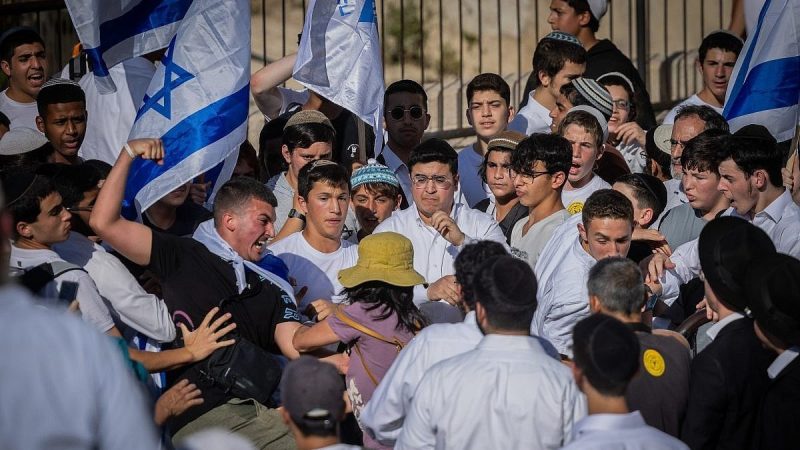
Tens of thousands of Jewish settlers descended on occupied Jerusalem on 14 May to celebrate the so-called ‘Flag March,’ beating Palestinian residents in the Muslim Quarter of the city, damaging storefronts, and shouting anti-Arab slogans.
The event, also known as the Flag Dance, commemorates the Israeli conquest of East Jerusalem during the Six-Day War in 1967.
Even before the parade began, Zionist youths pushed and cursed Palestinian residents and activists from “Standing Together,” an Israeli-Palestinian group established to protect Palestinians during the parade.
“When we put our bodies on the line, it oftentimes reduces the violence because settlers are less willing to attack when there are Jews there or when we document what’s going on,” stated Ori Shaham, the group’s international spokesperson.
The parade has long been marked by violence, extreme racism, and hate songs directed against the Palestinian residents of the Old City.
On Wednesday, the Knesset’s Aliyah, Absorption, and Diaspora Committee held a discussion on the violence directed against Christians during the annual parade.
The committee’s chairman, MK Gilad Kariv, stated that “there is nothing more ugly and offensive to the status of Jerusalem than the ugly behavior on the sidelines of the Flag Parade.”
“Every year we know what will happen … Muslim and Christian residents will close their shops, close their homes and schools, and lock themselves in their homes so as not to be exposed to violence? Is this the way of Judaism and the Torah of Israel?”
Last month, Haaretz reported that the Authority for Jewish National Identity in the Prime Minister’s Office provided nearly $200,000 in funding to organize the parade.
The remainder of the $400,000 budget was provided by the Foundation for the Renewal of Communities in Israel, an umbrella organization for several Torah groups.
National Security Minister Itamar Ben-Gvir used the Flag Day march to make a provocative raid on the Temple Mount, home to the Al-Aqsa Mosque, the third-holiest site in Islam.
Ben Gvir declared the Temple Mount to be “in our hands,” claiming Israel had “restored sovereignty on the Temple Mount thanks to determination and deterrence.”
The Jerusalem Day parade is being held the day before Palestinians commemorate the Nakba (or Catastrophe) when pre-state Zionist militias killed some 13,000 Palestinians and violently expelled 750,000 from their homes and lands in 1948, enabling the creation of the State of Israel.
Israeli Military Medics Are Training On Dead Americans
AJ+ and Al Jazeera | May 11, 2026
A U.S. university is selling dead bodies that were donated for scientific research and education to the U.S. Navy. And some of those bodies are being used to train Israeli military surgical teams in Los Angeles – all without the donors’ consent.
AJ+’s Dena Takruri investigates what’s been happening at the two universities involved, the University of Southern California and the University of California, San Diego, in collaboration with the student journalists who broke the story.
France investigates possible Israeli company interference in local elections
MEMO | May 14, 2026
French authorities are investigating whether an obscure Israeli company called BlackCore played a role in a foreign interference campaign targeting the hard-left party La France Insoumise (France Unbowed – LFI) ahead of local elections held in March.
According to Reuters, citing two sources, French intelligence services are investigating who allegedly hired BlackCore to carry out a smear campaign against three party candidates through deceptive websites and social media accounts.
The campaign reportedly included false accusations of criminal behaviour and disparaging digital ads.
On its website, BlackCore describes itself as “an elite influence, cyber, and technology company built for the modern era of information warfare.”
According to French authorities and the candidates involved, the campaign targeted Marseille mayoral candidate Sebastien Delogu, Toulouse candidate François Piquemal and Roubaix candidate David Guiraud.
French newspaper Le Monde first revealed details of the operation in March, based on a report by the agency Viginum, which referred to a limited “foreign digital interference” scheme targeting a French political party and several of its candidates in Marseille, Toulouse and Roubaix.
Russia says disputes over Iran, Greenland and Canada distract from Palestine
MEMO | May 13, 2026
Russian Foreign Minister Sergey Lavrov accused the US of trying to distract global attention from Palestine, Anadolu reports.
Commenting on the situation in the Middle East in an interview with RT India TV channel, Lavrov said ongoing US-provoked disputes involving Iran, Venezuela, Cuba, Greenland and Canada were distracting international attention from the Israeli-Palestinian conflict.
“All of the efforts that are being taken right now on Venezuela, Iran, Cuba, Greenland, and now Canada … all of these issues are moving us away from settling the most protracted, the most negative crisis in the world – that is, the crisis around Palestine,” he said.
The minister criticized American proposals regarding the future of the Gaza Strip, saying they did not address the establishment of a Palestinian state.
“I have no doubt that when plans to stir up aggression against Iran were being hatched, one of the goals was to prevent the normalization of relations between Iran and the Arab states,” he said.
He added: “Now, everything is being done to ensure that reconciliation never happens … and to pull its other Gulf neighbors into structures that, first, will not focus on resolving the Palestinian issue, and second, will force them to betray the Palestinian cause as the price for normalizing relations with Israel.”
Lavrov argued that failure to create such a state would prolong instability and extremism in the region for decades.
“We are returning to a period when everything is decided by force and international law is ignored,” Lavrov said.
Hidden deep in an NPR story about a man who threatened to kill Jews at Cornell… He admits he did it to benefit Israel
The North Star with Shaun King | May 9, 2026
In the Fall of 2023, local, national, and even international news reported that a New York man made a series of threats against Jewish students and staff at Cornell University. A year later he was actually convicted and sentenced to nearly two years in prison for it.
It happened. Students there were actually afraid. I don’t want to pretend that they weren’t.
But there is one detail in this story that pretty much changes EVERYTHING.
According to NPR’s own reporting, the lawyer for Patrick Dai — the former Cornell student sentenced to 21 months in prison for making violent threats against Jewish students — said Dai made those threats as a “misguided attempt” to generate support for Israel and that he was a devout supporter of Israel. It was a false flag attack.
Patrick Dai, a former Cornell student from Pittsford, New York, pleaded guilty to one felony count of posting threats to kill or injure another person using interstate communications. According to the Department of Justice, Dai admitted that on October 28th and 29th, 2023, he posted anonymous threats to the Cornell section of an online discussion forum, including threats to shoot up 104 West, a Cornell dining hall that serves kosher meals and is located next to the Cornell Jewish Center.
The posts were vile.
They were criminal.
They terrorized Jewish students.
And Dai deserved serious consequences.
But that is not the whole story.
The part that should have been in the headline — or at least in the first few paragraphs — is that Dai’s own attorney said he was not acting out of hatred for Israel, but out of a desire to defend it. Except I had to literally scroll down TWELVE PARAGRAPHS to learn that the student was a Zionist who did it all to make people feel more sympathy for Israel.
NPR reported that Dai’s lawyer, Lisa Peebles, described his actions in a court filing as a “misguided attempt to highlight Hamas’ genocidal beliefs and garner support for Israel.” She said he believed the posts would create “blowback” against what he perceived as anti-Israel media coverage and pro-Hamas sentiment on campus.
Read that again.
According to his lawyer, he made threats against Jewish students to create sympathy for Israel.
That is not a small detail.
That is not a footnote.
That is the story.
Because if that defense claim is true, even partly true, then this was not just a case of antisemitic threats in the simple way NPR framed it. It was a false-flag-style propaganda act: a man allegedly posing as the very hatred he claimed to oppose in order to manipulate public opinion.
And NPR buried that fact deep inside the story.
That matters because media framing shapes public consciousness. Most people never read to paragraph 10 or 12 or 15. They read the headline. They skim the first few paragraphs. They absorb the frame. And the frame here was simple: a former Cornell student made antisemitic threats during a period of rising campus tension after October 7th.
But the buried fact makes the story more complicated and more politically explosive.
The threats were real. The fear was real. The crime was real. But according to the defense, the motive was not what the public would naturally assume.
That is the tension NPR should have centered.
To be fair, prosecutors rejected Dai’s explanation. NPR reported that federal prosecutors described his claims as “self-serving” and said they were contradicted by the threats themselves and by his later apology. The court also found that his conduct qualified as a hate crime under federal sentencing guidelines because he targeted Jewish students and substantially disrupted Cornell’s educational function. The Justice Department said the threats “terrorized the Cornell campus community for days and shattered the community’s sense of safety.”
That must be included.
But including the prosecution’s view does not erase the media problem.
The public deserved to know, from the start, that the defendant’s lawyer said this was an attempt to manufacture sympathy for Israel. Arab News, citing AFP, stated it much more directly:
Peebles told the court Dai was “pro-Israel” and made posts “in the guise of an anti-Semite Hamas extremist.”
That phrase should stop everybody cold.
“In the guise.”
Meaning, according to the defense, he was pretending.
If a Muslim student had posted fake Islamophobic threats against Muslims and later claimed he did it to generate sympathy for Palestine, do we honestly believe NPR would have buried that detail deep in the story?
No.
It would have been the headline.
It would have been the lead.
It would have been the entire frame.
We would have heard about hoaxes, manipulation, propaganda, radical activism, and fake victimhood. Every cable news panel would ask what this says about pro-Palestinian movements. Every politician who wanted to criminalize Palestine solidarity would use it as evidence.
But when the alleged motive points in the other direction — toward manufacturing support for Israel — suddenly the detail is handled delicately, carefully, quietly.
That is the double standard.
And it is not harmless.
Since October 2023, American media has repeatedly helped create an atmosphere where Palestinian, Arab, Muslim, and anti-war students are treated as presumed threats. Their protests are scrutinized. Their chants are criminalized. Their grief is pathologized. Their politics are framed as danger before they are understood as dissent.
Meanwhile, this case involved a man who admitted to making horrific threats against Jewish students — and whose own lawyer said he did so to create backlash against anti-Israel sentiment.
That should have forced a deeper media conversation about how fear is manufactured, how propaganda works, and how quickly institutions accept narratives that benefit Israel.
Instead, the story was mostly folded back into the same familiar frame.
“Rising antisemitism.”
“Campus tensions.”
“Threats against Jewish students.”
Again, the threats were real. Jewish students were harmed. Nothing about Dai’s claimed motive changes the terror they experienced.
But motive matters.
Political context matters.
Media framing matters.
Because when a threat is allegedly staged to create sympathy for Israel, the public deserves to understand that clearly. Not as an afterthought. Not buried beneath official statements. Not softened into a detail most readers will miss.
The same media institutions that demand endless nuance when Israel bombs hospitals, schools, refugee camps, journalists, doctors, and children somehow lose their curiosity when a story might reveal pro-Israel manipulation.
That curiosity returns only when it can be aimed at Palestinians, Muslims, Arabs, immigrants, protesters, or anyone demanding an end to genocide.
This is why independent media matters.
Because the question here is not whether Dai should have been punished. He should have been.
The question is why one of the most important facts in the story was buried.
The question is why a case that may involve false-flag-style threats designed to “garner support for Israel” was still framed mainly as a straightforward example of antisemitic danger on campus.
The question is why American media is so much more comfortable telling stories that benefit Israel than interrogating stories that expose how support for Israel is manufactured.
That is the real story.
And NPR had it.
They just buried the lead.
Love and appreciate each of you.
Your friend and brother,
Shaun
In letter to UN, Yemen calls for end to blockade, sabotage by US, allies
Press TV – May 12, 2026
Yemen has written to the United Nations, calling for an end to over 10 years of blockade of the country and urging cessation of aggressive measures targeting the nation by the US and its allies.
Deputy Foreign Minister Abdulwahid Abu Ras denounced continuation of the “unjust blockade” in a letter addressed to the UN secretary general and the world body’s Security Council, Yemen’s official Saba news agency reported on Monday.
Continuation of the blockade, he added, “does not serve international peace and security.”
Saudi Arabia and its Arab allies launched the blockade as part of a full-scale war on March 26, 2015, with military, political, and logistical support from the United States and other Western states.
The war went on to claim the lives of tens of thousands of Yemenis, while consistently falling short of its main objective of restoring power to Yemen’s former Riyadh-friendly government.
The government had fled the country amid a power struggle, prompting Yemen’s popular resistance Ansarullah movement to start running state affairs.
Following a fragile UN-brokered ceasefire that was clinched in 2022, the United States, the United Kingdom, and the Israeli regime waged many rounds of wholesale aggression against Yemen.
The attacks would seek to cripple Sana’a’s capability to stage solidarity strikes against Israeli targets in response to Tel Aviv’s war of genocide on the Gaza Strip.
According to the Yemeni official, “The continued hostile activities of the United States and its proxies will inflict greater damage on the region, and their consequences will be catastrophic.”
“The state of ‘neither war nor peace’ is no longer acceptable under any circumstances.”
Featured Video
Trita Parsi: Israel Set a Trap for Total War in the Region
or go to
Aletho News Archives – Video-Images
From the Archive
Zionism’s Violent Legacy
By Donald Neff | Washington Report On Middle East Affairs | January 1996
On January 4, 1948, Jewish terrorists drove a truck loaded with explosives into the center of the all Arab city of Jaffa and detonated it, killing 26 and wounding around 100 Palestinian men, women and children.[1] The attack was the work of the Irgun Zvai Leumi – the “National Military Organization,” also known by the Hebrew letters Etzel – the largest Jewish terrorist group in Palestine. The Irgun was headed by Revisionist Zionist Menachem Begin and had been killing and maiming Arabs, Britons and even Jews for the previous ten years in its efforts to establish a Jewish state.
This terror campaign meant that at the core of Revisionist Zionism there existed a philosophical embrace of violence. … continue
Blog Roll
 Aletho News
- Trita Parsi: Israel Set a Trap for Total War in the Region
- Trump’s Iran war is on an Israeli leash
- Saudi oil boss issues global supply warning
- Riyadh Says Its Oil System Is Intact. The Numbers Say Otherwise.
- Trump and Netanyahu Want to “Finish the Job” on Iran
- US ‘one-sided dictation’ not Iran’s beliefs makes rational talks impossible: Baghaei
- Iran’s Next Strike May Not Explode. It Could Shut You Down /Col Doug Macgregor
- Iran: US political targets legitimate if assassinations return
- Iraq shuts key border crossing with Iran under US pressure: Report
- Undersea Internet cables could be targeted in retaliation for attacks on Iran: IRGC deputy chief
- If Americans Knew
- The Israel Lobby’s Changing Fortunes
- AIPAC has become such a political liability that it’s shifting to a more “nimble” approach to buying politicians
- At least 160 Israeli settler attacks in 2 weeks
- Will Gaza’s Ancient Christian Community Disappear Forever?
- Israel’s vision of regional security rests on keeping Arab states weak
- Heidi Levine recounts how Palestinian youths helped save her in settler attack
- DAILY UPDATE: Latest essential news on Palestine, Israel, & region
- Trump’s Intensifying Sabotage of the ICC, for Israel’s Sake
- Israeli military detain US and UK volunteers in West Bank including Democratic NY politician Brad Lander
- Americans at National Conservatism Conference held in Israel this year criticize Israel
- No Tricks Zone
- E-Cars Reduce CO2 Emissions By Only 41% Compared To Internal Combustion Engine Vehicles
- Predictions Made By Renowned Climate Professor Over Past Decades Have Been Proven To Be Poor
- New Study Suggests Large Regions Of The Pacific Ocean Have Been Cooling For The Last 80 Years
- Germany’s Green Energy Debacle: High Energy Costs Force Kahla Porzellan to Close After 182 Years!
- New Study: 50 Years Of The Most Aggressive ‘Net Zero’ Policies Can Only Affect The Global Climate By 0.03°C
- US September “Heat” Was No Record…Many Records Set Decades Ago
- Latest European Green Energy Debacle; Portugal’s Largest Flagship Solar Park Insolvent!
- Green Energy Debacle: German Expert Professor Fritz Vahrenholt Warns Of Severe Economic And Social Consequences
- Two More Paleo Reconstructions Affirm Meters-Higher Sea Levels Across Ireland, Brazil 7000-6000 Years Ago
- New Study: Earth And Venus Surface Warmth Largely Explained By Convection And Lapse Rate, Not CO2 Or Radiation

