Israeli forces leave Bethlehem village following military drill
Ma’an – 18/12/2013
BETHLEHEM – Israeli forces vacated the Bethlehem village of Arab al-Rashayida on Tuesday after conducting military drills in the area for several hours, locals said.
Fawaz al-Rashayida, head of the local village council, told Ma’an that 5,000 heavily armed Israeli soldiers arrived in the village at dawn on Tuesday.
Locals are used to Israeli forces performing drills on the outskirts of Arab al-Rashayida, but this is the first time they have raided homes and local institutions in the village, Fawaz al-Rashayida said.
The drills, which took place in between residential homes, caused damage to the village’s water grid, he added.
Israeli forces also issued demolition orders for six properties belonging to Ali Awda Mohammad Rashayid.
The population of Arab al-Rashayida is around 2,000 and the majority of residents live in cement houses, while others live in tents and dwellings made of steel and tin.
On Monday afternoon, Israeli forces deployed in a nature reserve east of Arab al-Rashayida known locally as al-Muteirda, displacing nearby families and declaring it a “closed military zone.”
During military drills, Israeli forces can enter Palestinian homes and involve Palestinian civilians in their operations without warning them that the raids are mere practice.
In November, Israeli human rights group Yesh Din said Israeli troops had been using a Muslim cemetery in Hebron as a location for military drills and practice.
Approximately 18 percent of the West Bank has been designated as a closed military zone for training, or “firing zone,” which is roughly the same amount of the West Bank under full Palestinian Authority control.
Over 5,000 Palestinians reside in the firing zones in 38 communities.
Related articles
- Palestinian Injured After By Rammed By Army Jeep In Bethlehem (imemc.org)
- Soldiers Uproot Olive Trees Near Bethlehem (imemc.org)
- Twin Girls Rammed By Settler’s Vehicle Near Beit Jala (alethonews.wordpress.com)
- Tuqu’ – a village under siege (alethonews.wordpress.com)
- Israeli forces raid Duheisha near Bethlehem detain 4 (palestineprisoners.wordpress.com)
Why Doesn’t Israel Eliminate Hezbollah Now?
By Yahya Dbouk | Al-Akhbar | December 16, 2013
Israeli political and military leaders of all levels have been issuing almost daily threats against Hezbollah while claiming that the Israeli army stands fully ready to confront – and even crush – Hezbollah. So, why don’t they destroy Hezbollah now?
Recently, Israel began to step up its verbal threats, “flexing the muscles” of its military. Hardly a day passes without a statement, report, or interview coming from the Jewish state raising alarm about Hezbollah’s military capabilities but affirming at the same time the “might” of the Israeli armed forces and their preparedness for any future conflict involving Hezbollah.
Israeli military commanders have all put their two cents in. The Israeli top brass seem to suffer from a curious case of overconfidence, prompting observers to wonder why Tel Aviv has not already proceeded to wage war and end Hezbollah once and for all, with victory so close at hand given Israel’s allegedly full readiness and unmitigated superiority.
The most recent statement on Hezbollah came from Yuval Steinitz, Israel’s intelligence minister. Steinitz was keen to affirm that Hezbollah does not have chemical weapons, and that it had not obtained any, prior to the deal to dismantle Syria’s arsenal being reached.
Steinitz may have been clarifying remarks made earlier by a senior Israeli officer, who said that it could be neither confirmed nor denied whether Hezbollah had acquired part of Syria’s chemical weapons – an issue that aggravates the concerns Israelis have regarding the losses to be expected in the event of a confrontation with Hezbollah.
In recent days, Tel Aviv resumed its campaign against Hezbollah, raising many questions about its aims with regard to timing. Usually, these Israeli campaigns, often instigated by the Israeli army spokesperson, seek to ramp up the perception of Israel’s deterrence vis-à-vis Hezbollah to dissuade it from carrying out any operations, or to warn it against responding if Tel Aviv decides to launch an attack.
The question is: Does this weeks-long campaign seek to achieve one of these goals, or both?
Colonel Asher Ben-Lulu, commander of the Israeli army’s Kfir infantry brigade, stressed the army was ready to face the worst and most complex scenarios involving Hezbollah, though he acknowledged, “The smartest and most formidable enemy we face is Hezbollah, whether at the level of intelligence, combat techniques, or military doctrine.” In an interview with Maariv, Ben-Lulu said, “Hezbollah is a smart enemy. It possesses a network of underground tunnels and has professional fighters and state-of-the-art combat techniques.”
Regarding scenarios for a future conflict with Hezbollah, Ben-Lulu warned, “The conflict will not involve convoys of armored vehicles or legions of soldiers, but [will involve] guerilla warfare and hostilities originating from civilian areas.” The Israeli colonel then stressed the need for additional troops on the ground, and said that the Kfir brigade would be suitable for the job.
Ben-Lulu continued, “The next war will see forces brought in to control the areas where rockets are launched. We at the Kfir brigade train on combat behind enemy lines to inflict heavy losses on the enemy.”
The commander then remarked that Israel’s enemies, especially Hezbollah, are fully aware of Israel’s air superiority, intelligence capabilities, and precise firepower, and said, “Hezbollah will operate underground, will not rely on communications, and will try to invalidate our superiority as a conventional army.”
In the same vein, Raafat Halabi, commander of the Israeli army’s Herev (Sword) battalion, said that his unit was prepared to move from “zero to one hundred” in a matter of seconds. In an interview with the website Israel Defense, the officer in charge of the Druze battalion specialized in combat in Lebanon revealed that preparations had been stepped up recently, with the build-up focusing on training and increased readiness for contingencies along the northern front. He said, “We must be ready in a matter of seconds.”
“Hezbollah members patrol the border in four-wheel drives or disguised as shepherds, who are sometimes seen carrying scopes,” he added.
Concerning whether Hezbollah’s intervention in Syria serves the interests of the Israeli army, Halabi said, “On the one hand, this hurts Hezbollah. But nevertheless, it allows its fighters to accumulate operational experience on how to carry out attacks.” Halabi reckoned that “offensive combat is new to Hezbollah, which has so far played on the defensive.”
Herev’s commander then pointed out that the members of his unit are frequently posted along different border positions with Lebanon to maintain their readiness, saying that in the next war, they will spend a long time inside Lebanese territory and reach the areas where Hezbollah’s rocket-launching platforms are deployed.
According to Israel Defense, a specialized military affairs website, the Herev battalion has developed new techniques to fight Hezbollah. Israel Defense indicated that the Northern Command in the Israeli army is currently considering transferring Herev’s techniques to other units that must also be ready for war.
The website also stated that the soldiers in the battalion were training to fight inside Lebanon in a third Lebanon war and to defend settlements in the Galilee, as Hezbollah Secretary General Hassan Nasrallah had promised “surprises” in any future conflict, for example, in the form of a Hezbollah incursion into northern Israel.
Sanctions, War and the Policy of Dual Containment
The United States and Iran
By SASAN FAYAZMANESH | March 17, 2008
It is now nearly three decades since the Unites States adopted the policy of dual containment of Iran and Iraq. While much has been written about the containment of Iraq, there has been very little in-depth analysis of this policy when it comes to Iran. In a book that is going to be released on March 31, 2008, entitled The United States and Iran: Sanctions, Wars and the Policy of Dual Containment (Routledge), I attempt to address this shortcoming by investigating when and why the US policy of containment of Iran came about, how it evolved, and where it stands today.[1] To the extent that Israel has been involved in US policy making, the study will also include the role that Israel has played in the containment of Iran. Also, since the fate of Iran has been inextricably linked to that of Iraq, occasionally the investigation will overlap with the containment of Iraq.
The policy of dual containment of Iran and Iraq originated during the Carter Administration, but it was not until the Clinton Administration that the expression “dual containment” became popular. Despite its widespread use, the meaning of the expression is not crystal clear; different individuals have had different interpretations of “containment” of Iran and Iraq. For some, it has meant keeping the two countries militarily, economically, and politically in check. This was the case with Iraq between 1990-when Saddam Hussein invaded Kuwait and United Nations sanctions were imposed on Iraq-and 2003-when the US invaded Iraq for the second time and occupied the country. In the case of Iraq, it was hoped initially that economic pressures through extensive United Nations sanctions, as well as some limited military actions, would create discontent and lead to “regime change.” But since sanctions did not result in the overthrow of Hussein, Iraq was not exactly contained. The 2003 US invasion and occupation of Iraq showed that containment could go beyond sanctions and limited military operations; it could involve outright invasion of a country to achieve the desired goals.
To this day, the US military adventure in Iraq has not been successful, and the future of Iraq and its government remains uncertain. In this sense, some may argue that Iraq has not been contained. But a few might disagree with this conclusion. For these individuals Iraq has already been contained, since the country has been economically ruined, militarily shattered, and politically disintegrated. For decades to come, Iraq will not be able to rise from the ashes and challenge the US and Israel; and this, in the opinion of these individuals, is a successful containment. Such a view might appear to be too cynical to be held by anyone. But, as I have argued in my book, the attitude of many US and Israeli officials toward the Iran-Iraq war indicates that this view did actually exist. Some American and Israeli officials wished to see Iran and Iraq destroy one another in a costly and protracted war. They helped to prolong the war and make sure that neither side had a decisive victory. The horrendous eight-year war, which resulted in a massive loss of human life and severe economic losses, was therefore viewed as a kind of containment. The same view of containment seems to exist today among many so-called neoconservatives who, after pushing for the Iraq invasion, show no remorse for the resulting carnage and advocate bombing Iran.
Whatever the interpretation of the dual containment of Iran and Iraq, one aspect of this policy has been to use war, or threats of war, to bring about the desired change. Another has been to rely on sanctions. US unilateral sanctions against Iran started shortly after the 1979 Revolution and continued throughout the Iran-Iraq war. In this period many of the imposed sanctions were intended to prevent Iran from winning the war against Hussein’s Iraq. But it was also hoped that sanctions would bring about popular dissatisfaction in Iran and result in the overthrow of the new government. Such sanctions continued and became even more intensified after the Iran-Iraq war, particularly in the 1990s. Yet, even though these sanctions did harm the Iranian economy, they did not bring about the intended “regime change.” The failure was attributed to the unilateral nature of these sanctions, and therefore multilateral sanctions, imposed through the United Nations, were sought. So far three such sanctions have been passed against Iran. Whether these sanctions will have the desired results and, eventually, would do to Iran what has been done to Iraq is hard to predict. But it is even harder to make any predictions about the future without knowing the past. It was in the spirit of documenting the history, in order to better understand the present and the future, that The United States and Iran Sanctions, Wars and the Policy of Dual Containment was written. An outline of the book is as follows.
The origin of the dual containment policy, as mentioned above, goes back to the Carter Administration. There is plenty of evidence to suggest that individuals within the Carter Administration, contrary to their denials, gave Hussein the green light to invade Iran and assisted him after the invasion. It was hoped that the war would not only lead to the resolution of the so-called hostage crisis, but that it might lead to the overthrow of the Iranian government and the restoration of the old order, where the Shah of Iran maintained a symbiotic relationship with the US and Israel. However, assisting Hussein in his war against Iran did not mean that the US was planning to establish a long-term relationship with him. Befriending Hussein was temporary; and while the US was helping the Iraqi government, the Israelis were selling arms to Iran with the full knowledge of the US. Indeed, the Carter Administration itself was considering the possibility of providing Iran with military spare parts as well. This was the beginning of the policy of dual containment, when the US, playing the role of a double agent, tried to make sure that neither side would achieve a decisive victory in the Iran-Iraq war.
The dual containment policy continued in the 1980s under the Reagan and George H. W. Bush Administrations. But while the US assisted Hussein covertly during the Carter period, it did so overtly during the Reagan Administration, despite the official US policy of remaining neutral in the war. The support also became more vigorous. US officials tried to prevent Iran from winning the war against Hussein by providing him with intelligence, weapons, and extension of credit. They also established full diplomatic relations with Hussein’s government, lifted trade sanctions against Iraq, and imposed new economic sanctions against Iran. In addition, the Reagan Administration closed its eyes to the use of chemical weapons by Iraq in the war, and, indeed, supplied Saddam Hussein with chemical compounds that had multiple uses, including making poison gas. Subsequently, with the Iranian military victories, the US entered the war against Iran directly to assure that Hussein was not defeated. With this direct US intervention, in 1988 Iran was forced to accept a humiliating ceasefire, especially after the USS Vincennes affair. In the end, the Reagan Administration had managed by means of indirect and direct war to defeat Iran for all practical purposes and contain it. Yet the policy of dual containment demanded that not only Iran but also Iraq be emasculated as a potential challenger. Therefore, while helping Hussein, the US also sold arms to Iran, mostly with the help of the Israelis, in what came to be known as the “Iran-Contra scandal.” Furthermore, the US administration provided both Iran and Iraq with deliberately distorted or inaccurate intelligence data on the other’s capabilities. More importantly, with the end of the Iran-Iraq war-and the emergence of Iraq militarily stronger at the end of the war than at the beginning-the US turned its attention toward containing Iraq. This was accomplished through manufactured sensational news and incidents, as well as a sudden US interest in the “gross violation of international law” by Iraq during the Iran-Iraq war. The final incident was Iraq’s invasion of Kuwait after the US gave confusing messages to Hussein. Following this invasion, the US tried to contain Iraq by means of a war, UN economic sanctions, and limited military operations.
The US policy of the dual containment cannot be understood without understanding the role that Israel has played in it. Following the 1979 Revolution in Iran, which ended a cozy and symbiotic relation between the Jewish state and the Shah, Israel started a campaign against the new Iranian government. However, once the Iran-Iraq war started, Israel began to sell arms to Iran. This was not because Israel was against the US policy of dual containment and the devastation of Iran and Iraq in a costly and protracted war, but because Israel wished to see Iraq contained before Iran. As a result, while the US was aiding Iraq, Israel was selling arms to Iran, and, eventually, got the US to sell arms to Iran in the infamous Iran-Contra scandal. When put in historical context the Iran-Contra affair does not appear as an aberration or isolated incident. It was part of the policy of helping to contain both countries. At the end of the Iran-Iraq war, however, Israel, like the US, largely concentrated on containing Iraq. In so doing, Israel contributed greatly to the propaganda campaign against Saddam Hussein before Iraq was invaded by the US. After the imposition of UN sanctions against Iraq in 1990 and the first US invasion of Iraq, Israel turned its attention toward containing Iran. With the help of its lobby groups in the US, particularly the American Israel Public Affairs Committee (AIPAC), Israel concentrated on strengthening US economic sanctions against Iran. In this pursuit, Martin Indyk, the head of the Washington Institute for Near East Policy, an AIPAC affiliate, became instrumental. The meteoric rise of Martin Indyk to power in the Clinton Administration allowed him to carry on the policy of dual containment-which he took credit for devising-primarily by means of increasing sanctions against Iran. In this policy Iran was accused of three misbehaviors: sponsoring terrorism worldwide; opposing Middle East peace efforts; and developing weapons of mass destruction. Once formulated, these alleged misbehaviors became the rationale for maintaining and strengthening US sanctions against Iran. Indeed, during the Clinton Administration Israeli lobby groups became the major underwriters of US foreign policy toward Iran.
Besides Martin Indyk there were other individuals in the Clinton Administration who helped develop the Iran sanctions policy. One such individual was Secretary of State Warren Christopher, who had a particular animosity toward Iran since his hostage negotiation days. This animosity came in handy for Indyk and the Israeli lobby groups in implementing their sanctions policy against Iran. But this was not all; there was also a competition between a predominantly Republican Congress and a Democratic Administration as to which was more hostile to Iran and thus faithful to Israel. In this competition, the role of Senator Alfonse D’Amato in trying to pass sanctions acts against Iran is examined in my book. One major act, the Iran-Libya Sanctions Act (ILSA)-which imposed secondary sanctions on foreign companies that would make new investments of at least $40 million in Iran-becomes a focus of my study. With the passage of ILSA, however, the US sanctions policy started to fall apart. Not only did many countries around the world defy it, the US corporate lobbies, too, began to organize to oppose various Israeli lobby groups. In this regard, I examine the role of some heavyweights that the corporate lobby brought forth to oppose the sanctions-such as two former national security advisors, Zbigniew Brzezinski and Brent Scowcroft-the formation of an umbrella lobby organization called USA*ENGAGE, various individuals or lobbyist groups working with the Iranian government who started to organize, and a number of US Congressmen who were lobbied by the corporations to oppose the passage of further unilateral sanctions against Iran. All this, as well as the appointment of a new Secretary of State, Madeleine Albright, who tilted more toward the corporate lobby, resulted in an incoherent and inconsistent US policy toward Iran at the end of the Clinton era, a policy that tried to reconcile the irreconcilable aims and interests of Israel and the US corporations. It is worth noting that during the Clinton Administration the Mujahedin-e-Khalq-e-Iran (MEK), an Iranian exile group, became a convenient tool in the hands of strange bedfellows-namely Iraq, the US, and Israel-in a campaign to overthrow the Iranian government. Even though in 1997, as a result of some shifts in US foreign policy, the US State Department put MEK officially on the list of terrorist organizations, the group operates relatively freely in the US to this day.
The end of the Clinton era ushered in a new phase in the US policy of containment of Iran. The 2000 US presidential election brought uncertainty concerning the future policies of the Bush Administration toward the Middle East in general and Iran in particular. The fact that the new administration was top heavy with former oil executives added to this uncertainty. Yet, in spite of the uncertainty, Israel correctly perceived that the policy would be made more by the neoconservative forces within the new administration-such as Paul Wolfowitz and Richard Perle-than anyone else, including those in the State Department. Wolfowitz and Perle-who were on the Board of Advisors of the Washington Institute for Near East Policy, an offshoot of AIPAC-had advocated, at least since 1992, the use of military force against Iraq. But Israel was more interested in containing Iran rather than Iraq and was hoping that the neoconservative forces, particularly those within the administration, would achieve that goal. The events of September 11, 2001 played a determining role in both containments. The neoconservative forces got what they had wished for when it came to invading Iraq. But as far as Iran was concerned, the initial reaction of the US State Department after 9/11 was to start a courtship dance with Iran, a dance that Israel, its lobby groups, and its neoconservative allies, in and out of the administration, watched with a great deal of trepidation. A concerted campaign was waged by Israeli officials, including Binyamin Netanyahu and Ariel Sharon, to end the dance. The US was warned by these officials not to cozy up to Iran. Such warnings, as well as the puzzling Karine-A affair, managed to end the US State Department’s attempt to approach Iran. The death of the rapprochement was made official by President Bush in his “axis of evil” speech on January 29, 2002, a speech in which Iran was accused, along with Iraq and North Korea, of aggressively pursuing weapons of mass destruction and exporting terror. In the end, Israel, its various lobby groups, and its neoconservative allies changed the direction of US policy toward Iran as conceived by the US State Department. A case had to be made as to why Iran should be targeted. Israel put forward a list of allegations against Iran that included everything from Iran’s involvement in the Karine-A affair to pursuing missiles capable of striking Israel with chemical and biological weapons, dispatching its Revolutionary Guards to foment anti-Israel activity in Lebanon, and being on schedule to develop a nuclear bomb by 2005. Yet even though Israel had made its case for targeting Iran, and wished to see Iran attacked before Iraq, it had to settle for second-best: wait until after the invasion of Iraq to contain Iran. Thus, in an interview with The Times (London) on November 5, 2002, Sharon stated that he considered Iran to be the “centre of world terror,” and “that as soon as an Iraq conflict is concluded, he will push for Iran to be at the top of the ‘to do’ list.”
How was Iran pushed to the top of the US’s “to do” list? As in the case of Iraq, Iran’s alleged development of weapons of mass destruction became the rallying point for targeting the country. The first step in the process came in late summer 2002, when, in a dramatic press conference, a representative of MEK revealed the construction of a uranium enrichment facility and a heavy water production plant in Iran, neither of which had been reported to the International Atomic Energy Agency (IAEA). The actual source of the revelation appears to have been Israel, which passed the information to MEK. Once these constructions were disclosed, the US and Israel started to build a case for reporting Iran to the United Nations Security Council and for the imposition of sanctions. How the case proceeded is narrated in my book. Before that, however, the origin of Iran’s nuclear program is discussed. It is argued that the US and Israel had no problems with Iran’s nuclear program when the Shah of Iran was in power. Indeed, the US helped the Shah with nuclear technology and encouraged him to build nuclear power plants. Subsequently, the Shah signed an agreement to purchase two reactors from Germany to be installed at Bushehr. The construction of these power plants began in 1975, but after the 1979 Iranian Revolution the Germans left the country without completing the project. In 1995 Iran signed a formal agreement with Russia to finish the Bushehr reactor. But Russia continuously postponed the completion of the reactor and delivery of nuclear fuel. Given Russia’s foot-dragging, as well as the numerous US sanctions imposed on Iran, it appears that Iran had engaged in a number of nuclear-related activities not reported to the IAEA, including building the two structures that were disclosed by MEK. Even though, technically speaking, the construction of these facilities did not violate the Nuclear Non-Proliferation Treaty (NPT)-to which Iran is a signatory-it provided the perfect excuse to the US and Israel to argue that Iran was clandestinely developing nuclear weapons. Such claims, however, were not new. They were heard as early as 1984, when a neoconservative argued that Iran might be only two years away from acquiring nuclear weapons. Following this claim there were numerous others concerning the impending development of nuclear weapons by Iran. Indeed, in the 1990s a number of sources associated with Israel claimed that Iran had already purchased three or four nuclear warheads from the former Soviet republic of Kazakhstan. That allegation and subsequent assertions concerning Iran developing nuclear arsenals all proved to be false. But the guessing game continued well into the late 1990s and early 2000s. With each day passing and no nuclear weapons or even evidence of development of such weapons showing up, the ever-changing prediction of doomsday appeared to attract little attention until the revelation of the two unreported nuclear-related facilities in Iran. Once this revelation was made, Israel could push for Iran to be at the top of the US’s “to do” list.
The road was being paved to report Iran to the Security Council. The 2003 IAEA report mentioned certain failures by Iran to disclose information. It also encouraged Iran to sign the “Additional Protocol” to the IAEA Safeguards Agreements. But the report did not show any smoking gun and, therefore, was not the report that the US and Israel needed to contain Iran. Nevertheless, the report left a number of open questions that made the US and Israel hopeful about taking Iran before the Security Council. For example, why was Iran developing a facility to produce heavy water, building a uranium enrichment facility, manufacturing uranium metal, hesitant to allow IAEA inspectors visit an electric workshop and take environmental samples? The last question, in particular, made the US and Israel contend that Iran was hiding something, and this could be an indication of a nuclear weapons program. In the end, this allegation proved to be incorrect. However, such allegations continued to be made until Iran was reported to the Security Council. In addition to making false claims, the US and Israel intensified their psychological warfare against Iran, threatening a preemptive military strike on her nuclear facilities. Such threats made the Europeans, particularly France, Britain, and Germany (EU 3), worry and start negotiating with Iran in October of 2003 to sign the “Additional Protocol,” stop nuclear enrichment, and provide full disclosure of its nuclear program. The Iranian government capitulated and signed an agreement in December 2003, even though the Iranian parliament refused to ratify the “Additional Protocol.” The US and Israel, however, continued their pressure on Iran by making false claims and portraying Iran as a threat to Israel and the world at large. Pressure mounted in summer of 2004 to report Iran to the Security Council. The EU 3 made a last-ditch effort to stop Iran’s enrichment activities. The result was the November 2004 Paris Agreement, which asked Iran to suspend all enrichment-related and reprocessing activities voluntarily and temporarily in exchange for some vague and, for all practical purposes, undeliverable economic promises. The US gave this agreement guarded approval but made it clear that it was a kind of “good-cop, bad-cop arrangement,” where the Europeans and Americans were working together but playing different roles.
The US and Israel intensified their threats of a preemptive strike against Iran in 2005. By now the argument had changed from not allowing Iran to develop nuclear weapons to not even tolerating Iran having knowledge of nuclear enrichment. At the same time there were reports that the US might support EU negotiations with Iran and accept the so-called carrot and stick approach. Even though this was no more than the bad cop joining the good cop, Israel and its lobby groups were opposed to any shift in US policy and waged a campaign against it. In Iran, too, there was opposition to the Paris Agreement, especially after the US gave the agreement its tacit blessing. The opposition became stronger with the election of Mahmoud Ahmadinejad as President of Iran, a man who was demonized by a massive US and Israeli disinformation campaign as soon as he took office. After protesting that the Paris Agreement was turning a voluntary and temporary halt in uranium enrichment activities into a permanent freeze and that the EU had not kept its part of the bargain, Iran ended the agreement. The campaign to report Iran to the Security Council by the IAEA gained momentum and a resolution to this effect was passed; however, the question of the timing of when the matter would be referred to the Security Council was left open. A number of events speeded up the process of referral. One such event was Ahmadinejad quoting Ayatollah Khomeini as saying that the occupying regime of Jerusalem must disappear from the page of time. The statement was translated in both Israel and the US as “wipe Israel off the map,” and was used in a massive campaign to portray Iran as Nazi Germany and Ahmadinejad as another Hitler poised to commit a holocaust. Another was the claim by American intelligence officials that they had discovered a stolen laptop showing Iran’s attempt to design a nuclear warhead. The contents of the laptop were shown to IAEA inspectors, but, IAEA officials doubted the authenticity of the material, and believed that much of the intelligence provided by the US and other intelligence services had proved to be wrong. Numerous assertions, even though false, made any compromise solution impossible. In the end, a relentless effort by the US and Israel to bring Iran before the Security Council and impose UN sanctions against her paid off in early 2006. The IAEA was forced to issue an early update brief followed by a full report on Iran’s compliance with the earlier resolution. But even before the full report was issued, the five permanent members of the Security Council and Germany reached an agreement, and soon afterwards the US obtained the necessary vote to refer Iran to the Security Council. Iran, in turn, ended all voluntary cooperation with the IAEA.
Accusations and threats by US and Israel continued against Iran even after Iran’s referral to the Security Council. As the US allocated more funds to bringing “democracy” to Iran, AIPAC mounted another “largest ever policy conference” aimed at bringing about the harshest possible sanctions against Iran. Frantic efforts by those uneasy about imposing UN sanctions, including the Director General of the IAEA, failed as most US policy makers followed the lead of Israel and its allies in the US. The Security Council issued in late March 2006 a draft statement asking Iran to halt all enrichment activities, and ordered the Director General of the IAEA to report in 30 days on Iran’s compliance. This was not exactly the harsh resolution that the US and Israel were hoping for. The US pushed for the passage of a UN Chapter 7 resolution against Iran that could result in the use of military force against her. In this effort, parallels were continuously drawn between Iran and Nazi Germany and Ahmadinejad and Hitler. Iran’s alleged hidden nuclear programs were reported and talks of pre-emptive military attacks by either the US, Israel, or both were heard. In this atmosphere even the most outrageous tales would become credible news. One such story was an alleged new law in Iran that would force the Iranian Jewish population to wear yellow insignia. Even though the “news” proved to be a complete fabrication, it for some time and enabled many political figures around the world, particularly Americans, to condemn and demonize Iran. The US, however, still had to get the reluctant Russians and Chinese on board to impose sanctions against Iran. A new strategy was adopted: the US would join the EU 3 in negotiating with Iran if Iran halted all enrichment activities. The Bush Administration knew full well that this offer would not be accepted by Iran and was, indeed, worried about a possible positive response by Iran. The US gambit paid off, and the “carrot and stick” package offered was ultimately rejected by Iran. The US wielded more sticks, including financial sanctions to paralyze the Iranian banking system. Security Council Resolution 1696 was passed in July 2006, demanding that Iran suspend all enrichment-related and reprocessing activities and that the Director General of the IAEA give a report by the end of August 2006 on Iran’s compliance. If Iran did not comply, according to Resolution 1696, UN sanctions would be imposed. The stage was set for the imposition of the first set of UN sanctions against Iran.
The August 2006 IAEA report indicated that Iran was not complying with UN Resolution 1696. The report was followed by Iran’s adversaries calling for immediate imposition of sanctions. Any compromise offered, including a temporary suspension of uranium enrichment by Iran, was ruled out by the US and Israel. The US further tightened its financial sanctions against Iran, and Israel raised, once again, the specter of Iran becoming another Nazi Germany determined to commit another holocaust. The campaign to impose UN sanctions against Iran was beginning to bear fruit. Draft resolutions for such sanctions began to circulate in November 2006. War drums beat intensely and there was again talk of a possible military strike by Israel against Iran’s nuclear facilities. US pressure mounted for adopting a sanction resolution. The push resulted in Security Council Resolution 1737 in December of 2006, the first UN sanction resolution against Iran. The resolution demanded that Iran halt all enrichment-related and reprocessing activities and suspend work on all heavy water-related projects. It asked all states to take the necessary measures to prevent the supply, sale, or transfer of all items, materials, equipment, goods, and technology which could contribute to Iran’s enrichment related, reprocessing, or heavy water-related activities, or to the development of nuclear weapon delivery systems. It also asked all states to exercise vigilance regarding the entry into or transit through their territories of individuals engaged in Iran’s proliferation-sensitive nuclear activities or the development of nuclear weapon delivery systems. In addition, the resolution provided a list of certain Iranians and asked all states to freeze their funds, other financial assets, and economic resources.
Moreover, the resolution established a sanctions committee to monitor Iran’s compliance with the resolution and collect information from countries about their trade with Iran. Finally, the resolution asked the Director General of the IAEA to provide a report in 60 days on Iran’s compliance. Resolution 1737 was the crown jewel of the US-Israeli policy of containment of Iran. More than a quarter of a century of US unilateral sanctions against Iran, many underwritten by forces close to Israel, had not contained Iran. Even though this resolution was too weak to contain Iran, it was hoped that future resolutions would do the job. Iran shrugged off the sanctions and reduced its cooperation with the IAEA. The US levied more accusations against Iran and engaged in more provocative acts. Israel continued to call Iran an existential threat. In early 2007 there were fears that a war with Iran might become inevitable. In the end, however, the threats of war were used to set the stage for the second round of UN sanctions against Iran.
After an IAEA report indicating Iran’s non-compliance with Resolution 1737, the US and Israel pushed for another resolution. The result was Security Council Resolution 1747 in March 2007, which extended previous sanctions. The resolution called upon all states to exercise vigilance and restraint regarding the entry into or transit through their territories of certain Iranians engaged in or associated with Iran’s proliferation-sensitive nuclear activities. In addition, it provided another list of Iranian entities involved in nuclear or ballistic missile activities and entities whose funds or assets shall be frozen. Among these was one of the largest banks in Iran. Resolution 1747 also stated that Iran shall not supply, sell, or transfer any arms or related materiel. Furthermore, it called upon all states to exercise vigilance and restraint in the supply, sale, or transfer of any battle tanks, armored combat vehicles, large caliber artillery systems, combat aircraft, attack helicopters, warships, missiles, or missile systems. Finally, the resolution asked all states and international financial institutions not to enter into new commitments for grants, financial assistance, and concessional loans to the Iranian government. As in the previous case, the resolution asked the Director General of the IAEA to prepare a report within 60 days as to whether Iran had complied with the demands of Resolutions 1737 and 1747. Iranian officials were defiant and shrugged off the effect of the resolutions. Yet Resolutions 1737 and 1747 put great pressure on Iran economically and politically, setting the stage for further, and harsher, resolutions to follow.
The next Security Council sanction resolution against Iran did not materialize until nearly a year after Resolution 1747. On March 3, 2008, the Security Council passed its third sanction resolution against Iran, Resolution 1803.[2] The new resolution tightens two previously passed sanction acts by 1) asking states to exercise “vigilance and restraint” against a new set of Iranian nationals purportedly involved in “proliferation-sensitive nuclear activities or the development of nuclear-weapon delivery systems”; 2) extending the freezing of the financial assets of persons or entities allegedly “supporting” the above mentioned activities; 3) calling upon states to “exercise vigilance over the activities of financial institutions in their territories with all banks domiciled in Iran, in particular with Bank Melli and Bank Saderat”; and 4) continuing to block the import and export of allegedly “sensitive nuclear material and equipment.”
Resolution 1803 also added a new provision to the previous sanction acts: it called upon states to “inspect cargo to and from Iran of aircraft and vessels owned or operated by Iran Air Cargo and Islamic Republic of Iran Shipping Line, provided ‘reasonable grounds’ existed to believe that the aircraft or vessel was transporting prohibited goods.” This new provision is one of the most dangerous provisions in all the resolutions that have been passed so far by the Security Council against Iran. The term “Reasonable grounds” is ambiguous. What is reasonable or unreasonable is in the eye of the beholder. Thus, theoretically, any adversary of Iran can now stop an Iranian aircraft or vessel to inspect it because it is “believed” there is “reasonable grounds” for such an inspection. If the Iranian vessel refuses inspection, all hell could break loose.
The new provision was probably one of the reasons why four non-permanent members of the Security Council, Indonesia, Libya, South Africa and Vietnam, tried in vain to stop, revise or at least slow down the passage of Resolution 1803. At the end, however, under pressure from the US and its allies, three of the four countries caved in and went along with the resolution. The fourth, Indonesia, abstained. US and its allies, who wanted unanimous vote against Iran in the Security Council, and wished for a much harsher resolution, declared victory nevertheless. But this was not enough. A day after, US, France and Britain tried to introduce another resolution against Iran at the meeting of the IAEA. This time, however, Russia, China and a number of countries belonging to the Non-Aligned Movement (NAM) stopped the effort and argued that given the action by the Security Council a day earlier, a new resolution against Iran would be superfluous.
All this happened against the backdrop of two major reports undermining the necessity of passing a third sanction resolution against Iran. The first was the November 2007 National Intelligence Estimate (NIE) report, entitled “Iran: Nuclear Intentions and Capabilities.”[3] The “Key Judgments” portion of the report that was made public stated:
We judge with high confidence that in fall 2003, Tehran halted its nuclear weapons program; we also assess with moderate-to-high confidence that Tehran at a minimum is keeping open the option to develop nuclear weapons. We judge with high confidence that the halt, and Tehran’s announcement of its decision to suspend its declared uranium enrichment program and sign an Additional Protocol to its Nuclear Non-Proliferation Treaty Safeguards Agreement, was directed primarily in response to increasing international scrutiny and pressure resulting from exposure of Iran’s previously undeclared nuclear work.
The report, of course, claimed that Iran had exerted “considerable effort from at least the late 1980s to 2003 to develop such [nuclear] weapons.” But the assertion that such efforts had been halted in 2003 not only removed the rationale for the US and Israel to wage a military campaign against Iran but it apparently slowed down the attempt to pass a third sanction act through the Security Council. Indeed, the resolution which passed recently was supposed to have been passed in early summer of 2007. But almost immediately after the conclusion of the NIE report became public the US government, as well as its allies, belittled or even dismissed its value, and, in so doing, made the passage of a new sanction resolution against Iran appear to be urgent.
The second report that undermined the urgency of the 3rd round of UN sanctions was the IAEA report.[4] The summary of the report stated that
The Agency has been able to continue to verify the non-diversion of declared nuclear material in Iran. Iran has provided the Agency with access to declared nuclear material and has provided the required nuclear material accountancy reports in connection with declared nuclear material and activities. Iran has also responded to questions and provided clarifications and amplifications on the issues raised in the context of the work plan, with the exception of the alleged studies. Iran has provided access to individuals in response to the Agency’s requests. Although direct access has not been provided to individuals said to be associated with the alleged studies, responses have been provided in writing to some of the Agency’s questions.
The summary also stated that the “Agency has been able to conclude that answers provided by Iran, in accordance with the work plan, are consistent with its findings.” But, the summary also added, the “one major remaining issue relevant to the nature of Iran’s nuclear programme is the alleged studies on the green salt project, high explosives testing and the missile re-entry vehicle.” According to the report, the documents related the allegations were only shown to Iran in February, as late as just a few days before the IAEA report. Iran the report states, “maintained that these allegations are baseless and that the data have been fabricated.” The Agency, the report stated, is examining the allegations and the statements provided by Iran.
The allegations apparently refer to the content of the “stolen laptop” that the US had in its possession and supposedly showed Iran’s plans to build a nuclear warhead.[5] The content of this mysterious laptop had resurfaced a number of times before and its authenticity questioned by a number of sources, including IAEA’s own experts. For example, on February 22, 2007, the Guardian reported that, according to “informed sources” at the IAEA, “most of the tip-offs about supposed secret weapons sites provided by the CIA and other US intelligence agencies have led to dead ends when investigated by IAEA inspectors.” The report quoted an IAEA “diplomat” as saying: “Most of it has turned out to be incorrect. . . They gave us a paper with a list of sites. [The inspectors] did some follow-up, they went to some military sites, but there was no sign of [banned nuclear] activities.” The report then referred to the mysterious “stolen laptop” that the US had in its possession and supposedly showed Iran’s “plans to build a nuclear warhead.” As the report pointed out, in “July 2005, US intelligence officials showed printed versions of the material to IAEA officials, who judged it to be sufficiently specific to confront Iran.” But the report pointed out that IAEA officials doubted the authenticity of the laptop. “First of all,” the Guardian quoted one such official as saying, “if you have a clandestine programme, you don’t put it on laptops which can walk away [Moreover, the] data is all in English which may be reasonable for some of the technical matters, but at some point you’d have thought there would be at least some notes in Farsi. So there is some doubt over the provenance of the computer.” A similar report appeared on February 25, 2007, in the Los Angeles Times under the heading “U.N. Calls U.S. Data on Iran’s Nuclear Aims Unreliable.” The report quoted a “senior diplomat at the IAEA” as saying: “Since 2002, pretty much all the intelligence that’s come to us [by way of the CIA and other Western spy services] has proved to be wrong.” This report, too, pointed out that some IAEA officials doubted the authenticity of the laptop story.
Had IAEA officials changed their minds? Was there more to this report than had been divulged before? Or was the intense pressure exerted on the IAEA by the US and its allies, including repeated calls by the US and Israel to remove the IAEA Director, Dr. ElBaradei, resulted in the IAEA changing its position about the authenticity of the allegations? Given the number of false claims made by the US and its allies-which I have documented in my book-and given the intense pressure that the IAEA has been under to produce results agreeable to Iran’s adversaries, one cannot help but to suspect that story of the mysterious laptop might be another fabrication.
Whatever the nature of the US allegations, one thing is certain: even if the threat of military attack against Iran by the US, Israel or both has subsided for the time being, sanctioning of Iran has not. US unilateral sanctions, as well UN multilateral sanctions, are being intensified. Iran is clearly feeling the pain of numerous sanctions. It is, however, uncertain whether this pain is sufficient for Iran to relinquish its “inalienable right” to “develop research, production and use of nuclear energy for peaceful purposes without discrimination,” as guaranteed under Article IV of the Nuclear Non-Proliferation Treaty. The fact that after three rounds of UN sanctions Iran is still cooperating with the IAEA shows that Iran is bending under the pressure. But even if Iran does forfeit its right and capitulates, it is uncertain whether the US and Israel would stop their attempts to contain Iran. If containment means the destruction of any country that stands in the way of US and Israel, the fate of Iran might be similar to that of Iraq; ultimately an excuse will be found to do to Iran what was done to Iraq. The advocates of the dual containment policy, particularly those who had argued that Iran should be contained before Iraq, have been relentless. They will not stop until they achieve the ultimate containment of Iran.
Notes
[1] This essay is based on the Introduction of my book: http://www.routledgemiddleeaststudies.com/books/The-United-States-and-Iran-isbn9780415773966
[2] The text of Resolution 1803 is available at: http://www.counterpunch.org/2008/sc9268.doc.htm
[3] The text of the report is available at: http://www.dni.gov/press_releases/20071203_release.pdf
[4] The text of the report is available at: http://www.iaea.org/Publications/Documents/Board/2008/gov2008-4.pdf
[5] For more details about the “laptop” see my book, The United States and Iran, and a recent article by Gareth Porter, “Iran Nuke Laptop Data Came from Terror Group,” February 29, 2008: http://ipsnews.net/news.asp?idnews=41416.
Sasan Fayazmanesh is chair of the Department of Economics at California State University, Fresno. He can be reached at: sasan.fayazmanesh@gmail.com

Anti-boycott academics demonstrate lack of excuses in supporting Israel
By Dr Sarah Marusek | MEMO | December 16, 2013
In recent days, a group of American scholars have been debating publicly whether or not to boycott Israel. According to the New York Times, the American Studies Association (ASA) will disclose today the results of its members’ vote on a resolution to endorse an academic boycott of Israel that was approved unanimously by the association’s National Council on 4 December. This follows a decision last April by the Association for Asian American Studies to endorse the academic boycott, which only focuses on institutions, so does not include Israeli scholars as long as they do not represent Israeli universities or the government.
Meanwhile, last week the president of Palestine categorically rejected any boycott of Israel. Speaking to reporters in South Africa, President Mahmoud Abbas stated firmly that, “No, we do not support the boycott of Israel,” citing the Palestinian Authority’s relationship with Tel Aviv. Instead, Abbas only supports boycotting products made in illegal settlements.
By confining the Palestinian people to a “we” that only consists of the PA, based in the West Bank, Abbas is symbolically ceding East Jerusalem to the occupiers, since under the Oslo Accords the PA is prohibited from carrying out any activities there. In addition, he is turning his back on those Palestinians in Gaza who are suffering under a draconian Israeli-led siege, a fate far worse than any proposed boycott. He is also abandoning the millions of Palestinian refugees who are being denied their right of return, as upheld by UN resolution 194.
Indeed, by placing the relationship that the PA has with Israel above the daily humiliations the Palestinians are forced to endure under Israel’s military occupation, Abbas has clearly put aside the rights of his own people, reaffirming once again his own illegitimacy (his term of office actually expired in 2009).
With these remarks Abbas has illustrated that he is out of touch not only with the Palestinian people, but also with the international community. The world is increasingly supportive of the boycott of Israel as called for by the Palestinian Campaign for the Academic and Cultural Boycott of Israel (PACBI), launched in Ramallah in 2004 by a group of Palestinian academics and intellectuals, as well as the wider international Boycott, Divestment and Sanctions (BDS) movement, launched by Palestinian civil society in 2005.
Indeed, this week Haaretz cited “new research published by the Molad Centre for Renewal of Democracy”, a progressive Israeli think tank, which “addresses Israel’s standing in the world”. The group’s research findings suggest that “Israel is particularly vulnerable to sanctions and boycotts by Western countries due to the animosity of neighbouring countries, and because 40 per cent of Israel’s Gross National Product is based on exports, primarily to Europe.” The findings, adds Haaretz, also “show that Israeli businessmen, artists and academics are confronting increasing refusal of international agencies and potential partners to collaborate with them.”
But at least Israel still has the support of Abbas, who continues to carry out the charade of a US-brokered “peace process” while Israel carries on building more illegal settlements.
Interestingly, both Abbas and the whole “peace process” share the same framework as those American scholars who have campaigned to reject the ASA resolution to endorse an academic boycott of Israel; this is no coincidence. All those refusing the boycott are employing a “rights-based” framework that seems to recognise the rights of everybody but the Palestinians.
Members of the ASA had until 15 December to decide whether or not to back the boycott resolution; opponents of the boycott have been tireless in making their case against it. Similar to Abbas and the “peace process”, they all end up denying Palestinians their rights, either directly or indirectly.
For example, only two days after the ASA resolution was proposed, the American Association of University Professors (AAUP) called upon ASA members to vote down the motion. In an open letter, the president and vice president of AAUP argue: “In seeking to punish alleged violations of academic freedom elsewhere, such boycotts threaten the academic freedom of American scholars to engage the broadest variety of viewpoints.”
Of course, the “alleged violations” of Palestinians’ academic freedom include the fact that the occupation authorities place unfair bureaucratic obstacles on Palestinian universities, close institutions by military orders, ban textbooks, and prevent Palestinian students and their lecturers from travelling to and from class. During the 2006 aggression against Gaza, Israel deliberately bombed the Islamic University, as well as 18 schools. Despite this, when efforts are proposed to try to redress these injustices, the AAUP says no because it will infringe upon the rights of American scholars.
Although the AAUP letter also reaffirms the association’s “stand in opposition to academic boycotts as a matter of principle”, it gave active support to the boycott against South Africa’s apartheid regime. As David Lloyd, a professor of literature at the University of California, points out, “That movement did call for individual boycotts of South African scholars, cultural workers, and sports persons,” whereas “PACBI’s call is specifically and exclusively institutional.” So it seems pretty clear that the AAUP’s position is not related to the rights of scholars, but only to the rights of American scholars; it is not a principled stand against boycotts per se, but a stand against the boycott of Israel in particular.
To take another example, in an open letter to the president of ASA, Claire B. Potter, a professor of history at The New School, suggests: “Scholars of any nation ought to be free to travel, publish and collaborate across borders; I consider this to be a fundamental human right, and so does the United Nations. We in the American Studies Association cannot defend some of those human rights and disregard others.”
The irony of such a statement is acute. By only granting the right of education to “scholars of any nation” Potter is denying this right to Palestinians, as well as to all stateless persons, whereas the UN insists that “all peoples and all nations” have this right. Thus, her position is actually doing precisely what she warns against – defending the rights of some and disregarding others. Considering America’s history of trampling the rights of Native Americans and African Americans, Potter’s turn of phrase is especially ill-thought.
And although Potter does recognise that there are people who are “suffering under, and threatened by, the exclusions, violence and expulsions that are characteristic of Israel’s occupation of Palestinian lands”, she argues that the proposed boycott would impact on “anti-occupation academics, including Palestinian scholars employed by Israeli institutions.”
While it is nice that Potter is at least trying to think about the rights of Palestinian scholars, a recent Haaretz survey of Israeli research universities “found few Arab scholars in the highest professional level at each university. Hebrew University has two Arab professors at the highest level out of 20 senior faculty members. Ben-Gurion University has 13 Arab professors out of 451, five at the highest level and eight in lower positions. Haifa University has two Arab professors at the highest rung and 10 in lower levels, out of 265 professors.” Tel Aviv University officials said that they have about 25 senior Arab faculty members there. The university boasts a 25:1 ratio of student to faculty, so with 30,000 students this means that it employs around 1,200 professors in total. At “Bar-Ilan University there are two senior Arab faculty members. Ariel University’s 80 professors include not a single Arab.”
Considering that Palestinians comprise around 20 per cent of the Israeli population, and almost 50 per cent of the total population when including the occupied Palestinian territories, these numbers are even more shocking. The opportunities for Palestinian students are almost as limited. According to a special report published by the Washington Report for Middle East Affairs, Palestinians make up just 11.2 per cent of all undergraduates, 6.1 per cent of all master’s students, and only 3.5 per cent of all PhD students.
Thus it seems more than a bit unfair to privilege the rights of a few dozen anti-occupation scholars while ignoring the rights of millions of Palestinians, regardless of their politics.
In yet another example of an American scholar using a “rights based” framework to promote the rights of some over others, Mark Rice, a professor of American Studies at St. John Fisher College, says that he opposes the ASA boycott because “the primary role of a professional academic organisation is to advocate for the needs and concerns of its members within their professional lives.” Again, he too is presenting the argument that the rights of American scholars ought to come first, in this case to enhance our own professional careers, thus perhaps raising the tyranny of “rational choice theory” to a whole new level.
Rice also rejects the boycott because he thinks that ASA members will be “discouraged from pursuing Fulbright research or teaching opportunities in Israeli universities, as Fulbright opportunities typically require explicit affiliation with host institutions. That, to my mind, is a restriction of the academic freedom of individual scholars.”
This seems a reasonable concern. That is, until you look at the countries where Fulbright grants are being offered. During the 2014-2015 academic year Fulbright awards will not be available to scholars wanting to study in: “Algeria, Gaza, Iran, Iraq, Lebanon, Libya, Qatar, Saudi Arabia, Syria, Tunisia, the West Bank, or Yemen.” What Middle East countries are left? Bahrain, Egypt, Israel, Jordan, Kuwait, Morocco, Oman and the United Arab Emirates; all are current allies of the US government. One can only wonder if Rice has anything to say about that.
Of course, there are also American scholars who are adopting a much cruder framework for completely rejecting any boycott of Israel. For example, Larry Summers, the former president of Harvard University and former US Treasury secretary, suggests simply that targeting Israel is “anti-Semitic in effect”. Furthermore, while he insists ardently that boycotts are against the principle of academic freedom, he also hopes that universities will stop funding faculty participation in ASA if the resolution is passed.
Regardless of whether ASA members choose to uphold the boycott or not, what having this public debate highlights more than anything else is that those who continue to support Israeli apartheid and occupation are quickly running out of excuses.
Related article
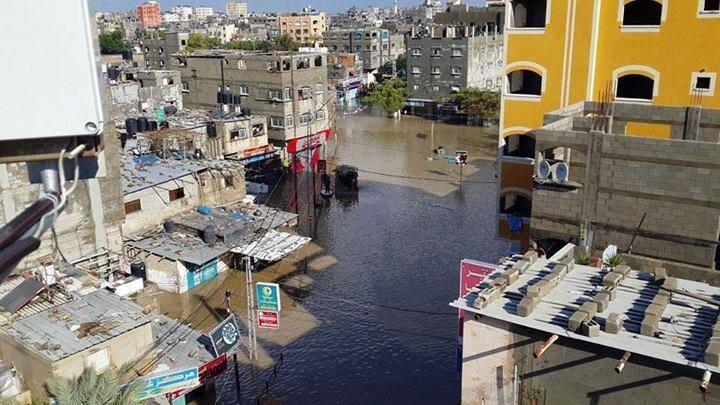
Number recently displaced by flooding in Gaza tops 10,000
Ma’an | December 15, 2013
BETHLEHEM – Approximately 10,000 people have been forced to flee their homes due to widespread flooding in the Gaza Strip, according to a report released Saturday evening by the United Nations Office for the Coordination of Humanitarian Affairs.
The numbers of displaced dwarf earlier estimates, as they take into account both the thousands who have sought refuge in Gaza shelters as well as those who have sought refuge elsewhere.
Previous estimates released by the Gaza government had measured only those who had sought refuge in official shelters, who at their peak reached above 5,000 but were estimated at around 2,234 on Sunday.
In a comprehensive report on winter storm Alexa’s effects on the Palestinian Territories, OCHA reported that as of Saturday at 9 p.m., 10,000 Gazans had been evacuated from their homes and had gone to either shelters or relatives’ houses.
The areas most devastated by the storm are “North Gaza and Gaza City where over 1,500 houses suffered damage due to water entering houses, damaging furniture and electricity networks.”
An infant died and 100 were injured in storm-related incidents throughout Gaza, the report said. Gaza government officials said on Sunday that two individuals had died, but did not mention any case involving an infant.
Schools throughout Palestine have been closed since Thursday, and according to OCHA 17 schools in Gaza have been converted into shelters, while five other schools have been rendered unusable due to flooding.
The report also discussed the effects of the storm, in conjunction with the Israeli occupation, on herding communities in the West Bank.
“Several herding communities had their structures demolished (by the Israeli authorities) one day before the storm hit, prompting the UN Humanitarian Coordinator to call again for a halt to demolitions due to their humanitarian impact,” the report said.
Additionally, “approximately 30 families living in ten Bedouin communities in the northern Jordan Valley require emergency assistance.”
Meanwhile, the report said farmers across Palestine have been hit with livestock and crop losses, further weighing on levels of food insecurity throughout the territories.
“In the West Bank, preliminary reports of damages to the livestock sector are emerging from Hebron, Bethlehem and Salfit. Bedouin and herding communities seem to be the most affected. Herders are expected to face increasing livestock fatalities and morbidity in the coming weeks.”
In Gaza, over 10 percent of the coastal enclave’s greenhouses and field crops were destroyed or damaged by winter storm Alexa, in addition to 50 animal pens, the report said.
“120,000 chicks and 200 heads of livestock died as a result of the weather.”
The Gaza Strip is currently under a state of emergency due to severe weather conditions caused by a historic storm front moving south across the Levant.
UNRWA spokesperson Chris Gunness said on Saturday that large regions of the Gaza Strip were a “disaster area” and called on the international community to lift the Israeli blockade in order to allow recovery efforts to proceed.
“Any normal community would struggle to recover from this disaster. But a community that has been subjected to one of the longest blockades in human history, whose public health system has been destroyed and where the risk of disease was already rife, must be freed from these man made constraints to deal with the impact of a natural calamity such as this,” he said in a statement sent to Ma’an.
Fuel shortages have caused daily life in the Gaza Strip to grind slowly to a halt since early November, cutting off access to basic necessities for Gaza residents.
Until Sunday, the Gaza Strip had been without a functioning power plant since the beginning of November, when the plant ran out of diesel fuel as a result of the tightening of a seven-year-long blockade imposed on the territory by Israel with Egyptian support.
The power station began operating Sunday after receiving a delivery of diesel that was purchased from Israel by the Palestinian Authority using funds donated by Qatar.
The plant was only reopened in 2012 after it was targeted by an Israeli airstrike in the 2006 assault on the Strip. The power plant generates around 30 percent of the Gaza Strip’s electricity supply, while the rest comes from Israel and Egypt.
Until July of this year, the tunnels to Egypt provided a vital lifeline for the territory amidst the otherwise crippling Israeli blockade. The blockade has been in place since 2006, and it has limited imports and exports and led to a major economic decline and wide-reaching humanitarian crisis.
In 2011 and 2012, however, the situation improved, as the tunnels to Egypt witnessed a brisk trade following the Egyptian Revolution.
Gaza Strip energy officials have blamed Egypt for destroying numerous tunnels linking the Gaza Strip and Egypt in recent months. They also blamed the Fatah-led Palestinian Authority for charging taxes on fuel too high for Hamas authorities to afford.
Related article
Netanyahu urges more pressure against Iran

Press TV – December 15, 2013
Israel’s Prime Minister Benjamin Netanyahu has called for the escalation of international pressure against Iran over the country’s nuclear energy program.
“As long as we don’t see actions instead of words, the international pressure should continue, and even more than that, it should be strengthened,” Netanyahu said on Sunday.
The remarks were Netanyahu’s first comments after the four-day expert-level nuclear talks between the representatives of Iran and six world powers in Vienna last week.
On Thursday, the US Treasury Department announced new sanctions against a number of companies and individuals for “providing support for” Iran’s nuclear energy program.
On Sunday, Iranian Foreign Minister Mohammad Javad Zarif slammed the US action as “unconstructive and inappropriate” and reaffirmed Iran’s resolve to respond prudently to such measures, while seriously pursuing the nuclear negotiations with the six countries.
The new US sanctions came despite the nuclear deal inked between Iran and the five permanent members of the UN Security Council – Russia, China, France, Britain and the US – plus Germany in the Swiss city of Geneva on November 24.
Following the conclusion of the interim agreement, Netanyahu described the nuclear deal as a “historic mistake.”
Israel, known as the sole possessor of nuclear weapons in the Middle East, has repeatedly accused Iran of pursing non-civilian objectives in its nuclear energy program and threatened to take unilateral military action against the country.
Related article
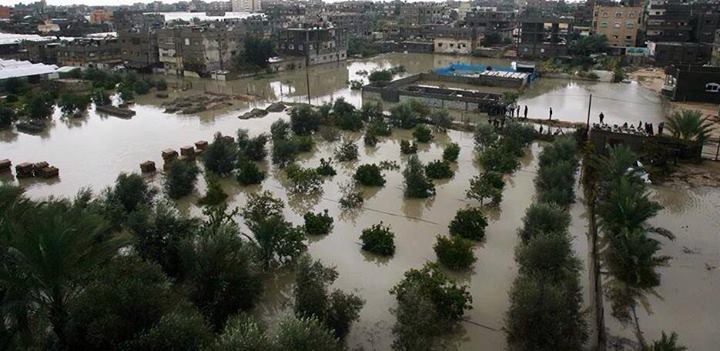
Israel ‘opens dams’ flooding Gaza Strip near Deir al Balah
Ma’an – 13/12/2013
BETHLEHEM – The Gaza Government’s Disaster Response Committee announced late Friday that Israeli authorities had opened up dams just east of the Gaza Strip, flooding numerous residential areas in nearby villages within the coastal territory.
Committee chairman Yasser Shanti said in a press conference that Israeli authorities had opened up dams just to the east of the border with the Gaza Strip earlier in the day.
He warned that residential areas within the Gaza Valley would be flooding within the coming hours.
He said that the move by Israeli authorities would flood areas in Moghraqa and other parts of Deir el-Balah in central Gaza, and he called upon residents of areas near the Gaza Valley to evacuate their homes in preparation for the anticipated flooding.
The Gaza Strip is currently under a state of emergency due to severe weather conditions caused by a historic storm front moving south across the Levant.
Fuel shortages have caused daily life in the Gaza Strip to grind slowly to a halt since early November, as power plants and water pumps are forced to shut down, cutting off access to basic necessities for Gaza residents.
Lack of diesel fuel is a result of the tightening of a seven-year-long blockade imposed on the territory by Israel with Egyptian support.
The Gaza Strip has been under a severe economic blockade imposed by the State of Israel since 2006.
See also:
Israelis open Wadi Salaqa dams, dozens of homes flooded
Palestine Information Center – 16/12/2013
GAZA — Israeli occupation forces opened on Sunday Wadi Sofa dam east of Rafah, south of the Gaza Strip, flooding dozens of Palestinian homes, local sources said.
The IOF opened its dams towards Palestinian houses without any prior warning for the second time since the stormy weather hit the region recently.
Rescue teams have evacuated trapped people from their flooded houses and transferred them to safe places and shelter centers.
Several Israeli earth dams have been established to the east of Gaza Strip, in order to benefit from rainwater and prevent its access to Gaza; however in such cases the Israeli occupation opens its dams toward the Strip to prevent swamping its agriculture lands.
Many residential areas and agricultural lands in Gaza were flooded when the Israeli authorities opened up the dams, which aggravated the population’s suffering. … Full article
Update:
Did Israel Deliberately Flood Gaza?
By Richard Edmondson | Fig Trees and Vineyards | December 17, 2013
It has been reported in the past several days, by Ma’an News and on several websites including this one, that Israel may have opened one or more dams resulting in the severe flooding we have seen in Gaza and further exacerbated conditions already made dire by the onslaught of winter storm Alexa. This at any rate is the charge that has been made by the Gaza government’s Disaster Response Committee and its chairman, Yasser Shanti.
So far I myself have heard no official response from Israel either confirming or denying. However, the following is reported by the Middle East Monitor:
According to Israel’s Yedioth Ahronoth newspaper, the rainfall led to a lot of excess water which couldn’t drain away, so “the Israeli authorities resorted to discharging the excess water into the Gaza Strip.”
I could not find this reported on Ynet’s English website, but it’s possible it was reported in the Hebrew edition. So was a dam released? All we have to go on is the statement by Shanti, accompanied, of course, by the shocking images we have seen of inundated streets, flooded homes, and people paddling in boats. But I did come across this video and thought I would share it. If it turns out that a dam or floodgate of some sort was deliberately released, it apparently would not be without precedent. The following was reported by Press TV in January of 2010—and take special note of what the reporter says regarding the flooding and its coinciding with the one-year anniversary of the close of Israel’s Operation Cast Lead.
If Israel did this in 2010, does it beggar belief they would have done the same thing again this past week? If they did, the question then becomes did they do it out of a) a need to divert flooding from their own communities in Israel, or b) pure malice?
The question of whether a dam was opened or floodwater in some way diverted is addressed in a report on the Gaza flooding published at The Ecologist, an environmental website:
Amid the chaos it is impossible to verify the accusations. The heavy rain has also affected bordering areas of Israel and whether or not dams have been deliberately opened, drainage systems in Sderot and other cities were certainly overwhelmed by the volume of water.
What is certain is that low-lying Gaza, on the coastal plain, lacking functioning drainage and sewage systems, would in any case suffer most severely from the rainfall. Moreover Israel already stands accused of deliberately running down basic sanitation services in Gaza in order to make life unlivable for its residents.
And as Gaza resident Fidaa Abuassi points out: “Unlike their neighbors in Sderot Gaza’s refugees have nowhere to flee when heavy rains flood their 25-mile occupied territory, blockaded by land, air, and sea.”
Even as the floodwaters recede, there may be worse to come. The report warns of what most likely is an “impending health catastrophe” in the making, with a flare up of respiratory and skin diseases brought on by constant exposure to sewage water and lack of medical supplies.
Update #2
No Dams in the Negev? Anatomy of a Hasbara Swarm
Israel joins EU’s atomic research centre
MEMO | December 13, 2013
 Israel has officially become a full member of the European Organisation for Nuclear Research, known as CERN, which owns the world’s largest particle physics laboratory on the French-Swiss border. The organisation’s 20 European member states voted unanimously on Thursday in favour of the decision to accept Israel as a full member of CERN following a two-year probationary period.
Israel is the first non-EU member to join the organisation. The European decision will benefit Israel on both a scientific and economic level, as it allows Israel’s science and technology industry to be eligible to apply for grants and to bid in CERN tenders.
Israel’s Deputy Foreign Minister Zeev Elkin has welcomed the European decision, saying it shows that one can engage in scientific projects with the EU without involving political considerations.
An official ceremony to celebrate Israel’s membership is scheduled to take place within a few weeks in Geneva.
~
See also: After Assassinating Iranian Scientists, Israel is Admitted to CERN
Featured Video

Genocide-linked firm handles Britons’ NHS data
or go to
Aletho News Archives – Video-Images
Book Review
How the U.S. Navy Sold the Vietnam War
By Gareth Porter | TruthDig | March 27, 2019
Dr. Tom Dooley, whose best-selling book “Deliver Us From Evil” helped create a favorable climate of opinion for U.S. intervention in South Vietnam, has long been linked to legendary CIA officer Edward G. Lansdale and his black operations in Vietnam between 1954 and 1955. But the real story about Dooley’s influential book, which has finally emerged from more recent scholarly research, is that it was engineered by an official of the U.S. Navy’s Pacific Command, Capt. William Lederer.
Lederer is best known as the co-author, with Eugene Burdick, of the 1958 novel “The Ugly American,” which was turned into a 1963 movie starring Marlon Brando. Far more important, however, is the fact that from 1951 through 1957 Capt. Lederer was on the staff of the commander in chief of the U.S. Pacific Fleet (CINCPAC), Adm. Felix Stump. … continue
Blog Roll
 Aletho News
- The 10 Disease Renamings That Rescued the Vaccine
- NATO cancels 2027 leaders’ summit
- IAEA’s politicized use of safeguards undermines its impartiality: Russian envoy
- UK must be ready to strike Russian Arctic – ex-PM
- Fico’s Two Red Lines: Russian Energy and the Next Ukraine Loan
- Thousands rally for banned NATO-skeptic presidential candidate
- Ukraine Settlement and New European Security Architecture Must Go Hand in Hand – Kremlin
- Book review: Boiling Point, How America Brought War to Ukraine
- Israel Revives The ‘Iranian Assassination Threat Against Trump’ Deception In A Desperate Bid To Restart The War
- US rewrites history to dodge blame for illegal war on Iran: Foreign Ministry spokesperson
- If Americans Knew
- No, Christians did not invent Zionism
- Hakeem Jeffries & Chuck Schumer: Conduits for Israel Lobby Dark Money
- DAILY UPDATE: Latest essential news on Palestine, Israel, & region
- Aid organizations in Gaza are pulling back, leaving hundreds of thousands of Palestinians without food
- 1.4 Million People in Gaza Live in Tents. Winter Storms Can Be a Death Sentence.
- Israel Used a U.S.-Made Missile to Kill Six at Gaza’s Nasser Hospital
- Congress Might Sneakily Use Lame Duck to Deeply Intertwine the U.S. and Israeli Militaries
- DAILY UPDATE: Latest essential news on Palestine, Israel, & region
- 9-month-old baby dies from severe cold in Gaza, 1st cold-related death this winter: Health Ministry
- Israel Kills over 12, Injures Many Across Gaza
- No Tricks Zone
- New Study: Barents Sea Temperatures Were Warmer And Sea Ice Less Extensive In The 1700s Than Today
- German Authorities Start Initiative To Evaluate Public Register For Climate “Disinformation” Spreaders!
- Zonal Asymmetry of Temperature Change in the Antarctic Circumpolar Current
- New Study: The Net Fossil Fuel Contribution To Rising Atmospheric CO2 Has Been Zero For 500 Years
- Germany’s Green Energy Transition Becoming Increasingly Expensive…Another 6 Trillion Euros!
- Sudden Stratospheric Warming, Powerful El Niño Combination May Lead To Extreme Europe Cold, Energy Crisis!
- Two New Studies Find Thwaites Glacier Melt Cannot Be Driven By Human Activity Or A Warming Ocean
- E-Cars Reduce CO2 Emissions By Only 41% Compared To Internal Combustion Engine Vehicles
- Predictions Made By Renowned Climate Professor Over Past Decades Have Been Proven To Be Poor
- New Study Suggests Large Regions Of The Pacific Ocean Have Been Cooling For The Last 80 Years

