To curb Iran’s influence, Washington and Tel Aviv are preventing alleviation of Lebanon’s economic crisis
By Robert Inlakesh | RT | November 16, 2022
Despite the recent signing of a historic maritime border agreement between Tel Aviv and Beirut, tensions continue to remain high, with both Israel and the United States attempting to force Lebanon into compliance with their regional agenda.
Although Israeli and Lebanese leaders signed letters of intent earlier this month ending their long-standing maritime border dispute and averting a major escalation in their ongoing conflict, the two sides still remain technically at war. Beirut refuses to recognise Israel, maintaining the stance that first the Palestine issue must be resolved, as Tel Aviv maintains control over the Shebaa Farms area which Lebanon claims to be its territory.
Last week, drone strikes were reported to have killed up to 25 people after targeting a fuel aid convoy that had just passed the Al-Qaim crossing into Syria from Iraq. There are conflicting reports on who actually carried out the attack, with both Israel and the United States accused of having been behind it. The US military instantly distanced themselves from the incident, by denying they had carried out any strikes, whilst the Israeli government refused to comment and is now widely assumed to be culpable. According to Iraqi authorities, the fuel trucks, numbering 22 according to Iranian state-media, were approved for heading out of the country and seemed to be part of Iran’s new agreement with Lebanon to provide free fuel.
Despite opposition from top US officials, in August Lebanese Prime Minister Nijab Mikati accepted an offer from Tehran to supply Lebanon with fuel free of charge. Although the US ambassador to Lebanon, Dorothy Shea, had warned Beirut not to take the offer from Iran, it was decided that going ahead with receiving the Iranian gift was in the Lebanese national interest. It is likely that the temporary US silence following this was in large part to do with the then-ongoing maritime border dispute between Tel Aviv and Beirut. The US has repeatedly attempted to counter Iranian influence in Lebanon, even going as far as claiming Beirut is not in need of the Iranian fuel, whereas the country is clearly in a state of economic collapse and suffers a shortage.
After Hezbollah, one of Lebanon’s most popular political parties, organized Iranian fuel shipments in 2021, Washington quickly took to countering any future attempts for Tehran to come to the aid of the Lebanese economy. A deal was then organized in September of 2021, under US supervision, for Egypt to supply natural gas through Jordan and Syria into Lebanon, in order to ease the energy crisis. However, the US government had pledged to amend its Caesar Act sanctions that it currently implements against Damascus to allow for the deal to go ahead, but has so far failed to do so. Although the Lebanese State is now quickly taking to exploring and, it hopes, extracting natural gas from the offshore Qana prospect, which it secured its rights to under its maritime border agreement with Israel, this process could take years to bear fruit.
In the short term, Beirut needs a solution to its energy crisis and Iran is offering free fuel to supplement part of its needs. Washington and its close ally Tel Aviv see this as a plot between Hezbollah and Tehran to take control over the Lebanese State. Although Lebanon is technically an independent state, the reality is that France, the US and the Gulf States, particularly Saudi Arabia, hold huge shares of influence in the political and economic affairs of the country, and none of them feel comfortable with the idea of Tehran having a significant influence.
The regional strategy of the United States government, which Israel is also in lockstep with, is to combat the influence of the Iranian government. Part of this strategy is to pressure more Arab States to normalize ties with Tel Aviv and to give up on the consensus amongst Arab League States to adhere to the Arab Peace Initiative. The initiative maintained that recognition of Israel by Arab states, along with the establishment of military, economic and political ties, could not come without the realisation of a Two-State solution under which the creation of a viable Palestinian State would be established. So far the UAE, Bahrain, Morocco, Egypt, Sudan and Jordan have all normalized ties with Tel Aviv, abandoning the Palestinian cause for Statehood. The US Biden administration is clearly seeking to add Saudi Arabia to the list, but eventually wants to go further than that.
At the recent COP27 climate meeting, held in Egypt’s Sharm el-Sheikh, Lebanese, Iraqi and Israeli representatives were all photographed standing near each other and had agreed to a distant cooperation on combating climate change. In Israeli and US media, this has been framed as somewhat of a breakthrough, despite being officially undermined by both Baghdad and Beirut. What is certain, however, is that the US and Israel are continuing to send a message to Lebanon, that they will not let it simply go about its business and thrive without adhering to their own agenda. Hence the US has not allowed for the Egypt-Jordan-Syria deal for transfer of fuel into Lebanon.
The most insidious part of the stance maintained by the US government is that Lebanon cannot simply leave the Iranian sphere of influence altogether and Washington is well aware of this. As long as Lebanese Hezbollah remains a popular force in the country, there will always be a link between Tehran and Beirut. This means that the US policy is designed to punish the Lebanese people for not getting rid of Hezbollah, something that neither the US nor Israel will dare try to do themselves. If Israel and the US are both in lockstep about preventing Iranian fuel from reaching Lebanon, then this means that they are simply depriving Lebanon of its ability to get back on its feet, all in the name of combating Iran and Hezbollah. In their eyes, if the Lebanese people perceive the Iranian fuel imports to be their saving grace, this runs counter to US hegemony and, together with the latest perceived victory for Hezbollah in forcing the Israelis to negotiate a maritime border settlement, Tehran would come off with greater support in Lebanon.
The US and Israel are proving incapable of allowing the Lebanese people to achieve a greater standard of life, due to the fact that Hezbollah and Iran are still there. Meanwhile, getting rid of Hezbollah would not only be militarily impossible, but there is also no evidence that such a move would actually bring stability – as evidenced with the case of Sudan, which normalized ties with Israel and earned itself a place in the good books of the US government, but the West is yet to aid the country, which endures a continuous state of crisis.
Robert Inlakesh is a political analyst, journalist and documentary filmmaker currently based in London, UK. He has reported from and lived in the Palestinian territories and currently works with Quds News. Director of ‘Steal of the Century: Trump’s Palestine-Israel Catastrophe’.
Pentagon exploits post 9/11 laws to wage ‘secret wars’ worldwide: Report
The Cradle | November 9, 2022
A report released last week by the New York University School of Law’s Brennan Center for Justice details how the US Department of Defense (DoD) has been allowed to covertly deploy troops and wage secret wars over the past two decades in dozens of countries across the globe.
Among the nations in West Asia affected by these so-called ‘security cooperation authorities’ are Lebanon, Iraq, Syria, and Yemen; however, they also include many African and Latin American nations.
Known as ‘security cooperation authorities,’ they were passed by the US Congress in the years following the 11 September attacks, and are a continuation of the 2001 Authorization for Use of Military Force (AUMF), a piece of legislation that has been stretched by four successive governments.
According to the report, the AUMF covers “a broad assortment of terrorist groups, the full list of which the executive branch long withheld from Congress and still withholds from the public.”
Following in this tradition, the ‘security cooperation authorities’ being abused by the Pentagon are Section 333 and Section 127e of Title 10 of the United States Code (USC).
Section 333 authorizes the US army to “train and equip foreign forces anywhere in the world,” while Section 127e authorizes the Pentagon to “provide support to foreign forces, paramilitaries, and private individuals who are in turn supporting US counterterrorism operations,” with a spending limit of $100,000,000 per fiscal year.
However, thanks to the vague definition of ‘support’ and ‘training’ in the text of these laws, both Section 333 and Section 127e programs have been abused to target “adversarial” groups under a strained interpretation of constitutional self-defense; they have also allowed the US army to develop and control proxy forces that fight on behalf of – and sometimes alongside – their own.
As a result of this, in dozens of countries, these programs have been used as a springboard for hostilities, with the Pentagon often declining to inform Congress or the US public about their secret operations under the reasoning that the incidents are “too minor to trigger statutory reporting requirements.”
“Researchers and reporters uncovered Section 127e programs not only in Afghanistan and Iraq, but also in Cameroon, Egypt, Kenya, Lebanon, Libya, Mali, Mauritania, Niger, Nigeria, Somalia, Syria, Tunisia, and Yemen,” the report highlights.
Researchers also point out that defense authorities “have given little indication of how [they] interpret Section 333 and 127e.”
Even more concerning, and ignoring the damage caused by these ‘anti-terror’ laws, the US Congress recently expanded the Pentagon’s security cooperation authorities, particularly with Section 1202 of the National Defense Authorization Act (NDAA).
Section 1202 allows the US army to allow “irregular warfare operations” against “rogue states” like Iran or North Korea, or “near-peers,” like Russia and China.
The report comes at a time when the US army and its proxy militias are accused of illegally occupying vast regions of Syria and Yemen, looting oil from the war-torn countries, just over a year after their brutal occupation of Afghanistan ended. Moreover, a former US official on Tuesday revealed that anti-Iran militias are being armed in the Iraqi Kurdistan Region (IKR), where both the CIA and the Mossad are known to operate.
US Siege Persists: Lebanon Prevented from Importing Iran’s Fuel Donation
Al-Manar | November 9, 2022
After several months of vagueness, the US administration announced clearly that sanctions will be imposed on Lebanon if it approves the Iranian fuel donation, according to a report posted by Al-Akhbar daily.
The Lebanese newspaper mentioned that the remarks made by the Assistant Secretary of State for Near Eastern Affairs, Barbara Leaf, indicated that the US siege on Lebanon persists.
Al-Akhbar added that the US vague stances pertaining the Iranian fuel donation during the past months aimed only at sustaining the positive atmosphere of the maritime border demarcation.
It is worth noting that Hezbollah secretary General Sayyed Hasan Nasrallah mentioned during his latest speech that the Americans will not allow Lebanon to import the Egyptian gas, Jordanian electric power, and Iranian fuel.
According to Al-Akhbar, the Lebanese caretaker prime minister, Najib Mikati, followed the US vagueness with time consuming steps, including sending a technical team to Tehran to study the fuel specifications.
The newspaper added that, after the energy minister Walid Fayyad sent a report about the Iranian fuel specifications to Mikati, the latter contacted the US administrations whose various offices told him that Washington rejects granting Beirut any waiver in this regard.
Netanyahu says to ‘neutralise’ Lebanon maritime deal
MEMO | October 31, 2022
Israeli leader, Benjamin Netanyahu, said Monday he will “neutralise” a recent maritime border deal with Lebanon if he is elected prime minister.
“I will behave as I did with the Oslo Accords,” Netanyahu said in an interview with Army Radio.
He said that the Oslo Accords with the Palestinians “were not cancelled, they were neutralised.”
The former premier, however, did not detail his specific intentions for the border agreement with Lebanon during his Monday’s interview.
Last week, Israel and Lebanon signed a US-mediated deal to demarcate maritime border between the two countries. The deal covers an area in the Mediterranean Sea, which contains part of the Karish gas field and Qana, a prospective gas field.
Netanyahu had termed the maritime deal as “illegal”, saying he would not be bound by it. He argued that Prime Minister, Yair Lapid, and Defense Minister, Benny Gantz, “didn’t want to extract the gas in the first place, but now they want to surrender it to Hezbollah.”
Israeli voters will go to polling stations on Tuesday in the country’s 5th legislative election in less than four years.
Opinion polls suggest that Netanyahu, the leader of the right-wing Likud Party, could come within a single seat of an outright majority in the Knesset (Israel’s parliament).
Lebanon and Israel finalize historic maritime border deal
The Cradle | October 11, 2022
Lebanon and Israel have agreed to a US-mediated maritime deal to demarcate the gas-rich blocks in the Mediterranean sea, seemingly putting an end to the prospect of an armed conflict.
In two separate statements by Lebanese and Israeli authorities, Beirut and Tel Aviv announced they have concluded all negotiations and will meet soon in Naqoura to sign the agreement.
“This is a historic achievement that will strengthen Israel’s security, inject billions into Israel’s economy, and ensure the stability of our northern border,” Israeli interim Prime Minister Yair Lapid said in a statement on Twitter.
A statement released by the office of outgoing Lebanese President Michel Aoun claims the deal “is satisfactory to Lebanon and meets its demands,” adding that it “preserves [the nation’s] rights to its natural wealth.”
In details revealed by Lebanese daily newspaper Al-Akhbar, all obstacles that led to a recent spike in tensions have been resolved, as both countries compromised with regards to the legal language used in the final draft.
The newspaper reveals that both sides agreed that Israel will be paid royalties from the Qana prospect field. However, the money will be paid from the revenue generated from the French oil company Total, not Lebanon’s share of the revenue.
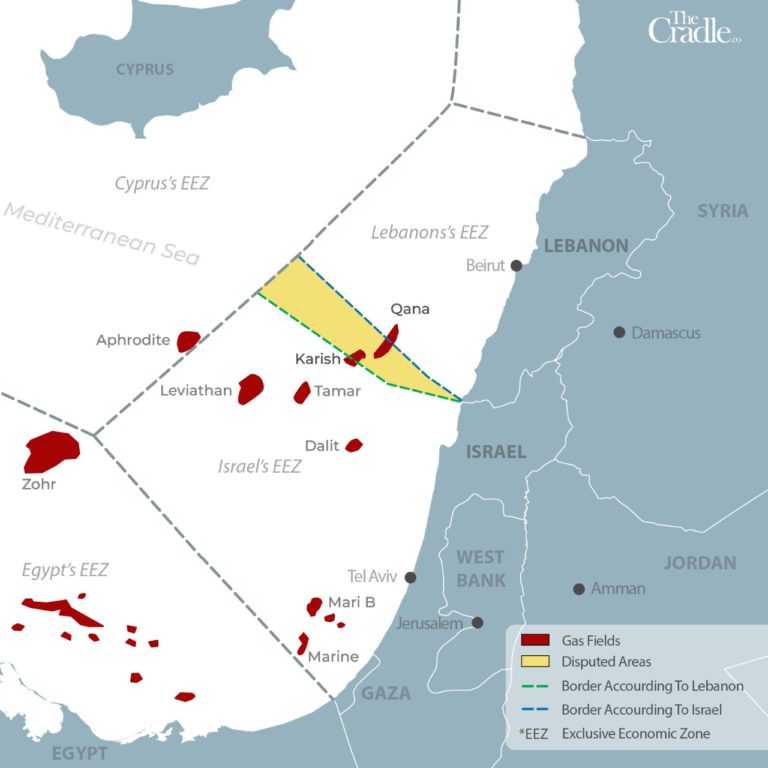
Map of the disputed maritime border between Lebanon and Israel. (Photo Credit: The Cradle)
As for the most pressing concern for both sides, Lebanon and Israel compromised in the legal language regarding the buoys deployed at sea to demarcate the various economic blocks.
According to the leaks, Lebanon insisted on adopting Line 20 while refusing to acknowledge that the line demarcates the maritime borders, but simply the blocks at sea.
Whereas Israel insisted on Line 31 which is going to be on the final draft between both countries.
Nonetheless, Lebanon will not acknowledge its effects on the land border demarcation, leaving the issue for indirect land-border negotiations.
In light of these developments, Lebanese caretaker Prime Minister Najib Mikati met on 11 October with the Lebanese Minister of Energy, Walid Fayyad, and a delegation from Total.
The delegation included the Director of Oil Exploration and Production Laurent Vivier, who was informed about the results of the negotiations and received a request to start operations.
Total informed the Lebanese side that the logistics of exploration need time, promising to start “as soon as possible.”
Similarly, Israeli National Security Council Chairman Eyal Hulta announced that all of Israel’s demands have been met.
“Israel’s security interests have been preserved. We are on our way to signing a historic agreement,” Hulta said.
According to Israeli Minister of Defense Benny Gantz, the current state of alert at the norther border with Lebanon came as a result of credible intelligence information about Hezbollah’s plans to launch an attack had Israel started to extract gas from the Karish gas field before a deal was concluded with Lebanon.
Similar assessments were made by the foreign intelligence services of several western countries.
This attack would have fulfilled the promise made by the Secretary General of Hezbollah, Hassan Nasrallah, who reiterated on several occasion that only mutual access to the gas reserves will be permitted.
“Israel, the US, and EU all know we are not bluffing. They have enough proof of that,” the resistance leader said during a televised speech in September.
Will Lebanon and Israel go to war over the maritime border dispute?
By Robert Inlakesh | Samizdat | October 8, 2022
Israel has announced its readiness for war with Lebanon, as the ongoing US-mediated maritime border demarcation talks head towards a dead end. The issue, however, is not just causing dispute between Beirut and Tel Aviv, but also becoming more prevalent within Israeli politics as it heads into another round of general elections.
On Thursday, Israeli Prime Minister Yair Lapid rejected Lebanese amendments to a US-proposed maritime border demarcation agreement. The previous day, Israeli officials had reportedly been briefed on the deal, which was the cause of much optimism, with an unnamed source telling Axios news that Lapid “made it clear that Israel will not compromise on its security and economic interests, even if that means that there will be no agreement soon.”
Later on Wednesday, Israeli Defense Minister Benny Gantz ordered the military establishment to prepare for an armed confrontation with Lebanon. A four-hour cabinet meeting, which was said to have been attended by major Israeli security establishment figures, was then concluded with a public announcement that the prime minister and defense minister had been granted permission to strike Lebanon without further cabinet approval.
Why are Lebanon and Israel on the verge of war?
In early June, a ship owned by the gas company Energean arrived at the resource-rich Karish field in the Eastern Mediterranean to begin preparations for natural gas production for Israel. Lebanese President Michel Aoun condemned the arrival, warning Tel Aviv against taking any further “aggressive action.” The Karish field, as well as the nearby Qana field, have for years been central to on-off US-mediated negotiations between Lebanon and Israel. The two nations have still not come to any agreement on the demarcation of their maritime borders, with Beirut seeing Karish and Qana as vital to reviving its collapsing economy.
While Lebanon maintains, due to legal arguments put forth in previous negotiations, that the entire area is to be considered ‘disputed waters,’ Israel has maintained that all of the Karish field and the majority of the Qana field are within its own ‘Exclusive Economic Zone’. The Lebanese political and military party Hezbollah, which claims to have 100,000 battle-ready troops at its disposal, then weighed in on the debate, vowing to protect Lebanon’s rights to its oil and gas.
Secretary General of Lebanese Hezbollah Seyyed Hassan Nasrallah declared that if no maritime border deal were reached and Lebanon is not able to secure its rights, then military action will be taken. Nasrallah vowed that the new reality would be “If we can’t have our resources, nobody can.” Hezbollah’s red line is Israeli extraction from the Karish field before any agreement is signed – if this happens, the group has threatened to strike not only Tel Aviv’s infrastructure at site, but every other Israeli oil and gas facility in the Mediterranean.
Israel has since responded with threats of its own, which have ranged from a vow to eliminate the entire densely populated Beirut suburb that serves as Hezbollah’s stronghold, to Benny Gantz’s recent warning that the whole of Lebanon would “pay a heavy price” for any military action by Hezbollah. Now that the negotiations have reached a “make or break” point, there are significant fears that military action will be taken, either by Israel or Hezbollah.
Empty threats?
The most recent threats issued by the military and political leadership in Tel Aviv have caused panic among Israelis living near the Lebanese border. However, there is a significant possibility that the rhetoric is aimed at a domestic audience. Israel will enter into a new round of national elections in November and the demarcation of maritime borders has recently been weaponized against the current Israeli leadership, causing ministers to act in order to save face.
Israeli opposition leader and former long-time prime minister Benjamin Netanyahu began to lash out at interim-PM Yair Lapid back in September, releasing a video in which he claimed that Lapid had “totally folded in the face of Nasrallah’s threats” and that Hezbollah had forced him to delay extraction from the Karish field. Netanyahu has continued to heavily criticize his political opponents’ handling of the demarcation-line issue, with similar claims that Israel is backing down over the threats issued by Lebanese Hezbollah.
Netanyahu’s words ring true in that Lapid has clearly been forced to take the issue of demarcation of maritime borders very seriously and has conceded on positions held by Tel Aviv in the past. In addition to this, the extraction of gas from the Karish field has also been delayed, as Energean, which owns the rights to extract from the site, was initially prepared to begin operations in late September and has so far refrained from doing so. However, had Netanyahu remained as PM, he would hardly have had any other choice but to do the same.
The threats made by Hezbollah are very serious, and the group apparently has the capacity to follow through with them and destroy all of Israel’s oil and gas facilities. At this time, however, the Israeli far-right camp headed by Netanyahu is blaming the situation on Lapid’s weak governance, saying he is prepared to give away territory that belongs to Israel. For this reason, it is likely that Yair Lapid will attempt to delay extraction of gas from the Karish field in order to sideline the issue until after the elections.
The necessity of a deal for Lebanon
Lebanon sees the Karish and Qana issue as integral to its survival. Some UN experts put the percentage of Lebanese living in poverty at around 80%, while the country endures round-the-clock blackouts, a rising crime rate, and civil instability. Some people have even been spotted searching for food in garbage bins, as well as fighting over loaves of bread at bakeries. Getting its hands on a possible multi-billion-dollar oil and gas field is a matter of life or death for Beirut – but not for Tel Aviv, which enjoys far more economic stability.
The US mediator in the Lebanon-Israel talks, Amos Hochstein, gave an interview to the American owned al-Hurra TV in June, laughing when asked about the prospect of trading the Karish field for Qana. Months later, after Hezbollah upped its threats and the group’s leader, Nasrallah, stated that the Lebanese people would not be laughed at, this issue has become a rather grave one. The US, which has a clear pro-Israeli bias, is now being forced to take the talks much more seriously.
Earlier this year, as the European Union looked for alternative gas suppliers, a deal was inked between Tel Aviv and Brussels, under which Israel would send gas through pipelines to Europe via Egypt. This has encouraged Tel Aviv to announce its plans to double its gas output, and the Karish field is key to achieving this.
The Qana field, however, has not yet been explored and will take time to develop. Despite this, one of the key reasons for Israel’s rejection of the Lebanese proposal is that Beirut refuses to pay Tel Aviv royalties for the gas it would extract from the Qana field should it be handed to Lebanon. Beirut cannot commit itself to such an agreement, because this would mean normalizing ties with the Tel Aviv regime, which still occupies Shebaa farms – an area that Lebanon claims as its rightful territory.
Whether war happens will now boil down to whether bickering between Israeli political parties and individual officials will cause Tel Aviv to adopt a belligerent approach and push forward with gas production in the disputed fields before an agreement is reached. If it does, there can be little doubt that Hezbollah will open fire if its red line is crossed. Israel’s stake in the matter is additional energy revenues, while for Lebanon it is potentially a matter of life or death. Neither side wants war, but one has much to gain and the other has everything to lose.
Robert Inlakesh is a political analyst, journalist and documentary filmmaker currently based in London, UK. He has reported from and lived in the Palestinian territories and currently works with Quds News.
Europe’s Biggest Enemy Isn’t Russia Nor Islamic Terrorism, but Israel
By Martin Jay | Strategic Culture Foundation | September 25, 2022
When Joe Biden took office, many pundits said that at least relations between the U.S. and EU would be restored. But the Iran deal is the ultimate test of just how much he loves the old continent.
Just how far will Israel go to scupper the so-called Iran deal from being signed by both Iran and the West? And will it play a fair game or use underhand and covert tactics to achieve its goal of the deal never being signed? Recently, we have seen the talks in Vienna progress as even the Americans say that certain key negotiating points have been taken out of the deal from the Iranians which has made the negotiations move closer to an agreement; we have also seen though Israel pulling out all the stops, from a PR and lobbying perspective at least.
And then there is the murky subject of skullduggery to destroy the talks. If you’re one of these people who believes in fairies at the bottom of the garden or that certain toothpastes can make your teeth whiter, then you might not buy into Israel using Mossad to derail the deal. Attacks on U.S. forces for example in Iraq, supposedly carried out by Iran-backed militias would normally have most people pointing the finger at Iran, proclaiming that Tehran is not at all serious about the deal but just playing along for time so that it can roll out a nuclear bomb. Then there is the curious case of the Salman Rushdie attack, which, again, many would point out could be attributed to the Iranians who still have a very much ‘alive’ fatwa against the British writer. Indeed, even the Supreme Leader is reported to have made a comment against Rushdie when he heard of the knife attack.
Given even the Israeli media have speculated that Mossad did it, it would be easy to conclude an open and shut case right?
Yet the author believes, like the 9/11 attacks in New York, which was the dirty work of Mossad, that these previous attacks can also be attributed to the Israelis who may well be plotting a bigger attack in the U.S. which Iran can be framed for; in fact, Americans are so ignorant of Islam or anything to do with the Arab world, that such an attack doesn’t even need to be linked to Iran but simply “Islamic terrorists” which might have tenuous links with Tehran.
There is no limit for Israel in terms of how far it can go to block the deal as the elite there believes that the Iran deal would exponentially boost Tehran’s power given the impact of sanctions relief on the economy. But the emergence of Iran as a regional player, economically, will always be a threat to Israel especially as it throws the spotlight on the once pariah state and many will see the fraud of hatred between Israel and Iran for what it is. Just as for decades the West goaded the Gulf States about Iran, installing fear to such a point that it was America and the UK who cleaned up on weapons sales, Israel needs to keep this yarn alive that Iran is the threat both for internal politics with their own people and also to justify the obscene amount of military aid which is sent to Israel each year. But any hack in Lebanon who has connections with Hezbollah will tell you that this threat is phoney and that both sides have enormous respect for one another; in reality both sides are fooling their own people into buying into the threat of an attack as it’s good for political support. The recent claims by Matthew Levitt in the Israeli media for example that Hezbollah wants to start some skirmishes with Israel can’t be taken seriously from those who are close to the Shiite group in Lebanon who say simply that Hezbollah is too scared to do such a thing off its own bat; being directed by the Supreme Leader in Iran though is another matter.
Hezbollah and Indeed Israel’s game of smoke and mirrors in Lebanon makes some pundits question whether Iran is really serious about reaching out for a deal with the west to lift its sanctions, or just playing us all along to win time? Surely Israel can’t have it both ways as its desperate antics of late tend to contradict themselves.
Hezbollah serves Israel well as the latter can focus more of defence spending and other such border initiatives in preference for being held more accountable for its governance. For Hezbollah it’s exactly the same. The threat of Israel launching an attack, once again, is the very bedrock of Hezbollah support in Lebanon. Without that threat, the Shia group may well lose half of its support overnight. This is one of the reasons why Israel continues to bomb Syria, targeting Iranian and Hezbollah activities: to keep the dream alive. It’s another reason why Hezbollah has a despondent enthusiasm towards Lebanon securing gas drilling rights close to Israel’s maritime border.
Yet in this time of Europe’s economies diving into recessions, we should ask ourselves what is the bigger picture? If Israel fails to derail the Iran talks and once again the Iranians get a deal which appeases the Americans, then certainly their economy in Iran will return to the billion dollars a month trade with the EU. One minor detail though which is overlooked and carefully airbrushed out of mainstream media’s narrative is the impact on Europe if the deal goes ahead. Cheap Iranian oil being sent to most EU countries which are really suffering from the shortages of oil and gas and its present market price could be a godsend and would enrage the Israelis even further. Europeans and even the British would look at Iran through a more favourable prism. Many would argue that Iran should be brought back in from the cold, in preference to the loathing of Putin and the hatred generally towards Russia. At least we can talk to the Iranians, many will argue. This notion cannot have escaped the attention of the EU dogs of war in Brussels who seem to be detached from all realities about the Ukrainian war and their sanctions towards Russia. Is it that they are banking on cheap oil from Iran saving EU economies? Biden too must have been advised of how things will pan out. But cheap oil for EU countries doesn’t favour the U.S. directly whereas letting the Europeans sink in their own demise will actually boost the U.S. economy according to the Washington Post, So much for the special relationship with Europe. For both Israel and Washington.
How the US controls Lebanon’s energy supply
The US is leveraging Egypt’s gas supply to pressure Beirut over US-brokered maritime border talks with Israel
By Yeghia Tashjian | The Cradle | August 19 2022
Consider the chaos in Europe today caused by a sudden reduction in Russian gas supplies.
Now imagine the catastrophic state of Lebanon’s energy sector after two years of fuel shortages, limited foreign currency with which to purchase new, urgent supplies, and US-sanctions on Syria impeding Lebanon’s only land route for imports.
After decades of stalled reforms, Lebanon is running out of time and money.
In June 2021, a lifeline was handed to the country in a deal struck with Baghdad to supply two Lebanese power stations with Iraqi fuel. The agreement, which was due to expire in September 2022, has recently been extended for one year.
But while there are short and long term solutions available to remedy Lebanon’s energy crisis, the two main options are both monopolized by US policymakers with stakes in regional geopolitics.
The first option involves transporting fuel to Lebanon via the Arab Gas Pipeline (AGP), whereby Egypt will supply gas through Syria. Although the proposal was originally an American suggestion, this fuel route requires US sanctions waivers that have not yet been approved by Washington.
The second option is for Lebanon to extract its own gas supply from newly discovered fields off its coastline. This too depends entirely on US-mediated, indirect negotiations with Israel to resolve a maritime dispute over the Karish gas field in the eastern Mediterranean Sea.
Accessing its own gas supplies will go a long way to guarantee Lebanon’s own energy security, while providing the state with much needed revenues from exports.
However, the success of either project depends largely on the status of US-Lebanese relations at any given moment. The two options are also inextricably linked to each other: Washington is pressuring Beirut to compromise with Tel Aviv on the maritime border dispute before agreeing to “green light” Cairo’s gas exports via Syria, which is in turn heavily sanctioned by the US’s “Caesar Act.”
While Washington is playing a leverage game, Lebanon is slowly collapsing.
Gas from Egypt
Under the agreement signed with Cairo, 650 million cubic meters of natural gas will be exported annually via the AGP. As it turns out, the actual supply of gas, as per the World Bank’s conditions, awaits US approval to exclude Egypt from sanctions imposed on the passage of goods through Syria.
The AGP is already a functioning pipeline that has supplied Lebanon with Egyptian gas in the past, but operations were halted in 2011 when Syrian pipelines were damaged during the country’s armed conflict.
Under the deal, Egypt will pump gas through the pipeline to supply Lebanon’s northern Deir Ammar power plant, which can then produce 450 megawatts of electricity – adding four hours of additional electricity supply per day. It is a modest but necessary improvement over the barely two hours of electricity currently provided by the state.
The World Bank has pledged to finance the deal on the condition that the Lebanese government implements much needed reforms in the electricity sector, which has created tens of billions of dollars in public debt.
The Syrian equation
For the Syrian government, the arrangement is perceived as a diplomatic victory as it confers ‘legitimacy’ to the state and represents a step toward its international rehabilitation. The AGP deal was also hailed by Syrian Minister of Oil and Mineral Resources Bassam Tohmy as one of the most important joint Arab cooperation projects.
According to Will Todman, a research fellow in the Middle East Program at the Center for Strategic and International Studies, the agreement is “a win for the [Bashar al-]Assad government. The deal represents the first major move toward Syria’s economic integration with the region since Arab Spring protests shook Syria in March 2011, halting previous integration efforts.”
However, due to US Caesar Law restrictions, no concrete progress has been made over the past months. Amman and Cairo have both requested guarantees from Washington that they will not be subject to sanctions – to no avail. US President Joe Biden has yet to make a final decision on whether the plan will be considered a violation of sanctions on Syria.
Linking the Egypt deal with Israel talks
In order to create a certain interdependency in the region to minimize the possibility of new conflicts with Israel, the US is attempting to link the Egyptian gas deal with the ongoing, indirect, maritime negotiations between Tel Aviv and Beirut.
Amos Hochstein, the State Department senior adviser on energy security, who acts as chief mediator on the disputed maritime border between Lebanon and Israel, said after arriving in Beirut on 14 June that the US side will look at the final agreement between Egypt and Lebanon to evaluate the sanctions compliance of the natural gas project.
This means that Washington is linking the fate of the gas deal to the maritime dispute with Israel to exert additional pressure on Lebanon.
On 14 October, 2020 – just two months after the Beirut port blast which severed the primary transportation route for seaborne Lebanese imports – Lebanon and Israel began the long-awaited US-mediated talks to demarcate their maritime borders, under the supervision of the UN.
The framework agreement announced by both countries at the time was the most serious attempt to resolve the maritime dispute and secure gas drilling operations through diplomatic means.
However, there are many challenges that can slow or even derail these negotiations.
According to Lebanese estimates, the country has 96 trillion cubic feet of natural gas reserves and 865 million barrels of oil offshore, and is in urgent need to begin drilling to save its ailing economy.
Israel is also in hurry to resolve this dispute as it wants to finalize the negotiations before September 2022, when the Karish gas rig is expected to begin production. The concern is that if a deal is not signed by then, Hezbollah may take action to halt Israel’s extraction altogether – until Lebanon is able to extract its own fuel from those waters.
Resolution or conflict
Last month, Hezbollah Secretary General Hassan Nasrallah reiterated warnings against Tel Aviv in the event that Lebanon is prevented from extracting its own resources in the Med. “When things reach a dead-end, we will not only stand in the face of Karish… Mark these words: we will reach Karish, beyond Karish, and beyond, beyond Karish,” he cautioned.
Initially, Lebanon took a maximalist position on its maritime borders with Israel: the main dispute was around the percentage both countries should share in the disputed 860 square kilometers, which covers Lebanon’s offshore gas Blocks 8, 9 and 10.
It is worth mentioning that Lebanon does not enter these negotiations from a position of strength and is in dire economic need to unlock foreign aid and begin the flow of potential gas revenues.
Meanwhile, the arrival this summer of the British-based Energean, an oil and gas exploration company, which will begin a drilling operation close to the Karish gas field, has sparked tensions between both countries, prompting US envoy Hochstein to race back to the region on 13 June.
In order to provide Lebanon with some much-needed leverage and accelerate negotiations, Hezbollah dispatched three drones towards the Karish gas field on 2 July. The operation sought several results: to test Israeli military responses to the drones, to scare off the private company contractors working on the rig, and to motivate both Tel Aviv and Washington to step up and strike a deal.
The operation achieved its goals. Israel’s military now can’t rule out the possibility that the Lebanese resistance movement will launch additional attacks on the gas field in the near future, or provoke Israel in a different manner – if the maritime dispute is not ironed out, and soon.
Beyond the Mediterranean Sea
The negotiations have also been impacted by international developments, chiefly, the war in Ukraine and the growing energy crisis in Europe. Sweeping western economic sanctions on Moscow’s economic interests have dried up Russian exports to the continent, driving Europe to seek alternative sources of energy, few of which are readily available.
In May 2022, the US and EU unveiled a plan to reduce Europe’s dependence on Russian fossil fuels and in June, the EU and Israel signed an agreement to export Israeli gas to Europe. These external factors have further motivated the US and Israel to hasten the negotiation process with Lebanon, all of which are overshadowed by the aforementioned US pressure on the Lebanese government.
Energy expert Laury Haytayan believes that linking Lebanon to regional energy projects makes it harder for Lebanon to go to war with Israel. Haytayan told The Cradle: “Lebanon needs gas, Israel needs stability, and the US wants to give both what they want.”
It is important to recognize that a final maritime demarcation agreement also means defusing the tensions on the Lebanese-Israeli border, which may require a broader US-Iranian agreement, something that is unlikely in the short term.
If the gas deal is successful and the US approves the Egyptian energy exports, the move will only increase US leverage over Lebanon when it comes to future negotiations on energy security.
It is in Lebanon’s interest to ensure that one party, the US, does not continue to hold all the cards related to its vital fuel needs. A recent offer from Iran to supply the country with monthly free fuel was tacitly accepted by Lebanon’s prime minister and energy minister, but needs work. Other states have offered to build power generation plants to enhance the nation’s infrastructure and efficiency.
But with Lebanon so deeply affected by Washington’s whims – and punishments – it isn’t at all certain that the country can steer itself to these more independent options.
The US and Israel have never been this highly incentivized to solve the maritime dispute. If the deal fails, Hezbollah may proceed with military action, especially before the conclusion of political ally President Michel Aoun’s term this Fall.
Furthermore, the gas issue may turn into a contentious domestic political issue ahead of Israel’s November parliamentary elections. In that instance too, a military conflict between Israel and Hezbollah may be triggered.
The only solution is to strike a deal, get gas flowing, and avert war. Will saner minds prevail, or will the region’s high-stakes geopolitical competition continue to escalate blindly? More importantly, can Washington bear to allow Lebanon the breathing space after three years of severe economic pressure to control Beirut’s political decisions?
Israel ‘yields to Lebanon’s maritime demands’ as Hezbollah-set deadline approaches
Press TV – August 19, 2022
Israel has reportedly yielded to Lebanon’s full maritime demands over the disputed waters and gas fields, asking the Arab country for extra time to finalize a deal.
According to a report by Lebanese newspaper Al-Akhbar on August 19, the regime sent a message to Hezbollah through diplomatic channels, saying it accepts Lebanon’s full demands.
Israel has pledged to acknowledge that Line 23 and the Qana prospect field are in Lebanese territory while also pleading with Hezbollah to set aside potential plans to attack Israeli gas fields in case of a delayed deal, the report added.
Secretary General of Hezbollah Sayyed Hassan Nasrallah has already rejected any delays in the case as Lebanon is going through dire economic conditions. “Time is short, and depending on the [Israeli] response, we will surely act,” he said in a speech during Ashura mourning procession.
Hezbollah had set a deadline for Lebanon to secure its rights over the disputed areas, which will expire on September 15.
Meanwhile, Israeli media reported an Israeli official is set to make a trip to the United States to discuss the dispute in the hopes of achieving an agreement.
According to Al-Akhbar, some firms have warned Israel they would withdraw their employees and facilities in case the regime fails to guarantee their safety.
Nasrallah had earlier said the Israeli regime would not be allowed to conduct drilling operations for oil and natural gas in the disputed area in the Mediterranean Sea until Lebanon gets what it deserves.
“Lebanon is facing a historic and golden opportunity to get out of its financial crisis. If we fail to take advantage of it, we would not be able to extract oil within the next 100 years. We are not looking for moral gains out of extraction in the Karish natural gas field. We rather want to tap into our oil reserves. There would, therefore, be no room for oil or gas extraction in the entire region if Lebanon does not get its right,” Nasrallah said at a local event in Beirut on July 19.
Lebanese politicians hope commercially viable hydrocarbon resources off Lebanon’s coast could help the debt-ridden country out of its worst economic crisis in decades.
In February 2018, Lebanon signed its first contract for drilling in two blocks in the Mediterranean with a consortium comprising energy giants Total, Eni, and Novatek.
Lebanon and Israel took part in indirect talks to discuss demarcation in 2020. But the talks stalled after Lebanon demanded a larger area, including part of the Karish gas field, where Israel has given exploration rights to a Greek firm.
The talks were supposed to discuss a Lebanese demand for 860 square kilometers (330 square miles) of territory in the disputed maritime area, according to a map sent to the United Nations in 2011. However, Lebanon then said the map was based on erroneous calculations and demanded 1,430 square kilometers (552 square miles) more further south, including part of Karish.
Hezbollah warns Israel against targeting Palestinians in Lebanon
MEMO | August 9, 2022
The head of Lebanon’s powerful Hezbollah movement, Sayyed Hassan Nasrallah, today warned against any Israeli attempts to expand their targeting of Palestinian resistance members to Lebanon, Reuters reported.
“Any attack on any human being will not go unpunished or unanswered,” Nasrallah said in a televised address marking Ashura, a commemoration for Shia Muslims of the killing of the Prophet Muhammad (peace be upon him)’s grandson Hussein.
The comments came after Israel launched a war against Gaza on Friday, killing 44 Palestinians including 15 children. It also killed senior Islamic Jihad leaders. The bombing was halted late on Sunday under the terms of an Egypt-brokered ceasefire.
On Saturday, Israeli defence minister Benny Gantz hinted at the possible targeting of Islamic Jihad officials abroad, who he said could be seen in “restaurants and hotels in Tehran, Syria and Lebanon”.
“They too will have to pay the price,” Gantz said. Yesterday he said Israel could carry out “pre-emptive strikes” abroad.
“In the future too, if necessary, we will deliver a pre-emptive strike in order to defend Israel’s citizens, sovereignty and infrastructure and this is true for all fronts, from Tehran to Khan Yunis,” he said.
Tensions between Hezbollah and Israel have been escalating in recent months over a disputed maritime border between Lebanon and Israel.
Featured Video

“Historic Russia”: The Land Putin Will Not Give Back
or go to
Aletho News Archives – Video-Images
From the Archive
How Ukraine Tortured and Slaughtered Donbass
By Kit Klarenberg | Al Mayadeen | July 11, 2024
Almost immediately after the proxy war erupted, ISIS-tier footage of the torture and murder of Russians in Ukrainian custody emerged.
On July 6th, the New York Times published an astonishing investigation: In Ukraine, Killings of Surrendering Russians Divide an American-Led Unit. The article documents in grim detail how Chosen Company, an international volunteer battalion for Kiev, routinely executes Russian prisoners of war. It is the very first mainstream admission that this practice – a brazen breach of the Geneva Conventions, and a grave war crime – is widespread among Ukraine’s fighters, both foreign and homegrown. … continue
Blog Roll
 Aletho News
- BRITAIN’S WARNING: PREPARE FOR WAR
- “Historic Russia”: The Land Putin Will Not Give Back
- How the Cambridge Analytica scandal still haunts Mark Zuckerberg
- The Ongoing Cancellation Campaign Against a Dissenting Academic in Norway
- Yemen and ‘the Houthis’: Challenging Sami Hamdi’s Narrative
- No, Christians did not invent Zionism
- AIPAC-led lobbying network opens branches in Cypriot, Greek parliaments
- Araghchi blasts ‘parasitic’ alliance as US taxpayers pay for Israel’s war on Iran
- Easy fix for Europe’s chaos? Stop fueling war against Russia
- Putin’s key remarks on peace talks and Europe’s ‘schizophrenia’
- If Americans Knew
- An error has occurred; the feed is probably down. Try again later.
- No Tricks Zone
- Two New Studies Find Thwaites Glacier Melt Cannot Be Driven By Human Activity Or A Warming Ocean
- E-Cars Reduce CO2 Emissions By Only 41% Compared To Internal Combustion Engine Vehicles
- Predictions Made By Renowned Climate Professor Over Past Decades Have Been Proven To Be Poor
- New Study Suggests Large Regions Of The Pacific Ocean Have Been Cooling For The Last 80 Years
- Germany’s Green Energy Debacle: High Energy Costs Force Kahla Porzellan to Close After 182 Years!
- New Study: 50 Years Of The Most Aggressive ‘Net Zero’ Policies Can Only Affect The Global Climate By 0.03°C
- US September “Heat” Was No Record…Many Records Set Decades Ago
- Latest European Green Energy Debacle; Portugal’s Largest Flagship Solar Park Insolvent!
- Green Energy Debacle: German Expert Professor Fritz Vahrenholt Warns Of Severe Economic And Social Consequences
- Two More Paleo Reconstructions Affirm Meters-Higher Sea Levels Across Ireland, Brazil 7000-6000 Years Ago

