New ‘CIA Officer Whistleblowing’ Video Reeks Of Disinfo
By Brandon Turbeville | Activist Post | July 2, 2016
Making quite the circuit on the internet landscape is a new video purporting to show a former CIA agent speaking out against the manner in which the “war on terror” is prosecuted and portrayed to the American public. The video has been shared and discussed thousands of times particularly within the alternative media community as evidence that the “war on terror” is one big snowball of bad decisions and blowback.
The video, is a short clip of an interview conducted by AJ+ with Amaryllis Fox, a former CIA Clandestine Services Officer, who makes a number of claims during the three minute clip that range from the reasonable to the absurd. While many alternative media outlets have hailed Fox’s video as “brave” and Fox herself as a whistleblower, it would be wise to analyze her statements for what they are as opposed to praising them simply because they are being presented as “anti-establishment.”
Fox makes a surprising amount of claims for three minutes and she also manages to conflate issues, concepts, and people in a cleverly designed monologue that is clearly scripted for effect.
Fox begins by saying,
If I learned one lesson from my time with the CIA it is this: everybody believes they are the good guy. I was an officer with the CIA Clandestine Service and worked undercover on counterterrorism and intelligence all around the world for almost ten years. The conversation that’s going on in the United States right now about ISIS and the United States overseas is more oversimplified than ever.
Fair enough. Lower level agents of the CIA and most lower level fighters in terrorist organizations or national militaries believe they are the good guys. The propaganda surrounding the “war on terror” is oversimplified. All of this is true indeed. But Fox moves from information easily verified such as the statement above to much more questionable claims. For instance, she says,
Ask most Americans whether ISIS poses an existential threat to this country and they’ll say yes. That’s where the conversation stops. If you’re walking down the street in Iraq or Syria and ask anybody why America dropped bombs, you get: “They were waging a war on Islam.” And you walk in America and you ask why we were attacked on 9/11, and you get “They hate us because we’re free.” Those are stories, manufactured by a really small number of people on both sides who amass a great deal of power and wealth by convincing the rest of us to keep killing each other.
Fox is correct on the latter part of her statement. Much of these stories are indeed manufactured by a small number of people in order to drum up support for foreign invasions and a police state back at home. But who exactly is Fox talking to on the streets of Syria and Iraq that would respond “a war on Islam” to the question of why the United States is dropping bombs on their country? It certainly isn’t the average Syrian as she tries to portray. In fact, if one were to go to the average Syrian on the street and ask “Why is America dropping bombs?” the answer would almost always be centered around Israel. Almost every researcher is aware of this fact but not one time was the word “Israel” mentioned in Fox’s interview. The “war on Islam” line is typically reserved only for the more fanatical religious zealots who make up the so-called “opposition.” So what is Fox suggesting? Is she suggesting that the average Syrian holds the same belief system as the average al-Qaeda fighter?
Actually, that is exactly what she is doing, regardless of whether or not she states it explicitly or not. She continues,
I think the question we need to be asking, as Americans examining our foreign policy, is whether or not we are pouring kerosene on a candle. The only real way to disarm your enemy is to listen to them. If you hear them out, if you’re brave enough to really listen to their story, you can see that more often than not, you might have made some of the same choices if you’d lived their life instead of yours. An al-Qaeda fighter made a point once during a debriefing. He said all these movies that America makes, like Independence Day, and Hunger Games and Star Wars, they’re all about a small scrappy band of rebels who will do anything in their power with the limited resources available to them to expel and outside, technologically advanced invader. And what you don’t realize, he said, is that to us, to the rest of the world, you are the empire, and we are Luke and Han. You are the aliens and we are Will Smith.
Fox is implying that there was a “fundamentalist al-Qaeda” problem before America’s foreign policy was formed. In other words, that the problem existed and that the United States perhaps acted rashly in dealing with it. But the fact is that the al-Qaeda issue never would have existed in the first place had the United States not invented it. Indeed, al-Qaeda, ISIS, and other related terrorist organizations are entirely creations of the U.S. government and the NATO apparatus. While Fox may be forgiven for not knowing this little detail, not knowing the difference between a fundamentalist al-Qaeda fanatic and an average Syrian is not excusable. That is, assuming that the mistake is actually a mistake and not an intentional attempt to mislead the audience.
Fox also provides questionable analogies when she discusses the al-Qaeda fighters’ interpretation of Hollywood movies. If the fighter was so convinced that the U.S. is the empire (fair point – it is) and al-Qaeda is the equivalent of Luke and Han, why did al-Qaeda attack the Syrian government? Why did they attack the Iraqi government? Why did they attack the Libyan government? This would be the equivalent of Luke and Han attacking the Galactic Republic while claiming to fight the Empire. It doesn’t make sense. Continuing with the Star Wars analogy, Saddam Hussein, Bashar al-Assad, and Muammar Ghaddaffi would represent the Republic and those nations’ militaries along with Iraq’s “insurgents” fighting back against the U.S. would be the true rebels. Fox should know this very well.
Nevertheless, Fox concluded her statements by saying,
But the truth is when you talk to the people who are really fighting on the ground on both sides, and ask them why they’re there, they answer with hopes for their children, specific policies that they think are cruel or unfair. And while it may be easier to dismiss your enemy as evil, hearing them out on policy concerns is actually an amazing thing. Because as long as your enemy is a subhuman psychopath that’s going to attack you no matter what you do, this never ends. But if your enemy is a policy, however complicated, that we can work with.
So, again, the question would be “who is Fox actually talking about?” When she references “the people who are really fighting on the ground on both sides, does she mean U.S. forces and terrorists vs the Syrian military? Does she exclude the U.S. military? Her statements simply do nothing to clarify the reality on the ground, only to confuse it.
One good question for Fox would be how the Syrian government should listen to and hear out a “policy” coming from an organization that crucifies women, beheads “heretics,” and seeks to impose Shariah law on a civilized people? How should Syria simply listen to the “concerns” of the United States after the latter power has funded those “subhuman psychopaths” (yes, it is an accurate description) who have invaded their country? Is it possible that the “policy” of the United States and its proxy terrorists is simply wrong? Is it possible that the other sides might not be so willing to have a couples’ therapy session?
While Fox makes a number of good points regarding the fact that the narrative surrounding al-Qaeda and the situation in Syria and Iraq is indeed manufactured by a small number of people in high places, Fox herself makes an incredibly wrong description of the conflict, equating average Syrians and Iraqis with jihadists in terms of their mindset and suggesting that the upsurge of terrorism is a result of blowback as opposed to outright funding and conspiracy to overthrow sovereign states in search of world hegemony.
Fox’s statements simply serve to continue to drag Americans off into the abyss of misinformation surrounding the crisis in the Middle East while claiming to do otherwise. After watching Fox’s video, (notably produced by AJ+ – al-Jazeera, a Qatari news agency that has long been pro-jihadist), we can safely say that Ms. Fox is either misinformed herself or simply good at her job.
Image Credit: Anthony Freda
Obama drone casualty numbers a fraction of those recorded by Bureau of Investigative Journalism
By Jack Serle | Bureau of Investigative Journalism | July 1, 2016
The US government today claimed it has killed between 64 and 116 “non-combatants” in 473 counter-terrorism strikes in Pakistan, Yemen, Somalia and Libya between January 2009 and the end of 2015.
This is a fraction of the 380 to 801 civilian casualty range recorded by the Bureau of Investigative Journalism from reports by local and international journalists, NGO investigators, leaked government documents, court papers and the result of field investigations.
While the number of civilian casualties recorded by the Bureau is six times higher than the US Government’s figure, the assessments of the minimum total number of people killed were strikingly similar. The White House put this figure at 2,436, whilst the Bureau has recorded 2,753.
Since becoming president in 2009, Barack Obama has significantly extended the use of drones in the War on Terror. Operating outside declared battlefields, such as Afghanistan and Iraq, this air war has been largely fought in Pakistan and Yemen.
The White House’s announcement today is long-awaited. It comes three years after the White House first said it planned to publish casualty figures, and four months after President Obama’s chief counter-terrorism adviser, Lisa Monaco, said the data would be released.
The figures released do not include civilians killed in drones strikes that happened under George W Bush, who instigated the use of counter-terrorism strikes outside declared war zones and in 58 strikes killed 174 reported civilians.
Today’s announcement is intended to shed light on the US’s controversial targeted killing programme, in which it has used drones to run an arms-length war against al Qaeda and Islamic State.
The US Government also committed to continued transparency saying it will provide an annual summary of information about the number of strikes against terrorist targets outside areas of active hostilities as well as the range of combatants and non-combatants killed.
But the US has not released a year-by-year breakdown of strikes nor provided any detail on particularly controversial strikes which immediately sparked criticism from civil liberty groups.
Jamel Jaffer, Deputy Legal Director of the American Civil Liberties Union said: “While any disclosure of information about the government’s targeted-killing policies is welcome, the government should be releasing information about every strike—the date of the strike, the location, the numbers of casualties, and the civilian or combatant status of those casualties. Perhaps this kind of information should be released after a short delay, rather than immediately, but it should be released. The public has a right to know who the government is killing—and if the government doesn’t know who it’s killing, the public should know that.”
The gap between US figures and other estimates, including the Bureau’s data, also raised concerns.
Jennifer Gibson, staff attorney at Reprieve said: “For three years now, President Obama has been promising to shed light on the CIA’s covert drone programme. Today, he had a golden opportunity to do just that. Instead, he chose to do the opposite. He published numbers that are hundreds lower than even the lowest estimates by independent organisations. The only thing those numbers tell us is that this Administration simply doesn’t know who it has killed. Back in 2011, it claimed to have killed “only 60” civilians. Does it really expect us to believe that it has killed only 4 more civilians since then, despite taking hundreds more strikes?
“The most glaring absence from this announcement are the names and faces of those civilians that have been killed. Today’s announcement tells us nothing about 14 year old Faheem Qureshi, who was severely injured in Obama’s first drone strike. Reports suggest Obama knew he had killed civilians that day.”
The US government said in a statement: “First, although there are inherent limitations on determining the precise number of combatant and non-combatant deaths, particularly when operating in non-permissive environments, the US Government uses post-strike methodologies that have been refined and honed over years and that use information that is generally unavailable to non-government organsations.”
Bibi Mamana
 Bibi Mamana was a grandmother and midwife living in the the tribal region of North Waziristan on Pakistan’s border with Afghanistan.
On October 24 2012, she was preparing for the Muslim festival of Eid. She used to say that the joy of Eid was the excitement it brought to children. Her eight-year-old granddaughter Nabeela was reported to be in a field with her as she gathered vegetables when a drone killed Mamana.
“I saw the first two missiles coming through the air,” Nabeela later told The Times. “They were following each other with fire at the back. When they hit the ground, there was a loud noise. After that I don’t remember anything.” Nabeela was injured by flying shrapnel.
At the sound of the explosion, Mamana’s 18-year-old grandson Kaleem ran from the house to help. But a few minutes later the drones struck again, he told the BBC. He was knocked unconscious. His leg was badly broken and damaged by shrapnel, and needed surgery.
Atiq, one of Mamana’s sons, was in the mosque as Manama gathered vegetables. On hearing the blast and seeing the plume of smoke he rushed to the scene. When he arrived he could not see any sign of his mother.
“I started calling out for her but there was no reply,” Atiq told the Times. “Then I saw her shoes. We found her mutilated body a short time afterwards. It had been thrown quite a long distance away by the blast and it was in pieces. We collected many different parts from the field and put a turban over her body.”
Atiq’s brother Rafiq told Al Jazeera English he received a letter after the strike from a Pakistani official that said the attack was a US drone strike and that Mamana was innocent. But nothing more came of it, he said. The following year Rafiq, a teacher, travelled to the US to speak to Congress about the strike.
“My job is to educate,” he said in an emotional testimony. “But how do I teach something like this? How do I explain what I myself do not understand?”
Picture credit: BBC
Evaluating the numbers
The administration has called its drone programme a precise, effective form of warfare that targets terrorists and rarely hits civilians.
With the release of the figures today President Obama said, “All armed conflict invites tragedy. But by narrowly targeting our action against those who want to kill us and not the people they hide among, we are choosing the course of action least likely to result in the loss of innocent life.”
In June 2011 Obama’s then counter terrorism chief, now CIA director, John Brennan made a similar statement. He also declared drones strikes were “exceptionally precise and surgical” and had not killed a single civilian since August 2010. A Bureau investigation in July 2011 demonstrated this claim was untrue.
Most of the Bureau’s data sources are media reports by local and international news outlets, including Reuters, Associated Press and The New York Times.
The US Government suggests it has a much clearer view of post-strike situations than such reporting, suggesting this is the reason why there is such a gap between the numbers that have been recorded by the Bureau, and similar organisations, and those released today.
But the Bureau has also gathered essential information from its own field investigations.
The tribal areas have long been considered a difficult if not impossible area for journalists to access. However, occasionally reporters have been able to gain access to the site of the strikes to interview survivors, witnesses and relatives of people killed in drone strikes.
The Bureau conducted a field investigation through the end of 2011 into 2012, in partnership with The Sunday Times. Through extensive interviews with local villagers, the Bureau found 12 strikes killed 57 civilians.
The Associated Press also sent reporters into the Fata, reporting its findings in February 2012. It found 56 civilians and 138 militants were killed in 10 strikes.
Access to affected areas is a challenge in Yemen too. But in December 2009 a deputation of Yemeni parliamentarians sent to the scene of a strike discovered the burnt remnants of a camp, which had been set up by several families from one of Yemen’s poorest tribes.
A subsequent investigation by journalist Jeremy Scahill revealed a deception that hid US responsibility for the deaths of 41 civilians at the camp – half of them children, five of them pregnant women.
The reality on the ground flew in the face of the US government’s understanding of events. A leaked US diplomatic record of a meeting in Sana’a, the capital of Yemen, between General David Petraeus and the Yemeni president revealed the US government was ignorant of the civilian death toll.
Salem Ahmed bin Ali Jaber
 Salem Ahmed bin Ali Jaber, a 40-year-old father of seven, was exactly the kind of man the US needed in Yemen. A widely respected cleric in rural Yemen, he delivered sermons in his village mosque denouncing al-Qaida.
He gave just such a speech in August 2012 and earned the attention of the terrorist group. Three anonymous fighters arrived in his village two days later, after dark, calling for Jaber to come out and talk.
He went to meet them, taking his policeman cousin, Walid Abdullah bin Ali Jaber, with him for protection. The five men stood arguing in the night air when Hellfire missiles tore into them.
A “huge explosion” rocked the village, a witness said. Jaber’s father, Ahmad bin Salim Salih bin Ali Jaber, 77, arrived on the scene to find people “wrapping up body parts of people from the ground, from here and there, putting them in grave clothes like lamb.”
All the dead were al Qaeda fighters, unnamed Yemeni officials claimed. However Jaber’s family refused to allow him to be smeared as a terrorist.
For three years they fought in courts in America and Germany for recognition that he was an innocent civilian. In November 2013 they visited Washington and even managed to arrange a meeting in the White House to plead their case. In 2014 the family said it was offered a bag containing $100,000 by a Yemen national security official. The official said it was a US strike and it had been a mistake.
By late 2015 the family offered to drop their lawsuits against the US government if the administration would apologise. The Department of Justice refused. In February 2016 the court dismissed the family’s suit but they have not stopped fighting: in April they announced they would appeal.
Picture credit: Private
Falling numbers of civilian casualties
The White House stressed that it was concerned to protect civilians and that best practices were in place to help reduce the likelihood of civilian casualties.
The Bureau’s data does show a significant decline in the reports of civilian casualties in recent years.
In Pakistan, where the largest number of strikes have occurred, there have been only three reported civilian casualties since the end of 2012. Two of these casualties – Warren Weinstein and Giovanni Lo Porto – were Western hostages held by al Qaeda. The US, unaware they were targeting the American and Italian’s captors, flattened the house they were being held in.
The accidental killing of a US citizen spurred Obama to apologise for the strike – the first and only time he had publicly discussed a specific CIA drone strike in Pakistan. With the apology of a “condolence payment to both the families,” National Security Council spokesman Ned Price told the Bureau. However, they have yet to receive any compensation from the US government for their loss.
Families who have lost relatives in Pakistan have not reported being compensated for their loss. In Yemen, money has been given to families for their loss but it is not clear whether it actually comes from the US. The money is disbursed by Yemeni government intermediaries, nominally from the Yemeni government’s coffers.
Tariq Khan
 Tariq Khan was a 16-year-old from North Waziristan who attended a high-profile anti-drone rally in Islamabad in October 2011. Only days later, he and his cousin were killed in a drone strike.Tariq was the youngest of seven children. He was described by relatives as a quiet teenager who was good with computers. His uncle Noor Kalam said: “He was just a normal boy who loved football.”
On 27 October, Tariq made the eight-hour drive to Islamabad for a meeting convened by Waziri elders to discuss how to end civilian deaths in drone strikes. The Pakistani politician Imran Khan, his former wife Jemima, members of the legal campaign group Reprieve and several western journalists also attended the meeting.
Neil Williams from Reprieve said Tariq seemed very introverted at the meeting. He asked the boy if he had ever seen a drone. Tariq replied he saw 10 or 15 every day. He said they prevented him from sleeping. “He looked absolutely terrified,” Williams said.
After a four-hour debate, the audience joined around 2,000 people at a protest rally outside the Pakistani parliament. After the rally, the tribesmen made the long journey home. The day after he got back, Tariq and his cousin Wahid went to pick up his newly married aunt, according a Bureau reporter who met Tariq at the Islamabad meeting. When they were 200 yards from the house two missiles slammed into their car. The blast killed Tariq and Wahid instantly.
Some reports suggested Wahid was 12 years old.
An anonymous US official acknowledged the CIA had launched the strike but denied they were children. The occupants of that car were militants, he said.
Picture credit: Neil Williams/Reprieve
Unnamed
Most of the dead from CIA strikes in Pakistan are unnamed Pakistanis and Afghans, according to Naming the Dead – a research project by the Bureau. Over three years the Bureau has painstakingly gathered names of the dead from US drone strikes in Pakistan. The project has recorded just 732 names of people killed since 2004 – 329 of which were civilians.
The fact that so many people are unnamed adds to the confusion about who has been killed.
A controversial US tactic, signature strikes, demonstrates how identities of the dead, and their status as a combatant or non-combatant, eludes the US. These strikes target people based on so-called pattern of life analysis, built from surveillance and intelligence but not the actual identity of a person.
And the CIA’s own records leaked to the news agency McClatchy show the US is sometimes not only ignorant of the identities of people it has killed, but also of the armed groups they belong to. They are merely listed as “other militants” and “foreign fighters” in the leaked records.
Former Deputy US Secretary of State, Richard Armitage outlined his unease with such internal reporting in an interview with Chris Woods for his book Sudden Justice. “Mr Obama was popping up with these drones left, right and down the middle, and I would read these accounts, ’12 insurgents killed.’ ’15!’ You don’t know that. You don’t know that. They could be insurgents, they could be cooks.”
Follow Jack Serle and Abigail Fielding-Smith on Twitter and sign up for the monthly update from the Bureau’s Covert War project.
Obama: US Military Engaged in Anti-Terror Operations Across 15 Countries
Sputnik — 13.06.2016
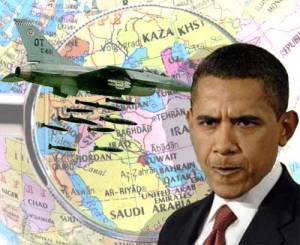 US military personnel are engaged in counterterrorism operations across 15 different countries, President Barack Obama said in a biannual statement to Congress released on Monday.
The letter outlined US military counterrorism operations across the globe in Afghanistan, Iraq, Syria, Turkey, Somalia, Yemen, Djibouti, Libya, Cuba, Niger, Cameroon, the Central African Republic, Egypt, Jordan, and Kosovo. All nations have US combat-equipped personnel deployed for a specific counterterrorism mission.
Obama indicated that that there is no timeline for the war on terrorism, and he will direct “additional measures to protect US citizens and interests” if necessary.
“It is not possible to know at this time the precise scope or the duration of the deployments of US Armed Forces necessary to counter terrorist threats to the United States,” Obama said.
Under the 2001 authorization for use of military force, the US president must update Congress every six months on the military operations against al-Qaeda, the Taliban and associated forces.
Hillary’s Foreign Policy Speech: Queen Galadriel Before Her Magic Mirror

By Gary Leupp | CounterPunch | June 6, 2016
Rachel Maddow, the famously progressive MSNBC show host, pronounced it “her greatest speech of the campaign.” Chris Matthews agreed, adding that it would “have a very strong appeal to the neocon movement.” He mentioned in particular Bill Kristol, the Weekly Standard editor and TV commentator, as someone likely to be impressed. “A very smart man,” opined Matthews, the conservative Democrat and “Hardball” host, causing the entire cosmos to shudder.
You’d think that that war in Iraq, which Kristol had tirelessly championed, had never happened. And that its results had been anything other than horrific for the entire Middle East.
Hillary Clinton’s fiery performance last Thursday night, intended to assert her credentials as a former secretary of state (with all the positive “experience” that’s supposed to entail), framed by no fewer than seventeen U.S. flags, was a strident reassertion of U.S. “exceptionalism” without apologies or even reflections on the recent past and her bloody role in it.
It was billed as a “major foreign policy address,” the sort of thing you might expect of a sitting president. And it was designed, of course, to make her look presidential, and to underscore her campaign’s declaration that she has the Democratic nomination all sewed up. But it was not in fact a foreign policy speech at all; Donald Trump is quite right to call it “a political speech” directed at him.
Maddow has occasionally shown signs of critical reasoning in her coverage of the U.S.’s imperialist wars. One has to wonder what she finds admirable in the speech. Because actually, Clinton said nothing new.
However unsubstantial, it was all over the news the next morning, competing with the stories about new fencing at the Cincinnati Zoo and Prince’s autopsy results. Meanwhile the networks systematically ignore the ongoing wars in Iraq and Syria generated by the invasion of Iraq 13 years ago, and the European refugee crisis sparked by the regime-change wars in those countries as well as in Afghanistan and Libya. Like the monkeys adorning the Nikko Shrine, they see no evil, hear no evil, and speak no evil.
Some takeaway lines from the Clinton speech: “Donald Trump doesn’t know the first thing about Iran or its nuclear program.” It’s true that Trump is an uninformed blowhard and that Hillary in contrast knows a lot. She knows, for example, that the entire U.S. intelligence community, in two separate National Intelligence Estimates after 2003, concluded that Iran does not have a military nuclear program. She knows that the whole issue was hyped at the demand of the Israeli leaders who continuously demanded that the U.S. bomb Iran’s nuclear facilities (that in fact date back to the period of the Shah’s reign and supported by the U.S.’s “Atoms for Peace” program).
She also knows from experience the value of the Big Lie in obtaining mass acceptance for real or threatened military action.
Clinton has generally avoided specifics in discussing her plans for more war with one conspicuous exception: she has continuously stated that she strongly advocates a “no-fly zone and humanitarian corridors” in Syrian air space and on the ground in that country beset by civil war pitting a secular regime, mainly against terrorist and terrorist-aligned Islamist opponents.
For Hillary, Syria is the ideal battlefield: one that pits her vision of U.S. hegemony against both Russia (Syria’s patron and her main target) and the nebulous evil of Islamist terrorism in the world—on behalf of an imaginary middle force of democrats who will stay cozy with the U.S. and end support for armed groups opposing Israel.
Her plans are as much a recipe for war as the bogus humanitarian mission in Libya in 2011. They would, as estimated by former Chairman of the Join Chiefs of Staff Gen. Martin E. Dempsey, require the deployment of 70,000 U.S. troops for their implementation.
In last week’s speech she was more circumspect. “We need to take out [ISIL’s] strongholds in Iraq and Syria,” she declared, “by intensifying the air campaign and stepping up our support for Arab and Kurdish forces on the ground. We need to keep pursuing diplomacy to end Syria’s civil war and close Iraq’s sectarian divide, because those conflicts are keeping ISIS alive. We need to lash up with our allies, and ensure our intelligence services are working hand-in-hand to dismantle the global network that supplies money, arms, propaganda and fighters to the terrorists.”
She didn’t mention that the money supplied to the terrorists is overwhelmingly from donors in Saudi Arabia, Turkey and Gulf states closely allied with the U.S. Or that the current U.S. air campaign over Syria is, unlike that of Russia, illegal, opposed by the internationally recognized government in Damascus and lacking UN approval. Her “major foreign policy address” could not address such small details.
Hillary did not mention her own crowning achievement as secretary of state—the savage destruction of Libya involving the death of about 30,000 people, the unleashing of the ugliest forms of tribalism, and ISIL’s securing of a beachhead around Sirte—even once.
In contrast she made repeated references to NATO, well aware no doubt that most Americans aren’t clear at all about what that is but think it must be something good. Like the UN, or the International Red Cross. (I doubt that one in ten knows what the acronym stands for—the North Atlantic Treaty Organization—or realizes that it has only been deployed well outside the North Atlantic region, in the Balkans, Afghanistan, and North Africa.)
“This is someone [Trump] who has threatened to abandon our allies in NATO,” Clinton thundered (as though the peoples of Europe had ever earnestly sought, or are begging to maintain that Cold War, specifically anti-Russian, alliance).
It’s true that Trump has—on occasion and inconsistently—labeled NATO “obsolete” and opined that it should have been dissolved years ago. Whether he truly believes this is unclear. As Hillary says, his “ideas are dangerously incoherent” and he can withdraw or deny such comments at any time. But Trump’s statements about NATO, however vague, are actually the most intelligent and welcome statements he’s made in the course of his campaign.
The fact is, beginning in 1999 at her husband Bill’s orders, the NATO alliance designed as a binding military pact uniting West European countries against the Soviet Union from 1949—that should have been dissolved in 1990 when the Warsaw Pact formed in response shut down—has relentlessly expanded to encircle Russia. That’s post-Cold War Russia, with a military budget about 7% of the U.S. figure. Some NATO leaders aim to ultimately swallow Ukraine—which just happens to have been part of the Russian state from the 1670s to the Bolshevik Revolution, when it was made a soviet socialist republic until the collapse of the Soviet Union in 1991. Its economy including its munitions industry are inextricably interwoven with Russia’s; its eastern regions are peopled by ethnic Russians; it shares a 1,400 mile long border with Russia.
Does it not make sense that Moscow would see the incorporation of Ukraine, especially one headed by the current Russophobic leadership, into an anti-Russian military alliance as threatening and unacceptable?
Yet Hillary has been a ferocious advocate for the infinite expansion of the alliance, its wars that have produced dysfunctional U.S. client states (Kosovo, Bosnia-Herzegovina) in the former Yugoslavia, and its provocative moves on Russia’s doorstep. But in her speech, avoiding any reference to that expansion—the key geopolitical change of the last quarter-century—she proclaimed: “Moscow has taken aggressive military action in Ukraine, right on NATO’s doorstep.” She never explains why that doorstep has advanced (despite Reagan’s promises to Gorbachev) to include Poland, Slovakia, Hungary and Romania to begin with. Or why it has bordered Russia itself since the inclusion of the former soviet socialist republics of Estonia and Latvia, which share a 508 kilometer border with Russia.
The “military action in Ukraine” that she alludes to refers to separatists’ resistance to the U.S.-backed coup in February 2014, surely supported by Russia at some level, and surely by Russian public opinion, but you notice that the Pentagon has produced precious little evidence for large scale “military actions.” And the annexation of Crimea (Russian from 1783 to 1954, when it was transferred to the Ukrainian SSR within the old Soviet Union) was only a “military action” in that the 25,000 Russian troops stationed there by treaty were deployed to secure government buildings.
And do not expect Hillary to ever inform her audiences that Sevastopol on Crimean Peninsula is Russia’s only year-round ice-free port except Murmansk north of the Arctic Circle; that the Russian Black Sea Fleet has been headquartered there without interruption since 1783; and that the expulsion of the Russians and their replacement with NATO forces would constitute a truly existential threat to the Russian state.
It would in fact be hard to build a case convincing to the American people that all these countries need to be locked into an alliance with the U.S. and obliged to pay out 2% of their GDPs on military expenses in order to protect them from some imaginary Russian invasion. (From a rational standpoint, it would be precisely like persuading the Russian people that Moscow should head up an alliance including Canada, Mexico and Cuba to secure them against U.S. aggression.)
But the expansion of NATO to include Ukraine has been a pet project of the former Madame Secretary. Clinton chose as her Under Secretary of State for European and Eurasian Affairs Victoria Nuland, a former aide to Vice President Dick Cheney, neocon and wife of the powerful neocon Republican pundit (John McCain advisor and recently declared Hillary supporter) Robert Kagan. Nuland already had a rich history of warmongering when she embarked on a plan to topple the elected government in Ukraine and replace it with one that would join NATO.
She boasted publically that the U.S. had spent $ 5 billion by 2014 in an effort to, as she put it so quaintly and dishonestly, “support Ukraine’s European aspirations.” The result was the coup in February 2014 and consequent civil war that has taken over 8,000 lives, including hundreds killed by the neo-fascist Azov Battalion which functions as a regiment of the National Guard.
The U.S. State Department echoed by the compliant media has methodically depicted these events as Russian interference, rather than the results of a U.S.-orchestrated “Color Revolution”-type regime change campaign. To anyone paying attention, the dishonesty, and the success of the propaganda prettifying the coup, is sickening.
Trump has, as Clinton notes, praised Vladimir Putin as someone to whom he’d award an A for leadership. She for her part calls him a “dictator,” a term she would never use for a U.S. ally such as Egypt’s Abdel Sisi or the Saudi king. She has compared the apparently popular president, who has deftly pushed Obama back from his 2013 threat to order a massive strike on Syria and cooperated in the conclusion of the Iran nuclear deal, to Hitler—an astonishing statement of historical illiteracy and propensity for sensationalism.
Hillary’s imperious message boils down to: We are the exceptional nation, which the world needs to maintain its “stability.”
“I believe in strong alliances; clarity in dealing with our rivals; and a rock-solid commitment to the values that have always made America great. And I believe with all my heart that America is an exceptional country – that we’re still, in Lincoln’s words, the last, best hope of earth. We are not a country that cowers behind walls. We lead with purpose, and we prevail.”
The peoples of Korea, Vietnam, Afghanistan, Iraq, and Libya, know very well how “exceptional” a country the U.S. is, how seldom it “cowers behind walls,” how cheerfully and unapologetically it destroys countries using its “alliances”—even when the latter are jerry-rigged to provide a fig-leaf for what’s essentially unilateral action. Even when their member-lists are often padded with name-only participants such a tiny Pacific nations sometimes informed after the fact that they’re suscribers.
The youth of Iraq—93% of whom according to a recent poll view the U.S. as an enemy—know how U.S. “values” manifest themselves: in the form of “shock and awe” bombing, Abu Ghraib torture, Blackwater murders, and cowboy-managed “reconstruction” that in fact further divided and scourged an already ruined and humiliated country. There is nothing good that can be said about the war that Hillary so passionately supported, until it became politically impossible for her to continue to do so.
Madame Secretary looked regal Thursday night, in the worst way. She reminded me of the elfin Queen Galadriel, as played by Cate Blanchett, in The Lord of the Rings, in that scene where she stares into her magic mirror, sees a vision of the power of Sauron, and suddenly towers over Frodo, arms like dark hollows, arms flung high, and bellows:
“In place of a Dark Lord, you would have a queen! Not dark, but beautiful and terrible as the dawn! Treacherous as the sea! Stronger than the foundations of the earth! All shall love me, and despair!”
Trump and Clinton are both servants of the enchanted ring called Capital. It is not at all clear who is more darkly and fatefully bound, or whose foreign policy, applauded by more devoted followers, would be more terrible and cause the greater despair among the people of this planet.
In response to the warrior-queen awaiting coronation, Bernie Sanders has sadly avoided the whole question of U.S. imperialism. (Among other things, he never uses the term.) It’s as though he accepts Chris Matthew’s smug pronouncement, “The American people don’t care about foreign policy.” The best Bernie could do last week was to say: “… when it comes to foreign policy, we cannot forget that Secretary Clinton voted for the war in Iraq, the worst foreign policy blunder in modern American history, and that she has been a proponent of regime change, as in Libya, without thinking through the consequences.”
Forgive me, Bernie—because I do of course hope you’ll win—but that comment was wimpish. Hillary’s Libya policy wasn’t a matter of not “thinking through consequences,” but a matter of calculated ruin of a modern state. It’s the difference from the “blunder” of accidental manslaughter and well-planned murder. (Recall how Madame Secretary cackled with hilarity after Col. Gadhafy was sodomized with a knife and assassinated in the desert by NATO’s friends.)
Like the CNN anchors who sometimes mention in passing Hillary’s “foreign policy blunders such as Libya,” Sanders cannot yet call out evil for what it is, but has to chalk it up to well-meaning mistakes lacking forethought.
But that level of criticism is the best the system can provide, the most it will allow. Mistakes were made. There were some intelligence flaws. There were blunders. To paraphrase Erich Segal’s Love Story: being the exceptional power means never having to say you’re sorry. You just acknowledge you fucked up, because hey, things like that happen. And let’s move on.
Had Bernie been the antiwar, anti-imperialist candidate throughout, rather than just repeating his (totally valid) tirade against Wall Street, he might have further sharpened his differences with Clinton. If he loses in California, and then betrays his following with a Clinton endorsement, he will be saying that more wars for regime change and more confrontation with Russia is worth some changes in party rules and some meaningless clauses on the party platform.
I would hope that any Bernie supporters (or anyone at all) who watched last night’s speech, or have read the on-line transcript, would buckle down on their opposition to this creature of Wall Street and the Democratic Party establishment. Better to vote not at all, if Clinton’s the nominee—and instead think about how best to topple whichever candidate wins.
The “billionaire class” that Bernie decries wants badly to suck you in. That’s why the party bosses praise Sanders for “bringing so many new young people into the process”—the better to eat you, my dear! They want you to love this queen, even as you despair of ever electing anybody better.
One Ring to rule them all, One Ring to find them,
One Ring to bring them all, and in the darkness bind them,
In the Land of Mordor where the Shadows lie
Better, surely, to destroy the Ring that is the rigged economy, rigged political process and murderous foreign policy that Hillary so personifies.
Gary Leupp is Professor of History at Tufts University, and holds a secondary appointment in the Department of Religion.
Libya: How to Bring Down a Nation
By Patrick Howlett-Martin | CounterPunch | May 31, 2016
More than 30,000 Libyans died during seven months of bombing by an essentially tripartite force – France, Great Britain, United States – which clearly favored the rebels. “The most successful mission in NATO’s history”, in the imprudent words of NATO Secretary General, Anders Fogh Rasmussen, a Dane, in Tripoli in October 2011[1].
French president Nicolas Sarkozy’s eagerness to support a military intervention with the purported aim of protecting the civilian population contrasts with the reception offered to the Libyan president, Muammar Gaddafi, when he visited Paris in December 2007 and signed major military agreements worth some 4.5 billion euros along with cooperation agreements for the development of nuclear energy for peacetime uses. The contracts that Libya seemed no longer willing to pursue focused on 14 Dassault Rafale multirole fighter jets and their armament (the same model that France sold or is trying to sold to Egypt´s General Abdel Fattah al-Sisi, the self-proclaimed marshal), 35 Eurocopter helicopters, six patrol boats, a hundred armored vehicles, and the overhaul of 17 Mirage F1 fighters sold by Dassault Aviation in the 1970s[2].
The major oil companies (Occidental Petroleum, State Oil, Petro-Canada…) working in Libya helped Libya pay the 1.5 billion dollars in compensation that the Libyan regime had agreed to pay to the families of the victims of Pan Am flight 103[3]. At the time, the compensation was intended to be one of the conditions for Libya to be reaccepted into the community of international relations.
The principal Libyan investment funds (LAFICO-Libyan Arab Foreign Investment Company; LIA-Libyan Investment Authority) were shareholders in many Italian and British corporations (Fiat, UniCredit, Juventus, the Pearson Group, owner of the Financial Times, and the London School of Economics, where Gaddafi was addressed as “Brother Leader” during a video conference in December 2010 and his son Saif was awarded a PhD in 2008). The New York investment bank Goldman Sachs was sued in 2014 by a Libyan fund (Libyan Investment Authority) which had lost more than 1.2 billion dollars between January and April 2008 after the American firm took a commission of 350 million dollars for investing their money in highly speculative derivatives[4].
Muammar Gaddafi had been received with full honors by the major powers some months earlier: in addition to the reception in grand style in Paris, where he was a guest for five days in 2007, he was received in Spain in December 2007, in Moscow in October 2008, and in Rome in August 2010, two years after accepting the Italian gift of 5 billion dollars as compensation for the Italian occupation of Libya from 1913 to 1943. And also of note are the five trips to Tripoli in three years by former British Prime Minister Tony Blair, a paid senior advisor to the investment bank JPMorgan Chase[5]. Former French president Nicolas Sarkozy was received in Tripoli in July 2007, where he announced the beginning of a partnership for the installation of a nuclear power plant in Libya. The European Union was ready to facilitate access to the European market for Libyan agricultural exports[6]. Libya was invited by the NATO Chiefs of Defense to the Maritime Commanders’ Meeting (MARCOMET) in Toulon on May 25-28, 2008.
A policy that recalls the one towards the Iraqi leader, Saddam Hussein. The Iraqi leader was invited to Paris in June 1972 and September 1975; an agreement was signed in June 1977 for the sale to Baghdad of 32 Mirage F1 combat aircraft. A coincidence that didn’t do either of them any good in the long run.
Arab military leaders (veterans of Afghanistan and members of the Libyan Islamic Fighting Group, with ties to Al-Qaeda) helped overthrow Gaddafi. One of the principal military leaders of the rebellion, Abdel Hakim Belhadj (a.k.a. Abu Abdullah al-Sadik), then Tripoli Security Chief and today the main leader of the conservative Islamist al-Watan Party had been arrested in Bangkok in 2004, tortured by CIA agents, and delivered to Gaddafi’s Abu Salim prison. He is now the main ISIL leader in Lybia. Jaballah Matar was kidnapped from his home in Cairo by the CIA in 1990 and then handed over to Libyan officials[7] Documents seized after the death of Gaddafi reveal close cooperation between Libyan, American (CIA), and British (MI6) intelligence services[8].
Under Gaddafi, Islamic terrorism was virtually non-existent. Prior to the U.S. led bombing campaign in 2011, Libya had the highest Human Development Index, the lowest infant mortality and the highest life expectancy in all Africa. Today Lybia is a wrecked state.
In January 2012, three months after the end of hostilities, the United Nations High Commissioner for Human Rights, Navi Pillay, reported the widespread use of torture, summary executions, and rape in Libyan prisons. At the same time, the organization Doctors Without Borders decided to withdraw from the prisons in Misrata because of the ongoing torture of detainees[9].
The NATO intervention in Libya, involving most member countries under a humanitarian pretext, set an unfortunate precedent for efforts to resolve the Syrian crisis: the attack by French and British warplanes on the Warfallah tribe, who remained faithful to Muammar Gaddafi, and on the convoy carrying the Libyan leader and one of his sons, leading directly to Gaddafi’s death under deplorable circumstances. The images by videographer Ali Algadi and journalist Tracey Sheldon provide a graphic account of the Libyan leader being dragged from a drain pipe on October 20, 2011 and killed shortly thereafter. These circumstances belie the pseudo-humanitarian nature of the military intervention and tarnish the image of the “Libyan Spring”[10].
The death of U.S. Ambassador to Libya, J. Christopher Stevens and one of his aides in a fire set in the U.S. Consulate in Benghazi in September 2012, revealing the breadth of CIA activities, in which the Consulate served as a façade. The recruitment by the CIA on its Benghazi base[11] of combatants from the city of Derna for the conflict in Syria, fief of the Islamists (Al-Bittar brigade), against President Bashar al-Assad, has inescapable parallels with the recruitment in 1979, again by the CIA, of the mujahedeen against the Soviet Union in Afghanistan, with all the consequences that we are well familiar with, and particularly the birth of Sunni jihadism.
The car bomb attack on the French Embassy in Tripoli in April 2013; the escape of 1,200 detainees from the Benghazi prison; the murder of the human rights lawyer Abdel Salam al-Mismari in July; and the attack on the Swedish Consulate in Benghazi in October 2013 all highlighted the inability of the authorities to gain control over the security situation in Libya as it was overrun by heavily armed militias. In July 2013, Libyan Prime Minister Ali Zeidan threatened to bomb Libyan ports in the Benghazi region that were in the hands of militias who were profiting by exporting the oil now under their control. In October, the Prime Minister was kidnapped by 150 armed men in the center of Tripoli and held for six hours to protest the abduction on Libyan soil of Abu Anas al-Libi in a secret American airport operation. Al-Libi was accused of being one of the leaders of Al-Qaeda and later died while in custody in the United States.
The year 2015 began with Libya bereft of all institutions. It is ruled by a motley group of coalitions vying for power, based in Tripoli (Farj Libya, which controls the central bank), Benghazi (Shura Council, consisting of Ansar al-Sharia, facing off against the Libyan National Army of the renegade general Khalifa Hiftar), and in Tobruk-Bayda (offshoot of the National Transition Council, enjoying international diplomatic recognition after the June 2013 elections).
The security and health situation for the civil population is near disastrous. When I visited the country in 1994 it was a model for public health and education, and boasted the highest per capita income in Africa. It was clearly the most advanced of all Arab countries in terms of the legal status of women and families in Libyan society (half of the students at the university of Tripoli were women). The aggression against the presenter Sarah Al-Massalati in 2012, the poet Aicha Almagrabi in February 2013, and the women’s rights activist Magdalene Ubaida, now in exile in London, bear grim testimony to their legal status in post-Gaddafi Libya. The city of Benghazi is now semi-destroyed; schools and universities are mostly closed[12].
It is the theatre of fratricidal clashes between rival factions financed and armed by a series of sorcerer’s apprentices A general who has been stationed in the United States for 27 years commands a motley coalition with military backing from Egypt, the United Arab Emirates and Saudi Arabia while Islamist groups claiming allegiance to ISIL and well entrenched in Sirte and Derna are able to spread their influence thanks to the institutional crisis. and, Qatar, Turkey, and Sudan supporting Farj Libya on the other.
Gaddafi, leader of the Libyan revolution, the Jamahiriya, in power from 1969 to 2011, gave a warning to Europe in an interview with French journalist Laurent Valdiguié of the Journal du Dimanche on the eve of the NATO intervention, in words that now seem prophetic:
“If one seeks to destabilize [Libya], there will be chaos, Bin Laden, armed factions. That is what will happen. You will have immigration, thousands of people will invade Europe from Libya. And there will no longer be anyone to stop them. Bin Laden will base himself in North Africa […]. You will have Bin Laden at your doorstep. This catastrophe will extend out of Pakistan and Afghanistan and reach all the way to North Africa”[13].
Libya has become a hub for illegal trafficking, particularly of African emigrants under conditions reminiscent of the slave trade. According to Global Initiative Against Transnational Organized Crime, the refugee smuggling market in Libya was worth 323 million dollars in 2014. In the first five months of 2015, more than 50,000 undocumented immigrants have reached Italy from sub-Saharan Africa via Libya; 1,791 of them lost their lives at sea[14]. Prior to the initiation of hostilities, 1.5 million sub-Saharan Africans worked in Libya in generally menial jobs (oil industry, agriculture, services, public sector). Darker days at sea are still to come.
Notes.
[1] “NATO chief Rasmussen ‘proud’ as Libya mission ends”, BBC News, October 31, 2011.
[2]. Agence France Presse, December 11, 2007.
[3]. International Herald Tribune, March 24, 2011.
[4] Jeremy Anderson, “Goldman to reveal income linked to Libyan lawsuit”, International New York Times, November 25, 2014.
[5]. The Telegraph, March 23, 2012.
[6]. O´Globo, July 26, 2007.
[7] Souad Mekhennet, Eric Schmitt, “Libyan rebels seek to shed El Qaeda past”, International Herald Tribune, July 19, 2011.
[8]. Rod Nordland, “Files note close CIA ties with Qaddafi spy unit”, International Herald Tribune, September 5, 2011.
[9]. International Herald Tribune, January 28-29, 2012.
[10]. Borzou Daragahi, “Call for probe into Libyan Civilian Deaths”, Financial Times, May 14, 2012.
[11] Seymour Hersh, “U.S. Effort to Arm Jihadis in Syria. The Scandal Behind the Benghazi Undercover CIA Facility”, Global Research, Washington’s Blog, April 15, 2014.
[12] Abdel Sharif Kouddous, “Report from the Front: Libya’s Descent Into Chaos”, The Nation, February 25, 2015.
[13] Journal du Dimanche, March 5, 2011 (www.lejdd.fr)
[14] Source: International Organization for Migration and the European Commission.
Patrick Howlett-Martin is a career diplomat living in Paris.
Hillary Clinton’s Memoir Deletions, in Detail
By Ming Chun Tang | The Americas Blog | May 26, 2016
As was reported following the assassination of prominent Honduran environmental activist Berta Cáceres in March, former Secretary of State Hillary Clinton erased all references to the 2009 coup in Honduras in the paperback edition of her memoirs, “Hard Choices.” Her three-page account of the coup in the original hardcover edition, where she admitted to having sanctioned it, was one of several lengthy sections cut from the paperback, published in April 2015 shortly after she had launched her presidential campaign.
A short, inconspicuous statement on the copyright page is the only indication that “a limited number of sections” — amounting to roughly 96 pages — had been cut “to accommodate a shorter length for this edition.” Many of the abridgements consist of narrative and description and are largely trivial, but there are a number of sections that were deleted from the original that also deserve attention.
Colombia
Clinton’s take on Plan Colombia, a U.S. program furnishing (predominantly military) aid to Colombia to combat both the FARC and ELN rebels as well as drug cartels, and introduced under her husband’s administration in 2000, adopts a much more favorable tone in the paperback compared to the original. She begins both versions by praising the initiative as a model for Mexico — a highly controversial claim given the sharp rise in extrajudicial killings and the proliferation of paramilitary death squads in Colombia since the program was launched.
The two versions then diverge considerably. In the original, she explains that the program was expanded by Colombian President Álvaro Uribe “with strong support from the Bush Administration” and acknowledges that “new concerns began to arise about human rights abuses, violence against labor organizers, targeted assassinations, and the atrocities of right-wing paramilitary groups.” Seeming to place the blame for these atrocities on the Uribe and Bush governments, she then claims to have “made the choice to continue America’s bipartisan support for Plan Colombia” regardless during her tenure as secretary of state, albeit with an increased emphasis on “governance, education and development.”
By contrast, the paperback makes no acknowledgment of these abuses or even of the fact that the program was widely expanded in the 2000s. Instead, it simply makes the case that the Obama administration decided to build on President Clinton’s efforts to help Colombia overcome its drug-related violence and the FARC insurgency — apparently leading to “an unprecedented measure of security and prosperity” by the time of her visit to Bogotá in 2010.
The Trans-Pacific Partnership
Also found in the original is a paragraph where Clinton discusses her efforts to encourage other countries in the Americas to join negotiations for the Trans-Pacific Partnership (TPP) trade agreement during a regional conference in El Salvador in June 2009:
So we worked hard to improve and ratify trade agreements with Colombia and Panama and encouraged Canada and the group of countries that became known as the Pacific Alliance — Mexico, Colombia, Peru, and Chile — all open-market democracies driving toward a more prosperous future to join negotiations with Asian nations on TPP, the trans-Pacific trade agreement.
Clinton praises Latin America for its high rate of economic growth, which she revealingly claims has produced “more than 50 million new middle-class consumers eager to buy U.S. goods and services.” She also admits that the region’s inequality is “still among the worst in the world” with much of its population “locked in persistent poverty” — even while the TPP that she has advocated strongly for threatens to exacerbate the region’s underdevelopment, just as NAFTA caused the Mexican economy to stagnate.
Last October, however, she publicly reversed her stance on the TPP under pressure from fellow Democratic presidential candidates Bernie Sanders and Martin O’Malley. Likewise, the entire two-page section on the conference in El Salvador where she expresses her support for the TPP is missing from the paperback.
Brazil
In her original account of her efforts to prevent Cuba from being admitted to the Organization of American States (OAS) in June 2009, Clinton singles out Brazilian President Luiz Inácio Lula da Silva as a potential mediator who could help “broker a compromise” between the U.S. and the left-leaning governments of Venezuela, Ecuador, Bolivia and Nicaragua. Her assessment of Lula, removed from the paperback, is mixed:
As Brazil’s economy grew, so did Lula’s assertiveness in foreign policy. He envisioned Brazil becoming a major world power, and his actions led to both constructive cooperation and some frustrations. For example, in 2004 Lula sent troops to lead the UN peacekeeping mission in Haiti, where they did an excellent job of providing order and security under difficult conditions. On the other hand, he insisted on working with Turkey to cut a side deal with Iran on its nuclear program that did not meet the international community’s requirements.
It is notable that the “difficult conditions” in Haiti that Clinton refers to was a period of perhaps the worst human rights crisis in the hemisphere at the time, following the U.S.-backed coup d’etat against democratically elected president Jean-Bertrand Aristide in 2004. Researchers estimate that some 4,000 people were killed for political reasons, and some 35,000 women and girls sexually assaulted. As various human rights investigators, journalists and other eyewitnesses noted at the time, some of the most heinous of these atrocities were carried out by Haiti’s National Police, with U.N. troops often providing support — when they were not engaging in them directly. WikiLeaked State Department cables, however, reveal that the State Department saw the U.N. mission as strategically important, in part because it helped to isolate Venezuela from other countries in the region, and because it allowed the U.S. to “manage” Haiti on the cheap.
In contrast to Lula, Clinton heaps praise on Lula’s successor, Dilma Rousseff, who was recently suspended from office pending impeachment proceedings:
Later I would enjoy working with Dilma Rousseff, Lula’s protégée, Chief of Staff, and eventual successor as President. On January 1, 2011, I attended her inauguration on a rainy but festive day in Brasilia. Tens of thousands of people lined the streets as the country’s first woman President drove by in a 1952 Rolls-Royce. She took the oath of office and accepted the traditional green and gold Presidential sash from her mentor, Lula, pledging to continue his work on eradicating poverty and inequality. She also acknowledged the history she was making. “Today, all Brazilian women should feel proud and happy.” Dilma is a formidable leader whom I admire and like.
The paperback version deletes almost all references to Rousseff, mentioning her only once as an alleged target of NSA spying according to Edward Snowden.
The Arab Spring
By far the lengthiest deletion in Clinton’s memoirs consists of a ten-page section discussing the Arab Spring in Jordan, Libya and the Persian Gulf region — amounting to almost half of the chapter. Having detailed her administration’s response to the mass demonstrations that had started in Tunisia before spreading to Egypt, then Jordan, then Bahrain and Libya, Clinton openly recognizes the profound contradictions at the heart of the U.S.’ relationship with its Gulf allies:
The United States had developed deep economic and strategic ties to these wealthy, conservative monarchies, even as we made no secret of our concerns about human rights abuses, especially the treatment of women and minorities, and the export of extremist ideology. Every U.S. administration wrestled with the contradictions of our policy towards the Gulf.
And it was appalling that money from the Gulf continued funding extremist madrassas and propaganda all over the world. At the same time, these governments shared many of our top security concerns.
Thanks to these shared “security concerns,” particularly those surrounding al-Qaeda and Iran, her administration strengthened diplomatic ties and sold vast amounts of military equipment to these countries:
The United States sold large amounts of military equipment to the Gulf states, and stationed the U.S. Navy’s 5th Fleet in Bahrain, the Combined Air and Space Operations Center in Qatar, and maintained troops in Kuwait, Saudi Arabia, and the UAE, as well as key bases in other countries. When I became Secretary I developed personal relationships with Gulf leaders both individually and as a group through the Gulf Cooperation Council.
Clinton continues to reveal that the U.S.’ common interests with its Gulf allies extended well beyond mere security issues and in fact included the objective of regime change in Libya — which led the Obama administration into a self-inflicted dilemma as it weighed the ramifications of condemning the violent repression of protests in Bahrain with the need to build an international coalition, involving a number of Gulf states, to help remove Libyan leader Muammar Gaddhafi from power:
Our values and conscience demanded that the United States condemn the violence against civilians we were seeing in Bahrain, full stop. After all, that was the very principle at play in Libya. But if we persisted, the carefully constructed international coalition to stop Qaddafi could collapse at the eleventh hour, and we might fail to prevent a much larger abuse — a full-fledged massacre.
Instead of delving into the complexities of the U.S.’ alliances in the Middle East, the entire discussion is simply deleted, replaced by a pensive reflection on prospects for democracy in Egypt, making no reference to the Gulf region at all. Having been uncharacteristically candid in assessing the U.S.’ response to the Arab Spring, Clinton chose to ignore these obvious inconsistencies — electing instead to proclaim the Obama administration as a champion of democracy and human rights across the Arab world.
‘UK trains armies on its own human rights blacklist’
Press TV – May 23, 2016
The British government is providing military training to the majority of nations it has blacklisted for human rights violations, a new report reveals.
In a report published on Sunday, the Independent revealed that 16 of the 30 countries on the Foreign & Commonwealth Office (FCO)’s “human rights priority” watchlist are receiving military support from the UK despite being accused by London itself of issues ranging from internal repression to the use of sexual violence in armed conflicts.
According to the UK Ministry of Defense, since 2014, British armed forces have provided “either security or armed forces personnel” to the military forces of Saudi Arabia , Bahrain, Afghanistan, Bangladesh, Myanmar, Burundi, China, Colombia, Egypt, Iraq, Libya, Pakistan, Somalia, Sudan, Yemen and Zimbabwe.
Britain is a major provider of weapons and equipment such as cluster bombs and fighter jets to Saudi Arabia in its year-long military aggression against Yemen that has killed nearly 9,400 people, among them over 2,230 children.
Since the conflict began in March 2015, the British government has licensed the sale of nearly $4 billion worth of weaponry to the Saudi kingdom.
British commandos also train Bahraini soldiers in using sniper rifles, despite allegations that the Persian Gulf monarchy uses such specialist forces to suppress a years-long pro-democracy uprising in the country.
Bahraini forces visited the Infantry Battle School in Wales last week, accompanied by troops from Nigeria, the Defense Ministry said.
Nigeria’s top military generals are accused by Amnesty International of committing war crimes by causing the deaths of 8,000 people through murder, starvation, suffocation and torture during security operations against the Boko Haram Takfiri terrorists, according to the report.
Andrew Smith, with the Campaign Against Arms Trade, said Britain should not be “colluding” with countries known for being “some of the most authoritarian states in the world.”
‘Pouring arms onto troubled Libyan waters makes no sense’
RT | May 17, 2016
World powers’ decisions to provide weapons to Libya’s unity government may lead to negative consequences as the arms will likely be used not only against ISIS but against all other sides, says Marko Gasic, an international affairs commentator.
World powers are ready to lift an arms embargo and to arm Libya’s internationally-recognized unity government to combat Islamic State terrorists.
The decision was announced by US Secretary of State John Kerry on Monday as members of the UN Security Council signed an official communique at talks in Vienna.
RT discussed the issue with experts.
RT: Libya is far from stable at the moment. Is this the right time to arm the country?
Diana Johnstone, political writer: There isn’t any right time. This would be comic if it wasn’t so tragic. We talk about the internationally recognized government. This is an internationally imposed government that was imposed by the supposed UN which has become really an instrument of US policy in this case. This government is called the government of national accord – but there is no national accord, this is a government of international accord that allows the US to bring in 20 countries to fight ISIS. Of course, ISIS is there because of the US bombing. So this is a perfectly circular situation: the US creates the chaos and then sends in soldiers…
RT: Is Libya ready to be armed? Or will this add more fuel to the fire?
Abayomi Azikiwe, the editor of Pan-African News Wire: We have to look at who caused the crisis in Libya. It was, in fact, the Pentagon, the CIA and NATO that armed Islamist extremist organizations five years ago. NATO and the Pentagon [dropped] 10,000 bombs on the country over a period of seven months. It is they who created the crisis. This is just another method of justifying a ground intervention in Libya by saying they are willing to lift the arms embargo. The arms embargo was imposed by the Pentagon and NATO during the period of the bombing in 2011. They were the ones who prevented arms and other goods from reaching Libya.
RT: Is it a practical way to try and counter ISIS in Libya?
AA: I don’t think it is a method to bring stability to Libya. It was the US who created the conditions for the growth of ISIS in Iraq and later in Syria. Because of the intervention of Russia, of Hezbollah, of Lebanon and assistance from the Islamic Republic of Iran many of them have now been forced to flee to Libya, where there is a political vacuum in existence. I think that the US has to be honest about its overall intentions in Libya. They have destroyed the country. They turned it into one of the major sources of human trafficking across North Africa, the Mediterranean into southern, eastern and central Europe. They created the worst humanitarian crisis since the conclusion of World War Two with some 60 million refugees and internally displaced persons. No, I don’t think they can create a solution for the problem that they in fact are responsible for bringing into existence.
RT: How do you see this decision to arm the recognized government – decisive or destructive?
Marko Gasic, an international affairs commentator: I don’t know what there is to recognize here because what we have to recognize first of all, is that there is a degree of chaos in Libya. There are alliances which are shifting, which are in a state of flux, which you can’t predict probably more than couple of months ahead. It makes no sense to be pouring arms onto troubled Libyan waters because all that we are going to do effectively is give one side an encouragement to attack the other side, to create more refugees and problems for Libya and the wider region.
The problem is of course that ISIS will not be the only side that will be attacked. Because when a side has weapons it of course will use these weapons against all its enemies as convenient. It is not going to have a glass ceiling between one of the enemies and the other. It will simply act in a pragmatic way to achieve its self-interests. So, there is absolutely no guarantee that these weapons would purely be used against ISIS. And they are far more likely to be used against all other sides as well with negative consequences to the stability of Libya and also for the chance of creating an inclusive solution for the peoples of Libya because with an increasing killing, an upscale of killing we are not going to have less polarization – we are going to get more.
Leaked Memo: Jordan’s King Reveals UK SAS Forces On The Ground In Syria, Israel Supports Nusra
By Brandon Turbeville | Activist Post | May 10, 2016
According to a leaked memo obtained by the Guardian in late March, 2016 King Abdullah of Jordan apparently briefed US officials on the fact that Jordanian Special Forces would be deployed to Libya to work alongside the British SAS. In that same briefing, Abdullah also allegedly stated that British SAS had been active in Libya since early 2016.
As Randeep Ramesh wrote for the Guardian at the time,
According to the notes of the meeting in the week of 11 January, seen by the Guardian, King Abdullah confirmed his country’s own special forces “will be imbedded [sic] with British SAS” in Libya.
According to the memo, the monarch met with US congressional leaders – including John McCain, the chairman of the Senate armed services committee, and Bob Corker, the chairman of the Senate foreign relations committee. Also present was the House of Representatives speaker, Paul Ryan.
King Abdullah said UK special forces needed his soldiers’ assistance when operating on the ground in north Africa, explaining “Jordanian slang is similar to Libyan slang”.
Abdullah also allegedly pointed out that the British had been instrumental in setting up a “mechanized battalion” in Southern Syria made up of “local tribal fighters” (aka terrorists) and lead by a “local commander” for the purposes of fighting against the Syrian government forces.
The Jordanian king also stated that his troops were ready to fight side by side with the British and Kenyans for the purposes of invading Somalia.
According to the Guardian,
The full passage of the briefing notes says: “On Libya His Majesty said he expects a spike in a couple of weeks and Jordanians will be imbedded [sic] with British SAS, as Jordanian slang is similar to Libyan slang.”
The monarch’s apparent openness with the US lawmakers is an indication of just how important an ally Jordan is to the US in the region. Since the 1950s Washington has provided it with more than $15bn (£10.5bn) in economic and military aid.
However, the Jordanians had become frustrated over perceived US inaction over the Middle East in recent months. Five years of fighting in Syria have dramatically impacted on Jordan, which has absorbed more than 630,000 Syrian refugees, and the king has repeatedly called for decisive action to end the conflict.
Interestingly enough, the King also allegedly admitted that Turkey and specifically Recep Erdogan is hoping for the victory of “radical Islamists” in Syria and that Israel is tacitly supporting al-Qaeda/al-Nusra in Syria.
Ramesh summarizes the King’s alleged statements by writing:
- The Turkish president, Recep Tayyip Erdoğan, “believes in a radical Islamic solution to the problems in the region” and the “fact that terrorists are going to Europe is part of Turkish policy, and Turkey keeps getting a slap on the hand, but they get off the hook”.
- Intelligence agencies want to keep terrorist websites “open so they can use them to track extremists” and Google had told the Jordanian monarch “they have 500 people working on this”.
- Israel “looks the other way” at the al-Qaida affiliate Jabhat al-Nusra on its border with Syria because “they regard them as an opposition to Hezbollah”.
In March, Stratfor analysts reported that UK Special Forces were already in Libya and that they were “escorting MI6 teams to meet with Libyan officials about supplying weapons and training to the Syrian army and to militias against the Islamic State. The British air force bases Sentinel aircraft in Cyprus for surveillance missions around [the Isis Libyan stronghold] Sirte as well.”
The presence of Western/NATO Special Forces in Syria is by no means a revelation at this point. These forces have been present in the embattled Middle Eastern country for some time.
In October, 2015, it was announced by the White House that 50 Special Forces troops would be sent to Syria. This announcement came days after it was reported that U.S. Special Forces commandoes were working with Kurdish forces to “free prisoners of the Islamic State” in Syria. Later, the presence of U.S. Special Forces in Syria was tacitly acknowledged in 2015 when the U.S. took credit for the killing of Abu Sayyaf.
Reports circulated in October, 2014 that U.S. soldiers and Special Forces troops were fighting alongside Kurdish battalions in Kobane. An article by Christof Lehmann published in March 20, 2015 stated,
Evidence about the presence of U.S. special forces in the Syrian town Ayn al-Arab a.k.a. Kobani emerged. Troops are guiding U.S. airstrikes as part of U.S support for the Kurdish separatist group PYD and the long-established plan to establish a Kurdish corridor.
A photo taken in Ayn al-Arab shows three U.S. soldiers. One of them “Peter” is carrying a Bushnell laser rangefinder, an instrument designed to mark targets for U.S. jets, reports Ceyhun Bozkurt for Aydinlik Daily.
The photo substantiated previous BBC interviews with U.S. soldiers who are fighting alongside the Kurdish separatist group PYD in Syria.
The photo of the three U.S. troopers also substantiates a statement by PYD spokesman Polat Can from October 14, 2014, reports Aydinlik Daily. Can admitted that a special unit in Kobani provides Kurdish fighters with the coordinates of targets which then would be relayed to “coalition forces”.
The first public U.S. Special Forces raid in Syria took place in July, 2014 when Delta Force personnel allegedly attempted to rescue several Americans being held by ISIS near Raqqa. Allegedly, the soldiers stormed the facility but the terrorists had already moved the hostages. While the raid would provide evidence that U.S. Special Forces were operating in Syria in 2014, many researchers believe the story is simply fabricated by the White House to provide legitimacy to the stories of murdered hostages and thus the subsequent pro-war propaganda that ensued as well as to promote the gradual acceptance of U.S. troops on the ground in Syria.
In 2012, an article published in the Daily Star by Deborah Sherwood revealed that SAS Special Forces and MI6 agents were operating inside Syria shortly after the destabilization campaign began in earnest. Sherwood writes,
Special Forces will help protect the refugees in Syria along the borders.
Last week as the president ignored an international ceasefire, plans were being finalised to rescue thousands of Syrians.SAS troops and MI6 agents are in the country ready to help rebels if civil war breaks out as expected this weekend.
They also have hi-tech satellite computers and radios that can instantly send back photos and details of refugees and Assad’s forces as the situation develops.
Whitehall sources say it is vital they can see what is happening on the ground for themselves so Assad cannot deny atrocities or battles.
And if civil war breaks out the crack troops are on hand to help with fighting, said the insider.
. . . . .
“Safe havens would be an invasion of Syria but a chance to save lives,” said a senior Whitehall source.
“The SAS will throw an armed screen round these areas that can be set up within hours.
“There are guys in the communications unit who are signallers that can go right up front and get involved in close-quarter fighting.”
In addition, in March 2012, it was reported by Lebanon’s Daily Star that 13 French intelligence agents had been captured by the Syrian government, proving not only that Western Special Ops presence in Syria did, in fact, exist but also that it existed essentially from the start.
Brandon Turbeville – article archive here – is the author of seven books, Codex Alimentarius — The End of Health Freedom, 7 Real Conspiracies, Five Sense Solutions and Dispatches From a Dissident, volume 1 andvolume 2, The Road to Damascus: The Anglo-American Assault on Syria, and The Difference it Makes: 36 Reasons Why Hillary Clinton Should Never Be President.
The Donald’s Foreign Policy
It sure trumps Hillary
By Philip Giraldi • Unz Review • May 10, 2016
Coming off a string of victories in the so-called Acela state primaries two weeks ago, GOP presidential candidate presumptive Donald J. Trump made what he described as a major foreign policy speech. Critics have blasted the effort as being short on details and long on generalities but, as ever, one’s perspective pretty much depends on what one expects or wants to hear. I admire Trump for two reasons. First is his uncompromising stance on illegal immigrants, which I fully support, and second is his willingness to challenge Republican orthodoxy on foreign policy by condemning the Iraq War and opposing nation building and military intervention overseas.
I wanted to hear two things on foreign policy: that Donald Trump is indeed committed to military non-intervention in other countries except in those rare instances where vital national interests are at stake and also that the United States would pursue a course of positive engagement with Vladimir Putin and Russia. I was not disappointed.
Trump actually used the words “peace” and “peaceful” a number of times, something that has been missing from GOP rhetoric for many years. He said that he would “view the world through the clear lens of American interests,” something that he went on to describe as “America First,” adding “Our goal is peace and prosperity, not war and destruction… war and aggression will not be my first instinct.” Paraphrasing John Quincy Adams, Trump concluded that “The world must know that we do not go abroad in search of enemies, that we are always happy when old enemies become friends, and when old friends become allies.”
Trump observed that there has been a fixation with policies that are both “foolish and arrogant” that have “led to one foreign policy disaster after another” in places like Iraq, Syria, and Egypt. “It all began with the dangerous idea that we could make western democracies out of countries that had no experience or interest in becoming a western democracy. We tore up what institutions they had and then were surprised at what we unleashed: civil war.”
This is all good common sense, lambasting the twin plagues of military intervention and democracy promotion, the two false idols that have respectively driven the foreign policies of the GOP and the Democrats. Trump’s comments in those specific areas could have been made by Ron Paul.
Trump went on to observe that “our actions in Iraq, Libya and Syria have helped unleash ISIS.” I would have added that the power vacuums that we have created actually gave birth to ISIS. Regarding Russia and China, he said “We desire to live peacefully and in friendship with Russia and China. We have serious differences with these two nations and must regard them with open eyes. But we are not bound to be adversaries. We should seek common ground based on shared interests…I believe an easing of tensions and improved relations with Russia…is possible.”
On the negative side, Trump took obligatory swipes at Iran and the nuclear agreement negotiated by the Obama Administration, but he did not say that he would seek to terminate the arrangement and the only line he drew was that “Iran cannot be allowed to have a nuclear weapon,” far less vitriolic than the neocon and conventional Republican demand that Tehran not have the “capability” to do so, which is a threshold that has already been passed and which many have viewed as a carte blanche justification of an immediate attack by the U.S.
Regarding Israel, Trump engaged in the usual American politician speak regarding “the one true democracy in the Middle East” that also serves as a “force for justice and peace.” He also has stated that he would be “neutral” in negotiating peace between the Israelis and Palestinians and turned around to endorse continued expansion of Israeli settlements on Arab land. Hopefully he knows better about what is going on in the Middle East or will have advisers who know better and are not afraid to speak the truth. At least he didn’t invite Israeli Prime Minister Benjamin Netanyahu to move in down the hall in the White House on Inauguration Day, which Hillary Clinton has de facto done.
And speaking of Hillary, comparing her record and promises with the Trump speech demonstrates the differences between the two. David Stockman has noted that Hillary “wants to use government to make government great again” while The Donald wants “to use government to make America great again.” Hillary is indeed the favorite candidate of the Welfare-Warfare State Leviathan, a monster that seeks to dominate overseas while simultaneously stripping Americans of their liberties at home.
Hillary’s record is one of unmitigated belligerency. She enthusiastically supported her President-husband’s devastation of the Balkans in the 1990s, a “police action” in which she repeatedly lied about being “under fire” when she arrived on a visit. And she also signed on to the invasions of Afghanistan in 2001 and Iraq in 2003 carried out by the George W. Bush Administration.
As Secretary of State, Hillary was the driving force behind “surges” of U.S. forces in Afghanistan, in demanding the attacks on Libya and the overthrow of its leader and in the arming of jihadis in Syria to bring about regime change. Bombing Libya was indeed a Hillary project, initiated at her insistence in spite of misgivings by President Barack Obama. The Libyan fiasco led to government arsenals being looted with the weapons making their way to arm local militias and also to Islamic militants in Central Africa. It is widely believed that the four Americans killed in Benghazi in 2012 were killed while arranging for weapons transfers to the “moderate rebels” in Syria. If success as a diplomat is measured by the ability to destabilize entire regions, Hillary certainly takes center stage as the finest Secretary of State since Madeleine Albright, who famously declared that killing half a million Iraqi children through sanctions was “worth it.” Albright is currently regarded as Hillary’s closest foreign policy adviser.
Like several of the other women who have surrounded the president as top level advisers, Hillary is an enthusiastic advocate of the “R2P” doctrine, “responsibility to protect.” That means that the Washington can intervene in a foreign country even if that nation’s government in no way threatens the United States. The intervention is based on humanitarian grounds, allegedly to protect the local citizens against their own leaders, but it ironically and inevitably winds up killing mostly civilians in far greater numbers than would have otherwise been the case if there had been no military action. Libya and Syria are perfect examples of R2P on steroids.
Hillary has a team of strongly pro-Israel foreign policy advisers and she has frequently expressed her hostility towards Iran, which she has threatened to “obliterate.” One of her campaign videos includes “Iran seeks the destruction of Israel, Iran is a leading sponsor of terror in the region, Iran is flouting international law with its ballistic missile tests and its threats against our allies and partners.” None of the assertions are actually true.
Regarding the threat from Russia, Hillary has inevitably likened President Vladimir Putin to Adolph Hitler. She and her neocon acolyte Victoria Nuland were the driving forces behind cranking up the unrest in Ukraine, which eventually exploded into yet another pastel revolution that quickly became mired in corruption before dissolving into something approaching anarchy, which prevails to this day. She nevertheless wants to provide lethal arms to Kiev and also wants to expedite both Ukraine and Georgia joining NATO, even though it is a given that such action would provoke a major crisis with a nuclear armed and militarily quite capable Russia.
Hillary sees the conflict in Syria as an additional opportunity to confront Moscow, just like in the heady days of the Cold War, so she advocates a no-fly zone as a way for American and Russian flyboys to go head to head and is firm in her demand to replace Bashar al-Assad no matter what. She is one tough lady and she wants to make sure than everyone knows it. And of course her role model is Benjamin Netanyahu, who, she has promised, will be invited to join her in Washington as soon as her administration begins work in January.
So if one is concerned with foreign policy the choice between Donald and Hillary is no choice at all. Hillary may have the resume but it is essentially a bad one. If Trump does even a little of what he pledges to do he is a much better deal for the American people, as well as for most of the world, than is Hillary Clinton.
Featured Video
BRITAIN’S WARNING: PREPARE FOR WAR
or go to
Aletho News Archives – Video-Images
From the Archives
British weapons and personnel doing much of the killing in Yemen
Press TV – June 18, 2019
A detailed report published by the Guardian newspaper has shown how Britain is massively contributing to Saudi Arabia’s devastating war on Yemen as it suggests that London is not only supplying the bombs that fall on Yemenis, but it provides the personnel and expertise that keep the war going.
The comprehensive report by Arron Merat published on Tuesday showed that Britain was doing much of the killing in Yemen as the country continues to provide Saudi Arabia with everything it needs to turn its southern impoverished neighbor into a graveyard.
“Every day Yemen is hit by British bombs – dropped by British planes that are flown by British-trained pilots and maintained and prepared inside Saudi Arabia by thousands of British contractors,” said Merat in the report. … continue
Blog Roll
 Aletho News
- Pentagon designates Chinese cultural centers national security threat
- Israel Demolishes Home Of Lebanese Journalist Whose Viral Film Exposed Pager Attack
- Record Oil, Empty Tanks: The UAE’s Miracle Recovery
- Burnham tackles Britain’s poverty with aggression in Yemen
- Peace in Ukraine: the easy way – or the hard way
- Trump & the Rrrrussians
- US taxpayer money laundered back through Ukraine – Musk
- Before COVID, an NIH lab chief proposed making a SARS-like bat virus more infectious
- Gates, Bourla on Trial in Netherlands Accused of ‘Great Reset’ Scheme at Vaccine Injury Hearing
- BRITAIN’S WARNING: PREPARE FOR WAR
- If Americans Knew
- An error has occurred; the feed is probably down. Try again later.
- No Tricks Zone
- Two New Studies Find Thwaites Glacier Melt Cannot Be Driven By Human Activity Or A Warming Ocean
- E-Cars Reduce CO2 Emissions By Only 41% Compared To Internal Combustion Engine Vehicles
- Predictions Made By Renowned Climate Professor Over Past Decades Have Been Proven To Be Poor
- New Study Suggests Large Regions Of The Pacific Ocean Have Been Cooling For The Last 80 Years
- Germany’s Green Energy Debacle: High Energy Costs Force Kahla Porzellan to Close After 182 Years!
- New Study: 50 Years Of The Most Aggressive ‘Net Zero’ Policies Can Only Affect The Global Climate By 0.03°C
- US September “Heat” Was No Record…Many Records Set Decades Ago
- Latest European Green Energy Debacle; Portugal’s Largest Flagship Solar Park Insolvent!
- Green Energy Debacle: German Expert Professor Fritz Vahrenholt Warns Of Severe Economic And Social Consequences
- Two More Paleo Reconstructions Affirm Meters-Higher Sea Levels Across Ireland, Brazil 7000-6000 Years Ago

