The Israeli armed forces began a massive fortnight-long military exercise on Tuesday, billed as the biggest in the past 19 years, simulating a war with Lebanon’s Hezbollah. The Jerusalem Post reported that “thousands of soldiers and reservists from all different branches of the IDF (cyber, intelligence, ground forces, the air force and the navy) are going to coordinate their operations as during wartime.”
Hezbollah has reacted with disdain, a top official taunting Israel, “we are ready for any attack or Israeli stupidity.” He added, “The Israelis won’t succeed in surprising us, because Israel knows full well [what] Hezbollah’s capabilities are after the loss it suffered in 2006 [in the Second Lebanon War], which deterred the IDF.”
Israel’s advantage will be that Hezbollah is embroiled in other conflicts, in particular the Syrian conflict. Hezbollah’s capability, on the other hand, has vastly increased since 2006 and there is some merit in its claim of being “the second largest military in the Middle East,” apart from having at least 100,000 rockets aimed at Israeli targets. Logically speaking, a war is improbable but then, nothing is beyond the realms of possibility in the Middle East region.
Israel will be sorely tempted to test Hezbollah’s increased capabilities now rather than later, because a point of no return may be reached soon and will have a hard time holding itself back. The fact of the matter is that Israel is coming face to face with a new security paradigm that would have seemed incredible even six months ago. The spectre that haunts Israel today is that for the first time since the 1967 war, the balance of forces is shifting adversely.
Sharmine Narwani, a seasoned Beirut-based analyst of Middle East politics (and a personal friend of mine) has written an insightful piece in the American Conservative connecting the dots and explaining how a once-favorable balance of power has suddenly shifted in a direction that clips Israel’s wings.” She analyses that for a start, Israel is failing spectacularly in its attempt to dictate the limits to Iran’s presence in post-conflict Syria.
Israel knocked on the doors of the Trump White House to get the US troops to take on the responsibility of the so-called de-escalation zone in southern Syria bordering Golan Heights. But the Pentagon cold-shouldered the idea. Thereafter, three weeks ago, Prime Minister Benjamin Netanyahu travelled to Sochi to meet President Vladimir Putin to convey a veiled threat that Israel may choose to intervene if Russia did not rein in Iran’s influence in Syria. Putin, it seems, was also unimpressed.
In fact, the magnificent victory this week by the Syrian government forces in breaking the ISIS’ 840-day siege of the eastern Syrian city Dier Ezzor in the Euphrates Valley was possible only with the participation side-by-side by the Russian Special Forces, Iranian militia and Hezbollah. Moscow may have sent a strong signal to Netanyahu when RT, which is closely identified with the Kremlin, featured an unprecedented interview with the Hezbollah leader Sheikh Naim Kassem on Tuesday where he thoroughly denounced Israel’s “main part in Syria’s destruction” having been “an important supporter of the armed opposition, especially in the southern part of Syria.”
But there are other dimensions to the emergent security scenario as well that are worrying Israel. One, Hezbollah has successfully cleaned up the border regions separating Lebanon and Syria, where there was a big presence of the extremist Syrian opposition groups, including ISIS (some of which had enjoyed covert Israeli backing.) That has “freed up Hezbollah forces for deployment on other fronts – including its southern border with Israel.” It is a matter of time now before Hezbollah goes for the jugular veins of the extremist groups, especially the al-Qaeda affiliate Nusra Front, which are ensconced in the border of the Israeli-occupied Golan Heights (with Israeli support.) If and when that happens, Hezbollah (and Iran) would be Israel’s next-door neighbor in the Golan Heights.
Additionally, Jordan, which used to be Israel’s main staging post for operations in Syria, is showing signs of “defecting” to the Russian side. This is not surprising because Jordan sees the writing on the wall, especially after the Gulf Arab states began distancing themselves from the Syrian cauldron in the most recent months. Russia has been quietly cultivating Jordan. The Saudi establishment media organ Al-Arabiya carried a report on Monday to the effect that Jordan is edging toward re-opening relations with Syria and that Damascus is reciprocating the sentiment. It quoted a Syrian official as saying, “Hearts in Syria and Jordan still beat for each other and this reflects the Arab people’s longing for the project of reawakening and liberation.”
Meanwhile there are signs that Turkey may mediate a normalization between Jordan and Iran, too. What Israel is unlikely to overlook is that Hamas is also re-establishing links with Tehran. The new Hamas leader Yehiyeh Sinwar was quoted as saying on Monday that Iran is now “the largest backer financially and militarily” to Hamas’ armed wing. (Fox News)
So, we get here an interesting regional line-up of Turkey, Syria, Lebanon, Gaza, Jordan, Iraq and Iran which have a shared antipathy toward Israel for one reason or the other. Paradoxically, the recent spat within the Gulf Cooperation Council has erased the sectarian divide in the regional politics, which of course has a multiplier effect on Iran’s regional influence. Equally, Israel is viewed as a key patron of the Kurdish separatist movement in Iraq, while Turkey, Syria, Iraq and Iran have congruent interest in preventing, no matter what it takes, the emergence of an independent Kurdistan on the regional map. All in all, therefore, the victory in the Syrian war greatly boosts Iran’s regional standing and gives it land access to the East Mediterranean coast.
Read Sharmine Narwani’s article Israel’s Geopolitical Gut Check, here.
September 7, 2017
Posted by aletho |
Ethnic Cleansing, Racism, Zionism, Militarism, Timeless or most popular | Golan Heights, Hezbollah, Iran, ISIS, Israel, Jordan, Lebanon, Middle East, Syria, Zionism |
Leave a comment
The Power Elite in the Time of Trump
Introduction
In the last few months, several competing political, economic and military sectors – linked to distinct ideological and ethnic groups – have clearly emerged at the centers of power.
We can identify some of the key competing and interlocking directorates of the power elite:
- Free marketers, with the ubiquitous presence of the ‘Israel First’ crowd.
- National capitalists, linked to rightwing ideologues.
- Generals, linked to the national security and the Pentagon apparatus, as well as defense industry.
- Business elites, linked to global capital.
This essay attempts to define the power wielders and evaluate their range of power and its impact.
The Economic Power Elite: Israel-Firsters and Wall Street CEO’s
‘Israel Firsters’ dominate the top economic and political positions within the Trump regime and, interestingly, are among the Administration’s most vociferous opponents. These include: the Federal Reserve Chairwoman, Janet Yellen, as well as her Vice-Chair, Stanley Fischer, an Israeli citizen and former (sic) Governor of the Bank of Israel.
Jared Kushner, President Trump’s son-in-law and an Orthodox Jew, acts as his top adviser on Middle East Affairs. Kushner, a New Jersey real estate mogul, set himself up as the archenemy of the economic nationalists in the Trump inner circle. He supports every Israeli power and land grab in the Middle East and works closely with David Friedman, US Ambassador to Israel (and fanatical supporter of the illegal Jewish settlements) and Jason Greenblatt, Special Representative for International negotiations. With three Israel-Firsters determining Middle East policy, there is not even a fig leaf of balance.
The Treasury Secretary is Steven Mnuchin, a former Goldman Sachs executive, who leads the neo-liberal free market wing of the Wall Street sector within the Trump regime. Gary Cohn, a longtime Wall Street influential, heads the National Economic Council. They form the core business advisers and lead the neo-liberal anti-nationalist Trump coalition committed to undermining economic nationalist policies.
An influential voice in the Attorney General’s office is Rod Rosenstein, who appointed Robert Mueller the chief investigator, which led to the removal of nationalists from the Trump Administration.
The fairy godfather of the anti-nationalist Mnuchin-Cohn team is Lloyd Blankfein, Goldman Sach’s Chairman. The ‘Three Israel First bankerteers’ are spearheading the fight to deregulate the banking sector, which had ravaged the economy, leading to the 2008 collapse and foreclosure of millions of American homeowners and businesses.
The ‘Israel-First’ free market elite is spread across the entire ruling political spectrum, including ranking Democrats in Congress, led by Senate Minority leader Charles Schumer and the Democratic Head of the House Intelligence Committee Adam Schiff. The Democratic Party Israel Firsters have allied with their free market brethren in pushing for investigations and mass media campaigns against Trump’s economic nationalist supporters and their eventual purge from the administration.
The Military Power Elite: The Generals
The military power elite has successfully taken over from the elected president in major decision-making. Where once the war powers rested with the President and the Congress, today a collection of fanatical militarists make and execute military policy, decide war zones and push for greater militarization of domestic policing. Trump has turned crucial decisions over to those he fondly calls ‘my Generals’ as he continues to dodge accusations of corruption and racism.
Trump appointed Four-Star General James ‘Mad Dog’ Mattis (retired USMC) – a general who led the war in Afghanistan and Iraq – as Secretary of Defense. Mattis (whose military ‘glories’ included bombing a large wedding party in Iraq) is leading the campaign to escalate US military intervention in Afghanistan – a war and occupation that Trump had openly condemned during his campaign. As Defense Secretary, General ‘Mad Dog’ pushed the under-enthusiastic Trump to announce an increase in US ground troops and air attacks throughout Afghanistan. True to his much-publicized nom-de-guerre, the general is a rabid advocate for a nuclear attack against North Korea.
Lieutenant General H. R. McMaster (an active duty Three Star General and long time proponent of expanding the wars in the Middle East and Afghanistan) became National Security Adviser after the purge of Trump’s ally Lt. General Michael Flynn, who opposed the campaign of confrontation and sanctions against Russia and China. McMaster has been instrumental in removing ‘nationalists’ from Trumps administration and joins General ‘Mad Dog’ Mattis in pushing for a greater build-up of US troops in Afghanistan.
Lt. General John Kelly (Retired USMC), another Iraq war veteran and Middle East regime change enthusiast, was appointed White House Chief of Staff after the ouster of Reince Priebus.
The Administration’s Troika of three generals share with the neoliberal Israel First Senior Advisors to Trump, Stephen Miller and Jared Kushner, a deep hostility toward Iran and fully endorse Israeli Prime Minister Netanyahu’s demand that the 2015 Nuclear Accord with Tehran be scrapped.
Trump’s military directorate guarantees that spending for overseas wars will not be affected by budget cuts, recessions or even national disasters.
The ‘Generals’, the Israel First free marketers and the Democratic Party elite lead the fight against the economic nationalists and have succeeded in ensuring that Obama Era military and economic empire building would remain in place and even expand.
The Economic Nationalist Elite
The leading strategist and ideologue of Trump’s economic nationalist allies in the White House was Steve Bannon. He had been chief political architect and Trump adviser during the electoral campaign. Bannon devised an election campaign favoring domestic manufacturers and American workers against the Wall Street and multinational corporate free marketers. He developed Trump’s attack on the global trade agreements, which had led to the export of capital and the devastation of US manufacturing labor.
Equally significant, Bannon crafted Trumps early public opposition to the generals’ 15-year trillion-dollar intervention in Afghanistan and the even more costly series of wars in the Middle East favored by the Israel-Firsters, including the ongoing proxy-mercenary war to overthrow the secular nationalist government of Syria.
Within 8 months of Trump’s administration, the combined forces of the free market economic and military elite, the Democratic Party leaders, overt militarists in the Republican Party and their allies in the mass media succeeded in purging Bannon – and marginalizing the mass support base for his ‘America First’ economic nationalist and anti-‘regime change’ agenda.
The anti-Trump ‘alliance’ will now target the remaining few economic nationalists in the administration. These include: the CIA Director Mike Pompeo, who favors protectionism by weakening the Asian and NAFTA trade agreements and Peter Navarro, Chairman of the White House Trade Council. Pompeo and Navarro face strong opposition from the ascendant neoliberal Zionist troika now dominating the Trump regime.
In addition, there is Secretary of Commerce, Wilbur Ross, a billionaire and former director of Rothschild Inc., who allied with Bannon in threatening import quotas to address the massive US trade deficit with China and the European Union.
Another Bannon ally is US Trade Representative Robert Lighthizer a former military and intelligence analyst with ties to the newsletter Breitbart. He is a strong opponent of the neoliberal, globalizers in and out of the Trump regime.
‘Senior Adviser’ and Trump speechwriter, Stephen Miller actively promotes the travel ban on Muslims and stricter restrictions on immigration. Miller represents the Bannon wing of Trump’s zealously pro-Israel cohort.
Sebastian Gorka, Trump’s Deputy Assistant in military and intelligence affairs, was more an ideologue than analyst, who wrote for Breitbart and rode to office on Bannon’s coat tails. Right after removing Bannon, the ‘Generals’ purged Gorka in early August on accusations of ‘anti-Semitism’.
Whoever remains among Trump’s economic nationalists are significantly handicapped by the loss of Steve Bannon who had provided leadership and direction. However, most have social and economic backgrounds, which also link them to the military power elite on some issues and with the pro-Israel free marketers on others. However, their core beliefs had been shaped and defined by Bannon.
The Business Power Elite
Exon Mobile CEO Rex Tillerson, Trump’s Secretary of State and former Texas Governor Rick Perry, Energy Secretary lead the business elite. Meanwhile, the business elite associated with US manufacturing and industry have little direct influence on domestic or foreign policy. While they follow the Wall Street free marketers on domestic policy, they are subordinated to the military elite on foreign policy and are not allied with Steve Bannon’s ideological core.
Trump’s business elite, which has no link to the economic nationalists in the Trump regime, provides a friendlier face to overseas economic allies and adversaries.
Analysis and Conclusion
The power elite cuts across party affiliations, branches of government and economic strategies. It is not restricted to either political party, Republican or Democratic. It includes free marketers, some economic nationalists, Wall Street power brokers and militarists. All compete and fight for power, wealth and dominance within this administration. The correlation of forces is volatile, changing rapidly in short periods of time – reflecting the lack of cohesion and coherence in the Trump regime.
Never has the US power elite been subject to such monumental changes in composition and direction during the first year of a new regime.
During the Obama Presidency, Wall Street and the Pentagon comfortably shared power with Silicon Valley billionaires and the mass media elite. They were united in pursuing an imperial ‘globalist’ strategy, emphasizing multiple theaters of war and multi-lateral free trade treaties, which was in the process of reducing millions of American workers to permanent helotry.
With the inauguration of President Trump, this power elite faced challenges and the emergence of a new strategic configuration, which sought drastic changes in US political economic and military policy.
The architect of the Trump’s campaign and strategy, Steve Bannon, sought to displace the global economic and military elite with his alliance of economic nationalists, manufacturing workers and protectionist business elites. Bannon pushed for a major break from Obama’s policy of multiple permanent wars to expanding the domestic market. He proposed troop withdrawal and the end of US military operations in Afghanistan, Syria and Iraq, while increasing a combination of economic, political and military pressure on China. He sought to end sanctions and confrontation against Moscow and fashion economic ties between the giant energy producers in the US and Russia.
While Bannon was initially the chief strategist in the White House, he quickly found himself faced with powerful rivals inside the regime, and ardent opponents among Democratic and Republican globalists and especially from the Zionist – neoliberals who systematically maneuvered to win strategic economic and policy positions within the regime. Instead of being a coherent platform from which to formulate a new radical economic strategy, the Trump Administration was turned into a chaotic and vicious ‘terrain for struggle’. Bannon’s economic strategy barely got off the ground.
The mass media and operatives within the state apparatus, linked to Obama’s permanent war strategy, first attacked Trump’s proposed economic reconciliation with Russia. To undermine any ‘de-escalation’, they fabricated the Russian spy and election manipulation conspiracy. Their first successful shots were fired at Lt. General Michael Flynn, Bannon’s ally and key proponent for reversing the Obama/Clinton policy of military confrontation with Russia. Flynn was quickly destroyed and openly threatened with prosecution as a ‘Russian agent’ in whipped-up hysteria that resembled the heydays of Senator Joseph McCarthy.
Key economic posts in the Trump regime were split between the Israel-Firster neoliberals and the economic nationalists. The ‘Deal Maker’ President Trump attempted to harness Wall Street-affiliated neoliberal Zionists to the economic nationalists, linked to Trump’s working class electoral base, in formulating new trade relations with the EU and China, which would favor US manufacturers. Given the irreconcilable differences between these forces, Trump’s naïve ‘deal’ weakened Bannon, undermined his leadership and wrecked his nationalist economic strategy.
While Bannon had secured several important economic appointees, the Zionist neoliberals undercut their authority. The Fischer-Mnuchin-Cohn cohort successfully set a competing agenda.
The entire Congressional elite from both parties united to paralyze the Trump-Bannon agenda. The giant corporate mass media served as a hysterical and rumor-laden megaphone for zealous Congressional and FBI investigators magnifying every nuance of Trump’s US Russia relations in search of conspiracy. The combined state-Congressional and Media apparatus overwhelmed the unorganized and unprepared mass base of the Bannon electoral coalition which had elected Trump.
Thoroughly defeated, the toothless President Trump retreated in desperate search for a new power configuration, turning his day-to-day operations over to ‘his generals’. The elected civilian President of the United States embraced his generals’ pursuit of a new military-globalist alliance and escalation of military threats foremost against North Korea, but including Russia and China. Afghanistan was immediately targeted for an expanded intervention.
Trump effectively replaced Bannon’s economic nationalist strategy with a revival Obama’s multi-war military approach.
The Trump regime re-launched the US attacks on Afghanistan and Syria –exceeding Obama’s use of drone attacks on suspected Muslim militants. He intensified sanctions against Russia and Iran, embraced Saudi Arabia’s war against the people of Yemen and turned the entire Middle East policy over to his ultra-Zionist Political Advisor (Real Estate mogul and son-in-law) Jared Kushner and US Ambassador to Israel David Friedman.
Trump’s retreat turned into a grotesque rout. The Generals embraced the neoliberal Zionists in Treasury and the Congressional global militarists. Communication Directory Anthony Scaramucci was fired. Trump’s Chief of Staff General Joe Kelly purged Steve Bannon. Sebastian Gorka was kicked out.
The eight months of internal struggle between the economic nationalists and the neoliberals has ended: The Zionist-globalist alliance with Trump’s Generals now dominate the Power Elite.
Trump is desperate to adapt to the new configuration, allied to his own Congressional adversaries and the rabidly anti-Trump mass media.
Having all but decimated Trump’s economic nationalists and their program, the Power Elite then mounted a series of media-magnified events centering around a local punch-out in Charlottesville, Virginia between ‘white supremacists’ and ‘anti-fascists’. After the confrontation led to death and injury, the media used Trump’s inept attempt to blame both ‘baseball bat’-wielding sides, as proof of the President’s links to neo-Nazis and the KKK. Neoliberal and Zionists, within the Trump administration and his business councils, all joined in the attack on the President, denouncing his failure to immediately and unilaterally blame rightwing extremists for the mayhem.
Trump is turning to sectors of the business and Congressional elite in a desperate attempt to hold onto waning support via promises to enact massive tax cuts and deregulate the entire private sector.
The decisive issue was no longer over one policy or another or even strategy. Trump had already lost on all accounts. The ‘final solution’ to the problem of the election of Donald Trump is moving foreword step-by-step – his impeachment and possible arrest by any and all means.
What the rise and destruction of economic nationalism in the ‘person’ of Donald Trump tells us is that the American political system cannot tolerate any capitalist reforms that might threaten the imperial globalist power elite.
Writers and activists used to think that only democratically elected socialist regimes would be the target of systematic coup d’état. Today the political boundaries are far more restrictive. To call for ‘economic nationalism’, completely within the capitalist system, and seek reciprocal trade agreements is to invite savage political attacks, trumped up conspiracies and internal military take-overs ending in ‘regime change’.
The global-militarist elite purge of economic nationalists and anti-militarists was supported by the entire US left with a few notable exceptions. For the first time in history the left became an organizational weapon of the pro-war, pro-Wall Street, pro-Zionist Right in the campaign to oust President Trump. Local movements and leaders, notwithstanding, trade union functionaries, civil rights and immigration politicians, liberals and social democrats have joined in the fight for restoring the worst of all worlds: the Clinton-Bush-Obama/Clinton policy of permanent multiple wars, escalating confrontations with Russia, China, Iran and Venezuela and Trump’s deregulation of the US economy and massive tax-cuts for big business.
We have gone a long-way backwards: from elections to purges and from peace agreements to police state investigations. Today’s economic nationalists are labeled ‘fascists’; and displaced workers are ‘the deplorables’!
Americans have a lot to learn and unlearn. Our strategic advantage may reside in the fact that political life in the United States cannot get worse – we really have touched bottom and (barring a nuclear war) we can only look up.
Please note James Petras’s most recent book:
THE END OF THE REPUBLIC AND THE DELUSION OF EMPIRE
ISBN: 978-0-9972870-5-9
$24.95 / 252 pp. / 2016
EBOOK ISBN: 978-0-9972870-6-6
ORDER E-BOOK: $19.00
September 6, 2017
Posted by aletho |
Corruption, Deception, Economics, Ethnic Cleansing, Racism, Zionism, Militarism, Timeless or most popular | Afghanistan, Israel, Middle East, Stanley Fischer, Steve Bannon, Syria, United States, Zionism |
Leave a comment
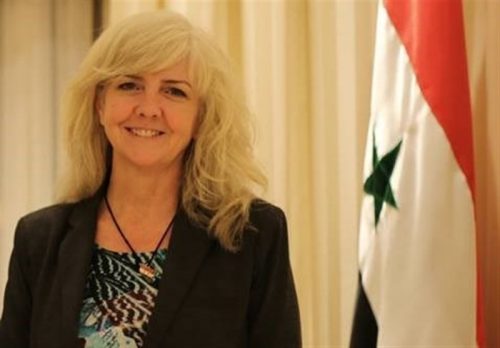
TEHRAN – A peace activist and journalist based in Virginia said Israeli Prime Minister Benjamin Netanyahu’s panic about recent advances of Iran and its allied forces against terrorists in Syria signals that the Tel Aviv regime is “losing its stranglehold” over Washington.
“Netanyahu’s panic and his incessant warnings regarding ‘Iranian expansion’ may be the most hopeful sign that Tel Aviv is losing its stranglehold over Washington,” Janice Kortkamp from Leesburg, Virginia, said in an interview with the Tasnim News Agency.
Following is the full text of the interview:
Tasnim: It seems that recent advances of the Syrian army and its allied forces against foreign-backed terrorist groups like Daesh (ISIS or ISIL) in the Arab country have infuriated the Israeli regime. A senior Israeli official has issued a warning to Russia that the Israeli military will bomb Syrian President Bashar Assad’s palace in Damascus if Russia allows Iran to make military advances in Syria, according to media reports. The official added another caution in the Al-Hayat al-Jadida newspaper that if regional changes don’t take place in the current advance by Iran, Israel will act to scuttle the Syrian ceasefire deal recently concluded by the US and Russian governments. The warnings came during a meeting last week on the Black Sea between Israeli Prime Minister Benjamin Netanyahu and Russian President Vladimir Putin. In your opinion, what is the reason behind the Israeli officials’ concerns?
Kortkamp: I believe this is an exceedingly dangerous time in the Syrian conflict; Israel is in a panic right now with the victory in the strategic Qalamoun region over Daesh. Israel’s goal has been to keep the war in Syria going indefinitely – for it to bleed to death – to weaken the Syrian Arab Republic (SAR) and Hezbollah just as they had wanted the war in Iraq to weaken both it and Iran. The opposite outcome has occurred with Hezbollah stronger and more respected than ever; the alliance and coordination between Syria, Hezbollah, Iran, and Russia also stronger; Iraq is also cooperating in many regards with that alliance, and President Putin is now seen as the predominant global strategist. Another factor is that Prime Minister Netanyahu is under investigation for fraud and corruption and a war would probably distract Israelis from pursuing an indictment. Netanyahu’s emotional entreaties to President Putin seemed to have fallen on deaf ears according to Pravda’s report of August 25 on the meeting, saying Israel’s Prime Minister failed to convince President Putin on the need to stop “Iran’s expansion in the Middle East.” In fact, the report stated the Kremlin is “interested to further strengthen Tehran’s influence in the region.” A trapped predator is the most dangerous however and many analysts, including former CIA operations operator who writes on these topics, Philip Giraldi, are predicting a preemptive strike against an Iranian target in Syria, which might escalate into greater involvement by the United States against Syria on Israel’s behalf.
Tasnim: As you may know, a US helicopter has recently transferred members of the Daesh terrorist group in Syria’s eastern province of Deir ez-Zor for the second time in a week, according to a UK-based monitoring group called Syrian Observatory for Human Rights (SOHR). The SOHR said the airlift was conducted in the town of al-Tabani. Measures taken by Washington up to now indicate that it has been seeking to destabilize the Arab country by arming and supporting the terrorists under the disguise of anti-terrorism coalition. What do you think about these developments?
Kortkamp: There are several points to consider:
1) I do not think of the SOHR as a credible resource, however that action would be consistent with other US actions in both Syria and Iraq so it could well be true.
2) The two previous administrations have held the goal of destabilizing Syria using covert pressure as well as through proxy forces armed and funded by the West’s allies in the Persian Gulf countries and Turkey. Little seems to have changed under President Trump, with the new administration putting considerable resources into supporting America’s latest “rebel” force – the SDF.
3) The support for Kurdish and other separatists is troubling and seems to indicate continued US commitment to dividing the northern part of Syria off which would be in line with Israel’s desires – it is no coincidence separatists are waving Israeli flags at rallies. President Trump has surrounded himself with advisors whose interests are “Israel first” and using military action to achieve it. UN Ambassador Nikki Haley discusses eliminating Iran from Syria as the only priority there and Jared Kushner is clearly under Netanyahu’s influence.
4) Top Israeli defense chiefs were in Washington recently to discuss Syria and they reiterated what anyone following this conflict knows, that the outcome of the war in Syria will reshape the region. It doesn’t appear though that the delegation from Tel Aviv went home with many reassurances.
5) President Trump’s turning over of the Afghanistan conflict to his generals is also troubling as it is in their interest to prolong every war and to create new ones. The Israeli delegation also put pressure on Washington to remain in and strengthen forces in Afghanistan.
6) All that being said, no one knows what was discussed between President Putin and President Trump. Netanyahu’s panic may be the most hopeful sign that his incessant warnings regarding “Iranian expansion” may finally be losing their stranglehold over Washington.
Tasnim: Iranian Deputy Foreign Minister for Arab and African Affairs Hossein Jaberi Ansari said on Monday that the next round of Syria peace talks in Kazakhstan’s capital city of Astana would be held in mid-September. What is your assessment about the previous rounds of the talks between Tehran, Moscow, and Ankara on the Syrian crisis? And what is your prediction about the result of the next round?
Kortkamp: The current agreement has allowed Syrian and allied forces to make considerable gains over the past months so I am hopeful the next round of talks may also be effective. I would never consider President Erdogan a trustworthy alliance member but the strength of Russia and Iran seems to have curtailed his actions against Syria.
Once again, everything is in the balance and the tipping point is Syria. Saudi Arabia is receiving greater criticism of their war against Yemen; their proxies in Syria are crumbling, and there is a deep schism now between them and Qatar. Israel is seeing their many-decades long plan for hegemony in the region failing.
The stakes are so very high. We are facing a possible regional conflagration that could dwarf the horrific wars of the past 13 years and ignite a global conflict, or the US and its allies may back down from Syria and let a much-needed balance occur in the region.
Janice Kortkamp became an independent, completely self-funded, journalist after “seeing Western media bias regarding Syria and how that bias was promoting war and destabilization in Syria and all the Levant”. She has researched the current crisis for over four years, putting in over 6,000 hours of study. She has visited Syria three times over the past year, spending three months traveling around the major population areas and the outskirts of Damascus, Homs, Latakia (including Kessab) and Aleppo. She has also gone to Germany, Lebanon, and Kuwait to meet with Syrian refugees and emigrants. Through friends and contacts in Syria as well as reports from genuine news sources around the world, she tracks the situation on the ground in Syria on an hourly basis.
September 6, 2017
Posted by aletho |
Ethnic Cleansing, Racism, Zionism, Wars for Israel | Israel, Middle East, United States, Zionism |
Leave a comment
After years of fomenting the Syrian conflict from the shadows, the U.S. has recently seemed to back away from its push to militarily intervene in the embattled nation, instead choosing to focus its saber-rattling and destabilization efforts on other theaters. The consequence of this has seemingly been the winding down of the long-running conflict, now entering its seventh year.
Buoyed by Russia, Iran and Lebanon, the Syrian government led by President Bashar al-Assad has managed to retake vast swaths of territory, all while surviving and growing stronger over the course of a largely foreign-funded onslaught. As a result, many of the governments that were instrumental in funding and arming the so-called “moderate” opposition have begun to extricate themselves, unwilling to further test the resilience of Assad or the Syrian people.
With some anticipating the long-awaited conclusion of the Syrian conflict, recent threats from Israel’s government to assassinate Assad by bombing his residence seemed to appear out of the blue. According to the Jerusalem Post, a senior Israeli official accompanying Israeli Prime Minister Benjamin Netanyahu on a recent visit to Russia warned the Kremlin that if Iran continues to “extend its reach” in Syria, Israel would bomb the presidential palace in Damascus.
Israel’s comments should come as no surprise, however, as the foreign-funded and manufactured conflict in Syria was always Israel’s war. The only real surprise is Israel’s growing isolation in pushing for the further escalation of the conflict.
WikiLeaks sheds light on the origins of the war
Though it has successfully avoided being labeled a major player in the effort to oust Assad, Israel has long been the mastermind of the plan, which stems in large part from the long-standing hostilities between the two nations as well as Israel’s own regional ambitions. State Department diplomatic cables released by WikiLeaks have shown that in 2006, five years before the conflict in Syria manifested, the government of Israel had hatched a plan to overthrow the Assad government by engineering sectarian strife in the country, creating paranoia within the highest-ranks of the Syrian government, and isolating Syria from its strongest regional ally, Iran.
Israel then passed this plan along to the United States, which would then involve Saudi Arabia, Turkey, Qatar and Egypt in fomenting the “breakdown” of the Assad regime as a way of weakening both Iran and Hezbollah — with the effect of empowering both Israel and the Gulf monarchies, two seemingly disparate forces in the region that are becoming increasingly allied.
Leaked emails belonging to former Secretary of State Hillary Clinton further reveal Israel’s role in covertly creating the conflict and its clear role in securing the involvement of the U.S. and other nations in executing its plan for Assad’s removal. One email, forwarded by Clinton to her advisor Jacob Sullivan, argues that Israel is convinced that Iran would lose “its only ally” in the region were Assad’s government to collapse.
It further stated that “The fall of the House of Assad could well ignite a sectarian war between the Shiites and the majority Sunnis of the region drawing in Iran, which, in the view of Israeli commanders would not be a bad thing for Israel and its Western allies.” This possible sectarian war was perceived as a potential “factor in the eventual fall of the current government of Iran.”
Another Clinton email released by WikiLeaks stated:
“The best way to help Israel deal with Iran’s growing nuclear capability is to help the people of Syria overthrow the regime of Bashar Assad,
Adding
Bringing down Assad would not only be a massive boon to Israel’s security, it would also ease Israel’s understandable fear of losing its nuclear monopoly.”
The email also notes:
A successful intervention in Syria would require substantial diplomatic and military leadership from the United States” and states that “arming the Syrian rebels and using western air power to ground Syrian helicopters and airplanes is a low-cost high payoff approach.”
Read the full Wikileaks release below:
Stated plainly, the U.S.’ decision to spend over $1 billion until 2015 to arm Syria’s terrorist-linked “rebels” — and to invoke the assistance of Wahhabi terrorism exporters like Saudi Arabia and Qatar in funneling weapons and funds to these same groups — was spurred by Israel, which not only drafted the original blueprint for the Syrian conflict but guided U.S. involvement by exerting its powerful influence over the foreign policy of that country.
Aiding the Rebels
Israel did more, however, than covertly instigate and guide the funding of opposition “rebels” — having secretly funded and aided opposition groups, including ones with overt terrorist affiliations, over the course of the six-year-long conflict.
Israeli involvement in direct funding and aiding the Syrian “rebels” was suspected for years before being officially made public by the Wall Street Journal in June of this year. The report revealed that Israel, since the beginning of the conflict, had been “supplying Syrian rebels near its border with cash as well as food, fuel, and medical supplies for years, a secret engagement in the enemy country’s civil war aimed at carving out a buffer zone populated by friendly forces.” Israel has also frequently brought wounded “rebels” into Israel for medical treatment, a policy it often touts as a “humanitarian effort.”
These “friendly” forces were armed groups that formed part of or were allied with al-Nusra Front, al-Qaeda’s Syrian branch, known for committing atrocities against thousands of Syrian civilians and slaughtering religious and ethnic minorities. Since 2013, al-Qaeda-affiliated terrorist groups have dominated the “eight-square-kilometer separation zone on the Golan.” Israel has stated officially that these fighters are part of the U.S. coalition-supported Free Syrian Army (FSA). However, it has long been known that the vast majority of the groups comprising FSA have pledged allegiance to the al-Qaeda-affiliated al-Nusra Front, and that those who still fight under the FSA banner meet with al-Nusra on a daily basis.
Israel’s support for terrorist groups went far beyond medical treatment, food supplies and cash. The Israeli army was also found to have been in regular communication with these terrorist groups and even helped “pay salaries of fighters and buy ammunition and weapons.” In addition, when the positions of the “rebel” groups it funded, armed and paid were in danger of being overtaken by Syrian government forces, Israel stepped in to directly bomb Syrian targets. For instance, in June, Israel attacked several Syrian military positions after claiming a stray mortar had landed within the boundaries of the Golan Heights, part of Syria that has long been occupied by Israel. However, the attack tellingly coincided with Syrian army advancements against the “rebel” groups that Israel has long cultivated as part of the so-called “buffer zone.”
Furthermore, Israel has launched attacks inside Syria “dozens and dozens of times,” according to a recent admission by Netanyahu. Earlier this year, Israel also threatened to “destroy” Syrian air defenses after the Syrian army fired missiles at Israeli warplanes striking targets within Syria.
Also very telling has been Israel’s position on Daesh (ISIS). In June of last year, Israel’s military intelligence chief, Major General Herzi Halevi, openly stated that Israel does not want to see Daesh defeated in Syria — expressing concern about the offensives against Daesh territory and lamenting their “most difficult” situation. Prior to Halevi’s comments, Israeli officials had regularly noted that Daesh conquering the whole of Syria would be preferable to the survival of the Assad government. These comments have been echoed by Israeli and NATO-affiliated think tanks, one of which called Daesh “a useful tool in undermining” Iran, Hezbollah, Syria and Russia — despite Daesh’s barbaric tactics, war crimes, enslavement of women and ethnic cleansing efforts.
Israel’s larger geopolitical agenda
Though Israel’s support of Wahhabi terrorists like Daesh (ISIS) and al-Nusra may seem counter-intuitive, Israel’s overarching purpose in expelling Assad from power is based on strategic geopolitical and economic goals that Israel is determined to meet at any cost. While Israel frequently mentions Iran as the pretext for its involvement in Syria, the strongest motivators for Israel’s participation in the destruction of its northern neighbor are oil and territorial expansion.
One of Israel’s clearest reasons for being interested in the destabilization of Syria is its ability to assert further control of the Golan Heights, an area of Syria that Israel has illegally occupied since 1967 and annexed in 1981. Despite filling the area with illegal settlements and military assets, Israel has been unable to convince the international community, and even its close allies such as the U.S., to recognize its sovereignty over the territory. However, the conflict in Syria has proven beneficial to this end, allowing Israel to send even more settlers into the Golan, an estimated 100,000 over five years.
Israel is largely interested in gaining control over the Golan for economic reasons, owing to the occupied territory’s oil reserves, which are estimated to contain “billions of barrels.” Under the cover of the Syrian conflict, the Israeli branch of an American oil company — whose investors include Dick Cheney, Jacob Rothschild and Rupert Murdoch — has been drilling exploratory wells throughout the region, as the Heights’ uncertain territorial status prevents Israel from financially exploiting the resource.
Despite the prohibitions of international law, Israel is eager to tap into those reserves, as they have the potential to “make Israel energy self-sufficient.” Israel has even offered, per the Galant plan, to “rebuild” Syria with billions in U.S. taxpayer dollars in exchange for the Golan Heights — though the plan received a tepid reception from all involved parties other than Israel itself.
As its stands, Assad’s removal and replacement with a government friendly to Israeli and Western interests is Israel’s only real means of claiming the Golan Height’s energy resources for itself.
Pawns blocking Israel’s endgame
Aside from the oil and the territory it seeks to gain in the Golan Heights, Israel is also seeking to expand well beyond that territory in order to more widely exert its influence and become the region’s “superpower.” This ambition is described in the Yinon Plan, a strategy intended to ensure Israel’s regional superiority in the Middle East that chiefly involves reconfiguring the entire Arab world into smaller and weaker sectarian states. This has manifested in Israel’s support for the partition of Iraq as well as Syria, abetted by its support for the establishment of a separatist Kurdish state within these two nations.
This goal, in particular, largely explains Israel’s obsession with curbing Iranian influence in the Middle East, whether in Syria or elsewhere. Iran – more than any other nation in the region – is the most likely to threaten the “superpower” status that Israel seeks to gain for itself, as well as Israel’s loss of monopoly as the region’s only nuclear power.
Given Israel’s compound interests in seeing the removal of Assad and the partition of Syria, it is hardly surprising that Israeli political rhetoric has reached new heights of saber-rattling as Tel Aviv becomes increasingly concerned that the conflict it masterminded could backfire. Prior to the explosive comments regarding Israeli threats to bomb Assad’s residence, an anonymous Israeli government minister blamed the U.S. for backing out of Syria, a move he argued sacrificed Israeli interests:
The United States threw Israel under the bus for the second time in a row. The first time was the nuclear agreement with Iran, the second time is now that the United States ignores the fact that Iran is obtaining territorial continuity to the Mediterranean Sea and Israel’s northern border [through Syria].”
Not only that but Israel has recently vowed to “nullify” the ceasefire deal brokered between Russia and the U.S. with Syrian and Iranian support if it fails to comply with Israel’s needs — an ultimatum based on rather subjective terms given that “Israel’s needs” are hardly static. Israel’s response again shows the perception among officials in Tel Aviv that the Syrian conflict is of primary importance to Israeli geopolitical interests.
Furthermore, given that the response suggested so far by Israeli officials – on more than one occasion – has been to assassinate Syria’s democratically-elected President – the contemplated means of Israel “nullifying” the ceasefire deal will likely have explosive implications. Israel — apparently refusing to accept that the conflict it orchestrated is not going, and may not end, as planned — is now willing to escalate the situation militarily, with or without allies, resorting to dangerous brinkmanship with global implications.
September 5, 2017
Posted by aletho |
Illegal Occupation, Timeless or most popular, War Crimes, Wars for Israel | al-Nusra Front, al-Qaeda, Hillary Clinton, ISIS, Israel, Middle East, Saudi Arabia, Syria, Turkiye, United States, Zionism |
Leave a comment
The American Legion finally calls for a congressional inquiry
On June 8th 1967 the United States Navy intelligence ship the U.S.S. Liberty was attacked in international waters by aircraft and vessels belonging to Israel. Thirty-four sailors, Marines and civilians were killed in the attack. The deliberate Israeli air and sea onslaught sought to sink the clearly identified intelligence gathering ship and kill all its crew. It was in truth the worst attack ever carried out on a U.S. Naval vessel in peace time. In addition to the death toll, 171 more of the crew were wounded in the two-hour assault, which was clearly intended to destroy the intelligence gathering vessel operating in international waters collecting information on the ongoing fighting between Israel and its Arab neighbors. The Israelis, whose planes had their Star of David markings covered up so Egypt could be blamed, attacked the ship repeatedly from the air and with torpedo boats from the sea. When one Israeli pilot hesitated, refusing to attack what was clearly an American ship, he was instructed to proceed anyway.
Most Americans are completely unaware that a United States naval vessel was once deliberately targeted and nearly sunk by America’s “greatest friend and ally” Israel. The attack was followed by a comprehensive cover-up that demonstrated clearly that at least one president of the United States even back nearly fifty years ago valued his relationship with the state of Israel above his loyalty to his own country.
The most disgusting part of the tale relates to how U.S. warplanes sent to the Liberty’s aid from an aircraft carrier in the Mediterranean were called back by Defense Secretary Robert McNamara acting under orders from President Lyndon Baines Johnson, who declared that he would rather see the ship go to the bottom of the sea than embarrass his good friend Israel. Ironically, the first ship to reach the foundering Liberty and offer assistance was from the Soviet Union, an offer that was declined.
The incredible courage and determination of the surviving crew was the only thing that kept the Liberty from sinking. The ship’s commanding officer Captain William McGonagle was awarded a Congressional Medal of Honor for his heroic role in keeping the ship afloat, though President Lyndon Baines Johnson broke with tradition and refused to hold the medal ceremony in the White House, also declining to award it personally, delegating that task to the Secretary of the Navy in a closed to the public presentation made at the Washington Navy Yard. The additional medals given to other crew members in the aftermath of the attack made the U.S.S. Liberty the most decorated ship based on a single engagement with hostile forces in the history of the United States Navy.
The cover-up of the attack began immediately. The Liberty crew was sworn to secrecy over the incident, as were the Naval dockyard workers in Malta, and even the men of the U.S.S. Davis, which had assisted the badly damaged Liberty to port were ordered to be silent. A hastily convened and conducted court of inquiry ordered by Admiral John McCain interviewed only a few crewmen and did not seek to determine what had actually happened, instead, acting under orders from Washington, it moved quickly to declare the attack a case of mistaken identity. The inquiry’s senior legal counsel Captain Ward Boston, who subsequently declared the attack to be a “deliberate effort to sink an American ship and murder its entire crew,” also revealed that Admiral Isaac Kidd, who presided over the inquiry, had told him that “President Lyndon Johnson and Secretary of Defense Robert McNamara ordered him [Kidd] to conclude that the attack was a case of ‘mistaken identity’ despite overwhelming evidence to the contrary.” The court’s findings were rewritten and sections relating to Israeli war crimes, to include the machine gunning of life rafts, were excised.
Following in his father’s footsteps, Senator John McCain of Arizona has used his position on the Senate Armed Services Committee to effectively block any reconvening of a board of inquiry to reexamine the evidence. The documents relating to the Liberty incident from the White House perspective of McNamara and Johnson, if they have not been destroyed, have never been released to the public in spite of the 50 years that have passed since the attack took place.
In retrospect, one might well have expected little better from the likes of Lyndon Johnson, Robert McNamara and either Admiral John McCain or his son, but the cover-up that has endured for fifty years involving the national media as well as politicians from both parties is perhaps even more disgraceful because it has established the principle that even when Israel targets and kills American military personnel it will never ever be held accountable. Such is the power of the Israel Lobby in the United States.
Even if one is not exactly surprised by the behavior of Washington’s own apparatchiks there has been one constituency that has been steadfast in its support of the U.S.S. Liberty and its surviving crew and that is America’s veterans. Or at least that has been true with one major exception, consisting of the largest veterans’ organization, the American Legion. The second largest veterans’ group the Veterans of Foreign War (VFW) has long demanded a proper investigation into what happened to the Liberty as have also the Military Order of the Purple Heart, Disabled Veterans of America, and the Retired Officers Association, but the Legion has long been actually hostile to any attempts to establish accountability for the Liberty survivors.
The Legion’s history of opposition to any examination of what happened to the U.S.S. Liberty is interesting in that it demonstrates how one or two individuals can work insidiously within a large organization to prevent the endorsement of policies overwhelmingly favored by most of its members. The American Legion did, in fact, decry the Israeli attack on the Liberty shortly after it occurred. In August 1967, after the conclusion of the flawed Admiral John McCain directed inquiry, the American Legion adopted Resolution 508 declaring that the published report “fails to provide the American public with a satisfactory answer as to the reason for the attack.” It asserted that “The American Legion denounces and condemns Israel’s irresponsible attack” and demanded “a complete and thorough investigation of the incident.” Immediately after the passage of the resolution there were complaints and pressure coming from Jewish groups and individuals, which is why the resolution was unfortunately never acted upon at a time when it might have had some impact on a congress that was not yet completely Israeli occupied territory. The 1967 resolution was rescinded by the Legion’s National Executive Committee in 1984.
There followed more than thirty years of futility as Liberty survivors and veterans groups sought to reintroduce their demand for a proper inquiry as an active American Legion resolution, but the group’s National Executive exploited a number of stratagems to block every attempt to introduce a new resolution, including rejecting proposals in committee, changing convention rules and physically confronting and expelling those who objected. Indeed, the Legion’s executive did its best to drop the U.S.S. Liberty story down a memory hole. An article written by James Ennes, an officer wounded in the attack, was commissioned for publication in the Legion magazine but was pulled at the last minute because it was “too controversial.”
Efforts by the Legion’s Michigan Department in 2012 to introduce a new resolution resulted in some heated exchanges with senior Legion officials who clearly were the driving force on blocking any action relating to the Liberty. The Legion’s Judge Advocate General Phil Onderdonk confronted the Michigan delegate Ted Arens and angrily informed him that “Your resolution is going nowhere” before describing the Liberty survivors as “anti-Semites.” He also said that “The ship should never have been there. It was a spy ship.” Onderdonk was true to his word about the resolution going nowhere. He reportedly personally removed Arens’ name from the foreign affairs committee agenda to block him from either speaking or presenting his resolution.
Onderdonk’s name pops up regularly in the reminiscences of those who have been advocating for a new Liberty resolution. Indeed, he appears to have been the Legion point-man for dealing with the U.S.S. Liberty inquiries. He is a lawyer from Indiana who served as a “contracting officer” during the Vietnam War. Onderdonk was obviously badly informed regarding the facts in the case as the Liberty was in international waters and clearly marked as an American vessel. And if it was a spy ship, that spying was being done under orders from and to benefit the United States government. And, of course, the claim of anti-Semitism is as ever the last refuge of a scoundrel who has nothing better to say, particularly if one is allegedly representing a patriotic organization and is discussing a surprise attack by a foreign government in which 34 American sailors, Marines and civilians were killed.
I should also note that Onderdonk has been the Legion Judge Advocate General since 1983, shortly before the original Liberty resolution by the Legion was rescinded. If past interaction with Liberty survivors is anything to go by, it can be assumed that he will do everything in his power to block any recognition for the ship and its crew. He is, unfortunately, still the Legion Judge Advocate General and it is at least somewhat ironic that a Religious Liberty Award has been named in his honor and recently presented to Senator Ted Cruz.
Also in 2012, two Liberty survivors were turned away from the annual convention where they had expected to man a booth for the Liberty Veterans Association, which they had paid for. They were forcibly ejected from the convention hall and the Legion’s conference coordinator Dick Holmes turned on Arens and told him “I am sick of you bastards and am going to throw you out on your ass.” In 2013, Liberty survivors’ application for a booth was similarly rejected without any reason being offered. In the following year, the Legion reached out to the VFW and tried to convince it to ban the Liberty survivors from its own gatherings. The VFW rejected the appeal.
So the attempt of the U.S.S. Liberty survivors and their supporters to get the American Legion on board for an inquiry seemed doomed to fail – until this year, the 50th anniversary of the attack. A new resolution was adopted in March by Post 40 in Seattle Washington and was later passed unanimously at the State of Washington’s own American Legion convention, thus placing it on the agenda of the national convention. It was then endorsed by the Iowa delegation, which introduced it to the Foreign Relations subcommittee. Gunnery Sergeant Bryce Lockwood, who received a Silver Star for gallantry during the Israeli attack, worked the August 17-24 national convention in Reno and performed heroically for a second time on behalf of his shipmates, shepherding the draft resolution through in spite of resistance from the American Legion Executive and Foreign Relations subcommittee chair William Flanagan.
One of the participants in the process described how the critical vote came at the National Security Committee level, which was where previous draft resolutions had been derailed. The National Executive had recommended against the resolution and there was considerable opposition from the leadership on the Foreign Relations subcommittee, but the rank-and-file on Foreign Relations did not back down and were successful in a 27-11 vote. The Security Committee then passed it on an overwhelmingly favorable voice vote, with Gunny Lockwood working hard from the sidelines on both committees as well as on the convention floor. When the resolution finally was presented to the full membership it easily passed on another voice vote, revealing that there was strong support from the Legion membership.
Resolution 40 begins by making the case for the Liberty in 11 “Whereas” paragraphs. It then states: “RESOLVED, By The American Legion in National Convention assembled in Reno, Nevada, August 22, 23, 24, 2017, that The American Legion calls upon the 115th United States Congress to publicly, impartially, and thoroughly investigate the attack on the USS Liberty and its aftermath and to commence its investigation before the end of 2017, the 50th anniversary year of the attack.”
Whether Congress can be induced to do the right thing by the Liberty remains to be seen, but the adoption of the resolution was a major victory brought about by a confluence of factors as well as a lot of hard work on the part of the Liberty survivors and their supporters. And certainly, it is no time to relax as the Israel Lobby never sleeps, never gives up. The resolution is posted on the American Legion website but one should assume that there will still be some pushback against actually doing anything about the resolution being exerted by senior officials within the American Legion bureaucracy. Israel meanwhile will certainly use all the resources that it has at hand, and they are considerable, to make sure that Congress never looks into the attack on the U.S.S. Liberty in any capacity.
We Americans who care for the Liberty and are concerned by the 50 years of lies, cover-up and general obfuscation regarding it can do our bit by calling or writing our members of Congress to remind them that all major veterans groups now are expecting action. We should also tell them that the investigation into what happened on that day is way past due. Sometimes even Senators and Representatives listen.
September 5, 2017
Posted by aletho |
Deception, Ethnic Cleansing, Racism, Zionism, False Flag Terrorism, Timeless or most popular, War Crimes | Israel, Lyndon Johnson, Middle East, U.S.S. Liberty, United States |
Leave a comment
The UAE has paid tens of millions of dollars to expand its regional and international influence by buying positions and the loyalty of key figures, an Al Jazeera documentary has said.
Aired yesterday, “Men around Abu Dhabi” claimed the Emirates paid former British Prime Minister Tony Blair, the international envoy to Libya Bernardino Leon and a number of leaders of the US Department of Defence in order to keep them on side.
The channel said that UAE paid $35 million to Tony Blair when he was the envoy for the Middle East Quartet. He was also paid as a consultant, leaked email published by the Sunday Telegraph revealed.
The UAE government paid about $53,000 per month to the Spanish diplomat Bernardino Leon.
Last year, the UAE Diplomatic Academy, which is headed by the UAE’s Minister of Foreign Affairs and Chairman of its Board of Trustees, Sheikh Abdullah Bin Zayed Al Nahyan, announced that Leon, who served as UN envoy to Libya, will be assigned as its general manager.
At that time, media sources considered the news as a scandal that would undermine the credibility of the United Nations.
Abu Dhabi also paid $20 million in donations to the Middle East Institute in Washington, which is run by US General Anthony Zinni.
Zinni is an American general who once led US forces in the Middle East. After retiring, he served as a special envoy to the region. The US administration chose him and Assistant Secretary of State for Near Eastern Affairs, Timothy Lenderking, as envoys to support the Kuwaiti mediation to resolve the Gulf crisis.
There is also James Mattis, the current US secretary of defence, who was previously hired by the UAE as a military adviser to develop its army and Robert Gates, the former US secretary of defence who attacked Qatar’s policies and Al Jazeera.
The documentary also revealed that Turki Aldakhil, the director of Al Arabiya TV channel, received more than $23 million in return for promoting Abu Dhabi’s agenda in the region.
On 5 June, Saudi Arabia, the UAE, Bahrain and Egypt severed diplomatic relations with Qatar and imposed punitive measures on the small Gulf state accusing it of “supporting terrorism”. Doha strongly denied the claims.
August 31, 2017
Posted by aletho |
Corruption, Deception | Middle East, Qatar, Tony Blair, UAE, UK, United States |
Leave a comment
In the UK, parliament may still be in summer recess, but government ministers aren’t resting. Defense Minister Michael Fallon jetted to Oman August 28 to cement a number of military agreements with the Sultanate’s leaders. The inking represents a continuation of a longstanding and rarely examined “special relationship” between the two countries.
During his two day visit, Fallon met with Sayyid Badr bin Saud bin Harub Al Busaidi, Oman’s Minister Responsible for Defense Affairs, in Muscat. The pair signed a “Memorandum of Understanding and Services Agreement” that secures UK use of naval facilities at Duqm Port — a multi-million dollar joint venture between the two countries.
An official statement issued by the Foreign & Commonwealth Office said the “booming” Port complex would provide “significant opportunity” for the two countries’ “defense, security and prosperity agendas,” and serve as a home from home for the UK’s flagship aircraft carrier, HMS Queen Elizabeth.
“This agreement ensures British engineering expertise will be involved in developing Duqm as a strategic port for the Middle East, benefiting the Royal Navy and others. Oman is a longstanding British ally and we work closely across diplomatic, economic and security matters. Our commitment to the Duqm project highlights the strength of our relationship,” Fallon said.
The Defense Minister’s visit gained virtually no recognition in the UK media — while the traditional paucity of official government business to report on over the summer arguably makes the story a prime candidate for press coverage, radio silence on UK-Oman relations is a seemingly enduring mainstream editorial policy.
Declassified British government files reveal the oil-rich Gulf state’s leader Sultan Qaboos bin Said al Said — one of the longest serving unelected rulers in the world — was brought to power in a 1970 palace coup planned by UK foreign intelligence service MI6, and sanctioned by then-Prime Minister Harold Wilson. The Sultan has absolute power in governance, and is also the country’s Prime Minister and Minister of Defense, with total authority over Oman’s judicial and legal systems.
Ever since the coup, Oman has proven a most faithful ally to the UK, hosting a number of major British intelligence and military operations.
For example, UK spying agency GCHQ has three separate bases in the country — codenamed Timpani Guitar and Clarinet — that feed off various undersea cables passing through the Strait of Hormuz to the Arabian Gulf. In the process, the bases intercept and process a vast volume of emails, telephone calls and web traffic generated in the region, which is then shared with the US’ National Security Agency.
Moreover, UK troops have long trained Omani armed forces, and in May 2016 it was announced the UK would increase its number of training teams in Oman from 34 to 45 in 2017.
August 30, 2017
Posted by aletho |
Illegal Occupation, Militarism | Duqm, Middle East, Oman, UK |
Leave a comment
There is no doubt that Vladimir Putin is the world’s most powerful President. By comparison, while China’s Xi Jinping is highly powerful and intelligent, China’s leadership retains a collective element while in Russia, Vladimir Putin maintains an unwritten but obvious veto power over all major decisions. In the United States, the very idea that Donald Trump is an all-powerful President is now laughable even to most Americans, including those who support Donald Trump.
By the same extrapolation it is abundantly clear that Benjamin Netanyahu, the Israeli leader is the world’s most powerful liar. His power comes from the fact that he is in charge of the highest portion of weapons of mass destruction in the Middle East, including nuclear weapons.
His dishonesty is immediately revealed by his statements about Iran. When speaking in front of the Russian President, Netanyahu said, “… where the defeated Islamic State (Daesh) group vanishes, Iran is stepping in”.
This statement is disingenuous on many levels. First of all, Netanyahu stated to Putin that he felt that Iran is a danger and secondly, that this danger is tantamount to that of Daesh.
Iran has not invaded a country in its modern history and there is no evidence to indicate that this will change. By contrast, Israel occupies Syria and Palestine and formerly occupied Lebanon and Egypt. During the course of Syria’s struggle against Takfiri terrorism, Israel repeatedly bombed Syria illegally. Inversely, Iran’s presence in Syria, like that of Russia, is legal according to international law as it is at the behest of the Syrian government.
Secondly, to equate a state like Iran with Daesh is preposterous. Iran is first of all far more powerful than Daesh has ever been. Daesh is a terrorist group which is quickly crumbling in both Syria and Iraq. Iran is a large state with a professional and highly trained armed forces.
Iran however, uses its military and political influence to fight Takfiri terrorism whose methods, and sinister ideology is anathema to the Iranian Constitution and to the values of the Islamic Revolution.
If one is even slightly interested in fighting Daesh, it logical to thank Iran for its valiant efforts against the wicked group which along with Russia are the only two major non-Arab countries which are combatting a group which has set up base across the Arab world.
During his meeting with Vladimir Putin, Netanyahu also said, “Iran is already well on its way to controlling Iraq, Yemen and to a large extent is already in practice in control of Lebanon”.
This again is a lie. Iran controls Iran and no one else. Iran does not have puppet states in the region in the way that America has had and continues to have puppet states and client states throughout the world. What Iran does have and what it has increasingly, is respect in the Arab world. Iranian forces are in Syria because the Syrian government asked for their assistance in fighting Takfiri terrorism and Iran agreed. Russia finds itself in the same position.
Iran has many supporters and admirers in Baghdad and Iran has helped train Iraqi volunteer units which are fighting and winning the battle against Daesh in Iraq. In Lebanon, Hezbollah is of course a pro-Iranian political party, one which holds two Cabinet level ministers in the Lebanese government. Hezbollah’s military aims are defensive. Their primary goal is to prevent further occupations of Lebanon by Israel. Hezbollah also has worked with the Syrian government to fight Daesh and al-Qaeda.
Israel is a country that has fought wars with all of its neighbours and has occupied most of them. Iran by contrast has occupied none of its neighbours but in the 1980s was the victim of a war that Iraq started with western support. The two situations are objectively incomparable.
One does not have to be ‘pro-Iranian’ to realise this fact. It is a fact that the world acknowledges, including elements of the Arab world which are hostile to Iran.
Vladimir Putin wisely refrained from responding to Netanyahu’s anti-Iranian tirade. The nature of modern Russian diplomacy is to quietly execute its objectives without needlessly entering into arguments with extremists.
Previously, when Netanyahu told historical untruths about Iran, Vladimir Putin did intervene, telling Netanyahu that it is best to focus on modern events rather than ancient history.
Israel’s anti-Iranian rhetoric is increasingly unpopular in the wider world. Even in Europe, most companies and many countries would rather do business with Iran rather than enter into an ideological struggle on Israel’s terms.
Only the United States, Saudi Arabia and Saudi’s client states share Israel’s stance about Iran and none of the Arab countries have the ability or in reality the nerve to start a war with Iran that they would clearly not win.
The great pity is not that Netanyahu continues to tell provocative lies about Iran and the wider region, the pity and the danger is that anyone could still believe him. Iran does not threaten any nation with aggressive war, but if Netanyahu’s impassioned rhetoric foments a war, Iran will defend itself. Those interested in peace ought to ignore Netanyahu and work instead for the important cause of greater peace, cooperation and dialogue, not just in the Middle East but in the wider world.
Copyright © Adam Garrie, Global Research, 2017
August 28, 2017
Posted by aletho |
Deception | al-Qaeda, Benjamin Netanyahu, Da’esh, Iran, Middle East, Vladimir Putin, Zionism |
Leave a comment
Despite the chaos and ugliness of the past seven months, President Trump has finally begun to turn U.S. foreign policy away from the neoconservative approach of endless war against an ever-expanding roster of enemies.
This change has occurred largely behind the scenes and has been obscured by Trump’s own bellicose language, such as his vow to “win” in Afghanistan, and his occasional lashing out with violence, such as his lethal Tomahawk missile strike on a Syrian airfield.
Some Trump advisers also have downplayed the current shift because it may fuel the Democrats’ obsession with Russia-gate as a much-desired excuse to impeach Trump. Every peaceful move that Trump makes is called a sop to Russia and thus an excuse to reprise the dubious allegations about Russia somehow helping to elect him.
Yet, despite these external obstacles and Trump’s own erratic behavior, he has remained open to unconventional alternatives to what President Obama once criticized as the Washington “playbook,” i.e. favoring military solutions to international problems.
In this sense, Trump’s shallow understanding of the world has been a partial benefit in that he is not locked into the usual Washington groupthinks – and he personally despises the prominent politicians and news executives who have sought to neuter him since his election. But his ignorance also prevents him from seeing how global crises often intersect and thus stops him from developing a cohesive or coherent doctrine.
Though little noted, arguably the most important foreign policy decision of Trump’s presidency was his termination of the CIA’s covert support for Syrian rebels and his cooperation with Russian President Vladimir Putin to expand partial ceasefire zones in Syria.
By these actions, Trump has contributed to a sharp drop-off in the Syrian bloodshed. It now appears that the relatively secular Syrian government of President Bashar al-Assad is regaining control and that some Syrian refugees are returning to their homes. Syria is starting the difficult job of rebuilding shattered cities, such as Aleppo.
But Trump’s aversion to any new military adventures in Syria is being tested again by Israeli Prime Minister Benjamin Netanyahu, who is threatening to attack Iranian and Hezbollah forces inside Syria.
Last week, according to Israeli press reports, a high-level delegation led by Mossad chief Yossi Cohen carried Netanyahu’s threat to the U.S. government. The Israeli leader surely has raised the same point directly in phone calls with Trump.
Tiring of Bibi
I was told that Trump, who appears to be growing weary of Netanyahu’s frequent demands and threats, flatly objected to an Israeli attack and brushed aside Israel’s alarm by noting that Netanyahu’s policies in supporting the rebels in Syria contributed to Israel’s current predicament by drawing in Iran and Hezbollah.
This week, Netanyahu personally traveled to Sochi, Russia, to confront Putin with the same blunt warning about Israel’s intention to attack targets inside Syria if Iran does not remove its forces.
A source familiar with the meeting told me that Putin responded with a sarcastic “good luck!” and that the Russians thought the swaggering Netanyahu appeared “unhinged.”
Still, a major Israeli attack on Iranian positions inside Syria would test Trump’s political toughness, since he would come under enormous pressure from Congress and the mainstream news media to intervene on Israel’s behalf. Indeed, realistically, Netanyahu must be counting on his ability to drag Trump into the conflict since Israel could not alone handle a potential Russian counterstrike.
But Netanyahu may be on somewhat thin ice since Trump apparently blames Israel’s top American supporters, the neocons, for much of his political troubles. They opposed him in the Republican primaries, tilted toward Hillary Clinton in the general election, and have pushed the Russia-gate affair to weaken him.
President Obama faced similar political pressures to fall in line behind Israel’s regional interests. That’s why Obama authorized the covert CIA program in Syria and other aid to the rebels though he was never an enthusiastic supporter – and also grew sick and tired of Netanyahu’s endless hectoring.
Obama acquiesced to the demands of Official Washington’s neocons and his own administration’s hawks – the likes of Secretary of State Hillary Clinton, CIA Director David Petraeus, his successor John Brennan, and United Nations Ambassador Samantha Power.
The Syrian conflict was part of a broader strategy favored by Washington’s neocons to overthrow or cripple regimes that were deemed troublesome to Israel. Originally, the neocons had envisioned removing the Assad dynasty soon after the invasion of Iraq in 2003, with Iran also on the “regime change” menu. But the disastrous Iraq War threw off the neocons’ timetable.
‘Regime Change’ Chaos
The Democratic Party’s liberal interventionists, who are closely allied with the Republican neocons, also tossed in Libya with the overthrow and murder of Libyan leader Muammar Gaddafi in 2011. Then, weapons from Gaddafi’s stockpiles were shipped to Syria where they strengthened rebel fighters allied with Al Qaeda’s Nusra Front and other Islamist groups.
Faced with this troubling reality – that the U.S.-backed “moderate rebels” were operating side by side with Al Qaeda’s Syrian affiliate and its allies – Washington’s neocons/liberal-hawks responded with sophisticated propaganda and devised clever talking points to justify what amounted to indirect assistance to terrorists.
The “regime change” advocates portrayed a black-and-white situation in Syria with Assad’s side wearing the black hats and various anti-Assad “activists” wearing the white hats (or literally White Helmets). The State Department and a complicit mainstream media disseminated horror stories about Assad and – when the reality about Al Qaeda’s role could no longer be hidden – that was spun in the rebels’ favor, too, by labeling Assad “a magnet for terrorists” (or later in cahoots with the Islamic State). For years, such arguments were much beloved in Official Washington.
But the human consequences of the Syrian conflict and other U.S.-driven “regime change” wars were horrific, spreading death and destruction across the already volatile Middle East and driving desperate refugees into Europe, where their presence provoked political instability.
By fall 2015, rebel advances in Syria – aided by a supply of powerful U.S. anti-tank missiles – forced Russia’s hand with Putin accepting Assad’s invitation to deploy Russian air power in support of the Syrian army and Iranian and Hezbollah militias. The course of the war soon turned to Assad’s advantage.
It’s unclear what Hillary Clinton might have done if she had won the White House in November 2016. Along with much of the U.S. foreign policy establishment, she called repeatedly for imposing a “no-fly zone” in Syria to stop operations by the Syrian air force and Russia, a move that could have escalated the conflict into World War III.
But Trump – lacking Official Washington’s “sophistication” – couldn’t understand how eliminating Assad, who was leading the fight against the terrorist groups, would contribute to their eventual defeat. Trump also looked at the failure of similar arguments in Iraq and Libya, where “regime change” produced more chaos and generated more terrorism.
Pandering to Saudis/Israelis
However, in the early days of his presidency, the unsophisticated Trump lurched from one Middle East approach to another, initially following his son-in-law Jared Kushner’s grandiose thinking about recruiting Saudi Arabia to an “outside-in” strategy to settle the Israel-Palestine conflict, i.e., enlisting the Saudis to pressure the Palestinians into, more or less, letting Israel dictate a solution.
Kushner’s “outside-in” scheme was symbolically acted out with Trump making his first overseas visit to Saudi Arabia and then to Israel in May. But I’m told that Trump eventually cooled to Kushner’s thinking and has come to see the Israeli-Saudi tandem as part of the region’s troubles, especially what he views as Saudi Arabia’s longstanding support for Al Qaeda and other terror groups.
Perhaps most significantly in that regard, Trump in July quietly abandoned the CIA’s covert war in Syria. In the U.S., some “regime change” advocates have complained about this “betrayal” of the rebel cause and some Democrats have tried to link Trump’s decision to their faltering Russia-gate “scandal,” i.e., by claiming that Trump was rewarding Putin for alleged election help.
But the bottom line is that Trump’s policy has contributed to the Syrian slaughter abating and the prospect of a victory by Al Qaeda and/or its Islamic State spinoff fading.
So, there has been a gradual education of Donald Trump, interrupted occasionally by his volatile temper and his succumbing to political pressure, such as when he rushed to judgment on April 4 and blamed the Syrian government for a chemical incident in the remote Al Qaeda-controlled village of Khan Sheikhoun.
Despite strong doubts in the U.S. intelligence community about Syria’s guilt – some evidence suggested one more staged “atrocity” by the rebels and their supporters – Trump on April 6 ordered 59 Tomahawk missiles fired at a Syrian air base, reportedly killing several soldiers and some civilians, including four children.
Trump boasted about his decision, contrasting it with Obama’s alleged wimpiness. And, naturally, Official Washington and the U.S. mainstream media not only accepted the claim of Syrian government guilt but praised Trump for pulling the trigger. Later, Hillary Clinton said if she were president, she would have been inclined to go further militarily by intervening with her “no-fly zone.”
As reckless and brutal as Trump’s missile strike was, it did provide him some cover for his July 7 meeting with Putin at the G-20 summit in Germany, which focused heavily on Syria, and also for his decision to pull the plug on the CIA’s covert war.
Saudi-backed Terror
I’m told Trump also has returned to his pre-election attitude about Saudi Arabia as a leading supporter of terror groups and a key provocateur in the region’s disorders, particularly because of its rivalry with Iran, a factor in both the Syrian and Yemeni wars.
(Official White House Photo by Shealah Craighead)
Though Trump has recited Washington’s bipartisan (and benighted) mantra about Iran being the principal sponsor of terrorism, he appears to be moving toward a more honest view, recognizing the falsity of the neocon-driven propaganda about Iran.
Trump’s new coolness toward Saudi Arabia may have contributed to the recent warming of relations between the Sunnis of Saudi Arabia and the Shiites of Iran, a sectarian conflict dating back 1,400 years. In a surprising move announced this week, the two countries plan an exchange of diplomatic visits.
Even in areas where Trump has engaged in reckless rhetoric, such as his “fire and fury” warning to North Korea, his behind-the-scenes policy appears more open to compromise and even accommodation. In the past week or so, the tensions with North Korea have eased amid backchannel outreach that may include the provision of food as an incentive for Pyongyang to halt its missile development and even open political talks with South Korea, according to a source close to these developments.
On Afghanistan, too, Trump may be playing a double game, giving a hawkish speech on Monday seeming to endorse an open-ended commitment to the near-16-year-old conflict, while quietly signaling a willingness to negotiate a political settlement with the Taliban.
One alternative might be to accept a coalition government, involving the Taliban, with a U.S. withdrawal to a military base near enough to launch counterterrorism strikes if Al Qaeda or other international terror groups again locate in Afghanistan [likely an air base from which to threaten Iran – Aletho News ].
Many of Trump’s latest foreign policy initiatives reflect former White House strategist Steve Bannon’s hostility toward neoconservative interventionism. Secretary of State Rex Tillerson, the former Exxon-Mobil chief executive, also shares a more pragmatic approach to foreign affairs than some of his more ideological predecessors.
Albeit still in their infancy, these policies represent a new realism in U.S. foreign policy that, in many ways, paralleled what President Obama favored but was often unwilling or unable to see through to its logical conclusions, given his fear of Netanyahu and the power of the neocons and their liberal-hawk allies.
Still, some of Obama’s most important decisions – not to launch a major military strike against Syria in August 2013 and to negotiate an agreement with Iran to constrain its nuclear program in 2013-15 – followed a similar path away from war, thus drawing condemnation from the Israeli-Saudi tandem and American neocons.
As a Republican who rose politically by pandering to the GOP “base” and its hatred of Obama, Trump rhetorically attacked Obama on both Syria and Iran, but may now be shifting toward similar positions. Gradually, Trump has come to recognize that the neocons and his other political enemies are trying to hobble and humiliate him – and ultimately to remove him from office.
The question is whether Trump’s instinct for survival finally will lead him to policies that blunt his enemies’ strategies or will cause him to succumb to their demands.
Investigative reporter Robert Parry broke many of the Iran-Contra stories for The Associated Press and Newsweek in the 1980s.
August 25, 2017
Posted by aletho |
Timeless or most popular, War Crimes, Wars for Israel | Afghanistan, al-Qaeda, Benjamin Netanyahu, Hillary Clinton, Israel, Middle East, Obama, Saudi Arabia, Syria, United States, Zionism |
Leave a comment

Iran and Saudi Arabia will soon exchange diplomatic visits, Tehran said, in a possible sign of tensions easing after the arch rivals cut ties last year.
Iranian Foreign Minister Mohammad Javad Zarif told local media the visits would take place after this year’s hajj pilgrimage to Mecca in Saudi Arabia, which is due to start at the beginning of September.
“Visas have been delivered for the two sides. The final steps need to be completed so our diplomats can go inspect our embassy and consulate in Saudi Arabia and for Saudi diplomats to come inspect their embassy and consulate,” Zarif told news agency ISNA.
Zarif urged Riyadh to reconsider its foreign policy.
“Saudi Arabia’s behavior goes against its own interests. We want security and stability throughout the region and insist on the need to fight against the dangers that threaten us all,” he said.
“Saudi Arabia has not benefited from two years of war and horrific acts against the Yemeni people, on the contrary,” he said. “It’s the same in Syria or in Bahrain. We hope they will choose another path.”
August 24, 2017
Posted by aletho |
Aletho News | Iran, Middle East, Saudi Arabia, Syria |
Leave a comment
An Israeli delegation will be received at the White House this week. The agenda: Syria.
The three members of the Israeli delegation are:
• Yossi Cohen (photo), Head of Mossad (Foreign Intelligence);
• General Herzl Halevi, Head of Aman (Military Intelligence); and
• Colonel Zohar Palti, Head of Military and Political Affairs at the Ministry of Defense.
This delegation will meet with the following US representatives:
• General H.R. McMaster, National Security Advisor;
• Dina Powell, Vice National Security Advisor; and
• Jason Greenblatt, The President’s representative for international negotiations.
Israël, which has already secured a prohibition on Iranian troops or troops from the Hezbollah being present in Southern Syria, intends to use this visit as an opportunity to present compelling grounds for closing down the Silk Route. Israel’s justification? Teheran could use this route to supply arms to the Hezbollah.
The three members of the Israeli delegation and Trump’s representative (Jason Greenblatt), all four of them are Jewish Orthodox. As for Dina Powell, she was involved in the assassination of Rafiq Hariri and planning the “Arab Springs”.
August 24, 2017
Posted by aletho |
Ethnic Cleansing, Racism, Zionism, Timeless or most popular, Wars for Israel | Hezbollah, Iran, Israel, Lebanon, Middle East, Syria, United States, Zionism |
Leave a comment
The Kuwaiti Attorney General’s office filed criminal cases against several social media users who have been criticizing Arab states and their leadership for the decision to cut ties with Qatar and impose a blockade, Kuwaiti Information Minister Sheikh Mohammad Abdullah Al Sabah said Tuesday.
“We do not tolerate offensive remarks regarding any friendly Arab country, made by both licensed Kuwaiti media and social media users. The Attorney General’s office will deal with all those who offended Persian Gulf states,” Al Sabah said in an interview to Saudi Arabian Okaz newspaper.
He also noted that the names of those users had been already submitted to the Attorney General’s office.
In early June, Saudi Arabia, the United Arab Emirates, Bahrain, Egypt and a number of other countries broke off diplomatic relations with Qatar in early June, accusing it of supporting terrorism and interfering in their internal affairs. The move has been strongly condemned by a number of Kuwaiti journalists and analysts, who have a large number of followers on social media.
Kuwait, acting as a mediator in the crisis, handed over the four Arab states’ ultimatum containing several demands to Doha. The list included requests to sever relations with Iran, close Turkey’s military base on Qatar’s territory, shut down Al Jazeera TV channel and end support for the Muslim Brotherhood, a terrorist organization banned in Russia. Doha has refused to comply with the demands.
August 23, 2017
Posted by aletho |
Civil Liberties, Full Spectrum Dominance | Human rights, Kuwait, Middle East |
Leave a comment