US military constructing new base in Iraq’s Kurdish region: Report
Press TV – August 22, 2017
The US military is reportedly building a new permanent base in Iraq’s semi-autonomous Kurdistan region as part of attempts to perpetuate its occupation of the conflict-ridden Arab country indefinitely, regardless of all opposition from religious figures and people from all walks of life.
Iraq’s Kurdish-language Rudaw television network reported on Tuesday that the base is being constructed in Kariz village of Zummar district, located 60 kilometers northwest of Mosul, stressing that 60 percent of the work has already been done.
The report added that 120 US soldiers and 300 long-range artillery systems have also been stationed in the area.
Hassan Khalo Ali, a Kurdistan Democratic Party (KDP) official, said the base is being built on an area of 20 acres of land, local people can see helicopters continuously taking off and landing and entering the base is prohibited in every way to ordinary people.
The new US base would mark the fifth of its kind in Iraq’s Kurdish region.
A Kurdish military official, requesting anonymity, said US officials, President of the Kurdistan Regional Government (KRG) Masoud Barzani as well as officials from the Ministry of Peshmerga have reached a tripartite agreement on the construction of the base.
The Kurdish official went on to say that the base will help Americans to monitor movements in a vast expanse of land, which stretches from the western bank of the Tigris river to Tal Afar city, located 63 kilometers west of Mosul.
Meanwhile, Deputy Peshmerga Minister Sarbast Lazgin said the base will be a reinforcement facility for Tal Afar liberation operation.
On American bases in Iraq’s semi-autonomous Kurdistan region, Lazgin stated that a joint operations room is now operating in Erbil, noting that there are US military bases in Harir and Khazir sub-districts of Shaqlawa district.
The report comes as Iraq’s Kurdistan region plans to hold an independence referendum late next month.
Turkish Foreign Minister Mevlut Cavusoglu told the state-run TRT Haber television news network on August 16 that the vote will lead to “civil war” in Iraq.
Hoshyar Zebari, a close adviser to Kurdistan Regional Government (KRG) President Massoud Barzani, told Reuters on August 12 that Kurdish authorities were determined to hold the referendum on September 25 irrespective of all objections.
In June, Iraqi Prime Minister Haider al-Abadi described as untimely the decision by Barzani to hold the referendum.
“We have a constitution that we’ve voted on, we have a federal parliament and a federal government… The referendum at this time is not opportune,” Abadi said on June 13.
Iran has also expressed opposition to the “unilateral” scheme, underlining the importance of maintaining the integrity and stability of Iraq and insisting that the Kurdistan region is part of the majority Arab state.
Israel’s Alarm over Syrian Debacle
By Daniel Lazare | Consortium News | August 22, 2017
There’s a rumor going around that the Syrian civil war is finally winding down and that the Baathist government is nearing its goal of driving out thousands of ISIS-Al Qaeda head-choppers financed and supplied – directly or indirectly – by the U.S., Turkey, Saudi Arabia, and the other Persian Gulf oil monarchies.
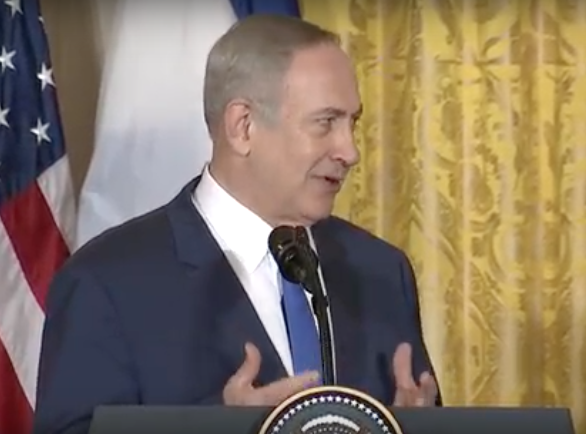
(Screenshot from White House video)
It would be good news if true. But most likely it’s not. While one stage in the Syrian conflict is coming to an end, another is beginning, and this time the results could be even worse.
The reason is Israel, until now the odd man in the latest Mideast wars. Despite intervening sporadically on the rebel side in Syria, the Jewish state generally held itself aloof from the conflict in the belief that events were breaking its way regardless of whether it stepped in or not. After all, why go to war when your enemies are doing a fine job of tearing each other apart on their own?
With President Bashar al-Assad expected to step down eventually, Israel figured that it only had to wait and watch as a hostile regime collapsed under its own weight as it thrashed about unable to restore order to Syria. Never in the Arab-Israeli hundred years’ war had Israel seemed stronger and the Arabs weaker and in greater disarray.
But then the unthinkable happened. Assad not only survived but prevailed. Backed by Russia, Iran and the Lebanese Shi‘ite militia Hezbollah, he has bottled up Al Qaeda in East Ghouta and Idlib province in the extreme northwest and is racing to lift ISIS’s siege on Deir-Ezzor along the Euphrates. If successful, the effect will be to clear a path straight through to the Iraqi border some 30 miles to the east.
U.S. military enclaves may remain in the northeast and in the southern border town of Al-Tanf. But it’s hard to see how they’ll have much of an impact as the Damascus regime tightens its grip on the country as a whole.
Israeli Outrage
But rather than making a wider war less likely, the upshot is to make it even more. Having bet on the wrong horse, Prime Minister Benjamin Netanyahu now finds himself facing a nightmare scenario in which Iran takes advantage of Assad’s winning streak to extend its reach from Iraq and Syria into Lebanon beyond. It’s not just a question of political influence, but of the emergence of a powerful Iranian-led military bloc.
Eleven years after fighting a vicious 34-day war in southern Lebanon, Israel thus finds itself facing not only Hezbollah but the Syrian Arab Army, Iran’s Islamic Revolutionary Guards, and Iraqi Shi‘ite militias – all backed by Russian military might – in a front extending across its entire northern border. All are battle-hardened after years of combat, better armed, better led, and more self-confident to boot. Israel finds itself confronting a new threat that is many times more powerful than Hezbollah (or Syria) alone.
Israeli consternation is not to be underestimated. One news outlet says the official attitude is one of “grave concern” while an anonymous government minister heaped blame on the U.S. for sacrificing Israeli interests:
“The United States threw Israel under the bus for the second time in a row. The first time was the nuclear agreement with Iran, the second time is now that the United States ignores the fact that Iran is obtaining territorial continuity to the Mediterranean Sea and Israel’s northern border. What is most worrisome is that this time, it was President Donald Trump who threw us to the four winds – though viewed as Israel’s great friend. It turns out that when it comes to actions and not just talk, he didn’t deliver the goods.”
Netanyahu is meanwhile off to the Black Sea resort of Sochi to confer with Russian President Vladimir Putin while, in Washington, Israeli military and intelligence officials are meeting with top Trump officials such as National Security Adviser H.R. McMaster and special Mideast envoy Jason Greenblatt.
Israel has also engaged in saber-rattling with regard to a missile factory that it says Iran is building in the Syrian port city of Baniyas. Gadi Eisenkot, the Israeli military’s chief of staff, said that stopping efforts by Iran, Syria, and Hezbollah to equip themselves with accurate missiles capable of striking deep inside the Jewish state “is our top priority.”
Adds Avigdor Lieberman, Israel’s hard-right defense minister: “We know what needs to be done…. We won’t ignore the establishment of Iranian weapons factories in Lebanon.”
Neocon Chorus
Words like that should not be taken lightly. Meanwhile, influential neoconservatives are joining the me-too chorus. At the Atlantic Council – the hawkish Washington think tank partly funded by the United Arab Emirates and pro-Saudi interests that functioned as an arm of Hillary Clinton’s 2016 presidential campaign – former Obama administration official Frederic C. Hof recently argued that the U.S. wouldn’t be in such a pickle if it had invaded Syria years ago:
“A Syrian opposition recognized by Washington in December 2012 as the ‘legitimate representative of the Syrian people’ should have been tasked with preparing for post-ISIS governance, and assisted to that end by an American-organized, multi-national effort. An all-Syrian stabilization force should have been built in a protected eastern Syria to pacify the area, facilitate humanitarian aid, and spur reconstruction.”
But now the U.S. is seemingly “indifferent” to what comes next once Islamic State is gone. As a consequence, Hof said, the Trump administration is effectively “install[ing] Iran as Syria’s suzerain, with the Assad entourage sifting through the country’s ruins for spoils and setting the stage for successive waves and varieties of extremism arising in response.” The only solution, according to Hof, is a radical strategic change “to prevent Iran and Assad doing their worst for the security of the United States, its allies, and its partners.”
With the Zionists and their neocon yes-men agreeing that something must be done, it seems that something WILL be done sooner rather than later.
Of course, a few complications could get in the way. One involves Russian President Vladimir Putin who, despite his close alliance with Assad, enjoys a solid working relationship with Israel and is none too eager to see war break out between the two countries. Another is the Syrian government in Damascus, which, under the leadership of the careful and cautious Assad, is none too eager to rush into a conflict that could conceivably prove even more ruinous than the one it is trying to finish up.
A Sick Kingdom
But even sober politicians like Putin and Assad may be unable to cope with the forces raging across the Middle East. The sectarian war that the Saudis unleashed more than a decade ago with U.S, help shows no signs of letting up. The kingdom is mired in an anti-Shi‘ite crusade in Yemen that it is desperate to escape, but doesn’t know how. It has suppressed a Shi‘ite uprising in Awamiyah, a city of 25,000 people in its own oil-rich Eastern Province, killing dozens according to Iranian sources and flattening an entire neighborhood, but dissent continues to bubble up ominously.
Saudi Arabia also has imposed an economic blockade on Qatar, and it is backing a repressive regime in Bahrain that has imposed a reign of terror on the country’s 70-percent Shi‘ite majority. Riyadh continues to engage in a dangerous war of words with Iran, which the royal family believes is engaged in an Elders of Zion-like Shi‘ite conspiracy to dismember the kingdom and wrest away control of Mecca and Medina.
The more paranoid Saudi leaders become, the more threatening Saudi Arabia grows – and the more resolved Iran becomes to make the most of its victory in Syria by fulfilling the ancient Persian goal of opening a corridor to the Mediterranean Sea. Aggression on one side leads to counter-aggression on the other, a process of mutual escalation that seems impossible to reverse.
Finally, there is the question of political stability – or, rather, an increasing lack thereof. In Iran, newly re-elected President Hassan Rouhani is locked in a growing confrontation with hardline Shi‘ite Islamists with little appetite for compromise.
In Saudi Arabia, power is in the hands of Crown Prince Muhammad bin Salman, a rambunctious 31-year-old who launched the disastrous war in Yemen in March 2015 – and then disappeared on a vacation in the Maldives as U.S. officials tried desperately to reach him by phone – and who more recently unveiled an ambitious economic reform program that so far has done nothing to stem the kingdom’s alarming decline. Despite vows to diversify the economy, non-oil revenue actually shrank by 17 percent this spring while foreign reserves have fallen by nearly a third since 2014. But that didn’t stop MbS, as he’s known, from committing himself to $110 billion in U.S. arms purchases in May or his father, King Salman, from spending a reported $100 million on a summer vacation in Morocco.
Saudi Arabia is thus becoming the sick man of the Middle East, one whose collapse could trigger a “geopolitical tsunami” sweeping across much of the region.
Trump’s Imbalance
Then there is the United States, where politics are even more unsettled. As President Trump careens from one disaster to another, foreign policy has grown both unpredictable and bellicose. One day, America’s second popular-vote-losing president in 16 years is calling for regime change in Tehran, the next he’s threatening Pyongyang with “fire and fury,” and then he’s blustering about some unspecified “military option” with regard to Venezuela.
The fact that Trump has so far demonstrated little follow-through is hardly reassuring. Sooner or later, rash rhetoric can only lead to rash actions, if not on America’s part then someone else’s. The shakier Trump grows, the greater the likelihood that he will engage in some risky adventure in order to strengthen his grip.
A number of forces are thus converging: political instability in Tehran, Riyadh and Washington, a growing thirst for more war on the part of Israel and the U.S. foreign-policy establishment, and a growing defensiveness on the part of a “Shi‘ite crescent” stretching from Yemen to southern Tehran. The United States, Turkey, Saudi Arabia, and others have already plunged Syria into death and destruction by sponsoring a murderous Sunni Salafist assault on one of the most diverse populations in the Middle East. The big question now is whether, with Israeli help, they are about to impose another.
Given the vicious cycle of violence in the Middle East, one that the U.S. has done its level best to worsen at every step of the way, it’s hard not to believe that even worse may be ahead.
Daniel Lazare is the author of several books including The Frozen Republic: How the Constitution Is Paralyzing Democracy (Harcourt Brace).
AIPAC video describes decades-long role in US laws against BDS
If Americans Knew – August 14, 2017
AIPAC, the American Israel Public Affairs Committee, is a powerful Washington DC lobbying organization. In this 2016 video, AIPAC describes how it has successfully worked to create U.S. laws against boycotting Israel over its multitudinous violations of human rights and international law.
The video doesn’t mention the anti-boycott legislation working its way through Congress right now (S.720 / H.R. 1697) that AIPAC helped draft: iak.salsalabs.org/antiboycottbill
Such anti-boycott laws hurt everyone.
They interfere with Americans’ fundamental consumer rights and freedom of speech, often harm American businesses and thereby the U.S. economy, and damage American international relations.
They prevent peace and perpetuate violence in the Middle East. By helping to sustain Israel’s enormous power over Palestinians, they cause Israeli leaders to believe two things: they can ignore international law, and they don’t need to negotiate with Palestinians in good faith to reach a fair and lasting peaceful resolution.
Ultimately, AIPAC’s actions have hurt Palestinians, Israelis, Americans, and the many of others impacted by the Israeli-Palestinian conflict and by Israel’s various wars against its neighbors.
Netanyahu Backs Partitioning Iraq for Kurdish State
teleSUR | August 14, 2017
During a meeting with a U.S. delegation, Israel’s Prime Minister Benjamin Netanyahu expressed interest in partitioning Iraq.
The Prime Minister told the group of 33 congressmen that he favored the establishment of an independent Kurdish state in the Arab country. Israel has a longstanding relationship with the Kurds, who remains one of its few non-Arab allies in the area.
The Jerusalem Post reported that a source who attended the meeting said Netanyahu referred to the Kurds as “brave, pro-Western people who share our values.”
Netanyahu previously spoke on the issue in 2014 when he said in a speech that Israel should “support the Kurdish aspiration for independence.”
Two months ago Iranian Parliament Speaker Ali Larijani warned about bids to break up Iraq, saying the partitioning of Arab countries serves the interests of Israel. “The Zionist regime seeks Iraq’s disintegration,” Larijani accused during a meeting with Iraqi Prime Minister Haider al-Abadi in Tehran.
A report published in the New Yorker magazine in 2004 said Israeli military and intelligence operatives were active in Kurdish areas and providing training for commando units.
According to the report, Israel has been expanding its presence in Kurdistan and encouraging Kurds, its allies in the region, to create an independent state.
Facing Defeat in Syria, ISIS Inexplicably Expands Globally
By Tony Cartalucci – New Eastern Outlook – 11.08.2017
Throughout human history, when a military force and its economic center has been defeated, it contracts, then collapses. For the first time in human history, the self-proclaimed “Islamic State” (ISIS), has managed to reverse this fundamental aspect of reality – but not without help.
Facing defeat in Syria as government forces backed by its Russian and Iranian allies close in on the terrorist organization, stripping it of territory it seized, it has managed to spread far beyond Syria’s borders, establishing itself in Libya, Afghanistan, and even as far as Southeast Asia where it has seized an entire city in the Philippines’ south, and carried out attacks and conducting activities everywhere from Indonesia and Malaysia to allegedly Thailand’s deep south.
It should be remembered, according to Western governments and their media, the territory ISIS holds in Syria is allegedly providing it with the summation of its financial resources and thus the source of its fighting capacity. According to official statements, the US and its European allies allege that ISIS fuels its fighting capacity with “taxes” and extortion as well as black market oil sales – all of which are derived from territory it holds in Syria.
The Washington Post in a 2015 article titled, “How the Islamic State makes its money,” would note:
Weapons, vehicles, employee salaries, propaganda videos, international travel — all of these things cost money. The recent terrorism attacks in Paris, which the Islamic State has claimed as its own work, suggest the terrorist organization hasn’t been hurting for funding. David Cohen, the Treasury Department’s Undersecretary for Terrorism and Financial Intelligence, described the Islamic State last October as “probably the best-funded terrorist organization we have confronted” — deep pockets that have allowed the group to carry out deadly campaigns in Iraq, Syria and other countries.
To explain where ISIS actually makes its money, the Washington Post claims:
Unlike many terrorist groups, which finance themselves mainly through wealthy donors, the Islamic State has used its control over a territory that is roughly the size of the U.K. and home to millions of people to develop diversified revenue channels that make it more resilient to U.S. offensives.
The Washington Post would also claim:
Its main methods of generating money appear to be the sale of oil and antiquities, as well as taxation and extortion. And the group’s financial resources have grown quickly as it has captured more territory and resources: According to estimates by the Rand Corporation, the Islamic State’s total revenue rose from a little less than $1 million per month in late 2008 and early 2009 to perhaps $1 million to $3 million per day in 2014.
With this territory quickly shrinking and the intensity of fighting against what remains of ISIS in Syria and Iraq expanding, it is seemingly inexplicable as to how ISIS is expanding globally, instead of contracting and collapsing.
The Washington Post’s already implausible thesis regarding ISIS finances – based on official statements from the US Treasury Department and US corporate-funded policy think tanks like Rand – appears to be the only thing contracting and collapsing.
ISIS Enjoys Global Reach Many Nation-States Lack
Regarding just how expansive ISIS’ global activities are, US Secretary of State Rex Tillerson himself would claim in an August 1, 2017 statement that:
I think our next steps on the global war to defeat ISIS are to recognize ISIS is a global issue. We already see elements of ISIS in the Philippines, as you’re aware, gaining a foothold. Some of these fighters have gone to the Philippines from Syria and Iraq. We are in conversations with the Philippine Government, with Indonesia, with Malaysia, with Singapore, with Australia, as partners to recognize this threat, try to get ahead of this threat, and help them with training – training their own law enforcement capabilities, sharing of intelligence, and provide them wherewithal to anticipate what may be coming their direction.
Tillerson made these remarks after noting ISIS’ shrinking holdings in both Syria and Iraq. He claimed in regards to Iraq:
More than 70 percent of Iraqi territory that was once held by ISIS has been liberated and recovered. ISIS has been unable to retake any territory that it has been – that has been liberated, and almost 2 million Iraqis have returned home. And this is really the measure of success, I think, is when conditions are such that people feel like they can return to their homes.
Regarding Syria, Tillerson would claim:
Similarly, over in Syria, we’re assisting with the liberation of Raqqa, which is moving at a faster pace than we originally anticipated.
The steps outlined by Tillerson to combat ISIS sidestep strategic fundamentals like identifying, isolating, and eliminating the economic and financial source of the organization’s fighting capacity, and instead focus on an indefinite justification for global US military operations – particularly across Southeast Asia at a time when the region is incrementally uprooting American influence and replacing it with Eurasian alliances, networks, as well as military and economic blocs.
For ISIS – fueled by resources found only within the boundaries of its meager and shrinking territorial holdings in Syria and Iraq – to be simultaneously fighting the national armies of Syria and Iraq, backed by Iran, Russia, Lebanon’s Hezbollah, and allegedly a US-led coalition including dozens of countries, all while expanding its reach worldwide, including full-scale military operations in Southeast Asia, begs belief.
ISIS doing all of this with multi-billion dollar multinational state sponsorship, not only makes much more sense, it is the only explanation.
ISIS is State Sponsored
Until recently, ISIS territory butted directly against the borders of NATO-member Turkey. In fact, looking at any map of the Syrian-Iraqi conflict with ISIS revealed what appeared to be logistical trails leading directly out of Turkey and to a lesser extent, Jordan.
A 2014 report from Germany’s public broadcaster Deutsche Welle, revealed a torrent of supplies, men, and weapons flowing daily over the Turkish-Syrian border, headed directly toward ISIS territory, directly under the nose and with the complicity of Turkish officials.
The report titled, “‘IS’ supply channels through Turkey,” would note:
Every day, trucks laden with food, clothing, and other supplies cross the border from Turkey to Syria. It is unclear who is picking up the goods. The haulers believe most of the cargo is going to the “Islamic State” militia. Oil, weapons, and soldiers are also being smuggled over the border, and Kurdish volunteers are now patrolling the area in a bid to stem the supplies.
So obvious was the logistical support for ISIS flowing from Turkey, that ISIS flags were clearly visible from the Turkish border throughout DW’s footage.
It was only until Russia’s military intervention in Syria upon Damascus’ request, that these logistical routes were targeted and significant pressure could be placed on ISIS inside Syria, rolling back its fighting capacity.
ISIS enjoys a global reach few nation-states could achieve because it is financially, politically, and militarily backed by nations with the resources to obtain that global reach. This includes the US itself, NATO, and the Gulf Cooperation Council (GCC) which in turn includes nations like Saudi Arabia, the United Arab Emirates (UAE), and Qatar.
ISIS is America’s Foot in the Door in Southeast Asia
US Secretary of State Rex Tillerson’s comments regarding ISIS’ spread into Southeast Asia implied long-term US involvement in the region, including closer involvement with regional police and even military forces. In the Philippines, where US-Philippine relations were spiraling downward, the sudden appearance of ISIS there and the organization’s ability to seize an entire city led directly to justification for not only a continued US military presence in the country, but its expansion.
Other nations across Southeast Asia – including Indonesia, Malaysia, and Thailand – have been incrementally pushing US influence out of the region in favor of stronger and more stable ties with each other and with neighboring China.
Thailand for instance, has begun replacing aging US military hardware with weapon systems from Russia, China, and Europe. Thailand has also begun joint military exercises with China, ending America’s post-Vietnam War monopoly. Thailand and Indonesia have also begun striking a series of economic and infrastructure deals with China, including immense expansions of their respective national railways.
As each nation has taken steps to move the US out of Asia, the US has increased pressure on each respective nation. It has done this through US-funded fronts posing as nongovernmental organizations (NGOs) and US-backed opposition movements. It also appears to be doing this through the introduction and expansion of ISIS activity in the region.
It should be remembered that it was the US itself that created Al Qaeda in the mountains of Afghanistan to fight the Soviets in the 1980s.
If the situation unravels there is the possibility of establishing a declared or undeclared Salafist principality in eastern Syria (Hasaka and Der Zor), and this is exactly what the supporting powers to the opposition want, in order to isolate the Syrian regime, which is considered the strategic depth of the Shia expansion (Iraq and Iran).
Israel to occupy Africa
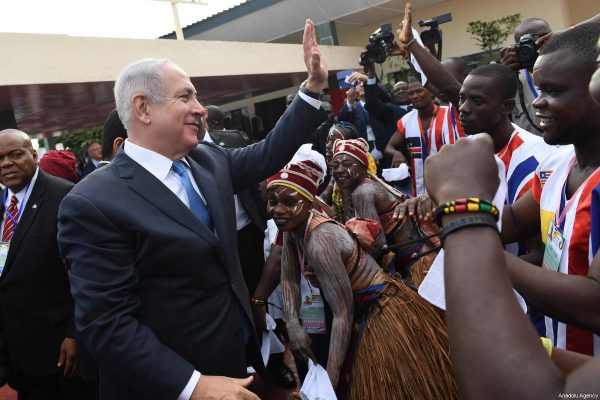
Israeli Prime Minister Benjamin Netanyahu greets people during his arrival at James Spriggs Payne Airport in Monrovia, Liberia on 4 June 2017 [Prime Ministry of Israel/Anadolu Agency]
By Helmi Al-Asmar | Al-Araby Al-Jadeed* | August 10, 2017
With the exception of the popular efforts made by the Conference for Palestinians Abroad to hinder the rabid Israeli efforts to hold a major conference next October entitled the Israeli-African Summit in Togo, we have barely seen any official or popular Arab efforts in this direction. This is despite the great danger posed by convening such a summit, which Israel has been laying the foundations for for several years, in light of the almost complete absence of the Arabs, which is an unprecedented development in Israel’s tireless efforts to bypass the wide wall of isolation and moral rejection it faces in Africa. It aims to present itself as a trusted partner for the continent’s nations.
The Conference for Palestinians Abroad viewed this summit, rightly so, as an insult to the struggles of the African nations and a disregard for their generations’ fair fight for liberation from colonisation and racism. It is also an attempt on the occupation government’s part to portray itself as a trusted partner for the African countries in order to fabricate its reality. It is not coming to Africa in order to spread love and unity, but instead aims to make Africa a market for the lethal products it produces and a place to export its mercenaries to help the dictators of the continent.
This is despite the fact that the African nations’ true interests and their efforts towards sustainable development, prosperity and growth do not align with the colonial racist occupation government in Palestine, given its record of hostility and terrorism. This is documented by several international and independent reports, including the ESCWA report regarding the escalations of the Israeli apartheid policies issued this year.
In addition to this, Israel, which commits war crimes, mass killings, flagrant violations and intimidation methods, as well as confiscates the Palestinian people’s land and resources and sponsors illegal extremist settler gangs, does not have the right to be a partner to developing nations seeking advancement, prosperity and the combat of terrorism.
The efforts of the Conference for Palestinians Abroad are focused on mobilising governments, official and popular institutions, parties, civil society organisations, public figures, community leaders and the media across Africa and the entire world, in order to rally the efforts against the Israeli government’s actions. These actions are an attempt on Israel’s part to promote itself in the continent in a misleading manner, ignoring the principles of justice, the peoples’ rights and international laws and conventions. The conference summoned its efforts and began taking action, contacting concerned parties, especially the influential forces in the African nations in order to confront Israel’s attempts of exploitation and deception.
These are commendable efforts but of course they are not enough to stop this hateful and racist emergence in Africa. Putting an end to the conference is the duty of all African countries, organisations, committees, and people specifically, and generally the duty of the Arab and Muslim countries. This is because Israel’s presence in the continent will not be in the best interest of the African people, but rather in Israel’s interest as it exports death, mercenaries and tyranny to all the countries of the world. It also supports the totalitarian regimes that commit the ugliest forms of aggression, looting and pillage. Therefore, resisting this conference and sabotaging it by all means available is the duty of all nations on Earth.
It is worth mentioning in this regard that the only Arab action against the convention of this summit was by the President of the Palestinian Authority, Mahmoud Abbas, during his visit to Khartoum in July 2016. In his meeting with Sudanese President Omar Al-Bashir, Abbas raised the issue of developing the Arab strategy in the African continent and cooperating in order to stop Israel’s attempts to achieve a breakthrough in Africa.
We do not expect Sudan or the PA to do anything now, as it is too late and their political/diplomatic capabilities are limited. Moreover, their problems and misfortunes are too many to count, according to the former Egyptian Ambassador to Angola, Sao Tome and Niger, Belal Al-Masry, who, in an important article published on the Democratic Arab Centre website, listed five reasons why the Israeli summit in Africa is dangerous. These points should be considered and reflected upon, the most important of which is the fact that the conference’s purpose is to restore and develop the African voting bloc in order to use it to support Israel’s international status.
Israel views the countries of the African continent as a voting bloc consisting of at least 50 votes. This was confirmed by the Israeli Prime Minister Benjamin Netanyahu to seven African leaders with whom he met in Rwanda in July 2016. He also reiterated this in his speech to the Economic Community of West African States (ECOWAS) Summit in Monrovia in June 2017. Hence, his statement regarding Israel having a bright future in the UN during his speech before the UN General Assembly at its regular session in September 2016, wasn’t too far from the truth. He also stated that his main diplomatic goal was to stop the African states from automatically voting against Israel at the UN and that the day he would achieve this isn’t too far. Therefore, holding the Israeli summit in Africa will mark the end of the Egyptian and Arab role, in general, in Africa and Israel will join the international forces competing for influence in the African continent. These countries include China, the United States, France, India, Russia, Iran and recently, Turkey.
It is not an overstatement to say that the Israeli conference in Togo will pave the way for Israel to reoccupy Africa, or at least a large part of it, politically, economically and militarily. This will further strengthen Israel’s international and regional standing and increase the suffering of the Palestinian people, who are paying the price for the fragmentation of the Arab system and their preoccupation with resisting the effects of the Arab Spring revolutions.
*Translation by MEMO
How Donald Trump Threw Peace and Prosperity Under an AIPAC Bus
By Phil Butler | New Eastern Outlook | 04.08.2017
Shortly after 11:00 AM, Wednesday August 2, 2017 US President Donald Trump declared full scale economic war on Russia. Russian Prime Minister Dmitry Medvedev is joined by millions of us who’ve now lost all hope of peace and reconciliation in the world. Cold War II is on.
Dmitry Medvedev attacked Trump’s decision to sign the bill in the same way most of us analysts will, chastising the US President after his clear bow to a US Congress unified in its hysteria against Vladimir Putin’s Russia. But the Russian Prime Minister did not delve into just “why” Trump is praying to the altar of neo-conservatism today. Trump feigned disagreement with sections of the law his team said are “unconstitutional”, but the force behind these sanctions on Russia, Iran, and North Korea is hidden. Let me enlighten you on what is really taking place in Washington.
Two days ago, a close colleague of mine was on the line from Greenwich, Connecticut to discuss my upcoming book when the conversation turned to these new Russia sanctions. My colleague related a story from Capital Hill and an insider who explained the vote on the sanctions law. The gist of this insider’s revelation was that the overwhelming “yes vote” in Congress indicated one powerful player behind the curtain – America’s pro-Israel lobby AIPAC.
When I heard AIPAC stood behind, my mind immediately reverted to images and sound bites of Trump and Israeli Prime Minister Netanyahu. Their mutual gratification society handshakes, the syrupy sweetness of the Israeli’s recollections on young Trump – and then I thought on the Saudi arms deal and the wider frame of the Arab Spring. Sorry to consolidate so many facets here, but if Trump and all of Washington has acquiesced totally to the will of AIPAC, then America is all done. Looking again at Russia’s Medvedev:
“Trump’s administration has demonstrated total impotence by surrendering its executive authority to Congress in the most humiliating way.”
The point of this new sanctions law is revealed simply. If AIPAC controls the Unites States Congress, and if the President of the United States has surrendered his executive authority to that body, then the Israeli lobby controls the Government of the United States – lock stock and barrel. In other words, a foreign sovereign nation and ideology rules America – and it rules it with impunity.
Turning to the law itself, even the Trump administration admitted there are sections that are “unconstitutional”, which means illegal. “Illegal!” Is a Barack Obama infused Supreme Court going to overturn the law? This question is rhetorical, for no justice will ever even read through this law. Looking at the Israel lobby and the Zionist influence on America overall, it’s becoming stunningly clear “legality” has little to do with American policy either internally or internationally. When I heard AIPAC was “all in” on this law, I did a two minute analysis of their digital and social media footprint. It’s important to run down the lobby’s online rhetoric here.
The website is replete with Trump administration ambassadors and evangelists for Israel “likes”, as well as Congressional “yes men” who I found to be key in pushing this law down our throats. The Twitter feed of AIPAC the last few weeks reads like an online gambling casino SPAM attack. And until this sanctions bill was signed by Trump, the scrolling Twitter message from AIPAC endeavored to lump Russia in with marginalized Iran and North Korea – today the feed reverts to bashing the Palestinians. With Russia now “punished” for foiling the “Syria plan” with more crippling sanctions, the Zionists are hot on the trail of destroying funding from America for Palestinians. The controversial AIPAC pressure to pass the so-called Taylor Force Act, is being pressed in order to ruin $300 million annually in U.S. economic support to the Palestinian cause. Reverting back to the Russia sanctions law though, the Israelis tout every supporter in Washington and aboard who bends to its will. A Tweet retweeted by AIPAC from Senator Bob Menendez is emblematic:
“Russia, Iran & NK cant violate int’l order w/o consequence. Proud many sanctions I wrote included in bipartisan bill”
Menendez is a lunatic in my view. The New Jersey Senator’s efforts to please the Israel lobby in the bag today, the member of Foreign Relations Committee is out to strip Russia of the upcoming FIFA World Cup today. This Tweet reveals the deep state seemingly bent on all out war on Russia.
“#ICYMI FIFA must dismiss Russia as host of @FIFAWorldCup if forced labor reports are true. Ignoring them=complicity”ttps
Some may recall that Menendez is the senator who was indicted in federal corruption charges involving convicted South Florida Dr. Salomon Melgen, who was found guilty recently of sixty-seven criminal counts of fraud. Menendez was turned down this month in his attempt to have a September trial postponed. He’s accused of taking bribes from Melgen, who allegedly paid him over $1 million. Menendez gave a rousing speech at the 2017 AIPAC conference back in March. The last to speak at the Tuesday session of the conference, Menendez framed a future for us all without even meaning to. In his Netanyahu praising cap off, the New Jersey sellout offers this with regard to America’s intentions in the Middle East:
“I was proud to help secure our record breaking $38 billion Memorandum of Understanding you all advocated for it — an agreement that ensures that Israel’s defenses will remain unmatched in the region and that together, the United States and Israel will continue developing defense technologies of astounding sophistication, like Iron Dome, David’s Sling, and the Arrow-3 missile defense systems.”
“Record breaking!” The arrogance and cutting clarity of that stinks of money, control, and a militarism these new Russia sanctions signal. Yes, Israel will be secure for a while, as secure as she was during the first Cold War. Armed to the teeth, with tentacles in every power structure in the western hemisphere and near Asia, a tiny nation is insulated from catastrophe, while surrounding neighbors burn. Donald Trump just sealed a “record breaking” deal for Saudi Arabia to blast neighbors to hell. Now Iran is the psychosis for AIPAC and Israel. So, Russia must be penalized, and North Korea must be glued to an evil axis in order that Americans can identify.
AIPAC has exerted a massive pressure, and the message could not be more clear, the Zionists who control Israel are at the wheel. Just read the list of speakers at the conference. Sen. Majority Leader Mitch McConnell (R-KY), Sen. Democratic Leader Charles Schumer (D-NY), House Democratic Leader Nancy Pelosi (D-CA), House Majority Leader Kevin McCarthy (R-CA), Speaker of the U.S. House of Representatives Paul Ryan (R-WI), United States Ambassador to the United Nations Nikki Haley, and Vice President of the United States Mike Pence stood tall in their unwavering support for Israel – no matter what. With the unseeing and deaf American public preoccupied elsewhere, a free democracy has been taken over by the agnostic hierarchy of Zion. And Judaism is used as the cloak of invisibility and viability for the most evil and biased ideas on Earth.
Donald Trump threw his constituents under the bus this week. But the American president’s crime will be registered when more trillions are spent uselessly on weapons, and when the souls of innocent dead reach God. This sanctions law ruined all of our work to restore moderation and peaceful calm to a crisis ridden world. I place fifty percent of the blame on the people behind this Israeli lobby, and the other fifty percent on the one man who might have prevented it.
Trump Battles the CIA: The Korea Ban & Bad Signs in the Market
By Caleb Maupin – New Eastern Outlook – 02.08.2017
The ban on travel to the Democratic People’s Republic of Korea is primarily an attack on the people in the northern part of the Korean Peninsula. It is a move to further isolate the DPRK, and prevent tourist dollars from flowing in, while also preventing fraternization between Americans and citizens of the country. However, the State Department’s decision also has another target in the crosshairs, one much closer to Washington DC.
According to reports in the press, roughly 5,000 US citizens visit the DPRK each year. Most are tourist youth attracted to the mystique and adventure of traveling to a country so widely demonized in the US media. Communist organizations send political delegations and Christian sects such as the Mennonites often send missionaries and aid workers. However, one can be sure that among the 5,000 people who visit the country each year is more than a few American spies, posing as tourists.
When one looks over the recent history of Americans being arrested in North Korea prior to the tragic death of Otto Warmbier, the reasons for the arrest almost always indicate activities that could be described as espionage. Merrill Newman, for example, was a former member of the US military’s “White Tigers” division during the Korean War. The 85 year old man was arrested in the DPRK as he wore a ring with the insignia of this anti-DPRK fighting and intelligence unit. After being arrested he confessed to participating in some of the war crimes against the Korean people during the 1950-1953 war. Newman stated “I did not realize North Korea was still at war” after his eventual release.
The State Department ban on travel to the DPRK is far more extreme than the widely challenged ban on travel to Cuba, enacted as part of the blockade. Officials say that any American who visits DPRK will automatically have their passport invalidated. The constitutionality of such an extreme ban is likely to be challenged.
In the meantime, however, any efforts by the CIA to gather information inside North Korea, or to manipulate or maneuver within its internal affairs, are greatly limited.
Two divisions of the US Federal Government that have long been at odds in issues of foreign policy have been the military and the Central Intelligence Agency. The nature of the two entity’s work lays the basis for their constant disagreement and conflict. The new State Department policy has essentially declared that the DPRK will be handled with military operations, not with “color revolutions,” plots of a coup, manipulation of the youth, or the other shenanigans carried out by the intelligence agencies.
A Longstanding Fight – CIA vs. Pentagon
The US military brass is trained at West Point, and though a great deal of history and background is provided, the focus of their training is military science and the “art of war.” Meanwhile, the Central Intelligence Agency’s administrators come from Harvard, Yale, and Princeton, and are trained in the subtle art of expanding US influence and quietly neutralizing those who challenge it.
The favorite word of those who extol the military and disfavor the CIA is “strength.” The strategies favored by the Pentagon involve demoralizing opponents of US power with “shock and awe” style crushing of enemies. The mass bombing campaigns in Vietnam and Korea did not win credibility and respect for the US internationally, and this was not their intention. The same can be said for Bush’s unilateral invasion of Iraq. The Pentagon does not concern itself with winning friends and influencing people, but with blowing things up, and its favored foreign policy reflects this.
The CIA, on the other hand, tends to favor soft power, negotiations, and internal subversion of global rivals, all done covertly, with the USA looking like a benevolent “Mr. Nice Guy” on the surface. The CIA favors arming and training third party proxies to fight their enemies, while waging a fierce battle in the field of public relations and propaganda.
The clash between the military and the intelligence agencies has played out dramatically in recent US history. It is widely understood that John F. Kennedy began enacting policies that overwhelmingly favored the CIA prior to his death. Kennedy resisted the efforts to escalate military involvement in Vietnam, while funding and emphasizing CIA-linked operations like the Peace Corps. Kennedy’s often quoted the phrase “those who make peaceful revolution impossible make violent revolution inevitable” stated the CIA’s exact strategy for fighting Communism during the Cold War. The CIA favored “reforms” in US aligned third world regimes that made Marxist-Leninist revolution less appealing, while also presenting the US as a benevolent, charitable country that did not seek to intervene in other countries domestic affairs. The CIA worked to make sure that the hands of the USA during the rise of military dictatorships and the toppling of pro-Soviet world leaders were well hidden.
Prior to Kennedy’s assassination, a hard, right-wing mass movement against him, involving the John Birch Society and many Pentagon linked political figures, called the “Camelot” President a traitor and Soviet agent. Many sections of the military thought Kennedy’s “soft power” strategy for confronting Communism, and his ultimate refusal to invade Cuba with US troops after the CIA’s failed “Bay of Pigs” operation, showed weakness. Films like “Dr. Strangelove” widely mocked the well-known fanaticism of the military brass, which distrusted the intelligence agencies and the ability of politicians to make military decisions. Kennedy’s subtle alliance with the Civil Rights Movement, though inconsistent and widely criticized by activists, also threatened a military brass packed with the sons of wealthy southern families.
After the death of Kennedy, the US military seemed to be on top in the power struggle. Richard Nixon’s electoral victory in 1968, and his “secret plan” to win the Vietnam War with massive bombing, showed the military and its allies as the dominant force in setting policy.
But the demoralizing and unpopular war in Vietnam reversed this by the mid-1970s. Nixon found himself listening and depending more on the advice of Henry Kissinger, opening relations with the People’s Republic of China, and eventually being driven from office. Jimmy Carter took office in 1976 calling himself a “student” of CIA strategist Zbiegniew Brzezinski. Under Reagan, the CIA got stronger, with CIA chief George H.W. Bush rising to be Vice President and eventually Reagan’s successor as commander-in-chief.
The often repeated narrative that the US military’s escalation of the arms race was the key factor in defeating the USSR is said with absolute defensiveness by the Pentagon’s right-wing allies. Though the “strong man Reagan” explanation is more widely understood among the US public, within the circles of power in the USA, the CIA takes more credit.
Under the direction of Brzezinski, who boasted that he “gave the USSR a Vietnam” by funneling money and weapons to insurgents in what he called the “Afghan trap,” the CIA manipulated political situations in Eastern Europe causing unrest and a crisis that eventually toppled the USSR. The CIA widely credits itself for terminating the Soviet Union by manipulating internal problems and applying less blatant forms of external pressure.
The CIA is not a “Conservative” Organization
Many leftists and anti-war activists assume that the CIA is staffed with jingoistic conservatives due to the nature of the job. While the rank-and-file of “the company” may attract a more rightist crowd of Mormons and military types, the leaders of the CIA are not conservative in any sense of the word.
John Brennan, the director of the CIA under Barack Obama admits that he voted for Communist Party Presidential Candidate Gus Hall in the 1976 Presidential election. Brennan was stationed in Riyahl for many years, and at the time of his appointment, many voices came forward to allege that he had actually converted to the Wahabbi brand of Islam. The allegations remain unproven.
The CIA strategist who was most influential between the 1960s and the 1990s was Zbiegnew Brzezinski. To call Brzezinski conservative would be deeply mistaken. Zbeignew’s daughter, Mika Brzezinski is a host on liberal leaning MSNBC’s TV program “Morning Joe.”
Brzezinski developed the art of propaganda, presenting the USA to the world as the homeland of Beatles Music, the paintings of Jackson Pollack, and sexual hedonism. In Eastern Europe, Brzezinski’s policies convinced millions of alienated young people that overthrowing the Marxist-Leninist governments would transform their countries into Disneyland playgrounds packed with consumer goods and never ending rock and roll concerts.
In Afghanistan, Brzezinski worked with a young Saudi billionaire named Osama Bin Laden to fight against the People’s Democratic Party. With US made weapons and funding, complimented by heroin revenue, the insurgents poured acid on women’s faces and hanged literacy campaign volunteers. Brzezinski’s slick propaganda work convinced the world that these Wahabbi extremists were actually Che Guevara-esque freedom fighters, battling the “Soviet Empire” for freedom. CBS news was even caught airing staged, fake battle footage.
The figure known as George Soros has become a favored talking point of right-wing activists in the USA. They present him as the sinister bank-roller of leftist activism. Long before Soros was promoting Democrats and Liberals in the USA, he was bank-rolling CIA supported anti-Communist “color revolutions.” Soros is known to have funded anti-communist, pro-capitalist and pro-western protest movements in the USSR, Czechoslovakia, Yugoslavia, and elsewhere.
During the Cold War, the CIA launched a program called the “Congress for Cultural Freedom.” The program funded the art of Jackson Pollack, as well as the Trotskyist magazine Partisan Review. The CIA also launched a project called MK-Ultra which involved distributing hallucinogenic drugs on college campuses.
Obama’s Administration – The White House Stood With Langley
Barack Obama’s grandparents were prominent executives of the Bank of Hawaii. Obama’s grandmother Madelyn Dunham, actually became the first female Vice-President of the bank. The Bank of Hawaii was key in transferring money to US intelligence operations across Asia.
Obama’s mother, Ann Dunham, was married to Lolo Soetoro, a figure in Indonesia who openly supported the 1965 CIA backed coup d’etat against President Sukharno. Soetoro eventually became a military officer under US backed dictator Suharno. It should be noted that the 1965 coup, which Obama’s grandparent’s Bank of Hawaii was involved in financing, was particularly bloody, and involved mass slaughter of ethnically Chinese people. Some estimate that as many as 500,000 people died.
Obama’s family connections aside, his Presidency was very much favorable to the CIA’s strategy for international relations. Obama’s middle name is Hussein. He attended an Islamic elementary school as a child. Long before becoming President, Obama famously had a meeting with Palestinian scholar Edward Said. He maintained a hostile war of words with Israeli Prime Minister Benjamin Netanyahu.
One is reminded of how Napoleon Bonaparte sent out proclamations saying he was a Muslim as he attempted to seize Syria and Egypt for France. To the Arab world, a key region in US foreign policy strategy, Obama gave the illusion of possibly being a Muslim and an ally against Israel.
The fact that a dark skinned man, whose middle name was “Hussein” occupied the White House probably played a key role during the Arab Spring. The uprisings of youth in Islamic countries did not become a repeat of the 1979 Islamic Revolution of Iran, where western capitalism was replaced by a government proclaiming “war of poverty against wealthy” and “Not capitalism but Islam.”
The USA was able to maneuver within the Arab spring to topple the Islamic Socialist government of Libya, and to reduce the Baath Socialist country of Syria to civil war and chaos. Meanwhile, the US backed autocracies in Saudi Arabia, Bahrain, and elsewhere remained thoroughly intact. The continuation of the Yemeni revolution against a pro-Saudi regime now faces an onslaught of bombs and foreign troops.
The establishment of diplomatic relations between the USA and Cuba, with friendly words while intel operatives worked behind the scenes to plot social media unrest with a “Cuban Twitter,” fits the CIA playbook and strategy completely. The JCPOA negotiations with Iran fit into a similar strategy.
In the final weeks of the Obama administration, desperate “Mr. Nice Guy” maneuvers to increase the credibility of the USA on the global stage were carried out. John Kerry gave a speech criticizing Israel, and the US did not protect Israel from a harshly worded resolution at the UN Security Council.
Trump Stands With The Pentagon
Even before Trump took office, his presidential campaign was loaded with subtle hostility to the CIA. Trump castigated the results of US foreign policy, specifically in Syria and Libya where the CIA had been instrumental. During his debate with Hillary Clinton he criticized the funding of rebels in Syria. He repeatedly said that the policies of Obama and Secretary of State Hillary Clinton had created ISIS.
Trump repeated perspectives that would be popular with the military. The key word repeated in Trump’s foreign policy speeches was “strength.” The idea that a huge military budget and direct military interventions make the USA look stronger as a country has long been a talking point of the military brass, against proponents of soft-power and subtle influence.
At times, Trump seemed to be contradictory when talking about foreign policy. It is no secret that among rank-and-file soldiers, and the white, working class, rural communities they often originate in, right-wing isolationist sentiments are widespread. Trump appealed to those sentiments when talking about the bad results of “toppling regimes” and employing the slogan “America First.”
At the same time, he appealed to the Pentagon’s calls for strength, saying that Obama’s “red line” around chemical weapons had “meant nothing.” It may sound contradictory to favor isolationism, while criticizing a president for not making good on threats to attack a country, but it fits into his overall appeal to sentiments within the military.
At the same time that Trump critiqued foreign policy and echoed isolationist talking points, he consistently called for an increase in military spending. In Trump’s foreign policy rhetoric, the isolationism of rank and file soldiers, the Generals’ lust for strength, and the military-industrial complex’s desire for more profits were all re-assured.
The spat between Trump and the CIA is no secret, and is widely acknowledged, even in mainstream US media. The intelligence agencies continue to repeat, without proof, that Trump received assistance from “Russian meddling” in the 2016 elections. A series of leaks from within the administration have found their way to the press.
The Trump administration fought back first by dramatically crippling the CIA’s operations in the Middle East. The executive order banning travel from 6 countries was widely called a “Muslim ban” in the US press. In reality, it targeted all citizens, Muslim or not, from 6 specific countries. (Note: The ban originally included 7 countries, but Iraq was removed from the list.)
Sudan, Iran, Syria, Yemen, Libya, and Somalia are all the site of ongoing conflicts, and in each of these countries US intelligence agencies are working to influence and coordinate with certain forces. As was pointed out by an opponent of the ban on FOX news, the “travel ban” prevents the CIA from rewarding those who do its bidding with visas. A key “soft power” bribe has been taken away from the CIA for its operations in the Middle East.
Trump ultimately shut down the CIA’s training program for anti-government fighters in Syria, according to reports. Trump has accused Obama of wiretapping him during the Presidential campaign.
Trump has even discussed designating the Muslim Brotherhood, an organization that works closely with the CIA around the world, as a Foreign Terrorist Organization. The Muslim Brotherhood was key in undermining and fighting against Arab Socialism during the cold war. More recently, the Muslim Brotherhood was key in aiding US activities to manipulate the Arab spring, and the create turmoil in Libya and Syria.
The Turkish government, which draws its support from the Muslim Brotherhood, is far less friendly to the United States than just a few years ago. The current spat between Saudi Arabia and the Muslim Brotherhood-supporting state of Qatar may reflect difference within the power structure about relations to the Muslim Brotherhood and its use in the fight against independent governments.
Despite presenting himself as an isolationist, Trump ultimately did what Obama was unwilling to do, and launched direct US attacks on the Syrian government. Many in his base were furious, and even longtime hawks like Ann Coulter denounced Trump’s move. However, the more well connected members of the Republican establishment praised it, using the military’s favorite word, calling the bombing a demonstration of “strength.”
As Donald Trump remains President of the United States, the press is solidly against him. This should be no surprise as the US Central Intelligence Agency, not the Pentagon, is primarily involved with influencing media. From the days of “Project Mockingbird” to today, the CIA works very hard to influence and craft public opinion, especially on issues of foreign policy. The flow of ‘anonymous leaks’ from the intel community into the press reflects the longstanding relationship between the intelligence agencies and the media.
The Specter of Economic Crisis, Greatest Danger to Trump
 Right now, spending in the USA is down. Wal-Marts are shutting their doors, and suburban malls, which employed thousands, are becoming a thing of the past. The post-2008 “new normal” of low wage retail jobs replacing good paying jobs for the next generation is rapidly fading away, as retail itself is being pushed aside by online shopping. Jeff Bezos outstripped Bill Gates as the richest man in the United States in terms of directly traceable assets.
Meanwhile, home ownership is still declining. The basic ability of American families to own houses has widely been eroded, home ownership has not been restored to anywhere near the pre-2008 levels. In neighborhoods across the USA, family homes are not being resold to American families, but to renting institutions.
As property values remain low and home ownership drops in suburban and rural areas, another aspect of the “new normal,” the “prosperous urban centers” hopping with young workers in high tech jobs, are also seeing a new decline in property values. Unemployment is low, but so are wages.
In the unfolding atmosphere of eroded spending power and decreasing incomes, banks in the USA are now cutting back lending. When banks stop lending, it is generally based on an understanding that bad times are ahead and they may not be able to collect.
Between 2000 and 2008, Alan Greenspan and the Federal Reserve did everything possible to hold off a crash. Greenspan legalized all kinds of previously illegal credit card and housing mortgage lending, in order to keep the US public spending money they did not have. While the spending power of the US public was drastically reduced by deindustrialization, automation, and shifts in the global economy, Greenspan spent his final years working tireless to keep sales up. Many will recall how George W. Bush urged Americans who wanted to help their country in the aftermath of 9/11 to “go shopping.”
Greenspan’s maneuvers worked only until 2008. With deregulated banking laws, Americans could keep buying houses and maxing out their credit cards, keeping the economy that faced turmoil from 2001 afloat, until the “bubble burst.”
Alan Greenspan was a high ranking member of the Council on Foreign Relations, a think tank often described as “the CIA’s brain.” He did not make his decisions in isolation, but most likely consulted with other figures in the intelligence community about the need to hold off the crisis as long as possible. Greenspan’s decision to legalize credit and keep the public spending, and temporarily hold off the crisis, was not a decision he made by himself.
As the economy crashed and burned in 2007 and 2008, Bush and his cronies, widely viewed as soft on big money, packed their bags, and Barack Obama was able to ride to the White House almost on a white horse, presented as the savior who offered “hope and change.” Greenspan’s efforts did not prevent a the financial crisis, but enabled it to come at a more convenient time, with less political fallout.
However, the political situation facing the USA is far different today. The intelligence community and a large section of the rich and powerful are adamantly opposed to Donald Trump’s presidency, there may not be any specific motivation to work to hold off a financial catastrophe.
If a financial crash were to occur again, Donald Trump would be the ideal scapegoat. The fallout could be blamed on his unpopular presidency which is already routinely ridiculed and demonized by the press.
Will Trump Come Out On Top?
The fact that Trump’s “infrastructure week” contained so few concrete actions may not have hurt Trump at the moment, but a failure to vastly improve the lives of the rust-belt working class that voted for him could be the ultimate undoing of his presidency.
As Trump battles the intelligence community, and seems to side with the Pentagon, he is facing an uphill battle. Allies of the Pentagon brass are disappointed and opponents of Trump are emboldened. However, Trump has proven that he has the ability to unpredictably reverse circumstances that are hostile to him, and come out victorious. The unexpected 2016 elections results are the most concrete example.
If anything was proven by Trump’s surprise victory or the Brexit vote, as well as the rise of Jeremy Corbyn and Scottish Nationalism in the UK, it is that anti-establishment sentiments are stronger and deeper than ever in western countries. People in the west realize that things are deeply wrong and are looking for answers. The answers offered by the status quo, often answers that are engineered and delivered in coordination with the intelligence community, are proving to be unsatisfactory.
In the age of easy access to information, the intelligence community may have both an advantage and disadvantage in the face of their opponents in the US power structure. On the one hand, their deceptions and crafting of public opinion can be more widely and cheaply disseminated than ever before. However, an audience that once had nowhere else to look can easily find alternative views, and debunk their claims. The economic decline and rising police state repression are making the US public more and more partisan toward opposing the establishment and entrenched power that the CIA’s propaganda activities seek to defend.
Trump and his allies in the Pentagon are in a weaker position as they face off with the Intelligence Community, however, the underlying shift in public opinion and the changes in the global economy give them a competitive edge.
Featured Video

Death Spikes & Rising Cancer In Our Youth Explained
or go to
Aletho News Archives – Video-Images
From the Archives
Politicians lie
By Mazin Qumsiyeh | Popular Resistance | August 18, 2013
There is no way to say this truth nicely: Politicians lie. That includes Japanese, American, Egyptian, Israeli, and Palestinian politicians! Is there something more common sense than that? Yet, so many citizens around the world believe their own politicians or wistfully acknowledge lies but think it is part of the job needed to run things. They believe even when politicians contradict themselves blatantly. This phenomenon is rather remarkable. It is a dissonance and disconnect from reality that many seem oblivious to. It is very dangerous because it can lead to accepting rationales for going to war. These can be deadly wars that lead to millions of lives lost as happened in what was called World War 1 and WW2. Even when incredible and declassified evidence abound, politicians continue to lie and old mythologies refuse to die. Here are just a few of the countless lies told to us over the past few decades… continue
Blog Roll
 Aletho News
- RSF military group defects, joins Sudanese army: State media
- Ireland goalkeeper refuses to play ‘Israel’ as squad weighs boycott
- China pushes back against US on Cuba, Iran
- Ukrainian Soldiers, Potential Mercenaries: Have Gun, Will Travel!
- Burnham’s UN debut… A masterclass in British disinformation
- Iran flights continue despite US aviation sanctions
- Global Tipping Points Lead the World Into a State of Entropy
- The day-after at the White House: USA and Xi Jinping
- The Geopolitical Balance in the Red Sea: The UAE Being Displaced by New Players
- Iraqi resistance group vows to stage airport sit-ins over Iran aerial blockade
- If Americans Knew
- Deconstructing Netanyahu’s pants-on-fire UN rant – Daily Update
- Trump betrayed voters with his campaign lies and prioritized a foreign country once he took office
- Netanyahu calls Israel’s war in Gaza ‘opposite of genocide’ in UN speech to near-empty hall
- Settler Kidnappings: Torture, Sexual Abuse and Terrorisation of Palestinian Abductees as Israel Deepens Annexation of West Bank
- Gaza winter nears as 162,000 tents become unusable, raising fears of humanitarian crisis
- Netanyahu says, “It’s the opposite of genocide”; UN says Gaza economy is world’s ‘most severe crisis on record’ – Daily Update
- Israel’s US-Backed Assault on Gaza Has Created the ‘World’s Most Severe Economic Crisis on Record’: UN
- ‘Protecting U.S. Citizens’… From Israel
- ‘This is where I live now, the back of a truck’: a day in the life of a grandmother in Gaza
- In UN Speech, Iran’s President Displays Pictures of Children Killed by US, Brings Attention to Israel’s Nuclear Arsenal
- No Tricks Zone
- New Study: Earth And Venus Surface Warmth Largely Explained By Convection And Lapse Rate, Not CO2 Or Radiation
- 2025 Nature Paper Claiming Worsening Global Drought Gets RETRACTED …Heavily Flawed
- New Study: ‘Global Drought Shows No Detectable Recent Acceleration Under Climate Warming’
- Economic Masterminds: German Socialists Suggest Taxing Productivity Gains Stemming From Using AI
- The South China Sea Has Not Been Cooperating With The Climate Change Narrative
- Energy Crisis: Germany Enters Heating Season With Historically Low Gas Reserve Fill Levels
- New Study: The Antarctic Ice Sheet Gained Mass From 2020-2024 Due To Staggering Snow And Ice Accumulation
- Study: Ocean Heating Rates From Thousands Of Years Ago ‘Dwarf’ Modern Ocean Heating Rates
- Climate Extremists Target, Attack Large-Scale Power Grid Infrastructure In Germany!
- New Study: Antarctic Ice Melt Has Contributed Less Than 1 Centimeter To Sea Level Rise In The Last 30 Years

