Red Cross says life has ‘stopped’ in Myanmar’s Rakhine
Press TV – December 13, 2017
The International Committee of the Red Cross says life has “stopped” in Rakhine state due to the fear of violence, nearly four months after a new wave of crackdown by the government erupted against the persecuted Rohingya Muslims.
The ICRC director of operations, Dominik Stillhart, said Wednesday that tensions between the Muslims and the dominant Buddhist community were preventing Muslim traders from reopening shops and markets.
“The situation in the northern Rakhine has definitely stabilized, there are very sporadic incidents, but tensions are huge between the communities,” Stillhart said after a three-day mission to the remote area. “You get a sense, especially of the two main communities being deeply scared of each other.”
He visited the towns of Maungdaw, Buthidaung and Rathedaung in northern Rakhine, where the ICRC, the only aid agency operating in the violence-hit region, is providing food, water and other aid to 150,000 people.
Stillhart said the Red Cross hoped to reach all of the 180,000 Rohingya it estimated remained in the “politically-sensitive” region after more than 600,000 people fled to Bangladesh.
“You travel through the countryside and you really see on both sides of the road villages that are completely destroyed. It just gives you a bit of a sense of the scale of destruction. There is also this pervasive sense of absence.”
“It is as if life has stopped in its tracks, people do not move, markets are closed in Muangdaw town,” Stillhart said.
He said the main problem facing the Muslims was “the very limited possibilities for them to access their own livelihoods like fields, and especially markets and services.”
Late last month, Bangladesh and Myanmar reached a deal to repatriate the Rohingya refugees within several months.
The Red Cross said the returns must be voluntary and safe. “But for now we really don’t see a significant return movement and I’m also not expecting that we will see massive return anytime soon,” Stillhart said. Citing UN figures, he added that nearly 300 Muslims still fled daily.
About 650,000 Rohingya Muslims have fled Myanmar to Bangladesh since late last year, when Myanmar’s soldiers and Buddhist mobs began vicious attacks on the minority Muslims in Rakhine. The crackdown on the Rohingya has intensified since August 25.
All along, government troops and the Buddhist mobs have been killing, raping, and arbitrarily arresting members of the Muslim community. They have also been setting the houses of the Muslims on fire in hundreds of predominantly-Rohingya villages in the northern parts of Rakhine, where nearly all the Rohingya reside.
Myanmar’s government denies full citizenship to the Rohingya, branding them illegal immigrants from Bangladesh. Dhaka, in turn, regards the desperate refugees as Myanmarese. The Rohingya, however, track their ancestors many generations back in Myanmar.
The UN has already described the Rohingya as the most persecuted community in the world, calling the situation in Rakhine similar to “a textbook example of ethnic cleansing.”
14,000 orphans among Rohingya refugees: Bangladesh
Press TV – October 15, 2017
A new influx of Rohingya refugees that hit Bangladesh contains around 14,000 orphans, authorities say, as new details emerge of a brutal crackdown in neighboring Myanmar which forced over half a million Rohingya Muslims to flee their homes.
Bangladesh’s social services department said Sunday that some 13,751 children without a parent or parents were identified in the crowded refugee camps along the country’s border with Myanmar.
“The majority of them said they lost one or both parents in the violence in Rakhine,” said Pritam Kumar Chowdhury, a department deputy director, adding, “Others said they didn’t know what happened to their parents, and they came to Bangladesh with relatives.”
The United Nations says children comprise the bulk of the exodus of Rohingya refugees who have fled Myanmar since violence erupted in the country’s western state of Rakhine in late August. The total number of arrivals currently stands at 536,000, of which some 320,000 are children, one-third under five years of age.
The exodus began when the army and Buddhist mobs launched sweeping attacks on villages populated by Muslims to the north of Rakhine. The government rejected claims about torching of villages and killing of innocent residents, saying military forces were simply hunting for suspected militants who had carried out deadly attacks on border and police posts on August 25.
However, rights campaigners and international organizations have documented numerous accounts of gang rapes and massacres against the Rohingya Muslims as the refugees continue to recount the violence they suffered back home.
The UN and other agencies have also warned about humanitarian problems that could occur in crowded refugee camps in Bangladesh, especially given the high number of vulnerable children and women living in those areas. Bangladesh is building the world’s largest refugee camp in the area with plans in place for setting up an orphanage to deliver extra assistance and familial support to unaccompanied minors and those without a parent.
UN: Myanmar’s ‘systematic’ crackdown on Rohingya aimed at permanent expulsion
Press TV – October 11, 2017
The United Nations says Myanmar’s “systematic” crackdown on the persecuted Rohingya Muslim community is aimed at permanently expelling them from their home in Rakhine state.
A report published by the UN on Wednesday detailed a campaign by Myanmar’s military to terrorize the Rohingya through atrocities that range from indiscriminate killings to rape.
“Brutal attacks against Rohingya in northern Rakhine State have been well-organized, coordinated and systematic, with the intent of not only driving the population out of Myanmar but preventing them from returning to their homes,” the UN report said.
Myanmar’s troops often operate “in concert with armed Rakhine Buddhist individuals,” the report added.
“In some cases, before and during the attacks, megaphones were used to announce: ‘You do not belong here, go to Bangladesh. If you do not leave, we will torch your houses and kill you’,” it said.
The investigative report also contradicts claims by Myanmar’s government that the crackdown was a response to militant attacks on security posts on August 25. The probe found that the latest wave of military “clearance operations” in Rakhine actually began before that date, possibly in early August.
The investigation outlines an army-led campaign to erase the Rohingya connection to their homeland in the majority Buddhist country.
Teachers, as well as cultural, religious and community leaders have also been targeted in the latest crackdown “in an effort to diminish Rohingya history, culture and knowledge,” the report said.
“Efforts were taken to effectively erase signs of memorable landmarks in the geography of the Rohingya landscape and memory in such a way that a return to their lands would yield nothing but a desolate and unrecognizable terrain.”
The latest UN report is based on interviews with refugees who have fled to Bangladesh’s Cox’s Bazar area since August 25. The UN team spoke to hundreds of people in a series of 65 interviews, some with individuals and some with groups of up to 40 people.
UN figures show more than half a million people have fled the ongoing violence.
The researchers also found evidence of abuses designed to “instill deep and widespread fear” among the Rohingya. This included accounts of soldiers surrounding homes and firing indiscriminately as residents ran for their lives as well as uniformed men gang-raping women and girls, some as young as five. One statement, “received by an extremely credible source, referred to a (pregnant) woman whose stomach was slit open after she was raped.”
Speaking to reporters in the Swiss city of Geneva, researcher Thomas Hunecke said the UN had “very credible information” that Myanmar’s military had planted landmines along the Bangladesh border. “It is highly likely that these mines have been planted in order to prevent the Rohingya population from returning.”
The United Nations believes the government of Myanmar might have committed ethnic cleansing and crimes against humanity in its crackdown. The Rohingya are considered by the UN the “most persecuted minority group in the world.”
Bangladeshi army personnel direct Rohingya volunteers carrying ice boxes with cholera vaccines at the Thangkhali refugee camp in Ukhia district, October 10, 2017. (Photo by AFP)
EU to cut ties with Myanmar military chiefs
The European Union is to cut ties with senior Myanmar military chiefs to protest the “disproportionate use of force” against the Rohingya, according to an agreement approved by EU ambassadors and set to be signed off at a meeting of foreign ministers on Monday.
The agreement said the rapid flight of so many people from Rakhine “strongly indicates a deliberate action to expel a minority.”
“In the light of the disproportionate use of force carried out by the security forces, the EU and its member states will suspend invitations to the commander-in-chief of the Myanmar/Burma armed forces and senior military officers and review all practical defense cooperation,” the agreement says.
According to the agreement, the EU “may consider additional measures” if the crisis does not improve. The bloc currently bans the export of arms and equipment that can be used for “internal repression.”
Bangladesh set to relocate all Rohingya to mega refugee camp: Official
Press TV – October 5, 2017
Bangladesh says it plans to expand a massive settlement under construction in its southernmost district to house nearly 900,000 persecuted Rohingya Muslims who have fled violence in Myanmar.
Mofazzal Hossain Chowdhury Maya, minister for disaster management and relief, said on Thursday that the estimated 890,000 refugees would eventually be moved to the new site near the border town of Cox’s Bazar.
“All of those who are living in scattered places… would be brought into one place. That’s why more land is needed. Slowly all of them will come,” media outlets quoted the minister as saying.
Elsewhere in his remarks, the minister said that families were already moving to the new site, known as the Kutupalong Extension.
There are currently nearly two dozen camps and other makeshift camps along the border. Two of the existing settlements have already been shut down.
Last month, two thousand acres of land next to the existing Kutupalong camp were set aside for the new Rohingya arrivals. Another 1,000 acres were later set aside for the new camp.
The number of newcomers has exceeded 500,000 — adding to 300,000 already in Bangladesh.
The mega camp project has, however, caused concern among doctors and charities on the ground that they fear a disease like cholera could spread quickly through such a congested, overpopulated site.
The International Organization for Migration (IOM) says the situation is “slowly spiraling into a catastrophe of biblical proportions.”
According to Mark Lowcock, UN emergency relief coordinator, the world body would be seeking around $430 million to scale up the humanitarian operation for the destitute Rohingya.
In a fresh bout of violence in Myanmar, soldiers and Buddhist mobs have been attacking Rohingya Muslims and torching their villages since October 2016. The attacks have seen a sharp rise since August 25, following a number of purported armed attacks on police and military posts in the western state of Rakhine.
Many witnesses and rights groups have reported systematic attacks, including rape, murder and arson, at the hands of the army and Buddhist mobs against Rohingya Muslims, forcing them to leave their generations-old homes and flee to overcrowded and squalid refugee camps in Bangladesh.
The UN has described the crackdown on Rohingya in Myanmar as a textbook example of ethnic cleansing.
Corbyn criticizes UK foreign policy, Israel oppression, Trump

Press TV – September 27, 2017
British Labour Party Leader Jeremy Corbyn has slammed London’s foreign policy, asserting that “terrorism is thriving in a world our governments have helped to shape.”
“The targeting of our democracy, of teenage girls at a pop concert, of people enjoying a night out, worshipers outside a mosque, commuters going to work — all of these are horrific crimes…But we also know that terrorism is thriving in a world our governments have helped to shape, with its failed states, military interventions and occupations where millions are forced to flee conflict or hunger,” Corbyn said at the party’s annual conference in Brighton on Wednesday.
Military solutions to the threats of terrorism in Europe were another area of Corbyn’s speech.
“We have to do better and swap the knee-jerk response of another bombing campaign for long-term help to solve conflicts rather than fuel them,” Corbyn said.
Corbyn also hinted at the double standards of British foreign policy in the Middle East region, criticizing arms sales to Saudi Arabia.
“Democracy and human rights are not an optional extra to be deployed selectively. So we cannot be silent at the cruel Saudi war in Yemen while continuing to supply arms to Saudi Arabia, or the crushing of democracy in Egypt or Bahrain, or the tragic loss of life in Congo.”
The Labour leader addressed the brutal suppression of Rohingya Muslims in Myanmar and demanded that Aung San Suu Kyi end the violence against the Rohingya and allow the UN and international aid agencies into Rakhine state. “The Rohingya have suffered for too long,” Corbyn emphasized.
Corbyn criticized Israel’s 50-year oppression of Palestinians and called for an end to the “oppression of the Palestinian people, the 50-year occupation and illegal settlement expansion.”
On Donald Trump
US President Donald Trump’s speech at the UN and his policies were another area that Corbyn critically addressed.
Corbyn said Trump’s UN speech was “devoid of concern for human rights or universal values” and “was not the speech of a world leader.”
Pointing to the historical relationship between the UK and the US, Corbyn said, “If the special relationship means anything, it must mean that we can say to Washington: that way is the wrong way.”
As a veteran peace activist, Corbyn has long been critical of London’s involvement in US-led wars across the world its support of Israel in its unending oppression against Palestinians.
Corbyn has stood up for Palestine and Palestinian rights and has been a strong advocate against Britain’s foreign wars in the Middle East.
Israel refuses to stop arms sales to Myanmar despite Rohingya massacre
Press TV – September 27, 2017
The Israeli regime will not put an end to its sale of ammunition to Myanmar in light of incontrovertible evidence and United Nations data that the Southeast Asian nation’s military has perpetrated various forms of atrocities, including systematic rape and expulsions, against Rohingya Muslims.
English-language Haaretz daily newspaper reported that a group of human rights activists had filed a petition in the so-called High Court of Justice, demanding an end to the arms sales.
Senior Israeli official Shosh Shmueli, in return, said the court should not interfere in Israel’s foreign relations.
Shmueli’s comments came as Israeli arms companies have sold more than 100 battle tanks, as well as patrol boats and light weapons to the Burmese military in recent years.
Meanwhile, TAR Ideal Concepts has trained Burmese special forces in Myanmar’s restive western state of Rakhine, where a wave of serious communal violence continues unabated.
The Tel Aviv-based company posted pictures on its website in August last year, showing its staff training Myanmar’s forces on combat tactics and how to handle weapons.
The High Court of Justice was set to rule on the petition filed by Eitay Mack along with 10 other activists later on Wednesday.
The judges hearing the case – Yoram Danziger, Anat Baron and David Mintz – issued a gag order on Tuesday regarding the court’s decision on the Myanmar arms sales controversy. The measure was adopted at the request of the Israeli regime.
Myanmar’s forces have been attacking Rohingya Muslims and torching their villages in Rakhine since October 2016. The attacks have seen a sharp rise since August 25, following a number of armed attacks on police and military posts in the troubled western state.
The government of de facto leader Aung San Suu Kyi has snubbed and obstructed UN officials who have sought to investigate the situation. The government has prevented aid agencies from delivering food, water and medicines to the refugees.
Suu Kyi has also rejected UN accusations that Myanmar’s forces are engaged in the ethnic cleansing of Rohingya Muslims.
Considering Suu Kyi’s reputation for micromanagement, political analysts say it seems unlikely that the ongoing violence is taking place without her approval.
In early September, peace activists launched an international campaign calling on the Nobel Peace Prize Committee to take back its 1991 prize to Suu Kyi over her complicity in what is viewed as the ethnic cleansing of the Rohingya.
Over 80,000 Rohingya children ‘wasting’ from hunger in Myanmar: UN
Press TV – July 17, 2017
The United Nations has warned that tens of thousands of Rohingya Muslim children under the age of five are in dire need of treatment for “acute malnutrition” in Myanmar’s western state of Rakhine.
The World Food Program (WFP) reported on Monday that 80,500 children living in the areas are “wasting” and will need treatment for acute malnutrition within the next 12 months.
According to WFP spokesperson in Myanmar, the “wasting” condition, which is a rapid weight loss that can become fatal, impairs the functioning of the immune system.
“Based on the household hunger scale, about 38,000 households corresponding to 225,800 people are suffering from hunger and are in need of humanitarian assistance,” said the report.
The agency warned that “households with children under the age of five,” and those that composed of only one female adult, had the highest frequency of episodes of severe hunger.
The report was based an assessment in April of villages in the Rakhine state, which has been under a military lockdown since October 2016, when the military launched a campaign to hunt down those who allegedly staged deadly attacks on police posts.
A quarter of all Rohingya households composed of only one female adult because the men had left due to the military campaign, it added.
Since the beginning of the army’s operation, some 75,000 Rohingya have fled Rakhine to Bangladesh, according to UN estimates. Those who remain are now reeling from a food crisis.
There have also been numerous accounts by eyewitnesses of summary executions, rapes, and arson attacks against Muslims since the crackdown began.
The United Nations Human Rights Council agreed in March to send an international fact-finding mission to Myanmar, but the country’s de facto leader Aung San Suu Kyi has so far denied entry to members of the mission.
US Still Seeks Regime Change Across Asia
By Ulson Gunnar – New Eastern Outlook – 26.11.2016
While the US could accurately be described as a global power in decline, the ambitions of prominent special interests at the center of its economic and political power still pose a potent threat to global stability and national sovereignty worldwide. In Asia particularly, despite a clear shift in a regional balance of power that has persisted for nearly a century, the US is still actively involved in attempting to dictate which governments come to power in respective nation-states and how they rule and all in an attempt to create a balance of power in Asia that serves US interests.
From Myanmar to Vietnam, US Ambitions Still a Clear and Present Danger
US ambition to transform Asia manifests itself in a number of ways. In Malaysia, it has been fueling for years the so-called Bersih movement and its campaign for “clean and fair elections.” While the movement attempted to appear spontaneous and independent of any political party, it was quickly revealed that its core leadership was funded by the US State Department via the US National Endowment for Democracy (NED) and Open Society. It was also revealed that Bersih was in fact an auxiliary front of a political coalition headed by US-backed opposition leader Anwar Ibrahim who quite literally led the protests in the streets himself.
Extensive US support has been provided to the now ruling government of Aung San Suu Kyi in Myanmar, including the creation of Suu Kyi and her National League for Democracy’s (NLD) entire media capabilities. Pro-NLD media platforms created and funded annually by the US government include the New Era Journal, the Irrawaddy, and the Democratic Voice of Burma (DVB). It was also revealed that Suu Kyi’s Minister of Information, Pe Myint, was quite literally trained in Bangkok by the US government-funded Indochina Media Memorial Foundation, which now co-occupies the Western media’s Foreign Correspondents Club (FCCT) office in Bangkok.
In Thailand, in addition to the substantial lobbying support the above mentioned FCCT provides the ousted US-backed regime of Thaksin Shinawatra and his also-ousted sister, Yingluck Shinawatra, the US government funds a large number of supposed “nongovernmental organizations” (NGOs) in a bid to create the illusion of a legitimate, pro-democracy opposition. The Shinawatra family also enjoys continued lobbying support from Washington, with influential firms having registered on their behalf every year since at least as early as 2006.
Currently, US lobbyists are still active in supporting the Shinawatra regime and their political supporters within Thailand. The Shinawatra’s themselves are still positioning themselves to retake power, and the US media is still turning out a large amount of content aimed at setting the stage for continued political conflict within the country.
In Cambodia, opposition leader Sam Rainsy has received years of support from the US government and America’s European allies, including regular political and media support from the US State Department’s Voice of America (VOA) network.
Indonesia strains under pressure put on the government and society by US and Saudi-backed groups capable of mobilizing large numbers of protesters both to augment their own political power and to put pressure on the current ruling government in a bid to roll back growing ties between Jakarta and Beijing.
And while Vietnam lacks any clearly visible, central opposition figure, the US has steadfastly built up an opposition movement with which to pressure the Vietnamese government.
Cultural Colonization via YSEALI
Collectively, across the entire Southeast Asian region, the US is engaged in what some analysts have called “cultural colonization,” particularly with a program it calls Young Southeast Asian Leaders Initiative (YSEALI) in which the US State Department actively recruits, indoctrinates and directs young Asian students and professionals toward building a pro-Western opposition front. This includes a program called “Generation: Go NGO!” in which the US creates and directs a growing network of US government funded fronts posing as “nongovernmental organizations.”
Mirroring a modern day version of the very sort of imperial networks constructed by the British Empire across Asia, America’s reach into Asia seeks to reinvent and reassert Western domination across Asia Pacific. Not only does it seek to dominate the respective people, resources, economies and politics of nations in Southeast Asia, but it also seeks the creation of a united front with which to encircle, contain and eventually displace Beijing’s growing influence in the region.
Asserting Economic Hegemony via the TPP
The Trans-Pacific Partnership (TPP), a decidedly US dominated project, sought to string Asian states together in an economic alliance opposed to China’s rising regional and global influence. The deal’s details were introduced and brokered in secret, contravening any sense of self-determination for those nations and people subjected to it. Ultimately, the inequitable conditions of the deal required coercion and bribery to move forward, and despite great efforts, it appears that it will not likely succeed.
Nations like Thailand have categorically refused to sign the deal thus far, and nations like Vietnam who had initially promised to sign it, have wavered. The US’ desperation in moving through deals like the TPP may also explain the expansive networks it has constructed and continues to construct to apply pressure on both Asia as a region, and each nation individually.
Combating US Primacy
Such aspirations are more than mere speculation, and are instead derived from the writings of prominent US policymakers, including Robert Blackwill who in 2015 penned an entire paper about reasserting US “primacy” over Asia. Blackwill, it should be noted, served as a lobbyist for the above mentioned US proxy Thaksin Shinawatra of Thailand.
For Asia collectively, and for each nation respectively, the need for an international voice as Russia’s RT or China’s CCTV has granted Moscow and Beijing , is essential for challenging and overcoming divisive and destructive narratives perpetuated by the Western media. It is also an important factor in exposing and diminishing the influence of US-backed political opposition parties and the army of US-funded fronts posing as “NGOs.”
And while instinctively, building closer ties with China may seem to be a viable formula to balancing a US that seeks to reassert itself, such ties must be done within a larger regional framework to build a sustainable balance of power. Simply trading US hegemony in for Chinese hegemony, would fail to serve the rest of Asia’s interests well. For each respective Asian state, strong domestic institutions, economies, education systems and military institutions ensures not only America’s inability of asserting its interests over those of each nation’s, but also heads off China from filling in and exploiting the void left by a retreating United States.
YSEALI: America’s Quiet Colonisation of Southeast Asia
By Joseph Thomas – New Eastern Outlook – 21.09.2016
 The US State Department’s Young Southeast Asian Leaders Initiative (YSEALI) claims on its official US government website to build “the leadership capabilities of youth in the region and promotes cross-border cooperation to solve regional and global challenges.”
It not only consists of US-based educational and professional “fellowships” for Southeast Asian participants, but also a funding component to help alumni establish foreign-funded organisations posing as “nongovernmental organisations” (NGOs), enhancing the already large presence of US-funded organisations operating across Asia in the service of American interests.
Under an initiative called, “Generation: Go NGO!,” YSEALI claims:
This is an opportunity for young NGO leaders to advance their professional skills and competencies with the aim to grow, scale, and take the organizations they work for, or those they founded, to new heights.
From developing baseline metrics to creatively pursuing financial and in-kind resources to assertively applying social media to advance mission, this workshop will bring together individuals from across ASEAN to learn and collaborate on ways to build capacity, message, and impact.
Beyond this, YSEALI also conducts other workshops across Southeast Asia to help prepare what is essentially a parallel political establishment that serves not Southeast Asian institutions or the population, but the US State Department and the corporate and financial interests it represents, quite literally an ocean and continent away.
One such activity was conducted by the US Embassy in Cambodia, called the “First Model Prime Minister Debate” organised by the US Ambassador’s Youth Council, Phnom Penh.
In essence, the US State Department is preparing an entire generation of impressionable young people, raised on American-style consumerism and hooked into US-based social media platforms like Facebook, and moulding them into a client political bloc they will eventually assist into power, just as they have attempted to do in Hong Kong recently with US State Department-funded “Umbrella Revolution” leaders winning several seats in local legislative elections and as they have already done in Myanmar through Aung San Suu Kyi’s National League for Democracy (NDL) with her minister of information quite literally trained by US-funded organisations in neighbouring Thailand before assuming his post.
Using children and young adults through what appear to be benign overseas scholarships and work opportunities, as well as through events across Southeast Asia organised by US embassies appears at first disarming and scaled back from the sort of subversion the US has typically engaged in over the past several decades (i.e. 1953 Operation Ajax: Iran, 1973 Chilean coup d’état, or the violent 2011 Arab Spring).
Yet despite its apparent benign nature, it represents precisely the same end result; a US backed government, representing parallel institutions that answer not to the people they are put in power over, but instead represents those foreign interests that cultivated, funded and directed them into power from abroad.
YSEALI’s activities are fundamentally inappropriate, undiplomatic and constitute an intentional and direct threat to the sovereignty and self-determination of the entire region of Southeast Asia. Were China or Russia conducting such activities in the United States, it is likely a coordinated government and media campaign would be mobilised to counteract it, and possibly even legislation passed to stop it all together.
Likewise, ASEAN should consider revising rules, regulations and legislation governing foreign-funded organisations masquerading as “NGOs” and limiting foreign missions to the region and each respective nation to diplomatic activities only.
Funding from foreign governments for allegedly “nongovernmental” organisations is in itself a contradiction in both terms and in principle. And the idea of a parallel political system created in the US embassy and composed of Southeast Asian youths “built” by US efforts somehow representing or resulting in “democracy” or “self-determination” is an obvious and intentional misrepresentation by the US State Department.
Not only should local governments across Southeast Asia counter these efforts through restricting or ending them altogether, they should create their own programmes to develop their nation’s next generation of political and business leaders, infused with local principles, values, cultural ideals and reflecting the best interests of the people and nation they will eventually assume positions of power over. Self-determination is not a right the US or the “international community” it poses as leader of will grant freely to the nations of the world it presumes dominion over, it is a right that nations must fight for, earn and protect proactively.
Exposing US-Funded “NGOs”
From Moscow to Myanmar, US-European funded organisations undermine the essential work of genuine NGOs
The New Atlas | August 9, 2016
A nongovernmental organisation (NGO) is described as a not-for-profit organisation independent from states and international governments. They are funded by donations and facilitated by volunteers drawn from the communities they serve.
Genuine NGOs fitting this description fulfil a vital role within the nations they work regarding issues including education, healthcare, the media, the environment, technology, and economic development.

They often perform their work in parallel with government organisations and may even cooperate with their national government. At other times, they provide a necessary but constructive check and balance to deficiencies present within a state.
However, NGOs can be abused. Foreign governments and financially motivated special interests can use the structure and appeal of NGOs as vectors to project unwarranted, coercive power and influence.
Funded not by the communities they claim to serve, but by these foreign interests, they often operate under the pretext of upholding the legitimate roles and responsibilities of genuine NGOs while in reality undermining a targeted nation’s government, its people, its institutions, and national peace and stability. Ironically, such organisations also undermine the perceived legitimacy and effectiveness of real NGOs.
Foreign interests seek to do this for a number of reasons including pressuring a targeted government to make concessions regarding bilateral relations, competing with and eventually overrunning state institutions, and even replacing a nation’s entire government.
How the US State Department Took Over Myanmar’s Ministry of Information
An extreme example of this can be seen in Southeast Asia’s Myanmar, where the Ministry of Information is now firmly under the control of Pe Myint, trained in “journalism” by a US government-funded organisation posing as an NGO, called the Indochina Media Memorial Foundation.
Pe Myint is also a member of a political party supported by a large collection of US and British funded organisations (National Endowment for Democracy (NED), Open Society, USAID, etc.), which in turn was propelled into power during recent elections also influenced heavily by organisations posing as NGOs funded by these same foreign interests.
Previously an independent institution of Myanmar, the Ministry of Information is now firmly under the influence of the US State Department. This may explain uncharacteristic comments regarding “substandard democracy” published by a national newspaper it controls directed at neighbouring Thailand ahead of the August 7, 2016 Thai referendum.
Henceforth, the Ministry has been made to serve the best interests of the United States, not Myanmar, indicated by the fact that its recent comments only risk jeopardising what would otherwise be constructive and beneficial bilateral relations with Thailand.
In this example, foreign-funded organisations not only pressured the government of Myanmar to accept the conditions in which a foreign-backed opposition came to power, but these foreign-funded organisations also helped create an entirely parallel government that are now overwriting Myanmar’s sovereignty.
Recognise the Threat
These foreign-funded organisations masquerading as NGOs are more than just foreign-funded “charities,” “rights advocates,” or “media platforms.” This can be discerned simply by examining the intermediary organisations providing these groups money and examining the special interests and agendas they in turn serve.
The United State National Endowment for Democracy (NED) for example, lists among its 2013 sponsors (.pdf) petrochemical giant Chevron, Wall Street’s Goldman Sachs, US State Department-connected and privacy usurping tech-giant Google and the US Chamber of Commerce which itself represents corporations ranging from defence contractors to oil companies to banks, as well as agricultural and pharmaceutical giants. Individual donors include pro-war Republican politicians including Frank Carlucci, Paula Dobriansky, Condoleezza Rice and Robert Zoellick.
 |
| (It would be exponentially more difficult for foreign funded organisatons posing as NGOs to attract volunteers and local support if the true nature of their funding was transparently and repeatedly disclosed to the communities they allegedly serve.) |
NED’s board of directors represents a similar and troubling convergence of special interests who directly contradict the alleged purpose of both NED itself, and the many organisations it funds around the world.
Unfortunately, many people who work for foreign-funded organisations posing as NGOs are unaware of such facts. Senior leadership of these organisations often go through great lengths to conceal their foreign funding to avoid scrutiny and even in some cases, to avoid properly paying people who are led to believe no funds are available and thus are asked to “volunteer” to help. Those few who are aware of this funding, are usually unaware of who and what NED and other organisations like them truly represent.
To put it simply, any organisation or institution serves only the interests of those who support it. An NGO supported by local donations and volunteers serves its local community. A foreign-funded organisation posing as an NGO serves foreign interests.
And simpler still, an organisation funded by a foreign government cannot possibly be characterised as “nongovernmental.” Even at face value, this notion strains credibility.
Case Study: Prachatai, Thailand
After being caught concealing foreign funding, Bangkok-based media platform Prachatai disclosed several million baht in US State Department funding, Open Society grants and funds from several European governments.
Remarkably, Prachatai was (and still is) soliciting donations on their website. They also have categorically failed to update their foreign funding in English (since their first and only disclosure in 2011) and have never disclosed their foreign funding to their Thai readers.
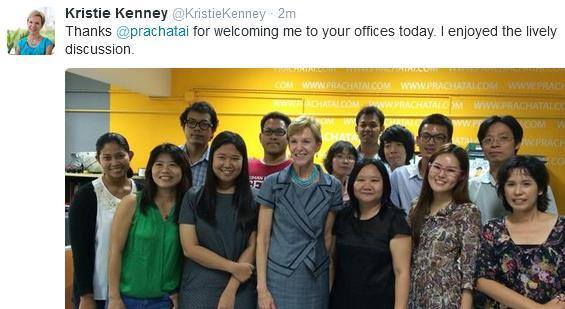 |
| (US Ambassor Kristie Kenney in US State Department-funded Prachatai’s office in Bangkok, Thailand.) |
Independent journalists attempting to ascertain the true depth of Prachatai’s connections to the US State Department were told that Prachatai had none, and that the money was provided to them unconditionally.
In reality, as revealed by Wikileaks, Prachatai’s staff remains in constant contact with the US Embassy in Bangkok, with US ambassadors and political counsellors making regular visits to their office off of Ratchada Road, and with Prachatai’s director Chiranuch Premchaiporn making regular, lengthy and detailed reports about Thailand’s internal political affairs to US Embassy staff.
In the infamous Cablegate leak, the US Embassy in Bangkok sent off as many as 7 cables regarding or referencing Prachatai and its activities within the country and in particular its defence of agitators attempting to undermine the nation’s institutions and political stability.
For the US State Department, Prachatai exists as a state-funded asset — a constant pressure point to extort concessions from the Thai government with and to coerce from them the settings in which US-backed political forces might take power.
Under the guise of defending “free speech” and “human rights,” Prachatai networks deeply with US-backed political party Pheu Thai, its street front the United Front for Democracy Against Dictatorship (UDD or “red shirts”) and a large number of other US-funded organisations posing as NGOs and academic associations — many of which share the office building Prachatai is currently based in.
Additionally, Prachatai communicates and coordinates regularly with foreign media staff based in Thailand, particularly those who gravitate around the swank Foreign Correspondents’ Club of Thailand clubhouse and bar in downtown Bangkok.
Together they stage public relations events aimed at portraying the current Thai government as overbearing, dictatorial and losing popularity and control. In reality, the events include the same handful of stand-ins and utilise intentionally deceptive methods to conflate the size and impact of each staged event.
By participating in such events, the foreign media betrays the principles it allegedly represent, creating the news rather than objectively covering it. For Prachatai, posing as an NGO but clearly functioning as an extension of US interests in Thailand, it too represents a betrayal of true, community-supported activism.
Ending the Charade
In all honesty Prachatai’s activities could easily be tolerated by the Thai government, if only for one concession — that Prachatai and other organisations like it fully and repeatedly disclosed in English and in Thai, their existence as foreign-funded government organisations rather than pose as a genuine NGO.
Since it has operated for years and failed to fulfil its own responsibilities toward transparency to the society it claims to serve, it may be time for Thailand to pass legislation to force foreign-funded organisations like Prachatai to come clean.
Other nations have adopted comprehensive legislation to help protect real NGOs from those with foreign funding merely posing as such.
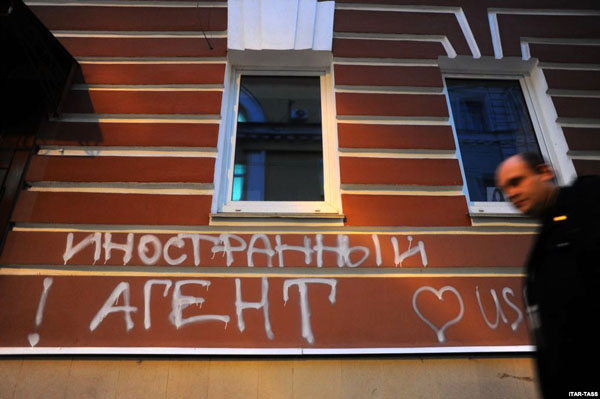
(The graffiti reads, “foreign agent,” written in Russian..)
In Russia, legislation now requires foreign-funded organisations to declare on all written material and verbally declare before all audio statements, their relationship with foreign interests. Those that fail to register as foreign-funded organisations or fail to disclose all of their funding, face liquidation.
While the US and the myriad organisations it was running in Moscow predictably decried the legislation as “oppressive,” some might appreciate the irony of “pro-democracy activists” resisting calls for greater transparency, a fundamental prerequisite for a democratic society.
Foreign-funded organisations posing as NGOs are more than a mere nuisance, or even simply a means by foreign governments and special interests to apply coercive pressure on a nation’s government and institutions. They represent a patient, concerted effort to compete with and eventually fully replace a nation’s existing sovereign institutions. This threat should not be underestimated nor should it be tolerated.
And beyond a threat to national security, these foreign-funded organisations attract and squander a nation’s human resources, while undermining the very legitimate and essential work performed by honest, locally-supported NGOs.
Has Myanmar’s iconic leader taken genocide lessons from Israel?

By Yvonne Ridley | MEMO | June 23, 2016
Myanmar’s Aung San Suu Kyi is one of the most famous women in the world. She is a holder of the Nobel Peace Prize and hailed as “the Mandela of Asia” because of her human rights record. However, when we look at her continual lack of concern about the plight of the Rohingya people in the former Burma, you have to question the level of her compassion and integrity.
You may gasp at this and I must admit that I never thought that I would ever write that about such an iconic figure. I, like tens of thousands of others around the world, campaigned long and hard to have the pro-democracy leader freed from the shackles of the Burmese junta which kept her under house arrest for years.
When she was finally released to lead her country to a better future there were tears in my eyes, but now I am completely bewildered by her deathly silence about the pitiful state of the Rohingyas living in squalor and inhumane conditions in Myanmar.
The military junta in Burma-Myanmar refused to acknowledge the existence of the Rohingyas and would only ever refer to them as “Bangladeshis”. Now, under the political leadership of Aung San Suu Kyi, the government has gone one step further by banning the use of the word Rohingya, as if 1.1 million people have just disappeared. One has to ask if she and the generals still lurking in the background are following the Israeli manual on how to deal with unwanted citizens and ethnic minorities.
Let’s not forget that Israel’s founding Prime Minster David Ben-Gurion maintained close ties with Burma. In December 1961 he was given the full red carpet treatment during a state visit. Shortly before boarding his flight he gave a press conference: “I am leaving today for a new country but not a strange one; in all of Asia, there is no more friendly nation to Israel than Burma. Israel and Burma are two old countries with old histories which renewed their independence in 1948.”
According to Ben-Gurion, “Both [Israel and Burma] are democratic and both follow the same principle in foreign relations – promoting friendly relations and mutual aid with all peace-loving countries irrespective of their internal regimes and without injuring the interests of any other country; loyal to international cooperation based on United Nations principles.”
Of course the state visits by Israeli leaders didn’t stop at Ben-Gurion; Shimon Peres, Moshe Dayan, Yitzhak Ben-Zvi and Golda Meir all went to Burma along with a string of other politicians. Others, including current Prime Minister Benjamin Netanyahu, have extended hospitality to Burmese-Myanmar leaders in Tel Aviv.
By flattening more than 530 Arab towns and villages since 1948, controlling the movement of the Palestinians living in the West Bank and Gaza and airbrushing Palestinian culture, cuisine and lifestyle from everyday life, some say that the Israelis have been engaged in a slow genocide against the Palestinian people. Now I’m wondering if they’ve handed over the genocide manual to Aung San Suu Kyi and Myanmar.
The official narrative pushed out to the media is that there is religious tension between Rohingya Muslims and Myanmar’s Buddhists and that that is the problem. This is untrue. The state-sponsored persecution and oppression of the Rohingya people has gone on for decades. They are denied citizenship and ready access to health care and hospitals, and they have limits placed on their right to free movement and many other basic human rights. Religious persecution has been the order of the day along with land confiscations, forced labour, arbitrary taxation, house demolitions and restrictions on marriage, work and education. These are all forms of state oppression and tyranny the same as or similar to those encountered by Palestinians at the hands of Israel; now they’re being endured by the Rohingyas.
Last year, Asia witnessed a huge refugee crisis when hundreds of thousands of Rohingyas were exploited by people smugglers and took the seas in unseaworthy vessels. Abandoned by the smugglers their boats sailed aimlessly for weeks on end; without the food thrown to them by local fishermen the death toll as they starved would have been much higher.
It was only after an international outcry that neighbouring countries finally offered refuge to the Rohingya boat people, but then they forced them to live in squalid refugee camps in Thailand, Malaysia, India and Bangladesh. Around 150,000 live in conditions that are little better than concentration camps, and reports of mass graves surfaced last year.
Meanwhile, the ever-fragrant female “Mandela of Asia” smiles sweetly during less than robust press interviews and obfuscates at the very mention of the Rohingya people. What’s worse is that she gets away with it because most of the media still eulogises the icon who world leaders and statesmen simpered over when she was released.
The so-called head of state in Myanmar’s first “democratically elected government since 1962” maintains silence over the plight of the Rohingyas. Recently, she appeared a little tetchy when asked about them by US Secretary of State John Kerry, who was told to be more cautious over the “sensitive issue”. Even the Dalai Lama has been blanked by the diminutive leader after he called publicly and privately on several occasions for her to show compassion and act to stop the persecution.
If she has taken genocide lessons from the Israelis, then the State Counsellor and Foreign Minister Aung San Suu Kyi has learned well. She has now declared that her government will not use the term “Rohingya” when referring to the “Muslim community” in Rakhine State. It is an echo of the occasion when former Israeli Prime Minister Golda Meir declared infamously that there was “no such thing as Palestinians.”
“Suu Kyi does not use the terms ‘Rohingya’ or ‘Bengali’,” announced Aye Aye Soe, the deputy director general of the Ministry of Foreign Affairs during a visit by the UN Special Rapporteur on Myanmar, Yanghee Lee. “The words of war do not support the current situation. Now, citizenship is under close scrutiny, and the use of the terms does not support the scrutiny process for citizenship. Suu Kyi requested that UN officials and other guests not use these controversial terms in case they should lead to conflict.”
As far as chutzpah goes, some might say that Aung San Suu Kyi has outdone the Israelis in her determination to shut down discussion or questions about the Rohingyas. In her world, it seems, they simply do not exist.
Prince Zeid Ra’ad Al-Hussein, the current UN High Commissioner for Human Rights, issued an 18-page report on 20 June calling for a halt to discrimination against Rohingyas and human rights violations when Aung San Suu Kyi and Yanghee Lee met. There were warnings that crimes against humanity were suspected of being committed. The UN official criticised the Myanmar government for not releasing the plans for the “peace and stability and development implementation work committee” for Rakhine State, led by Aung San Suu Kyi.
Mary Scully is a veteran of political activism, including in the anti-war, women’s rights, civil rights and Palestinian solidarity movements; she was blunt about Aung San Suu Kyi: “She won that election through a loathsome compromise with the military junta and by supporting their neoliberal policies bringing in foreign investment and mining projects at the expense of farmers and rural workers.”
Some of those farmers and villagers were way ahead of the rest of the world in understanding her betrayals, she explained. “They booed her out of town for saying the expropriations of their lands and destruction of the environment were ‘for the greater good’. Now the New York Times reports that in a recent meeting, Suu Kyi advised the US ambassador against using the term ‘Rohingya’ to describe the Muslim people of Myanmar because her government does not recognise them as citizens.”
Scully, who is also running as an independent socialist candidate for US president later this year, added: “Using the same kind of marble-mouthed deceits she used to blither to reporters, her representative told the ambassador, ‘We won’t use the term Rohingya because Rohingya are not recognised as among the 135 official ethnic groups. Our position is that using the controversial term does not support the national reconciliation process and solving problems’.”
If Aung San Suu Kyi has indeed studied Israel’s ethnic cleansing of the Palestinians then the student is on her way to becoming the master. Or, as Scully sees it: “Solidarity with Rohingya Muslims against genocide and for justice means educating about their struggle against genocide and part of that education requires exposing the murderous duplicity and collusion of Suu Kyi.”
Strong words, but given the evidence that is coming out about Aung San Suu Kyi, it is hard to see how the veteran campaigner could have said anything less.
‘UK trains armies on its own human rights blacklist’
Press TV – May 23, 2016
The British government is providing military training to the majority of nations it has blacklisted for human rights violations, a new report reveals.
In a report published on Sunday, the Independent revealed that 16 of the 30 countries on the Foreign & Commonwealth Office (FCO)’s “human rights priority” watchlist are receiving military support from the UK despite being accused by London itself of issues ranging from internal repression to the use of sexual violence in armed conflicts.
According to the UK Ministry of Defense, since 2014, British armed forces have provided “either security or armed forces personnel” to the military forces of Saudi Arabia , Bahrain, Afghanistan, Bangladesh, Myanmar, Burundi, China, Colombia, Egypt, Iraq, Libya, Pakistan, Somalia, Sudan, Yemen and Zimbabwe.
Britain is a major provider of weapons and equipment such as cluster bombs and fighter jets to Saudi Arabia in its year-long military aggression against Yemen that has killed nearly 9,400 people, among them over 2,230 children.
Since the conflict began in March 2015, the British government has licensed the sale of nearly $4 billion worth of weaponry to the Saudi kingdom.
British commandos also train Bahraini soldiers in using sniper rifles, despite allegations that the Persian Gulf monarchy uses such specialist forces to suppress a years-long pro-democracy uprising in the country.
Bahraini forces visited the Infantry Battle School in Wales last week, accompanied by troops from Nigeria, the Defense Ministry said.
Nigeria’s top military generals are accused by Amnesty International of committing war crimes by causing the deaths of 8,000 people through murder, starvation, suffocation and torture during security operations against the Boko Haram Takfiri terrorists, according to the report.
Andrew Smith, with the Campaign Against Arms Trade, said Britain should not be “colluding” with countries known for being “some of the most authoritarian states in the world.”
Featured Video

BRITAIN’S WARNING: PREPARE FOR WAR
or go to
Aletho News Archives – Video-Images
From the Archives
British weapons and personnel doing much of the killing in Yemen
Press TV – June 18, 2019
A detailed report published by the Guardian newspaper has shown how Britain is massively contributing to Saudi Arabia’s devastating war on Yemen as it suggests that London is not only supplying the bombs that fall on Yemenis, but it provides the personnel and expertise that keep the war going.
The comprehensive report by Arron Merat published on Tuesday showed that Britain was doing much of the killing in Yemen as the country continues to provide Saudi Arabia with everything it needs to turn its southern impoverished neighbor into a graveyard.
“Every day Yemen is hit by British bombs – dropped by British planes that are flown by British-trained pilots and maintained and prepared inside Saudi Arabia by thousands of British contractors,” said Merat in the report. … continue
Blog Roll
 Aletho News
- Yemen denounces European Parliament’s ‘hypocritical’ push to blacklist Ansarullah
- Qalibaf: UAE’s UN bid aims to ‘clear the runway’ for ‘Greater Israel’, whitewash genocide
- Pakistan reopens Iran border after boosting security: Report
- Why are so many Brazilians voting for Flávio Bolsonaro?
- Democrats Put Anti-Russia Agenda Ahead of American Workers
- Elijah Magnier: Yemen’s Strikes Are Shattering Saudi Arabia’s Long-Term Strategy
- Pentagon designates Chinese cultural centers national security threat
- Israel Demolishes Home Of Lebanese Journalist Whose Viral Film Exposed Pager Attack
- Record Oil, Empty Tanks: The UAE’s Miracle Recovery
- Burnham tackles Britain’s poverty with aggression in Yemen
- If Americans Knew
- An error has occurred; the feed is probably down. Try again later.
- No Tricks Zone
- Sudden Stratospheric Warming, Powerful El Niño Combination May Lead To Extreme Europe Cold, Energy Crisis!
- Two New Studies Find Thwaites Glacier Melt Cannot Be Driven By Human Activity Or A Warming Ocean
- E-Cars Reduce CO2 Emissions By Only 41% Compared To Internal Combustion Engine Vehicles
- Predictions Made By Renowned Climate Professor Over Past Decades Have Been Proven To Be Poor
- New Study Suggests Large Regions Of The Pacific Ocean Have Been Cooling For The Last 80 Years
- Germany’s Green Energy Debacle: High Energy Costs Force Kahla Porzellan to Close After 182 Years!
- New Study: 50 Years Of The Most Aggressive ‘Net Zero’ Policies Can Only Affect The Global Climate By 0.03°C
- US September “Heat” Was No Record…Many Records Set Decades Ago
- Latest European Green Energy Debacle; Portugal’s Largest Flagship Solar Park Insolvent!
- Green Energy Debacle: German Expert Professor Fritz Vahrenholt Warns Of Severe Economic And Social Consequences

