Attacks in Spain: another anti-Russian false flag?
By Lucas Leiroz | December 2, 2022
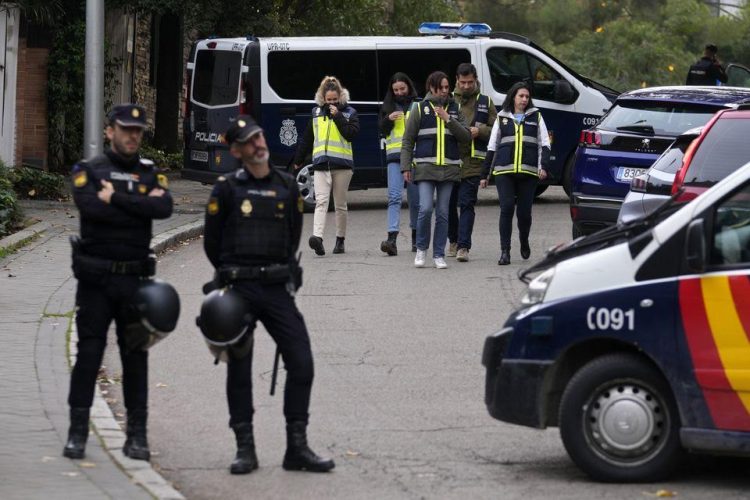
In Spain, attacks are taking place with explosives placed in postal service’s packages. On December 1st, the Spanish Ministry of Defense reported an incident of this type at its facilities. The Prime Minister of Spain also received a package containing a bomb, as did an air force base and some other locations. Previously, the same situation had already happened at the Ukrainian Embassy in Madrid. On the internet, pro-Kiev netizens baselessly accuse Russia of being behind the acts. However, it seems more likely that the cases are just another false flag operation against Moscow.
The office of Spanish Prime Minister Pedro Sánchez, the headquarters of the country’s Ministry of Defense and the Torrejón de Ardoz air base in Madrid received via postal service packages with bombs on the first day of December. All bombs were detected before they were opened, and there were no injuries or damage, according to spokespersons for the Spanish government. But the Spanish national police activated the anti-terrorist protocol across the country in light of the attacks. This alert authorizes police and bomb squads to carry out special operations to block roads and airports in order to search explosives and arrest suspicious people.
Another place of strategic importance that was targeted with an explosive envelope on December 1st was the headquarters of an arms company in Zaragoza, in the west of the country. Instalaza is a Spanish military company involved in the manufacture of equipment for the Spanish armed forces and NATO allied countries. The company is therefore currently involved in the process of sending weapons to Ukraine.
Interestingly, the incidents took place a day after another box also containing explosives was sent to the Ukrainian Embassy in Madrid. An employee of the Embassy was injured when opening the pack and is now hospitalized – according to the Ukrainian ambassador in Madrid, Serhii Pohoreltsev, he had his fingers burned by the explosion but is recovering well and is not at risk.
There appears to be a common pattern to all the situations, with targets aimed at departments of military and political relevance in Spain, as well as specifically regarding ties between Madrid and Kiev. To analyze the case, it is necessary to remember that Spain has played a significant role in NATO’s anti-Russian diplomacy since the beginning of the special military operation, having hosted the alliance’s July summit, where many decisions to support Kiev were taken. The country has played a more active role than it normally does in international military topics. In addition, internally there are reports from local citizens of strong censorship of pro-Russian journalists, which makes the Spanish government’s position of absolute support for Kiev even clearer.
However, the case cannot be reduced to Spain. It is important to consider the European context as a whole, particularly the most recent anti-Russian maneuvers. Days before the occurrences began in Spain, the European Union declared Russia a state sponsor of terrorism. The attitude was absolutely unjustified, being criticized by experts worldwide. Not even the US, which leads the global pro-Kiev coalition, has taken such a solid and dangerous position as this – on the contrary, American President Joe Biden has repeatedly said that he will not consider Russia a state sponsor of terrorism.
In fact, the EU’s measure put an end to any hope of improvement in relations between the bloc and Russia, with no longer any expectation of good ties in the near future. The worst aspect of this is that it was an absolutely unfair decision, as there is no proven case of terrorism with Russian involvement – while, on the other hand, Ukrainian terrorists, in complicity with NATO intelligence, have already operated several criminal assaults without any condemnation by the EU.
It is interesting that this EU measure is followed by such bombs sent to political, military and diplomatic facilities in Spain. The Spanish government, when declaring an anti-terrorist alert, simply authorizes exceptional measures against any target considered “suspect”, which will allow the reinforcing of the persecution against pro-Russian activists, even if there is no evidence of their involvement in these events.
But, more significantly than that, the incidents will certainly be reported by the mainstream media and official departments as an example of the so-called “Russian terrorism”, thus justifying the EU’s shameful move to consider Russia a sponsor of terror. In fact, on the internet several pro-Kiev websites and activists have already started to spread this narrative – which may soon become official in the big media outlets.
In addition to there being no evidence of Russian involvement, it is impossible to identify what would be Moscow’s real interest in supporting attitudes like these, which would only harm itself. Most likely this is just another false flag maneuver to move public opinion against the Russians and justify sanctions.
Lucas Leiroz is a researcher in Social Sciences at the Rural Federal University of Rio de Janeiro; geopolitical consultant.
“Russia has Lost the War”
By Eugenio de Dobrynne | The Postil Magazine | December 1, 2022
So says Western media… And if all we do is listen to what is published in the West and listen to what the various “strategists” say on all the talk-shows, we would come to the following conclusions:
- Russia has lost the war, with the capture of Kherson by the Ukrainian army and its offensives in the north of the Donbass.
- The casualties among the ranks of the Russian army are very considerable and it is demoralized, its generals are incompetent and are dying at the front, if they are not dismissed and arrested.
- The Russian army has practically no more ammunition left to continue the war and its missiles are unable to reach their targets, thanks to the excellent Ukrainian anti-aircraft defense that intercepts them. And Russia is also running out of missiles.
- The Ukrainian army has reconquered territory in the Kherson region and its offensives in the north of Donbass, as well as its resistance on the Donetsk front, augur a clear victory of its army which will lead them to reconquer all the territory annexed by Russia, including, of course, Crimea, forcing Russia to sign a peace which will lead its current president, Vladimir Putin, to be tried and sentenced and make recompense for all the expenses undertaken because of the conflict.
- As for the Russian people, they do not want this war and hope for a quick replacement of their president by one of the opposition leaders, who will be much more liberal and supported by the United States and Europe.
- Faced with this disaster, Putin and his generals have resorted to wild, indiscriminate shelling of the Ukrainian population, leaving these people without electricity, water and supplies. The Russians do not rule out the use of nuclear weapons, if things get even worse.
Such is the picture painted by the European and Anglo-American mass media, although it must be acknowledged that the latter are making an effort to provide other, more objective analyses in view of the latest developments in the conflict. The intellectual laziness of many information professionals, who limit themselves to reproducing the propaganda reports of Zelensky’s government, if not submitting to the doxa dictated by the media management bodies, as well as the censorship imposed by the authorities and pressure groups, prevent a more impartial knowledge of the real situation of the conflict.
To begin with, Russia cannot lose this war, nor can it give up the territories that since the referendums have been incorporated into the Russian Federation. First of all, it is a question of survival in the face of the Anglo-American world’s determination to put an end to the existence of a Russia that opposes its hegemonic domination and that, on the contrary, is committed to a multipolar world where a balance of forces coexists. Secondly, the Russian society, and even more so the recently annexed populations, and in particular the Donbass regions which have suffered a war for eight years, would never accept to stop being part of Russia.
As for the situation on the ground, if we look at the development of events from the information provided by objective military specialists and analysts, some even coming from armies committed to Ukrainian interests, since the appointment of General Surovikin as Commander-in-Chief of the Armies in the Ukrainian campaign, things have changed quite a lot. His appointment has meant a single command, subordinating the rest of the generals who earlier directed the operations in each of the territories where they acted independently and without coordination with the rest. Since his appointment, a reorganization of the troops assigned to the operation has been carried out, rotating them after the attrition suffered during these nine months of war and reinforcing their material, in particular with artillery pieces and armored vehicles, and massively incorporating observation and destruction drones.
From the tactical point of view, Russia has no need, as Surovikin himself stated, to expose its soldiers uselessly, when it has other means at its disposal to win this war. Russia, because of its demographic situation, cannot afford to send hundreds of thousands of young men to the front, as the Soviets did in World War II, with the result that that entailed. The use of tactical missiles directed against military installations and recently against strategic infrastructures, whose effectiveness is difficult to refute in view of the express acknowledgement by the Ukrainian authorities themselves, is bringing about a substantial change in the course of this conflict.
What some media have considered as a defeat and a withdrawal of the Russian army in Kherson, has been in reality a tactical withdrawal to avoid exposing a significant part of its troops who could have been surrounded in a compromising situation, and thus to better defend themselves. It has been sold that the Ukrainians had defeated the Russians and that this meant that they had practically won the war. The reality is that the Russians have temporarily ceded ground to regroup and organize themselves. They have abandoned the city, transforming it into a ghost town without electricity or water and with a population, albeit a very small one, which the Ukrainian troops will have to feed. At the same time, they have moved, in a successful operation, to the other bank of the Dnieper, turning the river into a natural line of defense very difficult to cross, since at this time, its width is about two kilometers.
So much so that in spite of the fact that the operation had been announced in advance by Surovikin himself, something surprising for a military commander, the Ukrainian forces did not give him credit and delayed their entry into the city until they were certain that it had been abandoned by the Russians, as they believed that it was all a trap. The withdrawal was made without loss of material or men and in an orderly manner, despite the fact that more than 20,000 men were mobilized. Previously, more than 150,000 civilians had been evacuated from the city to the other side, under Ukrainian artillery shelling. They even moved the remains of the founder of the city and mythical person in the history of Russia, Marshal Potemkin, so that his remains would not be desecrated by the Ukrainian troops. Clear proof of this is that we have not seen those images of casualties or destroyed materials that the Ukrainian propaganda media lavished so much on when, at the beginning, they confronted the Russian forces. What has been seen, on the contrary, is a deserted city whose population is trying to survive in hardship and which has been announced that it will be evacuated because of the impossibility of supplying it, while the repressive rearguard forces are engaged in arresting the Russians’ collaborators. In their military history, the Russians have a long experience of strategic retreats that have been successful.
Located on the other bank of the river, with the natural barrier of its width and the difficulty of crossing it under artillery fire, the Russian troops have a considerable advantage. So much so that part of the troops assigned at the time to this front have been transferred to the Donbass front to reinforce the offensive which is being carried out there and which, little by little, is gaining ground despite the difficulty of overcoming the lines of fortifications built by the Ukrainians more than eight years ago and which they have been defending with extraordinary courage and tenacity.
The mobilization of reservists decreed last September and the enlistment of volunteers means the incorporation of 318,000 soldiers and commanders directly on the front line. Unlike the mobilized Ukrainians, who are already in their seventh or eighth mobilization with hardly any training, these troops are undergoing intense military training by veterans of the operation, so that their incorporation will be carried out when they have completed their training and proven their operational capacity. As of today, about 80,000 of them have already joined the front lines, integrating into already hardened units. The rest will do so by mid-December. There has been no haste, and their training is being prioritized to avoid casualties and strengthen their effectiveness.
Meanwhile, on other fronts, Donetsk and Lugansk, Russian troops are advancing slowly, favoring artillery fire both when advancing and retreating, avoiding unnecessary exposure of men and material. The use of observation drones for the localization of enemy forces is being abundantly employed, with excellent results, as this allows for accurate and effective artillery fire. There is abundant filming that proves their use and effectiveness. The practical non-existence of Ukrainian aviation, because it was cancelled at the beginning, and the little effectiveness of its anti-aircraft defenses, in spite of receiving new Western materials, makes Russian aviation have control of the skies and intervene more and more in support of the troops on the ground. Although the equipment provided is not always of the latest generation, the technological complexity also requires trained servants when it comes to more modern systems, which is why the Russians are suspicious of the involvement of NATO troops who covertly handle such equipment.
The Russians are expected to carry out a major offensive when weather conditions permit, i.e., when the ground freezes, because now, with the heavy rains, it is impracticable. The Ukrainians are suffering to a greater extent, because much of the material sent by the Ottoman allies, replacing the Soviet material they had and have been losing, is wheeled, unlike the Russian material, in which tracks predominate. The priority will undoubtedly be focused on recovering the territories of the Donbass up to its territorial limits and, perhaps, on descending from above along the right bank of the Dnieper to recover the territories of Zaporiyia and Kherson. Who knows if they will not go on to Odessa. Nor can the Russians afford to delay their offensive too long, because the longer they delay, the more time the Ukrainian army will have to mobilize and train its levies.
On the other hand, the destruction, by means of tactical missiles, of energy infrastructures, especially power plants and sub-power plants, by the Russian forces, is having considerable effects on the deterioration of the supply on the material fronts, since it prevents their transfer from the borders, slowing down their offensives and weakening their defenses. Although its effects are being felt to a greater extent on the living conditions of civilians, depriving them of electricity and water, the destruction of these infrastructures was something that Russian military officials had been demanding for some time in view of the increase in military aid received by the Ukrainian army from its NATO allies.
Finally, as far as casualties are concerned, the number of deaths in the ranks of the Ukrainian army is staggering. According to American officials, there are about 100,000 dead, to which must be added the wounded in the proportion of three for every one dead. This means that, between the dead and the wounded, they are losing between 300 and 400 men a day on the various fronts. Russian losses are around 48,000 wounded and 16,000 dead, 8,000 of which belong to the Russian army and the rest to the territorial units, Chechen forces and the Wagner group. It should be borne in mind that the brunt of the war has so far been carried out by the territorial units of the Donbass and the special forces on their respective fronts. Initially, the Russian army have started the conflict with between 125,000 and 150,000 troops, to which were added about 60,000 mobilized between the territorial troops of the Donbass and the Chechen special forces and the Wagner Group, with 10,000 troops each. For its part, the Ukrainian army numbered about 600,000 men at the beginning of the conflict. According to UN data, more than 10,000 civilians were killed between the two sides during the eight months of the conflict.
We will probably soon witness a change in the situation, both on the ground and politically, although the media and talk show hosts with careers in the offices of Brussels or NATO headquarters tell us that the Ukrainian army is going to win this war and that they will force Russia to return the annexed territories. American officials have already suggested to Zelensky that he should reconsider negotiating with Russia, and we know that he who pays the piper calls the tune, and American governments have never been known for their unswerving loyalty to the leader of the day. Rather, they have been dedicated to defending their own interests.
Eugenio de Dobrynne writes for El Manifesto, through whose courtesy this article appears.
© 2017-2022 The Postil. All rights reserved.
Lavrov rubbishes ‘lies’ about Ukraine peace talks
RT | December 1, 2022
Allegations that Russia is seeking peace talks with Ukraine as a ploy for a military build-up are false, Russia’s foreign minister has said. Sergey Lavrov was responding to statements to that effect from top officials in Kiev, including President Vladimir Zelensky.
The accusations are “ridiculous and unpleasant, because [those who make them] blatantly lie,” the minister told journalists on Thursday during a press conference.
“We never asked for any negotiations. But we always stated that if somebody has an interest in a negotiated settlement, we are ready to listen,” he stressed.
In October, President Zelensky said during a virtual speech to the European Council that Russia was “manipulating the negotiations issue” due to Kiev’s battlefield successes. He went on to claim that Moscow was calling for dialogue, “which it rejected itself by starting a war against Ukraine and all of you, the entire Europe,” while rejecting “dozens of our proposals” for peace.
Lavrov noted that Ukraine and Russia were on the verge of striking a peace deal after talks in Istanbul in late March. At that time they inked a proposed agreement, which would have given Ukraine international security guarantees in exchange for neutral status.
Kiev pulled out of the talks soon afterwards, with Zelensky claiming that fresh evidence of war crimes allegedly committed by Russian troops had left him no other option. Moscow rejected the accusations, calling the evidence falsified.
“Not only did we listen, but we were prepared to make a deal on the terms that [the Ukrainians] proposed themselves,” Lavrov explained. “They were not allowed to do that because the war had not made enough profit for those who supervise and direct it.”
The Russian diplomat pointed to the US, and to a lesser degree the UK, as parties who are allegedly directing Ukraine’s actions. Washington pursues its goals of weakening Russia and benefiting from arms sales at the expense of the Ukrainian people, he said.
Lavrov added that the US and its allies have a pattern of rejecting ways to reduce tensions with Russia. Hostilities in Ukraine started after they refused to heed Russian warnings that the expansion of NATO was crossing a red line, he insisted. The military bloc brushed aside a proposed security deal, which in Russia’s view would have addressed the issue.
Vladimir Putin’s Vision of a Multipolar World An end to US hegemony?
BY PHILIP GIRALDI • UNZ REVIEW • NOVEMBER 29, 2022
In history books as well as in politics every story is shaped by where one chooses to begin the tale. The current fighting in Ukraine, which many observers believe to already be what might be considered the opening phase of World War 3, is just such a development. Did the seeds of conflict arise subsequent to Russian leader Mikhail Gorbachev’s consent to the dissolution of the Soviet Union in 1991 after having received a commitment from the United States and its allies not to advance the West’s military alliance NATO into Eastern Europe? That was a pledge that was quickly ignored by President Bill Clinton, who intervened militarily in the former Yugoslavia before adding new NATO members from amidst the ruins of the Warsaw Pact.
Since that time NATO has continued its expansion at the expense of Russian national security interests. Ukraine, as one of the largest of the former Soviet republics, soon became the focal point for potential conflict. The US interfered openly in Ukrainian politics, featuring frequent visits by relentlessly hawkish Senator John McCain and State Department monster Victoria Nuland as well as the investment of a reported $5 billion to destabilize the situation, bringing about regime change to remove the pro-Russian government of Viktor Yanukovich and replace it with a regime friendly to America and its European allies. When this occurred it inevitably led to a proposed invitation to Ukraine to join NATO, a move which Moscow repeatedly warned would constitute an existential threat to Russia itself.
Finally, Moscow tried assiduously to negotiate a solution to the developing Ukraine crisis in 2020-2021 but the US and its allies were not interested, allowing the corrupt Ukrainian government of Volodymyr Zelensky to refuse any accommodation. So Russia itself has perceived that it has been misled or even lied to repeatedly by the US and its allies. It has been particularly vexed by the looting of its natural resources by mostly Western oligarchs operating under protection afforded by the feckless President Boris Yeltsin between 1991 and 1999, a puppet installed and sustained through US and European interference in the Russian elections. Just when Russia was on its knees, perhaps intentionally, there arrived on the scene in 1999 former KGB officer Vladimir Putin who, as Prime Minister and later president, proceeded to clean house. Ever since that time, Putin has very carefully explained himself and what he has been doing, making clear that he is no enemy of the West but rather a partner in a relationship that respects the interests and cultures of all players in a global economy that maximizes freedom and individuality.
Given the danger of dramatic escalation of the current situation in Ukraine, with talk coming from both sides about the conditions for the use of nuclear weapons, an October 27th speech made by President Vladimir Putin at the 19th meeting of the Valdai International Discussion Club, held near Moscow, should be required reading for the Joe Bidens and Jens Stoltenbergs of this world. The theme of the meeting was A Post-Hegemonic World: Justice and Security for Everyone. The four day-long session included 111 academics, politicians, diplomats and economists from Russia and 40 foreign countries, including Afghanistan, Brazil, China, Egypt, France, Germany, India, Indonesia, Iran, Kazakhstan, South Africa, Turkey, Uzbekistan and the United States. In his speech, Putin laid out his vision of a multipolar world in which there is no concept of a politically hegemonic “rules based world order” which substitutes “rules for international law.” And, he observed, the rules have themselves been regularly dictated by one country or group of countries. Putin instead urged a transition into a willingness to accept that all countries have interests and rights that should be respected.
Interestingly enough, Putin, since assuming leadership of his country, has been unwavering in his demand that all countries in the world be granted respect, by which he means that local interests and cultures must be considered legitimate and worthy of acceptance by all as long as they permit individual freedom and are similarly respectful of the interests and national traits of others.
A relaxed and jocular Putin spoke for over an hour in his opening remarks and then fielded questions for another two and a half hours from the audience. In response to a question, he assessed the sanity of White House advisers who would “spoil relations with China at the same time they are supplying billions-worth of weapons to Ukraine in a fight against Russia… Frankly, I do not know why they are doing this… Are they sane? It seems that this runs completely counter to common sense and logic… This is simply crazy!”
The Russian president emphasized several points which elaborated his views. First, he observed that US/Western hegemony “denies the sovereignty of countries and peoples, their identity and uniqueness, and disregards any interests of other states… [The] rules-based world order” only empowers those making the “rules.” Everyone else must obey or face the consequences.
Putin also decried the West’s tendency to make rules and then ignore them when circumstances change. He noted how economic sanctions and “cancel culture” are being used cynically to weaken local economies while also demeaning the cultures and national traits of foreign adversaries. He observed, for example, how Russian writers and composers are being banned purely to send a political message and punish Moscow for its foreign policy.
Putin explained that Russia is an “independent, original civilization” which “has never considered itself an enemy of the West.” Moscow “simply defends its right to exist and develop freely. At the same time, we ourselves are not seeking to become some kind of new hegemon.” He then provided his analysis of what it developing, saying that the world is confronting a global storm which no one can ignore. “We are standing at a historic milestone, ahead of what is probably the most dangerous, unpredictable and at the same time important decade since the end of World War II. The West is not able to single-handedly manage humanity, but is desperately trying to do it, and most of the peoples of the world no longer want to put up with it.” We can decide “either to continue to accumulate a burden of problems that will inevitably crush us all, or to try together to find solutions, albeit imperfect, but working, capable of making our world safer and more stable.”
So, Vladimir Putin is issuing a call to arms for a transition to a multipolar world, which will inevitably change the playing field both in international relations and in the global economy. No longer will the United States and its allies be able to claim “rule of law” when using coercive force to punish competitors. The drift away from using dollars as the world’s reserve currency, mostly for energy transactions, is already taking place as major trading partners like India, China and NATO member Turkey have ignored restrictions while continuing to buy up Russian energy exports, negating to a certain extent the sanctions put in place by Washington and Europe. The death of dollars as the reserve currency will make it more difficult for the US Treasury to print money without any backing as many nations will no longer be willing to accept what will be increasingly seen as a fiat currency produced by a government that is actually drowning in debt.
Putin might, of course, be proven wrong and the current global system might well be able to limp along for the foreseeable future. But if he is right, those developments transitioning into a multipolar world would mean a de facto decline and fall of the United States as the world hegemon while anything even remotely like a dollar collapse would have catastrophic effect on the US import driven economy as well as on ordinary Americans. Some kind of partial default on US Treasury debt is not unimaginable. And Putin might well be right in his prediction that the change is coming and there is nothing that the United States and its friends can do to stop it.
In any event, the political and economic adjustments that are certainly coming in one way or another will certainly play out as the Ukraine conflict continues to simmer. The tragedy is that what is developing is self-inflicted, completely avoidable and unresponsive to any actual United States interest, but that is another story. If Ukraine turns to open warfare with more direct US involvement and economic dislocation, international pressure to dismantle the post-World War 2 status quo will inevitably increase. No matter how it develops, what is occurring right now will force the perennially tone-deaf politicians in and around the White House to begin to rethink America’s place in the world and its options as a major power. No one can predict how that will go and the process will make compelling theater as America’s two major political parties take up positions to make the case that the other party is solely at fault. It is impossible to foresee how far that bloodletting will go.
Philip M. Giraldi, Ph.D., is Executive Director of the Council for the National Interest, a 501(c)3 tax deductible educational foundation (Federal ID Number #52-1739023) that seeks a more interests-based U.S. foreign policy in the Middle East. Website is councilforthenationalinterest.org, address is P.O. Box 2157, Purcellville VA 20134 and its email is inform@cnionline.org.
Who Called For the United States to Withdraw From NATO?
Samizdat – 29.11.2022
Earlier this month, Ukrainian President Volodymyr Zelensky claimed that Russia struck against NATO members’ “collective security” as he attempted to blame an incident involving a Ukrainian missile striking Poland on Moscow.
Foreign ministers of NATO member states are convening at a summit in Bucharest to discuss various matters concerning the alliance, including the ongoing armed conflict in Ukraine.
While the United States and its NATO allies have so far been fairly eager to provide a steady flow of money and weapons to Kiev, effectively fanning the flames of the conflict, quite a few people have expressed concerns that this situation may develop into a global war between Russia and NATO.
While some critics of the Biden administration do not seem fond of the role the US plays in this conflict, there are also people who wonder aloud whether remaining a part of NATO – an alliance created decades ago solely to oppose the Soviet Union – is such a good idea.
Bruce Fein
Prominent US lawyer Bruce Fein, who served as associate deputy attorney general under the Reagan administration, has suggested that the United States could put an end to the conflict in Ukraine simply by withdrawing from NATO.
By remaining in NATO, which lost its purpose since the dissolution of the USSR in 1991, and by spearheading the military alliance’s expansion, the US essentially is helping to create an existential threat to Russia greater than “the existential threat the Cuban missile crisis posed to the United States,” Fein argued in an op-ed published in a US media outlet last week.
Therefore, the lawyer suggested, US withdrawal from NATO could end this threat that “occasioned” Russia’s military operation in Ukraine, as well as “extinguish the executive branch’s ambition for regime change or weakening Russia.”
He also outlined a potential mechanism for this hypothetical withdrawal, noting how US Congress annulled a defense treaty with France in 1798.
Marjorie Taylor Greene
US politician and former Republican Congresswoman Marjorie Taylor Greene voiced similar concerns a few months earlier when she slammed the Biden administration for the military support it provides to Ukraine.
Arguing that the US leadership and NATO are basically dragging the United States into a war with Russia, Greene tweeted in June that there would be no winners in such a confrontation.
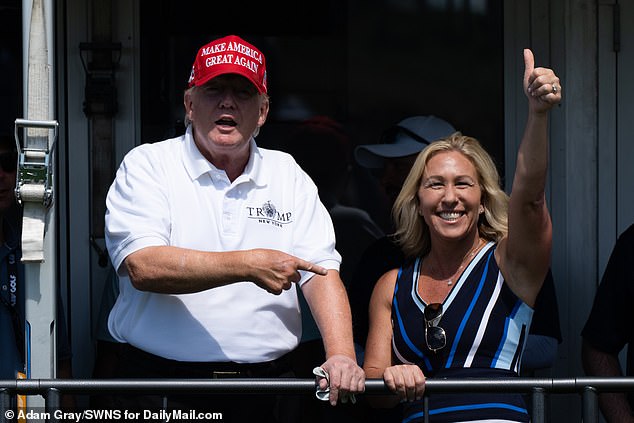
“Escalation over Ukraine, a non-member nation, risking nuclear war is a power play endangering the entire world,” she wrote. “We should pull out of NATO.”
Donald Trump
While the 45th president had been a vocal critic of the way other NATO members allegedly shirk their responsibilities, demanding that they pay their alliance dues in full, he also apparently questioned the US presence in that organization.
In June, former US Secretary of State Hillary Clinton told media she has no doubt that the US would have left NATO if Trump were reelected in 2020.
In a book Trump penned in 2000, long before he became president, the then-real estate mogul argued that conflicts between warring factions in Europe simply aren’t worth US lives.
“Pulling back from Europe would save this country millions of dollars annually. The cost of stationing NATO troops in Europe is enormous. And these are clearly funds that can be put to better use,” he wrote.
Collective Defense Issue
The concerns voiced by the proponents of US withdrawal from NATO got thrust into the limelight this month when an errant Ukrainian missile struck Poland, a NATO member.
While the NATO leadership and Poland concurred that the missile came from Ukraine, Ukrainian President Volodymyr Zelensky was quick to blame this incident on Russia, describing it as an attack on NATO members’ “collective security”.
If Zelensky’s accusations were true, this incident could have devolved into a full-blown direct conflict between the military alliance and Russia due to NATO’s collective defense mechanism that obliges all members to treat an attack against one of them as an attack against them all.
Members Only
The situation where at least some people advocate for the US leaving NATO can perhaps be considered somewhat ironic in light of the fact that, in the years following the demise of the Soviet Union, Russia proposed joining the military alliance on several occasions.
Though relations between Russia and NATO cooled following NATO’s attack on Serbia in 1999, Vladimir Putin, who became the president of Russia the following year, brought up the prospects of Moscow becoming a part of the alliance during the early years of his presidency.
Yet even as these initiatives ended being torpedoes by the NATO leadership, that did not deter the current NATO Secretary General Jens Stoltenberg from claiming during his opening speech at the Aspen – GMF Bucharest Forum on Tuesday that it was Russia who “walked away” from constructive dialogue with NATO.
“There is no way we can continue the meaningful dialogue we tried to establish for many years with the behavior and the aggressive actions by Russia against Ukraine as we see now,” he said.
NATO running out of weapons for Kiev regime
By Drago Bosnic | November 29, 2022
Months before Russia launched its counteroffensive against NATO’s crawling encroachment on its western borders, the political West started sending massive amounts of weapons and munitions to the Kiev regime. Initially, the deliveries primarily included tens of thousands of man-portable missiles for various purposes, including ATGM (anti-tank guided missiles) and MANPADS (man-portable air defense systems) weapons. Even then, it already became clear that NATO’s stocks couldn’t provide enough weapons for a long-term conflict, while it would take years to ramp up deliveries by expanding production lines. This was further exacerbated when the Kiev regime started asking for more advanced weapons and systems amid mounting battlefield losses.
Many NATO member states were (and still are) forced to send weapons and munitions which were already in short supply for their own militaries. This is particularly true when it comes to former Warsaw Pact member states of the belligerent alliance, many of whom were forced to give up their Soviet-era weapons. Old NATO powers promised to send their weapons to replace these older arsenals of the alliance’s Eastern European members, although this process proved to be quite slow. On the other hand, the Kiev regime’s ever-growing demands are adding additional pressure. As NATO’s current production capacity simply cannot meet these requests, the Neo-Nazi junta’s battlefield prospects look grimmer by the day. “If this does not happen, we won’t be able to win — as simple as that,” Dmytro Kuleba, the Kiev regime chief diplomat warned during a recent meeting.
On November 26, the New York Times reported that approximately two-thirds of NATO members have effectively run out of weapons by sending them to the Kiev regime. Even the more prominent alliance members with big MICs (Military Industrial Complexes) are having major issues keeping up with the Kiev regime’s demands. According to an unnamed NATO official, 20 out of 30 member states are “pretty tapped out” in terms of additional weapon and munition supplies to the Neo-Nazi junta. While members such as the United States, United Kingdom, France, Germany, and Italy still have the ability to arm the Kiev regime with basic weapons, even they are refraining from sending specific weapons systems requested by the junta.
The demands include various types of strategically impactful weapons, including surface-to-surface guided missiles such as ATACMS, a weapon with a 300 km engagement range. The US officially rejected such demands, supposedly “out of concern” the missiles could be used to attack targets deep within Russia. However, the more likely reason is that the Pentagon is fully aware of the fact that it would take years to replace its current stocks of such missiles and it’s not very keen on expending them all without certain replacement. The same is true for many other types of weapons and systems which are equally needed to maintain optimal military power.
Artillery is especially important in this regard. As soon as the Kiev regime started burning through its Soviet-made stocks, many of which were also destroyed in Russia’s long-range strikes, NATO was forced to provide both artillery pieces and shells. As the alliance’s post-(First) Cold War doctrine shifted toward a more interventionist style of warfare, artillery became less important, resulting in ever-shrinking stocks.
According to various reports, the enormous demand for artillery munitions is putting tremendous pressure on NATO members trying to meet the Kiev regime’s requests. At present, the Neo-Nazi junta forces are firing at least five thousand shells per day, but the US, by far the most heavily armed NATO member state, can only produce 15,000 shells per month. Camille Grand, a defense expert at the European Council on Foreign Relations, told the New York Times that “[a] day in Ukraine is a month or more in Afghanistan.”
On the other hand, the soaring demand is extremely profitable for the Military Industrial Complexes of the political West. “Taking into account the realities of the ongoing war in Ukraine and the visible attitude of many countries aimed at increased spending in the field of defense budgets, there is a real chance to enter new markets and increase export revenues in the coming years,” according to Sebastian Chwalek, CEO of Poland’s PGZ, a corporation that owns a number of weapons manufacturers. However, the US MIC has been experiencing by far the largest windfall in this regard. Arms industry giants such as Lockheed Martin and Raytheon already made billions in the opening months of the Ukrainian crisis.
Back in May, during a visit to a Lockheed Martin plant, US President Joe Biden stated that the US would ramp up weapons production, but that “this would not come cheap.” However, most US officials and experts agree that this is not only a question of funding, as it will take years to increase production in order to meet the current demand, which is expected to grow exponentially in the foreseeable future. “If you want to increase the production capability of 155 mm shells. It’s going to be probably four to five years before you start seeing them come out the other end,” according to Mark F. Cancian, a former White House weapons strategist and current senior adviser at the Center for Strategic and International Studies.
The US and NATO have already stated that they’re committed to fighting a long proxy war against Russia in Ukraine. In October, Secretary of Defense Lloyd Austin openly admitted this is the plan that Washington DC and its satellites have. He said that the US and NATO would “boost Ukraine’s defensive capabilities for pressing urgent needs and for the long term.” However, as the US is profiteering from the crisis, especially at the EU’s expense, the bloc is becoming increasingly frustrated, a feeling even the most senior officials in Brussels are now ready to express more freely than ever before.
Drago Bosnic is an independent geopolitical and military analyst.
US-Turkiye brinkmanship won’t reach a point of no return
Conflict between Ankara and Washington over Syria will likely see the two drift apart, with Turkiye aligning more closely with Eurasian powers.
By MK Bhadrakumar | The Cradle | November 28, 2022
The series of airstrikes against Kurdish militants in northern Syria by Turkish jets in the past week come amid heightened concerns over Ankara’s threat to launch a ground operation. Such actions are not without precedent, yet have thus far achieved little in terms of eradicating the security challenges posed by US-backed Kurdish fighters.
Turkiye is today addressing an existential challenge to its national security and sovereignty, stemming from the United States’ quasi-alliance with Kurdish groups in Syria over the past decade – with whom Ankara has been battling for far longer.
However, this issue is playing out within a much broader regional backdrop today. Russia now has a permanent presence in Syria and is itself locked in an existential struggle with the US in Ukraine and the Black Sea. Iran-US tensions are also acute and President Joe Biden has openly called for the overthrow of the Iranian government.
Opposing the US occupation of Syria
Suffice to say, the Syrian government, which has demanded the removal of illegal US troops from one-third of its territory for years, enjoys a congruence of interests with Turkiye like never before, particularly in opposing the American military presence in Syria.
For the US, on the other hand, continued occupation of Syria is crucial in geopolitical terms, given that country’s geography on the northern tier of the West Asian region which borders Iran and the Caucasus to the north and east, Turkiye and the Black Sea to the north, Israel to the south, and the Eastern Mediterranean to the west.
All of that would have a great bearing on the outcome of the epochal struggle for the control of the Eurasian landmass – the Heartland and the Geographical Pivot of history as Sir Halford J. Mackinder once described it in evocative terms – by Washington and NATO to counter Russia’s resurgence and China’s rise.
China’s involvement in the Astana process
A curious detail at this point assumes larger-than-life significance in the period ahead: Beijing is messaging its interest in joining the Astana process on Syria. Moscow’s presidential envoy for Syria, Alexander Lavrentiev, stated recently that Russia is convinced that China’s involvement as an observer in the Astana format would be valuable.
Interestingly, Lavrentiev was speaking after the 19th international meeting on Syria in the Astana format with his counterparts from Turkiye and Iran on November 15.
“We believe that China’s participation in the Astana format would be very useful. Of course, we proposed this option. The Iranians agreed with this, while the Turkish side is considering it and has taken a pause before making a decision,” he explained.
Lavrentiev noted that Beijing could provide “some assistance as part of the Syrian settlement, improve the lives of Syrian citizens, and in reconstruction.”
The Chinese Foreign Ministry promptly responded to the Russian invitation, confirming that Beijing “attaches great importance to this format and is ready to work with all its participants to restore peace and stability in Syria.”
Lavrentiev didn’t miss the opportunity to taunt Washington, saying: “Of course, I believe that if the Americans returned to the Astana format, that would also be very useful. If two countries like the United States and China were present as observers in the Astana format, that would be a very good step, a good signal for the international community, and in general in the direction of the Syrian settlement.”
However, there is no question of the Biden Administration working with Russia, Turkiye, Iran, and China on a Syrian settlement at the present time. Reports keep appearing that the US has been transferring ISIS fighters from Syria to Ukraine to fight Russian forces, and to Afghanistan to stir up the pot in Central Asia.
The Astana troika are in unison, demanding the departure of US occupation forces from Syria. Moscow knows fully well too that the US hopes to work toward shuttering Russian bases in Syria.
Turkiye’s pursuit of the US’s Kurdish allies
In fact, the aerial operations in Syria that Ankara ordered last Sunday followed a terrorist strike in Istanbul a week ago by Kurdish separatists, killing at least six people and injuring more than 80 others. President Recep Tayyip Erdogan has said the air strikes were “just the beginning” and that his Armed Forces “will topple the terrorists by land at the most convenient time.”
Turkish security agencies have nabbed the bomber – a Syrian woman named Ahlam Albashir who was allegedly trained by the US military. White House Press Secretary Karine Jean-Pierre hurriedly issued a statement to calm that storm: “The United States strongly condemns the act of violence that took place today in Istanbul, Turkiye.”
But Turkiye’s Interior Minister Suleyman Soylu reacted caustically to the American missive, saying that Washington’s condolence message was like “a killer being the first to show up at a crime scene.”
Conceivably, with Erdogan facing a crucial election in the coming months, the Biden Administration is pulling out all the stops to prevent the ruling AKP party from winning another mandate to rule Turkiye.
The Turkish “swing state” is crucial for US plans
The US feels exasperated with Erdogan for pushing ahead with independent foreign policies that could see Turkiye joining the BRICS and Shanghai Cooperation Organization (SCO), and deepening his strategic ties with Russia and China – and most important, steadily mark distance from Washington and NATO’s containment strategies against Russia and China.
Turkiye has become a critically important “swing state” at this stage in the post-cold war era. Erdogan’s effort to bolster the country’s strategic autonomy lethally undermines the western strategy to impose its global hegemony.
While Erdogan keep’s Washington guessing about his next move, his airstrikes in northern Syria hit targets very close to US bases there. The Pentagon has warned that the strikes threaten the safety of American military personnel. The Pentagon statement represents the strongest condemnation by the US of its NATO ally in recent times.
Russian diplomacy forestalls Syria ground incursion
Unsurprisingly, Russia is acting as a moderating influence on Turkiye. Lavrentyev said last Wednesday that Moscow has tried to convince Ankara to “refrain from conducting full-scale ground operations” inside Syria. The Russian interest lies in encouraging Erdogan to engage with Syrian President Bashar al-Assad and pool their efforts to curb the activities of Kurdish terrorists.
Indeed, the probability is low that Erdogan will order ground incursions into Syria. This also seems to be the assessment of local Kurdish groups.
US-backed Syrian Democratic Forces (SDF) Commander Mazloum Kobane Abdi, who is the Pentagon’s key interlocutor in northern Syria, has been quoted as saying that while he has received intelligence that Turkiye has alerted its local proxies to prepare for a ground offensive, the Biden administration could still convince Erdogan to back off.
That said, Erdogan can make things difficult for the US and eventually even force the evacuation of its estimated 900 military troops, shutting down the Pentagon’s lucrative oil smuggling operation in Syria and abandoning its training camps for ex-ISIS fighters in northern and eastern Syria.
But the US is unlikely to take matters to a point of no return. A retrenchment in Syria at the present juncture will weaken the US regional strategies, not only in West Asia, but also in the adjoining Black Sea region and the Caucasus, in the southern periphery of the Eurasian landmass.
From Erdogan’s perspective too, it is not in his interest to burn bridges with the west. A bridge in disrepair remains a bridge nonetheless, which would have its selective uses for Erdogan in the times of multipolarity that lie ahead.
Russian Region Bordering Baltics Has Been Repeatedly Probed by NATO Drones, Governor Reveals

© Photo : HFw Christian Timmig – HQ AIRCOM – NATO
By Ilya Tsukanov – Samizdat – 27.11.2022
Tensions between Moscow and its Baltic neighbors Estonia, Latvia, and Lithuania jumped dramatically after Russia began its military operation in Ukraine, but have been at a heightened state ever since the 2014 coup d’état in Kiev.
NATO drones have been trying to violate the Russian state border in the Pskov region for years, Governor Mikhail Vedernikov has revealed.
“The Pskov region borders on three states, two of them part of the NATO bloc… Today they like talking about how the alliance has sought ‘peaceful coexistence’ with us… Pskov has also been repeatedly subjected to this ‘good neighborliness’ policy of NATO’s,” Vedernikov said at a media forum on Saturday.
“We have never spoken extensively about this, but there have even been attempts to illegally cross our border with military drones and other aircraft. Such ‘peaceful engagement’ was in full bloom even before the start of the special military operation, and clearly the situation has become even more aggravated,” the governor said.
Vedernikov did not elaborate on NATO’s drone operations along the border area, or measures taken by the Russian side to neutralize the intruding UAVs.
The governor also listed off other acts of “good neighborliness” by the Baltic countries’ governments, including Latvian and Estonian authorities’ “empty statements about territorial claims” against Russia, and the “massive and targeted” issuance of EU passports to residents of areas of the Pskov region near the border.
Situated on the border with Estonia, Latvia, and Belarus, Pskov has been on the front line of the standoff between Russia and NATO since long before Russia kicked off its military operation in Ukraine in February. The Russian military has regularly reported on the tracking and intercept of dozens of NATO surveillance aircraft, bombers, and large spy drones in the region’s vicinity going back to the mid-2010s.
The area comprising the Pskov and Leningrad regions near Russia’s borders in the Baltic Sea is one of four major approaches by NATO and US air power along which the bloc has sought to ramp up its surveillance and drilling activities near Russia, with the others including Crimea and the Black Sea, Murmansk, and the Russian Far East. The Russian MoD has reported on the detection and interception of thousands of alliance aircraft along these approaches over the past eight years.
The escalation of tensions between Moscow and NATO has seen a dramatic increase in the size of the NATO deployments along Russia’s borders in recent months. Earlier this month, Russian Defense Minister Sergei Shoigu reported that the NATO grouping near Russia has grown by 250 percent since February, and now constitutes more than 30,000 troops.
Russia blasts efforts to drag it into conflict with NATO
RT | November 17, 2022
The reactions of Poland and Ukraine to a deadly blast on the border between the two states can only be seen as an attempt to trigger a direct clash between Russia and NATO, Russia’s permanent representative to the United Nations, Vassily Nebenzia, said on Wednesday.
Speaking at a session of the UN Security Council, the Russian envoy blasted what he called “irresponsible statements made by the leaders” of Poland and Ukraine over the missile strike.
He noted that it did not take long for Ukrainian President Vladimir Zelensky to blame the explosion in a Polish village on Moscow and to call for NATO to retaliate.
“I underscore that such claims are made by the person who cannot but be well aware that it had been Ukrainian air defense missiles that hit the territory of Poland,” Nebenzia stated. According to the diplomat, this was a “conscious attempt to drag NATO, which is waging ‘a war by proxy’ on Russia in Ukraine, into a direct confrontation with our country.”
He added that the response of the Polish government to the incident was not much better, as they “stated unapologetically from the very start that they had suffered an attack by Russia.”
Had it not been for evidence in the form of photos from the scene of the blast, “all facts would have been concealed from the public, and Russia would have been proclaimed the guilty side,” the diplomat said.
On Tuesday, two civilians were killed in a blast in the Polish village of Przewodow near the Ukrainian border. The Polish Foreign Ministry initially claimed that a “Russian-made missile” was behind the incident. Later, however, Polish President Andrzej Duda indicated that the projectile was probably a Ukrainian air defense missile.
The Russian Defense Ministry denied any involvement, saying its military experts had analyzed the photos from the scene and identified parts of the projectile “as elements of a missile from the S-300 air defense system used by the Air Force of Ukraine.”
While Western officials admitted that the missile was Ukraine’s, they claimed that ultimate responsibility rests with Russia, as the incident only took place due to Moscow’s military operation in Ukraine.
NATO Reaction to Explosion in Poland Shows Member States Can Act With Impunity – Expert
Samizdat – 16.11.2022
WASHINGTON – NATO’s reaction to the explosion on Polish territory near the border with Ukraine shows that member states can act with impunity, Washington-based Eurasia Center Executive Vice President Earl Rasmussen told Sputnik.
On Tuesday evening, Polish media reported that two missiles had fallen on the country’s territory, in the Lublin Voivodeship on the border with Ukraine. As a result of the incident, two people were reportedly killed. However, the Polish Foreign Ministry said that only one missile, allegedly Russian-made, had fallen on Poland’s territory.
At the time, Polish President Andrzej Duda said that Warsaw had no accurate information about the origin of the missile, but the next day he stated it most likely belonged to Ukraine.
The Russian Defense Ministry also said Russian forces had launched no strikes on targets near the Ukrainian-Polish border on Tuesday, and that the released photos of the missile’s debris indicated it was not Russian. According to Moscow, media reports of the alleged Russian origin of the missiles are a deliberate provocation aimed at escalating the situation around Ukraine.
“It does show that certain member states have specific privileges than others and can act with impunity. Hence, the reaction or non-action to the internal terrorist attack on the pipelines and most likely with any actions following this missile strike by Ukraine in Poland,” said Rasmussen, a retired Lieutenant Colonel with over 20 years in the US Army.
Rasmussen expressed his personal opinion, that despite accusations against Russia in this incident, the West knew about the origin of the missile.
“NATO, as a result of tracking systems, most likely knew immediately that the strike inside of Poland was not a Russian missile and most likely Ukrainian. This includes officials from Poland and the Baltic States who immediately blindly started screaming for Article 4 or Article 5 actions against Russia,” he said.
He also emphasized that the West, particularly mainstream media, and Ukraine will blame Russia in any case, saying that Kiev fired its defense missile because of Moscow’s attack.
“The explanation is entirely unjustified and merely shows the Russo-phobic nature of current western political leadership,” Rasmussen noted, adding that Russia clearly has no intent on attacking any NATO country.
On Wednesday morning, US President Joe Biden called an emergency meeting of the G7 and NATO leaders participating in the G20 summit in Bali. Based on preliminary information, the meeting concluded that the missile that fell in Poland was not fired from Russia.
The Pentagon announced its intention to rely on facts, not speculation, in examining the missile incident. Moreover, until the necessary information is received, Washington will not support invoking Article 5 of the NATO Charter, according to which an armed attack on one NATO member state is considered an attack on all, Pentagon spokesman Patrick Ryder said.
Missile incident was Ukrainian ‘provocation’ – Polish politician

Lublin, Poland © Getty Images / Aleksander Glowacki / EyeEm
RT | November 16, 2022
Poland should rethink its position towards the conflict in Ukraine after a “provocation” on the part of Kiev that cost two villagers their lives, a former city councilman in Lublin said on Wednesday. Jaroslaw Pakula, whose term ended four days before the incident, said the missile that struck Przewodow was obviously Ukrainian and that the government in Warsaw needed to send a message to Kiev instead of telling “fairy tales” to its citizens.
“Of course, this is a Ukrainian rocket. Of course, this is a provocation on the part of the Ukrainian authorities,” Pakula posted on his Facebook page. “The rocket could not be fired 100km in the opposite direction by mistake.”
The purpose of the provocation was to scare the EU and get civil society support for sending even more weapons to Ukraine, Pakula added. Instead of telling “fairy tales” about the missile, the Polish president should tell Ukraine’s Vladimir Zelensky that Warsaw “will no longer put up with this behavior” by Kiev.
“I urge you to rethink Poland’s position [regarding] this war in the event that the red line is crossed again!” Pakula concluded.
Pakula’s Facebook page still has a Ukrainian flag over his portrait photo, and lists him as chairman of the city council of Lublin, the seat of the region where Przewodow is located. The official city website, however, notes that he was no longer in office as of November 11.
Zelensky was quick to accuse Russia of attacking Poland and the entire NATO after a missile exploded in Przewodow on Tuesday afternoon, killing two people. The government in Kiev said the incident showed the need for NATO to “close the sky” over Ukraine, as they have demanded since February.
While Zelensky continues to insist the missile was Russian, Warsaw and Moscow have both identified it as a S-300 air defense missile, with Poland calling it “Russian-made” and Russia pointing out it was in Ukrainian service. The US and NATO have also described the missile as an air defense rocket that strayed, seeking to minimize the incident while also arguing that Russia was the ultimate culprit for bombing Ukraine in the first place.
The Russian military has pointed out that Tuesday’s missile strikes on Ukrainian military and energy infrastructure targets came nowhere close to the Polish border.
Featured Video
Integrity Initiative: UK-funded network framed dissent as Russian disinformation for years
or go to
Aletho News Archives – Video-Images
From the Archives
Why Saudi Ties to 9/11 Mean U.S. Ties to 9/11
By Kevin Ryan | Dig Within | September 27, 2015
Media interest in Saudi Arabian connections to the crimes of 9/11 has centered on calls for the release of the 28 missing pages from the Joint Congressional Inquiry’s report. However, those calls focus on the question of hijacker financing and omit the most interesting links between the 9/11 attacks and Saudi Arabia—links that implicate powerful people in the United States. Here are twenty examples. … continue
Blog Roll
 Aletho News
- IAEA inspectors cannot return to Iran amid US threats: Russia
- Senate Rejects Iran War Powers Resolution Passed By House
- ‘We did not attack Pakistan with drones’: Afghan sources
- Iraqi Resistance faction links arms to sovereignty, questions US exit
- Cannon fodder no more… South Korea rejects Trump’s pressure to join his criminal war on Iran
- Neria Leiter Was A Legitimate Military Target
- Integrity Initiative: UK-funded network framed dissent as Russian disinformation for years
- ‘We don’t seek permission to defend our country’: Snippets from President Pezeshkian’s UNGA address
- NATO chief wants Europeans to fight American wars [for Israel]
- German chemicals giant reveals details of downsizing
- If Americans Knew
- Israel displaces hundreds of Palestinians amid wave of demolitions in West Bank
- Aid, reconstruction, and Israel’s history of obstruction in Gaza
- Trump administration digs an ever-deeper hole of complicity in genocide – Daily Update
- US-Israel $2.8 Billion Arms Deal, 40,000-Bomb Supply Faces New Gaza Complicity Accusations
- Caught on Tape: AIPAC CEO Boasted of Controlling Trump’s National Security Officials
- Why Hamas Attacked Israel in October 2023 – Israeli professor Ilan Pappé
- They see them, then kill them: Israeli quadcopters track, deliberately target civilians in Gaza
- Winter could turn Gaza’s treacherous, war-damaged buildings into deathtraps
- Majority of Democratic Voters Want to Prosecute Both Biden and Trump Administration Officials Over Gaza
- As Gaza languishes, world leaders gather at the UN – Daily Update
- No Tricks Zone
- New Study: Earth And Venus Surface Warmth Largely Explained By Convection And Lapse Rate, Not CO2 Or Radiation
- 2025 Nature Paper Claiming Worsening Global Drought Gets RETRACTED …Heavily Flawed
- New Study: ‘Global Drought Shows No Detectable Recent Acceleration Under Climate Warming’
- Economic Masterminds: German Socialists Suggest Taxing Productivity Gains Stemming From Using AI
- The South China Sea Has Not Been Cooperating With The Climate Change Narrative
- Energy Crisis: Germany Enters Heating Season With Historically Low Gas Reserve Fill Levels
- New Study: The Antarctic Ice Sheet Gained Mass From 2020-2024 Due To Staggering Snow And Ice Accumulation
- Study: Ocean Heating Rates From Thousands Of Years Ago ‘Dwarf’ Modern Ocean Heating Rates
- Climate Extremists Target, Attack Large-Scale Power Grid Infrastructure In Germany!
- New Study: Antarctic Ice Melt Has Contributed Less Than 1 Centimeter To Sea Level Rise In The Last 30 Years

