UK admits it sent troops to Ukraine
RT | December 13, 2022
British Royal Marines conducted high-risk operations in Ukraine in April, Lieutenant General Robert Magowan wrote in the force’s official journal. Before Magowan’s admission, Russia’s claims that NATO troops were active in Ukraine had been dismissed by Western analysts and media.
Members of 45 Commando Group of the Royal Marines left Ukraine in January after evacuating the British embassy in Kiev to Poland. However, some 300 members of the elite unit were sent back into the country in April to reestablish the British mission in Kiev, before going on to conduct “other discreet operations,” Magowan wrote in the force’s magazine, according to a report by The Times on Tuesday.
These operations took place “in a hugely sensitive environment and with a high level of political and military risk,” Magowan, who formerly served as commandant general of the Royal Marines and is now deputy chief of Defense Staff at the Ministry of Defense, stated.
While Magowan did not elaborate on what kind of missions the commandos carried out, his statement marks the first time that the UK has admitted its troops conducted special operations in Ukraine. The Ministry of Defense refused to confirm earlier accounts of British special forces training Ukrainian troops in Kiev in April.
Russian President Vladimir Putin has described the conflict in Ukraine as one between Russia and the “entire Western military machine,” and claimed in September that there are entire military units in Ukraine “under the de-facto command of Western advisers.”
Putin’s words were rejected by Western media outlets. “There is no evidence of NATO ground forces participating in Ukraine,” Edward Arnold of the Royal United Services Institute think tank told the BBC at the time. “Nor of NATO commanders directing Ukrainian units on the battlefield. There is also a very low likelihood of this happening in the future as Nato seeks to mitigate escalation risks.”
Magowan’s admission proves Arnold incorrect, but the UK is not the only NATO country to acknowledge the presence of its forces in Ukraine. An unnamed Pentagon official told reporters in October that an unspecified number of US troops were inspecting American arms shipments somewhere within Ukraine.
US anti-Russian war plans limit aid to Kiev
By Lucas Leiroz | December 13, 2022
There is no doubt among military experts that NATO is currently at war with Russia – just using Kiev as a proxy. However, the possibility of something even worse – a direct full-scale war – limits American participation in the current conflict. Internally, Washington’s political scenario is divided between parliamentarian warmongers, interested in taking assistance to Kiev to the ultimate consequences, and experienced, cautious military, interested in keeping the country’s internal stocks ready for any need.
According to a recent Foreign Policy article, US lawmakers are pressuring Pentagon’s officials to send more weapons to Ukraine. The objective would be to allocate the largest possible amount of combat equipment in Kiev, allowing the local forces to continue to face the Russians and possibly “win the war” – since, according to the narrative of the American media, Russia would be frightened and weakened, which obviously does not correspond to the reality of the battlefield.
Pentagon agents, however, act more rationally, avoiding strategic mistakes that could bring problems for national security. Unlike congressmen, whose reasons for supporting Kiev are based on ideological alignment or economic interest, the American military thinking is based on calculations and solid data, so it seems irrational to send Kiev military aid at a level that threatens the US’s defense capability.
The dialogue between the Pentagon and the US Congress for the production, purchase or allocation of weapons and ammunition works through the Department of Defense’s periodic reports on its war plans. These reports are called operational plans (or OPLANs). In theory, the Pentagon has an OPLAN for every situation considered a risk to American security, which includes relations with enemy countries such as Russia, China, and North Korea. After considering the evaluation of its experts, the Pentagon prepares a list of equipment considered necessary to face such countries, submitting the reports to the Congress for approval. If approved, the Pentagon purchases such weapons from private companies affiliated with the “military industrial complex” and eventually allocates them to overseas bases.
In principle, military assistance to Kiev was supposed to be restricted to an exclusive OPLAN for the Ukrainian conflict, but congressmen want to change that. For politicians, who do not think strategically, this is a “mistake” and more weapons to Kiev are needed. Congressmen consider it appropriate to invest all available resources in Ukraine, as Kiev is the state that is currently actually fighting Russia. For them, betting on sending weapons on a large scale is the right attitude, even if the stock reserved for other OPLANs is running out – which is already happening.
As a response to the stock supply crisis, parliamentarians suggest thinking about measures to speed up production and replenishing. According to them, the problem is not the transfer of weapons to Ukraine, but the fact that there is difficulty in filling stocks quickly, as they are dwindling with assistance to Kiev.
However, this narrative does not seem consistent with reality. As previously reported, the American military industry is entering a vicious cycle, where there is no modernization of its arsenal, only a race by military companies to replace weapons which are wasted by the systematic transfer to Ukraine. In this sense, expanding aid and violating the stocks of other OPLANs would only worsen this critical scenario.
In its decisions, the government oscillates between supporting realism and warmongering. For example, a new aid package was recently announced, valued at 275 million dollars – one of the smallest since February. Warmongers criticize this attitude and say that it is time to increase assistance as much as possible, taking advantage of the opportunities of the supposed “Ukrainian counteroffensive” and “imminent victory”. Apparently, many politicians in the US believe the lies created by the American media itself and actually plan strategies based on these fallacies.
Experts, however, know that this rhetoric is unsubstantiated. Ukraine is suffering significant losses day after day. The great victory of Russian forces in Bakhmut makes this absolutely clear. There is no chance of victory for Kiev and, given the defeat in this proxy conflict, the most rational thing to do would be to reduce support and encourage peace negotiations, while replenishing internal stocks for an eventual situation of direct war.
In fact, the case illustrates the US internal scenario well: the dispute between those who want to prepare for a future war with Russia and those who want to do it now, through Ukraine. To solve this problem, the most appropriate thing would be to avoid any possibility of war, taking the simple attitude of interrupting support for Kiev and talking to Russia about a policy of non-expansion of NATO in Eurasia.
Lucas Leiroz is a researcher in Social Sciences at the Rural Federal University of Rio de Janeiro; geopolitical consultant.
Kosovo Conflict is Part of US, EU and NATO’s Broader Plan Aimed Against Serbia & Russia, Experts Say
By Ekaterina Blinova – Samizdat – 12.12.2022
Kosovo and Metohija Serb leader Goran Rakic announced on December 12 that a crisis headquarters would be created to provide civilians and the media with first-hand information about the simmering crisis in the north of the region. Meanwhile, the self-proclaimed Albanian leadership of the so-called Republic of Kosovo is urging NATO to step in.
“A standoff in the predominantly Serbian northern Kosovo was sparked by an arrest of a former police officer [Dejan Pantic] accused of attacking a Kosovo law enforcement patrol,” Scott Bennett, a former US psychological warfare officer and State Department counterterrorism analyst, and former Booz Allen Hamilton contractor, told Sputnik.
“Serbian protesters erected barricades over the weekend to stop Kosovo police from entering a town and launching any kind of a terror operation against the Serbian people. Tensions were already running high after Pristina announced snap elections in the area, which were expected to be boycotted by all Serbian parties. On Saturday, Kosovo’s [de facto] President Vjosa Osmani postponed the vote until April,” Bennett continued.
The Albanian population of Serbia’s province of Kosovo unilaterally declared independence from Serbia in February 2008. Serbia has de facto not controlled the territory of its southern province since 1999, after the US-led NATO invasion of Yugoslavia, which was the first all-out war in Europe after the Second World War.
Even though the so-called Republic of Kosovo has been recognized by the US and less than half of the international community, Serbia’s territorial integrity is confirmed by United Nations Security Council Resolution 1244 of June 10, 1999. Hence, there is no state border between them, but just an internal border line.
This summer, tensions erupted around the self-proclaimed Republic of Kosovo after Pristina decided to impose a ban on the entry of vehicles with Serbian license plates from August 1, 2022. This prompted Serbs, who maintain large communities in northern Kosovo, to hold protests against the move.
Pristina’s initiative was clearly in breach of the 2013 Brussels Agreement. The agreement guaranteed that “there will be an association/community of Serb majority municipalities in Kosovo” with substantial local powers and ties to Serbia. The treaty was negotiated and concluded in Brussels under the auspices of the European Union.
“The Brussels negotiations between Belgrade and Pristina did not bring any positive result for Serbia, but led to the violation of international law, i.e. Resolution 1244, and the Constitution of Serbia,” Dragana Trifkovic, director of the Center for Geostrategic Studies, told Sputnik. “At the same time, the Pristina side did not even fulfill what it committed to in the Brussels agreement. Therefore, the only solution would be for Serbia to announce that it is canceling the Brussels agreement and request that the negotiation process continue in the UN, where it is the place for negotiations if we take into account the fact that the status of Kosovo cannot be resolved outside the framework of the UN Security Council. Attempts by the West to resolve the Kosovo issue outside the framework of international law must be condemned.”
On July 31, 2022 the Russian Foreign Ministry lambasted Pristina and its backers in Brussels and Washington for an attempted expulsion of the Serbian population and Serbian social institutions from Kosovo, calling upon the international community to observe the rights of Serbs in the region.
At the time, the de-facto Albanian authorities of the region backed down, but the conflict erupted again in December.
On Thursday, December 8, the “customs” of the self-proclaimed republic confiscated a batch of 42,000 liters of wine from one of the oldest Serb producers in the village of Velika Hoča in the southwest of the region. The formal reason was that the activities of the manufacturer’s legal entity were frozen during the COVID pandemic. De facto customs officers drove the tank to the wine cellar and poured all sorts of wine into it, thereby actually destroying the high-quality product, which would be impossible to consume if returned.
On December 10, the self-declared republic’s security forces detained 56-year-old former Serb police officer Dejan Pantic on “suspicion of terrorism.” Pantic resigned in November along with other Serbian law enforcement personnel from the self-proclaimed republic’s Interior Ministry. At the time, some Serbs living in Kosovo deliberately withdrew from local government institutions in protest against Pristina’s decision to fine anyone who did not change their Serbian car registration plates to Kosovo ones. Pantic was arrested while trying to enter central Serbia.
Pantic’s arrest prompted Kosovo Serbs to blockade roads and checkpoints on the administrative line between Kosovo and central Serbia. After that, employees of the European Union Rule of Law Mission (EULEX) in Kosovo and KFOR – the NATO-led international force in Kosovo – were dispatched to the barricades. NATO reportedly has roughly 3,700 personnel stationed in Serbia’s province.
The media reported interruptions in Internet and mobile communications. Gunshots were also heard in the north of Kosovo. Eventually, Kosovo’s de facto President Vjosa Osmani announced that local elections scheduled for December 18, 2022 would be postponed until next year.
Meanwhile, Serbia’s President Vucic announced on Saturday that he would make a request to the commander of NATO’s KFOR mission to deploy a 1,000-strong Serbian contingent in the north of Kosovo to protect Serbs under UN Security Council Resolution 1244.
The resolution authorizes Serbia to deploy up to 1,000 military, police, and customs officials to Kosovo’s Orthodox Christian religious sites, areas with Serb majorities, and border crossings, if such a deployment is approved by KFOR’s commander. However, Vucic added that he had “no illusions” that his request would be approved by NATO.
US and Brussels are Behind Kosovo Conflict
According to Bennett, the escalation of tensions over Kosovo was provoked by the US and its Western allies in order to tighten the screws on Belgrade, with whom Russia has a longstanding special relationship, amid Moscow’s special military operation to demilitarize and de-Nazify Ukraine.
“It seems the West, and specifically the United States and its proxies in NATO, are planning a military pivot to open up a new civil war between Serbia and Kosovo, as a means of menacing Russia and opening up a potential new front,” said Bennett. “So expect some kind of a false flag attack where the British-American intelligence services and military mercenaries artificially create a situation – most likely a bombing or massacre – and blame it on Serbia and Russia, to engineer yet another wave of hysterical EU sanctions and NATO military support for Kosovo against Serbia, and by proxy Russia.”
Hysteria has already engulfed Brussels and Pristina, with EU foreign policy chief Josep Borrell trying to threaten Belgrade over possible attacks on the EULEX and Kosovo’s de facto Prime Minister Albin Kurti urging the West to “punish” Serbia.
“The EU has behaved as a biased side from the beginning,” Professor Stevan Gajic, a research associate at the Institute of European Studies in Belgrade, told Sputnik. “And this was obvious, since the negotiations were basically lowered to the level of the EU from the level of the United Nations. The EULEX was biased. The whole process of Brussels agreements was only a sham in order for Serbia to give up all its state powers that it had. It is only logical that now the EU behaves like this. This might be a provocation. Serbia is very calm, actually trying not to use force to defend its citizens. But it only depends on the Western structures, whether they want to escalate or de-escalate this conflict.”
Gajic noted that nothing has changed in the West’s perception of Serbia over the last two centuries: “[T]he Serbs resisted Hitler’s pact [in July 1941] and we were bombed and consequently occupied,” he noted, referring to Nazi Germany’s occupation and subsequent division of the Kingdom of Yugoslavia in 1941 and Serbia’s resistance movement.
“NATO already bombed us twice in the 1990s,” the professor continued. “They bombed the positions of Serbs in Bosnia-Herzegovina, in Croatia in 1995, and then they bombed Yugoslavia, meaning Serbia and Montenegro, in 1999, directly supporting Albanian separatists and terrorists. Now they are again against the Serbs because they see us as proxies of Russia. And this didn’t start yesterday, but it’s been like that for the last 200 years, at least.”
The West is currently trying hard to sever ties between Moscow and Belgrade by both demanding that Serbia impose sanctions on Russia, and pressuring Belgrade into signing a comprehensive peace agreement with Pristina, which would pave the way to Serbia losing its Kosovo province, according to Trifkovic.
“The request for the introduction of sanctions against Russia is related to this in the sense that the West believes that by severing the ties between Russia and Serbia, it would solve the Kosovo issue much faster in terms of the implementation of the Kosovo independence project,” she explained. “Even if Serbia were to impose sanctions on Russia, which over 80% of the population of Serbia opposes, there would still be demands to sign a comprehensive peace agreement with Pristina.”
In addition to that, the West seems eager to twist Belgrade’s hand into dropping its partnership with Moscow because the US and EU’s anti-Russia sanctions have turned out to be a complete failure, according to Bennett. “Former Austrian Vice-Chancellor Heinz-Christian Strache has said Europeans are bearing the brunt of the crisis, while Moscow’s economy is doing fine,” the former US State Department counterterrorism analyst remarked. The West’s inability to “rein in” Moscow is casting a shadow over its image as leader of the world order.
One shouldn’t be deluded into believing Washington or Brussels’ statements about their intent to maintain peace and stability in Kosovo, according to Bennett. “As we have seen in the past, the promises and agreements made by the West, by the EU, and by NATO are worthless and not to be trusted,” he stressed.
Another telling moment, according to Bennett, is former German Chancellor Angela Merkel’s recent remarks about the 2015 Minsk Agreements, which deeply frustrated President Vucic:
“President Vucic describe[ed] how amazed, shocked, and disappointed he was to discover that Germany’s former Chancellor Angela Merkel has admitted what many people suspected all along: that the promises made by Germany and France in the Minsk agreements were never intended to be honored, and were instead simply a ruse or lie intended to generate space and time for the Ukrainian military to build up its ability to wage a proxy war against Russian civilians. President [Vladimir] Putin has also commented on the deceitfulness of this grotesque betrayal, but then again, betrayal and monstrous ugliness seems to be fast becoming the main characteristic of the European Union’s character,” Bennett observed.
Meanwhile, there are numerous similarities between the involvement of American politics in Kosovo and Ukraine, said Trifkovic.
She noted that in both cases, the US, as well as other Western countries, supported extremism, fuelled militant nationalism directed against the Serbs and the Russians in Kosovo and Ukraine, respectively. NATO also provided logistical and material support, so the extremists underwent training and received weapons, according to her. Meanwhile, the Western mainstream media actively spread anti-Serbian and anti-Russian propaganda, with numerous Western-funded NGOs joining the media chorus, the Serbian geopolitical analyst pointed out.
“By and large, they created a complex war atmosphere, and they brought to power extremist structures in Kosovo, as well as in Ukraine, which they control and through which they actually rule,” Trifkovic said. “At the expense of that, American and other Western companies [served] their economic interests. In Kosovo and Metohija, the Americans opened the largest military base in Europe, Bondsteel, and I am sure that there were plans to open American military bases in Ukraine as well. In fact, American military bases have surrounded the whole of Russia, and the attack on Serbia in 1999 was only one segment of that process.”
Merkel confirms Ukraine peace deal was a ploy

RT | December 7, 2022
The 2014 ceasefire brokered by Berlin and Paris in Minsk was an attempt to give Kiev time to strengthen its military and was successful in that regard, former German chancellor Angela Merkel argued in an interview published on Wednesday.
In an extensive interview about her 16 years in power, Merkel told Zeit magazine her policy towards Russia and Ukraine was correct, even if not successful.
“I thought the initiation of NATO accession for Ukraine and Georgia discussed in 2008 to be wrong,” Merkel said. “The countries neither had the necessary prerequisites for this, nor had the consequences of such a decision been fully considered, both with regard to Russia’s actions against Georgia and Ukraine and to NATO and its rules of assistance.”
She described the September 2014 Minsk agreement as “an attempt to give Ukraine time.” France and Germany had brokered a ceasefire after the failure of Ukraine’s attempt to subdue the republics of Donetsk and Lugansk by force.
“[Ukraine] used this time to get stronger, as you can see today,” Merkel continued. “The Ukraine of 2014/15 is not the Ukraine of today. As you saw in the battle for Debaltsevo in early 2015, [Russian President Vladimir] Putin could easily have overrun them at the time. And I very much doubt that the NATO countries could have done as much then as they do now to help Ukraine.”
The defeat at Debaltsevo resulted in the second Minsk protocol being signed in February 2015. Merkel said that it was “clear to all of us that the conflict was frozen, that the problem had not been solved, but that gave Ukraine valuable time.”
Meanwhile, she defended the decision to build the Nord Stream 2 pipeline for Russian gas, since refusing to do so would have “have dangerously worsened the climate” with Moscow given the situation in Ukraine. It just so happened that Germany couldn’t get gas elsewhere, she added.
Asked for any self-criticism, Merkel told Zeit that “the Cold War never really ended because Russia was basically not at peace,” and that NATO “should have reacted more quickly to Russia’s aggressiveness” in 2014.
Pyotr Poroshenko, who became president of Ukraine after the 2014 US-backed coup in Kiev, told a domestic audience in August 2015 that Minsk was a ruse to buy time for a military build-up. He admitted as much to the West in July 2022, in an interview with German media.
Russia sent troops into Ukraine on February 24, citing Kiev’s failure to implement the Minsk agreements, designed to give the regions of Donetsk and Lugansk special status within the Ukrainian state. The Kremlin recognized the Donbass republics as independent states, which have since voted to join Russia alongside with most of the regions of Kherson and Zaporozhye, and demanded that Ukraine officially declare itself a neutral country that will never join any Western military bloc. Kiev insists the Russian offensive was completely unprovoked.
Can Germany’s plan for confrontation with Russia work?
By Drago Bosnic | December 8, 2022
On November 14, Der Spiegel published a report according to which leaked documents of the German Ministry of Defense indicate that the Bundeswehr is preparing for a war with Russia. The secret draft titled “Operational guidelines for the Armed Forces” was authored by the German Chief of Defense Staff, General Eberhard Zorn. It was written in late September and according to General Zorn, “an attack on Germany can potentially happen without warning and can cause serious damage, even existential. Therefore, the defense capabilities of the Bundeswehr are essential for the survival of the country.” The German Chief of Defense Staff stressed the need for a “mega-reform” of the Bundeswehr, adding that “for approximately 30 years, the focus placed on missions abroad no longer does justice to the current situation, with possible consequences that endanger the system.”
Instead, General Zorn thinks it’s crucial for Germany to focus on “the Atlantic defense of the Alliance,” with the “capacity to provide visible and credible deterrence, to dominate Germany’s military action plan.” In this regard, specifically, “the Bundeswehr must arm itself for a forced war, since a potential confrontation on NATO’s eastern flank has once again become more probable.”
The draft clearly identified Russia as the “immediate threat”. However, the designation makes little sense, as Russia is now over 1,500 km away from Germany, with Belarus, Poland and Ukraine standing between the two countries. While it made some sense for Germany to maintain a large, highly trained military force with constant combat readiness during the (First) Cold War, as the USSR had approximately half a million soldiers in East Germany at the time (in addition to other Warsaw Pact member states), the situation is effectively reversed nowadays.
It’s precisely NATO that’s encroaching on Russia’s western borders, with the crawling expansion including coups and other interventions in various Eastern European and post-Soviet states. This aggression by the political West forced Moscow’s hand, culminating with the February 24 counteroffensive. However, the German plan has already been set in motion and no matter how ill-conceived it is, an analysis of how it could play out is in order. The plan certainly isn’t new, as it has been in the works for well over half a year. Back in early March, the German government announced it would allocate approximately €100 billion to upgrade the Bundeswehr, which has become a mere shadow of what it was during the heydays of the (First) Cold War.
The 2021 budget for Bundeswehr was approximately €50 billion. If Berlin was to increase that by close to 100%, it would put extreme pressure on the struggling German economy. Such a massive upsurge in military spending wouldn’t only take away from other branches of the government, but it would also come at a time when the sanctions boomerang from the failed economic siege of Russia is ravaging all of the European Union. The bloc hasn’t even begun recovery from the fallout of the COVID-19 pandemic, but it’s already facing severe economic contraction resulting from anti-Russian sanctions and policies. Much of Germany’s prosperity was based on access to cheap Russian energy, which is now a thing of the past thanks to Berlin’s suicidal subservience to “Euro-Atlantic values”.
In essence, this means that Germany is doomed to massively increase military spending while having significantly fewer resources at its disposal to do so. This doesn’t even factor in how the German people would react to such a momentous foreign (and, to a large extent, domestic) policy shift. As the EU’s largest and most important economy, Germany would also cause shockwaves throughout the bloc if it were to go ahead with such a plan. With Russian energy supplies either gone or effectively unaffordable, any government in power in Berlin would have virtually the entire German private sector against it, with the notable exception of the arms industry, which would be the only one not contracting thanks to increased orders for the Bundeswehr.
On the other hand, even this plan is bound to hit several major snags before it’s even put in motion. The US Military Industrial Complex dominates in NATO, making it the primary beneficiary of German (re)militarization. Domestic weapons production has atrophied significantly in the last 30 years, while the globalization of the world economy led to the rest of it being outsourced to other countries, both in Europe and elsewhere around the globe.
New reports indicate that Berlin’s decision to supply weapons and munitions to the Kiev regime is severely depleting German stockpiles, a problem further exacerbated by the significant slowdown of component imports from China. This is also the result of the German government’s self-destructive push for an economic decoupling of the EU and the Asian giant. Beijing has been extremely patient with the bloc’s subservience to Washington DC, but it seems this patience has now run out.
Another major issue will be the reaction of other EU members. With the notable exception of the clinically Russophobic Baltic states and Poland, the rest of the bloc is extremely concerned with the economic fallout of the failed sanctions war on Russia. As the German economy contracts, the rest of the EU will almost certainly follow suit, causing massive political instability.
At least half a dozen European governments have already fallen, while the neoliberal elites in Brussels are now forced to contend with new anti-liberal political parties in power in several EU member states. This is bound to cause further rifts within the bloc. It will be followed by the general militarization of the EU, which will further erode the already falling living standards and cause more political instability. This will turn Europe into an economically devastated bulwark that serves no other purpose except to contain Russia while the US shifts focus to the Asia-Pacific region.
Drago Bosnic is an independent geopolitical and military analyst.
Russia responds to Macron’s security guarantees offer
RT | December 6, 2022
The subject of security guarantees can be raised again if the West is serious about it, Russian Deputy Foreign Minister Sergey Ryabkov told reporters on Tuesday. Until then, he added, Moscow will continue to respond appropriately to any further NATO expansion.
Talks could begin “when they confirm that they are ready for some kind of more sensible and balanced dialogue in terms of interests,” Ryabkov said.
“If and when we hear that the West really has an interest in this, we will return to the topic,” the diplomat added. “But, as in the situation with the dialogue on strategic stability, which was unilaterally interrupted by the United States, we are not chasing anyone and we are not asking anyone for anything.”
His comments came after French President Emmanuel Macron said on Saturday – fresh from a visit to Washington – that NATO should be prepared to offer Russia security guarantees as part of any upcoming talks on ending the conflict in Ukraine.
Russia sent a set of security proposals to NATO and the US in December 2021, with Ryabkov playing a key role in the talks. Among other things, Moscow demanded the withdrawal of NATO’s offensive weapons from its borders and guarantees that Ukraine would never join the bloc.
In January, the US and NATO refused, saying they would only be interested in strategic arms control talks. Since the conflict in Ukraine escalated in February, the bloc has also moved to expand to Sweden and Finland.
Ryabkov said this would receive a “corresponding response” from Russia. “Do the countries who wish to join NATO need that? Why? This is ultimately a question for them to address. We will draw conclusions for ourselves, as we have done so far.”
The “strategic stability” Ryabkov mentioned was a reference to the abortive talks between Russia and the US in Cairo last month, dealing with an impasse over New START. Moscow suspended its participation in the treaty inspections mechanism in August, saying the US sanctions gave Washington an unfair advantage by preventing Russian inspectors from doing their work. Further talks on the treaty are not possible so long as the US continues arming Ukraine, Foreign Ministry spokeswoman Maria Zakharova said last month.
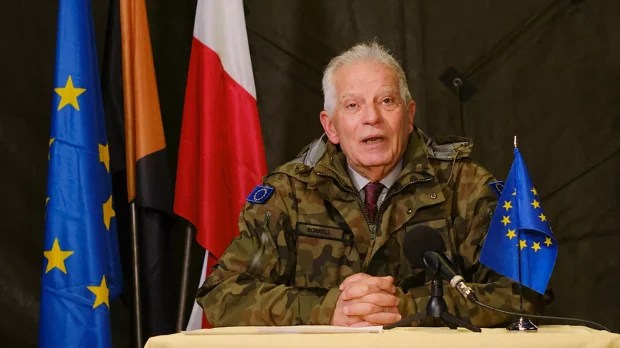
‘We’ll Talk About This Later’: EU’s Borrell Sweeps Aside Security Guarantees for Russia
© AFP 2022 / BARTEK SADOWSKI
By Ilya Tsukanov – Samizdat – 06.12.2022
In late 2021, Moscow sent Washington and its allies two draft treaties on security guarantees designed to dramatically reduce tensions between Russia and the Western bloc. Weeks later, Kiev massed troops along the contact line in the Donbass and began to intensively shell the region, prompting Russia to kick off a military operation in Ukraine.
The end of the crisis in Ukraine will be achieved through “security guarantees for Ukraine,” not Russia, European Union foreign affairs chief Josep Borrell has said.
“As for Russia, we’ll talk about that later,” the EEU’s top diplomat told attendees of a symposium in Paris on Monday. “The end of this conflict will have to be done in compliance with international legality,” Borrell added, claiming this would include Moscow being made to pay “reparations” to Kiev, face “war crimes” trials, and withdrawing its forces.
Borrell also said that the crisis in Ukraine has solidified its “place in the EU.”
“It is written. History has decided for us,” he said.
Borrell’s comments appeared to be a direct rebuke to French President Emmanuel Macron, who said Saturday that he and his US counterpart Joe Biden sought to flesh out “the security architecture in which we want to live tomorrow,” and discussed “guarantees of security for Russia” if and when Moscow “returns to the table” for talks.
“One of the essential points is the fear that NATO will be at its door, and the deployment of weapons that can threaten Russia,” Macron said.
The French president received flak from Kiev over his comments, but slapped down Ukrainian officials’ objections. “I think we should not… try to create controversy where there is none,” he said at a summit in Tirana on Tuesday.
Borrell’s latest remarks weren’t the first time the top EU diplomat has called for an aggressive approach in Ukraine. In April, as some Western leaders encouraged Moscow and Kiev to resolve the crisis through negotiations, Borrell instead called for a military solution, saying “this war will be won on the battlefield” and pledging another €500 million in military support to Ukraine. Since then, the EU has sent over €29 billion in aid to Kiev.
Russian officials have repeatedly slammed Borrell for his ‘undiplomatic’ approach. In May, Russian Foreign Minister Sergei Lavrov reminded him that he was the bloc’s “top diplomat, and not the European Union’s military leader.”
Security Guarantees
Next week will mark the one year anniversary of Russia’s delivery of a pair of draft security treaties to the US and NATO designed to dramatically reduce tensions between Moscow and the Western bloc. The documents, released publicly by the Russian Foreign Ministry, proposed legally binding commitments by each side not to deploy troops, equipment, warships, missile systems and aircraft in areas where they may be seen as a threat to the other side, and asked Washington to pledge not to continue NATO’s eastward expansion, including in Ukraine. The document also asked parties to explicitly affirm that they do not consider one another adversaries.
NATO and Washington rejected the proposals in January, and stressed that the bloc’s “open door” policy will not change. Weeks later, the Donbass republics reported an unprecedented escalation in shelling, sabotage and sniper attacks by Ukrainian forces along the line of contact, and began the evacuation of hundreds of thousands of civilians to Russia. The Kremlin expressed concerns that Ukrainian troops were amassing in apparent preparation for an all-out assault on the Donbass, while NATO announced plans for new battle group deployments in the region. On February 24, 2022, citing threats to the Donbass posed by the Kiev regime, Russian President Vladimir Putin announced a special military operation in Ukraine aimed at demilitarizing the country and ‘de-nazifying’ its leadership.
In the nine-and-a-half months since, Moscow has repeatedly expressed readiness to restart talks, with Russia’s core conditions including no NATO membership for Ukraine, security for the Donbass, and recognition of Crimea as Russia. Kiev and its benefactors have rejected these conditions.
Necessary Illusions – Even the narrative of the EU as a geo-strategic player has now burst
By Alastair Crooke | Strategic Culture Foundation | December 5, 2022
Something odd is afoot in Europe. Britain recently has been ‘regime washed’, with a strongly pro-EU Finance Minister (Hunt) paving the passage to an election-free premiership by ‘globalist’ Rishi Sunak. Why so? Well, to impose swingeing cuts to public services, to normalise immigration running at 500,000 per annum and to raise taxes to the highest levels since the 1940s. And to open channels about a new relationship deal with Brussels.
A British Tory Party is content to do that? Slash social support and hike taxes into an already existent worldwide recession? On the face of it, it doesn’t seem to make sense. Shades of Greece 2008? Greek austerity for Britain — are we missing something? Is this setting the scene for the Remainer Establishment to point to an economy in crisis (blamed on Brexit failure), and to say there is no alternative (TINA) but a return to the EU in some form, (British ‘cap in hand’, and with head bowed)?
Simply put, forces behind the scenes seem to want the UK to resume its former role as US plenipotentiary inside Brussels — pushing the US primacy agenda (as Europe sinks into self-doubt).
Likewise odd — and significant – was that on 15 September, former German Chancellor Schroeder entered unannounced into Scholtz’s office where only the Chancellor, and Vice-Chancellor, Robert Habeck, were present. Schroeder slapped down a long-term gas supply proposal by Gazprom on the desk, directly under Scholtz’s eyes.
The Chancellor and his predecessor held each other’s gaze for a minute – without a word passing. Then Schroeder reached out, took back the unread document, turned his back and exited the office. Nothing was said.
On 26 September (11 days later), the Nordstream pipeline was sabotaged. Surprise (yes, or no)?
Many unanswered questions. The upshot: No gas for Germany. One Nordstream train (2B) however, survived the sabotage and remains pressurised and functional. Yet still no gas arrives in Germany (other than high price liquified gas). There are presently no EU sanctions on gas from Russia. Landing the Nordstream gas requires only a Regulatory go-ahead.
So then: Europe is to have austerity, loss of competitiveness, price and tax hikes? Yes — yet Scholtz did not even glance at the gas offer.
The Green Party of Habeck and Baerbock (and the EU Commission) is in close alignment with those in the Biden team insisting to maintain US hegemony, at all costs. This Euro-coalition is explicitly and viscerally malefic towards Russia; and in contrast, is as viscerally indulgent towards Ukraine.
The big picture? German Foreign Minister Baerbock in a speech in New York on 2 August 2022 sketched out a vision of a world dominated by the US and Germany. In 1989, George Bush famously had offered Germany a “partnership in leadership”, Baerbock claimed. “Now the moment has come when we have to create it: A joint partnership in leadership”. A German bid for explicit EU primacy, snaring US support. (The Anglos will not like that!)
Ensuring no backsliding on Russia sanctions and continuing EU financial support for the Ukraine war is a clear ‘Red Line’ for precisely those in the Biden team likely to be attentive to Baerbock’s Atlanticist bid — and who understand that Ukraine is the spider at the centre of a web. The Greens explicitly are playing this.
Why? Because Ukraine is still the global ‘pivot’: Geopolitics; geo-economics; commodity and energy supply chains — all revolve around where this Ukraine pivot finally settles. A Russian success in Ukraine would bring a new political bloc and monetary system into being, through its allies in the BRICS+, the Shanghai Cooperation Organization and the Eurasian Economic Union.
Is this European austerity binge then just about the German Green Party nailing down EU Russophobia? Or are Washington and its Atlanticist allies now prepping for something more? Prepping for China to get the ‘Russia treatment’ from Europe?
Earlier this week at Mansion House, PM Sunak changed gear. He ‘hat-tipped’ to Washington with the promise to stand by Ukraine ‘as long as it takes’, yet his primary foreign policy focus was firmly on China. The old ‘golden’ era of Sino-British relations ‘is over’: “The authoritarian regime [of China] poses a systemic challenge to our values and interests”, he said — citing the suppression of anti-zero-COVID protests and the arrest and beating of a BBC journalist on Sunday.
Over in the EU — belatedly panicking over unfolding widespread de-industrialisation — President Macron has been signalling that the EU might take a more hard-line China stance, though only were the US were to back-down on the subsidies in the Inflation Reduction Act, which entice EU companies to up-anchor, and sail off to America.
Yet, Macron’s ‘play’ is likely to meet a dead end, or at best, a cosmetic gesture — for the Act has already been legislated in the US. And the Brussels political class unsurprisingly already is waving the white flag: Europe has lost Russian energy and now stands to lose China’s tech, finance and market. It’s a ‘triple whammy’ — when taken together with European de-industrialisation.
There you have it — austerity is always the first tool in the US toolbox for exerting political pressure on US proxies: Washington is prepping the EU ruling élites to sever from China as fundamentally Europe has already done from Russia. Europe’s largest economies already are taking a harder line on Beijing. Washington will squeeze the UK and EU ‘til the pips squeak to get full compliance on a China cut-off.
The protests in China over Covid regulations could not have arrived at a more serendipitous time from the US’ ‘China hawks’ perspective: Washington whipped the EU into full propaganda mode on Iranian ‘demonstrations’ — and now the China protests offer the opportunity for Washington to go full court on China demonisation:
The ‘line’ used against Russia (Putin makes mistake after mistake; the system bumbles; the Russian economy is precariously perched on a knife edge and popular disaffection is soaring) – will be ‘cut and pasted’ to Xi and China.
Only, the inevitable EU moral lecturing will antagonise China even further: Hopes to keep a trade foothold in China will vanish, and effectively it will be China ‘washing its hands’ of Europe, rather than vice versa. European leaders have this blind spot — quite some Chinese may deplore the Covid lockdown practice, yet still will remain deeply Chinese and nationalist in sentiment. They will hate EU lecturing: ‘European values speak only for themselves — we have our own’.
Obviously, Europe has dug itself into a deep hole. Its adversaries grow bitter at EU moralising. But what exactly is going on?
Well, firstly, the EU is hugely over-invested in its Ukraine narrative. It seems incapable of reading the direction of travel that events in the war zone are taking. Or, if it does read it correctly (of which there is little sign), it appears incapable of being able to affect a course correction.
Recall that the war at the outset was never seen by Washington as likely ‘being decisive’. The military aspect was viewed as an adjunct — a pressure multiplier — to the political crisis in Moscow that sanctions were expected to unleash. The early concept was that financial war represented the front line — and the military conflict, the secondary front of attack.
It was only with the unexpected shock of sanctions not achieving ‘shock and awe’ in Moscow that priority switched from the financial to the military arena. The reason the ‘military’ was not firstly seen as ‘front-line’ was because Russia clearly had the potential for escalatory dominance (a factor which is now so evident).
So, here we are: The West has been humiliated in the financial war, and unless something changes (ie. dramatic escalation by the US) – it will lose militarily too — with the distinct possibility that Ukraine at some point, simply implodes as a state.
The actual situation on the battlefield today is almost completely at odds with the narrative. Yet, so heavily has the EU invested in its Ukraine narrative that it just doubles-down, rather than draw back, to re-assess the true situation.
And so doing — by doubling-down narratively, (standing by Ukraine ‘for as long as it takes’) — the strategic content to the ‘Ukraine’ pivot rotates 180 degrees: Rump ‘Ukraine’ will not be ‘Russia’s Afghan quagmire’. Rather, its’ rump is morphing into Europe’s long-term financial and military ‘quagmire’.
‘As long as it takes’ gives the conflict an indeterminate horizon — yet leaves Russia in control of the timetable. And ‘as long as it takes’ implies ever more exposure to NATO blind spots. The rest-of-world intelligence services will have observed NATO’s air defence and military-industrial lacunae. The pivot will show who is the true ‘paper tiger’.
‘As long as it takes’ — has the EU thought this through?
If Brussels imagines too, that such dogged adherence to narrative will impress the rest-of-the-world and bind these other states closer to the EU ‘ideal’, they will be wrong. Already there is a wide hostility to the notion that Europe’s ‘values’ or squabbles have any wider pertinence, beyond Europe’s borders. ‘Others’ will see the inflexibility as some bizarre compulsion by Europe to self-suicide – at the very moment that the end of ‘everything bubble’ already threatens a major downturn.
Why would Europe double-down on its ‘Ukraine’ project, at the expense of losing its standing abroad?
Perhaps, because the EU political class fears even more losing its domestic narrative. It needs to distract from that — it is a tactic called ‘survival’.
The EU, as with NATO, was always a US political project for the subjugation of Europe. It still is that.
Yet, the meta-EU narrative — for internal EU purposes — posits something diametrically different: that Europe is a strategic player; a political power in its own right; a market colossus, a monopsony with the power to impose its will over whomsoever trades with it.
Simply put, the EU narrative is that it has meaningful political agency. But Washington has just demonstrated it has none. It has trashed that narrative. So, Europe is destined to become an economic backwater. It has ‘lost’ Russia — and soon China. And is finding it has lost its standing in the world, too.
Again, the actual situation on the geo-political ‘battlefield’ is almost completely at odds with the EU narrative of itself as a geo-strategic player.
Its ‘friend’, the Biden Administration, is gone — whilst powerful enemies elsewhere accumulate. The EU political class never had a good grasp of its limitations — it was ‘heresy’ even to suggest there were limitations to EU power. Consequently, the EU has hugely overinvested in this narrative of its agency too.
Hanging EU flags from every official building will not cast a fig leaf over the nakedness, nor hide the disconnect between the Brussels ‘bubble’ and its deprecated European proletariat. French politicians now openly ask what can save Europe from complete vassalage. Good question. What does one do when a hyper-inflated power narrative bursts, at the same time as a financialised one?
OSCE nothing more than a branch of NATO
By Ahmed Adel | December 2, 2022
The West is attempting to turn the Organization for Security and Co-operation in Europe (OSCE) into a subsidiary organisation of NATO, which is paradoxical because it is meant to be concentrated on peacebuilding, unlike the Atlantic Alliance which fosters tensions to justify its existence in a post-Soviet world. It is for this reason, among others, why Poland refused to grant a visa to Russian Foreign Minister Sergei Lavrov, thus barring him from attending the OSCE meeting held on December 1 and 2 in Lodz.
Poland claims it refused to grant Lavrov a visa because he is on the list of people who have been sanctioned. However, this does not explain why many from the Russian delegation were also denied visas despite not being on a sanctions list.
This weak excuse is to justify Warsaw’s consistent policy of provocation against Moscow, especially in the context of the current war in Ukraine. Poland and the West are hoping that by humiliating Russia, the country will withdraw from the OSCE. The West are desperate for Russia to withdraw so as to be able to implement and impose whatever it wants on the OSCE.
It is recalled that Moscow very effectively blocked the 2022 OSCE budget. Without a Russian withdrawal, the West will not be able to put the OSCE under its complete control, something that should be avoided as it would undermine the very foundation of the organisation – serving as a platform where Western and Eastern Europe could discuss and resolve issues.
Rather, the OSCE today has turned into a political tool of the West and effectively has no meaning or role anymore. With the OSCE descending into childlike behaviour by barring Russian delegates and top diplomats, it does seem that the organisation has become redundant as it is appearing more like a Euro-focussed political wing of NATO.
The OSCE meeting in Poland was essentially a two-day event for speakers to bash Russia.
None-the-less, Moscow is unlikely to be deterred by these provocations and will remain committed to its responsibilities as an OSCE member. This is likely to ensure that paths of reconciliation are always open despite Western attempts to close them.
The Kremlin might also believe that the OSCE’s uptick in provocations is because Poland is the current chairman. Russian policymakers might also believe that tensions will relax when North Macedonia takes over the chairmanship in 2023. It could be for this reason that Lavrov called out Poland by highlighting that its “anti-chairmanship” was taking the OSCE to its “most miserable place ever in this organisation’s history.”
It can be argued though that the OSCE has always been geopolitically against Moscow. It is recalled that the American establishment boasted that they had inserted a Trojan horse into the Eastern Bloc with the signing of the Helsinki Accords in 1975, the roots of today’s OSCE.
The Helsinki Accords stresses the respect for human rights and equal rights, a result of Western insistence because the Soviets were instead mostly interested in finalising Germany’s borders. The West is not interested in human rights though, and rather their main interest is ideological, economic and military hegemony all over the world, with human rights only being weaponised as one vehicle of achieving this goal.
Effectively, it can be argued that the OSCE was born as a trap for Moscow. When “security”, “cooperation” and “Europe” are in the name of the OSCE but it turns into an organisation completely dominated by promoting US interests, the argument is made that the organisation now resembles something like a branch of NATO.
Playing its own role in serving Western interests, Ukraine continues to call for Russia to be kicked out of the OSCE entirely, with Foreign Minister Dmytro Kuleba claiming in a tweet that the “OSCE is on a highway to hell because Russia abuses its rules and principles.”
“Everything has been tried in regards to Russia: to please, to appease, to be nice, to be neutral, to engage, not to call a spade a spade. The bottom line: It would be better for OSCE to carry on without Russia,” he added.
However, this is once again an example of Kiev’s classic projection of portraying their own illiberal values as that of Russia. In fact, it is Europe’s own unwillingness to “call a spade a spade,” such as whitewashing Ukraine’s fascistic policies and pretending it was a Western-styled liberal country, which ultimately led to war.
Proving that the OSCE is now nothing more than a branch of NATO, US Under Secretary of State Victoria Nuland said, when speaking in Lodz, that Russia had “failed demonstrably to break the OSCE.”
If the OSCE is anything other than a branch of NATO, it must be questioned why the US Under Secretary of State was an honoured guest at a Europe-focussed and Europe-based organisation, which was initially established to connect Western and Eastern Europe together, while Russia’s top diplomat and other officials were barred.
Ahmed Adel is a Cairo-based geopolitics and political economy researcher.
US troops are combat ready on Russian border – Lithuanian commander
RT | December 2, 2022
The US forces stationed in Lithuania have switched their stance from deterrence of Russia to combat readiness, Lithuanian Chief of Defense Lieutenant General Valdemaras Rupsys has said. The country shares a border with Russia’s Kaliningrad exclave on the Baltic Sea, as well as with Belarus and Latvia.
“The main factor used to be deterrence, the demonstration that they were here and could increase our forces at any time,” Rupsys told radio LRT on Friday.
“And now the situation has changed: those units are being deployed so that they can fight immediately. It’s a seamless … transition from one mode to another.”
“At least until 2025, we will have rotating US units that will carry out military training and serve as a factor of deterrence, but also will be ready to carry out defensive actions together with us and other allies,” he added.
The chief of defense said on Wednesday that he had been assured by the Chairman of the US Joint Chiefs of Staff General Mark Milley that American troops would have “a persistent presence in Lithuania.”
Battalion-sized US units with around 500 troops, Abrams tanks and Bradley armored vehicles have been stationed on a rotation basis in the eastern Lithuanian city of Pabrade since 2019. NATO also maintains a German-led multinational unit in the country.
The US-led bloc announced the enhancement of its military capabilities in response to Russia’s military operation in Ukraine, which began in February. NATO Secretary General Jens Stoltenberg said in June that the alliance’s rapid-response force would grow from around 40,000 to over 300,000.
Moscow has repeatedly stated that it considers NATO troops near its borders a national security threat. Foreign Minister Sergey Lavrov said on Thursday that the bloc’s actions signify its return to “conceptual priorities” adopted during the Cold War.
Featured Video
Integrity Initiative: UK-funded network framed dissent as Russian disinformation for years
or go to
Aletho News Archives – Video-Images
From the Archives
Why Saudi Ties to 9/11 Mean U.S. Ties to 9/11
By Kevin Ryan | Dig Within | September 27, 2015
Media interest in Saudi Arabian connections to the crimes of 9/11 has centered on calls for the release of the 28 missing pages from the Joint Congressional Inquiry’s report. However, those calls focus on the question of hijacker financing and omit the most interesting links between the 9/11 attacks and Saudi Arabia—links that implicate powerful people in the United States. Here are twenty examples. … continue
Blog Roll
 Aletho News
- IAEA inspectors cannot return to Iran amid US threats: Russia
- Senate Rejects Iran War Powers Resolution Passed By House
- ‘We did not attack Pakistan with drones’: Afghan sources
- Iraqi Resistance faction links arms to sovereignty, questions US exit
- Cannon fodder no more… South Korea rejects Trump’s pressure to join his criminal war on Iran
- Neria Leiter Was A Legitimate Military Target
- Integrity Initiative: UK-funded network framed dissent as Russian disinformation for years
- ‘We don’t seek permission to defend our country’: Snippets from President Pezeshkian’s UNGA address
- NATO chief wants Europeans to fight American wars [for Israel]
- German chemicals giant reveals details of downsizing
- If Americans Knew
- Israel displaces hundreds of Palestinians amid wave of demolitions in West Bank
- Aid, reconstruction, and Israel’s history of obstruction in Gaza
- Trump administration digs an ever-deeper hole of complicity in genocide – Daily Update
- US-Israel $2.8 Billion Arms Deal, 40,000-Bomb Supply Faces New Gaza Complicity Accusations
- Caught on Tape: AIPAC CEO Boasted of Controlling Trump’s National Security Officials
- Why Hamas Attacked Israel in October 2023 – Israeli professor Ilan Pappé
- They see them, then kill them: Israeli quadcopters track, deliberately target civilians in Gaza
- Winter could turn Gaza’s treacherous, war-damaged buildings into deathtraps
- Majority of Democratic Voters Want to Prosecute Both Biden and Trump Administration Officials Over Gaza
- As Gaza languishes, world leaders gather at the UN – Daily Update
- No Tricks Zone
- New Study: Earth And Venus Surface Warmth Largely Explained By Convection And Lapse Rate, Not CO2 Or Radiation
- 2025 Nature Paper Claiming Worsening Global Drought Gets RETRACTED …Heavily Flawed
- New Study: ‘Global Drought Shows No Detectable Recent Acceleration Under Climate Warming’
- Economic Masterminds: German Socialists Suggest Taxing Productivity Gains Stemming From Using AI
- The South China Sea Has Not Been Cooperating With The Climate Change Narrative
- Energy Crisis: Germany Enters Heating Season With Historically Low Gas Reserve Fill Levels
- New Study: The Antarctic Ice Sheet Gained Mass From 2020-2024 Due To Staggering Snow And Ice Accumulation
- Study: Ocean Heating Rates From Thousands Of Years Ago ‘Dwarf’ Modern Ocean Heating Rates
- Climate Extremists Target, Attack Large-Scale Power Grid Infrastructure In Germany!
- New Study: Antarctic Ice Melt Has Contributed Less Than 1 Centimeter To Sea Level Rise In The Last 30 Years

