Georgia and NATO announce joint exercises
RT | March 12, 2022
Joint NATO-Georgia IT-based exercises will be conducted from March 20 to 25, the Georgian ministry of defense announced on Saturday.
The exercises, which have been planned since 2020, will take place in the Georgia-NATO Joint Training and Evaluation Center (JTEC) with representatives of 23 NATO member states set to take part.
“The exercises will help increase interoperability between the military of Georgia and NATO member and partner countries,” the Defense Ministry said in a statement.
It specified that the goal of the upcoming exercises would be to develop the skills necessary for planning operations by using computer simulations, as well as to share knowledge and experience.
The exercises would be the third of their type held since 2016 and are a part of the Substantial NATO-Georgia Package, which was approved at the 2014 Wales Summit.
In 2008, in the Bucharest Summit Declaration the alliance announced that NATO welcomed “Ukraine’s and Georgia’s Euro-Atlantic aspirations for membership in NATO.” The summit participants agreed that eventually these countries would “become members of NATO.”
This decision was condemned by Moscow which consistently opposed NATO’s expansion to Russia’s borders.
The possibility of Ukraine becoming a member of the bloc has been one of the reasons for Russia’s ongoing military offensive, despite numerous assurances from NATO that neither Ukraine’s and Georgia’s memberships are currently on its agenda.
Much wants more and loses all
GEFIRA | March 11, 2022
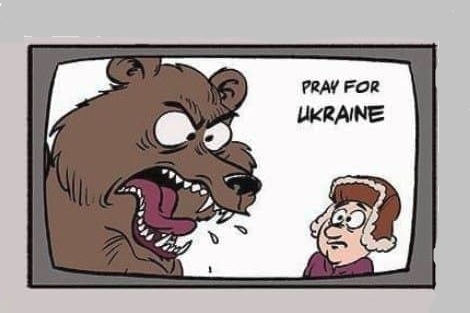 The collective post-West has been running amok for the last two weeks. The powers that be make believe that they did not expect that events would unfold the way they are unfolding now (though they did their best to make things happen as they are happening) and they make a show imposing sanctions on the aggressor and assuring the populace that the aggressor sooner or later will cave in. There is yet a third aspect to the phenomenon: the same powers that be want the people to forget that merely twenty years back they themselves assaulted Yugoslavia/Serbia, used missiles with depleted uranium, bombed cities and shot at civilians. Of course, that earlier event was a humanitarian action while the current one is a brutal act of aggression, but we digress.
Now there is a big misconception on the part of the post-West about Russia. If the Western media claim the Russian people are against the war or that the Russian people are about to rebel and overthrow President Putin, then they are either delusional or lying through their teeth. Reality is something that refuses to obey our wishes. The Russian people have rallied around their president and their authorities; the Russian people – unlike citizens of the post-Western countries – are patriotic and ready to sacrifice themselves in defence of their fatherland. Western sanctions? The post-West may withdraw businesses and impose sanctions on Russian oligarchs, which is music to the ears of the Russian people. They resented Western dominance anyway and they will be more than happy to see the oligarchs mopped up from their society. Russians view the hostilities as a repeat of the Great Patriotic War of 1941-1945. Contrary to what has been done to the Western collective mentality, the Russian authorities under Vladimir Putin took great efforts to raise Russia’s citizens in patriotic values. Russians are going to win because they do not care about money so much as the West does. That’s one big misconception that Western people have about their opponents from the East.
It is the West that cannot imagine a life without money and the resultant luxuries. Sanctions or no sanctions, Western companies will sooner or later (I bet: sooner) resume business with Russia because – as everybody in the West knows – “money makes the world go round”. No less a person than Comrade Lenin famously said: capitalists will sell us the rope with which we will make a noose to hang them. And so they will, make no bones about it.
Yes, the West is ready to go to war with Russia so long as it has… Ukrainian, Polish, Romanian, Lithuanian, Latvian or Estonian soldiers at its disposal. The moment the West runs out of those soldiers, its leaders will go back to the negotiating table with the Kremlin. Do you want any evidence? Here you are.
A few days ago Americans tried to set Poland against Russia in that they suggested to Warsaw that it send Soviet-made MiG aircraft to Ukraine. Though the Polish authorities usually oblige the West’s wishes, this time they had second thoughts about the proposal and replied that they were ready to send the said aircraft to the American air base in Rammstein so that Americans could pass them over to Kiev. And you know what? Washington was beside itself with annoyance! You see? The dog was expected to bite the bear, with the dog’s owner watching from the sidelines and biding his time.
Just picture it to yourself. Warsaw sends the MiG aircraft to Ukraine, Moscow regards it (and rightly so!) as a hostile act and fires a couple of missiles against selected targets in Polish territory. What do you think the West would do? Yes, you guessed it right. The West would express its great indignation and impose a set of new sanctions… for a time.
Talking about President Putin, who – according to the Western analysts is about to be toppled either by the people closest to him or by the nation – his Christian name is Vladimir, and Vladimir was the name of the grand prince of Rus’ who united the many Slavic tribes and christened them. He went down in history as Vladimir the Great. The chances are – whether you like it or not – that Putin is going to be another Vladimir the Great.
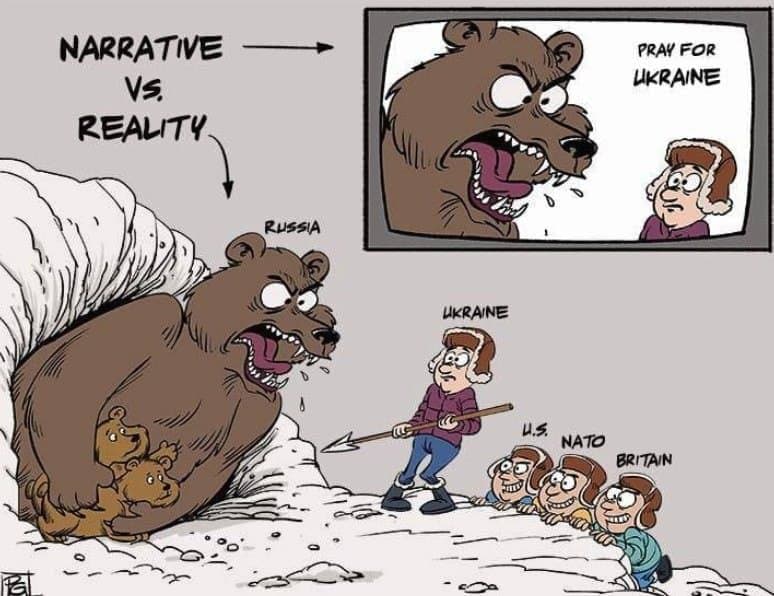
The current war means the end of the world that we have been accustomed to. We are entering a new cold war period and a new division of the globe with the United States, Great Britain, and the European Union on the one side, and Russia and China on the other. This new world throws a monkey wrench into the plans forged by globalists of the Klaus Schwab ilk. Or, globalism will be reduced to the Western world. The international rules that all the countries have up to now tried to abide by are no more valid for Russia, and consequently sooner or later for others because of the domino effect. Being beleaguered by the West, Moscow will have no intention to play by the rules created in this West. Why should it?
Sanctions work both ways. Russia has a lot to offer, be it crude oil, natural gas, rare metals or what not. Look back into the past! The Bolsheviks that took reins of power after 1917 were hated by the West. Lo and behold, it did not take many years for the capitalists to resume business with the hated communists; similarly, after the Second World War the Soviet Union was regarded as a hostile empire and yet, and despite that, business between the West and the Soviets went as usual. How about China? It was Taiwan that was first supported by the West, yet slowly but surely Washington reversed course, left Taiwan to its own devices and resumed contacts with Beijing. Since – as said above – money makes the world go round, the greedy capitalists helped China develop in that they outsourced almost all production to the Middle Kingdom. Do you think it is going to be different now with regard to Russia?
When Ukraine is eventually conquered by Russia, what will the elites in such small countries like Lithuania, Latvia and Estonia – all bordering on Russia – think about their security and the ability of the collective West to help them? I want to see that man or that woman who really thinks that NATO will go to war with Russia over Estonia or Latvia.
Ukraine has been exploited by Western companies for thirty long years. All those contacts with democracies and capitalism did not benefit the country at all. It only benefited a handful of people, who fled Ukraine before the hostilities, leaving the rank and file behind. Rumour has it that President Zelensky is kept in the American embassy in Warsaw though we are all made to believe that he remains in Kiev. How much would you bet on President Zelensky residing in Kiev, a city that is about to be soon encircled?
The West could have further exploited Ukraine and teased Russia but it simply overplayed its hand. Precisely as it is described in this fable by Aesop where a goose laying golden eggs is killed by the greedy owners. The moral? Much wants more and loses all. Now that Moscow is taking retaliatory steps like shutting down media outlets that propagated Western ideas and Western lifestyle the West has lost its ideological bridgehead inside Russia that it has held for thirty years. The West really thought it was ready to make a killing. A big killing. Western elites really thought Russia would be withdrawing from its positions further and further; they really believed the Navalny kind of Russian dissenters that the Russian people were all against the authorities. Worse, the West still thinks that Russians will force their president to surrender because otherwise common people will be stripped of the opportunity to eat hamburgers and cheeseburgers in McDonald’s restaurants in Moscow and Petersburg! Sure, there are some such people who are ready to trade their country for ham- and cheeseburgers, but then it is a splinter from the large whole. The majority accustomed to Russia’s greatness are not willing to sell this greatness off. Plus, they are not attracted by the Western values of married homosexuals or the many sexes that are invented by the month. That’s also something that the post-West is not aware of. Remember also that millions of Russians have bitter recollections of the Yeltsin era during which western-style capitalism promised them well-being and brought poverty, unrest and humiliation instead. That’s one big reason why President Putin is appreciated by the vast majority of the population: he put an end to chaos and brought in stability. If you think Russians dream about homosexual parades in their cities or pregnant soldiers in their army or the many gender pronouns, you cannot be more delusional.
There is one more explanation to all what is occurring. The West went to great lengths to have Russia and Ukraine clash for the sheer purpose of weakening both countries. This is one sure way of preserving world preponderance, is it not? Lead nations to war the moment you see they have developed too much and too fast. The United States achieved its global dominance because the Second World War wreaked havoc with the economies of Germany, Great Britain, France, Russia, Italy and Japan – the world’s powerhouses. After the cessation of the hostilities all those countries needed American aid and American dollars and were compelled to accept almost all the dictates from Washington.
Look at the present political map of the world. Iraq, Syria, Libya, Afghanistan, Ukraine, the countries of former Yugoslavia, the states that went through an array of all those colour revolutions: they are reeling under the blows of all manner of war, civil war, social upheaval and the attendant economic collapse. Which country emerges victorious? Yes, sure, the one that has not been directly engaged in the conflict. A classic case of two dogs fighting for a bone with a third running away with it.
Russia and Ukraine will lose a number of people (killed, wounded, displaced); Ukraine will have its economy ruined; Poland is already accommodating a million (and rising!) Ukrainians who somehow do not want to defend their country and prove their rights to it (If you say that women and children do not or should not take part in hostilities, then think again); Warsaw will have a lot of trouble with them. Who emerges victorious? You know who. Vice-President Kamala Harris visited Poland to reassuringly pat the Polish nation on the shoulder in recognition of Poland’s hospitality towards Ukrainians. She knows that such gestures work with Poles. The supranational elites hating ethnically monolithic countries are rubbing their hands in glee. At last Poland, this ethnically and religiously monolithic nation, is changing to a mix of Poles and Ukrainians, of Catholic and Orthodox Christians, to be later skilfully set off against each other like Croats and Serbs if Warsaw should fail to toe the Western party line.
GEFIRA – Global Analysis from the European Perspective. Preparing for the world of tomorrow.
Pushing toward Nuclear War
By Jacob G. Hornberger | FFF | March 9, 2022
According to Yahoo! News, “More than two dozen foreign policy experts have called for the United States and NATO to institute a partial no-fly zone over Ukraine, which would serve as an escalation of the conflict with Russia.” Joining them is Illinois Republican Congressman Adam Kinzinger, who also happens to be a former Air Force combat officer. That would mean the U.S. military would be shooting down Russian planes containing Russian soldiers.
So far, the idea is being resisted by President Biden and the military-intelligence establishment. However, given the extreme anti-Putin mentality that characterizes Biden, the Pentagon, and the CIA, their position could easily change on a moment’s notice.
The matter brings to mind what happened during the John Kennedy administration, the details of which were set forth in an article we posted yesterday on FFF’s website, entitled “When the Pentagon Wanted to Nuke Russia.” The article was an excerpt from FFF’s book JFK’s War with the National Security Establishment: Why Kennedy Was Assassinated by Douglas P. Horne, who served on the staff of the Assassination Records Review Board in the 1990s.
In July 1961, the U.S. military establishment was pressing Kennedy to launch a surprise nuclear attack on the Soviet Union, China, and all the other communist-bloc countries, similar to the surprise attack that Japan initiated against the United States at Pearl Harbor.
 Their attitude was that there was inevitably going to be a nuclear war anyway between the United States and the Soviet Union. Given such, the generals believed that it would be in the best interests of the United States to fire first in order to disable a large portion of the Soviet nuclear arsenal.
The generals acknowledged to Kennedy that under their first-strike surprise-attack plan, the United States would nonetheless suffer a large number of deaths — like in the neighborhood of, say, 70 million people — as well as significant destruction of property.
But there would still be tens of millions of Americans who would survive, given that the surprise attack would disable much of the Soviet nuclear arsenal. The important part of the first-strike plan was that there would be no Russians, Chinese, or other communists who would survive the massive U.S. surprise nuclear attack. Since there would still be millions of Americans surviving, that would mean that America will have prevailed as the winner in the war, under indefinite military rule of course.
There is something else that is worth noting: The Pentagon’s plan called for the launching of the surprise nuclear attack “during a period of heightened tensions” with Russia and the rest of the Soviet Union.
To his everlasting credit, Kennedy walked out during the middle of the meeting in total disgust. In the process, he turned to his Secretary of State, Dean Rusk, and stated, “And we call ourselves the human race.” Do you see why they hated the guy so much?
Was that military mindset passed down from generation to generation within the Pentagon? I don’t know. But what I do know is that the political gamesmanship that the Pentagon and the CIA have played to maneuver Russia into having to choose between invading Ukraine versus permitting the Pentagon and the CIA to establish military bases, missiles, tanks, and weapon on Russia’s border constitutes an evil, irresponsible, and dangerous game, one that comes with the possibility of nuclear fire.
In the midst of this war, where the Pentagon and the CIA are furnishing weaponry to the Ukrainians to help them kill Russian soldiers, and where U.S. officials are targeting the Russian people with death and impoverishment with brutal economic sanctions, any mishap can easily lead to a rapid escalation of hostilities between the United States and Russia, one in which it becomes in the interest of both sides to initiate a first-strike nuclear attack. Moreover, there is no telling what any exhausted person, including Vladimir Putin, will do when he is under severe pressure in a highly stressful war situation.
That’s one big reason why this entire escapade is so highly evil and irresponsible, even if it is resolved without a war between the United States and Russia. And make no mistake about the cause of the crisis: It’s not about liberty. It is entirely about NATO, the Pentagon-CIA-controlled bureaucratic dinosaur that should have gone out of existence when the Cold War racket supposedly ended decades ago. If NATO had been abolished back then, this crisis in Ukraine would never have happened. All those dead people in Ukraine would still be alive today.
In the final analysis, President Biden, the Pentagon, and the CIA were willing to sacrifice any number of Ukrainians for the sake of having Ukraine join NATO, which would thereby permit the Pentagon and the CIA to establish U.S. military bases, missiles, tanks, and weaponry on Russia’s border.
If that isn’t evil, I don’t know what is. Not one single Ukrainian life was worth NATO, the corrupt bureaucratic dinosaur that should have gone out of existence a long time ago.
Even worse, their unswerving devotion to NATO has clearly motivated Biden, the Pentagon, and the CIA to run the risk of a war with Russia, a war that could easily turn nuclear and cost the lives of countless millions of Americans. If that’s not evil, I don’t know what is. I do know this: NATO, that corrupt bureaucratic Cold War-era dinosaur, is not worth risking the life of even one American, much less untold millions of Americans.
If the United States can escape a nuclear conflict with Russia this time, there is no telling when the Pentagon’s and the CIA’s political gamesmanship will produce the same sort of crisis in the future, either against Russia, China, or North Korea. That’s one big reason it is imperative that the American people do some serious soul-searching about what they want out of life. If they want a crisis-filled life that might well end up at some point in a nuclear holocaust, then they should keep the national-security state form of governmental structure that was brought into existence after World War II. If Americans instead want a life filled with liberty, peace, prosperity, security, and harmony, there is but one solution: restore America’s founding system of a limited-government republic and a non-interventionist foreign policy.
Zelensky rubbishes Biden’s war on Russia
BY M. K. BHADRAKUMAR | INDIAN PUNCHLINE | MARCH 9, 2022
What was the need for all that happened in the period since mid-December when Russia transmitted to Washington its demands for security guarantee? This question will haunt US president Joe Biden long after he retires from public life. The foreign policy legacy of his presidency and the reputation of this much-vaunted 80-year old politician with a half-century’s record in public life, much of it supposedly in he domain of American foreign policy are in tatters — irreparable.
News has appeared that Ukrainian President Volodymyr Zelensky has conceded that he is willing to concede to the Russian demand that his country will not seek to become a member of the North Atlantic Treaty Organisation! The announcement came in an interview with the ABC News where he revealed that he is no longer pressing for Ukraine’s Nato membership!
In fact, Zelensky lets the cat out of the bag by casually adding, “I have cooled down regarding this question a long time ago after we understood that… Nato is not prepared to accept Ukraine.”
Zelensky explains why: “The alliance is afraid of controversial things, and confrontation with Russia.”
This comes after his earlier revelation that he is “open to compromise” on the sovereignty of the two breakaway republics of Lugansk and Donetsk in the eastern Donbass region and on the status of Crimea.
The ABC News reportedly telecast the interview on Monday night Eastern Time. Since then, the duo in the Biden team who piloted the Ukraine strategy, those apocalyptic “sanctions from hell” and the demonisation of Vladimir Putin through the recent months — Secretary of State Antony Blinken and Undersecretary of State Victoria — are nowhere to be seen.
That duo of East European descent in the driving seat — Blinken driving and Nuland by his side navigating him — ought to offer an explanation for this charade playing out, which is virtually demolishing the American prestige as a superpower.
Questions are galore. Principally, if it is so easy to work out a compromise over Russia’s legitimate security demands, especially regarding Ukraine’s Nato membership and the alliance’s further expansion, why was Biden so very stubborn in his refusal to even discuss it, given the urgency of the matter?
Can it be that Biden was acting smart to create a fait accompli for Moscow by formalising Ukraine’s membership at the forthcoming Nato summit on June 29-30 in Madrid?
What’s the need to destabilise the European economies and rock the world oil market at a juncture when most economies are entering on a path of post-pandemic economic recovery?
What explains this unnatural obsession on the part of Biden over Ukraine’s regime?
Why such visceral hatred on Biden’s part toward Russia, something unworthy of an 80-year old world statesman?
Why is it that the economic war against Russia has become such a very personal affair for Biden, as his White House speech on Tuesday shows?
But such an ignominious end to this entire episode over Ukraine’s Nato membership was entirely to be anticipated. Fundamentally, this is an existential issue for Russia. Whereas, Biden, Blinken and Nuland are dilettantes sitting 10,000 kms away indulging in old neocon pastimes of interfering in other countries’ internal affairs, threatening them, disciplining them or punishing them for defying America’s diktat.
Even after Zelensky spoke, what has been Biden’s reaction? He scheduled a speech to announce that the US shall no longer import oil from Russia. Shouldn’t he have heaved a sigh of relief that this war in Ukraine is petering out?
Instead, he resorted to this strange toothless measure to impress the American audience that he is still on a winning streak promoting democracy in faraway lands. Isn’t such gimmick an insult to the gullible American public?
Biden took this new step after Europeans told him plainly that they are not interested in such a move against Russia, given their heavy reliance on Russian oil.
Second, Biden doesn’t seem to know or has pretended otherwise that America is actually shooting at its own feet. For, Russian prices are highly competitive and American companies will now have to pay much more to source heavy grade oil suitable for their refineries.
Biden already swallowed his pride and sent a team of officials to Venezuela, a country under crippling US sanctions, to beg for oil from President Nicolas Maduro (who was on CIA hit list not too long ago for being a socialist) to replace Russian oil.
Maduro sent them back suggesting a broader mutually beneficial relationship between Venezuela and America. All this drama took place in broad daylight witnessed by the entire Western Hemisphere. Wouldn’t they be laughing that America’s president is a man of straw?
Biden claims he is making sure that Putin won’t have money for his “war machine” if America stops buying oil from Russia. This is laughable, bordering on a lie.
The US was purchasing about 12% of Russia’s total oil exports. Alright, that’s a decent figure. But, it isn’t as if Russia won’t have any other buyers in a world market where oil price has soared to $130 per barrel (thanks to Biden’s “sanctions from hell” against Russia)?
Surely, any number of potential buyers would queue up if Russia were to offer competitive prices (as it had been doing for the US companies) to divert the extra stocks due to Biden’s boycott.
At any rate, Biden can’t be unaware that Russia’s current budget is balanced on the belief that oil prices would be around $40-45 per barrel. With the current level of oil price, Russia is actually making a fortune! And the funny part is, it is a gift from Biden’s sanctions!
Fundamentally, the problem today is that the American elite are delusional. While the rest of the world knows that in a multipolar world, the US’ capacity to force its will on other countries is inexorably in decline, the American elite shut their eyes to that reality. The present ridiculous situation happened only due to this arrogance and self-deception.
The strategic defeat that Washington has suffered will dent the US prestige worldwide, weaken its transatlantic leadership, unravel its Indo-Pacific strategy and accelerate the drain of American influence in the 21st century. Biden presidency will carry this heavy cross.
Poland ready to deploy all their MIG-29 jets to the Rammstein Air Base
Statement of the Minister of Foreign Affairs of the Republic of Poland regarding the statement by the US Secretary of State on providing airplanes to Ukraine – 08.03.2022
The authorities of the Republic of Poland, after consultations between the President and the Government, are ready to deploy – immediately and free of charge – all their MIG-29 jets to the Ramstein Air Base and place them at the disposal of the Government of the United States of America.
At the same time, Poland requests the United States to provide us with used aircraft with corresponding operational capabilities. Poland is ready to immediately establish the conditions of purchase of the planes.
The Polish Government also requests other NATO Allies – owners of MIG-29 jets – to act in the same vein.
Ukraine faces defeat
BY M. K. BHADRAKUMAR | INDIAN PUNCHLINE | MARCH 8, 2022
Belying the predictions of western media, Russia’s special operation in Ukraine is entering a successful endgame on the political and diplomatic track much sooner than one would have thought.
A close reading of the outcome of the 3rd round of peace talks in Belarus last night is that the Ukrainian negotiators have sought some more time to come up with a full response to the Russian terms for ceasefire.
Ukraine has signalled willingness to be a neutral country ruling out NATO membership. The main sticking points narrow down to: a) recognition of Crimea as part of Russia; and, b) sovereignty of Lugansk and Donetsk.
They are non-negotiable demands. But they are a bitter pill for the Ukrainian leadership to swallow. The Ukrainian stance is that these demands are “practically” impossible.
But, as Vladimir Medinsky, leader of the Russian team, told RT, “In my opinion, there is a big difference between impossible and ‘practically impossible’… I hope that eventually we will find a solution.”
The Russian side feels encouraged albeit yesterday’s talks produced no tangible results. They are in no hurry to rush into major military offensives.
Indeed, the pattern throughout has been that the Russian generals would apply coercive military power to create synergy to kickstart a parallel political / diplomatic track to attain Moscow’s objective (which is not about territorial conquest.)
The western analysts who expected the Russian generals to behave like Patton or MacArthur with a massive attack on Kiev instead witnessed a confusing Russian strategy — slow, halting operations, without excessive force and with a distinct preference to avoid fighting by encircling and bypassing pockets of resistance, and avoiding set battles.
Putin revealed yesterday that “conscripts aren’t and won’t be taking part in hostilities, and there will be no additional call-up of reservists from the reserve… Missions are carried out only by professional troops.”
The Ukrainian side realises that the Russian strategy is winning, as Russian forces are encircling Kiev from the northwest, west and east, Black Sea ports are no longer accessible, and the forces in the east are entrapped. Yesterday, Zelensky acknowledged the grim situation.
After the third round in Belarus, he hastened to assure that talks will continue until a settlement! In his words,
“Today the third round of negotiations took place in Belarus, and I would like to say ‘the third and final one,’ but we are realists. Therefore, we will talk, we will insist on negotiations until we find a way to tell our people, ‘this is how we will come to peace.’”
Russians are in no tearing hurry. They eschew triumphalism, and instead allow enough space for the Ukrainian side to take some really hard decisions on surrender — while military pressure is kept up on Kiev. Foreign Ministry spokeswoman Maria Zakharova said yesterday, “We keep the door open to diplomatic options. As soon as there are corresponding signals, we will be acting on them.”
Importantly, the two sides have agreed on a roadmap for creating humanitarian corridors and Russian side has announced a ceasefire. Also, these corridors will be operated in close coordination through a hotline.
The Russian statement says that a “continuous communication link shall be established between the Russian and Ukrainian sides for mutual exchange of information about the preparation and implementation of the evacuation of civilians and foreign citizens.”
The Russian side since conveyed all relevant details to foreign embassies, appropriate UN and OSCE agencies, the International Committee of the Red Cross and other concerned international organisations. The humanitarian corridors will be:
- from Kiev and adjacent regions to Gomel (Belarus);
- from Sumy along two routes to Poltava (central Ukraine) and to Russia;
- from Kharkov to Russia or to Lvov, Uzhgorod and Ivano-Frankovsk (all three in western Ukraine); and,
- from Mariupol along two routes to Russia and Zaporozhe (on the Dnieper river in southeastern Ukraine.)
This joint work and the lull in fighting sets the stage for the crucial meeting between Russian Foreign Minister Sergey Lavrov and his Ukrainian counterpart Kuleba in the Turkish resort of Antalya on Thursday. The very fact the talks have been elevated to foreign minister level signals hope that a critical mass may be accruing.
Thoroughly disillusioned with the betrayal by the US and NATO, Zelensky is inching toward an agreement with Moscow. It is futile to pre-judge the outcome, but there is a game changer. The major European countries — UK, France, Germany, Netherlands — have rebuffed Washington’s hawkish proposal to impose sanctions on Russia’s oil exports.
Oil exports are Russia’s principal source of income, therefore, this is a strong rejection of Washington’s efforts to isolate Russia. French President Macron captured the zephyr in his remark yesterday:
“It is impossible to build a lasting peace if Russia doesn’t participate in building a comprehensive security architecture on our continent, because history and geography mandate this. Our responsibility is to preserve all the ties that we can preserve. We must continue to talk with the Russian and Belarusian peoples. We need to do this with help from representatives of the world of culture, the scientific and technical community, non-governmental organisations.”
On Sunday, in an op-ed in the New York Times, UK Prime Minister Boris Johnson also wrote: “We have no hostility toward the Russian people, and we have no desire to impugn a great nation and a world power. Ukraine had no serious prospect of NATO membership in the near future. This is not a NATO conflict, and it will not become one.”
Meanwhile, major European countries, especially Germany, are ruling out EU membership for Ukraine, either — which, ironically, was the issue that had precipitated the US-backed coup in Kiev in 2014 triggering the catastrophic slide toward conflict involving Russia.
Ukraine Crisis – Russia Sets Out The Terms Of Peace
By Richie Allen | March 7, 2022
It is being reported this lunchtime that the Russian government is ready to end it’s invasion of Ukraine if Kyiv agrees to its terms. Kremlin spokesman Dmitry Peskov told Reuters news agency that Russia is ready to halt its military action “in a moment” if Kyiv meets its conditions.
According to The Telegraph this lunchtime:
The demands include:
-
- Ceasing all military action
- A change to the constitution to enshrine neutrality
- Acknowledgement of Crimea as Russian territory
- Recognition of Luhansk and Donetsk as independent
It is the most explicit Russian statement so far of the terms it wants to impose on Ukraine to halt what it calls its “special military operation.”
This morning, Ukraine said Russia is “manipulating” the West by claiming it will observe ceasefires to allow civilians to evacuate.
The Russian military has said it has opened six humanitarian corridors for civilians to leave major cities for Belarus and Russia, the Russian Defence Ministry claimed.
As yet, there has been no official response from the Ukrainian government to Russia’s demands.
However, it’s unlikely that Ukrainian President Volodymyr Zelensky’s government will agree to drop plans for the country to join NATO, or give up Luhansk and Donetsk.
US gives NATO countries ‘green light’ to provide fighter jets to Ukraine
RT | March 6, 2022
US Secretary of State Tony Blinken told CBS News on Sunday that Washington has given a “green light” to NATO members to supply Ukraine with fighter jets, and that the US would work to replace any jets sent to Kiev. Blinken spoke after Ukrainian President Volodymyr Zelensky urged US lawmakers to intervene in the ongoing conflict with Russia.
Asked whether NATO members could begin sending planes to Ukraine, Blinken said “that gets a green light.” The US’ top diplomat then said that Washington was already working with Polish officials to “backfill” any aircraft they send to Ukraine – meaning the US would replace every Polish aircraft given to Kiev with an American one.
Supporting the delivery of jets to Ukraine occupies a middle ground for the US between active intervention in Ukraine and purely economic retaliation against Moscow. The government in Kiev has made no secret of its desire for the US to intervene militarily, with President Zelensky urging American lawmakers on Saturday to enforce a “no-fly zone” over Ukraine. Such a measure would see the US and any willing NATO allies commit to shooting down Russian aircraft, something Moscow has explicitly said it would perceive as an act of war.
The US and NATO have ruled out a no-fly zone, and repeatedly stated that they would not send troops to Ukraine.
However, delivering fighter jets to the Ukrainians has not proven simple thus far. The European Union pledged warplanes to Ukraine late last month, but faced two significant hurdles: first finding jets that Ukrainian pilots could fly, and then finding countries willing to deliver them from their airports.
The Ukrainian Air Force uses Soviet-designed MiG-29 and Sukhoi Su-24, Su-25, and Su-27 jets in combat roles, and with the Su-25 used by Bulgaria and the MiG-29 used by Poland, Bulgaria and Slovakia, the jets would need to be sourced from these countries.
Shortly after the EU’s announcement, Poland stated that it wouldn’t send jets to Ukraine nor allow its airports to be used for deliveries. Bulgaria and Slovakia then stated that they wouldn’t take part in any deal, effectively killing off the EU’s arms supply plans.
However, Blinken’s statement on Sunday suggests that the plan may have been revived, but by the US and Poland rather than the EU. Blinken did not give any indication how soon Polish planes could be on their way to Ukraine, but said that discussions between Washington and Warsaw were “active.”
Featured Video

AIDS Inc. by Gary Null (2007)
or go to
Aletho News Archives – Video-Images
From the Archives
Clash of Civilization, Iran Part II
By Jamal Kanj – Intifada-Palestine.com – January 14, 2011
Israel’s survival kit is: perpetuate conflict, insecurity to rationalize collective hate and finally playing victim.
Devoid of conflict, Israel implodes internally; without hate, Zionism loses its justification; and playing eternal victim to continue blackmailing the West. Absence of this holy trinity, Israel ceases to exist.
From its inception, the house of Zion has mastered exploiting adversarial powers to advance Israel’s cause. For instance, their influence over the Democratic Party in the US began with President Truman’s bid for 2nd term election in 1948.
Responding to strong opposition from Secretary of State General George Marshall and Department experts urging against recognition of Israel, President Truman replied: “I’m sorry gentlemen but I have to answer to hundreds of thousands [Jewish voters] who are anxious for the success of Zionism. I do not have hundreds of thousands of [voting] Arabs among my constituents”
Zionists influence over liberal American politics was matched with the doctrinal school of Conservative theoreticians aligning the Republican Party’s platform with Israel’s objectives. The Neoconservative Zionists, coined Zioncons, invented the “Clash of Civilization” concept to fight Israel’s wars. … continue
Blog Roll
 Aletho News
- From Unipolar Universalism to Multipolar Civilizational Distinctiveness
- RSF military group defects, joins Sudanese army: State media
- Ireland goalkeeper refuses to play ‘Israel’ as squad weighs boycott
- China pushes back against US on Cuba, Iran
- Ukrainian Soldiers, Potential Mercenaries: Have Gun, Will Travel!
- Burnham’s UN debut… A masterclass in British disinformation
- Iran flights continue despite US aviation sanctions
- Global Tipping Points Lead the World Into a State of Entropy
- The day-after at the White House: USA and Xi Jinping
- The Geopolitical Balance in the Red Sea: The UAE Being Displaced by New Players
- If Americans Knew
- Israel forces Gazans to live in constant peril – Daily Update
- Deconstructing Netanyahu’s pants-on-fire UN rant – Daily Update
- Trump betrayed voters with his campaign lies and prioritized a foreign country once he took office
- Netanyahu calls Israel’s war in Gaza ‘opposite of genocide’ in UN speech to near-empty hall
- Settler Kidnappings: Torture, Sexual Abuse and Terrorisation of Palestinian Abductees as Israel Deepens Annexation of West Bank
- Gaza winter nears as 162,000 tents become unusable, raising fears of humanitarian crisis
- Netanyahu says, “It’s the opposite of genocide”; UN says Gaza economy is world’s ‘most severe crisis on record’ – Daily Update
- Israel’s US-Backed Assault on Gaza Has Created the ‘World’s Most Severe Economic Crisis on Record’: UN
- ‘Protecting U.S. Citizens’… From Israel
- ‘This is where I live now, the back of a truck’: a day in the life of a grandmother in Gaza
- No Tricks Zone
- New Study: Earth And Venus Surface Warmth Largely Explained By Convection And Lapse Rate, Not CO2 Or Radiation
- 2025 Nature Paper Claiming Worsening Global Drought Gets RETRACTED …Heavily Flawed
- New Study: ‘Global Drought Shows No Detectable Recent Acceleration Under Climate Warming’
- Economic Masterminds: German Socialists Suggest Taxing Productivity Gains Stemming From Using AI
- The South China Sea Has Not Been Cooperating With The Climate Change Narrative
- Energy Crisis: Germany Enters Heating Season With Historically Low Gas Reserve Fill Levels
- New Study: The Antarctic Ice Sheet Gained Mass From 2020-2024 Due To Staggering Snow And Ice Accumulation
- Study: Ocean Heating Rates From Thousands Of Years Ago ‘Dwarf’ Modern Ocean Heating Rates
- Climate Extremists Target, Attack Large-Scale Power Grid Infrastructure In Germany!
- New Study: Antarctic Ice Melt Has Contributed Less Than 1 Centimeter To Sea Level Rise In The Last 30 Years

