China sees parallel between Ukraine, Taiwan
BY M. K. BHADRAKUMAR | INDIAN PUNCHLINE | MARCH 20, 2022
The Chinese stance on developments around Ukraine was initially one-dimensional, namely, there is no conceivable comparison between Ukraine and Taiwan issues, as they are fundamentally different, because Taiwan is a part of China, whereas Ukraine is an independent country. Factually, that was a correct stance.
However, there has been a shift lately toward acknowledging that the Eurasian tensions hold an analogy for the Indo-Pacific region. Chinese commentaries underline that the relentless expansion of NATO in the post-Cold War era is the root cause of events unfolding over Ukraine. In the video call with President Biden in the weekend, President Xi Jinping implicitly touched on this aspect:
“The US and NATO should also have dialogue with Russia to address the crux of the Ukraine crisis and ease the security concerns of both Russia and Ukraine… As two Chinese sayings go, ‘It takes two hands to clap.’ ‘He who tied the bell to the tiger must take it off.’ It is imperative that the parties involved demonstrate political will and find a proper settlement in view of both immediate and long-term needs… An enduring solution would be for major countries to respect each other, reject the Cold War mentality, refrain from bloc confrontation, and build step by step a balanced, effective and sustainable security architecture for the region and for the world…”
In the spate of Chinese commentaries on the Ukraine conflict, one report that catches attention for its incisiveness and insights is an interview in the Global Times entitled Russia-Ukraine conflict can be regarded as a ‘preview’ of US’ possible acts in Asia: Zheng Yongnian – NATO’s phantom.
Zheng Yongnian is best known as an international authority on Chinese politics, political economy and the CCP. He opined categorically that NATO’s expansion will not stop and it will likely expand to Asia.
In his view, the US is already putting in place “the prototype of an “Asian NATO” — referring to AUKUS, Quad, Five Eyes, Indo-Pacific Strategy, US moves vis-a-vis Vietnam and Singapore. Second, he said China should anticipate a Ukraine-style crisis taking place in “many countries and regions” in Asia and “the expansion of NATO will only stop when another bloc can compete with it and form a check and balance.”
Third, while China’s economic openness and interdependence are its strong points, that may not prevent a war but can probably slow it down. He said bluntly: “Once fierce conflicts happen between China and the US, will the US kick China out of the SWIFT system as it did with Russia? My opinion is: 100 percent YES.” That said, China’s economy, deeply embedded in the West, can make the West feel real pain.
However, Zheng Yongnian also pointed out that it is not all black and white, either. On the one hand, while China and Europe have common interests and no geopolitical disputes, on the other hand, Europe’s current solidarity with the US is very fragile, as European interests are at risk in a longer term perspective and the EU itself is “at a particularly vulnerable moment.”
Besides, a remilitarised Germany will cause uneasiness in the continent, especially for France, with geopolitical implications. Also, the spectre of nuclear proliferation haunts Europe now. It is no longer possible to rule out conflicts happening again within the Western civilisation.
Interestingly, Zheng Yongnian also flagged that the geopolitical landscape of Asia may radically change if Japan, on the footfalls of Germany, also opts for remilitarisation. “This will impact on the entire East Asia, he warned.”
The analysis is very profound and there is very little to add to it. China is wary that Washington is moving in the direction of creating a “Ukraine-like” strategic dilemma for Beijing apropos Taiwan. To be sure, China has been provoked by the abrasive remarks recently by Gen. Kenneth Wilsbach, commander of Pacific Air Forces, on the “key lessons” Beijing should draw out of the Ukraine conflict.
The general listed them as the “solidarity of the global community” in opposing “an unprovoked attack on a neighbour” and “the onerous sanctions that have economically crippled Moscow”. Wilsbach threatened that if China behaves in the Russian way, “something more robust will happen.”
In addition, he warned, China should also consider the opposition of regional countries, apart from the ravages of the war in human lives and treasure. It could not have been lost on Beijing that Wilsbach shot straight from the hip just before Biden’s phone call to Xi Jinping.
Against this backdrop, the speech by Chinese Vice Foreign Minister Le Yucheng on Saturday at the Tsinghua University on the implication of the Ukraine developments for the Asia-Pacific region merits careful attention.
These are the first authoritative remarks by a top Chinese official acknowledging that “the Ukraine crisis provides a mirror for us to observe the situation in the Asia-Pacific. We cannot but ask, how can we prevent a crisis like this from happening in the Asia-Pacific?” They have followed immediately after the 2-hour long phone conversation between President Xi Jinping and President Biden.
Le Yucheng took note that the Asia-Pacific is in “promising situation” today — an anchor of peace and stability, an engine for growth and a “pace-setter” for development. The region faces two choices between building “an open and inclusive family for win-win cooperation or go for small blocs based on the Cold War mentality and group confrontation.”
Le Yucheng explained this binary choice as between: “peace and not undermining regional tranquility; so-called absolute security and common security; mutual respect and wanton interference in others’ internal affairs; and, unity and cooperation versus division and confrontation. Without doubt, he was sounding alert about the US’ so-called Indo-Pacific strategy.
Le Yucheng underscored that the India-Pacific strategy characterised by acts of provocation, formation of “closed and exclusive small circles or groups”, and fragmentation and bloc-based division can only lead to a situation “as dangerous as the NATO strategy of eastward expansion in Europe… (which) would bring unimaginable consequences, and ultimately push the Asia-Pacific over the edge of an abyss.” He underscored the criticality of the regional states pursuing “independent, balanced and prudent foreign policies” that dovetail with the process of regional integration.
The parallels between the situations around Ukraine and Taiwan respectively, are being discussed explicitly in the Chinese commentaries and articulation — while the US “squeezed Russia’s strategic space” through NATO expansion and simultaneously incited Kiev to confront Russia, when it comes to Taiwan too, Washington is instigating the secessionist forces in the island by upgrading arms sales to provoke Beijing.
Of course, the US has refrained from direct intervention in Ukraine, as Russia is not only a military power but also a nuclear power. The big question is whether China will arrive at a conclusion that its best opportunity “to solve its internal Taiwan question” lies in confronting the US at the present juncture when “the US is short of confidence and needs to bluster to embolden itself” and when the NATO’s hands are full in Eurasia and it is unlikely that the US’ allies in the Asia-Pacific will want to intervene in Taiwan.
China-Russia relations the most important strategic asset that cannot be damaged by US provocation
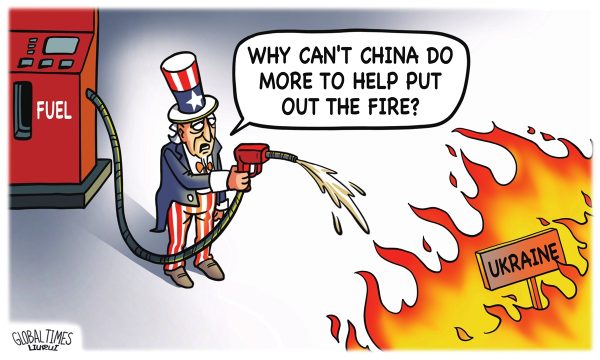
Illustration: Liu Rui/GT
Global Times | March 18, 2022
The close relationship between China and Russia has been a thorn in the US’ side, especially against the backdrop of the ongoing Ukraine crisis. With the simmering of the situation, it couldn’t be any clearer that Washington is eager to exploit the Russia-Ukraine conflict to drive a wedge between Beijing and Moscow.
For one thing, senior White House officials have on multiple occasions accused China of not exerting enough pressure on Russia to stop the country’s military action in Ukraine. US Secretary of State Antony Blinken said on Thursday before US President Joe Biden’s virtual meeting with Chinese President Xi Jinping that Washington will “impose costs” for any support Beijing provides to Russia’s actions against Ukraine. He urged Beijing to assume “responsibility to use its influence and defend the international rules and principles that it professes to support.” For another, an increasing number of Western media reports and analyses have emerged to hype how China’s ties with Russia have made China “uncomfortable” and “awkward” and warn that Beijing risks isolation if it doesn’t distance itself from Moscow.
NATO’s eastward expansion is the root cause of Russia’s anger and military operation in Ukraine. It’s the US that should put out the fire it lit in Ukraine. Ridiculously, it is demanding Beijing to do this job at the cost of damaging China-Russia relations. This is unreasonable and insidious. By pushing China to denounce Russia and asking China to bear the responsibility for the fatal strategic mistake the US and NATO made in the construction of so-called European security, Washington has no intention of hiding its desire to sow discord between China and Russia.
US State Department spokesperson Ned Price said on Monday that China could use its unique relationship to bring an end to Russia’s actions against Ukraine. What nonsense. Russia is an independent major power and China has no ability to exert influence on Russia’s decision on the Ukraine issue which it deems as a “life-and-death” matter.
If China really pressures Russia in a way that is inconsistent with the China-Russia comprehensive strategic partnership of coordination, it will only undermine the China-Russia relationship and sabotage mutual trust, which will be a huge strategic loss to both sides. This is what the US is eager and happy to see.
Washington knows that China cannot influence Russia or force it to do anything. But it has regarded the Ukraine crisis as a good chance to tear the two countries apart. The more discord Washington could sow between China and Russia, the more it will be in line with US interests. But how can Beijing and Moscow allow such an evil trick to succeed?
Not like the petty followers that Washington can manipulate at will, China and Russia are both independent great powers. Besides, China has maintained a consistent position over the Ukraine issue, emphasizing all sides’ security concerns and interests should be respected and upheld. Its position is out of its own interests and the interests of the region. It will never dance to the tune of the US or sacrifice relations with Russia to satisfy US demands.
It also should be noted that no matter how the Ukraine crisis evolves and how heavily Russia is targeted by the US now, Washington still views China as its biggest strategic competitor. China should bear this in mind all the time. It must not give the US any chance to drive a wedge in the China-Russia relationship.
For a long time, the West has misinterpreted the China-Russia relationship, believing it’s based on expediency and could be easily torn apart. The truth is, the China-Russia comprehensive strategic partnership of coordination has withstood the test of the time and is rock solid. It’s China’s most important and stable diplomatic strategic asset that cannot be damaged.
Cheerleader of NATO wars spotted in Ukraine
By Rachel Marsdon | Samizdat | March 17, 2022
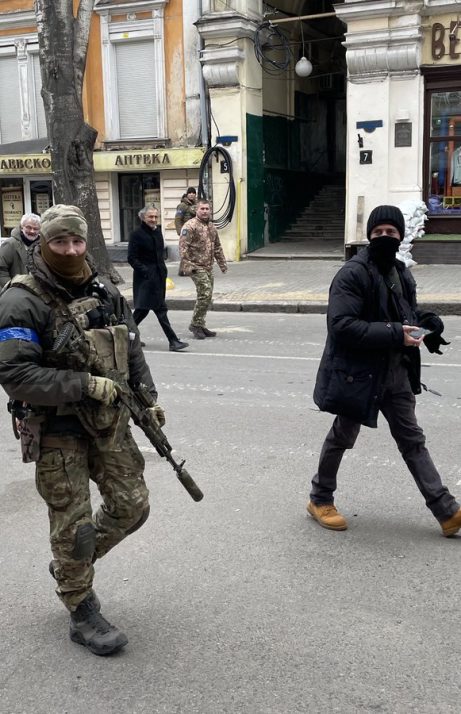 French intellectual and philosopher, Bernard-Henri Lévy (“BHL”), has an odd propensity for appearing alongside western proxy fighters in war zones. And new reports now place him on the ground amid the conflict in Ukraine.
The day after the February 24 launch of Russia’s attack on Ukraine, France 2, the main state-owned television network, hosted a debate featuring, on one side, former prime minister Dominique de Villepin, perhaps best known worldwide for his role during the run up to the Iraq war in 2003. Back then, he served as the foreign minister and represented France’s opposition to the American efforts under then president Jacques Chirac at the United Nations Security Council.
After then US Secretary of State Colin Powell made his now infamous speech imploring the international community to back an invasion of Iraq to prevent Saddam Hussein’s use of weapons of mass destruction, De Villepin argued in favor of inspections.
“Given this context, the use of force is not justified at this time. There is an alternative to war: Disarming Iraq via inspections. Moreover, premature recourse to the military option would be fraught with risks,” he said.
History has now proven him correct in his assessment.
De Villepin’s call for prudence and avoidance of military escalation in Ukraine was loaded with historical lessons learned. “Military interventions never yield the expected results,” recalled the former French prime minister. “History has taught us this in Libya, Iraq and the Sahel.”
On the other side of the France 2 debate table was BHL, who has a rather interesting relationship to some of the conflicts evoked by De Villepin. “[Russian President Vladimir Putin] launched this crazy war, without reason, against a people who had done nothing to him,” replied the philosopher.
It seems that in BHL’s world, wars start like magic with a need to protect completely innocent parties that just happen to be on NATO’s side, and not because of covert shenanigans that predate them — something that BHL should certainly know about.
During the NATO-backed war in Yugoslavia — the war in Europe that those commenting on the current situation in Ukraine seem to forget — BHL, who just happened to be hanging out in the region, overtly backed the NATO proxy, then Bosnian president Alija Izetbegović, who, his opponents believed, was a Muslim fundmentalist. Izetbegović was allegedly used by western forces to helm Islamist fighters against Serbia and ultimately carve out a zone of influence and military control in the Balkans. Later, in a 2019 tweet, BHL referred to the al-Qaeda-linked Izetbegović as “one of the great, luminous figures of the 20th century.”
Then, in March 2011, ahead of the NATO invasion of Libya, which led to an overthrow of Muammar Gaddafi that October, BHL was spotted in Libya meeting with “Libyan rebels,” footage of which can be seen in BHL’s documentary, “The Oath of Tobruk.” It would be easy to chalk up Levy’s presence among the western-backed proxy fighters ahead of Gaddafi’s ultimate demise at their hands as just journalistic interest or intellectual curiosity. But that theory is betrayed by French reports of an activist role at the highest level of the French government.
BHL succeeded in bringing three members of the future Libyan government in waiting to meet with then French President Nicolas Sarkozy at the Elysée Palace on March 10, 2011 — seven months before Gaddafi’s demise, according to Le Figaro. The newspaper also reported that BHL, who met with then US Secretary of State, Hillary Rodham Clinton, at a Paris hotel and noted an American disinterest in military intervention, subsequently took to French airwaves to pressure Sarkozy into having the French take the lead in the invasion by telling the French audience that, “If Gaddafi takes Benghazi, the huge French flag flying on the Corniche will literally be spattered with the blood of the massacred Libyans.” Four days after the media appearance, NATO began its military intervention in Libya.
In 2012, as the NATO-led invasion of yet another country, Syria, raged in an (ultimately unsuccessful) attempt to overthrow President Bashar al-Assad with “Syrian rebels” backed by CIA and Pentagon covert programs, BHL took to the red carpet at the Cannes Film Festival with both Libyan and Syrian rebels, to symbolize “the passing of the torch of Liberty,” according to Le Point magazine. Just a few months later, BHL was calling for France to also send weapons to the western’s proxy “rebels” to fight the Syrian army, specifically, “cannons, anti-aircraft missiles, defensive weapons, for Aleppo, Homs and the rest of Free Syria.”
Then, in February 2013, BHL wrote on his blog, “La Règle du Jeu,” praising then French president Francois Hollande for launching French military operations in Mali, which were ultimately an unsurprising result of the destabilization of Libya caused by the earlier French-led, NATO-backed invasion cheered by BHL himself. “For the first time, in Mali and Libya, force was put at the explicit service of freedom and justice; for the first time – since Valmy! – there is a desired link … between the exercise by France of its power and the defense of values that go beyond it.” In defense of the “values” of leaving countries in tatters for years after hopelessly destabilizing them because their leaders refuse to kowtow to the agenda of Washington and its allies, apparently.
And now, BHL — symbolic of a certain caviar leftist that sells wars and invasions of benefit to the military industrial complex from the lofty perch of humanitarianism — wants action in Ukraine. And after calling for it prominently via French mainstream media, he is hanging out in Odessa — coincidentally, just in time for the launch of the new “Ukraine fighters”, once again doing NATO’s dirty work, but this time comprised of foreign and domestic western-armed warriors, both regular troops and irregular combatants, cheered from the sidelines by the west against Russian troops.
A regular and welcome fixture all over English and foreign western establishment media from America to Europe, BHL tends to appear wherever there’s armed conflict between interests of the western establishment intent on clinging to the current unipolar world order, against those more representative of a more competitive multipolar alternative. His very presence in Odessa should give pause to anyone who still honestly believes that NATO isn’t a directly involved player, using Ukraine as a platform for its ongoing fight against an new and emerging world order over which it risks losing control.
How America will Profit from War in Europe
By Salman Rafi Sheikh – NEO – 16.03.2022
When the US President Joe Biden announced, on March 8, his decision to ban imports of Russian oil and gas to the US, he opened up a potential business opportunity for the US LNG gas business to expand further into Europe and beyond. While Biden’s decision does not automatically apply to Europe, given how Europe is mindlessly following the US in its footsteps at the expense of its own strategic autonomy, there was/is no denying that most European nations will follow suit the US decision. Indeed, this was Biden’s intention when he said that this decision was made in “close consultation with our Allies and our partners around the world, particularly in Europe … to keep all NATO and all of the EU and our allies totally united.” But this is not just about unity; it is about business, making money and keeping Europe under exclusive US control.
For quite a long time, the US has been making efforts to prevent Europe from asserting too much autonomy in the international arena as a player in itself. Europe decided to refuse to follow the US decision to scrap the Joint Comprehensive Plan of Action (JCPOA) with Iran. Until recently, it had differences with the US over NATO, with the French President Macron even calling the organisation “brain dead.”
But things are fast changing to the US advantage. By deliberately pushing for NATO’s expansion into Eastern Europe and by denying Russia any reasonable security guarantees, the US set the stage for the present crisis, which has now not only ‘united’ the EU under the US leadership, but many NATO members – in particular, Germany – have decided to increase their defense budget by at least 100 billion Euros.
What the US President Trump was unable to do through table-talks, the Biden administration has achieved through generating an actual war/ crisis in Eastern Europe. Other than NATO members, non-NATO members like Sweden, too, have decided to increase their budget, with public opinion in Sweden swinging for the fits time in favour of NATO membership in the wake of the on-going crisis. Where will this defense spending go?
There is no denying that no European county will be buying weapon systems from Russia or China, but mainly from the US military industrial complex. (NATO does not have its own force; “NATO forces” refer to multinational forces from NATO member countries, who in turn contribute both personnel and equipment to the organisation for “collective defense.”) A highly expected sale will involve F-35 fighter jets. It is, therefore, not surprising to see two major US military industrial groups, Lockheed and Raytheon, have seen their market shares rising up by 16 per cent and 3 per cent since the start of the war in Ukraine, respectively.
Apart from this massive increase in defense production, a clear indication of war in Europe being a business opportunity for the US is the field of energy export to Europe. The US decision to impose a ban on energy exports from Russia is symbolic insofar as the US is not a large buyer of Russian oil and gas. The imposition of the ban is, however, aimed at luring European markets to the US. The US, in short, is eyeing capturing the European market on a long-term basis.
As it stands, US LNG exporters are already appearing to be the big winners as gas prices in Europe hit all-time high. Major US exporters like Cheniere Energy Inc are among the top beneficiaries, as they have been able to sign long-term delas to sell LNG to Europe in very recent months. The present crisis has only made their task a lot easier and much more profitable at the same time.
This is happening at a time when the US LNG exports are expected to reach 11.4 billion cubic feet per day in 2022, accounting roughly for 22 per cent of the expected global LNG demands next year. The number of cargos of LNG shipped from the US to Europe, only in the first two months of 2022, has reached a record high of 164, as compared to the previous record of 125 in 2020. This trend is likely to continue – and even intensify – amidst European nations’ claims to reduce their dependence on Russian natural gas.
Supplying the US LNG to Europe is also part of a US plan-in-the-making to globalise its exports. As a recent report in the Washington-based think-tank, Centre for Strategic and International Studies – which receives funding from the US government – the US export of LNG to Europe for the next 20 years could provide the foundation for the export of US LNG to Asia, which is the largest market for LNG. Expansion of US LNG gas supply lines to Asia would also mean a direct territorial expansion of the US global influence.
The New York Times’ advocacy of a yet another “trans-Atlantic Pact” between the US and Europe reflects essentially how the path for increasing Europe’s dependency on the US is being laid. The EU/NATO already largely depends on the US for its security, which is one reason why there was, until recently, a growing demand from within Europe to enhance its own strategic autonomy by developing weapons systems “independently of the US.”
These initiatives are unlikely to develop any time soon, and even if they do develop, they will have no impact on Europe’s quest for strategic autonomy. It will only add to the US-led trans-Atlantic alliance.
It is important to understand that until very recently, Europe was seeking autonomy from the US, not from Russia. By manufacturing a crisis in Europe and by forcing the European nations to confront a war in their own continent, the US has been able to bring a sea-change in the European political discourse from seeking autonomy from Washington to reducing ‘dependence’ on Russia. From the US perspective, therefore, the war is already a major strategic victory – a victory that the European elite is either completely unaware of, or has been forced to shut its eyes to.
‘West’s global political and economic dominance ends’ – Russian President
Samizdat | March 16, 2022
Russian President Vladimir Putin has stated that the latest rounds of unprecedented sanctions imposed on Russia by the US and its allies over the Kremlin’s military campaign in Ukraine, mark the end of an era. According to Putin, from now forward the West will be losing its “global dominance” both politically and economically.
On Wednesday, the Russian head of state proclaimed that the “myth of the Western welfare state, of the so-called golden billion, is crumbling.” Moreover, it is the “whole planet that is having to pay the price for the West’s ambitions, and its attempts to retain its vanishing dominance at any cost,” Putin said.
The president predicted food shortages across the world as Western sanctions against Russia adversely affect the entire global economy.
Touching on the decision by several Western powers to freeze Russia’s central bank assets, Putin said that this would only serve to irreparably undermine trust in those nations, and make other countries think twice before placing their reserves in the care of those countries. According to him, nearly half of Moscow’s assets were “simply stolen” by the West.
Addressing people in the West, the Russian leader said the massive sanctions imposed on Russia are already backfiring on the US and Europe themselves, with governments there trying hard to convince their citizens that Russia is to blame.
Putin warned ordinary people in the West that attempts to portray Moscow as the primary source of all their woes were lies, with many of those issues being the direct result of Western governments’ “ambitions” and “political short-sightedness.”
Western elites, according to Putin, have turned their countries into an “empire of lies,” but Russia will keep on presenting its own position to the whole world, no matter what.
Outlines of potential Ukraine peace deal as revealed by Russia
Samizdat | March 16, 2022
Vladimir Medinsky, Russia’s top negotiator at the peace talks with Ukraine, says that Kiev is floating the idea of becoming a neutral nation.
“Ukraine is proposing an Austrian or a Swedish model of a neutral demilitarized state, but with its own army and navy,” Medinsky said on Wednesday, adding that “the size of Ukrainian Army” was among the issues discussed.
Moscow wants Ukraine to officially become a neutral country which will never join NATO. Russia attacked Ukraine on February 24, saying that it was seeking the “demilitarization” of the country, among other demands.
Medinsky reiterated that Moscow wants Kiev to recognize Crimea as part of Russia, and the independence of the Donetsk and Lugansk People’s Republics (DPR and LPR), which broke away from Ukraine shortly after the 2014 coup in Kiev. Other key issues of concern the “denazification” of Ukraine and the rights of Russian speakers living in the country, the negotiator said.
“There was some progress on several issues, but not all of them,” Medinsky said about the talks with Kiev.
Commenting on this model of Ukrainian neutrality, Kremlin spokesman Dmitry Peskov said “it can be viewed as a certain compromise.”
Austria declared itself a neutral country in 1955. Its laws ban the nation from joining military alliances and hosting foreign military bases on Austrian soil.
Sweden is often described as a ‘non-aligned’ country, given its longstanding tradition of not formally joining any military bloc. It is not a NATO member and has no foreign bases on its territory.
However, in response to the Russian attack on Ukraine, NATO invited non-members Sweden and Finland to attend the US-led bloc’s meetings and decided to share intelligence with them.
The Ukrainian leadership previously said it was ready to discuss potential neutrality with Russia. At the same time, President Volodymyr Zelensky said Ukraine must receive “security guarantees” from Russia and the West.
Moscow attacked its neighbor in late February, following a seven-year standoff over Ukraine’s failure to implement the terms of the Minsk agreements, and Russia’s eventual recognition of the Donbass republics in Donetsk and Lugansk. The German- and French-brokered protocols had been designed to regularize the status of those regions within the Ukrainian state.
Russia has now demanded that Ukraine officially declare itself a neutral country that will never join the US-led NATO military bloc. Kiev insists the Russian offensive was completely unprovoked and denied claims it was planning to retake the two republics by force.
YouTube flags Tulsi Gabbard’s criticism of “military industrial complex” as “inappropriate,” “offensive”
By Christina Maas | Reclaim The Net | March 15, 2022
An interview for Fox News’ “Ingraham Angle,” featuring former Congresswoman Tulsi Gabbard, was censored for being potentially “offensive” and “inappropriate” to some audiences.
In the interview, Ingraham asked Gabbard, “Congresswoman, why are we talking about no-fly zones instead of the fact that for the first time we have President Zelensky stepping back from his earlier NATO wishes and even demands?”
Gabbard expressed her frustration with the fact that allegedly no one was discussing a statement Ukraine’s President Zelensky made, about being “… open to the fact of saying, ‘Hey, yeah, maybe we’ll set this NATO membership thing aside,’ and he’s willing to talk with Putin directly to negotiate.”
Gabbard suggested that the West was interfering with attempts to settle the conflict because, “it’s good for the military industrial complex” and it allowed Western leaders to “have this proxy war with Russia, something that Hillary Clinton laid out just recently.”
Gabbard strongly condemned the war, saying: “This war machine, this power elite in Washington, want to turn Ukraine into another Afghanistan, turn into killing fields where this long-term insurgency is supported. And they bleed out and cripple, kill as many Russians as possible for who knows how long, and they’re really showing their real aim in the fact that they’re not taking action right now to end this conflict.”
YouTube flagged the video, putting up a filter that said, “the following content has been identified by the YouTube community as inappropriate or offensive to some audiences.”
China names world’s ‘hacking empire’
RT | March 15, 2022
Calling the US a “hacking empire” of the world, the Chinese Foreign Ministry urged Washington to stop “malicious” cyber activities following reports that American hackers subverted a network in China to launch attacks on Russia and Belarus.
“China is gravely concerned about cyberattacks against other countries that originate from the US and use China as a springboard,” Foreign Ministry spokesperson Zhao Lijian told reporters at a press briefing on Monday.
Zhao was commenting on recent Chinese media reports that hackers, mainly from the US but also from NATO allies Germany and the Netherlands, recently hijacked a Chinese computer network for cyberattacks, 87% of which targeted Russia.
“Against the background of the Ukraine situation, such a move may produce the negative effect of misleading the international community and spreading disinformation,” Zhao said, pointing out that “a former US senior official called publicly for launching cyberattacks on Russia not long ago.”
This appeared to be a reference to Hillary Clinton, former US secretary of state and presidential candidate, who made the calls in an MSNBC interview at the end of February.
While Beijing doesn’t know the exact role of the US government in the attack, or if it is linked to the “long practice of smearing China in cyberspace” by the US, Zhao called for Washington to “adopt a more responsible attitude.”
Meanwhile, the White House said on Monday that the US has threatened China with “significant consequences” if it helps Russia in any way, during lengthy talks in Rome between National Security Advisor Jake Sullivan and Chinese envoy Yang Jiechi.
Multiple Western outlets claimed over the weekend that Moscow had asked Beijing for military aid for the conflict in Ukraine. Zhao called the claims “disinformation” coming from the US.
Is Washington Fighting Russia Down to the Last Ukrainian?
By Ron Paul | March 14, 2022
As the Russian invasion of Ukraine moves past its third week, there are slight hopes that negotiations between the two sides may soon produce a ceasefire. But with the shrill warmongering talk in Washington, it almost seems like the US government would hate to see that happen.
Congress and the US Administration seem determined to drag the United States into a war with Russia over Ukraine. Senator Lindsay Graham is openly calling for someone to kill the Russian president and many in the US House have demanded that the Administration establish a “no-fly zone” over Ukraine.
Are they insane? A no-fly zone means you destroy anything and everything that can prevent total US air dominance. That means an attack on Russian missile and air defense systems within Russia. In other words, World War III.
We can all feel disgust at the destruction in Ukraine, but is it really necessary for us to gamble with our own nuclear annihilation?
Sadly, a large bipartisan group in Congress seems to think so.
Much of what is happening in Ukraine can be traced back to the Obama Administration. State Department officials like Victoria Nuland and Antony Blinken planned and executed the overthrow of the Ukrainian government in 2014. This is what set us on this path to conflict, as the government put in place after the coup began demanding NATO membership.
Blinken, Nuland, and the others responsible for this heinous act returned to government in more senior positions under President Biden and they have continued to push their Ukraine agenda.
Last week Secretary of State Blinken – our top diplomat – sought to send Soviet-era Polish fighter jets into Ukraine to shoot Russians. When the Poles said they’d be happy to ship the planes to a US base in Germany and let the Pentagon transfer them to Ukraine, the Pentagon finally stepped in to quash an extraordinarily high-risk move that even the Pentagon said would have no real effect on the outcome of the war.
The State Department is trying to get us into a war and the Pentagon is trying to keep us out. How ironic!
Back when I was on the campaign trail I would say that we have a few thousand diplomats in government, it might not be a bad idea to use them. But I certainly did not mean that we should use them to try and get us further involved in a war!
Three weeks into this terrible war, the US is not pursuing talks with Russia. As Antiwar.com recently reported, instead of supporting negotiations between Ukraine and Russia that could lead to a ceasefire and an end to the bloodshed, the US government is actually escalating the situation which can only increase the bloodshed.
The constant flow of US and allied weapons into Ukraine and talk of supporting an extended insurgency does not seem designed to give Ukraine a victory on the battlefield but rather to hand Russia what Secretary of State Blinken called “a strategic defeat.”
It sounds an awful lot like the Biden Administration intends to fight Russia down to the last Ukrainian. The only solution for the US is to get out. Let the Russians and Ukrainians reach an agreement. That means no NATO for Ukraine and no US missiles on Russia’s borders? So what! End the war then end NATO.
Zelensky Thanks Zuckerberg For Fighting ‘Side by Side’ With Ukraine in Info War
By Chris Menahan | InformationLiberation | March 13, 2022
Ukrainian president Volodymyr Zelensky on Sunday expressed his gratitude to Mark Zuckerberg for Facebook and Instagram censoring Russian news outlets, allowing calls for violence against Russians and helping his government spread endless disinformation.
“War is not only a military opposition on UA land. It is also a fierce battle in the informational space,” Zelensky said Sunday on Twitter. “I want to thank @Meta and other platforms that have an active position that help and stand side by side with the Ukrainians.”
Last month, Facebook changed their rules to allow users to praise the “neo-nazi” Azov Battalion and this week they changed their rules further to allow calls for violence against Russians.
Facebook blocks RT and Sputnik in the EU but allows the Ukrainian military to announce plans to commit war crimes.
Facebook has helped Zelensky himself spread endless disinformation to try and con NATO into World War III. Most recently, they helped Zelensky spread the lie that Russians attacked the Zaporizhzhia nuclear power plant with tanks and it was leaking radiation and could lead to a nuclear holocaust wiping out all of Europe (if NATO doesn’t immediately get involved in the war and start WW3).
They also helped Zelensky spread the lie that Russians attacked the Chernobyl nuclear power plant and were trying to trigger a meltdown.
With Mark Zuckerberg’s full backing, Zelensky used Facebook to lie about Snake Island and spread the fake news that Russia attacked a Holocaust memorial “to erase our history.”
Whereas Facebook said in the past they would censor content that may cause harm or lead to violence, they now boost Israeli-funded “neo-nazi” groups in Ukraine and spread Zelensky’s lies and disinformation to millions in an effort to start WW3.
Featured Video

AIDS Inc. by Gary Null (2007)
or go to
Aletho News Archives – Video-Images
From the Archives
Clash of Civilization, Iran Part II
By Jamal Kanj – Intifada-Palestine.com – January 14, 2011
Israel’s survival kit is: perpetuate conflict, insecurity to rationalize collective hate and finally playing victim.
Devoid of conflict, Israel implodes internally; without hate, Zionism loses its justification; and playing eternal victim to continue blackmailing the West. Absence of this holy trinity, Israel ceases to exist.
From its inception, the house of Zion has mastered exploiting adversarial powers to advance Israel’s cause. For instance, their influence over the Democratic Party in the US began with President Truman’s bid for 2nd term election in 1948.
Responding to strong opposition from Secretary of State General George Marshall and Department experts urging against recognition of Israel, President Truman replied: “I’m sorry gentlemen but I have to answer to hundreds of thousands [Jewish voters] who are anxious for the success of Zionism. I do not have hundreds of thousands of [voting] Arabs among my constituents”
Zionists influence over liberal American politics was matched with the doctrinal school of Conservative theoreticians aligning the Republican Party’s platform with Israel’s objectives. The Neoconservative Zionists, coined Zioncons, invented the “Clash of Civilization” concept to fight Israel’s wars. … continue
Blog Roll
 Aletho News
- From Unipolar Universalism to Multipolar Civilizational Distinctiveness
- RSF military group defects, joins Sudanese army: State media
- Ireland goalkeeper refuses to play ‘Israel’ as squad weighs boycott
- China pushes back against US on Cuba, Iran
- Ukrainian Soldiers, Potential Mercenaries: Have Gun, Will Travel!
- Burnham’s UN debut… A masterclass in British disinformation
- Iran flights continue despite US aviation sanctions
- Global Tipping Points Lead the World Into a State of Entropy
- The day-after at the White House: USA and Xi Jinping
- The Geopolitical Balance in the Red Sea: The UAE Being Displaced by New Players
- If Americans Knew
- Deconstructing Netanyahu’s pants-on-fire UN rant – Daily Update
- Trump betrayed voters with his campaign lies and prioritized a foreign country once he took office
- Netanyahu calls Israel’s war in Gaza ‘opposite of genocide’ in UN speech to near-empty hall
- Settler Kidnappings: Torture, Sexual Abuse and Terrorisation of Palestinian Abductees as Israel Deepens Annexation of West Bank
- Gaza winter nears as 162,000 tents become unusable, raising fears of humanitarian crisis
- Netanyahu says, “It’s the opposite of genocide”; UN says Gaza economy is world’s ‘most severe crisis on record’ – Daily Update
- Israel’s US-Backed Assault on Gaza Has Created the ‘World’s Most Severe Economic Crisis on Record’: UN
- ‘Protecting U.S. Citizens’… From Israel
- ‘This is where I live now, the back of a truck’: a day in the life of a grandmother in Gaza
- In UN Speech, Iran’s President Displays Pictures of Children Killed by US, Brings Attention to Israel’s Nuclear Arsenal
- No Tricks Zone
- New Study: Earth And Venus Surface Warmth Largely Explained By Convection And Lapse Rate, Not CO2 Or Radiation
- 2025 Nature Paper Claiming Worsening Global Drought Gets RETRACTED …Heavily Flawed
- New Study: ‘Global Drought Shows No Detectable Recent Acceleration Under Climate Warming’
- Economic Masterminds: German Socialists Suggest Taxing Productivity Gains Stemming From Using AI
- The South China Sea Has Not Been Cooperating With The Climate Change Narrative
- Energy Crisis: Germany Enters Heating Season With Historically Low Gas Reserve Fill Levels
- New Study: The Antarctic Ice Sheet Gained Mass From 2020-2024 Due To Staggering Snow And Ice Accumulation
- Study: Ocean Heating Rates From Thousands Of Years Ago ‘Dwarf’ Modern Ocean Heating Rates
- Climate Extremists Target, Attack Large-Scale Power Grid Infrastructure In Germany!
- New Study: Antarctic Ice Melt Has Contributed Less Than 1 Centimeter To Sea Level Rise In The Last 30 Years

