Biden Mulls Sending Extra Weapons & Trainers To Ukraine Amid Dubious Reports Of “Russian Invasion”
By Tyler Durden | Zero Hedge | November 24, 2021
Here we go again: the ratcheting tit-for-tat threats currently being unleashed between Moscow and Washington arguably hasn’t been this intense since the height of the Donbass conflict of years ago, and the Crimea crisis. It’s leading to the Biden administration mulling ramping up arms transfers to Kiev.
CNN on Tuesday is citing multiple defense sources to report “The Biden administration is weighing sending military advisers and new equipment including weaponry to Ukraine as Russia builds up forces near the border and US officials prepare allies for the possibility of another Russian invasion.
And yet as we’ve reviewed, there’s still as yet little to nothing in the way of hard evidence that Russia is setting in motion any kind of plans to “invade Ukraine” – as Bloomberg last week first reported based on anonymous US sources. Much of the speculation appears based on satellite images of Russian troop movements taking place significantly far from Ukraine’s border, with Moscow’s constant refrain to the West being that it can move its own troops within Russia’s sovereign borders wherever it wants to.
But this new US plan to not just send more military hardware – but also US military advisers – would mark a serious escalation, as the Kremlin has recently warned it would see any kind of NATO forces buildup inside Ukraine as violating its “red lines” which would require taking action.
According to the fresh CNN report, the proposed lethal aid package now under consideration by the White House could include stinger missiles – which Moscow would without doubt consider a severe escalation:
The discussions about the proposed lethal aid package are happening as Ukraine has begun to warn publicly that an invasion could happen as soon as January. The package could include new Javelin anti-tank and anti-armor missiles as well as mortars, the sources said.
Air defense systems, such as stinger missiles, are also under consideration, and the Defense Department has been pressing for some equipment that would have gone to Afghanistan — like Mi-17 helicopters — to instead be sent to Ukraine. The Mi-17 is a Russian helicopter that the US originally purchased to give to the Afghans. The Pentagon is now weighing what to do with them after the US withdrawal from Afghanistan in August.
And in particular the Javelins are seen as deadly and effective against Russia’s T-80 tanks. Recently, Moscow has accused pro-Ukrainian forces of heightened attacks on pro-Russian separatists in Ukraine’s east over the past months, which has included multiple deaths from sporadic mortar fire.
The past year has seen NATO military exercises utilize closer Ukrainian army and naval participation…
Already in response to the rumors and reports of more US weapons and trainers sent to Ukraine, Russia is responding with threats of its own to send its weapons into eastern Ukraine.
Kremlin spokesman Dmitry Peskov said, “we shouldn’t rule out the possibility of sending military advisers and weapons to Ukraine, because this is already taking place. Military advisers are arriving there, weapons are supplied there — not only from the United States, but also from other NATO countries. And all this, of course, leads to a further aggravation of the situation on the border line.”
Previously on Monday the Kremlin vehemently denied the Western reports of any planned-for “invasion”, with government spokesman Peskov explaining that currently the Russian military is merely engaged in the “usual background level” of military maneuvers – similar to the training drills that ended up generating false reports last April and May of a “planned Ukraine invasion”. That prior situation, like the current one, involved Russian troops and weaponry being observed at least 60km from the actual Ukrainian border, and not along it.
During the statement, Peskov actually turned the charges back on NATO, saying, that in Ukraine “The number of provocations has increased significantly and these provocations are conducted using weapons delivered by NATO.” He blamed Kiev and its backers for the soaring tensions, calling its own military build-up “alarming” – thus each side appears to be ramping up troop readiness based on accusing the other of a “build-up” of forces.
NATO submarine caused Kursk sinking that killed 118 Russian sailors, ex-admiral claims
By Layla Guest | RT | November 22, 2021
The catastrophic sinking of the Russian nuclear-powered Kursk submarine more than two decades ago was the result of a collision with a stricken NATO vessel in the Barents Sea, a former high-ranking navy chief has insisted.
The ‘Kursk’ sank on August 12, 2000 at a depth of 108 meters, claiming the lives of all 118 crew members and sparking the first major international crisis of Vladimir Putin’s presidency. An official investigation commissioned by the Russian government ruled two years later that the incident was the result of a torpedo explosion, which then triggered the detonation of ammunition on board.
However, in an interview with RIA Novosti, aired on Monday, former Northern Fleet commander Vyacheslav Popov offered a theory on how the incident might have happened. According to him, a vessel operated by a NATO power got too close to Moscow’s vessel, colliding with its bow and damaging the torpedo tube, which was followed by an explosion. The compartment then flooded, sending the sub to the depths of the sea.
“The submarine that collided with ‘Kursk’ was following it, apparently, but failed to ensure safety in the sea’s environment and all other conditions, approached too close, or the Kursk maneuver led to a loss of contact,” he said.
Popov claimed he knew the name of the sub belonging to the US-military led bloc “with a 90% probability.” However, he admitted he did not have sufficient available evidence to make the case publicly at present.
According to the former naval chief, who served until 2001, the vessel was in the region where it collided with ‘Kursk’. He also noted that SOS signals were sent from special equipment that Russian boats were not equipped with, implying another submarine must have been present.
Viktor Kravchenko, a former chief of staff of the Russian Navy, later agreed with Popov’s theory, remarking he was “also inclined to believe this version” of the demise of the Kursk, based on circumstantial evidence.
Three NATO vessels, the British ‘Splendid’ and American subs ‘Toledo’ and ‘Memphis’, were reportedly in the vicinity of Russian military exercises in the Barents Sea at the time. Neither Washington nor London provided documents on the condition of their vessels after Moscow requested the information.
However, the Russian government maintains that the official investigation’s conclusion is the most likely, with many analysts pointing out the period was a challenging time for the Russian military. A combination of underfunding, aging Soviet hardware, and low morale could all have contributed to the incident.
Putin, then only months into his first term as president, took the brunt of much of the criticism for the Kursk tragedy, with the large-scale loss of young Russian sailors sparking sorrow and outrage. Failed rescue efforts caused anger and frustration both domestically and worldwide.
Popov’s claims come amid heightened concerns over NATO’s activity around Russia’s borders. On Friday, the bloc’s top official, Jens Stoltenberg, proposed deploying American nuclear warheads around Eastern Europe to counter a supposed threat posed by Moscow.
In response, the Kremlin said such a statement would mean that the Founding Act of Russia-NATO relations “no longer exists.” Under this document, inked in 1997, the two parties do not consider each other rivals. It guarantees no nuclear weapons will be deployed to new NATO members after this date.
Theater of Absurd… Pentagon Demands Russia Explain Troops on Russian Soil
Strategic Culture Foundation | November 19, 2021
The United States Secretary of Defense Lloyd Austin this week performed impressive, albeit pathetic, mental gymnastics. In a press conference, the Pentagon chief called on Russia to be more transparent about troop movements “on the border with Ukraine”. In others words, on Russian soil.
Meanwhile, the absurd hypocrisy sees U.S. and NATO forces brazenly escalating their offensive presence on Russia’s borders, especially in the Black Sea region.
Here’s an Associated Press clip on the Pentagon press conference: “American officials are unsure why Russian President Vladimir Putin is building up military forces near the border with eastern Ukraine but view it as another example of troubling military moves that demand Moscow’s explanation, Defense Secretary Lloyd Austin said Wednesday.”
The report quotes Austin as saying: “We’ll continue to call on Russia to act responsibly and be more transparent on the buildup of the forces around on the border of Ukraine… We’re not sure exactly what Mr Putin is up to.”
This dubious talent for mind-bending mental gymnastics and double-think is shared with other members of the Biden administration. Last week, America’s top diplomat Antony Blinken claimed that Russia was about to invade Ukraine yet at the same time the U.S. Secretary of State confessed similar ignorance about what “Putin is up to”.
How is it possible to engage in meaningful dialogue with such vacuous people who are supposed to be government leaders – and leaders too of the self-declared world’s most powerful, most brilliant nation? No undue offense intended, but it would probably be more productive to engage in a dialogue with the bewildering characters from Samuel Beckett’s absurdist play Waiting for Godot.
Russia has repeatedly dismissed all claims about it threatening Ukraine or any other country with invasion. Moscow also disputes “unreliable” information touted by the Biden administration and Western media of troop buildup near Ukraine on its western flank. Western media reports have relied on dodgy commercial satellite data purporting to show Russian military maneuvers. It is contemptible that senior U.S. government figures are basing grave allegations against Russia on such ropy sources. That in itself speaks volumes about the deterioration in Washington’s diplomatic professionalism and political intelligence.
Secondly, the salient fact being missed in all the hullabaloo is this: Russian troops and equipment are on Russia’s sovereign territory. It is the height of absurdity for U.S. officials to demand that Russia “explain” and be “more transparent” about its own national defenses. That speaks of a hyper-arrogance among American politicians that are deforming their ability to think reasonably.
There is an analogy here with the outcry this week over Russia’s successful missile test against a Soviet-era satellite in orbit. The Biden administration condemned Russia for creating “space junk” and weaponizing space while ignoring the fact that the U.S. previously carried out the same kind of missile strike and, arguably has been trying to weaponize space since the Reagan administration’s “star wars” program during the 1980s.
In any case, the U.S. charges of Russia’s military buildup on its own territory are made all the more ridiculous when we consider the actual increase in NATO forces in Ukraine and the Black Sea region – right on Russia’s western doorstep.
In a major speech this week delivered at the Russian foreign ministry, President Putin noted again how Western powers have continually failed to register Moscow’s national security concerns over the expansion of NATO forces along Russia’s borders. He described this inability for cognition of what should be an obvious grievance as “very peculiar”.
The Kremlin has suggested that the increasing NATO offensive presence near Russia’s borders is not due to stupidity, but rather is aimed at provoking a conflict. Russia is strenuously resisting the danger of an armed confrontation, and yet the provocations continue.
Nearly two weeks ago, William Burns, the head of the CIA made a high-profile visit to Moscow during which he held discussions with senior Kremlin figures, including President Putin. We can safely assume that Burns was told in no uncertain terms that the buildup of U.S. and NATO forces near Russia’s territory is a red line that will presage a response from Russia.
But these red lines continue to be skirted by Washington and its NATO allies.
More perplexing, too, are the moves by the U.S.-backed Kiev regime to escalate the conflict in Ukraine against the ethnic Russian population in the separatist Donbas region. The ultranationalist regime has been waging a low-intensity war against the Donbas since the U.S.-backed coup in Kiev in 2014. The Americans and other NATO powers are increasing weapon supplies and military trainers to the regime, emboldening it to repudiate any peaceful settlement of the eight-year conflict.
Only last month, Pentagon chief Austin was in Kiev where he recklessly endorsed the joining of the NATO bloc by Ukraine. That is in spite of numerous warnings from Moscow that such a move would be an unacceptable destabilization.
The stepped-up war drills by NATO in the Black Sea region are inevitably leading the Kiev regime to resile from legally binding commitments to the Minsk Peace accord of 2015 – brokered by Russia, Germany and France. The release this week of diplomatic communications by the Russian Foreign Minister Sergei Lavrov clearly demonstrates that Germany and France are complicit in turning a blind eye to the Kiev regime’s systematic violation of the Minsk deal.
In this context, Russia is justifiably deeply wary of a confrontation exploding out of the tinderbox conditions in Ukraine and the Black Sea. Given the Russian nation’s tragic history of suffering from past military invasions, it is entirely understandable and indeed vitally prudent that the country’s formidable defenses are on high alert.
It is not for Russia to explain its troops. It is for the United States and its NATO partners to account for their wanton aggression and to desist.
There is something of the theater of absurd in American and European posturing. But it’s far from funny. It’s menacingly deranged.
Ukraine gives its view on alleged Russian military buildup near border
By Jonny Tickle | RT | November 16, 2021
Ukraine’s State Border Service has rejected claims that Russia’s military is gathering near the two countries’ shared border, after NATO’s Secretary-General said there was a “large and unusual” build-up of forces at the frontier.
Speaking to the Ukraine-24 TV channel on Monday, border service spokesman Andrey Demchenko revealed that Kiev does not have reason to believe Russian troops are accumulating nearby.
“We do not register any movement of equipment or military of our neighbouring country near the border,” he explained. “If any actions are taking place, it may be dozens or even hundreds of kilometres from the state border.”
Demchenko’s comments directly contradict a claim from NATO head Jens Stoltenberg, made earlier that day. “We see an unusual concentration of troops, and we know that Russia has been willing to use these types of military capabilities before to conduct aggressive actions against Ukraine,” Stoltenberg said.
Last week, American business outlet Bloomberg reported that US officials warned their European counterparts that Moscow may be planning an invasion of Ukraine, noting that their concerns were backed by “publicly available evidence.”
The suggestion of an invasion was quickly slammed by Kremlin spokesman Dmitry Peskov groundless.
“This is not the first publication and not the first statement by the US that they are concerned about the movement of our armed forces in Russia,” he said. “We have repeatedly said that the movement of our armed forces on our own territory should be of no concern to anyone. Russia poses no threat to anyone.”
EU Official Calls US Warships Near Russia’s Coast “Clearly” An Unncessary “Provocation”
By Tyler Durden | Zero Hedge | November 12, 2021
An EU official has made surprising remarks this week, evaluating the presence of a pair of large US warships in the Black Sea. French member of the European Parliament Thierry Mariani slammed ongoing naval exercises by the USS Porter and USS Whitney as “clearly a provocation” by Washington.
“The presence of the ‘Mount Whitney’, flagship of the US Sixth Fleet and the USS Porter in the Black Sea, as well as the NATO naval maneuvers, are clearly a provocation of Russia,” Mariani said.
He issued the statements in an interview to Russia’s Sputnik : “Can you imagine what the American reaction would be if the Russian navy organized maneuvers in international waters off the American coast, near Washington DC?” he questioned.
The statements come as both US and Ukrainian officials, as well as Romanian leaders and other Black Sea NATO members, have urged a greater US military presence on the Black Sea, citing “Russian aggression.”
On renewed tensions over Ukraine, coming two weeks after Kiev officials accused the Kremlin of building up troops near Donbass and in the Crimea area, the French official said:
“This is very serious and could push Ukrainian politicians, the culprits of this widespread corruption, into a headlong rush action, for example into a hazardous military offensive in Donbass or an armed provocation of Russia in the Black Sea.”
And on NATO encroachment in eastern Europe and around the Black Sea, he said:
“NATO should have been dismantled at the same time as the Warsaw Pact was suppressed in the last century and the present expansion, and projection by NATO of military forces to the whole world is very alarming.”
The statements appeared to back provocative statements made days ago by Russian Defense Minister Sergei Shoigu, who said, “This is an almost constant attempt to test us, to check how ready we are, how much we have built the entire [defense] system off the Black Sea coast.”
Russia denies US media reports that it plans to invade Ukraine
By Jonny Tickle | RT | November 12, 2021
The Kremlin has strongly denied suggestions that Russia is planning to invade Ukraine, after reports emerged that officials from the US had warned their counterparts in Europe that Moscow is considering a “military operation.”
Speaking to the press on Friday, Kremlin spokesman Dmitry Peskov slammed the suggestion as groundless.
“This is not the first publication and not the first statement by the US that they are concerned about the movement of our armed forces in Russia,” he said. “We have repeatedly said that the movement of our armed forces on our own territory should be of no concern to anyone. Russia poses no threat to anyone.”
Reports that Washington fears Russian aggression against Ukraine were first published by business outlet Bloomberg on Thursday. Citing unnamed sources, the news agency reported that US officials had briefed their partners in the EU over a “potential invasion,” noting that their concerns were backed by “publicly available evidence.”
“Such headlines are nothing but empty, unfounded tension build-up. Russia poses no threat to anyone,” Peskov reiterated.
The suggestion was earlier refuted by Dmitry Polyanskiy, Russia’s first deputy ambassador to the UN, who wholly denied any plan to attack its neighbor.
“We have never planned [an invasion] and never will, unless we are provoked by Ukraine or someone else, and it is a matter of defending our national sovereignty,” he said.
Russian MP Viktor Vodolatsky also commented on the accusation, suggesting that the article is more indicative of NATO’s plan to create conflict in Ukraine.
“This is all done with only one goal: to get Ukraine involved in a war, realizing that Russia will not turn a blind eye to it,” he said. Vodolatsky is the first deputy head of the parliamentary committee on CIS Affairs, Eurasian Integration, and Relations with Compatriots.
Biden has pledged that ‘America is back.’ But as peace shatters in the Balkans, does that mean yet more US misadventures?
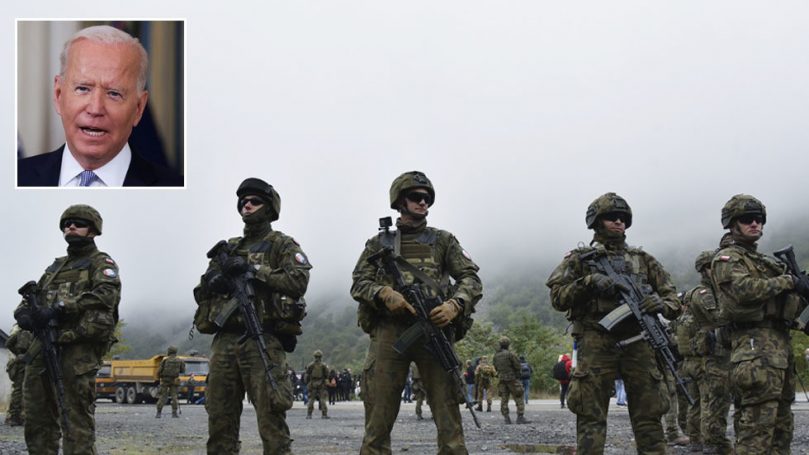
KFOR forces patrol near the border crossing between Kosovo and Serbia in Jarinje, Kosovo, October 2, 2021. © REUTERS / Laura Hasani; Inset © REUTERS / Evelyn Hockstein
By Julian Fisher | RT | October 24, 2021
With warnings that fresh tensions between Serbia and Kosovo could unravel the decades-old peace deal that put an end to bloody fighting in the Balkans after the breakup of Yugoslavia, the US is increasingly split on what to do.
Earlier this month, the SOHO forum in New York City hosted a debate between Scott Horton, long-time libertarian and anti-war radio host, and Bill Kristol, the neoconservative thinker and one of the ideological architects of America’s post-9/11 world order. The subject of the debate was US interventionism, its merits and historical record.
Predictably, Kristol offered vague niceties that attempt to recast America’s legacy as that of the “benevolent global hegemony”, a term which he himself coined in 1996 when describing the country’s role in the world. Reflecting on the wars in Iraq, Kristol simultaneously said that America “didn’t push democracy enough” and also “may have been too ambitious.” In short, he acknowledged mistakes were made, which is an admission that would have been unthinkable only a few years ago, and yet still falls short of accountability.
However, whereas American actions in the Middle East leave a lot to be desired for Kristol, he insists that the US intervention in the Yugoslav Wars during the 1990s was a success. As he put it, the Balkans was “one case of a war that was worth it and that I think had pretty good consequences.” As if on cue, the Balkan pot is beginning to boil once again.
An unresolved conflict
Kosovo has been a potential tinderbox in Southern Europe ever since the end of the war of 1998/1999. A recent row with Serbia, from which it unilaterally declared independence, has led to a new escalation in tensions.
Beginning in September 2021, Serbs living in Kosovo launched protests against authorities hassling travelers who enter the territory with Serbian-issued license plates, prompting a mobilization of armed Kosovo police forces, roadblocks, and traffic jams near the border. Two vehicle registration offices were vandalized.
The EU mediated a temporary fix in September that involves covering up national insignia on license plates with stickers, until a special working group in Brussels determines a more permanent solution sometime within the next six months. Whether this will be sufficient in bringing about immediate calm remains to be seen, however. Since then, further clashes have erupted between police and protesters near Mitrovica.
Russia’s Foreign Ministry has condemned the use of violence by Kosovo police against ethnic Serbs. Foreign Minister Sergey Lavrov met with Serbian President Aleksandar Vucic in mid-October, calling for talks between Pristina and Belgrade and a diplomatic solution to be respected by all sides.
As the situation heated up, NATO quickly ramped up patrols throughout Kosovo, including the North. “KFOR [Kosovo Force] will maintain a temporary robust and agile presence in the area,” the US-led military bloc said in an official statement earlier this month, intended to support the implementation of the EU-brokered solution. Last week, Kosovo’s minister of defense, Armend Mehaj, flew to Washington to meet with Under Secretary of Defense for Policy Dr. Colin Kahl at the Pentagon. The subject of the discussions was “bilateral security cooperation priorities”.
These moves are only the latest instance of US-led posturing in Kosovo. It was with American support that Kosovo launched its campaign for international recognition in 2008. Many major countries, representing most of the world’s population — including Russia, China, and India — have not recognized it as a sovereign state. Kosovo’s persistent claim to independence is what makes an issue as seemingly benign as license plates a question of war and peace.
In the background is still the 1999 Kosovo War, which was the site of NATO’s infamous bombing campaign against Serbia that led to the deaths of at least 489 civilians, according to Human Rights Watch. In April of 1999, NATO deliberately targeted Serbia’s Radio Television station, killing 16 civilians, according to Amnesty International. At one point, the US “mistakenly” bombed the Chinese embassy in Belgrade, killing three and wounding some 20 more, in what turned out to be the only target picked by the CIA over the course of the war.
To this day, the US maintains a military base, Camp Bondsteel, near Urosevac, Kosovo, as part of the international Kosovo Force (KFOR).
Two states in one
To the west, Bosnia and Herzegovina (BiH) has also reappeared in international news coverage. Against the backdrop of the EU’s Western Balkan Summit in early October, the Bosnian Serb leader Milorad Dodik said last week that the parliament of the Serb Republic, one of two entities that together make up BiH, would soon vote to undo some of BiH’s state institutions. He included the military, the High Judicial and Prosecutorial Council (HJPC) and the tax administration. These and others were established after the signing of the 1995 Dayton Peace accords and are not enshrined in the constitution.
Dodik wants an independent Serb Republic without compromising the territorial integrity of BiH, and he claims he has the support of seven EU member states, though he has not said which ones.
The genesis of Bosnia and Herzegovina’s recent headache is an amendment to the Criminal Code that makes various forms of inflammatory speech a punishable offense. The law was enacted in July of this year by the Office of the High Representative, an international “viceroy” with the power to impose binding decisions and remove public officials.
Russia has maintained that this appointed position is outdated, with a statement from the Foreign Ministry saying it was high time to “scale down the institute of foreign oversight over Bosnia-Herzegovina, which only creates problems and undermines peace and stability in that country.” Moscow also remains critical of attempts to integrate the country into NATO, insisting there is no consensus among the people of Bosnia and Herzegovina when it comes to joining the US-led bloc.
Playing to a different tune, already last month Washington tried to reprimand Dodik for his “secessionist rhetoric”. In a meeting just a few weeks ago, US Deputy Assistant Secretary of State Gabriel Escobar warned of “nothing but isolation and economic despair” for the people of the Serb Republic. According to a transcript that Dodik shared with the press, he told Escobar that he doesn’t “give a damn about sanctions,” adding, “I’ve known that before. If you want to talk to me, don’t threaten me.”
In the US, various Balkan-American organizations have released a joint statement calling on Congress and the Biden administration “to immediately initiate steps to rebuff the attempts by the government of Serbia to unravel the region’s peace and security”. Citing both aforementioned developments in Kosovo and the Serb Republic of Bosnia and Herzegovina, the statement demands a reinvigoration of “NATO enlargement as a priority for the region.” It suggests that what’s at stake in the Balkans is America’s legacy: “America invested too much of its own resources into this region to allow revanchist actors to decimate nearly a quarter century of progress.”
However, what does America investing its resources actually look like? In early 1992, before the war that scarred Bosnia and Herzegovina, all parties involved had already come to an agreement, the Carrington–Cutileiro plan, to divide Bosnia and Herzegovina into cantons along Serb, Croat, and Bosniak lines.
At the last minute, however, the then-US ambassador to Yugoslavia, Warren Zimmermann, met with the leader of the Bosniak majority, Alija Izetbegovic, in Sarajevo, reportedly promising him full recognition of a single Bosnia and Herzegovina. Izetbegovic promptly withdrew his signature from the partition agreement, and shortly thereafter the US and its European allies recognized Izetbegovic’s state. War ensued a month later, in April 1992. The US eventually worked its way back to new partition negotiations that echoed the talks held prior.
As the New York Times reported in 1993, “tens of thousands of deaths later, the United States is urging the leaders of the three Bosnian factions to accept a partition agreement similar to the one Washington opposed in 1992.”
Zimmermann is quoted as saying at the time that “Our hope was the Serbs would hold off if it was clear Bosnia had the recognition of Western countries. It turned out we were wrong.”
Returning to the Horton-Kristol debate from earlier, Horton cited America’s underhanded opposition to the Carrington-Cutileiro plan, and the devastating consequences, as a case in point of US interventions impeding, rather than promoting, peace and stability.
President Joe Biden declared at the start of his administration that “America is back.” Taking a look at the history of US interventions, this could spell trouble for the Balkans.
Julian Fisher is a policy analyst at the Russian Public Affairs Committee (Ru-PAC). He writes about Russia-U.S. relations, American foreign policy, and national security
NATO’s new secret plan for nuclear war & space battles with Russia risks spiraling into a new arms race
By Paul Robinson | RT | October 24, 2021
Tensions between Russia and NATO are at an all-time high. But instead of seeking a way off the ladder of escalation, the US-led bloc’s new plan for hybrid war risks accelerating an already dangerous lethal arms race with Moscow.
There’s a concept in international relations, almost one of the first that students learn, called the ‘security dilemma’. It’s hardly rocket science, but it’s something governments and armed forces planners seem to consistently forget when it comes to making policy.
The idea is basically this: Country A feels threatened by country B; it therefore takes some measures – such as increasing its defence spending – to make itself more secure; but when country B sees what country A is doing, it in turn feels threatened, and so takes reciprocal measures of its own. The result is that country A ends up less safe than it was to start with.
The dilemma is that if you do nothing to strengthen your defences, you’ll be insecure, but if you do something you’ll end up worse off because of the counter-measures the other side will take. What do you do? If countries A and B both take action to defend themselves, they will find themselves in an ever-escalating process – what theorists like to call the ‘spiral model’, but which in public parlance is often called an arms race.
The obvious way out is to break the spiral. Avoid escalating and resort to other measures, such as negotiation and arms control. All it may take is for one side to unilaterally step back, and the vicious circle will turn into a virtuous one.
It’s pretty basic stuff, but again and again, state leaders choose to ignore it and prefer instead to march down the path of the spiral. So it is today in the case of Russian-NATO relations, which are as classic an example of the security dilemma as you could possibly hope to find. Deep down, there’s no fundamental reason for conflict, but mutual suspicion leads to a continuing ramping up of reciprocal measures that deepen the suspicion, leading to more measures, more suspicion, and so on, seemingly ad infinitum.
For instance, earlier this year, the Russian military undertook a series of exercises close to its Western borders. From a Russian perspective, these were purely defensive. From a Western perspective, they appeared potentially threatening, justifying in turn Western exercises that NATO claims are entirely for defence, but which Russia considers a threat, prompting further Russian measures.
The latest round in this dangerous process is the announcement this week that NATO has developed a new ‘masterplan’ to defend against a possible Russian attack. The plan itself is secret, so we don’t know its contents, but it’s said to focus on non-conventional war, including nuclear strikes, cyberwarfare, and even war in space. Geographically, it covers the whole spread of NATO’s border with Russia, from the Baltic to the Black Seas inclusive.
In part, this is just what military institutions do: They plan for possible future conflicts. The Russian military almost certainly also has similar contingency planning in place for a potential war with NATO. It would be very odd if it didn’t. In this sense, NATO’s new masterplan shouldn’t in theory be seen as a cause for alarm. Moreover, NATO insists that its purpose is not aggressive. Rather, the plan’s aim is deterrence, thus its formal title: ‘Concept for Deterrence and Defence in the Euro-Atlantic Area’.
However, as students of the spiral model know, reality is much less important than perception. Deterrence is a matter of signals. One sends a message to potential enemies that if they attack, they will suffer devastating consequences. The problem is that although this message may be clear to the one doing the signalling, it may not be so clear to the one to whom it is sent. You think you are deterring, but they think you are threatening. They therefore respond in kind. In this way, deterrence ends up being counter-productive.
This doesn’t always happen, but in this instance, it seems to be the case. Some aspects of NATO’s announcement seem unnecessarily escalatory, in particular the references to nuclear war. We’ve come a long way from the musings of nuclear strategists like Herman Kahn and Bernard Brodie, who tried to calculate how it was possible to fight and win a nuclear war. One shouldn’t be surprised that when other people hear such talk being revived, they’re not deterred but alarmed.
Unsurprisingly, Russia’s reaction to NATO’s new military concept has been decidedly negative. “There is no need for dialogue under these conditions,” Kremlin spokesman Dmitry Peskov said, continuing: “this alliance was not created for peace, it was conceived, designed and created for confrontation.”
From the Russian point of view, NATO’s actions justify Russia’s recent decision to sever ties with the Atlantic alliance. Rather than bringing Russia to heel, NATO may merely be driving it into an ever more hostile position.
In this way, the West’s perception of Russia as a threat becomes a self-fulfilling prophecy. The same, of course, could be said the other way around. For if the West perceives Russia as threatening, it is because of things that Russia has done – as it sees it, for its own defence. For instance, NATO argues that what has made its new plan necessary is Russia’s strengthening of its armed forces and its recent advances in military technology.
The more Russia defends itself, the more it incites NATO. And the more NATO defends itself, the more it incites Russia. A security dilemma par excellence. The risk both parties run is that the situation will continue to spiral further and further into ever more dangerous territory. Already this spring, Europe passed through a period of high tension in which it looked entirely possible (although unlikely) that war might erupt between Ukraine and Russia. Anything that contributes to a further worsening of the situation is therefore thoroughly undesirable. NATO’s new military plan, it seems fair to say, runs the risk of doing just that.
Paul Robinson, a professor at the University of Ottawa. He writes about Russian and Soviet history, military history and military ethics, and is the author of the Irrussianality blog.
NATO, Not Russia, Perpetuates Cold War Logic… It is a Relic Best Ignored
Strategic Culture Foundation | October 22, 2021
It was the end of an era this week when Russia announced that it was severing diplomatic links with the North Atlantic Treaty Organization. For the past 30 years since the dissolution of the Soviet Union, the Russian Federation has engaged with the US-led military bloc in a bid to establish partnership and secure peace.
The incipient detente culminated in the NATO-Russia Founding Act in 1997 which demarcated certain boundaries for peaceful coexistence. Those boundaries were subsequently flouted as NATO doubled its members over the ensuing years to stand at the current membership of 30 countries, including states that share a border with Russia.
There was also established in 2002 a NATO-Russia Council which in principle provided a forum for dialogue between delegations hosted in the Belgian capital Brussels where NATO has its headquarters.
But the truth is initial promises of partnership have waned. For several years now, at least since the 2014 Ukraine crisis, NATO’s relations with Russia have been characterized more and more with an imperious attitude of lecturing Moscow over a litany of alleged transgressions. These allegations are more accurately described as slanders because they are never substantiated beyond bald accusation.
Russia is routinely accused of posing a threat to Europe and plotting to sabotage Western democracies. This week the NATO defense ministers held a summit in which it was breathlessly claimed that Russia is becoming an even greater threat to the transatlantic alliance. On the back of that hysterical claim, NATO has now moved to implement a “master plan” to “defend” Europe from a “potential Russian attack on multiple fronts”.
Reality check. Moscow has repeatedly stated that it has no intent of aggression towards the United States, NATO, Europe or anyone else for that matter. Despite this categorical assurance, the Western bloc has persisted in talking up tensions with Russia.
It is the United States that has abrogated several arms-control treaties and introduced new missile systems into Europe. It is NATO that is encroaching on Russia’s territory. Reality is turned on its head by Western accusations.
Indeed there have been conflicts over Georgia in 2008 and ongoing in Ukraine. But in each case, there are substantial grounds for laying the blame of these conflicts on NATO. How did the coup d’état in Kiev happen in 2014, who supported it? And why did the people of Crimea vote in a constitutional referendum to secede from Ukraine to join the Russian Federation with which they have centuries of shared history and culture?
In any case, if there were proper partnership and dialogue between NATO and Russia then such concerns and disputes could have been appropriately aired and discussed in the assigned forum. But the fact is there was never any genuine attempt at dialogue by NATO. Russia has become an object of harangue and hostility. The supposed partnership envisaged some three decades ago became a travesty. Instead of dialogue and debate there was simply disdain. Instead of equality there was vilification, opprobrium, and sensationalized smears without the slightest due process afforded to Russia (the Skripals, Navalny, Novichok, electoral interference, cyberattacks, shooting down a Malaysian airliner, and so on and so on, like an old skipping vinyl record incapable of moving on.)
The supposed diplomatic channels were nothing but echo chambers for NATO propaganda talking points, rather than being used as a means to resolve misapprehensions through mutual dialogue and presentation of evidence.
As the Russian foreign ministry noted this week in explaining the severance of diplomatic ties, it is NATO that systematically destroyed relations and “chose the Cold War logic”.
Alexander Grushko, Russia’s deputy foreign minister, commented that normal relations were not possible amid unfriendly steps taken by NATO “sliding into Cold War schemes”.
The last straw was the expulsion earlier this month by NATO of Russian diplomats from the NATO forum in Brussels. The Russian staff were accused of being “undeclared spies” allegedly working for military intelligence. No evidence was provided, as usual, by the accusers. It was the familiar high-handed approach of fait accompli and Russia “guilty until proven innocent”.
Everyone recognizes that relations between the Western states and Russia are at their lowest since the end of the former Cold War. Thus it may be put to Moscow that it is being reckless to close down channels of communication at this precarious time.
Russia has not ruled out pursuing a more productive relationship in the future. It has said, however, that it is up to NATO to make the first move towards improving relations. Until then, henceforth, any communications can be submitted through Russia’s ambassador to Belgium.
It is our view that Russia has made the correct call to drop diplomatic channels with NATO. Russia will pursue bilateral relations with individual nations as it does already, for example, with the United States on the vital issues of arms control and cybersecurity. NATO has proven to be incapable of progressive negotiations owing to an organizational “groupthink” that is encumbered with Russophobia and Cold War ideology.
By engaging directly with individual nations, it may be more productive for mutual understanding to be advanced because the noise of “groupthink” and of competing group negativity is removed.
Unfortunately, it has to be noted that the original purpose of NATO when it was formed in 1949 was rooted in Cold War hostility towards the Soviet Union. Such animosity has not abated even though the Soviet Union no longer exists.
Fundamentally, NATO is an organization in search of enemies in order to justify the militarism that is essential for the functioning of Western capitalism. There is a pivotal contradiction between NATO and today’s emerging world of multipolar cooperation and peaceful development. Its disgraceful, diabolical destruction of Afghanistan alone debars that organization from having any progressive role in today’s world.
Russia is right to disabuse the illusion of “partnership” with NATO. It is a relic of Cold War hostility that belongs in a war museum not in a modern forum for diplomacy.
Russia to suspend direct diplomatic ties with NATO from November
RT | October 18, 2021
Moscow has announced that it will completely suspend the operations of its mission to NATO, two weeks after the US-led bloc expelled eight Russian diplomats for alleged ‘undisclosed espionage’ at its Brussels headquarters.
Speaking on Monday, Russian Foreign Minister Sergey Lavrov also revealed that the NATO information bureau in Moscow will be forced to shut down as part of retaliatory measures.
Earlier this month, NATO officials decided to slash the size of the permanent Russian delegation to the bloc, revoking the credenitals of eight envoys, in response to what it called “suspected malign Russian activities.”
Following NATO’s decision, Foreign Ministry spokeswoman Maria Zakharova warned that Moscow would work on a response.
Now, if the US-led bloc wants to talk to Russia, it must deal with the embassy in Belgium, Lavrov said.
“As a result of purposeful steps by NATO, we do not have the right conditions for elementary diplomatic activities,” he told TASS news agency.
“In response to NATO’s actions, we are suspending the work of our permanent mission, including the work of our chief military representative.”
“The NATO International Secretariat has already been notified.”
“If NATO members have any urgent matters, they can contact our ambassador in Belgium, who ensures bilateral relations between Russia and the Kingdom of Belgium,” the minister said.
Nuclear Weapons and Europe
By Brian Cloughley | Strategic Culture Foundation | October 12, 2021
On October 5 the U.S. State Department announced that the U.S. military’s arsenal of nuclear weapons numbered 3,750 as of September 30, 2020. It was stated with satisfaction that “This number represents an approximate 88 percent reduction in the stockpile from its maximum (31,255) at the end of fiscal year 1967”, although it wasn’t mentioned that the reduction since 2018 was only 35.
On the same day, the U.S. Defense Department publication Stars and Stripes reported that “an Air Force fighter jet slated to debut later this year in Europe passed a milestone when it dropped mock nuclear bombs during training flights designed to ensure its ability to fulfil NATO’s nuclear deterrence mission . . . The successful test of the F-35A Lightning II came as the 48th Fighter Wing, based at Britain’s RAF Lakenheath, reactivated the 495th Fighter Squadron last week for a new mission in Europe. [Emphasis added.] Ahead of the fighter model’s arrival at Lakenheath, two F-35As that took off from Nellis Air Force Base, Nevada, completed a full weapon system demonstration, regarded as a graduation flight test for achieving nuclear certification.”
In February 2021 U.S. Secretary of State Antony Blinken informed the Conference on Disarmament in Geneva that “President Biden has made it clear: the U.S. has a national security imperative and a moral responsibility to reduce and eventually eliminate the threat posed by weapons of mass destruction” and President Biden pledged to “take steps to reduce the role of nuclear weapons in our national security strategy,” but it has not been made clear how elimination of the threat from nuclear weapons or reduction of their role in U.S. military strategy can be achieved by training more combat aircraft pilots in the use of nuclear weapons and then deploying them to Europe with their strike aircraft.
The United Kingdom has an equally interesting perspective in what it describes as its “leading approach to nuclear disarmament” and is increasing its arsenal of nuclear weapons. As the Royal United Services Institute noted in March, the UK’s 2021 Integrated Review of Security, Defence, Development and Foreign Policy states that the UK is “raising a self-imposed limit on its overall nuclear warhead stockpile” of the current 225 warheads.
The Review, headed “Global Britain in a Competitive Age”, explains that in 2021 it had been announced as national policy that there would be a reduction in “our overall nuclear warhead stockpile ceiling from not more than 225 to not more than 180 by the mid-2020s. However, in recognition of the evolving security environment . . . this is no longer possible, and the UK will move to an overall nuclear weapon stockpile of no more than 260 warheads.” Then it assured the international community that in spite of increasing the number of its nuclear weapons delivery systems the United Kingdom is “strongly committed to full implementation of the NPT in all its aspects, including nuclear disarmament.”
It is intriguing that the present British government would have us believe that more nuclear weapons and deployment of 27 U.S. nuclear-capable F-35 aircraft to the UK’s Royal Air Force base at Lakenheath are in some fashion compatible with nuclear disarmament, but what is consistent is their linkage with the stockpiles of U.S. nuclear bombs already in Europe.
It is not known if there are or will be any U.S. nuclear weapons kept at Lakenheath, and no doubt the UK government would be comfortable with such storage which would add comparatively few bombs to the hundred or so already stored in vaults in air bases at Kleine Brogel in Belgium, Büchel in Germany, Aviano and Ghedi in Italy, Volkel in the Netherlands, and Incirlik in Turkey. It is regrettable that while the U.S. and Britain insist that they are trying to reduce the threat of nuclear war they are actually increasing and expanding numbers, locations and strike capabilities of nuclear weapons’ systems.
The U.S.-Nato military alliance policy is that “nuclear weapons are a core component of NATO’s overall capabilities for deterrence and defence,” resting almost entirely on U.S. nuclear delivery capabilities which are to be expanded at vast expense, with the new generation of Intercontinental Ballistic Missile Systems, now referred to as the Ground-Based Strategic Deterrent, likely to cost 95 billion dollars — if there are no cost overruns.
As stated by the Congressional Budget Office, it is “required by law to project the 10-year costs of nuclear forces every two years” and its latest paper, “Projected Costs of U.S. Nuclear Forces, 2021 to 2030” makes sobering reading because it is projected that U.S. taxpayers, in this era of fiscal crises, will be required to pay sixty billion dollars a year for nuclear forces over the next ten years. The Office estimates that “about $188 billion of the $551 billion total over the 2021–2030 period would go toward modernizing nuclear weapons and delivery systems. Of that amount, $175 billion would go toward modernizing the strategic nuclear triad, and $13 billion would be for modernizing tactical nuclear weapons and delivery systems.” And this does not include funding of such massive projects as the F-35 strike aircraft which will cost some $1.6 trillion.
The political justification for massive military spending on conventional and nuclear weapons by the governments in London and Washington is their contention that Russia and China pose a threat and that, in the words of the 2021 U.S. Interim National Security Strategic Guidance, Russia, for example, is “determined to enhance its global influence and play a disruptive role on the world stage.” (Presumably Washington means the sort of disruption that Associated Press reported on October 7 when “Europe’s soaring gas prices dropped . . . after Russian President Vladimir Putin suggested his country could sell more gas to European spot buyers via its domestic market in addition to through existing long-term contracts.”)
The surge in deployment of nuclear systems and the overall tenor of nuclear weapons developments in Europe do not meet with approval in the European community. For example, a survey published in January revealed that 74% of Italians, 58% of Dutch and 57% of Belgians and 83% of Germans want U.S. nuclear weapons removed from their countries, and another poll (albeit by the Campaign for Nuclear Disarmament) found that 77% of Britons favour a total ban on nuclear weapons.
Europe is in a state of flux, and not only because of the economic and social effects of the pandemic. For example, the Warsaw government’s recent refusal to abide by European Union laws could result in Poland leaving the EU (which would be greeted with approval by most EU citizens) but this would have no effect on the U.S.-Nato military buildup — the “Enhanced Forward Presence” along Russia’s borders, backed to the hilt by nuclear weapons.
U.S. deployment of a further squadron of nuclear strike aircraft to the UK, for a “new mission in Europe”, combined with its existing stocks of nuclear weapons in Europe and Britain’s undebated decision to increase its nuclear weapons’ arsenal are signals to continental European nations that planning for nuclear war against Russia is accelerating. While these countries prefer to engage with Washington and London in a balanced fashion and wish to maintain cordial relations, it would be advisable to question the motives behind the growing emphasis on nuclear war and insist on reduction in confrontational deployments.
This week’s elections could pave way for Prague to Czech out of EU
By Paul A. Nuttall | RT | October 4, 2021
The elections in the Czech Republic later this week have largely been ignored, but the political situation in the country is not only compelling, it could have ramifications for the rest of Europe, and in particular for the EU.
Czechs go to the polls on Friday and Saturday in legislative elections that will determine who will lead the country for the next four years. These elections have been getting little attention in the international press, mainly because the focus has been on the elections taking place in Germany.
The Czech Republic has been led by a coalition government since 2017. The senior partner in the coalition is the ANO 2011 party, and its leader is the current Prime Minister Andrej Babis.
Babis’ party is described as ‘populist’. An ally of Hungarian Prime Minister Viktor Orban, he recently attended the Demographic Summit in Budapest, where Babis and his counterparts from Poland, Serbia and Slovenia announced their intention to oppose further mass immigration in Europe.
Babis is also opposed to further EU integration and determined not to see the euro replacing the country’s current official currency, the koruna. He claims his party “will not hand over the sovereignty of the Czech Republic to the European Parliament or the European Commission.”
Recent polls put the ANO 2011 party in the lead with 27%. The main opposition parties, SPOLU (an alliance of liberals and conservatives) and the bizarrely named Pirates and Mayors party are polling around 21%. Both are committed to combining their votes in an alliance to force Babis from power.
Indeed, some commentators, who it must be said are firmly opposed to Babis’ politics, are predicting that the Czech Republic could be heading towards a constitutional crisis. However, it is expected that President Milos Zeman will use his constitutional powers to appoint the leader of the largest party as prime minister.
In all likelihood, this will be Babis, and it will give him the first opportunity to form a coalition. However, even if this is the case, he will be facing a big problem, as his current coalition partners have seen their support fall off a cliff recently.
The Social Democrats, who share power with Babis, are only polling between 4% and 6% and may not even make the 5% threshold to have candidates elected to parliament. And this puts Babis in a difficult position because, devoid of his main coalition partner, he will be forced to look elsewhere.
The ‘elsewhere’ in this case is most likely to be the Freedom and Direct Democracy Party (SPD), which is the most Eurosceptic political party in the country and is polling around 11%. The SPD is committed to a direct democracy law that will allow citizens to force referendums, and the one the party wants most is a referendum on Czech membership of the European Union.
SPD leader Tomio Okamura has made it clear that any negotiations for his party to join a future coalition will be conditional on holding such a referendum: “One of the fundamental conditions is for the government manifesto… to include a referendum law including the possibility of a referendum on leaving the EU or potentially NATO.”
Now this places Babis in a difficult position because, although he is a Eurosceptic, he does not envisage the Czech Republic leaving the EU anytime soon. Moreover, he is opposed to the idea of citizen-led referendums, or at least he would like prohibitive barriers implemented, such as a requirement for a huge number of signatories to force a referendum.
Another problem is that a direct democracy law would require the support of a three-fifths majority in both the Chamber of Deputies and the Senate. However, the upper house, which is elected for a six-year term, is dominated by a pro-EU majority.
Nevertheless, the fact that an EU referendum is on the agenda could be seen as an outlier to where the Czech Republic is eventually headed. And let us not forget, the Czechs are not alone here. Recently, there have been noises in Budapest about the need for a referendum on EU membership in Hungary.
Although largely ignored, the elections in the Czech Republic this weekend will be fascinating, but even more enthralling could be the political “horse trading” that follows – the outcome of which could have ramifications for the rest of the EU.
Paul A. Nuttall is a historian, author and a former politician. He was a Member of the European Parliament between 2009 and 2019 and was a prominent campaigner for Brexit.
Featured Video

AIDS Inc. by Gary Null (2007)
or go to
Aletho News Archives – Video-Images
From the Archives
Clash of Civilization, Iran Part II
By Jamal Kanj – Intifada-Palestine.com – January 14, 2011
Israel’s survival kit is: perpetuate conflict, insecurity to rationalize collective hate and finally playing victim.
Devoid of conflict, Israel implodes internally; without hate, Zionism loses its justification; and playing eternal victim to continue blackmailing the West. Absence of this holy trinity, Israel ceases to exist.
From its inception, the house of Zion has mastered exploiting adversarial powers to advance Israel’s cause. For instance, their influence over the Democratic Party in the US began with President Truman’s bid for 2nd term election in 1948.
Responding to strong opposition from Secretary of State General George Marshall and Department experts urging against recognition of Israel, President Truman replied: “I’m sorry gentlemen but I have to answer to hundreds of thousands [Jewish voters] who are anxious for the success of Zionism. I do not have hundreds of thousands of [voting] Arabs among my constituents”
Zionists influence over liberal American politics was matched with the doctrinal school of Conservative theoreticians aligning the Republican Party’s platform with Israel’s objectives. The Neoconservative Zionists, coined Zioncons, invented the “Clash of Civilization” concept to fight Israel’s wars. … continue
Blog Roll
 Aletho News
- 12 Things Your Psychiatrist Was Trained Not to Tell You
- From Unipolar Universalism to Multipolar Civilizational Distinctiveness
- RSF military group defects, joins Sudanese army: State media
- Ireland goalkeeper refuses to play ‘Israel’ as squad weighs boycott
- China pushes back against US on Cuba, Iran
- Ukrainian Soldiers, Potential Mercenaries: Have Gun, Will Travel!
- Burnham’s UN debut… A masterclass in British disinformation
- Iran flights continue despite US aviation sanctions
- Global Tipping Points Lead the World Into a State of Entropy
- The day-after at the White House: USA and Xi Jinping
- If Americans Knew
- Israel forces Gazans to live in constant peril – Daily Update
- Deconstructing Netanyahu’s pants-on-fire UN rant – Daily Update
- Trump betrayed voters with his campaign lies and prioritized a foreign country once he took office
- Netanyahu calls Israel’s war in Gaza ‘opposite of genocide’ in UN speech to near-empty hall
- Settler Kidnappings: Torture, Sexual Abuse and Terrorisation of Palestinian Abductees as Israel Deepens Annexation of West Bank
- Gaza winter nears as 162,000 tents become unusable, raising fears of humanitarian crisis
- Netanyahu says, “It’s the opposite of genocide”; UN says Gaza economy is world’s ‘most severe crisis on record’ – Daily Update
- Israel’s US-Backed Assault on Gaza Has Created the ‘World’s Most Severe Economic Crisis on Record’: UN
- ‘Protecting U.S. Citizens’… From Israel
- ‘This is where I live now, the back of a truck’: a day in the life of a grandmother in Gaza
- No Tricks Zone
- New Study: Earth And Venus Surface Warmth Largely Explained By Convection And Lapse Rate, Not CO2 Or Radiation
- 2025 Nature Paper Claiming Worsening Global Drought Gets RETRACTED …Heavily Flawed
- New Study: ‘Global Drought Shows No Detectable Recent Acceleration Under Climate Warming’
- Economic Masterminds: German Socialists Suggest Taxing Productivity Gains Stemming From Using AI
- The South China Sea Has Not Been Cooperating With The Climate Change Narrative
- Energy Crisis: Germany Enters Heating Season With Historically Low Gas Reserve Fill Levels
- New Study: The Antarctic Ice Sheet Gained Mass From 2020-2024 Due To Staggering Snow And Ice Accumulation
- Study: Ocean Heating Rates From Thousands Of Years Ago ‘Dwarf’ Modern Ocean Heating Rates
- Climate Extremists Target, Attack Large-Scale Power Grid Infrastructure In Germany!
- New Study: Antarctic Ice Melt Has Contributed Less Than 1 Centimeter To Sea Level Rise In The Last 30 Years

