As West blames Moscow for ‘food crisis’, ships sail from Mariupol with Moscow’s help
Meanwhile Ukraine holds vessels in its ports
By Eva Bartlett | Samizdat | July 1, 2022
Without much notice in the West, on June 21, the first foreign ship departed from the Port of Mariupol since Ukrainian and foreign mercenary forces were fully forced out of the Donbass city a month prior. Escorted by Russian naval boats, the vessel’s departure set the precedent for a resumption of normal port activity to and from Mariupol.
Russia’s Defense Ministry on May 20 announced the liberation of the Azovstal plant from Ukraine’s Nazi Azov Battalion, and some days later stated that sappers had demined an area of one and a half million square meters around the city’s port.
In early June, the ministry declared the facility ready for use anew. “The de-mining of Mariupol’s port has been completed. It is functioning normally, and has received its first cargo ships,” Defense Minister Sergey Shoigu said at the time.
Russia promised to give ships safe passage, and on June 21, the Turkish ship Azov Concord left with a Russian escort. At Mariupol port that day, prior to setting off, the captain of the ship, Ivan Babenkov, spoke to the media, telling us that the vessel, without cargo, was heading to Novorossiysk for loading, and then on to its destination.
Rear Admiral Viktor Kochemazov, commander of the Russian naval base in Novorossiysk on the Black Sea’s northeastern coast, down the Kerch Strait from Mariupol, explained that while the corridor has been operational since May 25, the nearly one-month delay in departing was because “ships were significantly damaged during the conduct of hostilities.” Notably, he also said that some ships were deliberately damaged by Ukrainian forces in order to prevent them from leaving.
From aboard a Russian anti-sabotage forces boat, media watched the Azov Concord leave port. Further on, the ship would be met by warships of the Novorossiysk base and escorted to the Kerch Strait where FSB border control ships would continue to escort the ship.
A Bulgarian ship, the Tsarevna, was readying to depart the port next, “also following the same humanitarian corridor to its destination in accordance with plans for the use of the court by the owner,” Rear Admiral Kochemazov said.
Western press ignoring developments
Predictably, just as the Western media continues to ignore Ukraine’s war crimes against the Donbass republics, including not only the bombing of houses, hospitals, and busy markets – plus the killing and maiming of civilians – so too do they omit coverage of anything positive emanating from areas where Ukrainian forces have been ousted and stability restored.
Instead, Western media continues to spin the story that it’s Russia that’s blocking ports and preventing grain exports, and blame Moscow for “aggravating the global food crisis” – when in reality, it is Ukraine that has mined ports and burned grain storages.
In fact, according to Russia’s Ministry of Defense, “70 foreign vessels from 16 countries remain blocked in six Ukrainian ports (Kherson, Nikolaev, Chernomorsk, Ochakov, Odessa and Yuzhniy). The threat of shelling and high mine danger posed by official Kiev prevent vessels from entering the high seas unhindered.”
While Russia maintains it has opened two maritime humanitarian corridors in the Black and Azov Seas, Kiev is apparently not engaging with representatives of states and ship-owning companies about the departure of docked foreign ships.
Meanwhile, in the same vein, media outlets like the New York Times (writing as always from afar) claim that Mariupol is “suffering deeply” under Russian rule (citing the runaway former mayor, nowhere near the city for months, who is the source of previous war propaganda) even describing the Azov Neo-Nazis as “the city’s last military resistance.”
Yet, what I’ve seen in multiple trips to Mariupol in the past couple of weeks is rubble being removed so that the rebuilding process can begin, newly established street markets, public transportation running, and calm in the streets.
The people of Mariupol have indeed suffered, but now that the Azov Nazis and Ukrainian nationalists no longer reign, they can live without fear of persecution, execution, rape, torture, and all of the other ‘democratic values’ of the forces backed by the West.
The rebuilding will take time, but with the port functioning anew, and the possibility now of also bringing reconstruction materials by sea, it can begin, ship by ship.
Eva Bartlett is a Canadian independent journalist. She has spent years on the ground covering conflict zones in the Middle East, especially in Syria and Palestine (where she lived for nearly four years).
The Fantasy of Fanaticism
Despite what some “defense analysts” may be telling Western media, the longer the war continues, the more Ukrainians will die and the weaker NATO will become.
By Scott Ritter | Consortium News | June 25, 2022
For a moment in time, it looked as if reality had managed to finally carve its way through the dense fog of propaganda-driven misinformation that had dominated Western media coverage of Russia’s “Special Military Operation” in Ukraine.
In a stunning admission, Oleksandr Danylyuk, a former senior adviser to the Ukrainian Ministry of Defense and Intelligence Services, noted that the optimism that existed in Ukraine following Russia’s decision to terminate “Phase One” of the SMO (a major military feint toward Kiev), and begin “Phase Two” (the liberation of the Donbass), was no longer warranted. “The strategies and tactics of the Russians are completely different right now,” Danylyuk noted. “They are being much more successful. They have more resources than us and they are not in a rush.”
“There’s much less space for optimism right now,” Danylyuk concluded.
In short, Russia was winning.
Danylyuk’s conclusions were not derived from some esoteric analysis drawn from Sun Tzu or Clausewitz, but rather basic military math. In a war that had become increasingly dominated by the role of artillery, Russia simply was able to bring to bear on the battlefield more firepower than Ukraine.
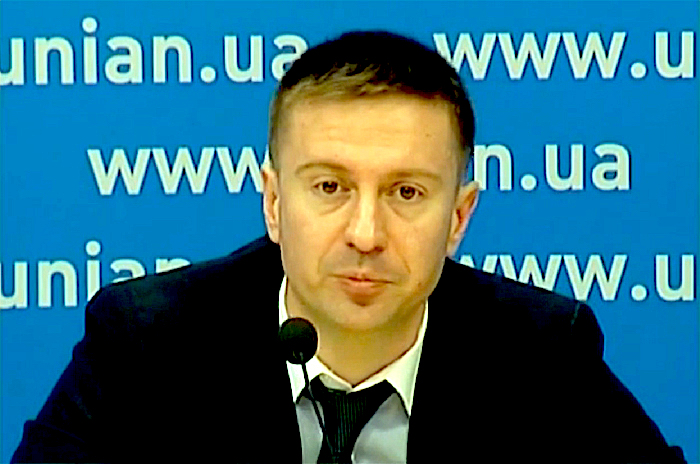
Oleksandr Danylyuk in 2015. (CC BY 3.0, Wikimedia Commons)
Ukraine started the current conflict with an artillery inventory that included 540 122mm self-propelled artillery guns, 200 towed 122mm howitzers, 200 122mm multiple-rocket launch systems, 53 152mm self-propelled guns, 310 towed 152mm howitzers, and 96 203mm self-propelled guns, for approximately 1,200 artillery and 200 MLRS systems.
For the past 100-plus days, Russia has been relentlessly targeting both Ukraine’s artillery pieces and their associated ammunition storage facilities. By June 14, the Russian Ministry of Defense claimed that it had destroyed “521 installation of multiple launch rocket systems” and “1947 field artillery guns and mortars.”
Even if the Russian numbers are inflated (as is usually the case when it comes to wartime battle damage assessments), the bottom line is that Ukraine has suffered significant losses among the very weapons systems — artillery — which are needed most in countering the Russian invasion.
But even if Ukraine’s arsenal of Soviet-era 122mm and 152mm artillery pieces were still combat-worthy, the reality is that, according to Danylyuk, Ukraine has almost completely run out of ammunition for these systems and the stocks of ammunition sourced from the former Soviet-bloc Eastern European countries that used the same family of weapons have been depleted.
Ukraine is left doling out what is left of its former Soviet ammunition while trying to absorb modern Western 155mm artillery systems, such as the Caesar self-propelled gun from France and the U.S.-made M777 howitzer.
But the reduced capability means that Ukraine is only able to fire some 4,000-to-5,000 artillery rounds per day, while Russia responds with more than 50,000. This 10-fold disparity in firepower has proven to be one of the most decisive factors when it comes to the war in Ukraine, enabling Russia to destroy Ukrainian defensive positions with minimal risk to its own ground forces.
Casualties
This has led to a second level of military math imbalances, that being casualties.
Mykhaylo Podolyak, a senior aid to Ukrainian President Volodymyr Zelensky, recently estimated that Ukraine was losing between 100 and 200 soldiers a day on the frontlines with Russia, and another 500 or so wounded. These are unsustainable losses, brought on by the ongoing disparity in combat capability between Russia and Ukraine symbolized, but not limited to, artillery.
In recognition of this reality, NATO Secretary General Jen Stoltenberg announced that Ukraine will more than likely have to make territorial concessions to Russia as part of any potential peace agreement, asking,
“what price are you willing to pay for peace? How much territory, how much independence, how much sovereignty… are you willing to sacrifice for peace?”
Stoltenberg, speaking in Finland, noted that similar territorial concessions made by Finland to the Soviet Union at the end of the Second World War was “one of the reasons Finland was able to come out of the Second World War as an independent sovereign nation.”
To recap — the secretary general of the trans-Atlantic alliance responsible for pushing Ukraine into its current conflict with Russia is now proposing that Ukraine be willing to accept the permanent loss of sovereign territory because NATO miscalculated and Russia —instead of being humiliated on the field of battle and crushed economically — is winning on both fronts.
Decisively.
That the secretary general of NATO would make such an announcement is telling for several reasons.
Stunning Request
First, Ukraine is requesting 1,000 artillery pieces and 300 multiple-launch rocket systems, more than the entire active-duty inventory of the U.S. Army and Marine Corps combined. Ukraine is also requesting 500 main battle tanks — more than the combined inventories of Germany and the United Kingdom.
In short, to keep Ukraine competitive on the battlefield, NATO is being asked to strip its own defenses down to literally zero.
More telling, however, is what the numbers say about NATO’s combat strength versus Russia. If NATO is being asked to empty its armory to keep Ukraine in the game, one must consider the losses suffered by Ukraine up to that point and that Russia appears able to sustain its current level of combat activity indefinitely. That’s right — Russia just destroyed the equivalent of NATO’s main active-duty combat power and hasn’t blinked.
One can only imagine the calculations underway in Brussels as NATO military strategists ponder the fact that their alliance is incapable of defeating Russia in a large-scale European conventional land war.
But there is another conclusion that these numbers reveal — that no matter what the U.S. and NATO do in terms of serving as Ukraine’s arsenal, Russia is going to win the war. The question now is how much time the West can buy Ukraine, and at what cost, in a futile effort to discover Russia’s pain threshold in order to bring the conflict to an end in a manner that reflects anything but the current path toward unconditional surrender.
The only questions that need to be answered in Brussels, apparently, are how long can the West keep the Ukrainian Army in the field, and at what cost? Any rational actor would quickly realize that any answer is an unacceptable answer, given the certainty of a Russian victory, and that the West needs to stop feeding Ukraine’s suicidal fantasy of rearming itself to victory.
Enter The New York Times, stage right. While trying to completely reshape the narrative regarding the fighting in the Donbass after the damning reality check would be a bridge too far for even the creative minds at the Gray Lady — the writing equivalent of trying to put toothpaste back in the tube. But the editors were able to interview a pair of erstwhile “military analysts” who cobbled together a scenario that transformed Ukraine’s battlefield humiliation.
‘Military Analysts’
They described a crafty strategy designed to lure Russia into an urban warfare nightmare where, stripped of its advantages in artillery, it was forced to sacrifice soldiers in an effort to dig the resolute Ukrainian defenders from their hardened positions located amongst the rubble of a “dead” city — Severodonetsk. [Ukraine forces withdrew from the city Friday.]

Gustav Gressel in Berlin in February 2020
According to Gustav Gressel, a former Austrian military officer turned military analyst, “If the Ukrainians succeed in trying to drag them [the Russians] into house-to-house combat, there is a higher chance of inducing casualties on the Russians they cannot afford.”
According to Mykhailo Samus, a former Ukrainian naval officer turned think-tanks analyst, the Ukrainian strategy of dragging Russia into an urban combat nightmare is to buy time for rearming with the heavy weapons provided by the West, to “exhaust, or reduce, the enemy’s [Russia’s] offensive capabilities.”
The Ukrainian operational concepts in play in Severodonetsk, these analysts claim, have their roots in past Russian urban warfare experiences in Aleppo, Syria and Mariupol. What escapes the attention of these so-called military experts, is that both Aleppo and Mariupol were decisive Russian victories; there were no “excessive casualties,” no “strategic defeat.”
Had The New York Times bothered to check the resumes of the “military exerts” it consulted, it would have found two men so deeply entrenched into the Ukrainian propaganda mill as to make their respective opinions all but useless to any journalistic outlet possessing a modicum of impartiality. But this was The New York Times.
Gressel is the source of such wisdom as:
“If we stay tough, if the war ends in defeat for Russia, if the defeat is clear and internally painful, then next time he will think twice about invading a country. That is why Russia must lose this war.”
And:
“We in the West… all of us, must now turn over every stone and see what can be done to make Ukraine win this war.”
Apparently, the Gressel playbook for Ukrainian victory includes fabricating a Ukrainian strategy from whole cloth to influence perceptions regarding the possibility of a Ukrainian military victory.
Samus likewise seeks to transform the narrative of the Ukrainian frontline forces fighting in Severodonetsk. In a recent interview with the Russian-language journal Meduza, Samus declares that:
“Russia has concentrated a lot of forces [in the Donbass]. The Ukrainian armed forces are gradually withdrawing to prevent encirclement. They understand that the capture of Severodonetsk doesn’t change anything for the Russian or the Ukrainian army from a practical point of view. Now, the Russian army is wasting tremendous resources to achieve political objectives and I think they will be very difficult to replenish… [f]or the Ukrainian army, defending Severodonetsk isn’t advantageous. But if they retreat to Lysychansk they’ll be in more favorable tactical conditions. Therefore, the Ukrainian army is gradually withdrawing or leaving Severodonetsk, and upholding the combat mission. The combat mission is to destroy enemy troops and carry out offensive operations.”
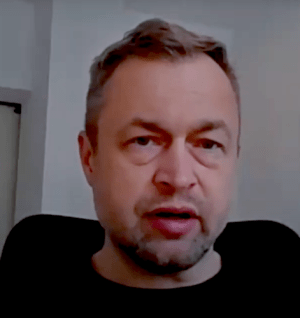
Mykhailo Samus on March 27. (YouTube still)
The truth is, there is nothing deliberate about the Ukrainian defense of Severodonetsk. It is the byproduct of an army in full retreat, desperately trying to claw out some defensive space, only to be crushed by the brutal onslaught of superior Russian artillery-based firepower.
To the extent Ukraine is seeking to delay the Russian advance, it is being done by the full-scale sacrifice of the soldiers at the front, thousands of people thrown into battle with little or no preparation, training, or equipment, trading their lives for time so that Ukrainian negotiators can try to convince NATO countries to mortgage their military viability on the false promise of a Ukrainian military victory.
This is the ugly truth about Ukraine today — the longer the war continues, the more Ukrainians will die, and the weaker NATO will become. If left to people like Samus and Gressel, the result would be hundreds of thousands of dead Ukrainians, the destruction of Ukraine as a viable nation-state, and the gutting of NATO’s front-line combat capability, all sacrificed without meaningfully altering the inevitability of a strategic Russian victory.
Hopefully sanity will prevail, and the West will wean Ukraine off the addiction of heavy weaponry, and push it to accept a peace settlement which, although bitter to the taste, will leave something of Ukraine for future generations to rebuild.
Was the Maidan Massacre a False Flag?
By Noah Carl | The Daily Sceptic | May 30, 2022
To understand the war in Ukraine, you have understand the events that led up to it. And no preceding event is more important than the toppling of Viktor Yanukovych’s government in February of 2014.
Officially known as the ‘Revolution of Dignity’, it was denounced by Vladimir Putin as an “unconstitutional coup”. And while most Western media stick to the official nomenclature, some prominent voices dissent. John Mearsheimer has referred to “the illegal overthrow of Ukraine’s democratically elected and pro-Russian president”, while George Friedman has described what happened as “the most blatant coup in history”.
A recap of the basic facts is in order.
In November of 2013, Yanukovych’s government suspended plans for signing an Association Agreement with the EU, and decided to renew talks with Russia. This decision sparked protests in Ukraine’s capital city, Kiev. By December, the number of protestors had reached the tens of thousands, and a permanent encampment had been established on Maidan square. Although most of the protesters were ordinary Ukrainians, far-right groups were also present.
Beginning in December, there were violent clashes between protesters and the police. On 23rd January, protestors succeeded in occupying various buildings around Maidan square. The situation came to a head on 18–20th February when protestors were fired upon by snipers, leaving scores dead and hundreds wounded. A dozen police offers were also killed in the clashes. From November 2013 to February 2014, 112 protestors and 18 police officers lost their lives; though most of the killings happened on 20th February.
On 21st February, Yanukovych signed an agreement with the parliamentary opposition calling for reforms and new elections. But the next day, he was impeached by the Ukrainian parliament. This impeachment process was in several respects unconstitutional, and Yanukovych declared he was still “the legitimate head of the Ukrainian state elected in a free vote by Ukrainian citizens”. However, he subsequently fled to Russia and a new government was formed.
The ‘Revolution of Dignity’ led immediately to Russia’s annexation of Crimea, and the outbreak of civil war in Donbas – so its geopolitical importance can hardly be overstated. Yet despite huge international attention, one question remains shrouded in mystery: who ordered snipers to fire at protestors on 18–20th February?
The ‘official’ narrative is that the snipers were from the Berkut – a special police unit loyal to Yanukovych. On the other hand, Russia has long maintained they were deployed by the Ukrainian far-right as part of a false flag operation to bring down Yanukovych’s government.
What is true is that more than eight years after the massacre – which took place amid a giant demonstration at the centre of Ukraine’s capital in front of dozens of television cameras – not a single person has been convicted. The perpetrators of one of the deadliest mass shootings in European history remain at large.
Why don’t we have an answer? Well, perhaps we do.
Away from the limelight, one Canadian academic has been poring over the evidence for the last eight years. And he’s convinced the ‘official’ narrative is wrong. Ivan Katchanovski (a political scientist at the University of Ottawa) believes the Maidan massacre was a false flag operation carried out by the Ukrainian far-right.
Professor Katchanovski cannot be dismissed as some fringe commenter or stooge of the Kremlin. He has published his arguments in scholarly books and journals, and has presented them at academic conferences. His latest article, which can be accessed for free, reviews all the evidence he’s collected to date – including witness testimonies, weapon ballistics and medical forensics. It’s based on hundreds of hours of footage of the Maidan massacre trials, as well as synchronised video segments of the massacre itself.
As Katchanovski explains, the ‘false flag theory’ first gained credence in March of 2014, when a phone call between two European officials was leaked online. During the call, the Estonian Foreign Minister Urmas Paet tells the EU’s Catherine Ashton about a conversation he’d had with someone called Olga:
What was quite disturbing, the same Olga told, all the evidence shows that people who were killed by snipers from both sides among policemen and then people from the streets – that they were the same snipers, killing people from both sides. She also showed me some photos. She said that as medical doctor, she can, you know, say that it is the same handwriting, same type of bullets. And it’s really disturbing that now the new coalition, that they don’t want to investigate what exactly happened. So that there is now stronger and stronger understanding that behind snipers it was not Yanukovych but it was somebody from the new coalition.
‘Olga’ was later identified as Olga Bohomolets, a doctor who had treated wounded protestors on Maidan square. When quizzed by the press, she said she had not told Paet that somebody from the new coalition was behind the snipers. Likewise, the Estonian Foreign Ministry said, “We reject the claim that Paet was giving an assessment of the opposition’s involvement in the violence” (though they acknowledged the recording was authentic). It is still unclear why Paet would divulge such shocking revelations if he did not believe they had some basis in fact.
Aside from TV recordings and media reports, much of Katchanovski’s evidence comes from the trials of five Berkut police officers, who were charged with the murder of protestors on 20th February, 2014. Various other state actors, including Yanukovych himself, were also charged, but they were not brought to trial as they had already fled the country. (Recall that none of those put on trial were convicted.)
What, then, is Katchanovski’s evidence?
The majority of wounded protestors who testified at the trail said they were shot by snipers from Maidan-controlled buildings. Remarkably, even many witnesses for the prosecution said this. Their testimony is consistent with video footage of journalists and protestors pointing to snipers in buildings like the Hotel Ukraine, which were under Maidan control at the time.
Police snipers testified that they had been ordered to locate and neutralise snipers firing from Maidan-controlled buildings. And Yanukovych himself, who appeared at the trial via video-link, testified that he had received reports of snipers firing from those buildings.
Several Georgian ex-military personnel who testified at the trail actually confessed they were among the snipers, and had been given orders by specific Maidan leaders to fire upon the protestors. They also testified that they had witnessed other snipers shooting from Maidan-controlled buildings. By contrast, no police officers or other state actors confessed to having fired upon protestors.
In the majority of cases where wounded protestors testified that they had been shot by snipers from police-controlled areas, other evidence contradicted their testimony. For example, synchronized video segments showed the exact times they were hit did not coincide with the exact times police officers were discharging their weapons. Other videos showed that several protesters were killed before police officers had even taken up their positions.
Forensic examinations by government experts revealed that the majority of protestors were shot from the side or back, and from top to bottom, strongly suggesting they had been hit by snipers from Maidan-controlled buildings. Only one protestor had a horizontal entry wound. Experts also determined that several protestors were killed by bullets that did not match those used by the police.
An American architecture company created a 3D model of the killing of three protestors, which was used as evidence that those protestors were in fact killed by the police. (This 3D model was covered in a 2018 New York Times article.) However, the wound locations in the model did not match the wound locations from forensic medical examinations.
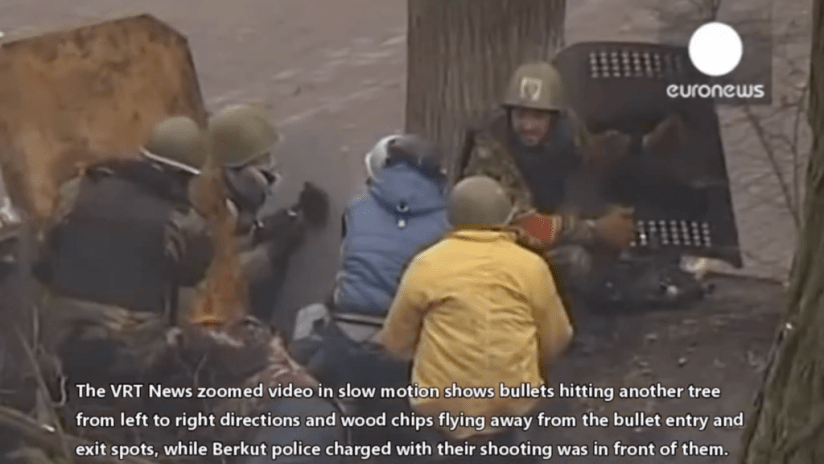
A screenshot from the video appendix to Katchanovski’s latest paper.
Aside from what Katchanovski calls “overwhelming evidence” that protestors were shot from Maidan-controlled buildings, he believes there was a cover-up by the post-Maidan authorities.
On 21st February, the Ukrainian parliament passed an amnesty law granting blanket immunity to Maidan protestors for serious crimes that had taken place during the protests. This law also prohibited investigation of the protestors for such crimes, and ordered that existing evidence be destroyed.
Two of the Berkut police officers who had been charged with murdering protestors were released by trial judges due to lack of evidence, suggesting the charges against them were trumped up. And all remaining defendants were released in a prisoner exchange within several months of the expected verdict.
Public statements made by various Maidan participants concerning the far-right’s involvement in the massacre were never investigated. One politician said she saw Maidan leaders bringing snipers into a building and then saw snipers firing from that building. Several activists said they witnessed snipers being evacuated by Maidan leaders. And another politician said that Maidan leaders had “arranged” the massacre.
There were unexplained reversals of testimony on the part of wounded Maidan protestors. Key pieces of evidence went missing or were destroyed. Several trees with bullet holes in them were cut down; all helmets and shields used by those who were shot disappeared, as did security camera footage from Maidan-controlled buildings.
Finally, two far-right politicians stated in separate interviews that a Western government official told them killings of a few protestors would not be enough for Western governments to stop recognising Yanukovych, and for that to happen the number of victims would need to be 100. The protesters who lost their lives subsequently became known as the “Heavenly Hundred”, even though some of those ‘hundred’ were not killed in the massacre itself (and in fact simply died of illness.)
On the basis of all the evidence he’s gathered, Katchanovski concludes that the Maidan massacre was “a false flag operation” which involved “elements of the Maidan leadership”.
If true, the implications are immense. It would mean the event that marked the turning point of Euromaidan – that set in motion Yanukovych’s removal from power – was in fact orchestrated by his political opponents. And aside from implicating those individuals in a brutal act of mass murder, it would remove any doubt that the that the ‘Revolution of Dignity’ was illegitimate.
Is it true?
I have been unable to track down any serious criticism of Katchanovski’s work, and when I reached out to him, he told me “there is no other scholarly study” that disputes his findings. What’s more, the political scientist Gordon Hahn reached similar conclusions in his book Ukraine Over the Edge: Russia, the West and the “New Cold War”.
So why haven’t Western governments shown more interest in investigating the massacre? I put this question to Katchanovski. He said that such an investigation would be “politically inconvenient” because it would “upend the narrative that the Western backed overthrow of the Ukrainian government in 2014 by the pro-Western Maidan opposition was peaceful and democratic”. He added that a definitive answer could be obtained by consulting relevant documents once they are declassified.
As I mentioned above, Katchanovski has published his arguments concerning the ‘false flag theory’ in scholarly books and journals, and has presented them at academic conferences. All the germane papers are available for free online. You might therefore expect for his work to have received significant media attention – particularly in the last few months.
Yet with the exception of a few ‘non-mainstream’ outlets, it hasn’t. Major Western media have ignored his studies “for political reasons”, he told me. This is despite the fact that Katchanovski’s other work on Ukraine (unrelated to the massacre) has received ample media attention, including from the Associated Press, Reuters and the Washington Post.
Katchanovski knows that certain media outlets are aware of his work because he’s brought it to their attention. Following the New York Times article on the 3D model of killings at Maidan, he sent a letter to the editor pointing out they had “misrepresented the wound locations”. But his letter wasn’t published. In another case, “Open Democracy accepted a popular version of my Maidan massacre study, but then did not publish it.” Katchanovski said he gave “long interviews concerning the Maidan massacre to several major TV and Radio networks” but “none of them were broadcast”. In every single case “there was no reason given”.
The only time Katchanovski’s work on the massacre has been put under the spotlight was in Oliver Stone’s 2019 documentary Revealing Ukraine. This film is available on Rumble, and the relevant segment begins at 20:00.
What about everything that’s happened since? In our email exchange, Katchanovski clarified that the Maidan massacre “does not justify the Russian invasion and other actions in Ukraine”. Equally, however, Russia’s invasion does not justify ignoring – in his words – “overwhelming and undeniable evidence” of Maidan snipers.
If others believe that Katchanovski is mistaken, they must come forward and present their arguments. In the meantime, I would strongly recommend reading his papers: they make a compelling case that what’s been labelled a “conspiracy theory” is, in fact, true.
Climate Colonialists Disrupt African Pipeline, Perpetuate Poverty
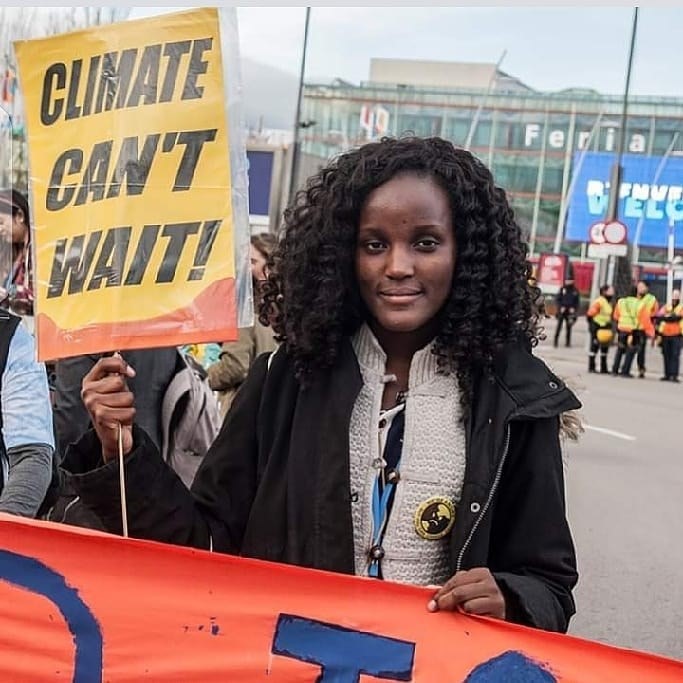
Vanessa Nakate
By Vijay Jayaraj | RealClear Energy | April 28, 2022
Climate activists’ ill-founded opposition to fossil fuels threatens to stop a major pipeline project in East Africa and stymie economic growth in Uganda and Tanzania — home to some of the world’s poorest people.
Uganda is betting big on its fossil fuel reserves. In February, China National Offshore Oil Corporation (CNOOC) and France’s TotalEnergies agreed to invest $10 billion to develop two Ugandan oil reserves. But the landlocked country needs the East African Crude Oil Pipeline project (EACOP) to transport its product to a port in Tanzania.
The 895-mile-long pipeline from Uganda’s Lake Alberta region to the seaport of Tanga will be the longest electrically heated crude oil pipeline in the world and will carry 216,000 barrels per day. The project received a green light for construction after the completion of an Environment and Social Impact Assessment.
The Africa Report says that the investment will be huge: “(A)bout $10 billion will be invested in the sector (oil and gas) before first oil is produced in 2025, mainly on the pipeline, refinery, and infrastructure. The government has been commissioning road construction in the region where oil will be produced, in Buliisa and Hoima districts, and an airport is also being constructed in the region.” The project is expected to generate around 10,000 jobs even after the construction phase.
The Government of Uganda expects massive employment of its citizens during construction: “This will be through direct employment of about 14,000 people by the companies, indirect employment of about 45,000 people by the contractors, and induced employment of about 105,000 people as a result of utilization of other services by the oil and gas sector. Of the direct employment, 57 percent are expected to be Ugandans, which is expected to result in an estimated $48.5 million annual payment to Ugandan employees.”
However, the global war against fossil fuel has now reached Ugandan soil and extremists are determined to stop this lifesaving, economically critical project.
Vanessa Nakate of StopEACOP rants against the pipeline in a recent column in the New York Times, saying the project would bring poverty and destruction to the people of Africa. She also references extreme weather in implying the pipeline will worsen the climate.
During a visit to the ultra-rich Vatican, Vanessa says: “It is evident that there is no future in the fossil fuel industry…. we know the impacts on our food. We know the impacts on our water. We know the impacts on our livelihood…… the climate crisis is already affecting so many people not only in Uganda, but the African continent.”
But her reasons for opposing the pipeline are scientifically inaccurate and logically senseless.
She points to a forecast by the Intergovernmental Panel on Climate Change (IPCC) that predicts African droughts. But IPCC, by its own admission, has indicated that extreme weather events have no significant correlation with rising global average temperatures. Neither has there been any significant increase in the frequency of extreme cyclones, droughts, rainfall, and fires. Even if droughts and cyclones were to increase, a better socio-economic condition would enable people to adapt more effectively.
Contrary to Vanessa’s hyperbole, the world is experiencing near optimum temperatures for global food production and the advancement of human society, much as it did 1,000 years ago during the Medieval Warm Period and 2,000 years ago during the Roman Warm Period. Globally, we now have better access to clean water, better access to nutritious food, people with higher income, and a very rapid increase in life expectancy rates. How are we in a crisis if climate is aiding the improvement of every metric used to measure the quality of people’s lives?
It is shocking how Vanessa ignores the plight of millions of her own people dwelling in persistent poverty and in need of affordable, dependable energy sources like coal, oil, and gas. It is less shocking if we understand the DNA of climate extremists, which has them deny the reality of energy needs and promote unreliable, primitive, and expensive wind turbines that even economic giants like Germany and the U.S. hesitate to adopt completely.
Climate extremists like Vanessa are fostering the continuation of abject poverty in Africa — a continent with the lowest level of electrification and highest rates of poverty in the world. Vanessa claims that the pipeline is another colonial project subjecting Africans to slavery. But, it is Vanessa and her ilk who are the colonialists and would-be slave masters.
Vijay Jayaraj is a Research Associate at the CO2 Coalition, Arlington, Va., and holds a Master’s degree in environmental sciences from the University of East Anglia, England. He resides in Bengaluru, India.
US bragging about its direct involvement in Ukraine may lead to uncontrollable escalation
By Drago Bosnic | May 6, 2022
On May 4, the New York Times published a highly controversial article openly bragging about how the United States has been providing critical intelligence about the location and movement of Russian troops, which has allowed Ukrainians to target them. The publication also claims that “many Russian generals have died in action in the Ukraine as a result,” citing senior US officials. However, this is hardly news, since the US and NATO have been doing it since day one of the special military operation in Ukraine. The Russian military has been warning the political West about this issue. And yet, the US and NATO aren’t only ignoring the warnings, but are also openly bragging about their actions which are contributing to the death of Russian military personnel in Ukraine as we speak.
The claim that “many Russian generals have died” is questionable at best, but it does show the US and NATO’s determination, whose involvement is key to prolonging the conflict. An epidemic of fake news about alleged injuries or even murder of Russian High Command officers has become the mainstay, even among the once-respected Western media. According to these news outlets, Russian Defense Minister Sergei Shoigu has so far survived at least two heart attacks “due to bad performance and high casualties of the Russian military” and even “Putin’s order to shoot the Defense Minister for his failures in Ukraine”.
These claims are not just outright lies, but simply ridiculous. However, they expose the mainstream media in the US and other NATO countries as an inalienable part of the military and (geo)political structure. Their reporting is designed not just to demoralize the opponent, but also to boost public morale, galvanize it and push for more support for a potential war with the targeted country or even a group of countries. This is exacerbating the already high tensions between the political West on one side and Russia and its allies on the other.
When the special military operation started, the US and NATO at least claimed their non-involvement, even though everyone knew they were involved. But the very statement they weren’t sent a message that NATO will not escalate tensions. However, this report has now changed that. By admitting effectively direct involvement in the conflict, the US and NATO are opening the door for further escalation, which most certainly will not be appreciated by Russia, whose leadership has already given strong statements regarding this issue.
The intelligence sharing is part of “a stepped-up flow” in US assistance that includes heavier weapons and billions in military supplies, demonstrating how quickly the “early American restraint” on support for Ukraine has shifted as the war enters a new stage, the NYT reported. This is further proof that the US is not interested in de-escalation. On the contrary, the latest “lethal aid” package President Biden announced is said to be $33 billion, a truly staggering sum, orders of magnitude greater than Ukraine’s annual military budget.
“The administration has sought to keep much of the battlefield intelligence secret, out of fear it will be seen as an escalation and provoke President Vladimir V. Putin of Russia into a wider war. American officials would not describe how they have acquired information on Russian troop headquarters, for fear of endangering their methods of collection. But throughout the war, the U.S. intelligence agencies have used a variety of sources, including classified and commercial satellites, to trace Russian troop movements,” the NYT report added.
This statement alone should trigger alarm across the globe. The admission that the US military and intelligence services are using commercial satellites in their operations sets a dangerous precedent which further blurs the line between civilians and the military. This comes at a time when companies such as SpaceX are accused of using their products and services, most notably the Starlink satellites, to help the Ukrainian military target Russian and DLNR units. It’s clear the US is mobilizing all of its assets in an attempt to weaken Russia. In fact, this is exactly what US Defense Secretary Lloyd Austin openly stated. He went so far as to say that “we want to see Russia weakened to the degree it cannot do the kinds of things that it has done in invading Ukraine.”
However, there are still moments when the Pentagon and State Department are giving vague and even contradictory statements regarding this issue. When asked about the intelligence being provided to the Ukrainian side, Pentagon spokesman John Kirby said that “we will not speak to the details of that information.” But he acknowledged that the US provides Ukraine with intelligence information. After the NYT article was published, Adrienne Watson, a National Security Council spokeswoman, said that the battlefield intelligence was not provided to the Ukrainians “with the intent to kill Russian generals.”
“Not all the strikes have been carried out with American intelligence. A strike over the weekend at a location in eastern Ukraine where Gen. Valery Gerasimov, Russia’s highest-ranking uniformed officer, had visited was not aided by American intelligence, according to multiple U.S. officials. The United States prohibits itself from providing intelligence about the most senior Russian leaders,” the official said.
This statement clearly refers to the reports that the Chief of Russian General Staff, General Gerasimov was allegedly wounded in a Ukrainian strike during a visit to the frontline units. Again, this shows an almost schizophrenic nature of statements coming from US officials. First, they are bragging about the “decisive role” of their intelligence support to Ukrainians, but as soon as reports of Russian High Command officers being injured surface, they are quick to announce how this support might not be “as decisive as previously thought”.
This just goes to show how dangerous US involvement in Ukraine is. Even though we know the statements about Gerasimov are false, an obvious question arises, what if it were to happen? What if he or any other Russian High Command officer were injured in Ukraine? Does the US truly believe they could just say “it wasn’t our intelligence” in an attempt to control the level of escalation which could plunge all of us into a world-ending conflict?
Drago Bosnic is an independent geopolitical and military analyst.
PBS agitates to have Tucker Carlson taken off the air
By Russell Cook | American Thinker | May 4, 2022
The taxpayer-funded national network PBS is pushing for less viewpoint diversity, no doubt intended to accelerate the growing push for Tucker and Fox News to be taken off the air. From the PBS Newshour, May 2, 2022: “Tucker Carlson’s influence and his increasingly extreme views” (Amna Nawaz interviews New York Times’ Nick Confessore, who wrote the 4/30 “How Tucker Carlson Stoked White Fear to Conquer Cable“).
Excerpts (emphases added):
Nick Confessore: … He’s the highest rated cable show host in history. And it’s also the most racist show in history. … Every night, that show teaches fear and loathing. He may claim to be a person who opposes racism and prejudice, but what the show tells you every night is to be afraid, to be afraid of people who are in the street asking for police officers to not shoot Black people, be afraid of Afghan refugees who helped us in the war who are coming over here now, to be afraid of Dr. Fauci, and to be afraid of immigration in general, which he posits is part of a cabal, a plot to destroy Western civilization … it’s not just the anti-white racism kind of rhetoric on the show. He’s literally taking ideas that began on the very far right, on arcane corners of the Internet, on neo-Nazi sites …
… Amna Nawaz: Nick, he’s also aggressively defended January 6 insurrectionists and played down how violent that day actually was. … he’s very much in line with the Republican Party and their message. What did your reporting find about that relationship between the GOP and Tucker Carlson?
Nick Confessore: Look, I would say he is the high priest of Trumpism.
“Amy Walter and Annie Linskey on primary election season, Tucker Carlson’s role in the GOP”
Excerpts:
Judy Woodruff: … Amy, let’s start with what we just heard Amna talking to Nick Confessore about … Clarify for us, what is Tucker Carlson’s role in the Republican Party, in American politics?
Amy Walter: … Nick Confessore put it really well when he said that he’s filling the void that had been left by Donald Trump‘s voice being off of social media … He’s also being talked about as a potential 2024 candidate for president. And that’s not idle discussion. I think his name will be very seriously floated, and we may see more to come of a Tucker Carlson trial balloon in 2024.
… Judy Woodruff: And, Annie, what — the darker side of this, which we heard in that conversation, about race… and about the role of the threat that many white Americans feel, what does that say about our politics right now?
Annie Linskey: … I think that was one of the most stunning takeaways, for me at least, from the New York Times reporting, which was just so incredible, is just the extent to which they really documented the ways in which Carlson is normalizing discussions of race that I think would not be considered — are not considered appropriate in many parts of the country. … But Carlson’s show is moving through the window to where they’re becoming more appropriate. And I think that’s what many groups on the left worry about. And I think that is what The Times is reporting is kind of showing us, really the danger that Tucker Carlson and his show presents, is making it more OK to have those kinds of grievances voiced out loud…
According to the PBS NewsHour and the NYT, neither of which seems to have people who’ve watched Tucker’s show at any depth, Tucker espouses Bull Connor–style racism and enables people like you and me to freely advocate talk that escalates toward genocide. His show should therefore be silenced, he should be jailed for insurrectionist incitement before he announces his presidential run, and you and I need to be leery of saying anything against… well, anything. Obey.
Selling Albright as a ‘Feminist Icon’: Was the Price Worth It?
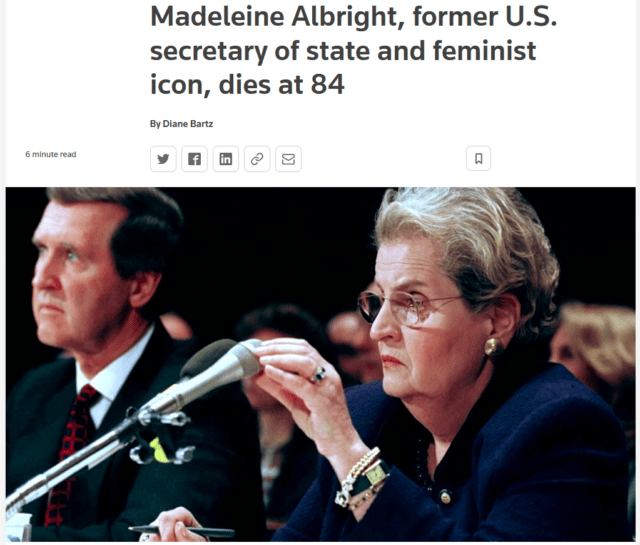
BY BRYCE GREENE | FAIR | APRIL 13, 2022
When Clinton-era Secretary of State Madeleine Albright died of cancer last month, a stream of fawning obituaries hailed her as a hero of NATO, a feminist icon and a “champion of human rights and diplomacy” (CNN, 3/24/22).
Most coverage failed to levy any criticism at all of Albright’s actions in government, despite her presiding over a critical turning point in the American Empire. For the foreign policy establishment, the ’90s under Albright solidified the US self-image as the “indispensable nation,” ready and able to impose its will on the world, a position with repercussions that still echo today. Instead of critically exploring this legacy, corporate media opted for celebration and mythmaking.
‘Icon’ and ‘trailblazer’
Some of the coverage focused on Albright as a “feminist icon” (Reuters, 3/23/22; USA Today, 3/23/22) breaking the glass ceiling. A commonly used term was “trailblazer” (e.g., NPR, 3/24/22; Washington Post, 3/23/22).
The New Yorker (3/24/22) declared, “Madeleine Albright Was the First ‘Most Powerful Woman’ in US History.” CNN (3/24/22) went as far as to call Albright an early progenitor of “feminist foreign policy.”
NPR (3/24/22) claimed that Albright “left a rich legacy for other women in public service to follow.” BuzzFeed (3/23/22) found time to discuss the meaning of the jewelry she wore when meeting foreign leaders.
There is nothing wrong with remarking on the significance of a woman taking charge in the historically male-dominated halls of US power. However, it is far more important to take a critical look at her policies, including whether they jibe with the tenets of feminism as generally understood—something few in the media chose to do.
Media fell into this same trap when praising Gina Haspel as the first female head of the CIA, or when they applauded the top military contractors for having female heads (FAIR.org, 6/28/20). Similarly, Albright’s violent legacy is being obscured by seemingly progressive language.
‘More children than died in Hiroshima’

Madeleine Albright telling 60 Minutes (5/12/96) that half a million dead children is a price worth paying.
One of the first things many progressives think of when they think of Albright is her championing of the sanctions against Iraq during the ’90s. In between the two US wars on Iraq, Albright presided over crushing sanctions aimed at turning the Iraqi population against the Ba’athist government. These sanctions cut off crucial supplies to the nation, starving its people. A UN survey found that the sanctions led to hundreds of thousands of dead Iraqi children.
When Albright was confronted with this figure in an interview with CBS‘s Leslie Stahl on 60 Minutes (5/12/96; Extra!, 11–12/01), Albright’s response was cold:
“We have heard that half a million children have died. I mean, that is more children than died in Hiroshima,” Stahl said. “And, you know, is the price worth it?”
“I think that is a very hard choice, but the price, we think, the price is worth it.”
The UN numbers have since been revised downward, but the unavoidable fact is that Albright accepted the number she was given, took willful responsibility for the deaths and concluded that they were “worth it” for the purpose of turning the Iraqi people against their government.
While so many Americans seem to have forgotten this shameful display, the rest of the world has not. Ahmed Twaij, an Iraqi writing in Al Jazeera (3/27/22), said that his “most prominent memory of Albright” was that notorious interview:
As an Iraqi, the memory of Albright will forever be tainted by the stringent sanctions she helped place on my country at a time when it was already devastated by years of war.
Despite its resonance around the world, the quote wasn’t even referenced in many of the retrospectives FAIR reviewed. USA Today (3/23/22) mentioned that Albright received “criticism” for calling the deaths “worth it,” and Newsweek (3/23/22, 3/25/22, 3/23/22) mentioned the quote in some of its coverage. But it went missing from the New York Times (3/23/22, 3/25/22), Washington Post (3/23/22), NBC.com (3/23/22), CNN.com (3/24/22, 3/26/22), New Yorker (3/24/22) and The Hill (3/24/22).
Guaranteed shootdown
Gen. Hugh Shelton, former chair of the Joint Chiefs of Staff, recounts in his book how Albright suggested to him that the US fly a plane over Iraqi airspace low enough to be shot down, thus giving the US an excuse to attack Saddam Hussein. Shelton recalls Albright’s words:
What we really need in order to go in and take out Saddam is a precipitous event—something that would make us look good in the eyes of the world. Could you have one of our U-2s fly low enough—and slow enough—so as to guarantee that Saddam could shoot it down?
Albright was quickly rebuffed, but she was later able to get her wish of war in Iraq. Her efforts culminated in the Iraq Liberation Act, signed in October 1998, which made seeking regime change in Iraq official US policy.
As the New York Times (3/23/22) mentioned in its obituary, Albright threatened the Ba’athist leader with bombing that year if he didn’t open the country to weapons inspectors. Even though Kofi Annan brokered an agreement on the inspectors, the US bombed anyway in December 1998.
The Times didn’t explore these events further—not mentioning that the administration justified the bombing using the debunked pretext of Saddam’s weapons of mass destruction—and instead continued ahead with its largely positive obituary.
Rewriting Yugoslav history
One of Albright’s most notable moments during her tenure as secretary of state was the 78-day bombing campaign in Yugoslavia in 1999. Today, the bombing is hailed as a major victory by the forces of democracy, and Albright’s role is cast in a positive light.
NPR’s three sentences (3/24/22) on the subject show the dominant version of the events:
As chief diplomat in the late ’90s, Albright confronted the deadly targeting of ethnic Albanians in Kosovo. Time magazine dubbed it Madeleine’s War. Airstrikes in 1999 eventually led to the withdrawal of Yugoslav forces.
Americans were told at the time that the war solidified the US as “an indispensable nation asserting its morality as well as its interests to assure stability, stop thugs and prevent human atrocities” (Time, 5/9/99). The Washington Post (3/23/22) seized on this myth, calling Albright “an ardent and effective advocate against mass atrocities.” In this story, she is a hero for mobilizing the timid American giant to use its military might on behalf of humanitarian and democratic ideals.
But the truth is that the bombing Albright advocated was motivated less by humanitarian concerns and more by the US goal of breaking up Yugoslavia and establishing a NATO-friendly client state via the Kosovo Liberation Army. Indeed, the US’s negotiating tactic with Serbian President Slobodan Milosevic was to offer the choice of either occupation by NATO or destruction. As a member of Albright’s negotiating team anonymously told reporters (Extra!, 7–8/99): “We intentionally set the bar too high for the Serbs to comply. They need some bombing, and that’s what they are going to get.”
Exacerbating bloodshed
One fact that quickly debunks the humanitarian pretext is that the US-led bombing greatly exacerbated the bloodshed. According to Foreign Affairs (9–10/99), 2,500 died during the preceding civil war, but “during the 11 weeks of bombardment, an estimated 10,000 people died violently in the province.” And while Albanian civilians bore the brunt of the violence during the NATO attacks, in the year preceding the bombing, British Defense Secretary George Robertson told the Parliament that the NATO-backed KLA “were responsible for more deaths in Kosovo than the Yugoslav authorities had been” (Monthly Review, 10/07).
As Edward Herman and David Peterson wrote in their detailed essay on Yugoslavia in the Monthly Review (10/07), the US and NATO were
key external factors in the initiation of ethnic cleansing, in keeping it going, and in working toward a violent resolution of the conflicts that would keep the United States and NATO relevant in Europe, and secure NATO’s dominant position in the Balkans.
The concern for ethnic minorities was merely a pretext offered to the American people, and lapped up wholeheartedly by a compliant mass media.
Along with liberal hawks like Samantha Power, Albright helped weaponize human rights and legitimize unsanctioned “humanitarian interventions” around the world. This showcase of unilateral and illegal violence has had direct repercussions around the world, paving the way for US interventions in Afghanistan, Iraq and Libya—to say nothing of the current Russian attack on Ukraine.
Promoting hawkish policy
Much of the coverage framed Albright’s Clinton-era career arc as one in which she repeatedly failed to get the US to play a larger role in advancing its ideals in the post-Cold War world. This fight included taking on international institutions that didn’t understand American exceptionalism.
Albright clashed with then–UN Secretary General Boutros Boutros-Ghali “as she advocated fiercely for US and democratic interests,” in the words of CBS (3/23/22). She and Boutros-Ghali butted heads over the US role in peacekeeping operations during crises in Rwanda, Somalia and Bosnia.
In the end, Albright dissented against the entire UN Security Council, using the US veto power to deny Boutros-Ghali a second term as secretary general. His ouster paved the way for the more US-friendly Kofi Annan, as the “Albright Doctrine” took center stage.
In its cover story on “Albright’s War,” Time (5/9/99) described the Albright doctrine as
a tough-talking, semimuscular interventionism that believes in using force—including limited force such as calibrated air power, if nothing heartier is possible—to back up a mix of strategic and moral objectives.
In other words, Albright advocated a policy of unilateral intervention instead of a global order based on international law and mutual obligations. The US could assert itself whenever and wherever it determined the “strategic and moral objectives” were of sufficient importance.
The diplomat was more blunt about the US chauvinism imbued in the doctrine when she spoke to NBC (2/19/98) in 1998:
If we have to use force, it is because we are America; we are the indispensable nation. We stand tall and we see further than other countries into the future.

A CNN op-ed (3/24/22) positively cited Albright’s comment to Colin Powell: “What’s the point of having this superb military you’re always talking about if we can’t use it?”
The media reflect positively on this mindset that “blended her profound moral values from her childhood experience in Europe with US strategic interests,” according to the New Yorker (3/24/22). Some suggested that this mindset should continue to animate American policy.
‘Albright was right’
CNN.com (3/24/22) published an opinion by Elmira Bayrasli that claimed, “The West would be wise to heed Madeleine Albright’s lessons on foreign policy.” She embraced Albright’s hawkish label, saying that “advocating the oppressed and actively upholding human rights… sometimes meant using the might of the American military.”
Hillary Clinton, whose “trailblazing” also obscured the deadly cost of her foreign policy initiatives, published a guest essay in the New York Times (3/25/22) under the headline “Madeleine Albright Warned Us, and She Was Right.” To Clinton, the world still needs Albright’s “clear-eyed view of a dangerous world, and her unstinting faith in… the unique power of the American idea.”
While some pieces were clear in calling her a hawk (e.g., Washington Post, 3/23/22), CNN (3/24/22) wrote, “It is a mistake to see Albright exclusively as a hawk,” because she sat on the board of the National Democratic Institute (NDI) and supported the activities of the US Agency for International Development (USAID). The Hill (3/24/22) also highlighted her support for these organizations, noting that for Albright, “democracy and human rights… were integral to American foreign policy.”
The NDI exists under the umbrella of the National Endowment for Democracy, a deceptively named organization that spends tens of millions of dollars annually promoting and installing US-friendly governments around the world. USAID has long been used as a front for intelligence and soft power initiatives. During Albright’s time in office, USAID was heavily involved in facilitating the further destruction of Haitian democracy, among a myriad of similar activities around the world.
These organizations have been well-documented as extensions of US power and bases for subversive activities, but this history is dismissed in favor of the government’s line that they are genuine conduits for democracy. The methods of empire have evolved, but the Albright coverage continues to obscure this fact. Regime change efforts can be recast as efforts to spread democracy around the world if the press refuses to scrutinize the official line.
NATO expansion
NATO expansion, a major initiative during Albright’s tenure, has come to the forefront of US discussion in recent months. The Russian invasion of Ukraine is in part a result of the decades-long expansion of the NATO military alliance, despite the warnings of US foreign policy veterans that the expansion was a “policy error of historic proportions.” (See FAIR.org, 3/4/22.)
In 1998, legendary diplomat George Kennan (New York Times, 5/2/98) called NATO expansion “a tragic mistake.” He predicted, “I think the Russians will gradually react quite adversely and it will affect their policies… and then [the NATO expanders] will say that we always told you that is how the Russians are.”
Kennan’s words have proven prophetic, but most articles on Albright’s passing wrote fondly of her role in NATO expansion and the accompanying anti-Russian politics. CNN.com (3/23/22), in an article headlined “Albright Predicted Putin’s Strategic Disaster in Ukraine,” declared that the former top diplomat “died just as the murderous historic forces that she had spent her career trying to quell are raging in Europe again.”
MSNBC.com (3/24/22) declared that “Madeleine Albright’s NATO Expansion Helped Keep Russia in Check.” Columnist Noah Rothman explained that “only the compelling deterrent power of counterforce stays the hand of land-hungry despots.”
The New Yorker (3/24/22) described NATO expansion as one of Albright’s “major achievements,” despite acknowledging that in the wake of the policy, “US interests are indeed threatened more than at any time in three decades by Russian aggression in Europe.”
Some pieces were more reflective. The Conversation (3/24/22) went into detail on her role in expanding NATO, acknowledging that “Albright’s curt dismissal of Russia’s security concerns might seem to have been ill-judged… in light of Russia’s invasion of Ukraine.”
A time for reflection
In the United States, political figures are merged with the culture of celebrity. Too many judge politicos by their force of personality or lines on their resume, rather than the material changes that occurred on their watch. The substantive history of US policymaking is rarely brought up, and political discussion remains surface-level and incomplete.
This celebrity culture is on full display whenever a venerated member of the Washington establishment passes away. We’ve seen similar soft media coverage after the deaths of George H.W. Bush (FAIR.org, 12/7/18), Colin Powell (FAIR.org, 10/28/21) and Donald Rumsfeld (FAIR.org, 7/2/21).
By now, the idea of the United States as the global policeman has been discredited enough to warrant at least some pushback in the corporate press. The passing of one of America’s leading interventionists should be a time for reflection. How did this person’s policies contribute to what is going on now?
Instead, the media decided to use Albright’s death to reinforce the myths and legitimize the policies that have led to so much destruction around the world.
Rallying Round the False Flags
By Finian Cunningham | Strategic Culture Foundation | April 12, 2022
Another day, another provocation, and Western leaders are frothing at the mouth with denunciations of Russian “barbarity”. U.S. President Joe Biden signs off on more weapons to Ukraine while European counterparts slap more economic warfare sanctions on Russia.
Just when the Western media had saturated “reports” of Russian troops executing civilians and leaving their bodies to rot on the streets of Bucha, then we read of more horror from accusations that Russian forces fired a missile at a train station in Kramatorsk killing over 50 people, including women and children.
Last week the Western media were telling us about Russian forces bombing a theatre in Mariupol and killing people sheltering in the basement. The week before it was an alleged Russian airstrike on a maternity hospital in the same city.
The onslaught of the reports of these alleged atrocities is itself telling. There is hardly any time for the Western public to think critically about the reports and whether they are credible. We are being bombarded with sensation and disgust and forced to rally around the flag of supposed Western values such as democracy and morality. That means sending more weapons to Ukraine to “defend” that country from Russian “barbarity”.
Let’s take the latest incident in Kramatorsk on April 8. The New York Times and other Western media reported that a Russian missile hit a train station and killed at least 50 people who were trying to evacuate the city. The impression conveyed in the reporting is that civilians are fleeing as Russian troops advance on more of the Donbass territory.
Russia denied that its forces fired on Kramatorsk. It described the incident as a provocation, or what others would call a false flag operation. The Russians said the missile was fired by the NATO-backed Ukrainian military some 45 kilometres from Kramatorsk.
So, who’s right?
One important fact that all media reported, including the New York Times, is that the explosion was caused by a Tockha-U short-range ballistic missile. Fragments of the munition were identified and photographed near the scene of carnage at the train station.
The Soviet-era weapon is no longer used by the Russian military as of 2019. It is, however, widely used by the Ukrainian military.
Indeed, the Ukrainian military has been firing Tockha-U missiles into the pro-Russian Donbass territory for years, killing civilians indiscriminately. Last month, a missile killed over 20 people when it struck Donetsk city.
Western media have not been reporting that. They have hardly reported that the NATO-backed Kiev Ukrainian forces have been waging a war on the pro-Russian people of Donbass for eight years since the CIA-sponsored coup in Kiev in 2014. The Western media don’t tell you that the NATO bloc has been weaponizing and training Ukrainian regiments like the Azov Battalion that are infested with Nazi supporters who view the killing of Russians as a noble mission. The Western media don’t tell you why Russia views Ukraine and its NATO ambitions as a national security threat and that Moscow went into Ukraine on February 24 because of mounting attacks on civilians in the Donbass.
The Kramatorsk “crime against humanity” that Biden, Johnson, Macron and Von Der Leyen have been denouncing as “cynical” and “abominable” was in all probability carried out by the Ukrainian military that the United States, NATO and the European Union are supporting and sending weapons to.
The same goes for the reported killings in Bucha. Western media and leaders have roundly condemned Russia for allegedly carrying out the atrocity. The Western media have relied totally on Ukrainian claims concerning Bucha, as they have for Kramatorsk and other alleged atrocities.
But if you can withstand the hype and hyperbole, the shock and awe of the media blitz, the claims don’t stand up to scrutiny. The alleged Bucha atrocity came to light in Western media four days after Russian troops withdrew from that city on March 30, and the freshly dead corpses on the streets were filmed by the Ukrainian military. The alleged Russian atrocity has been convincingly debunked, just as Moscow has been saying, blaming it on a provocation.
The earlier bombing of the maternity hospital and the theater in Mariupol were also false-flag attacks carried out by the NATO-backed Ukrainian military. So too was the alleged killing of dozens of Ukrainian soldiers on Snake Island. Remember how Western media reported Ukrainian defenders on the island radioing the Russian forces to “go fuck themselves” before they were blasted to death. Turns out the Russians safely evacuated the surrendering Ukrainians under normal laws of war having afforded them safe passage from the island.
The Western media are playing the public like an organ-grinder. The U.S. media have even admitted to spinning false information in the cause of an “information war” against Russia.
And so we see people like Pope Francis kissing the flag and praying for Ukraine and condemning Russia, we see Biden and European leaders calling for war crimes prosecution of Russian President Vladimir Putin and ordering up more weapons to Ukraine. We see American actors like Sean Penn going into hysterics threatening to “melt down” his Academy Awards in protest over Russian barbarity. Maybe Sean’s next project will be starring in a movie about fighting to the death to defend Snake Island!
Ukrainian comedian-actor-president Vladimir Zelensky (a Jewish frontman for a Nazi regime) said of the Kramatorsk atrocity – and it was an atrocity, but one carried out by his military: “Lacking the strength and the courage to stand up to us on the battlefield, they [Russia] are cynically destroying the civilian population. This evil knows no limits. And if it is not punished it will never stop.”
Cue the anguished tears, condemnations, and billions of dollars/euros of taxpayer-funded aid and lethal weapons to the Ukrainian regime – because we are all supposed to rally around the flag of Western democratic and moral virtue. Even that latter claim is one big false flag.
MSM’s Bucha Tall Tale
BY NICK GRIFFIN | SAMIZDAT | APRIL 5, 2022
“The Bucha Massacre” has now become the driving force for the propaganda push for even more NATO involvement in the conflict in Ukraine.
Yet the claim that this is a Russian war crime is so patently false that a rational observer can only be left astounded by the combination of bare-faced nerve and slapdash incompetence displayed by the media outlets and politicians pushing this disgusting smear.
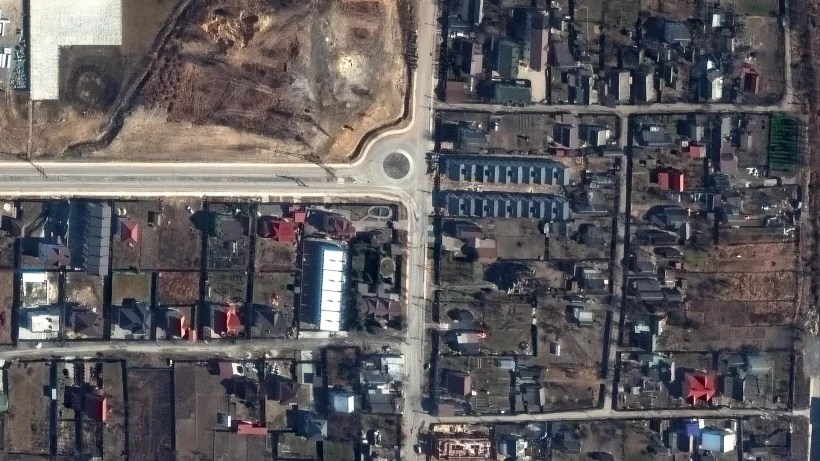
The latest effort of the Western media to deny Russian rebuttals is the claim that satellite photos show the bodies were there for weeks. Far from ‘proving’ the case against Russian troops, however, this new assertion in fact raises yet more questions which undermine the Western story.
The satellite photos certainly appear to show bodies, but they also show no sign at all of the burnt out cars which are such a prominent feature of the ground photos and videos. Are we supposed to believe that these vehicles were carefully driven in and positioned between the corpses after the shooting spree?
A similar suspension of belief is required when considering the dates involved. The ‘Bucha Massacre’ entry in Wiki (accessed 09.25 on 5th April 2022) reads as follows:
‘On 4 April, satellite images were provided to The New York Times by Maxar Technologies. The Times compared images to video evidence and concluded: “many of the civilians were killed more than three weeks ago, when Russia’s military was in control of the town.” The images of Yablonska Street show at least 11 “dark objects of similar size to a human body” appearing between 9 March and 11 March”.’
Wiki also tells us that Ukrainian troops re-entered Bucha on April 1st, following the redeployment of the Russian force to south eastern Ukraine.
Maxar Technologies, as a major contractor for NASA, is of course an integral part of the NATO military-industrial complex. As such its assertions with regards to the conduct of the conflict in Ukraine have to be regarded with caution. That said, Maxar’s dates of 9th– 11th March seem to be causing some concern in mainstream media outlets promoting the Russian massacre claim.
The Maxar dates should indeed raise eyebrows. The idea that bodies could lie in the open air for three whole weeks without undergoing massive decay is only remotely credible because the average Westerner thinks that Ukraine is in some kind of winter weather deep-freeze in late March.
Yet a look at the weather data for Kiev for March 2022 reveals that there has not been one single day in the city (of which Bucha is a suburb) with temperatures below freezing since March 11th. The average daily temperature in the last few days of the month was 6 degrees centigrade – the same as the English city of Leeds. That average in turn of course includes highs in the spring sunshine. The weather graph for Kiev for the last week in March shows the situation very clearly, with temperatures up to 15 and 17 degrees:

March weather in Kiev
Anyone who has walked past an animal killed and left on the road for a few days under such conditions will be able to imagine the appalling stench which would come from so many human bodies left in the spring sunshine for three weeks, yet not one of the Ukrainian soldiers or police shown examine the bodies can be seen wearing a mask, making any expression of revulsion or mentioning the smell.
As more graphic images have emerged of the victims, the evident freshness of the corpses seems to have prompted a revision of the dates of the alleged ‘Russian massacre’. By 5th April, for example, the UK Daily Mail’s lead story was claiming that the satellite photos showing the bodies on the road were taken on 19th March. No explanation was given for the ten-day change.
But even accepting the revised time-line, there is still the problem that none of the bodies shown in videos or photos has any sign of decay or damage from carrion-eaters. In order to believe the accounts and videos put out by Kiev and the Western media, it is also necessary to believe that Ukraine has no stray dogs, no rats and not one single crow or other carnivorous bird.
Look again at the video footage of the Ukrainian troops driving along the corpse-lined road. Do you see any carrion-eating birds flying up from any of the bodies?
For that matter, why were some of the bodies not crushed by the Russian tanks which withdrew from and through the town? Do you really believe that soldiers brutal enough to slaughter dozens of defenceless civilians would then be considerate enough to slow down their withdrawal from the area by carefully weaving their heavy armour around each corpse?
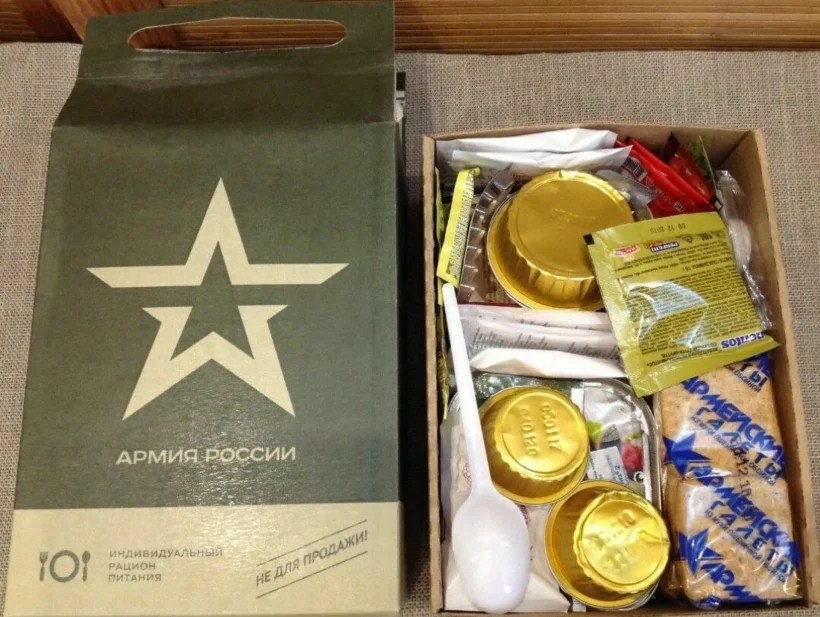
Returning to the weather, there was of course rain during the three weeks the bodies are supposed to have laid (not) rotting in the road. Looking at the cardboard of the green boxes of the food aid packages lying near some of the (clearly fresh) corpses, it is clear that they have not been subjected to bad weather. The presence of those packages is also, of course, another important pointer as to the truth in this matter – for they are Russian.
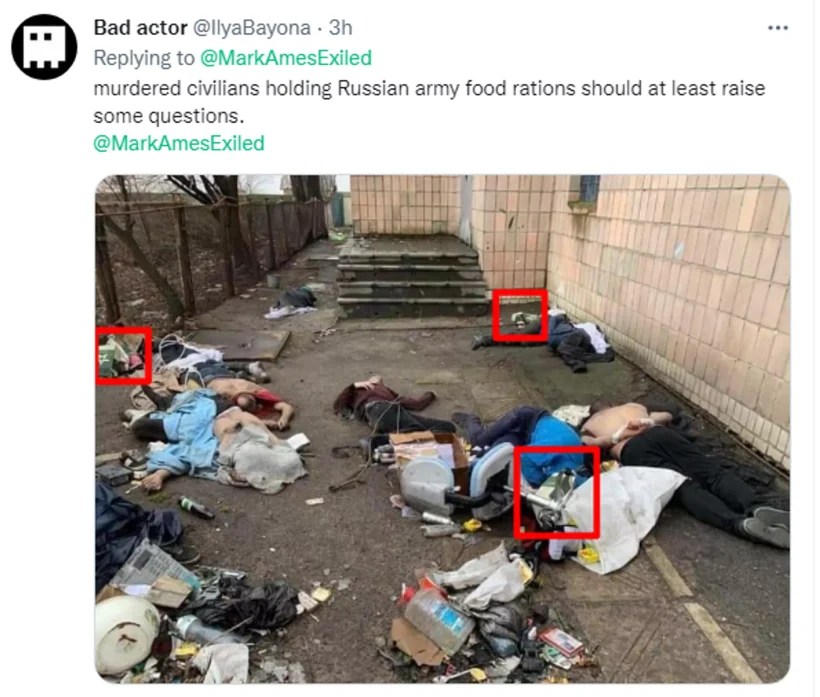
Thus, in order to believe the Western propaganda narrative, we must swallow yet another ridiculous tall tale: The ‘analysts’ have spent the last month repeatedly telling us that the Russian army cannot even supply its own troops with fuel or food; but now they would have us believe that the Russians went to all the trouble of taking vast quantities of emergency food parcels to the occupied suburbs of Kiev, handed them out to civilians – and then promptly shot them.
On top of all this, there are four key facts which have already received considerable attention on Telegram (the last uncensored social media platform of any size in the West), though which have predictably enough been routinely ignored by the warmongering mainstream media.
The first of these is the video of the Mayor of Bucha speaking about how the Russian troops have left and that a ‘clean-up’ is now underway. As a non-Russian speaker I cannot judge for myself, but the comments by Russian-speakers accompanying this video on Telegram say that he does not mention the bodies of civilians.
The second fact, closely related to this, is the video which shows a detachment of the paramilitary Ukrainian National Police clearing the roads of burnt out and abandoned vehicles. Again, there is no sign of the bodies which appeared on the streets the following day.
Third, and perhaps most devastating of all, are the white armbands on a number of the bodies. These are clearly shown in the main video of Ukrainian troops driving along the corpse-strewn road, and they are also visible on several of the bodies of victims of torture and murder in cellars in Bucha.
The fact that Ukrainian forces wear blue armbands, while Russian troops wear white ones, is universally accepted. A number of videos from various parts of the conflict zone also show civilians wearing white armbands, as a sign either of sympathy with the Russians or at least neutrality.
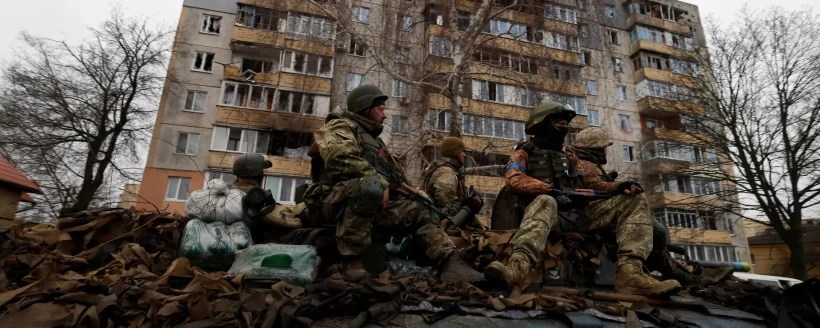
Situation in Ukraine
Video: Kiev Territorial Defence in Bucha Given Green Light to Shoot Those Not Wearing Blue Armband 3 April, 16:38 GMT
Thus the appearance of white armbands on the victims of ‘the Bucha Massacre’ is overwhelming evidence that the victims were ethnic Russians. They were murdered not by Russian troops – who were of course sent in with a key aim of stopping the persecution of Russian-speakers by racist neo-Nazis – but by Ukrainians.
This should come as no surprise, for the whole history of Ukrainian nationalism is based on the mass murder of ‘unclean’ and ‘sub-human’ civilians from other ethnic groups, most notably the Poles of Wolyn and Eastern Galicia, Jews, Hungarians, Romanians and, of course, Russians.
Finally, we come to the video clip from the streets of Bucha, which was posted and then removed from the social media account of the known Ukrainian neo-Nazi ‘Botman’: “There are guys without blue armbands. Can we shoot them?” “F**k, yeah!”
The truth of the massacre is so clear that we can see why Western leaders such as Boris Johnson are so adamant that there should not be a proper international investigation into the crime.
Instead, they are using the most blatant fake news to justify imposing another round of sanctions pain on their own people, and to excuse the sending of billions of pounds, dollars and euros worth of high-tech weapons in order to prolong the war. One has to wonder about the scale of the kick-backs these real war criminals are getting from their military-industrial complex cronies!
Featured Video

“Historic Russia”: The Land Putin Will Not Give Back
or go to
Aletho News Archives – Video-Images
Book Review
Why the War on Conspiracy Theories Is Bad Public Policy
By Kevin Barrett • Unz Review • February 1, 2019
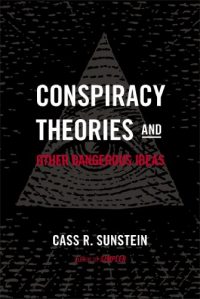 A Review of Conspiracy Theories and Other Dangerous Ideas by Cass Sunstein (based on an earlier paper co-authored with Adrian Vermeule); In Defense of Troublemakers: The Power of Dissent in Life and Business by Charlan Nemeth; and Conspiracy Theories and the People Who Believe Them, edited by Joseph E. Uscinski
On January 25 2018 YouTube unleashed the latest salvo in the war on conspiracy theories, saying “we’ll begin reducing recommendations of borderline content and content that could misinform users in harmful ways—such as videos promoting a phony miracle cure for a serious illness, claiming the earth is flat, or making blatantly false claims about historic events like 9/11.”
At first glance that sounds reasonable. Nobody wants YouTube or anyone else to recommend bad information. And almost everyone agrees that phony miracle cures, flat earthism, and blatantly false claims about 9/11 and other historical events are undesirable.
But if we stop and seriously consider those words, we notice a couple of problems. First, the word “recommend” is not just misleading but mendacious. YouTube obviously doesn’t really recommend anything. When it says it does, it is lying. … continue
Blog Roll
 Aletho News
- “Historic Russia”: The Land Putin Will Not Give Back
- How the Cambridge Analytica scandal still haunts Mark Zuckerberg
- The Ongoing Cancellation Campaign Against a Dissenting Academic in Norway
- Yemen and ‘the Houthis’: Challenging Sami Hamdi’s Narrative
- No, Christians did not invent Zionism
- AIPAC-led lobbying network opens branches in Cypriot, Greek parliaments
- Araghchi blasts ‘parasitic’ alliance as US taxpayers pay for Israel’s war on Iran
- Easy fix for Europe’s chaos? Stop fueling war against Russia
- Putin’s key remarks on peace talks and Europe’s ‘schizophrenia’
- Trita Parsi: Israel Set a Trap for Total War in the Region
- If Americans Knew
- An error has occurred; the feed is probably down. Try again later.
- No Tricks Zone
- Two New Studies Find Thwaites Glacier Melt Cannot Be Driven By Human Activity Or A Warming Ocean
- E-Cars Reduce CO2 Emissions By Only 41% Compared To Internal Combustion Engine Vehicles
- Predictions Made By Renowned Climate Professor Over Past Decades Have Been Proven To Be Poor
- New Study Suggests Large Regions Of The Pacific Ocean Have Been Cooling For The Last 80 Years
- Germany’s Green Energy Debacle: High Energy Costs Force Kahla Porzellan to Close After 182 Years!
- New Study: 50 Years Of The Most Aggressive ‘Net Zero’ Policies Can Only Affect The Global Climate By 0.03°C
- US September “Heat” Was No Record…Many Records Set Decades Ago
- Latest European Green Energy Debacle; Portugal’s Largest Flagship Solar Park Insolvent!
- Green Energy Debacle: German Expert Professor Fritz Vahrenholt Warns Of Severe Economic And Social Consequences
- Two More Paleo Reconstructions Affirm Meters-Higher Sea Levels Across Ireland, Brazil 7000-6000 Years Ago

