UNRWA calls for unimpeded passage into Gaza for vital goods
MEMO | August 25, 2020
The UN Relief and Works Agency for Palestine Refugees in the Near East (UNRWA) called on Tuesday for all vital goods to be granted unimpeded passage into the besieged Gaza Strip, including fuel for electricity. UNRWA made the appeal against the background of 14 years of an illegal blockade and the socio-economic impact of the COVID-19 pandemic.
“The agency in Gaza is extremely concerned about the closure of the lone power plant since last Tuesday, 18 August,” UNRWA said. “The closure of the plant has caused the power feed to decline to two or three hours per day, followed by 20 hours of interruption.”
This, explained UNRWA, will have a negative impact on the wellbeing and safety of the people of Gaza and devastating effects on the Strip’s vital services, including hospitals. “Thus, this puts at risk the lives and health of nearly two million people, including 1.4 million registered Palestine refugees.”
The official statement from the UN agency pointed out that, “Under international humanitarian law, the passage of all relief consignments, in this case fuel for electricity, should not be prevented.”
Commenting on the situation in the Gaza Strip, the Director of UNRWA Affairs in the Palestinian territory, Matthias Schmale, said that the call is being made to all concerned parties to maintain a supply of electricity that is sufficient to meet the basic needs of the civilian population. “UNRWA is, furthermore, concerned about other measures perceived as punitive to the civilian population, such as closing down the fishing zone, as well as the escalating tensions and military activities.”
Gaza, Schmale pointed out, has now been hit by air raids for more than ten nights in a row. “All parties must show utmost restraint and protect the civilian population with full respect for their dignity and human rights.”
In Blow to US Efforts, Morocco Says No to Normalization with Israel
Palestine Chronicle | August 24, 2020
Morocco will not follow the lead of the United Arab Emirates and normalize with Israel, the country’s Prime Minister Saad-Eddine El-Othmani said during a high-level political meeting late on Sunday.
El-Othmani told members of his Justice and Development Party that Morocco “refuses to normalize relations with the Zionist entity (referring to Israel) because this will embolden it to further breach the rights of the Palestinian people.”
The top Moroccan official reiterated that the country’s King, government and people will remain steadfast in defense of the rights of the Palestinian people and Al-Aqsa Mosque, located in occupied Palestinian East Jerusalem (Al-Quds).
“In 1993, Morocco and Israel had low-level diplomatic ties following the signing of the Oslo Accords between the Palestinians and Israel,” Anadolu news agency reported on Monday.
“However, Rabat suspended the relations with Israel following the outbreak of the Palestinian uprising in 2000,” Anadolu added.
On August 13, Israel and the UAE have reached a deal that is expected to lead to “full normalization of relations” between the small Arab nation and Israel in an agreement that US President Donald Trump brokered.
How the UK Government Provides Cover for Israel’s Crimes
By Stuart Littlewood | American Herald Tribune | August 22, 2020
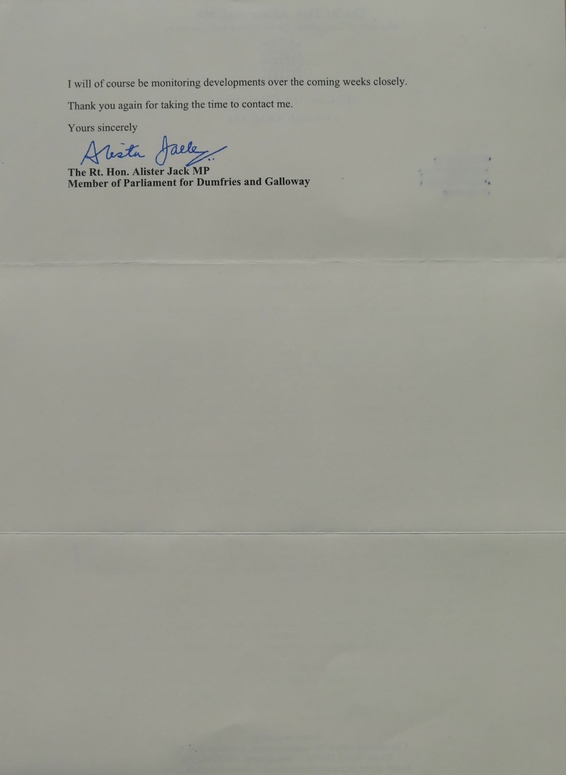
MP Alister Jack has finally replied to my question asking where he and the UK government stand on the threat by Israel to annex more Palestinian territory known as the West Bank. It seems the Government has urged them not to do it.
I doubt if his letter reproduced here, is his own work. It is sprinkled with the humbug and deceit repeated for decades by Tory and Labour governments and was likely penned at least 20 years ago by a Foreign Office scribbler vaccinated with an Israeli embassy gramophone needle. It is still used as a reply template by MPs and ministers who dare not speak their own minds or are plain clueless.
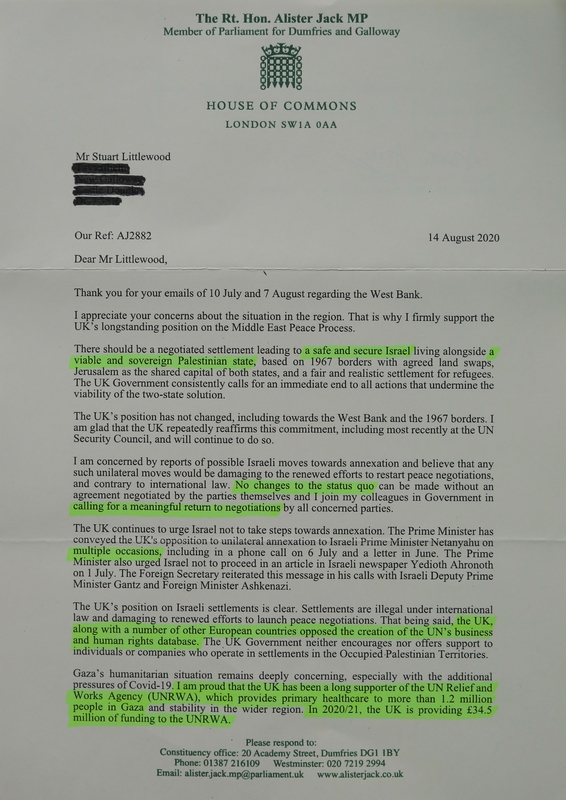
As usual, Her Majesty’s Government wants “a safe and secure Israel” but only “a viable and sovereign Palestinian state”. What a deplorable statement. Viable means workable in the most meagre sense. And when it comes to safety and security why can’t Mr. Jack be evenhanded? His words (if they are indeed his) express clear racial prejudice favouring the wellbeing and prosperity of one people at the expense of another which, I’d have thought, deserves a sharp rap on the knuckles.
He says there can be no changes to the status quo without a negotiated agreement between the parties. Mr Jack is surely aware that the status quo is itself illegal and breaches umpteen UN resolutions. And why does he feel the Palestinians must ‘negotiate’ their freedom? Picture the scene with the invader holding a gun to the head of the victim whose land the invader has occupied under brutal military control and in defiance of international law for 70+ years. Why is Mr Jack joining his colleagues in calling for more lopsided negotiations instead of pushing for law and justice?
‘Nothing shall be done to prejudice the rights of non-Jewish communities….’ Sorry, forget that.
So many experts are saying that a negotiated two-state solution is impossible. Does anyone seriously think the Israelis will voluntarily give up their ill-gotten territorial gains which are crucial to their Greater Israel dream? The only peaceable way to change their mind is through the persuasive power of BDS and other sanctions. For that reason BDS is under relentless Zionist attack and is fiercely opposed by the servile UK Government. The reason why the West endlessly woffles about ‘negotiations’ is their cowardly failure ever since 1948 to confront Israel’s greedy ambition for expansion and domination. That inconvenient bit in Britain’s 1917 pledge to Rothschild and the Zionist Federation about “it being clearly understood that nothing shall be done which may prejudice the civil and religious rights of existing non-Jewish communities in Palestine” is best forgotten. It’s so much easier for the UK Government to say and do nothing while their Zionist ‘friends’ surreptitiously complete their programme of creeping annexation. And never mind the 70+ years of grief this has caused innocent Palestinians.
Mr Jack refers to Boris Johnson’s article in Yedioth Ahronoth which appeared on the very day Netanyahu was supposed to be carrying out his crazed threat. “Annexation would represent a violation of international law…. I profoundly hope that annexation does not go ahead,” he wrote. “If it does, the UK will not recognize any changes to the 1967 lines, except those agreed between both parties.” But Israel has repeatedly violated international law and repeatedly been rewarded, so why should it care what the UK thinks about boundary changes? They have been changing all the time. Israel’s annexation of East Jerusalem (including the Old City) in 1967 was a flagrant breach of international law, and what did the UK or anyone else do about it? “I want to see an outcome that delivers justice for both Israelis and Palestinians,” says Johnson absurdly. He has no interest in justice otherwise he’d be leading the charge for implementing international law and UN resolutions which have already ruled on the issue.
As for Israel’s annexation misfire, it looks like world hostility gave Netanyahu cold feet and he and Trump cast around in desperation for a face-saver. They found it the United Arab Emirates’ ‘MBZ’ with whom they cobbled a deal for full diplomatic relations between Israel and the UAE provided Israel suspended annexation, and this is touted as a triumph. No-one of course insisted on actually abandoning annexation and you can bet the piecemeal ethnic cleansing, destruction of Palestinian homes and confiscation of their lands will continue unabated.
Mr. Jack then says he’s proud that the UK supports UNRWA and is providing £34.5 million funding this year. If the Palestinians were allowed their universal right to freedom of movement and self-determination in their homeland there’d be no need to keep throwing our tax money at agencies like UNRWA. It’s scandalous that money for our own schools and hospitals has been diverted to subsidise Israel’s long-running programme of thieving, collective punishment, dispossession and the trashing of the Palestinian economy.
Mr Jack goes on to say: “The UK’s position on Israeli settlements is clear.” Well no, it isn’t. They are illegal and even constitute a war crime yet the UK Government doesn’t mind if companies or individuals profiteer from using and endorsing those squats to the detriment of the Palestinians. And he seems to agree with his government’s opposition to the UN’s business and human rights database. Back in March 2016, UN Human Rights Council resolution 31/36 mandated the High Commissioner’s Office to produce a database of all businesses engaged in activities related to Israel’s settlement enterprise and having implications for the rights of the Palestinian people. Fair enough, you might think. But a year ago 103 local, regional and international organizations felt it necessary to call on the High Commissioner to release the Database expressing deep concern that the document and names of the companies facilitating the settlement programme had been withheld from circulation for 3 years due to political pressure. In the meantime the Israeli government had escalated the construction of new squats and broadcast its intention to formally annex parts of the West Bank in further violation of international law.
“The Database will bring an important degree of transparency on the activities of businesses which contravene rules and principles of international humanitarian and human rights law as a result of their operations in or with illegal Israeli settlements,” they said.
Amnesty International commented: “Naming the businesses which profit in the context of this illegal situation sends a clear message from the international community that settlements must never be normalized. These companies are profiting from and contributing to systematic violations against Palestinians.”
And Lawyers for Palestinian Human Rights said: “The UK Government abstained on the vote of this Human Rights Council resolution in March 2016…. It was the only state to declare that the database was ‘inappropriate’ and that ‘it would not co-operate in the process’ of its implementation.” LPHR felt that the reasons given for the Government’s position “did not individually or cumulatively amount to an adequate basis for justifiably opposing the UN Database”. One such reason was that the UK Government thought the Human Rights Council should focus on states rather than private companies. LPHR says this contradicts the UK’s earlier agreement, along with the rest of the international community, that companies as well as states have vital responsibilities in protecting and advancing respect for human rights.
I won’t trouble Mr Jack for an explanation for all this. It’s enough that voters and campaigners are aware of the skullduggery.
Gaza health official: Electricity cuts threaten lives of 120 newborn babies
MEMO | August 20, 2020
Consultant paediatrician and Chairman of the Gaza Neonatal Network (GNN) Dr Nabil Al-Baraqoun warned on Wednesday that the frequent electricity outages threaten the lives of 120 newborn babies currently being taken care of in intensive care incubators in Gazan hospitals.
Dr Al-Baraqoun explained that the 135 neonatal incubators are all powered by electricity, noting that the frequent power cuts and the use of alternative energy sources cause damage to medical devices such as incubators, resuscitation equipment and ventilators, which could cause complications for the infants, and even deaths.
He clarified that the alternation in using alternative energy sources like power generators and solar energy do not provide adequate energy to the incubators.
‘People of the Cave’: Palestinians Take their Fight for Justice to the Mountains
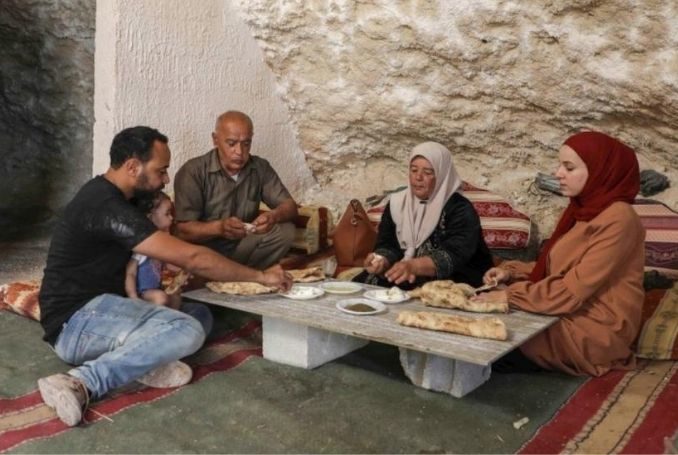
Ahmed Amaranth (L) and his family live in a cave home and now face Israeli eviction. (Photo: via Twitter)
By Ramzy Baroud | Palestine Chronicle | August 19, 2020
Palestinians are not going anywhere. This is the gist of seven decades of Palestinian struggle against Zionist colonialism. The proof? The story of Ahmed Amarneh.
Amarneh, a 30-year-old civil engineer from the northern West Bank village of Farasin, lives with his family in a cave. For many years, the Amarneh family has attempted to build a proper home, but their request has been denied by the Israeli military every time.
In many ways, the struggle of the Amarnehs is a microcosm of the collective struggle of Farasin; in fact, of most Palestinians.
Those who are unfortunate enough to be living in areas of the West Bank, designated by the Oslo II Accord of 1995 as Area C, were left in a perpetual limbo.
Area C constitutes nearly 60% of the overall size of the West Bank. It is rich with resources – mostly arable land, water and ample minerals – yet, relatively sparsely populated. It should not be surprising why right-wing Israeli Prime Minister, Benjamin Netanyahu, wants to annex this region. More land, with fewer Palestinians, has been the guiding principle for Zionist colonialism from the outset.
True, Netanyahu’s annexation plan, at least the de jure element of it, has been postponed. In practice, however, de facto annexation has been taking place for many years, and, lately, it has accelerated. Last June, for example, Israel demolished 30 Palestinian homes in the West Bank, mostly in Area C, rendering over 100 Palestinians homeless.
Additionally, according to the United Nations Office for the Coordination of Humanitarian Affairs (OCHA), Israeli army bulldozers destroyed 33 non-residential structures as well. This is “the same number (of homes) demolished throughout the entire first five months of 2020,” OCHA reported.
Unfortunately, Farasin, like numerous other Palestinian villages and communities across Area C, has been singled out for complete destruction. A small population of approximately 200 people has been subjected to Israeli army harassment for years. While Israel is keen on implanting Jewish communities in the heart of the occupied West Bank, it is equally keen on disrupting the natural growth of Palestinian communities, the indigenous people of the land, in Area C.
On July 29, Israeli forces invaded Farasin, terrorizing the residents, and handed over 36 demolition orders, according to the head of the Farasin village council. Namely, this is the onset of ethnic cleansing of the entire population of the village by Israel.
Ahmed Amarneh and his family also received a demolition order, although they do not live in a concrete house, but, rather, in a mountain cave. “I didn’t make the cave. It has existed since antiquity,” he told reporters. “I don’t understand how they can prevent me from living in a cave. Animals live in caves and are not thrown out. So let them treat me like an animal and let me live in the cave.”
Amarneh’s emotional outburst is not misleading. In a recent report, the Israeli rights group B’tselem, has listed some of Israel’s deceptive methods used to forcefully remove Palestinians from their homes in Area C or to block any development whatsoever within these Palestinian communities.
“Israel has blocked Palestinian development by designating large swathes of land as state land, survey land, firing zones, nature reserves and national parks,” according to B’tselem. Judging by the systematic destruction of the Palestinian environment in the West Bank, Israel is hardly interested in the preservation of animals, either. The ultimate goal is the allocation of “land to settlements and their regional councils,” B’tselem argues.
Therefore, it should not come as a surprise that, for example, as of November 2017, only 16 of the 180 Palestinian communities in Area C have been approved for development. The rest are strictly prohibited.
Between 2016 and 2018, of the 1,485 Palestinian applications for construction and development in these areas, only 21 permits have been approved.
These unrealistic and draconian measures leave Palestinian families with no option but to build without a permit, eventually making them targets for Israeli military bulldozers.
Hundreds of families, like that of Ahmed Amarneh, have opted for alternative solutions. Failing to obtain a permit and wary of the imminent demolition if they build without one, they simply move to mountain caves.
This phenomenon is particularly manifest in the Hebron and Nablus regions.
In the mountainous wasteland located on the outskirts of Nablus, the wreckage of abandoned homes – some demolished, some unfinished – is a testimony of an ongoing war between the Israeli military, on the one hand, and the Palestinian people, on the other. Once they lose the battle and are left with no other option, many Palestinian families take their belongings and head to the caves in search of a home.
Quite often, the fight does not end there, as Palestinian communities, especially in the Hebron hills region, find themselves target to more eviction orders. The war for Palestinian survival rages on.
The case of Ahmed Amarneh, however, is particularly unique, for rarely, if ever, Israel issues a military order to demolish a cave. When the cave is demolished, where else can the Amarneh family go?
This dilemma, symptomatic of the larger Palestinian quandary, reminds one of Mahmoud Darwish’s seminal poem, “The Earth is Closing on Us”:
“Where should we go after the last frontiers?
Where should the birds fly after the last sky?
Where should the plants sleep after the last breath of air?”
However depressing the reality may be, the metaphor is undeniably powerful, that of savage colonialism that knows no bounds and Palestinian steadfastness (sumoud) that is perennial.
Often buried within the technical details of oppression – Area C, home demolition, ethnic cleansing and so on – is the tenacity of the human spirit, that of the Amarneh family and hundreds of other Palestinian families, who have turned caves into loving homes. It is this unmatched perseverance that makes the quest for justice in Palestine, despite the innumerable odds, possible.
– Ramzy Baroud is a journalist and the Editor of The Palestine Chronicle. He is the author of five books. His latest is “These Chains Will Be Broken: Palestinian Stories of Struggle and Defiance in Israeli Prisons” (Clarity Press, Atlanta). Dr. Baroud is a Non-resident Senior Research Fellow at the Center for Islam and Global Affairs (CIGA), Istanbul Zaim University (IZU).
Yemen’s Ansarullah slams UAE-Israel deal as ‘great betrayal’ of Palestinians
Press TV – August 14, 2020
Yemen’s Houthi Ansarullah movement has decried the deal reached between the United Arab Emirates and Israel to fully normalize relations as a “great betrayal” of the Palestinian cause.
In a statement issued on Friday, Ansarullah’s political bureau said the exposure of the UAE-Israel relations proved the emptiness of all the pan-Arabist slogans raised by the Saudi-led coalition in waging war on Yemen.
The statement added that the UAE was continuing to move forward on the wrong path of serving American and Israeli interests against the Muslim Ummah, referring to the Emirates’ participation in the Saudi-led war on Yemen, which began in March 2015 and has left tens of thousands of people killed.
Ansarullah dismissed assertions that normalization with the Israeli regime would lead to the establishment of peace and stability in the region as “mere delusions.”
It also called for isolating any regime that announces normalization with Israel and boycotting it economically and commercially, stressing that Arab and Muslim peoples were able to do a lot to help Palestine.
The deal between the UAE and Israel was announced on Thursday. US President Donald Trump, who apparently helped broker the deal, has attempted to paint it as a big breakthrough.
But the Palestinians have utterly rejected the deal.
Palestinian President Mahmoud Abbas referred to the deal as an “aggression” against the Palestinian people and a “betrayal” of their cause. The Palestinian resistance movement Hamas described it as “a stab in the back of the Palestinian cause.” And Palestinian people staged protests against the deal in the occupied West Bank and the besieged Gaza Strip on Friday.
The Emirates is now the third Arab country, after Egypt and Jordan, to normalize with Israel. Abu Dhabi was already believed to have clandestine relations with Tel Aviv.
‘No change’ of West Bank annexation plans after Israel-UAE deal, Netanyahu says
RT | August 13, 2020
Israel is still committed to annexing parts of the occupied West Bank, PM Benjamin Netanyahu said, after a peace deal with the UAE was reached. As part of the deal, Tel Aviv agreed to suspend the annexation.
The revelation was made by Netanyahu in a televised speech on Thursday.
“There is no change in my plans to apply sovereignty over Judea and Samaria, with full coordination with the US,” Netanyahu said, referring to parts of the West Bank region by their biblical names.
The remark came shortly after the peace deal between the United Arab Emirates and Israel was unveiled. Among other things, it contains a provision that Tel Aviv agrees to ‘suspend’ its annexation plans.
Netanyahu did not give any timeframe for when exactly his land-grabbing plans will go through, but apparently sought to reassure his hardline supporters, disappointed by the sudden U-turn on the annexation issue.
The Israel-UAE deal was first announced by US President Donald Trump on Twitter earlier in the day. Trump called the agreement a “HUGE breakthrough” and labeled the whole deal a “historic” achievement.
Most of the Arab world does not officially recognize the Jewish state, but countries like Saudi Arabia have enjoyed quite cozy relations with Tel Aviv for years.
Palestinians are deprived of a political voice, and their leaders do nothing about it
By Ramona Wadi | MEMO | August 13, 2020
Palestinian refugees are at the core of Palestinian narratives. The international community has, however, classified Palestinian refugees as a humanitarian issue. In between these diverging depictions, the Palestine Liberation Organisation (PLO) seeks to grapple with both strands to push for “international protection” within the context of the coronavirus pandemic.
With international aid for Palestinian refugees barely enough for basic necessities and thus contributing to their increased vulnerability, the PLO has requested the UN to provide protection and financial aid for them. According to reports, “Such protection and support must continue until a solution for the issue of the refugees is found based on Resolution 194.”
The political exploitation of Palestinian refugees knows no limits. UN Resolution 194, which has been accepted blindly as the framework upon which a solution should be found, is rarely criticised for shifting accountability upon the colonised population, rather than the settler-colonial framework which usurps Palestinian territory and made Palestinians refugees in the first place. Resolution 194 is part of the international narrative on Palestine and has little to do with safeguarding the rights of refugees because it fails to call for the decolonisation of their land.
Palestinian refugees are not allowed a political platform at an international level. Hence the constant “speaking for” refugees within a humanitarian context that in turn justifies the international community’s role in deciding how the promotion of Palestinian refugees should be carried out in order to highlight the humanitarian paradigm. Humanitarian aid is about the international community first and foremost. The recipients are forced to play a part in this charade, which ignores Israel’s colonisation of Palestine as the cause of the whole issue.
Furthermore, the PLO’s request for aid promotes the international narrative of delays. Aid must be given until a solution is found, the PLO insists, yet how much emphasis is placed upon finding and implementing that solution? The international community and the Palestinian leadership have turned Palestinian refugees into accessories for political convenience. Indeed, there is hardly any mention of Palestinian refugees unless a humanitarian context is evoked, or if the UN inaugurates a project to exploit the illusion of “Palestinian autonomy”, which is non-existent in a humanitarian context rigged with deficiencies and political allegiances to the Zionist colonial project.
So I have a suggestion: how about remembering Palestinian refugees as the most prominent victims of Zionist colonisation; as people who have been deprived of their rights by the international community which allows that colonisation to continue unabated? Decades have passed since the UN Relief and Works Agency was mandated to provide for Palestinian refugees and bound to a “neutral” narrative, despite being funded by countries that prioritise their diplomatic and economic ties to Israel over and above human rights and justice. Palestinian autonomy for Palestinians, including refugees, is still a non-existent concept, because the international community has monopolised the politicisation of humanitarian aid without allowing Palestinians to participate in the process.
Each time the legitimate Palestinian right of return is tied to requests for humanitarian aid, the “right” is whittled down even further. Such rhetoric falsely equates Palestinians with a passive stance, one that the Palestinian Authority is fond of describing as “waiting”. Such projections are harmful to Palestinians; they are not waiting, they have been deprived of a political voice, and their leadership is doing nothing to counter this international violation of human rights.
Biden orders removal of Israel occupation reference from election campaign
MEMO | August 8, 2020
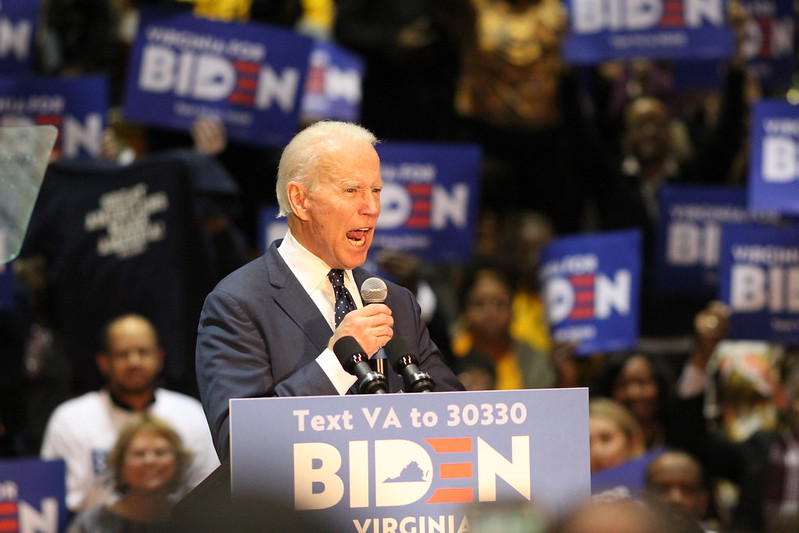
US Democratic presidential nominee Joe Biden has ordered the removal of any reference to the Israeli occupation in his campaign programme just days before it was released on 15 July, Foreign Policy revealed on Thursday.
Vermont Senator Bernie Sanders, who withdrew his presidential campaign in favour of Biden, had agreed with Biden that he would include in the Democratic Party platform an assertion that Palestinians had a right to live free of foreign “occupation”, referring to Israel.
However, under pressure from pro-Israeli advocacy groups, Biden made a last-minute decision to remove any reference to the Israeli occupation, Foreign Policy reported three sources confirming.
Therefore, Biden aides asked the progressive leaders in the Democratic Party and urged them to drop their demand to declare Israel an occupying power, the magazine reported.
According to the magazine, Biden aides argued that the inclusion of the word “occupation” threatened to undermine unity within the Democratic Party.
“The question of whether to allow the text to refer to ‘occupation’ or use the phrase ‘end the occupation’ was taken to the vice president and he said ‘no’,” Jason Isaacson, chief policy and political affairs officer at the American Jewish Committee, told Foreign Policy.
“This is not an issue on which the party can bend because it would be contrary to the position of Joe Biden,” Isaacson added.
Foreign Policy noted that the retraction reflected Biden’s reluctance to reverse decades of staunch support for Israel.
It also stated that this retreat marked something of a victory for the party’s establishment, which has sought to preserve close relations with Israel, even as its Prime Minister Benjamin Netanyahu has moved increasingly close to the Republican Party and its standard-bearer, President Donald Trump.
“The party platform section on Israel and Palestine is a clear victory for those supporting a return to mainstream Democratic policies of the past and a loss for the progressives seeking more restrictive or conditional support for Israel,” Peter Mulrean, who served for three decades in the State Department and subsequently oversaw United Nations aid programmes for Palestinians, informed the magazine.
Featured Video
10K More U.S. Troops Deploy as Trump Weighs New Iran Strikes
or go to
Aletho News Archives – Video-Images
From the Archives
Genetic baloney in thick slices
MAYBE COULD BE INC.
By Jon Rappoport | No More Fake News | July 8, 2021
Gene research companies tend to come and go. They start out banging and popping like fireworks in the sky, and then they fade out—selling themselves to larger outfits who’ve hired better liars…
Once upon a time, it sounded easy. Start with a disease, find the gene responsible for the disease, and correct the problem.
Then, researchers wondered, was disease the result of one gene or a group of genes acting together?
Either way, the proof would be in devising cures for diseases using gene therapy. “Not yet, but soon…”
And regardless, the major need was: money. Lots and lots of money.
This need required good PR people. “We have to pump up the idea that we’re on the edge of tremendous breakthroughs. We’re always on that edge…”
This hype also needed to obscure the fact that there wasn’t (and isn’t) ANY gene cure for ANY disease. … continue
Blog Roll
 Aletho News
- UK Government Body Kept Files on People Criticizing Prevent Program
- US military withdrawal from Iraq and the collapse of US-Israeli hegemonic project in West Asia
- What does Europe want – a war with Russia?
- She Followed the Actual Data on COVID Vaccines and Masks — Her Career Took a Huge Hit
- Florida AG Sues Pfizer, Bourla Over Deceptive Marketing of COVID Vaccines
- Von der Leyen gifts her spin doctor a job for life
- 10K More U.S. Troops Deploy as Trump Weighs New Iran Strikes /Suliaman Ahmed
- Iranian crew declared Dena training vessel ‘unarmed’ to US warship before deadly torpedo strike: Report
- Iran’s NPT debate moves beyond parliament
- Houthis condemn Saudi claims of attack on Medina
- If Americans Knew
- Israel is squeezing the life out of Palestinians – Daily Update
- The Israeli Right Portrays Islam as Murderous. It Serves a Political Purpose
- Jordan Has Had Enough: King Abdullah’s Scathing Warning to Israel
- Israeli Colonizers (i.e. Settlers) Kill Palestinian Man Near Salfit
- New Google Maps images reveal massive scale of devastation in Gaza
- Jewish supremacy, anti-Palestinian bigotry on display in Israel – Daily Update
- Israeli Soldiers Abduct At Least 22 Across Occupied West Bank
- Eight Palestinians Killed in Israeli Attacks on Gaza
- Israeli former leaders and security chiefs threaten legal action over ‘Jewish terrorism’
- Israel map in LA Times ad includes all land from the river to the sea
- No Tricks Zone
- Green Energy Debacle: German Expert Professor Fritz Vahrenholt Warns Of Severe Economic And Social Consequences
- Two More Paleo Reconstructions Affirm Meters-Higher Sea Levels Across Ireland, Brazil 7000-6000 Years Ago
- New Study: Earth And Venus Surface Warmth Largely Explained By Convection And Lapse Rate, Not CO2 Or Radiation
- 2025 Nature Paper Claiming Worsening Global Drought Gets RETRACTED …Heavily Flawed
- New Study: ‘Global Drought Shows No Detectable Recent Acceleration Under Climate Warming’
- Economic Masterminds: German Socialists Suggest Taxing Productivity Gains Stemming From Using AI
- The South China Sea Has Not Been Cooperating With The Climate Change Narrative
- Energy Crisis: Germany Enters Heating Season With Historically Low Gas Reserve Fill Levels
- New Study: The Antarctic Ice Sheet Gained Mass From 2020-2024 Due To Staggering Snow And Ice Accumulation
- Study: Ocean Heating Rates From Thousands Of Years Ago ‘Dwarf’ Modern Ocean Heating Rates

