YouTube censors video about daily life for Palestinians

If Americans Knew | July 8, 2020
YouTube does not want American high school students to know the truth about the Israeli occupation of Palestine.YouTube is censoring an eight-minute video entitled “Daily Life in Occupied Palestine.” The video, produced by If Americans Knew, contains video clips of Israeli actions against Palestinian men, women, and children, both Muslim and Christian. It also provides statistical and historical information about the Israeli-Palestinian issue. The US gives Israel over $10 million per day.
YouTube first removed the video claiming that it “violates YouTube guidelines.” When this claim was appealed, reviewers at the company admitted that it “does not violate YouTube guidelines.”

YouTube restored the video, but is prohibiting high school students from viewing it, and discouraging adults from watching it.
When people click on the video, they see a black screen with the unusually dire warning: “The following content has been identified by the YouTube community as inappropriate or offensive to some audiences. Viewer discretion is advised.”
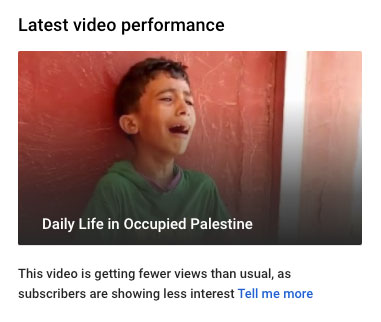 This has caused a significant reduction of views.
If Americans Knew has appealed these actions, writing to YouTube that the video—
“hasn’t been identified by ‘the YouTube Community’ as offensive; the information it contains has been labeled offensive by Israel partisans – that’s very different.
“We went to great lengths to censor all scenes of blood and gore, and even profane language. The purpose of this video is to educate the public about the ongoing situation in Israel-Palestine.”
In point of fact, the video is entirely within the range of footage shown on nightly TV. The only viewers for whom this is “offensive” are the Israel apologists whose lobby enables the violence it contains.
High school students study U.S. History, World History, and Government. They will soon be voters. Many are politically active and volunteer in diverse political campaigns. They regularly see movies filled with violence. There are laws in at least 12 states mandating that schools teach about the Nazi holocaust, an extremely violent episode in European history.
It is deeply inappropriate for YouTube to prevent American students from viewing a factual video about one of the most urgent issues in today’s world, and about a country that receives more US tax money than any other.
It is similarly inappropriate for YouTube to work to discourage adults from viewing the video and thus learning about what our money to Israel funds.
While YouTube, a Google subsidiary, is a private company, its dominance of the video hosting market confers certain responsibilities of fairness on it.
We ask that people who oppose censorship and believe that Americans need to learn facts about this urgent issue tell YouTube to remove its prohibition against students viewing the video, and remove its damaging warning screen.
Please sign this petition and share it widely.
Please also share our blog post of the video and our Facebook post of it as widely as possible.
US policy against Lebanon not to weaken but strengthen Hezbollah: Nasrallah

Press TV – July 7, 2020
The Secretary General of the Lebanese resistance movement Hezbollah has censured the US interference in the country’s internal affairs, saying Washington’s hostile policy against Lebanon will not weaken the popular movement but will strengthen it.
Sayyed Hassan Nasrallah made the remarks during a televised speech broadcast by the Arabic-language al-Manar satellite television station in the Lebanese capital of Beirut on Tuesday.
Nasrallah blasted the US ambassador to Lebanon for “openly” meddling in the country’s domestic affairs and called on the Lebanese government to stand up against US provocations.
“The US ambassador to Lebanon has been openly interfering in our internal affairs. The US meddling in Lebanon is rejected and the Lebanese state must move in this regard,” the Hezbollah chief said.
“Your policy in Lebanon won’t weaken Hezbollah but will strengthen it and that blockade on Lebanon is futile, my advice is to abandon this policy,” Nasrallah underlined.
Moreover, the Secretary General of the Lebanese resistance movement lashed out at the US ambassador and said, “Don’t give lectures on human rights especially that your country is the great violator of human rights worldwide,” adding that, “Your country has funded terrorism in the region.”
In an interview with Saudi-owned al-Hadath television news network last week, US Ambassador to Beirut Dorothy Shea said Washington has “great concerns” over Hezbollah’s role in the Lebanese government.
The US has labeled the entire Hezbollah a terrorist organization and levied several rounds of sanctions on the Lebanese resistance movement as well as its top officials.
Hezbollah’s growing popularity in the Arab and Muslim world after the resistance movement shattered the Israeli military’s myth of invincibility during the 33-day military offensive on Lebanon in the summer of 2006 has been a matter of serious concern for the Tel Aviv regime and its Western allies.
The resistance movement’s heroic defense as well as its vehement opposition to any foreign intervention in Lebanon’s domestic affairs has turned the group into a major stakeholder in the country’s political and military domains.
‘Why are you afraid of Iran?’
During the televised speech on Tuesday, Nasrallah also dismissed accusations that Hezbollah wants to turn Lebanon into another Iran and said, “Iran is a self-sufficient model, why are you afraid of this model?”
The Hezbollah chief stressed that the hard living conditions and the economic crisis Lebanon has been witnessing require a national approach and exerting united efforts by all Lebanese parties.
Since October, Lebanon has been in a financial crisis that has seen businesses close and prices and unemployment soar. The Lebanese pound has also continued to plummet against the US dollar.
Lebanese protesters have resumed demonstrations, demanding early Parliamentary elections and tougher measures to fight corruption and the return of looted state funds.
Nasrallah went on to say on Tuesday that the movement could use all its capabilities in agricultural and industrial sectors to help overcome the country’s current economic crisis.
“As Lebanese people, we have to unite efforts in agriculture and in finding markets for our crops. And the same thing applies to the industry,” he said, adding, “We in Hezbollah, we call on the Lebanese to revive the agricultural and industrial sectors as one of the major factors of steadfastness.”
The Hezbollah leader concluded his speech by condemning the Israeli plan to annex significant portions of the occupied West Bank, saying, “Lebanon’s current crisis must not divert us from supporting the Palestinian cause especially now as the Zionist regime is planning to annex areas of the West Bank and Jordan Valley.”
The contentious plan — which would allow Tel Aviv to annex about 30 percent of the West Bank — is in accordance with a Middle East scheme drawn up by the administration of US President Donald Trump and unveiled in January on the Israeli-Palestinian conflict.
The scheme — which Trump calls the deal of the century — largely gives in to Israel’s demands while creating a Palestinian state with limited control over its own security and borders, enshrining the occupied Jerusalem al-Quds as Israel’s “capital.”
The US-backed annexation scheme has drawn international criticism and triggered waves of protest rallies around the globe.
Israeli Prime Minister Benjamin Netanyahu had set July 1 as the date for starting the annexation plan’s implementation, but the move faced delays amid internal rifts and as Tel Aviv awaits a green light from Washington.
The PA is a willing accomplice in the international subjugation of Palestine
By Ramona Wadi | MEMO | July 7, 2020
From seemingly defiant rhetoric to the expected capitulation, Palestinian Authority President Mahmoud Abbas has offered nothing in terms of a unified Palestinian stance against US President Donald Trump’s deal of the century. Going back to a compromised international community, ready to negotiate additional losses for Palestinians which will ultimately fail to prevent Israel’s annexation of their land, is not a counter-proposal, as the PA wishes us to believe. A more honest approach would have been a clear statement that the PA’s role is dependent upon donor funding and hence only capable of delivering upon compromised political agendas.
In a call with German Chancellor Angela Merkel on Sunday, Abbas announced his willingness to restart negotiations based upon UN resolutions and the Middle East Quartet demands. In light of Israeli Prime Minister Benjamin Netanyahu’s decision to postpone — not abandon — the annexation of large swathes of the occupied West Bank, the two-state paradigm will once again be touted as “the only solution”. The reality is that the only solution is to dismantle the Zionist colonial enterprise in its entirety.
While it was expected that Abbas would renege on his rhetorical threats, his approach towards the international community, which also appeases Israel, confirms the political game that pitted the two-state hypothesis against the deal of the century; in other words, the international community against Trump. This was a shallow, despicable manoeuvre that ties Palestinian politics perpetually to international demands, because the PA functions as a security apparatus for Israel and a hierarchy presiding over a symbolically recognised, yet non-existent, state.
With Abbas’s decision, Israel boosts its upper hand. The settler-colonial entity considers itself above international law and, in fact, holds it in contempt. Diplomatic negotiations, therefore, present no obstacle to its annexation plans. It is highly likely that if annexation takes place, the international community will take its time but will, inevitably, normalise the violation of international law, while setting the scene to negotiate a non-existent two-state travesty, this being nothing less than legitimising the deal of the century.
International donors fund the illusion of Palestinian state building; they also fund the PA’s security coordination with Israel because, ultimately, the PA does not relish the possibility of Palestinians rising up against the imposed status quo which elevates its status, albeit only within the parameters decided upon by the international community and Israel. Abbas also knows that stopping security coordination will contribute to a complete collapse of its institutions.
As for international opposition to Israel’s annexation, which is already weak and not intended to seek a confrontation with the Zionist state, a scenario can unfold in which not even the most cosmetic of stances opposing annexation will be followed through. The international community’s diplomacy, after all, is based entirely upon the two-state compromise. Abbas may have no choice indeed, unless he is ready to base his politics upon Palestinian demands, which would trigger a complete change in terms of diplomacy.
However, the PA’s repeated excuse that the Palestinian cause has been marginalised by the international community only tells one part of the story. The PA has supported this marginalisation, but it just prefers not to speak about its role in altering the Palestinian political demands of land and refugees’ legitimate right of return, into a global project supporting Israel’s colonial demands. It is a willing accomplice in the international subjugation of the Palestinians.
UK Government Evasive About Sanctions If Israel Annexes West Bank
Ministers insist on being ‘friends and allies’ of the racist regime regardless of its horrendous crimes
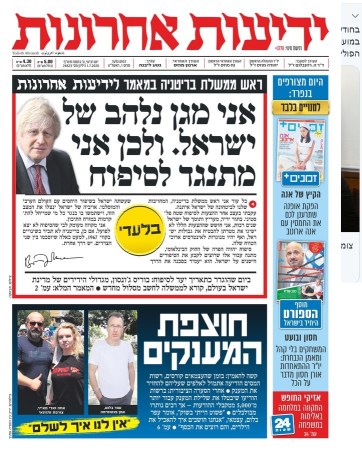
UK prime minister Boris Johnson’s article in the Israeli paper Yedioth Ahronoth
By Stuart Littlewood | American Herald Tribune | July 1, 2020
Writing in the Israeli paper Yedioth Ahronoth today – the very day Netanyahu threatened to commence extending Israeli sovereignty to illegal Jewish squatter communities and the Jordan Valley in a blatant bid to thieve more Palestinian land – UK prime minister Boris Johnson makes this disgraceful claim:
“I am a passionate defender of Israel…. a life-long friend, admirer and supporter.” On other occasions he has declared himself “a passionate Zionist”, an equally tasteless thing to be. “Few causes are closer to my heart than ensuring its people are protected from the menace of terrorism and anti-Semitic incitement. The UK has always stood by Israel and its right to live as any nation should be able to, in peace and security. Our commitment to Israel’s security will be unshakable while I am Prime Minister of the United Kingdom.”
The trouble, dear Boris, is that the Israelis, who are violent intruders, won’t let their neighbours live in peace and security and cry blue murder whenever they put up resistance which they have every right to do. Your brilliant solution to the Holy Land problem is to force the Palestinians and Israelis back to the negotiating table and never mind implementing international law and scores of UN resolutions. Will you never learn?
Yesterday, at Westminster, the scene was Questions to the Foreign Secretary, the subject ‘Planned Annexation of the West Bank.
– Tonia Antoniazzi: What recent representations he has made to the Israeli Government on their planned annexation of parts of the west bank.
– Julie Elliott: What assessment he has made of the effect of Israel’s plan to annex parts of the west bank on human rights in that region.
– James Cleverly (Minister of State for Middle East & North Africa): The UK’s position is clear: we oppose any unilateral annexation. It would be a breach of international law and risk undermining peace efforts. The Prime Minister has conveyed our position to Prime Minister Netanyahu on multiple occasions, including in a phone call in February and a letter last month. The UK’s position remains the same: we support a negotiated two-state solution based on 1967 borders, with agreed land swaps, Jerusalem as a shared capital and a pragmatic, agreed settlement for refugees.
– Tonia Antoniazzi: Current sanctions are clearly not working as a deterrent for Israel’s plan to annex the west bank illegally. Strong words at this point are a betrayal of the Palestinian people—they need actions. Can the Minister outline what action the Government will take against annexation?
– James Cleverly: The Government have maintained a dialogue with Israel. We are attempting to dissuade it from taking this course of action, which we believe to be not in its national interest and not compliant with international law.
– Julie Elliott: In 1980, the UN Security Council condemned Israel’s illegal annexation of East Jerusalem and, in ’81, its illegal annexation of the Golan Heights. What lesson does the Minister think the Israeli Government took from the failure to see those Security Council resolutions adhered to? Are the UK Government abandoning the Palestinian people, as suggested in a recent open letter by UK charities?
– James Cleverly: The UK Government remain a friend of Israel and also a friend of the Palestinian people. We have continued to have dialogue both with the leaders of the Palestinian Authority and with the Government of Israel, and we encourage them to work together to come towards an agreed settlement that will see a safe, secure state of Israel alongside a safe, secure and viable Palestinian state. There is still the opportunity for that negotiated settlement to be the outcome, and we will continue working with both the Israelis and the Palestinians to facilitate that.
– Lisa Nandy: World leaders are warning of consequences should annexation go ahead, but the silence from this Government has been deafening, so much so that the Israeli newspaper Haaretz says that France is now the world’s “last, best hope” to stop annexation. This really is shameful. I raised my concerns with the US ambassador—has the Minister? Will he commit to a ban on settlement imports and recognise Palestine, as this House voted to do? Forgive me, I may have missed it. If he will not do those things, can he tell us what exactly he is proposing to do?
– James Cleverly: The UK remains a friend and ally to the state of Israel and a good friend to the Palestinian people. It is tempting—and I am sure it will placate certain voices on the left of the political spectrum—to stamp our feet and bang the table, but we will continue to dissuade a friend and ally in the state of Israel from taking a course of action that we believe will be against its own interests, and we will do so through the most effective means available.
– Alyn Smith: I listened carefully to the previous exchange, and I have much respect for the Minister, but I am not asking him to stamp his feet or bang the table—I am asking him to match the sensible position that he has outlined today on the illegal annexation of the already illegally claimed settlements with some actual action. No amount of warm words and sympathy are going to cut it in this discussion. My party, likewise, is a friend of the two-state solution. We are a friend of the Israeli state, and we are a friend of the Palestinians as well. We want to see a viable solution, but there is a lively debate that we can influence right now within Israel, and we need to put action on the table, not warm words and sympathy. Settlement goods should at the very least be labelled as illegal, and targeted sanctions need to be put on the table to focus the minds of the coalition. I urge him to act, not just talk.
– James Cleverly: My right hon. Friend the Foreign Secretary has spoken with his opposite number and other members of the Israeli Government, as have I and indeed our Prime Minister. We are working to dissuade Israel from taking this course of action. There will always be voices in British politics that would jump at any opportunity to bring in sanctions and disinvestment. We do not agree with those voices, and we will continue to work towards a negotiated two-state solution, using the diplomatic means we have at our disposal.
– Alyn Smith: I appreciate that answer, and I would urge more. When Russia illegally occupied Crimea, the UK Government, with our support, implemented sanctions with the international community. We need that sort of action now, and I would urge the Minister to greater efforts than we have heard today.
– James Cleverly: I reiterated the UK’s position at the UN Security Council on 24 June. I made it clear that annexation would not go unanswered. However, I will not stand at this Dispatch Box in order, as I say, to placate some of the traditional voices in criticism of Israel when the best way forward is to negotiate and speak with a friend and ally, in the Government of Israel, to dissuade them from taking a course of action that we believe is not in their own best interests.
Well, you get the picture…… a bizarre piece of parliamentary theatre in which a British minister of the Crown plays chief pimp for a foreign racist entity. What a pathetic performance by Mr Cleverly. He mouths the same tired and obsolete excuses for inaction as his predecessors and cannot bring himself to show principle or backbone. Perhaps that’s because Her Majesty’s Government simply hasn’t any.
So here is a question of my own. Why would anyone want to be “a friend and ally to the state of Israel”, as Government ministers like to describe themselves, when outside the Westminster bubble of Zionist stooges the racist regime has no friends? And for the simple reason that being a Friend of Israel means embracing the terror on which the state of Israel was built, approving the dispossession of the innocent and oppression of the powerless and applauding the discriminatory laws against indigenous non-Jews who inconveniently remain in their homeland.
It means aligning oneself with the horrific mindset that abducts civilians — including children — and imprisons and tortures them without trial, imposes hundreds of military checkpoints, severely restricts the movement of people and goods, and interferes with Palestinian life at every level.
And never mind the shooting up by Israeli gunboats of Palestinian fishermen in their own territorial waters, the strangulation of the West Bank’s economy, the cruel 14-year blockade on Gaza and the bloodbaths inflicted on the tiny enclave’s packed population. And don’t let’s even think about the religious war that humiliates the Holy Land’s Muslims and Christians and prevents them visiting their holy places.
If, after all that, you are still Israel’s special friend, where is your self-respect?
Will annexation happen? As I write this the news agencies remain silent and the world holds its breath. If Israel goes ahead it will be another step in the fulfilment of Plan Dalet, the Zionists’ dirty ploy to take over the Palestinian homeland as a prelude to declaring Israeli statehood. Its intention was, and still is, to gain control of all areas of Jewish presence and strategic and economic importance and keep expanding Israel’s (deliberately fluid) borders in order to satisfy their insatiable greed.
Don’t you think Netanyahu and his loathsome crew make superb recruiting sergeants for the BDS (Boycott, Divestment, Sanctions) movement? I now expect BDS to expand dramatically and hit the rogue state where it hurts if it doesn’t get civilised.
An obvious response from even the most retarded Western politicians would be to suspend the EU-Israel Association Agreement and the new UK-Israel Trade and Partnership Agreement. To enjoy the Association’s privileges Israel promised the EU to show “respect for human rights and democratic principles” as set out in Article 2, an essential and enforceable element of the Agreement. But Israel, as usual, shows contempt for these principles and its membership ought to have been terminated long ago.
To its shame the go-it-alone UK Government remains committed to rewarding its evil creature’s most obscene crimes, having announced that it is “working closely with the Israeli government to implement the UK-Israel trade and partnership agreement.… and to host a bilateral trade and investment summit in London.” This suggests that the provisions of Article 2 were not carried over from the EU to the new UK-Israel Agreement. However, exactly a year ago Lisa Nandy put this question:
“To ask the Secretary of State for International Trade, if he will seek the inclusion of a binding human rights clause in a future free trade agreement with Israel to establish that the (a) relations between the parties and (b) provisions of the agreement shall be based on respect for human rights and democratic principles as is provided for in Article 2 of the EU-Israel Association Agreement.”
The answer from the Minister of State for Trade Policy was: “The UK-Israel Agreement incorporates human rights provisions of the EU-Israel Trade Agreements, without modification.”
Let’s see if they really mean it and suit action to their words.
Will the ICC Investigation Bring Justice for Palestine?
By Ramzy Baroud & Romana Rubeo | Palestine Chronicle | June 29, 2020
In the past, there have been many attempts at holding accused Israeli war criminals accountable. Particularly memorable is the case of the late Israeli Prime Minister, Ariel Sharon, (known, among other nicknames, as the ‘Butcher of Sabra and Shatila’) whose victims attempted to try him in a Belgian Court in 2002.
Like all other efforts, the Belgian case was dropped under American pressure. History seems to be repeating itself.
On December 20, the International Court of Justice (ICC) Chief Prosecutor, Fatou Bensouda, resolved that she had sufficient evidence to investigate alleged war crimes committed in the occupied West Bank, East Jerusalem, and the Gaza Strip. The ICC’s unprecedented decision concluded that there were “no substantial reasons to believe that an investigation would not serve the interests of justice”.
As soon as Bensouda made her decision, although after much delay, the US administration swiftly moved to block the Court’s attempt at holding Israeli officials accountable. On June 11, US President Donald Trump signed an executive order slapping sanctions on members of the global judicial body, citing the ICC’s investigations of US war crimes in Afghanistan and Israeli war crimes in Palestine.
Will the US succeed, once more, in blocking another international investigation?
On June 19, we spoke to Dr. Triestino Mariniello, a member of the legal team representing the Gaza victims before the ICC. Mariniello is also a Senior Lecturer at the John Moore University in Liverpool, UK.
There has been much doubt about whether the ICC was serious, willing or capable of pushing this case forward. Later, technical questions arose regarding the ICC’s jurisdiction over occupied Palestine. Have we moved beyond these doubts?
Last December, the Prosecutor decided to ask the Pre-Trial Chamber the following question: “Does the ICC have jurisdiction, that is to say, is Palestine a State under the Rome Statute – not, in general, under international law, but at least under the founding Statute of the ICC? And, if yes, what is the territorial jurisdiction of the Court?”
The Prosecutor argued that the Court has jurisdiction over crimes committed in the West Bank, including East Jerusalem, and Gaza. This request to the Pre-Trial Chamber was not necessary, for a very simple reason: because the situation is being referred by the State of Palestine. So, when a State party refers a situation to the Prosecutor, the Prosecutor does not need authorization by the Pre-Trial Chamber. But let us analyze things within a wider context.
The formal engagement of the State of Palestine with the ICC began in 2009, following the Gaza war (“Operation Cast Lead”). At the time, Palestine had already accepted the jurisdiction of the ICC. It took more than two years for the former Prosecutor to decide whether Palestine was a State or not. After three years, he said: We don’t know if Palestine is a State, so we don’t know if we can accept the jurisdiction of the ICC. Thereafter, this question was raised before the UN General Assembly and the Assembly of State Parties. In other words, they delegated the answer to political bodies, and not to the Pre-Trial Chamber.
That investigation was never conducted and we never had justice for the victims of that war.
In 2015, Palestine accepted the jurisdiction of the Court, and it also became a State Party. Still, the Pre-Trial Chamber decided to involve a number of states, civil society organizations, NGOs, scholars and experts to ask them the question: Is Palestine a State under the Rome Statute? The response was, The Pre-Trial Chamber will decide on this, after it receives the views of the victims, of states, of civil society organizations … and it will decide in the next few weeks or months.
Aside from the Trump Administration, other Western countries, such as Germany and Australia, are lobbying at the ICC to drop the investigation altogether. Will they succeed?
There are at least eight countries that are openly against an investigation of the Palestinian situation. Germany is one. Some of the others came as a surprise, to be honest, for at least four other countries, Uganda, Brazil, Czech Republic, and Hungary had explicitly recognized that Palestine is a State under international law, yet are now submitting statements before the ICC Pre-Trial Chamber saying that this is not true anymore.
Of course, the issue is a little bit more complex, but the substance is, these countries are raising political arguments before the ICC which have no legal basis. It is surprising that these states, on the one hand, claim to be supportive of an independent International Criminal Court, but on the other hand, are trying to exercise political pressure (on that very legal body).
On June 11, Trump signed an executive order in which he imposed sanctions on individuals associated with the ICC. Can the US and its allies block the ICC investigation?
The answer is “no”. Trump’s administration is putting pressure on the ICC. By pressure, we mainly refer to the Afghanistan situation, and also to the Israeli-Palestinian situation. So, every time there is a statement by Trump or Secretary of State, Mike Pompeo in relation to the ICC, they never forget to mention the Afghanistan case.
In fact, the Prosecutor is also investigating alleged war crimes committed by CIA members and US soldiers. So far, this pressure has not been particularly effective. In the case of Afghanistan, the Appeal Chamber has directly authorized the Prosecutor to start an investigation, amending a decision taken by the Pre-Trial Chamber.
Successive US administrations have never been very supportive of the ICC, and the major problem in Rome when the Statute was drafted in 1998 was specifically regarding the role of the Prosecutor. The US opposed, from the beginning, an independent role of the Prosecutor, where the Prosecutor could start an investigation without the authorization of the UN Security Council. This opposition goes back to the Clinton, Bush, Obama, and Trump administrations.
Now, though, we are witnessing an unprecedented situation, with the US administration willing to issue economic sanctions and visa restrictions to individuals associated with the ICC and, perhaps, to other organizations as well.
Article 5 of the Rome Statute – the founding document of the ICC – has an extended definition of what constitutes ‘serious crimes’, that being the crime of genocide, crimes against humanity, war crimes, and the crime of aggression. It could be argued, then, that Israel should be held accountable for all of these ‘serious crimes’. Yet, the ICC opted for what is known as the ‘narrow scope’, thus the investigation will only be looking at the single component of war crimes. Why is that?
If we look at the request by the Prosecutor to the Pre-Trial Chamber, particularly paragraph 94, surprisingly, the scope of the investigation is quite narrow, and the victims know that. It only includes (as part of its investigation into war crimes) some incidents related to the Gaza war of 2014, crimes committed within the context of the ‘Great March of Return’, and the (illegal) Jewish settlements.
It is surprising not to see any reference to the alleged committing of ‘crimes against humanity’, which, as victims say, is widely documented. There is no reference to the systematic attacks put in place by Israeli authorities against the civilian population in the West Bank, including East Jerusalem or in Gaza. The ‘narrow scope’, which excludes crimes against humanity, is something the Prosecutor should look back into. The overall situation in Gaza is largely ignored; there is no reference to the 14-year long siege; there is no reference to the overall victims of the Gaza war in 2014.
That said, the scope of the investigation is not binding for the future. The Prosecutor can decide, at any moment, to include other crimes. We hope it will happen because, otherwise, many victims will never get justice.
But why is Gaza being excluded? Is it because of the way that the Palestinians presented the case or the way the ICC has interpreted the Palestinian case?
I do not think that the blame should be placed on the Palestinians, because the Palestinian organizations submitted (a massive amount of) evidence. I think it is a prosecutorial strategy at this stage, and we hope this will change in the future, particularly with reference to the situation in Gaza, where even the overall number of victims has been overlooked. More than 1,600 civilians were killed, including women and children.
In my personal opinion, there are several references to the concept of conflict itself. The word ‘conflict’ relies on the presumption that there are two parties that are fighting each other on the same level and there is not enough attention given to the Israeli occupation itself.
Additionally, all the crimes committed against Palestinian prisoners have not been included, such as torture and inhumane and degrading treatment. Also not included is Apartheid as a crime against humanity. Again, there is massive evidence that these crimes are committed against Palestinians. We hope that there will be a different approach in the future.
Walk us through the various scenarios and timelines that could result from the ICC investigation. What should we expect?
I think if we look at the possible scenarios from the perspective of the Rome Statute, of the law which is binding, I do not think that the judges have any other option but to confirm to the Prosecutor that Palestine is a State under the Rome Statute and that the territorial jurisdiction includes the West Bank, East Jerusalem and Gaza.
I would find it very surprising if the judges reach any other conclusion. The Palestinian State was ratified in 2015, so you cannot go back to the Palestinians and say: No, you are not a member anymore. Meanwhile, Palestine has taken part in the Assembly of State Parties, is a member of the Supervisory Committee of the ICC, and has participated in important decisions.
The likelihood is that the Prosecutor will receive a green light by the Pre-Trial Chamber. If this does not happen, the Prosecutor can (still) move forward with the investigation.
Other possible scenarios can only be negative ones because they would prevent the victims from getting any justice. The reason that the case is at the ICC is because these victims have never received any justice before domestic courts: the State of Palestine is unable to try Israeli nationals, while Israeli authorities are unwilling to try individuals who have committed international crimes.
If the ICC judges decide not to accept the jurisdiction over war crimes committed in Palestine, this would prevent victims from having access to the only possibility of getting justice.
A particularly dangerous scenario would be the decision by the judges to confirm the ICC jurisdiction over some parts of the Palestinian territory while excluding others, which has no legal ground under international law. It would be very dangerous, because it would give international legitimacy to all the unlawful measures that Israeli authorities – and now even the Trump Administration – are putting in place, including the (illegal) annexation plan.
– Ramzy Baroud is a journalist and the Editor of The Palestine Chronicle. He is the author of five books. His latest is “These Chains Will Be Broken: Palestinian Stories of Struggle and Defiance in Israeli Prisons” (Clarity Press, Atlanta). Dr. Baroud is a Non-resident Senior Research Fellow at the Center for Islam and Global Affairs (CIGA), Istanbul Zaim University (IZU). His website is www.ramzybaroud.net
– Romana Rubeo is an Italian writer and the managing editor of The Palestine Chronicle. Her articles appeared in many online newspapers and academic journals. She holds a Master’s Degree in Foreign Languages and Literature, and specializes in audio-visual and journalism translation.
Nasrallah: Syria triumphs, Israel is waging an imaginary war
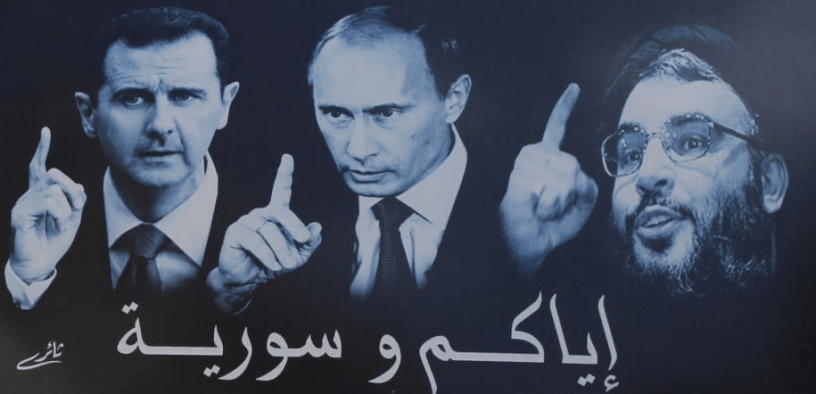
Speech by Hezbollah Secretary General Sayed Hassan Nasrallah on May 13, 2020, in commemoration of the martyrdom of Hezbollah Commander Mostapha Badreddine, killed in Syria in May 2016.
Summary:
- Syria has already won the war, even if there are still some minor battles to be fought
- Having failed militarily, the enemies of Syria strive doubly hard in their diplomatic, economic and psychological warfare
- There is no dissension between the allies of Damascus, nor a struggle for influence between Iran and Russia
- News of Bashar al-Assad being sidelined is just propaganda
- There are no Iranian armed forces in Syria, just military cadres and advisers
- Having bet everything on the terrorists, Israel sees its defeat and fears the recovery of Syria and the threat it will pose to the occupation of the Golan and the very existence of the Zionist entity
- The so-called Israeli campaign against the Iranian presence in Syria is nothing but window dressing aimed at reassuring Israeli opinion and providing cover for attacks on the Syrian ballistic power
- Israel presents as a victory a simple redeployment of forces due to successive victories over almost the entire Syrian territory, and a reduction in air movements between Iran and Syria due to the coronavirus
- Iran, Hezbollah and other Resistance movements will never leave Syria
- Israeli incursions into Syria are caused by worry, fear and adventurism, but can lead to uncontrolled escalation and regional war
This video only subtitles the last section of the transcript below, ‘Israel in Syria‘
Transcript:
Syria won the world war against it
[…] Today we can say that Syria won this war. In previous battles, when great achievements were made, such as after the liberation of Homs, Damascus, the South and even Aleppo, it was said that Syria had won the war, and analysts and specialists in strategic issues said no: Syria had won one (or more) battles, but had not (yet) won the war. Because a war is made of many battles: you can win a battle, lose another, win a third, lose the fourth, but all that does not (necessarily) mean that the whole war is won, or that the whole war is lost.
Today, in all simplicity, and via an objective and genuine assessment (of the situation), whoever goes to Syria and travels there —except for the politicized Arab (and Western) media—, whoever goes to Syria, in its provinces, in its cities, in its villages and boroughs, in all the regions currently in the hands of the State, anyone who observes the overall situation in Syria can easily affirm that Syria won the war, although there are still some battles going on. It should not be said that Syria has won one, two or three battles, and has lost one or two others, and that the war is still going on, without it being clear whether Syria will win it or not, no. The fair and accurate strategic assessment is that the Syrian leaders, the Syrian army, the Syrian State and the great majority of the Syrian people who stood firm in this struggle won this war.
Of course, there are still a few battles left, military or political, which require persistence and continuity of action, whether in Idlib, East of the Euphrates or certain areas North of Syria, but this is only a partial, limited and circumscribed part (of Syria). Syria has triumphed over partition projects, Syria has won this war, and suffice it to say that the objectives of this world war (against Syria) for which, according to their own admission, hundreds of billions of Arabian dollars have been spent —the dollar is American, but it is the Arab (countries) that have paid the bills; if this money had been spent for the good of the Arab peoples of our region, they would have extricated them from ignorance, poverty, misery, illiteracy, diseases, and the said funding countries (Saudi Arabia, etc. ) would not face financial incapacity in the face of the economic consequences of the Covid-19 pandemic as they do now—, thousands of tons of weapons and ammunition, tens of thousands of terrorists and takfiris who were brought from all over the world, dozens of international conferences, etc., etc., etc. They have deployed everything, done everything, absolutely everything, to achieve their objective in Syria: sectarian or political slogans, incitement (to racial or religious hatred), everything that the front of Arrogance (imperialism) and its instruments were able to mobilize in terms of resources and ideology, everything they could do against Syria, they did. And Syria, through the perseverance of its leaders, its army, its people and the State, and thanks to the presence and perseverance of its allies by its side, managed to win this war.
And that is why today, when we talk about our martyr leader, Sayed Mustapha Badreddine, and our other martyrs in Syria, we feel, in addition to the consequences for their afterlife and their (eminent) position close to God the Most High and the Exalted as martyrs, we have the feeling that their blood has borne fruit and enabled these results to be achieved, and that the objective for which they went to fight and for which they sacrificed their blood, their peace and their life, and for which they made unremitting efforts night and day, this goal was achieved and it is before our eyes today.
Economic, diplomatic & psychological warfare
I will now raise some points (concerning Syria). The first point is that naturally, what (the enemies of Syria) have been unable to achieve militarily, they have been trying for the past few years to obtain it politically, through political pressure on the Syrian leaders, on the allies of Syria, on Iran, on Russia, on those who stand alongside Syria, through international relations, through the UN Security Council, through intimidation, threats and tempting promises, so that the allies of Damascus will abandon Syria. But all of this has failed so far. And we know that sometimes the political battle is just as intense as the armed struggle. And sometimes its dangers are even greater, and require all of our vigilance and attention. Syria is still plunged into political war and is facing political pressures which, so far, have failed to achieve any of their goals.
Naturally, and I come to the second point, after the failure of the military war and the impotence and the ineffectiveness of the political war and the political pressures in achieving any objective at all, the front of Arrogance (imperialism), the American despots and their Allies resorted to other means, namely psychological warfare on the one hand, and sanctions and blockade on the other. With regard to psychological warfare, a very broad front has been open for years against Syria, and lately there has been an intensification of psychological warfare, some aspects of which I will touch on in a moment. Likewise, the sanctions and the state of siege against Syria are increasing, and they are betting on the economic consequences (which they hope will become unbearable for Syria and its allies). The coronavirus has added to these pressures, but this pandemic is not specific to Syria: the pressures of the coronavirus are weighing on the whole world. Today, those who besiege Iran, Syria, Venezuela and other countries, Gaza, Yemen, etc., are starting to suffer the economic consequences of the coronavirus themselves. We have all seen the catastrophe hitting the United States, the countries of Western Europe, as well as certain countries in our region (Saudi Arabia, etc.). In any event, it is also a means of attacking Syria, namely economic pressures, sanctions, the state of siege against Syria.
With regard to the sanctions and the blockade, we place our hopes on the endurance of the Syrian leaders, the Syrian State and the Syrian people, just as they persevered in the face of the military and political war. What gives us hope is that Syria is a country endowed with human capital and colossal possibilities; the Syrian people are full of liveliness, the wealth and innate means of Syria are many and huge. Before the crisis, Syria was not a debt-ridden or weak country, nor was it a country brimming with wealth, but its economy was entirely viable. In some Arab countries, millions of people live in cemeteries, but no family lived in a cemetery in Syria. Anyway, in the economic battle, the livelihood battle, the financial battle, we have good hope in the endurance and initiative of Syria, just as we trust Syria to succeed against the psychological battle.
Tensions between Syria’s allies ?
With regard to the psychological battle, I would like to give an example, before addressing my last point concerning Syria. Part of the psychological battle concerns the situation of the allies, and we often hear that the allies of Damascus have started to abandon Syria. (According to these rumors), Iran would be entangled in its internal situation and would prepare to abandon Syria. Russia, because of the pressures, its internal situation, such pressures or such problems or I don’t know what other rubbish, would abandon Syria. All these words express only dreams and hopes that we have been hearing for years, and some have been disseminated as if they were information, etc., but they were only aspirations (US / Israeli / Saudi wishful thinking).
Among the talking points of the current psychological warfare, let us quote again the recurrent remarks that we find in the media of the Gulf and certain Western media —the Western media are more reluctant to diffuse these reports, because they try to preserve the (little) credibility they still have— about an Iranian-Russian power struggle in Syria. There is no hint of truth in it. I said at the beginning of my speech that I was going to talk about Iran again. In the two points that remain for me to address (on Syria), I will clearly point out certain sensitive points which concern the Islamic Republic of Iran.
Neither the Islamic Republic of Iran, nor Hezbollah, nor the Resistance factions from different countries —Iraq, Afghanistan, Pakistan, etc. ; yes, Resistance movements came from these countries and fought in Syria alongside the Syrian Arab Army, the Syrian people and the Syrian popular forces, and are still present there… The Islamic Republic of Iran is not fighting for influence against anyone in Syria. Neither against Russia —regardless of what Russia is doing— nor against anyone. The position of the Islamic Republic in Syria was clear from the beginning: its (only) goal was to prevent the fall of Syria under American-Israeli control, and under the control of the instruments of Arrogance (imperialism), our common enemy. This was Iran’s goal, and nothing else. The Islamic Republic does not seek any influence in Syria, it has no aims and no greed in Syria, and has no desire to interfere in the internal affairs of Syria. Iranian interference in Syria has never existed, does not exist and will never exist with regard to internal Syrian issues, whether in the form of the regime, government, laws, the State… Iran will never do anything that some other States (especially the imperialist and neo-colonialist West) do, in any case. All that mattered and still matters for the Islamic Republic of Iran is that Syria remains in its (pro-) Arab, (pro-) Islamic, (pro-) Resistance position, that it preserves its identity, its independence, its sovereignty, its unity, that Syria remains a noble and dignified, persevering fortress, does not submit to American and Zionist hegemony, and does not compromise on its rights (over the Golan). This is all that Iran wants in Syria, no more no less. And that does not enter into any struggle for influence with anyone.
Certainly, to be completely frank and sincere, there may be differences between the allies as regards the definition of certain military or ground priorities, political questions, at the level of negotiations, etc. But this in no way leads to a struggle for influence, because the decisions of the Islamic Republic are categorical as regards the position alongside the Syrian leaders (who have the final say on all matters), Iran complying with what they determine and accept. The Islamic Republic has a position of support towards the endurance, the persistence, the maintenance and the independence of Syria, and its resilience in the face of projects of hegemony and control over it, and of liquidation of the Axis of Resistance in the region. In this regard, I would therefore like to reassure the masses & supporters of the Resistance in the Arab-Islamic world: in Syria, there is no struggle for influence between Iran and Russia. So could we say that the front of the allies and supporters of Damascus is plagued by internal strife or is in withdrawal? This is absolutely not true.
Israel in Syria
The other point I also wanted to talk about concerning Syria and Iran in Syria, and the Israeli enemy in Syria, is the Israeli aggression and the Israeli project in Syria. Especially in the past few weeks, the Zionist Israeli Minister of War (Naftali Bennett) is trying to brag and present (false victories) to the Israeli masses, lying to them and misleading them, and also to the public opinion in the Arab-Muslim world —and there are also Arab media that spread these lies and falsifications—, in order to highlight the imaginary victories and achievements of Israel in Syria at the expense of Syria, the Islamic Republic of Iran and the Axis of Resistance. I want to talk about it a bit, and it may be the first time that I do it in such a frank and detailed way, even if it will be synthetic.
During the first years (of the war in Syria), from 2011, Israel bet on the (terrorist) armed groups. The relations of the armed groups —especially in the south of Syria— with Israel are absolutely undeniable: exchange of information, financing, supplies, medical care, aid and support of all kinds, up to transit, all this is well known and obvious. Israel has been active in the war in Syria since 2011, and has counted & invested heavily on those who fight the regime in Syria. Israel had a whole set of objectives, the highest of which was the fall of the regime and the liquidation of the current administration (of Bashar al-Assad). But there were several other lesser goals.
When this war against Syria failed, and the Zionists understood that their instruments and the horse on which they had bet had failed in Syria, and that they had lost the war… They are still fighting in Syria, but they lost the war, as I just explained. The proof is that all of southern Syria, the vast majority of which was under the control of armed groups, which cooperated with Israel, was assisted by Israel and were Israel’s allies both openly and secretly, they all left, and some left Syria via the Zionist entity. We don’t forget their buses at night.
The Israelis therefore understood that their objective (to bring down the regime) had failed. They therefore aimed at a new objective, namely to fight against a new danger which appears to them, new dangers which will emanate from the situation and the victory in Syria. What are these new dangers? Some reside in the Syrian Arab forces themselves, in the Syrian army and in the Syrian military capabilities, especially with regard to ballistic capability and the manufacture of precision missiles. And that’s why we see that Israel is attacking everything related to the production of missiles in Syria, because he considers that the ballistic capacity and the manufacture of missiles constitute a (enormous) force for Syria, and obviously also for the Axis of Resistance.
Israel therefore considers Syria as a future threat, Syria which has stood firm during all these years in the face of a universal war waged against it: if Damascus regains its strength and regains its health, and develops its military, human and material capabilities, this will give Syria prevalence in the region and in the Arab-Israeli struggle. Therefore, Israel considers Syria as a threat, a future threat: Syria may not be a current threat, because it remains entangled in its internal situation and the few battles that remain to be fought. Likewise, Israel views the presence of Iran and Resistance factions in Syria as a threat. Israel is worried about Syria, Israel is afraid. Israel is terrified of what the future holds for it in Syria. This is the true description of the situation.
So look at the way Israeli officials express themselves about the Golan Heights, claiming that in southern Syria, for example, Hezbollah has a certain presence and a certain activity, and is trying to create a structure (of Resistance), with the help, silence or complicity of the Syrian authorities, cooperating with young Syrians (combatants) in order to recover the Golan and attack the Israeli occupation in the Golan. And all this while nothing important has happened yet. But this simple assumption, this simple fact created an atmosphere of terror within the Zionist entity, and sometimes pushes it to escalation measures which can lead to unforeseen and dramatic consequences (an open regional war). This indicates that Israel behaves towards Syria from a position of worry, fear and terror in the face of the consequences of the great victory in Syria. You have to keep that in mind in the first place.
Israel has therefore announced a goal in Syria. He cannot declare that he strikes Syria and the Syrian army, even if that is what he is doing concretely. Israel has therefore announced a goal linked to the Iranian presence in Syria, and the presence of Hezbollah, even if he insists above all on the Iranian presence. So they launched a campaign under the slogan “We want to expel Iran from Syria.” And their stupidity is such that it prompted the Israeli Minister of War, Naftali Bennett, to go so far as to set a timetable, promising that before the end of 2020, he would have ended the Iranian presence in Syria. So remember this deadline and count the months that we have before the end of the year to see what will happen to the promise of this stupid minister.
Israel has therefore worked to achieve this goal. What did they do, apart from the international, regional and domestic incitement, and the attempt to present the Iranian presence in Syria —which I will describe in detail— as having gone from a factor of assistance to a burden for Syria, which is a gross lie? They began with airstrikes and air operations which occasionally hit means of transport, warehouses or certain locations in Syria. This has been happening for years, and I never talked about it (in detail).
What is new? The new thing is that Israel goes astray, tricks its people and deceives the opinion in our region (and in the world) —and we are always fighting this battle to raise public awareness by revealing the truth—, trying to present certain details like the proofs of his victory in Syria and the beginning of the defeat of the Axis of Resistance or the Islamic Republic of Iran, the beginning of our exit and withdrawal (from Syria).
What are the clues and evidence that Israel puts forward? For several weeks, certain Israeli officials, media and analysts have been propagating these statements, even if other Israeli analysts say that these statements are inaccurate and just for show —and the latter are the ones who are right. Israel has spoken of several points (put forward as evidence of an Iranian withdrawal from Syria):
1/ the number of troops: the “Iranian (armed) forces”, to use their expression, would have greatly decreased in Syria;
2/ certain bases that have been evacuated, returned (to the Syrian authorities) or abandoned;
3/ the concentration of efforts on eastern Syria and the presence in the region of al-Boukamal, Deir Ezzor, etc.
The conclusion of all of this, (if we are to believe the Zionist enemy), is that the result of intelligence operations, military actions and aerial bombardments carried out by Israel, have largely fulfilled their objectives: Iran would leave Syria, the Iranians would be in full withdrawal, Hezbollah would retreat, and this moron (Bennett) believes he achieved an historic exploit which he trumpets at every occasion, predicting the full achievement of this objective before the end of 2020. Just see how he spreads these lies and fools public opinion.
Let me show you the real situation. First, regarding the situation on the ground, Israel keeps talking about the presence of “Iranian (armed) forces”, but in Syria there have only been Iranian military advisers and experts since 2011. I would like to say that they were present even before 2011 alongside the Syrian Arab Army and alongside the Resistance in Lebanon (Hezbollah), and after 2011, they remained, and due to the events, their number increased. But there are no Iranian military forces in Syria. When we talk about Iranian military forces, we mean one or more battalions, one or more units, legions, etc. That is what we are referring to when we talk about the armed forces.
There are a number of military advisers and experts in Syria, the number of which has increased with the events (since 2011). They had and still have a very important role:
1/ providing support and advice to the Syrian armed forces;
2/ managing groups of Syrian, Arab and Islamic popular forces which they train, arm and lead in the various battles in progress;
3/ coordinating operations with Resistance movements, including Hezbollah;
4/ coordinating the logistical support operations provided by the Iranian defense ministry to the Syrian defense ministry.
These Iranian advisers are not Iranian (armed) forces. It is not an Iranian armed presence.
You see, the Israelis announced a nonexistent, illusory, imaginary goal, similar to the objective of successive American administrations to prevent Iran from manufacturing nuclear weapons, while the Iranians do not have nuclear weapons and do not want to obtain nuclear weapons. In Syria, Israel is waging an imaginary battle to prevent Iranian forces from being present in Syria. While in Syria there are only Iranian military advisers and military experts. Despite all the difficulties, the situation in Syria in no way requires the arrival of Iranian (armed) forces in Syria.
To be frank and honest, at one point, a real discussion took place on this subject with the Iranian leaders, and at one point, for a few months, certain Iranian armed forces came to Aleppo, for 2 or 3 months. But apart from this exceptional case, there have never been Iranian forces in Syria, and I say and repeat that there are only advisers, in the number required by the situation: there may be more or less according to the needs of the field, and many of them fell martyrs —some could put forward this argument as proof of an armed presence; but it’s because these advisers were on the front lines alongside the Syrian Arab Army and Resistance factions, fighting and participating in battles, in the manner of the school of their commander of the al-Quds Forces, the martyr Qassem Soleimani, may God the Most High be pleased with him. This is therefore the real and precise description of the situation.
Secondly, naturally, as the battles were won, whether for the Iranians or the factions of the Resistance, and sometimes even for the Syrian army, when the battle or the threat ended in a region, there was no longer any reason to maintain a presence of combatants or military bases, nor our positions on combat axes and front lines. At one time, the fighting was taking place (simultaneously) in Homs, in the rif of Damascus, in Damascus, in the East of Homs, in the suburbs of Aleppo and in Aleppo itself, in Idlib, in the south of Syria, Badiya, al-Boukamal, Deir Ezzor, etc. It was therefore natural to have a presence (of the armed forces) in all these regions. While on the coast, there were no battles, and there was therefore no reason to have this presence.
When the province of Homs was liberated, this presence ceased. Same thing when the battles in Damascus and in the rif of Hama ended, as well as in southern Syria, in Palmyra and in the Badiya. If the Syrian army, of which it is the country, wanted to maintain a certain presence in certain barracks, to take the necessary precautions (to face a possible resurgence of the terrorists), that made sense; but as for the auxiliary forces, whether Iranians, Hezbollah or other factions of the Resistance, it is quite natural that they left this region, maintaining only the minimum of personnel, of combatants and of material there as a precaution. There would have been no reason to maintain the same number of forces, the same bases, etc.
For about two years, when this victory became clear, especially after the liberation of the Badiya and the opening of the highway to Aleppo, and the end of the battle in Damascus, in the rif of Damascus and in the south, the (Syrian & allied) forces gathered (in the last places of activity of the terrorists). The presence of many Iranian advisers was no longer required, and so they returned to Iran. Likewise for a number of Hezbollah fighters and cadres in Syria, whose presence was no longer useful, so they returned to Lebanon. Many of our Iraqi brothers and other nationalities were no longer required, so they returned home.
The situation in Syria having become very good, (what would have been the point of maintaining all this presence)? Some bases and barracks have always remained empty, and had been prepared in case there was a need for additional manpower. Many bases and barracks were no longer useful because there were no more fights, and were therefore abandoned. It all started two years ago or more, and has nothing to do with Israeli operations and attacks in Syria. It has nothing to do with the Israeli strikes in Syria. And that has nothing to do with the martyrdom of brother commander Hajj Qassem Soleimani. It started under his leadership, and the current leadership of the Al-Quds Forces (IRGC) continues the same program it began operating over two years ago.
Likewise, Hezbollah and the rest of the factions of the Resistance have started to do the same for more than two years, namely to decrease the troops, decrease the number of (active) bases, decrease the presence, because Syria begins to recover, Syria has won, the Syrian Arab Army has won, many frontlines no longer exist, the battles having been definitively won there. This is the truth.
Today, when anyone talks about a downsizing of foreign forces in Syria… Let me give you an example for Lebanon. At some point I announced that on the whole axis of Qalamoun, we ended our presence (that used to be massive), keeping only one or two positions. Same thing for the whole axis of Zabadani. All was done in coordination with the Syrian army. Is this an Israeli success? Or is this fact explained because the Syrian army and the Resistance won all the battles in these regions, as well as in the rif of Damascus, in the rif of Homs, etc. What would be the point, once the fighting is over, of staying on the mountains, in the cold, in the heat, what good is it to mobilize and use resources, etc. All that would be useless, it would be a waste of material and human resources. When the fighting is over, all we have to do is pack up and return to our main front, namely southern Lebanon (facing Israel).
The pseudo-evidence put forward by Israel today, namely the issue of the reduction of troops in Syria, the total or partial evacuation of certain places, bases or positions, this is only due to the fact that the presence there would no longer make any sense, as for example in Damascus or around Damascus, where the fighting has stopped. It is quite natural that the military presence should go to al-Boukamal, Deir Ezzor, Aleppo, Idlib, because the front lines are there, and there is no more fighting elsewhere. The remaining battles are there, so those who want to help must go there and not sit (arms crossed) in Damascus.
The pseudo-evidence advanced by Israel in no way proves Israeli successes, but proves the victory of Syria, the victory of the Islamic Republic of Iran, the victory of Hezbollah, the victory of the Axis of Resistance in Syria. This victory in the war involves, as with any army and any military force in the world, a redeployment of forces in accordance with new responsibilities and new challenges, in the light of our achievements and victories.
More so, a sign of the imbecility and lies of the Israeli media is that they have tried to explain the fact that for example, lately, the movements between Syria and Iran have decreased somewhat —air freight, the movement of airplanes—, and this has also been put forward as evidence of the Israeli military successes in Syria, while these claims are nothing but lies and falsifications. The cause is the coronavirus. The covid-19 which impacted the US military, European armies, and even the army of the Israeli enemy itself, which canceled maneuvers, training, and large military parades planned to celebrate the anniversary of the victory of 1945, and it is only natural that the pandemic also affects Syria, the Islamic Republic, ourselves and everyone.
To summarize this point, by way of synthesis before evoking the internal situation in Lebanon in the minutes that I have left, I would like to address the Israeli public to invite them to check their information and not to believe the lies of their leaders, who put forward imaginary victories in Syria, whether against Syria or against Iran. Admittedly, Syria suffers prejudice, just as Iranian advisers, Hezbollah and the Resistance in Syria are affected by the Israeli aggressions, which the Syrian, Iranian and Resistance leaders consider as they should —I don’t have time to speak in detail about our point of view on the issue, I will do it another time if necessary—, but the Israelis need to know that what their leaders are saying is only lies, deception and illusions, purely imaginary achievements. And if Israel continues on this path, they can make a mistake or a blunder that would blow up the whole region.
As for the announced objective, namely to expel the Iranian presence —the military advisers, and not the pseudo Iranian forces, as I explained— or even to expel Hezbollah and the Resistance from Syria, this objective will never be achieved, o Zionists. This objective will never be achieved. These advisers are present following a joint decision by Syria and Iran, and the Resistance movements are present at the request of the Syrian leaders and in accordance with the will of the Resistance movements themselves, and all those who, since 2011 to date, have sacrificed thousands of martyrs and suffered thousands of injuries, will not be defeated or deterred by an air strike or an assassination here and there. They will remain firmly on their positions, and will not abandon the battlefield or the place under any circumstances. This goal is unachievable.
These are just illusions that you live in your imagination; you are engaging in sheer adventurism, and at any moment, you can make a serious error in Syria that you will regret bitterly. […]
Source: https://video.moqawama.org/details.php?cid=1&linkid=2112
Translation: resistancenews.org
Belgium Urges Sanctions against Israel if it Annexes West Bank
Palestine Chronicle | June 27, 2020
The Belgian parliament on Friday passed a resolution urging the government to call on the European Union to impose sanctions against Israel if it proceeds with its plan to annex large swaths of the occupied West Bank.
The measure “concerning Israel’s annexation of occupied territories in Palestine”, passed in the 150-member House of Representatives with 101 affirmative votes, 39 abstentions and zero votes against it.
The body was also due to vote on a motion calling for the recognition of a Palestinian state but this was delayed after it was sent back to the foreign affairs committee for further debate.
MPs from left-wing parties, including the Socialist Party and members of the French and Green parties, proposed the resolutions.
“It is a matter of defending international law. There is no equidistance to be respected in this fight,” said MP Ecolo Simon Moutquin who authored the resolution.
The resolution has two objectives, he said: “On the one hand, send a message to the Israeli government ‘Don’t cross that red line’. On the other hand, give some hope to the Palestinians who have suffered injustice for decades.”
More than 1,000 European lawmakers across the political spectrum issued a letter earlier this week warning Israel against annexing parts of the occupied West Bank.
Legislators said they “share serious concerns about [US] President Trump’s plan for the Israeli-Palestinian conflict and the imminent prospect of Israeli annexation of West Bank territory.”
UAE conceals news about normalising ties with Israel
MEMO | June 27, 2020
Despite the official announcement, the United Arab Emirates’ (UAE) mass media has concealed news about medical cooperation with Israel from its people, Arab48.com reported on Friday.
The National reported the news while the Spokeswoman of the Ministry of Health Hend Al-Otaiba posted a tweet on her account.
It was noteworthy that the country’s mouthpieces, Sky News Arabic and Al-Hadath, did not make reference to this news, despite offering wide coverage of internal UAE issues and the medical assistance the country offers to the needy.
Local UAE newspapers including Al-Bayan, Al-Khaleej and Emarat Al-Youm also did not feature the news.
However, mass media covered the article of UAE Ambassador to the US Yousef Al-Otaiba, where he claimed that his country is moving against the Israeli annexation of Palestinian lands.
During the last two decades, Israel launched several major offensives on the Palestinians and Lebanese, and killed thousands along with settlement expansion at the expense of the Palestinians. Meanwhile, the Arab world, especially the UAE, continued criticising the Palestinian resistance while maintaining good relations with Israel.
‘Antisemitic conspiracy theory’ tweet sees Long-Bailey booted from UK Labour shadow cabinet
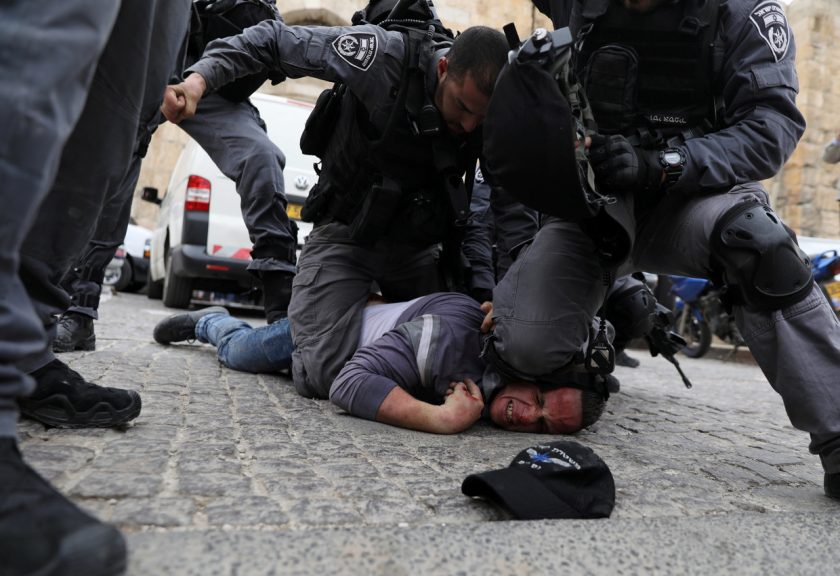
Israeli police officers detain Palestinian protestor outside the compound housing al-Aqsa Mosque in Jerusalem’s Old City March 12, 2019. © Reuters/Ammar Awad
RT | June 25, 2020
The UK Labour Party’s “antisemitism crisis” has claimed another victim, as shadow education secretary Rebecca Long-Bailey is fired for sharing an article containing a so-called “antisemitic conspiracy theory.”
“This afternoon Keir Starmer asked Rebecca Long-Bailey to step down from the shadow cabinet,” a spokesman for the Labour leader said, claiming that an article she shared earlier on Thursday contained an antisemitic conspiracy theory.
The statement went on to say that Starmer, who took over the party plagued with accusations of antisemitism, has been “clear that restoring trust with the Jewish community is a number one priority,” adding, “antisemitism takes many different forms and it is important that we all are vigilant against it.”
Long-Bailey shared an Independent interview with Maxine Peake on Twitter. In it, the actress says: “The tactics used by the police in America, kneeling on George Floyd’s neck, that was learnt from seminars with Israeli secret services.” It was later updated to include a denial by the Israeli police that this is the case, and a reference to an Amnesty International report about US law enforcement travel to Israel for training was removed.
Long-Bailey shared an Independent interview with Maxine Peake on Twitter. In it, the actress says: “The tactics used by the police in America, kneeling on George Floyd’s neck, that was learnt from seminars with Israeli secret services.” It was later updated to include a denial by the Israeli police that this is the case, and a reference to an Amnesty International report about US law enforcement travel to Israel for training was removed.
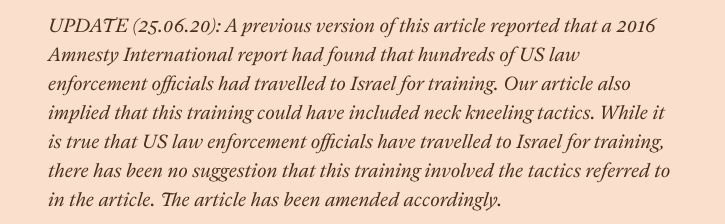
Amnesty International has said that Israeli forces train US law enforcement and partake in police exchange programs. In the wake of Floyd’s murder a number of articles circulated, reporting that Minnesota cops received Israeli training in Chicago in 2012. Israeli soldiers have been photographed leaning on Palestinians’ chests and necks, although Israel Police spokesman Mickey Rosenfeld denies this is a tactic they use. It of course isn’t proven that the police officer who killed Floyd was taught how to lean on people’s necks by Israeli police.
Long-Bailey tweeted an explanation for her retweet, saying she shared the article because of Peake’s “significant achievements and because the thrust of her argument is to stay in the Labour Party. It wasn’t intended to be an endorsement of all aspects of the article.”
She later added that she agreed on the wording of her explanation with the Labour Party Leader’s Office, but was “subsequently instructed to take both this agreed clarification and my original retweet down.” She said she couldn’t do this without issuing a press statement of clarification and asked to discuss it with Starmer but “sadly he had already made his decision.”
The Jewish Board of Deputies among a number of other groups which called out Long-Bailey’s tweet. Before she was fired, it released a statement slamming the politician’s “pathetic” response to criticism of her tweet and questioning her “suitability” for her role.
Truly Shameful BBC Israeli Propaganda
By Craig Murray | June 25, 2020
In a genuinely outrageous piece of victim blaming, BBC News just blamed Palestinian intransigence in refusing to accept Israeli annexation of the West Bank for the deaths of Palestinian children caused by the Israeli blockade of medical supplies to Gaza.
This is a precise quote from the BBC TV News presenter headline at 10.30am:
“The lives of hundreds of sick Palestinian children are being put at risk because of the latest downturn in relations between their leaders and Israel last month. The Palestinian President said his government was giving up on past peace agreements because of Israeli plans to annex parts of the West Bank. That decision stopped co-operation on many security and civil matters including medical and travel permits.”
There followed a heart rending piece by BBC Middle East correspondent Yolande Knell featuring Palestinian children in Gaza dying of various medical conditions and their distraught mothers.
The entire piece very plainly blamed Palestinian officials for the situation.
The BBC did not blame Israel for placing a blockade illegally preventing pharmaceuticals and medical supplies from entering Gaza – the basic reason the children cannot be treated at home.
The BBC did not blame Israel for blockading in illegally the civilian population of Gaza, so that these children cannot freely leave for treatment in Europe without Israeli clearance.
The BBC did not point out that the proposed annexation of the West Bank is illegal, has been condemned by the UN Secretary General and by 95% of the governments of the world, and will precipitate great violence.
No, the BBC blamed the Palestinians.
“Accept the illegal annexation of still more of your land, or small children will die and it will be your fault”.
That is a line the BBC are perfectly happy to push out on behalf of Israel. It is an astonishing moment for the UK state propagandist. It is important we do not ourselves become complacent at this absolutely unacceptable behaviour.
Why the assault on a diplomat in Israel should come as no surprise
By Jonathan Cook | June 22, 2020
An Israeli diplomat filed a complaint last week with police after he was pulled to the ground in Jerusalem by four security guards, who knelt on his neck for five minutes as he cried out: “I can’t breathe.”
There are obvious echoes of the treatment of George Floyd, an African-American killed by police in Minneapolis last month. His death triggered mass protests against police brutality and reinvigorated the Black Lives Matter movement. The incident in Jerusalem, by contrast, attracted only minor attention – even in Israel.
An assault by Israeli security officials on a diplomat sounds like an aberration – a peculiar case of mistaken identity – quite unlike an established pattern of police violence against poor black communities in the US. But that impression would be wrong.
The man attacked in Jerusalem was no ordinary Israeli diplomat. He was Bedouin, from Israel’s large Palestinian minority. One fifth of the population, this minority enjoys a very inferior form of Israeli citizenship.
Ishmael Khaldi’s exceptional success in becoming a diplomat, as well as his all-too-familiar experience as a Palestinian of abuse at the hands of the security services, exemplify the paradoxes of what amounts to Israel’s hybrid version of apartheid.
Khaldi and another 1.8 million Palestinian citizens are descended from the few Palestinians who survived a wave of expulsions in 1948 as a Jewish state was declared on the ruins of their homeland.
Israel continues to view these Palestinians – its non-Jewish citizens – as a subversive element that needs to be controlled and subdued through measures reminiscent of the old South Africa. But at the same time, Israel is desperate to portray itself as a western-style democracy.
So strangely, the Palestinian minority has found itself treated both as second-class citizens and as an unwilling shop-window dummy on which Israel can hang its pretensions of fairness and equality. That has resulted in two contradictory faces.
On one side, Israel segregates Jewish and Palestinian citizens, confining the latter to a handful of tightly ghettoised communities on a tiny fraction of the country’s territory. To prevent mixing and miscegenation, it strictly separates schools for Jewish and Palestinian children. The policy has been so successful that inter-marriage is all but non-existent. In a rare survey, the Central Bureau of Statistics found 19 such marriages took place in 2011.
The economy is largely segregated too.
Most Palestinian citizens are barred from Israel’s security industries and anything related to the occupation. State utilities, from the ports to the water, telecoms and electricity industries, are largely free of Palestinian citizens.
Job opportunities are concentrated instead in low-paying service industries and casual labour. Two thirds of Palestinian children in Israel live below the poverty line, compared to one fifth of Jewish children.
This ugly face is carefully hidden from outsiders.
On the other side, Israel loudly celebrates the right of Palestinian citizens to vote – an easy concession given that Israel engineered an overwhelming Jewish majority in 1948 by forcing most Palestinians into exile. It trumpets exceptional “Arab success stories”, glossing over the deeper truths they contain.
During the Covid-19 pandemic, Israel has been excitedly promoting the fact that one fifth of its doctors are Palestinian citizens – matching their proportion of the population. But in truth, the health sector is the one major sphere of life in Israel where segregation is not the norm. The brightest Palestinian students gravitate towards medicine because at least there the obstacles to success can be surmounted.
Compare that to higher education, where Palestinian citizens fill much less than one per cent of senior academic posts. The first Muslim judge, Khaled Kaboub, was appointed to the Supreme Court only two years ago – 70 years after Israel’s founding. Gamal Hakroosh became Israel’s first Muslim deputy police commissioner as recently as 2016; his role was restricted, of course, to handling policing in Palestinian communities.
Khaldi, the diplomat assaulted in Jerusalem, fits this mould. Raised in the village of Khawaled in the Galilee, his family was denied water, electricity and building permits. His home was a tent, where he studied by gaslight. Many tens of thousands of Palestinian citizens live in similar conditions.
Undoubtedly, the talented Khaldi overcame many hurdles to win a coveted place at university. He then served in the paramilitary border police, notorious for abusing Palestinians in the occupied territories.
He was marked out early on as a reliable advocate for Israel by an unusual combination of traits: his intelligence and determination; a steely refusal to be ground down by racism and discrimination; a pliable ethical code that condoned the oppression of fellow Palestinians; and blind deference to a Jewish state whose very definition excluded him.
Israel’s Foreign Ministry put him on a fast track, soon sending him to San Francisco and London. There his job was to fight the international campaign to boycott Israel, modelled on a similar one targeting apartheid South Africa, citing his own story as proof that in Israel anyone can succeed.
But in reality, Khaldi is an exception, and one cynically exploited to disprove the rule. Maybe that point occurred to him as he was being choked inside Jerusalem’s central bus station after he questioned a guard’s behaviour.
After all, everyone in Israel understands that Palestinian citizens – even the odd professor or legislator – are racially profiled and treated as an enemy. Stories of their physical or verbal abuse are unremarkable. Khaldi’s assault stands out only because he has proved himself such a compliant servant of a system designed to marginalise the community he belongs to.
This month, however, Israeli Prime Minister Benjamin Netanyahu himself chose to tear off the prettified, diplomatic mask represented by Khaldi. He appointed a new ambassador to the UK.
Tzipi Hotovely, a Jewish supremacist and Islamophobe, supports Israel’s annexation of the entire West Bank and the takeover of Al Aqsa mosque in Jerusalem. She is part of a new wave of entirely undiplomatic envoys being sent to foreign capitals.
Hotovely cares much less about Israel’s image than about making all the “Land of Israel”, including the occupied Palestinian territories, exclusively Jewish.
Her appointment signals progress of a kind. Diplomats such as herself may finally help people abroad understand why Khaldi, her obliging fellow diplomat, is being assaulted back home.
Featured Video

False Flags and the Dawn of Bioterrorism
or go to
Aletho News Archives – Video-Images
From the Archives
How 1960’s French Nuclear Tests Are Still Claiming Lives in Algeria
Sputnik – 15.02.2018
On February 13, 1960, France carried out its first nuclear test in Algeria’s southern Reggane region. According to official statistics, 17 nuclear tests were carried out in total over the next 6 years. The area remains affected, and local scientists say that radioactive contamination has caused genetic mutations and irreversibly changed the region.
There are no official statistics on the number of victims. The only figures can be found in the records kept by the French representative of the local church, which lists 42,000 victims of nuclear tests. Three years ago, the French Ministry of Defense issued a statement, putting the number at 27,000 people. The victims include French soldiers as well as local Algerians who lived in the surrounding areas. … continue
Blog Roll
 Aletho News
- Using nuclear weapons, the US-Israeli alliance still can’t beat Iran
- Sunset on the Quality of Western Propaganda: Arrival of the Dr Strangelove Moment
- Ukrainian general accused of protecting crime bosses
- US-‘Israel’ alliance faces growing rupture after midterms
- GOP’s Crushing Midterm Loss Could Reshape US Political Landscape – Analyst
- Midterm loss gives Congress power to rein in US war on Iran
- Midterms Were ‘Vote of No Confidence’ in GOP, But Iran Has No Illusions About Democrats – Marandi
- Israeli Soldiers Inadvertently Prove Their Own Genocidal Guilt
- Ukraine arrests woman who exposed Azov battalion’s ‘torture chamber’
- Did Israel lose the midterms?
- If Americans Knew
- An error has occurred; the feed is probably down. Try again later.
- No Tricks Zone
- New Study: The Net Fossil Fuel Contribution To Rising Atmospheric CO2 Has Been Zero For 500 Years
- Germany’s Green Energy Transition Becoming Increasingly Expensive…Another 6 Trillion Euros!
- Sudden Stratospheric Warming, Powerful El Niño Combination May Lead To Extreme Europe Cold, Energy Crisis!
- Two New Studies Find Thwaites Glacier Melt Cannot Be Driven By Human Activity Or A Warming Ocean
- E-Cars Reduce CO2 Emissions By Only 41% Compared To Internal Combustion Engine Vehicles
- Predictions Made By Renowned Climate Professor Over Past Decades Have Been Proven To Be Poor
- New Study Suggests Large Regions Of The Pacific Ocean Have Been Cooling For The Last 80 Years
- Germany’s Green Energy Debacle: High Energy Costs Force Kahla Porzellan to Close After 182 Years!
- New Study: 50 Years Of The Most Aggressive ‘Net Zero’ Policies Can Only Affect The Global Climate By 0.03°C
- US September “Heat” Was No Record…Many Records Set Decades Ago

