Hundreds of Palestinians flee as Israel opens dams into Gaza Valley
Ma’an – 22/02/2015
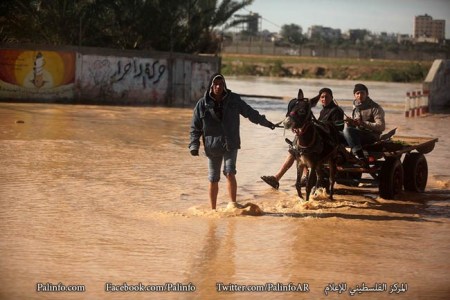
GAZA CITY – Hundreds of Palestinians were evacuated from their homes Sunday morning after Israeli authorities opened a number of dams near the border, flooding the Gaza Valley in the wake of a recent severe winter storm.
The Gaza Ministry of Interior said in a statement that civil defense services and teams from the Ministry of Public Works had evacuated more than 80 families from both sides of the Gaza Valley (Wadi Gaza) after their homes flooded as water levels reached more than three meters.
Gaza has experienced flooding in recent days amid a major storm that saw temperatures drop and frigid rain pour down.
The storm displaced dozens and caused hardship for tens of thousands, including many of the approximately 110,000 Palestinians left homeless by Israel’s assault over the summer.
The suffering is compounded by the fact that Israel has maintained a complete siege over Gaza for the last eight years, severely limiting electricity and the availability of fuel for generators. It has also prevented the displaced from rebuilding their homes, as construction materials are largely banned from entering.
Gaza civil defense services spokesman Muhammad al-Midana warned that further harm could be caused if Israel opens up more dams in the area, noting that water is currently flowing at a high speed from the Israel border through the valley and into the Mediterranean sea.
Evacuated families have been sent to shelters sponsored by UNRWA, the UN agency for Palestinian refugees, in al-Bureij refugee camp and in al-Zahra neighborhood in the central Gaza Strip.
The Gaza Valley (Wadi Gaza) is a wetland located in the central Gaza Strip between al-Nuseirat refugee camp and al-Moghraqa. It is called HaBesor in Hebrew, and it flows from two streams — one whose source runs from near Beersheba, and the other from near Hebron.
Israeli dams on the river to collect rainwater have dried up the wetlands inside Gaza, and destroyed the only source of surface water in the area.
Locals have continued to use it to dispose of their waste for lack of other ways to do so, however, creating an environmental hazard.
This is not the first time Israeli authorities have opened the Gaza Valley dams.
In Dec. 2013, Israeli authorities also opened the dams amid heavy flooding in the Gaza Strip. The resulting floods damaged dozens of homes and forces many families in the area from their homes.
In 2010, the dams were opened as well, forcing 100 families from their homes. At the time civil defense services said that they had managed to save seven people who had been at risk of drowning.
Israel is still banning Gaza students from West Bank universities
MEMO | February 20, 2015
Palestinian students from Gaza are still prevented by Israel from studying at West Bank universities, after an announcement this week to the contrary was retracted as a mistake.
On Wednesday, Israel’s Coordinator of Government Activities in the Territories (COGAT) announced that a quota of 50 students would be permitted to exit Gaza “for the purpose of academic studies” in the West Bank. However, as related by NGO Gisha, the very same evening, COGAT clarified that there had been a “clerical error” in the relevant document, and that there would be no such permits.
The Israeli government has opposed Palestinians from Gaza studying in the West Bank on the grounds of ‘security’. The High Court of Justice has also rejected petitions by human rights groups on the matter, including one filed on behalf of five women studying gender, democracy and law.
In 2009, 21-year-old, Bethlehem University student Berlanty Azzam was arrested at a West Bank checkpoint and immediately returned to the Gaza Strip, after a solider noted Gaza City as the town of residence on her ID.
The ill-fated announcement was included on a list of various measures apparently prepared by Israel to “ease” restrictions. According to reports from COGAT and Palestinian officials, it would appear that the number of merchant permits will rise, as will the type and quantity of goods permitted to exit from Gaza for sale in the West Bank.
Back in November, two truckloads of wooden planks left Gaza for sale in the West Bank, the first time that wood from Gaza has been sold in the West Bank since the blockade was imposed in 2007. The same month, some truckloads of clothes, fish, and agricultural products made the same journey, again for the first time.
This is less indicative of Israeli authorities’ generosity but rather highlights the deception that is the ‘security’ rationale for the restrictions in the first place. Why were Gaza’s farmers allowed to send cucumbers to the West Bank on November 6, 2014 – but not before? Why won’t Israel lift restrictions on exports, save for piecemeal exceptions?
The continued refusal to allow Palestinian students from Gaza to study in West Bank universities is further evidence that Israel’s approach is one based on collective punishment. Worth remembering, the next time someone tries justifying yet another apartheid policy in the name of ‘security’.
UN Peace Coordinator Unwelcome by Palestinians
By Nicola Nasser | Al-Ahram | February 20, 2015
The PLO (Palestine Liberation Organisation) did not object to the appointment of new UN special coordinator for the Middle East peace process Nikolay Mladenov, although he was described by Tayseer Khaled, a member of the PLO’s Executive Committee, as “persona non grata” — not trusted by the Palestinians and nor qualified for the job.
The 15-member UN Security Council unanimously voted to appoint Bulgarian Mladenov, 42, to succeed Holland’s Robert Serry. He would also be the representative of the UN secretary general to the International Quartet (the UN, US, EU and Russia), and personal representative of the UN chief to the PLO and the Palestinian Authority (PA).
Although protocol allows the PLO the right to reject diplomatic representatives to the organisation, observers cannot understand why it accepted Mladenov. There is no convincing answer except a futile desire by the PLO to appease the UN and Secretary General Ban Ki-Moon, at a time when PLO diplomatic efforts are focused on the UN and its agencies.
Mladenov not only failed in a similar mission as UN envoy to Iraq and resigned, he is someone who describes himself — and is described by the leaders of the Israeli occupation — as “a good friend of Israel”. As Bulgarian foreign minister, Mladenov suggested a “military alliance” between Bulgaria and Israel. He has often spoken about his bias towards “Israel’s right to exist” and its right “to defend itself” against Palestinians resisting Israeli occupation. He even admitted to being a Free Mason, served Jewish billionaire George Soros, and publicly advocated the US’s “constructive chaos” policies in the Arab world. In fact, his Jewish origins may be the least controversial aspect of him.
Meanwhile, the occupation state does not hesitate in ignoring the UN, its resolutions and representatives, disregarding and even assassinating them when necessary. Most recently, Israeli Foreign Minister Avigdor Lieberman threatened to “expel” Mladenov’s predecessor Serry as “persona non grata”. Shortly before that, William Schabas, the head of the UN commission investigating the occupation’s recent war on the Gaza Strip, resigned after Israel refused to cooperate with him or allow him to enter the country.
After the UN tolerated the assassination of its first envoy to Palestine, Swedish Count Folke Bernadotte in 1948, at the hands of the Zionist Stern Gang led by Yitzhak Shamir (who later became prime minister of the occupation state), Israel was emboldened to adopt a permanent policy of disregarding the UN without deterrence so far.
In fact, over the past two years the occupation state has carried out a proxy war against the UN. It has facilitated logistics, intelligence, firepower and medical assistance to allow the domination of militias fighting the Syrian regime on its side of the disengagement zone between the liberated and occupied Arab Syrian Golan. This compelled the UN Disengagement Observer Force (UNDOF) to withdraw after its positions were attacked, dozens of its troops kidnapped and their weapons and equipment seized. Until today, the UN has not dared to rectify the situation, which resulted in the collapse of the UN-sponsored ceasefire and rules of engagement between Syria and Israel.
The Middle East is teeming with international peace envoys. The UN has one, so does the US, the EU, Russia, China and the Quartet. Their names change without anything on the ground in occupied Palestine changing. Except for expanding the occupation through settlements under the “peace” umbrella these envoys provide, without any hope that the international community they represent will be able to effect any real tangible change for the present and future of the Palestinian people on the ground.
So what can Mladenov do that his predecessors, the UN, the Quartet, the Arab League and others, couldn’t?
Khaled believes the real test, to remove Palestinian doubts about Mladenov’s role and mission, will be his position on the siege on Gaza and reconstruction there. However, Mladenov’s track record does not indicate there is cause for optimism. Nor does the track record of “UN special coordinators” since the creation of the position in 1994 and the subsequent expansion of its role, as well as the extensive history of choosing UN and US envoys of Jewish origins or related in the first degree to Jews, such as Henry Kissinger, Madeleine Albright, John Kerry, Dennis Ross, Martin Indyk and Quartet representative Tony Blair.
On 6 February, the secretaries general of the UN and Arab League issued a joint statement expressing “deep concern” about conditions in Gaza. They urged Arab and international donors to honour their financial pledges made at the Cairo Conference last October “as soon as possible”, in order to rebuild the Gaza Strip and end the siege there. A few days ago, James Rowley, UN coordinator for humanitarian affairs in the Palestinian territories occupied since 1967, sent out an “urgent call” for these commitments to be fulfilled and an “immediate” lift of the siege on Gaza, because he is “very concerned another conflict will break out” if not.
The Palestinian Foreign Ministry described the statement by the Quartet on 8 February after it met in Munich, Germany, as “short of expectations” because it ignored “all the old-new and evolving truths” of the occupation state.
The Quartet also said it is “deeply concerned” about the “difficult conditions in Gaza where reconstruction needs to be quicker” and urged donors to “pay their financial pledges as soon as possible”. However, it linked this to encouraging both sides to “restart negotiations as soon as possible”.
Restarting talks “as soon as possible”, nonetheless, must await the outcome of general elections in Israel and the US. This means the Palestinian people must wait for another two years in the vain hope of reconstructing Gaza. It is obvious the occupation state is enjoying the luxury of time, making easy the occupation without resistance, as well as building settlements without deterrence.
Before handing over the reins to Mladenov, Serry described the failure of donors to pay their dues as “scandalous” and warned “if there is no progress in the coming months” — not two years — towards a two-state solution, “the reality will be a one state [solution]”: the single state of Israel. Former UN coordinator Terry Rod Larsen said in 2002, “the Palestinian patient is dying in the interim.”
Last December, Serry warned in his report to the Security Council that a war in Gaza “could re-ignite if conditions on the ground do not change” in the besieged Gaza Strip. It is clear that what Serry described as a “deadly diplomatic vacuum” coupled with the ongoing siege on rebuilding Gaza, are an explosive recipe in the besieged Gaza Strip, the outcome and ramifications of which are unpredictable.
The “scandal” of donors not paying their dues to rebuild Gaza, as Serry described it, under the pretext that the PLO government does not control the Gaza Strip, is a green light given by the international community to the occupation state to carry out another military assault on national resistance forces in Gaza.
The scandal of Arabs not paying their pledges at Arab summits to provide the PA with a financial “safety net” amounts to flagrant Arab pressure on the PLO to accept the Quartet’s proposal to restart talks with the occupation state “as soon as possible”.
This is Mladenov’s dual mission as the new UN special coordinator for the Middle East peace process. PLO negotiators continue to wait for a breakthrough by “peace” envoys that are imposed on them and appointed by the US and the UN, although they represent the occupation state. Mladenov is the most recent. He will not change anything on the ground.
Translation by Palestine Chronicle
Nicola Nasser is a veteran Arab journalist based in Bir Zeit, West Bank of the Israeli-occupied Palestinian territories. He can be reached at: nassernicola@ymail.com.
New testimonies from Palestinian children subjected to torture in Israeli prisons
IMEMC News & Agencies | February 19, 2015
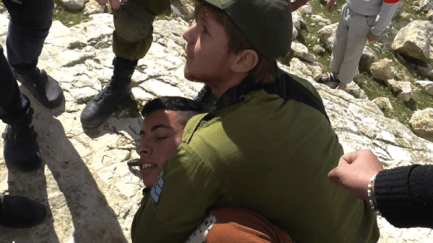
New testimonies from Palestinian minors have made their way out of Israeli prisons, speaking of the brutal beating and torture of youngsters conducted by Israeli soldiers and investigators.
Hiba Masalha, lawyer of the Palestinian Detainees Committee, who visited a number of children in HaSharon Israeli prison, said that the prisoners suffered incredibly savage treatment and brutality.
According to the PNN, 16-year-old prisoner Mohammed Zidani, from Silwan village, who was detained on the 10th of November, last year, and sentenced to 16 months of prison on January 19 of this year, said that he underwent electric shocks during his detention, for “confessions”.
Ziadni told Masalha that he was driven away from his home at 2 AM by private units and soldiers after they overwhelmingly raided his home, then dragged him to the Mascoubiya detention center, “room number 4”. The child said that, before they reached their destination, they stopped the military jeep bearing them, took him down to the street and started beating him so hard he suffered bruises and contusions all over his body.
In Mascoubiya room number 4, Mohammed said that he was forced to kneel and put his head between the legs, with his hands cuffed to his back and his eyes blindfolded. He was kept in this position for 4 hours. The investigation carried on for about 12 hours. He was given no food and was not allowed to go to bathroom.
Zidani said that during the investigation sessions that used to carry on until after midnight, the investigators beat him on his face and stomach.
During one of the sessions, Mohammed said, the investigator had “a stick shaped machine,” put it on his foot and pressed a button. Mohammed then felt the electric shock invading his body, and had unbearable pain in his foot. The investigator repeated the process three times in a row to “pull confessions out of him.” He started shouting of pain.
The testimony of another child prisoner, Kathem Annous (15) further demonstrates the torture children receive in Israeli jails.
Kathem, from Ras Al-Amoud, in occupied East Jerusalem, has been detained since November 3 of last year, in Hasharom prison. Similar to Mohammed Zidani’s case, he was driven from his home by Israeli soldiers and intelligence, and driven to a nearby settlement handcuffed and blindfolded, and kept for hours in the cold.
One soldier, using his iron-soled shoe, slammed Kathem’s foot, causing him contusions. He was then driven to Mascoubiya detention center.
During the investigation, Kathem was forced to kneel and point his head towards the wall, handcuffed. The investigation took 3 hours, in which Kathem was constantly beaten on his stomach and slapped on the face. He was kept in Mascoubiya for 12 days.
Annous said that he was also beaten by the Nahshon forces on his way to the court, and his handcuffs were very tightened. He mentioned that one time,a Nahshon member attacked him in the waiting room, and started violently knocking his head against the wall, for no reason whatsoever.
Anemic 14-year-old prisoner, Khaled Al-Sheikh, has been imprisoned for 55 days now, and hasnt been allowed to see his parents since then.
Child abuse in Israeli prisons is on the increase. According to Ahrar Center, there are about 300 children detained in Israeli prisons.
Briefing – Gaza: Life beneath the drones
By Tom Anderson and Therezia Cooper | Corporate Watch | February 19, 2015
 Click here to download – 150 DPI PDF | 300 DPI PDF
Click here to buy
Click here to read online
Unpiloted aircraft, known as drones in the arms industry, have become Israel’s weapon of choice in its attacks on Gaza. In 2012 drones killed more people in Gaza than any other aircraft. In Israel’s ‘Operation Protective Edge’ attack, 37% of those killed died in drone attacks.
In 2013 Corporate Watch visited Gaza for two months to interview the survivors of drone attacks and human rights workers about the effect of living beneath the drones. The interviews tell the story of the survivors and highlights their calls for support from the global solidarity movement.
This briefing compiles the interviews and gives short profiles of some of the companies profiting from Israel’s drone wars: Elbit and IAI.
We hope that reading this briefing will inspire you to take action in solidarity with people living under siege in Gaza. As one survivor of a drone strike told us: “We do not need just words”.
Hamas rebuffs Blair’s allegations
MEMO | February 18, 2015
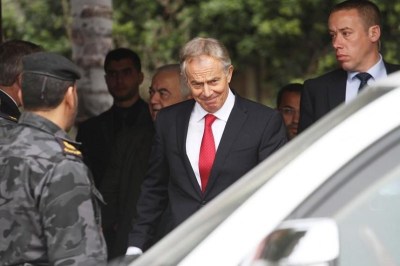
Senior member of Hamas’ political bureau Mousa Abu-Marzkouk yesterday revealed that Quartet peace envoy Tony Blair is trying to blackmail Hamas in return for reconstructing the Gaza Strip.
On his Facebook page, Abu-Marzouk revealed five conditions put by the Quartet that Hamas has to meet in order to make way for the reconstruction of what the Israeli occupation destroyed during last summer’s 51-day war in Gaza.
Abu-Marzouk said: “Once again, and in the name of the international community, Tony Blair is exploiting the tragedy made by the Israeli occupation that includes the destruction of homes and making people homeless.”
Expressing deep concern about the devastated people in Gaza, Abu-Marzouk said: “Destroyed homes of Palestinians in Gaza became shrines to Blair and his likes. Blair says that there is no reconstruction unless these five conditions are fulfilled, and Hamas has to agree to:
- Accept the Palestinian reconciliation.
- Accept the political programme based on a Palestinian state on 1967 borders.
- Reiterate that Hamas is a Palestinian faction with only Palestinian goals and it is not part of any Islamist movement with regional goals.
- Adopt the two-state solution as a final, not temporary, solution for the Palestinian-Israeli conflict.
- Send an assurance message to Egypt that Gaza is not a terror base for Sinai terrorists and hold talks with the Egyptian government to stop terrorism in Sinai.”
“These are the conditions for Hamas to be accepted by the international community as well as the Quartet’s conditions for rebuilding Gaza and improving living standards,” Abu-Marzouk said.
He added: “These conditions do not mean that Hamas will deal with the Zionist enemy; not even one condition was put on Israel.”
Abu-Marzouk refuted the conditions one by one. Regarding the reconciliation, he said: “It was achieved. I do not know what more is needed from Hamas, which conceded everything for a technocrat government.”
About the state on the 1967 borders, he said: “The problem is not with the Palestinian side, but with the other side. Blair should have spoken about it with Israel. He should have asked it whether it accepts a Palestinian state on the 1967 borders with Jerusalem as its capital and whether it accepts to dismantle settlements.”
Regarding Hamas’s goals, he stressed that Hamas is a Palestinian faction with Palestinian goals and it is not part of a regional Islamist movement. “We know that he means the Muslim Brotherhood,” he said.
“This is used by all as a pretext,” he stressed. “Hamas is a Palestinian movement and its history proves that as it has not carried out any of its operations outside the Palestinian lands. Even when its leaders were targeted outside Palestine, it did not respond in the same places.”
Meanwhile, he reiterated the importance of Hamas having links with any side offering help for it. “We have no interest to have hostility with any party wherever it is and whatever the ideological differences with it are,” he said.
About the two-state solution, Abu-Marzouk said: “Blair knows that any oppressive agreement cannot remain alive for too long. Any agreement imposed by the current powers cannot remain the same when these powers change.”
Regarding Egypt, he explained: “Egypt is not merely a neighbouring country; its stability and unity are in the Palestinian interest. We deal seriously and responsibly with anyone who harms Egypt. Gaza will absolutely not be a breeding ground for terrorism.”
Adding that Hamas’s relationship with Egypt is not of Blair’s concern.
Journalism Student & Folk Dancer, Lina Khattab, Sentenced to Six Months
By Saed Bannoura | IMEMC News | February 17, 2015
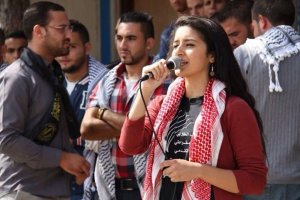 The Israeli military court in the ‘Ofer prison, in the occupied West Bank, sentenced on Monday, a Palestinian journalism student who is also a Folk Dancer and activist, Lina Khattab, to six months imprisonment and a 6,000 Shekel fine.
The court also instated a three-year suspended sentence on Khattab, 17 years of age, for what it called “participating in a protest in solidarity with Palestinian political prisoners,” in front of the Ofer prison.
Lina Khattab, who is a Journalism student at Birzeit University, was kidnapped by Israeli soldiers on December 13, 2014, during a nonviolent protest organized by students marking the 47th anniversary of the establishment of the leftist Popular Front for the Liberation of Palestine (PFLP).
This past December, an Al-Quds News broadcast report about Lina featured an interview with her mother who spoke of the kidnapping of her daughter by the soldiers, who deliberately targeted her for her nonviolent political activities.
In the interview, Lina’s mother said that when she managed to see her for the first time, she noticed that her daughter has lost a lot of weight, and also told reporters that despite harsh living conditions and interrogation methods, her daughter remained steadfast to her principles of justice and liberation.
She added that her daughter told her about the extreme beating she was subjected to when the soldiers kidnapped her, before placing her in their jeep, and that the soldiers were angered that despite the beating, she was not crying, and even asked her why she wasn’t crying, but she remained strong and steadfast without showing any signs of weakness.
The soldiers claimed she hurled stones at them, but she continuously told them she was visiting her friend, and that the soldiers were just trying to frame her by making different allegations and fabrication.
Following her arrest, Dina was moved to the ‘Ofer Israeli prison, were she was forced to stand against a wall in the rain and cold, and the next day, she was moved to the HaSharon prison.
Whenever she was moved to HaSharon to the Ofer military court, the soldiers would wake her up nearly at 2 am, and deprive her from sleeping, before moving her to Ofer in a military vehicle while deliberately running cold air through the area of the vehicles were she was held, and once arriving in Ofer, she would also be placed in a cold room with a cooling system on despite the cold weather.
Activists in UK occupy second Israeli owned arms factory
MEMO | February 17, 2015
 A factory in Kent owned by Israeli arms company Elbit Systems was occupied early Tuesday morning by activists responding to the Palestinian call for solidarity and BDS.
Instro Precision, a subsidiary of Elbit, was occupied at 5am, with more than a dozen activists taking up positions on the roof and at the entrance.
According to a press release from London Palestine Action, “Instro is owned by Israeli arms company Elbit Systems, who make drones that are used to kill Palestinian civilians in Gaza.”
It adds: “Optical and camera systems like those made at the Instro factory are also supplied by Elbit for use in drones flown over Afghanistan, as well as in Israel’s apartheid wall.”
The site in Broadstairs, Kent, is the second Elbit-linked company to be targeted by activists in the UK, after a successful occupation last summer of a drone engine factory near Birmingham.
Campaign Against the Arms Trade, welcoming the direct action, pointed out on Twitter that “there are 4 Elbit sites in the UK” and that “activists have so far targeted Kent & Staffordshire.”
Just last month, the prosecution of protesters who had occupied that first factory was dropped at the last minute, when Elbit refused to hand over evidence about its exports of weaponry to Israel.
During ‘Operation Protective Edge’, the Israeli military killed hundreds of Palestinians with drones. Activists say that Elbit Systems supplies 85% of the drones used by the military, and that the company’s “share price rose in July off the back of the extensive use of its technology during Israel’s massacre.”
Demonstration in Bil’in honoring slain US citizens faces attacks and arrests by Israeli forces
International Solidarity Movement | February 17, 2015
Bil’in, Occupied Palestine – On Friday 13th February, Israeli forces assaulted the demonstration in Bil’in with hundreds of tear gas rounds, dozens of stun grenades and pepper spray, injuring eleven Palestinian, Israeli and international demonstrators. Member of the Bil’in popular committee Mohammed Khatib and a UK citizen and solidarity volunteer Michael “Mick” Bowman were both violently arrested. At the demonstration, Palestinian activists carried posters honoring Kayla Mueller and condemning the murders of the three students in Chapel Hill, North Carolina.
“As people were protesting a soldier suddenly came running, wielding pepper spray, spraying it at journalists and activists indiscriminately,” reported Karam Saleem, a Palestinian activist present documenting the demonstration. Those who had been pepper sprayed, including Mohammed Khatib, were taken down to an ambulance to treat their burns. Saleem continued, “Mohammed was about twenty meters away from the main part of the protest, still suffering from pepper spray, when suddenly a soldier ran after him and grabbed him. Another five soldiers quickly surrounded him and shoved him violently to the ground.”
He was handcuffed and blindfolded before being loaded into a military jeep.
Israeli forces targeted journalists and those attempting to document the protest; many were shoved and threatened while attempting to photograph or film. Those present reported that the Israeli military also fired tear gas directly at people holding cameras.

Journalist being assaulted by Israeli forces – only one of many that Friday in Bil’in (photo by ISM)
Israeli forces pepper sprayed demonstrators who were doing nothing more that trying to photograph the army’s brutality, and also pepper sprayed those holding posters of Kayla Mueller and the three US students from Chapel Hill. Jameel Al-Barghouthi, head of the Palestinian Authority Committee Against the Apartheid Wall and Settlements, Munthir Amira, head of the Popular Struggle Coordination Committee (PSCC), Mohammed Khatib, a member of Bil’in’s Popular Struggle Coordination Committee, Issam Rimawi, a Palestinian photojournalist, two Palestinian activists Abdallah Elian and Kafah Mansour, British citizen and activist Mick Bowman, two female Israeli activists, and one Danish and one Dutch female international volunteer were all injured.
“The army was extremely brutal yesterday in their use of tear gas, beatings, and pepper spray,” recalled Tali Shapiro, an Israeli activist who was severely pepper sprayed in Friday’s demonstration, suffering from first degree burns on her hands, ears, and most of her throat and neck. “We saw they were beating and arresting someone (Mohammed Khatib), so I ran towards them. By the time I got up the hill Mohammed had been taken away and another man [Mick] was on the ground with many soldiers on top of him, twisting his limbs and head. I immediately took out my phone to take pictures. The soldiers started pushing away journalists. They formed a line in front of several of us, and before I could assess the situation another soldier sprayed my face with pepper spray.”

Activist Tali Shapiro after being severely pepper sprayed (photo by ISM)
Fifty-six-year-old Mick Bowman, a social worker and resident of Newcastle upon Tyne, England, recalled that in the time before his arrest, “the Israeli forces behaved with particular aggression towards protesters who were carrying the posters of Kayla and of the students from Chapel Hill North Carolina.” Border police threw stun grenades directly towards demonstrators, scattering those holding posters near the front of the protest.
“Next thing I knew,” Mick recalled, “three or four soldiers jumped on me from behind and forced me to the ground. I was lying face downwards, with a couple of them kneeling on my back.

Mick Bowman, knelt on, assaulted and pepper sprayed by Israeli border police arresting him (photo by ISM)
As they were handcuffing me, one of them stood on my hand, rubbing his boot back and forth and crushing my thumb. One of them grabbed my nostrils, and another was pressing down on my face, causing abrasions and bruising around my right eye. After they had handcuffed me, a border policeman also pepper sprayed the left side of my face from the distance of a few inches.”
After their arrest, Mohammed and Mick were transported to the Binyamin settlement police station. Mohammed Khatib was taken to Ofer military prison and Michael Bowman was taken to Muskubiya (the Russian Compound) prison in Jerusalem. Both were charged with ‘assaulting a soldier.’
“When police officers use violence they always claim that violence was used against them. It’s standard procedure” explained Mohammed Khatib. Mick was released on the evening of February 14th, and Mohammed was eventually released on the evening of February 15th, on a bail of 4,000 shekels (1,030 USD).
Abdullah Abu Rahma, head of the Bil’in popular committee, described the purpose of demonstration in Bil’in: “On Friday we protested against the theft of our land by Israel’s illegal wall and settlements and to express our resistance to terrorism everywhere. We carried the images of Kayla Mueller who was killed while being held captive by Da’esh and who had marched with us in Bil’in. We also carried the images of Deah Barakat, Yusor Mohammad, and Razan Abu-Salha, who were murdered in their home in North Carolina. We made it clear that we will oppose terrorism and the killing of innocent people whether it is committed by organizations like Da’esh, by states like Israel or by individuals like the murderer from Chapel Hill.” This Friday will mark the tenth anniversary of Bil’in’s popular resistance demonstrations – against the Apartheid Wall, against the Israeli occupation, and against oppression and violence everywhere.
Israel’s claims on journalists slain in its war “misleading”
Palestine Information Center – February 16, 2015
 GAZA – The Palestinian ministry of information strongly denounced Israel’s channel 7 for fabricating claims about some of the journalists that had been killed by the Israeli army during the last war on the Gaza Strip, and described its report as “misleading.”
Israel’s channel 7 claimed in a recent report that eight of the journalists who were killed during Israel’s last military operation in Gaza were working for Hamas and Islamic Jihad.
The information ministry said in a press release on Sunday that the channel’s claims about the journalists was an exposed attempt by the Israeli government to shirk its responsibility for the crimes its army had committed against the journalists in Gaza.
The ministry underlined that all Israeli crimes against the journalists in the last war were documented in reports issued by international and local organizations, especially the International Federation of Journalists.
It said that Israel’s attempt to deflect attention from its crimes by questioning the number of slain journalists and their professional activities could not deceive the UN probe committee or the international community.
Israeli authorities ban water hook-up to Palestinian city
MEMO | February 16, 2015
Israeli Minister of National Infrastructure, Energy and Water, Silvan Shalom, banned water connection to the new West Bank Palestinian city of Rawabi, which is to house around 40,000 Palestinian families, Israeli newspaper Haaretz reported yesterday.
Israeli Defence Minister Moshe Ya’alon and the Coordinator of the Israeli Government Activities in the Palestinian Territories Major General Yoav Mordechai had ordered the Israeli Water Authority to provide water to the city.
However, Shalom refused Ya’alon’s instruction saying that water and sewage projects in the West Bank require the Israeli-Palestinian Joint Water Committee’s (JWC) approval.
Shalom blamed the Palestinians, claiming they have been refusing to convene the committee since 2010. The response from Shalom’s office stated that according to an agreement with the Palestinians signed in 1995, the committee is the principal party which decides on such issues in West Bank communities.
Haaretz reported the Palestinian side confirming that the committee had not convened since 2010, but they insisted this does not justify the ban to connect water to the city.
The head of project department in the Palestinian Water Authority, Ihab Al-Barghouti, said: “The reason that the committee has not convened was the Israeli condition that the committee must approve an Israeli settlement project in return for any approval of any Palestinian project.”
Al-Barghouti insisted that the Palestinians refused this condition, thus, they do not attend the committee’s meetings.
Featured Video

Spain train disaster raises questions over Israeli-linked security contractors
or go to
Aletho News Archives – Video-Images
From the Archives
Are There 50,000 ‘Israeli-born’ Individuals Living in the UK?
By Professor David Miller | August 18, 2026
Recent disclosures by the Zionist regime show that some 2,069 British nationals were serving in the IDF as of March 2025, according to Freedom of Information (FoI) requests submitted to the occupation forces (1,686 dual British-Israeli, plus 383 multinational). We cannot tell from the figures how many of these were already settler colonists and intend to stay in the colony, and how many will return or have returned to the UK. Presumably, those returning to the UK will number far fewer than 2,000, since many are known to have become permanently residents of the colony.
Additionally, the IDF figures only provide a snapshot, and do not tell us how many have served in the Jewish supremacist military either before or after March 2025. One way into the question of how many genocidaires are living in Britain is to ask how many current British residents were born in the Zionist colony. There is data on that, as we shall see. … continue
Blog Roll
 Aletho News
- US-Israeli war on Iran cost Persian Gulf states nearly $1T in damage, lost growth: Report
- Congress probe could put ‘Israel’ in dock over Iran war: Israeli media
- Spanish public prosecutor backs US demand to extradite pro-Palestine philanthropist Fergie Chambers
- Zelensky spent over 740 days outside Ukraine while West serves as his real home
- Indian captain of Russian ‘shadow fleet’ tanker faces 10-year jail term in UK
- Europe, US face higher heating bills amid Iran war fallout
- The Leak That Arrived Right on Cue
- No, New York Times, California’s Climate Has Always Been a Land of Flood, Drought, and Fire
- Are There 50,000 ‘Israeli-born’ Individuals Living in the UK?
- German CDU MPs Seek Climate “Misinformation” List
- If Americans Knew
- An error has occurred; the feed is probably down. Try again later.
- No Tricks Zone
- German Authorities Start Initiative To Evaluate Public Register For Climate “Disinformation” Spreaders!
- Zonal Asymmetry of Temperature Change in the Antarctic Circumpolar Current
- New Study: The Net Fossil Fuel Contribution To Rising Atmospheric CO2 Has Been Zero For 500 Years
- Germany’s Green Energy Transition Becoming Increasingly Expensive…Another 6 Trillion Euros!
- Sudden Stratospheric Warming, Powerful El Niño Combination May Lead To Extreme Europe Cold, Energy Crisis!
- Two New Studies Find Thwaites Glacier Melt Cannot Be Driven By Human Activity Or A Warming Ocean
- E-Cars Reduce CO2 Emissions By Only 41% Compared To Internal Combustion Engine Vehicles
- Predictions Made By Renowned Climate Professor Over Past Decades Have Been Proven To Be Poor
- New Study Suggests Large Regions Of The Pacific Ocean Have Been Cooling For The Last 80 Years
- Germany’s Green Energy Debacle: High Energy Costs Force Kahla Porzellan to Close After 182 Years!

