On Leaving the United States
A Long and Arduous Ordeal
By SAMI AL-ARIAN | CounterPunch | February 6, 2015
After 40 years, my time in the U.S. has come to an end. Like many immigrants of my generation, I came to the U.S. in 1975 to seek a higher education and greater opportunities. I also wanted to live in a free society where freedom of speech, association and religion are not only tolerated but guaranteed and protected under the law. That’s why I decided to stay and raise my family here, after earning my doctorate in 1986. Simply put, to me, freedom of speech and thought represented the cornerstone of a dignified life.
Today, freedom of expression has become a defining feature in the struggle to realize our humanity and liberty. The forces of intolerance, hegemony, and exclusionary politics tend to favor the stifling of free speech and the suppression of dissent. But nothing is more dangerous than when such suppression is perpetrated and sanctioned by government. As one early American once observed, “When the people fear their government, there is tyranny; when the government fears the people, there is liberty.” Because government has enormous power and authority over its people, such control must be checked, and people, especially those advocating unpopular opinions, must have absolute protections from governmental overreach and abuse of power.
A case in point of course is the issue of Palestinian self-determination. In the United States, as well as in many other western countries, those who support the Palestinian struggle for justice, and criticize Israel’s occupation and brutal policies, have often experienced an assault on their freedom of speech in academia, media, politics and society at large.
After the tragic events of September 11th, such actions by the government intensified, in the name of security. Far too many people have been targeted and punished because of their unpopular opinions or beliefs.
During their opening statement in my trial in June 2005, my lawyers showed the jury two poster-sized photographs of items that government agents took during searches of my home many years earlier. In one photo, there were several stacks of books taken from my home library. The other photo showed a small gun I owned at the time. The attorney looked the jury in the eyes and said: “This is what this case is about. When the government raided my client’s house, this is what they seized,” he said, pointing to the books, “and this is what they left,” he added, pointing to the gun in the other picture. “This case is not about terrorism but about my client’s right to freedom of speech,” he continued.
Indeed, much of the evidence the government presented to the jury during the six-month trial were speeches I delivered, lectures I presented, articles I wrote, magazines I edited, books I owned, conferences I convened, rallies I attended, interviews I gave, news I heard, and websites I never even accessed.
But the most disturbing part of the trial was not that the government offered my speeches, opinions, books, writings, and dreams into evidence, but that an intimidated judicial system allowed them to be admitted into evidence.
That’s why we applauded the jury’s verdict. Our jurors represented the best society had to offer. Despite all of the fear-mongering and scare tactics used by the authorities, the jury acted as free people, people of conscience, able to see through Big Brother’s tactics. One hard lesson that must be learned from the trial is that political cases should have no place in a free and democratic society.
But despite the long and arduous ordeal and hardships suffered by my family, I leave with no bitterness or resentment in my heart whatsoever. In fact, I’m very grateful for the opportunities and experiences afforded to me and my family in this country, and for the friendships we’ve cultivated over the decades. These are lifelong connections that could never be affected by distance.
I would like to thank God for all the blessings in my life. My faith sustained me during my many months in solitary confinement and gave me comfort that justice would ultimately prevail.
Our deep thanks go to the friends and supporters across the U.S., from university professors to grassroots activists, individuals and organizations, who have stood alongside us in the struggle for justice.
My trial attorneys, Linda Moreno and the late Bill Moffitt, were the best advocates anyone could ask for, both inside and outside of the courtroom. Their spirit, intelligence, passion and principle were inspirational to so many.
I am also grateful to Jonathan Turley and his legal team, whose tireless efforts saw the case to its conclusion. Jonathan’s commitment to justice and brilliant legal representation resulted in the government finally dropping the case.
Our gratitude also goes to my immigration lawyers, Ira Kurzban and John Pratt, for the tremendous work they did in smoothing the way for this next phase of our lives.
Thanks also to my children for their patience, perseverance and support during the challenges of the last decade. I am so proud of them.
Finally, my wife Nahla has been a pillar of love, strength and resilience. She kept our family together during the most difficult times. There are no words to convey the extent of my gratitude.
We look forward to the journey ahead and take with us the countless happy memories we formed during our life in the United States.
Sami Amin Al-Arian is a Palestinian-American civil rights activist who was a computer engineering professor at University of South Florida.
Israel Aerospace Industries: a company profile
By Tom Anderson | Corporate Watch | February 5, 2015
Israel Aerospace Industries is one of Israel’s biggest arms companies. Founded in 1953 as Bedek, IAI has long been at the forefront of Israel’s arms production and export. It also develops systems for commercial aircraft. In 2013, 73% of IAI’s sales revenues came from exports.
IAI and Israel’s drone wars
IAI was one of the earliest developers of drone technology and launched its first surveillance drone, the IAI Scout, in 1979. Since then the company has launched a number of drone models (see below). Drone development is handled by IAIs MALAT divisions. IAI describes its unmanned aerial systems as ‘combat proven’ and writes on its website of its drones’ “unsurpassed track record of over 1,200,000 operational flight hours for over 50 users on five continents”. According to Drone Wars UK, IAI has exported their UAVs, sometimes through joint venture agreements, to various European countries as well as South America, Australia, Canada and India and the company has a growing market in Africa.
IAI and Gaza
Most of IAI’s unmanned aerial vehicle (UAVs) are surveillance drones, but the Heron 1 and Heron TP both have strike capabilities and have been used in Gaza. According to Human Rights Watch (HRW),i the Heron can fly up to 40 hours and can carry four Spike missiles. It is also used for surveillance and to identify targets on the ground.
Drone Wars UKii reports that Israel was deploying armed Heron 1 drones during the Operation Summer Rains attack in Gaza in 2006.
The IAI Heron TP is Israel’s biggest drone, with a wing span of 26 metres. It was first used during Operation Cast Lead in Gaza during 2008-2009.iii When the Heron TP is marketed as ‘combat proven’ it means that it has been tried out on the people of Gaza with fatal consequences.
Attacks on Lebanon:
IAI’s Searcher and Scout drones were both used for surveillance in Israel’s attacks on Lebanon in the 1990s and early 2000s. It is believed that armed Heron drones were used in the assault on Lebanon in 2006iv
IAI and the US:v
During the first Gulf War, IAI Pioneer drones were used by the US navy to guide shells fired from battleships.
Industry:
A ‘defence’ company which develops and produces a variety of products for both military and commercial markets in Israel and around the world, including unmanned aerial vehicles (UAVs), fighter jets and naval and ground defence systems. In 2013, military equipment accounted for 73% of the company’s sales, with only 27% going to commercial markets.vi
Traded on: TASE
Revenues/Assets/Sales: In 2013 the company reported an operating income of $84 million, the company recorded total assets of over $5 billion and net sales of over $3.5 billion – to view the company accounts click here.
Employees: 16,000
Subsidiaries:
ELTA Systems Ltd (Israel)
ELTA North America (based in Maryland, US)
European Advanced Technology (EAT)
Addresses:
Website: www.iai.co.il
Head quarters: Ben Gurion International Airport, 70100, Israel. Phone: 00972-3-9353111 Email: corpmkg@iai.co.il
Representatives: The company has representatives around the world, including in Asia, Australia, Brazil, Colombia, Korea, North America and Russia.
Ownership: IAI is fully owned by the Israeli state. It is the largest state owned defence and aerospace company in Israel.
Drones manufactured by IAIvii
IAI Scout, Bird Eye 400, Mini Panther, Mosquito 1, Mosquito 1.5, Panther, Harpy, Searcher I, I-View-150, Searcher II, Searcher III, B-Hunter, Heron 1 (Shoval), Heron TP (Eitan).
Countries IAI has exported to:viii
Angola, Australia, Azerbaijan, Belgium, Brazil, Canada, China, Ecuador, France, Germany, India, Indonesia, Russia, Singapore, South Korea, Spain, Sri Lanka, Taiwan, Thailand, Turkey, United States, UK.
Resistance:

In 2011 a Palestinian civil society call demanded a two way embargo on arms sales to and from the Israeli state and Israeli companies.
In October 2014, activists from London Palestine Action occupied the London offices of Airbus over its involvement with IAI. The two companies are working together on the Harfang drone for the French Air Force. The Harfang drone is based on the IAI Heron.
Background
The battlefields of Israel’s militarism and occupation have proved effective testing grounds for new types of weaponry. Israel’s constant state of warfare has ensured a reliable marketplace for Israeli arms manufacturers. According to Drone Wars UK, surveillance drones were first used in Egypt in the lead up to the Yom Kippur War. The first recorded use of an Israeli drone to help piloted warplanes bomb targets (target acquisition) was in 1982 in the run up to the Israeli invasion and occupation of Lebanon. According to the Al Mezan Centre for Human Rights, the first recorded use of an armed drone by Israel was in 2004. The experience gleaned during years of military repression has made Israel the largest exporter of drone technology in the world. Israeli arms companies have sold drones to over 50 countries.
According to Human Rights Watch (HRW): “the missile fired from a drone has its own cameras that allow the operator to observe the target from the moment of firing. The optics on both the drone and missiles include imaging infrared cameras that allow operators to see individuals at night as well as during the day. With these visual capabilities, drone operators should have been able to tell the difference between fighters and others directly participating in hostilities, who are legitimate targets, and civilians, who are immune from attack, and to hold fire if that determination could not be made. If a last-second doubt arises about a target, the drone operator can use the missile’s remote guidance system to divert the fired missile, steering the missile away from the target with a joystick.”
Despite this, the number of deaths (as a proportion of total deaths) caused by drone strikes has been increasing. During our 2013 visit to Gaza, Corporate Watch interviewed several survivors of Israeli drone attacks who had not involved in any fighting before they were targeted, many of those killed by drone attacks are children. The Gaza based Al Mezan Centre for Human Rights provided Corporate Watch with these shocking figures for the years 2000-2012:
| Year |
Total recorded number of people killed by Israeli attacks in Gaza |
Number of people killed by Israeli drones in Gaza (% of total) |
| 2000 |
123 |
0 (0%) |
| 2001 |
243 |
0 (0%) |
| 2002 |
472 |
0 (0%) |
| 2003 |
398 |
0 (0%) |
| 2004 |
646 |
2 (0.3%) |
| 2005 |
99 |
0 (0%) |
| 2006 |
534 |
91 (17%) |
| 2007 |
281 |
98 (34.9%) |
| 2008 |
769 |
172 (22.4%) |
| 2009 |
1058 |
461 (43.6%) |
| 2010 |
72 |
19 (26.4%) |
| 2011 |
112 |
58 (51.8%) |
| 2012 |
255 |
201 (78.8%) |
Israeli drone strikes are carried out from the Palmachin and Tel Nof air force bases.xxii
Endnotes:
i Human Rights Watch (2009), Section 4
iiDrone Wars UK (2014), page 10
iiiT. Goldenburg, Huffington Post, Israel Unveils New Drone Fleet that can reach Iran (2010)
ivDrone Wars UK (2014), page 10
vDrone Wars UK (2014), page 7
viIAI – http://www.iai.co.il/Shared/UserControls/Print/PopUp.aspx?lang=en&docid=45888
viiDrone Wars UK (2014), page 7
viiiDrone Wars UK (2014), page 19
Report: 500 Palestinians Are Currently Held Under Administrative Detention
By Saed Bannoura | IMEMC News | February 5, 2015
The Palestinian Prisoners Society (PPS) has reported that the current number of Palestinians, held by Israel under Administrative Detention orders without charges or trial, has arrived to 500.
The PPS said the Hebron district, in the southern part of the occupied West Bank, witnessed the highest number of arrests and Administrative detention Orders.
It added that twelve administrative detainees, including democratically elected legislators, have been held under such orders for many years.
The detained legislators are Mohammad Jamal Natsha, Hatem Qfeisha, Mohammad Bader, ‘Azzam Salhab, Nayef Rajoub, Basem az-Za’arir, Samir al-Qadi, all from Hebron, in addition to Abdul-Jabbar Foqaha and Hasan Yousef from Ramallah, Mohammad Abu Teir and Ibrahim Abu Salem from Jerusalem, in addition to Abdul-Rahman Zeidan from Tulkarem.
The PPS said 208 of the 500 administrative detainees are from Hebron, including Ahmad Shabana, who spent eighteen years in Israeli prisons, including 13 years under Administrative Detention orders.
His latest arrest was on February 2 2014, and has been held since then; he also participated in the June 2012 61-day hunger strike, along with all Administrative Detainees.
Furthermore, detainee ‘Omar al-Barghouthi, 61 years of age, from the central West Bank city of Ramallah, has been detained since June of last year,
His repeated arrests led to him spending more than 25 years in Israeli prisons, including twelve years under Administrative Detention orders.
Israel “justifies” the use of Administrative Detention by claiming to have “secrets files” against the detainees, that neither the detainees, nor their lawyer can have access to.
EU Parliament cancels visit of Israeli official who has ‘blood on his hands’
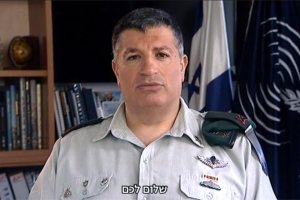
MEMO | February 5, 2015
Left-wing politicians in the EU Parliament undermined a visit by Israeli Major General Yoav Mordechai because he has “blood on his hands” according to Northern Ireland MEP Martina Anderson.
Mordechai, who is one of the commanders of the Israeli elite force, is the coordinator for the Israeli government activities with the European Parliament regarding the Palestinian territories. His visit, which was due on Tuesday, was cancelled shortly before it was due to take place.
Portuguese parliamentarian Marisa Matias, from the European United Left–Nordic Green Left grouping, was quoted as saying that “giving him [Mordechai] a platform to host a lecture would legitimise his violations of international law and human rights”.
She pointed out: “Rather than giving a warm welcome to those, who stand for repression and apartheid, the EU institutions should pressure the Israeli government to abide by the rules of international law and UN resolutions.”
Calling for prosecuting him and his likes, she said: “We must bring to justice those responsible for human rights violations in the Occupied Palestinian Territories.”
Another member of the same political grouping, Northern Ireland MEP Martina, chairwoman of the Parliament’s Delegation for Relations with the Palestine Legislative Council, welcomed the cancellation, even though she said the reasons behind it were unclear.
However, she said: “We condemn the fact that it was set to go ahead in the first place. We cannot accept someone with such a track record being welcomed to the European Parliament. Put simply, this man has blood on his hands.”
Israeli war crime suspects may be able to run but they cannot hide
By Dr Daud Abdullah | MEMO | February 5, 2015
The resignation of William Schabas from his post as head of the UN commission to investigate possible war crimes during Israel’s 2014 onslaught on Gaza was always on the cards. From the time of his appointment in August last year, he has been subjected to a relentless campaign that questioned both his integrity and impartiality.
The manner and timing of his resignation, weeks before the commission presents its report to the UN Human Rights Council (UNHRC), recalls the case of Judge Richard Goldstone who was forced to disassociate himself from the findings of another UN enquiry into the 2008-09 war on Gaza. Instead of subjecting himself to similar humiliation, Schabas decided to throw in the towel sooner rather than later.
While Israeli officials may count this as a victory, it does not lift the spectre of war crimes charges against them. Nor will it alter Israel’s image as an international pariah. Whether Schabas stayed or resigned is, therefore, actually irrelevant. Israel has never, and never will, cooperate with an independent investigation into its wartime conduct. Hence, the claim that the UNHRC is innately biased must be seen for what it is — a rather pathetic attempt to evade accountability.
Lawyers acting on behalf of human rights organisations in Gaza point out that all the evidence presented to the UN suggests that there is a compelling a case for a formal investigation by the International Criminal Court (ICC). The character assassination of Schabas will not change the course of events.
What is at stake is whether or not Israel acted within the confines of the law that governs armed conflict. Prime Minister Benyamin Netanyahu’s claim that the UNHRC “is the same body that only in 2014 passed more resolutions against Israel than against Iran, Syria and North Korea combined” is immaterial; it’s simply an attempt to deflect world attention from the real issue.
Did the UNHRC set out deliberately to malign Israel as Netanyahu claims? On 23 July2014, Navi Pillay, the UN High Commissioner for Human Rights, reiterated the fact that war crimes and crimes against humanity are two of the most serious types of crimes in existence. She noted that in the case of Israel’s war on the Gaza Strip the “credible allegations that they have been committed must be properly investigated.”
A newly published survey by Chatham House — the Royal Institute of International Affairs — showed that 35 per cent of Britons said that they “feel especially unfavourable towards” Israel. The study, conducted in 2014, showed that the number of those viewing Israel unfavourably had actually increased by 18 points since 2012, presumably because of its military campaign in Gaza which led to thousands of casualties among Palestinian civilians.
Significantly, the categories of international crimes referred to by Pillay originated in the Nuremberg Tribunal of 1945-46. Though intended to deal with those responsible for the persecution of Jews in Europe, their writ was never confined to the Nazi leadership. Robert H Jackson, the former US Supreme Court Justice and prosecutor at Nuremberg, wanted to make it clear, “That if this law is first applied against German aggressors, the law includes, and if it is to serve a useful purpose it must condemn aggression by other nations, including those which sit here now in judgment.”
Given the circumstances which led to the tribunal it seems utterly mind-boggling that Israel should today seek to deny others the benefit and protection of the laws used at Nuremburg. As such, none of these laws will be worth the paper they are written on as long as Israeli officials continue to enjoy apparent impunity and evade accountability for their actions. The consequences of this selective approach to justice and the rule of law are already evident across the Middle East and beyond.
Moreover, not even the countries that support Israel have been spared the consequences of its disregard for the rule of law. Consider, for example, the 2010 assassination of a Hamas official, Mahmoud Al-Mabhouh, in a Dubai hotel. Several of the suspects involved used false passports of several European countries to carry out the operation. Apart from the expulsion of junior diplomats from Britain, Australia and Ireland, not one of the 29 Israeli suspects have been brought before a court of law.
More than anyone, Israelis who have hunted down Nazi war criminals for decades are well positioned to know that the pursuit and prosecution of those believed to have committed war crimes and crimes against humanity is relentless and not bound by time. Their perceived success in bringing down William Schabas will have absolutely no bearing on the Palestinian quest for justice. Israeli war crime suspects may be able to run but they cannot hide; they may continue to avoid arraignment at The Hague but they know for sure that they have already lost in the court of world opinion. In the grand scheme of things, it is perhaps this which matters most, for Israel must remain isolated and a pariah in the community of nations until justice is seen to be done.
Demonstrators face military violence for protesting Israeli President Rivlin’s visit
International Solidarity Movement | February 5, 2015
Hebron, Occupied Palestine – On Monday, February 2nd, Palestinian demonstrators faced military violence at the hands of Israeli forces in occupied Al-Khalil (Hebron). Protesters gathered in Bab Al-Zawiye, on the H1 (Palestinian administered) side of Shuhada checkpoint, to denounce Israeli president Reuven Rivlin’s visit to the illegal Israeli settlement of Beit Hadassah. Israeli sodliers and border police fired rounds of tear gas and numerous stun grenades, injuring at least two protesters.
The demonstration was organised by local Palestinian organisation Youth Against Settlements against the visit of the Israeli president to the settlement, which is illegal under international law and serves as a frequent source of oppression and violence against local Palestinians. Palestinians claimed their own rights, trampled by the military occupation, in the face of the visit’s attempt to legitimate the settler colonisation. Some signs called for opening the once vibrant and now closed Shuhada street, some for an end to the illegal settlements, some for President Rivlin to be brought before the International Criminal Court.
Around fifty Palestinians began the demonstration outside of Shuhada Checkpoint, holding signs and banners and hanging Palestinian flags on the fence. Israeli forces stopped them from passing through the checkpoint, preventing them from protesting on Shuhada street, near where the president was due to speak. As protesters continued to demonstrate, holding signs, waving flags and chanting for an end to occupation, a group of Israeli soldiers and border police exited the checkpoint and pushed protesters further back. Soldiers also occupied the roofs overlooking Bab Al-Zawiye “I just heard a soldier on a roof say ‘okay, enough’ and five minutes later they started throwing stun grenades and tear gas,” stated an ISM activist. “It was extremely sudden, and very scary.”
Israeli forces targetted Palestinian activists and organizers, hitting many in the legs with stun grenades and tear gas grenades. One man was hit directly with a stun grenade, which detonated right by his leg. “He screamed and fell down, rolling on the ground” one ISM activist recalled. Another man was also hit in the head with a stun grenade after the Israeli forces continued to use potentially lethal force against unarmed Palestinian protesters.
Demonstrators then attempted to continue the protest into the souq (Al-Khalil’s Old City market), but Israeli forces threatened them with stun grenades and prevented them from advancing. The protesters decided to go back after the army launched one stun grenade directly into the group of demonstrators. The protest eventually dispersed in Bab Al-Zawiye, after being targeted by a few more rounds of tear gas grenades.
Demolitions in Qusra
International Solidarity Movement | February 3, 2015
Qusra, Occupied Palestine – In the early morning of February 2nd, 2015, Israeli forces demolished a two-room structure, a water well, and damaged a stone wall in Qusra, Occupied West Bank. All of the destroyed property was on land belonging to brothers Anwar and Akram Tayseer.
Israeli forces, at approximately 5:00am, destroyed the property with bulldozers. When farmers went out into their fields at 5:00am, five Israeli military jeeps were still present at the site, loitering around the recently destroyed infrastructure. The occupying forces refused to speak with anyone. The water well and small concrete structure were built with money donated by the French Consulate, to facilitate agricultural development in the vulnerable region. Located in Area C, Qusra is subject to common attacks from nearby illegal Israeli settlements, mainly the Esh Kodesh outpost. Settlers living in the illegal outpost Esh Kodesh have been implicated in various ´price tag´ attacks throughout the West Bank (acts of violence against Palestinians by settlers). Settlers come after every time local Palestinians work their land, in day or night, sometimes armed with iron bars; families often wake up to destroyed trees, structures, or crops. Israeli soldiers are often present at these incidents, intervening only to protect settlers. An Israeli military watchtower was constructed on the hill overlooking the agricultural lands around ten months ago. In the past, village residents have received Israeli orders to stop building on their land, which they have always respected (despite their illegality). However, it is not uncommon, according to locals, for farmers to have their agricultural structures demolished shortly after receiving these orders, despite the lack of further development.
This is not the first time the Tayseer´s family land has been attacked by settlers. On one occasion two years ago, Akram Tayseer was taken by the settlers, and severely beaten. He sustained injuries which put him in the hospital for two months, in his head, face, and arm. He was unable to leave his home for one year. Since this incident, residents recount that they have not seen him smile, and perceive that he is broken inside. The family has documents indicating their ownership of the land and the property which once stood on it.
The cost of agricultural structure demolished is approximately 5000 NIS (~$1275USD). The water well served as a collection site, and an important reservoir to nourish the fields. Enclosing the plots of land, around 500 meters of a traditional Palestinian stone wall was dismantled. The fields are the main source of income for the family.
According to OCHA (United Nations Office for the Coordination of Humanitarian Affairs), 82 Palestinian homes and agricultural structures have been demolished by Israel since the beginning of 2015. Under the Fourth Geneva Convention, it is illegal for occupying powers to destroy property; Article 53 states: “Any destruction by the Occupying Power of real or personal property belonging individually or collectively to private persons…is prohibited.” Since 1967, Israel has demolished over 27,000 Palestinian structures in the Occupied West Bank.
Israel freezes another $100m in Palestinian tax revenues
MEMO | February 3, 2015
Israeli Prime Minister Benjamin Netanyahu has frozen an additional 400 million shekels ($100 million) from Palestinian tax revenues, Israel Today revealed yesterday.
The funds were from January’s tax revenues, the newspaper said, and will be added to the 500 million shekels ($128 million) that Israel froze in December, making the amount of Palestinian tax revenues frozen about $228 million.
Sources close to Netanyahu told the newspaper that he promised continuous tax freezes as a punishment for the Palestinian leadership’s application to join the International Criminal Court.
Such revenues constitute 70 per cent of the Palestinian Authority’s source of income which finance the bulk of salaries and public services in the West Bank such as hospitals and schools.
It is worth mentioning that the money freeze last month faced critical reactions from the UN, US and many EU countries, but none of them put any pressure on Israel to recede its decision.
The Israeli newspaper reported that sources say the situation in the West Bank is expected to explode because of the hard economic circumstances resulting from the lack of funds.
Netanyahu: UN Gaza probe should be ‘shelved’
MEMO | February 3, 2015
Israeli Prime Minister Benjamin Netanyahu on Tuesday said that a probe by the UN Human Rights Council (UNHRC) into last year’s Israeli offensive against the Gaza Strip should be shelved in light of the recent resignation of inquiry commission head William Schabas.
“After the resignation of the committee chairman, who was biased against Israel, the report that was written at the behest of the UNHRC… needs to be shelved,” Netanyahu said in a statement.
The Israeli premier went so far as to slam the rights council as “an anti-Israel body, the decisions of which prove it has nothing to do with human rights.”
“This is the same council that in 2014 made more decisions against Israel than against Iran, Syria and North Korea combined,” Netanyahu asserted.
“It is Hamas, the other terrorist organizations and the terrorist regimes around us that need to be investigated, not Israel,” he added.
The Israeli government has already said it would not cooperate with the UNHRC committee formed to investigate violations committed during Israel’s onslaught on the Gaza Strip last July and August.
Israel had said that the UN council would not be objective.
The Israeli offensive left more than 2,160 Palestinians dead and some 11,000 injured – the vast majority of them civilians – while partially or completely destroying thousands of residential structures across the territory.
The onslaught, which was launched with the stated aim of ending rocket fire from the coastal enclave, finally ended with the announcement last August of an open-ended cease-fire between Israel and Palestinian resistance factions.
On Monday, Schabas, a Canadian professor of international law, reportedly resigned from his post as head of the investigation committee due to Israeli allegations of bias.
Israeli Foreign Minister Avigdor Lieberman, for his part, hailed Schabas’ resignation, saying it was a “victory” for the self-proclaimed Jewish state.
“It is an Israeli diplomatic victory. However, it will not change the probe’s conclusions,” he said.
He added that the appointment of Schabas to investigate last year’s war against Gaza was like “appointing Cain to investigate who killed Abel.”
Lieberman: Third Lebanon war, fourth Gaza operation inevitable
Press TV – February 1, 2015
Israel’s foreign minister has described as “inevitable” a third war with Lebanon and a fourth aggression in the besieged Gaza Strip in the wake of a recent retaliatory attack by Hezbollah.
“A fourth operation in the Gaza Strip is inevitable, just as a third Lebanon war is inevitable,” Avigdor Lieberman said in an interview with Israel’s Ynet on Sunday.
“There’s no doubt the rules of the game have been changed, what Hezbollah forced upon us. We don’t respond, but rather decide to contain this incident,” Lieberman said, adding that the Lebanese resistance movement is “more determined.”
The Israeli official also said that another war on the Gaza Strip was on the horizon, adding that Hamas was already rebuilding its military capacities.
“We saw 10 rockets being fired at the sea last week. We see every week how they’re rebuilding [their arsenal],” he said, referring to the Palestinian resistance movement.
Hezbollah killed two Israeli soldiers and destroyed at least nine Israeli military vehicles in a retaliatory attack on a military convoy in northern occupied territories on January 28. Tel Aviv said a 20-year-old sergeant and a 25-year-old captain were killed.
Following the attack, Hezbollah said the move was in retaliation for Israel’s January 18 attack on the Syrian section of Golan Heights, where six Hezbollah members and an Iranian commander lost their lives.
Jihad Mughniyeh, the son of martyred Hezbollah top commander, Imad Mughniyeh, was among those killed in the attack.
Israel Arrests, Mistreats 700 Palestinian Children Every Year: Report

Palestinian protestors hold posters of 14-year-old Palestinian girl Malak al-Khatib who is in Israeli jail, during a demonstration to show solidarity with Palestinian prisoners in Nablus, West Bank on January 27, 2015. Anadolu Agency/Nedal Eshtayah
Al-Akhbar | February 1, 2015
A lawyer for the Department of Prisoner Affairs released a report on Saturday on the mistreatment of Palestinian minors by Israeli Occupation Forces (IOF) after she visited Palestinian minors in Israeli custody.
The report came after Child Rights International Network (CRIN) published in its first 2015 report that some 700 Palestinian children per year are arrested and face “ill-treatment” by the IOF.
The IOF have shut down a program meant to decrease the number of nighttime arrest raids targeting children in Palestinian homes after less than a year, with statistics suggesting that even when the program was active night raids barely decreased at all.
Military Court Watch, a Palestinian legal monitor focused on the treatment of Palestinian children in Israeli detention, said in a statement on Thursday that the Israeli military had also failed to keep any statistics on the program it implemented of its own accord, meaning no independent evaluation could be conducted.
The report comes less than a year after Israeli military authorities unveiled the program to the international media with great fanfare, in the wake of a series of concerns raised in Europe and Australia over the effects of Israeli nighttime raids on Palestinian homes.
Hiba Massalha said in a statement that many of the minors spoke of being assaulted and beaten during their arrests and throughout interrogation.
Malek Hamdan, a 16-year-old Palestinian from Jerusalem, was beaten to the point of his bones being fractured while he was held at the Russian Compound detention center, the statement said.
Additionally, 17-year-old prisoner Mohammed Abdul Fattah Radwan, from Qalqiliya, told Massalha that during his detention, he was assaulted and dragged for a long distance while handcuffed and blindfolded.
Radwan was held at the al-Jalama detention center for 15 days. He was interrogated for several hours each day while tied to a small chair.
The teen said he was held in a small, filthy, cold room with the lights kept on all day and all night.
Another prisoner, 16-year-old Mohammed Yusuf Ikhleil from al-Khalil (also known as Hebron), was detained on November 1 while he was on his way home from school. He is currently being held in HaSharon prison.
Ikhleil said he was shot with a live bullet in the thigh, and while he was being detained, he lost a lot of blood as Israeli soldiers beat him.
He was moved to the Soroka Hospital in Beersheba for treatment, where he was kept in the ICU for three days and underwent a bone surgery for his thigh injury.
Ikhleil added that he was interrogated for an hour while at the hospital, and that he was shackled to the bed for 24 hours while guards watched him.
He was taken to the al-Ramla Hospital where he stayed for two months before being moved to HaSharon prison.
Meanwhile, 14-year-old prisoner Hussam Omar Mohammed Abu Khalifa from Bethlehem is suffering from depression and needs constant medical care.
Hussam is currently being held in HaSharon prison.
Moreover, 18-year-old Lina Khattab, a student at Bir Zeit University and dancer in the al-Funoun Palestinian cultural dance troupe, was arrested on December 18 and charged in a military court for “throwing stones” and “participating in an unauthorized demonstration.”
Khattab’s trial has been postponed more than six times. The military court had refused to release her on bail or put her in house arrest. The judge said at the time: “looking at her, I can see the characteristics of a leader.”
In 2013, the UN children’s fund (UNICEF) reported that Israel was the only country in the world where children were “systematically tried” in military courts and gave evidence of practices it said were “cruel, inhuman and degrading treatment or punishment.”
The UNICEF report said in a 22-page report that over the past decade, Israeli forces have arrested, interrogated and prosecuted around 7,000 children between 12 and 17, mostly boys, noting the rate was equivalent to “an average of two children each day.”
CRIN report
According to CRIN, some 700 Palestinian children per year are arrested and face “ill-treatment” on the hands of Israeli soldiers.
“During 2014, an average of 197 children were held in military detention every month, 13 per cent of whom are under the age of 16,” the CRIN report read.
“Arrested children are commonly taken into custody by heavily armed soldiers, blindfolded with their wrists tied behind their backs before being transported to an interrogation centre,” CRIN said, adding, “Children questioned about their experience frequently report verbal and physical abuse during the arrest.”
According to research conducted by Defense for Children International in Palestine, which was cited by CRIN in their report, some 56 percent of children report having experienced “coercive” interrogation techniques during their time in Israeli custody.
Some 42 percent say they were forced to sign documents in Hebrew, despite the fact that most Palestinian children do not speak or understand the language.
Additionally, 22 percent of detained children say they underwent up to 24 hours of solitary confinement, in violation of international standards.
“This detention is a clear violation of children’s rights under several international human rights treaties to which Israel is a party,” the CRIN report said.
“The UN’s Special Rapporteur on Torture has called for a complete ban on solitary confinement for juveniles, warning that it ‘can amount to torture or cruel, inhuman, or degrading treatment or punishment when used as a punishment, during pre-trial detention, indefinitely or for prolonged periods, for persons with mental disabilities or juveniles.'”
The report said that while it is technically possible to file a complaint about the way a child is treated in Israeli detention, “complaints are almost universally dismissed,” and there are “very few examples of soldiers being punished for ill-treatment.”
The report highlighted a case in which a 14-year-old girl from Ramallah was arrested on December 31 and held for 22 days in Israel before being issued a sentence.
She was charged with throwing stones, blocking the road, and allegedly possessing a knife, “sentenced to two months in prison, and fined $1,528 by an Israeli military court.”
The Israeli cabinet approved early November a new legislation that would allow the imposition of a prison sentence up to 20 years for those convicted of throwing stones or other objects at Israeli soldiers or their vehicles.
Her father believes she was coerced into confessing, saying: “She seemed to be very sick and scared.”
“The plight of this one girl put a face on a system that routinely runs roughshod over children’s rights,” CRIN said, adding “But behind this story there is a broader issue.”
The report recommended reforms while noting that countless other recommendations by human rights groups regarding the treatment of Palestinian children in Israeli custody have gone unheeded by Israeli authorities.
Ultimately, CRIN concluded, children will never be treated well under an Israeli military justice system.
“Regardless of the precise formulation of military rule, it can never protect children in the same way as a developed civilian juvenile justice system which places the best interests of the child at the center of its work,” the report read.
(Ma’an, Al-Akhbar)
Featured Video

Spain train disaster raises questions over Israeli-linked security contractors
or go to
Aletho News Archives – Video-Images
From the Archives
Are There 50,000 ‘Israeli-born’ Individuals Living in the UK?
By Professor David Miller | August 18, 2026
Recent disclosures by the Zionist regime show that some 2,069 British nationals were serving in the IDF as of March 2025, according to Freedom of Information (FoI) requests submitted to the occupation forces (1,686 dual British-Israeli, plus 383 multinational). We cannot tell from the figures how many of these were already settler colonists and intend to stay in the colony, and how many will return or have returned to the UK. Presumably, those returning to the UK will number far fewer than 2,000, since many are known to have become permanently residents of the colony.
Additionally, the IDF figures only provide a snapshot, and do not tell us how many have served in the Jewish supremacist military either before or after March 2025. One way into the question of how many genocidaires are living in Britain is to ask how many current British residents were born in the Zionist colony. There is data on that, as we shall see. … continue
Blog Roll
 Aletho News
- US-Israeli war on Iran cost Persian Gulf states nearly $1T in damage, lost growth: Report
- Congress probe could put ‘Israel’ in dock over Iran war: Israeli media
- Spanish public prosecutor backs US demand to extradite pro-Palestine philanthropist Fergie Chambers
- Zelensky spent over 740 days outside Ukraine while West serves as his real home
- Indian captain of Russian ‘shadow fleet’ tanker faces 10-year jail term in UK
- Europe, US face higher heating bills amid Iran war fallout
- The Leak That Arrived Right on Cue
- No, New York Times, California’s Climate Has Always Been a Land of Flood, Drought, and Fire
- Are There 50,000 ‘Israeli-born’ Individuals Living in the UK?
- German CDU MPs Seek Climate “Misinformation” List
- If Americans Knew
- An error has occurred; the feed is probably down. Try again later.
- No Tricks Zone
- German Authorities Start Initiative To Evaluate Public Register For Climate “Disinformation” Spreaders!
- Zonal Asymmetry of Temperature Change in the Antarctic Circumpolar Current
- New Study: The Net Fossil Fuel Contribution To Rising Atmospheric CO2 Has Been Zero For 500 Years
- Germany’s Green Energy Transition Becoming Increasingly Expensive…Another 6 Trillion Euros!
- Sudden Stratospheric Warming, Powerful El Niño Combination May Lead To Extreme Europe Cold, Energy Crisis!
- Two New Studies Find Thwaites Glacier Melt Cannot Be Driven By Human Activity Or A Warming Ocean
- E-Cars Reduce CO2 Emissions By Only 41% Compared To Internal Combustion Engine Vehicles
- Predictions Made By Renowned Climate Professor Over Past Decades Have Been Proven To Be Poor
- New Study Suggests Large Regions Of The Pacific Ocean Have Been Cooling For The Last 80 Years
- Germany’s Green Energy Debacle: High Energy Costs Force Kahla Porzellan to Close After 182 Years!

