Aletho News

ΑΛΗΘΩΣ

Here facing immorality

By Mazin Qumsiyeh | Popular Resistance | February 3, 2013

Here is where Israeli colonial settlements continue to expand on our lands. Here is where Israeli elites make billions from injustice while nature and people suffer. Here is the forefront of a global struggle. Here is where western hypocrisy gets exposed. Rhetoric about democracy and liberty in Syria and Iran is stripped naked when people see Western supported colonialism, racism and subjugation in Palestine. Here is where billions of Western taxpayer money is used to destroy life while enriching land thieves and war criminals. Here where we lost most of our land to colonial settler activity and suffer regularly from racist settler attacks. Here is where morality is shed daily because of paranoia and inferiority/superiority complexes (chosen but eternally victimized Jewish “people”). Here is where immorality has become a norm of society (see good analytic piece in Haaretz below). Here is where yesterday the Israeli occupation army and racist colonial settlers attacked villagers in Burin. Several Palestinians were injured (one 16-year old Palestinian was shot by live ammunition from settlers). 18 were brutally arrested/kidnapped including our friend Ashraf Aburahma from Bilin. Ashraf was himself arrested many times in nonviolent demonstrations. In one videotaped event, he was handcuffed, blindfolded and THEN shot at close range by occupation soldiers.

But here also is where we must and we will change things. Here the struggle goes on (La Luta Continue, tastimur almasira) to hang on to our humanity. We Palestinians with help of people of conscience from around the world must do better to challenge immorality (including “mental occupation”). We must work harder to undermine apartheid and repression. More people come to visit and participate with us in our struggle thus lighting candles in the darkness. We must accelerate this and be more bold. Nothing scares the elites in the apartheid state or their Western and Arab/Palestinian collaborators than actions like civil disobedience and BDS (boycotts, divestments, and sanctions) and other forms of practical resistance. There are signs of a new uprising/intifada. It will be the 13th or 14th wave/uprising on the way to liberty. We hope it is a global uprising against injustice and that is why many of us talk with internationals on a daily basis about morality, justice, and human rights. Of course there will be pain along the way (as happened yesterday in Burin) because no freedom is acquired without struggle and sacrifices. May the families of those thousands of martyrs killed in the struggle be comforted. May the injured heel. May the prisoners be released (some are now close to death as they engaged in a hunger strike). May all the suffering end. May more people shed immorality and join us to work to accelerate the end of injustice.

Do visit Palestine frequently even if only in your mind.

Just one story of thousands in the land of immorality: The struggle of Burin village

http://english.al-akhbar.com/node/14847

Pictures

http://www.facebook.com/media/set/?set=a.560035280673447.130173.136633479680298&type=3

Videos before the evictions and arrest but shows settlers throwing stones

https://www.youtube.com/watch? v=K5mtU5SPRYU

Video of beating and kicking a Palestinian during the arrests

Standing defiant. Khalid Daragmah’s family protect their land in a sea of settlements

http://www.middleeastmonitor.com/resources/interviews/5144-standing-defiant-khalid-daragmahs-family-protect-their-land-in-a-sea-of-settlements

Follow-up: In my talks and in taking delegations around, I sometimes mention some things which happened in the past like the story of the “fugitive cows” in Beit Sahour or the destruction of a playground in Beit Jala. Here and in future emails I will send some follow-up on these stories and on stories I had shared in previous emails. They are not only relevant to those who heard directly from me about these things but to the thousands of others who receive those emails.

The Story of 18 fugitive cows of Beit Sahour

Video of the Israeli destruction of a playground to build an apartheid wall on Palestinian land

Analytical pieces

Never Again – unconditionally:

“As Jews, with our own painful history of oppression, we are compelled to speak out against human rights violations committed by the State of Israel – in our name – against the Palestinian people.” These are the first words of a group of South African Jews in their public statement in the Mail & Guardian of 14 December 2012. They recognize not only their own wounds and humanity…………

http://marthiemombergblog.wordpress.com/2013/01/09/never-again-unconditionally/

Big Brother: When secrecy becomes a norm in Israel, it comes as a price premium

http://www.haaretz.com/weekend/magazine/big-brother-when-secrecy-becomes-a-norm-in-israel-it-comes-with-a-price.premium-1.500560

February 4, 2013 Posted by | Video | , , , , , , | Leave a comment

Israel arrests 22 Hamas members ahead of Fatah-Hamas talks

Al-Akhbar – February 4, 2013

Israeli forces led an arrest sweep of at least 22 Hamas members Sunday night and Monday morning, including 3 members of the Palestinian Legislative Council.

The Israeli military confirmed arrests were made but would not elaborate further.

The Palestinian Ma’an news agency identified two of the MPs as Hatim Qafisha of Hebron and Ahmad Attoun of Jerusalem. Qafisha has previously been detained six times by Israel, whereas Attoun was forcibly transferred from Jerusalem to the West Bank by Israeli forces.

The third MP was identified by WAFA news agency as Mohammad al-Tul from Dahrieh.

Israel has a history of arresting Palestinian politicians and legislators, mainly targeting members of the pro-Hamas Change and Reform bloc since 2006, when Hamas won a majority of seats in the Palestinian parliament.

According to prisoners’ rights NGO Addameer, nearly a third of all members of the Palestinian Legislative Council were held in Israeli prisons in 2009.

The recent upsurge in arrests is most likely a response to Friday’s planned talks between rival Palestinian parties Hamas and Fatah as a way to undermine attempts at Palestinian political unity, according to Murad Jadallah of Addameer.

“Israel wants to show it has the authority and the military power to decide whether reconciliation happens,” the activist told Al-Akhbar.

Addameer has recorded the arrests of at least 40 Palestinians in the past 48 hours.

As of January 1, Israel held 4,743 Palestinians in its prisons, including 12 Palestinian MPs and 178 held without charge, according to Addameer’s latest figures.

Citing security sources, AFP reported that Israel plans to step up arrests of “suspected militants” in the West Bank.

Extensive use of administrative detention is illegal according to international law, but is commonly practiced by Israel against Palestinians.

February 4, 2013 Posted by | Ethnic Cleansing, Racism, Zionism, Subjugation - Torture | , , , , , , , | Leave a comment

Standing defiant. Khalid Daragmah’s family protect their land in a sea of settlements

By Amelia Smith | MEMO | February 1, 2013

Khalid Daragmah’s home dates back to the Ottoman times. Set on 22 dunams of green, arable land, it is sprinkled with trees, a spring and rolling hills to the back. It has been in his family for generations; his grandfather ran a business pressing olives from inside.

These days, the entrance has been fitted with solid iron doors; a preventative measure to keep out the groups of settlers who arrive at night with sticks and stones to harass his family. They mainly come from Ma’ale Levona, a settlement on the West side of his home, which has been built on the land of Al Libban village near Bablus. Across the valley, on the mountain in front of the house, the Naley and Shilo settlements stretch for miles from here until the green line.

When I spoke to Jamal Juma’, coordinator of the Palestinian grassroots organisation, ‘Stop the Wall’ who are helping Khalid with his case, he explained that the family are protecting a very sensitive part of the West Bank. “The Israelis want it because it’s connecting the settlements together. In this area they are planning to cut off the West Bank from the north and the middle of the south. So from here, until the Armistice Line, there are over thirty kilometres of settlements continuously. There are gaps between the settlements, and one of the main gaps is this one, that’s why Khalid has been under heavy attack for years now.”

In August last year, Khalid’s wife and sons were beaten at their house. They have also been subject to arson attacks, and jailed for fighting with the aggressors. “I don’t count how many times I’ve been arrested because it’s been so many times,” Khalid tells me. “Last time I was arrested they even stole stones from the house, and the tools I inherited from my grandfather, which he was using for the land.” It was one of many tactics used by settlers, intent on scaring them out of their house.

The settlers attacked Khalid’s wife so badly that she had to be taken to hospital. They told her it was because the house was their synagogue and they wanted it back, though Khalid’s family insist that this is not the case. “Historically, this place has been inhabited by my ancestors, it was never empty and there is no sign of Jewish heritage here,” Khalid explains. “Inside the house, there is nothing to do with Jewish culture.”

To complement the violence, officially, in 2004, 2006, 2009 and 2010, Khalid received eviction notices from the Israeli military asking him to vacate the property, but the family have refused. “This is our land, and they will not force us to leave” he told me defiantly. “They are trying to find any mistake they can to use against me, they’re searching all my files and records since I was born. Which law in the whole world can penalise somebody for staying in his home and his land?”

Officials have delivered a string of excuses to the family, pretexts for why they have to leave. “They give one reason after the other, like the road leading to my house.” Khalid tells me. “They want me to open it because it is an obstacle to the military or to visitors, i.e. the settlers. They want me to allow the settlers to visit and pray in the house. They want me to remove the fence from around the spring and remove the doors from the house to allow them to come in.”

At one point, military officers even came to tell him he must use his home as a supermarket, to open it and charge visitors money to enter the room and pray inside, or let them swim in the spring. “They are punishing me and destroying my life.” Khalid tells me. “What problems have I caused them for them to do this to me? My only crime is that I’m staying in my house and I don’t want to leave.”

Khalid has a strong case because the land is officially registered in his name, and he has documents to prove the house is privately owned. But this has not stopped the authorities from claiming it is state owned and belongs to them. “In all the time I have lived here, why have they come here in the last few years? They say this is state land, and I asked them officially if they have any proof that this is state owned land. My cousins and my extended family are living in the village and we have had houses here for more than 270 years,” Khalid says.

For this reason, it is not easy for them to evict him, which is why they’re using pressure, scare tactics and making his life impossible. “Abu Jamal [Khalid] is a very strong guy and despite all of this, he’s still standing here, he’s still staying in his land,” Juma’ adds. “They want to exploit him and make him totally disparate. They want to know how long he can survive under all these years of attack and targeting and they are gambling that he will get fed up and leave.”

Life is certainly hard. He rarely leaves his house without somebody staying inside; if he goes to the shop or to work they will occupy the house. He lives far from the nearest Palestinian village, so it’s not easy for people to come and help. A large source of the family’s income comes from their 22-year-old son, Jamal, who works as a mechanic nearby earning 1000 shekels a month. But such harsh tactics have meant the family have grown stronger. “They have tried so many aggressive tactics that now we’re not scared of anything” Khalid tells me. “Before, when my wife saw a mouse she got scared and started screaming. Now, when she sees a hyena, she will attack it.”

A large part of the problem is the Palestinian Authority, who don’t do anything to help them. Responsibility therefore falls on international organizations, which collect money to buy fruit trees to plant so he can earn money from his land, and individuals like Lubna Masarwa, a Palestinian activist, who is currently helping him find a lawyer. “Myself and Jamal Juma’ are really doing our best to try and keep him in the house,” Masarwa tells me, “but it’s impossible because someone always has to be here otherwise the settlers will use the chance occupy the house.”

“The settlers are well organised, they’re becoming very violent. And they don’t respect any laws. The rule of the army is to defend the settlers. When the settlers attack the Palestinian families, the army will be standing there; the soldiers are there to protect them, this is their work. In the West Bank you feel like you’re in a jungle, they’re beating the kids, they’re shooting, the kids don’t sleep at night. And they have nowhere to go with no one who can really protect them. In the last few years, the settlers are getting stronger,” Masarwa explains.

Khalid thinks that more people around the world should start pressuring governments and officials to hold Israel to account for this behaviour. Juma’ explains that in other cases this has helped a lot. “They [the Israeli authorities] try to do these things silently and in the dark, they don’t want anyone to know what they’re doing. The question is, how we can make his case well known, and how we can mobilise people to move, to talk about it, to ask them to question the Israelis about why they are doing this to him.”

Despite the hardship, Khalid and his wife are adamant that they’re not leaving. “I don’t have other option,” Khalid’s wife Um Jamal tells me “I can’t leave the house, my husband and the land; there is nothing I can do. Before they put in the iron doors it was scarier but now I feel a little bit safer. You can’t have a decent night sleeping when you can be attacked at any point.”

Yesterday, when the settlers came, one of her children stood in the window and asked them to go away. Um Jamal smiles as she tells me the story. “What do you expect? What can we do? This is our life and we have to show our power. If the settlers feel that we’re scared or weak, they will get stronger. The younger and the older kids have to show strength and have to stand up to them because this is the only thing that we have, we don’t have anything else.”

“This is our life and this is our struggle and we’re not going to give up. We’re not going to leave the house. I will never leave my home and my land.”

February 2, 2013 Posted by | Ethnic Cleansing, Racism, Zionism, Solidarity and Activism, Subjugation - Torture, Timeless or most popular | , , , , , | Leave a comment

The Case of Gilad Atzmon

By BLAKE ALCOTT | CounterPunch | February 1, 2013

Panel at Cooper Union NYC led by Anne-Marie Slaughter, 28 September 2006:

Tony Judt:  I just… I’d just like to say one very quick thing about [the difficulty of getting anything critical of Israel into the mainstream media]. When I submitted an article about the Israeli Lobby debate — that Mearsheimer and Walt kicked off — to a very well known American, North American, newspaper [NY Times], I was asked by the editorial directors would I mind telling them whether I’m Jewish or not. They felt it was something they would like to know before they published it.

Martin Indyk: But they published it.

TJ: I told them I was Jewish.         (Audience laughs.)

This review of Gilad Atzmon’s book The Wandering Who? A Study of Jewish Identity Politics and the anti-Atzmon essay by Ali Abunimah and some 20 co-signatories called Granting No Quarter: A Call for the Disavowal of the Racism and Antisemitism of Gilad Atzmon is an effort to unite the movement for one secular, democratic state (ODS) in historic Palestine of which both Atzmon and Abunimah are adherents. Edward Said wrote,

The absence of a collective end to which all are committed has crippled Palestinian efforts not just in the official realm, but even among private associations, where personality conflicts, outright fights, and disgraceful backbiting hamper our every step.

In his last years Said put such a “collective end” into words – for coexistence between Jews and Arabs in one state – and now, at the end of a decade that has witnessed outstanding articles, books and conferences articulating this vision, a chasm opens up. If our effort is not to be crippled both sides must bury the hatchet.

Abunimah, Omar Barghouti, Rafeef Ziadah and other signatories, as well as other ODS supporters known to me who have disavowed Atzmon, have made enormous contributions to justice for Palestinians. Their accusations are worth examining, which requires examining The Wandering Who? and some of Atzmon’s blogs and videos with an eye out for the racism, ‘antisemitism’ and Holocaust denial of which Granting accuses him. I haven’t read everything, of course, and there are certainly mistakes in my judgment, so I welcome any feedback and debate.

The call for disavowal accuses Atzmon of 5 trespasses:

(1) He claims to speak for Palestinians.

(2) He denies that Zionism is settler-colonialist.

(3) He believes that to self-identify as a Jew is to be a Zionist.

(4) He denies the Holocaust.

(5) He is an ‘antisemite’, a racist.

Two general observations: First, Granting’s accusations are formulated indirectly, not ‘in so many words’; but a reading of the short document shows that these are what it boils down to. Second, Granting itself does not include any proof or evidence for the accusations; there are no examinations of Atzmon’s texts, even out of context. Neither are there explicit definitions of the terms ‘racist’ and ‘antisemitic’ that would by rights accompany such severe accusations. For such more detailed definitions and arguments I have searched the web in vain, but of course the web is large, and if I have missed something I hope somebody tells me. I’m restricting my analysis almost entirely to Wandering on the assumption that evidence for the accusations would be there, if anywhere.

Strictly speaking there is thus no case, only claims. Atzmon is innocent till proven guilty. It is unfair, difficult and inefficient to put the burden of proof on the accused. Nevertheless, I’ve read the book carefully and ended up writing a defense of it that includes several criticisms, quoting Atzmon at length along the way. Please also see the favourable reviews by Mazin Qumsiyeh and John Mearsheimer, and a less favourable one by Elias Davidson. I ignore denunciations of Atzmon by Alan Dershowitz, Tony Greenstein and Jeffrey Goldberg because they consist of associative thinking and are based on often-unreferenced quotations out of context. Preceding Granting, in late February 2012, was a similar critique of Wandering that actually contains 12 quotations from Atzmon.

 The five accusations

(1)   Guiding the Palestinian struggle

Granting claims that Atzmon “for many years now… has taken on the self-appointed task of defining for the Palestinian movement the nature of our struggle, and the philosophy underpinning it.” Since I am sure the Granting signatories do not reject all ideas of all outsiders, this leaves it unclear what counts as acceptable opinion and support. It is moreover legitimate for Atzmon and other Israeli citizens to advocate visions of the future of their country – necessarily including Palestinians.

Granting’s concern becomes clearer through the further statement that “As Palestinians, it is our collective responsibility, whether we are in Palestine or in exile, to assert our guidance of our grassroots liberation struggle.” Atzmon has in fact elsewhere agreed with this:

It is our duty (as human beings) to show our support to the Palestinian people but we are not allowed to tell them what to do. We are not allowed to tell them what is right or wrong, we can only offer ourselves as soldiers…

Ignoring the absurdity of the idea of ‘telling Palestinians what to do’, roles between the oppressed and those in solidarity with them must always be negotiated. In this case however I know that there is almost total agreement between Atzmon and the “principles” of the movement guided by the signatories: Right of Return, equality not apartheid within Israel, liberation of the West Bank and Gaza, and perhaps even a preference for one over two states.

(2)   Settler-colonialism

Granting claims that “Zionism, to Atzmon, is not a settler-colonial project… ” The text of Wandering does not support this claim. Atzmon in several places explicitly affirms that Zionism is settler-colonial. (pp 9, 88, 101, 165) In apparent contradiction, he does in one place write that it “is not a colonial movement with an interest in Palestine”. (p 19) In my reading this means it is not just a run-of-the-mill colonial movement out for economic or geopolitical gain: there is no mother country unless it is world Jewry, and Zionism’s only colony is Palestine, which was chosen over Argentina and Uganda for cultural and/or religious reasons. Atzmon elsewhere objects to the “misleading” colonialism paradigm because he regards Zionism as a unique racialist project, not motivated by material exploitation for the (non-existent) homeland.

Atzmon is basically asserting that the settler-colonialist paradigm is not sufficient to explain Zionism: Zionist events like the attack on the Mavi Marmara, dropping White Phosphorus on Gaza, slicing up the Holy Land with separation walls, and indeed the original expulsion of “the vast majority of the Palestinian indigenous population just three years after the liberation of Auschwitz… have nothing to do with the colonialist nature of the Jewish state…” (pp 181-182) To be sure, the term “nothing” overstates the case, but his claim is that more than colonialism is involved. I’m inclined to agree when I read for instance Netanyahu’s December 2012 statement that “We live in a Jewish state, and Jerusalem is the capital of Israel. The Western Wall is not occupied territory. We will build in Jerusalem because this is our right.”

(3) Jewish political identity

Granting interprets Atzmon’s complex sociological concept of Jewish-ness to mean that

Zionism… is… part and parcel of defining one’s self as a Jew. Therefore, he claims, one cannot self-describe as a Jew and also do work in solidarity with Palestine, because to identify as a Jew is to be a Zionist.

Now, to say that self-identifying as a Jew entails Zionism is prima facie absurd, and I do not find the claim in Wandering. I agree with Granting that Atzmon is wrong in his blanket criticism of anti-Zionist Jewish groups. I also find Atzmon at places abstruse on this issue of the relation between world Jewry, “Jewish ideology” and Zionism.

But confusion is abated when we realise that his definition of Zionism differs from the standard, broad ‘movement for a Jewish state in Palestine’. Rather: “I suggest that it makes far more sense to regard Zionism as a tribal Jewish preservation project [aiming at] the prevention of assimilation… [] Accordingly, Zionism should be seen as an amalgam of different philosophies specialising in different forms of tribal separatism, disengagement and segregation.” (p 70) Atzmon is thus talking only about a political self-identity, so Granting misrepresents him.

Atzmon sets up three non-exclusive basic categories: “Jews (the people), Judaism (the religion) and Jewish-ness (the ideology)… or identity politics, or political discourse”. (p 15) The book does not criticise Jews, the first category, does criticise a few aspects of Judaism, the second, and argues for 200 pages against the third, Jewish-ness, and against those who “put their Jewish-ness over and above all of their other traits.” (p 16)

I am confused as to whether Atzmon wants to say that politically identifying with Jewish-ness entails Zionism. In numerous places criticises or laughs at Jewish tribalism (pp 19, 32, 56, 113, 116, 164-165, 172, 181-184), writing that “to identify politically as a Jew and to wonder what is ‘good for the Jews’ is the true essence of Jewish tribal thinking...” (p 184) Zionism “united the tribe on many levels” (p 46) and “is grounded on a very specific realisation of the Jewish identity as a synthesis of racial awareness, religious awareness and nationalistic awareness”. But while Jewish-ness is an ethnically-based political ideology, Atzmon doesn’t show that non-Zionist Jewish political identities are inconceivable.

Granting’s signatories must have misread the sentence, “To be a Zionist means to accept that, more than anything else, one is primarily a Jew.” (p 19) This says that all Zionists are 3rd-category Jews, not the reverse. The context moreover is a specific discussion of sanayim, Mossad agents living abroad.

I do however fault Atzmon’s statement that “… considering the racist, expansionist Judeo-centric nature of the Jewish State, the Diaspora Jew finds himself or herself intrinsically associated with a bigoted, ethnocentric ideology and an endless list of crimes against humanity.” (p 48) What does “intrinsically” associated mean? Merely being “associated” (by others) with something bad is one thing; but when this is “intrinsic” it could mean that the bad thing is indeed “part and parcel” of being a Diaspora Jew.

(4) Holocaust denial

Atzmon throughout acknowledges the Holocaust, shoah or Judeocide, asserting however that it should be studied historically like other ethnic exterminations. (pp 43, 70, 130-131, 154, 175-176, 182, 185-186) And we need to see how the Holocaust is used in the destruction of the Palestinians – a position shared by Yeshayahu Leibowitz, Adi Ophir, Norman Finkelstein and Marc Ellis. (pp 148-152, 162) I do find imprecision in his statement that the “Holocaust… [is] not an historical narrative, for historical narratives do not need the protection of the law and politicians” (p149); to be consistent with everything he writes about the Holocaust this should read “not merely an historical narrative”.

Atzmon recalls,

As much as I was a sceptic youngster, I was also horrified by the Holocaust. In the 1970s Holocaust survivors were part of our social landscape. They were our neighbours, we met them in our family gatherings, in the classroom, in politics, in the corner shop. They were part of our lives. The dark numbers tattooed on their white arms never faded away. It always had a chilling effect. Yet I must mention that I can hardly recall a single Holocaust survivor who ever attempted to manipulate me emotionally.” (pp 185-186)

Further, “It is the Holocaust that eventually made me a devoted supporter of Palestinian rights, resistance and the Palestinian right of return.” (p 186)

An earlier blog reads,

[T]he form of Holocaust denial that really bothers me is the denial of the on-going Palestinian Holocaust. This Holocaust is documented and covered daily by the western media. The turning of residential Palestinian cities into concentration camps; the deliberate starvation of the Palestinian population; the withholding of medical aid from Palestinian civilians; the wall that tears the holy land into isolated cantons and Bantustans; the continuous bombardment of civilians by the IAF are known to us all. This Holocaust is committed by the Jewish state with the support of world Jewry.

This accusation by Granting is absurd.

(5) Racism and ‘antisemitism’

Atzmon writes nothing against Jews by origin, i.e. against anybody based on their genetic heritage or ‘race’; yet this would be the precondition for justifying the allegation of ‘antisemitism’/racism because ‘semitic’ refers to an ethnos or race. I trust moreover that ‘some of his best friends are Jewish’, and he vows:

I will present a harsh criticism of Jewish politics and identity. Yet… there will not be a single reference to Jews as ethnicity or race… This book doesn’t deal with Jews as a people or ethnicity. If anything, my studies of the issue suggest that Jews do not form any kind of racial continuum… [] I also refrain from criticisng Judaism. Instead, I confront different interpretations of the Judaic code. I deal with Jewish Ideology, Jewish identity politics, and the Jewish political discourse. I ask what being a Jew entails. (p 15; also pp 147-148)

Again, his first two categories – religious Jews and Jews by origin – are “harmless and innocent”. (p 16) No one is calling for harm to Jews. (p 131)

Atzmon does once lambaste Judaism for tribalism because it so closely adheres to an ethnic rather than religious concept of itself (p 113) and sees a continuum between the Bible and Zionism (pp 120-122). But he says clearly,

I am against racism and in fact in my writing you won’t find a single racial reference. Moreover, when I write about Jewish identity I analyse it in ideological and philosophical terms. For me Jewishness is a mind set. Nothing to do with the quality of one’s blood or the religion of one’s mother.

He does unfortunately make several statements that refer to “Jews” where “Jewish-ness” or “Zionist” would be more accurate and consistent with the whole book. He for instance writes of “European and American Jews” who have assimilated and cast aside their “Jewish identity”, where he means their Jewish political identity or identification with the “tribe”. (pp 64-65) He rightly says that all Jewish Zionists sign up to the Jewish-ness ideology, but he should avoid any ambiguity suggesting that all Jews adhere to Jewish-ness.

Blurring occurs when he omits the qualifier ‘political’ in writing of “the Jew within”, “the Jewish understanding of the past” or occasionally of “Jewish identity”. (pp 95, 173, 135) He does however usually precisely include it, for example in writing that one “can hardly endorse a universal philosophy while being identified politically as a Jew.” (p 39; also pp 102, 138, 145, 174) Imprecision burdens as well the statement that “Jewish people… can never be like ‘other people’, for those who demand to be seen as equal must feel inherently and categorically different.” (p 52) I also miss clear definitions for the phrases “the Jewish condition” (p 184) and “the wider Jewish problem”. (p 15)

Atzmon’s use of the phrase “Jewish lobbyists” (pp 152, 171) has been challenged, clarity speaking for “Israel lobby” or “Zionist lobby”. It is however at least mitigating that most Jewish Zionist lobbyists themselves refer to themselves and their organisations as ‘Jewish’, and that Zionists themselves appropriate Jewish identities to oppress Palestinian Arabs – for instance with the Holocaust (pp 130-134) or Judaic symbols on fighter planes (p 140). As Zionist Michael Bar-Zohar puts it, “If you’re attacking Israel, this means you are attacking Jews.” But why should one language-rule be valid for pro-Israel lobbies and another for its critics? (pp 149-151)

Granting in addition accuses Atzmon of ‘”allying” himself with “conspiracy theories, far-right, orientalist, and racist arguments, associations and entities”, but offers no evidence, nor even a definition of what “allying” would look like. I urge Atzmon to make his language less ambiguous, but given that he is criticising what he sees as the dominant Jewish political culture, not Jews in general, his book in fact supports Granting’s position that “our struggle was never, and will never be, with Jews, or Judaism, no matter how much Zionism insists that our enemies are the Jews. Rather, our struggle is with Zionism.”

Anti-Jewish-ness

Benny Morris, in an interview with Jewish Chronicle and Guardian Zionist Jonathan Freedland, defends himself against Freedland’s suggestion that his critical, negative claims about Arab culture “could be seen as” racist by rejoining that he [like Atzmon] is speaking of a dominant political culture, not Arabs as a genetically defined ethnic group. Morris’s ambiguities are between statements that ‘all Arabs’ or ‘a majority of Arabs’ or ‘Arabs’ or ‘Arab culture(s)’ place relatively low value on human life, but it seems the generalising nature of sociological analysis always entails a degree of conflation between (1) the dominant norms of the group and (2) all members of the group. Nietzsche walked the same tightrope in his Kulturkritik of Christianity. But the issue is the quality of Morris’s or Atzmon’s or Nietzsche’s empirical evidence and cultural analysis – a well-known academic field – not whether any such investigation is racist. It is not, since there is no appeal to ethnic causality which is the criterion for both positive (e.g. ‘philosemitic’) and negative (e.g. ‘antisemitic’) racism.

The advertisement for Wandering claims: “Since Israel defines itself openly as the ‘Jewish State’, we should ask what the notions of ‘Judaism’, ‘Jewishness’, ‘Jewish culture’ and ‘Jewish ideology’ stand for.”  The Jewish state and its behaviour is an explicandum of the first order, costing as it does Palestinian lives and livelihoods. He quotes Israel’s first president: “‘There are no English, French, German or American Jews, but only Jews living in England, France, Germany or America.’ In just a few words, Weizmann managed to categorically define the essence of Jewish-ness.” (p 16) With this concept he hopes to correct and add to our understanding of Zionism.

Atzmon told Ha’aretz:

The Israelis can put an end to the conflict in two fucking minutes. Netanyahu gets up tomorrow morning, returns to the Palestinians the lands that belong to them, their fields and houses, and that’s it. The refugees will come home and the Jews will also finally be liberated: They will be free in their country and will be able to be like all the nations, get on with their lives and even salvage the bad reputation they have brought on themselves in the past 2,000 years. But for Netanyahu and the Israelis to do that, they have to undergo de-Judaization and accept the fact that they are like all peoples and are not the chosen people. So, in my analysis this is not a political, sociopolitical or socioeconomic issue but something basic that has to do with Jewish identity.

The anti-Zionist as well as the pro-Zionist discourse cannot be separated from the Jewish discourse.

At a One Democratic State conference in Stuttgart in 2010, attended by both Atzmon and Abunimah, the latter argued that this ‘culture’ category is useless:

I think that to use language that blames a particular culture – [Atzmon] was talking about Jewish culture – is wrong [applause] because such arguments could be made about anyone. We could blame German culture for the history of Germany, we could blame British culture for the history of British imperialism, we could blame Afrikaner culture for apartheid in South Africa. And this really doesn’t explain anything at all. (emphasis added)

Atzmon counters that this is

what historians, sociologists, anthropologists, intellectuals are doing when they try to understand historical and political development. The historians and sociologists who look into the Nazi era, don’t they look into German culture, into German philosophy, into the work of Wagner, both as a writer and as a composer, into the work of Hegel, and the German spirit, into Christian antisemitism, and the impact of the Protestant church, don’t they look into a Martin Luther, and his infamous book about the Jews and their lives? Don’t they look into German Early Romanticism? We are in the 21st century. We understand very well that culture, politics, history, heritage, religions, are all bonded together.

Abunimah’s position is of course untenable, while at the same time it remains to be seen whether Atzmon’s concept of ‘Jewish-ness’ really earns its keep.

Perhaps “Jewish-ness” is not strictly necessary to refute Zionism and support ODS. However, on the principle of ‘know thine enemy’ it may assist us in fighting Zionism and negotiating with Israel – were it ever to come to the table. I moreover submit that analysing the hoary topic of ‘what it is to be a Jew’ is of much interest to many Jews who are now doubting their support of the Jewish state. It seems to me that the issue can contribute to both an intra-Jewish discussion and to the discussion of how to stop the Jewish state’s murderous ethnic cleansing. Why should it do only one or the other?

One Granting signatory, Omar Barghouti, has sought in terms similar to Atzmon’s to explain Zionist crimes against Palestinians, the “relative-humanization” of Palestinians, and how Zionists live with it. His explanatory concept is ‘Jewish fundamentalism’, relying partly on the thought of Israel Shahak to find cold-bloodedness and justification for Jewish ethnic superiority in some “tenets of Jewish Law”. The Midianite genocide and certain Torah passages provide precedents for what is happening today. Atzmon likewise relates Israeli behaviour to Biblical precedents (pp 120-122, 157-162), yet in the main looks at secular Jewish culture, whereas Barghouti is perhaps focusing only on religious Jewish culture. Or, if it is not Atzmon’s anti-Jewish-ness that Barghouti finds racist, antisemitic and Holocaust-denying, what is it?

As for the content of Jewish-ness – in the broadest terms merely “Judeo-centric political discourse” (pp 88, 55, 145, 197) – Atzmon characterises it as (1) exclusivist, (2) based on the uniqueness of Jewish suffering, (3) supremacist and (4) uncannily paralleling some Old Testament stories. (pp 121, 160, 188) He writes for instance that

assimilation has never been presented as a Jewish political call. It was rather individual Jews who welcomed and enjoyed European liberal tendencies. The Jewish political call was inspired by different means of tribal, cultural or even racially-orientated segregation. (p 32)

As evidence that it is more “tribal” than many other groups Atzmon points to a relatively high resistance to assimilation, strong halachic marriage rules (procreative isolation), and high hurdles for conversion to Judaism. (pp 19, 32, 56, 113, 116, 164-165, 172) The bridge to Zionism, in Atzmon’s view, seems to be that a combination of exile, cohesion and chosenness, together with feelings of unique suffering, led to both a strong desire for an ethnically-defined rather than secular-democratic state and a sense of righteousness (and thoroughness) in its establishment at the expense of indigenous people.

I don’t know much about either Judaism or Jewishness, but I think Atzmon’s evidence for the trait of supremacy is inadequate. (see pp 2, 101, 181-182) True, Zionist acts are racially supremacist, but the book does not give a rigorous proof that feelings of ethnic superiority inhere in the Jewish political culture. But this is a question of content; that he writes about it is certainly kosher.

We should perhaps not forget that Hess, Jabotinsky, Weizmann and all Israeli politicians have tied the state as closely as possible to Jewish history and culture. (pp 16-17, 139) The Law of Return, the Jewish National Fund, Jews-only settlements and roads, the very concept of Eretz Israel, and Israel’s Declaration of Independence are racist. Negative Kulturkritik is not.

Atzmon unexpectedly even has a good word for Jewish-ness in seeing its “complexity” and the “duality of tribalism and universalism… at the very heart of the collective secular Jewish identity… ” (pp 148, 162, 56) “Secular collective Jewish identity” is made up of both elements, “Athens” and “Jerusalem”. (pp 56, 57, 78) In conciliatory mode he ambivalently asserts that while there is no such thing as a “Jewish humanist heritage’… there are some remote patches of humanism in Jewish culture, [which however] are certainly far from being universal.” (p 113) By reference to the ethnic particularism of Jewish-ness he suggests an answer to the question  “How is it that… Israel and its lobbies are so blind to any form of ethical or universal thinking?” (p 177, emphasis added)

Another writer seeking connection between “Jewish resources” and a universal, egalitarian ethics is Judith Butler, whose new book Parting Ways: Jewishness and the Critique of Zionism promises a rewarding look at this topic which should be debated, not silenced by the charge of ‘antisemitism’ or denying the legitimacy of cultural explanations in principle.

Imagine an exam question: “Is the following statement antisemitic?:

The reopening of the tunnel [beneath al-Haram al-Sharif] seems… an act of arrogant triumphalism, a sort of rubbing of Palestinian and Muslim noses in the dirt. This had the added effect of pouring fuel on the smoldering sectarian competition that has been the city’s long-standing bane. I do not think there is any doubt that this Lukud assertion of what is unmistakably Jewish power over Muslim holy places was intended to show the world… that Judaism can do what it wants.

Atzmon speaks of “Jewish nationalism, Jewish lobbying and Jewish power” (p 145), interpreted perhaps by Granting with the somewhat vague phrase “attacking Jewish identities”. But cannot one speak of a political ideology that sees itself as Jewish using the term ‘Jewish’ with its bundle of ethnic, religious, and political meanings?

Taboos

Atzmon asks several taboo questions.

I think that 65 years after the liberation of Auschwitz, we must be entitled to start asking questions… We should strip the Holocaust of its Judeo-centric exceptional status and treat it as an historical chapter that belongs to a certain time and place. The Holocaust, like every other historical narrative, must be analysed properly… Why were the Jews hated? Why did European people stand up against their neighbours? Why are the Jews hated in the Middle East, surely they had a chance to open a new page in their troubled history? If they geniunely planned to do so, as the early Zionists claimed, why did they fail? (pp 175-176)

People who place such questions out of bounds “are doomed to think that anti-Semitism is an ‘irrational’ social phenomenon that ‘erupts out of nowhere’. Accordingly they must believe that the Goyim are potentially mad.” (p 182) It is a matter of simple logic that to ask why Jews were hated in Europe is not to presuppose that there were good reasons.

Another excerpt:

It took me many years to understand that the Holocaust, the core belief of the contemporary Jewish faith, was not at all an historical narrative [for] historical narratives do not need the protection of the law and political lobbies. It took me years to grasp that my great-grandmother wasn’t made into a ‘soap’ or a ‘lampshade’ as I was taught in Israel. She probably perished of exhaustion, typhus or maybe even by mass shooting… The fate of my great-grandmother was not so different from hundreds of thousands of German civilians who died in deliberate, indiscriminate bombing, just because they were Germans. Similarly, people in Hiroshima died just because they were Japanese… [As devastating as it was], at a certain moment in time, a horrible chapter was given an exceptional meta-historical status. (pp 175, 149)

The “Holocaust religion” freezes a certain narrative in law while Holocaust research follows normal historiographic rules; the claim of its uniqueness is ‘philosemitic’, and its severity is used to justify, with the logic of two wrongs’ making a right, the ethnic cleansing of people having nothing to do with the Holocaust. (pp 148-153)

Evil questions came naturally to Atzmon:

[At age 14 he] asked the emotional tour guide if she could explain the fact that so many Europeans loathed the Jews so much and in so many places at once. I was thrown out of school for a week. (p 184)

“As long as we fail to ask questions, we will be subjected to Zionist lobbies and their plots. We will continue killing in the name of Jewish suffering.” (p 176)

Ben White has similarly asked, “Is it possible to understand the rise in anti-semitism?” This requires defining both ‘antisemitic’ and ‘understand’. One poll question asked people if they “can understand very well that some people are unpleasant towards Jews”. While White is not anti-Semitic and not unpleasant towards Jews, he “can… understand why some are.” First, Israel subscribes to the racial supremacy of Jews, and Zionists “equate their colonial project with Judaism”, and although reacting to this racism and injustice with “attacks on Jews or Jewish property [is] misguided”, it can be understood politically. Second, since the Western media are overwhelmingly pro-Israel, some people believe, again “misguidedly”, the idea of a “Jewish conspiracy”. We must live with the ambiguity of the word ‘understand’.

Similarly, when Atzmon calls violence against non-combatants who are Jewish by origin “rational”, we must acknowledge the ambiguity of the term ‘rational’, which doesn’t mean ‘morally justified’. Atzmon defends his statement that burning down a synagogue can be “a rational act” by explaining that by “rational” he means that “any form of anti-Jewish activity may be seen as political retaliation. This does not make it right.” One can ask why such violence occurs, just as we can ask why the Jewish state commits and condones violence against innocent Palestinians and the destruction of olive trees and water cisterns. It can be Israeli racism, but it could also be ‘rational’ behaviour for Israel’s security. Antisemitism expert Antony Lerman, also, has noted that many acts against Jews in Europe were tied to Israel’s unjust behaviour – they were political, not irrational in the sense of arbitrary, or necessarily motivated solely by hate of Jews.

Another hot topic that might can approach solely in terms of Zionism, not Jewish-ness, is that of the economic, political and media power of Zionists who are also Jews in part motivated by allegiance to their ethnic group. Atzmon covers this briefly (169-172), his Exhibit A being the ardently pro-Zionist Jewish Chronicle’s listing of the relatively large number of Jews in the UK Parliament (all hard or soft Zionists). Exhibit B is billionaire Haim Saban who says, according to a New Yorker portrait, “I’m a one-issue guy, and my issue is Israel… [The Arab] terrorists give me a potch in the panim…”; he openly seeks influence in “political parties,… think tanks… and media outlets…”, has tried to buy the LA Times and NY Times to push his agenda, and “harbors a wariness of Arabs that may stem from growing up as a Jew in Egypt.”

To declare out of bounds the subject of Jewish, as opposed to merely Zionist, influence in politics, finance and media is to claim that support for Zionism by many powerful people has nothing at all to do with the fact that they are Jewish, or rather, that they politically identify as Jews. Xstrata boss Mick Davis’s charity ‘United Jewish Israel Appeal’ (‘Powering young people in the UK and Israel’, ‘Strengthening Jewish identity and the connection to Israel’), is merely pro-Israel; in spite of its name, its slogans and its activities furthering Judaisation in “the Galil” and the Negev, it has nothing to do with Jewishness, no ethno-cultural content whatsoever. The Anti-Defamation League in the US, on this view, is merely a group protecting Jews from ‘antisemitism’, only coincidentally pro-Israel. Everybody knows this is fiction, and the subject appears taboo for critics but not for supporters of Zionism.

Again, one can strip Herzl’s movement for a Judenstaat to its settler-colonialist bones, but given an interest in promoting pro-Palestinian public opinion, one can look at this subject soberly, with no ‘antisemitic’ intent. Whether Jewish-ness and Zionism connect here, and whether this makes any difference in understanding Zionist oppression of Palestinians, are open questions, and I for one look for ‘Zionist’ rather than ‘Jewish’ publicists. But why should this be taboo? At any rate, on this subject Atzmon delivers a one-liner: “As I have said earlier, I do not believe in Jewish conspiracies: everything done in the open.” (p 76) But his real view is that “In fact the opposite [than a conspiracy] is the case. It isn’t a plot and certainly not a conspiracy for it was all in the open. It is actually an accident.” (pp 30, 21)

To be avoided is the situation where only supporters of Israel can point to ethnic-ideological connections while critics of Israel cannot. If we want to understand the entity committing the Palestinicide, the only line to be drawn is at hate speech based on ethnic, racial and religious criteria.

My objections

The ambiguity of ‘Jewish’

As shown above, some of Atzmon’s statements fail to distinguish clearly between his 2nd and 3rd categories – between Jews by biological origin and those whose priority is their (Jewish) cultural identity – and could thus be read as ‘antisemitic’. I find however no evidence of hate of, distaste for, or even criticism of, ‘Jews’. Complicating judgment of these statements is the fact that when they are ‘philosemitic’ they are not, in our mainstream discourse, seen as objectionable. (p 51) Not only ‘Jewish humour’, but quotidian political analysis routinely refers to ‘Jewish’ – not ‘Zionist’ or ‘Israeli’ – identity.

One Israeli analyst for instance correlates Israeli “right” and “left” stances with “where on our scale of identity we place Jewish identity”, quoting Netanyahu saying, “The leftists have forgotten what it is to be Jewish.” Still, I believe Atzmon should avoid sentences that use the unqualified terms ‘Jews’ or ‘Jewish’ when the subject is identity politics. The statement “I grasped that Israel and Zionism were just parts of the wider Jewish problem” (p 15) is understood by those familiar with a long intra-Jewish discourse, but not by the wider world. It takes a lot of context to de-fuse a statement like, “With contempt, I am actually elaborating on the Jew in me” – the context coming three paragraphs later, namely that “Jewish-ness isn’t at all a racial category… ” (pp 94-95)

Tribal supremacy

As already touched on, while the Jewish supremacy of the Jewish state’s Zionism is obvious, Wandering does not demonstrate to my satisfaction that Jewish-ness is supremacist. Now if Jewish political culture (‘Jewish-ness’) is Zionism, the claim is tautologically true, but Atzmon maintains throughout that they are different. To be sure, adherence to any ethnically- or religiously-defined group arguably implies a belief that the group is a bit better than rival groups: upholding türklük, or saying ‘I am a Christian’ says something about Kurds, and perhaps Islam, as well. But Atzmon’s claim is not only open to empirical examination, it is not a claim about (all) Jews as an ethnicity, and therefore not racist. Nevertheless, because this claim is so central to building the bridge between Jewish-ness and Zionism it deserves more argument.

Jews Against Zionism

Atzmon criticises groups that mix ethnic Jewish identity with the non-ethnic political goals of socialism and anti-Zionism; they put their Jewish-ness above the content of their political stance in addition to excluding non-Jews. (pp 62, 71-76, 86-87, 102-105) Groups such as British Jewish Socialists, Jews for Boycott of Israeli Goods, Jews for Justice for Palestinians, or Jewish Voice for Peace remain, he says, within the discourse of ethnicism rather than universal humanism:

Even saying ‘I do not agree with Israel although I am a Jew’ is to fall into the trap. Having fallen into the trap, one cannot leave the clan behind – one can hardly endorse a universal philosophy while being identified politically as a Jew. (pp 38-39)

He gives an instance of the conflicting loyalties of Jews who oppose Zionism or support socialism as Jews by relating a Jewish Chronicle interview with two founding members of British Jewish Socialists who want also to belong to the Jewish ethnic group or nation.

I do differentiate between ‘the leftist who happens to be jewish’ – an innocent category inspired by humanism, and ‘the Jewish leftist’, which seems to me to be a contradiction in terms, for the left aims to universally transcend itself beyond ethnicity, religion or race. Clearly ‘Jewish left’ is there to maintain a Jewish tribal ethnocentric identity at the heart of working class philosophy. (pp 116-117)

The Marxist European Bund also mixed pro-socialist and pro-Jewish goals (pp 56, 116, 181), but I am not aware of what substantial differentiae would set Jewish socialism off from other brands.

It is however Atzmon’s attack on Jewish anti-Zionists that prompts the passage in Granting stating,

We will not allow a false sense of expediency to drive us into alliance with those who attack, malign, or otherwise attempt to target our political fraternity with all liberation struggles and movements for justice.

Yes, Atzmon targets that part of the pro-Palestinian movement defining itself as ‘Jewish’, believing that in the long run the cause is best served if we shed our ethnic political identities. He is asking whether, when the message is that “not all Jews are Zionists” (p 102), the main goal is to protect the good name of Jews, to retain some Jewish-ness, or to further the Palestinian cause. I believe Atzmon is here too severe in his critique, firstly because many such Jews fighting for Palestinian rights have impeccable motives, and secondly because there is a gain for Palestinians when a message to world opinion is that criticism of Israel does not entail being against Jews as Jews.

I am not aware that investigations into both ‘Jewishness’ and ‘Jewish ethics’ in connection with Zionism have revealed any difference in content between ‘Jewish’ anti-Zionism and ethno-religiously neutral anti-Zionism (i.e. universal ethics). I also accept the common observation that “Anti-Zionist (or Israel-critical) organizing, then, plays a crucial role in establishing a new secular Jewish identity, a field dominated by Zionism in Western nations for decades.” But again, the groups often identify themselves as Jewish for public-relations reasons, and indeed, why shouldn’t some such activists promote both anti-Zionism and the good name of their Jewish ethnos?

The social-marketing desirability of de-coupling Jewishness from criticism of Israel, which Atzmon misses or rejects (p 102), is expressed by the group ‘Jews for Justice for Palestinians’ (which nota bene supports the two-state solution and is thus not anti-Zionist):

As well as organising to ensure that Jewish opinions critical of Israeli policy are heard in Britain, we extend support to Palestinians trapped in the spiral of violence and repression. We believe that such actions are important in countering antisemitism and the claim that opposition to Israel’s destructive policies is itself antisemitic.

While in the long or even medium run it is good to eliminate ethnocentricity from politics, there is perhaps now still some benefit for the Palestinian cause in having explicitly Jewish allies.

Finally, it slanders the many sincere anti-Zionist Jews organised as Jews to claim that they “hate the Goyim” (p 55), that they are (only) there “to keep the debate within the family” (p 102). While I sympathise with Atzmon’s attempt to “untangle the knot” (p 15) of religion, ethnicity and Jewish identity politics, and agree we should first and foremost explicitly embrace universal ethics, he here overstates his case. It also seems merely polemical to claim that “when it comes to ‘action’ against the so-called ‘enemies of the Jewish people’, Zionists and ‘Jewish anti-Zionists’ act as one people – because they are one people.” (p 102) Philosophical analysis of what Zionism has to do with Jewish-ness is still a nascent field, and I urge Atzmon to criticise but not ridicule all organised ‘anti-Zionist Jews’.

Alan Greenspan

Atzmon offers a cogent argument that Alan Greenspan’s economic policies were disastrous, but asserts that Greenspan, by creating an economic boom, “found a… way to facilitate or at least divert… attention from the wars perpetrated by the largely Jewish neo-conservatives in Afghanistan and Iraq.” (pp 27-30) He however neither offers evidence that Greenspan intended the boom to enable the expensive warmongering, nor criticises him for Zionism. He merely calls him a “rich Jew”. (p 27) This not only feeds the ‘antisemitic’ picture of the unscrupulous Jewish money-grubber but is based on Greenspan’s being a Jew by origin, not any purported Jewish political identity or culture. I also happen to know that the foreign-policy views of Greenspan are much closer to those of Ron Paul, and that in 1969 he paid for the bail and lawyer of my best friend who had refused to be drafted to go fight in Vietnam. Atzmon’s digression on Greenspan is harmful or at least pointless in the battle for justice for Palestinians.

An objection to Granting

The anti-colonialist ‘self-determination’ discourse must today compete with the individual-rights discourse. While Atzmon adheres strictly to the latter and sees the dangers in the self-determination of groups (pp 52, 105-106), Granting refers to the Arab-Palestinian “homeland” and the “self-determination… of the Palestinian people” (emphasis added); the text speaks of “our native lands”. The “our” can refer to those comprising the large majority of those who have lived there during the last dozen-plus centuries and happened to be ‘Arabs’ or ‘Semites’ and overwhelmingly Moslem; or it can be ethnicist, meaning Arab Semites, perhaps describing the signatories. Here perhaps we have contrasting visions of the one-state vision broadly shared by Atzmon, Barghouti and Abunimah, the latter seeing the constitution more in terms of bi-nationalism rather than the state’s absolute blindness towards ethnicity and religion. Yet why would this would be a reason to “disavow” Atzmon?

The signatories speak of “the struggle for Palestine and its national movement” and of theirs as “the Palestinian movement”. They also claim some rights in “defining for the Palestinian movement the nature of our struggle” and “the philosophy underpinning it”. Some sectarian as well as secular anti-Zionist Palestinians might disagree with this but, recalling the very first accusation against Atzmon (above), the point is that unless one excludes Israeli Jews from voting in the future secular, democratic state, Atzmon can speak not only universally but for himself as a citizen. I agree that one state is a bigger ask for the Palestinians than for the Israeli Jews, who as colonists are being invited to remain. But even outsiders like myself have the right to support any part of the ‘Palestinian movement’ we agree with. These questions about homelands and leadership deserve discussion rather than disavowal.

Granting speaks as well of Atzmon’s “obsession with ‘Jewishness’”, but this would surely be only Atzmon’s problem. The call moreover characterises Atzmon’s “attacks on anyone who disagrees with his [alleged] obsession with ‘Jewishness’” as “vicious”. However, in Wandering he aims no criticism at critics of his concept of Jewish-ness, and while I find sarcasm that occasionally goes too far, “vicious” is a crass mis-characterisation.

Other takes on Jewishness

How does Atzmon’s anti-Jewish-ness compare with other types of pro- or anti-Jewishness? Witness a Jewish-critical statement of Meron Benvenisti:

I would say that what characterizes us collectively is ethnic hatred, ethnic recoil, ethnic contempt and ethnic patronizing.

He balances this generalising take on the Jewish “collective” with the caveat that “I would not categorize us all as racists”, exactly paralleling Atzmon’s distinction between 2nd– and 3rd-category Jews; he attests racism only of a “large segment” of Jewish Israeli society. Benvenisti by the way also makes the statement that he is “proud to be a white sabra [native-born Israeli Jew]”. Is Benvenisti an anti-Jewish racist, a pro-Jewish one, or neither?

Philo-Jewishness statements likewise may or may not be ‘philosemitic’. In a Guardian interview Arnold Wesker utters, “A reverence for the power of the intellect is for me a definition of Jewishness:…” Now, a definition has a genus and one or more differentiae, so what distinguishes “Jewishness” as a type of sociological reification is a reverence for the power of the intellect. The inescapable corollary is that other ethnic (religious? cultural?) groups have no, or less, such reverence. It is perhaps evidence of this purported reverence that a website proudly lists Jewish Nobel laureates.

What are we to make of the observation of one of these Nobel laureates, Saul Bellow, on a trip to Jerusalem, that “a few Arab hens are scratching up dust and pecking”? That “Jewish claims in Jerusalem are legitimate”? That Israelis have a tough life “all because [they] wished to lead Jewish lives in a Jewish state”? That “When the Jews decided, through Zionism, to ‘go political’, they didn’t know what they were getting into”? That (according to A.B. Yehoshua) “Perhaps there is something exceptional in all our Jewishness [which] to us… is clear and we can feel it…”? That Bellow’s one academic colleague who criticised Zionism “went out to jog on a boiling Chicago afternoon and died of heart failure”? Bellow, who believes in “the moral meaning of Israel’s existence” and that it “stands for something in Western history”, uses ethnic, political and culture concepts interchangeably. Is Bellow an anti-Arab racist, a pro-Jewish one, or neither?

Many Jews-by-origin reject Zionism but retain Jewishness. Paul Knepper writes of Michael Polanyi:

In making the case for a Jewish state as the solution to anti-Semitism, Zionists had thrown up an array of mistaken identities, defining Jewishness in political, religious, and cultural terms. Polanyi rejected this as inward-looking, even reactionary; he pursued an outward-looking understanding based on the relationship of Jews to non-Jews. Polanyi saw assimilated Jews [like himself] not as running away or denying Jewish identity, but instead, as pursuing a truer and more significant expression of Jewishness.

Atzmon agrees with the first sentence but argues against finding identity in what one is not, and abandons the quest for Jewish-ness as such. (pp 31-36, 58-63, passim)

Eric Hobsbawm, the unobservant Jew who called himself a “non-Jewish Jew” and “not a Jewish historian [but an] historian who happened to be Jewish” (also Atzmon, pp 16-18), similarly saw a need to retain some “Jewishness”, even if it consisted merely of not being ashamed to be Jewish. He said of his friend Isaiah Berlin in contrast, “His Jewish identity implied identity with Israel because he believed that the Jews should be a nation.”

I have read only the introduction to Judith Butler’s Parting Ways, where she outlines the Jewishness of her formation and many of the ethical sources she draws on but acknowledges the paradox – perhaps contradiction – of holding values that are simultaneously universal and Jewish. (pp 26, 18) As the jacket of her book states,

Jewish ethics not only demand a critique of Zionism, but must transcend its exclusive Jewishness in order to realize the ethical and political ideals of living together in radical democracy.

She is a proponent of one secular, democratic state in Palestine searching for “a different Jewishness… [and] the departure from Jewishness as an exclusionary framework for thinking both ethics and politics.” (p 2) Her book promises [recalling Polanyi, above] “to locate Jewishness in the moment of its encounter with the non-Jewish, in the dispersal of the self that follows from that encounter [mainly with Edward Said and Mahmoud Darwish].” (p 26)

Conclusions

Within Israel’s left, Atzmon’s ideas and formulations ruffle few feathers. As Ha’aretz journalist Yaron Frid says, lamenting Israel’s loss of Atzmon, “The score, for now: 1-0, Palestine leading.” In Israel Atzmon’s mother commented, “[The book] is not at all anti-Semitic. Gilad has a problem with Jewishness, he talks about three categories of Jews, but you have to read everything to understand – rather than bring quotations and take them out of context… I am very proud of my son.” (ibid.) But a mother would say that, wouldn’t she?

Atzmon insists that the desire for a Jewish nation arises out of Jewish suffering’s experienced specialness and asks what is then left of Jewish-ness when identification with (the uniqueness of) Jewish suffering is overcome. He asserts that Israel is not just another colonial power, but one driven by a distinctly Jewish ideology, and he convinced me that we must understand this Jewish-ness to understand for instance AIPAC, or to see that the West Bank to be given up by Israel in some phantasmagoric two-state settlement is not the West Bank, but Judea and Samaria. Yes, talking about a culture as opposed to some number of that culture’s members holds risks of conflation and ambiguity, and some of Atzmon’s discussion is an intra-Jewish one. But his book undoubtedly illuminates the ‘prosemitic’ racist ideology fatal to Palestinians. Perceptions differ, of course, but I do not see how anyone can read the whole book, with open ears, and find Atzmon ‘antisemitic’ or racist.

Granting’s signatories write that they “stand with all and any movements that call for justice, human dignity, equality, and social, economic, cultural and political rights.” I urge them to re-read (or read) Wandering, present a definition of ‘antisemitic’ racism, and based on textual evidence debate whether Atzmon’s words fulfill it. Because Jew-hatred has been so trivialised by Zionists, accusations of ‘antisemitism’ must be especially well-argued. For the ODS movement unity at any cost is not essential, but we need our energies to help transform Israel into a normal country respecting all humans’ rights. Unless racism is proven, one should bury the hatchet.

Blake Alcott is an ecological economist living in Cambridge, England. He can be reached at: blakeley@bluewin.ch.

February 1, 2013 Posted by | Book Review, Ethnic Cleansing, Racism, Zionism, Solidarity and Activism, Timeless or most popular | , , , , , | Leave a comment

Israeli occupation forces kill 7 Palestinians, arrest 300 others during January
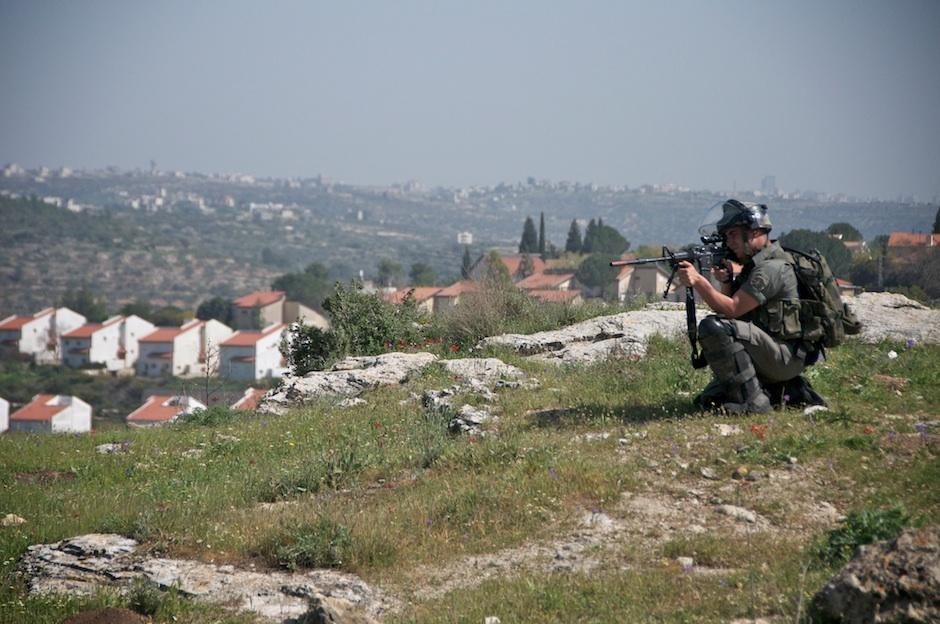
Photo by Dylan Collins - Nabi Saleh

Palestine Information Center – 01/02/2013

RAMALLAH — A Palestinian human rights report confirmed that the Israeli occupation forces (IOF) killed 7 Palestinians, and arrested more than 300 others during the month of January 2013.

Tadamun Foundation for Human Rights stated, in its monthly report released on Thursday, that four Palestinians, including two children and a woman were killed by Israeli fire in the occupied West Bank, while 3 other citizens were killed in the Gaza Strip, including a child.

Regarding arrests, the report pointed out that the occupation forces arrested more than 300 Palestinians across the West Bank and Gaza, including more than 60 children and 5 women.

The report noted that the arrest number does not include those detained during the clashes that erupted during the storming of Bab al-Shams village, built on Palestinian land slated for confiscation, near the city of Jerusalem.

The report added that the highest number of detention cases were in al-Khalil city, in the southern occupied West Bank, 80 arrests, and in occupied Jerusalem, 70 arrests.

The Foundation explained that a number of liberated prisoners, who have spent several years in Israeli jails, were among those arrested, such as Sheikh Jamal Tawil, Bajes al-Nakhla, and Fadi Sadak from Ramallah.

February 1, 2013 Posted by | Ethnic Cleansing, Racism, Zionism, Subjugation - Torture | , , , , , | Leave a comment

Israeli Foreign Ministry Produces A Film Replacing Al-Aqsa Mosque With Jewish Temple

By Saed Bannoura | IMEMC & Agencies | January 30, 2013
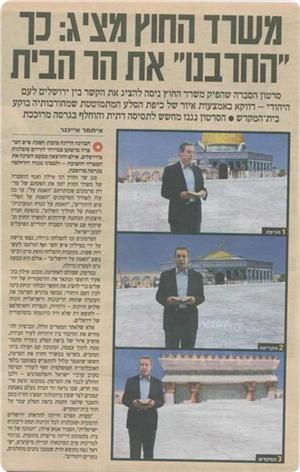
DataFiles-Cache-TempImgs-2013-1-images_News_2013_01_31_film-1_300_0In a film that was produced by the Israeli Foreign Ministry, and was banned from being officially published, Israeli Deputy Foreign Minister, Danny Ayalon, is seen standing and speaking in various areas of Jerusalem, including in front of the Dome Of The Rock, where in the film, it disappears and is replaced by Jewish temple.

The film, “The Fact About Jerusalem”, is meant, from an Israeli point view, to encourage tourism and portray harmony, but at the same time is meant to show the sole Jewish history of the holy city, while Ayalon also claims that the film “is about freedom of religion of the three faiths – Judaism, Christianity and Islam.

The Israeli source, Yedioth Aharonoth, said that the film includes provocative content and was not published due to fear of causing anger among the Muslims, not only in Palestine, but around the world.

Ayalon “stars” in the movie by appearing at different areas of occupied Jerusalem, showing its history, advanced technology, public transportation systems, and also appears standing in front of the Dome of the Rock before it disappears and is digitally transformed into a temple.

Yet, he talks about “diversity” and “harmony” in the Holy City, “in a Jerusalem that is shared not divided”.

The Foreign Ministry said that the film is about “facts”, different “facts” from its point of view about Jerusalem, the West Bank and the peace process.

The film was also translated to various languages attracting attention of millions of viewers around the world.

Despite the fact that the film was banned from being officially published, Ayalon uploaded it onto his own YouTube Channel.

Ayalon said that the film is about history and about what he called religious freedom, describing it as being produced to show what he described as the “freedom of religion to followers of the three faiths in the region”.

Palestinians denounced the film dubbing it as part of the ongoing Israeli attempts to void the Arab and Islamic history, culture and archeology.

Despite his claims of diversity and sharing the city of “the united not divided” Jerusalem, Israel prevents millions of Arab Muslims and Christians, from entering the city to pray at their holy sites or to tour the city.

January 31, 2013 Posted by | Ethnic Cleansing, Racism, Zionism, Illegal Occupation, War Crimes | , , , , , , , | Leave a comment

Hamas negates news about its acceptance of two-state solution

Palestine Information Center – 31/01/2013

BEIRUT — The Hamas Movement categorically denied some news reports claiming that the head of its political bureau, Khaled Mashaal, had asked the Jordanian monarch to tell the US administration that Hamas accepts the two-state solution with Israel.

“We, in Hamas, affirm that such allegations are untrue,” its information office stated in a press release.

It added that during his meeting last Monday with king Abdullah in Amman Mashaal did not table at all the issue of the two-state solution.

According to the press release, Mashaal discussed with the Jordanian king the Palestinian situation in general as well as the national reconciliation and the events in the region.

Mashaal also reiterated his Movement’s keenness on Palestinian unity and its refusal of all plans about the alternative homeland.

January 31, 2013 Posted by | Ethnic Cleansing, Racism, Zionism, Illegal Occupation, Timeless or most popular | , , , , , , , | Leave a comment

Israel must remove all Jewish settlers from occupied West Bank – UN inquiry

RT | January 31, 2013

A UN human rights inquiry has called on Israel to remove all Jewish settlers from the West Bank and cease expansion. The report said the settlements violate international law, and are an attempt to drive out Palestinians through intimidation.

­”Israel must, in compliance with article 49 of the Fourth Geneva Convention, cease all settlement activities without preconditions,” the report read, adding that Israel must immediately begin to withdraw all settlers from the occupied Palestinian territories (OPT).

The inquiry prompted a strong reaction from Israel who slammed the report as biased.

“The Human Rights Council has sadly distinguished itself by its systematically one-sided and biased approach towards Israel. This latest report is yet another unfortunate reminder of that,” said spokesman Yigal Palmor in a statement.

The 1949 Geneva Convention prohibits the transfer of a civilian population into an occupied area – such an act could constitute war crimes if brought before the International Criminal Court. Following the UN’s de facto recognition of Palestine last December, Israel announced plans to build thousands of homes in the OPT.

In response, Palestine wrote to the UN warning that Israel’s planned expansion into the occupied territories would lead to more war crimes being committed.

The UN investigators interviewed over 50 people who were driven from their homes. They described how their livelihoods were destroyed and their land was confiscated, and how they were subjected to continuous violence from Jewish settlers.
“The mission believes that the motivation behind this violence and the intimidation against the Palestinians as well as their properties is to drive the local populations away from their lands and allow the settlements to expand,” said the report.

The report has the potential to significantly worsen the UN’s already-strained relationship with Israel, particularly after Israeli representatives failed to appear at a UN human rights review two days ago.

The Israeli government has repeatedly ignored international condemnations of its settlements in the occupied territories, and continues to bar the entry of a Human Rights Council probe to assess the impact of the settlements. Israel has insisted that the organization is biased in favor of the Palestinians, and claimed that historic and biblical ties justify its claim to the territories.

January 31, 2013 Posted by | Ethnic Cleansing, Racism, Zionism, Illegal Occupation, Timeless or most popular, War Crimes | , , , , , , , , , | Leave a comment

Israel boycotts UN forum, first state in history to ignore human rights review

RT | January, 2013

Israel has boycotted the UN human rights forum over fears of scrutiny of its treatment of residents of the occupied territories. Israel is now the first state in history to win a deferment of the periodical review of its human rights record.

Tel Aviv has refused to send a delegation on Tuesday to the United Nations Human Rights Council in Geneva for the Universal Periodic Review procedure where UN member states have their human rights record evaluated every four years.

Israel’s cooperation with the council stopped last March after the UN set up a committee to inspect the effects of the Israeli settlements on Palestinians.

Israel which earlier accused the United Nations of anti-Israel bias reiterated its stance, recalling that the council has passed more resolutions against Israel than all other countries combined.

“After a series of votes and statements and incidents we have decided to suspend our working relations with that body,” Yigal Palmor, Israeli foreign ministry spokesman, told the Financial Times. “I can confirm that there is no change in that policy.”

“There have been more resolutions condemning Israel than the rest of the world put together,” an Israeli government official said on Tuesday. “It’s not a fair game – it’s not even a game.”

Following the Israeli decision, the council has decided to postpone its review until no later than November.

The Council president has also called on the body to adopt a draft response to an unprecedented move by Israel.

Egypt’s representative meanwhile has warned that a “soft” approach would create a dangerous precedent and leave “a wide-open door for more cases of non-cooperation,” the AFP quoted.

Activist groups have lashed out against Israel’s disregard for international law.

“By not participating in its own review, Israel is setting a dangerous precedent,” Eilis Ni Chaithnia, an advocacy officer with al-Haq, a human rights organisation based in Ramallah has told the FT. “This is the first time any country has made a determined effort not to attend.”

Others thought that the council’s decision to delay gives Tel Aviv the opportunity to make amends. Eight Israeli human rights organizations issued a statement saying, “Israel now has a golden opportunity to reverse its decision not to participate,” adding “it is legitimate for Israel to express criticism of the work of the Council and its recommendations, but Israel should do so through engagement with the Universal Periodic Review, as it has done in previous sessions,” JTA quotes.

The investigation into Israel’s Human Rights record began in 2007, but last year the UN started to pay particular attention to Israel’s activities in the West Bank.

The probe at the time prompted an angry response from the country’s leader.

“This is a hypocritical council with an automatic majority against Israel,” Prime Minister Benjamin Netanyahu said.

Senior Israeli officials announced last month that Israel does not intend to cancel plans to accelerate settlement construction.

Netanyahu himself said in an interview with Israeli Channel 2 last month that the … area “is not occupied territory” and that he “does not care” what the UN thinks about it.

Around 500,000 Israelis and 2.4 million Palestinians live in the West Bank and in East Jerusalem, areas that, along with Gaza, the Palestinians want for a future state.

The United Nations regards all Israeli settlements in the West Bank as illegal. Tel Aviv last attended the human rights review in 2008. Israel is not a member of the Council, which is comprised of 47 UN member states.

January 30, 2013 Posted by | Ethnic Cleansing, Racism, Zionism, Illegal Occupation | , , , , , , , | Leave a comment

Mahmoud Sarsak – Palestinian International Footballer

Free Gaza Scotland | January 29, 2013

On Wednesday 23rd of January I with other members of our group had the pleasure and honour to meet Mahmoud Sarsak in our appartment. He is a slight, quietly spoken young man, with a gentle manner and his good humour and patience with our questioning betray none of the pain he has suffered over the last 3 and a half years. When he begins to speak about his experience of imprisonment he tells his story with a matter of fact, quiet sincerity that is striking and makes the horror of his experience all the more shocking.

262793_503572486339823_1300969775_nMahmoud was 21 years old, at the start of a playing career which had already seen him being recognised as one of the best young prospects in Palestine, already a regular for the Palestinian National side. He had an invitation to play for a football team in Nablus in the West Bank. This meant that he had to ask for permission from the Israelis to cross from Gaza through Erez crossing into Israel in order to travel on to the West Bank. This did not worry him as it was a trip he had already done twice before and when he recieved his permission he went to the crossing looking forward to the opportunity of playing in Nablus. However when he got to Erez at 9am on the 22nd July 2009 his whole world changed, instead of being allowed to cross he was arrested and taken to a Police Station, from here his family were called and informed that he was being taken to Ashkelon Jail.

He was made to take off his clothes and change into overalls, an ‘under investigation uniform’. He describes how for the first 18 days he was tied to a chair with his eyes covered, the only times he was untied was when he was given food and they untied his hands or when he was allowed to go to the toilet when his legs were untied. He explains that during this time he was kept awake, not fed properly and questioned daily, every 4 days he was taken to a court where a judge gave permission for him to be held for a further 4 days. This treatment he says ‘wasn’t so bad’ in comparison with what was to come although I think that most people would call it torture.

At the end of that 18 days he was taken to a Military Jail in the South where he was kept for 6 days and his treatment became much worse. He was beaten regularly and was put in what he described as a fridge, he also had very hot and very cold water put under his feet. During all of this time in both places he was questioned, his interrogators were wanting him to say that he had been involved in ‘activities against Israel’. He didn’t understand what they meant by this, he was a footballer, he had not been involved in anything else and so refused to make things up to make his interrogators happy. He had no idea why he had been arrested.

At the end of these 6 days he was taken back to a civilian jail for another 11 days where suddenly things got much better. He was fed and allowed to sleep properly, his captors became very friendly offering him his freedom, a new house, a salary, a car, access to proper training facilities to help his playing career and foreign travel. All he had to do was become a collaborator. He refused, which provoked many serious threats from his Israeli interrogators. They told him that they would burn his family home down, attack his family and kill his brothers. Despite the pressures upon him and his ordeal so far, he continued to refuse to collaborate.

Except for short visits to court when his lawyer was present, during this initial 35 days of incarceration he had absolutely no contact with anyone but his jailors and interrogators. His lawyer told him that he was going to be all right, the court had said he was going to be released. Instead he was told by a Military Officer that he was now being held under ‘The Law of An Illegal Fighter’ and that they no longer needed to go to court to ask permission to keep him. He was then taken to Kitseot Jail near Bersheva where at least he could see other prisoners and his time of interrogation was over. He asked the other prisoners what this ‘Law of an Illegal Fighter’ meant but none of them had ever heard of it. When he was finally allowed access to his lawyer and was able to ask him he was told that it was a law that the Israeli authorities use when they have nothing against you but they want to hold onto you. He then asked his lawyer what rights he had under this law and was told that he had none, he could now be held in jail for as long as the Israeli Military wanted to keep him.

Mahmoud was the first Palestinian who had been held under this law, the only other people he knows of who had previously been held under it were 2 Hizbollah members from Lebanon who were arrested in 1982. He thinks that because he had no rights he was put in a cell which was 2m x 1m for his time in Kitseot, this cell had only a matress and toilet in it and he developed chest, skin and back problems while there. He was not taken to a hospital while there, and was only seen briefly by a prison doctor for these problems. He was allowed out of his cell for 1 hour a day for exercise with his fellow prisoners when he played football with them.

On the 22nd of February 2010 Mahmoud was taken to Tel Aviv for a court hearing to extend his imprisonment and then to another court hearing for the decision in Jerusalem two weeks later. The journey to court and between jails is in what the prisoners call a ‘post bus’ which is metal bus with steel compartments in which you are jostled and hit off the steel walls. He knew before he was taken to the second hearing that he was going to be held for another six months. After this hearing he was also barred from playing football with his fellow prisoners for that precious hour in the mornings and was told that this was due to his back being too bad. At this time they also started to move him between prisons every 2 months and he was still taken to court every 6 months in order to have his stay in prison extended.

On the 23rd of August 2011 he was told that he was going to be released, he was happy and said goodbye to the other prisoners. He was taken by ‘post bus’ to Erez, his hands and legs were not tied as they usually were, the window was open and when he got there they opened the door of the prison van and the guards moved away talking among themselves. He stayed where he was as he didn’t know what was happening and he didn’t want to be shot if they thought he was trying to escape. He called to the guards to ask what was happening and they told him they were taking him back to jail, he wasn’t being released. He was taken to a different jail for 2 weeks with only the clothes he had on when they took him to Erez. He said that he was later told about another prisoner who had been taken to Erez and left in an open ‘post bus’ with his legs untied in the same way. He had gone to the door to look out and been instantly shot in the leg and accused of trying to escape. After this 2 week period he was taken back to the jail he had originally been in when first imprisoned, here his other clothes and small number of belongings were finally brought to him.

When he was taken to this jail he was given another 6 months but his lawyer was promised that he would be released when this time ended on the 23rd of February 2012. The 23rd of February came and went, 10 days after this he was taken back to court, he had decided that this time if he wasn’t released he would go on hunger strike and stay on hunger strike until they promised in writing that he would be released. So when he was told that he was going to be imprisoned for another 6 months he prepared himself for 10 days, eating less each day and gradually reducing his physical activity. On the 15th of March 2012 he started his hunger strike. He only took water and sometimes a little salt in order to prevent his stomach from beginning to rot.

7 days after he started they began to move him from jail to jail before putting him in Nafha Jail which meant he was put in with the Israeli criminal population. Then he was put into isolation for a spell followed by hospital in Bersheva for 2 days tied to his bed then back to Nafha. From here he was sent to Eshel jail where he was put in isolation again and became very sick. This time they wouldn’t take him to hospital but would only allow him to see the Doctor in Eshel. After 35 days of this the Doctor in Eshel refused to continue to be responsible for him and he was taken to the Prison hospital in Ramle jail where he was with another 5 Palestinian prisoners who were also on hunger strike. He refused treatment here and was put back into isolation, this time his isolation cell had no windows so he was in darkness. After 47 days on hunger strike he bagan to have serious problems with his stomach, he couldn’t even drink water without vomiting. First white then black then brown vomit. They took him back to Ramle Prison hospital then and gave him antibiotics.

Along with the other hunger strikers he was asked regularly to break his hunger strike, on the 15th of May he was told that if he would break his hunger strike he would be released on the 23rd of August and the other hunger strikers were also told that they would have their demands met if they broke theirs. 3 of them accepted but along with 1 of the others Akram Al Rihawy he refused, he had heard promises of release before and he insisted that he have the promise in writing signed by a senior Judge and a Minister from the Israeli Ministry of the Interior. He was also told that he would not be allowed to return to Gaza, he had to choose between Germany, France or Norway which he also refused to accept. At this time he finally began to get International Committee of the Red Cross visits twice a week and he was asked daily to break his hunger strike, he continued to refuse until he got it in writing that he would be released back to Gaza and that he would be properly monitored by a committee of doctors when he started eating again.

Eventually on the 18th of June 2012 on the 96th day of his hunger strike a Minister from the Israeli Ministry of the Interior came to see him with the signed paper that he had been asking for stating in writing that he would be released on the 20th of July 2012. The Minister asked him if he would now please give up his hunger strike and he agreed. The Minister asked him to drink a glass of milk in front of him so that he could confirm and report that he had indeed broken his hunger strike which he did alathough he immediately vomited this back up. His stomach couldn’t cope even with milk after such a long time with no more than water going into it. He said that even though his stomach rejected this cup of milk his whole body felt as though it had drunk and felt relieved.

For 14 days he had to build up to eating again with first intravenous vitamins and nutrition, followed by nutritional drinks, before finally eating his first bit of bread after this 14 day period, which he still vomited back up. During the time of his hunger strike he was only allowed 2 visits from his lawyer, on the 40th day and on the last day. I asked if he was allowed any visits from his family during his time in jail. He replied that because he was given no rights under the ‘Law of An Illegal fighter’ he was not only denied visits from family but was not even allowed the 6 monthly letters delivered to his fellow prisoners by the Red Cross. He wasn’t able to write to them either, not even one short note.

At no time during Mahmoud’s entire incarceration was he actually accused of anything other than being asked to admit to the vague term ‘activities against Israel’ and he was never charged with anything. He was very clear that he had no idea why he was arrested. He was a footballer. The court appearances he attended were simply formalities under Military Law which say that every 6 months any detention order must be renewed.

All Palestinians from the West Bank and Gaza who are arrested by Israel are dealt with under Military Law not Israeli Criminal Law and therefore it is not necessary for Israel to ever bring charges against them. Many who are prosecuted are those who have signed false confessions under torture and are not able to retract them afterwards. Mahmoud’s case was slightly worse than normal Military law, under which there are a few rights which at least give some protection in prison. Mahmoud had none of these rights under this so called ‘Law of an Illegal Fighter’ by which he was held.

I asked Mahmoud if he was back in training for football and if he thought that it would be possible for him to return to his playing career. He said that finally he had managed to attend 3 training sessions and was hoping to be able to return to the team at some point in the future once he was back to full fitness. I sincerely wish him luck with this and hope that he will reach that stage very soon.

This has to be one of the clearest examples of why the BDS (Boycott Divestment and Sanctions) campaign should be supported by everyone and why Israel should be barred from participating in International Sporting events. Currently the 2013 UEFA U-21 Championship is scheduled to be played in Israel. How can this be allowed when they can treat a Palestinian International Player like this? Not to mention that they bombed the only 2 football pitches in Gaza during Operation Pillar of Cloud as well as destroying many local playing areas in the West Bank over the years. I saw several during my visit there in 2004 including one in Ramallah which had been bulldozed.

Mahmoud told us that the other prisoner who had stayed on hunger strike with him, Akram Al Rihawy, had spent his whole sentence in hospital due to his medical problems. His reason for being on hunger strike was not for release but for proper medical treatment. He stopped his hunger strike after being told that he was going to be released on Wednesday the 23rd of January 2013. Yesterday, on the 25th of January 2013 we were told that he was not released as promised and that he is now back on hunger strike.

To join the campaign against Israel hosting the 2013 UEFA U-21 Championship go to the following link and get involved: http://redcardapartheid.weebly.com/

January 29, 2013 Posted by | Civil Liberties, Full Spectrum Dominance, Solidarity and Activism, Timeless or most popular | , , , , , , , | Leave a comment

The most violent settlement in the West Bank encroaches on Asira al Qibliya

International Solidarity Movement | January 27, 2013
G

Asira al Qibliya, Occupied Palestine – According to OCHA statistics Yizhar is the most violent settlement in the whole of the West Bank with 70 recorded incidents in 2011 alone. Every week there is at least one attack by Yizhar settlers in the six affected villages.

Four months ago, settlers from Yizhar built a temporary outpost on top of a hill belonging to villagers from Urif. This continued until earlier in the week when Israeli authorities delivered maps to the village which showed that Yizhar had laid claim to 2 dunums of land. This was a massive understatement; they had in-fact seized the entire hill.

The land grab of this hillside seems to be all but complete; a shepherd who was working the land around the Yizhar outpost was recently beaten whilst tending to his sheep: the injuries he sustained were serious but not critical. In another incident, as the Palestinian owners of the land were walking along the road towards the hill this week, they were fired on by Israeli soldiers. Villagers want to challenge this latest land grab, however the law in this country is anything but just. The villagers are all too aware that if they resist they have only stones in the face of tear gas, stun grenades and the very real threat of being fired upon with live ammunition.

Harassment of the residents has also been on the rise. Currently at least once a week soldiers have been invading Asira in the middle of the night. They have been banging on villagers doors with the butts of their assault rifles, making sure people are disturbed in much the same way as has been reported in Urif as well as in Burin.

Yizhar a relatively small but very aggressive settlement in the north of the occupied West Bank. It is situated on a hill surrounded by six Palestinian villages which are all made to live in a state of constant fear.

January 27, 2013 Posted by | Ethnic Cleansing, Racism, Zionism, Illegal Occupation, Subjugation - Torture | , , , , , , , , | Leave a comment

Continued harrassment of the Nasser family in Madama

International Solidarity Movement | January 27, 2013
Settler attacks in Madama. Photo by Jaafar Ashtiyeh/AFP/Getty Images 2012

Madama, Occupied Palestine – A month after unprovoked settler and army attacks, the victim of severe violence Mamun Nasser remains in Israeli prison. The arrest of yet another member of the Nasser family shows Israeli army’s continued harassment in Madama.

On December 18th the notorious security guard charged with the protection of the illegal settlement of Yizhar, Jacob, attacked Mamun Nasser while he was tending to his flock of sheep in a hill outside the settlement. Mamun was handcuffed and beaten in front of his entire family, who desperately tried to intervene.

The Israeli army arrived on the scene, who responded by firing live ammunition on the Nasser family and others who tried to help, quickly ending their attempt to stop the vicious assault.  One round passed through Mamun’s sisters clothing narrowly missing her while another one hit his brother, Amir, in the leg. His mother told us “They wanted to kill him [Amir]. I heard the officer giving that order. He was lucky that he was only shot in his leg.” Severely beaten, Mamun was then arrested and taken away by the Israeli military into custody. One month later he remains detained in Majdou Prison.

On January 23rd at 4 pm, the Israeli army followed up the harassment by raiding the Nasser family home in Madama, arresting Mamun’s brother Amir who was still recovering from the gunshot wound he received only a month prior. This is another episode in the continued harassment of villagers surrounding Yizhar which is described as the West Bank’s most violent settlement by the United Nations.

Video taken by settlers during the incident on December 18th

January 27, 2013 Posted by | Ethnic Cleansing, Racism, Zionism, Illegal Occupation, Subjugation - Torture, Timeless or most popular, Video | , , , , , , , | Leave a comment
