US training terrorists to target Russia – Moscow
RT | February 13, 2023
The US has turned to Islamist extremists to plan terrorist attacks in Russia and other ex-Soviet republics, Moscow’s Foreign Intelligence Service (SVR) said on Monday. A group is being trained at a base in Syria for the purpose, the agency claimed.
“The US military is actively recruiting militants from jihadist groups affiliated with Islamic State [IS, formerly ISIS] and Al-Qaeda to commit terrorist attacks in Russia and members of the Commonwealth of Independent States [CIS],” the SVR stated, citing “credible reports.”
Established after the collapse of the Soviet Union, the CIS incorporates some of its former republics, including Armenia, Azerbaijan, Belarus, Georgia, Kazakhstan, Kyrgyzstan, Tajikistan, Turkmenistan, and Uzbekistan.
According to the SVR, the US has enlisted 60 terrorists who have already been active in the Middle East. They are undergoing training at the Al-Tanf American military base in Syria, where they are learning how to manufacture and use improvised explosive devices, it added.
“Particular attention is paid to planning attacks on well-protected facilities, including foreign diplomatic missions,” the agency stated. It added that Washington is aiming to “deploy the militants as part of small groups to the territory of Russia and the CIS states in near future.” They will then target “diplomats, public officials, law enforcement officers, and military personnel,” the SVR claimed.
“We see that US security agencies have lost all moral principles… Obsessed with the crazy idea of ‘bleeding Russia dry’, Washington strategists presume it is acceptable to directly use terrorists for their dirty purposes,” the agency said. It asserted that “such actions put Washington on a par with the largest international terrorist groups.”
In December, SVR Director Sergey Naryshkin claimed that the White House was pursuing policies to create an “instability belt along Russia’s external perimeter.” Naryshkin had previously stated that the security services in Russia and CIS countries have the common goal of “counteracting Western countries’ destructive actions on the territory of our states.”
Hungary slams EU push to arm Ukraine
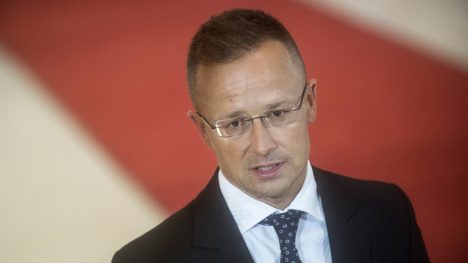
Hungarian Foreign Minister Peter Szijjarto © Michal Cizek / AFP
RT | February 12, 2023
Hungarian Foreign Minister Peter Szijjarto speaks to journalists in Prague, Czech Republic, on August 30, 2022. © Michal Cizek / AFP
The European Union’s calls to keep supporting Ukraine with arms shipments will only prolong the conflict with Russia, the Hungarian foreign minister said on Sunday.
Speaking to radio Kossuth, Peter Szijjarto commented on recent remarks by the President of the European Parliament, Roberta Metsola, who pushed for fighter jets and long-range weapons to be sent to Kiev. According to the minister, EU lawmakers’ decisions on Ukraine “have generally caused damage to Europe,” and further weapons deliveries will only worsen the hostilities.
He went on to blast the EU legislature, claiming that its “credibility is practically zero.” Szijjarto pointed to a recent graft scandal as proof that the EU parliament is “one of the most corrupt organizations in the world.”
He was referring to the recent arrest of the parliament’s former vice president, Eva Kaili, who has been charged with taking bribes from Qatar in exchange for illegally lobbying the interests of the Gulf state.
Szijjarto noted that in Western countries, war rhetoric sounds “incomparably louder than the rhetoric of peace,” while nations outside “the transatlantic bubble” tend to prefer peace to a deadly conflict.
The minister went on to question the West’s anti-Russia sanctions. He argued that they have failed to force Moscow to end the conflict, while Europe’s economy has “faced incredible difficulties,” and that “the tenth sanctions package will only be suitable for causing further damage to us Europeans, similar to the previous nine ones.”
Since the start of large-scale hostilities in Ukraine almost a year ago, Hungary, which is heavily dependent on Russian energy, has been critical of Western sanctions against Moscow. It has also refused to support Kiev with weapons, or allow arms transfers across its border with Ukraine.
US officials basically admit they blew up Nord Stream – Lavrov
RT | February 12, 2023
US officials are basically admitting that they were behind the sabotage of the Nord Stream pipelines, which was perpetrated to prevent rapprochement between Moscow and Berlin, Russian Foreign Minister Sergey Lavrov has said.
“The US decided that we [Russia] have been cooperating too well with Germany over the past 20 or 30 years; or rather, the Germans cooperated with us too well,” he said in an interview published on the Foreign Ministry’s website on Sunday.
The “powerful alliance” based on Russian energy resources and German technology “began to threaten the monopoly position of many American corporations,” Lavrov explained.
So, Washington decided to destroy this alliance between Moscow and Berlin, and did it “literally” by attacking the pipelines, which were built to deliver Russian gas to Europe through Germany, he added.
“American officials are basically admitting that the explosions that occurred at Nord Stream 1 and 2 were their doing. They even speak about it with joy,” the foreign minister stated.
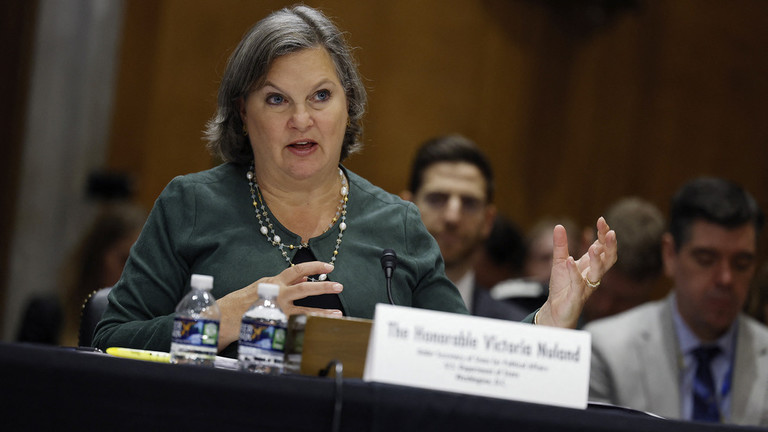
Lavrov was likely referring to a confession made by US Under Secretary of State for Political Affairs Victoria Nuland during a Senate hearing in late January. “I am, and I think the administration is, very gratified to know that Nord Stream 2 is now… a hunk of metal at the bottom of the sea,” she said at that time.
“The vileness of Western politicians is well known,” Lavrov continued, suggesting that “the plan, which is now being implemented through ‘inciting’ Ukraine against Russia and waging a war by the entire West against Russia by means of Ukraine, is to a large extent aimed at preventing a new rapprochement between Germany and Russia.”
The comments by Russia’s top diplomat come just days after iconic American investigative journalist Seymour Hersh released a bombshell report, blaming Washington for sabotaging the Nord Stream pipelines last year.
According to an informed source who talked to Hersh, explosives were planted at the pipelines in the Baltic Sea back in June 2022 by US Navy divers under the guise of a NATO exercise. They were detonated in late September, rendering the key European energy infrastructure inoperable.
US National Security Council spokeswoman Adrienne Watson denied the report by the Pulitzer Prize-winning journalist, calling it “utterly false and complete fiction.” No one among high-ranking American officials has even commented on the accusations made by Hersh.
For months, the Russian authorities have been pointing to the fact that the only side to benefit from the destruction of Nord Stream was the US, which has seen supplies of its more expensive liquefied natural gas to Europe increase massively since the explosions.
Sanction failures piling up
Free West Media | February 11, 2023
Western sanctions were supposed to “ruin” Russia not only economically, but also technologically – according to the well-known announcement by German Foreign Minister Annalena Baerbock.
The ban on supplying electronics was intended to paralyze the Russian armaments industry. But Western war planners appear to have gotten even the most basic facts wrong. As is now apparent, an “isolated” Russia has managed to circumvent US-imposed sanctions in the technology sector. What’s more, Russia is importing even more microchips and semiconductors than before the war.
Among other things, the US and the EU banned the supply of microchips and semiconductors to Russia, depriving them of “70 percent” of their imports. The most important companies in the sector, such as Intel, AMD, the Taiwanese chip giant TSMC and Nexperia from the Netherlands, stopped doing business in Russia almost overnight.
At the end of March, US President Biden confidently announced that Russia would no longer be “able to rebuild those devastating weapon systems” and was on its way back “to the 19th century” as a result of the Russian operation in Ukraine, while US Commerce Secretary Gina Raimondo stated: “We have reports from Ukrainians that when they find Russian military equipment on the ground, it’s filled with semiconductors that they took out of dishwashers and refrigerators”.
Raimondo spoke at a Senate hearing in May last year, noting that she had recently met with Ukraine’s prime minister. “Our approach was to deny Russia technology — technology that would cripple their ability to continue a military operation. And that is exactly what we are doing.”
And in September, the President of the EU Commission, Ursula von der Leyen, defiantly announced that Russia’s industry was in ruins. “The Russian military is taking chips from dishwashers and refrigerators to repair their military equipment because they are running out of semiconductors. Russian industry is in tatters,” she claimed in a speech in the European Parliament.
Total Western failure to predict outcomes
But the Russian armed forces never had to do that during the war, as is now evident. Referring to an official report, the weekly German newspaper Zeit reported that Western sanctions in no way reduced Russian imports of electronic components – on the contrary: Russia imported even more processors and semiconductors in 2022 than before the war. Overall, imports in this segment have increased from 1.8 billion euros to 2.45 billion euros.
Beyond that, Russian imports fell by just 16 percent on a yearly basis. This was also confirmed by US economist and sanctions advocate Matthew Klein. According to his calculations, Russian imports in November were only 15 percent below the monthly average for 2021. At the beginning of 2022, shortly after the Russian operation started, Western “experts” had expected a slump of at least 30 to 40 percent.
The fact that Russia was able to circumvent the sanctions is due to countries like China, Turkey or the United Arab Emirates, which quickly filled the gaps left by Western corporations. They also act as a location for Russian intermediaries who obtain Western technology from letterbox companies.
At the same time, Russians have been manufacturing their own goods to fill the gaps that have arisen as a result of sanctions and the withdrawal of western corporations.
IMF expects Russia’s economy to grow
Until recently the West doubted that Russia’s economy would survive under sanctions, but the International Monetary Fund (IMF) is now sounding more optimistic than even the Russian government. Known for its gloomy forecasts, The IMF has predicted that Russia’s GDP will expand this year.
By far the most important trading partner for Russia is China. Overall, imports from China rose by 13 percent in 2022. Many Western companies such as Apple or Ikea had supplied the Russian market before they withdrew. This decision to leave could be compensated for.
China’s companies now deliver the majority of new cars and smartphones, computers, but also heavy equipment such as construction machinery and trucks. In fact, exports of trucks from China more than tripled in 2022 while imports of construction equipment have doubled.
Most importantly from a Russian point of view, however, are the imports of microchips. Together with Hong Kong, China shipped $900 million worth of semiconductors to its neighbour in 2022, more than double than the figure for 2021.
US defense official flags ‘no objections’ to Kiev attacking Crimea
RT | February 11, 2023
The US would have no objections to Ukrainian forces striking targets inside Crimea with American-supplied weapons, a senior defense official said on Friday.
Dr Celeste Wallander, Assistant Secretary of Defense for International Security Affairs, was asked whether Washington supports Kiev in seizing Crimea, or at least in striking Russian targets there. The peninsula overwhelmingly voted to become part of Russia in 2014 following a Western-backed coup in Kiev.
Speaking at the Center for a New American Security, Wallander reiterated that the US “supports Ukraine’s territorial integrity and sovereignty over its internationally recognized borders, and that includes Crimea.” With this in mind, the official argued that Kiev “has the right to defend every inch of its territory.”
As long as Ukraine “identifies operational value in targeting Russian forces on Ukrainian territory… we don’t have objections and do not seek to limit Ukrainian military operations to achieve their objectives.”
She also commented on remarks made by Chairman of the US Joint Chiefs of Staff General Mark Milley, who warned in January that it would be “very difficult” for Ukraine “to militarily eject the Russian forces” from all the territories they currently control.
“I am not going to contradict general Milley, and I think he was giving a hard-headed assessment of the scale of the challenge,” she said.
In January, The New York Times reported, citing sources, that the administration of US President Joe Biden was warming to the prospect of helping Ukraine to target Crimea, “even if such a move increases the risk of escalation.”
On February 3, the US announced a new $2.17 billion security package for Ukraine which included ground-launched, small-diameter bombs (GLSDB) with a range of up to 150 kilometers (93 miles). While the Pentagon said that this long-range capability would enable Ukrainians “to take back their sovereign territory,” it declined to speculate about Kiev’s future potential operations.
Last week, former Russian President Dmitry Medvedev, who now serves as Deputy Chair of the nation’s Security Council, warned that any attack on Crimea would be interpreted as an attack on the country itself. Kiev, he said, must understand that such moves would be “met with inevitable retaliation using weapons of any kind.”
Germans Opposing Arms Supplies to Kiev Need to Start Peace Movement, Lawmaker Says
Sputnik – 11.02.2023
BERLIN – Germans that advocate peace talks and oppose arms supplies to Kiev must organize into a movement for peace, otherwise the situation will deteriorate further and Germany will get dragged deeper into the Ukraine-Russia conflict, lawmaker Sahra Wagenknecht told die Welt newspaper on Friday.
Earlier in the day, Wagenknecht, a member of the German Parliament for The Left Party, and prominent German feminist journalist Alice Schwarzer launched a petition on the change.org portal titled “Manifest for Peace.”
In their petition, the pair called on German Chancellor Olaf Scholz to stop sending arms to Ukraine and initiate peace talks. As of yet, over 75,000 people have signed the petition.
“We urgently need a peace movement in Germany, otherwise we will be drawn deeper and deeper into this war, which must be ended. It is necessary to negotiate for this, and not to supply more and more weapons,” she told the newspaper.
“If there is no ‘Stop’ sign and if the half of Germans that, according to surveys, does not want [arms] supplies does not manifest itself more explicitly, then fighters will also be delivered [to Kiev] in the near future.”
A couple of weeks ago, it was considered impossible for Germany to be among the first countries to supply tanks, Wagenknecht said. Now, fighter jets and long-range missiles are being discussed, which, according to the lawmaker, will not end the war, but will only lead to the escalation of the conflict.
The lawmaker also said that only the Vatican has so far expressed its desire for peace, while Germany, France, the US and the EU have only been making unrealistic demands. A realistic proposal, according to Wagenknecht, will be a neutral status for Ukraine and the creation of a de-militarized zone in contested regions, followed by referendums on their territorial affiliation.
“If such a proposal had been made, and [Russian President Vladimir] Putin would have refused to even discuss it, then it would be possible to talk about a different path. But how can you say that Russians do not want negotiations, if such an offer is not even on the table?” she said.
The lawmaker also announced that a demonstration in support of the petition would take place in central Berlin on February 25.
US ‘lying’ about Nord Stream expose – Moscow
RT | February 10, 2023
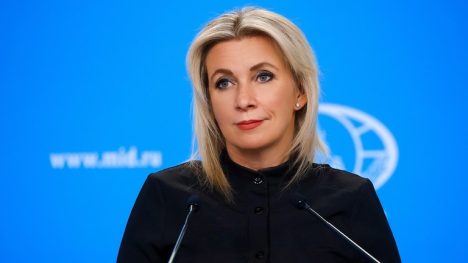
Attempts by the US State Department to brush off Seymour Hersh’s article about the sabotage of Nord Stream pipelines as “nonsense” are overt lies that display shocking ignorance of American history, Russian Foreign Ministry spokeswoman Maria Zakharova told reporters on Friday.
The veteran investigative journalist reported on Wednesday that the US was behind the destruction of the Baltic Sea pipelines in September 2022. American divers planted charges under the cover of a NATO exercise, and a Norwegian airplane detonated them remotely when the time came, Hersh wrote.
“It would not be typical for us to engage allies and partners on something that is utter and complete nonsense,” State Department spokesman Ned Price said on Thursday, answering a question about Hersh’s article.
Zakharova said she was astonished by Price’s audacity to call “nonsense” what US President Joe Biden and Deputy Secretary of State Victoria Nuland openly described as their preferred outcome.
“The US is once again lying live on air, openly mocking journalists who asked fully justified questions,” Zakharova said.
Washington also has a history of targeting civilian petrochemical infrastructure, Zakharova noted, citing the 1983 CIA sabotage of a pipeline in Nicaragua as an example.
“You did this, you do this, and you will do this until you’re stopped,” the spokeswoman added.
As for bringing allies and partners into “nonsense,” Zakharova argued that this was precisely what “trans-Atlantic solidarity” means in practice, referring to the 2003 invasion of Iraq as one example.
“Twenty years ago, Secretary of State Colin Powell brought to the UN Security Council a vial of something, and called [on] allies and partners to invade a sovereign state, without any evidence, over claims that proved to be utter nonsense. Ned, do you know your own department’s history?” Zakharova said. “I have no doubts that at the State Department they are bad with the history of their own country. That’s why we are where we are.”
Explosions that damaged both Nord Stream pipelines near the Danish island of Bornholm cut off the flow of Russian natural gas to Germany. US officials tried to blame Russia for the blasts, while expressing delight at the destruction and calling it an “opportunity” for Europe. The White House has denounced Hersh’s report as “utterly false and complete fiction.”
Zakharova noted that Denmark and Sweden had refused Russian offers to assist with the investigation, while Norway declined to provide aid citing EU sanctions, adding that this shows the three governments were not interested in finding out the truth, but rather covering it up.
Ukrainian pilot: Performance of Western fighters inferior to Russian jets
By Drago Bosnic | February 10, 2023
In recent weeks, the Kiev regime intensified its efforts to acquire Western fighter jets to replace its rapidly dwindling inventory of Soviet-era aircraft. In the immediate aftermath of the Soviet dismantlement, Ukraine was left with one of the world’s largest and most advanced fighter fleets, including the then nearly brand-new Su-27 “Flanker”, one of the best air superiority aircraft ever designed. And while the ensuing post-Soviet economic collapse essentially halted any modernization efforts, Ukraine remained one of the leading European countries in heavyweight fighter jet deployment.
However, efforts to sustain (much less modernize) the country’s fleet came to nothing after the political West conducted the infamous 2014 Maidan coup and brought the Neo-Nazi junta to power. The new illegal foreign-backed authorities had trouble even with the basic maintenance, further exacerbating the Ukrainian Air Force’s troubles. Decades of deteriorating conditions for pilots and aircraft were now made even worse, as the much-needed defense ties with Russia were cut, denying the UAF access to enough spare parts and other assets necessary to keep its fleet airworthy. Hundreds of airframes were placed in long-term storage, as the country was struggling with providing funds and resources to sustain the massive Soviet legacy it was left with.
Over the next 8 years, the coup authorities conducted a thorough purge, crushing any opposition to the transformation of the country’s military into an armed wing of the Neo-Nazi regime. Only after this process was completed, the political West decided to fund sustainment and modernization efforts. However, despite years and billions of dollars invested in this endeavor, the Kiev regime forces were completely outclassed by the VKS (Russian Aerospace Forces), with Moscow fielding incomparably more capable fighter jets, including the Su-35S, a deeply modernized design based on the Su-27 still used in Ukraine, in addition to other platforms such as the superfast, high-flying MiG-31 and the brand-new Su-57.
Within only a week since the beginning of the special military operation, the vast majority of the Kiev regime’s air assets have either been destroyed or forced into hiding as the Russian military established air dominance and targeted most airbases under the junta’s control. There were still pilots trying to face the VKS, but their efforts were mostly in vain, as they would often get shot down from hundreds of kilometers away, either by Russian fighter jets or the Eurasian giant’s second-to-none long-range SAM (surface-to-air missile) systems. Moscow has both qualitative and quantitative advantages, as many of its pilots accumulated precious combat experience, including a record holder with over 800 combat sorties, a truly astounding achievement.
With the remnants of the former Ukrainian Air Force virtually wiped out, the Kiev regime is desperate to rebuild it with Western-made aircraft. However, the Neo-Nazi junta is faced with severe difficulties to achieve this goal. Logistics, training, finances and, most of all, time are the main issues preventing this. As the Russian Aerospace Forces dominate the skies, Kiev regime pilots are faced with almost certain death if they were to go up against the Eurasian giant. The Neo-Nazi junta’s intention to acquire Western fighter jets, particularly the F-16, certainly doesn’t make the Ukrainian pilots feel any safer. On the contrary, many are worried that the lightweight US-made aircraft is completely outclassed by Russian heavyweight fighter jets, such as the aforementioned Su-35, MiG-31 and Su-57.
A video taken during the summer of 2022 shows the Kiev regime pilot Lieutenant Colonel Dmitry Fischer, who claimed that the F-16’s performance is significantly inferior to that of the Su-27. He based the assessment on his personal experience in flying both aircraft. “… I flew the F-16 the first day and loved it. However, in terms of performance, the Su-27 is significantly superior,” Fischer admitted. He then added that the Russian-designed jet has better flight performance in every category, including speed and maneuverability, giving it an incomparable advantage in dogfights and WVR (within visual range) engagements. The pilot concluded his remarks with an assertion that the Su-27 is “the king of dogfighting”.
It should be noted that the Su-27 jets in service with the Kiev regime forces are decades behind the newer generation derivatives used by the VKS, which operates significantly more advanced versions of the jet, such as the Su-30 and Su-35, with the latter essentially being a so-called “fifth-generation” aircraft in every aspect bar stealth. If the Ukrainian pilots themselves consider the basic Su-27 superior to F-16, then the US-made fighter stands no chance against the much more modern “Flanker” iterations used by Russia. The Su-27 jets in service with the Kiev regime were decimated by the VKS and Lieutenant Colonel Fischer himself seems to have met his untimely end flying precisely this aircraft.
Various sources, both Russian and Ukrainian, claim that the pilot was killed on June 5, 2022. Apparently, Fischer was piloting his Su-27P1M when he was shot down over the town of Orekhov in the Zaporozhye oblast (region). There is conflicting information on how exactly he was downed, with some sources claiming that his “Flanker” was struck by a Russian air-to-air missile, while others insist that the Kiev regime’s air defenses shot him down in a friendly-fire incident. Either way, Fischer’s fate, as well as his assertion that the F-16 is inferior to the Su-27 already fielded by the Kiev regime forces serve as a stark warning to other Ukrainian pilots that no Western-made jet will give them greater chances of survival, let alone an actual advantage over their Russian rivals.
Drago Bosnic is an independent geopolitical and military analyst.
Loss of Western brands is Russia’s gain – Putin
RT | February 9, 2023
Many foreign brands and businesses are leaving Russia not of their own volition but because they are feeling pressured to do so, and suffer financially as a result, Russian President Vladimir Putin said on Thursday at a meeting of the supervisory board of the Agency for Strategic Initiatives.
Moscow, however, will not force anyone to stay, according to the president.
“Many of them, as you know, under pressure from their governments, are leaving our market. Well, all the best to them. However, because of the loss of our market they incur huge losses. It’s their choice, it’s their decision,” Putin said, noting that many of those companies “do it without any pleasure.”
“Who wants to lose a well-established business in which they invested effort, money? It’s not even about the money sometimes – many have invested their hearts – but under pressure from their governments are forced to leave.”
According to Putin, Russia will not allow the varied assets and infrastructure these companies leave behind to go to waste, and domestic industries may even benefit from the situation.
“They leave behind a good legacy, so to speak, they leave behind production infrastructure, well-trained personnel. Perhaps someone thinks that all of this will immediately crumble and fall apart – nothing of the sort is happening. Our companies, our entrepreneurs are picking up these enterprises and businesses and continuing this work. And quite successfully,” the Russian president assured.
After Moscow’s military operation in Ukraine began, many major Western brands announced their withdrawal from the Russian market and the suspension of investment. According to economists from Switzerland’s University of St. Gallen, more than 1,400 companies decided to quit Russia over the past year, including electronics manufacturers, automakers, hotels, banks and restaurant chains.
However, Russia managed to secure supplies of goods through alternate routes – via the so-called ‘parallel imports’ – where products continue to be delivered to Russia through third countries without a brand license from the rights holder.
In addition to this, the Russian government has launched a number of programs and initiatives to support domestic manufacturers, which fall within the framework of ‘import substitution’. According to Putin, the country produces a lot of quality products, which until recently had a hard time making their way to the domestic market due to competition from global players.
However, the departure of Western brands means “our domestic manufacturers received unique opportunities for development and we must take advantage of them,” Putin stated.
Kremlin reacts to Nord Stream sabotage claim
Sputnik – 09.02.2023
MOSCOW – The report of investigative journalist Seymour Hersh on Washington’s involvement in the explosions at Nord Streams has once again pointed to the need for an open international investigation into the incidents and punishment for those responsible, Kremlin spokesman Dmitry Peskov said on Thursday.
On Wednesday, Hersh, a Pulitzer Prize winner, published a report saying that US Navy divers during NATO Baltops exercises in the summer of 2022 planted explosives to destroy the Nord Stream pipelines, which Norway activated three months later. According to the report, US President Joe Biden decided to sabotage the Nord Streams after more than nine months of secret discussions with the national security team.
“The appearance of such materials once again shows the need for an open international investigation of this unprecedented attack on critical infrastructure, international critical infrastructure. It is impossible to leave this without revealing the perpetrators and without their punishment,” Peskov told reporters.
Some points of the report can be disputed, some points need proof, but it is remarkable for the depth of analysis, the official said, noting that it would be at least unfair to ignore it, especially for such a country as Germany, which, in fact, as a result of this terrorist act, was deprived of a very important energy facility.
Kremlin spokesman added that the report did not break in Western media, stressing that it is surprising.
“Unfortunately, the article was not widely disseminated in the Western media, which cannot but arouse our surprise,” Peskov rold reporters.
Moscow sees attempts to silently curtail the international investigation into the attacks, but this is a dangerous precedent, as those who committed the attack on the Nord Stream pipelines can repeat it anywhere in the world, the official said.
Russian FM: US playing with fire, encouraging separatism in Kurdish region in Syria
Press TV – February 6, 2023
Russian Foreign Minister Sergei Lavrov says the United States is “playing with fire” with its activities on the common border between Iraq and Syria, especially by backing separatist militants affiliated with the so-called Syrian Democratic Forces (SDF) and encouraging separatism.
Lavrov said at a press conference in Baghdad with his Iraqi counterpart, Fuad Hussein, that Washington “fosters separatism among locals of Kurdish-populated regions in Iraq and Syria. It is playing with fire.”
He added, “Americans encourage Kurdish separatism one way or another and ignore other matters, including the territorial integrity of Syria, warning that such an approach “exposes other countries in the region to ensuing dangers and threats.”
Security conditions have been deteriorating in the areas controlled by the US-led SDF in Syria’s northern and northeastern provinces of Raqqah, Hasakah, and Dayr al-Zawr amid ongoing raids and arrests of civilians by the US-sponsored militants.
Locals argue that SDF’s constant raids and arrest campaigns have generated a state of frustration and instability, severely affecting their businesses and livelihoods.
Residents accuse the US-backed militants of stealing crude oil and failing to spend money on service sectors.
Local councils affiliated with the SDF have also been accused of financial corruption. They are said to be embezzling funds provided by donors, neglecting services, and not meeting the basic needs.
The Russian foreign minister went on to note that Moscow continues to work on negotiations within the Astana format for the peaceful settlement of Syria conflict, and regards the peace talks as useful.
“We consider Iraq’s observer status at the Astana talks, with Iran, Russia and Turkey acting as the guarantor states, to be very useful. We will continue our interactions and welcome participation of Iraq as an observer. Jordan and Lebanon also play the same role,” Lavrov said.
The Russian foreign minister went on to speak of a “vital importance” to “safeguard” bilateral economic ties with Iraq against “illegal sanctions” imposed on his country by the United States and its allies due to the conflict in Ukraine.
Lavrov said Russia had already invested some $13 billion in Iraq, arguing that Russian oil companies have not received outstanding payments because of the West’s coercive measures.
Elsewhere in his remarks, the top Russian diplomat underlined the importance of the Palestinian issue, saying that the West is procrastinating resolution of the Israeli-Palestinian conflict.
Hussein, for his part, termed Lavrov’s visit to Iraq as a remarkable development, stressing that Baghdad and Moscow will discuss problems linked to the work of Russian companies and Russian financial dues in the Arab country through meetings of the joint committee between the two sides.
The Iraqi foreign minister said he would discuss the issue of cooperating with Russian companies during an upcoming visit to the US.
Hussein said he would insist the US should refrain from imposing sanctions on Iraqi companies for working with Russian partners in Iraq.
He also touched on the Ukraine crisis, stating that Iraq demands a ceasefire between Russia and Ukraine, and calls for an end to the crisis through sincere dialogue between the two countries.
Ukraine accused of chemical warfare
RT | February 6, 2023
Russian military commanders are reporting that Ukrainian troops have been deploying some kind of chemical weapon against their units in Donbass, according to a local official.
Speaking to Russian television on Monday, Denis Pushilin, the acting governor of the Donetsk People’s Republic said his office has been receiving reports about possible chemical warfare “for at least two weeks.” Ukrainian troops have reportedly been deploying “chemical compounds that make our military service members ill,” he said.
Dmitry Peskov, the spokesman for the Kremlin, declined to discuss the allegation with journalists, saying that his office didn’t have accurate information about the issue.
He said the Russian military would pass such incidents up the chain of command and suggested contacting the Defense Ministry with further inquiries. The Defense Ministry did not immediately comment on the claim.
Speculation that some Ukrainian units may use air-dropped munitions with a chemical agent has been swirling on social media since mid-January. The rumors were apparently triggered by a video that surfaced showing people in Ukrainian military uniforms assembling small quad drones carrying small containers, with the payload apparently taken from a refrigerator. Some military experts suggested that whatever was used must have been volatile if it had to be stored at a low temperature.
Chemical warfare is forbidden under the Chemical Weapons Convention (CWC), an international treaty that took effect in 1997 and to which both Ukraine and Russia are signatories. The military prohibition applies even to riot control agents, colloquially known as tear gas, though unlike other chemical weapons, the CWC allows such substances to be manufactured and used in law enforcement.
Featured Video

Death Spikes & Rising Cancer In Our Youth Explained
or go to
Aletho News Archives – Video-Images
From the Archives
Politicians lie
By Mazin Qumsiyeh | Popular Resistance | August 18, 2013
There is no way to say this truth nicely: Politicians lie. That includes Japanese, American, Egyptian, Israeli, and Palestinian politicians! Is there something more common sense than that? Yet, so many citizens around the world believe their own politicians or wistfully acknowledge lies but think it is part of the job needed to run things. They believe even when politicians contradict themselves blatantly. This phenomenon is rather remarkable. It is a dissonance and disconnect from reality that many seem oblivious to. It is very dangerous because it can lead to accepting rationales for going to war. These can be deadly wars that lead to millions of lives lost as happened in what was called World War 1 and WW2. Even when incredible and declassified evidence abound, politicians continue to lie and old mythologies refuse to die. Here are just a few of the countless lies told to us over the past few decades… continue
Blog Roll
 Aletho News
- Global Tipping Points Lead the World Into a State of Entropy
- The day-after at the White House: USA and Xi Jinping
- The Geopolitical Balance in the Red Sea: The UAE Being Displaced by New Players
- Iraqi resistance group vows to stage airport sit-ins over Iran aerial blockade
- Turkish parliament to review Saudi-Pakistan defense pact next month
- DEATH SPIKES & RISING CANCER IN OUR YOUTH EXPLAINED
- Iran offers Trump deal before US election
- Merz regime wants ‘secret police’ – opposition
- Israeli settlers terrorize West Bank Palestinians with state-provided drones: Report
- They see them, then kill them: Israeli quadcopters track, deliberately target civilians in Gaza
- If Americans Knew
- Deconstructing Netanyahu’s pants-on-fire UN rant – Daily Update
- Trump betrayed voters with his campaign lies and prioritized a foreign country once he took office
- Netanyahu calls Israel’s war in Gaza ‘opposite of genocide’ in UN speech to near-empty hall
- Settler Kidnappings: Torture, Sexual Abuse and Terrorisation of Palestinian Abductees as Israel Deepens Annexation of West Bank
- Gaza winter nears as 162,000 tents become unusable, raising fears of humanitarian crisis
- Netanyahu says, “It’s the opposite of genocide”; UN says Gaza economy is world’s ‘most severe crisis on record’ – Daily Update
- Israel’s US-Backed Assault on Gaza Has Created the ‘World’s Most Severe Economic Crisis on Record’: UN
- ‘Protecting U.S. Citizens’… From Israel
- ‘This is where I live now, the back of a truck’: a day in the life of a grandmother in Gaza
- In UN Speech, Iran’s President Displays Pictures of Children Killed by US, Brings Attention to Israel’s Nuclear Arsenal
- No Tricks Zone
- New Study: Earth And Venus Surface Warmth Largely Explained By Convection And Lapse Rate, Not CO2 Or Radiation
- 2025 Nature Paper Claiming Worsening Global Drought Gets RETRACTED …Heavily Flawed
- New Study: ‘Global Drought Shows No Detectable Recent Acceleration Under Climate Warming’
- Economic Masterminds: German Socialists Suggest Taxing Productivity Gains Stemming From Using AI
- The South China Sea Has Not Been Cooperating With The Climate Change Narrative
- Energy Crisis: Germany Enters Heating Season With Historically Low Gas Reserve Fill Levels
- New Study: The Antarctic Ice Sheet Gained Mass From 2020-2024 Due To Staggering Snow And Ice Accumulation
- Study: Ocean Heating Rates From Thousands Of Years Ago ‘Dwarf’ Modern Ocean Heating Rates
- Climate Extremists Target, Attack Large-Scale Power Grid Infrastructure In Germany!
- New Study: Antarctic Ice Melt Has Contributed Less Than 1 Centimeter To Sea Level Rise In The Last 30 Years

