Putin warns the US to back off in Ukraine
BY M. K. BHADRAKUMAR | INDIAN PUNCHLINE | APRIL 27, 2022
The Western narrative of the two-month old war in Ukraine imbued with the rhetoric of “democracy versus autocracy,” has dramatically changed with the assertion by the US Secretary of Defence Lloyd Austin at a news conference in Poland Monday following his and Secretary of State Antony Blinken’s trip to Kiev, that Washington wants to “to see Russia weakened.”
David Sanger at the New York Times noted that Austin was “acknowledging a transformation of the conflict, from a battle over control of Ukraine to one that pits Washington more directly against Moscow.” But this is not really a transformation. Sanger’s colleague at the Washington Post, David Ignatius, had written over three months ago that the Biden Administration was working on a road map to get Russia bogged down in Ukraine and attrition it in a way that it becomes a much diminished power on the world stage.
For the Kremlin, most certainly, Austin’s remark would not have come as surprise. As recently as on Monday, President Vladimir Putin repeated at a meeting in the Kremlin that the US and its allies have sought to “split Russian society and destroy Russia from within.” Putin revisited the topic again on Wednesday pointing out that “the forces that have been historically pursuing a policy aimed at containing Russia just don’t need such an independent and large country, even enormously large, in their view. They believe that its very existence poses a threat to them.”
In fact, several perceptive Western observers had estimated that the Kremlin has effectively fallen into a trap laid by the US that is intended to bring down Putin’s regime. Come to think of it, that famous gaffe on 26 March wasn’t a gaffe after all, when President Biden, speaking in Warsaw, had blurted out the impromptu, unscripted remark: “For God’s sake, this man (Putin) cannot remain in power.”
All the same, Austin’s remark signifies that a dramatic change is taking place in the geopolitical situation, which could have positive or negative results. On Monday, Russian Foreign Minister Sergey Lavrov warned the West that staying involved in the Russia-Ukraine war posed “serious” and “real” risks of a World War III and “we must not underestimate it.”
To be sure, the conflict is slowly but steadily turning into a new phase. Foreign fighters and soldiers from NATO regular units are increasingly beefing up the depleted Ukrainian army’s front lines.
That said, the optics also need to be understood. Austin’s war cry comes soon after Mariupol fell to the Russian forces. A couple of thousands Ukrainian nationalists and a few hundred military personnel from NATO countries are trapped in an underground labyrinth at the Azovstal complex in the city, which Russian forces have sealed off. It has been a severe blow to the US’ prestige.
The Russian special operation is on track — “grinding” the Ukrainian forces to the ground, to borrow the graphic expression from UK prime minister Boris Johnson. On Monday, Russian high-precision missiles hit at least six railway substations in Western Ukraine destroying railway facilities in Krasnoe, Zdolbunov, Zhmerinka, Berdichev, Kovel, Korosten, which were meant to be key transshipment points for the supply of Western weaponry to the Ukrainian forces in the Donbas region. Rail communication in several western regions of Ukraine is effectively blocked.
Reports from the east show that Ukrainian forces are suffering heavy losses. Russian forces have taken the city of Kremennaya and are approaching the town of Lyman, which would give them control of a direct road to Slavyansk from the east.
Austin’s hyped up rhetoric notwithstanding, Ukraine is not only not showing any signs of winning but keeps bleeding, and the territory under the actual control of the Ukrainian government is steadily shrinking. US officials admit that the Pentagon lacks the ability to track the weapons that are going in. Yet, the Biden administration has so far spent around $4 billion on Ukraine. Therein hangs a tale. Who are the real beneficiaries of the US supplies? The level of corruption in Ukraine is legion.
The plain truth is that it will be many weeks or months before meaningful volumes of heavy weapons could be delivered to Ukrainian combat units but in the meanwhile, the Battle of Donbass will be fought almost entirely on the basis of the current strength on the ground. In a detailed analysis this week, a former colonel in the US Army and prolific media commentator Daniel Davis concluded: “It will take too long for Western governments to come up with a coherent equipping plan and then prepare, ship, and deliver the kit to its destination in a timeframe that could provide Kyiv’s troops the ability to tip the balance against Russia.”
The bottom line is this: The Biden Administration’s geopolitical agenda is to prolong the military conflict, which apart from weakening Russia militarily and diplomatically, turns Europe into a battlefield and makes the continent heavily dependent on the US leadership for a very long time to come. For Biden, the war provides a useful distraction in US politics in an election year.
Austin hosted a conference of the US’ allies on Monday at the American base in Germany to form a monthly contact group on Ukraine’s self defence to coordinate the “efforts to strengthen Ukraine’s military for the long haul.” It has the ominous look of a “coalition of the willing.” Even Israel was recruited. But the US is underestimating the steely Russian resolve to fully realise the objectives behind the special operation in Ukraine. Moscow will not brook any roadblocks, no matter what it takes.
Putin issued a stern warning today: “If someone from outside moves to interfere in the current developments, they should know that they will indeed create strategic threats to Russia, which are unacceptable to us, and they should know that our response to encounter assaults will be instant, it will be quick.”
He was explicit that Russia has military capabilities that the US cannot match. “We have all the tools to do it, the tools that others can’t boast of at the moment, but as for us, we won’t be boasting. We will use them if the need arises and I would like everyone to be aware of it. We have made all the necessary decisions in this regard,” Putin warned.
US Boeing X-37 may carry weapons of mass destruction — Head of Roscosmos
TASS – April 23, 2022
MOSCOW – US Boeing X-37 orbital spacecraft may carry reconnaissance tools or weapons of mass destruction, Director General of Roscosmos Dmitry Rogozin said on Saturday.
“It may carry some kind of reconnaissance tools or weapons of mass destruction. This is a new category of carriers of mass destruction weapons. Attacks from space pose the most serious danger,” he said in an interview with Rossiya 24 TV channel, mentioning the vehicle returning from space.
“We do not have any intelligible information from the United States about the purpose and technical capabilities of this device,” he added.
According to Rogozin, the Russian side believes that the United States is trying to launch weapons into space with the help of the Boeing X-37.
Political West mulls reshaping UN and what’s left of international law
By Drago Bosnic | April 27, 2022
In order to understand the prelude to World War 2, one cannot ignore the failures of the long-defunct League of Nations, which was a UN-like structure aimed at being a forum of countries resolving disputes through dialogue rather than war. Although just another noble idea before World War 1, in the immediate aftermath of the sheer death and destruction resulting from that conflict, it became an urgent necessity. The League of Nations was supposed to make sure nothing of sorts ever happened again.
Sadly, as we all know, it failed miserably, with an even worse conflict erupting less than 20 years after the Paris Peace Conference was completed. Now, nearly 80 years since the horrors of WW2, we have reached a hauntingly similar point as we realize the UN didn’t just inherit the League of Nations flag, but also many of the same faults which ultimately led the world into yet another disaster of global proportions, one which resonates to this very day.
The United Nations Security Council (UNSC) is the pillar of the UN and its veto power mechanism serves as a balancing tool which takes into account the interests of world powers and thus provides the UN with relevance which no other international organization or forum of sovereign nations in known history ever had. Currently, the five permanent members of UNSC (China, France, Russia, the UK and the US) can veto any resolution put forth by the body. The council’s other 10 rotating members do not have such powers.
This veto power has especially been a source of frustration for the United States, NATO and the EU. Due to their dominance in the UN General Assembly (UNGA), where there is a swarm of Western client states and statelets, many of which were created through deliberate and oftentimes forceful disintegration of larger and more sovereign nations (for instance, Yugoslavia was split into 6 states and one illegal state-like entity), the political West wants this UN body to be more prominent than the UN Security Council.
By pushing the UN General Assembly to the forefront of decision making, the West could then simply force these countless vassal states and statelets to vote in a way which would be beneficial to the US, EU or NATO and give these decisions a sort of “international community” touch which the political West needs in order to build what they see as a much-needed facade of “international legitimacy”.
Because of this, Western political elites and the mainstream media often try to portray the UNGA as a “more democratic” body than the UNSC. How truly democratic is up for debate, given the sheer amount of US pressure and arm-twisting used to coerce countries into voting not just in line with Western interests, but oftentimes at the expense of their own. And in terms of population distribution, we see that these states and statelets, despite oftentimes being the majority or close to a majority in the UNGA, actually represent less than 20 or even 15 percent of the world’s population. This also explains the Western obsession with forceful fragmentation of larger nations into smaller ones, echoing the ancient Roman policy of divide et impera.
To meet this goal, the UNGA is now considering introducing a provision that would require permanent members of the UN Security Council to justify their use of veto powers. It was tabled by Liechtenstein in mid-April and presented at a closed-door discussion panel last Tuesday. The discussion supposedly “turned out to be quite positive” and the initiative “received additional co-sponsors”, the mission of the microstate to the UN said after the meeting.
“We had a strong turnout and positive engagement on the Veto Initiative in open format this afternoon. We will continue our work to get the strongest possible political support for our text which now has 57 cosponsors,” it stated.
If adopted, the initiative would mandate convening the UNGA within 10 days after a permanent member of the UNSC uses their veto power. At the meeting, the state would have to justify its decision to use the veto. According to Liechtenstein, adopting the provision would “empower the General Assembly and strengthen multilateralism.”
Quite unsurprisingly, so far, the initiative has been openly supported only by one permanent member of the UNSC – the United States. Washington co-sponsored the provision, openly acknowledging the drive is aimed at Moscow and its use of the veto power to block a resolution on the ongoing Russian special military operation in Ukraine. Announcing the co-sponsorship, the US envoy to the UN Linda Thomas-Greenfield accused Moscow of “misusing” its veto powers.
“We are particularly concerned by Russia’s shameful pattern of abusing its veto privilege over the past two decades,” she stated, adding that, in the latest alleged abuse, Moscow had used the veto power to “protect President Putin from condemnation over his unprovoked and unjust war of choice against Ukraine.”
Of course, it would require an entirely separate analysis to dissect US envoy’s statements, which are filled with “liberal interpretation” of facts. But the statement does confirm the assertion that the political West, and the US in particular, are trying to reshape the UN to their liking, which would result in sidelining US competitors. In doing so, the US might be successful in turning the UN into another footnote of its belligerent foreign policy and even use it to justify sanctions and wars of aggression anywhere in the world.
However, even though this may seem like a victory to the aggressive planners in Washington DC, it may spell a disaster for world peace. By sidelining countries like Russia, China or even India, Brazil, South Africa and many others in the foreseeable future, the US is incentivizing these countries to ignore or even leave the UN, which would bring about the de facto end of international law.
At best, it would result in the creation of another UN-style organization led by those same sidelined countries, bringing about a deeply divided world where there would be at least two blocks – the political West (plus its vassals) and the rest of the world composed of sovereign nations. The last time such a division happened, the world suffered up to 80,000,000 dead in just 6 years.
Drago Bosnic is an independent geopolitical and military analyst.
Germany to supply Ukraine with heavy weaponry
Samizdat | April 26, 2022
The German government has given the green light for the delivery of self-propelled anti-aircraft guns to Ukraine, the country’s Defense Minister Christine Lambrecht said on Tuesday.
Speaking at US-hosted defense talks at the American airbase Ramstein in Germany’s Rhineland-Palatinate state, Lambrecht said that the leadership in Berlin made the decision on Monday. She emphasized that Germany was “determined to help the Ukrainian people with unified resolve in this existential emergency.”
The minister explained that “Ukraine will order” hardware from German manufacturers and “Germany will pay.” Berlin would earmark some 2 billion euros to that end, Lambrecht added.
The armored vehicles in question are Gepard self-propelled anti-aircraft guns, which were decommissioned by the German military back in 2010. Designed to take out cruise missiles and aircraft, Gepards can also be used against targets on the ground. As many as 50 heavy vehicles could reportedly be delivered to Ukraine. Defense firm Krauss-Maffei Wegmann will now refurbish the equipment before transferring it on to Kiev, Germany’s dpa news agency reported. It is, however, not known when exactly Ukraine can expect delivery of the anti-aircraft systems.
Lambrecht also announced that Berlin “has initiated a swap scheme with our partners in eastern Europe” that is ensuring that “Ukraine is quickly obtaining heavy weaponry that doesn’t require lengthy training.” But, according to the minister, Germany could do a lot more in this respect.
On top of that, Berlin will be cooperating with the US and the Netherlands when it comes to providing training to Ukrainian troops on German soil in the use of various artillery systems.
Lambrecht made the announcements during a meeting of defense ministers from 40 countries hosted by US Defense Secretary Lloyd Austin on Tuesday.
Earlier this month, several German outlets reported that Germany’s Rheinmetall arms manufacturer was prepared to sell 88 decommissioned Leopard tanks, as well as ammunition, spare parts and tools to repair the hardware. Training on the equipment would also be provided to Ukrainian troops. The company was awaiting the German government’s approval, the media said at the time.
Moscow has repeatedly condemned NATO arms supplies to Kiev, saying they only destabilize the situation on the ground and hamper the prospect for peace. It also warned that any equipment deliveries will be considered a legitimate military target for the Russian forces once they cross into Ukrainian territory.
“NATO is essentially going to war with Russia through a proxy and arming that proxy. War means war,” Russia’s Foreign Minister said on Monday.
Kiev says ready to attack Crimean Bridge at first opportunity
By Lucas Leiroz | April 25, 2022
The Ukrainian government seems to be willing to further increase its military actions just to continue a conflict in which it has no chance of winning. On April 21, a Kiev official announced that they are about to bomb and destroy the Crimean Bridge.
In a recent speech, Secretary of the National Security and Defense Council, Oleksiy Danilov, revealed that Kiev’s armed forces are ready to attack the bridge at any time, having plans to act at the first possible opportunity. His words during an interview with Radio NV leave no doubt about the Ukrainian intentions: “If we had the ability to do it, we would have already done it. If there is an opportunity to do it, we will definitely do it”. Danilov also commented on the reasons behind the plan, mentioning the strategic value of the bridge, which destruction would largely obstruct the movement of Russian troops.
There are many problems with Danilov’s statement. In fact, it is possible to speak of a “strategic value” in its destruction of the Crimean Bridge, but this is far from implying any justification. Many anti-humanitarian measures have “strategic value” but should be avoided simply because they are legally and ethically wrong procedures. For example, it is precisely to avoid unreasonable civilian casualties and damage to historical heritage that Moscow refrains from excessive use of air force during the special military operation in Ukraine. No doubt there would also be strategic value in escalating the use of air force.
Carefully measuring one’s own acts to avoid mass victims should be the attitude of any side during a conflict. And this is what should be expected of Kiev, considering that the destruction of the bridge would cause civilian casualties, since non-military people still circulate in the region and would completely obstruct the flow of goods between Crimea and the rest of the Russian territory, which could lead to large supply deficits and social crises.
But, apart from the humanitarian and ethical argument, the main factor is another: Kiev is announcing military attacks on the sovereign territory of the Russian Federation. Both Kerch and Taman, cities connected by the bridge, are part of Russia, so the attack would hit a non-border Russian zone and its respective marine territory, generating a serious provocation. The risk of escalating the conflict into Russia’s sovereign territory may be too high for the Ukrainian side.
The words of Dmitry Medvedev, deputy chairman of the Russian Security Council, confirm this prediction of reaction in the event of an attack: “I hope he [Oleksiy Danilov] understands what Russia would target in retaliation”. Earlier, Kremlin spokesman Dmitry Peskov had already announced that Moscow would interpret a bombing of the bridge as a terrorist attack and announced that Moscow is already acting to prevent any Ukrainian action in this regard: “Such a statement [about the potential bombing of the Crimean Bridge] is nothing but an announcement of a possible terrorist act; this is unacceptable (…) All the necessary security measures and precautions by the relevant service are being taken around the bridge and all strategic facilities”.
Still, it is necessary to emphasize the omission of Western countries and international organizations in this case. Kiev announces that it is organizing terrorist-like attitudes and Moscow condemns it, but with no statement of the rest of international society. Ignoring Kiev’s threats seems to have become standard, commonplace action in recent years while, on the other hand, actions of the Russian army are automatically condemned.
Finally, Kiev is on the verge of an escalation of the conflict in which it will not be able to deal with the consequences. If there’s really a plan going on to destroy the bridge, the best thing to do is to abort it.
Lucas Leiroz is a researcher in Social Sciences at the Rural Federal University of Rio de Janeiro; geopolitical consultant.
Russia warns about threats of Israeli settlement plans in Syrian Golan
Press TV – April 26, 2022
Russia’s Permanent Representative to the United Nations Vasily Nebenzya has once again denounced Israel’s occupation of the Golan Heights, stating that the regime’s plans for the expansion of its illegal settlements in the strategic region undermine regional stability.
He made the remarks during a UN Security Council session on the situation in the Middle East, including the Palestinian question in New York on Monday.
“Israel’s settlement plans in the occupied Syrian Golan threaten to undermine regional stability,” Nebenzya said.
In 1967, Israel waged a full-scale war against Arab territories, during which it occupied a large area of the Golan and annexed it fourteen years later – a move never recognized by the international community.
In 1973, another war broke out, and a year later, a UN-brokered ceasefire came into force, according to which Tel Aviv and Damascus agreed to separate their troops and create a buffer zone in the Heights. However, Israel has over the past several decades built dozens of illegal settlements in the Golan in defiance of international calls for the regime to stop its illegal construction activities there.
In a unilateral move rejected by the international community in 2019, former US president Donald Trump signed a decree recognizing Israeli “sovereignty” over the Golan.
Nevertheless, Syria has repeatedly reaffirmed its sovereignty over the Golan, saying the territory must be completely restored to its control.
The United Nations has also time and again emphasized Syria’s sovereignty over the territory.
Earlier this year, Deputy Russian Ambassador to the UN Dmitry Polyanskiy said Russia is concerned over Tel Aviv’s announced plans for expanding settlement activity in the occupied Golan Heights.
He said the move directly contradicts the provisions of the 1949 Geneva Convention.
“We stress Russia’s unchanging position, according to which we do not recognize Israeli sovereignty over the Golan Heights that are an inalienable part of Syria,” Polyanskiy said on February 23.
Last December, Israel announced that it intends to double the number of its illegal settlements in the Golan, despite an earlier resolution adopted by the UN General Assembly demanding the regime’s full withdrawal from the occupied territory.
Israeli-Russian relations have soured since the beginning of Moscow’s military operation in Ukraine. Observers had already predicted that the Russia-Ukraine crisis could put Israel in a difficult position, as the Tel Aviv regime has good relations with both Moscow and Kiev.
Earlier this month, the Israeli regime voted in favor of a United Nations General Assembly resolution suspending the Russian Federation’s membership in the UN Human Rights Council.
Reacting to the vote, the Russian foreign ministry called the resolution “unlawful and politically motivated.”
It also called the Israeli regime’s support for it “a thinly veiled attempt to take advantage of the situation around Ukraine in order to divert the attention of the international community from one of the oldest unresolved conflicts — the Palestinian-Israeli one.”
Russian President Vladimir Putin announced a “special military operation” in Ukraine on February 24, following Moscow’s recognition of self-declared Lugansk and Donetsk republics, collectively known as the Donbass. The two breakaway regions, located in eastern Ukraine, are largely populated by ethnic Russians.
Moscow lays blame for stalled Ukraine talks
London and Washington made Zelensky backtrack on Istanbul deal, Russian FM Sergey Lavrov says
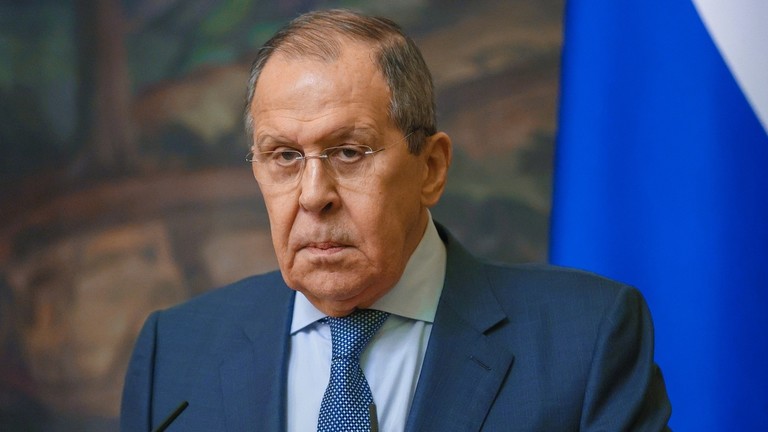
Russian Foreign Minister Sergey Lavrov, April 22, 2022
Samizdat | April 26, 2022
There is a belief in Moscow that Washington, London and other Western capitals – not Kiev – are the real decision-makers when it comes to Ukraine, Foreign Minister Sergey Lavrov said in an interview on Monday. He said that Kiev’s negotiators backtracked on the tentative understanding reached last month in Istanbul on advice from the US and the UK.
Ukrainian and Russian negotiators met face-to-face in Turkey at the end of March. Russia then took Ukraine’s outline, put it together in a “contractual” format and sent it to Kiev, only to get back “radically different” ideas in what was a “huge step back,” Lavrov said in the interview with the ‘Great Game,’ a political show on Russia’s Channel One.
“We know for sure that neither the US nor the UK – which is trying in every possible way to compensate for its current lonely status after leaving the EU – advised [Ukrainian President Volodymyr] Zelensky to speed up the negotiations, but to harden his position each time,” Lavrov said. The backtracking after Istanbul, he added, “was taken on the advice of our American or British colleagues. Maybe the Poles and the Balts played some role here.”
Meanwhile, Western leaders – such as the British PM Boris Johnson and EU foreign minister Josep Borrell – make statements to the effect that Russia “must be defeated” and that the conflict needs to be resolved “on the field of battle,” while sending weapons to Kiev, Lavrov pointed out.
“These weapons will be a legitimate target for the Russian Armed Forces,” the foreign minister said. “Warehouses, including in the west of Ukraine, have become such a target more than once. How else? NATO is essentially going to war with Russia through a proxy and arming that proxy. In war, as in war.”
While “casting spells” against a Third World War, the West is fueling the conflict with weapons and hoping to have the “fight Russia to the last man” in order to bleed Moscow, Lavrov said.
“You know, goodwill is not unlimited,” he added. “If it is not reciprocated, then this does not contribute to the negotiation process. As before, many of us are convinced – as I have already mentioned – that the real position of Ukraine is determined in Washington, London and other Western capitals,” he said, noting that some political scientists have said that talks should be held with NATO, and not Zelensky.
However, Lavrov also pointed out that Russia has not had much luck talking to NATO directly. When Moscow presented its security proposals to the US and NATO in December 2021, they were politely heard and then ignored.
“Rather impolitely, they made it clear that what was needed for our security was not up to us to decide,” Lavrov said.
The objectives of the “special military operation” announced by Russian President Vladimir Putin on February 24 have not changed, Lavrov said: the destruction of military infrastructure in Ukraine that threatened Russia, with “the strictest measures in order to minimize any damage to the civilian population.”
Lavrov also offered a prediction how the conflict would end. “As in any situation where armed forces are used, everything will end with a treaty,” he said. “But its parameters will be determined by the stage of hostilities at which this treaty becomes a reality.”
Russia attacked the neighboring state in late February, following Ukraine’s failure to implement the terms of the Minsk agreements, first signed in 2014, and Moscow’s eventual recognition of the Donbass republics of Donetsk and Lugansk. The German and French brokered Minsk Protocol was designed to give the breakaway regions special status within the Ukrainian state.
The Kremlin has since demanded that Ukraine officially declare itself a neutral country that will never join the US-led NATO military bloc. Kiev insists the Russian offensive was completely unprovoked and has denied claims it was planning to retake the two republics by force.
Russia says it destroyed weapons delivered by US and EU to Ukraine
Samizdat | April 23, 2022
Russian forces have destroyed a logistics terminal in Odessa that held a large batch of foreign weapons, Moscow said on Saturday amid its ongoing military offensive in Ukraine. However, the city’s authorities claimed that its air defense group destroyed two missiles but that another four hit a military target and residential buildings, leading to victims. It was not immediately clear if the civilian buildings were hit as a result of attempts by Ukrainian forces to strike down the missiles initially aimed at a military target.
According to Russian military spokesman Major General Igor Konashenkov, in the afternoon, “high-precision long-range air-launched missiles” hit a logistics terminal located on a military airfield near Odessa, where “a large batch of foreign weapons received from the United States and European countries was stored.”
Russia has repeatedly warned NATO against sending arms to Ukraine and stated that it would consider arms convoys to be legitimate military targets.
Odessa regional emergency services earlier said that “as a result of an enemy shelling,” a sixteen-story residential building caught fire, which was put out in about two and a half hours.
“At this point it is known that 6 people died, including one child, and 18 people were injured. Two people were rescued from the rubble, 86 people were evacuated,” the authorities said in a statement.
Ukrainian President Volodymyr Zelensky, speaking later at a press conference in Kiev, elaborated on these claims.
“At this very moment eight people have died. Eighteen or twenty have been injured. A three-month old child died. A three-month old child was killed. When the war started, this child was just one month old. Can you imagine this?” Zelensky said.
According to the press office of Ukraine’s South Air Command, on Saturday the air defense group destroyed two cruise missiles, allegedly launched by Russian TU-95 strategic aircraft from the Caspian Sea, and two operational-tactical level UAVs, which “presumably corrected the flight of cruise missiles and placed active obstacles to air defenses.”
“Unfortunately, 2 missiles hit a military facility and 2 {hit} residential buildings,” the Ukrainian military claimed.
Sending heavy weapons to Ukraine in German interests?
By Lucas Leiroz | April 22, 2022
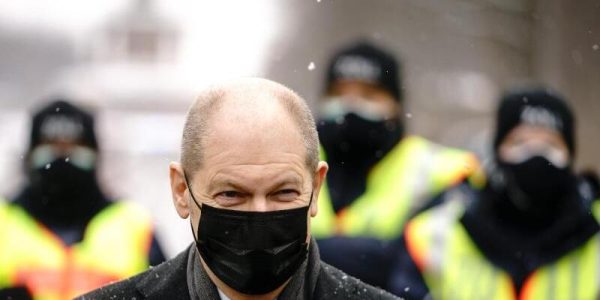
Political polarization in Germany continues to increase. Currently, there is strong pressure for German Chancellor Olaf Scholz to take a more incisive stance on the Ukrainian issue. The opposition insists on the need to send weapons to support Zelensky, endorsing the speech spread by NATO and the EU. It is evident that by refusing to take such positions, Scholz is trying to look for the interests of his country, but it remains to be seen whether he will be really strong enough to deal with the pressure coming both externally, from Brussels and London, and internally in Berlin.
Recently, Scholz met in London with his British counterpart Boris Johnson to discuss the Ukrainian conflict. During the conversation, Johnson clearly pressed Scholz to go along with the UK and the rest of the West in their stance of absolute opposition to Russia in the conflict. The Chancellor, however, avoided giving clear answers and maintained his ambiguous position on the possibility of supporting Kiev militarily, preventing from doing more incisive statements and preferring silence.
What happened next was even more remarkable and symbolic: the British prime minister traveled to Kiev to meet with Zelensky while Scholz returned to Germany in order to promote electoral campaign. The international mainstream media took advantage of the fact to intensify its pro-NATO propaganda, claiming that Scholz is concerned only with his internal political condition, ignoring the current international situation, while the Western world is supposedly “concerned” and takes the Ukrainian issue as a “humanitarian” priority.
In Germany, Scholz’s opponents are also increasingly agitated to criticize the chancellor, taking benefit of international pressure to intensify polarization and generate a crisis of legitimacy against him. Obviously, this was a predictable attitude on the part of opposition groups, but the main problem currently is that Scholz is losing support within his own coalition. The Free Democratic Party (FDP) and the Green Party are deeply dissatisfied with Germany’s unwillingness to send weapons to Kiev and use the case as a pretext to point to Scholz as a “big problem” to be solved through an electoral overthrow. And, in this sense, his situation is really worsening day after day.
In general, Scholz’s enemies demand that he takes a more active stance on the German role in the conflict. The chancellor is characterized by an extremely passive posture, avoiding making decisions until they become inevitable. Marie-Agnes Strack-Zimmermann, a member of the FDP and head of the Defense Committee in parliament, for example, recently commented that Scholz needs to “take the baton in his hand and set the rhythm.” In other words, opponents are asking Scholz to guarantee Germany a leading role on the European stage, as might be expected from the continent’s greatest economic power.
The central problem in this topic is that Scholz already seems to have realized that the most strategic thing for Germany is to remain as neutral as possible and away from any involvement in activities that harm the partnership with Russia, which is a very important commercial pillar for Germany. Scholz did not want to adhere to large-scale economic sanctions, especially regarding the SWIFT ban and the energy boycott. But he was forced to slowly accept such measures as other Western countries implemented them. This has been his typical behavior: postponing but, in the end, passively adhering to all Western measures when he finds himself “isolated”.
In this sense, the opposition is right on one point: Scholz has to change his attitudes and assume a leadership position, since this is what is expected from a country like Germany, which for years has consolidated itself as one of the “leaders” of the European bloc. The oppositionists’ problem is that they are pressuring Scholz to assume a leadership stance that is as damaging to German interests as his current indecision and passivity.
It is naive to think that sending heavy weapons to Ukraine benefits German interests in any way. On the contrary, it only extends the abyss between Moscow and Berlin even further, and with practically no benefit in return for the Germans: neither Ukraine will be sufficiently strengthened to win the conflict by receiving such heavy weaponry, nor will Germany reassume a supposed role of “leadership” in Europe.
It is not by chance that the greatest pressure on the Germans so far has been exerted precisely by Boris Johnson. The UK is not part of the EU and therefore does not care about the German role in the bloc, but, on the other hand, it is one of the most important members of NATO and tries to elevate its status in the military alliance as a way of boosting its international image in this post-Brexit context. In fulfilling British requests, Scholz would only be pursuing non-German and non-European interests.
It is obvious that there is also pressure within Europe and within Germany itself, but this pressure belongs to an outdated view of what the role of Germans and Europeans in the Western world should be. Scholz’s opponents apparently still expect a totally submissive stance on NATO from Berlin. This is also a very active thought in Brussels, with a strong tendency to see the entire European continent as a mere annex of the American military umbrella, ignoring that Europe has its own interests, which can often collide with those of the Western military alliance. That is why, in trying to prevent Germany from getting actively involved in the Ukrainian case, Scholz proves to be a really pragmatic politician who prioritizes the interests of his own country, but without the political force necessary to guarantee them.
In addition, there is a topic that needs to be mentioned, which is the German military passiveness of the last seventy years. Although it is active within NATO and has been trying to reform its defense forces in recent years, Berlin remains a virtual-demilitarized country, with an army of low offensive potential, outdated weaponry and a low-investment war industry.
In order to send heavy weapons to Ukraine, Germany would have to start a broad military industrial investment, which would cost it not only millions of euros, but a change in its international image, returning to being a nation of effective participation in international conflicts. Of course, improving its military status is a German right, but it must be taken into account in the name of what Berlin intends to do so. Would it really be strategic to break with seventy years of pacifism to defend the interests of the Maidan Junta in a conflict where Russian victory is highly predictable?
Scholz needs to be strong and active in defending German interests. His posture of passivity and silence demonstrates weakness and damages the image of both him and his country. But his stance must not be to subject Germany even more to foreign interests: on the contrary, he must assert what is in Berlin’s interests and pragmatically defend it, even if he has to clash with the NATO’s plans to do so. If Germany is interested in neutrality and maintaining good relations with Russia, Scholz must not only refrain from adhering to the new Western sanctions but also revoke those taken so far.
Lucas Leiroz is a researcher in Social Sciences at the Rural Federal University of Rio de Janeiro and a geopolitical consultant.
Russian airlines told to prepare to fly without GPS
Samizdat | April 22, 2022
Russia’s air traffic regulator has told carriers to learn to fly their planes without relying on the American Global Positioning System (GPS) satellite-based-navigation facility, newspaper Izvestia reported on Friday.
According to the letter from the regulator, Rosaviatsia, which was seen by the paper, it has instructed national airlines to prepare to cope without GPS after a March report by the European Union Aviation Safety Agency (EASA), which warned of increased cases of jamming and spoofing of the system’s signal after February 24 – the day Russia started its military offensive in Ukraine.
These were apparently registered in such areas as Russia’s western enclave, the Kaliningrad Region, the Baltics, eastern Finland, the Black Sea, the eastern Mediterranean, Israel, Cyprus, Lebanon, Syria, Turkey and northern Iran.
The interference has led to some planes changing their course or destination as the pilots were unable to perform a safe landing without the GPS, EASA has reportedly said.
According to Rosaviatsia, carriers should evaluate the risks of GPS malfunction and provide additional training to its pilots on how to act in such situations. The crews have also reportedly been told to instantly inform traffic control about any problems with a satellite navigation system.
The letter from the agency should be treated as a recommendation only and doesn’t constitute a ban on the use of GPS by the Russian airlines, the paper clarified.
Several Russian carriers, including major ones like Aeroflot and S7, have confirmed receiving a relevant message from the traffic regulator. However, they insisted that they didn’t encounter any problems with GPS over the past two months.
Rosaviatsia later clarified that “disconnection from GPS or its disruption won’t affect flight safety in Russia.”
The GPS signal isn’t the only source of information about the location of a plane at any given moment. Crews can also rely on the aircraft’s inertial navigation system, as well as ground-based navigation and landing systems, the agency said.
Last month, Dmitry Rogozin, head of the Russian space agency Roscosmos, warned that Washington may well disconnect the country from GPS as part of draconian sanctions imposed on it over the conflict in Ukraine.
On Friday, Rogozin took to Telegram to propose switching all of the country’s commercial planes from GPS to its Russian counterpart, Glonass.
However, it might be a complicated thing to do as Boeing and Airbus planes, mainly used by the country’s carriers, are designed to solely support the GPS technology.
Russia warns G20 of global impact of sanctions
Samizdat | April 21, 2022
Sanctions imposed on Russia are creating serious risks to the global economy, Russian Finance Minister Anton Siluanov said via video link at a meeting of G20 finance ministers and central bank governors in Washington, DC on Wednesday.
“Excessively loose budgetary and monetary policy pursued in recent years in developed countries created inflationary pressure last year, and the sanctions imposed against Russia not only further strengthened it, but also led to new risks in the economy,” Siluanov said.
Spiking prices for energy and agricultural produce will hit developing and low-income countries, the minister warned, adding that some countries will face severe social consequences.
According to Siluanov, Russia has never refused to fulfill its obligations and continues to comply with all contracts’ terms, while shipments of goods across the global markets are being artificially restrained by sanctions, triggering an imbalance in supply and demand.
Russia has faced unprecedented penalties introduced by the US and its allies in retaliation to the Ukrainian military operation.
In less than two months, Russia has turned into the world’s most sanctioned nation, having become subject to more than 6,000 different targeted restrictions.
Featured Video

AIDS Inc. by Gary Null (2007)
or go to
Aletho News Archives – Video-Images
From the Archives
Clash of Civilization, Iran Part II
By Jamal Kanj – Intifada-Palestine.com – January 14, 2011
Israel’s survival kit is: perpetuate conflict, insecurity to rationalize collective hate and finally playing victim.
Devoid of conflict, Israel implodes internally; without hate, Zionism loses its justification; and playing eternal victim to continue blackmailing the West. Absence of this holy trinity, Israel ceases to exist.
From its inception, the house of Zion has mastered exploiting adversarial powers to advance Israel’s cause. For instance, their influence over the Democratic Party in the US began with President Truman’s bid for 2nd term election in 1948.
Responding to strong opposition from Secretary of State General George Marshall and Department experts urging against recognition of Israel, President Truman replied: “I’m sorry gentlemen but I have to answer to hundreds of thousands [Jewish voters] who are anxious for the success of Zionism. I do not have hundreds of thousands of [voting] Arabs among my constituents”
Zionists influence over liberal American politics was matched with the doctrinal school of Conservative theoreticians aligning the Republican Party’s platform with Israel’s objectives. The Neoconservative Zionists, coined Zioncons, invented the “Clash of Civilization” concept to fight Israel’s wars. … continue
Blog Roll
 Aletho News
- Pro-Palestine protesters arrested outside UK’s ruling Labour Conference in Liverpool
- Mauritius denies landing permit to flight from Israel, forcing cancellation: Tour operator
- Israeli finance minister calls for genocidal war on West Bank, annexation of south Lebanon
- 12 Things Your Psychiatrist Was Trained Not to Tell You
- From Unipolar Universalism to Multipolar Civilizational Distinctiveness
- RSF military group defects, joins Sudanese army: State media
- Ireland goalkeeper refuses to play ‘Israel’ as squad weighs boycott
- China pushes back against US on Cuba, Iran
- Ukrainian Soldiers, Potential Mercenaries: Have Gun, Will Travel!
- Burnham’s UN debut… A masterclass in British disinformation
- If Americans Knew
- Israel forces Gazans to live in constant peril – Daily Update
- Deconstructing Netanyahu’s pants-on-fire UN rant – Daily Update
- Trump betrayed voters with his campaign lies and prioritized a foreign country once he took office
- Netanyahu calls Israel’s war in Gaza ‘opposite of genocide’ in UN speech to near-empty hall
- Settler Kidnappings: Torture, Sexual Abuse and Terrorisation of Palestinian Abductees as Israel Deepens Annexation of West Bank
- Gaza winter nears as 162,000 tents become unusable, raising fears of humanitarian crisis
- Netanyahu says, “It’s the opposite of genocide”; UN says Gaza economy is world’s ‘most severe crisis on record’ – Daily Update
- Israel’s US-Backed Assault on Gaza Has Created the ‘World’s Most Severe Economic Crisis on Record’: UN
- ‘Protecting U.S. Citizens’… From Israel
- ‘This is where I live now, the back of a truck’: a day in the life of a grandmother in Gaza
- No Tricks Zone
- New Study: Earth And Venus Surface Warmth Largely Explained By Convection And Lapse Rate, Not CO2 Or Radiation
- 2025 Nature Paper Claiming Worsening Global Drought Gets RETRACTED …Heavily Flawed
- New Study: ‘Global Drought Shows No Detectable Recent Acceleration Under Climate Warming’
- Economic Masterminds: German Socialists Suggest Taxing Productivity Gains Stemming From Using AI
- The South China Sea Has Not Been Cooperating With The Climate Change Narrative
- Energy Crisis: Germany Enters Heating Season With Historically Low Gas Reserve Fill Levels
- New Study: The Antarctic Ice Sheet Gained Mass From 2020-2024 Due To Staggering Snow And Ice Accumulation
- Study: Ocean Heating Rates From Thousands Of Years Ago ‘Dwarf’ Modern Ocean Heating Rates
- Climate Extremists Target, Attack Large-Scale Power Grid Infrastructure In Germany!
- New Study: Antarctic Ice Melt Has Contributed Less Than 1 Centimeter To Sea Level Rise In The Last 30 Years

