Why Is Russia Still Collaborating With Countries That Are Actively Working to Destroy It?

By Edward Slavsquat | Anti-Empire | April 20, 2022
Close your eyes and imagine you’re Russia.
You’re scrambling to create an alternative financial system in order to bypass 100 gazillion sanctions.
At the same time, you’re formulating “global health” policies with the same countries that are actively trying to destroy your economy.
Something doesn’t quite add up here.
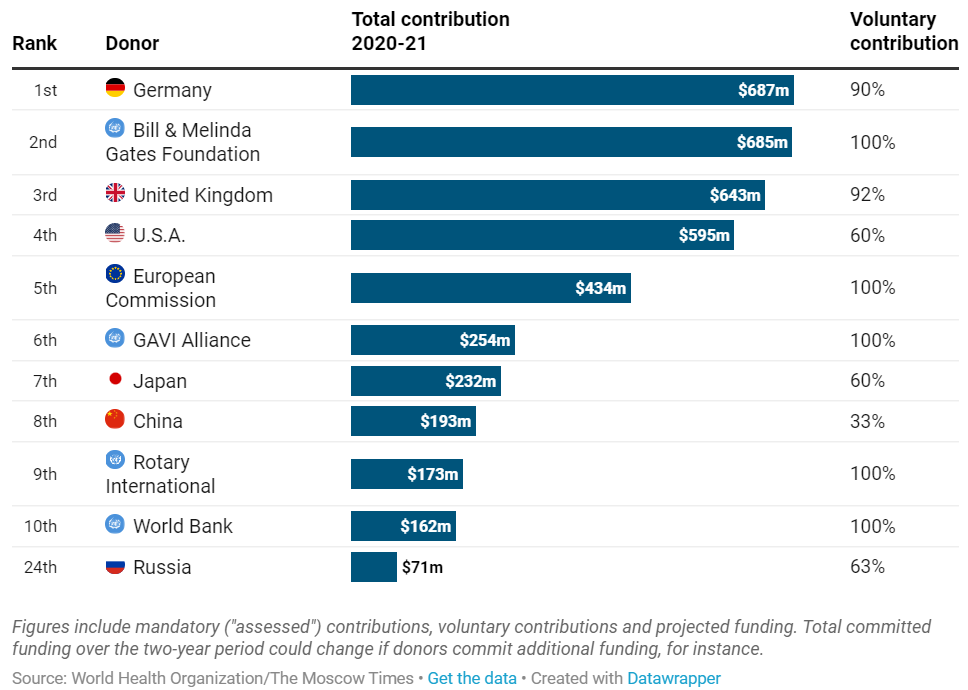
Imagine being Russia and implementing “health recommendations” from an organization funded by Germany, Bill Gates, the UK and the USA. And yet…
There is endless excitement about Russia’s imminent “economic sovereignty,” but what about Russia’s medical sovereignty? Does it matter if Russia adopts the golden petro-yuan (or whatever) if it continues to copy-paste “health measures” drafted by an organization that gets most of its funding from NATO states and Bill Gates?
It’s a serious question, especially because the WHO is forging ahead with its so-called “global pandemic treaty.” Slated for completion in 2024, the agreement will give the World Health Organization unprecedented powers to combat new outbreaks of positive PCR tests.
Does Russia really need this? After two years of the WHO’s non-stop virus scamming, maybe it’s time to pull the plug?
Thankfully, a grassroots campaign (aided by lawmakers) seeks Russia’s immediate withdrawal from the WHO. This is an excellent idea—but is it possible?
Russia’s unrepentant WHO-love
It’s fun to fantasize about loading Dr. Tedros into a Novichok cannon and launching him into outer space, but it’s not so simple. The World Health Organization has friends in high places. Some prominent WHO-lovers in the Russian government include:
Dmitry Medvedev, Deputy Chairman of the Security Council: This guy is completely smitten with global “health” tyranny. In November, Medvedev whined about how the WHO lacked “the leverage to force states to pursue a single, coordinated policy at all levels” during a declared worldwide health emergency. Thankfully he offered a solution to this terrible conundrum:
It is necessary to think about giving WHO the authority to make significant mobilization decisions in the interests of the entire world community in an emergency situation (for example, during a pandemic). It is likely that in order for the WHO to obtain such authority, it will be necessary for the UN members to adopt an international convention on cooperation in this area.
There you have it: Medvedev has fully endorsed the idea of a pandemic treaty and wants Russia to submit to the WHO whenever there are too many positive PCR tests or other existential threats to public health. (It’s charming how over the last two months, Medvedev has endeavored to rebrand himself as a mighty crusader against the depraved West. Yes, he’s a true patriot.)
Mikhail Murashko, Health Minister: Okay, maybe Medvedev is an insufferable WHO groupie, but so what? He’s not in charge of health policy. That’s Murashko’s job:
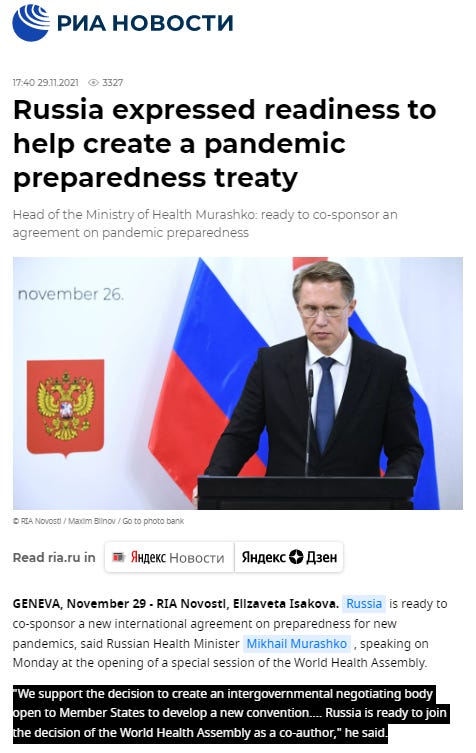
Yikes.
Russia has agreed to participate in the creation of a pandemic treaty, but with the stipulation that any new agreement should not “duplicate” previous accords.
What does this mean, exactly? It’s open to interpretation and gives Russia room to maneuver. [It sounds to me like it means the new agreement should go beyond existing agreements.] That being said, Murashko can hardly be described as hostile to the WHO; on the contrary, he’s worked tirelessly to make Russia WHO-friendly. Unsurprisingly, Murashko is also an unapologetic advocate for digital cattle tags.
Tatyana Golikova, Deputy Prime Minister: Russia’s former health minister (2007-2012) is True Believer who has been heaping praise on the WHO for more than a decade. Over the past two years she’s been instrumental in ensuring Russia’s adoption of WHO-endorsed anti-health measures.
But there’s also been some finger-wagging. In May 2021, Golikova told the WHO it needed to “speed up” its procedure for approving new vaccines. Because public health.
Sergey Sobyanin, Mayor of Moscow: In September 2020, Sobyanin thanked the WHO for inspiring him to impose a lockdown on Russia’s capital.
“I would like to express my gratitude to the World Health Organization, which from the first days of the pandemic has always informed the world community, both Russia and Moscow, about the processes that are taking place in different countries that were the first to be infected with COVID-19,” the mayor told Hans Kluge, the director of the WHO’s European Bureau.
Nine months later, Sobyanin became a trailblazer for compulsory vaccination and QR codes in Russia.
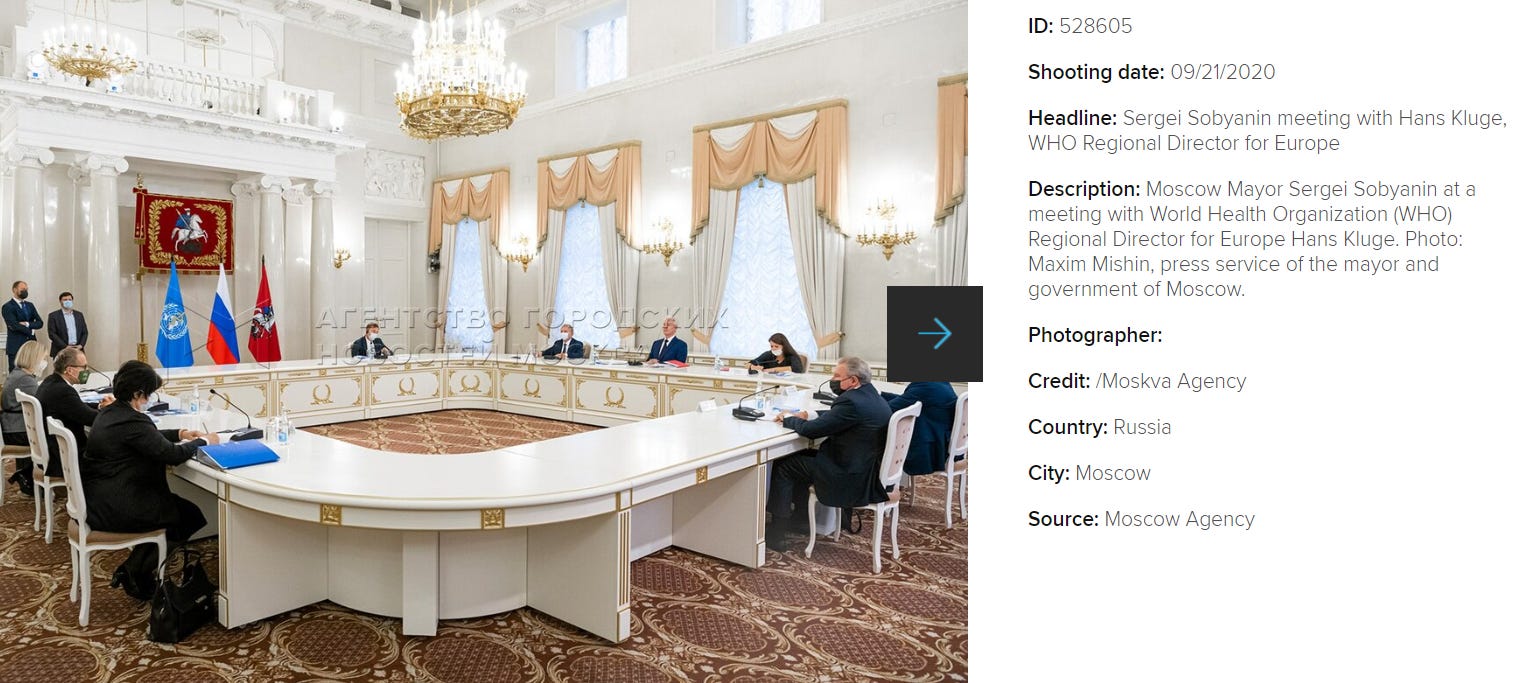
Cool WHO flag, bro.
Anna Popova, head of the Federal Service for Supervision of Consumer Rights Protection and Human Welfare (Rospotrebnadzor): As Russia’s chief sanitary doctor, Popova has taken on the role of National COVID Nanny. Her penchant for arbitrary and useless “epidemiological” measures can be attributed in part to her devotion to the WHO.
In October, Popova supervised a WHO exercise held in Kazan that simulated the outbreak of an infectious disease.
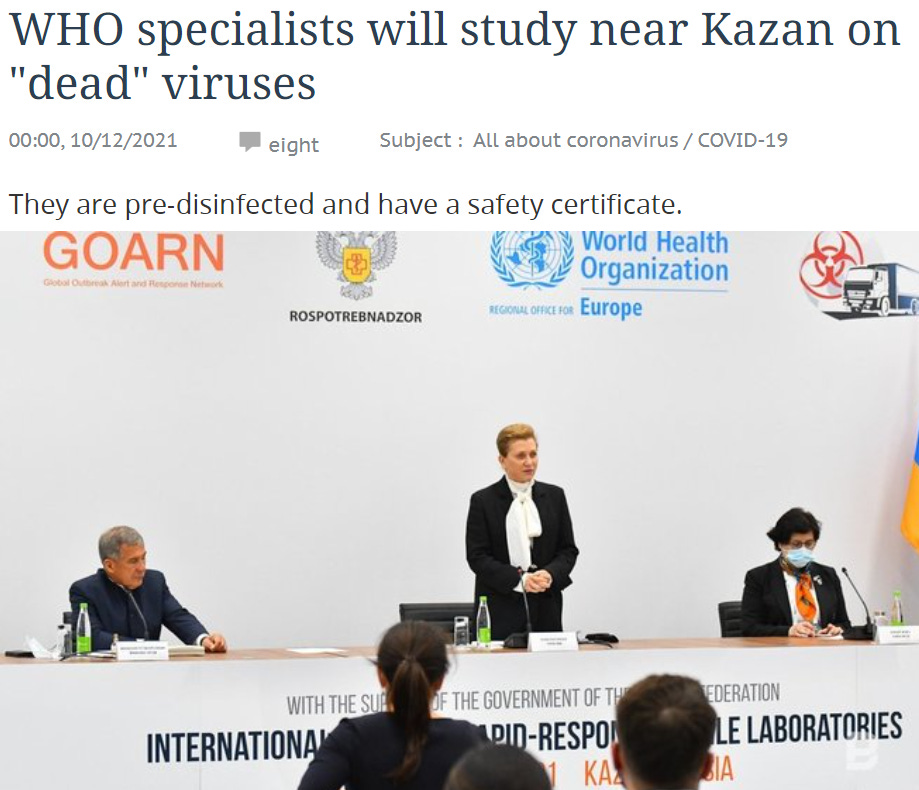
Popova oversaw WHO-sponsored Virus Games in Kazan (source)
The Rospotrebnadzor chief said the simulation would be used to develop international standards for rapid response to “epidemiological threats” around the world.
Ungrateful Kazan residents protested against the WHO-sponsored Virus Games, apparently because they felt they were being used as guinea pigs (ridiculous!).
Russia’s upper management is basically completely A-Okay with the WHO. So, uh, who doesn’t like the WHO? We’re glad you asked…
The fellowship of anti-WHO Duma deputies
Russia’s parliamentarians are starting to ask: “Hey, why are we part of an organization that is almost entirely funded by hostile NATO members/Bill Gates?” Good question.
Pyotr Tolstoy, Deputy Chairman of the State Duma: Tolstoy has called for Russia to withdraw from the WHO as well as the World Trade Organization and UNESCO. According to the senior lawmaker, it was idiotic of Russia to join these esteemed US-dominated global bodies in the first place.
Yana Lantratova, First Deputy Chairman of the State Duma Committee on Education: Lantratova believes Russia should suspend its cooperation with the WHO due to the organization’s links to biological laboratories in Ukraine.
“All of you know about the work of WHO around the world, it seems to me that interaction with this international organization in the current geopolitical situation does not meet the national interests of the Russian Federation,” she said last week. “Russia should suspend its membership in the WHO until the end of the parliamentary investigation. This will not affect on the health care system in Russia, but the fact that the organization has been collaborating for several years with biological laboratories created in Ukraine by American specialists cannot be ignored.”
Sergey Leonov, Deputy Chairman of the State Duma Committee on Health Protection: Although he opposes leaving the WHO, Leonov thinks Russia should stop paying membership fees.
“It is not entirely clear what benefit this organization brings to us,” the deputy said on March 30.
Sergei Mironov, parliamentary leader of A Just Russia — For Truth: Mironov and other members of his party recently introduced a draft resolution to the State Duma calling for Russia to suspend its membership with the WHO.
The proposed legislation would halt cooperation with the organization pending the results of a parliamentary investigation into the WHO’s dealings in Ukraine.
While lawmakers are focusing their rage on Ukraine-related WHO shenanigans, Russian activists have taken a more “big picture” stance: The World Health Organizations is actively destroying our health, and that’s bad.
“A direct threat to our national sovereignty”
What’s going on outside of the Duma chambers? Quite a bit.
A group of prominent Russian activists held a roundtable on April 14 to discuss how to safeguard Russia’s medical sovereignty. According to an excellent report from Katyusha.org, numerous participants called on Russia to withdraw from the WHO.
Anti-clot-shot crusader and conservative firebrand Alexandra Mashkova-Blagikh (whom your humble Moscow correspondent had the honor of meeting at the Doctors For Truth conference in December) gave a particularly rousing speech at last week’s event:
The WHO has been turned into an instrument of geopolitics. Whom it serves is clear if you look at its main sponsors: the USA, the Bill Gates Foundation, Germany, Britain… In the conditions of the war being waged against Russia, we cannot afford such a partnership. We are dealing with cultural, value, demographic and biological terrorism.
Now, under the pretext of the need to fight a “pandemic”, the WHO seeks to expand its power around the world through the Pandemic Agreement. This is a direct threat to our national sovereignty. It is obvious that this structure will never act in the interests of our country, and the time has come to withdraw from this organization. It is encouraging that serious politicians have started talking about this.
A coalition of activist groups has also issued an open letter calling for the removal of WHO-loving government officials (including many of the unsavory specimens we listed above).
What happens now?
A lot can happen in two years. What will the world look like in May 2024, when the pandemic treaty is scheduled for completion and ratification?
Probably we will all be eating bug-tacos in socially distanced quarantine camps as Triple-Ebola Swine Pox (a positive PCR test) ravishes the Earth.
If Russia wants to avoid this unpleasant future, it should probably not volunteer to be a “co-author” of any WHO-related treaty. Just to be on the safe side, Russia should exit this regrettable organization immediately. Today. Preferably right now.
Russia accuses OSCE of ‘spying’ for Ukraine
Samizdat | April 20, 2022
The Organization for Security and Co-operation in Europe (OSCE) collaborated with the Ukrainian government in its fight against the Donbass republics and tried to cover up offences by Ukrainian nationalist forces, Russia’s deputy representative to the UN told a UN Security Council meeting on Tuesday.
The accusations came as Dmitry Polyansky blasted Western powers, saying they were being hypocritical regarding the security crisis in Ukraine. The US and its allies pursue their own selfish interests rather than the interests of the Ukrainian people, when they fan hostilities in the east European country, the diplomat said.
“We obtained the latest proof of how dirty your tricks are in building a ‘rules-based order’ when we discovered proof that the OSCE special monitoring mission in Ukraine simply spied for Kiev instead of recording violations of the ceasefire,” he claimed. The official said Russia was collecting more evidence to make the case against the monitors.
Polyansky made more allegations as he brought up the seizure of official OSCE vehicles by Ukrainian nationalist troops in the city of Mariupol. He said there were reports that eight cars, some of them armored, were taken by the Ukrainians at gun point. One of them was later filmed with clear signs of use in battle. Similar reports came from other places in eastern Ukraine, he said.
“The OSCE leadership was aware of the problem, but they chose to hush up this fact as long as it could,” the Russian official claimed.
He added that such discoveries “undermined trust in international organizations where Western officials play a dominant role.” This lack of trust makes Moscow question any calls for a humanitarian ceasefire in Ukraine coming from the West, the official said.
“In practice, [the calls] demonstrated a desire to give Kiev nationalists and radicals a pause to regroup, receive new shipments of drones, anti-tank and anti-aircraft missiles, and stage more inhumane provocations to spread lies about the actions of Russian soldiers,” Polyansky said.
Russia will differentiate between “pseudo-peacemaking” and genuine attempts to “help Ukraine take the long-necessary right decisions,” he said.
The OSCE was invited to Ukraine to monitor the situation in the country in March 2014, shortly after an armed coup in Kiev triggered a spike in tensions in the east. The Special Monitoring Mission (SMM) became a crucial tool in observing a truce between government forces and rebels, which was listed as the first part of the roadmap to peace set in the so-called Minsk agreements. OSCE monitors patrolled the disengagement line to check whether deployments of forces by the warring parties complied with the deal and to report any violations of the ceasefire.
The field mission was the biggest in the organization’s history, with as many as 814 international and 477 national staff involved and over 2,400 daily reports produced in eight years.
The mission’s mandate expired on March 31, with Russia opposing its extension. Moscow accused the OSCE of pushing Russian representatives out of the SMM even as the number of observers was increasing.
As he explained the country’s decision to withdraw its participation and funding, the Russian representative at the organization, Aleksandr Lukashevich accused the OSCE of taking Kiev’s side in treating the two Donbass republics as “a territory under control of some terrorists,” and virtually refusing to coordinate with them.
Last week, the Donetsk and Lugansk People’s Republics decided to ban OSCE monitors on their respective territories starting April 30. Both are investigating allegations of espionage by members of the mission. The government in Lugansk reported arresting two OSCE employees suspected of treason. Russia is conducting its own criminal investigation of the espionage claims.
Russia extends Mariupol surrender offer
Samizdat | April 20, 2022
Russia’s Defense Ministry has extended the offer to surrender for the remaining Ukrainian forces holed up at the Azovstal steel plant in the Black Sea port city of Mariupol after they refused to leave through a humanitarian corridor on Tuesday.
Those present at the location may still exit the facility from 14:00 Moscow time on Wednesday without any arms or ammunition on them, officials said in a statement late on Tuesday.
“The Russian leadership guarantees the preservation of life, complete safety and provision of qualified medical assistance to all those who lay down their arms,” it said.
The country has proven its humane attitude towards surrendering Ukrainian troops on numerous occasions during the conflict and this time the term of the Geneva Convention on POWs will also be fulfilled, the ministry insisted.
To be able to leave the steel plant, the Ukrainian commanders inside were told to establish uninterrupted radio contact with the Russian forces, cease all hostilities and raise white flags along the perimeter of Azovstal.
The offer to lay down arms given to “militants of nationalist battalions and foreign mercenaries” is being repeated despite “the absence of any elementary steps from the Kiev authorities aimed at saving their country’s servicemen,” the statement read.
Members of the notorious Azov battalion were already given a chance to surrender on Sunday and Tuesday but didn’t take up the offer on both occasions.
Intercepted communications from Azovstal, suggest that the Ukrainian commanders “realize the hopelessness of their situation and are ready to lay down their arms, but only on the appropriate command (order) from Kiev,” which Ukrainian authorities are refusing to give, the ministry insisted. Surrendering without government approval may see them court martialed, with sentences of capital punishment possible, it added.
Moscow described such actions by Kiev as a “betrayal of the Ukrainian servicemen and members of nationalist battalions,” and again urged it to “show common sense, give appropriate instructions to the fighters to stop senseless resistance and exit through humanitarian corridors.”
If such an order isn’t made by the Ukrainian leadership once again, the commanders or ordinary servicemen should themselves make the decision to lay down their arms to survive, it added.
The strategic city of Mariupol has seen the heaviest fighting during the ongoing conflict between Russia and Ukraine, suffering immense destruction. It’s now almost entirely controlled by Russian forces, with Azovstal remaining the last pocket of Ukrainian resistance.
Those holed up at the steel plant, with its massive network of underground tunnels, have been running short of water and food, the Defense Ministry had said earlier, based on intercepted communications.
According to Russia’s estimates, Ukraine’s losses in Mariupol have reached some 4,000 combatants, including nationalist fighters of the notorious Azov and Aidar regiments, and “foreign mercenaries.”
India set to boost Russian energy imports
Samizdat – April 19, 2022
Indian importers plan to increase purchases of Russian crude oil and coal at discounted prices, media reports have stated.
According to The Economic Times, India’s state-owned oil refiners plan to boost Russian imports, shifting their purchasing strategy from tenders to negotiated deals in order to get larger discounts.
“In the coming weeks, Indian importers expect an increase in oil purchases from Russia. Due to the events in Ukraine and the outbreak of Covid-19 in China, India can get more oil at a more attractive price than before,” the publication stated, citing market sources. India has already increased purchases of Russian oil, having bought 15 million barrels of it since late February at a 25% discount. The discounts were offered by Moscow to secure trade contracts, amid the sanctions, placed on Russia by the US and its allies in response to its military operation in Ukraine. India has declined to join the sanctions campaign.
Separately, S&P reported that India is looking to raise imports of Russian coal amid stockpile shortages, as Moscow’s discounted prices are much lower than those on Australian and South African coal. Also, new purchase offers are expected soon, as, according to data from India’s Central Electricity Authority, stockpiles at Indian power plants as of April 13 were enough for little over eight days of coal burn. India imported 1.76 million metric tons of coal from Russia in 2021, according to data from Iman Resources. Market sources say that the only obstacle to buying Russian oil and coal for Indian importers is the difficulty in finding a payment method.
Western countries have cut off Russian banks from using the SWIFT financial messaging network, which facilitates interbank payments, and have limited their ability to conduct business using the US dollar and the euro.
However, at the end of March reports emerged that Russia and India were working to create a new transaction mechanism for bilateral trade, which would allow for settlements in national currencies, rubles and rupees. Reports say the countries may opt for adopting the Russian Financial Message Transfer System (SPFS) for bilateral trade, which is an analog of SWIFT.
According to analysts, a rupee-ruble trade mechanism is key to continued trade growth between the two countries, as India’s economy needs Russian energy and commodities to grow and Russia needs the huge Indian market to offset the impact of Western sanctions.
Drifting Mines Found in the Black Sea May be No Coincidence
By Vladimir Odintsov – New Eastern Outlook – 19.04.2022
Official representatives of Russia’s and Turkey’s Ministries of Defense keep talking about the continued threat of drifting Ukrainian mines which had been torn from their anchors.
Turkish National Defense Minister Hulusi Akar said that due to the continued threat of drifting mines, Turkey has raised the readiness level of de-mining units and other related services, as well as the alert and mobilization status. At the same time, the minister emphasized that it was impossible to determine the number of drifting mines in the Black Sea. “We have great capabilities to resolve this problem. We quickly mobilized them, raised the alert status of diving teams and drones. We are continuously monitoring the situation. As soon as we receive any alert notification, our units quickly take the necessary measures,” Akar said.
To date, three mines have been deactivated in the Bosporus shelf area. Some suspect that other drifting mines can be found in that district, but it is impossible to confirm this, Akar stressed. “What we are going to do about that is to remain vigilant,” he said. The Turkish minister explained that after the mines are detected, they are delivered to a safe zone and neutralized without harm to anybody.
On March 29, Stephane Dujarric, the spokesperson of the UN’s Secretary-General said that reports about drifting mines in the Black Sea raise concerns in the organization. He also said that the presence of mines can badly affect international shipping. In particular, he noted that the Black Sea region is important for the export of food from Russia and Ukraine.
For security reasons, all types of fishing in the Black Sea, in the area between Bulgaria and Kefken have been suspended since March 26. This restriction applies to the night period especially. The Turkish Navy have warned shippers to be more careful when entering the Black Sea and to watch for drifting mines. The warning was distributed after on March 19, the Federal Security Service of Russia reported that the Ukrainian Naval Forces had installed minefields at the approaches to the ports of Odessa, Ochakov, Chernomorsk and Yuzhny. Because of rope breakages caused by wind and sea currents, mines can move freely in the western part of the Black Sea. There have been reports that, in Odessa, several hundreds of anchor mines installed by the Kiev authorities along the coastal line were blown off by the storm and went “free sailing” to the Black Sea (and further on, possibly, through the Turkish Straits to the Mediterranean Sea), posing a threat for any marine vessel. According to the clarification in the official document published by Life.ru, there were some 420 anchor-mines and anchor-river-mines, which were installed by the Ukrainian Navy.
Turkey is conducting an investigation in connection with drifting mines detected in the Black Sea. One of the explanations for the presence of the mines in the sea along the coast of Turkey is a form of pressure by NATO. In particular, as Turkey suggested, it is not a coincidence that drifting mines appeared in the Black Sea. Mr. Akar believes that this is a way they use to gain admission to the Black Sea waters for NATO warships. “We have a suspicion about the deliberate presence of mines. Perhaps they were a part of some plan aimed at putting us under pressure to have Turkey admit the NATO minesweepers through the straits into the Black Sea. But we are committed to the Montreux Convention and will not admit their warships into the Black Sea,” the minister said.
Previously, Turkey’s Foreign Minister Mevlut Cavusoglu said that Turkey would close the Bosporus and Dardanelles Straits for any warships in connection with Russia’s special operation aimed at denazification and demilitarization of Ukraine. As you know, in accordance with the Montreux Convention, the only exceptions are ships going to home ports.
The Montreux Convention was adopted in 1936. It allows merchant ships to freely pass these straits both in peacetime and in wartime, however, the duration of the period when warships belonging to non-Black Sea states can stay in the Black Sea waters is limited to three weeks. In emergency situations, Ankara may prohibit or restrict the passage of warships through the Bosporus and the Dardanelles. “Turkey will adhere to the Montreux Convention and will not allow the warships of any country to enter the Black Sea,” Hulusi Akar said.
The Turkish Defense Minister admitted that some parties deliberately put pressure on Ankara and are “planting” mines along Turkey’s shores to make the country agree to let the NATO ships into the Black Sea. This explanation about the presence of mines found along Turkey’s coast line was given by the Turkish Defense Minister during a conversation with the leaders of the ruling Justice and Development Party.
According to Gercek Gundem, retired Rear Admiral of the Turkish Navy Jihad Aichi recently said that drifting mines that appeared in the Bosporus Strait could lead to a major disaster. “Necessary security measures have been taken. However, they cannot guarantee a 100% security. If any of those mines gets into the Bosporus Strait, it will kill a lot of people,” Jihad Aichi stressed. According to him, there are no doubts that it was Ukraine who allowed the drifting mines to appear in the Black Sea. “Why should Russia put obstacles for its own trade by installing mines in the Black Sea? Russia uses the Black Sea waters for transportation of crude oil, energy carriers, grain, and other exported and imported goods,” he said.
He also mentioned that 2.5% of crude oil is supplied to the outside world through the Turkish straits, and therefore the current situation is critical for many countries.
Due to increased warfare risks in the Black Sea, the cost of oil transportation has gone up dramatically. The price for insurance for oil tankers is higher today than the freight costs. Thus, the cost of chartering a Suezmax class tanker with a capacity of 1 million barrels for transporting oil from the Black Sea to Italy costs $3.5 million, while insurance costs have increased to $5 million. According to Bloomberg, due to warfare risks, which also include drifting Ukrainian mines, insurers demand to pay 10% of the cost of the vessel’s hull. As several market participants told Bloomberg, this is called a “warfare risks premium,” which before Russia started its special operation in Ukraine had been almost zero. This situation has particularly affected companies exporting oil from Russia, Kazakhstan and Azerbaijan through Black Sea ports to Novorossiysk or Supsa. This fact is an evidence that Russia is apparently not involved in the incident, and is not interested in the presence of drifting mines in the Black Sea. Unlike Ukraine.
Russia Has Withstood West’s ‘Economic Blitzkrieg’ Attempt – Putin
Samizdat | April 18, 2022
The US and its allies have slapped a grand total of over 9,600 sanctions against Russian officials, the state, companies, tycoons and other entities in connection with the crisis in Ukraine. Moscow now has more restrictions against it than Iran, Syria, North Korea, Venezuela and Myanmar combined.
Russia has successfully withstood unprecedented sanctions pressure from the West, President Vladimir Putin has said.
“The calculation was to quickly undermine the financial and economic situation in our country, to provoke panic in the markets, the collapse of the banking system, and a large-scale shortage of goods in stores,” Putin said, speaking at a briefing on the economic situation on Monday.
“We can say with confidence that this policy against Russia has failed – that the strategy of the economic blitzkrieg has failed,” he added.
Meanwhile, the president said, ordinary Europeans and Americans have been made to suffer a deterioration in their living standards as a result of their leaders’ shortsightedness.
“Moreover, the sanctions were not without consequences for the initiators themselves. I am refering to the growth of inflation and unemployment, the deterioration of economic performance in the US and the countries of Europe, the decline in the standard of living of the Europeans and the devaluation of their savings,” Putin said.
Putin asked the government to continue to expand its programme of emergency measures to deal with Western pressure, including by accelerating the switchover to foreign trade in rubles and the currencies of Russia’s trade partners.
“The restrictions placed on Russia by unfriendly countries have undoubtedly affected the possibilities of our businesses. They have complicated the logistics of delivery in export and import, created obstacles for payment. It is necessary to assist entrepreneuers in solving these problems, including by speeding up the transition of foreign trade to settlements in rubles and the national currencies of countries which are reliable trade partners,” he said.
At the moment, the president said, the Russian economy has stabilized, and the ruble exchange rate has basically returned to the levels seen in early February, before Moscow and its Donbass allies kicked off their military operation in Ukraine.
Russia achieved a Q1 2022 current account balance of payments of over $58 billion, “a historic maximum,” Putin said.
The Russian ruble collapsed in late February and early March against major foreign currencies, falling 30 percent against the US dollar and by a similar amount against the euro. The move prompted a temporary halt in trading on the Moscow stock exchange, led the central bank to raise the interest rate to 20 percent, and prompted authorities to force companies to sell 80 percent of their foreign exchange reserves to stabilize the situation.
The ruble began to bounce back after Putin’s announcement on 23 March ordering payments for Russian gas to be made in rubles, and is trading for about 80.6 USD/ruble, approaching the 77.3 marker it hit before dropping once Russia recognized the sovereignty of the Donbass republics in February.
The Kremlin has since asked the relevant ministries to expand the list of goods to be traded for using national currencies.
Battle for Mariupol is ending
BY M. K. BHADRAKUMAR | INDIAN PUNCHLINE | APRIL 17, 2022
The Russian Ministry of Defence offer of surrender terms to the personnel of the extreme nationalist neo-Nazi battalions and foreign mercenaries in the Azovstal iron and steel works to end hostilities by 1.00 pm Moscow time on Sunday would only have been a proforma gesture.
Moscow’s statement said, that radio interceptions at Azovstal — as many as 367 in the past twenty-four hours — showed that the militants were in a hopeless situation, practically without food and water, and were seeking permission to lay down arms and surrender but “the Kiev authorities categorically forbid them to do this.”
Yesterday, Denis Pushilin, Head of the Donetsk administration, openly called for “elimination” of the neo-Nazi militants holed up in Azovstal.
Azovstal is a massive Soviet-era plant, a city within the city of Mariupol. There is an underground city beneath the plant built in the Soviet era which includes Cold-War realities — structures to withstand bombing, blockades, and even nuclear strike. The Russian estimation is that a maximum of 2500 people could be holding out in the underground city equipped with armoured vehicles and huge arsenal of weapons and ammunition.
The Russian side is in some hurry to finish off the operation in Mariupol. The forces there are are urgently needed to be redeployed to the Donbass front. Kiev, on the other hand, is banking on delaying the Russian operation which gives it more time to reinforce its forces in Donbass.
President Zelensky has once again switched tack to speak about the diplomatic track. His latest stance is that Ukraine is ready to discuss abandoning its bid to join NATO and the status of Crimea with Russia, but not until Moscow halts hostilities and withdraws its troops!
The Ukrainian armed forces already lost 23,367 people while 1,464 people surrendered in Mariupol as of yesterday and another 2,500 are blocked at the city’s Azovstal plant. As for the Donbass, Russian forces enjoy superiority in numbers, logistics, firepower and terrain and a defeat on that front will leave Zelensky no choice but to seek a negotiated settlement on Russian terms. (See a relatively balanced prognosis by the American military analyst Colonel (Retd.) Daniel Davis, The Battle For Donbas Will Be A Tough Fight For Ukraine.)
Indeed, Zelensky and his American mentors hope that the battle for Donbass is wide open. The point is, although much of the war in eastern Ukraine will be fought in areas of open ground, Russian forces also have to take several significant population centres to achieve their objectives in Donetsk and Luhansk oblasts, including Severodonetsk, Rubizhne, Lysychansk, Slovyansk, and Kramatorsk as well as several smaller towns.
The Russian performance so far does not bode well for rapid success against built-up areas. Again, the weapons provided by the West have helped Ukrainian forces significantly to prevent Russia controlling the skies. The Ukrainian side is counting on these factors to stem the tide of the battle. Plus, of course, their morale is high.
Be that as it may, this time around, there is no confusion in the Russian mind that a peace settlement is round the corner. The Russians are unlikely to allow themselves to be hoodwinked again, when they took Zelensky for his word, trooped into the talks at Istanbul where an agreement was initialled on the basis of which, in an extravagantly emotional gesture of goodwill, they withdrew troops from Kiev and other northern territories, but only to see their interlocutors in Kiev backtrack on the terms of the agreement.
The strange Russian behaviour conveyed misperceptions that the Kremlin might be looking for the exit door. Evidently, that has emboldened the Western powers to embark upon a large-scale rearmament project for Ukraine, including transfer of heavy offensive systems, high-precision ammunition, modern air defence systems, American Stinger missiles, etc. for use in the upcoming new phase of military confrontation.
It is an open secret that military personnel of the NATO countries are deployed alongside the Ukrainian forces under the guise of “foreign volunteers.” The foreign fighters are led by US officers and the whole command of the Ukrainian armed forces is concentrated mainly in the hands of the Americans.
Arguably, the sinking of the warship Moskva fits into this paradigm. Russian analysts estimate that the last week’s missile strike on the Russian flag ship Moskva was actually masterminded and coordinated by the Pentagon. According to the ADS-B Exchange flight tracking site, a US Navy plane with electronic gear was spotted near the village of Zhurilovka in eastern Romania in the vicinity of the stricken ship Moskva (which probably guided the missile attacks.) Read here and here.
The implied message is: ‘Bring ‘em on.’ In military terms, though, the sinking of the ageing warship, 43 years old, may not be a game changer for the Russian operation. Everything now hinges on the offensive in Donbass — and, potentially further Russian operation in Kherson and Odessa without which the NATO will continue to pose an acute threat to Russia in the Black Sea region. NATO is already slouching toward Moldova.
Biden official admits US refused to address Ukraine and NATO before Russian invasion
By Ben Armbruster | Responsible Statecraft | April 14, 2022
A senior Biden administration official recently admitted that prior to the Russian invasion of Ukraine, the United States made no effort to address one of Vladimir Putin’s most often stated top security concerns — the possibility of Ukraine’s membership into NATO.
When asked on a podcast published on Wednesday by War on the Rocks — a U.S. foreign and defense policy analysis website — whether NATO expansion into Ukraine “was not on the table in terms of negotiations” before the invasion, Derek Chollet, counselor to Secretary of State Antony Blinken replied that “it wasn’t.”
Chollet’s remarks confirm suspicions by many critics who believe the Biden administration wasn’t doing enough — including offering to deny or delay Ukraine’s NATO membership — to prevent Russia from launching a war against Ukraine.
“We made clear to the Russians that we were willing to talk to them on issues that we thought were genuine concerns they have that were legitimate in some way, I mean arms control type things of that nature,” Chollet said, adding that the administration didn’t think that “the future of Ukraine” was one of those issues and that its potential NATO membership was a “non-issue.”
“This was not about NATO,” said Chollet, who contradicted himself moments later, saying, “In perpetrating this totally unjustified and unprovoked war, [Putin’s] goal was to try to divide the U.S. from Europe and weaken NATO.”
Of course Putin himself stated publicly many times before the invasion that indeed, Ukraine’s potential NATO membership was a key security concern for Russia.
Weeks before Russia launched its war against Ukraine, Putin claimed that Russia’s concerns about NATO enlargement were being ignored. “We need to resolve this question now … [and] we hope very much our concern will be heard by our partners and taken seriously,” he later said.
War on the Rocks’ Ryan Evans told Chollet that he takes Putin’s claims about NATO “seriously,” adding, “I’m a little struck by the refusal to even talk about the issue of NATO expansion.”
“We talked about NATO in saying that NATO is a defensive alliance. NATO is not a threat to Russia,” Chollet said.
Before the Russian invasion, Quincy Institute senior research fellow on Russia and Europe Anatol Lieven wrote that as part of a broader package to stave off war, the United States should propose “the declaration of a moratorium on Ukrainian membership of NATO for a period of 20 years, allowing time for negotiations on a new security architecture for Europe as a whole, including Russia.”
Should We Commit to Fight Russia — for Finland?
BY PAT BUCHANAN • UNZ REVIEW • APRIL 15, 2022
The prime ministers of Sweden and Finland, Magdalena Andersson and Sanna Marin, both signaled Wednesday that they will likely be applying for membership in NATO.
The “prospect” is most “welcome,” says The Washington Post: “Finland and Sweden Should Join NATO.”
The editorial was titled “A Way to Punish Putin.”
Before joining the rejoicing in NATO capitals, we might inspect what NATO membership for these two Nordic nations would mean for the United States.
Finland is a nation the size of Germany, but with a population only 4% of that of Russia and a border with Russia that is 830 miles long.
Should Finland join NATO, the United States, under Article 5 of the NATO treaty, would be obligated to go to war with the world’s largest nuclear power to retrieve Finnish lands that an enraged Russia might grab.
Moscow has already indicated that, should Sweden and Finland join NATO, Russia will introduce new nuclear weapons into the Baltic region.
Why is it wise for us to formally agree, in perpetuity, as NATO is a permanent alliance, to go to war with Russia, for Finland?
Given the war in Ukraine and concomitant crisis in Eastern Europe, it is understandable why Stockholm and Helsinki would seek greater security beneath the U.S. nuclear umbrella.
But why would we voluntarily agree to give Sweden and Finland these war guarantees? Why would we commit to go to war with Putin’s Russia, a war that could, and likely would, escalate to the use of tactical nuclear weapons, especially if Russia were losing?
Finland was neutral during the Cold War. Sweden has been neutral since the Napoleonic wars of the early 19th century.
How did we suffer from their neutrality?
In Helsinki and Stockholm, the benefit of a U.S.-NATO commitment to go to war for Finland or Sweden is understandable.
But how does it benefit our country, the USA, to be obligated to go to war with a nation that commands the world’s largest stockpile of nuclear weapons — over some quarrel in the Baltic Sea or Gulf of Finland that does not affect us?
Asked for his view on Sweden and Finland’s campaign to join NATO, Putin spokesman Dmitry Peskov had a note of warning:
“We have repeatedly said that the (NATO) alliance remains a tool geared towards confrontation and its further expansion will not bring stability to the European continent.”
Should Putin’s Russia clash with Finland or Sweden today, the U.S. is free to respond, or not to respond, as it sees fit, depending on our own assessment of risks and rewards.
Why not keep it that way? Why surrender our freedom of action in some future collision involving our main adversary?
History holds lessons for us here.
In March 1939, six months after Munich, when Czechoslovakia disintegrated into its ethnic components, Britain issued an unsolicited war guarantee to Poland, then negotiating with Germany over the port city of Danzig taken from Germany by the victorious Allies after World War I.
When Germany, on Sept. 1, 1939, invaded Poland, Britain was obligated to declare war on Germany over a matter that was not a vital interest of Great Britain or its worldwide empire.
Lest we forget, it was the Bucharest Declaration of 2008, opening the door to membership in NATO for Ukraine and Georgia, that led to the recent crises in Eastern Europe and the current war.
The Russia-Georgia War of August 2008, the U.S.-backed coup in Ukraine in 2014, and Putin’s annexation of Crimea, Luhansk and Donetsk in eastern Ukraine all proceeded from NATO’s decision in 2008 to open the door to membership for Georgia and Ukraine.
Russia’s invasion of Ukraine today is partly due to the U.S. and Ukraine’s refusal to rule out NATO membership for Kyiv.
No NATO nation today has a border with Russia nearly as long as that of Finland. If Finland joins NATO, will we put U.S. boots on the ground along that 830-mile border with Russia? Will U.S. warplanes fly in and out of Finnish airfields and air bases up to the border of Russia?
Collective security is said to be a good idea.
But the core of NATO security is provided by U.S. war guarantees, while most of the collecting is done by our 29 NATO allies, which could become 31 by summer’s end.
Otto von Bismarck predicted that the Great War, when it came, would be ignited by “some damn fool thing in the Balkans.”
And World War I was indeed triggered by the assassination of the Austrian archduke in Sarajevo in June 1914. The Germans came in in part because the kaiser had given Austria a “blank check” for war.
What enabled America to stay out of both world wars for years after they began was our freedom of “entangling alliances” when they began.
But today we not only lead an alliance of 30 nations, but we are adding two more members, one of which has a border of 830 miles with Russia.
How long does our luck last?
Featured Video

AIDS Inc. by Gary Null (2007)
or go to
Aletho News Archives – Video-Images
From the Archives
Clash of Civilization, Iran Part II
By Jamal Kanj – Intifada-Palestine.com – January 14, 2011
Israel’s survival kit is: perpetuate conflict, insecurity to rationalize collective hate and finally playing victim.
Devoid of conflict, Israel implodes internally; without hate, Zionism loses its justification; and playing eternal victim to continue blackmailing the West. Absence of this holy trinity, Israel ceases to exist.
From its inception, the house of Zion has mastered exploiting adversarial powers to advance Israel’s cause. For instance, their influence over the Democratic Party in the US began with President Truman’s bid for 2nd term election in 1948.
Responding to strong opposition from Secretary of State General George Marshall and Department experts urging against recognition of Israel, President Truman replied: “I’m sorry gentlemen but I have to answer to hundreds of thousands [Jewish voters] who are anxious for the success of Zionism. I do not have hundreds of thousands of [voting] Arabs among my constituents”
Zionists influence over liberal American politics was matched with the doctrinal school of Conservative theoreticians aligning the Republican Party’s platform with Israel’s objectives. The Neoconservative Zionists, coined Zioncons, invented the “Clash of Civilization” concept to fight Israel’s wars. … continue
Blog Roll
 Aletho News
- Merck Virologists Admitted to Falsely Certifying Vaccine Efficacy
- Mandatory Folic Acid for every man, woman & child
- Pro-Palestine protesters arrested outside UK’s ruling Labour Conference in Liverpool
- Mauritius denies landing permit to flight from Israel, forcing cancellation: Tour operator
- Israeli finance minister calls for genocidal war on West Bank, annexation of south Lebanon
- 12 Things Your Psychiatrist Was Trained Not to Tell You
- From Unipolar Universalism to Multipolar Civilizational Distinctiveness
- RSF military group defects, joins Sudanese army: State media
- Ireland goalkeeper refuses to play ‘Israel’ as squad weighs boycott
- China pushes back against US on Cuba, Iran
- If Americans Knew
- Israel forces Gazans to live in constant peril – Daily Update
- Deconstructing Netanyahu’s pants-on-fire UN rant – Daily Update
- Trump betrayed voters with his campaign lies and prioritized a foreign country once he took office
- Netanyahu calls Israel’s war in Gaza ‘opposite of genocide’ in UN speech to near-empty hall
- Settler Kidnappings: Torture, Sexual Abuse and Terrorisation of Palestinian Abductees as Israel Deepens Annexation of West Bank
- Gaza winter nears as 162,000 tents become unusable, raising fears of humanitarian crisis
- Netanyahu says, “It’s the opposite of genocide”; UN says Gaza economy is world’s ‘most severe crisis on record’ – Daily Update
- Israel’s US-Backed Assault on Gaza Has Created the ‘World’s Most Severe Economic Crisis on Record’: UN
- ‘Protecting U.S. Citizens’… From Israel
- ‘This is where I live now, the back of a truck’: a day in the life of a grandmother in Gaza
- No Tricks Zone
- New Study: Earth And Venus Surface Warmth Largely Explained By Convection And Lapse Rate, Not CO2 Or Radiation
- 2025 Nature Paper Claiming Worsening Global Drought Gets RETRACTED …Heavily Flawed
- New Study: ‘Global Drought Shows No Detectable Recent Acceleration Under Climate Warming’
- Economic Masterminds: German Socialists Suggest Taxing Productivity Gains Stemming From Using AI
- The South China Sea Has Not Been Cooperating With The Climate Change Narrative
- Energy Crisis: Germany Enters Heating Season With Historically Low Gas Reserve Fill Levels
- New Study: The Antarctic Ice Sheet Gained Mass From 2020-2024 Due To Staggering Snow And Ice Accumulation
- Study: Ocean Heating Rates From Thousands Of Years Ago ‘Dwarf’ Modern Ocean Heating Rates
- Climate Extremists Target, Attack Large-Scale Power Grid Infrastructure In Germany!
- New Study: Antarctic Ice Melt Has Contributed Less Than 1 Centimeter To Sea Level Rise In The Last 30 Years

