US State Department ‘Russian disinformation’ report aims to stop normalisation of relations, discredit alternative media – embassy
RT | August 6, 2020
Russia’s embassy in Washington believes apparatchiks at the State Department have put together a hysterical report on “Russian propaganda” to prevent politicians improving relations.
The Russian diplomats say the dispatch on the “Pillars of Russia’s Disinformation and Propaganda Ecosystem.” is an attempt to obstruct Moscow’s proposals to resume cooperation in key areas. They also claim the communique is obviously geared to discredit alternatives to the mainstream press, which generally toes the US establishment line. It’s also notable that the publication coincides with a request for $138 million in 2021 to spend on “countering” Russian media.
“(The) report is an attempt to silence Russian official proposals to resume cooperation in key areas on which the security of the entire world depends,” the embassy wrote on its Facebook account. “The US State Department is not very fond of the existence of alternative sources of information. Serious resources are employed to discredit them. Any voice that contradicts Washington is dubbed ‘disinformation’ in the service of the ‘Kremlin’ and Russian intelligence.”
Parts of the document are absurd, the Russian diplomats noted. For example, the authors classified far-right opposition LDPR leader Vladimir Zhirinovsky and the private radio station Govorit Moskva as “Official Government Communications.” The officials also cite Russian media with state funding, with headlines from Sputnik, RIA Novosti, RT and others presented as examples of ‘disinformation.’
“If this serves as the pinnacle of the entire structure, so carefully built by our American colleagues, then it seemingly looks like a house of cards,” the commentary reads. “Russian and foreign media outlets that dare to criticize the United States should bear in mind that they can and almost certainly will become the subject of thorough scrutiny. Their accounts in American social media are at risk of being suspended with no explanation.”
In its Special Report Pillars of Russia’s Disinformation and Propaganda Ecosystem, the GEC claims that Russia is a key threat in terms of disinformation and propaganda. According to the document, this “ecosystem” involves official government channels, state-run mass media, proxy-resources, and social network. The Russian authorities, as follows from the report, are responsible for the development of such tactics and platforms as part of their approach to the use of information as a weapon.
Russia repeatedly denied Western media allegations that it indulges in misinformation. Deputy Foreign Minister Sergei Ryabkov said that the recent allegations that Russia and China were propagating misinformation about the coronavirus infection were yet another manifestation of the West’s Russophobia and Sinophobia. The US State Department has requested $138 million in 2021 to “counter disinformation and propaganda from Russia.”
The US already has a government-controlled foreign broadcasting arm, the United States Agency for Global Media (USAGM), which operates the Voice of America and Radio Liberty/Free Europe, and their various branches. The operation is entirely funded from the US budget, with its current expenses amounting to around $800 million annually, according to Voice of America. This is more than two and a half times what Russia spends on RT.
Russian ambassador tells Britain: you exaggerate your political importance & London has become a haven for Russian criminals
RT | August 5, 2020
If you live in Britain, Russia looms large in political discourse, but for those in Moscow, the UK barely registers. Now Russia’s envoy to London has delivered a few home truths: he says his country has bigger fish to fry.
“I feel that Britain exaggerates, very much, its place in Russian thinking,” Andrei Kelin told the Daily Mail. “The scope and place of Great Britain in Russian politics is not that big. We have other problems of much larger magnitude,” the ambassador said.
The ambassador also dismissed the UK media narrative about nefarious Russian ‘oligarchs’ doing the Kremlin’s bidding in London. Kelin pointed out that, in reality, the British capital has turned itself into a haven for wealthy Russians trying to evade justice back home.
“Oligarchs mean rich people that can influence the president,” he explained. “The last one [oligarch] was about 20 years ago … those wealthy people living here [in Britain], the bulk of these people simply escaped Russia because they were being pursued for tax evasion, fraud and other criminal activities.”
“All of them have left the country just to escape prosecution. If the British authorities will decide to provide us with information about these people or decide to be positive on our demands for extradition, we will only greet this, salute this,” he added.
Back in 2018, Russia’s former prosecutor general, Yury Chaika, revealed that there were 61 Russian criminals living in London who had stolen around $10 billion from their home country. He expressed concern that Britain’s agenda was to pocket the stolen money, quipping, “you can keep the criminals, but return the money. This is our money.”
Kelin once again rejected claims that Russia had somehow tried to affect the results of the 2014 Scottish independence referendum, the 2016 Brexit referendum and the 2019 parliamentary elections in the UK. According to the diplomat, in all these cases, Russia was not politically interested in any particular outcome. “For us, there is no sense to choose any side,” he said.
“These accusations are invented, if not to say false. These are senseless accusations which we do not understand,” the ambassador added.
Kelin went on to say that, at present, relations between Moscow and London are “close to being frozen.” The UK is “throwing a lot of mud … in our direction,” he added, and this type of attitude “does not provoke much of an appetite for improving dialogue or relations in Moscow.”
Russia: Iran’s nuclear capacity ‘absolutely legitimate’
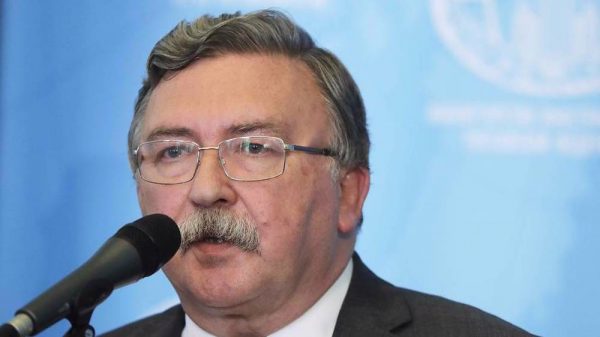
Mikhail Ulyanov, Russia’s permanent representative to international organizations in Vienna
Press TV – August 3, 2020
Russia’s permanent representative to international organizations in Vienna says Iran’s nuclear capacity is “absolutely legitimate” as it fits within the Nuclear Non-Proliferation Treaty (NPT).
“These opportunities and capabilities are absolutely legitimate as a long as they are used for peaceful purposes,” Mikhail Ulyanov tweeted on Sunday.
“The duty of IAEA (the International Atomic Energy Agency) is to certify non-diversion of nuclear materials,” he added. He was apparently referring to the United Nations nuclear agency’s repeated verification of non-diversion of Iran’s nuclear energy program.
The envoy made the assertions in response to a tweet by Mark Dubowitz, the CEO of the so-called Foundation for Defense of Democracies’ policy institute that has been identified as part of the Israeli lobby in the United States, and works hard to promote Washington’s policies against certain countries, including Russia and Iran.
In that tweet, Dubowitz had criticized what he called the “atomic capability” given to Iran under the Joint Comprehensive Plan of Action (JCPOA), a 2015 nuclear agreement between the Islamic Republic and world countries.
Ulyanov, however, asserted, “The atomic opportunities were given to Iran by #NPT.” He added that those who disagree with the nature of the IAEA’s duty being verification of various nuclear programs’ non-diversion ”work against NPT.”
The United States left the JCPOA in 2018, despite the fact that the agreement has been ratified by the UN Security Council as its Resolution 2231.
Ever since, Washington has been ceaselessly trying to undermine the deal.
Washington has also been threatening other JCPOA signatories into forsaking their duties under the accord.
Russia vows to respond ‘reciprocally’ to EU sanctions over ‘politically motivated’ & ‘far fetched’ hacking allegations
RT | July 31, 2020
Russian officials have dismissed as “baseless” restrictions imposed by the European Union on individual Russians and an intelligence unit accused of cybercrimes. Moscow has hinted at a mirrored response to Brussels’ sanctions.
“Obviously, the EU’s hostile action will not be left unanswered. As we know, everything in diplomacy is reciprocal,” Russia’s Foreign Ministry said in a statement.
On Thursday, the EU blacklisted four Russian individuals and the special technologies unit of Russia’s military intelligence agency, known as the GRU, which Brussels accuses of committing cyberattacks. A number of nationals and entities from China and North Korea were hit by sanctions as well.
Russia’s Foreign Ministry rejected the allegations as “baseless” and illegal under international law. Moscow said that the sanctions were enacted “under a far-fetched pretense,” and were strictly politically-motivated.
Why the US really accuses Russia & China of weaponizing space
By Finian Cunningham | RT | July 30, 2020
Washington has made startling accusations that Russia & China “have already turned space into a war-fighting domain,” but what’s really going on is the US is attempting to distract from its own controversial space militarization.
There is also a sequence of events reflecting Washington’s increasingly hysterical hostility towards Russia and China in which all events are perceived through an obsessive American lens of “hybrid warfare.”
An additional factor is the intensified US demand to include China in arms control talks with Russia, which resumed this week.
The claim made against Russia and China by Christophe Ford, a State Department arms control envoy, comes against the backdrop of President Trump announcing the establishment of a new Space Force Command earlier this year. That move by the Trump administration flies in the face of decades-long advocacy at the United Nations by Russia and China to keep weapons out of space.
The 1967 UN Outer Space Treaty forbids weaponization in the outer atmosphere. Thus, America’s renewed efforts through its Space Force Command are arguably illegal. Allegations from Washington that Moscow and Beijing have turned space into a war-fighting domain appear to turn reality on its head.
Karl Grossman, a professor at the State University of New York who has written extensively on the subject, says that Russia and China have consistently advocated for the expansion of the existing UN treaty to ban not only the placement of weapons of mass destruction but also for a prohibition on any weaponization in outer space.
“The United States has repeatedly voted against this effort, essentially casting a veto at the UN,” Grossman said.
It would seem therefore that America’s claims are motivated by a need to obscure its own controversial militarization of the “final frontier.”
On July 15, the US and Britain accused Russia of testing an anti-satellite weapon in space. Moscow denied this, saying it was carrying out an in-orbit satellite “inspection” by another one of its own satellites. The US Space Force Command acknowledges it was a “non-destructive event” but nevertheless alleged it was an attempt by Russia to deploy a “bullet” in space.
“Inspection of satellites” could of course be a euphemism for gaining the capacity to spy on other nations’ space vehicles. The US is reportedly involved in developing the same kind of surveillance activity against foreign satellites. But for the Americans to accuse Russia of testing a space-based “anti-satellite weapon” seems to be a provocative stretch.
Notably, the report of the alleged Russian weapon test was followed immediately by sonorous statements hailing the establishment last year of the US Space Force “to deter aggression and defend the nation.”
Grossman says: “The new US Space Force is, I’d say desperately, trying to justify itself and thus its announcement that Russia conducted an anti-satellite weapons test needs to be considered in this context.”
But there is more to the sequence of events. Last week, on July 23, China launched its first rover to explore Mars. If the mission succeeds in landing on the Red Planet in seven months, it will be seen as a breakthrough achievement by China, putting the country on par with the US in space exploration. The Chinese launch came a week before NASA blasted off its new rover to Mars which is due to reach the planet in February around the same time as China’s.
It seems significant that Christophe Ford, the US arms control envoy, first made his announcement accusing Russia and China of weaponizing space the day after China’s historic Mars mission launch. Given the closely overlapping engineering shared by space rocketry and ballistic missiles, it could, therefore, be loosely argued that a Mars mission by China has military dimensions. (As would all American missions, if using the same tenuous reasoning.)
However, in the present context of rampant accusations against Russia and China of waging “hybrid war,” including everything from “meddling in elections to subvert US democracy” to “unleashing a virus pandemic to destroy American capitalism,” it is not hard to see how in Washington’s mindset events in space could be construed as yet more hybrid warfare. American paranoia is simply going extraterrestrial.
Another important factor in the sequence is the resumption of arms control talks this week in Vienna between the US and Russia. These negotiations are aimed at extending the New START accord limiting strategic weapons. Washington is pushing the Russian side to lever China into joining a new trilateral arms control agreement. Secretary of State Mike Pompeo admitted in a recent keynote speech that Washington was seeking Russia’s help in curbing China’s nuclear arsenal. Moscow has indicated that such a trilateral accord with China, considering its relatively smaller arsenal, is not relevant at this stage in bilateral negotiations between the US and Russia over New START.
The US warned it would bring up the issue of Russia’s alleged anti-satellite weapon at the arms control talks this week in Vienna.
It seems the US is using claims about space weaponization not only to distract from its own illicit program, but also to undermine Russia in arms talks as a way to pressure Moscow into accommodating Washington’s overbearing demands regarding China.
That does not augur well for a successful arms control agreement or for global security. A foreboding case, so to speak, of ‘watch this space’.
Finian Cunningham is an award-winning journalist. For over 25 years, he worked as a sub-editor and writer for The Mirror, Irish Times, Irish Independent and Britain’s Independent, among others.
The Syrian Army Is Appointing on “Aleppo – Lattakia” Highway – Idlib Battle Is Approaching
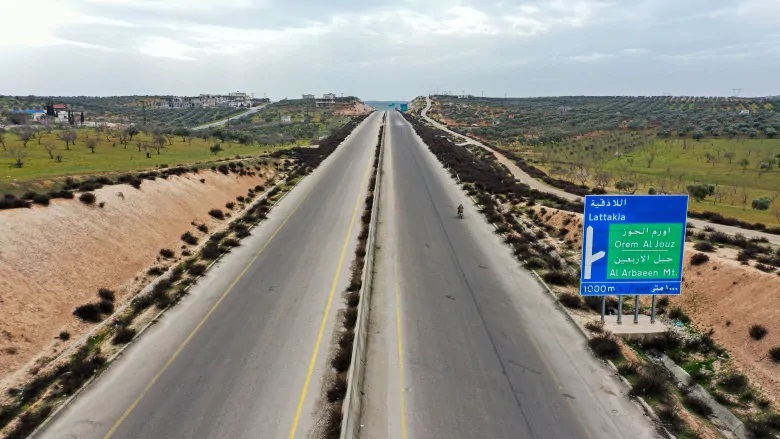
M4 International Highway
By Khaled Iskef | American Herald Tribune | July 28, 2020
The field developments return to the front of the Syrian events, after the cautious calm that lasted for several months in the north of the country coinciding with the implementation of the Russian-Turkish agreement on conducting joint patrols on the “M4” road known as “Aleppo-Lattakia” highway.
The reopening of the road from Raqqa, through Aleppo, to Lattakia, is now at the forefront of Syrian army’s next strategic goals, though the beginning of the “M4” highway starts in the eastern side of the country, specifically from the areas controlled by the US-backed Syrian Democratic Forces. The past days have witnessed huge Syrian military movements towards this highway in a sign that the Syrian forces are ready to start military action and open the road, which if it occurs, will have a significant positive impact on trade movement throughout the country in light of the circumstances due to the procedures of the blockade imposed by Washington.
Speaking of the field in the Syrian north, it is certain that Turkey did not succeed in fulfilling its obligations to the Russians about isolating terrorist organizations and keeping them out of the way, as the Russian and Turkish sides, shortly after the battle to secure Aleppo and reopen the M5 “Aleppo – Damascus” International highway, agreed that the militants should move away / 6 / kilometers to the north and south of the “M4”, knowing that the distance outside the control of the Syrian army, which links Aleppo to Lattakia, is estimated to be 60 kilometers.
The end of September 2020 was scheduled to be the Russian deadline for the Turks to implement their obligations, but the terrorist operation carried out by “Khattab Al-Checheni Brigades” targeting a Russian patrol on the road with a suicide operation, accelerated the launch of the military operation, which is expected to be early next month according to private sources. The Syrian army’s build-up and preparations have been completed, with confirmed information of the arrival of modern Russian weapons to the Syrian army, in addition to the army’s ongoing targeting of armed points on Hama and Idlib countryside axes, such as Kansafra, Al-Fateira, Kafr Ouid, and several villages of Jabal Zawiya.
If launched, the military operation is expected to be swift and decisive in case the Turkish side does not interfere directly or take any step that would hinder it in northern Syria. It is noteworthy that the military operation of the Syrian army had stopped after securing Aleppo city in the west and reopening the international highway, the main connection between the south and center of the country to the north.
Khaled Iskef is a journalist working for Almayadeen TV.
Nord stream-2 Completion of Nord Stream 2 to Cut Europe Gas Prices by 25%, Consulting Company Says
Sputnik – 25.07.2020
European prices for natural gas would drop by about one quarter if the Nord Stream 2 pipeline connecting Russia to Germany were completed, the consulting firm Wood Mackenzie said in a report on Friday.
“If Nord Stream 2 remains unfinished, European benchmark TTF gas is expected to average about $4 per million British Thermal Units next year. But if the project can be completed as its backers hope early in 2021, then the average TTF price that year could drop to about $3, we estimate”, the report said.
TTF, or Title Transfer Facility, refers to a benchmark price for gas in Europe based on a virtual trading exchange in the Netherlands.
Lower prices would mean higher gas consumption in Europe, in part because of coal to gas switching for power generation. But some of the increase in imports from Russia would come at the expense of US liquefied natural gas exporters, the report said.
Russian gas exports to Europe are expected to be about 176 billion cubic meters next year, up from 168 billion cubic meters this year. With Nord Stream 2, Russia’s exports next year could be about 27 billion cubic meters higher at 203 billion cubic meters, the report added.
Russian natural gas has been crucial to powering the European economy in the decades since the collapse of the Soviet Union.
However, the United States is eager to promote exports of liquefied natural gas to compete with Russia, according to US and European officials.
Iran, Russia to devise long-term strategic cooperation agreement: FM Zarif
Press TV – July 22, 2020
Iranian Foreign Minister Mohammad Javad Zarif says Tehran and Moscow have agreed to devise and conclude a long-term strategic cooperation agreement.
Speaking to reporters on the sidelines of a cabinet meeting on Wednesday, Zarif said the agreement was made during his Tuesday visit to Moscow, where he met with his Russian counterpart, Sergei Lavrov, and talked with President Vladimir Putin on the phone for one hour due to the coronavirus pandemic.
Describing his talks with Russian officials as fruitful, Zarif said he held intensive negotiations with the authorities in Moscow for four and a half hours that resulted in the agreement.
He pointed to a 10-year agreement initially inked between Tehran and Moscow two decades ago, which has been extended twice for five years each time and is due to expire in eight months.
“If no one has any objection, the agreement will be extended automatically for another five years, but we decided it would be better to devise a long-term comprehensive strategic treaty and update it,” he added, noting the agreement will be sent to Iran’s Parliament for approval.
Zarif traveled to Moscow to hold talks with senior Russian officials on issues of bilateral and regional significance and to convey President Hassan Rouhani’s “important” message to Putin.
Iranian Deputy Foreign Minister Abbas Araqchi also accompanied Zarif in his third visit to Russia in the past six months.
US concerned about emergence of new powers like Iran
Elsewhere in his remarks, the top Iranian diplomat commented on a recent article by US Special Representative for Iran Brian Hook, in which the American official expressed skepticism at a recent strategic partnership announced by Iran and China.
In a joint opinion article published in the Wall Street Journal on Monday, Hook and the US Undersecretary of State for Economic Growth, Energy, and the Environment Keith J. Krach took aim at a 25-year strategic partnership recently announced between China and Iran.
They noted in the article other parts of the partnership between Iran and China that they claimed could cause their alliance more harm than good and praised companies and countries that have sought to cut business ties with Iran and China.
In response to the article, Zarif described Hook as the “architect of the maximum pressure” campaign against Iran.
He has definitely never been benevolent towards the Iranian people or he would not have imposed economic terrorism against them under conditions that the people are grappling with the novel coronavirus pandemic, the minister said.
“The 25-year cooperation agreement between Iran and China is completely transparent. Nothing has been finalized yet, but we are very close to an agreement,” Zarif said.
He dismissed rumors about the agreement and noted that the US is making hue and cry as it is concerned about the emergence of new powers like Iran, China and India.
Due to COVID-19, face-to-face negotiations have not yet taken place, so no document is currently valid, Zarif said, but stressed that so far, all the steps taken have been transparently announced.
“There are no hidden points in the Iran-China cooperation document,” he concluded.
Zarif said earlier the agreement is at the “negotiation” stage, noting that the Foreign Ministry has obtained the required permission from the government to engage in the relevant talks.
Speaking to ICANA News Agency, the Iranian Parliament’s news outlet, last Thursday, he dismissed rumors and anti-Iran reports that the 25-year agreement with Beijing entails cession of some parts of the Iranian territory to Chinese contractors.
“These allegations are not true. There is not even a particle of truth to these allegations, which have been put forth,” he added.
‘It’s high time we created club of countries hit by US sanctions’ – Iranian envoy to Russia
RT | July 21, 2020
The states that have been targeted by Washington’s sanctions could unite to jointly counter the US policy, Iranian Ambassador to Russia Kazem Jalali has said.
“I believe it’s high time we created a club of countries hit by sanctions,” the envoy said in an interview with Kommersant newspaper, published on Tuesday. “Among its members will be many strong powers with developed economies: Russia, China and Iran.”
Such states should help each other in order to offset the negative influence of US moves, Jalali said, adding that Washington does not want to see any rivals, whose positions in any region would be stronger than those of the US. “They want Russia to be weak, China to be economically subordinated to them, and Iran to become their colony,” the diplomat claimed.
Jalali said on May 21 that partnership between Russia and Iran impedes the influence of external factors on their relations, TASS reported.
Iran to launch special trade office in China: Businessman
Press TV – July 21, 2020
Iran is to set up a special office in China to streamline trade activities with the East Asian country.
A senior businessman says major Iranian companies are teaming up to create a trade office in China amid growing economic relations between the two countries.
Gholamhossein Jamili, a board member at Iran Chamber of Commerce, Industries, Mines and Agriculture (ICCIMA), said on Tuesday that the trade office in China would play a major role in protecting Iranian businesses and firms working in the East Asian country against growing restrictions caused by US sanctions.
“We are working to launch this office before the end of the current Christian calendar year,” Jamili was quoted as saying by the official IRNA news agency.
The announcement comes amid reports of booming economic relations between Iran and China as the two countries move to finalize a 25-year comprehensive partnership agreement that would massively boost bilateral cooperation in areas like energy, infrastructure, tourism and trade.
China was the top buyer of Iranian oil before the United States introduced its unilateral sanctions on Iran two years ago. However, Beijing is still a top economic partner for Iran and the balance of trade between the two countries hit $20 billion in the year ending March, according to Iranian government data.
Other senior Iranian figures involved in trade with China said that the planned trade office would seek to resolve problems facing Iranian businesses and companies in China.
Majid Hariri, who chairs the Iran-China Joint Chamber of Commerce, said that the office in Beijing would serve as Iran’s economic embassy in the East Asian country.
The official IRNA news agency said the ICCIMA plans similar offices in India, Turkey, United Arab Emirates and Iraq, adding that two such offices are being set up in Russia’s Astrakhan and Syria’s Damascus.
Armenian-Azerbaijani Clashes And Shifting Balance Of Power In South Caucasus
South Front | July 18, 2020
The Armenian-Azerbaijani tensions have once again turned South Caucasus into a hot point increasing chances of a new regional war.
The key difference with previous military incidents between the two countries is that the point of confrontation shifted from the breakaway Nagorno-Karabakh Republic to the Armenian-Azerbaijani state border. Clashes first erupted on July 12 in the area of Tovuz and since then both sides have repeatedly accused each other of provoking the conflict, attacking civilians and declared defeats of the ‘enemy’.
According to the Defense Ministry of Azerbaijan, the fighting started after Armenian forces opened fire on positions of Azerbaijani forces in the Tovuz district. The fighting which included the use of combat drones, artillery, mortars, and battle tanks continued over the following days, including July 17. The Azerbaijani military confirmed that at least 12 personnel, including Major General Gashimov Polad and Colonel Ilgar Mirzaev, were killed. In turn, Kerim Veliyev, Azerbaijan’s deputy defense minister, said that 100 Armenian soldiers were killed, several fortified positions were destroyed and that a UAV was shot down. Armenia, according to Veliyev, is hiding the real number of its casualties.
Azerbaijani media and top leadership describe the current situation as an act of Armenian aggression, and say that Azerbaijani forces are only responding to it. President Ilham Aliyev even called Armenia a “fascist state” adding that “Armenian forces could not enter Azerbaijan in one centimeter of soil and will never be able to do this”.
The Armenian version of events is quite different. According to it, the clashes started after a group of Azerbaijani soldiers violated the Armenian state border in an UAZ vehicle. The defense ministry press service claimed that after the warning from the Armenian side, “the enemy troops returned to their positions”. It added that later Azerbaijani forces attacked an Armenian checkpoint.
As of now, the Armenian military said that it had repelled two ‘offensives’ involving at least 100 soldiers supported by fire of several artillery battalions. These attacks were allegedly actively supported by combat and reconnaissance drones of Azerbaijan. A spokesperson for the Armenian Defense Ministry Artsrun Hovhannisyan said that Azerbaijan lost at least 20 soldiers, a battle tank and other equipment during the clashes. Armenia says that only 4 of its service members were killed.
Both Armenia and Azerbaijan claim that their forces are repelling an aggression of the enemy, which has been attacking it and killing civilians. However, despite the harsh rhetoric, the leaderships of both countries are sending signals that they are not interested in a larger military confrontation.
At the same time, years of war propaganda and historic tensions between the nations push the situation towards a further escalation. A unilateral move towards the cessation of hostilities by leaders of either country would be presented by the other one as a sign of weakness and promoted as an admission of defeat. Taking into account the complicated political and economic conditions in both countries, neither Armenian nor Azerbaijani leaders could afford such a public move. Therefore, de-escalation is possible only through international mechanisms.
The situation is further complicated by the complex diplomatic situation in the region of the South Caucasus. Armenia, alongside Russia, Belarus, Kazakhstan, Tajikistan and Kyrgyzstan, is a member of the Collective Security Treaty Organization (CSTO). The CSTO expressed its concerns over the situation and called on the sides to commit to a ceasefire regime. Nonetheless, the Russia-led security bloc, and Russia itself, demonstrated that in the current situation they will focus on diplomatic measures.
Since the 2018 coup, when Nikol Pashinyan came to power in Armenia, the country has been consistently undermining its relations with the CSTO and Russia by pursuing a quite weak, but apparent anti-Russian and pro-Western foreign policy course. The bright dream of the Pashinyan government is to sell its loyalty to the United States for some coins and commit itself to the way of the so-called ‘European integration’. The issue with this plan is that Washington and its partners need Armenia only as a tool of their geopolitical gains and are not interested in providing it with any kind of military protection or economic assistance. The Pashinyan government is forced to play a double game in an attempt to simultaneously please its ‘democratic’ masters and receive protection and assistance from Russia. This attitude is not a secret for Moscow.
On the other hand, in the event of a large-scale military confrontation, Azerbaijan will be supported by its main ally Turkey, which also has close bilateral ties with Russia. Ankara already declared that it fully supports Azerbaijan and condemned the supposed ‘Armenian aggression’. Thus, in the event of full-scale military confrontation, Armenia will immediately find itself in a very complicated situation, and direct military assistance from the CSTO and Russia will be unlikely.
So, the Armenian chances in a limited military conflict with Azerbaijan and Turkey are at least shaky. Turkey and Azerbaijan fully understand this. By undermining strategic relations with Moscow, and thus the balance of power in the region, Erevan put the entire South Caucasus on the brink of a new regional war.
Featured Video
New positive ivermectin evidence
or go to
Aletho News Archives – Video-Images
From the Archives
Fanatical Followers of the Covid Regime: A Jim Jones-Style Cult?
By Professor Roger Watson and Dr. Niall McCrae | The Daily Sceptic | November 15, 2021
As scholars at leading British universities over recent decades, we witnessed the replacement of critical thinking and debate by narrative: facts are discrimination and scientific method is imperialism; truth, instead, is derived from ‘progressive’ values. This educational trend may be a major contributory factor to the ease in which society has been inculcated to the Covid ‘new normal’ of masking, testing, and repeated doses of vaccines for a disease of similar risk to severe influenza.
One doesn’t need much critical reasoning to observe the flawed logic of some vaccination enthusiasts, such as people who respond to experiencing any side effects, however debilitating, by saying “at least I know it’s working”, or, after contracting the disease despite their promised inoculation (over 90% effective, according to initial drug company claims), “I’d have been worse off without the jab.” … continue
Blog Roll
 Aletho News
- ‘Grave, alarming’: Iran mission on Trump’s UNGA ‘annihilation’ threats
- Najaf airport to reopen to Iranian flights within 24 hours: Ambassador
- From ‘How Will This End For Iran’ to ‘When America Walks Away’: A tale of two Economist covers
- Tehran blasts ‘baseless’ speculation linking Iran to alleged bomb plot at UK air base
- The Rise And… Rise Of ‘Color Revolutions’
- The Coming GOP Bloodbath?
- Arctic Scare Stories Melt Away
- Wrong, Euronews: Climate Change Has Not Created a Food, Energy, and Economic “Meta-Crisis”
- New positive ivermectin evidence
- Met Office Caught Fabricating Daily Temperature Record Claims
- If Americans Knew
- An error has occurred; the feed is probably down. Try again later.
- No Tricks Zone
- New Study: Earth And Venus Surface Warmth Largely Explained By Convection And Lapse Rate, Not CO2 Or Radiation
- 2025 Nature Paper Claiming Worsening Global Drought Gets RETRACTED …Heavily Flawed
- New Study: ‘Global Drought Shows No Detectable Recent Acceleration Under Climate Warming’
- Economic Masterminds: German Socialists Suggest Taxing Productivity Gains Stemming From Using AI
- The South China Sea Has Not Been Cooperating With The Climate Change Narrative
- Energy Crisis: Germany Enters Heating Season With Historically Low Gas Reserve Fill Levels
- New Study: The Antarctic Ice Sheet Gained Mass From 2020-2024 Due To Staggering Snow And Ice Accumulation
- Study: Ocean Heating Rates From Thousands Of Years Ago ‘Dwarf’ Modern Ocean Heating Rates
- Climate Extremists Target, Attack Large-Scale Power Grid Infrastructure In Germany!
- New Study: Antarctic Ice Melt Has Contributed Less Than 1 Centimeter To Sea Level Rise In The Last 30 Years

