US nukes in Poland would not be a deterrent, but a MASSIVE provocation for Russia
By Scott Ritter | RT | May 19, 2020
The US has promoted the deployment of US nuclear weapons on Polish soil as part of NATO’s ‘nuclear sharing’ arrangement. Such a move would only increase the chances of the very war such a deployment seeks to deter.
For the second time in little more than a year, the US ambassadors to Germany and Poland have commented on matters of NATO security in a manner which undermines the unity of the alliance while threatening European security by seeking to alter the balance of power in a way that is unduly provocative to Russia.
Richard Grenell, the US ambassador to Germany and the acting director of national intelligence, put matters into motion by writing an OpEd for the German newspaper Die Welt, criticizing politicians from within Chancellor Angela Merkel’s ruling coalition who were openly calling for the US to withdraw its nuclear weapons from German soil.
Adding fuel to the fire, the US ambassador to Poland, Georgette Mosbacher, tweeted out two days later that “If Germany wants to diminish nuclear capability and weaken NATO, perhaps Poland – which pays its fair share, understands the risks, and is on NATO’s eastern flank – could house the capabilities here.”
The action that provoked the Grenell-Mosbacher media blitz were comments made by Rolf Mützenich, the chairman of the Social Democratic Party in Germany’s parliament, calling for Germany to withdraw from its decades-old nuclear-sharing arrangement with NATO, noting that the deal had outlived its utility.
The US currently maintains a force of some 20 B-61 nuclear bombs on German soil, where they are earmarked for delivery by German aircraft during war. Since 1979, Germany has maintained a force of Tornado fighter-bombers dedicated to the nuclear-sharing mission. The decision by Germany to buy 30 US-manufactured F/A-18 Super Hornet aircraft to replace the Tornado in its nuclear delivery mission prompted Mützenich’s outburst.
Grenell and Mosbacher last teamed up to shake the foundations of NATO-based European security in September 2019, when Grenell’s comments made during the course of an interview with a German newspaper sparked controversy among German politicians sensitive to US criticism of German defense spending levels. “It is actually offensive to assume that the US taxpayer must continue to pay to have 50,000-plus Americans in Germany,” Grenell said, “but the Germans get to spend their surplus on domestic programs.”
Grenell’s comments were in the context of President Donald Trump’s ongoing insistence that America’s NATO allies pay their fair share of the cost of NATO by increasing their respective defense spending to levels matching two percent of their GDP. Germany’s defense budget in 2019 was approximately €43 billion, representing 1.2 percent of GDP. German lawmakers were quick to criticize Grenell’s comments, noting that while Germany’s defense expenditures were far short of what had been promised, it would not allow itself to be “blackmailed” by the US over matters relating to its national security.
Mosbacher then jumped into the controversy, tweeting“Poland meets its 2% of GDP spending obligation towards NATO. Germany does not. We would welcome American troops in Germany to come to Poland.”
Some left-wing German politicians proposed that Germany take Grenell up on his offer and begin to negotiate the withdrawal of US troops from German soil (there are some 52,000 Americans – 35,000 soldiers and 17,000 civilians – stationed in Germany today).
But these same politicians made a comment that has proved prescient. “If the Americans pull out their troops,” they noted, “then they should take their nuclear weapons with them. Take them home, of course, and not to Poland, which would be a dramatic escalation in relations to Russia.”
This, of course, is precisely what the Grenell-Mosbacher tag team has proposed today.
“NATO’s nuclear sharing,” the current NATO secretary general, Jens Stoltenberg, wrote in an OpEd published in the Frankfurter Allgemeine Zeitung, “is a multilateral arrangement that ensures the benefits, responsibilities and risks of nuclear deterrence are shared among allies.”
“Politically,” Stoltenberg said, “this is significant. It means that participating allies, like Germany, make joint decisions on nuclear policy and planning, and maintain appropriate equipment.”
For its part, Russia has declared the US-NATO nuclear-sharing arrangement as operating in violation of relevant provisions of the Non-Proliferation Treaty (NPT) which prohibits the transfer by a nuclear weapons state of nuclear weapons to a non-nuclear weapons state. While the US challenges this Russian interpretation, the point is that the issue of NATO’s nuclear arsenal is an extremely sensitive one to Russia, made even more so when viewed in the context of the expansion of NATO that brought Poland and other eastern European countries into its fold.
Poland, along with the Czech Republic and Hungary, joined NATO in March of 1999, making a mockery of every assurance that had been given to the former Soviet president, Mikhail Gorbachev, that NATO would never expand eastwards if Germany were allowed to unify.
Russian President Vladimir Putin pointedly referred to these guarantees during his speech to the Munich Security Conference in February of 2007, in the context of NATO’s continued expansion. “[W]e have the right to ask: against whom is this expansion intended? And what happened to the assurances our western partners made after the dissolution of the Warsaw Pact? Where are those declarations today? No one even remembers them.”
Russia remembers. For example, on February 6, 1990, when the former West German foreign minister, Hans-Dietrich Genscher, met with then-British Foreign Minister Douglas Hurd, Genscher told Hurd that “The Russians must have some assurance that if, for example, the Polish Government left the Warsaw Pact one day, they would not join NATO the next.”
These assurances were made by the former US secretary of state, James Baker, to the former Soviet foreign minister, Eduard Shevardnadze, in February 1990, when Baker noted that before Germany could reunify, “There would, of course, have to be iron-clad guarantees that NATO’s jurisdiction or forces would not move eastward.”
These assurances were given, only to be violated during the administration of President Bill Clinton. Today, over 4,500 US troops are stationed on Polish soil, including a reinforced battalion-sized ‘battlegroup’ stationed along the so-called Suwalki Gap separating Poland from the Baltic nations.
“If Russian forces ever established control over the Suwalki region, or even threatened the free movement of NATO personnel and equipment through it, they would effectively cut the Baltic States off from the rest of the Alliance,” a NATO report written in 2018 noted. “Deterring any potential action – or even the threat of action – against Suwalki is therefore essential for NATO’s credibility and Western cohesion.”
For its part, Russia has repeatedly declared that it has no desire to enter a conflict with NATO. However, NATO’s expansion in Poland and other eastern European countries has increasingly placed Russian security interests at risk. The deployment of Aegis Ashore launchers onto Polish soil in an ostensible anti-missile role, while declared by NATO to be exclusively oriented toward protecting Europe from Iranian missiles, is viewed by Russia as a threat to its own strategic missile capability. In response, Russia has deployed nuclear-capable short-range missiles in its Kaliningrad exclave between Poland and Lithuania.
If NATO were to deploy nuclear weapons on Polish soil as part of any upgraded nuclear-sharing agreement, the threat to Russia would be intolerable – every launch of a Polish fighter-bomber would be seen as a potential existential threat, forcing Russia to increase its alert status along its western frontier, as well as its capability to rapidly neutralize such a threat should an actual war break out.
This does not mean that Russia would choose a preemptive nuclear attack – far from it. Instead, Russia would rely on the abilities of the front-line formations of its 1st Guards Tank Army and 20th Combined Arms Army to conduct deep penetration offensive operations designed to capture and/or destroy any forward-deployed nuclear weapons before they could be used. Far from deterring a war with Russia, any deployment of nuclear weapons by the US on Polish soil only increases the likelihood of the very conflict NATO purports to seek to avoid.
Scott Ritter is a former US Marine Corps intelligence officer. He served in the Soviet Union as an inspector implementing the INF Treaty, in General Schwarzkopf’s staff during the Gulf War, and from 1991-1998 as a UN weapons inspector. Follow him on Twitter @RealScottRitter
Biological Warfare and Covid19
By Gilbert Doctorow | May 17, 2020
In the ‘fake news’ exchanges between China and the USA, the question of whose biological warfare lab may have developed and lost control over the coronavirus has figured prominently, although most intelligence agencies seem to agree that the virus had natural causes and was not manufactured by humans anywhere.
At the same time, it seems to me that no one is talking about how nations having cutting edge experience in biological warfare can apply that knowledge to combatting the virus. In Western media there is one tiny exception that is not properly drawn out and explained: namely the mention that the US Army is contributing to efforts of private pharmaceutical concerns to develop a vaccine.
Meanwhile, the fact that the Russian military is being brought into action on the Covid19 front hardly figures in Western coverage, except as related to the Russian mercy mission to Lombardy, when giant Russian freight aircraft brought in equipment and military medics to assist the vastly overwhelmed Italian medical establishment to cope with the tide of infected, ailing and dying. At that point there were some snide comments to the effect that the Russians were in Italy on an intelligence gathering mission, not truly humanitarian in motivation.
It escaped mention in the media, though surely did not escape notice in our intelligence services that the Russian mission to Italy was a powerful demonstration of what Russia’s military has learned in the domain of biological warfare. Italian journalists expressed their amazement at the specialized motorized equipment that the Russians brought to disinfect the towns, from streets to building by building, often using for interior work not chemicals but oxygen as the sanitizing agent.
If Britain, for example, has any similar insights in combatting biological agents at its Porton Down facility (so well publicized by the Skripal case), then we have heard nothing about these capabilities being harnessed for combatting the ongoing pandemic.
I make the foregoing remarks about Russia’s very special knowledge in the realm of biologicals because it is a possible additional reason why the country so far has an astonishingly low mortality rate compared to most countries in Western Europe and the USA. Perhaps from the same pool of knowledge, it would appear that the Russians are getting much better results with their use of ventilators to treat the worst affected cases of Covid19.
We have heard a lot about ventilators in the past two months everywhere in Europe and the USA. They were said to be in grave shortage in New York as the epidemic approached its peak there. What no one has talked much about is how capable our medical practitioners have been to achieve life-saving results with these devices. If I am not mistaken, there was mention several weeks ago that 88% of those put on ventilators in New York died. Here in Belgium it appears to be more than 50% die.
Does it have to be that way, or is it the lack of know-how in using these sophisticated devices to treat Covid19 that explains these shocking results? A very interesting program on Russian television several weeks ago indicated that they have been experimenting with the gas mixtures used in ventilators, in particular with the volume of helium versus oxygen to find the right balance whereby the oxygen is not blocked by the virus but in turn purges the virus from the lungs and allows the oxygen levels in the blood to return to levels sustaining life. We do not hear a peep about these issues in the Belgian media, for example.
If I may sum up, when the crisis passes and our journalists and civic activists begin their assessment of what has gone wrong in Western Europe to allow the levels of mortality to reach the shocking levels we have seen, let us hope attention will be given to the questions I have raised here, as well as to the issue I discussed yesterday: why our national governments did not open their checkbooks and order the urgent construction of dedicated state of the art hospitals to treat coronavirus patients well apart from the normal hospital establishments which were overtaken by the virus and ceased to perform their essential services for the non-infected population in oncology, in cardio-vascular medicine and the like. The Russians and the Chinese have done precisely that.
©Gilbert Doctorow, 2020
[If you found value in this article, you should be interested to read my latest collection of essays entitled A Belgian Perspective on International Affairs, published in November 2019 and available in e-book, paperback and hardbound formats from amazon, barnes & noble, bol.com, fnac, Waterstones and other online retailers. Use the “View Inside” tab on the book’s webpages to browse.]
Russia’s handling of the Covid-19 pandemic: a busy week
By Gilbert Doctorow | May 15, 2020
This week started with a major presentation by President Putin of Russia’s plans for gradually lessening the strictures of lockdown, restarting the economy and restoring normal life as the epidemic in the country passes stabilization, which was just reached, and enters the ebb phase of contagion, hospitalization and death. The setting was a virtual conference with major players in the government responsible for managing the health crisis. However, since Putin’s lengthy speech which came to 17 typed pages was televised live by all Russian state channels, it could just as easily be called an address to the nation. The main focus was on the economy and assistance to citizens and to business.
That speech has received little attention in the West and I will come back to it in a follow-up tomorrow, because it tells us a great deal about the guiding principles of Russian governance and its ‘social economy.’
In this essay I deal with the second major appearance by Putin this week dedicated to the coronavirus which took place this afternoon, Friday, 15 May. It also was carried live by all state television channels. It also was nominally remarks made within a virtual intragovernmental conference. And it also was a major policy statement that merits our greatest attention, not only for what it says about Russia, but more importantly for what it says about us, in the West, and how we are badly handling the challenges of the pandemic because of our stubborn and proud disparagement of China.
I listened closely to two of the reports to Putin from the ‘regions’, meaning territories outside Moscow on what is being done right now to handle the growing case load of coronavirus sufferers, and Putin’s comments which may be characterized as ‘programmatic’ insofar as they seek to use the ongoing experience in combatting the coronavirus to deliver, at long last, a substantial rebuilding of medical infrastructure across the country with the help of the military.
The regions reporting were St Petersburg, which is still relatively healthy compared to Moscow but has seen a growing number of infections and hospitalizations in the past few weeks, and Voronezh, which more typically represents the Russian provinces and till now has had a very low level of infection, but is preparing for the worst. In each case the governor read a report of what is being done to build dedicated hospitals for treatment of coronavirus cases both by the local administration and with the help of the Ministry of Defense, represented by the senior officer standing at their side who is overseeing construction of modular hospitals by military personnel and staffed by military doctors.
In Petersburg, which is Russia’s second largest city with a population of approximately 5 million, there are specialized hospitals for light cases with 1,000 beds being completed and specialized hospitals with Intensive Care Units in the size of 200 to 600 beds also reaching completion. A similar approach is being implemented in Voronezh.
The involvement of the Armed Forces in building some of these hospitals is very significant, because they have developed modular solutions that can be applied uniformly across the vast continent that is Russia.
In a way, these projects are similar to what Moscow did as first mover when it opened the state of the art hospital at the city’s periphery in a district called Kommunard. The logic is to remove the coronavirus patients from the general hospital system. This leaves the general hospitals free to continue to serve their traditional ‘clientele,’ the community of those with other ailments. It focuses training, equipment, medicines in locations where maximum attention can be given to ensuring sanitary conditions that protect medical staff and encourage application of well-rehearsed solutions to the challenges of each patient.
Now where would the Russians have gotten this idea from? It is not hard to imagine. We need only think back at the response of the Chinese authorities following the recognition that the outbreak in Wuhan posed existential questions for the local population, indeed for the nation as a whole if it were not contained and wiped out. We all were stunned at the construction of the first specialized facility to deal with the epidemic in one week!
The Russians are less “Stakhanovite” these days, and the hospital projects mentioned above are being executed on a 6 week schedule. But they are being implemented at the highest technical level. Putin gave the figure 5 million rubles as the cost of one hospital bed in the new units; that comes to $60,000 and in Russia’s price equivalency to the dollar probably represents a US cost double or triple the nominal ruble cost. So they are not skimping, not planning to put the incoming patients on matrasses on the floor as happened in Bergamo, Italy.
We also know from the day’s press, that the Russians are now entering into mass production of the few medicines which the Chinese told them proved to be effective in treating their coronavirus patients. Which ones Putin did not say.
And now I must ask, how does Russia’s borrowing from the Chinese playbook compare to what we see around us in Western Europe and the United States? Here China comes up in the coronavirus story only as a punching bag, the people who ‘kept us in the dark’ about the dangers of this plague, not as providers of solutions and advice from their own first and successful experience snuffing it out.
The question I must pose is this: are the Russians being especially clever, or are we being especially stupid?
The segregation of coronavirus patients from the general flows of the ailing contrasts dramatically with what has been going on in Belgium, for example. Here about 100 hospitals around the country have been sharing the aggravated cases of coronavirus requiring hospitalization. This population reached about 5,000 at its peak with nearly one third in Intensive Care, of which to two thirds required ventilators. At the peak a couple of weeks ago, the number of patients in the last category came close to the national inventory of ventilators, a bit more than 1,000. Thankfully, the numbers in the past ten days have come down sharply and there are now half the number of hospital beds taken by virus sufferers.
However, at the peak, all of Belgium’s hospitals resembled war zones with extraterritorial suited medics at the entrances. Normal patients did not have to think twice to shun them. Accordingly, even non-elective surgery was being cancelled; chemotherapy patients were staying at home, etc. This is one element of the mortality brought on by the coronavirus that no one has been recording. Moreover, one has to ask about the quality of medical attention when 100 hospitals, mostly without any experience in epidemics, in virology, were being used to treat Covid19 patients. This had to be a contributor to the body bag count that went into official statistics.
Finally, in closing ,a word about body counts.
In the past several days there have been news reports in Western media accusing Russia of under-reporting deaths in the country due to the coronavirus epidemic. In particular, I can point to articles in The New York Times and in the Financial Times.
With respect to the New York Times the piquant title given to one respective article pointing to a “Coronavirus Mystery” – is fully in line with the daily dose of anti-Russian propaganda that this most widely read American newspaper has been carrying on for years now. A couple of weeks ago the same paper carried an article by one of its veteran science journalists accusing President Putin of using the coronavirus to undermine American science, and medicine in particular. That article was totally baseless, a collection of slanderous fake news.
With respect to the accusation of intentional underreporting of mortality figures in Russia, the New York Times was actually borrowing from the Financial Times, which stated that Russian deaths from the virus may be 70 per cent higher than the official numbers. In both cases, even if the underreporting were true, and this is very debatable, it obscures the fact that both official and unofficial numbers are miniscule compared to the devastation wrought by the virus elsewhere in Europe (Italy, Spain and the UK) or in the USA, where the numbers continue to spike. Russia has either a couple of thousand deaths or something closer to three thousand. Compare that to the official deaths ten times greater in the worst hit European countries having overall populations less than half or a third of Russia’s. So the accusation of 72% underreporting in Russia is a debating point that can easily be shown to be deceptive if not irrelevant.
However, there is a missing element here: context. The whole issue of underreporting Covid19 deaths has been reported on by the Financial Times for a good number of countries, not just Russia. Indeed, their first concern has been to show that the official numbers posted by the UK government, now in the range of 30,000 are a fraction of the actual deaths in the UK (more than 50,000) if one uses not the death certificates case by case but the overall excess of deaths in a given month in 2020 compared to the norm in the given country over the 3 preceding years. The New York Times in its typical cherry picking approach to find what is worst to say about Russia ignores this background of FT reporting.
Why is there underreporting? There are many possible reasons, the chief one is the varying methodology used by the various countries to allocate a given death to the virus.
By curious coincidence this very issue was addressed in today’s press conference on the pandemic by the Belgian Ministry of Public Health. As is widely reported, Belgium has one of the world’s highest rates of mortality from Covid19, very close to the figures in Spain and Italy. This has been reported in the local press and the Ministry today chose to respond. As they noted, Belgium is one of the few countries to report ALL Covid-19 deaths, meaning both those in hospital and those in care homes (mostly old age homes). In Belgium, as in France, deaths have been equally split between these two sets of institutions. Almost no deaths have occurred at home or, as they say, ‘in the community.’ Moreover, deaths are attributed to Covid-19 if the symptoms were there even if no proper test was carried out to confirm this.
In total, Belgium death count today stands close to 9,000 for a general population of 11.8 million. High, but still substantially lower than the mortality in New York, for example, whichever way you count. And, to put the picture into a less dire context, it is reported that each winter Belgium experiences about 5,000 deaths attributable to the seasonal flu. Of course, the flu does not lay waste to the medical establishment, and there you have the difference that makes the ongoing Russian approach to Covid19 so relevant.
© Gilbert Doctorow 2020
UK Presents No Proof of Russia’s ‘Cyberattacks’ on COVID-19 Vaccine Developers, Moscow Says
Sputnik – May 15, 2020
MOSCOW – The United Kingdom has not presented any proof of Russia’s alleged cyberattacks on universities working on a vaccine against the coronavirus, Russian Deputy Foreign Minister Oleg Syromolotov said in an interview with Sputnik.
“Russia has not received any official request from the UK … Neither have we seen any persuasive proof of cyberattacks on British universities and scientific organisations by our country or from its territory”, Syromolotov said. “Unfortunately, we’re seeing another round of the anti-Russia campaign, in which our country is groundlessly accused of staging cyberattacks”.
He recalled that Georgia and the Czech Republic had filed similar accusations against Russia.
“Each time we see more and more refined attacks on Russia, aimed at discrediting its image on the global media arena”, Syromolotov noted.
According to him, London is trying to find any trace of “Russian meddling” to start yet another baseless campaign against Moscow on “highly likely” grounds.
In early May, reports emerged in the UK media, claiming that “hostile states”, such as Russia and China, were attempting to hack UK universities and steal research related to the vaccine.
In a world gone mad, China must build MORE NUKES to make disarmament possible
By Scott Ritter | RT | May 12, 2020
As the US threatens to withdraw from the New START treaty over Chinese non-participation, domestic pressure from inside China builds for a larger strategic nuclear arsenal. Could this be a good thing?
In an op-ed published in Chinese newspaper Global Times, its editor-in-chief Hu Xijin, argued that China should seek to upgrade its strategic nuclear arsenal from its current level of about 200 antiquated weapons to a modernized force comprising more than 1,000 nuclear weapons, including more than 100 modern mobile DF-41 intercontinental ballistic missiles (ICBMs), each armed with 10-12 nuclear warheads, capable of striking the US mainland.
The deployment of DF-41 missiles, when combined with China’s new JL-3 submarine-launched ballistic missiles and nuclear-armed H-20 strategic bombers, would give China a capable nuclear TRIAD that rivaled those of the US and Russia.
While Hu Xijin’s op-ed received considerable support on Chinese social media, there was some pushback. Zhao Tong, a senior fellow in nuclear policy at the Carnegie-Tsinghua Center for Global Policy, based in Beijing, has argued that even in a climate of deteriorating Sino-American relations, any effort on the part of China to build a viable strategic nuclear arsenal on par with that of the US was counterproductive and dangerous.
This point of view has a logic of de-escalation that is inherently attractive, but when viewed in the larger context of global nuclear posture where the US and Russian nuclear disarmament is held hostage by the current non-participation of China in meaningful disarmament talks, any call for China to maintain the nuclear status quo is in itself destabilizing.
The only way to bring China to the table for any meaningful arms control agreement is for it to build up its nuclear arsenal to a level where reciprocal cuts make sense for all involved parties. In short, nuclear symmetry perversely requires that China in effect adopts an “escalate to de-escalate” approach to arms control if disarmament is to have any political viability.
There is a historical precedent for this kind of madness. When the Soviet Union deployed the SS-20 intermediate-range nuclear missile in the late 1970s, it unhinged the strategic nuclear balance in Europe. Both NATO and the US were alarmed and pushed for arms control agreements that eliminated so-called Intermediate Nuclear Forces (INF) from the arsenals of both the US and the Soviet Union. In 1979 the US threatened to deploy advanced Pershing II missiles and Ground-launched Cruise Missiles (GLCMs) into Europe to offset the threat posed by the SS-20 missiles. The problem, however, was that while the SS-20 missile was a reality, the Pershing II/GLCM weapons were still in development stage and had yet to be deployed. From a purely political perspective, there was no incentive for the Soviets to get rid of the SS-20.
Instead, in November 1983, the US and NATO were compelled to go through with the deployment of Pershing II and GLCM missiles to Europe, triggering social and political unrest in the form of massive protests, and placed the US-NATO alliance under considerable stress. Besides, by deploying these new weapons into Europe, the US changed the very calculus of war — the Pershing II, once launched, was less than 10 minutes flight time from Moscow, reducing the time the Soviet command would have to react in a time of crisis regarding the initiation of a general nuclear war.
In the end, the US and the Soviet Union signed the INF Treaty, eliminating the SS-20, Pershing II, GLCM and other nuclear delivery systems, and in doing so heralded a new age of relations between the two sides that helped bring about the end of the Cold War. But the world had to be led to the edge of a nuclear abyss before reason could prevail.
Today the US and Russian strategic nuclear arsenals are capped at 1,550 nuclear delivery systems each by the limits set forth in the New START Treaty. While both sides recognize the desirability of additional reductions, the insistence on the part of the Trump administration that any future arms control agreement on strategic nuclear weapons must include China has thrown a monkey wrench in an arms control process which for decades has been governed on the basis of US-Soviet/Russian bilateral agreements. Even something as simple as extending the existing New START treaty for five years in order to buy time for the complexities of transitioning bilateral arms control structures into a new trilateral reality is unacceptable to Washington.
As insane as it might appear, the Trump approach might provide the only viable path forward regarding the possibility of meaningful trilateral arms control between the US, Russia, and China. As things currently stand, the failure to extend New START will eliminate constraints on the part of both the US and Russia when it comes to fielding new strategic nuclear weapons. This alone is a destabilizing and dangerous reality which, left to its own devices, could lead to a new nuclear arms race which would make those of the Cold War pale in comparison in terms of capability and lethality. The wild card in this equation is China. As things currently stand, the small size and relative lack of sophistication of China’s existing strategic nuclear arsenal make it a virtual non-player when it comes to discussions of symmetrical disarmament based upon historical TRIAD constructs (where strategic nuclear capability is spread among manned bombers, land-based ICBMs, and submarine-launched ballistic missiles.)
China’s current nuclear force structure is heavily weighted toward intermediate-range missiles. However, any nuclear modernization program that saw China develop a viable TRIAD-based nuclear deterrence capability would not only compel both Russia and the US to take into account a Chinese strategic nuclear threat when building their respective post-New START nuclear force structure, but also create real political incentive on the part of all three nations to take the off-ramp from a path of nuclear posture escalation and instead embrace the de-escalation of trilateral arms control.
This, of course, is not the ideal situation. Trillions of dollars will be expended by all three parties pursuing weapons whose only utility is to create the conditions for their eventual elimination. But nuclear policy historically has not been the purview of sane and rational thinking — one only needs to refer to the deterrence model of “mutually assured destruction (MAD)” to make that point.
In the early 1980s both the US and the Soviet Union knew that to escalate tensions by deploying new INF weapons into Europe was an inherently dangerous gambit. Indeed, on at least one occasion it nearly triggered a general nuclear war. But in the end, it was the only politically viable path toward eventual disarmament and the normalization of relations between the US and the Soviet Union.
In the dangerous waters of a post-New START world, perhaps the only way to navigate clear of the rocks and shoals of nuclear conflict is for China to escalate its development of a viable strategic nuclear force in order to enable the kind of meaningful trilateral strategic nuclear arms control the world needs to survive.
Scott Ritter is a former US Marine Corps intelligence officer. He served in the Soviet Union as an inspector implementing the INF Treaty, in General Schwarzkopf’s staff during the Gulf War, and from 1991-1998 as a UN weapons inspector. Follow him on Twitter @RealScottRitter
Russia Conducting Its Own Investigation Into Alleged Chemical Attacks in Syria – Ambassador to UN
Sputnik – 12.05.2020
UNITED NATIONS – Russia is conducting its own investigation into alleged chemical attacks in Syria and will share its conclusions with the world, Russian Permanent Representative to the United Nations Vassily Nebenzia told reporters on Tuesday.
“We are conducting our own expert investigation and we will share its results with you and international community”, Nebenzia said during a video briefing.
In late April, the Russian Foreign Ministry said the Organisation for the Prohibition of Chemical Weapons (OPCW) had sacrificed its reputation to serve the West’s geopolitical ambition in Syria, after the body published the first report of its newly created investigation and identification team two weeks ago, blaming the alleged chemical attacks in the Syrian town of Al Lataminah in Hama province in March 2017 on the country’s government.
Russia argued that the investigative body had been set up in violation of the Chemical Weapons Convention. Only the UN Security Council has the right to apportion blame for chemical attacks.
The Syrian Foreign Ministry has slammed the OPCW document as fabricated, adding that it is based on materials provided by Hayat Tahrir al-Sham (formerly known as Al-Nusra Front, an offshoot of Al-Qaeda).
Ukraine Asks Russia to Fill Its Budget Holes
By Paul Antonopoulos | May 6, 2020
The ambitious Nord Stream 2 pipeline project aims to deliver Russian gas to Europe via the Baltic Sea, thus bypassing Ukraine and reducing risk from Russia’s perspective. While Ukraine has consistently said it will prevent the completion of the Nord Stream 2 pipeline, the country is now also offering Russian state-owned Gazprom its gas storage facilities.
However, there are two major reasons why Moscow might not agree to Ukraine’s offer:
Moscow has difficulty in having confidence in Ukraine considering it maintains a pro-NATO policy.
Russia has enough of its own warehouses to store gas.
Although the proposal for storing Russian gas in Ukraine first appears logical, given the huge lack of trust in bilateral relations, this is a rather ambitious proposal by Kiev as it also continues to do everything in its power to prevent the construction of Nord Stream 2.
The Director General of the Ukrainian gas transportation system Sergei Makogon suggested that Gazprom lease Ukrainian underground gas storage facilities for the temporary storage of Russian gas transported to Europe. He said it would be three to five times cheaper for Gazprom than it costs in European Union countries who consume this gas – just $10 per thousand cubic meters. He added that in winter, as demand grows in the European Union, Gazprom will be able to take gas from underground Ukrainian gas storage facilities and send it to Europe.
He also predicts that Ukraine may end its role as a Russian gas transit in 2025 after the five-year contract between Russia’s Gazprom and Ukraine’s Naftogas expires, along with the completion of the Nord Stream 2 gas pipeline. This would be another major economic blow to Ukraine when considering after the first leg of the Turkish Stream was put into operation, the Ukrainian system had already lost 15 billion cubic meters of annual transit. The loss Ukraine faces because of the Turkish Stream will become even greater with the second phase of the pipeline that will run through Bulgaria, Serbia and Hungary, and account for another 15 billion cubic meter loss, is complete..
Although Makogon said he hopes Ukraine can store gas on behalf of Russia, he also announced that Ukraine “will make every effort to prevent the completion of Nord Stream 2, as this project has a clear political character and runs counter to European principles of solidarity.” So effectively he made two contradictory statements as one is friendly and the other is aggressive, thus again demonstrating why Russia finds it difficult in trusting Ukraine.
Russian officials point out that there is sufficient gas storage in Russia’s territory and that Russia does not currently need the assistance of other countries in this regard. Even if there is a need to rent a warehouse, in the case of Ukraine, a competitive price will not be sufficient as guarantees for safeguarding Russian gas will be needed so theft that has happened in the past will not be repeated.
It also needs to be factored in that because of the coronavirus, there is a decline in gas consumption. The need for gas storage will increase in winter – this is seemingly obvious. However, we are now only weeks away from summer and the demand for gas will significantly reduce, in addition to the fact that Gazprom has sufficient capacity for its own storage. Therefore, Makogon’s proposal for Ukraine to store Russian gas is actually a more of a desperate plea linked to the fact that Ukraine is experiencing a significant economic downturn, and the head of the Ukrainian gas transportation system is looking for an opportunity to somehow fill the deep budget holes.
It should also be considered that the infrastructure Ukraine is offering to Russia is generally 50 years old. Because of all this, it is highly unlikely that there will be agreements for the storage of Russian gas made between Moscow and Kiev.
Remembering that after tough negotiations last December, Kiev and Moscow signed a five-year agreement on the transit of Russian gas to Europe via Ukraine. The new contract stipulates that Gazprom will send at least 65 billion cubic meters of gas through Ukraine in the first year and then at least 40 billion annually from 2021 to 2024. This five-year agreement will bring Kiev more than $7 billion, which is critical for its short-term economic survival, but what then after that?
Russia-China entente deepens in the shadow of the pandemic
By M. K. BHADRAKUMAR | Indian Punchline | May 2, 2020
The Russian-Chinese entente emerged as one of the most significant templates of international politics in the recent period since the hugely consequential developments in Ukraine in 2014 that led to western sanctions against Moscow, which in turn galvanised the latter’s ‘pivot to Asia’.
Of late, this entente, which falls short of a formal alliance, assumes prominence, given the shift under way in regional and global alignments triggered by the coronavirus pandemic. The world economy faces recession and the US is threatened by a crisis unmatched since the Great Depression of the 1930s. The number of Americans filing for unemployment benefits is soaring past 30 million.
The decline of the US as a global power is accelerating. But the US refuses to come to terms with this geopolitical reality and is determined to perpetuate its domination of the global arena, no matter what it takes. China and Russia have been cast in the ‘enemy’ image. In the short term at least, tensions will rise — in the US-China relations, in particular.
It was reported last week that the US is deploying missile defence systems near Russia’s borders with the potential to deliver a surprise nuclear strike. A Tass report quoted the First Deputy Chief of the Russian General Staff’s Main Operations Department Lt. Gen.Viktor Poznikhir as saying that the US has developed a concept of pre-launch interception and planned to destroy intercontinental ballistic missiles of Russia, China and other countries while they are still in launchers.
Suffice to say, it is in the common interests of Russia and China that in their growing confrontation with the US, they stand by each other and support each other. There is every indication that US imperialism will assume an even more violent and oppressive character in the prevailing world situation.
The Russia-China entente is driven by their leaderships. Within the period of a month in March-April, there have been two telephone conversations between Russian President Vladimir Putin and Chinese President Xi Jinping to discuss the pandemic and its ramifications as well as the imperative need to jointly face the ensuing challenges.
The Chinese readouts (here and here) underscored that Putin was critical of the “provocation and stigmatisation by some country” (read the US) and the “attempt by some to smear China on the question of the origin of the virus.” Putin affirmed that since the start of COVID-19, Russia and China have “stood in unity and extended mutual support, which is a testament to the strategic nature and high quality” of their relationship.
The mutual support Russia and China are extending to each other creates space for both to effectively push back at the US. Earlier this week on April 29, the Chinese Foreign Ministry spokesman endorsed the concerns expressed by Moscow from time to time in recent years over the presence of Pentagon’s labs in the countries of the former Soviet Union for weaponising diseases. Moscow has cited a specific lab near Tbilisi in Georgia, even claiming intelligence regarding visits by senior Pentagon officials to the centre recently.
The Russians claim that there are 11 such labs in Ukraine developed by the Pentagon. They say when Crimea rejoined Russia in 2014, they found out that in one such lab in Simferopol, which was apparently a hub for collecting materials and sending them to Europe, 104 pools of ectoparasites, 46 samples of internal organs of rodents and 105 samples of human blood serum were found ready for despatch.
Moscow alleges that these labs conduct study on dangerous diseases, targeting specific ethnic groups, and include projects that are banned within the US itself. On April 29, at a media briefing in Beijing, the Chinese spokesman said,
“We noted the Russian foreign ministry spokesperson’s remarks and related reports. The US established multiple biological laboratories in former USSR countries but kept its mouth shut regarding the labs’ functions, purposes and safety, causing deep concerns from local people and surrounding countries. As we know, some local people strongly demand the labs be closed. We hope the US will act in a responsible manner, heed the concerns from the international community, attach importance to local people’s health and safety, and take concrete measures to eliminate the doubts.”
As the legal successor of the Soviet Union, Russia inherited its status as a party to the Geneva Protocol and the Biological and Toxin Weapons Convention (BWC) in 1992. China too had acceded to the BWC in 1984. All Asian countries are signatories to the BWC. Interestingly, so is the US, which had ratified the protocol in 1975.
Now, the US Government has not officially accused China of intentionally developing the COVID-19 as a biological weapon, while Trump keeps talking in innuendos. According to the assessment of the US intelligence, the virus was not man-made or genetically modified. But Trump claims he has seen evidence suggesting the novel coronavirus originated in a virology lab in Wuhan — although he couldn’t provide any evidence to support that claim.
China has reacted strongly to Trump’s jabs while Russia has been supportive of the Chinese stance. The Russian Foreign Minister Sergey Lavrov recently spoke derisively about the talk in some European countries demanding compensation from Beijing for “failing to timely inform the world community” — and by Trump himself saying similar US claims would be “much bigger than hundreds of billions US dollars.”
Indeed, this may become serious stuff if Trump chooses to pursue a punitive strategy towards China. The Washington Post wrote on Thursday, “In private, Trump and aides have discussed stripping China of its ‘sovereign immunity,’ aiming to enable the U.S. government or victims to sue China for damages.”
For the present, Russia agrees with the Chinese perception that the Trump administration is ratcheting up the rhetoric over Covid-19 to draw public attention away from its incompetence in countering the pandemic. But Russian support becomes crucial for Beijing if push comes to shove with Trump in the coming months.
Up until now, neither Russia nor China has sought each other’s help while negotiating bilateral relations with the US. There is a paradigm shift taking place here, which becomes a leap of faith for both China and Russia as well as a qualitatively new phase in their entente, which has so far been focused on regional and global issues of common concern.
Moscow: UN Weapons Embargo on Iran Can’t Be Prolonged Despite US Efforts
Sputnik – April 30, 2020
The UN embargo on conventional weapons sales to Iran, which expires in October 2020, can’t be extended despite US efforts to prevent its expiration, the Russian Deputy Foreign Minister has stated.
“For us, the case of the existing ban on arms deliveries to and from Iran was closed with the adoption of Resolution 2231. The embargo regime expires in October this year”, Deputy Foreign Minister Sergei Ryabkov stated.
Ryabkov went on to blame the US for its selective approach to Resolution 2231. He recalled that Washington itself had stopped adhering to its provisions two years ago and has since spared no effort to prevent other nations from remaining in compliance with the resolution by introducing unilateral sanctions.
“Instead of discussing which provisions of Resolution 2231 could be used to achieve certain political goals, the US would be better off ensuring the full and comprehensive implementation of the provisions of this resolution, and return to full compliance with the JCPOA”, the Deputy Foreign Minister added.
UN Resolution 2231 adopted back in 2015 alongside the Iran nuclear deal, prohibited the sale of conventional weapons to the Islamic Republic until 18 October 2020 and separately the sale of missiles until 2023. However, US Secretary of State Mike Pompeo stated yesterday that Washington is planning to do anything in its power to extend the ban beyond October 2020 and will apply to the UN to do that.
Pompeo mulled resorting to a mechanism that renews international sanctions against the Islamic Republic by declaring that it violated the nuclear deal inked in 2015, but was later abandoned by the US in 2018. The secretary of state claims the US is still formally a party to the deal and that Washington will seek help from its European allies, signatories to the deal, in this matter. UN inspections, however, revealed that Iran complied with the deal as it promised in 2015.
US push for low-yield nukes makes atomic war MORE likely as Russia will retaliate with full force: Moscow
By Nebojsa Malic | RT | April 30, 2020
The US State Department’s case for tactical nuclear weapons is a case study in psychological projection not seen since the darkest days of the Cold War and its ever-present threat of world-ending atomic holocaust.
Back in February, the Pentagon announced the US Navy has fielded the first batch of W76-2 low-yield submarine launched ballistic missile (SLBM) warheads. A paper by the State Department’s Bureau of Arms Control, published last week, aimed to explain the reasoning behind this move and “debunk” the critics. The 10-page document was endorsed by the acting Under Secretary for arms control Christopher Ford, who hailed the missiles as “reducing net nuclear risks.”
On Wednesday, however, Russian Foreign Ministry spokeswoman Maria Zakharova called the move “a deliberate blurring of the lines between non-strategic and strategic nuclear weapons” that “inevitably leads to a lowering of the nuclear threshold and an increase in the threat of nuclear conflict.”
“Everyone who wants to do this should understand that according to the Russian military doctrine, such actions will be considered the basis for the reciprocal use of nuclear weapons by Russia.”
At the root of this discrepancy is a fundamental misunderstanding. Foggy Bottom and the Pentagon are basing their arguments not on the actual Russian doctrine or behavior, but on their belief as to what those might be.
For example, there is an unquestioned assumption in US policy circles that Russia has a nuclear doctrine described as “escalate to de-escalate” – which “purportedly seeks to deescalate a conventional conflict through coercive threats, including limited nuclear use,” according to a 2015 congressional testimony of then-Deputy Secretary of Defense Robert Work.
As former UN weapons inspector Scott Ritter pointed out, Work’s own words reveal that this is not the actual Russian doctrine, but the impression of it by some US analysts. Whoever originated this utter fantasy is irrelevant; it ranks right alongside Molly McKew’s “expertise” on Russian nuclear posture or the likewise widespread acceptance of the nonexistent “Gerasimov Doctrine.”
The State Department’s paper is indeed based on Work’s assumptions about Russia, as it literally talks about the US “deterrence objective of undermining Russian confidence that it can control escalation in a nuclear war.”
In struggling to understand where this notion may have come from, I remembered a 1978 fiction book about World War III by Sir John Hackett, a British general. Hackett envisioned a Soviet nuclear strike on a European NATO capital after the conventional war started going badly for the USSR. In the book, NATO responds with a nuclear strike on Minsk, and the war ends with a coup in Moscow by Ukrainian nationalists (stop me if you’ve heard that one before!). It may sound insane that a 42-year-old fantasy appears to be the basis of US thinking about current Russian strategy, yet here we are.
The other thing that’s downright alarming about the State Department paper is its talk of a “limited response to demonstrate resolve.” Considering that the US is the only country in the world to ever use nuclear weapons in combat – against primarily civilian targets, no less – there is no reason for anyone to doubt Washington’s “resolve.” Go read their argument; it seems to be one giant straw man, composed of wishful thinking, projection and mirror imaging – textbook mistakes its authors should have known better than to make.
Which gets us to the fundamental misunderstanding at work here. Over the course of its 244-year history, almost every US war has been fought abroad and by choice. By contrast, Russian wars tend to be fought at home and against foreign invaders. Russians do not think of war in terms of posturing, but in terms of life and death. They don’t need to “demonstrate resolve” – not after countless documented acts of bravery against overwhelming odds.
Moreover, Russian President Vladimir Putin literally spelled out his country’s nuclear doctrine back in 2018, on two separate occasions. “Why would we want a world without Russia?” he said in March, illustrating the notion that Moscow is willing to use atomic weapons if the survival of Russia was endangered, even if by conventional means. Several months later, in October, he was even more graphic.
“Any aggressor should know that retribution will be inevitable and he will be destroyed. And since we will be the victims of his aggression, we will be going to heaven as martyrs. They will simply drop dead, won’t even have time to repent.”
Yet here are the Pentagon and the State Department, ignoring this observable reality in favor of their own wishful thinking that may well be based on decades-old fantasies from a world long since gone. As Zakharova correctly points out, that’s not making the world safer – not even a tiny bit.
Nebojsa Malic is a Serbian-American journalist, blogger and translator, who wrote a regular column for Antiwar.com from 2000 to 2015, and is now senior writer at RT. Follow him on Twitter @NebojsaMalic
Russia: US use of low-yield nukes would still be nuclear attack, draw retaliation
Press TV – April 30, 2020
Russia has warned that any attack by the United States involving its low-yield submarine-launched ballistic missiles would still be construed as nuclear aggression and would draw all-out nuclear retaliation.
Russian Foreign Ministry spokeswoman Maria Zakharova said on Thursday that any attack with the use of the submarine-launched ballistic missiles, regardless of their characteristics, would be viewed by the Kremlin as nuclear aggression and, therefore, a basis for a retaliatory strike.
Zakharova made the comments following the United States’ deployment of its low-yield nuclear warheads, saying the move was a dangerous step that would lead to destabilization.
“We noted the article, published by the US Department of State’s official website on April 24 and devoted to the issue of creating W76-2 low-yield nuclear warheads and deploy it on some of its Trident submarines,” she said. “As we have already said many times, we view this as a dangerous step. We believe that it carries a certain element of destabilization.”
The US State Department argued in a paper released last week that the new warhead “reduces the risk of nuclear war by reinforcing extended deterrence and assurance.”
But Russian Foreign Minister Sergey Lavrov said that the US’s production of W76-2 missiles lowered the nuclear threshold and increased the risk of a nuclear conflict.
Back in February, the United States announced the deployment of a new long-range nuclear missile aboard its stealth submarines to deter what it called Washington’s potential adversaries.
The US Department of Defense claimed in a statement at the time that the low-yield warheads were deployed on the USS Tennessee submarine patrolling in the Atlantic Ocean to deter “potential adversaries, like Russia,” and in response to Russian tests of similar weapons.
Low-yield nuclear weapons have less than 20 kilotons of destructive power but still have devastating effect. The atomic bomb dropped on Hiroshima, in August 1945, had about the same explosive power.
Washington has been deploying missiles in Eastern Europe and near Russia’s western borders, a provocative move denounced by the Kremlin.
Moscow has repeatedly warned Washington not to deploy weapons systems in the vicinity of Russia.
Russia dismisses as ‘baseless’ US claims on IRGC satellite launch
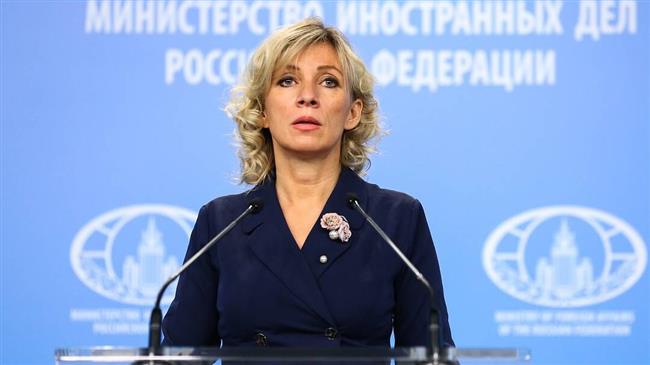
Russian Foreign Ministry Spokeswoman Maria Zakharova
Press TV – April 23, 2020
Russia has dismissed as “baseless” claims by the United States that the recent launch of Iran’s first-ever military satellite by the Islamic Revolution Guards Corps (IRGC) violates a United Nations Security Council resolution endorsing the 2015 nuclear deal between Tehran and world powers.
On Wednesday, the IRGC Aerospace Force launched the Nour (Light) satellite via the Qassed (Carrier) carrier, a move US Secretary of State Mike Pompeo was quick to condemn as a violation of United Nations Security Council Resolution 2231.
“This would not be the first time that a nation that has flagrantly breached the norms of international law and violated UNSC resolution 2231 is trying to deflect international condemnation by baselessly accusing Iran of noncompliance with the requirements of the Security Council,” Russia’s Sputnik news agency quoted Foreign Ministry spokeswoman Maria Zakharova as saying at a briefing on Thursday.
She noted that neither the resolution nor the 2015 Iran nuclear deal restrict Iran’s right to explore space to peaceful ends.
She added that Iran has made it clear that it does not intend to develop nuclear weapons, unlike the US, which has over the past months unveiled several plans to expand its nuclear arsenal.
“There are no, there have never been, and hopefully there will never be nuclear weapons in Iran. Iran, adhering to the resolution, does not develop, test or use ballistic missiles capable of carrying nuclear weapons, unlike the United States, which surprises the world every single day with news about plans to develop their nuclear missile capabilities,” she said.
The remarks came after Pompeo said Iran needed “to be held accountable” for the launch, claiming that the move violated UNSC Resolution 2231.
This is while the resolution in question calls on Iran “not to undertake any activity related to ballistic missiles designed to be capable of delivering nuclear weapons, including launches using such ballistic missile technology.”
The Nour-1 is Iran’s first multi-purpose satellite with application in the defense industry, among other areas. It is also the first Iranian satellite with an expected operational life of more than a year in Earth’s orbit.
Featured Video

Dan Dicks with James Corbett on Solutions Watch
or go to
Aletho News Archives – Video-Images
From the Archives
Secret document reveals plans for civil war in Lebanon, Israeli false flags, and invasion
By Randi Nord | Geopolitics Alert | April 5, 2019
Beirut – During his visit with US Secretary of State, Mike Pompeo, Lebanese President Michael Aoun reportedly received a US-Israeli document detailing plans for creating a civil war in Lebanon with covert false flag operations and possible Israeli invasion.
Although the source of the document is Israeli and created in partnership with Washington, no one knows who presented it to Aoun. The Lebanese TV station, Al-Jadeed, initially reported the document on Lebanese TV and a video on its website. Geopolitics Alert translated the report for this article. … continue
Blog Roll
 Aletho News
- There’s a drought in academia: A drought in honest research on the subject of drought and other weather extremes
- Department of War Awards $20.7 Billion Contract to Raytheon for Air-to-Air Missiles
- ‘Distance yourselves from Israel’: IRGC urges US population to question govt policies
- America’s Greenland deal has a radioactive backstory
- The RAF Fairford ‘terror plot’: Unpacking escalation in the UK echo-chamber
- EU Council Advances Chat Control 2.0 Scanning Proposal
- Ex-Greek MEP files complaint against Israeli spyware firm over alleged Pegasus surveillance
- Troubling ideas throughout the Torah, Talmud, Mishneh Torah and Tanya
- ‘Grave, alarming’: Iran mission on Trump’s UNGA ‘annihilation’ threats
- Najaf airport to reopen to Iranian flights within 24 hours: Ambassador
- If Americans Knew
- New Report: “Scholasticide and Genocide in Gaza: Assessment, Testimonies and Legal Analysis”
- Ex-Biden officials are desperate for a Gaza scapegoat
- Israeli “settlers” Invade Al-Aqsa; Pour Boiling Water on 75-Year-Old
- Israel Has Kidnapped Another American Teenager
- US arms sales to Israel worth $21.6 billion in 20 months
- Three Palestinians Killed in Israeli Attacks on Gaza
- Revealed: German “Anti-Semitism Expert” Driving Crackdown on Palestine Solidarity is Former Israeli Spy
- Egypt’s Warning to Israel Before Oct 7
- Israel’s siege signals another cruel winter for 1.8 million Gazans – Daily Update
- Netanyahu Asked UAE Leader to Deny Report on Oct. 7 Warning in Secret Visit, Sources Say
- No Tricks Zone
- New Study: Earth And Venus Surface Warmth Largely Explained By Convection And Lapse Rate, Not CO2 Or Radiation
- 2025 Nature Paper Claiming Worsening Global Drought Gets RETRACTED …Heavily Flawed
- New Study: ‘Global Drought Shows No Detectable Recent Acceleration Under Climate Warming’
- Economic Masterminds: German Socialists Suggest Taxing Productivity Gains Stemming From Using AI
- The South China Sea Has Not Been Cooperating With The Climate Change Narrative
- Energy Crisis: Germany Enters Heating Season With Historically Low Gas Reserve Fill Levels
- New Study: The Antarctic Ice Sheet Gained Mass From 2020-2024 Due To Staggering Snow And Ice Accumulation
- Study: Ocean Heating Rates From Thousands Of Years Ago ‘Dwarf’ Modern Ocean Heating Rates
- Climate Extremists Target, Attack Large-Scale Power Grid Infrastructure In Germany!
- New Study: Antarctic Ice Melt Has Contributed Less Than 1 Centimeter To Sea Level Rise In The Last 30 Years

